Personality and Social Behavior
RT4509X_C000.indd i
RT4509X_C000.indd i 1/3/2008 3:11:59 PM1/3/2008 3:11:59 PM
Series Editors:
Arie W. Kruglanski, University of Maryland at College Park Joseph P. Forgas, University of New South Wales
Frontiers of Social Psychology is a new series of domain-specifi c handbooks. The purpose of each volume is to provide readers with a cutting-edge overview of the most recent theoretical, methodological, and practical developments in a substan- tive area of social psychology, in greater depth than is possible in general social psy- chology handbooks. The Editors and contributors are all internationally renowned scholars, whose work is at the cutting-edge of research.
Scholarly, yet accessible, the volumes in the Frontiers series are an essential resource for senior undergraduates, postgraduates, researchers, and practitio- ners, and are suitable as texts in advanced courses in specifi c sub-areas of social psychology.
Published Titles
Negotiation Theory and Research, Thompson Close Relationships, Noller & Feeney
Evolution and Social Psycholog y, Schaller, Simpson, & Kenrick Social Psycholog y and the Unconscious, Bargh
Affect in Social Thinking and Behavior, Forgas Science of Social Infl uence, Pratkanis
Social Communication, Fiedler The Self, Sedikides & Spencer Personality and Social Behavior, Rhodewalt
Forthcoming Titles
Attitudes and Attitude Change, Crano & Prislin Social Cognition, Strack & Förster
Political Psycholog y, Krosnick & Chiang Social Psycholog y of Consumer Behavior, Wänke Social Motivation, Dunning
For continually updated information about published and forthcoming titles in the Frontiers of Social Psycholog y series, please visit: www.psypress.com/frontiers
RT4509X_C000.indd ii
RT4509X_C000.indd ii 1/3/2008 3:12:35 PM1/3/2008 3:12:35 PM
Personality and Social Behavior
Edited by Frederick Rhodewalt
Psychology Press
New York London
RT4509X_C000.indd iii
RT4509X_C000.indd iii 1/3/2008 3:12:36 PM1/3/2008 3:12:36 PM
270 Madison Avenue New York, NY 10016
27 Church Road
Hove, East Sussex BN3 2FA
© 2008 by Taylor & Francis Group, LLC
Printed in the United States of America on acid-free paper 10 9 8 7 6 5 4 3 2 1
International Standard Book Number-13: 978-1-84169-450-4 (Hardcover)
Except as permitted under U.S. Copyright Law, no part of this book may be reprinted, reproduced, trans- mitted, or utilized in any form by any electronic, mechanical, or other means, now known or hereafter invented, including photocopying, microfilming, and recording, or in any information storage or retrieval system, without written permission from the publishers.
Trademark Notice: Product or corporate names may be trademarks or registered trademarks, and are used only for identification and explanation without intent to infringe.
Library of Congress Cataloging-in-Publication Data Personality and social behavior / edited by Frederick Rhodewalt.
p. cm. -- (Frontiers of social psychology) Includes bibliographical references and index.
ISBN-13: 978-1-84169-450-4 (alk. paper) ISBN-10: 1-84169-450-9 (alk. paper)
1. Personality. 2. Social psychology. I. Rhodewalt, Frederick Thomas.
BF698.P47 2008
155.2--dc22 2007035776
Visit the Taylor & Francis Web site at http://www.taylorandfrancis.com and the Psychology Press Web site at http://www.psypress.com
RT4509X_C000.indd iv
RT4509X_C000.indd iv 1/3/2008 3:12:36 PM1/3/2008 3:12:36 PM
v
Contents
About the Editor vii
Contributors ix
1. Personality and Social Behavior: An Overview 1
Frederick Rhodewalt
2. Beyond Person and Situation Effects: Intraindividual Personality Architecture and Its Implications for the Study of Personality and
Social Behavior 9
Daniel Cervone, Tracy L. Caldwell, and Heather Orom
3. The Self and Social Behavior: The Fragile Self and Interpersonal
Self-Regulation 49 Frederick Rhodewalt and Benjamin Peterson
4. Contextual Variability in Personality: The Case of the Relational
Self and the Process of Transference 97
Susan M. Andersen, S. Adil Saribay, and Christina S. Kooij 5. Ties That Bind: Linking Personality to Interpersonal Behavior
Through the Study of Adult Attachment Style and Relationship
Satisfaction 117 W. Steven Rholes, Ramona L. Paetzold, and Mike Friedman
6. Different Toolkits for Different Mind-Readers: A Social-Cognitive Neuroscience Perspective on Personality and Social Relationships 149
Geraldine Downey, Jamil Zaki, and Jason Mitchell
7. Personality, Individuality, and Social Identity 177 Michael Hogg
RT4509X_C000a.indd v
RT4509X_C000a.indd v 1/3/2008 2:33:52 PM1/3/2008 2:33:52 PM
8. Leadership as Dynamic Social Process 197 Martin M. Chemers
9. Personality and Prejudice in Interracial Interactions 223 Patricia G. Devine, Frederick Rhodewalt, and Matthew Siemionko 10. Social Psychological Processes Linking Personality to Physical
Health: A Multilevel Analysis With Emphasis on Hostility and
Optimism 251 Bert N. Uchino, Allison A. Vaughn, and Sonia Matwin
Author Index 285
Subject Index 299
RT4509X_C000a.indd vi
RT4509X_C000a.indd vi 1/3/2008 2:34:00 PM1/3/2008 2:34:00 PM
vii
About the Editor
F
rederick Rhodewalt received his PhD in social psychology from Princeton University in 1979. His primary research explores the interpersonal con- struction and maintenance of self and includes topics such as self-handi- capping and narcissism. He is Professor of Psychology and Associate Dean of the Graduate School at the University of Utah. Dr. Rhodewalt is a former editor of Personality and Social Psychology Bulletin and Basic and Applied Social Psy- chology. In 2003, he was awarded the Distinguished Service Award to the Dis- ciplines of Social and Personality Psychology by the Society for Personality and Social Psychology.RT4509X_C000a.indd vii
RT4509X_C000a.indd vii 1/3/2008 2:34:00 PM1/3/2008 2:34:00 PM
ix
Susan M. Andersen New York University New York, New York Tracy L. Caldwell North Central College Naperville, Illinois Daniel Cervone
University of Illinois at Chicago Chicago, Illinois
Martin M. Chemers
University of California, Santa Cruz Santa Cruz, California
Patricia G. Devine
University of Wisconsin–Madison Madison, Wisconsin
Geraldine Downey Columbia University New York, New York Mike Friedman Texas A&M University College Station, Texas Michael Hogg
Claremont Graduate University Claremont, California
Christina S. Kooij New York University New York, New York
Contributors
Sonia Matwin University of Utah Salt Lake City, Utah Jason Mitchell Harvard University Cambridge, Massachusetts Heather Orom
Karmanos Cancer Institute Detroit, Michigan
and
Institute of Gerontology Wayne State University Detroit, Michigan Ramona L. Paetzold Texas A&M University College Station, Texas Benjamin Peterson University of Utah Salt Lake City, Utah Frederick Rhodewalt University of Utah Salt Lake City, Utah W. Steven Rholes Texas A&M University College Station, Texas S. Adil Saribay New York University New York, New York
RT4509X_C000a.indd ix
RT4509X_C000a.indd ix 1/3/2008 2:34:01 PM1/3/2008 2:34:01 PM
Matthew Siemionko University of Utah Salt Lake City, Utah Bert N. Uchino University of Utah Salt Lake City, Utah
Allison A. Vaughn University of Utah Salt Lake City, Utah Jamil Zaki
Columbia University New York, New York
RT4509X_C000a.indd x
RT4509X_C000a.indd x 1/3/2008 2:34:01 PM1/3/2008 2:34:01 PM
1
Personality and Social Behavior 1
An Overview
FREDERICK RHODEWALT
University of Utah
T
his volume is about personality and social behavior. It surveys a wide vari- ety of research domains with roots in the two disciplines in an attempt to understand the transactions between persons and their social worlds.The organizing questions are (a) How do characteristics of the person drive and shape interpersonal behavior? and (b) How do features of the social environment constrain and elicit behaviors from the individual? These are not new questions.
However, there are new and evolving answers. It can be argued that the “emerging symbiosis” (Swann & Selye, 2005) between the disciplines of social and personal- ity psychology is evidenced in the new and exciting approaches to addressing the personality and social behavior questions put forth in the following chapters.
Evidence for such symbiosis between the fi elds of personality and social psy- chology may be found in current textbook defi nitions of the two disciplines. Con- sider the following:
Personality is the complex organization of cognitions, affects, and behaviors that gives direction and pattern (coherence) to the person’s life. …personality consists of both structures and processes and refl ects both nature (genes) and nurture experience. (Pervin, 1996, p. 414)
Social psychology is the scientifi c study of how people think about, infl uence, and relate to one another. (Myers, 2007, p. 4)
As these two representative defi nitions suggest, contemporary views of person- ality and social psychology share much overlap in their central concerns. Although social psychology places greater emphasis on the interpersonal aspects of the
RT4509X_C001.indd 1
RT4509X_C001.indd 1 1/3/2008 11:00:10 AM1/3/2008 11:00:10 AM
person, both fi elds are interested in systematic study of the thoughts, emotions, and behaviors of the person, and both acknowledge that people behave in contexts. This rapprochement is a marked departure from more classic defi nitions of the respec- tive fi elds, personality being the study of individual differences and social psychol- ogy being the investigation of the impact of the situation on the individual.
Such “balkanization” of the disciplines set the stage for the person-situation debate of the 1970s and 80s. Ignited by Walter Mischel’s (1968) trenchant critique of traditional trait approaches, specifi cally that behavior is highly situation-specifi c and not cross-situationally consistent, the ensuing discussion and research con- tributed to a number of useful and some not so useful developments in the fi elds of personality and social psychology. First, it forced trait theorists and social psy- chologists to be more precise in defi ning their constructs and to clarify what their theories contended about the control and coherence of behavior. For example, did trait theorists ever suggest that one could predict an individual’s behavior in a single instance with only person information? Of course not. Did their conception of traits suggest levels of cross-situational and temporal consistency in individual behavior that was greater than that suggested by the data? Yes.
Second, it led to a renewed interest in interactionist frameworks in which to account for person and situation factors. In particular, reciprocal interactionist views (Bandura, 1986; Cantor & Kihlstrom, 1987; Endler & Magnusson, 1976;
Smith & Rhodewalt, 1986) depict person, situation, and behavior as unfolding over time and reciprocally infl uencing one another. For example, in their description of Type A coronary-prone behavior as a challenge-engendering behavioral style, Smith and Rhodewalt argued that Type As—through their choice of situations, appraisals of situations, and interpersonal behaviors—created situations that were objectively more challenging and stressful than were the situations encountered by non-coronary-prone Type Bs.
Most important, I would argue, is that the person-situation debate and subse- quent revisiting of interactionist ideas has led to the development of new “dispos- tional constructs” (Cervone, 2004; Mischel & Shoda, 1996) that have importantly reframed the person-situation debate (see Cervone, Caldwell, & Orom, this vol- ume). The person-situation question became virtually irrelevant when the social environment was represented within the individual difference variable. For exam- ple, a major challenge for dispositional approaches has been the issue of variability in responding across situations. A person who possesses the trait of assertiveness may be very assertive with family members but deferential with strangers. Mischel and Shoda (1995) propose that one can observe consistency in variation if one defi nes dispositions as containing the elements of behavioral (or cognitive/affec- tive) responses, situations, and conditional if-then linking rules. Thus, the trait of assertiveness becomes the dispositional construct of “if with family then behave assertively, if with strangers then show deference.” I will return to the appeal and applicability of this conceptualization of “disposition” later in this essay; my point for now is that the person-situation debate did not end in a stalemate in which each side grudgingly conceded the other’s validity. Rather, it advanced our basic understanding of what is meant by the term disposition in ways that integrated and enriched both fi elds.
RT4509X_C001.indd 2
RT4509X_C001.indd 2 1/3/2008 11:00:59 AM1/3/2008 11:00:59 AM
On the downside, however, one can argue that the person-situation controversy distracted personality psychology away from its rich conceptual history that con- strued personality as an interpersonal process, one that recognized the individual as an active interpersonal being. A goal of this chapter is to remind readers of these earlier frameworks so that one may appreciate the exciting work on personality and social behavior represented herein.
THE INTERPERSONAL PERSPECTIVE
The classic view of personality is that people possess psychological characteris- tics that give patterning and coherence to their behavior. However, although the focus is on qualities of the person, it is correct to say that these classic positions, be they psychodynamic, phenomenological, or dispositional, all specify to some extent that their putative characteristics have interpersonal origins and, often, ori- entations. Patterns of anxiety and defense, inauthentic self-perceptions, and traits develop through a set of fairly regular and routine interpersonal experiences. A few examples are mentioned here to illustrate this point. These examples by no means refl ect an exhaustive or in depth review of the interfaces between person- ality and interpersonal processes and situations (see Kiesler, 1996 for a more in depth resource). Also, to say that a characteristic describes patterns of behavior in interpersonal situations does not mean that it is not also viewed as a static descrip- tor of the person. For example, the Big Five trait (Digman, 1990; Goldberg, 1993) of agreeableness refers to a friendly and pleasant interpersonal style, a style that is temporally stable and cross-situationally consistent, but says nothing about the processes by which the person uniquely perceives, selects, and acts upon interper- sonal events.
Perhaps the earliest example of an interpersonal approach to personality is Freud’s (1925) theory of psychosexual development. Clearly one of the most con- troversial elements of his theory, in essence it specifi es a series of interpersonal learning affordances in which the child, when physically mature enough, can learn something about navigating his or her social world in order to meet biological and psychological needs. To paraphrase in contemporary terms, what is taken away from each learning affordance is a set of strategies for getting what one wants (or avoiding what one does not want) in various social contexts. It is interesting to note that in Freud’s view, the fl exible and appropriate use of strategies and defenses is adaptive. It is the rigid use of a particular coping behavior invariantly across situations that is maladaptive. Had he been available to comment on the person-situation debate, I suspect that Freud would have been more Mischelian than Cattellian.
As described by Rhodewalt and Peterson (this volume), Alfred Adler (1927) continued the interpersonal element in psychodynamic theory with his statements that individual differences, a person’s style of life, are the result of developmental, interpersonal relationships, including factors such as birth order and correlated family roles. For Adler, style of life included interpersonal goals and orientations as well as strategies for pursuing them. A common theme across interpersonal
RT4509X_C001.indd 3
RT4509X_C001.indd 3 1/3/2008 11:00:59 AM1/3/2008 11:00:59 AM
perspectives is the idea that a signifi cant part of personality is organized in the service of two social motives, agency and communion (Wiggins & Trapnell, 1996).
Adler’s concepts of striving for superiority (agency) and social interest (commu- nion) anticipated this idea.
Clearly the most interpersonal of the psychodynamic positions was Harry Stack Sullivan’s (1953) view that “personality is the relatively enduring pattern of recurrent, interpersonal situations which characterize a human life” (Sullivan, 1953, pp. 110–111). For Sullivan, personality was observed at the intersection of the person with others. Interpersonal behavior referred, “to the recurrent pat- terns of reciprocal relationships present among two persons’ covert and overt actions and reactions studied over the sequence of their transactions with each other.” Consistency and patterning, to the extent that it was an issue, was found in the fact that we tend to interact with the same individuals in a limited set of contexts. Although Sullivan’s is clearly a psychodynamic theory in the sense that behavior is driven by a desire to avoid or reduce anxiety, the source of anxiety is rooted in a set of internalized representations of previous interactions that were affectively positive or negative and the interpersonal behaviors associated with them. People behave in their current social settings in ways that produced the least anxiety in the past.
In contemporary personality theory, Sullivan’s infl uence is most clearly seen in the dyadic interactional perspective of Wiggins and colleagues (Pincus &Wiggins, 1992; Wiggins & Pincus, 1994). They argue that personality is organized around the social motives of the need for independence (a variant of the meta construct agency) and the need for security (a variant of the meta construct communion, see Wiggins & Trapnell, 1996). In this view the meaningful “interpersonal disposi- tions” of the person are in the service of meeting these social motives and can be depicted in an interpersonal circumplex space along the orthogonal dimensions of dominance-submissiveness and love-hate.
An interesting extension of these ideas is that the unit of analysis is not indi- vidual behavior but rather human transactions at the level of dyad or group (Kiesler, 1996). Thus, for example, the way in which persons view themselves, what we typically defi ne as the self, can only be understood in terms of the acted- out claims that a person places on others with regard to the kinds of reactions or acknowledgement the person wants others to provide. These ideas are well illustrated in the writings of Paul Wachtel, who has focused on cyclical processes in psychopathology. Wachtel (1994) notes that people behave in ways that draw predictable responses from other people; in effect, the person shapes the inter- personal environment. As the interpersonal environment changes, so to does the psychological state of the individual. For Wachtel, “internal states and external events continually recreate the conditions for the reoccurrence of each other”
(1994, p. 51). More recently, Cantor and Kihlstom (1987) have offered the term
“skewed interactionism” to capture the idea that personality structures and pro- cesses have a greater impact on social situations than social situations have on personality (see also Swann, 1985).
RT4509X_C001.indd 4
RT4509X_C001.indd 4 1/3/2008 11:01:00 AM1/3/2008 11:01:00 AM
CONVERGENT INTERESTS
In the late 1970s and continuing to the present, the cognitive revolution has swept through the fi elds of social and personality psychology. Fiske (2003) cites Markus’
(1977) paper on self-schema and Cantor and Mischel’s (1977) paper on prototypes in person perception as among a small group of papers that triggered the fi eld of social cognition. Social psychologists now had metaphors and paradigms for study- ing what was going on in the head of the individual during persuasion attempts, interracial interactions, social comparisons, and the like and could address more precisely the reciprocal effects of the social situation and the individual.
The cognitive wave also washed over the fi eld of personality. In describing interactional perspectives on personality, Wachtel (1994) stated that they “con- cern themselves with persistent individual differences, but the emphasis in the cyclical version is on the process that maintains these differences” (p. 53). Again, the importation of theory and research paradigms from cognitive psychology has been hugely important because the processes of greatest interest to personality researchers are most often those going on inside the head of the individual. Cantor (1990) describes three types of units—schemas, tasks, and strategies—as consti- tuting the cognitive substrate of personality. It is an analysis of these units in social context that occupies most of the authors contributing to this volume.
Perhaps the cognitive approach to personality process is best illustrated by Mischel’s (Mischel & Shoda, 1999: Wright & Mischel, 1987) defi nition of disposi- tions as if-then contingencies for behavior in specifi c situations. This notion has been particularly generative and is being applied to an increasingly broad set of topics within personality and social psychology. For example, Baldwin (Baldwin, 1997; Baldwin & Sinclair, 1996) has described the “relational self” as a set of cogni- tive representations of the person as he or she is in specifi c relationships with oth- ers. These representations are in the form of if-then contingencies such as “if with mom, then be dependent.” This approach contextualizes the self so that it changes as a function of the relational context. This view of the relational self has been used to frame Andersen’s (Andersen & Chen, 2002; Andersen, Saribay, & Kooij, this volume) social cognitive model of transference.
More recently, Murray, Holmes, and Collins (2006) have applied the if-then contingency framework in their risk-regulation system in close relationships. They propose that in balancing the goal of closeness with a romantic partner against the goal of avoiding rejection and hurt, the risk regulation system is engaged. This sys- tem is comprised of three interconnected if-then contingency rules involving cog- nitive, affective, and behavioral responses to perceptions of the partner’s behavior, particularly the partner’s regard. One of the appealing aspects of this model is that it accommodates individual differences in risk regulation and allows for a contex- tualized understanding of relationship viability. Rholes, Paetzold, and Friedman (this volume) cast attachment theory’s notion of working models of self and others as relational if-then schemas that have different specifi cs as a function of having secure versus insecure attachment styles.
The examples provided above are but a few of many that illustrate what I believe to be the convergence of personality and social psychology at the social behavior
RT4509X_C001.indd 5
RT4509X_C001.indd 5 1/3/2008 11:01:00 AM1/3/2008 11:01:00 AM
interface. As one fi nal illustration, the reader is reminded of how often one encoun- ters in our best journals what might be called the prototypical three-study package.
The fi rst study demonstrates the phenomenon of interest; the second manipulates the putative independent variables; and the third is a replication of the second, in which an individual difference measure is substituted for the manipulated vari- able. For example, a paper might report that people perform more poorly in the presence of an audience and speculate that self-awareness is the causative factor.
Then Study 2 shows that a manipulation of self-awareness produces the effects on performance observed in Study 1, and Study 3 shows the individual difference measure of self-consciousness moderates the performance effects. This research strategy has become ubiquitous in the social psychology research literature, such is the convergence of personality and social psychology.
THE CURRENT VOLUME
The chapters included in this volume chronicle the multiple ways in which the interplay between attributes of the person and features of the interpersonal con- text can be conceptualized and investigated. Rather than provide a collection of chapters reporting research on individual differences that have been related in one way or another to social situations, the goal was to draw on work from both social psychology and personality that focuses on the processes by which the per- son and situation transact with one another. Regardless of whether their primary identifi cation was in the area of personality or social psychology, contributors were asked to think about their work simultaneously in intraindividual and interpersonal terms. They were asked to discuss how individual differences serve as markers for differences in cognitive, motivational, emotional, behavioral, and interpersonal processes.
Several chapters begin with what may considered traditional topics in personal- ity. Cervone, Caldwell, and Orom trace the evolution of the fi eld since the person- situation debate erupted in the 1970s. Cervone et al. extend the Mischel and Shoda (1995) approach to dispositional constructs by elaborating on the cognitive mecha- nisms and processes that underlie the if-then dispositional framework. Rhodewalt and Peterson place self-esteem, a classic topic in personality, in an interpersonal context. They present a dynamic process model of self-esteem that specifi es the way in which individuals interact with others for the purposes of self-esteem regu- lation. Rholes et al. take another classic personality construct, attachment style, and describe a broad program of research that illuminates the ways in which self and other schema translate into interpersonal behaviors that channel relationship satisfaction. And fi nally, Andersen et al. return to the issue of contextual infl uences on personality through their analysis of social cognitive, affective, and behavioral processes illustrated in transference effects.
A second set of chapters begins with what may be considered a set of topics traditionally associated with social psychology. Michael Hogg tackles the problem of the friction between social identity theory’s focus on group behavior, intergroup relations and the context-dependent collective self and the traditional personality
RT4509X_C001.indd 6
RT4509X_C001.indd 6 1/3/2008 11:01:00 AM1/3/2008 11:01:00 AM
position of stable, context-free dispositions. He traces developments in both social identity theory and the way that personality is now conceptualized and suggests areas for future integrations. Leadership has been a daunting topic to both person- ality and social psychologists. Fiedler’s (1967) contingency model of leadership was arguably one of the fi rst person-situation interaction models found in psychology.
Martin Chemers, a protégé of Fiedler’s, expands on this early work to describe leadership as a bidirectional, dynamic process unfolding between leaders and group members. Prejudice is another subject that has been approached from both personality and social psychology perspectives. Devine et al. review Devine’s work on individual differences in the motivation to control prejudice and outline the cognitive, affective, and behavioral processes that shape interracial interactions.
Two very provocative chapters link personality processes and social behavior to emerging areas in psychology. Downey, Zaki, and Mitchell lay out the impli- cations and cautions offered by taking a social cognitive neuroscience approach to the study of personality and social behavior. They call for additional combina- tions of behavioral and neuroimaging studies to more fully understand how per- sonality dispositions refl ect the basic set of social-cognitive tools that people bring to contextualized interactions with other people. The fi eld of health psychology has grown rapidly in the past quarter century. Central to this growth have been attempts to connect personality to physical well-being. In their chapter, Uchino, Vaughn, and Matwin explore the connections among personality, social behavior, and physical health.
In total, the set of essays included in this volume represents a broad but far from exhaustive sampling of the exciting advances being realized as a result of the convergence of personality and social psychology.
REFERENCES
Adler, A. (1927). The practice and theory of individual psychology. New York: Harcourt, Brace, Jovanovich.
Andersen, S. M., & Chen, S. (2002). The relational self: An interpersonal social-cognitive theory. Psychological Review, 109, 619–645.
Baldwin, M. W. (1997). Relational schemas as a source of if-then self-inference procedures.
Review of General Psychology, 1, 326–335.
Baldwin, M. W., & Sinclair, L. (1996). Self-esteem and “if...then” contingencies of interper- sonal acceptance. Journal of Personality and Social Psychology, 71, 1130–1141.
Bandura, A. (1986). Social foundations of thought and action. Englewood Cliffs, NJ: Pren- tice Hall.
Cantor, N. (1990). From thought to behavior: “Having” and “doing” in the study of person- ality and cognition. American Psychologist, 45, 735–750.
Cantor, N., & Kihlstrom, J. F. (1987). Personality and social intelligence. Englewood Cliffs, NJ: Prentice Hall.
Cervone, D. (2004). The architecture of personality. Psychological Review, 111, 183–204.
Digman, J. M. (1990). Personality structure: Emergence of the fi ve-factor model. Annual Review of Psychology, 41, 417–440.
Endler, N. S., & Magnusson, D. (1976). Toward an interactional psychology of personality.
Psychological Bulletin, 83, 956–974.
RT4509X_C001.indd 7
RT4509X_C001.indd 7 1/3/2008 11:01:01 AM1/3/2008 11:01:01 AM
Fiedler, F. E. (1967). A theory of leadership effectiveness. New York: McGraw-Hill.
Fiske, S. T. (2003). The discomfort index: How to spot a really good idea whose time has come. Psychological Inquiry, 14, 203–208.
Freud, S. (1925). Collected papers, Vol. 2. London: Institute for Psychoanalysis and Hog- arth Press.
Goldberg, L. R. (1993). An alternative “description of personality”: The big-fi ve factor structure. Journal of Personality and Social Psychology, 59, 1216–1229.
Kiesler, D. J. (1996). Contemporary interpersonal theory and research: Personality, psy- chopathology, & psychotherapy. New York: Wiley.
Mischel, W. (1968). Personality and assessment. New York: Wiley.
Mischel, W., & Shoda, Y. (1996). A cognitive-affective system theory of personality: Recon- ceptualizing situations, dispositions, dynamics, and invariance in personality struc- ture. Psychological Review, 102, 246–286.
Mischel, W., & Shoda, Y. (1999). Integrating traits and processing dynamics with a uni- fi ed theory of personality. The cognitive-affective personality system. In L. Pervin &
O. P. John (Eds.), Handbook of personality: Theory and research (pp. 197–218). New York: Guilford.
Murray, S. L., Holmes, J. G., & Collins, N. L. (2006). Optimizing assurance: The risk regu- lation system in relationships. Psychological Bulletin, 132, 641–666.
Myers, D. (2007). Social psychology (8th ed.). New York: McGraw-Hill.
Pervin, L. (1996). The science of personality. New York: Wiley.
Pincus, A., & Wiggins, J. S. (1992). An expanded perspective on interpersonal assessment.
Journal of Counseling and Development, 71, 91–94.
Smith, T. W., & Rhodewalt, F. (1986). On states, traits, and processes: A transactional alter- native to the individual difference assumptions in Type A behavior and physiological reactivity. Journal of Research in Personality, 20, 229–251.
Sullivan, H. S. (1953). The interpersonal theory of psychiatry. New York: Norton.
Swann, W. B. (1985). The self as architect of social reality. In B. Schlenker (Ed.), The self and social life (pp. 100–125). New York: McGraw-Hill.
Swann, W. B., & Selye, C. (2005). Personality psychology’s comeback and its emerging symbiosis with social psychology. Personality and Social Psychology Bulletin, 31, 155–165.
Wachtel, P. (1994). Cyclical processes in personality and psychopathology. Journal of Abnormal Psychology, 103, 51–54.
Wiggins, J. S., & Pincus, A. (1994). Personality structure and the structure of personal- ity disorders. In P. Costa & T. Wideger (Eds.), Personality disorders and the fi ve- factor model of personality (pp.73–93). Washington, DC: American Psychological Association.
Wiggins, J. S., & Trapnell, P. D. (1996). A dyadic-interactional perspective on the fi ve-fac- tor model. In J. S. Wiggins (Ed.), The fi ve-factor model of personality: Theoretical perspective. (pp. 88–162). New York: Guilford.
Wright, J., & Mischel, W. (1987). A conditional approach to dispositional constructs: The local predictability of social behavior. Journal of Personality and Social Psychology, 53, 1159–1177.
RT4509X_C001.indd 8
RT4509X_C001.indd 8 1/3/2008 11:01:01 AM1/3/2008 11:01:01 AM
9
Beyond Person and Situation Effects: 2
Intraindividual Personality Architecture and Its Implications for the Study of Personality and Social Behavior
DANIEL CERVONE
University of Illinois at Chicago
TRACY L. CALDWELL
North Central College
HEATHER OROM
Karmanos Cancer Institute and Institute of Gerontology, Wayne State University
T
he study of personality and social behavior, as conducted by card-carrying personality and social psychologists, historically has been sustained by a narrative familiar to all. As in many classic tales, there are three characters:There are persons; there are situations; and there are social behaviors. The plot is a whodunit: Who—or perhaps “what”—caused those social behaviors? Was it the persons? Or—unbeknownst to the naive, unsuspecting persons—was it the situations?
The story has been sustaining in three respects. When theoretical paradigms pose questions that are simple, it is easy to formulate theory-driven research. To evaluate person versus situation causes, all one needs to do is round up some per- sons, classify them according to some commonly accepted dimension of variation,
RT4509X_C002.indd 9
RT4509X_C002.indd 9 1/11/2008 9:49:37 AM1/11/2008 9:49:37 AM
observe their behavior in different situations, and see if variation in social behavior is relatively predictable from variations among persons or among situations.
In addition to ease, the narrative has heightened interest in the fi eld, thanks primarily to a dramatic turn in the plot. People appeared to be in peril! Variations among persons seemed to leave more than 90% of the total variance in social behavior unexplained (Mischel, 1968).
Finally, sustenance has been derived from a third feature of the story: a happy ending. The cavalry arrived with more data, and persons were saved. Person effects were not only detectable, but equal in size to situation effects (e.g., Funder & Ozer, 1983). Personality psychologists and social psychologists could rest secure in the knowledge that “situation and disposition are about equally effective in predicting behavior” (Baumeister, 1999, p. 368).
Like other classic stories, this one is still told. One might have guessed that the widespread acceptance of person-situation interactionism would have brought the telling to an end. However, as Funder has noted, it “is something of a mystery . . . ev- erybody is an interactionist. Still, the argument persists” (Funder, 2006, p. 22).
Here in a handbook of personality and social behavior, this persistent story about the relative size of person and situation effects should be scrutinized. Its conclusions and, perhaps more importantly, the presuppositions made in formulat- ing questions about which conclusions could be drawn are fundamental to many issues: the interpretation of research fi ndings, the formulation of novel research, the relation between social and personality psychology, and the nature of situa- tions and persons.
OVERVIEW: PERSONALITY ARCHITECTURE AND ITS IMPLICATIONS
We thus begin our chapter by revisiting this story and considering some potential rewritings. This opening section (immediately below) is itself a preamble to the main story that we ourselves wish to tell. We advance an alternative perspective on personality and social behavior, specifi cally, a perspective that features a concep- tion of personality that is an alternative to the one that is embedded within the traditional narrative and that was particularly prominent in personality psychology in the latter two decades of the century past. We outline that perspective here.
Much past work in personality psychology has embraced a conception of personality that has two defi ning features: (a) Persons are construed in terms of behavioral tendencies, or dispositions; a “personality variable” is a construct that describes what people tend to do, and (b) persons are conceptualized using con- structs that are global; that is, personality constructs refer to generic, situation- free attributes of persons. Combining the two points yields a conception in which personality is a collection of situation-free tendencies to display a certain class of behavior. Recent writing conveys the position clearly: “A person . . . can be thought of as the sum total of all of his or her behaviors” (Funder, 2006, p. 31), and “a defi nitive task for personality psychology” is to identify “broader traits” that cap-
RT4509X_C002.indd 10
RT4509X_C002.indd 10 1/11/2008 9:50:00 AM1/11/2008 9:50:00 AM
ture “behavioral invariance or behavioral consistency . . . irrespective of the situa- tion” (Funder, 2006, p. 26).
Both of these features are severely limiting if one wants to construct a science of persons (Cervone & Mischel, 2002). If one defi nes persons merely as “sum totals of behaviors,” one fails to capture the distinction between persons and non-persons (cats, dogs, zombies . . . ) who also behave (cf. Gosling & John, 1999). If one defi nes personality psychology as the study of what people do irrespective of the situations they encounter, one removes personality psychology from the broader science of psychology, whose fi ndings repeatedly document that psychological systems can be understood only if one refrains from computing situation-free averages and instead examines the functioning of persons in context (e.g., Kagan, 2003, 2007).
The alternative, then, is the following. It is to base an understanding of per- sonality on the study of the human mind (cf. Kelly, 1955). We strive to understand personality and social behavior by exploring the mental systems—the social-cogni- tive and affective structures and processes—that contribute to the coherent and distinctive patterns of experience and action that are the hallmarks of personal- ity. Our overall effort is grounded in a conceptual model of these intra-individual cognitive and affective systems, or a model of personality architecture (Cervone, 2004a).
In this alternative, people are not aggregates of behavior. They are self-refl ec- tive agents who possess a mental architecture that enables them to plan courses of action, to self-regulate their behavior and emotions, to acquire knowledge and skills, and thereby to contribute to the course of their development (Bandura, 2006; Caprara & Cervone, 2000, 2003). People are not understood by positing personality variables that function irrespective of context. Instead, one under- stands personality by studying persons in context, for the reasons explained by Lewin long ago: Scientifi c understanding (of persons or of other complex entities) does not progress by positing abstract “Aristotelian” qualities that correspond to what things tend to do on average; it progresses by elucidating enduring structures and dynamic processes whose functioning can be understood only by examining how an entity interacts with its surrounding environment (Lewin, 1935; also see Cervone, 2006).
In grounding the study of personality and social behavior in the study of intra- individual personality architecture, we are not alone. As Kuhl and colleagues have noted, “there exists a new breed of theories of personality architecture, which ana- lyze the mental systems that shape the individual’s enduring, distinctive patterns of experience and action” (Kuhl, Kazén, & Koole, 2006, p. 409). Numerous inves- tigators contribute to the development of models of personality architecture (e.g., Cloninger, 2004; Kuhl & Koole, 2004; Matthews, Schwean, Campbell, Saklofske,
& Mohamed, 2000; Mischel 1973, 2004; Mischel & Shoda, 1995, 1998; Morf &
Rhodewalt, 2001). This new breed of theories is an exciting development for those who seek a truly integrated personality and social psychology. Once one construes personality in terms of the intra-individual architecture of cognitive and affective systems, personality psychologists and social psychologists become true partners in the explanation of behavior. The social psychologist’s models of affect and social
RT4509X_C002.indd 11
RT4509X_C002.indd 11 1/11/2008 9:50:01 AM1/11/2008 9:50:01 AM
cognition directly inform the personality psychologist’s quest to understand per- sonality systems and their coherence (see Higgins, 1999).
REWRITING THE NARRATIVE
Let us reconsider our opening narrative as a means of airing conceptual issues that surely recur throughout this volume. Our opening story about persons, situations, and the relative size of their effects on social behavior may elicit objections of two types.
Rewriting the Ending: The Relative Size of Person and Situation Effects
Some may object to the happy ending. Objections could come from either direc- tion. “No, no,” some might argue, “person and situation effects are not equal; situ- ation effects really are bigger.” A well-known basis for the claim of equality, a comparison of situation effect sizes in classic social psychology experiments to per- son effect sizes in personality-and-prediction studies (Funder & Ozer, 1983), could be turned on its head. As Ross and Nisbett (1991) have explained, in many classic social psychological studies investigators did not try to maximize effect sizes. They tried to maximize the subtlety of manipulations and unexpectedness of results while obtaining effects that merely reached standard signifi cance levels. In per- sonality psychology, in contrast, bigger person effects are the “coin of the realm”
(Bem & Allen, 1974, p. 512); no one drops an item from a personality scale because the item’s predictive strength is unsurprising. The comparison of person and situ- ation effect sizes (Funder & Ozer, 1983), then, is not so much a comparison of apples to oranges as apples to Palm™ Pilots: It’s nice the farmer could get the one to be so big; it’s surprising the engineer could get the other one to be so powerful while keeping it small; oh, and they happen to be about the same size.
“No,” others might contend, “person effects really are bigger.” In naturally- occurring circumstances, a highly signifi cant person effect is that people choose environments they encounter. Standard research paradigms do not detect this phe- nomenon. In laboratory experiments, people are assigned to situations at random.
In observational studies, people often are observed across a set of situations that is fi xed (e.g., Mischel & Peake, 1982). These procedures are necessary to some sci- entifi c goals. Yet they defl ect attention from a potentially large “person effect” by giving people no say in the situations they encounter or in which they are observed.
Our databases thus may systematically underestimate the effects of persons by reducing their role in the selection of situations. This underestimation could be severe; persons sometimes select themselves into long-lasting situations that can alter personal attributes enduringly. If people choose to enroll in a socially liberal college to expand their horizons, they encounter, year upon year, social situations and reference groups that may enduringly affect their basic value systems (New- comb, 1952/1965).
RT4509X_C002.indd 12
RT4509X_C002.indd 12 1/11/2008 9:50:01 AM1/11/2008 9:50:01 AM
This last example raises a broader question: Maybe, through mislabeling, situ- ations are getting credit for person effects. If the situation “liberal college” shifts one’s values but one has chosen to expose oneself to this situation, with the choice partly determined by one’s enduring personal attributes, might the shift not be called a person effect? Investigators who equate person effects with stability in personal attributes may underestimate the effects of persons. For example, in developing mathematically formal models of the stability of inter-individual dif- ferences, Fraley and Roberts (2005) aptly note that, “the environmental infl u- ences that come to infl uence the person are caused, in part, by the person” (p.
64) but add that “To the extent to which such transactions take place, the effect of the environment on the person is likely to sustain existing psychological quali- ties” (p. 65). Based on this reasoning, they construct a system of linear equations in which the “pathway . . . from the person to the environment . . . represents the effect that the person has on shaping, selecting, or infl uencing his or her environ- ment in ways that are consistent with the preexisting psychological quality” (p. 66, emphasis added). What about—the defender of person effects may ask—people’s potential to select environments that are inconsistent with their preexisting quali- ties: to enroll in the military to toughen one’s weak self; to travel to become more open to experiences; to engage in meditative practice to lessen one’s anxieties; to hire a life coach to become more conscientious? Putting “potentials” back into personality psychology (Caprara & Cervone, 2000) expands one’s conception of person effects.
Deconstructing the Narrative
The above objections accepted the overall story structure, questioning only its con- clusions. The narrative still depicted a person-versus-situation contest for a slice of behavioral-variance pie. The objections questioned merely whether the “situation and disposition” pieces really are “about equally” (Baumeister, 1999, p. 368) large.
An alternative objection would question the entire storyline by examining its pre- suppositions. What is logically entailed in asking about the relative size of person and situation effects?
Any discussion of the relative magnitude of person, situation, and interac- tive person-x-situation effects presupposes that there exist such things as “per- son effects” and “situation effects.” That is, it presupposes that one can discuss situation-independent persons and their effects as well as person-independent situations and their effects. At the level of theory, to pit persons versus situa- tions one must posit person constructs that are defi ned independently of situa- tions and situational constructs defi ned independently of any persons. If person constructs include situational components—e.g., if one explains social behavior by reference to cognitive schemas that are representative of one versus another sociocultural context and that are activated by situational cues (Wong & Hong, 2005)—then it makes no sense to discuss pure person effects that compete with pure situation infl uences in a variance-pie eating contest. Person and situation factors become collaborators, rather than competitors, in the prediction or expla- nation of behavior.
RT4509X_C002.indd 13
RT4509X_C002.indd 13 1/11/2008 9:50:01 AM1/11/2008 9:50:01 AM
What Are the Situation-Free Attributes of Persons? At fi rst glance, this two-sided assumption—pure persons, pure situations—may not appear problem- atic. Our normal conception of a person does not inherently include any situations.
One can easily imagine situations with no persons in them. Problems do arise, however, when one gets down to details. What personal attributes can be concep- tualized in a situation-free manner? That is, for what psychological attributes of persons can one reasonably posit constructs that make no reference whatsoever to situations?1
In response to this question, consider the range of psychological attributes people generally are thought to have. A typical list would include desires, motives, interests, and goals; beliefs, attitudes, preferences, and evaluative standards (i.e., criteria used to evaluate the goodness of entities or occurrences); and skills and competencies. One might add traits, but that would not change the list substan- tively if traits are defi ned to include “attitudes, interests, and other more or less stable psychological characteristics” (de Raad, 2005, p. 185). The question then is: Which of these attributes can be defi ned in a situation-free manner? That is, for which can one posit constructs that are entirely situation-free? Not desires, motives, interests, or goals. These refer not to isolated attributes of a person, but to the person plus something else: the aim of the desire, interest, or goal. It makes no sense to say “I desire [period]” or “I have a goal, but not to do or get any thing.”
Not beliefs, attitudes, and standards. Attitudes are attitudes about, beliefs are beliefs in, and standards are criteria for evaluating some thing. If one eliminates
“the thing,” the construct loses its meaning. One cannot “just believe” without believing something. The general point is that these personal attributes have the quality of intentionality (e.g., Searle, 1983); that is, they are directed entities in the world (including oneself as an object in the world). Finally, not skills and compe- tencies. Kagan (2007) explains that to understand competencies one must focus a Wittgenstein lens on concrete cases rather than engage in Platonic speculation about abstract, context-free essences that are hidden from view. This focus reveals the role of context. This is true even for simple competencies. Children’s ability to categorize objects presented visually is inherently context-linked “because the child’s perceptual schemata for many objects/events (in contrast to their semantic representations) represent the object together with its usual settings” (p. 4). For complex socially-acquired skills, the need for person-in-context constructs is only more obvious (Cantor & Kihlstrom, 1987).
It would be a mistake to conclude that only those who embrace a “social” or
“cognitive” (or some mixture of those words) orientation to personality require contextualized person constructs. Research on biological foundations of person- ality and individual differences similarly requires constructs that embed persons in situations. An understanding of temperament requires that one construe tem- perament contextually (Kagan, 2003) and consider cultural factors in the develop- ment of temperament and social behavior (Fox, Henderson, Marshall, Nichols, &
Ghera, 2005). The search for evolved mechanisms that subserve social behavior features context- or domain-linked constructs and research strategies (Sugiyama et al. 2002). Toulmin (1985) has explained that it was Darwinian principles that shifted scientists’ attention from timeless context-free laws to historically con-
RT4509X_C002.indd 14
RT4509X_C002.indd 14 1/11/2008 9:50:02 AM1/11/2008 9:50:02 AM
tingent relations between organisms and environments. More recently, Costall (2004) explains that Darwinian principles imply organism–environment “mutu- ality,” where “mutuality is most emphatically not ‘interactionism’” (p. 191). The conception is not of separate, encapsulated organisms and environments that occasionally bump into each other. One can distinguish organisms from environ- ments, of course, but the “distinction . . . presupposes their relation, just as riv- erbeds and rivers, and beaten-paths and walkers imply one another’s existence”
(Costall, 2004, p. 191).
Other approaches lead similarly to the conclusion that psychological function- ing cannot meaningfully be divorced from social context. Research and theory by McAdams and colleagues (McAdams, 2006; McAdams, Diamond, de St. Aubin, &
Mansfi eld, 1997) highlight the role in personality functioning of life stories, that is, personally constructed narratives that integrate aspects of the self with sociocul- turally situated events from the past as well as goals for the future. Life stores are attributes of persons, yet they inextricably combine the personal, interpersonal, and situational. Hermans’ (1996, 2001) dialogical approach to personality dynam- ics recognizes that the inner mental life of even seemingly isolated individuals con- sists heavily of multi-voiced dialogues in which people adopt different narrative positions. As a result, “the form of an interpersonal relationship” is used to study
“the inner world of one and the same individual” (Hermans, 1996, p. 32). Finally, work inspired by the later writings of Wittgenstein (1953, 1980) on language, social action, and the philosophy of psychology (e.g., Geertz, 2000; Hacker, 1996; Harré, 2002; Harré & Tissaw, 2005; Toulmin, 1985) reminds one that much of mental life is the production of fl ows of thought using linguistic symbols. Language acquisi- tion, understanding, and production, in this view, is understood metaphorically as a “game,” that is, a social activity featuring rules that are shared by a community of participants. The meaning of words and sentences—even when they are spo- ken to oneself—resides in their shared social usages. There is the little room for an asocial mental life. “A mental process can be called ‘mental’ at all,” Toulmin (1985, p. 18) summarizes, “only if it is called into play on relevant occasions as one element in a constellation of activities that manifest human mindedness.” Such thinking deeply questions psychology’s tendency to begin theorizing about persons and social behavior by typing the word “person” onto a computer screen and then placing an encapsulating box around it.
Where then did our fi eld’s story about situation-free person effects and per- son-free situation effects originate? Is determining the separate contributions of
“persons” versus “situations” to a psychological outcome simply a blunder, akin to determining the separate contributions of light versus shadow to the effect of a chiaroscuro painting? Is a story about situation-free persons and their effects a story about unicorns?
Things are not quite so bad. There exists one set of assumptions under which the computation of person and situation effects is sensible. Specifi cally, there are two distinct classes of referents for the word “personality” in the scientifi c litera- ture in personality and social psychology (Cervone, 2005). Under one meaning of the term “person” or “personality,” predicting overt social behavior via separate person and situation factors is at least sensible. Under the other, it is not.
RT4509X_C002.indd 15
RT4509X_C002.indd 15 1/11/2008 9:50:02 AM1/11/2008 9:50:02 AM
ALTERNATIVE CONCEPTIONS OF PERSONALITY:
INTER-INDIVIDUAL DIFFERENCES AND INTRA-INDIVIDUAL ARCHITECTURE
Like most words, the word personality can take on a various meanings. In the scientifi c literature on personality psychology, two have predominated. As a result, the fi eld houses two sets of conceptual units of analysis that differ qualitatively.
These alternative units of analysis are best suited to solving scientifi c problems that may be complementary, yet are distinct. In this sense, the professional fi eld har- bors “two disciplines” (Cervone, 1991). Any failure to grasp this distinction breeds confusion and misunderstanding in the study of personality and social behavior.
Inter-Individual Differences
For many personality psychologists, the primary target of empirical inquiry is inter-individual differences. Theoretical constructs are formulated by analyzing variations in personality styles in the population at large. In such work, it is most common that (a) as noted above, personality constructs describe average, or global, dispositional tendencies; (b) factor-analytic methods are used to identify primary dimensions of variation in these tendencies; and (c) fi ve (Goldberg, 1993; John &
Srivastava, 1999; McCrae & Costa, 1996) or six (Ashton et al., 2004) factors are required to summarize between-person differences. The resulting n-dimensional systems commonly are called a “personality structure” or “the structure of person- ality” (e.g., Ashton & Lee, 2005a, b; Digman, 1990; Paunonen et al., 1996; Wiggins
& Pincus, 1992).
In this usage of the phrase personality structure, personality refers to ways in which people differ on average. Each personality construct—that is, each of the fi ve or six constructs identifi ed via factor analysis—refers to an aspect of variation in the population at large. Whatever one thinks of this approach to the study of personality—brilliant, bankrupt, or anything in between—it is critical to recog- nize what its constructs are and are not doing. They are summarizing differences among people. They are not modeling psychological structure in the head of an individual person or describing behavioral tendencies displayed by each of a series of individual persons. This is clarifi ed by investigators who themselves advance this inter-individual differences tradition: “The lexical approach to personality structure [i.e., the approach to inter-individual differences that is grounded in the assumption that signifi cant differences among persons are encoded in the natu- ral-language lexicon as individual words] makes no assumption about the equiva- lence of interindividual and intraindividual structures . . . these structures might be rather different” (Ashton & Lee, 2005a, p. 16, emphasis added). In the inter- individual differences meaning of the term personality, then, one cannot assume that the “personality structures” are psychological structures within the psyche of any individual person.2
The n-dimensional inter-individual difference structures commonly are treated as taxonomies (John & Srivastava, 1999). Again, however, it is critical to recog-
RT4509X_C002.indd 16
RT4509X_C002.indd 16 1/11/2008 9:50:02 AM1/11/2008 9:50:02 AM
nize that the taxonomic structure is not a structure of, or in, the individual who is classifi ed; the inter-individual differences structure is not a structural model in the sense that id/ego/superego is a structural model. The dimensions cannot be equated with the study of personality because they describe variations in the pop- ulation, not mental entities in the head of each person. As Saucier, Hampson, and Goldberg (2002) explain, a lexical model of global personality attributes may yield
“a useful and highly generalizable classifi cation system for personality traits” but it “should not be reifi ed . . . the study of personality lexicons should not be equated with a study of personality” (p. 28). This is not in any way a critique of taxonomic models such as the Big Five; it is simply a natural feature of any taxonomy for classifying entities. Individuals do not each possess the constructs that comprise a taxonomy. Taxonomically, a snake is a reptile and, at a higher level of classifi ca- tion, an animal, but “reptile” and “animal” are not things to be found in any given snake. Taxonomic constructs are nominal (Harré, 2002); they specify features that lead one versus another individual in a population of beings to be called one versus another type of thing. Taxonomic constructs are not simultaneously models of the inner workings of each individual being who is classifi ed.
Intra-Individual Personality Architecture
The other meaning of personality is one that does, quite explicitly, reference intra- individual structure. Indeed, in this second meaning of the term, personality refers to intra-individual structure and dynamics, or personality architecture (Cervone, 2004a).
Although the term “personality architecture” may be new, the substantive sci- entifi c focus is not. When scholars of the early-mid 20th century crafted compre- hensive theories of personality, the central phenomenon about which they were theorizing was not variation in the population in average dispositional tendencies.
It was the organization of personality structures and dynamics in the head of the individual. It was only in the second half of the century, with the advent of com- puter-based factor analyses of inter-individual differences, that the primary refer- ent for the word personality became between-person variation (see Kagan, 2002).
In the old days, the target of investigation was the individual. That “the objects of study are individual organisms, not aggregates of organisms” is the fi rst proposi- tion—“Primary Proposition” “A.1.”—in the classic work of Murray and colleagues (Murray, 1938, p. 38). The theories of Freud (1923) and Lewin (1935) were quite obviously meant to model intra-individual mental dynamics, not dimensions of variation in the population. The reason that the models of Freud and Lewin look nothing like the Big Five model (e.g., Goldberg, 1993) is not that the older theorists lacked computer programs for running factor analysis; it is that they were studying an entirely different topic: intra-individual mental structure and dynamics.
Personality psychology has recently seen a resurgence of interest in its original mission (Swann & Selye, 2005). Numerous investigators in personality psychology and beyond contribute to the understanding of intra-individual personality archi- tecture (see Cervone, 2005; Cervone & Mischel, 2002; Mischel, 2004). Theoreti- cal analyses have advanced in a two-pronged line of attack. Some theorists have
RT4509X_C002.indd 17
RT4509X_C002.indd 17 1/11/2008 9:50:03 AM1/11/2008 9:50:03 AM
provided broad principles within which specifi c explanatory models of personality functioning could then be formulated. Others have capitalized on these founda- tions while providing specifi c explanatory models of one or more aspects of person- ality functioning, development, and individual differences. This two-step approach is natural to the sciences. Scientifi c explanation generally is achieved by identifying general principles that guide inquiry in an area of investigation and then formu- lating specifi c conceptual models of the structures or systems that underlie, and generate, observed phenomena of interest (Harre, 2002; Giere, 1999; Morgan &
Morrison, 1999).
General Principles: Cognitive and Affective Systems and Their Expressions. An encouraging sign for the study of personality construed the old fashioned way, as the study of intra-individual personality architecture, is that there exists much consensus at the level of broad principles. Numerous writers view personality as a complex dynamical system (e.g., Carver & Scheier, 2002;
Cloninger, 2004; Dimaggio & Semerari, 2006; Kuhl & Koole, 2004, Morf & Rho- dewalt, 2001; Nowak & Vallacher, 1998; Read & Miller, 2002). An exceptionally generative systems formulation is the Cognitive-Affective Personality Systems (CAPS) model of Mischel and Shoda (1995, 1998; also see Mischel, 2004; Shoda, Cervone, & Downey, in press). The CAPS model views the individual as a complex system of psychological processes that function within distinct, but highly inter- connected, cognitive and affective subsystems (Metcalfe & Mischel, 1999).
An implication of the CAPS model that is crucial for understanding personality and social behavior is its construal of dispositional tendencies. The question being addressed is: What is the nature of the distinctive and enduring behavioral tenden- cies that distinguish persons from one another? As Mischel and Shoda emphasize, once the individual is construed as a dynamic cognitive–affective system, there is no reason whatsoever to limit the notion of disposition or trait to average, mean- level behavioral tendencies. For any complex system, the system’s properties may be revealed in patterns of behavior displayed over time and context. Mean level of behavior, aggregated across some set of times and contexts, is just one parameter through which the system can be described. Other descriptions may be equally or more informative.
This abstract point is supported concretely by a wealth of research. In everyday social behavior, patterns of variation around the mean are temporally stable; these stable patterns are distinctive signatures of an individual’s personality (Mischel, 2004; Mischel & Shoda, 1995). The fi ndings of Mischel, Shoda and colleagues are complemented by numerous lines of research that similarly document the impor- tance of parameters of personality other than the mean (Eid & Langeheine, 2004;
Fleeson, 2001; Fleeson & Leicht, 2006; Moskowitz & Zuroff, 2005; Vansteelandt
& Van Mechelan, 2004). In light of these developments, the belief that “the most fundamental problem of the fi eld” (Goldberg, 1993, p. 26) is to identify constructs that describe mean-level tendencies now appears not only arbitrary but poten- tially detrimental in that it defl ects attention from much that is interesting about persons.
RT4509X_C002.indd 18
RT4509X_C002.indd 18 1/11/2008 9:50:03 AM1/11/2008 9:50:03 AM
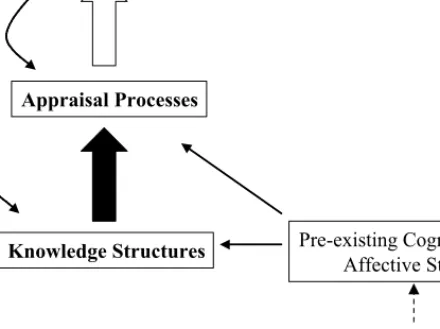
Intra-Individual Structure and Dynamics: A Knowledge-and-Appraisal Personality Architecture (KAPA). In addition to guiding principles, the study of intra-individual personality structure and dynamics requires well-speci- fi ed models. One needs a theoretically-grounded, comprehensive system of per- sonality structure and process variables. Such a variable system would serve as a heuristic guide for assessing intra-individual personality architecture and explain- ing personality consistency, coherence, and change. Note that one cannot meet this need by importing the trait variables identifi ed in factor analyses of variation in the population; on psychometric grounds, these between-person factors cannot be assumed to function as causal psychological structures at the level of the indi- vidual (Borsboom, Mellenberg, & van Heerden, 2003).
One of us recently has attempted to meet this challenge by providing a theo- retical system of intra-individual personality structure and dynamics. This system builds on past efforts in the social-cognitive tradition in personality psychology (Cervone & Shoda, 1999), especially the work of Bandura (1986, 1999), Mischel (1973; 2004), Dweck and colleagues (Dweck & Leggett, 1988; Grant & Dweck, 1999, 2003), Cantor and Kihlstrom (1987), Markus and colleagues (Markus, 1977;
Markus & Wurf, 1987), and Higgins (1996, 1999). The result is a conceptual model referred to as a Knowledge-and-Appraisal Personality Architecture (KAPA; Cer- vone, 2004a).
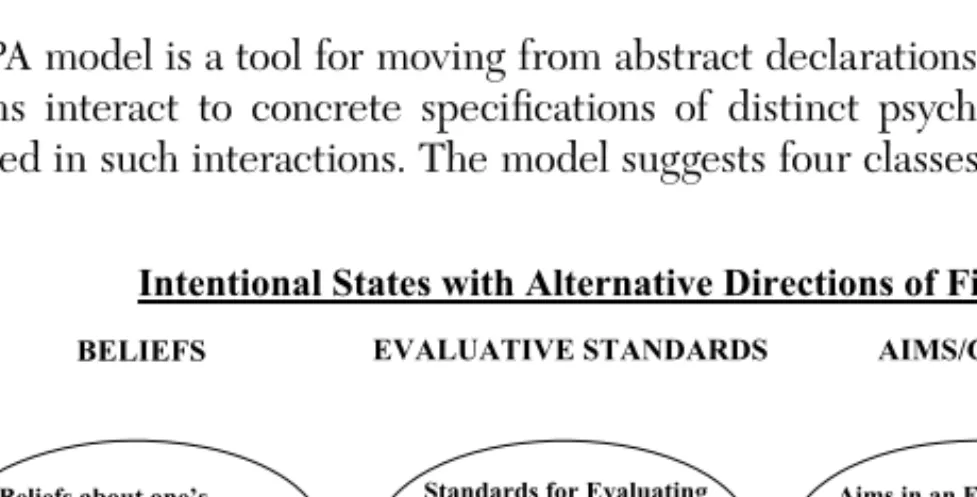
The KAPA model distinguishes among intra-individual personality variables via three conceptual principles. The fi rst, noted above, is the principle of inten- tionality. Some mental contents do, and others do not, possess a feature that phi- losophers refer to as intentionality: the internal mental content is directed beyond oneself to objects in the world (Searle, 1983). Propositional knowledge has this quality; propositions r