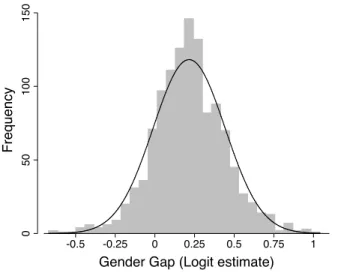
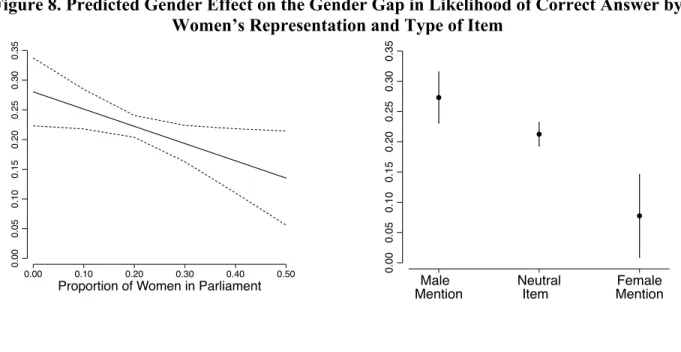
In the first chapter I investigate whether different views about men and women in politics and society have different psychological foundations and properties. In the second chapter, I argue that women's political representation influences the level of political knowledge expressed by men and women, and ultimately the gender gap. 1 The estimates in the graphs are weighted by observations and standard errors, taking into account the sampling design of the AmericasBarometer surveys.
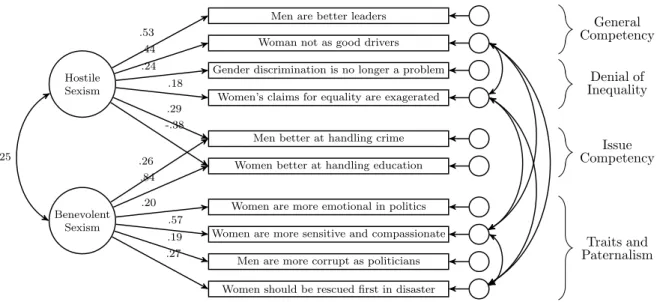
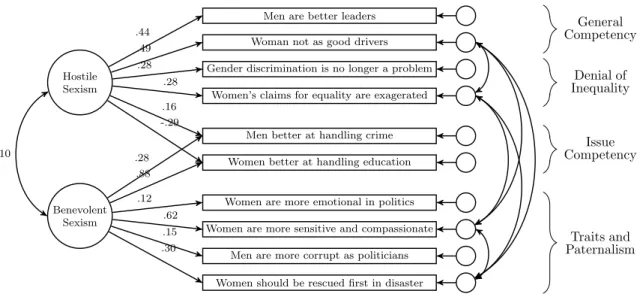
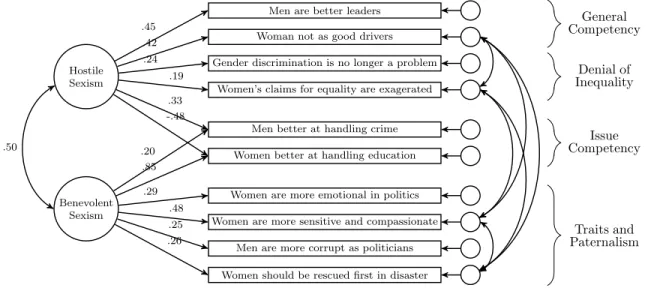
To test the claim that different types of gender attitudes are influenced by hostile and benevolent sexism, I included original questionnaire questions about gender attitudes in the 2014 round of the AmericasBarometer survey in Brazil. 5 All models presented take into account the complex sample design of the AmericasBarometer surveys in the two countries. The next step is to assess the validity of the proposed underlying structure of beliefs and attitudes about men and women in politics and society.
The results from the previous section show that hostile and benevolent sexism have different roles in shaping attitudes toward women's issues in Brazil. The results also show differential effects of interviewer gender on hostile and benevolent sexism. One of the recurring questions in the study of political behavior is why there is such a widespread gap in political knowledge between men and women.
According to the theory proposed here, the explanation for a substantial part of the gender gap in political knowledge is not related to gender differences in learning, but lies in the fact that being reminded of gender stereotypes in politics influences respondents' tendency to increase the knowledge that they actually have, use and display. Identifying and manipulating these environmental factors in experimental research is therefore an important step in the study of stereotype threat and the gender gap in political knowledge. According to the argument developed in the previous section, we should observe a decrease in the gender gap in political knowledge as women's descriptive political representation increases across contexts.
Either female representation affects the issue gender gap, or a change in the gender gap affects future levels of women's political representation. The results suggest that the level of political representation of women can help explain differences in the gender gap in political knowledge in different contexts. 51 The statistical model uses the natural logarithm of the average district size due to the presence of outliers in the data.
Predicted proportion of women in the lower house by constituency size and in-person voting incentives. 61 A statistical decomposition (Jann, 2008) of the gender gap shows that candidate-level variables in the model account for approximately two-thirds of the gender gap in candidate vote share. The main independent variable in the models is the extent to which respondents openly support sexist views of women in politics.

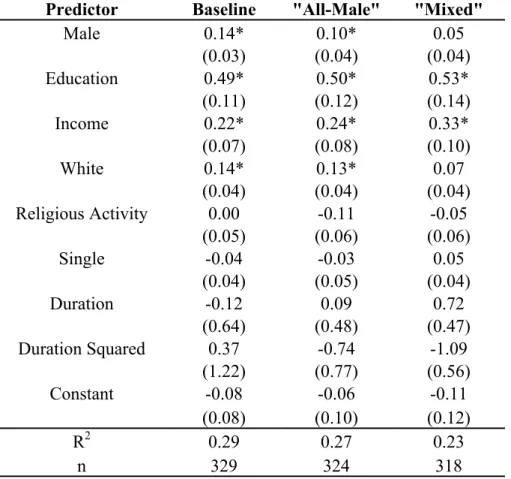
2010 Brazilian Election Study (n=729)
The following rows show the probabilities for respondents with the lowest value on the overt sexism measure (covert sexists), and the right side bars show the probabilities for respondents with the highest value on the overt sexism measure (overt sexists):68. The experiment manipulates hypothetical characteristics of the choice set that would allow voters to replace ideologically close female candidates with female candidates, as in a race for the Chamber of Deputies in Brazil. Therefore, the main objective of the experiment is to isolate the causal effect from the relationship observed in the previous section.
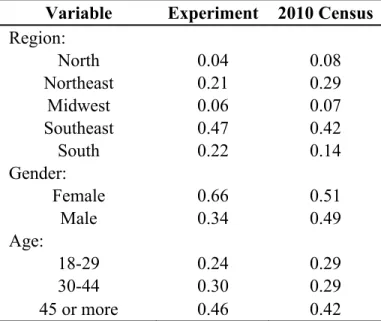
After agreeing to participate in the study, subjects answered standard background questions (on gender, age, education, race, religious activity) and proceeded to the main section of the study, which included the ballot experiment. To do so, before subjects were asked to cast their votes in the poll, the study asked whether they were for or against prominent political positions in Brazilian politics. The two items used in the poll were whether subjects were in favor or against the right of homosexuals to marry, and universities' use of racial quotas.
The ballots showed information about the candidates and also their opinions on the two policy positions. In the first experimental condition, the ballot included the first and last names of the four candidates, along with their ages, occupations, and opinions on the two policy areas mentioned above. Although the ballot used in the experiments does not resemble that aspect of Brazil's voting system, it has the primary purpose of simulating the broader cognitive task of evaluating information about competing candidates and deciding which one is preferred.
Thus, each of the three women competed in the elections not only with 9 other candidates of different profiles, but also with 2 ideologically identical candidates. Emphasis on gender made covert sexists more likely to vote for women on the 12-candidate ballot to conform to egalitarian norms. Subjects who do not overtly support sexist views of women in politics (covert sexists) are expected to be more likely to vote for women in the 4-candidate condition than in the 12-candidate condition.
The predicted probability of voting for a female candidate is higher in the 4-candidate condition (0.35 vs. 0.28 in the 12-candidate ballot). The experiment shows high proportions of votes for female candidates in all conditions and levels of sexism, although this did not prevent the manipulation from working in the expected direction.
Ballot Experiment (n=391)
Final Remarks
Much of the literature in political science points to gender stereotypes in politics as important factors in explaining why women are less likely to hold office, participate in politics, and express interest in political issues. These stereotypes can influence voters' evaluations of politicians, and especially female citizens, and their motivations to participate in the political process. The patterns in the chapter show that opinions on those issues are largely influenced by hostile rather than benevolent sexism.
Based on these insights, the chapter tests the moderating effect of benevolent sexism in the relationship between perceptions of corruption and the approval of the female president's job performance. The results in the second chapter suggest that the level of women's political representation can help explain the variation in the gender gap in political knowledge found across different contexts. The underrepresentation of women in the political domain reminds respondents of negative gender stereotypes when thinking about political affairs in their country.
Male respondents, on the other hand, may experience a boost in confidence and propensity to guess when exposed to the stereotypes, which in turn increases their performance on the knowledge test. To explore this main hypothesis, I first look at cross-national data on women's representation in lower houses to show that fewer women hold seats in lower houses in personalized electoral systems in which multiple co-parties compete against each other for the same seats. Given the increase in the presence of women in positions of power around the world, and the resulting public rejection of more open and derogatory forms of sexism, it is likely that benevolent stereotypes will become the dominant tone in the sexist discourse about men and women in politics over the following years.
Another research question I plan to explore next is related to the findings and conclusions I reach in chapter two, focusing on the effect of women's representation on the gender gap in political knowledge (via stereotype threat). An unclear aspect in the third chapter was the fact that the manipulation of candidates. The only way to identify a candidate's gender on the ballot was based on his or her name.
The findings and conclusions presented in this thesis, together with other research done on these topics in different contexts and times, suggest that women's increasing participation in parliaments and in the workforce could have major implications for democracies across the world. world. These global changes in the political landscape have major implications for how individuals view the roles of men and women in politics, how individuals think about politics in general, and how they choose the leaders and policies of the future.
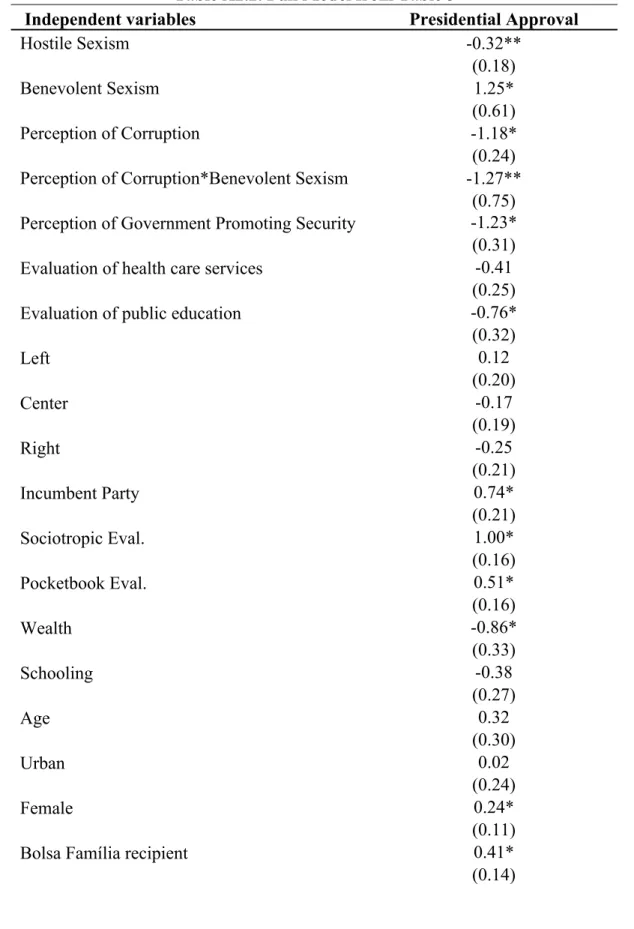
2010 Brazilian Election Study (n=828)
Engendering politics: The impact of descriptive representation on women's political engagement in Sub-Saharan Africa. Gender quotas, candidate backgrounds, and the election of women: a paradox of gender quotas in open-list proportional representation systems. The effects of gender stereotypes on female candidates at different levels and types of office.
Effects of gender stereotypes and leadership prototypes on the evaluation of male and female leaders. Exposure to benevolent sexism and complementary gender stereotypes: Implications for specific and diffuse forms of system justification. Putting Scandinavian equality to the test: An experimental evaluation of gender stereotypes of political candidates in a sample of Norwegian voters.
Consequences of Explicit and Implicit Gender Attitudes and Candidate Quality on Voter Calculus. Women in Legislatures and World Leaders: Knocking on the Highest Glass Ceiling. Electoral systems, contextual factors and women's opportunities for parliamentary elections in twenty-three democracies.
Effective Quotas, Relative Party Size, and the Success of Female Candidates: Peruvian Municipal Elections in Comparative Perspective. Parents' gender stereotypes and teachers' beliefs as predictors of children's perceptions of their mathematical abilities in elementary school.