The World Bank does not guarantee the accuracy of the data in this work. Higher education remains a core theme for the World Bank and its client countries, and will play a central role.
Country abbreviations used in fi gures
Currency equivalents
Fiscal year
Despite impressive gains, higher education could contribute even
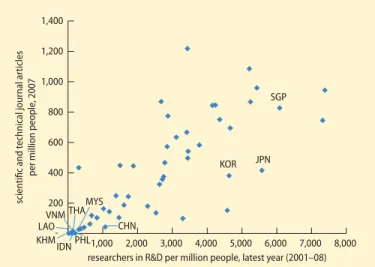
Higher education also does not provide the kind of research needed to drive technological progress in companies. But international rankings and research output indicate that low- and middle-income East Asian higher education systems do not deliver research of sufficient quality.
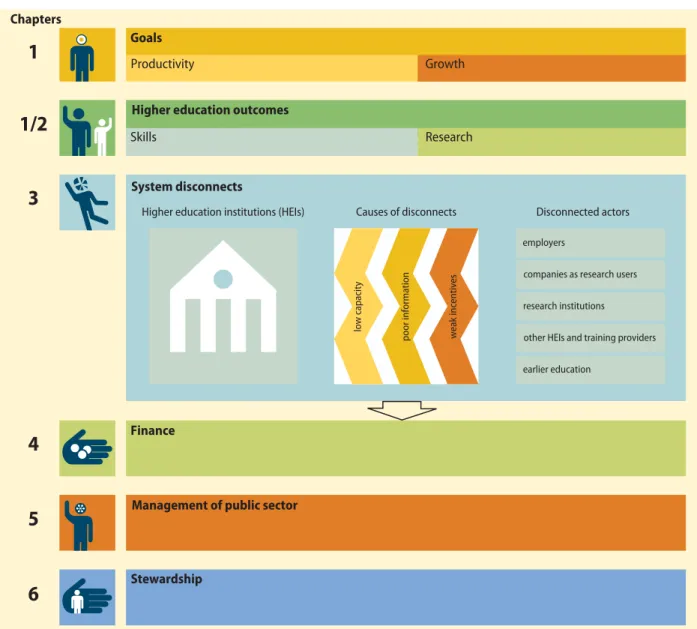
Five disconnects
Compounding the quality problems is the exclusion of able and talented students from higher education due to their socio-economic status, ethnicity and rural residence. Governments are urging universities to go beyond just providing skills to support innovation through research and technology.
Public policy and its three pillars
Beyond the management of the public sector, higher education departments must coordinate actors and links not under their full control, but critical to the performance of the sector. The lack of interaction between higher education institutions and firms to some extent reflects a lack of information about what works and a lack of legal and financial incentives to connect.
Country priorities, policies, and reform
The exercise of stewardship requires the capacity to coordinate higher education departments with other departments and ministries, steer private higher education institutions, support links between higher education institutions and firms in skills and research, and handle the interaction between the local and international higher education markets. . Governments can also connect firms and providers of skills and research by sharing best practices – from collaboration in curriculum development to setting up university incubators – and by providing the incentives to make these university-industry links work (by providing intermediaries and matching funds ).
Notes
Governments can improve their stewardship by ensuring that private and public service providers complement each other, particularly to meet the skills needs of employers.
The book argues that higher education is failing to deliver skills for growth and research for innovation because of widespread disconnects between higher education institutions and other skills and research users and providers. Rapid public intervention is needed because no country in East Asia has achieved high-income status without a strong higher education system.
East Asia’s economic landscape
Over the past two decades, exports as a share of GDP have grown considerably (Table B.3 in Appendix B). All are in the range of less than $7,000 per capita (Table 1.3) in constant nominal GDP.
Role and impact of higher education
Countries with a large workforce of highly educated individuals have higher productivity and higher tax payments. These benefits show how higher education can improve the quality of life for individuals and countries.

From higher education to growth: Skills and research
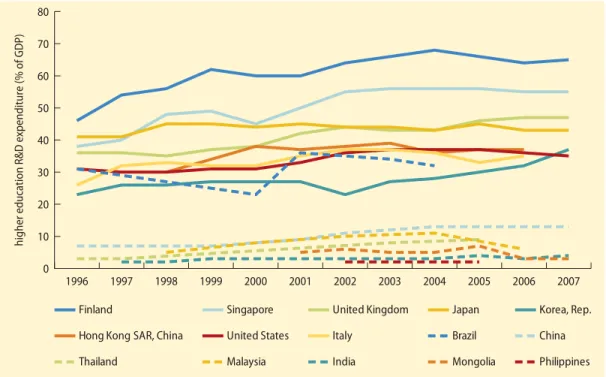
These points partly reflect a changing perception of the role of higher education. Indeed, research by government and higher education retains a significant share of total R&D in the economies of the top technology cluster (Table 1.10), and even more so in the Hong Kong, China and Singapore SARs.
Conclusion
A study of more than 300 large universities in the United States finds product-specific economies of scale for conducting research at undergraduate and graduate public and private universities. Improving the quality of education improves test scores in the short term (Jakubowski et al. 2010) and labor market success in the medium term (Bertschy, Cattaneo, and Wolter 2009).
Meeting Its Promises?
Higher education and skills for growth: The main issues
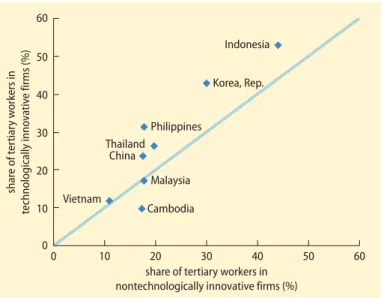
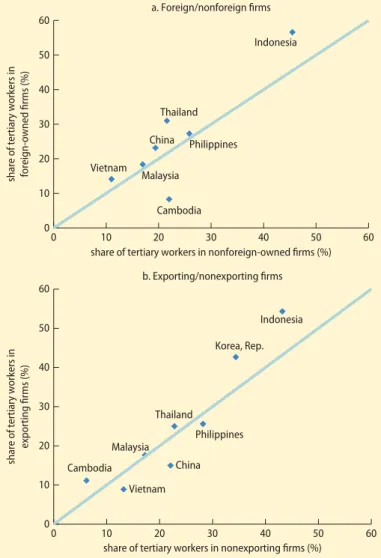
Overall, the relationship between skills gaps and technology is evident across all income groups, but somewhat stronger for middle-income countries.4. A higher income country like Korea experiences both lower skill gaps and a weaker relationship between skill gaps, technology and openness.
Quantity of higher education graduates
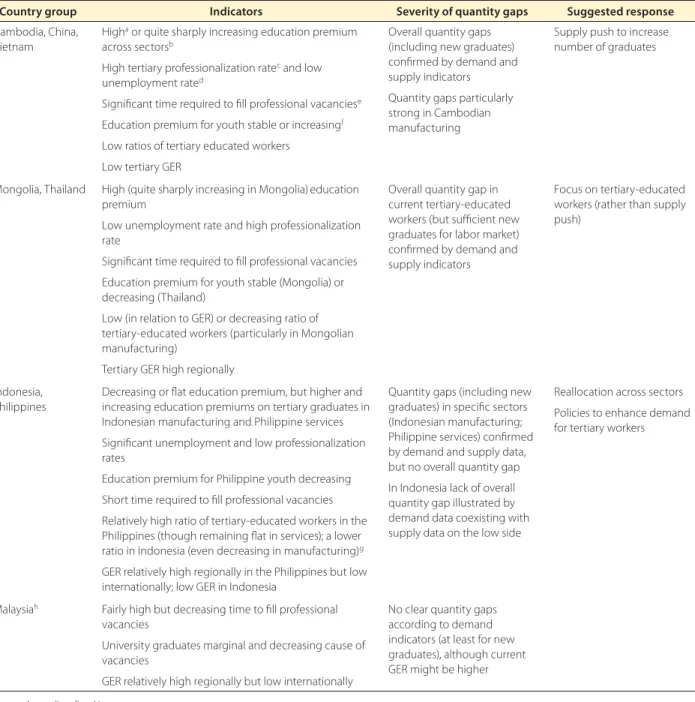
Significant time required to fill professional vacancies. Education premium for youth stable or increasing low ratios of tertiary educated workers. It relies on the proportion of tertiary graduates working as professionals (admittedly an imprecise indicator of local absorption potential as it is normal to have a proportion of tertiary graduates working as skilled production or non-production workers).
Quality of higher education graduates
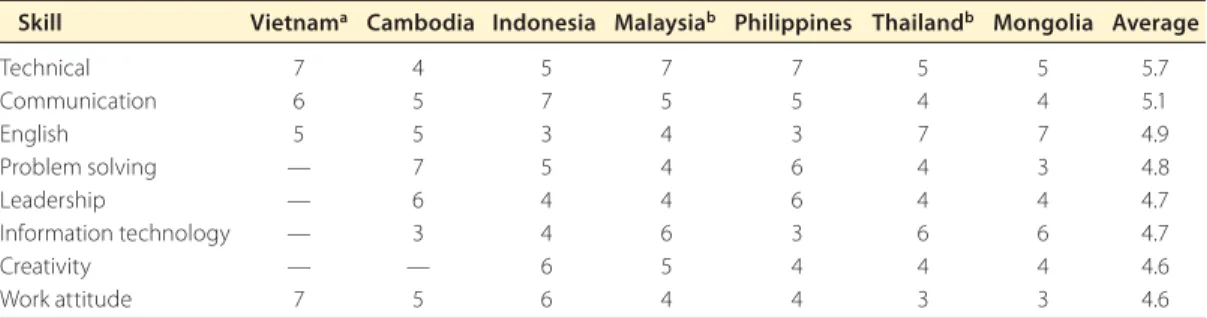
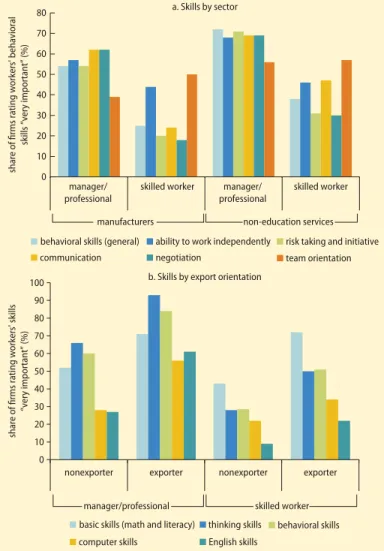
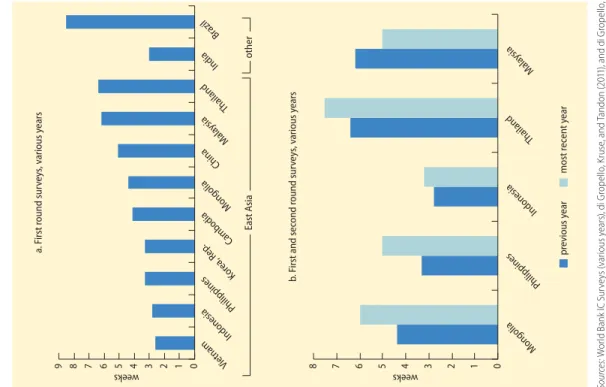
Gaps in communication and negotiation skills are also significant, particularly in V ietnam, in surveys of employers and employees. In the three countries for which the theory versus practice differentiation exists (Vietnam, Indonesia and the Philippines, as illustrated in Appendix J), practical knowledge is even more of a gap than theoretical working knowledge.
Research and innovation
In the Philippines the heavy metals industry (including chemicals and machinery) has lost ground, measured as a percentage of manufacturing value added, falling from 44 percent in 2003 to 36 percent in 2007 (Tan 2010). The situation is much worse in the Philippines in terms of the number of students receiving advanced degrees in STEM fields.
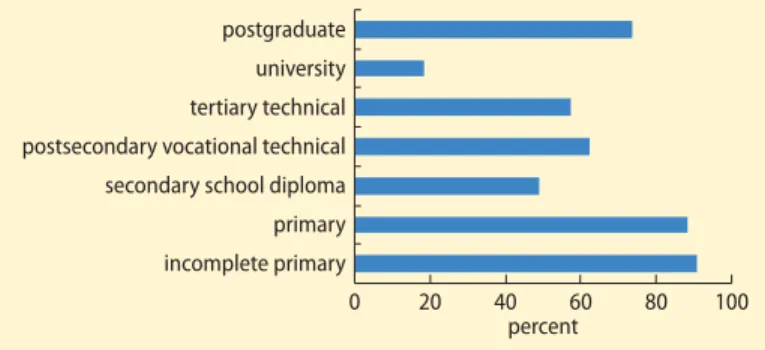
Education
The fi rst disconnect: Between higher education and employers
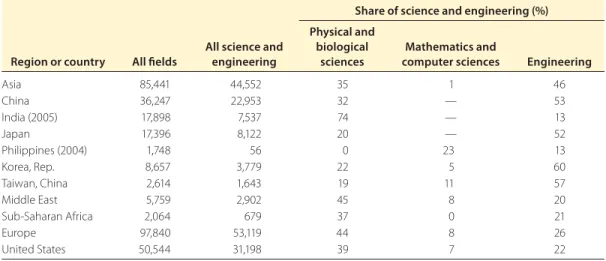
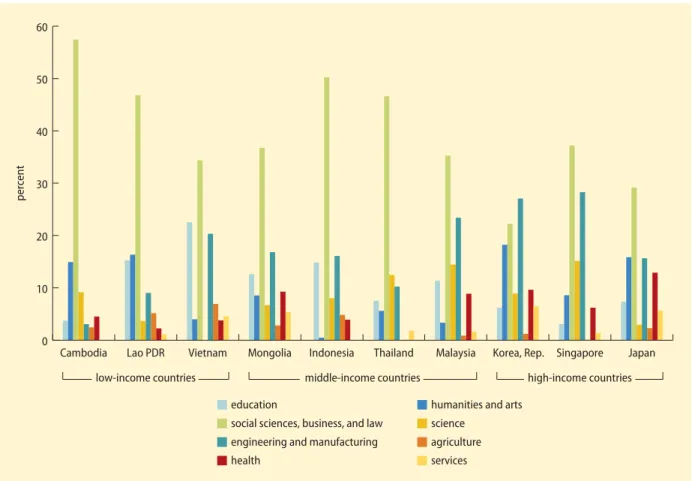
Areas of study data indicate that most tertiary systems in the region's low- and middle-income countries have an uneven distribution of students across disciplines. However, the number of promotions remains small relative to the stock in Europe (Table 3.1 and Appendix L), and almost all countries in the region have less than 2 percent of their tertiary students studying at the International Standard Classification of Education (ISCED) 6 level13 (figure 3.6), in contrast to about 5 percent in Western Europe and North America.14.
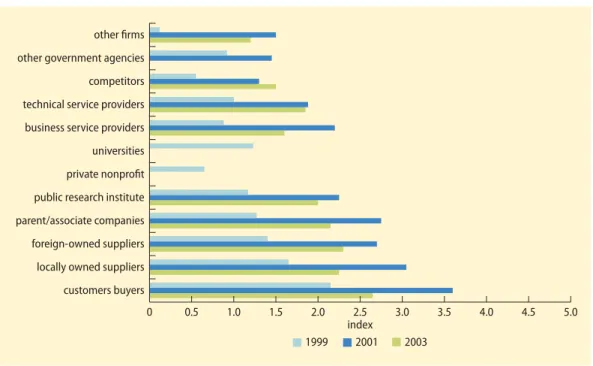
The second disconnect: Between higher education and companies
Lack of capacity will hinder both the cooperation itself and the results of this cooperation. A lack of creativity and entrepreneurial skills on the part of the company will obviously not support innovative collaboration.
The third disconnect: Between higher education and research
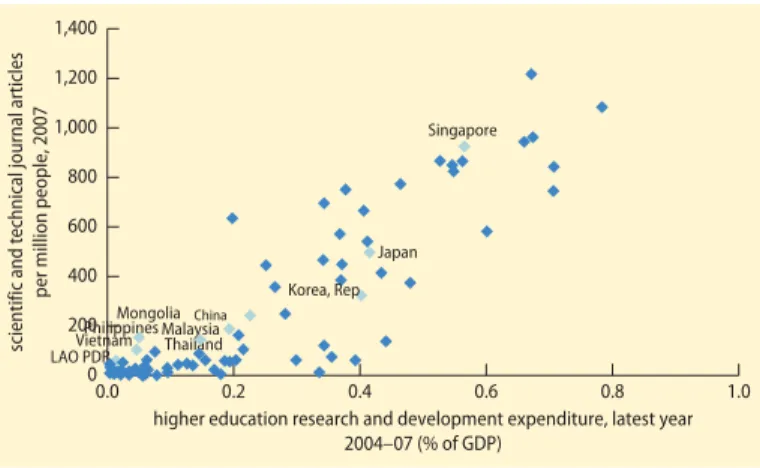
But Chinese universities have not yet become the main drivers of innovation, especially in relation to public research institutes, indicating that the separation between teaching and research functions is still evident. Most countries have adopted a model of separation between teaching and research that has not been conducive to the growth of research in universities.
The fourth disconnect: Among higher education institutions
And even more is the lack of incentives to pursue meaningful and productive research (resources must be used well). Part of the underlying problem appears to be the lack of a well-developed and unifying framework for different skill providers.
The fi fth disconnect: Between higher education and earlier
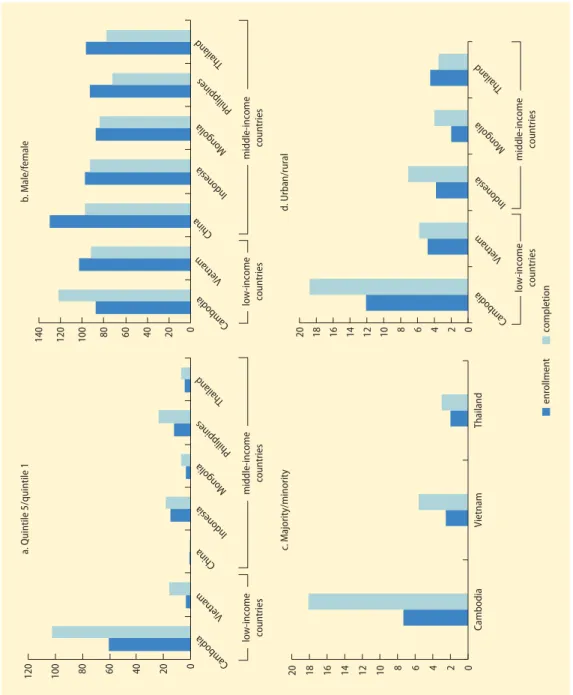
Second, countries with a higher TIMSS score in mathematics and science subsequently have higher STEM enrollment shares in tertiary education (figure 3.17). Other data indicate that in Vietnam, Mongolia and the Philippines, inequalities are already visible in secondary education and are then reflected in tertiary education (figure 3.23).

Conclusion and moving forward
Proper governance of the higher education system can help bridge the disconnect between users and providers of skills by effectively encouraging and regulating the private sector (addressing incentives, information and even capacity constraints). The next three chapters deal with the three most critical areas of public policy: financing, management of public institutions, and stewardship of the higher education system.
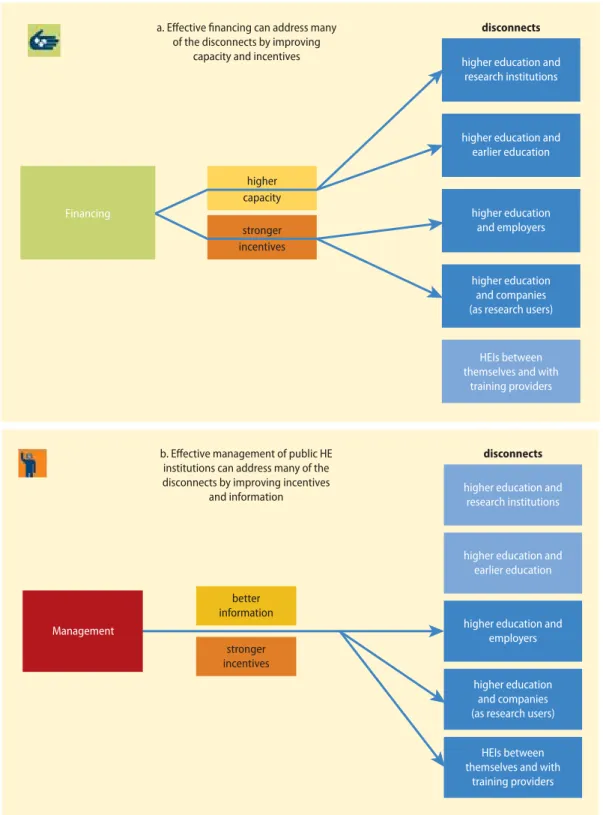
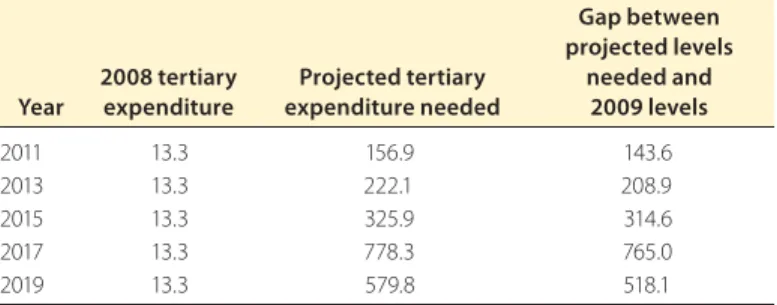
Financing needs
Achieving these expenditure targets appears very challenging in the short to medium term for all countries and should not be the cost norm for higher education in low- and middle-income East Asia. The results have been encouraging: there is evidence of significant effects on the participation of the poor in higher education.
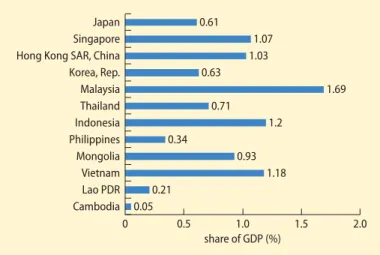
How to fund priority activities
One of the most effective tools for holding institutions accountable is the power of government. Alternatively, requiring students to pay at least part of the cost generally improves their motivation and performance.
Summary of policy priorities
In the early 1990s, when Hong Kong SAR, China, decided to recover more higher education costs through tuition fees, the local student finance scheme was split into two tracks.45 An extended loan scheme (not income-related) that charged a higher interest rate. of 4-5 percent per year, targeted. Programs to increase access to high-quality secondary schools and courses, especially targeting disadvantaged groups, could have a particularly high payoff, as shown by the example of the Urban Systemic Initiative in the United States.
Higher Education
How decision-making is shared across actors and how accountability is structured to translate autonomy into results are the two critical decisions regional policy makers face in managing the public sector. The following discussion reviews the case for giving higher education institutions greater decision-making autonomy while supporting strong accountability, and then moves to the key characteristics and issues related to autonomy and accountability in the region.
Global moves to autonomy
The authors found that on the supply side, the greater responsiveness of tertiary education provision (as measured by input flexibility, output flexibility and accountability) had a positive effect on the number of graduates produced. On the demand side, they found that higher internal rates of return also had a positive effect on the number of graduates, but that funding systems (the ratio of training costs to available funding - an index of liquidity constraints) had a negative effect.
Autonomy for low- and middle- income East Asia
Evidence suggests that following the move towards greater autonomy for its universities (see Box 5.4), the National University of Singapore has seen its performance improve along several dimensions. Finally, in Japan, while it is too early for a full assessment, since 2004, the year of governance reform (see box 5.4), the number of world-class universities has doubled from 5 to 11 in the THES ranking (see chapter 2).
Two fundamental issues
BOX 5.6 Autonomy in higher education in Japan before and after the National University Corporation Act of 2004 Higher education institutions in low-income countries still have little procedural autonomy, but it is increasing.

Moving forward
There is also an almost complete lack of rigorous studies assessing the effects of autonomy on higher education in the region. Finally, the globalization of higher education has the potential to address some of the disconnects that limit higher education.
Providing eff ective coordination among government bodies
For example, the integration of higher education within the ministries of education can help to resolve the differences between the education levels, but the connection with science and technology can be further removed. The committees could be entrusted with the responsibility of setting the strategic direction for tertiary education, coordinating the different actors and monitoring how higher education facilitates national and regional development.
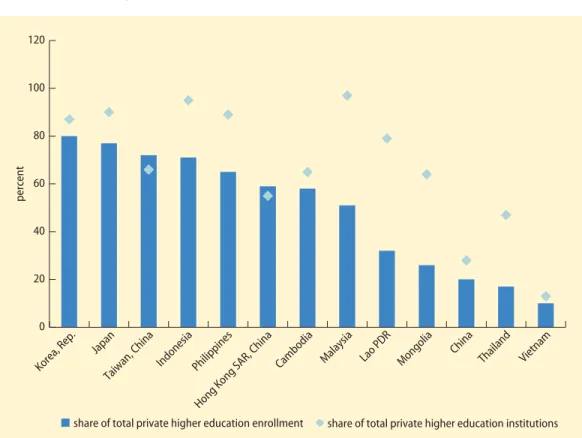
Steering private delivery
Post-war development prioritized rural, primary and secondary education rather than higher education in the public sector. Country Policy or approach Meaning of the policy or approach Malaysia Private higher education.
Encouraging eff ective university-industry links
Box 6.5 offers two – the first is suitable for all countries, the second is more suitable for high technology cluster countries.). The goal of the TAMA (Technology Advanced Metropolitan Area) association is to improve the competitiveness of small and medium-sized enterprises in the Tama region (northwest of Tokyo).
Stewardship of the internationalization of
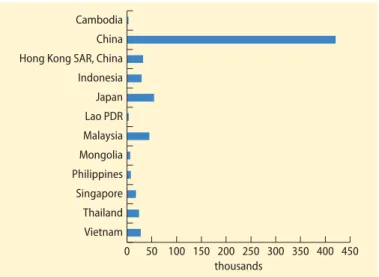
Although the potential for internationalization of higher education for East Asia is great, it needs to be carefully managed. Previous parts of this study have documented some of the main constraints facing East Asian higher education systems.
Appendix A
Number and Type of Higher Education Institutions in East Asia
Appendix B
Economic Indicators
Appendix C
Trends in Returns to Skill and Share of Skilled Workers, by Sector