
A catalog of these and over 100 other titles is available from IES or on the IES website, www.employment-studies.co.uk. Full information on membership is available from IES on request or at www.employment-studies.co.uk/networks/.
What drives engagement?
The above results show that organizations must work hard to prevent and minimize the impact of bad experiences. They must also ensure that the development needs of employees (including the special needs of professionals) are taken seriously; be aware of and value the roles of support staff; and to maintain interest in long-term employees.
IES’ diagnostic tool
General lessons
The study
- Introduction
- Why engagement?
- Approach and methodology
- Report contents
- discusses engagement as a concept, compares it to commitment and organisational citizenship behaviour, and
- focuses on the reasons why organisations should pay attention to employees’ engagement levels, specifically the
- describes how engagement can be measured and analysed
- discusses the drivers of engagement and the IES engagement model
- contains conclusions, recommendations and suggestions for further research
- What is Engagement?
- Why Worry About Engagement?
This type of engagement emphasizes the satisfaction people derive from their jobs and their colleagues, and the willingness of employees to go above and beyond the call of duty for the benefit of the organization. An engaged employee is aware of the business context and works with colleagues to improve job performance for the benefit of the organization.

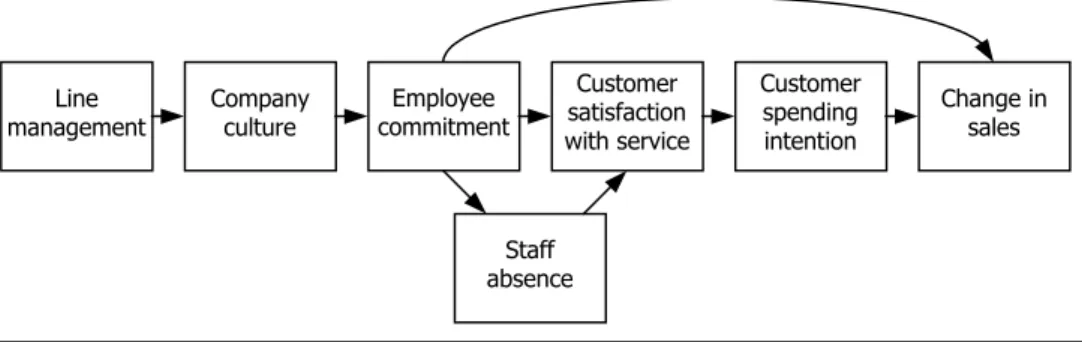
3.2 ‘From People to Profits’
- Engagement at the Royal Bank of Scotland
- Getting the Measure of Engagement
- Approach
- Engagement statements
- An indicator of engagement .1 The full indicator
- Analysis using the engagement indicator .1 Approach to the analysis in the NHS
- Understanding the Drivers of Engagement
- Engagement correlations .1 The key driver
- IES’ engagement model
- IES’ diagnostic tool
- Practical implications of the model
- The issues and challenges .1 It works both ways
- Final Words
- Defining and Creating Employee Commitment: A Review of
It also assessed the extent to which engagement levels are influenced by the nature of the work employees do and their experiences at work. The Engagement Indicator can be used to provide a single measure of engagement levels across the entire organization. It therefore makes sense for organizations to monitor the engagement levels of employees, and to take action to increase them.
The decline in involvement as employment increases poses a major challenge for organizations. In addition, the study analyzed the differences in the engagement levels of employee groups depending on their personal and job characteristics and their experiences at work. The encouraging news is that it is possible to take action to improve employees' sense of appreciation and commitment, and thus their engagement.
Introduction
The benefits of a committed workforce
Types of Commitment
Affiliative commitment – An organization's interests and values align with those of the employee, and the employee feels accepted by the organization's social environment. Moral commitment – employees experience the organization as on their side and the organization creates a sense of mutual obligation, with both the organization and the employee feeling a sense of responsibility to each other. Employees with high affective commitment are those who go above and beyond the call of duty for the good of the organization.
There are lures to enter and stay in the organization and barriers to leaving.
Antecedents of commitment Demographics
This type of commitment is often referred to in the literature as a continuation commitment. According to the typology above, when an organization is considering assessing the engagement of its workforce, it must ask not only how much engagement there is, but also what types of commitment there are. However, it is believed that the reason for this is that married employees tend to have greater financial and family responsibilities, which increases their need to remain in the organization.
Note, however, that this refers to structural commitment (or continuance commitment), as the costs associated with leaving the organization increase commitment to the organization.
Recruitment procedures
The organization must then ensure that it delivers on these promises to its employees, otherwise its efforts will be wasted. In this regard, much of the dialogue between employers and employees evaluating each other remains 'safe'. Work is done in a social context, and where and with whom it is done is as important as the nature of the work itself.
Expectations met
Induction and training
Relationships with managers
Relationships with colleagues
IES research with many organizations also supports the relationship between providing staff training and development opportunities and higher levels of engagement and job satisfaction. Organizations that want to build high levels of engagement should look for ways to build this through group activities, both inside and outside of work.
Group membership
Organisational justice and trust
Unless there is opportunity for regular and rewarding interaction, stronger feelings of belonging that can bind employees to the organization are unlikely to emerge. In addition, trust allows organizational flexibility because a payback need be neither immediate nor of equivalent value.
Promotion
Work-life balance
Job satisfaction
Pay and reward
A large study by the Institute for Families and Work (1998) showed that such employer support is associated with increased employee engagement. They found a positive correlation between the availability of such benefits and commitment, even for those who would not directly benefit. Similar research examined the relationship between organizational commitment and rewards, operationalized as actual income and pay satisfaction.
This research found that commitment was more strongly related to pay satisfaction than to actual income.
Summary and conclusion
Organisational Citizenship Behaviour: A Review of Current Research
Organizational citizenship behavior (OCB) has a research tradition spanning some 20 years, although much of the interest in the concept has only arisen more recently. OCB consists of a large group of behaviors, ranging from helping colleagues to conveying a positive impression of the organization to others. The vast majority of research effort has been directed at determining what causes employees to demonstrate OCB, and from this the practitioner can take ideas to help create an environment through which performance can be enhanced through OCB.
What is now emerging is that performance benefits can be reaped by considering softer as well as harder in-role behaviors, but while in-role behaviors can be scrutinized by managers, OCBs are voluntary in nature and more difficult to distinguish.
What is OCB?
Typology of OCBs
This consists of behaviors that involve promoting the organization to the outside world and remaining committed to it, even though this may entail personal sacrifice. This is evidenced by behavior that demonstrates macro-level interest in the organization as a whole, as a loyal citizen would show towards his country. Examples of such behavior include volunteering, taking an interest in organizing committees, and being vigilant against threats to the organization.
This behavior includes voluntarily improving one's own knowledge, skills and abilities in such a way that it is useful to the organization.
Consequences of OCB
With this in mind, another useful classification of OCB, which has been advocated by some researchers (Barbuto et al., 2003; Turnley et al., 2003), is that of organization-directed citizenship behaviors (OCB-O) or in the individual (OCB-I). Having defined the different types of OCB, its impact on organizational effectiveness will now be considered.
Organisational level outcomes
More substantial support for the OCB/performance link comes from a study based on a paper mill in which both quantity and quality of performance were measured (Podsakoff et al., 1997). In particular, a study by Wall et al., (1992) showed that when machine operators were given more autonomy to correct errors, machine downtime decreased and as a result. Relating this back to Podsakoff et al. 1997) study, it could be said that helping behavior only helped in this case because the workers were given autonomy so that they could use their knowledge to prevent future problems.
In a review by Podsakoff et al. 2000) note that previous studies have supported the idea of a link between OCB and organizational performance, although the link is greater for some types of OCB (such as helping behavior) than for others (such as sportsmanship and civic virtue).
Individual outcomes
Finally, more research conducted in the insurance sales sector found that employees who exhibit higher levels of OCB are perceived by customers to provide better service quality (Bell and Menguc, 2002). The findings tend to suggest that improvements can be made when employees demonstrate OCB, so it would be a fruitful line of inquiry to find out how to promote such behaviors in the first place. There was a longitudinal element to this study, and thus not only was there a negative correlation between OCB and intentions to quit, but also actual turnover.
This finding adds an additional dimension to the use of research on OCB as it not only has implications in terms of performance but also impacts retention.
Antecedents of OCB
Attitudinal predictors
OCB and the psychological contract
When we broke down these results further, it turned out that the violation of the employment relationship was more important than that of the reward. There was also evidence that when the reasons why a contract has been breached are adequately communicated by the organization, the resulting decline in performance (both within and outside the role) will be reduced. This is consistent with previous research (Robinson, 1996), which also found that performance declines are less likely to occur in organizations where levels of trust were at a high level before the breakup.
OCBs and abusive supervision
Dispositional predictors
Demographic predictors
Task-related predictors
Organisational predictors
Leadership-style predictors
Antecedents overview
Summary and conclusions
Royal Bank of Scotland Case Study
Background
Objectives
By examining the precursors, influences and consequences of engagement in this way, RBS sought to identify the key drivers of engagement across key business issues such as turnover and productivity. The primary objectives of this were to assess how and why employees were or were not engaged, and then investigate this further in relation to organizational data, for example employee turnover and bank productivity figures. An example of this is the work of Hewitt, Bacon and Woodrow (Hewitt Associates) who define engagement in their three-point model: 'Say', 'Stay', 'Strive' (Figure A3.1).
Below each driver is a selection of questions that can be used to better understand how engagement is affected.
RBS findings
The image and reputation of RBS and its brands based on the perception of the group as a corporate citizen and the value and quality of its services. This is the percentage of respondents who responded positively to the general question for this category. Influence bars show which categories have the greatest impact on overall engagement: both opportunities for improvement and threats for deterioration. Staff engagement levels were also examined by seniority and position within RBS, and in each area key opportunities and threats to developing and retaining strong employees. Table A3.2: Engagement of RBS employees by length of service (in percentages).
The relationship between levels of engagement and staff turnover was also investigated in a pilot area and over a four month period a correlation coefficient of -0.43 was found (this change in turnover would require a percentage increase in engagement. Not sure I'd like to elaborate into the changes.) This could be changed to say that the correlation was -0.43, indicating that a two percent increase in engagement would lead to a 0.86 percent decrease in employee turnover.

Employee engagement — differences by tenure
Employee Engagement and Related Indicators
Engagement indicator
Related indicators
Feeling valued and involved
Co-operation
Training, development and career
Communication
Equal opportunities and fair treatment
Family friendliness
Health and safety
Immediate management
Pay and benefits
Performance and appraisal
Racial discrimination policy
Sex discrimination policy
Colleagues
Current career intentions
Disability policy
Burnout
Likely stayers and leavers
Stress and work pressure
Reaction to change
Engagement Statistics
Engagement relationships Engagement links
Regression
Feeling valued and involved: correlations
Bibliography
Cohen A (1991), 'Career stage as a moderator of the relationship between organizational commitment and its outcomes: A meta-analysis', Journal of Occupational Psychology, Vol. Cook J, Wall T (1980), 'New job attitude measures of trust, organizational commitment and personal need non-fulfillment', Journal of Occupational Psychology, Vol. eds), Job Satisfaction, New York: Lexington Dindia K, Canary D (1993), 'Definitions and theoretical. Dunham R, Grube J, Castaneda M (1994), 'Organizational Commitment: The utility of an integrative definition', Journal of Applied Psychology, Vol.
Organizational citizenship behavior and the quantity and quality of work group performance', Journal of Applied Psychology, Vol.