All rights reserved. The Southern Baptist Theological Seminary has permission to reproduce and disseminate this document in any form by any means for purposes chosen by the Seminary, including, without limitation, preservation or instruction.
WITH DEVELOPMENTAL DISABILITIES
A Dissertation Presented to the Faculty of
The Southern Baptist Theological Seminary
In Partial Fulfillment of the Requirements for the Degree
Doctor of Education
by
Bobby Arlan Howard May 2010
All rights reserved
INFORMATION TO ALL USERS
The quality of this reproduction is dependent upon the quality of the copy submitted.
In the unlikely event that the author did not send a complete manuscript and there are miSSing pages, these will be noted. Also, if material had to be removed,
a note will indicate the deletion.
UMf
---Dissertation Publishing---- UMI 3445605
Copyright 2011 by ProQuest LLC.
All rights reserved. This edition of the work is protected against unauthorized copying under Title 17, United States Code.
Pro uesr
---
ProQuest LLC
789 East Eisenhower Parkway P.O. Box 1346
Ann Arbor, M148106-1346
PASTORAL ATTITUDES TOWARD INDIVIDUALS WITH DEVELOPMENTAL DISABILITIES
Bobby Arlan Howard
Read and Approved by:
d ·'
/J.
',£
/ ', ~ . \ / ~"-'/ ( ' / /
.~
'/tt.OvJ<C/G ~ ~/ .. &';v~r--
Brian C. Richardson (Cliairperso~)
Dennis E. Williams
Date
~ ILl, dOlO
our two girls, McKenzie and Cameron, whom I love with all my heart. Most importantly, to my Savior, Jesus Christ, Who constantly proves Himself loving and faithful.
Page LIST OF ABBREVIA nONS . . . Vll
LIST OF TABLES. . . .. Vl11
LIST OF FIGURES. . . IX
PREFACE... X Chapter
1. RESEARCH CONCERN. . . 1
Introduction to the Research Problem. . . 3
Research Purpose. . . 9
Research Questions. . . 9
Delimitations of the Study. . . lO Terminology. . . . .. 10
Research Assumptions. . . .. 15
Procedural Overview . . . 16
2. PRECEDENT LITERATURE. . . 18
Biblical Implications for Special Needs Ministry. . . 18
Theological Implications for Special Needs Ministry. . . . 36
Historical Implications for Special Needs Ministry. . . .. 40
Educational Implications for Special Needs Ministry. . . .. 47
Implications of Literature Review on Proposed Research. . . .. 57
IV
3. METHODOLOGICAL DESIGN. . . 59
Research Question Synopsis. . . 59
Design Overview . . . 60
Population. . . . 61
Samples and Delimitations . . . 61
Limitations of Generalization. . . 64
Instrumentation . . . 64
Procedures . . . 66
4. ANALYSIS OF FINDINGS. . . 70
Compilation Protocol. . . .. 70
Demographic and Sample Data. . . 75
Research Question 1 - The Relationship Between the MAS and the Levels of Intentional Special Needs Ministry . . . 80
Research Question 2 - The Relationship Between the Levels of Intentional Special Needs Ministry and Selected Variables. . . . 92
Research Question 3 - The Relationship Between the MAS and Selected Variables ... 102
Evaluation of the Research Design. . . .. 114
Weakness of the Research Methodology 115 Strengths of the Research Methodology 117 5. CONCLUSIONS ... 120
Research Purpose. . . . .. 120
Research Implications. . . .. 121
v
Research Applications. . . .. 131 Research Limitations. . . .. 134 Further Research. . . .. 134 Appendix
1. DEMOGRAPHIC QUESTIONS ... 138 2. THE MULTIDIMENSIONAL ATTITUDE SCALE
TOWARD PERSONS WITH DISABILITIES... 145 3. CORRESPONDENCE ... 149 4. PASTORAL RESPONSES ON THE
MULTIDIMENSIONAL ATTITUDES SCALE
TOWARD PERSONS WITH DISABILITIES . . . .. 153 5. VARIABLE COMBINATIONS YIELDING
SIGNIFICANT CORRELATION BETWEEN LEVELS OF SPECIAL NEEDS MINISTRIES
AND THE MAS SCORES . . . .. 157 REFERENCE LIST ... 161
VI
ADA Americans with Disabilities Act
ADTP Attitudes Toward Disabled Persons Scale IDEA Individuals with Disabilities Education Act
MAS Multidimensional Attitudes Scale Toward Persons with Disabilities
vii
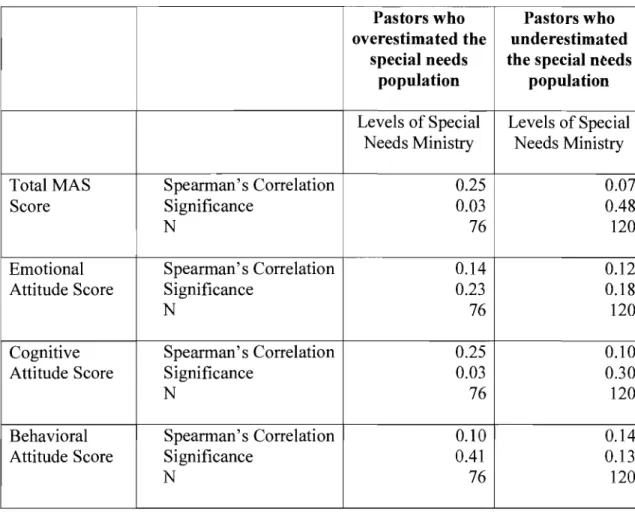
Table Page 1. Comparison of MAS scores and levels of
special needs ministries between pastors
based on special needs population. . . .. 88
2. Comparison of MAS scores and levels of special needs ministries between pastors based on formal courses of instruction . . . .. 89
3. Crosstabulation frequency data for special needs ministry and pastoral life experience with individuals with developmental disabilities. . . . 97
4. Crosstabulation life experience with individuals with developmental disabilities to MAS scores. . . .. 106
5. Comparison of formal courses of instruction related to MAS scores . . . .. 109
6. Crosstabulation of informal courses of instruction related to MAS scores . . . .. 111
AI. Number of pastoral responses for emotional attitude measurement ... 154
A2. Number of pastoral responses for cognitive attitude measurement ... 155
A3. Number of pastoral responses for behavioral attitude measurement ... 156
A4. Sets of three variables yielding significant correlation. . . .. 158
A5. Sets of two variables yielding significant correlation ... 159
A6. Significant correlation among pastors with formal instruction and tenure greater than five years. . . 160
viii
Figure Page
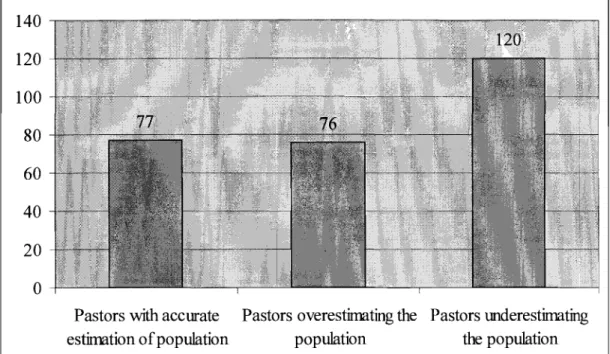
1. Categories for sample size determination .. . . 76
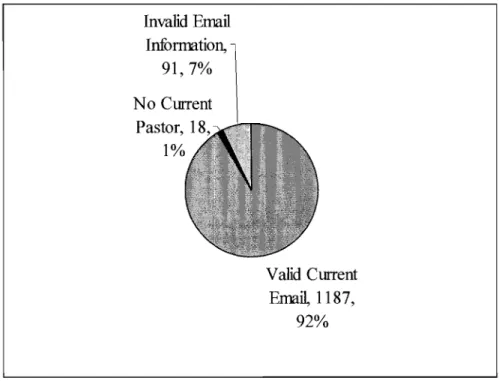
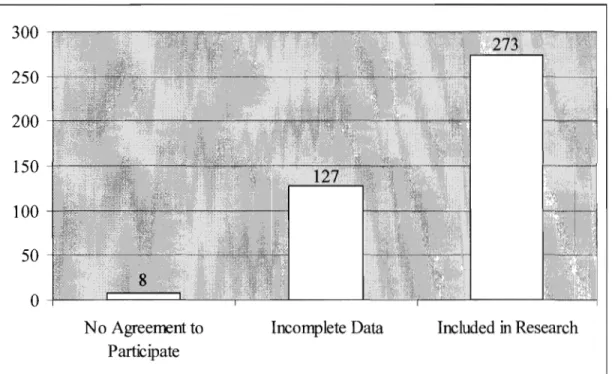
2. Classification of surveys received . . . 77
3. Percentage of respondents compared to percentage of population by regions ... . . 78
4. Pastoral tenure of respondents. . . 79
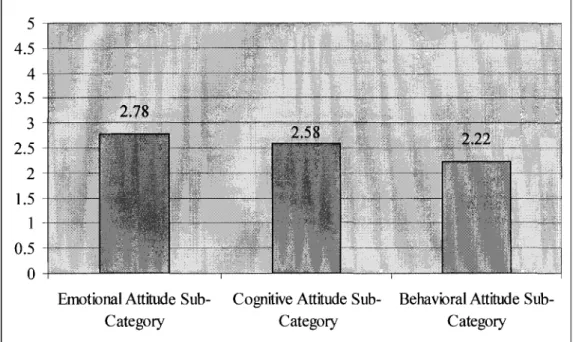
5. Mean attitude scores in the three subcategories. . . 82
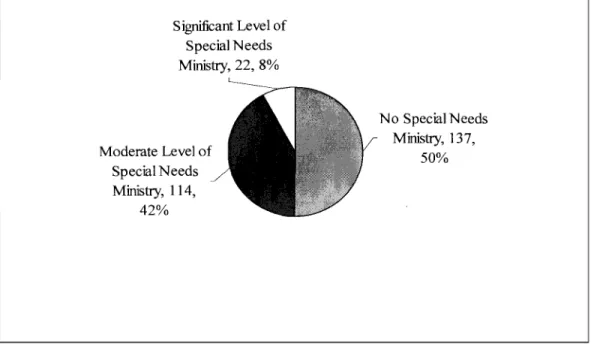
6. Special needs ministries for the sample population. . . 84
7. Comparison of MAS scores to special needs ministry levels. . . .. 84
8. Estimation of the population who have disabilities. . . 95
9. Number of respondents reporting life experience levels in each of the five categories . . . 96
10. Levels of formal courses of instruction among the respondents. . . . 98
11. Levels of informal courses of instruction among the respondents. . . . .. 100
12. Comparison of attitude scores to population estimation accuracy. . . . .. 104
13. Comparison of attitude scores to levels of life experiences . . . .. 105
14. Comparison of attitude scores to levels of formal instruction ... 108
15. Comparison of attitude scores to levels of informal instruction. . . .. 111
ix
I am extremely grateful to God for the opportunity to work through the task of dissertation completion. The task would have been impossible without the help and support of many people. Dr. Brian Richardson, my dissertation supervisor, and Dr.
Dennis Williams, my second reader, have offered invaluable encouragement, insights, and support throughout the process. Dr. Mark Simpson, Dr. Brad Wagner, and Dr.
Michael Anthony also made invaluable contributions to my education and have significantly impacted the work that I am presenting in this dissertation.
Throughout my educational endeavors, my wife has provided loving support and prayer. Our children have patiently supported me during the long hours of studying and writing. My parents have encouraged me and have given me unwavering love and support as well. Many friends and other family members have been instrumental in our lives and in my educational pursuits, and without their support I could not have attained the goal of completing the doctoral degree requirements.
My colleagues in the Ed.D. cohort have challenged me to a greater level of excellence in education. In particular, Dr. Keith Sharp has persistently stood behind me and encouraged me to complete this phase in my educational pursuits.
I am also very grateful to God for the desire He has placed in my heart to lead others in an effort to reach out to individuals with developmental disabilities and their families in order to encourage them to participate fully in a church community, serving God with the gifts and talents He has so graciously given. I am blessed to be the parent
x
unreached individuals with developmental disabilities not only have physical access to churches, but also have access that is not hindered by negative attitudes.
Charleston, South Carolina May 2010
xi
Bobby A. Howard
RESEARCH CONCERN
Individuals with developmental disabilities have faced difficulties in life for thousands of years. In a historical evaluation of archaeological evidence, Scheerenberger highlights examples from the time period of 10,000 to 6,000 B.C., when individuals with epilepsy and mental illness were treated for demon possession by boring small circular holes in their skulls to allow the evil spirits plaguing them to escape (Scheerenberger 1983,4). Some individuals use biblical history as an example to illustrate these
difficulties by referring to the teaching that any individual with a blemish could not offer sacrifices in order that the sanctuary of God might not be profaned (Webb-Mitchell 1994, 54). These blemished individuals included those who were blind, deaf, lame, hunched back or a dwarf (Lev 21: 16-24). Issues regarding individuals with developmental disabilities have been evident for centuries in which individuals with developmental disabilities have experienced ridicule, neglect, and even death because of their limitations.
German physician Johann Christian Reil described the trend in treatment of individuals with developmental disabilities in 1803 as follows:
We lock these unfortunate creatures in lunatic cells, as if they were criminals. We keep them in chains in forlorn jails, near the roosts of owls in hidden recesses above the gates of towns, or in the damp cellars of reformatories where no sympathetic human being can ever bestow them a friendly glance, and we let them rot in their own filth. Their fetters scrape the flesh from their bones, and their wan, hollow faces search for the grave that their wailing and our ignominy conceals from them.
(Blatt and Kaplan 1974, 52)
1
Moving into the early part of the twentieth century, those with disabilities fell victim to the eugenics movements influenced by the work of the prominent geneticist, Charles B.
Davenport. In his major work, Heredity in Relation to Eugenics, Davenport writes:
It is a reproach to our intelligence that we as a people, proud in other respects of our control of nature, should have to support about half a million insane, feeble-minded, epileptic, blind, and deaf, 80,000 prisoners and 100,000 paupers at a cost of over 100 million dollars per year. (Davenport 1911, 4)
Included in Davenport's plan is the concept that the state becomes the responsible entity for eliminating or at least minimizing the propagation of the mentally incompetent (Davenport 1911,4). Prior to World War II, the concept of euthanizing mentally handicapped children was perpetuated by psychiatrist, Foster Kennedy, who advocated killing mentally retarded children in an article in The American Journal of Psychiatry (Kennedy 1942, 141). He also held that it was morbid for parents to express love to mentally handicapped children and those parents were in need of psychiatric treatment (Kennedy 1942, 141). The years during World War II proved to be a continued time of discouragement and destruction for individuals with developmental disabilities as Germany used the phrase Lebensunwertes Leben, life unworthy of life, as a guiding principle that resulted in the extermination of hundreds of thousands of people with disabilities (Wolfensberger 1981, 2).
These and countless other examples have provided the background that has shaped attitudes toward individuals with developmental disabilities in the modem era.
Assessment and measuring of attitudinal barriers that hinder the involvement of
individuals with developmental disabilities in society has been a focus for rehabilitation and mental health professionals since the 1960s (Roush and Klockars 1988, 25).
Variations of these attitudinal barriers prevail even in the Christian community and have
given rise to the need for evaluating the manner in which attitudinal barriers toward individuals with developmental disabilities may impact the behaviors of pastors as they strive to lead their churches to reach out to all people (Carter 2007,6).
Introduction to the Research Problem
As mistreatment of individuals with developmental disabilities was
increasingly viewed as an injustice, the civil rights movements began to aid in shaping more positive attitudes of individuals whether they were victims of discrimination resulting from skin color, disability, gender, etc. In recent years, the United States has specifically adopted legislation that protects individuals with developmental disabilities from many types of discrimination (Block 2002,60-68, Eiesland 1998, 53-56). In 1990, the Americans with Disabilities Act was signed into law and many entities were thereby forced to consider ways to accommodate those previously excluded from participation (Americans with Disabilities Act of 1990). Facilities were to be made handicapped accessible (Americans with Disabilities Act of 1990, Title III). It became illegal to
discriminate based solely on one's special disabilities (Americans with Disabilities Act of 1990, Title I). Schools became intensely involved in providing special education for individuals in what the law described as the least restrictive environment (Americans with Disabilities Act of 1990, Title II). Transportation for those with developmental disabilities became available (Americans with Disabilities Act of 1990, Title II). With all of the positive things that the law brought about, there was one missing component that remains a very significant weakness in the provisions for those with developmental disabilities.
Laws began to guide various provisions for individuals but laws are not
sufficient in and of themselves to shape attitudes toward individuals with developmental disabilities. A gap was also provided for religious entities concerning their legal
relationship with individuals with developmental disabilities (Americans with Disabilities Act of 1990, Sec. 12187). In order to avoid the risk of being entangled in issues of separation of church and state, the government made religious entities exempt from almost all of the Americans with Disabilities Act mandates. Churches were not forced to make facility changes to accommodate those with physical disabilities (Americans with Disabilities Act of 1990, Title III). They were also not forced to consider ways they could minister to individuals with developmental disabilities. As a result, a major portion of the individuals with developmental disabilities and their families are not involved in a church community and therefore they are missing one of the most significant
opportunities in life - that of spiritual involvement, service, and growth (Carter 2007, 6- 7). In 2004, the United States Census Bureau reported 51.2 million non-institutionalized people with some level of disability living in the United States (Steinmetz 2004). The North American Mission Board of the Southern Baptist Convention reports that an estimated 95% of the population with disabilities is outside ofthe church. These individuals and their families would likely make up one of the largest unreached people groups in America (North American Mission Board of the Southern Baptist Convention 2007).
A primary focus for the church is to apply the Great Commission to every area oflife and ministry. God has designed this task to be accomplished under the headship of Jesus Christ as pastors of local churches lead their congregations in submission to and service for God. In the commission by Jesus for His followers to reach and disciple the
world, this would have included all people, even those with developmental disabilities and their families.
Exploratory research has documented an interest in full participation in the Christian community from individuals with developmental disabilities and their families (Shogren and Rye 2005, 29-53). Zhang and Rusch offer support for interest in spiritual and religious involvement regardless of whether the subject is an individual with
developmental disabilities from birth, one who acquired the disability later in life, or the family of the individual with a developmental disability (Zhang and Rusch 2005, 83-98).
Research based on a national study involving more than 11,200 youth who had various types of developmental disabilities highlights that although many students desire involvement in religious activities, less than one-half actually participate in a faith community on a regular basis (Wagner, Cadwallader, and Marder 2003,36).
5
Barriers stand in the way of full participation by individuals with
developmental disabilities and their families in church communities. The barriers not only impede individual involvement but also hinder churches from fulfilling the Great Commission as it relates to reaching and discipling individuals with developmental disabilities and their families. Among the barriers are architectural or building design problems. Many churches focus their attention on these architectural barriers because the remedies are more easily addressed (Haythom 2003,344). Another type of barrier that some churches readily recognize is that of communication. Large print Bibles and other reading materials as well as worship interpreted in sign language for the hearing impaired are examples of steps a church may have taken to address these barriers (Carter 2007, 13).
The National Organization on Disability presented research in 2002 which emphasized a religious organization "participation gap" between individuals with disabilities and those without disabilities. The research found that 47% of Americans with disabilities attend some type of religious services at least monthly as compared to 65% of those without disabilities (National Organization on Disability 2002).
Interpretation of the data led National Organization on Disabilities researches to conclude that "many congregations work hard to be hospitable and welcoming, but the barriers which exclude children and adults with disabilities from full participation may not be easily understood or identified. Certainly, it is easier to add ramps, pew cuts, accessible parking places, and restrooms than to remove the barriers of limiting attitudes and stereotypical thinking" (National Organization on Disabilities 2002).
A more difficult barrier to overcome is that of attitudinal barriers. Pastors and others in the congregations may not have transcended the attitude barriers that are often deeply rooted and subtle. The prejudices and fears that support the attitude barriers are difficult for individuals to overcome and may result in negative reactions toward those with developmental disabilities (Carter 2007, 10). Pastors may impact vision and direction for the church in which they lead, but if attitude barriers persist among pastors, then their churches may be significantly limited in their efforts to reach individuals with developmental disabilities and their families.
A plethora of attitude measurement scales have been developed since the early 1960s which primarily focus on attitudes pertaining to the integration of students with developmental disabilities into the public school setting (Antonak and Livneh 2000, 211- 13). Makas highlights in her annotated bibliography that attitude scales were used among
7 various populations over the 1975 to 1981 time frame (Makas 1981). Included in those listed people evaluated were disabled persons, family members of disabled persons, educational professionals, employers, medical professionals, law enforcement officers, social workers, childcare workers, and the general public. A search through the
approximately 1,000 citations indicates that none of these resources focus on the attitudes of pastors nor do they address the involvement of those with developmental disabilities in a faith community (Makas 1981).
Pastoral attitudes have been evaluated in some instances, but these are
generally unrelated to individuals with developmental disabilities. For example, Pastoral attitudes toward disciplining children were recently reported in an article in Pastoral Psychology (Vaaler et al. 2008, 535). Researchers have also included pastoral attitude
measures in studies related to job satisfaction (Hoge, Shields, and Griffin 1995,204-08).
In this study, the attitude measures were in regards to the vocation rather than any specific people groups within the community or the congregation. Although pastoral attitudes have been measured in various contexts, the measurement of attitudes toward individuals with developmental disabilities is rarely if ever addressed in the research setting.
One researcher investigated church involvement of individuals with
developmental disabilities and their families at a church in the Midwest (Farrington 2000, 67-70). This study was a qualitative project utilizing interviews and observations over time. Included in this research were church staff and leaders as well as the individuals with developmental disabilities and their families. The researcher discovered that when considering how individuals with developmental disabilities are involved in the church or
at least how they would like to be involved that every response in some manner related to barriers and facilitators to inclusion. Two notable issues are presented in Farrington's research that are applicable here. First, attitudes toward individuals with developmental disabilities are identified as both barriers and facilitators to including these individuals in church ministries. Second, pastoral attitudes are determined to be a significant factor in how a faith community is actively involved in the lives of individuals with developmental disabilities (Farrington 2000,237). The current research was intended to offer additional insights by quantifYing attitude scores among pastors in order to evaluate correlations between the attitudes, awareness of disability population, previous life experiences with persons with developmental disabilities, formal and informal education experience and actual levels of special needs ministry in the local churches.
Considering the pastoral role to lead the church congregation in an effort to fulfill the Great Commission, it is important to understand how the attitude of the pastor toward individuals with developmental disabilities may facilitate or stand as a barrier to special needs ministry. Quantitative measurement of attitudes can provide a means of determining the significance of the attitudes. When correlated with previous experience and education, this data provides a means of strengthening positive attitudes and breaking down negative attitudes through specific training and experiences for pastors in the future. With this goal accomplished, many doors may be opened for individuals with developmental disabilities and their families to become actively involved in a faith community. Most importantly, minimizing or eliminating negative attitude barriers may provide opportunities for many people to come to saving faith in Jesus Christ.
Research Purpose
The purpose of this study was to explore the attitude measurement score of senior pastors as it relates to awareness of special needs populations, levels of special education ministries in the churches, previous life experiences with persons with
developmental disabilities, and the pastor's training through formal and informal courses of instruction related to developmental disabilities. Attitude measurement scores among pastors are rare, yet they can provide insights into possible ways to break down barriers that inhibit individuals with developmental disabilities and their families from becoming involved in a faith community. This research was intended to offer support for the manner in which positive attitudes have facilitated involvement in special education ministry. Through the research process, effective seminary, college, and Southern Baptist sponsored training opportunities may be enhanced by applying the knowledge learned from the research findings. Curriculum changes, applied ministry projects and personal challenges to pastors regarding attitude changes can possibly result in many individuals having an opportunity to accept Jesus Christ as personal savior and for believers to grow in their faith within the context of a church community.
Research Questions
The three questions that guided the research for this study are as follows:
1. What is the relationship between the pastor's attitude measurement score on The Multidimensional Attitudes Scale Toward Persons with Disabilities and the level of intentional special education ministry in the church where he is serving?
2. What, if any, relationship exists between the selected variables (previous or current life experiences with an individual with developmental disabilities, training through formal or informal courses of instruction related to developmental disabilities, and the accuracy of his perception of special needs population in his geographical county) and the level of intentional special education ministry in the church where the pastor is serving?
3. In what ways do selected variables (previous or current life experiences with an individual with developmental disabilities, training through formal or informal courses of instruction related to developmental disabilities, and the accuracy of his perception of special needs population in his geographical county) influence the pastor's attitude measurement score on The Multidimensional Attitudes Scale Toward Persons with Disabilities?
Delimitations of the Study
The study did not explore the pastoral attitudes and experiences or special education ministries at churches outside of the membership of the South Carolina Baptist Convention who are also members of the Southern Baptist Convention. Pastoral
attitudes, life and educational experiences, and characteristics of current special education ministry were limited to the self-report of paid full-time and part-time church pastors and not the general church membership as a whole. Attitude measurement is subjective and admittedly included the possibility of altered reports resulting from knowledge that personal attitudes were being measured. An online anonymous survey format was used to minimize the possibility faulty reports.
The special education ministry characteristics were limited to ministries designed specifically for individuals age 5 through 20 who are qualified for special accommodations through the Americans with Disabilities Act and the Individuals with Disabilities Education Improvement Act. The United States census data was used as a reliable resource for population of individuals with developmental disabilities. The data as presented by the Census Bureau provided population counts for individuals between the ages of 5 and 20 who met specific criteria for developmental disabilities.
Terminology
The following definition and terms are presented to provide clarification as to how they were used in this research.
Attitude. In summarizing the main components of over thirty definitions of the term attitude, Rao highlights the consistent concept that attitudes are "emotion-laden mind sets that serve as a more or less hidden motivator for behavior" (Rao 2004, 192). In spite of various definitions, a common characteristic is to understand attitudes as
constructs that are based on affective, cognitive and behavioral variables (Findler, Vilchinsky, and Werner 2007, 166). This multidimensional definition is consistent with early descriptions of attitudes as "an idea charged with emotion which predisposes a class of actions to a particular class of social situations" (Triandis 1971, 2). For the purposes of the current special education ministry research, attitudes will be defined as a
"multidimensional concept involving cognitive, affective, and behavioral components which manifests itself through actual responses toward individuals with developmental disabilities" (Findler, Vilchinsky, and Werner 2007, 166-67).
Americans with Disabilities Act. This is the public law signed by President
George H.W. Bush in July 1990 which has as its primary purpose the role oflegally prohibiting discrimination of an individual based on disability (Americans with Disabilities Act of 1990). Disability is generally defined as "a physical or mental impairment that substantially limits a major life activity" (Americans with Disabilities Act of 1990, Sec. 12102). The law addresses issues of employment, public services, public accommodations, and telecommunications. Religious entities are exempted from much of these mandates, but this law provides an acceptable definition of disability (Americans with Disabilities Act of 1990, Sec. 12187). It also guides architectural guidelines for new church construction (Americans with Disabilities Act of 1990, Sec.
12183). This law is pertinent to this research in that it is a comprehensive and national
guide that highlights minimal expectations regarding the prohibition of discrimination against individuals with developmental disabilities.
Churches of the South Carolina Baptist State Convention. South Carolina
includes 43 local Baptist associations with 2,100 churches (South Carolina Baptist Convention 2008 Annual, 260). Pastors of South Carolina Southern Baptist churches have been chosen for the research population in part due to the diverse population of this state which may undergird the validity and applicability of the research findings. The population of South Carolina is 4,011,809, making it the twenty-fourth largest state in the United States of America (U.S. Bureau ofthe Census 2000). South Carolina includes 2 United States Air Force Bases, a United States Army Base, a United States Marine Corp Base, a United States Coast Guard Station, and a United States Naval Weapons Station Facility with transient populations involved in the military. Colleges in South Carolina offer undergraduate and graduate degree programs including two medical schools located within this region ofthe country. Among the churches in South Carolina are large city churches, including the oldest Baptist church in the southern United States, First Baptist Church, Charleston, SC. There are also rural churches in outlying areas. These
characteristics support the concept that this region is diverse in population and has a significant number of Southern Baptist churches ministering among the people of South Carolina.
Formal courses of instruction of the pastor. Any academic class that included
course content related to special education or working with individuals with
developmental disabilities in which the pastor has received academic credit hours will be included in this classification. Some researchers have discovered that a more favorable
13 attitude toward individuals with developmental disabilities can be documented when an individual has experienced academic courses of instruction that increased knowledge and awareness of issues involved in inclusion of individuals with developmental disabilities in society (Kobe and Mulick 1995, 1-2; Rapada 2007, 17,20; Tada 2003,41). An important variable in this research was the academic history of the pastors responding to the survey.
Individuals with developmental disabilities. A recent amendment to the
Americans with Disabilities Act is supportive of the concept that it is difficult to define exactly who is considered "a person with a disability" (ADA Amendments Act of2008).
The amended legal proceeding opens with repeated examples of how the intent of Congress was to enact a law that would eliminate discrimination against individuals based on disability, but that even the Supreme Court cases have misunderstood the intent and definition of disability (ADA Amendments Act of 2008). The purpose then of this amendment was to clarify the definition of who meets the criteria of a person with a disability. In summary, developmental disability is a label given to a diverse group of individuals who experience significant difficulties in one or more major life activities.
These include but are not limited to mobility, self-care, language, learning and
independent living (Carter 2007,2). For the purpose of this research, the definition of an individual with developmental disabilities was a person who experiences a long-lasting sensory, physical, mental or self-care disability and/or a person who reports difficulty going outside of the home or working at a job or business because of a physical, mental, or emotional condition lasting six months or more (U.S. Bureau of the Census 2000).
The disabilities considered for the research comprehensively include any disability that
entitles an individual to protection against discrimination under the Americans with Disabilities Act 1990.
Informal courses of instruction of the pastor. Exposure to care giving insights
and skills for ministering to individuals with various disabilities can be beneficial to pastoral performance (Mills 2002, 8). There may be value in formal and informal courses of instruction. An important element of the current research was to distinguish between formal and informal course experience and observe for the impact on attitude measures.
For the purpose of this research, informal courses of instruction was any non-credit course work which has the purpose of teaching the pastor about any aspect of special needs ministry in the local church setting. It included, but was not limited to, any course offered by any school, denominational agency, or social/government agency.
Life experiences of the pastor. This concept included any previous or current
contact with any individual with developmental disabilities. Researchers have proposed that when an individual has contact with a family member or close friend who
experiences a developmental disability, they are more likely to have a better understanding of the issue and a more positive attitude toward individuals with developmental disabilities (Carter 2007, 63-68). In research examining the effects of experience with children with various disabilities on their peers, Gottlieb and Budoff report that experiences with individuals with developmental disabilities may actually reinforce negative attitudes (Gottlieb and Budoff 1973, 17). Another possible finding based on research is that life experiences with individuals with developmental disabilities seem to have no significant impact on attitude measures (Hagan, Powell, and Adams 1983, 837). The variable of current and previous life experiences with individuals with
15 developmental disabilities provided valuable insights for the research.
Senior pastor. For the purposes of this research, senior pastor included the paid
or volunteer, full-time or part-time primary or lead pastor of a Southern Baptist Church, South Carolina Baptist Convention.
Special education ministry. Ministries of any type may have various degrees
of uniqueness. Special education ministries are typically designed to minister to and with individuals with developmental disabilities. Rapada lists a primary mission of a special needs ministry should be to assist individuals with developmental disabilities to "develop their full spiritual, emotional, cognitive and physical potential, while at the same time reach out to parents and siblings who would like to become part of a church" (Rapada 2007,1). Special education ministry includes a degree of intentionality and is aimed at meeting needs of individuals with developmental disabilities and their families (Verbal 2004, 14-15). For the purpose of this research, special education ministry included intentional church-based Christian ministries designed to enhance and encourage spiritual growth of individuals with developmental disabilities. The special education ministry is understood to occur within the context of unique physical, mental, and/or emotional disabilities.
Research Assumptions
The following assumptions undergird this research proposal:
1. Special education ministry is complex and involves a multitude of individual, church and societal independent and dependent variables. It is assumed that some ofthese variables can be evaluated using empirical research methodology.
2. Attitudes toward individuals with developmental disabilities may be a barrier to or facilitator of special education ministry.
3. Pastoral leadership involves the capacity and biblical mandate of directing a fellowship of believers in the task of fulfilling the Great Commission. This leadership capacity includes directing their church in reaching out to all people, including those with developmental disabilities and their families.
4. The Multidimensional Attitudes Scale Toward Persons with Disabilities is a reliable and validated instrument that is useful in assessing the attitudes of pastors toward individuals with developmental disabilities.
5. Pastors, in an anonymous online survey format, will provide accurate responses concerning awareness of special needs populations, formal and informal courses of instruction they have attended, previous and/or current life experiences with
individuals with developmental disabilities and attitude responses to the Multidimensional Attitudes Scale Toward Persons with Disabilities.
6. Previous and/or current life experiences with individuals with developmental disabilities, formal and informal coursework related to special education, and accurate awareness of the surrounding special needs population may have an impact on a pastor's involvement and leadership in the area of special education ministry.
Procedural Overview
The Multidimensional Attitudes Scale Toward Persons with Disabilities survey instrument was administered to all participating pastors of Southern Baptist Churches in the South Carolina Baptist Convention who had published church and/or personal email addresses in the 2008 South Carolina Baptist Convention annual report. The instrument was administered using an online survey format and provided data regarding the pastor's attitude scale toward individuals with developmental disabilities. Basic demographic information was also gathered in order to validate participation and to provide data pertinent to the research questions.
Once the attitude scale scores were calculated and demographic data was collected, a variety of statistical measures, including but not limited to multiple
regression coefficient statistical measurement, was used to analyze relationships that may exist between the pastoral attitudes, their awareness of the numbers of individuals with
17 developmental disabilities in their county, their educational courses of instruction, their life experience with individuals with developmental disabilities, and the levels of special education ministries in the churches where they pastor.
PRECEDENT LITERATURE
A comprehensive literature review for this research is divided into four sections. In the first section, the researcher will examine the biblical and theological background concerning individuals with developmental disabilities. The second section will overview the historical concepts of special needs ministry. The third section will examine the educational concepts related to special needs ministry within the local church, including attitudes that either impede or facilitate intentional special education ministry. A final section in this chapter will offer a synopsis of the manner in which the precedent literature impacts the research design.
Biblical Implications for Special Needs Ministry
Robert Perske has been an influential advocate, author, pastor, and journalist who has specialized in the areas of pastoral care and religious education for persons with developmental disabilities for over fifty years. In a 1965 conference, he clearly
advocated the concept that the foundational framework for effective ministry with individuals with developmental disabilities was an adequate theological view of disabilities (Perske 1965,36). Throughout the past three to four decades, experts have alluded to this same idea of accurate theology as a starting point for pastors and church congregations as they seek ways to include individuals with developmental disabilities in the life and ministry of the church (Block 2002,84; Webb-Mitchell 1994, 51;
18
19 Wolfensberger 2001,85). An adequate theological view must begin with an accurate understanding of God's Word as it applies to disabilities. Understanding will provide empathy and empathy will in tum facilitate acceptance and more effective ministry with those with disabilities (Mills 2002, 85-86). Modem secular and medical research has avoided any inclination toward a biblical worldview and has dehumanized those with developmental disabilities by defining human beings as only people with proper brain function (Singer 2006, 17-18). Writing for Joni and Friends International Disability Center, McReynolds stresses that the most effective means to provide truth regarding the nature of humanity and to discover the complexities of disabilities is to understand and promote accurate interpretation of Christian doctrines as taught in the Bible (McReynolds 2008, A_Knowledge_Tradition.pdf).
Disability and the Image of God
A foundational matter in considering the issue of developmental disabilities and church ministry is to explore the biblical doctrine concerning the image of God in mankind. In the Old Testament, there are three distinct passages that explicitly mention the image of God in mankind. Each of the references are in the book of Genesis and will be examined in this section.
The first passage in which the image of God is addressed is Genesis 1:26-27.
Then God said, "Let Us make man in Our image, according to Our likeness; and let them rule over the fish of the sea and over the birds of the sky and over the cattle and over all the earth, and over every creeping thing that creeps on the earth." God created man in His own image, in the image of God He created him; male and female He created them. (New American Standard Bible)
In Hebrew, the word 1:l7~ (tselem) is translated as "image," and the word nmJ (demuth) is translated as "likeness" in the Genesis 1:26-27 passage (Baker 1994, 5). In Genesis 5:1-
3, the author writes:
This is the book of the generations of Adam. In the day when God created man, He made him in the likeness of God. He created them male and female, and He blessed them and named them Man in the day when they were created. When Adam had lived one hundred and thirty years, he became the father of a son in his own likeness, according to his image, and named him Seth. (NASB)
In this passage in chapter 5, mankind is said to have been created in the m~1 (demilth) of God without including the word "image." It also indicates that Adam fathered a son named Seth who was in Adam's nm1 (demilth) and according to his l:l7~ (tselem) (Baker 1994, 14-15). Here the use of "image" and "likeness" is noted, but in the reverse order from the Genesis 1 :26-27 passage. Genesis 9:6 is the third passage in Genesis in which the image of God is mentioned. The context of the verse is the condemnation of murder because all of mankind is created in the image of God. The verse reads: Whoever sheds man's blood, by man his blood shall be shed, for in the image of God He made man (NASB). In this verse only the word l:l7~ (tselem) is used (Baker 1994, 24). An important task in determining the biblical meaning of the image of God is to determine the relationship of the words image and likeness in the context of these three passages in Genesis.
The word l:l7~ (tselem) is a noun used 16 times in the Old Testament. Five of these occurrences refer to man in the image of God. The remaining eleven times this word is used it refers to a figure or idol in a representational fashion (Baker 1994,2358).
The term stems from a root word that indicates the image is a shadow or an imprecise representation of the real person or inanimate object (Vine 1981,81). It is used in the Old Testament to describe statues, idols, and even portraits. The Hebrew concept expressed by this term is that there is an unspecified correlation between man's nature and the nature of God (Matthews 1996, 167). The Genesis passages fail to give exact
21
descriptions of the image of God in man, but they do affirm that all human beings are uniquely created in God's image unlike any other created being or things. As creatures made in God's image, the early recipients of the Hebrew writings would have understood that God had created mankind to not only be like Him but also to represent Him (Grudem
1994,442-43).
The word nm;r (demuth) is translated as "likeness" and has the meaning of one thing or person resembling another. It is a word with a more abstract meaning that generally signifies a visual resemblance (Davidson 1995, 150). As with the term t:l?~
(tselem), the specific details of the resemblance are not presented in the Bible text. The
truth that all of mankind is a representation of God and is like God in certain aspects is clearly presented in these passages (Hoekema 1986, 13).
Historically, the church has differentiated between image and likeness and has thereby proposed views of the image of God based on this dualistic nature presented in the creation account. Matthews emphasizes the differentiation of the terms for many centuries was likely due to the erroneous translation of Genesis 1 :26-27 in the Septuagint and the Latin Vulgate where the conjunction "and" was inserted between the expressions
"in our image" and "according to our likeness" (Matthews 1996, 164). General usage of the words tselem (t:l?~) and demuth (nm;r) in the Old Testament points to a conclusion that the terms are used interchangeably and are expressions of the same concept. In defense of the view that the words image and likeness are synonyms expressing one concept, Hoekema points to the lack of the conjunction "and" between the phrases in Genesis 1 :26, the fact that only the word "image" is used in Genesis 1 :27, and the fact that only the word "likeness" is used in Genesis 5:1 (Hoekema 1986, 13).
Centuries of debate regarding the exact meaning of the "image of God" is evident through literature review. Theologians attempt to discern and articulate the answer to the question: what is the scope and description of that which God bore on mankind and in what ways does the image of God remain in all human beings after the fall to sin? It is important to consider the accurate understanding of the concept ofthe image of God when one is searching for correlations between attitudes toward individuals with developmental disabilities and ministry involving these individuals (Grudem 1994, 449-50; Sherlock 1996, 172-73).
Substantive view of the image of God. A historically predominant view has been the substantive view which rests firmly on a metaphysical understanding of the image of God being spiritual capacity within mankind to reflect the character and attributes of God (Y ong 2007, 172). The central thesis of the substantive view is to understand that the image of God is the spiritual or immaterial being within the physical body of man (Erikson 1985, 499). The concept of a differentiation between image and likeness has provided a basis for this view. Since the early days of Irenaeus, some theologians have held the view that the image of God is simply the human's spiritual capacity to reason while the likeness of God is the ability to physically exhibit spiritual attributes which correspond with the attributes of God (Irenaeus 1992, 34-36; Hoekema 1986, 33-34). The bifurcation in terminology then progressed to an understanding that the likeness of God was completely lost when mankind sinned, yet the image of God has persisted in all human beings (Matthews 1996, 164).
Anderson proposes that the primary feature of the image of God according to the substantive view is the human intellect (Anderson 1982, 225). This concept has been
23 perpetuated by two unique characteristics. First, Christian doctrine presents Jesus Christ as the divine exemplification of wisdom in the New Testament which points toward intellect (Y ong 2007, 172). Jesus is the perfect image of God and it is in the act of justification that the unbeliever is "renewed in knowledge according to the image of Him who created him" (Co I 1: 15, 3: ION ew King James Version). Second, historical
Christian views have been influenced by Aristotelian doctrine which focuses on the ability of human beings to reason and to hold rational thoughts (Anderson 1982,225).
The underlying Aristotelian influence and requiring all mankind to possess intellect or the ability to reason has influenced some individuals to reject the substantive view of the image of God because it appears to allow for the idea that some individuals with developmental disabilities are not fully human because of their limitations (Pyne 1999, 70; Yong 2007, 172). The concept that man's humanity and value stems from the presence of God's image in all human beings and not in the degree of the reasoning capacity or physical capabilities serves as the basis for Joni Eareckson Tada's viewpoint regarding disabilities. She writes:
And where does this [human] value come from? Simply because God created you.
His creative act gave life a protection of His divine favor that could not be sold. We are precious masterpieces because a Master made us. And though sin marred the image, God's intrinsic value in life did not change. That means that every person born or afflicted with a marring condition still has intrinsic worth. (Tada 1995, 58) Other scholars reject the sufficiency of the substantive view due to its faulty foundation whereby the terms image and likeness are not understood to be synonymous and used interchangeably in the Genesis passages (Hoekema 1986, 35). Ware also warns that many traditionally held this substantive view based on speculation about the differences between man and animals without a strong understanding and focus on the texts of the Bible (Ware 2002, 16).
The substantive view with an understanding of the two-fold image and likeness of God in mankind held firm until the days of John Calvin when he proposed that the image and likeness of God should be viewed as a single concept that radiates out to the entire human being, including the physical body (Hoekema 1986, 42). Calvin proposes that "man is endowed with a single excellence, for God formed him in his own image and likeness, in which we see a bright refulgence of God's glory" (Calvin 1958, 58-59). In the original creation of man, God's image was manifested in the knowledge, righteousness, holiness, and physical body of man, but sin resulted in an irreparable destruction of every aspect of the image of God in man (Calvin 1921, 172). With a Reformed theology influence, the substantive view takes new shape and proposes that all aspects of human beings are being delivered from the marred image of God through faith in the death and resurrection of Jesus Christ (Matthews 1996, 165; 2 Cor 3:18). The process of reinstating the perfect image of God begins at the time of salvation but is ultimately realized in the resurrection (Rom 8:29, 1 Cor 15:49). This understanding of the substantive view is more accommodating of the full humanity of indi viduals with developmental disabilities who may not reach full adult intellectual capacity. It is then in the resurrected body that all human beings, regardless of ability or disability in the earthly life, will exemplify the image of God once again according to this view (Matthews 1996, 165).
Functional view of the image of God. A second primary view of the identity of the image of God in man is the functional view. The primary thesis of the functional view is that of responsibility and is directly focused on the words of God from Genesis 1 :26 that highlight His desire that mankind should exercise dominion over the created order (Erickson 1985,508; Yong 2007,165). Scholars attribute the foundations of this
view to the idea that God intended for mankind to be viewed as his royal regent on the earth, displaying his image and ruling the earth under his appointment (Ware 2002, 16).
Towns and Groff evaluate the functional view in its strictest sense as one in which human capacity is bound up in one's responsibility to exercise dominion, leaving open then the possibility that those with developmental disabilities may not be considered fully human because of their limitations (Towns and Groff 1972,39). A more acceptable application of this functional view, according to Towns and Groff, would be to consider that no individual from birth is recognized as totally responsible for exercising dominion but rather progresses into various degrees of responsibility over time. The same concept should apply to all human beings, regardless of level of abilities, and should thereby communicate value and dignity to all individuals (Towns and Groff 1972, 39).
The functional view has been considered by many scholars and has been both accepted and denied as the basis for understanding the image of God in mankind. Calvin rejects the idea that "there is any probability in the opinion which places the similitude of God in the dominion committed to man" (Calvin 1921, 117). Erickson argues that the expressions "Let us make man in our image, after our likeness" and "let them have dominion" appear to be two distinct concepts thereby supporting his rejection of the functional view. By rejecting the functional view Erickson does not deny the validity of the responsibility of mankind having dominion over the earth, but he points out that having dominion is more of a result of the image of God in man rather than a characteristic of the essence of having that image (Erickson 1985, 512).
In support for the functional view, Block emphasizes that
within the biblical literary context and the ancient Near Eastern cultural context, 'imageness' had more to do with the role played by man than with an ontological
quality about man. As the image of God, man is divinely authorized to serve as his representative (not representation) and charged to function as his deputy. (Block 2001,8)
Great value should be placed on accurate interpretation and application of the biblical texts concerning the functional aspects of the image of God. In the context of the Genesis passages, one cannot deny the role of dominion commanded by God, but to consider dominion alone as the essence of the image of God would render a much too narrow and an insufficient view of the meaning and implications of all human beings being created in the image of God (Grudem 1994,443; Ware 2002,16).
Relational view of the image of God. A final notable view of the image of God in mankind is based on the work of neoorthodox theologians such as Karl Barth. It is the relational view and is not based on who man is nor what he can do, but rather it is based on man's ability to be involved in relationships with God, others, and the world (Barth 1960, 183-86). Human ability to stand in an "I-Thou" partnership with others and with God is viewed as exemplifying the image of God within all people (Matthews 1996, 166). In support for this view, some theologians propose that an exegetical analysis of Genesis 1 :26-27 indicates that the plurality of the Godhead highlighted in the phrase "let Us make man in Our image" is manifested by God creating man and woman. It is in this context of plurality of the Godhead that man and woman is created, indicating God's intent to manifest his image in the social and relationship capacity of mankind (Barth 1960,184). An important feature of this view as explained by Ware is that God's image is reflected in man's relation to one another as well as to God (Ware 2002, 15).
Relational capacity may in part be based on the uniqueness of mankind as beings created in God's image, but some scholars report that this relational view falls short ofa
complete and sufficient explanation of the image of God in man. There are other relational beings such as demons and Satan as well as human beings who have no expressed interest in living in a relationship with God, but to hold the relational view as an all sufficient explanation of the image of God would potentially require one to believe that Satan, demons, and God-haters are also image bearers of God (Erickson 1985, 511;
Hoekema 1986, 52). In support of the validity of the relational view, Hammett proposes that in the arena of disability considerations, one cannot reject this view based on the idea that an individual with disabilities cannot relate to God. He states that "only God knows what is absolutely necessary for a relationship with him; only God knows how he deals with the spirits of the retarded, children, those with Alzheimer's, and those with other disabilities. We may affirm that each person has the capacity for a relationship with God because we believe God has the capacity to reach every human spirit" (Hammett 2007, 387). In a variation of the relational view and acknowledging the validity of man's capacity for relationships, Matthews holds that just as dominion over the earth is a result of the image of God in man, so the capacity for relationships is a consequence of the image of God and not the content of image in mankind (Matthews 1996, 166).
Summary of the image of God. Literature review reveals evidence that there is no consensus concerning the nature of the image of God in mankind. Views may be categorized into the three concepts that have been presented above. The truth that God's image is present in all human beings is an evident reality based on Scripture, but the exact meaning of the image remains a mystery (Erickson 1985, 512; Ware 2002,15).
Grudem argues that attempting to a focus on the various views of the image of God is based on a search for an understanding of the image that is far too narrow and specific in
relation to God's original intent (Grudem 1994,443). A general holistic understanding of the image of God that involves some characteristics from each of the views presented above is presented by Hoekema in his summary statement that
the image of God describes not just something that man has, but something man is.
It means that human beings both mirror and represent God. Thus, there is a sense in which the image includes the physical body. The image of God includes both a structural and a functional aspect (sometimes called the broader and narrower image), though we must remember that in the biblical view structure is secondary, while function is primary. The image must be seen in man's threefold relationship:
toward God, toward others, and toward nature. (Hoekema 1986, 95)
The implications for acknowledging the reality that the image of God is in all human beings are valuable for those involved in ministry with individuals with developmental disabilities. Individuals created in the image of God are deserving of dignity and value regardless of the level of one's abilities. The truth concerning mankind's dignity and value has been instrumental in the rejection of attitudes that result in the mistreatment and neglect of individuals who are elderly, unborn, and those who have developmental
disabilities (Pyne 1999,88; Sherlock 1996,174).
Disability and Prohibitions for the Priestly Role
Leviticus 21 includes one of the key passages in the Old Testament concerning individuals with developmental disabilities and has been a source of confusion as
evidenced by the various interpretations of the verses in this precedent literature review.
The text of the passage found in Leviticus 21: 17 -23 reads as follows:
No man of your descendents in succeeding generations, who has any defect, may approach to offer the bread of his God. For any man who has a defect shall not approach: a man blind or lame, who has a marred face or any limb too long, a man who has a broken foot or broken hand, or is a hunchback or a dwarf, or a man who has a defect in his eye, or eczema or a scab, or is a eunuch. No man of the
descendents of Aaron the priest, who has a defect, shall come near to offer the offerings made by fire to the LORD. He has a defect; he shall not come near to offer
the bread of his God. He may eat the bread of his God, both the most holy and the holy; only he shall not go near the veil or approach the alter, because he has a defect, lest he profane My sanctuaries; for I the LORD sanctify them. (New King James Version)
This passage provides a comprehensive statement concerning any defect that would prevent one from serving as priest. Not only does the list in the Leviticus passage prohibit people from priestly duties if they have a temporary issue such as a broken bone or a scab on the skin, but it also provides for a life-long prohibition for people with permanent disabilities such as dwarfism, hunchback, blindness, or those who are lame (Lev 21: 18-20). The only apparent reason for the priestly restriction from the text is that God desires that His sanctuary not be profaned by these individuals (Lev 21 :23). The text is problematic for some with disabilities and has been the subject of authors who attempt to discern the exegetical truth from the Leviticus passage concerning this restrictive mandate from God.
Literature review reveals various conclusions for understanding the restrictive language in this text. Minority views have included superficial explanations without deep investigation into the Bible passage. One such view proposes that the reason for the restriction was that the priest who made sacrifices was to be representative or more like all of the people. This view neglects the concept that the "unblemished" priest would then not have been representative of those with disabilities or any other minor defects. It does hold that the priest who had no "blemish" would have generally represented the majority of the population (Wink 1993, 71-82).
Another minority view is based on a Jewish understanding of disabilities being the result of the sins of an individual or their parents (Farrington 2000,47; Grant 1998, 80-81). According to this view, with clear and outward evidence of sin in a person's life
in the form of a disability, there was obvious broken fellowship with God which would render a person unacceptable for service as a priest (Farrington 2000,45). This minority view based on disabilities resulting strictly from sins fails to consider the overall
teachings of the Bible and appears to be based on traditional and cultural understandings rather than on an accurate understanding of the text.
Accurate and thorough exegesis of this Bible passage can provide the most reliable understanding of the meaning of the passage and can thereby clarify and educate individuals concerned about stigmas and attitudinal barriers toward persons with
developmental disabilities as they relate to these priestly exclusions.
Rooker emphasizes the manner in which this passage states that individuals with the listed disabilities were not deemed unclean or unable to participate in making offerings or receiving bread from the alter, but rather these individuals were simply excluded from fulfilling the priestly role of offering sacrifices (Rooker 2000, 276). The twelve disabilities listed in this passage may simply be representative of a vast number of those that would render an individual restricted from service (Rooker 2000,276).
Evidence of a representative list lies in the rabbinic teachings in Mishnah Bekorot 7: 1-7 where the twelve disabilities were expanded to 142. The Mishnah text expresses the understanding that the original twelve disabilities provided general guidelines that
included any characteristics that resulted in a disproportionate appearance (N eusner 1991, 803). Ancient rabbis held that God so desired perfection among the sacrificial animals and the priests that even a man with eyes, ears, or lips that were too large or small and disproportionate for head size would be disqualified by the Levitical mandate. Included in the rabbinic list of excluded conditions were physical attributes such as missing teeth
31 which would make one "unsightly," differing eye colors, breasts that were too large, a rounded belly, and a weak immune system that resulted in "falling sick too frequently"
(Neusner 1991, 800-03). A clear understanding of the term "blemish" from the text can aid in a better exegetical understanding of the passage.
In Leviticus 21: 17, the Hebrew word m~ (mum) is translated as blemish.
Generally in the Old Testament, an individual or animal with no literal, figurative or moral abnormalities was said to have no m~ (mum) or "no defect" (Baker 1994, 2329).
The exegetical and contextual evidence in Leviticus 21 highlights God's clear standard for perfection and biblical wholeness concerning the priests and the sacrifices (Rooker 2000,276). It can be said that the main teaching goal of this passage is neither to offer support for discrimination against those with developmental disabilities nor to exhibit negative attitudes toward these blemished individuals, but rather it is to highlight God's standard of perfection in the role of the priest and the sacrifices which includes a
prophetic glimpse of the future priest and sacrifice, Jesus Christ (Hartley 1992,349-50).
With a comprehensive examination of the Bible, it is understandable to see how Jesus Christ ultimately embodied this priestly standard as described in Hebrews 7:26 as the priest who was "holy, innocent, undefiled, separated from sinners, and exalted above the heavens" (New American Standard Bible).
Multiple examples in Old Testament texts support God's view oflove, compassion, and nondiscrimination against those with developmental disabilities. In Leviticus 19: 14, the writer is emphasizing holy living in a Hebrew community when he includes the guideline that "you shall not curse a deaf man, nor place a stumbling block before the blind, but you shall revere your God; I am the LORD" (NASB). God also
provided warnings in the form of a curse for anyone who "misleads a blind person on the road" (Deut 27:18 NASB).
Disability Narratives in the New Testament
Literature review reveals how the life and ministry of Jesus Christ as described in the Gospels can provide insights into the biblical understanding regarding God's view of those with developmental disabilities. One key concept is that of Jesus' ministry to those with disabilities. Matthew 9:1-34 includes Jesus displaying compassion and healing five individuals who had some type of disability or illness and restoring life to a young girl. Another example of Jesus' ministry to an individual with a disability is highlighted in Mark 7: 31-37 where Jesus restores hearing and clear speech to a man in the region of Galilee.
A second major concept that may be clarified from New Testament teaching is that of the relationship between sin and disabilities. Minority views which propose some of the disability narratives in the New Testament tend to marginalize and devalue
individuals with developmental disabilities may be opposed by an accurate exegetical understanding of those disability narratives. Review of the literature points toward a clear understanding of Jesus Christ expressing concern and compassion for those with developmental disabilities.
Jesus' ministry to those with developmental disabilities. In a careful analysis of the gospel accounts, Block highlights 13 occasions when Jesus Christ healed individuals with developmental disabilities (Block 2002, 106). Although Block is attempting to interpret the texts in the Bible in such a way to support her proposed theology of access for individuals with disabilities, her identification of the texts and the