A Middle Pennsylvanian macro fl oral assemblage from wetland deposits in Indiana (Illinois Basin): a taxonomic contribution with biostratigraphic, paleobiogeographic, and paleoecologic implications
Arden R. Bashforth,
1*William A. DiMichele,
1Cortland F. Eble,
2and W. John Nelson
31Department of Paleobiology, National Museum of Natural History, Smithsonian Institution, Washington, DC 20560, USA〈[email protected]〉;
2Kentucky Geological Survey, University of Kentucky, Lexington, KY 40560, USA〈[email protected]〉
3Illinois State Geological Survey, University of Illinois at Urbana-Champaign, Champaign, IL 61820, USA〈[email protected]〉
Abstract.—Taxonomic analysis is provided for a Middle Pennsylvanian macrofloral assemblage collected from clastic wetland deposits in Clay County, Indiana, on the eastern margin of the Illinois Basin. Adpressed plant fossils were recovered from four distinct beds in the lowermost Staunton Formation, positioned above the Minshall Coal (uppermost Brazil Formation), part of a succession deposited near the Atokan-Desmoinesian boundary. The assemblage of 22 fossil-taxa is dominated by pteridosperms (including Neuropteris flexuosa, Macroneuropteris scheuchzeri, Alethopteris densinervosa, Neuropteris ovata, Eusphenopteris neuropteroides, and Neuropteris missouriensis) with lesser cordaitaleans (Cordaitesspp. indet.) and sphenopsids (particularlySphenophyllum cuneifo- lium). Lycopsids are uncommon, and ferns are rare. In contrast, the microfloral assemblage from the Minshall Coal and overlying clastic units is dominated by lycopsid and tree fern spores. Comparisons with established biozonation schemes yield different ages depending on the regional biostratigraphic framework used: (1) latest Bolsovian (Radiizonates difformis Biozone, American microfloras); (2) latest Bolsovian or earliest Asturian (‘Neuropteris’ rarinervis Biozone, Appalachian Basin macrofloras); or (3) earliest Asturian (Linopteris obliquaBiozone, European macrofloras). The placement and correlation of the Bolsovian-Asturian and Atokan-Desmoinesian boundaries, which have traditionally been equated by palynology, are evaluated in the context of this discordance. Several revised stratigraphic scenarios are proposed for this interval in the Illinois Basin, which is being increasingly recognized as a time of significant environmental change throughout Euramerica. Homotaxial comparisons with European macro- floral assemblages indicate that, of the 18 biological taxa recorded, between 14 and 17 (78–94%) also are common in coeval wetland deposits in Europe. The similarities exemplify the spatial conservatism and low diversity of wetland plant communities over vast areas of tropical Euramerica, a manifestation of the intrinsically stressful conditions that characterize such habitats, and indicates that neither the Laurentian Shield nor the Appalachian-Variscan Mountains were an insurmountable barrier to plant dispersal during the Middle Pennsylvanian.
Introduction
American paleobotanists have long been criticized by their European contemporaries for a perceived negligence in documenting Pennsylvanian-aged macrofloral assemblages pre- served as adpressions (i.e., compression-impression floras). For example, after a reconnaissancefieldtrip to the USA in 1933, W.J.
Jongmans summarized the status of Carboniferous paleobotany in America in an unflattering quote (Jongmans and Gothan, 1934, p. 17, translated from German),“If one considers then how poor most of the American illustrations are, how relatively few works are supplied with illustrations—most papers only contain lists with many names, which provide us no clue on which to base a
judgment,—how confused the nomenclature is, because of paral- lel efforts by rather than collaboration between the American and European paleobotanists—, then it becomes clear to anyone that any attempt [of comparison] without one’s own consideration [of the evidence] will be very difficult if not impossible.” Thereafter, Jongmans (1937a, p. 364–366) and Bode (1958, p. 217, 218) expressed discontent about correlating between American and European successions, and pointed to the large size of (and distance between) Pennsylvanian basins in the USA, the use of parochial stratigraphic nomenclature in different states, the reliance of American paleobotanists on outdated literature that did not take European taxa into account, and the scarcity of publications with well-illustrated macrofloras. In particular, it was felt that the lack of consultation with the European literature had caused the introduction of many‘new species’, creating the illusion that Pennsylvanian vegetation preserved on either side of the Atlantic Ocean differed more than expected.
* Current Address: Geological Museum, Natural History Museum of Denmark, University of Copenhagen, Øster Voldgade 5-7, 1350 Copenhagen K, Denmark.
Email: [email protected]
589
Since the mid-20th century, the breakdown of language barriers, better international access to publications, and colla- boration between American and European paleobotanists has seen the resolution of many taxonomic issues, as W.C. Darrah foretold in a footnote in Jongmans (1937b, p. 394): “The number of [P]aleozoic plants with wide distributions in both Europe and America will increase rather than diminish with careful study.” Furthermore, publications that involve North American adpression assemblages grew substantially after the 1920s (Pfefferkorn and Gillespie, 1980a). Nonetheless, the idea persists that Pennsylvanian macrofloral assemblages lack documentation in the USA (e.g., Cleal et al., 2009, p. 184), thus hindering comparisons and biostratigraphic correlations of strata across the Euramerican paleocontinent. A task of this paper is to demonstrate that such claims are exaggerated.
This contribution focuses on the description and illustration of a Middle Pennsylvanian (middle Moscovian) macrofloral assemblage collected from wetland deposits above the Minshall Coal (lowermost Staunton Formation) of Indiana, situated on the eastern margin of the Illinois Basin. Plant remains were collected at a single locality from four distinct beds, each con- taining a compositionally unique suite of fossil-taxa (sensu Cleal and Thomas, 2010), although all specimens are treated as belonging to one macrofloral assemblage to simplify biostrati- graphic comparisons. The strata accumulated close to the Atokan-Desmoinesian Stage boundary, which has been corre- lated with the Bolsovian-Asturian Substage boundary of Wes- tern Europe (Peppers, 1996; Blake et al., 2002). The microfloral assemblage from the clastic beds and underlying Minshall Coal (uppermost Brazil Formation) also is tabulated, but only tou- ched on in biostratigraphic context. Comprehensive synonymy lists are compiled for fossil-taxa in the macrofloral assemblage based on comparison with a suite of North American literature, which were singled out because they contain well-illustrated records of Middle Pennsylvanian plant remains, with a focus on the Illinois Basin. Homotaxial biostratigraphic comparisons with American and European biozonation schemes are pre- sented, and uncertainties about the placement and correlation of
the Atokan-Desmoinesian and Bolsovian-Asturian boundaries are discussed. Evaluating the congruence of these boundaries is timely because they involve an interval that is being increas- ingly recognized as one of significant environmental change throughout Euramerica (cf., Cecil et al., 1985; Bertier et al., 2008; Van Hoof et al., 2013). Furthermore, nearly all macrofloral taxa identified also are present in contemporaneous deposits of Europe, and the paleobiogeographic and paleoeco- logic ramifications of thisfinding are considered in the context of Pennsylvanian wetland ecosystems in tropical Euramerica.
Geologic setting
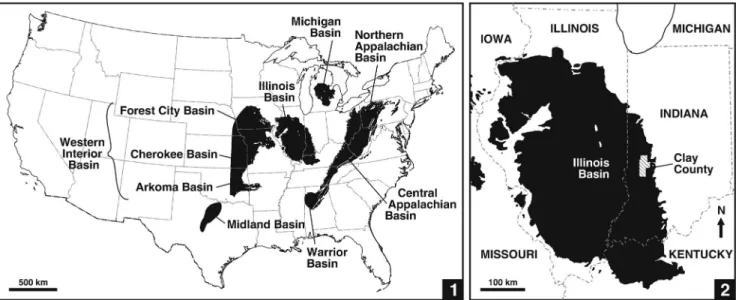
Illinois Basin.—The Illinois Basin (also called the Eastern Interior Basin) is an interior cratonic basin (Leighton et al., 1991), one of several large depocenters in the USA that contain coal-bearing strata of predominantly Pennsylvanian age (Fig. 1.1). In its present configuration, the basin underlies much of Illinois and parts of western Indiana and western Kentucky, with small outliers in Iowa and Missouri (Fig. 1.2). The Illinois Basin contains a largely siliciclastic succession of Morrowan to Virgilian (Bashkirian to Gzhelian, upper Namurian to upper Stephanian) strata (Nelson et al., 1991, 2013), which accumu- lated on a low-gradient slope that dipped toward a shallow epeiric sea (Watney et al., 1989; Greb et al., 2003). Glacioeu- static fluctuations from the west resulted in cyclic marine transgressions across the continental platform (Wanless and Shepard, 1935, 1936; Heckel, 1986; Langenheim and Nelson, 1992; Algeo and Heckel, 2008), and in accord with its paleo- geographic position, depositional environments in the Illinois Basin tend to be intermediate between the marine-dominated rocks of the Western Interior (Midcontinent) Basin and mainly deltaic to terrestrial strata of the Appalachian Basin to the east (Fig. 1.1; Heckel, 1977, 1980; Nelson et al., 2013). These basins developed in a paleoequatorial setting in the west-central part of Euramerica (Witzke, 1990), and were separated from eastern parts of the paleocontinent (present-day Europe)
Figure 1. Basins in contiguous USA that contain coal-bearing strata of Pennsylvanian age. (1) Western Interior, Illinois, Appalachian, and Michigan basins, and their components. (2) Illinois Basin, and position of Clay County, Indiana on eastern margin of basin.
by uplands of the Laurentian Shield and, in part, by the Appalachian-Variscan Mountains (Blakey, 2013).
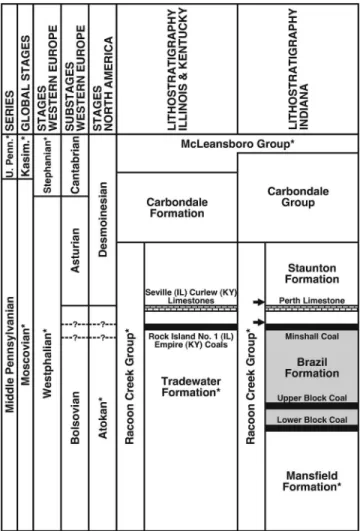
Study locality.—The study area is situated in Clay Country, west-central Indiana, on the eastern margin of the Illinois Basin (Fig. 1.1), where the thin and laterally discontinuous Lower Block, Upper Block, and Minshall coals of the upper Atokan Brazil Formation (Fig. 2) have been exploited due to their low to medium sulfur and ash content (Mastalerz et al., 2000, 2003;
Kvale et al., 2004). The Brazil Formation, defined as being from the base of the Lower Block Coal to the top of the Minshall Coal (Hutchison, 1976), is equivalent to the middle part of the Tradewater Formation of Illinois and Kentucky (The Tri-State Committee on Correlation of the Pennsylvanian System in the Illinois Basin, 2001). In Indiana, strata above the Minshall Coal are assigned to the Staunton Formation, which includes the
Perth Limestone, the top of which defines the Atokan- Desmoinesian Stage boundary based on palynology (Peppers, 1996). The Minshall Coal and overlying Perth Limestone correlate with the Rock Island (No. 1) Coal and Seville Limestone of northwestern Illinois and the Empire Coal and Curlew Limestone of southwestern Kentucky (Fig. 2; Tri-State Committee, 2001; Nelson et al., 2013).
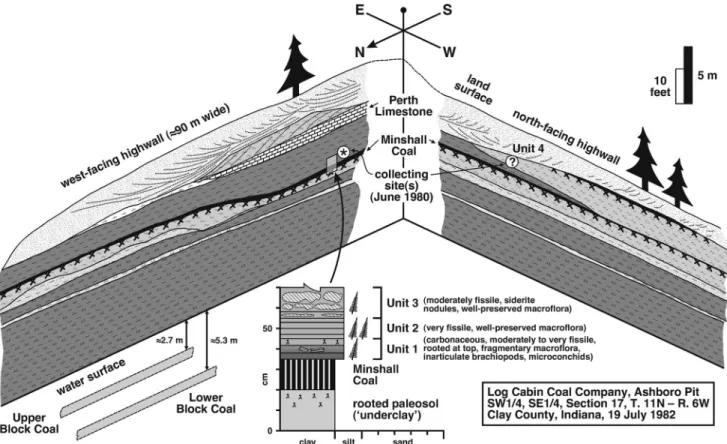
The macrofloral assemblage was collected from an open-pit mine north of Indiana Route 46, the now inaccessible Ashboro Pit (SW 1/4, SE 1/4, Section 17, Township 11N, Range 6W) operated by Log Cabin Coal Company. Plant fossils were collected during a reconnaissance in 1980, when the Lower Block and Upper Block coals were being mined, but the pit was idle and partlyfilled with water during a 1982 visit, leaving the upper highwall inaccessible. The west- and north-facing highwalls of the L-shaped pit are reproduced schematically in Figure 3. About 15 m of the Brazil and overlying Staunton formations were exposed, the lithostratigraphic boundary being the top of the Minshall Coal.
Correlation of limestone and coal members of the Brazil and Staunton formations is challenging due to their lenticular nature and variable lithology, but marker beds in the Ashboro Pit are identified with confidence (Fig. 3). The Lower and Upper Block coals are distinctive in this area, consisting of hard, dull- banded or ‘splint’ coal that separates into large cubic blocks along widely spaced joint planes. The type area of these coals is 15 km north of the locality, whereas the Minshall Coal and Perth Limestone have type sections five to 15 km farther north.
No other marine unit in the Brazil or lower Staunton formations in this part of Indiana is likely to be confused with the Perth Limestone.
Most macrofloral remains were collected from an ~35 cm- thick package of‘roof-shales’immediately above the Minshall Coal on the west-facing highwall (Units 1 to 3; Fig. 3), whereas some adpressions presumably are from a bed (Unit 4) on the north-facing highwall at a stratigraphic position above the Perth Limestone. All sampled beds belong to USNM Locality 38354.
Although the strata belong to the lowermost Staunton Forma- tion, as currently understood and depicted in Figure 2, Units 1 to 3 are assigned to the uppermost Atokan and Unit 4 to the lowermost Desmoinesian. Based on new data presented here, the age of the fossiliferous strata and position of the Atokan- Desmoinesian and Bolsovian-Asturian boundaries will be discussed in the Biostratigraphy and age section.
Fossiliferous units
A light-gray, rooted paleosol (‘underclay’) underlies the 15 cm- thick Minshall Coal (Fig. 3), which is relatively uniform in thickness, but undulatory due to irregularities on the paleosol surface. Following the‘low-stand coal’model (cf., Cecil, 1990;
Cecil et al., 2003, 2014; DiMichele, 2014), the Minshall Coal is interpreted to record peat buildup due to paludification and base-level rise under the (per)humid (everwet) conditions that attended a sea-level lowstand at maximum glaciation.
The ~35 cm-thick package of fossiliferous roof-shales above the Minshall Coal is divided into three distinct beds based on lithology and plant-fossil content (Units 1 to 3; Fig. 3).
Gradational with the underlying coal, Unit 1 (~10 cm thick) is a
Figure 2. Stratigraphy of Middle Pennsylvanian of Illinois Basin (as currently understood), showing correlation between chronostratigraphic and lithostratigraphic units (* indicates incomplete unit); compiled from Davydov et al. (2010,fig. 2), Falcon-Lang et al. (2011,fig. 1), and Nelson et al. (2013, fig. 2). Brazil Formation (shaded) incorporates strata from base of Lower Block Coal to top of Minshall Coal. Macrofloral assemblage collected from lowermost Staunton Formation (arrows). Atokan-Desmoinesian Stage boundary and Bolsovian-Asturian Substage boundary shown as coeval and equivalent to top of Perth, Seville, and Curlew limestones, after Peppers (1996). Dashed lines denote possible positions of one or both boundaries based on biostratigraphic data presented herein (see Fig. 7; Biostratigraphy and age section).
medium- to dark-gray, fissile, highly carbonaceous shale that contains abundant but fragmentary and poorly preserved plant remains. Spirorbiform worm-tubes (microconchids) are affixed to some fossil leaves, and inarticulate brachiopods occur sporadically. Fine root structures are present at the top of the bed. Unit 1 is interpreted to record deposition in the shallow, dysaerobic, and at least hyposaline waters of a tidally influenced mudflat or estuary, which developed above the precursor Minshall Coal during initial stages of transgression as degla- ciation commenced (cf., Archer et al., 1994, 2016; Mastalerz et al., 1997). Accordingly, plant remains mainly represent the remnants of drowned peat-forming vegetation. Roots at the top of the unit indicate upward shallowing, emergence, and devel- opment of a‘clastic swamp’(sensu Gastaldo, 1987; Demko and Gastaldo, 1992). The time required for establishment and colo- nization of the clastic swamp implies a temporary lull in sea level rise, possibly even a minor regressive event. Elsewhere in Clay County, the Minshall Coal consists of two distinct
‘benches’ separated by a clastic unit (up to 2.7 m thick) with roots at the top. A similar pattern occurs farther south in Daviess County, where a persistent claystone (~5 cm thick) exists near the middle of the Minshall Coal (incorrectly called the Buffaloville Coal by mine operators). As such, clastic swamp deposits at the top of Unit 1 may coincide with, and/or are a lateral equivalent of, the upper bench (Clay County) or upper part (Daviess County) of the Minshall Coal.
Unit 2 (~10 cm thick) is gradational with Unit 1, and comprises medium-gray, fissile, and well-indurated shale.
Adpressed plant fossils are abundant and well preserved. Unit 2 is interpreted to record renewed transgression and further accumulation of tidally influenced mudflat or estuarine deposits.
Macrofloral remains in this bed are thought to represent litter shed from clastic swamp vegetation on the periphery of the mudflat or estuary.
Unit 3 (~15 cm thick) is gradational with Unit 2, and consists of maroon, very well-indurated mudstone that contains siderite nodules. Macrofloral remains are well preserved but only moderately abundant. Unit 3 presumably resulted from additional base level rise due to transgression, with the presence of siderite nodules reflecting a change in depositional and/or diagenetic conditions on the mudflat or estuary. Adpressed plant fossils probably were derived from wetland vegetation in local clastic swamp habitats.
Unit 4 (10s of cm thick) consists of pinkish light-gray, well- laminated claystone that contains sparse but well-preserved plant adpressions. The most probable provenance is thefill of a hollow (Fig. 3) that was eroded down to the level of the Minshall Coal during the onset of regression, a consequence of polar ice buildup.
If this stratigraphic level is correct, Unit 4 may record the rapid filling of an abandoned channel, either in afluvial or tidally influ- enced deltaic setting. Plant debris probably was shed from clastic wetland plant communities alongside the abandoned channel.
Figure 3. Schematic drawing of succession exposed in Ashboro Pit (now inaccessible open-pit mine of Log Cabin Coal Company; SW 1/4, SE 1/4, Section 17, Township 11N, Range 6W), north of Indiana Route 46, Clay County, Indiana, during visits in June 1980 and July 1982. Brazil Formation incorporates strata from base of Lower Block Coal (under water) to top of Minshall Coal, and overlying strata belong to Staunton Formation. Top of Perth Limestone corresponds to Atokan-Desmoinesian boundary (Peppers, 1996). Macrofloral assemblage collected from roof-shales above Minshall Coal (Units 1 to 3, marked with *) on west-facing highwall, and presumably from claystone-filled hollow (Unit 4, marked with ?) on north-facing highwall. Note that Unit 4 is at stratigraphic position above the Perth Limestone. All sampled beds belong to USNM locality 38354.
Quantification and general characteristics offloral assemblages
Macrofloral assemblage.—Most plant remains are preserved as coalified compressions or impressions (i.e., adpressions; Shute and Cleal, 1987), although a small number of specimens are
‘naturally macerated’ (cf., Zodrow and Mastalerz, 2009).
Proximate analysis of a sample of the underlying Minshall Coal yields a vitrinite reflectance (%Romax) of 0.57, a coal rank of high-volatile C bituminous (Teichmüller and Teichmüller, 1982). Such a low rank indicates that phytoleims (coalified compressions) probably contain epidermal cuticles, although no attempt was made to procure cuticles.
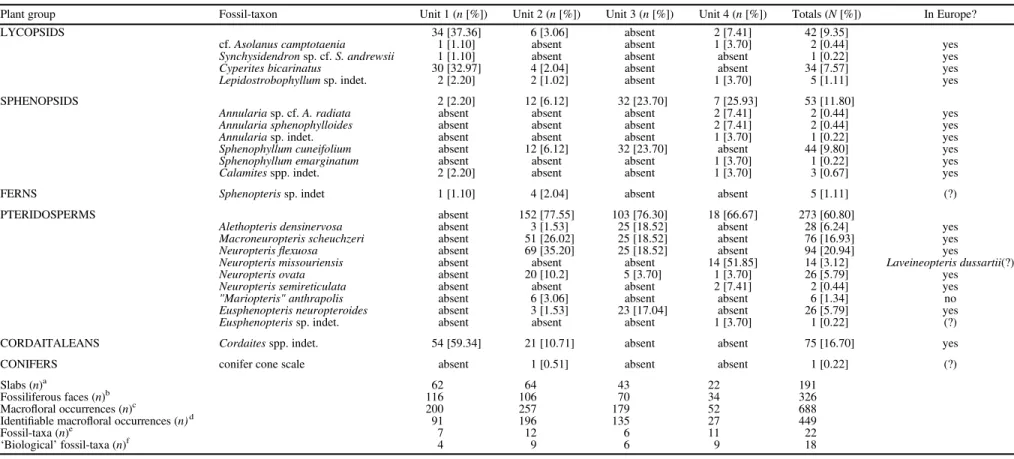
Table 1 presents a quantitative breakdown of the rock slabs and fossil-taxa in Units 1 to 4, and for the macrofloral assemblage as a whole. Of the 191 slabs collected, 326 slab faces bear macrofloral remains (excluding barren faces and counterparts). The quantification technique used is a variant of that described by Pfefferkorn et al. (1975): each slab face was treated as a quadrat, and a fossil-taxon was recorded as‘present’ regardless of the number of specimens on the face. Through this process, 688 macrofloral occurrences were recorded on the 326 fossiliferous slab faces. Excluding seeds and some axes, which could not be tied to a particular fossil-plant taxon with confidence (termed ‘unidentifiable’macrofloral occurrences in Table 1), there were 449‘identifiable’macrofloral occurrences.
Of the 22 fossil-taxa identified (Table 1), 18 can be considered‘biological’taxa (i.e., a reassembled conceptualiza- tion of a whole and once-living fossil plant; sensu Cleal and Thomas, 2010), whereas only four ‘non-biological’taxa were recorded (Cyperites bicarinatus Lindley and Hutton, 1832, Lepidostrobophyllum Hirmer, 1927 [sp. indet.], Calamites Brongniart, 1828a [spp. indet.], and a putative conifer cone scale). It is noted, however, that each fossiliferous bed contains a low-diversity assemblage, ranging from six to 12 fossil-taxa and four to nine biological taxa. When relative abundances for the entire macrofloral assemblage are considered, pteridosperms are the predominant (60.8%) and most diverse plant group (nine biological fossil-species). The sphenopsids (11.8%) are rela- tively diverse (five biological species), whereas all cordaitalean remains (16.7%) are included in Cordaites Unger, 1850 (spp. indet). The lycopsids (9.4%) are represented by two biological species, and fern and putative conifer remains are very rare.
Microfloral assemblage.—Samples of the Minshall Coal and four fossiliferous clastic units (~150 g of rock/coal crushed and sieved through–20 mesh) were oxidized using Schulze’s Solution (nitric acid saturated with potassium chlorate) to liberate spores and pollen, followed by digestion in 5% potassium hydroxide.
The organic fraction was concentrated with zinc chloride solution, and treated with ethylene glycol monoethyl ether (2-ethoxyethanol) and ultrasonic vibration to remove fine parti- culate matter from the spore/pollen fraction. Slides were prepared by strew-mounting a small amount of spore/pollen residue with polyvinyl alcohol on cover glasses, which were fixed with a synthetic piccolyte resin. Line counts (250 palynomorphs per sample) were performed at 640X magnification to establish
relative abundances, and additional slides were scanned at 250X to document forms of potential biostratigraphic significance that were not encountered in statistical counts. All slides, maceration residues, and unused portions of samples are stored at the Kentucky Geological Survey (KGS), University of Kentucky, Lexington, KY under KGS sample numbers 3264–3268.
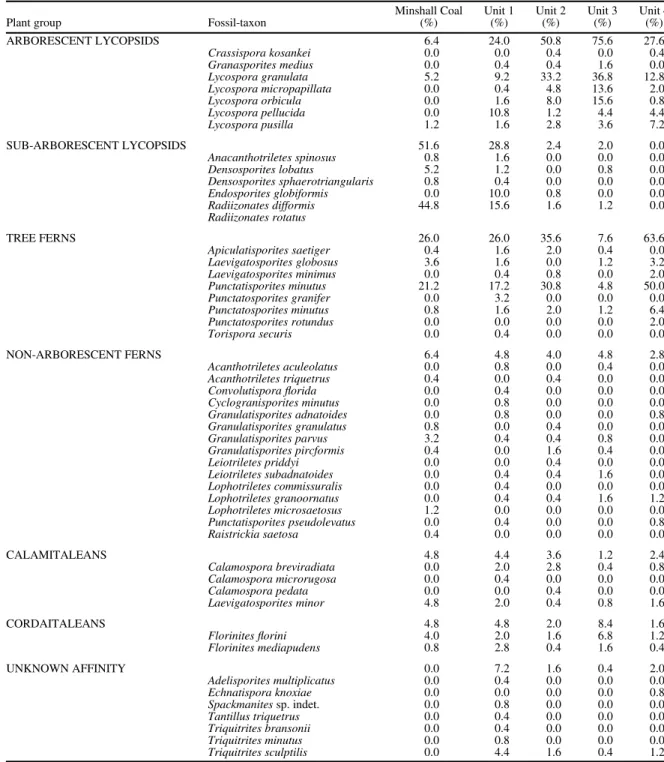
Table 2 gives a quantitative breakdown of the plant groups and fossil-taxa found in the Minshall Coal and Units 1 to 4.
Forty-nine miospore species were identified, seven of unknown affinity. The beds are dominated by spores of arborescent or sub-arborescent lycopsids (Minshall Coal, Units 1 to 3) or by tree ferns (Unit 4). Non-arborescent fern and calamitalean spores are rare, as is cordaitalean pollen. Although pteridosperm foliage dominates the macrofloral assemblage, it is emphasized that no samples contain pteridosperm pollen, despite targeted searches, even in maceration residues of the ≤250µm size fraction. Thus, although pteridosperm pollen typically is very large (100–600µm; Taylor, 1978) and may be excluded by traditional preparation techniques (Peppers and Pfefferkorn, 1970), some grains should have been found if present. Because this paper focuses on the macrofloral assemblage, the micro- floral data are only used to provide complementary biostrati- graphic control.
Biostratigraphy and age
The Minshall Coal and overlying Perth Limestone of western Indiana (Fig. 2), along with their correlates in southern Indiana (‘Buffaloville’Coal [see below], Curlew Limestone), western Kentucky (Empire Coal, Curlew Limestone), and western Illinois (Rock Island [No. 1] Coal, Seville Limestone), have figured prominently in the discussion surrounding placement of the contentious Atokan-Desmoinesian Stage boundary in the Illinois Basin (e.g., Shaver, 1984; Peppers, 1996; Heckel, 2013;
Nelson et al., 2013). Because a precisely defined Atokan stra- totype has yet to be realized (Sutherland and Manger, 1984), in large part because the poorly fossiliferous Atoka Formation (defined in the Arkoma Basin, Oklahoma; Fig. 1.1) is depositionally and tectonically complex, the position of the Atokan-Desmoinesian boundary in the Illinois Basin has shifted depending on the fossil group used for biostratigraphic control.
For example, marine faunas in the limestones have indicated either an early Desmoinesian age (ostracodes and fusulinids:
Shaver and Smith, 1974, Shaver, 1984; conodonts: Rexroad et al., 1998; fusulinids: Wahlman, 2013) or a late Atokan age (fusulinid foraminifera: Douglass, 1987; conodonts: Barrick et al., 2013).
Likewise, the Atokan-Desmoinesian boundary was placed at the top of the Seville, Perth, and Curlew limestones based on the correlation of microfloral assemblages from coal seams (Peppers, 1996; Fig. 2). By extension of these uncertainties, the position of the Minshall and equivalent coals remains uncertain in chronos- tratigraphic terms, although the seams usually are placed in the uppermost Atokan (Nelson et al., 2013).
Conodonts from the limestone directly overlying the Buffaloville Coal in its type area (southern Indiana) indicate that it is younger than the Perth, Curlew, and Seville limestones (personal communication, P.H. Heckel, 2014; Fig. 2). This result corroborates the palynological study of Peppers (1993),
Table 1.Fossil-taxa in macrofloral assemblage, from Units 1 to 4 above Minshall Coal (Fig. 3), segregated into plant groupings. Right-hand column indicates if fossil-taxon present in Europe. Symbols: (a) total slabs from unit; (b) slab faces with macrofloral remains (i.e., excludes barren faces and counterparts); (c) identifiable macrofloral occurrences +‘unidentifiable’macrofloral occurrences (e.g., axes and seeds); (d) occurrence indicates presence (in any quantity) on slab face; (e)‘biological’fossil-taxa +‘non-biological’fossil-taxa (Cyperites bicarinatusLindley and Hutton, 1832,LepidostrobophyllumHirmer, 1927 [sp.
indet.],CalamitesBrongniart, 1828a [spp. indet.], and putative conifer cone scale); (f) reassembled conceptualization of once-living, whole fossil plant. See text for details.
Plant group Fossil-taxon Unit 1 (n[%]) Unit 2 (n[%]) Unit 3 (n[%]) Unit 4 (n[%]) Totals (N[%]) In Europe?
LYCOPSIDS 34 [37.36] 6 [3.06] absent 2 [7.41] 42 [9.35]
cf.Asolanus camptotaenia 1 [1.10] absent absent 1 [3.70] 2 [0.44] yes
Synchysidendronsp. cf.S. andrewsii 1 [1.10] absent absent absent 1 [0.22] yes
Cyperites bicarinatus 30 [32.97] 4 [2.04] absent absent 34 [7.57] yes
Lepidostrobophyllumsp. indet. 2 [2.20] 2 [1.02] absent 1 [3.70] 5 [1.11] yes
SPHENOPSIDS 2 [2.20] 12 [6.12] 32 [23.70] 7 [25.93] 53 [11.80]
Annulariasp. cf.A. radiata absent absent absent 2 [7.41] 2 [0.44] yes
Annularia sphenophylloides absent absent absent 2 [7.41] 2 [0.44] yes
Annulariasp. indet. absent absent absent 1 [3.70] 1 [0.22] yes
Sphenophyllum cuneifolium absent 12 [6.12] 32 [23.70] absent 44 [9.80] yes
Sphenophyllum emarginatum absent absent absent 1 [3.70] 1 [0.22] yes
Calamitesspp. indet. 2 [2.20] absent absent 1 [3.70] 3 [0.67] yes
FERNS Sphenopterissp. indet 1 [1.10] 4 [2.04] absent absent 5 [1.11] (?)
PTERIDOSPERMS absent 152 [77.55] 103 [76.30] 18 [66.67] 273 [60.80]
Alethopteris densinervosa absent 3 [1.53] 25 [18.52] absent 28 [6.24] yes
Macroneuropteris scheuchzeri absent 51 [26.02] 25 [18.52] absent 76 [16.93] yes
Neuropterisflexuosa absent 69 [35.20] 25 [18.52] absent 94 [20.94] yes
Neuropteris missouriensis absent absent absent 14 [51.85] 14 [3.12] Laveineopteris dussartii(?)
Neuropteris ovata absent 20 [10.2] 5 [3.70] 1 [3.70] 26 [5.79] yes
Neuropteris semireticulata absent absent absent 2 [7.41] 2 [0.44] yes
"Mariopteris" anthrapolis absent 6 [3.06] absent absent 6 [1.34] no
Eusphenopteris neuropteroides absent 3 [1.53] 23 [17.04] absent 26 [5.79] yes
Eusphenopterissp. indet. absent absent absent 1 [3.70] 1 [0.22] (?)
CORDAITALEANS Cordaitesspp. indet. 54 [59.34] 21 [10.71] absent absent 75 [16.70] yes
CONIFERS conifer cone scale absent 1 [0.51] absent absent 1 [0.22] (?)
Slabs (n)a 62 64 43 22 191
Fossiliferous faces (n)b 116 106 70 34 326
Macrofloral occurrences (n)c 200 257 179 52 688
Identifiable macrofloral occurrences (n)d 91 196 135 27 449
Fossil-taxa (n)e 7 12 6 11 22
‘Biological’fossil-taxa (n)f 4 9 6 9 18
JournalofPaleontology90(4):589–631
who concluded that the true Buffaloville Coal is younger than the Minshall Coal.
According to Peppers (1996), the Atokan-Desmoinesian Stage boundary of North America coincides with the Bolsovian- Asturian Substage boundary of Western Europe (Figs. 2, 4).
If placement of this coupled boundary at the top of the Perth Limestone (and correlates) is accepted, the implication is that the underlying Minshall Coal (and correlates) are late Bolsovian in age. In the following section, the taxonomic composition of the microfloral and macrofloral assemblages from the Minshall Coal and overlying roof-shales (Units 1 to 3) are compared with
established biozonation schemes to determine whether or not this assumption holds. Unit 4, which is presumed to have been at a stratigraphic position above the Perth Limestone (Fig. 3), can be assigned an earliest Asturian age by default because it lies just above the Atokan-Desmoinesian boundary (Fig. 2).
Comparison with American microfloral biozonation.—Peppers (1984, 1996) constructed a microfloral biozonation scheme to facilitate regional correlation between the Illinois Basin and other parts of Euramerica. According to this framework (Fig. 4), the Brazil Formation is in the upper (but not uppermost)
Table 2.Fossil-taxa in microfloral assemblage, from Minshall Coal and Units 1 to 4 above coal (Fig. 3), segregated into plant groupings/
growth forms.
Plant group Fossil-taxon
Minshall Coal (%)
Unit 1 (%)
Unit 2 (%)
Unit 3 (%)
Unit 4 (%)
ARBORESCENT LYCOPSIDS 6.4 24.0 50.8 75.6 27.6
Crassispora kosankei 0.0 0.0 0.4 0.0 0.4
Granasporites medius 0.0 0.4 0.4 1.6 0.0
Lycospora granulata 5.2 9.2 33.2 36.8 12.8
Lycospora micropapillata 0.0 0.4 4.8 13.6 2.0
Lycospora orbicula 0.0 1.6 8.0 15.6 0.8
Lycospora pellucida 0.0 10.8 1.2 4.4 4.4
Lycospora pusilla 1.2 1.6 2.8 3.6 7.2
SUB-ARBORESCENT LYCOPSIDS 51.6 28.8 2.4 2.0 0.0
Anacanthotriletes spinosus 0.8 1.6 0.0 0.0 0.0
Densosporites lobatus 5.2 1.2 0.0 0.8 0.0
Densosporites sphaerotriangularis 0.8 0.4 0.0 0.0 0.0
Endosporites globiformis 0.0 10.0 0.8 0.0 0.0
Radiizonates difformis 44.8 15.6 1.6 1.2 0.0
Radiizonates rotatus
TREE FERNS 26.0 26.0 35.6 7.6 63.6
Apiculatisporites saetiger 0.4 1.6 2.0 0.4 0.0
Laevigatosporites globosus 3.6 1.6 0.0 1.2 3.2
Laevigatosporites minimus 0.0 0.4 0.8 0.0 2.0
Punctatisporites minutus 21.2 17.2 30.8 4.8 50.0
Punctatosporites granifer 0.0 3.2 0.0 0.0 0.0
Punctatosporites minutus 0.8 1.6 2.0 1.2 6.4
Punctatosporites rotundus 0.0 0.0 0.0 0.0 2.0
Torispora securis 0.0 0.4 0.0 0.0 0.0
NON-ARBORESCENT FERNS 6.4 4.8 4.0 4.8 2.8
Acanthotriletes aculeolatus 0.0 0.8 0.0 0.4 0.0
Acanthotriletes triquetrus 0.4 0.0 0.4 0.0 0.0
Convolutisporaflorida 0.0 0.4 0.0 0.0 0.0
Cyclogranisporites minutus 0.0 0.8 0.0 0.0 0.0
Granulatisporites adnatoides 0.0 0.8 0.0 0.0 0.8
Granulatisporites granulatus 0.8 0.0 0.4 0.0 0.0
Granulatisporites parvus 3.2 0.4 0.4 0.8 0.0
Granulatisporites pircformis 0.4 0.0 1.6 0.4 0.0
Leiotriletes priddyi 0.0 0.0 0.4 0.0 0.0
Leiotriletes subadnatoides 0.0 0.4 0.4 1.6 0.0
Lophotriletes commissuralis 0.0 0.4 0.0 0.0 0.0
Lophotriletes granoornatus 0.0 0.4 0.4 1.6 1.2
Lophotriletes microsaetosus 1.2 0.0 0.0 0.0 0.0
Punctatisporites pseudolevatus 0.0 0.4 0.0 0.0 0.8
Raistrickia saetosa 0.4 0.0 0.0 0.0 0.0
CALAMITALEANS 4.8 4.4 3.6 1.2 2.4
Calamospora breviradiata 0.0 2.0 2.8 0.4 0.8
Calamospora microrugosa 0.0 0.4 0.0 0.0 0.0
Calamospora pedata 0.0 0.0 0.4 0.0 0.0
Laevigatosporites minor 4.8 2.0 0.4 0.8 1.6
CORDAITALEANS 4.8 4.8 2.0 8.4 1.6
Florinitesflorini 4.0 2.0 1.6 6.8 1.2
Florinites mediapudens 0.8 2.8 0.4 1.6 0.4
UNKNOWN AFFINITY 0.0 7.2 1.6 0.4 2.0
Adelisporites multiplicatus 0.0 0.4 0.0 0.0 0.0
Echnatispora knoxiae 0.0 0.0 0.0 0.0 0.8
Spackmanitessp. indet. 0.0 0.8 0.0 0.0 0.0
Tantillus triquetrus 0.0 0.4 0.0 0.0 0.0
Triquitrites bransonii 0.0 0.4 0.0 0.0 0.0
Triquitrites minutus 0.0 0.8 0.0 0.0 0.0
Triquitrites sculptilis 0.0 4.4 1.6 0.4 1.2
Bolsovian part of the Radiizonates difformis (RD) Biozone, with the top of the Minshall Coal corresponding to the top of the biozone (Peppers, 1996).
The composition of the microfloral assemblage (Table 2) supports assignment of the Minshall Coal and overlying roof- shales to theRadiizonates difformis(RD) Biozone. Of particular importance is the presence of the diagnostic densospores Radiizonates difformis(Kosanke, 1950) Staplin and Jansonius, 1964 and Radiizonates rotatus (Kosanke, 1950) Staplin and Jansonius, 1964, which are most abundant in the coal and Unit 1. Further, none of the beds (including Unit 4) contain the namesake taxa of the succeedingCadiospora magna-Mooreis- porites inusitatus (MI) Biozone (Fig. 4). Cadiospora magna Kosanke, 1950 first appeared at the Bolsovian-Asturian boundary, whereas Mooreisporites inusitatus(Kosanke, 1950) Neves, 1958 arose in the latest Bolsovian (Peppers, 1996).
These factors collectively point to a late Bolsovian age for the Minshall Coal and overlying clastic beds.
Nonetheless, a microfloral assemblage from a clastic unit directly beneath the paleosol of the Minshall Coal adds uncertainty to this late Bolsovian assignment (these data, incorporated into another publication, are introduced here because they have important ramifications on the age of overlying strata). Most
noteworthy is the statistically significant abundance ofThymospora pseudothiessenii (Kosanke, 1950) Wilson and Venkatachala, 1963. The spore is considered a reference for basal Asturian, although itfirst appears in uppermost Bolsovian strata (Peppers, 1996; Lesnikowska and Willard, 1997) and reaches its epibole in the middle AsturianSchopfites colchesterensis-Thymospora pseudothiessenii(CP) Biozone (Fig. 4). Equally intriguing is the fact thatSavitrisporites nux(Butterworth and Williams, 1958) Smith and Butterworth, 1967 occurs (albeit very rarely) beneath the Minshall Coal, but not in the coal itself. Because this spore disappears just below the Bolsovian-Asturian boundary (Peppers, 1996), its absence in the coal does not in itself imply an Asturian age for the Minshall, but it does signify peat accumulation very close to the substage boundary. It is crucial to note that the scheme of Peppers (1984, 1996) is almost exclusively based on palynomorphs from coal, and many taxon ranges would be extended if clastic lithologies had been incorporated. These additional microfloral data signify that an earliest Asturian age for the Minshall Coal cannot be ruled out.
Comparison with American macrofloral biozonation.—Moore et al. (1944) and Read and Mamay (1964) segregated upper Paleozoic strata of the USA into fifteen macrofloral zones defined by the co-occurrence of common or diagnostic taxa.
Unfortunately, the absence of range charts and ambiguity of zone boundaries make this biostratigraphic framework difficult to apply. Gillespie and Pfefferkorn (1979) discussed the tem- poral distribution of key taxa and charted their ranges in the Appalachian Basin. Extending this work, Blake et al. (2002) produced an updated chart that correlates between lithostrati- graphic units of the Appalachian Basin, chronostratigraphic units of midcontinental USA and Western Europe, and macrofloral zones of the USA (Read and Mamay, 1964) and paleoequatorial Europe (Wagner, 1984). According to Blake et al. (2002, fig. 1, with updates from B.M. Blake, personal communication, 2014), the Atokan-Desmoinesian boundary, which they equated to the Bolsovian-Asturian boundary following Peppers (1996), is at the Upper Block (No. 5) Coal near the contact between the Kanawha and Allegheny forma- tions (Fig. 5). This level correlates to the middle of Zone 9 (‘Neuropteris’rarinervis) of Read and Mamay (1964).
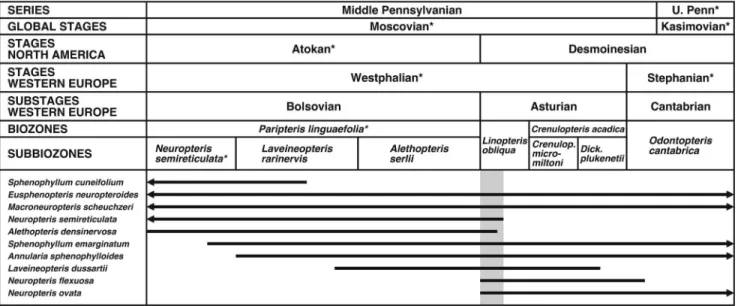
Blake et al. (2002, fig. 2) also provided a biostratigraphic range chart that shows the distribution of important fossil-taxa in the Appalachian Basin. A pragmatic approach to determining the age of the macrofloral assemblage above the Minshall Coal has been to compile the ranges of key fossil-species in the Appalachian Basin (e.g., Read and Mamay, 1964; Darrah, 1969;
Gillespie and Pfefferkorn, 1979; Blake et al., 2002; personal communication, B.M. Blake, 2014). The results of this exercise (Fig. 5) are somewhat ambiguous, in part because the first appearance datum (FAD) and last appearance datum (LAD) of Neuropteris semireticulata Josten, 1962, Neuropteris ovata Hoffmann, 1826a, 1826b, and Neuropteris flexuosa Sternberg, 1825 are poorly constrained. Additionally, a short hiatus may exist between the Kanawha and Allegheny formations (personal communication, B.M. Blake, 2014), further confounding age determination. Nonetheless, the compilation indicates that the macrofloral assemblage contains several species thatfirst appear in the middle Bolsovian but extend into and are more typical of the
Figure 4. Microfloral biozonation scheme of Peppers (1984, 1996) correlated with chronostratigraphic and lithostratigraphic units (* indicates incomplete unit). Modified from Peppers (1996, pl. 1). Microfloral assemblage corresponds to upperRadiizonates difformis(RD) Biozone.
Asturian. Maximum range overlap occurs in a late Bolsovian to earliest Asturian interval, equivalent to much of Zone 9 (‘Neuropteris’rarinervis) and in accord with the age suggested by the microfloral assemblage.
In contrast to Europe and Atlantic Canada (see below), in the USA Neuropteris ovata occurs sparingly in middle Bolsovian assemblages (Zone 8—‘Neuropteris’tenuifolia), is abundant in (but not characteristic of) late Bolsovian to early Asturian assemblages (Zone 9—‘Neuropteris’rarinervis), and only becomes more common in younger strata (Jongmans, 1937c; Read and Mamay, 1964; Darrah, 1969; Gillespie and Pfefferkorn, 1979; Blake et al., 2002). Likewise, Read and Mamay (1964) noted rare occurrences of Neuropterisflexuosa in Zone 8, but indicated that the species only became abundant in the middle to late Asturian (Zone 10—Neuropterisflexuosa and Pecopteris spp.); Darrah (1969) placed the FAD in the lower Allegheny Formation (lower Asturian).
That Neuropteris ovata and Neuropteris flexuosa first appear in middle to upper Bolsovian strata in the USA is supported by re-examination of specimens illustrated by Wood (1963), who documented assemblages from above the middle(?) Bolsovian Lower Block Coal in western Indiana (Fig. 2).
Although poorly preserved and fragmentary, both species seem to be present: N. ovata was misidentified under Neuropteris obliqua? (pl. 9, fig. 10) andOdontopteris subcuneata (pl. 10, fig. 5), whereas N. flexuosa may have been both correctly identified (pl. 9, fig. 5) and referred to Neuropteris hetero- phylla? (pl. 9,fig. 6). However, all of these taxa are listed as being“not common”(Wood, 1963, p. 32), indicating that they were not characteristic of the assemblages.
This analysis indicates that roof-shales above the Minshall Coal are either late Bolsovian or early Asturian in age. However, the fact that Neuropteris flexuosa is the most abundant pteridosperm in Units 2 and 3 (Table 1), and thatNeuropteris ovataalso is a common element in these beds, indicates that an early Asturian age is most probable.
Comparison with European macrofloral biozonation.—Building on previous biostratigraphic schemes (e.g., Dix, 1934; Bell, 1938;
Gothan and Remy, 1957; Corsin and Corsin, 1971; Laveine, 1977), a comprehensive framework for Carboniferous plant fossils was assembled by Wagner (1984), who compared the ranges of key taxa and incorporated preexisting floral zones to establish sixteen distinct biozones. The biozonation has been refined to improve its resolution, with several subbiozones now recognized (Cleal, 1991; Cleal and Thomas, 1994). Although primarily based on range data from western and central Europe, Wagner (1984) intended that the scheme would aid biostratigraphic correlations throughout the Euramerican paleoequatorial belt.
Comparison with the European biozonation (Fig. 6) is based on the compilation of taxon ranges as known in Western Europe (e.g., Laveine, 1987; Wagner, 1984; Cleal and Thomas, 1994). Although some taxa are long ranging, there is minimal overlap between the LAD of Neuropteris semireticulata and Alethopteris densinervosa Wagner, 1968 and the FAD of Neuropteris flexuosa and members of the Neuropteris ovata complex, the latter group being considered a guide to the basal Asturian (Van Leckwijck, 1964; Laveine, 1977; Wagner, 1984).
Accordingly, the age of the macrofloral assemblage can be tightly constrained to the early Asturian, assignable to the Linopteris obliqua Biozone. The anomalous presence of Sphenophyllum cuneifolium(Sternberg, 1821) Zeiller, 1878-79a, more typical of lower Westphalian assemblages, does not override this outcome.
Stratigraphic ramifications.—These homotaxial comparisons yield slightly different age results for the Minshall Coal and overlying roof-shales depending on the fossil group or bios- tratigraphic framework used: (1) probably latest Bolsovian (American microfloras; Fig. 4); (2) latest Bolsovian or earliest Asturian (Appalachian Basin macrofloras; Fig. 5); or (3) earliest Asturian (European macrofloras; Fig. 6). Although all analyses clearly convey that both peat and clastic sediment accumulation
Figure 5. Biostratigraphic ranges of key fossil-species in macrofloral assemblage correlated with chronostratigraphic units, lithostratigraphic units of Central Appalachian Basin, and American macrofloral biozonation scheme of Read and Mamay (1964) (* indicates incomplete unit); compiled from Darrah (1969), Gillespie and Pfefferkorn (1979), Blake et al. (2002), and B.M. Blake (personal communication, 2014). Maximum range overlap occurs in upper Kanawha to lower Allegheny formations (late Atokan to early Desmoinesian, late Bolsovian to early Asturian), equivalent to most of Zone 9 (‘Neuropteris’rarinervis).
occurred close to the Bolsovian-Asturian boundary, three cru- cial points need to be addressed before attempting to refine the stratigraphic resolution. First, the Minshall Coal and overlying roof-shales need not be the same age; the boundary may have been crossed in the interim between the final phases of peat accumulation and the drowning and burial of the mire during transgression. Second, significant (and perhaps undue) weight has been placed on coincidence of the Bolsovian-Asturian and Atokan-Desmoinesian boundaries, especially since they were defined in widely separated areas based on different parameters.
Third, there must have been a temporal lag between the evolu- tion of a new plant taxon and its dispersal to other parts of paleoequatorial Euramerica (cf., Laveine et al., 2000; Blake et al., 2002). These factors are taken into account as four stratigraphic scenarios are explored for the study section, each of which attempts to rectify the slightly disparate ages recorded in the microfloral and macrofloral assemblages.
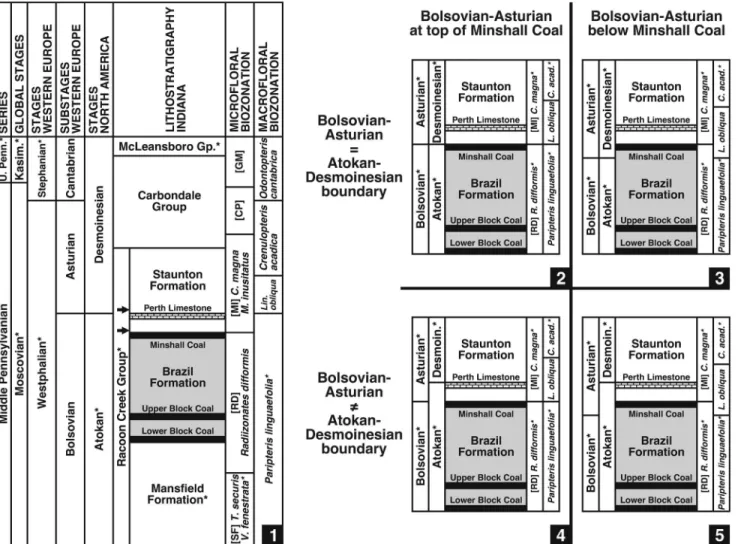
Figure 7.1 shows the currently accepted correlation scheme in the Indiana portion of the Illinois Basin (with a focus on the Brazil and Staunton formations) and displays the relationships among chronostratigraphic, lithostratigraphic, and biostratigraphic units, at least as they have been understood prior to this analysis.
The Bolsovian-Asturian Substage and Atokan-Desmoinesian Stage boundaries are equivalent and occur at the top of the Perth Limestone; the Minshall Coal belongs to the Radiizonates difformis(RD) Biozone and, by implication, the Minshall Coal and its roof-shales (Units 1 to 3) are upper Bolsovian. However, this scenario only is valid ifNeuropteris ovataandNeuropteris flexuosacan occur in abundance in late Bolsovian assemblages.
As noted above, both taxa make scattered appearances in middle to upper Bolsovian strata in the USA, but do not become common until the Asturian (Fig. 5;N. ovatain Zone 9,N.flexuosain Zone 10 of Read and Mamay, 1964).
Introduction of the European macrofloral biozonation framework indicates that the roof-shales (Units 1 to 3) above the Minshall Coal (but not necessarily the coal itself) are no
older than earliest Asturian (Fig. 6). At least four scenarios are possible (Fig. 7.2–7.5); all include the Minshall Coal in the Radiizonates difformis(RD) Biozone and its roof-shales in the Linopteris obliquaBiozone.
Scenario one.—The Bolsovian-Asturian and Atokan- Desmoinesian boundaries could remain coupled and lowered to the top of the Minshall Coal (Fig. 7.2). The implications are that the precursor mire existed during the latest Bolsovian (latest Atokan), and that a chronostratigraphic boundary was crossed before trans- gression and deposition of the roof-shales in the earliest Asturian (earliest Desmoinesian). As a consequence, the contact between the R. difformis (RD) and Cadiospora magna-Mooreisporites inusitatus (MI) microfloral biozones would be slightly younger than the late Bolsovian (late Atokan) age proposed by Peppers (1996; Fig. 7.1), and the basalmost Staunton Formation would correspond to the lower Asturian (lower Desmoinesian).
Scenario two.—The coupled Bolsovian-Asturian and Atokan-Desmoinesian boundary could be situated somewhere below the Minshall Coal (Fig. 7. 3), meaning that both the peat and overlying clastics accumulated during the earliest Asturian (earliest Desmoinesian). Consequently, the upper part of the R. difformis (RD) Biozone and uppermost Brazil Formation would be younger than currently understood (Fig. 7.1).
Scenario three.—The Bolsovian-Asturian and Atokan- Desmoinesian boundaries could be decoupled, with the former lowered to the top of the Minshall Coal and the latter remaining at the top of the Perth Limestone (Fig. 7.4). The ramifications mostly mirror those for point 1, except that the uppermost Brazil Formation, lowermost Staunton Formation, and lower part of theC. magna-M. inusitatus(MI) Biozone would be retained in the uppermost Atokan (although now correlative to the lower- most Asturian).
Scenario four.—The decoupled Bolsovian-Asturian boundary could be placed at an even lower position below the Minshall Coal (Fig. 7.5). As in point 3, the upper Brazil, lower Staunton, and lower C. magna-M. inusitatus (MI) Biozone
Figure 6. Biostratigraphic ranges of key fossil-species in macrofloral assemblage correlated with chronostratigraphic units and European macrofloral biozonation scheme. Compiled from Wagner (1984), Laveine (1987), Cleal (1991), and Cleal and Thomas (1994). Range ofLaveineopteris dussartii(Laveine, 1967) Laveine, 2005 included because may be synonymous withNeuropteris missouriensisLesquereux, 1879-80. Maximum range overlap occurs in lower Linopteris obliquaBiozone (early Asturian, early Desmoinesian).
would remain in the upper Atokan, but would correspond to an even younger Asturian age.
All four scenarios have validity, but because this study deals with plant-fossil assemblages from one locality, no further attempt is made to recommend one over another. However, decoupling the Bolsovian-Asturian and Atokan-Desmoinesian boundaries, and lowering the former to the top of (or below) the Minshall Coal (points 3 and 4) is considered the least disruptive to the established stratigraphic framework. Similar studies at other sites in the Illinois Basin and elsewhere are necessary to rectify the position of the Bolsovian-Asturian Substage boundary of western Europe and its relationship to the Atokan-Desmoinesian Stage boundary in the USA.
Paleobiogeographic and paleoecologic implications The temporal persistence of peat-inhabiting wetland vegetation in Pennsylvanian mires is well established, with evidence pointing to
long periods of ecological stability through recurring glacioeu- static cycles, and the repeated reassembly of communities drawn from a small pool of edaphic specialists when climatic conditions were favorable (DiMichele and Phillips, 1996a, 1996b; DiMichele et al., 1996, 2002; Willard et al., 2007; Falcon-Lang and DiMichele, 2010). Comparable patterns of persistence and com- positional recurrence also existed in vegetation from associated clastic wetland habitats (Scott, 1978; Pfefferkorn and Thomson, 1982; DiMichele et al., 1996; Cleal et al., 2012; Tabor et al., 2013). These low-diversity ecosystems were the product of prolonged evolution under the intrinsically stressful conditions that typify wetland settings, which are effectively closed systems with low rates of speciation and turnover, and that experience little taxonomic exchange with terra-firma habitats (Knoll, 1985;
DiMichele et al., 1987; Wing and DiMichele, 1995; DiMichele and Phillips, 1996a; Cleal et al., 2012).
Pennsylvanian wetland communities also retained compo- sitional conservatism at a variety of spatial scales. Over tens of
Figure 7. Options for placement of Atokan-Desmoinesian Stage boundary and Bolsovian-Asturian Substage boundary based on biostratigraphic data presented herein. (1) Stratigraphy of Middle Pennsylvanian of Indiana part of Illinois Basin (as currently understood), showing correlation between chronostratigraphic and lithostratigraphic units, and American microfloral and European macrofloral biozonation schemes (* indicates incomplete unit). Compiled from Figures 2, 4, and 6. Macrofloral assemblage collected from lowermost Staunton Formation (arrows). For all four scenarios presented in 7.2–7.5, Minshall Coal retained in Radiizonates difformis(RD) Biozone and clastic units bearing macrofloral assemblage (arrows) inLinopteris obliquaBiozone. (2) Atokan-Desmoinesian and Bolsovian-Asturian boundaries remain coupled and lowered to top of Minshall Coal. (3) Atokan-Desmoinesian and Bolsovian-Asturian boundaries remain coupled and lowered to below Minshall Coal. (4) Atokan-Desmoinesian and Bolsovian-Asturian boundaries decoupled, with Atokan-Desmoinesian boundary retained at top of Perth Limestone and Bolsovian-Asturian boundary lowered to top of Minshall Coal. (5) Atokan-Desmoinesian and Bolsovian-Asturian boundaries decoupled, with Atokan-Desmoinesian boundary retained at top of Perth Limestone and Bolsovian-Asturian boundary lowered to below Minshall Coal. See discussion in text for stratigraphic ramifications of each scenario.
meters to a few kilometers, mire vegetation was markedly heterogeneous yet encompassed a limited species pool (Pfefferkorn, 1979; DiMichele and Nelson, 1989; Pryor and Gastaldo, 2000; Gastaldo et al., 2004, DiMichele et al., 2007, Opluštil et al., 2009a, 2009b), and clastic wetland floras displayed a comparable mosaic of low-diversity patches (Wing and DiMichele, 1995; Bashforth et al., 2010, 2011; Cleal et al., 2012). However, local-scale variability was masked at the landscape or regional scale, and disappeared into the back- ground of the restricted wetland species pool. An expression of this homogeneity is discussed by Moore et al. (2014), who demonstrated that two contemporaneous clastic wetlandfloras, separated by 1100 km on the American craton, showed convergent dominance-diversity structures and a remarkable degree of compositional similarity.
A key result of this study is confirmation that Pennsylva- nian communities from clastic wetland habitats showed spatial conservatism over vast areas of tropical Euramerica. Despite promulgations about the lack of similarity between American and European adpressed macrofloral assemblages, this notion can be tempered, at least for the Middle Pennsylvanian time interval studied. Of the 18 biological fossil-taxa documented (Table 1), at least 14 species (78%; including Cordaites spp.
indet.) are common in contemporaneous European assemblages.
Assuming that Eusphenopteris Gothan, 1913 ex Simson- Scharold, 1934 (sp. indet.) andSphenopteris(Brongniart, 1822) Sternberg, 1825 (sp. indet.) also occur in Europe, which they almost certainly do, and considering that the American form Neuropteris missouriensis Lesquereux, 1879-80 may be conspecific with the European form Laveineopteris dussartii (Laveine, 1967) Laveine, 2005, the number of shared species could be as high as 17 (94%). Only the taxon identified as
“Mariopteris” anthrapolis Langford, 1958 seems to be unequivocally unique to Americanfloras of this age (Table 1).
Hence, it is not hyperbole to state that the macrofloral assemblage could have been collected from a lower Asturian roof-shale in Europe. It is clear, yet unsurprising, that the intrinsic stress inherent to wetland settings existed wherever such environments developed in tropical Euramerica, resulting in low-diversity communities that showed a high degree of taxonomic mutuality over the paleocontinent.
The discovery ofAlethopteris densinervosa in the macro- floral assemblage, and the realization that it had previously been misidentified asAlethopteris serlii(Brongniart, 1833-34) Göppert, 1836 in other Americanfloras (e.g., Basson, 1968; Oleksyshyn, 1982; Moore et al., 2014), provides additional evidence for the spatial congruity in Pennsylvanian clastic wetland vegetation.
Formerly only known from the Northern France Coalfield (Wagner, 1968; Laveine, 1987), and perhaps the Sydney Coalfield (Zodrow, 1986; Zodrow and Cleal, 1998), the presence of a rela- tively obscure fossil-species such as A. densinervosa in widely separated areas from strata of similar age (early Bolsovian to middle Asturian) highlights the commonality of Middle Pennsyl- vanianfloras in wetland deposits of Euramerica.
From a paleobiogeographic perspective, these observations are important because west-central and eastern Euramerica were separated by the expansive uplands of the Laurentian Shield to the north and, in part, by the Appalachian-Variscan Mountains (Blakey, 2013). The similarity of wetland communities on either
side of the paleocontinent confirms that, at least during the Middle Pennsylvanian, these elevated areas did not present an insurmountable barrier to dispersal for most wetland plants (cf., White, 1909; Pfefferkorn and Gillespie, 1980b; Blake et al., 2002). In fact, the mountain belt probably comprised a spatially and temporally discontinuous chain of tectonically active centers (Roscher and Schneider, 2006), which rose (and eroded down) earlier in the east than in the west in zipper-like fashion (Hatcher, 2002, 2010), rather than a continuous belt of high- elevation that spanned the entire equatorial region of Pangea. Of course, compositional differences and endemic taxa certainly existed in various parts of Euramerica (e.g., Bell, 1944;
Pfefferkorn and Gillespie, 1980b; Gastaldo and Boersma, 1983a, 1983b; Cleal, 2002, 2008a, 2008b; Cleal et al., 2009, 2012; Šimůnek and Cleal, 2011), presumably a product of regional landscape partitioning due to elevational, latitudinal, and climatic factors (Blake et al., 2002; Falcon-Lang et al., 2011). Such variables would have determined when and where speciation occurred, and must have impeded the dispersibility of wetland vegetation to some degree. For example, Neuropteris ovataandNeuropterisflexuosamake scattered appearances in middle to upper Bolsovian strata in the USA (Jongmans, 1937c;
Wood, 1963; Read and Mamay, 1964; Darrah, 1969; Blake et al., 2002), even though these species are key indicators to identifying the base of the Asturian in Europe and Atlantic Canada (Laveine, 1977; Wagner, 1984; Zodrow and Cleal, 1985; Cleal and Thomas, 1994; Cleal, 2007). The paleobio- geographic ramification of these precocious appearances in the USA is thatN. ovataandN.flexuosaoriginated in the western part of the paleocontinent before synchronously arriving in Europe. Although such paleobiogeographic vagaries may hinder the precision of homotaxial biostratigraphic comparisons between American and European macrofloral assemblages, on the whole, correlations within Euramerica should be possible so long as regional peculiarities are taken into account.
The marked lithological and biological changes that led to the recognition of the Atokan-Desmoinesian Stage boundary in the USA and the Bolsovian-Asturian Substage boundary in Western Europe may record a common climatic shift that occurred throughout equatorial regions of Euramerica (cf., Cecil et al., 1985; Bertier et al., 2008; Van Hoof et al., 2012). At the core of this environmental change was a shift to increasing seasonality of equatorial precipitation at all phases of glacioeu- static cycles (Cecil et al., 1985; Roscher and Schneider, 2006), which corresponded to a progressive decrease in grounded ice in the Southern Hemisphere (Fielding et al., 2008) and the onset of a rise in global sea level (Rygel et al., 2008). Because the change may have begun (or at least initially was most strongly manifest) in western Pangea before rapidly spreading eastward, and given the vast equatorial area over which the modification occurred, the boundaries show a degree of temporal and spatial disjunc- tion. As such, the expression of this major climatic shift in the rock record may present a more realistic model for the timing and effects of large-scale environmental changes than do short- term, globally contemporaneous catastrophes.
Tectonic activity also played a prominent role during this time interval in North America. In fact, the type Atokan Stage resides in the heart of the Ouachita orogenic belt (southern part of the greater Appalachian-Variscan chain), and the Ouachita
orogeny culminated near the end of the Atokan (Houseknecht, 1983). Assuredly, elevation of this new mountain range also affected regional climate.
Materials and methods
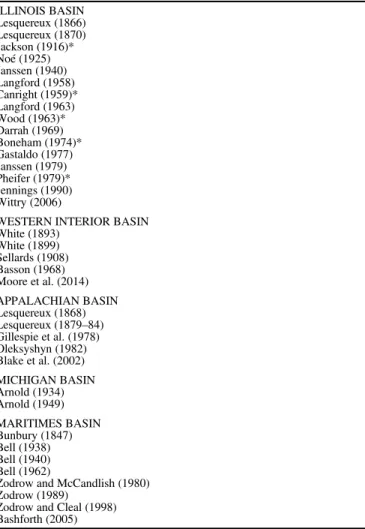
A selection of North American publications that provide detailed descriptive and illustrated records of Middle Pennsyl- vanian adpressions was the main source used for comparison with the macrofloral assemblage (Table 3). The list focuses on the Illinois Basin, and Indiana in particular, but includes records from the Western Interior, Appalachian, and Michigan basins of the USA, and the Maritimes Basin of Atlantic Canada. Almost all fossil-taxa in the macrofloral assemblages (Table 1) are described; the only exceptions areCalamitesspp. indet. and the putative conifer cone scale. Likewise, most taxa are illustrated in Figures 8–11 (including the conifer cone scale, Fig. 11.7).
Repositories and institutional abbreviations.—Plant fossils are stored at the National Museum of Natural History (NMNH), Smithsonian Institution, Washington, DC, and illustrated
specimens are reposited in the Plant Type and Illustrated Col- lection under USNM numbers 558409, 559867–559875, and 594359–594391. Components of the assemblage were the sub- ject of a dissertation (Comer, 1992) that included specimens from several stratigraphic levels and depositional facies not included in this study.
Systematic paleontology
Division Tracheophyta Class Lycopsida Order Isoëtales Bartling, 1830
Family Diaphorodendraceae DiMichele and Bateman, 1992 GenusSynchysidendronDiMichele and Bateman, 1993 Synchysidendronsp. cf.S.andrewsii(Lesquereux, 1879-80)
Moore, Wittry, and DiMichele, 2014 Figure 8.1
1879-80 Lepidodendron AndrewsiiLesquereux, p. 389, pl. 64, fig. 6.
1938 Lepidodendron dichotomum Arber var. bretonense Bell, p. 92, pl. 95,figs. 5–9, pl. 96,fig. 1, pl. 97,fig. 4.
1940 Lepidodendron dichotomum; Bell, p. 122, pl. 7,fig. 4.
1944 Lepidodendron dichotomum var. bretonense; Bell, p. 89, pl. 45,fig. 3.
1962 Lepidodendron bretonenseBell, p. 53, pl. 47,figs. 5, 6(?), pl. 48,figs. 4, 6(?).
(?)1963 Lepidodendron Sternberg sp.; Langford, p. 153, figs. 712, 713.
1980 Lepidodendron bretonense; Zodrow and McCandlish, p. 80, pl. 116,fig. 1, pl. 118,figs. 1(?), 2.
1985 Lepidodendron bretonense; Wnuk, p. 169, pl. 2, figs. 7, 8.
2005 Diaphorodendron bretonense(Bell) Bashforth, p. 36, pl. 2,figs. 1–4, 7, 8.
2006 Lepidodendron andrewsii; Wittry, p. 106,figs. 1–3 [holotype:figs. 1, 2].
2014 Synchysidendron andrewsii (Lesquereux) Moore, Wittry and DiMichele, p. 28, pl. 1,figs. 1–13.
Holotype.—USNM 15430 (part) and USNM 15431 (counter- part), Plant Type and Illustrated Collection, National Museum of Natural History, Smithsonian Institution, Washington, from Francis Creek Shale, Carbondale Formation (middle Desmoi- nesian), Illinois Basin, Mazon Creek, Illinois.
Occurrence.—USA and Canada: common throughout Middle Pennsylvanian (Bell, 1938, 1962; Bashforth, 2005; DiMichele et al., 2013a; Moore et al., 2014).
Material examined.—One specimen from Unit 1.
Description.—The axis fragment is 42 mm long and 23 mm wide. Leaf cushions are contiguous, crowded, asymmetrical, 7–9 mm long and 6–7 mm wide (L:W ratio ~ 1.3), and quad- rilateral to napiform with curved to obtusely rounded lateral margins. Upper angles appear obtusely to acutely pointed, whereas lower angles appear acutely pointed (but are
Table 3. Main literature sources used for comparison with macrofloral assemblage, and to compile synonymy lists. All publications provide detailed descriptive and/or illustrated records of Middle Pennsylvanian plant-fossil adpressions in North America, with focus on Illinois Basin (* indicates record from Indiana).
ILLINOIS BASIN Lesquereux (1866) Lesquereux (1870) Jackson (1916)*
Noé (1925) Janssen (1940) Langford (1958) Canright (1959)*
Langford (1963) Wood (1963)*
Darrah (1969) Boneham (1974)*
Gastaldo (1977) Janssen (1979) Pheifer (1979)*
Jennings (1990) Wittry (2006)
WESTERN INTERIOR BASIN White (1893)
White (1899) Sellards (1908) Basson (1968) Moore et al. (2014) APPALACHIAN BASIN Lesquereux (1868) Lesquereux (1879–84) Gillespie et al. (1978) Oleksyshyn (1982) Blake et al. (2002) MICHIGAN BASIN Arnold (1934) Arnold (1949) MARITIMES BASIN Bunbury (1847) Bell (1938) Bell (1940) Bell (1962)
Zodrow and McCandlish (1980) Zodrow (1989)
Zodrow and Cleal (1998) Bashforth (2005)
overlapped by the top of the subjacent cushion). Leaf scars are situated in the upper half of a cushion, slightly elevated, 1.2– 1.8 mm long, 2.3–4.0 mm wide (L:W ratio ~ 0.5), with a broadly
convex lower margin, a triangular upper margin with straight sides that converge to an obtusely pointed top, and acutely pointed lateral angles. Cicatricules are not preserved and their