Jōjin’s Travels in Northern Song China: Performances of Place in the Travel Diary A Record of a Pilgrimage to Tiantai and Wutai Mountains
by
Kimberly Ann Harui
A Dissertation Presented in Partial Fulfillment of the Requirements for the Degree
Doctor of Philosophy
Approved July 2018 by the Graduate Supervisory Committee:
Stephen H. West, Chair Stephen R. Bokenkamp
Huaiyu Chen William Hedberg
ARIZONA STATE UNIVERSITY
August 2018
©2018 Kimberly Ann Harui All Rights Reserved
ABSTRACT
In 1072 Jōjin (1011-1081) boarded a Chinese merchant ship docked in Kabeshima (modern Saga) headed for Mingzhou (modern Ningbo) on the eastern coast of Northern Song (960-1279) China. Following the convention of his predecessors, Jōjin kept a daily record of his travels from the time he first boarded the Chinese merchant ship in
Kabeshima to the day he sent his diary back to Japan with his disciples in 1073.
Jōjin’s diary in eight fascicles, A Record of a Pilgrimage to Tiantai and Wutai Mountains (San Tendai Godaisan ki), is one of the longest extant travel accounts
concerning medieval China. It includes a detailed compendium of anecdotes on material culture, flora and fauna, water travel, and bureaucratic procedures during the Northern Song, as well as the transcription of official documents, inscriptions, Chinese texts, and lists of personal purchases and official procurements. The encyclopedic nature of Jōjin’s diary is highly valued for the insight it provides into the daily life, court policies, and religious institutions of eleventh-century China. This dissertation addresses these aspects of the diary, but does so from the perspective of treating the written text as a material artifact of placemaking.
The introductory chapter first contextualizes Jōjin’s diary within the travel writing genre, and then presents the theoretical framework for approaching Jōjin’s engagement with space and place. Chapter two presents the bustling urban life in Hangzhou in terms of Jōjin’s visual and material consumption of the secular realm as reflected in his highly illustrative descriptions of the night markets and entertainers. Chapter three examines Jōjin’s descriptions of sacred Tendai sites in China, and how he approaches these spaces with a sense of familiarity from the textual milieu that informed his movements across
this religious landscape. Chapter four discusses Jōjin’s impressions of Kaifeng and the Grand Interior as a metropolitan space with dynamic functions and meanings. Lastly, chapter five concludes by considering the means by which Jōjin’s performance of place in his diary further contributes to the collective memory of place and his own sense of self across the text.
For Johnny Lin
ACKNOWLEDGMENTS
My deepest gratitude goes to my advisor Stephen H. West for introducing me to the incredibly rich text that I have only begun to scratch the surface of in this dissertation.
I am not only thankful for the countless hours he has spent reading and correcting my translations, but also the guidance and support he has provided for me throughout my graduate training. I also wish to thank Stephen R. Bokenkamp for welcoming me to his reading group and constantly challenging me to improve upon my scholarship, Huaiyu Chen for sharing his profound knowledge of medieval Chinese Buddhism with me and for encouraging me to further my studies of East Asian religions at conferences here and abroad, William H. Hedberg for his invaluable expertise in Japanese studies and the insightful suggestions he provided from close readings of my dissertation chapters, and Markus Cruse for enriching my understanding of space and place studies. I am sincerely grateful for the friendship and mentorship I received from Jiwon Shin, and the training and wisdom that Young Kyun Oh graciously extended to me. It has also been my privilege while at Arizona State University to take classes from Xiaoqiao Ling, Robert Joe Cutter, Hoyt Tillman, Yu Zou, and Madeline Spring.
Throughout the writing process, I could always look to Cassie Lue, Tiffany Sun, and Akori Mitsune for their friendship and encouragement, and for that I am truly thankful. In addition to my professors and friends, I would like to express my heartfelt appreciation for my parents, Stephen and Janice. Along with my husband, Johnny, they have been my constant pillars of support.
TABLE OF CONTENTS
Page
LIST OF TABLES……….vii
LIST OF FIGURES………..viii
CHAPTER 1 INTRODUCTION………...1
Outline of Chapters...………...7
Jōjin’s Genealogy and Buddhist Lineage...………..…...9
Japan’s Encounters with Medieval China...……….15
Kanbun as Jōjin’s Written Language...………....….20
The Diary as an Artifact of Placemaking...………...23
Notes on Style and Conventions...………...25
2 HANGZHOU………...30
Jōjin’s Route to Hangzhou...………...32
Sightseeing in Hangzhou...48
Traveling Along the Canals...………....…58
3 TIANTAI...68
Guoqing Temple...76
4 KAIFENG...106
Entering the Palace...107
The Dharma Transmission Cloister...123
Recording the Ghost Festival Across Histories...129
CHAPTER Page 5 CONCLUSION...140 BIBLIOGRAPHY...145 APPENDIX
A JAPANESE TRAVEL ACCOUNTS OF TANG AND SONG CHINA...153
LIST OF TABLES
Table Page
1. Animal Hour Conversions from the Twelve Earthly Branches……….29
LIST OF FIGURES
Figure Page
1. A Painting of Jōjin preserved at Mudoji Temple 無動寺藏 on Mount Hiei……...6
2. The old layout of Daiunji Temple on Mount Hiei……….13
3. Map of disembarkment sites used by kentōshi missions and Jōjin’s ship……….35
4. Two sugoroku boards……….41
5. Drawn map of the layout and surrounding geography of Uji bridge……….45
6. 1918 woodblock print of men with nets under the Uji Bridge...46
7. The pagoda in which Zhiyi’s bodily remains are said to be preserved...77
8. Trees surrounding the entrance to Guoqing Temple today...87
9. Map of multiple capitals set up during the Song as military strongholds...108
10. Map of the Grand Interior of Northern Song Kaifeng...112
11. 1998 reconstruction of Japan’s Vermillion Bird Gate...115
Chapter 1: Introduction
In 1072 Jōjin 成尋 (1011-81), a sixty-two-year-old monk of Japan’s Tendai (Ch.
Tiantai 天台) sect, boarded a Chinese merchant ship docked in Kabeshima 可部島 headed for Mingzhou 明州 (modern Ningbo 寧波) on the eastern coast of Song (960- 1279) China. 1 This seven-day voyage is recorded in Jōjin’s diary, A Record of a
Pilgrimage to Tiantai and Wutai Mountains (San Tendai Godaisan ki 参天台五台山記).
After mooring in Hangzhou 杭州, Jōjin continued his diary for sixteen months as he recorded his travels through major Song urban centers and sacred Tiantai sites. Much like the writings that shaped Jōjin’s pilgrimage, his diary in eight fascicles was sent back to Japan with his disciples to be shared with others in the Tendai lineage and contribute to Japan’s understanding of the coeval Northern Song Chinese bureaucracy and culture.
Although Jōjin never returned to Japan, his diary established his legacy amongst the select few who were paramount in shaping Japan’s understanding of China. Furthermore, his diary circulated throughout the Tendai sect and inspired others to make the pilgrimage to sacred Buddhist sites in China as earlier travel diaries had inspired Jōjin.
Jōjin’s diary reveals a palimpsest of landscapes upon which he navigates through Northern Song China. In some instances his travels are guided by the literary landscape
1 Although notions of China and Japan as discrete countries are fundamentally
modern concepts, I refer to the territory of the East Asian continent under Tang and Song rule as China, and the archipelago ruled by the Heian court as Japan. This does not begin to reflect the nuances of power, nation, and state that created the complicated vassal- sovereign tributary connections between these regions during this period, but it provides a clear reference for the geographic area being discussed in modern terms.
created by the literati and poets who first made these distant places familiar in Japan. In these cases, he appropriates elegant descriptive language that stands out against his own prosaic accounts of the scenery and topography. At other times, it is the bureaucratic landscape that controls his movements along the rivers and canals, and his entry into religious areas and imperial venues. Furthermore, he is accorded the most esteem when he finds himself upon the religious landscape. Here Jōjin is treated in high regard by the Chinese monastics he encounters, and his own representations of the sacred sites he visits are full of language that reflects his awe in coming face to face with these renowned Tiantai sites. His agency and movement along these landscapes are in constant flux, and his position varies greatly from that of a foreign visitor, to an expedient representative of Japan’s court, to an eminent monk.
Jōjin’s diary is a rich text, most notably for its detailed compendium of anecdotes on material culture, flora and fauna, water travel, and bureaucratic procedures during the Northern Song. In addition, Jōjin transcribed many official documents that he received, recorded famous Chinese literary texts, and kept lists of his purchases and procurements.
Because of the encyclopedic nature of the diary, it is valued for the historical insight it provides into both daily life in major Northern Song urban centers and foreign relations with the court in late eleventh-century China. Linguistically, the diary is a particularly interesting material artifact in that it preserves discrete variations of language within the same document. As such, the composition of the diary as a whole reads as a pastiche of entries with varying registers of language, transcribed legalese, and unattributed quotes from other Japanese diaries and Chinese literary sources. Much like a scrapbook, Jōjin’s
diary is an amalgamation of various imprints of culture and memory that enacts the places he visits and ascribes meaning to the physical spaces he encounters.
Although there is no complete translation of the text into English, Robert Borgen has published numerous chapters and articles on Jōjin’s diary along with translations of certain entries. This includes studies on Hanshan’s poetry, maritime travel, Japanese nationalism, and technology.2 In French, Charlotte von Verschuer has written an introduction to Jōjin’s diary with translations of the final entries of the first fascicle.3 In addition to the excellent annotated translations and studies published in Asia, there have also been a growing number of studies by Japanese and Chinese scholars in recent years on various parts of the diary, reflecting its continued research value to scholarship in the humanities.4 These, however, all primarily focus on different aspects of Northern Song
2 For some of Robert Borgen’s articles and book chapters on these topics, see the following: "The Legend of Hanshan: A Neglected Source," Journal of the American Oriental Society 111, no. 3 (1991), 575-79; “Jōjin’s Discoveries in Song China,” in Tools of Culture: Japan's Cultural, Intellectual, Medical, and Technological Contacts in East Asia, 1000-1500s, ed. Andrew Edmund. Goble, Kenneth R. Robinson, and Haruko Nishioka Wakabayashi (Ann Arbor: Association for Asian Studies, 2009),; “Jōjin’s Travels from Center to Center (with Some Periphery in Between),” in Heian Japan:
Centers and Peripheries, ed. Mikael Adophson, Edward Kamens, and Stacie Matsumoto (Honolulu: University of Hawai’i Press, 2006), 348-413. “Japanese Nationalism Ancient and Modern,” in Annual Report of the Institute for International Studies [Meiji Gakuin University], no. 1 (1998), 49-59; “The Case of the Plagiaristic Journal: A Curious Passage from Jōjin’s Diary,” in New Leaves: Studies and Translations of Japanese Literature in Honor of Edward G. Seidensticker (Ann Arbor: Association for Asian Studies, 1993), 63-88.
3 See Charlotte von Verschuer, “Le voyage de Jōjin au mont Tiantai,” in T'oung Pao, Second Series, Vol. 77 (1991), 1-48.
4 In addition to shorter articles and studies, Fujiyoshi Masumi 藤吉真澄 (1934-2012) also provides a meticulously annotated translation of Jōjin’s diary into modern Japanese.
See Fujiyoshi Masumi, San Tendai Godai san ki, 2 vols (Suita: Kansai University Press, 2007 and 2011). Wang Liping 王丽萍 has published multiple articles on the diary with a
culture and historiography. Rather than continuing this tradition of topical research, this dissertation builds on these studies by holistically approaching the major elements of the diary as paradigms of placemaking. There are three overarching questions that inform this process. First, how do Jōjin’s representations of spaces signify his engagement with the topography and environment around him? To this point, I look to Yi-fu Tuan’s Topophilia: A Study of Environmental Perception, Attitudes, and Values to flesh out Jōjin’s approach to the natural environment and urban spaces he encounters after reaching China.5 Second, how is his sense of self imprinted in his diary when he describes his contact with sacred sites as opposed to when he encounters urban spaces like Hangzhou and the eastern capital? Here, I follow Maurice Merleau-Ponty’s
discussion of the Cogito in The Phenomenology of Perception.6 Third, how is the process of performing ritual and action upon a space a mode of transforming space into place?
For this question, I build upon Tim Cresswell’s notion of place as a material space that is made meaningful by people.7 I further view place in Jōjin’s diary as being created
couple of the more recent being, Wang Liping, “Riseng Chengxun zai Song zhuixun xianren zuji kao” 日僧成寻在宋追寻先人足迹考 [A Study of Japanese Dhyana Master Jyuu Jin’s Pursuance of His Ancestors’ Footprints in Song Dynasty] in Zhejiang Social Sciences 浙江社会科学 , no. 12 (2016), 127-32; and Wang Liping, “Riseng Chengxun ru Song xunli tuzhong suojian Daojiao” 日僧成寻入宋巡礼途中所见道教 [The Daoist Teachings Seen by the Japanese Dhyana Master Jyuu Jin during his Pilgrimage into Song China] in Religious Studies 宗教学研究, no. 02 (2016), 29-34.
5 Yifu Tuan, Topophilia: A Study of Environmental Perception, Attitudes, and Values, Englewood Cliffs: Prentice-Hall, Inc., 1974.
6 Maurice Merleau-Ponty, The Phenomenology of Perception, trans. Donald A.
Landes (New York: Routledge, 2012).
7 Tim Cresswell, Place: A Short Introduction (Malden: Blackwell, 2004).
through the binding of a memory to a physical space. The memory itself cannot continue to thrive and have meaning without the physical space that it is attached to. This space in turn accumulates these memories and meanings through the actions performed upon it and the histories recorded about it. It is through this perpetual process that space is transformed into place. Through close readings of select passages from Jōjin’s diary alongside those of Ennin’s diary and several coeval Chinese sources, I further examine how Jōjin’s representations of prominent spaces reflect his contributions to what Maurice Halbwachs has termed collective memory.8 Jōjin’s ownership of his memories is at once dissolved and blurred within the aggregate collective memory the moment he records his experiences in his diaries for others to read and appropriate as a part of the
comprehensive collective memory attached to meaningful spaces, and this becomes his own entry into the cultural and literary milieu associated with these spaces as
embodiments of place.
8 Halbwachs writes, “The collective memory, for its part, encompasses the individual memories while remaining distinct from them. It evolves according to its own laws, and any individual remembrances that may penetrate are transformed within a totality having no personal consciousness.”See Maurice Halbwachs, “Historical Memory and Collective Memory,” in The Collective Memory, ed. and trans. Mary Douglas (New York: Harper and Row, 1980), 51.
Figure 1. A Painting of Jōjin preserved at Mudoji Temple 無動寺藏 on Mount Hiei.
Copied from Wang Liping’s 王丽萍 Newly Annotated Record of a Pilgrimage to Tiantai and Wutai Mountains (Xinjiao San Tendai Godaisan ki 新校参天台五台山记) (Shanghai guji chubanshe, 2009), frontmatter.
Outline of Chapters
This introduction begins with Jōjin’s ancestral and Buddhist genealogies, and his ingress into the Tendai school as a young child. After discussing Buddhism’s place and sources of influence in Heian society, a section follows on Japan’s previous encounters with medieval China. This includes the difficulties of maritime travel and the subsequent advances in shipbuilding technology that benefitted those making the voyage from Heian Japan to Song China in the eleventh century. In the next section, I present prefatory remarks on the language and genre of Jōjin’s text. The introduction ends with brief notes on the style and conventions used throughout the dissertation.
Chapter two covers select passages from Jōjin’s diary entries on Hangzhou, especially those that reveal Jōjin’s interest in the sights, sounds, and tastes he encounters along the way. Urban areas like Hangzhou presented Jōjin with opportunities to
experience the daily life of Song China from the perspective of a foreign visitor,
unclouded by the associations and expectations projected onto these spaces by the native observer. As such, his descriptions here are full of curiosity and the minutiae of urban life. The language and style of his writing differs greatly here from that of his entries on sacred religious sites, which are discussed in the subsequent chapter.
Chapter three presents Jōjin’s diary entries on Tiantai and his travels through the mountains visiting sacred sites. In these religious spaces, Jōjin finds himself face to face with the renowned sites that inspired him to make this pilgrimage. His conception of these spaces was formed by the eminent Japanese monks who preceded him and sent their own diaries back to Japan relaying descriptions of their grandeur. Therefore, it is
notable here that Jōjin not only reaffirms their written representations of these sites, but goes so far as to insert certain passages from their diaries word for word into his own account. In this vein, I explore how Jōjin approaches these sites from the native’s
perspective rather than the foreign visitor’s. This continues in line with the discourse laid out by Yi-fu Tuan in Topophilia: A Study of Environmental Perception, Attitudes, and Values.
Chapter four covers Jōjin’s initial arrival in Kaifeng where he is imperially hosted at the Dharma Transmission Cloister (Zhuanfa yuan 傳法院). This section of Jōjin’s diary is replete with government documents, lists, and invoices that he copied into his diary to maintain official records of monetary transactions, lodging arrangements, gifts, and requests. In addition, Jōjin’s descriptions of the capital can be compared with Chinese descriptions of Kaifeng that attest to their differing perceptions of the
significance and function of the spaces within the capital and palace. By examining the different representations of the Ghost Festival between Jōjin’s diary and Ennin’s diary, this section further explores how historical memory reveals itself in text.
In the conclusion, I address Jōjin’s subjecthood and sense of self in his diary as it is represented in the passages included in the above chapters. In addition to his awareness of his audience of other monastics back in Japan, I argue that Jōjin is also highly
conscious of how his diary establishes him as an enduring figure amidst the same literary landscape that informed his own travels. He followed the paths of Tendai monks before him, and as such he sees what he is supposed to see and he records what he is supposed to record. He follows a process of reproducing the spaces as they already exist in the diaries of Tendai monks before him. This affirms the inclusion of these spaces as part of the
religious memory as described by Halbwachs as composed of the traditions and events that took place in these spaces.9 One may question the authenticity of Jōjin’s
representations and emotive expressions when reading passages of his diary that appear to be plagiarized from other sources or written in stock language without any traces of personal voice; however, these aspects are in fact further demonstrations of Jōjin’s active involvement in creating a textual object that sustains notions of places that exist for a Japanese audience only in the memories of the others who had access to them. Through his engagement in reaffirming and attaching meaning to the spaces he encounters during his pilgrimage, Jōjin’s diary continues to serve as a material artifact of snapshots
chronicling his encounters with placemaking.
Jōjin’s Genealogy and Buddhist Lineage
Jōjin was born in 1011 into a prominent family within the Heian court as the elder of two sons. His family had connections to both the powerful Fujiwara and Minamoto clans. His mother – known only as “Jōjin’s mother” (Jōjin Ajari no Haha 成尋阿闍梨母) (b. 988) – was a direct descendent of Emperor Daigo (Daigo Tennō 醍醐天皇) (885-930) and the daughter of Minamoto Toshikata 源俊賢 (959-1027), who held the court position of major counselor. Little information was documented about Jōjin’s father, Sadanobu 貞 叙, but he also came from a prominent bloodline. Sadanobu was a son of Fujiwara
9 Maurice Halbwachs, “Space and Collective Memory,” in The Collective Memory, 128-57.
Sanetaka 藤原実方 (d. 998), the famous waka 和歌 poet and governor of the old Mutsu province 陸奥in modern Tōhoku 東北.10 This type of pedigree from his mother’s and father’s family lines ensured that Jōjin would have had a secure career in the court had his father not died when he was around seven years old. Due to this untimely tragedy in his childhood, his mother decided at this point to have Jōjin and his younger brother enter into the Tendai school of Buddhism to be raised as monks.11 This was most likely
because, as Robert Borgen has noted, Jōjin’s prospects in court without paternal backing would have been greatly diminished.12 Moreover, Jōjin’s mother was a devout Buddhist herself and knew that her sons would be able to secure prominent roles within the Tendai sect after they took their tonsure. Despite the notion of leaving home (J. shukke Ch.
chujia 出家) to cut off worldly ties, including those to one’s family, Jōjin and his mother maintained a close relationship throughout his life as a monastic.13 Furthermore, his
10 Sources do not mention Sadajo’s birth date or positions in court, but Helen Craig McCullough provides brief bibliographies of many other key Fujiwara figures that Jōjin was descendant from in Okagami, The Great Mirror: Fujiwara Michinaga (966-1027) and His Times (Princeton: Princeton University Press, 1980).
11 For a biographical timeline of the key events in Jōjin and his mother’s lives, see Ii Haruki, Jōjin no nissō to sono shōgai (Tokyo: Yoshikawa kobunkan, 1996), 243-6.
12 See Robert Borgen, “Jōjin’s Travels from Center to Center,” in Heian Japan:
Centers and Peripheries, ed. Mikael Adolphson, et al. (Honolulu: University of Hawai’i Press, 2007), 387. Borgen refers to Morotada by his other name, Moromasa 師尹, in the genealogy he provides.
13 Although little is known about Jōjin’s mother, her legacy endures through a famous collection of poetry that she wrote following Jōjin’s departure for Song China. The Collection [of Poems] by Jōjin’s Mother (Jōjin Ajari no Haha no shū 成尋阿闍梨母集) was compiled in the style of the Japanese diary genre (Nikki bungaku 日記文学) that made us of Japanese kana かな script rather than the kanbun 漢文 that was standard for men’s court diaries. Jōjin’s mother was so distraught over her perceived abandonment by
ancestral legacy followed him through his ascending ranks in Japan’s Tendai sect. In practice, family ties were often closely correlated with one’s success within the saṃgha and furthered religious advancement in the same way that prominent family backgrounds furthered political advancement in the secular domain.14 Thus, Jōjin’s rise within the Tendai sect can at least partially be attributed to the fact that he was not entering in as an orphan, tax evader, or mendicant, but rather as a son of court elite. Furthermore, Jōjin and his younger brother were also not sent away to small rural temples, but were instead tonsured in close proximity to the court.
Jōjin was a disciple at Mount Hiei 比叡山 in modern Kyōto 京都 under Monkei 文慶 (967-1046), a renowned Tendai teacher who had studied under Enchin’s 円珍 (814-
Jōjin that she wrote extensively on the pain he caused her, her desire to die, her
loneliness, and her fear that he will never return. Donald Keene devotes a brief chapter to Jōjin’s mother’s diary in Travelers of a Hundred Ages, but outside of his translations of a couple of poems, there are some troubling inaccuracies regarding Jōjin and his travels.
See Donald Keene, Travelers of a Hundred Ages (New York: Columbia University Press, 1999), 62-7. Instead, a complete study of the diary, including biographical information about Jōjin is better found in Robert Mintzer’s 1978 PhD dissertation. See Robert Mintzer, “Jōjin Azari no Haha no Shū: Maternal Love in the Eleventh Century, an Enduring Testament” (PhD diss., Harvard University, 1978). See also Robert Borgen,
"Jôjin Azari no Haha no Shû, A Poetic Reading," in The Distant Isle: Studies and Translations of Japanese Literature in Honor of Robert H. Brower, eds. Thomas Hare, Robert Borgen, and Sharalyn Orbaugh (Ann Arbor: University of Michigan Press, 1997), 1-34.
14 These connections between the religious and secular domains were prevalent in medieval China, as well. For example, Jinhua Chen has noted the relationships between powerful secular families and advancement within the saṃgha in Tang China in his article on the political and social roles of two prominent nuns, Facheng 法澄 (640-729) and Qiwei 契微 (720-81). See, Jinhua Chen, “Family Ties and Buddhist Nuns in Tang China: Two Studies,” Asian Major, Third Series, Vol. 15 No. 2 (2002), 51-85.
91) legacy.15 In 1041 Jōjin received the title of abbot at Daiunji 大雲寺 in Iwakura 岩倉 just northwest of Kyōto, and as a reflection of the close relationship he sustained with his mother, he had his mother moved to Daiunji, as well. Daiunji was a particularly
important stronghold for Enchin’s lineage during the late tenth-century conflicts with Ennin’s lineage, and continued to be a prime location for providing direct access to the capital.16 Soon after his placement at Daiunji, Jōjin was appointed imperial protector monk (gojisō 護持僧) and was officially stationed at the palace to perform prayers and rituals. It was during this time that he received the honored ācārya (ajari 阿闍梨) title of virtuous teacher.17
15 Enchin had made a pilgrimage to China over two centuries before Jōjin in 853 to study esoteric Tendai teachings on Mount Tiantai. After returning to Japan in 858 he established the Four-Part Vinaya (sifen lü 四分律) on Mount Hiei. In 868, four years after the death of Ennin 圓仁 (794-864), Enchin became abbot of Enryakuji 延暦寺.
Although both Ennin and Enchin had studied esoteric Tendai teachings during pilgrimages to China, Enchin was not a disciple of Ennin. On the contrary, monks of Enchin’s lineage and Ennin’s lineage were often at heads over the division of state favor between Enryakuji – now controlled by Ennin’s lineage, and Onjōji where monks of Enchin’s lineage had fled to amidst the conflict. This resulted in violent confrontations between the two factions at the end of the tenth century. For more on the development of the Ennin and Enchin lineages and the events leading up to the violent schism in the Tendai school, see “Aristocratic Buddhism” in The Cambridge History of Japan, ed.
Donald H. Shively and William H. McCullough (Cambridge: Cambridge University Press, 1999), Vol. 2, 478-92.
16 Daiunji is located at the western foot of Mount Hiei. The location also allowed the monks in Enchin’s lineage ready access to the elite patrons who supported the Tendai school. Paul Groner, Ryōgen and Mount Hiei: Japanese Tendai in the Tenth Century (Honolulu: University of Hawai’i Press, 2002), 104.
17 Borgen, “Jōjin’s Travels from Center to Center,” 387-8.
Figure 2. The old layout of Daiunji Temple on Mount Hiei. Copied from Wang Liping’s 王丽萍 Newly Annotated Record of a Pilgrimage to Tiantai and Wutai Mountains (Xinjiao San Tendai Godaisan ki 新校参天台五台山记) (Shanghai guji chubanshe, 2009), frontmatter.
In addition to his relationship with his mother, Jōjin also found himself
inextricably connected to the court. Although he entered into the Tendai seminary, the monastic community and the state were closely tied in Heian Japan just as they were in medieval China. Thus, even as a monastic Jōjin grew up at the center of court life. As a religious institution, Buddhism’s power in Heian Japan stemmed from massive
landholdings, imperial patronage, and political support from the court. Meanwhile, its reliance on the state for tax exemptions, appointments to public monasteries, and
sponsorship for approved histories and hagiographies also meant that the state always had a hand in the fortunes and misfortunes afforded to Buddhists. As such, the relationship between Buddhism and the court was highly influenced by the needs of the monastic community and the interests of the state. Imperial donations from the court and those made by powerful aristocratic families allowed Mount Hiei to become a center of Buddhist activity and a bedrock for the construction of new temples. The Tendai school was then able to extend its reach out to branch temples (betsuin 別院) in rural provinces across Mutsu 陸奥, Kōzuke 上野, Harima 播磨, Shinano 信濃, and Kaga 加賀.18
Although Buddhist teachings promoted escaping the mundane world of human affairs, sustaining a powerful religious institution meant becoming highly involved in the politics of the state, as well as the politics within the monastic sects themselves. Taking into consideration the interdependence between the court and the Buddhist sects, Jōjin’s
18 At the end of the ninth century, gifts of tax-exempt land and tax-rice by former emperors and princes had become commonplace to support Buddhist cloisters. See Shively and McCullough, eds. “Aristocratic Buddhism” in The Cambridge History of Japan, Vol. 2, 485.
tonsure did not allow him to escape the modalities of court life, but rather provided him with a lifetime of experience navigating through bureaucratic mores.
Japan’s Encounters with Medieval China
Detailed accounts of Japan’s direct contact with medieval China during the Tang (618-907) and Song (960-1279) dynasties are preserved in the extant travel records of Heian (794-1185) and early Kamakura (1185-1333) Japanese emissaries and monks.
During the Tang dynasty, official missions to China departed from Japan with envoys sent to deliver tributary gifts to the Tang court and monks seeking to make pilgrimages to the sacred sites of East Asian Buddhism or study under Chinese masters.19 These voyages were sanctioned and subsidized by the government, and their movements were highly controlled by the structure of the bureaucratic systems they were navigating.20 Prior to the Tang dynasty, four Japanese embassies were sent to Sui dynasty (581-618) China in order to reopen the lines of communication between the mainland state and small archipelago.
19 Charlotte von Verschuer has termed this system of tributary exchanges as “cultural imperialism” in that the Chinese court did not have administrative control over its
“vassals,” such as Yamato Japan in this case, but rather allowed these external territories the benefits of the influence of the Son of Heaven in return for their allegiance. This is clearly a more complicated case with Japan viewing its position as equal to that of China.
See Charlotte von Verschuer, Across the Perilous Sea: Japanese Trade with China and Korea from the Seventh to the Sixteenth Centuries, trans. Kristen Lee Hunter (Cornell University East Asian Program: Ithaca, 2006), 1.
20 For more on Tang emissary missions, see Douglas Sherwin Fuqua’s dissertation titled, “The Japanese Missions to Tang China and Maritime Exchange in East Asia, 7th- 9th Centuries” (PhD diss., University of Hawaii, 2004).
These missions brought goods, institutional codes, and insight into contemporary Chinese culture back to Yamato Japan (ca. 250-710), and provided Japanese emissaries the
opportunity to obtain official enfeoffments from the Chinese emperor.21 Following the renewed diplomatic relationship between Japan and China, there were fifteen “Envoys Dispatched to Tang,” or kentōshi (Ch. qiantangshi 遣唐使), that took place between 630 and 894.22 Monks like Dōshō 道昭 (629-700), Genbō 玄昉 (d. 746), Saichō 最澄 (767- 822), Kūkai 空海 (774-835), and Ennin 圓仁 (794-864) made their voyages with these official envoys, and kept records of their travels in the prosaic style of men’s court writings composed in literary Chinese.
Although the distance between Japan and China is not remarkably far, the dangers of travel by sea existed nonetheless for early travelers due to Japan’s comparatively rudimentary shipbuilding techniques. Japan had a long history of using logboats for water travel, but these were not fit for extended voyages or heavy hauls. Instead, archaeological evidence reveals that Chinese junk type ships were used for the embassy missions and
21These missions are documented in the official Chinese dynastic histories. See also Joshua A. Fogel, The Literature of Travel in the Japanese Rediscovery of China 1862- 1945 (Palo Alto, Stanford University Press: 1996), 21. Although Yamato Japan sought enfeoffments from Sui China, it also maintained a position as sovereign to its own vassals along the Korean peninsula, occupying Silla, Paekche, and Koguryō. Von Verschuer discusses this complicated paradox of existing as sovereign and vassal in chapter one of Across the Perilous Sea.
22 Fuqua, “The Japanese Missions,” x. Fuqua states that nineteen missions were planned and fifteen of these were successful. Charlotte von Verschuer has estimated this number of missions planned from the seventh to ninth centuries to be twenty to twenty- five. See Charlotte von Verschuer, “Looking from within and Without: Ancient and Medieval External Relations,” Monumenta Nipponica Vol. 55 No. 4 (Winter 2000): 538.
Josuha A. Fogel writes that the Japanese planned eighteen embassies during the Tang dynasty with fifteen successfully carried out. Fogel, Literature of Travel, 21.
subsequent merchant trade.23 These ships were specially built for delegations – often by Chinese shipbuilders – and the techniques they used for these Chinese junk type ships were not subsumed into Japanese shipbuilding practices until much later. Japan was nonetheless interested in acquiring shipbuilding materials and designs from China, and travel records reveal the writers’ attention to China’s infrastructure, ships, and sea routes, as well as the difficulties of travel caused by weather, rough waters, and vessel
limitations.24
Within the first century of Heian Japan, official embassies to China ceased and encounters with China shifted from diplomatic to primarily mercantile. Japanese monks continued to make the journey to China in order to obtain sutras and various ritual and material objects, visit sacred sites, and study with renowned masters of their sects. In turn, they brought numerous texts and Japanese goods that were similar to the types of fine items Yamato Japan presented as tributes on its emissary missions. Meanwhile, they were no longer part of an official embassy, nor were they allotted the ease of movement that went along with traveling with a government envoy. Instead, monks traveled to China on returning Chinese merchant ships, and not always with explicit permission from the Japanese court. Without these travel documents, delays and bureaucratic
23 Unlike the basic logboat construction that consisted of fewer parts and sometimes only a single hull, the Chinese junk ship had a keel and support from a v-shaped cross section. For figures and measurements of ancient Japanese vessels, see Hiroaki Miyashita, “Ancient Ships of Japan,” (MA thesis, Texas A&M, 2006).
24 Jōjin’s diary contains multiple passages about the types of water gates and locks used in Song China, as well as the various weather and water conditions that affected his travel. Similarly, Ennin’s diary notes the loss of passengers and failure of vessels in his Tang dynasty account.
complications often arose. The monks Enchin 円珍 (814-91), Shinnyo 真如 (799-865), Chōnen 涯然 (938-1016), Jakushō 寂照 (962-1034), Jōjin 成尋 (1011-81), and Shunjō 俊芿 (1166-1227) all made trips to China with varying degrees of authorization from the Heian court. What sets Jōjin apart is his meticulous account of his pilgrimage, and the preservation of his diary through to today. While monks traveling after the dissolution of government-sanctioned kentōshi missions faced more obstacles with procedure and government expediency than their predecessors, they greatly benefited from having Chinese mercantile ships as their mode of transportation. Chinese shipbuilding technology had greatly advanced from the earlier Chinese junk style ships used by Japanese envoy missions, and as a result, Japanese ship wrecks became less common.
Moreover, merchants were much better maritime travelers, with ample experience navigating open sea routes between Japan and China.25
Resulting from the long history of encounters with China, the notion of traveling to China was not unprecedented in Heian Japan. Yet, few would ever have the
opportunity to embark on such a voyage, and of those who did, not all reached China, let alone made it back to Japan. Because of this, the majority of people living in Japan’s classical and early medieval periods would never have a firsthand encounter with China.
Therefore, the written accounts of the sights, sounds, and experiences of those who did journey there were all the more valuable. Several extant travelogues from Japanese
25 One reason that the kentōshi faced more difficulties crossing the sea may be attributed to their lack of knowledge regarding the winds and weather conditions. It is noted that they often embarked at the wrong time of year and did not have the skills to make the voyage when conditions were severe. See Fuqua, “The Japanese Missions,” xii.
monks that discuss common topics to those found in Chinese written accounts – the capital, urban entertainments, major routes, and the palace – are indicative of the keen awareness of their Japanese monastic audiences who would most likely not have the opportunity to ever see these sights firsthand. Therefore, these types of travel diaries were completed with the expectation that they would be brought back to Japan, disseminated, incorporated into the Buddhist textual milieu, and read by others who were literate in the kanbun 漢文 they were composed in.26 Accordingly, they read very differently from contemporary Chinese accounts regarding the same places, events, and customs that were written by authors describing aspects of their own native land and culture using script that reflected their spoken language.27 Not only was the grammar often inconsistent in kanbun accounts, but the spaces and events that Japanese diarists deemed worth mentioning were not necessarily the same ones that Chinese writers were interested in recording for
posterity. Nonetheless, Jōjin availed himself of both Chinese and Japanese texts that were
26 Since these personal travel accounts were official documents, they were composed in literary Chinese, or kanbun, that made use of the written Chinese language system while still maintaining certain aspects of Japanese grammar and word order. Although there was greater room for linguistic creativity when writing in the Chinese script, there was less room for exact transcription of the Japanese language, and personal voice often fell to the wayside in favor of meeting standards of literary Chinese.
27 Literary Chinese was not spoken Chinese, but it did reflect the syntax, grammar, and sounds of Medieval Chinese and could be read as such. For Japanese, the phonemic writing system that is still used today was known as women’s writing (onnade 女手), or kana かな. These individual graphs were still based on Chinese characters and their pronunciations, but they were stylized and further simplified until they became consistent representations of a single syllable in Japanese for each specific graph. Although it did not become frequently used until the tenth century, the kana system allowed for an alternative mode of writing that could be used to reach the common, albeit literate, populace. Novels, stylized diaries, women’s writings, and other “frivolous” works were reserved for Japanese kana.
at his disposal, and in appropriating the language and content from both traditions, he was able to create a text that preserved aspects from each.
Kanbun as Jōjin’s Written Language
Jōjin was highly familiar and literate in kanbun as a high-ranking monk within the Tendai sect. He studied and memorized sūtras that were preserved in their Chinese
translations in Japan, but he did not by any means speak the language or assume this of his audience. This leads to disjunctive passages in his diary that often abruptly follow the syntax of spoken Heian period Japanese more closely than literary Chinese. Nonetheless, the diary itself reads cohesively as a lived record of movement and encounters in
Northern Song China. Rather than impeding the reader, the language of Jōjin’s diary succeeds in bringing the reader into a time and place that is experienced viscerally and phenomenologically through text in a written language that was in many ways not foreign at all to him or his reader.
While the introduction of the Buddhist religion into Japan did not mark the introduction of written language into the archipelago, it is clear why the two are often discussed together.28 When Buddhism was first brought into Japan in 552 – from China and through Korea – it entered as a textual religion.29 For Japanese Buddhists, literary
28 For more on the importance of Buddhism to the Japanese reading history, see Bjarke Frellesvig’s discussion in section 9.2.1 of his book, A History of the Japanese Language. Bjarke Frellesvig, A History of the Japanese Language (New York:
Cambridge University Press, 2010), 274-278.
Chinese continued to be the sacred language of Buddhism just as China was the sacred site for Buddhist pilgrimages. The sacred texts that Jōjin hoped to bring back to Japan were Chinese translations of Buddhist texts. These sūtras – regardless of whether they were actual translations of Indic texts from Sanskrit or Pāli, or apocryphal texts –
remained in Chinese when brought to Japan and were not further translated into Japanese as this would remove an aspect of their authenticity. In this sense, literary Chinese was understood as an “authentic” and “native” language for Japanese Buddhism.30
Another reason Buddhism played such an integral role in the development of writing in Japan is that it continually encouraged new texts to be produced. Sinitic Buddhism in particular generated a plethora of religious texts written in the Chinese script since there was a strong incentive for followers to reproduce scriptures as a means of accruing merit.31 By the eighth century, many common Buddhist terms held a firm place in the Japanese language even outside of religious beliefs and sects.32
29 The official date for the introduction of Buddhism to Japan is usually accepted as either 552 or 538. Roy Andrew Miller, The Japanese Language, 29.
30 Ibid, 30. There were, however, certain fundamental terms that were never Sinicized from the original Indic pronunciations, such as dharma (daruma 達磨) and karma
(karuma 羯磨), which proves that there had to be some contact with these Indic pronunciations outside of Chinese intermediaries. Ibid, 35. Meanwhile, terms like Buddha (OJ butu, MC but) and alms bowl (OJ fati, MC pat, OK pati, MK pali, Sanskrit pa:tra or pa:tri) were loanwords from Sanskrit that were borrowed via Chinese or Korean before coming into the Japanese language. Alexander Vovin, “Middle Classical Japanese,” in Encyclopedia of Linguistics, ed. Philipp Strazny (New York: Fitzroy Dearborn, 2005) 1.686.
31 For a comprehensive discussion on the influence of Buddhism on the history of writing and production in Japan, see David B. Lurie, Realms of Literacy , 131-150.
32 Roy Andrew Miller, The Japanese Language , 104.
By as early as 594, Buddhism was adopted as the official state religion, and this not only encouraged further intensive studies of the Chinese language and script, but also increased Japan’s interest in China as a model for its own government and literature. In addition to the Japanese envoy missions that were reporting back on government and customs, there were also missions from China that came to Japan with the intent of spreading Buddhism and providing instruction in the Chinese language.
Many of these Chinese scholars who arrived in Japan as part of these missions served as “pronunciation masters” (on hakase 音博士), while Korean scholars continued to assist the Japanese in the writing system as “writing masters” (te no hakase 手の博 士).33 This delineation between teachers of pronunciation and teachers of writing seems to indicate that the Koreans were no longer influential in the instruction of the
phonological applications of the script. Chinese pronunciation was particularly difficult for the Japanese, so it is understandable that they sought out Chinese scholars to assist them in this area. This process of cultural and linguistic exchange between the Chinese, Korean, and Japanese is the basis for Miller’s argument that by the seventh century, Chinese was a living and spoken language in Japan. This is not to say that the Japanese spoke Chinese with one another, but rather that a certain level of aural comprehension of the Chinese language had been established amongst Japanese studying the written system and using the language.34 As such, any lexical resemblances between Chinese, Japanese, and even Korean, can only be due to the wholesale borrowing on the part of the Japanese,
33 Ibid, 92.
34 Ibid, 31.
and not any sort of genetic relationship between the languages.35 Furthermore, it was not until the ninth century that Japan’s own syllabary appeared in the form of kana 仮名.
This followed the Japanese monk Kūkai’s 空海 (774-835) return from his 804-6 kentōshi mission to Tang China. Kūkai brought back over forty texts in Sanskrit that included an introduction into the phonetic writing system known as Sanskrit Siddham.36 This clearly influenced Japan’s creation of a phonetic syllabary, but kana still did not take the place of Chinese script as a sacred language for the copying and transmission of Buddhist texts.
Instead, it allowed for commentary and grammatical explanations of Buddhist texts that had already established literary Chinese as the written language for medieval Japanese Buddhism.37
The Diary as an Artifact of Placemaking
This study focuses on Jōjin’s diary as a primary example of the use of text in conceptualizing space and place for several reasons. First, Jōjin’s diary belongs to the distinctive genre of travel writing that is both personal and official in its capacity. Jōjin was writing for the monks in his lineage and followed certain conventions of formatting
35 It is interesting to note here that the Japanese also borrowed widely from the Chinese language in even the most basic semantic areas, such as terms for body parts and numbers. Ibid, 62.
36 See Ryūichi Abé, The Weaving of Mantra: Kūkai and the Construction of Esoteric Buddhist Discourse (New York: Columbia University Press, 1999), 391-3.
37 For more on the influence of the Siddham phonetic script on the Japanese written language, see Robert Hans van Gulik, Siddham: An Essay on the History of Sanskrit Studies in China and Japan (Nagpur : International Academy of Indian Culture, 1956).
and transcribing documentation of bureaucratic matters while in China. However, he also included details about what he personally found novel and interesting during his travels around the urban centers of Hangzhou and Kaifeng. This is at once both unlike Heian court travel diaries that were devoid of excessive personal impressions, and also unique from the poetic diary genre that was growing in popularity during this period.38 In addition, scholars have accepted Jōjin’s diary as a generally reliable source for historical insight into medieval China, setting it apart from other Japanese accounts that are not verifiable – the content of which is often considered to be highly fabricated if not completely belonging to literary imagination. Next, Jōjin’s diary recurrently features direct quotes from other monastic diaries. This reveals the texts that he was familiar with at the time he was writing, and the type of text he was modeling his own diary after.
Finally, Jōjin’s diary is comparatively one of the longest extant accounts China following the discontinuance of official kentōshi missions.39
With respect to issues of placemaking, Jōjin’s diary provides a trove of examples of processes of assigning meanings to spaces, including the enactment of repeated ritual and performance upon these spaces. Expanding on this fundamental notion of
38 This brings up the issue of assigning Jōjin’s writing to the Japanese diary genre of nikki bungaku 日記文学. While I refer to his text as a diary throughout this dissertation, it was not written with the intention of fitting into this anachronistic classification. For more on the modern notions and categorizations of the Japanese diary genre, see Kōsuke Tamai, Nikki Bungaku No Kenkyū (Tōkyō: Hanawa Shobō, 1965), Chūkō Shirai, Chūsei Kikō Bungaku Ronkō (Tōkyō: Bunka Shobō Hakubunsha, 1994), and Marilyn Jeanne Miller, The Poetics of Nikki Bungaku : A Comparison of the Traditions, Conventions, and Structure of Heian Japan's Literary Diaries with Western Autobiographical Writings (New York: Garland Publications, 1985).
39 For a list of other Japanese travel accounts from the Tang to the Song, see Appendix A, “Japanese Accounts of Travel to Tang and Song China.”
placemaking as described by Tim Cresswell, the text further brings up issues of
perceptions of the self against different landscapes and environments. Following Yi-fu Tuan’s theories on perceptions and responses to one’s environment, Jōjin’s diary can also be read for its demonstration of shifting historical attitudes toward and experiences with the sacred and the mundane. Furthermore, by reading Jōjin’s diary as a continuation of a textual tradition that includes the diaries of Ennin and Enchin, questions of historical memory can be brought to the foreground within the scope of what can be considered a shared collective memory.
Space and place studies have considered how place is created and conceptualized, and what defines a space versus place. These questions are addressed in this study, but this dissertation then further confronts how text itself serves as a material artifact of placemaking and becomes part of the places it contributes to the conception of. Most importantly, this study adds to the current scholarship on memory the processes of binding memory to place through text. Throughout this dissertation, I argue that place and space only exist as concepts within the framework of memory and experience. Thus, it is not just the individual words themselves that create memories of place and
transformations of space into place, but rather the action of recording, copying, and transmitting experience and memory through writing that forms perceptions of place.
Notes on Style and Conventions
Citations and bibliographic information follow the seventeenth edition of The Chicago Manual of Style, as do any terms or titles related to Chinese and Japanese
language materials. Chinese is Romanized according to the Pinyin system and Japanese is Romanized using the modified Hepburn system that employs macrons over long vowels instead of the repetition of the vowel. The only exceptions occur when the Romanization appears within a quoted text. This also applies to the appearance of simplified Chinese characters in source titles and quotations, when all other Chinese characters appear in traditional form.
All translations from Jōjin’s diary into English are my own unless noted. For instances in which an alternative translation exists in French or English, I cite this in the footnotes. In addition, I have consulted with Fujiyoshi Masumi’s translation of the diary into modern Japanese for all of the entries that are included in the following chapters.
While modern Japanese does not always explicitly explain certain points of grammatical difficulty and vocabulary left in Chinese characters, Fujiyoshi’s translation has proven to be an invaluable companion reader for the original kanbun text, which is copied from Wang Liping’s annotated edition of the diary and compared against the version preserved in The Collected Works of Japanese Buddhism (Dai Nihon bukkyō zensho 大日本佛教全 書) and the 1937 facsimile of a manuscript copy of the diary from 1220.40
Jōjin includes many Song dynasty titles and bureaucratic ranks for the officials that he comes in contact with during his travels. For common titles, I follow Charles O.
Hucker’s translations into English from A Dictionary of Official Titles in Imperial China (Taipei: SMC Publishing Inc., 1985). For titles that seem to signify rank more than a
40 Dai Nihon bukkyō zensho, ed. Takakusu Junjirō 高楠 順次郎 (1866-1945) et al., vol. 115 (Tōkyō : Bussho Kankōkai, 1912-22), 321-487. See also, Jōjin, San Tendai Godai san ki (Tōkyō: Tōyōbunko, 1937).
literal occupation, I further use Gong Yanming’s 龚延明 Dictionary of the Song Dynasty Bureaucratic System (Songdai guanzhi cidian 宋代官制辞典), and render these titles into English based on the function of the position described.41
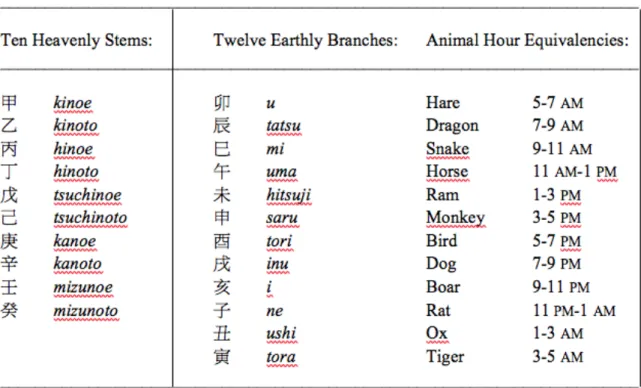
Finally, I provide the Western calendar year and lunar calendar month and day for Jōjin’s diary entries. This allows for easy cross-referencing and look-up between different editions of the diary as entries are referenced by the fascicle number followed by the lunar month and day. In each entry, Jōjin further lists the day according to the Chinese sexagenary cycle that pairs one of the ten heavenly stems (tiangan 天干) with one of the twelve earthly branches (dizhi 地支) in a cycle of sixty.42 I include the Japanese
Romanization of the day according to the sexagenary cycle at the beginning of each diary entry. For the time of day recorded in Jōjin’s diary entries, I refer to the double-hour periods by their animal names based on the twelve earthly branches.43
Below is a table listing the ten heavenly stems that are combined with the twelve earthly branches to signify the day according to the sexagenary cycle in Jōjin’s diary.
There is a list of conversions to the right of the twelve earthly branches for the double-
41 Gong Yanming, Dictionary of the Song Dynasty Bureaucratic System (Beijing:
Zhonghua Publishing House, 1997).
42 This system is was also used to count the years, but Jōjin only provides the name of the reign when noting the year in his diary. He uses the sexagenary cycle exclusively for naming the day.
43 For an article explaining the pre-modern Japanese system for division of time in great detail, including further breakdowns into the smaller units of each double-hour period, see Sōma Mitsuru, Kawabata Kin’aki, and Tanikawa Kiyotaka, “Units of Time in Ancient China and Japan” in Publications of the Astronomical Society of Japan, vol. 56 no. 5 (2004), 887–904.
hour periods and their corresponding animal names. Because the length of the hours and specific time of day were constantly in flux using this system, the ante meridiem and post meridiem time equivalencies are not precise, but are listed to provide a general sense of the commensurate time of day in modern terms. When Jōjin specifies the subdivision of a double-hour period, he uses “mark” 刻 (J. koku Ch. ke) or “point” 點 (J. ten Ch. dian).
These correspond to segments of the double-hour of approximately 14.4 minutes and 24 minutes, respectively.44
44 Ibid, 887-8.
Table 1. Animal Hour Conversions from the Twelve Earthly Branches
Chapter 2: Hangzhou
After thirty-seven days of travel, Jōjin recounts his first sightseeing outing in the major urban center of Hangzhou 杭州 on the evening of the twenty-second day of the fourth month of the fifth year of Zhaoning 照寧 (1072). Prior to this, most of Jōjin’s diary entries consist of details surrounding his movements across the sea and between ports, with occasional notes about the foods he tries and the scenery. The contrast
between these prosaic accounts of his maritime movement and the elaborate descriptions of Hangzhou’s streets and markets is rooted in the different way he engages with these spaces. Rather than the practical nature of recording the names of various ports and bays along his sea route, his entry on Hangzhou’s night market reflects Jōjin’s perception of the use of space for mercantile and entertainment activities that creates an economic and cultural history of Hangzhou. Where previous monastic accounts of China focused on logistical information, distances traveled, important documents, and descriptions of sacred sites, Jōjin finds himself absorbed in the minutiae of his immediate surroundings when confronted with urban spaces.
This chapter begins with Jōjin’s sea route to Hangzhou and compares the start of his diary to that of Ennin’s diary. These early entries from the beginning of Jōjin’s diary also serve as comparative texts for his later writings on the bustling city life in Hangzhou.
While the early entries of Jōjin’s travel are more detailed than Ennin’s, they still lack the proliferating visual details that emerge in his narrative of the entertainers, public
performances, and dense markets characterizing Hangzhou as an urban center. In this
section I also discuss how Jōjin ends his diary entries with mentions of his religious practices. He frequently records his use of prayers, chanting, worshipping the Buddha, and dharma practice at the end of his entries as common closing remarks. Jōjin makes a conscious effort to record what might otherwise be considered unremarkable practices for a monk, and this is not a convention that he follows from Ennin’s diary. Instead, this addition to his own diary emphasizes his religiosity and takes the reader from the broad public view of his surroundings back into his personal sphere of activity.
In the next section, a translation of Jōjin’s description of the night market and performances in Hangzhou is presented to demonstrate how he approaches preserving his personal memory of a public place that holds different meanings to different observers.
Unlike the sacred religious sites he goes on to visit later in his pilgrimage, Jōjin does not have access to writings on Hangzhou that could even subconsciously lend way to
preconceived notions about what to expect as he views the secular customs that filled the crowded city. His interest in the night market performances and packed streets reveal a natural curiosity for the novelty of Hangzhou to a Japanese Buddhist monk. As opposed to his esteemed position as an abbot and teacher in his own right when he travels around Buddhist sites, Jōjin is solely a foreign visitor when he walks around Hangzhou’s night market. He is an observer who is led around the exciting sights and sounds of the urban night life by those who know the city far better than he does.
Finally, the chapter ends with a section on Jōjin’s diary entries on his travels along the complex canal systems that crossed through Hangzhou as he made his way toward the first intended site of his pilgrimage, Mount Tiantai. Although Ennin and Enchin both traveled the canal systems during their trips to China, Jōjin did not have
extensive knowledge about how the waterways were engineered or managed. Moreover, while the sacred sites of the Tiantai and Wutai Mountains were deeply significant to Jōjin, the canals in China did not have the same type of historical or cultural meaning for him. Because of this, I compare Jōjin’s diary entries on the canal and rivers with those of Ennin and native Chinese writers to underline how Jōjin, like Ennin before him,
processes the canals as geographical spaces meant for expediency rather than as places that possess inherent meaning and cultural value.
Jōjin’s Route to Hangzhou
The sea routes from Japan to China are generally divided into northern and southern routes, departing from the northwestern coast of Kyūshū 九州 or the
southeastern coast of Honshū 本州. The established ports for embarkment to China from the time of the kentōshi missions were at Hakata 博多 (modern Fukuoka 福岡) and Naniwa 難波 (modern Ōsaka 大阪), but there are also records of ships embarking from various ports in the Hizen province 肥前 and the small islands off the western coast of Kyūshū.45
Douglas Sherwin Fuqua describes there being three distinct paths of the northern and southern sea routes taken by the kentōshi missions according to their travel notes.46
45 Douglas Sherwin Fuqua, “The Japanese Missions to Tang China and Maritime Exchange in East Asia, 7th-9th Centuries” (PhD diss., University of Hawaii, 2004), 22-32.
46 Ibid. Fuqua has compiled this information based on the study of maritime travel by Sugiyama Hiroshi 杉山宏. See, Sugiyama Hiroshi, “Concerning the Sailing Routes of
He classifies these routes as the Northern Route, the Southern Island Route, and the Southern or Open Sea Route. By the eighth century, the Northern Route was no longer utilized, possibly because of Japan’s strained diplomatic relations with the Korean Silla kingdom.47 Previously, the Northern Route, also known as the Silla Route (J. Shinra no michi Ch. Xinluo dao 新羅道), departed from Kyūshū northward toward the Korean Peninsula where ships would continue along the western coast of Silla toward Shandong 山東. Sailors would then either disembark at Shandong or continue south toward
Yangzhou 揚州.48 Both the Southern Island Route and the Southern Route or Open Sea Route avoided travel along the Korean peninsula, and instead traveled south toward the mouth of the Yangzi River 揚子江.49 The first ports along the Yangzi River that these
the Kentōshi” (Kentōshisen no korō nitsuite遣唐使船の航路について) in Several Problems Regarding Japanese Maritime History: Foreign Relations (Nippon kaijishi no shomondai taigaikankeihen日本海事史の諸問題 対外関係編), ed. Ishii Kenji 石井謙 治 (Tōkyō: Bunken Press, 1995), 31-64.
47 Fuqua, “Japanese Missions,” 25.
48 Fuqua explains that at the end of the voyage, those who continued toward Yangzhou were reported as taking the Ocean and River Route (J. kaidō kōru Ch. haidao jianglu 海道江路). Ibid, 23.
49 Fuqua notes that the Southern Island Route was much more dangerous, with extended periods on the open sea. He brings up the possibility that this route was stumbled upon due to winds and luck, rather than formally plotted out. The Southern Route or Open Sea Route, however, was much more direct and significantly safer, while still leading to the mouth of the Yangzi River from the East China Sea. See Ibid, 27-8.
vessels would reach were in Suzhou 蘇州.50 They would then continue on to disembark in Mingzhou 明州 or Yuezhou 越州. This sequence is recorded in Jōjin’s diary.51
50 In modern Jiangsu江蘇, Suzhou was recorded as the site of both embarkation and debarkation of multiple kentōshi missions. Ibid, 35-7.
51 Jōjin first stays overnight in Suzhou on the twenty-fifth day of the third month of 1072, and then continues his journey to the islands surrounding Mingzhou. On the fourth day of the fourth month of 1072 his vessel was ordered not to enter Mingzhou, so he continues on until he finally arrives in Yuezhou. His ship stops at a small island of Yuezhou on the fifth day of the fourth month of 1072. From here, the vessel continues to Hangzhou bay where he witnesses a huge tidal bore on the thirteenth day of the fourth month of 1072. From the diary, it is clear that the Chinese merchant ship was following the Southern Route all the way to the crew and passengers’ disembarkment in Hangzhou.
Figure 3. Map of disembarkment sites used by kentōshi missions and Jōjin’s ship. English labels added to map copied from Fujiyoshi Masumi, ed., San Tendai Godaisan ki, vol. 1 (Kansai University Press, 2007), 285.
By the time Jōjin was preparing to set off for Song China, Chinese merchant ships mooring along the archipelago had become a common sight. Maritime trade overtook inland trade along the silk routes during the Tang (618-907) creating an influx of Chinese merchants arriving at Japan’s major port in Hakata with foreign goods. Despite Japan’s attempts to regulate trade with China, the number of foreign merchants arriving only continued to increase in the Heian.52 This was particularly beneficial for monks seeking
52 Charlotte von Verschuer notes that one of the regulations put into place by the Heian court was the rule that all foreign merchant ships were only allowed to use the
Hangzhou Bay
Mingzhou Suzhou
Yuezhou
Tiantai Mountains Yangzi River
Mouth
to make pilgrimages into China after Japan stopped sending official envoys. By traveling as passengers on these returning Chinese merchant vessels, Japanese monks continued to gain access to China even when Japan was supposedly not sponsoring any diplomatic visits to China in an official capacity.
After traveling down to Kyūshū 九州 from Mount Hiei, Jōjin found one of these Chinese merchant ships that allowed him and his disciples to board in exchange for Japanese goods, rice, and payment in metals. The first entry of his diary begins with a description of the monks and Chinese boatmen he would be traveling with, along with the exact count or measurement of the various goods he provided as gifts to the Chinese merchants for allowing him and his disciples on board.
On the fifteenth day of the third month of the fourth year of the Enkyū period (1072), on the kinotohitsuji day during the tiger hours, I boarded a Chinese ship off of Kabeshima 壁嵨 (modern 加部島) in the Matsuura district (in modern Nagasaki prefecture) of Hizen province (modern Saga 佐賀and Nagasaki ⾧崎).
The first boatman, Zeng Ju, was named Zeng Three. He was a man of Nanxiong prefecture (modern Guangdong 廣東). The second boatman, Wu Zhu, was named Wu Ten. He was a man of Fuzhou. The third boatman, Zheng Qing, was named Zheng