PHARMACISTS’ PERCEPTIONS OF RAPID DIAGNOSTIC TESTING IN COMMUNITY PHARMACIES IN MISSISSIPPI: A DIFFUSION OF INNOVATIONS
APPROACH
by
Erin A. Hoevelmann
A thesis submitted to the faculty of The University of Mississippi in partial fulfillment of the requirements of the Sally McDonnell Barksdale Honors College.
Oxford May 2017
Approved by
___________________________________
Advisor: Dr. Donna West-Strum ___________________________________
Reader: Dr. Erin Holmes
© 2017 Erin A. Hoevelmann ALL RIGHTS RESERVED
This thesis is dedicated to my parents. Thank you for supporting me in my decision to move to Mississippi to attend the University of Mississippi and the Sally McDonnell
Barksdale Honors College, despite how difficult it may have been. Thank you for believing in me and supporting me the entire way, even from a few states away.
ACKNOWLEDGEMENTS
I would first like to thank my advisor, Dr. West-Strum. Thank you for agreeing to work with me before I had even begun pharmacy school, for your patience during this long process, and for remaining my advisor after your promotion.
I would like to thank Dr. Holmes for her help in making my defense as stress-free as possible.
I would like to thank Dr. Gregory for his continued support.
I would like to thank my family, my boyfriend, Jordan Houry, and my friends. They listened and reminded me of my abilities when I had forgotten.
Lastly, I would like to thank the Sally McDonnell Barksdale Honors College and the University of Mississippi School of Pharmacy. Thank you for the innumerable
opportunities to grow as a citizen, scholar, and student pharmacist. Because of you all, I know with absolute certainty I made the right decision four years ago when I chose to attend the University of Mississippi.
ABSTRACT
ERIN A. HOEVELMANN: Pharmacists’ Perceptions of Rapid Diagnostic Testing in Community Pharmacies in Mississippi: A Diffusion of Innovations Approach
(Under the direction of Dr. Donna West-Strum)
Objectives: The broad purpose of this study is to describe community pharmacists’
perceptions of rapid diagnostic tests (RDTs) in community pharmacies in Mississippi.
The focused goal of this study is to determine the correlation between Everett M. Rogers’
attributes of the diffusion of innovations (including relative advantage, compatibility, complexity, trialability, and observability) and the willingness of community pharmacists to offer RDTs in community pharmacies in Mississippi.
Methods: This study was approved by the University of Mississippi IRB. A list of licensed pharmacists was obtained from the Mississippi Board of Pharmacy. An email with study details and a link to the Qualtrics® survey was sent to licensed pharmacists.
The survey included a screening question (to ensure all participants had recent experience in a community pharmacy in Mississippi), demographic questions, practice-setting
questions, several statements for each attribute of the diffusion of innovations, possible barriers to and benefits of offering RDTs, and asked participants to rate their willingness to offer RDTs. SPSS® was used for data analysis.
Results: The Qualtrics® survey was sent to 3110 possible respondents. The actual response rate was 3.8%. Mean and median ratings were calculated for each of the attributes of the diffusion of innovations and for willingness to offer RDTs. A linear
independent variables/predictors and the mean rating of willingness to offer RDTs as the dependent variable/outcome variable was performed. Relative advantage, complexity, and trialability were found to be statistically significant in influencing pharmacists’
willingness to offer RDTs.
Conclusion: The attributes of Rogers’ diffusion of innovations that influence Mississippi pharmacists’ willingness to offer RDTs in the community pharmacy include relative advantage, complexity, and trialability. As the perceived benefit increases, perceived complexity decreases, and degree to which an innovation may be experimented with on a limited basis increases, a Mississippi community pharmacist’s willingness to offer RDTs increases. As RDTs are more widely implemented in community pharmacies, it will be important for pharmacists to see an advantage to offering RDTs, be prepared to
understand RDTs, and be able to experiment with the implementation of RDTs.
TABLE OF CONTENTS
LIST OF TABLES...viii
INTRODUCTION...1
METHODOLOGY...17
RESULTS...23
DISCUSSION...35
CONCLUSION...43
BIBLIOGRAPHY...44
APPENDIX A: EMAIL INVITATION...49
APPENDIX B: QUALTRICS® SURVEY...51
LIST OF TABLES
TABLE 1 DIFFUSION OF INNOVATIONS STATEMENTS……….20
TABLE 2 BENEFITS AND CONCERNS STATEMENTS...……….21
TABLE 3 DEMOGRAPHICS………24
TABLE 4 PRACTICE SITE………...25
TABLE 5 DIFFUSION OF INNOVATIONS: ATTRIBUTE STATEMENT RATINGS………..27
TABLE 6 DIFFUSION OF INNOVATIONS: ATTRIBUTE RATINGS………….29
TABLE 7 BENEFITS AND CONCERNS: STATEMENT RATINGS………….…29
TABLE 8 BARRIERS TO OFFERING POINT OF CARE TESTING……….……30
TABLE 9 BENEFITS OF OFFERING POINT OF CARE TESTING………….….31
TABLE 10 WILLINGNESS TO OFFER POINT OF CARE TESTING…………...31
TABLE 11 REGRESSION COEFFICIENTS………..32
TABLE 12 DIFFUSION OF INNOVATIONS: STATEMENTS GENERATING MEAN RATINGS OF LESS THAN 3……….….36
INTRODUCTION Background
Amidst changes in healthcare policy, the role of the pharmacist as a healthcare professional is expanding. What was once considered a profession revolved around dispensing and compounding is now evolving into a profession involving collaborating with physicians, counseling patients, medication therapy management, medication synchronization, and performing rapid diagnostic tests. Rapid diagnostic tests (or RDTs) are diagnostic tests designed for use at the point-of-care and are considered low-cost, simple to operate and read, specific, and require only a short amount of time to work (BIO Ventures for Global Health, 2015). They are also referred to as Point of Care tests.
These tests involve performing a robust diagnostic test outside of a laboratory near the patient. They provide reliable results to aid in disease screening and diagnosis (Gilbreath, 2016). RDTs are especially useful in impoverished countries and are often utilized to diagnose diseases such as malaria. In the United States, RDTs can be used to diagnose patients with influenza, Group A streptococcus, HIV, and hepatitis C. Performing these tests in the community pharmacy setting affords patients easy access to treatment without the high costs often related to primary care visits.
Objectives
The focused goal of this study is to determine the correlation between Everett M. Rogers’
attributes of the diffusion of innovations (including relative advantage, compatibility, complexity, trialability, and observability) and the willingness of community pharmacists to offer RDTs in community pharmacies in Mississippi.
RDTs and Education
Dr. Danielle M. Daunais and colleagues (2015) conducted research surrounding the adoption of rapid diagnostic tests in pharmacy and published, “Assessment of pharmacy students’ and licensed pharmacists’ perceived knowledge, application, and interpretation regarding rapid diagnostic tests (RDTs) for infectious diseases.” The study investigates the opinions and concerns of pharmacists and pharmacy students regarding the giving of and the interpretation of rapid diagnostic tests. 716 respondents, consisting of 194 pharmacists and 522 pharmacy students, were asked to respond and indicate their agreement to statements such as, “I am comfortable discussing RDTs with patients, including their value and limitations,” and, “RDTs will become a routine part of pharmacy practice.” Only 16.6% of participants agree or strongly agree that they are comfortable discussing RDTs with patients, while 45.2% of participants agree or strongly agree that RDTs will become a routine part of pharmacy practice.
Pharmacists and pharmacy students recognize the expanding roles of pharmacists and believe they will eventually give RDTs as a part of their every day duties. However, as of yet, many are neither prepared nor comfortable doing so. 53.7% of respondents disagreed
or strongly disagreed with the statement, “I feel my college education adequately prepared me to interpret RDTs.” Therefore, one of the largest obstacles preventing pharmacists and pharmacy students from performing RDTs is a lack of education on the topic.
The majority of pharmacists and pharmacy students indicated that they would attend a continuing education (CE) program to learn more about RDTs and their use by
pharmacists, attend a CE program to improve their physical assessment skills, and/or would enroll in a certificate program on RDTs. Therefore, it is not a lack of motivation or eagerness that is preventing more pharmacists from administering RDTs; it is simply a lack of education, which can easily be resolved in pharmacy schools as indicated by Dr.
Tolu P. Akinwale and colleagues (2015) in “Pharmacy-based point-of-care testing for infectious diseases: Considerations for the pharmacy curriculum.”
Dr. Tolu P. Akinwale and colleagues (2015) developed a curriculum in which pharmacy students are taught to perform and read RDTs while gaining practical experience. The proposed curriculum involves 750 minutes of contact time as a one-semester hour course.
This one credit hour course could be implemented into many Pharm.D. programs and could greatly diminish the objection pharmacists and pharmacy students have to
performing RDTs in the pharmacy setting, as a lack of education would no longer be an issue.
Pharmacists’ Role/Relationship
Even with solutions to the lack of education regarding RDTs, such as Dr. Tolu P.
Akinwale and colleagues’ (2015) proposed curriculum, the question arises regarding whether or not pharmacists will be utilized to perform RDTs. A study conducted by Dr.
Marcia M. Worley and colleagues (2007) explored the perceived roles of pharmacists from the aspect of both the pharmacist and the patient. The seemingly “traditional roles”
of the pharmacist were widely recognized and showed no significant differences in perceptions between the pharmacist and the patient. These roles included those regarding information sharing, specifically talking with patients about how to watch for medication side effects, talking with patients even if the patients do not have any medication
questions, and talking with patients about whether or not it is OK to take their
medications with over-the-counter products. These are questions asked by pharmacists to ensure the safety of patients, and these questions can be asked and discussed during the time the patient spends at the cash register. The information-sharing role of the
pharmacist is consistent with patients’ expectations and pharmacists’ expectations and does not require a significant portion of the pharmacists’ time.
Differences in perceptions of the pharmacists’ role arise when the pharmacist adopts roles that are more relationship-based. The patient-centeredness of the pharmacist-patient relationship is an area in which patients and pharmacists have differing perceptions.
Pharmacists agree more strongly that it is within their role to listen to patients when they have questions regarding medication. Patients agree more strongly that it is within the
role of the pharmacist to say “hello” to patients when they visit the pharmacy. This suggests a current lack of relationship between pharmacists and patients. The development of a professional relationship between pharmacists and patients could improve patients’ trust of pharmacists and generate loyalty.
The responsible behavior role of the pharmacist, involving showing an interest in working with patients to meet their healthcare needs, communicating a desire to help patients manage their medication, and making sure that patients understand how to use their medications before leaving the pharmacy also suggests differing perceptions of the pharmacists’ role. In each of these three cases, pharmacists show stronger agreement with these aspects of responsible behavior. The reason for differing perceptions may simply arise from the fact that patients are unaware the pharmacist can offer these services.
However, the differing ideas could also be due to the fact that patients perceive these roles as belonging to physicians or other practitioners, rather than a community pharmacist. This is the area in which pharmacists can improve their position and perceived role as healthcare team members. In order to adopt a more involved and expanded role in healthcare, pharmacists could allot more dispensing responsibilities to pharmacy technicians and participate in more face-to-face contact with patients through offering more immunizations, adopting medication management programs, and
performing rapid diagnostic tests.
A professional relationship between pharmacists and patients can create loyalty and trust.
relationship with their pharmacist to manage their medications (Worley et al., 2007). Of the respondents that did report having professional relationships with their pharmacists, the average length of the relationship was 7.6 years. By instigating a professional
relationship with patients, pharmacists can gain trust, loyal customers (which is good for business and profit), and can better help their patients. Gaining trust could help
pharmacists to successfully offer rapid diagnostic tests, as patients are more likely to look to pharmacists for healthcare needs if they have proved over several years that they are capable experts in their area. Pharmacists could better help patients if the two are
engaged in a professional relationship, as pharmacists would be aware of all medications the patient is taking and would also be knowledgeable of the patient’s medical history.
Differing perceptions of the role of the pharmacist could be a barrier to the adoption of rapid diagnostic tests in community pharmacies, as patients may not view anything beyond dispensing as the pharmacist’s role. However, this barrier would not be difficult to overcome. If pharmacists could assign more dispensing duties to pharmacy
technicians, heavily market the services offered at the pharmacy, and spend more time engaging with patients, the perceptions patients have of pharmacists could change drastically and shift from that of the pharmacist as a medication dispenser to that of the pharmacist as a front-line healthcare professional.
Pharmacy Services and RDTs
Within the past decade, pharmacists have adopted the role of immunizer in many
community pharmacies. Like RDTs, immunization services represent a shift in the role of
the pharmacist from medication dispenser to healthcare provider. Not surprisingly, there were many perceived barriers to the adoption of immunization services.
Khalid M. Kamal and colleagues (2003) investigated pharmacists’ participation in and impact on immunization services. Respondents overall showed a strong willingness to counsel and promote immunizations, while many were less willing to actually administer vaccines. The reluctance to administer vaccines stems from the many factors pharmacists perceived problematic to the provision of immunization. The major barriers identified included the availability of physicians who agree pharmacists should offer
immunizations, the availability of space within the pharmacy, the availability of time, staff support, level of reimbursement, and concern about legal liability. Many of these barriers remained present years later, as was portrayed in another study conducted in 2008.
In 2008, Gretchen L. Kummer and Leigh L. Foushee conducted a study focused on pharmacy immunization services in North Carolina. 1, 274 pharmacists were surveyed, whether they were active immunizers, inactive immunizers, or nonimmunizers. All respondents were likely to perceive time and space as potential barriers to immunization services. Other perceived barriers included the availability of vaccines, obtaining
reimbursement from third-party providers, the state’s regulations on pharmacist- administered immunizations, and the availability of physician support.
Despite the perceived barriers to adopting immunization services pharmacists anticipated, immunization services were adopted in many pharmacies nationwide. The adoption of immunization services closely parallels the adoption of RDTs, as both are services that have not historically been offered by pharmacies and have not been perceived as
belonging in pharmacies prior to implementation. The barriers to adopting RDTs will be further investigated in this study, but are likely to include the barriers pharmacists
identified in regards to immunization services, namely the availability of time, space, and physician support.
RDT Policies
Obvious problems arise when considering the expanding role of the pharmacist and the effect on other healthcare providers. Such problems are addressed in Collaborative Practice Agreements (CPA), formal agreements in which a licensed provider makes a diagnosis, supervises patient care, and refers patients to a pharmacist under a protocol that allows the pharmacist to perform specific patient care functions (CDC, 2013). CPAs give pharmacists the ability and authority to act in the best interest of the patient as part of a healthcare team. The CDC lists medication therapy management, collaborative drug therapy management, immunizations, counseling, diabetes management services, and blood pressure and cholesterol monitoring as services made possible in the pharmacy due to CPAs between pharmacists and healthcare providers.
Performing RDTs in the pharmacy would require CPAs between pharmacists and physicians. Whilst CPAs require pharmacists to seek out local healthcare providers and
form agreements, they can ultimately reduce patient fragmentation of care and improve health outcomes.
Rapid diagnostic testing in pharmacies is more relevant an issue now than ever. The following policies were adopted by the American Pharmacists Association’s House of Delegates at the 2016 APhA Annual Meeting in regards to rapid diagnostic testing:
1. APhA recognizes the value of pharmacist-provided, point-of-care testing and related clinical services, and it promotes the provision of those tests and services in accordance with the Joint Commission of Pharmacy Practitioners Pharmacists’
Patient Care Process.
2. APhA advocates for laws, regulations, and policies that enable pharmacist- provided, point-of-care testing, and related clinical services that are consistent with the pharmacists’ role in team-based care.
3. APhA opposes laws, regulations, and policies that create barriers to the tests that have been waived by the Clinical Laboratory Improvement Amendments and that are administered and interpreted by pharmacists.
4. APhA encourages the use of educational programming and resources to facilitate practice implementation of pharmacist-provided, point-of-care testing and related clinical services.
5. APhA supports patients taking active roles in the management of their health, including their ability to request and obtain pharmacist-provided, point-of-care tests and related clinical services.
6. APhA advocates for access to, coverage of, and payment for both pharmacist- provided, point-of-care tests and any related clinical services. (American
Pharmacists Association, 2016)
RDTs in Community Pharmacy
In some areas of the United States, rapid diagnostic testing in community pharmacies is already a reality. In the February 2016 edition of PharmacyToday, Sonya Collins investigates the logistics and outcomes of offering RDTs in Hy-Vee pharmacies with Alison Kingston, Pharm.D.. In Omaha, Nebraska, Hy-Vee grocery store pharmacies offer Group A strep tests and influenza tests as the result of a successful program implemented by the University of Nebraska Medical Center and Ferris State University in January 2014. The logistics of implementation include requiring the pharmacies to register as Clinical Laboratory Improvement Amendments (CLIA)-waived laboratories and requiring the pharmacies to form Collaborative Practice Agreements (CPAs) with prescribers. To register as a CLIA-waived laboratory, pharmacies must file a form with the Centers of Medicare and Medicaid Services (CMS). There is no requirement that pharmacists receive additional training; however, the National Association of Chain Drug Stores (NACDS) does offer a 20-hour Point of Care Testing Certificate for interested employers and pharmacists. Pharmacists collect samples from patients, including throat swabs for Group A strep and nasal swabs for influenza. For positive screenings,
pharmacists are authorized through their CPAs to prescribe amoxicillin, azithromycin, or oseltamivir. For negative results, pharmacists recommend over-the-counter products as
needed to treat symptoms. Test results are sent to the patient’s primary care provider and pharmacists follow up with patients two days after tests are performed.
Since the implementation of RDTs in Hy-Vee pharmacies in Omaha, pharmacists have helped shorten the time between the onset of influenza symptoms and treatment (thus decreasing the spread of infection), strengthened patient-pharmacist relationships, witnessed increased patient loyalty, expanded their roles as healthcare providers, and experienced a sense of satisfaction, as they can now care for patients in more ways.
The offering of Group A strep and influenza tests in Hy-Vee grocery store pharmacies is the result of a successful program implemented by the University of Nebraska Medical Center and Ferris State University in January 2014. This program/study was conducted by the University of Nebraska Medical Center and Ferris State University from October 1, 2013, to May 30, 2014, and was published in the Journal of the American Pharmacists Association in 2016. The study, titled, “Effectiveness of a pharmacist-physician
collaborative program to manage influenza-like illness,” (Klepser et al., 2016) investigated the implementation of influenza RDTs in community pharmacies in Michigan, Minnesota, and Nebraska. All pharmacies possessed a CLIA certificate of waiver, as was true with the Hy-Vee pharmacies in PharmacyToday. Pharmacists in Klepser and colleagues’ (2016) study also completed a 20-hour Point of Care testing certificate course.
Pharmacists were required to partner with physicians in one of two ways. Pharmacies could serve as CPA sites or prescriber consultation sites. At CPA sites, the pharmacist could dispense the appropriate medication in accordance with established CPAs. If assessment in accordance with the CPA determined the patient to be clinically unstable, the pharmacist called the patient’s primary care provider to discuss appropriate referral. If patients did not have a primary care provider, they were referred to urgent care facilities or emergency rooms. Encounter summaries were generated from each patient’s visit and were sent to either the patient’s primary care providers or the collaborating physician. At prescriber consultation sites, the pharmacist would contact the patient’s primary care provider and identify a treatment plan, whether that be dispensing an antiviral, scheduling an office visit, referral to an emergency department or urgent care center, or treating symptoms.
Results from Klepser and colleagues’ (2016) study showed rapid diagnostic testing in community pharmacies was time-efficient (the average pharmacy visit was 30-40
minutes), convenient for patients (as many pharmacies in the study were open 24 hours a day, 7 days a week), cost-effective (as the average emergency room visit is $510-635), and decreased the unnecessary use of antibiotics (as patients often pressure physicians but this is not possible with CPAs).
RDT: HIV
In the summer of 2012, the FDA approved the rapid HIV test for over-the-counter (OTC) sale. Recognizing this movement as an opportunity for community pharmacists to serve
as point-of-care providers, Beth E. Meyerson and colleagues (2013) conducted a study in Indiana regarding community pharmacists’ attitudes and perceptions about the OTC sale of HIV tests. Of the seventeen pharmacists surveyed, only two had experience with HIV testing within their pharmacies. Despite the fact that the other fifteen pharmacists were unaware of the availability of the test, all seventeen pharmacists recognized the test as an opportunity for pharmacists to provide consultation and linkage-to-care.
The HIV rapid test differs from other RDTs (such as Hepatitis C, influenza, and Group A streptococcus) in that the test can be interpreted by the patient at home (hence its sale as an OTC product). Problems that pharmacists recognized revolved around the fact that the test can be purchased and then performed and interpreted at home, with no need for the patient to return to the pharmacy. Pharmacists were not comfortable with just selling the test and having patients leave the pharmacy (Meyerson et al., 2013). In the case of the rapid OTC HIV test, pharmacists felt that consultation regarding test results and linkage to HIV treatment were equally important. The placement of the HIV test within the pharmacy was also an area of uncertainty. This uncertainty directly relates to the
pharmacists’ concern regarding the lack of consultation patients purchasing the test may be receiving. The sale of the test behind the counter offers pharmacists a definite
opportunity to provide consultation during the point-of-sale, whereas the sale of the test out in the store risks the chance of the patient purchasing the test without pharmacists’
knowledge. As consultation is a definite concern, the sale of the test behind the counter seems favorable. However, for patients purchasing the test for others or those concerned
with being discrete, the sale of the test behind the counter may prevent purchases and ultimately result in fewer people learning their HIV status early.
Despite the concerns of pharmacists regarding the rapid OTC HIV test, including its placement in the pharmacy and patient consultation barriers, all pharmacists recognized the sale of the test as an opportunity for pharmacists to offer consultation and linkage to care. Pharmacists in the Indiana-based study were willing to provide consultation and linkage to care in order to best help patients, which provides encouraging evidence for the implementation of other RDTs in the community pharmacy. The image of the pharmacist as a health consultant is consistent with a pharmacy practice shift from the isolated druggist to healthcare team member, immunizer, medication consultant, and even tester (Meyerson et al., 2013).
The pharmacist is considered a trusted and highly educated professional, so perhaps it should not be surprising that pharmacists are adopting more responsibilities and roles as healthcare team members rather than solely remaining the dispensers of medication when called for by a physician.
RDTs and the Diffusion of Innovations
Pharmacists’ perceptions of the offering of RDTs in the community pharmacy setting can be investigated using Everett M. Rogers’ diffusion of innovations theory, in which,
“Diffusion is the process by which (1) an innovation (2) is communicated through certain channels (3) over time (4) among the members of a social system” (Rogers, 2014). The
diffusion of innovations theory seeks to explain how an innovation is adopted and implemented. There are four key elements to the theory: the innovation, communication channel, time, and social system. This study revolves around the innovation (rapid diagnostic testing in community pharmacies) and its attributes (including relative advantage, compatibility, complexity, trialability, and observability).
The innovation is an idea, practice, or object that is perceived as new by an individual or other unit of adoption. In the case of the implementation of RDTs, rapid diagnostic testing in community pharmacies is the innovation. Innovations have several perceived attributes, including their relative advantage, compatibility, complexity, trialability, and observability. An innovation’s relative advantage is the degree to which an innovation is perceived as better than the idea it supersedes. The relative advantage of RDTs is the comparison of offering RDTs versus not offering RDTs, and factors such as economic terms, convenience, satisfaction, and advantageousness can all contribute. An
innovation’s compatibility is the degree to which an innovation is perceived as being consistent with the existing values, past experiences, and needs of potential adopters. The more compatible an innovation is, the more rapidly it will be adopted. Compatibility concerns that arise from offering RDTs in pharmacies include time constraints and the availability of space in the pharmacy to perform and interpret RDTs. An innovation’s complexity is the degree to which an innovation is perceived as difficult to understand and use. Innovations simpler to understand are adopted more quickly than their more complex counterparts, which may require the adopter to develop new skills and
complexity concerns, as a pharmacist who has had curriculum covering the performance and interpretation of RDTs may be more readily prepared and willing to offer RDTs than a pharmacist who must first participate in a continuing education program (Akinwale et al., 2015). An innovation’s trialability is the degree to which an innovation may be experimented with on a limited basis. Innovations that can be tested and trialed before being permanently implemented will be adopted more quickly than those that are not divisible, the reason being that a trialable innovation represents less uncertainty to adopters. A pharmacy’s ability to experiment with giving RDTs before permanently adopting the service is therefore important in the adoption of RDTs as a pharmacy-based service. An innovation’s observability is the degree to which the results of an innovation are visible to others. For example, community pharmacies may adopt RDTs more quickly if pharmacies in the nearby area are offering them. The attributes of an innovation are of the utmost importance to this study, as RDTs are a service not yet typically offered in pharmacies.
METHODOLOGY Purpose and Objectives
The broad purpose of this study is to describe community pharmacists’ perceptions of RDTs in community pharmacies in Mississippi.
The focused goal of this study is to determine the correlation between Everett M. Rogers’
attributes of the diffusion of innovations (including relative advantage, compatibility, complexity, trialability, and observability) and the willingness of community pharmacists to offer RDTs in community pharmacies in Mississippi.
Rapid Diagnostic Tests (RDTs) were referred to as Point of Care tests in all aspects of communication with participants, including both in the email invitation and throughout the survey. Point of Care testing was the terminology chosen over RDTs due to the possible negative connotation of the word “diagnostic.” In order to best present Point of Care testing to participants, the word “diagnose” was not utilized at all during
communication with participants. The RDTs of consideration for this study were
Influenza, Group A Strep, Hepatitis C, and HIV, as the average community pharmacist is likely familiar with at least one of these conditions and the appropriate treatment(s). For this study, pharmacists were told, “Point of Care testing involves performing a robust test
community pharmacies for infections including Influenza, Group A Strep, Hepatitis C, and HIV.”
Sample
A list of licensed pharmacists (study participants) in the state of Mississippi was obtained from the Mississippi Board of Pharmacy in 2015. A screening question was included ensuring participants had practiced in a community pharmacy in Mississippi within the year prior to taking the survey. Thus, the sample includes registered pharmacists in the state of Mississippi who had experience working in a community pharmacy within the year prior to taking the survey.
Data Collection
An internet-based survey was sent to the potential participants using an electronic
platform, Qualtrics®, along with an email invitation, which is included in Appendix A, in 2016. A screening question was included to ensure all participating pharmacists had recent community pharmacy experience. The invitation included information about the study and a link to the survey. All potential participants were informed that the survey was voluntary and answers would be kept confidential. Potential respondents were sent two email invitations.
Survey Instrument
The survey sent to participants is included in Appendix B. It consisted of six sections:
screening question, demographics, practice setting, diffusion of innovations, benefits and
concerns, and willingness to offer Point of Care testing. Participants were sent a survey with all of the sections combined and indistinguishable.
The screening question served to ensure all participants had recent experience in a
community pharmacy in Mississippi from which they could base their responses upon for the entirety of the survey.
The demographics section included questions regarding age, gender, highest degree held, time since graduation, and whether or not the participant has completed a residency.
The practice setting section included questions regarding the participant’s primary practice site (chain, independent, or hospital), practice setting (urban or rural), CE (continuing education) related to Point of Care testing, services currently offered by the participant’s pharmacy (cholesterol/lipid screening/monitoring, diabetes services, immunization services, medication synchronization, medication therapy management, Point of Care testing, smoking cessation, and an option for other), and the participant’s perceived knowledge of Point of Care testing.
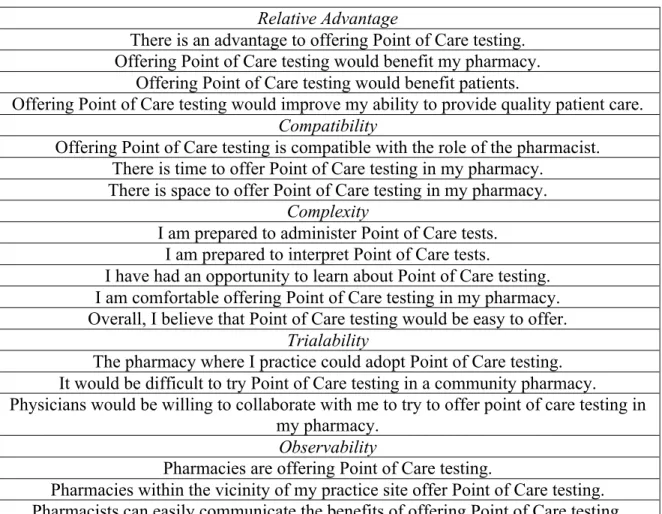
The diffusion of innovations section contained the bulk of the material. This section was itself divided into five sections according to Everett M. Rogers’ Diffusion of Innovations (2014): relative advantage, compatibility, complexity, trialability, and observability. The different sections and statements are shown in Table 1. More information regarding the
attributes of the diffusion of innovations can be found in the “Diffusion of Innovations”
section of the Introduction.
TABLE 1: DIFFUSION OF INNOVATIONS STATEMENTS Relative Advantage
There is an advantage to offering Point of Care testing.
Offering Point of Care testing would benefit my pharmacy.
Offering Point of Care testing would benefit patients.
Offering Point of Care testing would improve my ability to provide quality patient care.
Compatibility
Offering Point of Care testing is compatible with the role of the pharmacist.
There is time to offer Point of Care testing in my pharmacy.
There is space to offer Point of Care testing in my pharmacy.
Complexity
I am prepared to administer Point of Care tests.
I am prepared to interpret Point of Care tests.
I have had an opportunity to learn about Point of Care testing.
I am comfortable offering Point of Care testing in my pharmacy.
Overall, I believe that Point of Care testing would be easy to offer.
Trialability
The pharmacy where I practice could adopt Point of Care testing.
It would be difficult to try Point of Care testing in a community pharmacy.
Physicians would be willing to collaborate with me to try to offer point of care testing in my pharmacy.
Observability
Pharmacies are offering Point of Care testing.
Pharmacies within the vicinity of my practice site offer Point of Care testing.
Pharmacists can easily communicate the benefits of offering Point of Care testing.
The benefits and concerns section served to identify potential barriers to the
implementation of Point of Care testing and the potential benefits of offering Point of Care testing. This section included statements regarding participants’ perceptions of Point of Care testing, shown in Table 2.
TABLE 2: BENEFITS AND CONCERNS STATEMENTS
Point of Care testing will become a routine part of community pharmacy.
Community pharmacies should be offering Point of Care testing.
Offering Point of Care testing is beyond the scope of pharmacy.
Additionally, participants were allowed to select up to three barriers to and benefits of offering Point of Care testing. Potential barriers included: difficulty obtaining
Collaborative Practice Agreements (CPAs), it is beyond the scope of the pharmacist, it would require redesign of the pharmacy, lack of appropriate payment, lack of knowledge regarding Point of Care testing, lack of patient interest, lack of space, lack of support from pharmacy management, lack of time, meeting federal, state, and/or third-party demands, not enough personnel, physician resistance, too complicated, and other, in which the participant could list a barrier not mentioned. Potential benefits included:
expanding the role of the pharmacist, increasing revenue for a pharmacy, it would be convenient for patients, it would economically benefit patients, opportunity to collaborate with physicians, opportunity to offer better patient care, and other, in which the
participant could list a benefit not mentioned.
The willingness to offer Point of Care testing section gauged participants’ willingness to offer Point of Care testing, asked participants which test they would be most likely to implement first (Group A Strep, Hepatitis C, HIV, or Influenza), and inquired about participants’ interest CE regarding Point of Care testing.
Questions varied in format. Participants were required to write in their age. Some questions used multiple-choice type questions, such as those regarding years since graduation and primary practice site. Others allowed patients to select all boxes that were applicable, such as the benefits and concerns of Point of Care testing. A 5-point Likert type scale was used for some questions, in which a rating of “1” indicated participants strongly disagreed and a rating of “5” indicated participants strongly agreed.
Analysis
Analysis was conducted using SPSS®. Data were summarized using frequencies and descriptive statistics. A multivariable linear regression was used to examine relationships between variables.
RESULTS
An email with study details and a link to the Qualtrics® survey was sent to 3110 licensed pharmacists in the state of Mississippi. 227 responses were received and 117 participants were eligible for the study, resulting in an actual response rate of 3.8%. Exclusion criteria included not meeting the screening criteria (those excluded had not practiced in a
community pharmacy in Mississippi within the year prior to receiving the survey).
Demographics
Demographics are summarized in Table 3.
TABLE 3: DEMOGRAPHICS
Age in Years
(Age of eligible participants who provided their age, n=115)
Mean (±SD) 44.5 (±13.2)
Median 44
Gender
Gender Frequency of Selection
Female 54.7%
Male 45.3%
Degrees Held
Degree Frequency of Selection
B.S. 55.6%
Pharm.D. 53.0%
Other Graduate Degrees (M.S., M.B.A., Ph.D., etc.)
12.0%
Time Since Graduation
Time (in years) Frequency of Selection
0-10 35.9%
11-20 23.9%
21-30 17.1%
31-40 13.7%
More than 40 9.4%
Residency Completion
Has participant completed a residency? Frequency of Selection
No 87.2%
Yes 12.8%
Practice Site
Practice Site characteristics are summarized in Table 4.
TABLE 4: PRACTICE SITE
Primary Community Pharmacy Practice Site
Practice Site Frequency of Selection
Chain 53.0%
Independent 34.2%
Hospital 6.8%
Other
(Academia/clinical pharmacy, closed door, hospital employee pharmacy and chain,
inpatient hospice pharmacy, long-term care, supermarket, work site pharmacy)
6.0%
Primary Community Pharmacy Practice Site: Chain
Type of Chain Frequency of Selection
Traditional (e.g. Walgreens, CVS) 47.5%
Mass Merchandiser (e.g. Walmart) 42.6%
Grocery 9.8%
Practice Setting
Practice Setting Frequency of Selection
Rural 71.8%
Metropolitan (>50,000 people) 28.2%
Continuing Education Has participant completed Continuing
Education relating to point of care testing in the past year?
Frequency of Selection
No 80.3%
Yes 19.7%
Services Offered
Service Frequency of Selection
Immunization Services 82.1%
Medication Therapy Management (MTM) Services
81.2%
Medication Synchronization Services 54.7%
Diabetes services 29.1%
Smoking Cessation Services 18.8%
Cholesterol/Lipid Screening/Monitoring 13.7%
Point of Care Testing 13.7%
Other
(Blood pressure testing, compounding, genetic screening for selected drugs, Harmonyx pharmacogenetic testing,
obesity management)
4.3%
Knowledge of Point of Care Testing
Mean (±SD) 2.55 (±1.28)
Median 3.00
Diffusion of Innovations
Participants were instructed to rate their level of agreement with several statements on a Likert scale, with “1” indicating strongly disagree and “5” indicating strongly agree.
Statements were included for each of the five attributes of the diffusion of innovations:
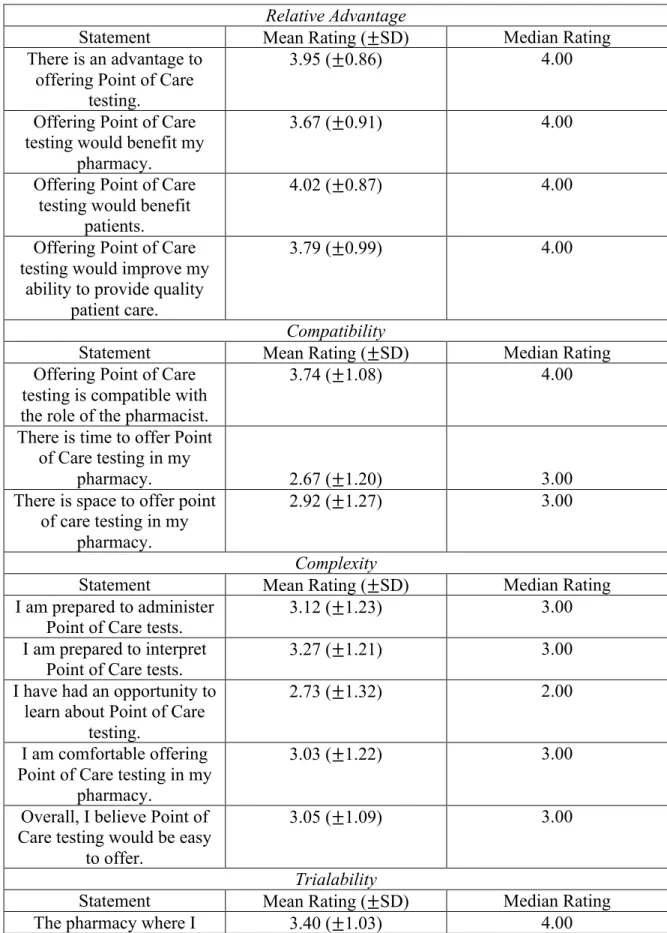
relative advantage, compatibility, complexity, trialability, and observability. Mean and median ratings for statements of each attribute of the diffusion of innovations are summarized in Table 5.
TABLE 5: DIFFUSION OF INNOVATIONS: ATTRIBUTE STATEMENT RATINGS Relative Advantage
Statement Mean Rating (±SD) Median Rating
There is an advantage to offering Point of Care
testing.
3.95 (±0.86) 4.00
Offering Point of Care testing would benefit my
pharmacy.
3.67 (±0.91) 4.00
Offering Point of Care testing would benefit
patients.
4.02 (±0.87) 4.00
Offering Point of Care testing would improve my
ability to provide quality patient care.
3.79 (±0.99) 4.00
Compatibility
Statement Mean Rating (±SD) Median Rating
Offering Point of Care testing is compatible with the role of the pharmacist.
3.74 (±1.08) 4.00
There is time to offer Point of Care testing in my
pharmacy. 2.67 (±1.20) 3.00
There is space to offer point of care testing in my
pharmacy.
2.92 (±1.27) 3.00
Complexity
Statement Mean Rating (±SD) Median Rating
I am prepared to administer
Point of Care tests. 3.12 (±1.23) 3.00
I am prepared to interpret Point of Care tests.
3.27 (±1.21) 3.00
I have had an opportunity to learn about Point of Care
testing.
2.73 (±1.32) 2.00
I am comfortable offering Point of Care testing in my
pharmacy.
3.03 (±1.22) 3.00
Overall, I believe Point of Care testing would be easy
to offer.
3.05 (±1.09) 3.00
practice could adopt Point of Care testing.
It would be difficult to try Point of Care testing in a
community pharmacy.*
3.14 (±1.11) 3.00
Physicians would be willing to collaborate with me to try
to offer Point of Care testing in my pharmacy.
2.81 (±0.84) 3.00
Observability
Statement Mean Rating (±SD) Median Rating
Pharmacies are offering
Point of Care testing. 3.19 (±0.90) 3.00
Pharmacies within the vicinity of my practice site offer Point of Care testing.
2.54 (±1.00) 3.00
Pharmacists can easily communicate the benefits of
offering Point of Care testing.
3.44 (±0.88) 4.00
*This question was reverse-coded, such that for each question a rating of “1” indicated disagreement/not in favor of Point of Care testing and a rating of “5” indicated
agreement/in favor of Point of Care testing in community pharmacies.
For each attribute, the mean and median ratings of each statement were added together and divided by the total number of statements to calculate a mean and median rating.
Mean and median ratings for each attribute of the diffusion of innovations are summarized in Table 6.
TABLE 6: DIFFUSION OF INNOVATIONS: ATTRIBUTE RATINGS
Attribute Mean Rating (±SD) Median Rating
Relative Advantage 3.86 (±0.83) 4.00
Compatibility 3.11(±0.99) 3.00
Complexity 3.04 (±1.00) 3.00
Trialability 3.12 (±0.75) 3.00
Observability 3.06 (±0.64) 3.00
Benefits and Concerns
Participants were instructed to rate their level of agreement with several statements on a Likert scale, with “1” indicating strongly disagree and “5” indicating strongly agree.
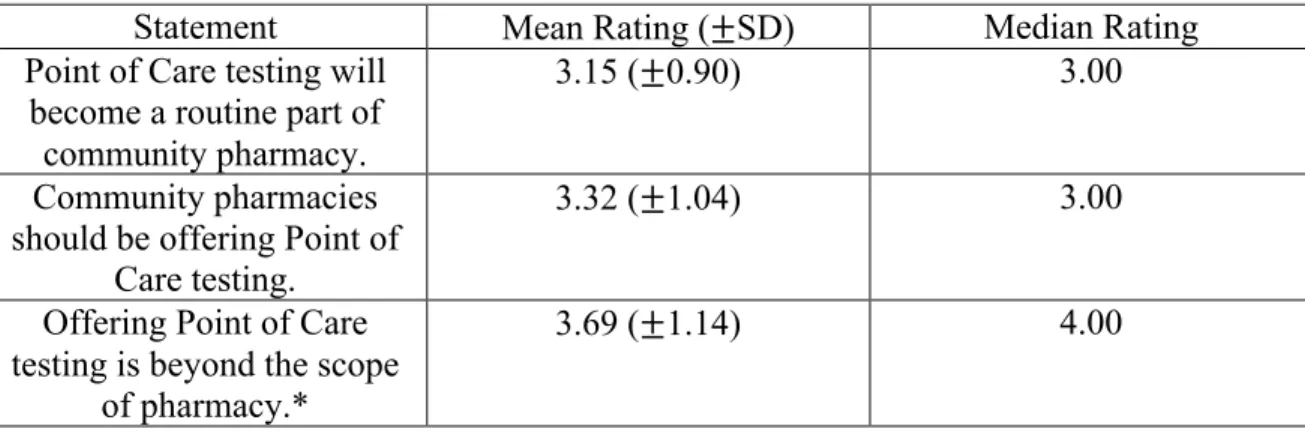
Mean and median ratings for each statement are summarized in Table 7.
TABLE 7: BENEFITS AND CONCERNS: STATEMENT RATINGS
Statement Mean Rating (±SD) Median Rating
Point of Care testing will become a routine part of
community pharmacy.
3.15 (±0.90) 3.00
Community pharmacies should be offering Point of
Care testing.
3.32 (±1.04) 3.00
Offering Point of Care
testing is beyond the scope 3.69 (±1.14) 4.00
*This question was reverse-coded, such that for each question a rating of “1” indicated disagreement/not in favor of Point of Care testing and a rating of “5” indicated
agreement/in favor of Point of Care testing in community pharmacies.
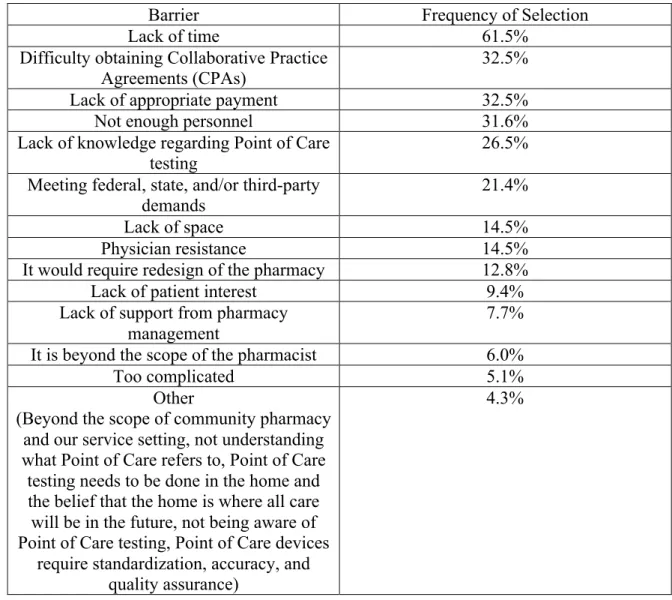
Participants were asked to identify up to three primary barriers to offering Point of Care testing in pharmacies. Identified barriers are summarized in Table 8.
TABLE 8: BARRIERS TO OFFERING POINT OF CARE TESTING
Barrier Frequency of Selection
Lack of time 61.5%
Difficulty obtaining Collaborative Practice
Agreements (CPAs) 32.5%
Lack of appropriate payment 32.5%
Not enough personnel 31.6%
Lack of knowledge regarding Point of Care
testing 26.5%
Meeting federal, state, and/or third-party demands
21.4%
Lack of space 14.5%
Physician resistance 14.5%
It would require redesign of the pharmacy 12.8%
Lack of patient interest 9.4%
Lack of support from pharmacy management
7.7%
It is beyond the scope of the pharmacist 6.0%
Too complicated 5.1%
Other
(Beyond the scope of community pharmacy and our service setting, not understanding what Point of Care refers to, Point of Care testing needs to be done in the home and the belief that the home is where all care will be in the future, not being aware of Point of Care testing, Point of Care devices
require standardization, accuracy, and quality assurance)
4.3%
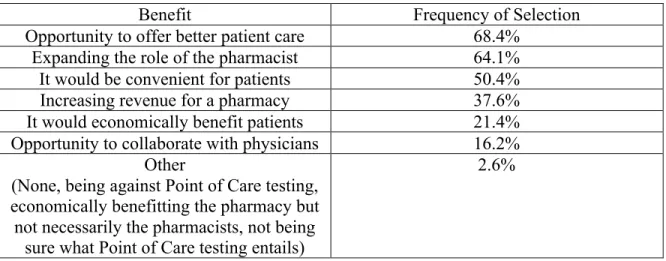
Participants were asked to identify up to three primary benefits of offering Point of Care testing in pharmacies. Identified benefits are summarized in Table 9.
TABLE 9: BENEFITS OF OFFERING POINT OF CARE TESTING
Benefit Frequency of Selection
Opportunity to offer better patient care 68.4%
Expanding the role of the pharmacist 64.1%
It would be convenient for patients 50.4%
Increasing revenue for a pharmacy 37.6%
It would economically benefit patients 21.4%
Opportunity to collaborate with physicians 16.2%
Other
(None, being against Point of Care testing, economically benefitting the pharmacy but not necessarily the pharmacists, not being
sure what Point of Care testing entails)
2.6%
Willingness to Offer Point of Care Testing
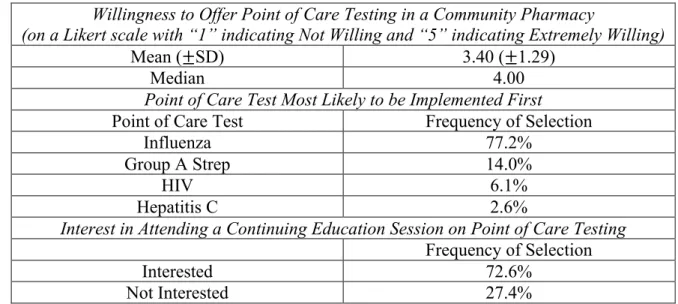
Results from willingness to offer Point of Care testing are summarized in Table 10.
TABLE 10: WILLINGNESS TO OFFER POINT OF CARE TESTING
Willingness to Offer Point of Care Testing in a Community Pharmacy
(on a Likert scale with “1” indicating Not Willing and “5” indicating Extremely Willing)
Mean (±SD) 3.40 (±1.29)
Median 4.00
Point of Care Test Most Likely to be Implemented First Point of Care Test Frequency of Selection
Influenza 77.2%
Group A Strep 14.0%
HIV 6.1%
Hepatitis C 2.6%
Interest in Attending a Continuing Education Session on Point of Care Testing
Regression Analysis
Mean ratings for each attribute of the Diffusion of Innovations and for willingness to offer Point of Care testing were treated as continuous data for the purpose of analysis.
A linear regression with each attribute of the Diffusion of Innovations as independent variables/predictors (the mean ratings for each attribute) and willingness to offer Point of Care testing as the dependent variable/outcome variable (the mean rating) was performed.
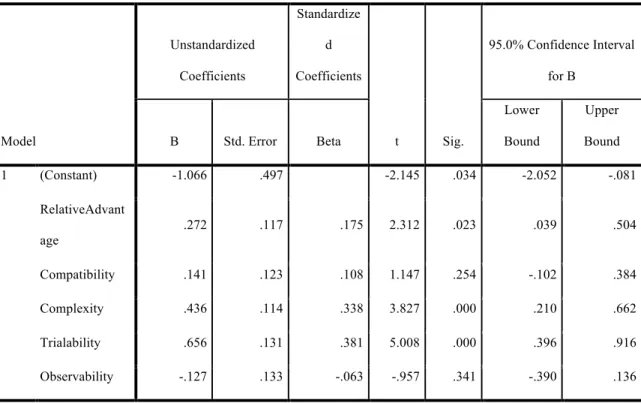
Results are summarized in Table 11.
TABLE 11: REGRESSION COEFFICIENTS
Model
Unstandardized Coefficients
Standardize d Coefficients
t Sig.
95.0% Confidence Interval for B
B Std. Error Beta
Lower Bound
Upper Bound
1 (Constant) -1.066 .497 -2.145 .034 -2.052 -.081
RelativeAdvant
age .272 .117 .175 2.312 .023 .039 .504
Compatibility .141 .123 .108 1.147 .254 -.102 .384
Complexity .436 .114 .338 3.827 .000 .210 .662
Trialability .656 .131 .381 5.008 .000 .396 .916
Observability -.127 .133 -.063 -.957 .341 -.390 .136
a. Dependent Variable: Rate your willingness to offer Point of Care testing in a community pharmacy, with 1 being Not Wi...
A linear regression was performed and values for beta were obtained (unadjusted and adjusted for the other predictors). T tests were performed with an alpha of 0.05.
Confidence intervals were constructed as well. When testing for zero slope (Beta=0) for each of the attributes of the diffusion of innovations at the 0.05 level of significance, the null hypothesis that Beta=0 was rejected for relative advantage, complexity, and
trialability.
It can be concluded with 95% confidence that the true slope of the line relating relative advantage to willingness to offer Point of Care testing is somewhere between 0.039 and 0.504. Because 0 is not contained, the null hypotheses that beta=0 is rejected, and as the mean relative advantage rating increases by 1, the mean willingness to offer Point of Care testing rating increases by 0.039 to 0.504. A higher relative advantage mean rating
indicates a higher degree to which offering Point of Care testing is perceived as better than not offering Point of Care testing, and as the mean relative advantage rating increases, so does pharmacists’ willingness to offer Point of Care testing.
It can be concluded with 95% confidence that the true slope of the line relating
complexity to willingness to offer Point of Care testing is somewhere between 0.210 and 0.662. Because 0 is not contained, the null hypotheses that beta=0 is rejected, and as the mean complexity rating increases by 1, the mean willingness to offer Point of Care testing rating increases by 0.210 to 0.662. A higher complexity mean rating indicates one is more in agreement with/in favor of offering Point of Care testing in the community
perceived as difficult to understand and use, and more complex innovations are adopted more slowly. In this survey, complexity was coded such that a higher mean rating was associated with less complexity, and the higher the complexity mean rating, the lower the complexity of the innovation. Thus, as the complexity mean rating increases and the complexity of the innovation decreases, pharmacists’ willingness to offer Point of Care testing increases.
It can be concluded with 95% confidence that the true slope of the line relating trialability to willingness to offer Point of Care testing is somewhere between 0.396 and 0.916.
Because 0 is not contained, the null hypotheses that beta=0 is rejected, and as the mean trialability rating increases by 1, the mean willingness to offer Point of Care testing rating increases by 0.396 to 0.916. A higher trialability mean rating indicates a higher degree to which an innovation may be experimented with on a limited basis, and innovations that can be tested and trialed before being permanently implemented will be adopted more quickly than those that are not. As the trialability mean rating increases, so does pharmacists’ willingness to offer Point of Care testing.
DISCUSSION Diffusion of Innovations
The mean ratings for each of the attributes of the diffusion of innovations (relative advantage, compatibility, complexity, trialability, and observability) were found to be 3.86 (±0.83), 3.11 (±0.99), 3.04 (±1.00), 3.12 (±0.75), and 3.06 (±0.64), respectively.
Many responses to statements were neutral as is reflected in the near neutral mean ratings. Reasons for the near-neutral mean ratings of the attributes can be explained by those statements which generated mean ratings of less than 3, which indicate
disagreement/not in favor of Point of Care testing. Statement mean ratings of less than 3 existed for the following attributes: compatibility, complexity, trialability, and
observability. The statements that generated mean ratings of less than 3 are summarized in Table 12.
TABLE 12: DIFFUSION OF INNOVATIONS: STATEMENTS GENERATING MEAN RATINGS OF LESS THAN 3
Statement Mean Rating (±SD)
There is time to offer Point of Care testing in my pharmacy.
2.67 (±1.20) There is space to offer Point of Care testing
in my pharmacy. 2.92 (±1.27)
I have had an opportunity to learn about
Point of Care testing. 2.73 (±1.32)
Physicians would be willing to collaborate with me to try to offer Point of Care testing
in my pharmacy.
2.81 (±0.84)
Pharmacies within the vicinity of my
practice site offer Point of Care testing. 2.54 (±1.00)
One reason for near-neutral mean ratings of attributes could be the fact that many participants are waiting for higher management to implement the changes necessary for Point of Care testing. Lack of time, space, and education regarding Point of Care testing can be attributed to higher management. Lack of time and space are issues that require redesign of the workflow and the pharmacy, respectively. As only 34.2% of participants selected their primary community pharmacy practice site as “independent,” the other 65.8% of participants likely work under the direction of higher management, and redesign of the workflow and the pharmacy is not likely within the scope of these participants’ duties and responsibilities. Lack of learning about Point of Care testing can also be attributed to higher management for participants working in areas of community pharmacy other than independent pharmacy. In order for pharmacists to offer Point of Care testing, a certain level of education is required. Education is often provided by higher management in the form of Continuing Education. Pharmacists must learn about Point of Care testing in the form of Continuing Education in order to offer Point of Care
testing, and higher management must therefore provide Continuing Education to pharmacists if they are to offer Point of Care testing. If higher management can implement these changes (redesign of the workflow, redesign of the pharmacy, and availability of Continuing Education courses on Point of Care testing), pharmacists may be more strongly in agreement with offering Point of Care testing.
Another reason for near-neutral mean ratings of attributes could be lack of support from the healthcare community. Participants indicated they disagreed physicians would be willing to collaborate with pharmacists. Without physician collaboration, Point of Care testing is not possible, as there is a need for Collaborative Practice Agreements or at least consultation. This lack of willingness of physicians could cause participants to have neutral opinions regarding Point of Care testing. Even if there are clear benefits to offering Point of Care testing, without physician collaboration Point of Care testing cannot become a reality. Since Point of Care testing is not possible in this situation, it is likely to generate less agreement among participants, thus leading to near-neutral mean ratings.
Near neutral mean ratings of attributes could also be explained by a current lack of
consideration of implementing Point of Care testing. Participants indicated they disagreed pharmacies within the vicinity of their practice sites offer Point of Care testing. If Point of Care testing is not offered by pharmacies in the vicinity, or by competitors, there is little perceived need to implement Point of Care testing. Therefore, even if participants
believe Point of Care testing is beneficial, if there is no perceived need to adopt Point of Care testing, there may be less agreement and therefore near-neutral mean ratings.
Benefits and Concerns
The top five barriers to offering Point of Care testing recognized by participants include (in order of frequency of selection from highest to lowest): lack of time, difficulty obtaining Collaborative Practice Agreements (CPAs), lack of appropriate payment, not enough personnel, and lack of knowledge. Of these five barriers, only one is directly related to the pharmacist. Lack of time and personnel can be attributed to higher
management, as these problems can be solved with redesign of the workflow and changes in staffing. For the 65.8% of participants who do not work primarily in independent community pharmacy, the responsibility of eliminating these barriers belongs to higher management. Difficulty obtaining Collaborative Practice Agreements (CPAs) and lack of appropriate payment are barriers attributed to other healthcare professionals and third- party payers. Lack of knowledge is the only barrier identified by participants that can be attributed to and solved by participants themselves. Participants who feel they lack knowledge can seek out learning opportunities, possibly through nearby schools of pharmacy or through Continuing Education. However, even this lack of knowledge could also be attributed to higher management. Pharmacists under the direction of higher management must learn about Point of Care testing in the form of Continuing Education in order to offer Point of Care testing, and higher management must therefore provide Continuing Education to pharmacists if they are to offer Point of Care testing. Thus, only one of the top five barriers to offering Point of Care testing is directly related to the
participant, and this one barrier can in many cases still be attributed to higher management.
The top five benefits of offering Point of Care testing recognized by participants include (in order of frequency of selection from highest to lowest): opportunity to offer better patient care, expanding the role of the pharmacist, it would be convenient for patients, increasing revenue for a pharmacy, and it would economically benefit patients.
Limitations
This study lacks external validity; it investigated only the perceptions of pharmacists who practice community pharmacy in Mississippi. Perceptions among pharmacists could differ between states.
This study worked with a convenience sample not representative of the entire population of community pharmacists in Mississippi. Any pharmacist in Mississippi who met the screening criteria (i.e. had practiced in a community pharmacy in Mississippi within the year prior to receiving the survey) could participate. The repercussions of convenience sampling are reflected in several areas of this study, including the offering of clinical services by community pharmacies, time since graduation with most recent degree, practice setting (rural or metropolitan), residency completion, and CE completion.
The majority of participants’ community pharmacies offered immunization services
synchronization services (54.7%). The offering of clinical services could influence one’s willingness to offer Point of Care testing, as the adoption of a new service may not be a foreign concept to these individuals. For new services to be offered, the pharmacy design, pharmacy workflow, and billing of services must be considered. It may therefore be more feasible for pharmacies that currently offer/have offered services to implement Point of Care testing. It may also be more feasible for pharmacists who have offered services before to implement Point of Care testing. In order to offer services, training and education is required. Pharmacists who are frequently trained and educated may find Point of Care testing less intimidating, and thus may be more willing to offer Point of Care testing. Had the majority of participants’ community pharmacies not offered services, perhaps the mean rating for willingness to offer Point of Care testing would have been lower than 3.40 (±1.29).
More than one-third of participants in this study graduated with their most recent degree 0-10 years ago (35.9%). This could be a limitation of this study, as there are certainly practicing pharmacists in the state who graduated more than 10 years ago. In 2008, the University of Mississippi School of Pharmacy faculty revised the curriculum to better prepare students to provide patient-centered care and to ensure that patients achieve optimal outcomes of their medication therapy (The University of Mississippi School of Pharmacy). Curricula produce pharmacists, and different curricula with different
emphases can produce pharmacists with different strengths and skills. Thus, participants who graduated with different curricula have different skillsets and strengths, and perhaps the participants of this study who graduated within the past 10 years believe they are
capable and willing to offer Point of Care testing while the participants who graduated more than 10 years ago believe they are less capable and less willing. Perhaps if fewer participants graduated within the past 10 years, the mean rating for willingness to offer Point of Care testing would have been lower than 3.40 (±1.29).
71.8% of participants in this study practice pharmacy in rural areas. Rural areas lack the multitude of healthcare facilities and providers present in urban/metropolitan areas. In some rural towns, there may be but one family physician. It is in the best interest of both healthcare providers and patients that Point of Care testing is offered in community pharmacies in rural areas. By offering Point of Care testing, pharmacists would be helping to relieve physicians of some of the workload associated with being one of a few physicians in an area. In this way, physicians in rural areas may be more willing to work with pharmacists, as they are benefiting from the implementation of Point of Care testing in community pharmacies. Additionally, the availability of Point of Care tests in
community pharmacies would expand access to healthcare services for much of the rural population, thus eliminating some of the health disparities that are known to exist in rural areas. Pharmacists in urban/metropolitan areas may not see the need for Point of Care testing in the community pharmacy, and physicians in urban/metropolitan areas may not be willing to surrender those services to pharmacists.
Few participants completed residencies (12.8%) and thus few participants had the additional training and knowledge gained by completing a residency. Additionally,
testing in the past year while 80.3% did not. The lack of residency experience and lack of CE completion may have contributed to the low mean rating of knowledge of Point of Care testing of 2.55 (±1.28).
This study does not aim to investigate the likelihood of the implementation of Point of Care testing in the community pharmacy but rather the pharmacists’ perceptions of such.
Pharmacists’ perceptions are not the sole determinant of whether Point of Care testing will be implemented in pharmacies. Patients must see a benefit and a need, as well. To get a better idea of the likelihood of the implementation of Point of Care testing in community pharmacies, patients should be surveyed regarding their perceptions of Point of Care testing in the community pharmacy.
CONCLUSION
The attributes of Rogers’ diffusion of innovations that influence Mississippi pharmacists’
willingness to offer RDTs in the community pharmacy include relative advantage, complexity, and trialability. As the perceived benefit increases, perceived complexity decreases, and degree to which an innovation may be experimented with on a limited basis increases, a Mississippi community pharmacist’s willingness to offer RDTs increases. As RDTs are more widely implemented in community pharmacies, it will be important for pharmacists to see an advantage in offering RDTs, be prepared to
understand RDTs, and be able to experiment with the implementation of RDTs.
BIBLIOGRAPHY
BIBLIOGRAPHY
"Actions of the 2016 APhA House of Delegates." Journal of the American Pharmacists Association 56.4 (2016): 369-81. American Pharmacists Association. American Pharmacists Association, 01 July 2016. Web. 27 Feb. 2017.
Akinwale, Tolu P., et al. "Opinion: Pharmacy-Based Point-Of-Care Testing For
Infectious Diseases: Considerations For The Pharmacy Curriculum." Currents In Pharmacy Teaching And Learning 7.(2015): 131-136. ScienceDirect. Web. 22 Sept. 2015.
Collaborative Practice Agreements and Pharmacists’ Patient Care Services: A Resource for Pharmacists. Atlanta: Centers for Disease Control and Prevention, 2013. Print.
Collins, Sonya. "The Promise of Point-of-care Testing: Hy-Vee's Kingston Shows How It Works." PharmacyToday (2016): 34-37. Print.
"Current Programs." Rapid Diagnostic Test (RDT). BIO Ventures for Global Health, 2015. Web. 27 Oct. 2015.
Daunais, Danielle M., Michael E. Klepser, and Brian J. Ogrin. "Research: Assessment Of Pharmacy Studentsʼ And Licensed Pharmacistsʼ Perceived Knowledge,
Application, And Interpretation Regarding Rapid Diagnostic Tests (Rdts) For Infectious Diseases." Currents In Pharmacy Teaching And Learning 7.(2015):
100-105. ScienceDirect. Web. 22 Sept. 2015.
Gilbreath, Marsha. "Point-of-Care Testing: Background Paper Prepared for the 2015- 2016 APhA Policy Committee." (n.d.): n. pag. Print.
"History of the University of Mississippi School of Pharmacy: More than a Century of
Dedication and Accomplishment." School of Pharmacy. The University of Mississippi School of Pharmacy, n.d. Web. 27 Feb. 2017.
<http://pharmacy.olemiss.edu/about-sop/history/>.
Kamal, Khalid M., S. Suresh Madhaven, and Lucinda L. Maine. "Pharmacy and Immunization Services: Pharmacists' Participation and Impact." Journal of the American Pharmacists Association J Am Pharm Assoc. 43.4 (2003): 470. Web. 4 Nov. 2015.
Klepser, Michael E., Donald G. Klepser, Allison M. Dering-Anderson, Jacqueline A.
Morse, Jaclyn K. Smith, and Stephanie A. Klepser. "Effectiveness of a
Pharmacist-physician Collaborative Program to Manage Influenza-like Illness."
Journal of the American Pharmacists Association 56.1 (2016): 14-21. Web.
Kummer, Gretchen L., and Leigh L. Foushee. "Description of the Characteristics of Pharmacist-based Immunization Services in North Carolina: Results of a Pharmacist Survey." Journal of the American Pharmacists Association 48.6 (2008): 744-51. Print.
Meyerson, Beth E., Priscilla T. Ryder, Christiana Von Hippel, and Kelsey Coy. "We Can Do More Than Just Sell the Test: Pharmacist Perspectives About Over-the-
Counter Rapid HIV Tests." AIDS Behav AIDS and Behavior 17.6 (2013): 2109 113. Web. 3 Nov. 2015.
Rogers, Everett M. Diffusion of Innovations, 5th Edition. 5th ed. S.l.: Free, 2014. Print.
Worley, Marcia M., et al. "Original Research: Pharmacists' And Patients' Roles In The
Pharmacist-Patient Relationship: Are Pharmacists And Patients Reading From The Same Relationship Script?" Research In Social And Administrative Pharmacy 3 (2007): 47-69. ScienceDirect. Web. 22 Sept. 2015.
APPENDICES