Digital Repository Universitas Jember
Digital Repository Universitas Jember
09/12/23, 12.04 Vol. 1 No. 2: July - December (2023) | Journal of Management Research and Studies
https://jmrs.optima-science.com/index.php/jmrs/issue/view/2 1/3
HOME ARCHIVES Vol. 1 No. 2: July - December (2023)
Vol. 1 No. 2: July - December (2023)
DOI: https://doi.org/10.61665/jmrs.v1i2 PUBLISHED: 05-09-2023
Analysis of the Influence of Career Development and Work Discipline on Employee Performance which is Mediated by Organizational Culture
The Influence of Financial Literacy and Income on the Decision to Invest in Islamic Stocks
Phenomenological Study of the Application of Islamic Business Ethics in Fashion Sale and Purchase Trasactions
The Role and Constraints of Group Sharia Financing in the Economic Empowerment of Women Customers
An Exploration of the Causes of the Failure of PPR Payments in the Wirogunan Residence Community during the Pandemic
The Influence of Marketing Mix on Loyalty Through Customer Satisfaction at Indomie Food Stalls (Warmindo) in Malang City
Effect of Competence on Career Development and Implication for Organizational Commitment
The Influence of the Marketing Mix on Customer Satisfation
/ /
ARTICLES
Muhammad Aghis Wahidu Zaman, Nasharuddin Mas 104-114
Galang Kalifat Ekanagara, Novi Puspitasari, Akhmad Munir 115-125
Vicki Luvian, Novi Puspitasari, Agus Mahardiyanto 126-143
Dewi Piyanggara, Novi Puspitasari, Suparman 144-155
Lailatul Mukaroma, Novi Puspitasari, Abdul Fatah 156-164
Fitriyah, Martaleni 165-177
Shinta Dewi Suprayitno, Survival, Dharmayanti Pri Handini 178-191
Dyah Murdayani Kusumaningrum, Martaleni 192-207
Digital Repository Universitas Jember
Digital Repository Universitas Jember
09/12/23, 12.04 Vol. 1 No. 2: July - December (2023) | Journal of Management Research and Studies
https://jmrs.optima-science.com/index.php/jmrs/issue/view/2 2/3
The Relationship between Leadership, Organizational Culture, and Human Capital in Organizations: Bibliometric
Analysis of the Effect of Work Environment and Organizational Culture on Teacher Performance with Teacher Work Discipline as an Intevening Variable
Influence Free Cash Flow and Growth Opportunity against Company Values with leverage as a Variable Intervening
The Influence of Promotion Through Social Media on Purchasing Decisions with Trust as a Moderation Variable
The Influence of Price Perceptions, Promotions and Service Quality on Repurchase Decisions
Implementastion of Internal Inventory Merchandise Control System
Market Retribution Market Potential Analysis in Malang City
The Influence of Intellectual Intelligence, Emotional Intteligence, and Spiritual Intelligence on Employee Ethical Behavior
PEOPLE
Contact Editorial Team Reviewers
POLICIES
Focus and Scope Publication Ethics Publication Frequency Peer Review Process Journal License Open Access Policy Article Processing Charges Screening Plagiarism Archiving
Choirul Anam, Arief Purwanto, Hanif Rani Iswari 208-217
Mintaasih Utami, Muchlis H Mas'ud 218-233
Agostinho Pinto Soares, Muchlis Mas'ud, Alfiana 234-251
Asmin Rahayaan 252-265
Irawan Rumatiga 266-282
Dita Andhini Setiyowati, Dwi Anggarani, Endah Puspitosarie 283-296
Mulyono, Survival 297-311
Muchammad Maulana Abdillah, Tuti Hastuti, Soedjono, Dharmayanti Pri Handini 312-325
Digital Repository Universitas Jember
Digital Repository Universitas Jember
09/12/23, 12.04 Vol. 1 No. 2: July - December (2023) | Journal of Management Research and Studies
https://jmrs.optima-science.com/index.php/jmrs/issue/view/2 3/3
SUBMISSION
Online Submissions Author Guidelines Copyright Notice Privacy Statement
TEMPLATE
Article Template Copyright Template
ISSN E-ISSN: 3024-8396
OTHER
Journal Indexing Visitors
Journal of Management Research and Studies Publisher: CV. Maenaka Cipta Kreasi Sejahtera
Jalan Simpang Soekarno Hatta, Kav. 4, Jatimulyo, Kec. Lowokwaru, Kota Malang, Jawa Timur, 65141
This work is licensed under a Creative Commons Attribution-ShareAlike 4.0 International License.
Digital Repository Universitas Jember
Digital Repository Universitas Jember
09/12/23, 12.03 Phenomenological Study of the Application of Islamic Business Ethics in Fashion Sale and Purchase Trasactions | Journal of M…
https://jmrs.optima-science.com/index.php/jmrs/article/view/33 1/4
HOME ARCHIVES VOL. 1 NO. 2: JULY - DECEMBER (2023) Articles
Phenomenological Study of the Application of Islamic Business Ethics in Fashion Sale and Purchase Trasactions
Vicki Luvian Universitas Jember Novi Puspitasari Universitas Jember Agus Mahardiyanto Universitas Jember
Keywords: Islamic Business Ethics, Quantitive, Case Study
ABSTRACT
The paper explores the impact of business growth on human life and emphasizes the neglect of ethics by some profit-driven entrepreneurs. It advocates for the integration of Islamic principles to guide business conduct, promoting a holistic approach and ethical boundaries based on the Qur'an and Hadith. Drawing parallels between Kant's deontology theory and Al-Ghazali's insights, the paper underscores the importance of grounding business actions in religious principles for a morally sound approach in the evolving economic landscape. This study aims to analyze the application of Islamic business ethics in buying and selling transactions based on the principles of unity, equilibrium, free will, responsibility, and benevolence at Althaf Moslem Store in Bogor, Indonesia. The research employs a qualitative method with a case study approach. Informant selection is determined using a purposive method, and observation serves as the primary data collection technique.
The results indicate that Althaf Moslem Store has successfully implemented the principles of Islamic business ethics.
/ / /
Digital Repository Universitas Jember
Digital Repository Universitas Jember
09/12/23, 12.03 Phenomenological Study of the Application of Islamic Business Ethics in Fashion Sale and Purchase Trasactions | Journal of M…
https://jmrs.optima-science.com/index.php/jmrs/article/view/33 2/4
PUBLISHED
Digital Repository Universitas Jember
Digital Repository Universitas Jember
09/12/23, 12.03 Phenomenological Study of the Application of Islamic Business Ethics in Fashion Sale and Purchase Trasactions | Journal of M…
https://jmrs.optima-science.com/index.php/jmrs/article/view/33 3/4
10-11-2023
ISSUE
Vol. 1 No. 2: July - December (2023) SECTION
Articles
LICENSE
Copyright (c) 2023 Vicki Luvian, Novi Puspitasari, Agus Mahardiyanto
This work is licensed under a Creative Commons Attribution-ShareAlike 4.0 International License.
PEOPLE
Contact Editorial Team Reviewers
POLICIES
Focus and Scope Publication Ethics Publication Frequency Peer Review Process Journal License Open Access Policy Article Processing Charges Screening Plagiarism Archiving
SUBMISSION
Online Submissions Author Guidelines Copyright Notice Privacy Statement
TEMPLATE
Article Template Copyright Template
ISSN E-ISSN: 3024-8396
OTHER
Journal Indexing Visitors
Digital Repository Universitas Jember
Digital Repository Universitas Jember
09/12/23, 12.03 Phenomenological Study of the Application of Islamic Business Ethics in Fashion Sale and Purchase Trasactions | Journal of M…
https://jmrs.optima-science.com/index.php/jmrs/article/view/33 4/4
Journal of Management Research and Studies Publisher: CV. Maenaka Cipta Kreasi Sejahtera
Jalan Simpang Soekarno Hatta, Kav. 4, Jatimulyo, Kec. Lowokwaru, Kota Malang, Jawa Timur, 65141
This work is licensed under a Creative Commons Attribution-ShareAlike 4.0 International License.
Digital Repository Universitas Jember
Digital Repository Universitas Jember
126
Phenomenological Study of the Application of Islamic Business Ethics in Fashion Sale and Purchase Transactions
Novi Puspitasari1, Vicki Luvian 2*, Agus Mahardiyanto3
1,2,3Department of Management, Universitas Jember, Indonesia
ARTICLE INFO
JEL Classification:
E31, M21, M31
Corresponding Author:
Vicki Luvian
([email protected]) Received: 01-10-2023 Revised: 14-10-2023 Accepted: 28-10-2023 Published: 10-11-2023 Keywords:
Islamic Business Ethics, Qualitative, Case Study
This work is licensed under a Creative Commons Attribution-ShareAlike 4.0 International License.
ABSTRACT
The paper explores the impact of business growth on human life and emphasizes the neglect of ethics by some profit-driven entrepreneurs.
It advocates for the integration of Islamic principles to guide business conduct, promoting a holistic approach and ethical boundaries based on the Qur'an and Hadith. Drawing parallels between Kant's deontology theory and Al-Ghazali's insights, the paper underscores the importance of grounding business actions in religious principles for a morally sound approach in the evolving economic landscape. This study aims to analyze the application of Islamic business ethics in buying and selling transactions based on the principles of unity, equilibrium, free will, responsibility, and benevolence at Althaf Moslem Store in Bogor, Indonesia. The research employs a qualitative method with a case study approach. Informant selection is determined using a purposive method, and observation serves as the primary data collection technique. The results indicate that Althaf Moslem Store has successfully implemented the principles of Islamic business ethics.
1. INTRODUCTION
Business activities have experienced rapid growth and development. This can be seen from the variety of goods and services offered to the general public. Business plays an important role in economic change and development. Industrial development always begins with business development. Business signals what people want (Hulaimi et al., 2016: 345). Business is an inseparable part and plays a very important role in meeting human needs. Business activities can affect all levels of human life at the personal, social, regional, national and even international levels.
The implementation of the economy is expected to be able to make a balanced contribution to human equality and sustainability, the development of the times increasingly requires humans to continue to improve their capacity and always act in accordance with what has been ordered according to religious teachings, namely the relationship between hablumminallah, hablum minan nass and hablum minal alam.
Therefore, it is important for humans to apply a good role model attitude, one of which is Journal of Management Research and Studies
https://jmrs.optima-science.com/index.php/jmrs
ISSN: 3024-8396 Vol. 1, No. 2, July – December (2023)
Digital Repository Universitas Jember
Digital Repository Universitas Jember
127 the application of business in accordance with Islamic law because business continues to develop following developments that occur in the world (Amalia, 2013: 117). Business reality shows that some entrepreneurs have begun to ignore the principles of business ethics in their business activities. Some parties interpret business as an economic activity that aims only to gain profit. The consequence for other parties is that the morality aspect cannot be used to assess business activities (Rosiyana et al., 2017: 196). Referring to classical law that directs entrepreneurs to maximize profits and spend minimum capital.
Finally, some entrepreneurs, both small and large, do not prioritize social responsibility, such as environmental impacts, the impact of products consumed by consumers, fair competition, government regulations, humanitarian ethics, and others. This attitude will have an impact on externality problems to community groups, especially consumers who are in a weak position. (Nursyamsiyah and Nopianti, 2021: 53).
Islam not only provides human guidance to worship Allah Subhanahu Wa Ta`ala, but Islam also provides a positive view of business activities (Bertens, 2013: 46). The Qur'an and Hadith are the main sources of human reference. Both are instructions and guidelines that are undoubtedly true for Muslims in regulating all aspects of life in this world including aspects of muamalah, especially with regard to trade in which Islamic business ethics are discussed (Jubaedi et al., 2018: 151). Basically, the purpose of applying Islamic law to entrepreneurs is to achieve blessed and noble wealth, realize spiritual, physical and spiritual welfare, then build a mechanism in society to bring equality and prevent social inequality (Patimah, 2020: 94). Islam is present to provide a boundary, and the dividing boundary is ethics, which can be interpreted as a signpost between right and wrong, permissible and impermissible, and halal and haram. The definition of ethics can be understood as a standard of conduct, which means leading business actors in acting, behaving and making decisions. Actions that are legal and correct in the moral choices a person makes can be interpreted as ethics (Alma, 2011: 53).
According to Qardawi in Djakfar (2007: 22) the relationship between economics (business) and ethics will never be separated like two sides of a coin that can never be separated, as is the case between science and morals, between politics and morals. So that the moral reality in people's lives that is clarified through critical studies is the field of business ethics and economic morals, so critical thinking is needed to produce morality that is meaningful for life (Puspitasari, 2016: 117). The deontology theory proposed by Imanuel Kant explains that a good act is an act that is done because it is an obligation, while a bad act is an act that is forbidden to do (Bertens, 2013: 67). One part of this theory is the traditional deontology theory which explains where individual moral actions and obligations must be based on God's commands (Darmawati, 2020:3).
This shows that Muslim entrepreneurs in business activities need to be based on God's commands where the foundation is in the Qur'an and Hadith in behavior and action.
Kant's business ethics theory has similarities with the thoughts of Al-Ghazali who is a Muslim figure who contributed in shaping the ethical system in Islam. Al-Ghazali's concept of ethics is defined as praiseworthy actions according to reason and Islamic law such as being responsible, honest, fair, speaking well and others. Meanwhile, bad actions such as not being trustworthy, lying or selfish. The good and bad of an action is traced
Digital Repository Universitas Jember
Digital Repository Universitas Jember
128 through religion and reason, therefore the two must complement each other and be brought together, because reason alone is not sufficient in moral life and neither is revelation (Ananda, 2021: 122).
According to Rosidah (2021: 38) Islam wants profit or profit in business. However, Islam does not just let someone do business at will to get the maximum profit possible by legalizing all means such as usury, bribery, fraud, perjury, and other false actions. Allah Subhanahu Wa Ta`ala says in the Qur`an surah An-Nisa verse 29 which contains false actions:
ْنَع ًة َرا َجِت َنوُكَت ْنَأ َّلَِإ ِل ِطاَبْلاِب ْمُكَنْيَب ْمُكَلا َو ْمَأ اوُلُكْأَت َلَ اوُن َمآ َني ِذَّلا اَهُّيَأ اَي اوُلُتْقَت َلَ َو ۚ ْمُكْن ِم ٍضا َرَت
ۚ ْمُكَسُفْنَأ ا ًمي ِح َر ْمُكِب َناَك َ َّاللَّ َّنِإ
Meaning: "O you who believe, do not eat of each other's wealth by means of false means, except by way of trade between you. And kill not yourselves; surely Allah is Most Merciful to you."
According to Anwar Basalamah (2011: 763), the development of business today takes a religious background increasingly mushrooming from the field of sharia institutions, sharia tourism, to sharia business. This shows that there is enthusiasm for business people who build or change their business direction on the concept of sharia so that they also claim to be a Muslim businessman. However, despite the proliferation of Muslim business people, in fact, in business practices the application of the sharia concept has not been fully implemented, even sharia is only used as a label or mere packaging, it can be said that these business people do not know for sure about the sharia business system.
One of the businesses that claims its business with sharia business is Althaf Moslem Store (AMS) located in Pakansari, Bogor Regency, Indonesia. AMS is one of the businesses engaged in the sale of Muslim clothing with target consumers aged 20-40 years and want to be stylish with the latest Muslim clothing models. AMS sells halal goods that do not violate the provisions of Sharia such as gamis clothes for both men and women, kurta clothes, sirwal pants, and other worship tools. However, based on the results of the initial survey, researchers found some clothes that had defects such as incomplete buttons, the stitches on the back of the sirwal pants were not neat, and some clothes were dull.
However, the AMS owner did not provide detailed information on the condition of the items sold. In fact, items that have these flaws are set at the same price as good quality items. Therefore, this is contrary to the concept of AMS, which claims to be a sharia business, but the owner continues to sell the defective clothes, making it appear that he does not have good business ethics.
Studies on business ethics with an Islamic perspective have been conducted by several previous researchers. The results of Muhammad Rais's study (2018) show that the behavior of batik clothes traders is unfair in providing selling prices to consumers.
The traders in determining the selling price based on the ability of consumers to bargain prices, gender, domicile, and shirt size. The traders have not been able to implement the foundation of balance in determining the selling price to consumers, especially to tourist
Digital Repository Universitas Jember
Digital Repository Universitas Jember
129 consumers. Therefore, batik clothes traders in Beringharjo Market in determining the selling price are not in accordance with Islamic business ethics.
The purpose of this research is to analyze the application of Islamic business ethics in buying and selling transactions based on the principles of unity, equilibrium, free will, responsibility, and benevolence at Althaf Moslem Store Bogor. This study provides both theoretical and practical benefits. The theoretical benefit of this study is to provide additional references in the science of Islamic business ethics and Islamic economics, especially regarding Islamic business management, Islamic marketing management, Islamic entrepreneurship. The practical benefit is as a consideration for Althaf Moslem Store Bogor Regency and other sharia business actors to improve and comply with the principles of Islamic business ethics. In addition, this research is a consideration for certain parties, especially for business actors who want to do business in accordance with Islamic law.
2. LITERATURE REVIEW
1) Business Ethics from an Islamic Perspective
Business ethics in Islam is a number of ethical business behaviors (akhlaq al Islamiyah) based on sharia values that prioritize halal and haram. Ethical behavior is behavior that follows the commands of Allah Subhanahu Wa Ta`ala and stays away from his prohibitions (Zamzam and Aravik., 2020: 10). Business actors must act ethically in their various activities. Trust, justice and honesty are the main factors in achieving business success in the future (Fitri Amalia, 2012: 3).
According to Lubis (2009:39) the Islamic standard of right and wrong is different from other measures. An action judged as right and wrong needs to pay attention to the criteria of how to do the action. The use of criteria can be referred to the provisions of the Qur'an. As said by Allah Subhanahu Wa Ta`ala in surah Al-Baqarah verse 263, as follows:
ٌميِل َح ٌّيِنَغ ُ َّاللَّ َو ۗ ىًذَأ اَهُعَبْتَي ٍةَقَدَص ْن ِم ٌرْي َخ ٌة َرِفْغ َم َو ٌفو ُرْع َم ٌل ْوَق Meaning: "A good word and forgiveness are better than charity that is accompanied by something."
Business actors who do not maintain ethics will not be able to run a good business so that it can threaten social relations and harm consumers, even themselves. Islamic business ethics upholds the spirit of mutual trust, honesty and justice, while between business owners and employees develops a family spirit (Rivai and Buchari, 2013: 237).
The difference between Islamic and conventional business ethics is that in conventional business ethics the relationship is only to fellow human beings, as long as no one knows that the action can harm others, then the behavior is considered valid.
While in Islamic business ethics, the relationship is not only to fellow humans, but also to Allah Subhanhu Wa Ta`ala. All actions taken will be accounted for before Allah Subhanhu Wa Ta`ala. Therefore, in conducting business transactions will affect life in the world and the hereafter (Khairani, 2015: 31).
Digital Repository Universitas Jember
Digital Repository Universitas Jember
130 2) Principles of Islamic Business Ethics
Business ethics in an Islamic perspective that is organized as a system has moral standards set as basic principles that become the discussion of Islamic business ethics as a reference for the moral awareness of business people. According to Badroen et al.
(2015: 89-102), the principles of Islamic business ethics are as follows:
a) Principle of Unity (Tawhid)
The concept of tawhid is the main source of Islamic business ethics which manifests in the total and pure belief in the oneness of God. The concept of tawhid means that Allah Subhanhu Wa Ta`ala sets certain limits on human behavior as a caliph, not to sacrifice individual rights but to provide benefits to other individuals (Badroen et al., 2015: 89). Tawhid is an acknowledgment for individuals of the existence of the Almighty God as the anchorage of accountability for human actions that cannot be avoided by anyone. The principle of tawhid leads humans in economic activities to believe that the property that is owned belongs to Allah Subhanahu Wa Ta`ala. Tawhid produces the unity of the world and the hereafter, leading a businessman not to pursue material alone, but blessings and more eternal benefits. Therefore, an entrepreneur is guided to avoid all forms of exploitation of fellow human beings (Djakfar, 2012: 34).
The principle of tawhid provides two realizations for business people. The first awareness is that tawhid provides awareness for business people that all resources on earth belong only to Allah Subhanahu Wa Ta`ala absolutely. The second awareness is the motivation for human creation into this world is to glorify Allah Subhanahu Wa Ta`ala who created the universe and its contents by worshiping Him (Hanafi, 2021: 4). The evidence that explains the unity of surah Al-An`am verse 162:
َني ِمَلاَعْلا ِ ب َر ِ َّ ِلِلّ يِت ا َم َم َو َياَي ْح َم َو ي ِكُسُن َو يِت َلََص َّنِإ ْلُق Meaning: "Say: surely my worship, my service, my life and my death are for Allah, the Lord of the worlds."
b) Principle of Equilibrium (Balance)
Islam requires business people to be fair, including to those who are not favored. The definition of fairness in Islam is emphasized so that the rights of others, the rights of the universe, the rights of the environment, and the rights of Allah and His Messenger apply as stakeholders of one's fair behavior. All of these rights must be placed according to sharia rules. Not accommodating one of the rights above, can put someone in injustice (Badroen et al., 2015: 91).
According to Rangkuti (2017: 18) justice is putting something in its place, treating according to its position, and giving something according to the rights of the recipient. Individuals are equal in human dignity. Discrimination cannot be applied based solely on skin color, race, nationality, religion, gender or general.
The economic rights and obligations of each individual are adjusted to their capabilities and capacities and synchronized with their respective normative roles
Digital Repository Universitas Jember
Digital Repository Universitas Jember
131 in the social structure. Therefore, a just person will be closer to piety. Allah says surah Al-Maidah verse 8:
َمآ َنيِذَّلا اَهُّيَأ َيا ۚ اوُلِدْعَت َّلََأ ٰىَلَع ٍم ْوَق ُنآَنَش ْمُكَّنَم ِرْجَي َلَ َو ۖ ِطْسِقْلاِب َءاَدَهُش ِ َّ ِلِلّ َنيِما َّوَق اوُنوُك اوُن
وُلِدْعا َنوُلَمْعَت اَمِب ٌريِبَخ َ َّاللَّ َّنِإ ۚ َ َّاللَّ اوُقَّتا َو ۖ ٰى َوْقَّتلِل ُبَرْقَأ َوُه ا
Meaning: "O you who believe, be those who always establish the truth for the sake of Allah, bearing witness with justice. And let not your hatred of any people lead you to be unjust. Be just, for justice is nearer to piety. And fear Allah, surely Allah knows best what you do."
The application of the principle of balance in Islamic business ethics in economic activity combines moral and spiritual values, because without a moral filter, economic activity is prone to destructive behavior that can harm others such as the practice of usury, monopoly, and other fraud which will eventually become a tradition in society to prioritize materialism without regard to morality.
(Badroen et al., 2015: 97). Rasulullah sallallahu `alaihi wa sallam in carrying out commerce upholds the principles of justice and implements Islamic values in every economic activity. The principle of balance must be applied in all dimensions of life to avoid acts of oppression, exploitation and violence. Islam forbids business people to cheat even if it is just to bring something to a condition that raises doubts such as using false oath sales.
c) Free will principle
Islamic teachings in business ethics have freedom, but that freedom is not detrimental to collective interests. No income limit for a person encourages humans to actively work and work with all the potential they have. The tendency of humans to continuously fulfill their unlimited personal needs is controlled by the existence of obligations through zakat, infaq, and sadaqah. The balance between individual and collective interests is the driving force for the movement of the economy without damaging the existing social system (Badroen et al., 2015:
96).
When viewed from an economic point of view, Islam rejects the free will put forward by conventional economic figures, where business people can act as they please, the main thing is to provide profit alone. Profit maximization is the most important goal in conventional economics, while Islamic economics emphasizes the principle of halal and worship to Allah Subhanahu Wa Ta`ala without ignoring profits (Rais, 2018: 115). Allah says in surah Al-Muthaffifin verses 1-3:
ِذَّلا َنۡيِفِ فَطُمۡلِ ل ٌلۡي َو َن ۡوُرِس ۡخُي ۡمُه ۡوُنَز َّو ْوَا ۡمُه ۡوُلاَك اَذِا َو َن ۡوُف ۡوَت ۡسَي ِساَّنلا ىَلَع ا ۡوُلاَت ۡكا اَذِا َنۡي Meaning: "Woe to those who cheat (in measuring and weighing); (they are) those who, when they receive a measure from others, ask for it to be fulfilled;
(conversely) when they measure or weigh for others, they reduce it."
Digital Repository Universitas Jember
Digital Repository Universitas Jember
132 The application of the principle of free will is to set the selling price transparently to consumers and compete fairly is a form of free will. Prices that are not transparent can lead to fraud. So, setting prices with transparency and fairness is highly respected in Islam so as not to fall into the practice of usury, maysir, gharar, and others. Humans have a tendency to compete in everything, including the freedom to do business. A business should be a reflection of the operation of the law of supply and demand represented by prices and not distorted by hands that deliberately play with it.
d) Responsibility Principle
According to Badroen et al., (2015: 101) perfect Muslim responsibility is based on a wide scope of freedom, which starts from the freedom to choose beliefs and ends with the most firm decisions he needs to make. Freedom is a picture of responsibility, if the latter can be emphasized, it means that at the same time the former must also get greater emphasis. Responsibility in the business world is carried out in two directions, namely vertically (to God) and horizontally to society or consumers. Responsibility can be shown openly, honestly, and the best service in all matters (Rahayu, 2020: 8). This is explained by the Qur'an surah Al- Muddassir verse 38:
ٌةَنْيِهَر ْت َب َسَك اَمِب ٍٍۢسْفَن ُّلُك It means: "Everyone is responsible for what he has done."
Human activities will be held accountable to both God and humans. The freedom that humans have in carrying out all their activities is limited by legal corridors, norms and ethics as guidelines. Allah says in surah An-Nisa verse 85:
اًتْيِق ُّم ٍء ْيَش ِ لُك ىٰلَع ُ هاللَّ َناَك َو ۗ اَهْن ِم ٌلْفِك ٗهَّل ْنُكَّي ًةَئِ يَس ًةَعاَفَش ْعَفْشَّي ْنَم َو ۚ اَهْن ِم ٌبْي ِصَن ٗهَّل ْنُكَّي ًةَنَسَح ًةَعاَفَش ْعَفْشَّي ْنَم Meaning: "Whoever brings about a good result will have his share of the reward.
And whoever causes a bad result, he will bear the sin. Allah is all-powerful over all things."
The greater the freedom desired, the greater the responsibility required.
When transacting, producing goods, selling goods, buying and selling, and making agreements all need to be accountable for what the businessman does. Balanced responsibility includes all forms and scope, between body and soul, between individuals, and between other communities (Nawatmi, 2010: 57).
e) Principle of Benevolence (Ihsan)
Ihsan is a commendable act to provide benefits to others and can affect every aspect of life, keihsanan is an attribute that has the best place in the side of Allah Subhanahu Wa Ta`ala (Badroen et al., 2015: 103). According to Ahmad (1995) actions that can support the implementation of ihsan in business, namely: (1) generosity (leniency); (2) service (service motivies); (3) awareness of the existence of God and the rules relating to the implementation of a priority (Badroen et al., 2015: 102). Generosity (leniency) means that it is easy to forgive and tolerate mistakes made by others, and repay bad behavior with good behavior, so that competitors can become friends. In a transaction, sellers and buyers must
Digital Repository Universitas Jember
Digital Repository Universitas Jember
133 be friendly and generous to every buyer. With this attitude, a seller will get blessings and will be enjoyed by buyers.
According to Djakfar (2012: 34) service (service motivies) pays attention to every need and interest of the other party, prepares every action of social conditions and so on. Islam teaches to have good relations (Interrelationship /ilat al-Rayhm) with anyone, so there is building good relationships between business people. Islam recommends business people to silahturahim because it can build networks and information that is absorbed more and more from various circles.
Thus, as long as the Muslim is engaged in business activities, it is the duty of a Muslim to provide the best service. Allah says surah Al-Qasas verse 77:
ِغْبَت َلَ َو ۖ َكْيَلِإ ُ َّاللَّ َنَس ْحَأ ا َمَك ْن ِس ْحَأ َو ۖ اَيْنُّدلا َن ِم َكَبي ِصَن َسْنَت َلَ َو ۖ َة َر ِخ ْلْا َراَّدلا ُ َّاللَّ َكاَتآ ا َميِف ِغَتْبا َو َني ِد ِسْف ُمْلا ُّب ِحُي َلَ ََّاللَّ َّنِإ ۖ ِض ْرَ ْلْا يِف َداَسَفْلا
Meaning: "And seek in what Allah has bestowed upon you the happiness of the Hereafter, and do not forget your happiness from the pleasures of this world, and do good to others as Allah has done good to you, and do not cause corruption on the earth, for Allah does not like those who cause corruption."
3. RESEARCH METHODS
This research uses a qualitative method of phenomenological approach. The use of qualitative methods is carried out to obtain more in-depth information from the explanations experienced and felt by informants about the application of the principles of Islamic business ethics in buying and selling transactions at the Althaf Moslem Store.
The location of this research is at the Althaf Moslem Store located on Jl. Col. Edy Martadipura Pakansari District, Bogor Regency, West Java 16915. Determination of location using the purposive area method, namely the research location is determined deliberately which is determined from the start and adjusted to the research objectives.
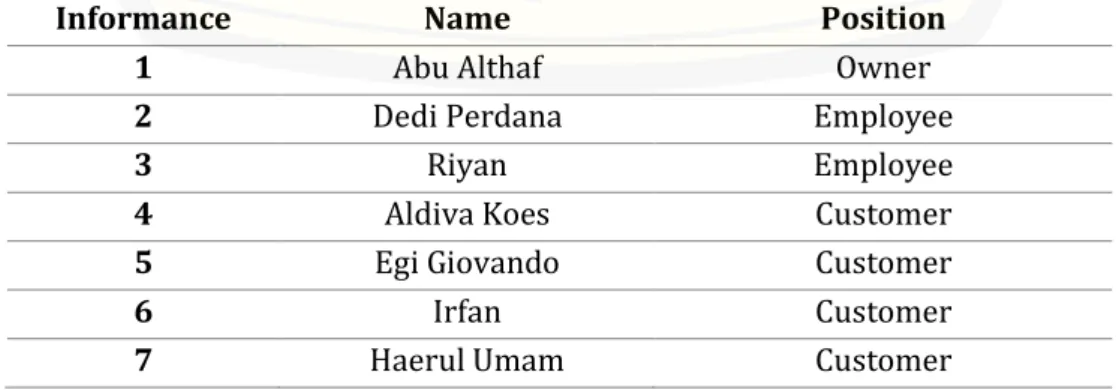
The time required in the research process is 2 months. The determination of informants for this study used the purposive method because the researcher had to obtain data related to the experiences of owners, employees, and customers in buying and selling transactions at the research site. Table 1 presents a list of informant names and positions for this research.
Table 1. Name of Informants at Althaf Moslem Store Bogor
Informance Name Position
1 Abu Althaf Owner
2 Dedi Perdana Employee
3 Riyan Employee
4 Aldiva Koes Customer
5 Egi Giovando Customer
6 Irfan Customer
7 Haerul Umam Customer
Digital Repository Universitas Jember
Digital Repository Universitas Jember
134 This study uses primary data in the form of interviews with owners, employees, and customers of Althaf Moslem Store. The interview used in this research is a semistructured interview, where the researcher will compile a list of questions in advance as an interview guide so that the interview process can take place smoothly. Researchers will use media such as notebooks to write the results of interviews, cellphones to record informants' voices, and photos with informants.
Data analysis conducted in this research is using the Interactive Analysis model of Miles and Hubermen (Burgan Bungin, 2008: 69) including data collection, data reduction, data presentation, and conclusion drawing and verification. Meanwhile, data validity is carried out by triangulation technique, which is a data validity checking technique that requires something else outside the data for comparison or as a check on the data (Moleong, 2016: 330).
Triangulation is done to increase the strength of theories, methods, and sources.
4. RESULTS AND DISCUSSION Analysis of Field Data Findings
Based on the description of the principles of Islamic business ethics according to Badroen et al. (2015: 89-102) as follows:
1) Principle of unity
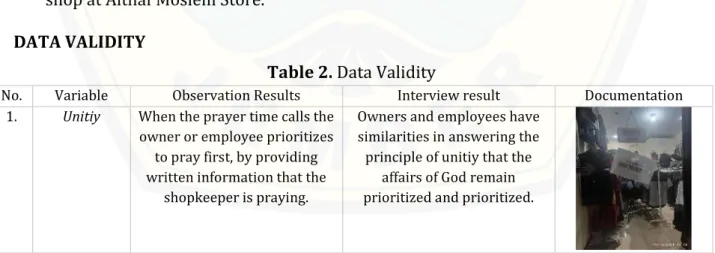
The results of research conducted in the field show that Althaf Moslem Store has applied the principle of unity to its business system. This can be seen from the existence of rest hours during prayer time and even when the store conditions are crowded with visitors, the store will temporarily close to perform prayers. Informant 1 Abu Althaf explained that:
"From all of us, when it's time for the call to prayer, we just close and lock the door, Alhamdulillah, the mosque from here is not too far from this place."
This was also clarified by informant 2 Dedi Perdana who explained that:
"Give understanding to customers when it's time to pray in the break, ..."
This shows that Althaf Moslem Store remains obedient to Allah by giving employees time to continue to pray. Based on the results of the author's observations, the quality of human resources at Althaf Moslem Store is highly prioritized, marked by praying or reading the Qur'an first before opening the store even though it is not done together because the store is only guarded by one person every day. Owners and employees here do not only think about selling, and not only to get profit for their sales alone. Allah Subhanahu Wa Ta``ala says in surah Ash-Shura verse 20:
ا َم َو اَهْن ِم ِهِت ْؤُن اَيْنُّدلا َث ْر َح ُدي ِرُي َناَك ْن َم َو ۖ ِهِث ْر َح يِف ُهَل ْد ِزَن ِة َر ِخ ْلْا َث ْر َح ُدي ِرُي َناَك ْن َم ٍبي ِصَن ْن ِم ِة َر ِخ ْلْا يِف ُهَل Meaning: "Whoever desires the gain of the Hereafter, we will increase it for him, and whoever desires the gain of the world, we will give him a portion of the gain of the world, and there will not be for him any happiness in the Hereafter."
2) Principle of Equilibrium (Balance)
Digital Repository Universitas Jember
Digital Repository Universitas Jember
135 The application of the principle of equibilirium (balance) at Althaf Moslem Store is not only concerned with self-interest but also concerned with customer satisfaction.
The realization of a balance between the seller and the buyer is a good socialization that does not harm both parties. The good quality of products and information provided to customers aims to serve customer needs and provide the best products for customers.
Infroman 1 Abu Althaf explained that:
"Alhamdulillah, every customer who comes here for problems with our goods, the name of the item has advantages and disadvantages, where are the weaknesses, I explain what are the minuses, what are the advantages, I explain to the customer. Every model of clothes is made of cotton, but there are many types of cotton, there are grades too, grade A and others."
This is reinforced by informant 4 Aldiva explained that:
"Oh adequate information, yes I get adequate information starting from the price and then the clothing model as well as the size I need and what I want I like what's the name of having trouble finding a size like that and he is looking to provide size too."
This is clarified by informant 5 Egi explained that:
"Yes, the most I can tell the price, color, and size."
The concept of this balance is that when the seller provides the best product for the buyer, the buyer will also provide the best loyalty for the seller, so that both sellers and buyers have good socialization between the two.
The principle of balance does not only lie with sellers and buyers, but on the other hand balance is also applied between owners and employees, especially in wage rights. Wages are set by the owner of Althaf Moslem Store to employees on a daily basis and given the freedom of employees to take wages on that day or weekly. Informant 3 Riyan explained that:
"Yes, the wage for a week is Rp.410,000."
This was clarified by informant 2 Dedi Perdana explaining that:
"There are daily and weekly depending on the employee's request. per hour at most Rp.10,000."
From this explanation, the owner of Althaf Moslem Store has determined that wages for employees are made on a daily basis, it's just that it doesn't meet the local UMR standards. The application of the principle of balance by the owner of Althaf Moslem Store to employees is not fully in accordance with the rules of ujrah al mitsli, namely the amount of wages must meet the standards in the area where the area works, so that from the explanation of informant 2 Dedi Perdana and informant 3 Riyan it can be said that it does not meet the category of ujrah al mitsli. So, employee wages refer to the value of such wages that generally apply in the community for the level of work performed.
3) Application of the principle of Free Will
The application of the principle of free will in practice Althaf Moslem Store Bogor Regency determines the product selling price policy so that there is no price manipulation to customers. The price given to customers is stated on the label of each product, especially in the SAMASE brand, for products that do not have a price tag, writing will be given on each product on display. Informant 1 Abu Althaf explained that:
Digital Repository Universitas Jember
Digital Repository Universitas Jember
136
"For SAMASE itself, it has been determined by the center and some customers who are used to buying SAMASE are different because they already know from social media so they already know. As for the price problem for other brands besides SAMASE, we look more at the market, seeing the type of material used and the quality of the material."
The explanation above is supported by the results of researcher observations that Althaf Moslem Store products in Bogor Regency have transparent price information that can be seen by customers. In addition, the prices offered are in accordance with the quality and benefits to customers. Informant 5 Egi Giovando said that:
"Yes, the price is not too expensive and not too cheap. In accordance with the material and model and more practical, it can be used for all events."
This was reinforced by informant 4 Aldiva Koes who stated that:
"The price set is in accordance with the standard of my sustenance. For the middle class, it is ok because the price is adjusted to the quality also owned by Althaf Moslem Store and in my opinion the quality of the products from Althaf Moslem Store is also good, so it is worth the price."
On the other hand, the practice of the principle of free will at Althaf Moslem Store Bogor Regency does not differentiate the prices offered to customers to buy the products sold. So that these items are set at an appropriate price and clearly depends on the brand of clothing that distinguishes because it is adjusted to the quality and raw materials. This was revealed by informant 2 Dedi who explained that:
"It's the same and not differentiated."
This is reinforced by informant 3 Riyan who stated that:
"According to the price so there is no difference."
There is no differentiation in the pricing of a product from the Althaf Moslem Store. The difference is if the customer offers these items and if the customer buys more than 2 or 3 items from Althaf Moslem Store, there will be a special price for the customer, but not all customers can get a discount, because it is the result of an agreement from both parties between the seller and the customer.
4) Principle of Responbility
The principle of responsibility is closely related to the principles of unity, balance, and free will. All obligations need to be respected unless they are morally wrong.
One cannot blame an individual for his own actions but he must bear the ultimate responsibility for his own actions (Muhammad, 2004:63). The application of responsibility ethics is very important to be applied because in running a business the most prioritized is the comfort of customers, it is not enough to serve them well but also must be full of responsibility.
Althaf Moslem Store will be responsible for what the customer complains about its business both from its products, facilities, services and others. Responsibility is a must in all aspects of business because this is the seller's commitment to the customer so that the customer is not disadvantaged from what is obtained from the seller, as well as at the Althaf Moslem Store to become a trust in the hearts of customers, owners and employees
Digital Repository Universitas Jember
Digital Repository Universitas Jember
137 are very open to accepting all forms of shortcomings and limitations that exist at the Althaf Moslem Store. Informant 1 Abu Althaf said that:
"I accept that in the future I will improve everything with the team in terms of service, or quality of goods, or what else, at least my team and I coordinate to try to improve for the better in the future."
Including the goods it sells, it provides an opportunity for customers if there are damaged or defective items, they can be exchanged for new items even though they have previously been checked in the store and there is no time period for how long the goods can still be exchanged, only one note from the seller if they want to exchange their goods, namely the price tag label on the clothes cannot be removed or cut. Informant 1 Abu Althaf explained that:
"For that problem, it has become our risk as traders for problems with defective goods or what, for example, both responsibilities can be replaced with other products, it often happens in buying and selling, the problem of what defects has become my risk as a seller and thank God from the buyer too, for example, at such a price comparison."
This was also conveyed by informant 2 Dedi who said that:
"Yes, it can be exchanged."
Informant 3 Riyan also explained that:
"Yes, as long as the price tag is not removed."
The form of commitment given by the Althaf Moslem Store to customers is a guarantee that customers do not need to worry about the goods purchased if they experience defects or damage caused by convection not from customers can be exchanged on fairly easy terms and do not burden customers.
So in the application of the principle of responsibility at Althaf Moslem Store, it has been implemented well and is consistent with what is conveyed and applied in the field. Both owners and employees have the intention to be responsible, provide good service to Althaf Moslem Store customers. With an attitude of responsibility, customers will also appreciate the attitude of owners and employees who both provide responsibility and minimize customer concerns if they want to buy back at the Althaf Moslem store.
5) Benevelonce Principle
The application of the principle of benevolence (keihsanan) in practice at Althaf Moslem Store Bogor Regency by providing the best service for customers. The application of this principle is reflected in the services provided by the Althaf Moslem Store.
Employees or owners as much as possible provide the best service for customers. The results of observations show that the Althaf Moslem Store in serving buyers begins with welcoming greetings such as greetings or can be directly asked to look for clothes or pants. After that the employee will allow the customer to explore the items available while being accompanied and help explain to the customer if the customer asks something about the item such as material, price, size, color, and sometimes the customer also asks for recommendations for items that are suitable for him or his family. Informant 3 Riyan said that:
Digital Repository Universitas Jember
Digital Repository Universitas Jember
138
"I let customers choose and sometimes they ask for the size and look for it in the stock."
The principle of keihsanan is also realized by Althaf Moslem Store employees by speaking in a friendly and polite manner. As conveyed by informant 4 Aldiva Koes said that:
"The service provided is very good and friendly. They are so nice to chat with and then we are also given a drink while relaxing so to choose how good the service is okay friendly too."
This was also added by informant 7 Haerul Umam:
"Alhamdulillah, good and friendly."
The same thing was also conveyed by informant 6 Irfan:
"Good service so we can choose if the front one is a promo if the one here is of course not a promo."
Althaf Moslem Store is also honest and straightforward when there are questions asked by customers, including if there are defects in goods that are only discovered when they want to show the customer and later the item goes on the list to be returned to the convection place.
In the principle of keihsanan in addition to generosity (leniency); service (Service motivies); there is also awareness of the existence of God and the rules that govern it. In buying and selling activities, customers certainly want to find goods at the best price with the customer's version, and vice versa, the seller also sells his goods at the best price for the seller, this is a natural thing in business. It is not surprising that there are customers who only look around without certainty that they will buy, the owner of the Muslim Store when meeting customers like that, the thing to do is to believe that everything is from Allah Subhanahu Wa Ta`ala.
Based on the research results, the application of Islamic business ethics axioms at Althaf Moslem Store is as follows:
1. The principle of unity means that Allah Subhanhu Wa Ta`ala sets certain limits on human behavior as khalifah, not to sacrifice individual rights but to provide benefits to other individuals (Badroen et al., 2015: 89). The manifestation of tawheed in doing business is realized in the intention and ultimate goal of the business. Business intentions and goals are dedicated solely for the sake of worship. Business motives are placed in the spiritual dimension of obedience and servitude to Allah Subhanahu Wa Ta`ala (Rahayu, 2020:7). The application of the unity principle at Althaf Moslem Store provides two realizations for business people. The first awareness for Althaf Moslem Store believes that everything on earth comes from Allah Subhanahu Wa Ta`ala including the issue of sustenance. The second awareness is to glorify Allah Subhanahu Wa Ta`ala by prioritizing worship to Him and leaving all business activities when the adhan time has been announced.
2. The principle of Equibilirium is to put something in its place, treat according to its position, and give something according to the rights of the recipient (Rangkuti, 2017:
18). The Equibilirium principle explains that Islam provides policies in determining prices to provide Muslim entrepreneurs to be able to realize actions in business that
Digital Repository Universitas Jember
Digital Repository Universitas Jember
139 can put themselves and others in the welfare of the world and the hereafter (Badroen et al., 2015: 92). In the application of Althaf Moslem Store selling the best goods for buyers, there are no elements of prohibited practices such as committing perjury or exaggerating in offering products to customers with the intention of convincing customers and not discriminating against customers. However, employee wages are not in accordance with ujrah al mitsli in the work area.
3. The principle of Free Will is to set the selling price transparently to consumers and compete fairly is a form of free will. Prices that are not transparent can lead to fraud (Badroen et al., 2015: 95). So, setting prices with transparency and fairness is highly respected in Islam so as not to fall into the practice of usury, maysir, gharar, and others. In the application of the principle of free will at Althaf Moslem Store does not give a false impression in providing information on an item such as price, changing prices will be followed by changes in product quantity and quality, avoiding deceiving customers for profit, not acting price discrimination on customers.
4. Responbility Principle According to (Badroen et al., 2015: 101) perfect Muslim responsibility is based on a wide scope of freedom, which starts from the freedom to choose beliefs and ends with the decisions he needs to make. In application, Althaf Moslem Store is willing to take responsibility for the goods and services provided to customers in the form of compensation for goods and accept all forms of complaints from customers.
5. The principle of Benevelonce according to Badroen et al., in Ahmad (1995) actions that can support the implementation of ihsan in business, namely: (1) generosity (leniency); (2) service (service motivies); (3) awareness of the existence of God and the rules relating to the implementation of priorities. In application, Althaf Moslem Store has provided friendly and polite service and there is no difference in attitude to whoever the customer is and regardless of the characteristics of customers who shop at Althaf Moslem Store.
DATA VALIDITY
Table 2. Data Validity
No. Variable Observation Results Interview result Documentation
1. Unitiy When the prayer time calls the owner or employee prioritizes
to pray first, by providing written information that the
shopkeeper is praying.
Owners and employees have similarities in answering the principle of unitiy that the
affairs of God remain prioritized and prioritized.
Digital Repository Universitas Jember
Digital Repository Universitas Jember
140
No. Variable Observation Results Interview result Documentation
2. Equibilirium Sellers provide recommendations for the best goods for buyers, there are no
elements of prohibited practices, but for employees,
this principle has not fully implemented because it is not in accordance with the rules of
ujrah al mitsli in the work area.
Customers are satisfied with the goods and services provided by the seller, but the
two participants who are employees at Althaf Moslem
Store complain about the wages given by the owner even though the complaint has
been conveyed to the owner.
3. Free Will Prices are adjusted to the quality and materials used, never force customers to buy
their products, and are transparent in determining prices. determining the price.
However, the two participants who became employees at
Althaf Moslem Store complained about the wages
given by the owner even though the complaint had been conveyed to the owner.
Customers do not feel disadvantaged because of the
price, and feel suitable with the price set because for customers there is a price
then there is quality.
4. Responbility Owners and employees are responsible for every matter
complained to them. Items purchased by customers will
be given information if the item is damaged can be exchanged with a note that the label on the clothes should not
be removed first.
The customer confirmed that they can exchange the purchased goods provided that the label is not removed
or broken first.
5. Benevelonce Althaf Moslem Store employees provide services
that show gentleness and friendliness to customers and
there is no difference in attitude to any of the
customers.
Customers feel comfortable shopping at Althaf Moslem Store because the service provided is friendly, polite
and full of gentleness and honesty.
Digital Repository Universitas Jember
Digital Repository Universitas Jember
141 5. CONCLUSION
1) The results of the research above show that the application of the axioms of the principles of Islamic business ethics has been carried out by Althaf Moslem Store Bogor. The results of this study corroborate the results of research conducted by Zulfa et al., with the title "Review of Islamic Business Ethics Against Muslim Clothing Marketing Practices at Almeera Moslem Store Bogor" which concluded that the application of Islamic business ethics in Muslim fashion marketing practices conducted by Almeera Moslem Store Bogor has fully implemented in every business activity. The principles that have been fulfilled are the principle of monotheism, the principle of justice, the principle of free will, the principle of responsibility and the principle of truth. This is shown by business people in their marketing activities intended for worship, as well as for the blessings of the world and in the hereafter by always being honest in marketing products, not discriminating against consumers in any way in the productivity of their business actors, being responsible in marketing products and always being friendly.
Friendly and polite to consumers.
2) This is also in accordance with the deontological theory according to Darmawati's view (2020) that good things are rooted in human success in carrying out their obligations. If an act is done with a sense of responsibility, then the act is considered moral. Duties and moral obligations must be oriented to God's commands. Obligations such as honesty, obedience, generosity, not harming other parties, the obligation to correct existing mistakes and repay those who do good deeds are a must. Thus it can be said that the results of this study are in line and can prove that the principles of Islamic business ethics have been applied by Althaf Moslem Store in carrying out its business activities.
REFERENCE
Agustin, H. 2017. Studi Kelayakan Bisnis Syariah. Depok: PT. Rajagrafindo Persada.
Alma, B. 2000. Manajemen Pemasaran dan Pemasaran Jasa. Bandung: Alfabeta.
Alma, B. 2011. Dasar-Dasar Etika Bisnis Islam. Bandung: Alfabeta.
Amalia, F. 2013. Etika Bisnis Islam: Konsep dan Implementasi Pada Pelaku Usaha Kecil. Jurnal Ilmu Ekonomi Syariah. 6(1): 117.
Asnawi, N., A. Fanani, dan Muhammad. 2017. Pemasaran Syariah. Depok: PT. Raja Grafindo Persada.
Bachri, B. S. 2010. Meyakini Validitas Data Melalui Triangulasi Pada Penelitian Kualitatif. Jurnal Teknologi Pendidikan. 10(1): 50.
Badroen, F., A. Mufraeni., Suhendra dan A. D. Bashori. 2015. Etika Bisnis Dalam Islam.
Jakarta: Prenadamedia Group.
Baidowi, A. 2011. Etika Bisnis Perspektif Islam. Jurnal Hukum Islam. 9(2): 239.
Digital Repository Universitas Jember
Digital Repository Universitas Jember
142 Beekum, R., I. 2004. Etika Bisnis Islami. Yogyakarta: Pusataka Pelajar.
Bertens, K. 2013. Pengantar Etika Bisnis. Yogyakarta: Kanisius.
Burhan, B. 2008. Analisis Data Penelitian Kualitatif. Jakarta: Raja Grafindo Persada.
Basalamah, Anwar. 2011. Hadirnya Kemasan Syariah dalam Bisnis Perhotelan di Tanah Air. Jurnal Binus Business Review. 2(2):763.
Fathoni, M. A, dan T. H. Syahputri. 2020. Potret Industri Halal Indonesia: Peluang dan Tantangan. Jurnal Ilmiah Ekonomi Islam. 6(3): 428.
Frederik, W. 2012. Relevansi Etika Bisnis Dalam Hukum Perjanjian Kredit Perbankan.
Jurnal Hukum dan Pembangunan. 42(4): 437.
Hardani, dkk. 2020. Metode Penelitian Kualitatif & Kuantitatif. Yogyakarta: Pustaka Ilmu.
Hasan, F. A. A. 2014. Etika Bisnis Al-Ghazali. Jurnal Ekonomi Syariah. 1(1): 4.
Hulaimi, A., Sahri, dan M. Huzaini. 2016. Etika Bisnis Islam Pedagang Sapi dan Dampaknya Terhadap Kesejahteraan Pedagang di Kecamatan Masbagik Kabupaten Lombok Timur. Jurnal Ekonomi dan Perbankan. 3(1): 345.
Hulaimi, A., Sahri, dan M. Huzaini. 2017. Etika Bisnis Islam Pedagang Sapi dan Dampaknya Terhadap Kesejahteraan Pedagang Sap. Jurnal Ekonomi dan Bisnis Islam. 2(1): 22.
Idri. 2015. Hadits Ekonomi (Ekonomi Dalam Persepektif Islam Hadis Nabi). Jakarta:
Kencana.
Irawan, H. 2017. Penerapan Etika Bisnis Islam Pada Pedagang Sembako di Pasar Sentral Sinjai. Tesis. Makassar: Program Pasca Sarjana Universitas Islam Negeri Alauddin.
Jubaedi. A., Sobari, dan S. Gustiawati. 2018. Impelementasi Etika Bisnis Islam. Jurnal Ekonomi Islam. 9(2): 151.
Kadir, A. 2013. Hukum Bisnis Syariah dalam Alquran. Jakarta: Amzah.
Lubaba, A. 2018. Impelementasi Etika Bisnis Pada UMKM Wirausahawan Krupuk Tayamum Di Desa Sarirejo Kabupaten Kendal. Tesis. Semarang. Universitas Islam Negeri Walisongo.
Lubis, K. S. 2009. Etika Profesi Hukum. Jakarta: Sinar Grafika.
Moeleong, L. J. 2016. Metodologi Penelitian Kualitatif. Bandung: PT Remaja Rosdakarya.
Nawatami, S. 2010. Etika Bisnis Dalam Perspektif Islam. Jurnal Fokus Ekonomi. 9(1):
57.
Digital Repository Universitas Jember
Digital Repository Universitas Jember
143 Norvadewi. 2015. Bisnis Dalam Perspektif Islam. Jurnal Ekonomi dan Bisnis. 1(1): 33.
Nursyamsiyah, I., dan N. Nopianti. 2021. Pengaruh Etika Bisnis Islam dan Kualitas Porduk Terhadap Kepuasan Konsumen Pada Usaha Rofi Collection Ciamis.
Jurnal Ekonomi Rabbani. 1(1): 53.
Purhantara, W. 2010. Metode Penelitian Kualitatif untuk Bisnis. Edisi pertama.
Yogyakarta: Graha ilmu.
Puspitasari, L. L. 2016. Etika Bisnis Islam: Teori dan Aplikasi Pada Perusahaan Manufaktur. Jurnal El-Muhabasa. 7(2): 17.
Puspitasari, I. 2019. Analisis Praktik Etika Bisnis Syariah Di Pasar Leuwiliang. Jurnal Ekonomi dan Keuangan Syariah. 3(1).
Rachman, F. F., S. Setyawan, dan D. Rahmi. 2018. Identifikasi Penerapan Etika Bisnis Islam Pada Pedagang Fasion Busana Muslim Di Pasar Baru Trade Center. Jurnal Ilmu Ekonomi. 4(1).
Rais, M. 2018. Perilaku Pedagang Baju Batik Merek Ulfa Di Pasar Beringharjo Yogyakarta Dalam Menentukan Harga Jual Ditinjau Dari Perspektif Etika Bisnis Islam. Tesis. Yogyakarta: Pasca Sarjana Universitas Islam Indonesia.
Rangkuti, A. 2017. Konsep Keadilan Dalam Perspektif Islam. Jurnal Pendidkan Islam.
6(1):18
Rivai, V. dan A. Buchari. 2013. Islamic Economics; Ekonomi Syariah Bukan Opsi, Tetapi Solusi. Jakarta: PT. Bumi Aksara.
Rosidah. 2021. Implementasi Bisnis Islam Bagi Pedagang Muslim di pasar Cipeujeuh Cirebon. Jurnal Ekonomi dan Bisnis. 3(1): 38.
Rosiyana, L., Z. Arifin dan Sunarti. 2017. Implementasi Etika Bisnis Guna Membangun Bisnis Yang Islami. Jurnal Administrasi Bisnis. 53(1): 196.
Ulhaq, M. Z. 2021. Implementasi Etika Bisnis Islam Perspektif Maqasid Syariah Pada Rumah Makan Hayaku Dan Ruman Makan Ayam Goreng Nelongs. Tesis.
Yogyakarta: Pasca Sarjana Universitas Islam Indonesia.
Zamzam, F. H., dan H. Aravik. 2020. Etika Bisnis Islam Seni Berbisnis Keberkahan.
Yogyakarta: Deepublish
Digital Repository Universitas Jember
Digital Repository Universitas Jember