Joel Cracraft F. Keith Barker Michael Braun John Harshman Gareth j. Dyke
Julie Feinstein Scott Stanley Alice Cibois
Peter Schikler Pamela Beresford
Jaime García-Moreno Michael D. Sorenson Tamaki Yuri
David P. Mindeli
Phylogenetic Relationships among Modern Birds (Neornitlies)
Toward an Avian Tree of Life
Modem perceptions of the inonophyly of avian higher taxa {modern birds, Neomiihes) and their interrelationships are the legacy uf systematic work undertaken in the 19th cen- tury. Before Llie imroduttion of an evolutionary wo rid view by Charles Darwin in 1859, taxonomists clustered laxa into groups using similarities that reflected a vision of how God might have organized ilic world ai the time of Creation. Such was the case with the Quinerian system of avian classifica- tion devised by Macleay (1819-1821) in which groups and subgroups of five were recognized, or of Strickland (1841) or Wallace (1856) in which affinities were graphed as un- rooted networks (see O'Hara 1988),
After Darwin, this worldview changed. For those com- parative biologists struggling to make sense of Earth's hiotic diversity in naturalistic terms, Darwinism provided a frame- work for organizing similarities and differences hierarchically, as a pattern of aneestry and descent. The search for the Tree of Life was launched, and it did not take long for the struc- ture of avian relationships to be addressed, The firsi to do so was no less a figure than Thomas Henry Huxley (1867), who produced an important and influential paper on avian clas- sification that was explicitly evolutionary, tt was also Huxley who provided the first strong argument that birds were re- lated to dinosaurs (Huxley 1868),
Huxley was particularly influential in England and was read widely across Europe, but the 'father of phylogeneiics"
and phylogenetic "tree-thinking" was clearly Ernst Haeckel, Darwin's conceptual framework had galvanized Haeckel,
and wfithin a few short years after Origin and a year before Huxley's seminal paper, he produced the monumental Generelle Morphola^c der Organismen•the first com]5rehen- sive depiction of the Tree of Life (Haeckel 1866). Haeckel's interests were primarily with invertebrates, but one of his students was to have a singular impact on systematic orni- thology that lasted more than 125 years.
In 1888 Max Fürbringe r published his massive (1751 pages, 30 plates) two-volume tome on the morjjhology and systematics of birds. Showing his classical training with Haeckel and the comparative anatomist Carl Gegenbaur, Fûrbringer meticulously buili the first avian Tree of Life•
including front and hind views of the tree and cross sections at different levels in time. The vastness of his morphological descriptions and comparisons, and the scope of his vision, established his conception of relationships as the dominant viewpoint within systematic ornithology. All classifications that followed can fairly be said to be variations on Fürbringer's theme. Such was the magnitude of his insights. Indeed, as Stresemann (1959: 270) noted:
On the whole all the avian systems presented in the standard works in this century are similar to each other, since they are all based on Fûrbringer and Gadow |who followed Ftirbringer's scheme closely and, being fluent in German, was able to read the
1888 tomej. My system of 1934 [Stresemann 1927- 1934] does not differ in essence from those which
468
Phylogenetic Relationships among Modern Birds (Neornithes) 469
Weimore (1951) and Mayr and Amadon (1951) have recommended.
Furl?ringer (1888) thus estabîished the framework for vir- lually all the major higher level taxa in use today, and the faci that subsequent classifications, with relatively minor alterations, adopted his groups entrenched them within or- nithology so pervasively thai his classificatory scheme has influenced how ornithologists have sampled taxa in system- atic studies to the present day.
Despite his monumental achievement in establishing the first comprehensive view of the avian branch of the Tree of Life, a\ian phylogeny soon became of only passing interest to systeraatists. Phylogenetic hypotheses•in the sense of taxa be- ing placed on a branching diagram•^were largely abandoned until the last several decades of ihe 20th century. For more than 80 years after Fûrbringer the pursuit of an avian Tree of Life was replaced by an interest in tweaking classifications, the most important being those of Wetmore (1930, 1934, 1940.
1951, 1960), Stresemann (1927-1934), Mayr and Amadon (1951), and Storer (1960). Aside from reflecting relationships in terms of overall similarity, these classifications also shaped contemporary views of avian phylogenetics by applying the philosophy of evolutionary classification (Simpson 1961, Mayr 1969), which ranked groups according lo how distinct they were morphologically.
What happened to "tree thinking" in systematic orni- thology between 1890 and 1970? The first answer to this question was that phylogeny became characterized as the unknown and unknowable. Relationships were considered impossible to recover without fossils and resided solely in the eye of the beholder inasmuch as there was no objective method for detennining them. Thus, Stresemann (1959: 270, 277) remarked.
The construction of phylogenetic trees has opened the door to a wave of uninhibited speculation. Everybody may form his own opinion , , . because, as far as birds are concerned, there is virtually no paleomologica!
documentation. . ., Only lucky discoveries of fossils can help us. ,..
A second answer is that phylogeny was eclipsed by a re- definition of systematics, which became more aligned with
"population thinking." This view was ushered in by the rise of the so-called "New Systematics" and the notion that "the population . , , has become the basic taxonomic unit" (Mayr 1942: 7). The functions of the systematist thus became iden- tification, classification ("speculation and theorizing"), and the study of species formation (Mayr 1942: 8-11). Phylog- eny became passé [see also Wheeler (1995) for a similar in- terpretation). Thus,
The study of phylogenetic trees, of orthogenetic series, and of evolutionary trends comprise a held which was the happy hunting ground of the speculative-minded taxonomist of bygone days. The development of the
"new systematics" has opened up a field which is far more accessible lo accurate research and which is more apt to produce tangible and immediate results, (Mayr
1942: 291)
A final answer was that, if phylogeny were essentially unknowable, it would inevitably be decoupled from classih- cation.andthe latter would be seen as subjective. The archi- tects of the synthesis clearly understood the power of basing classifications on phylogeny (e.g., Mayr 1942: 280) but in addition to lack of knowledge, "the only intrinsic difficulty of the phylogenetic system consists in the impossibility of representing a 'phylogenetic tree' in linear sequence."
Twenty-seven years later, Stresemann summarized clas- sificatory history to that date in starkly harsh terms:
In view of the continuing absence of trustworthy information on the relationships of the highest categories [taxa] of birds to each other it becomes smelly a matter of convention how to group them into orders. Science ends where comparative morphology, comparative physiology, comparative ethology have failed us after nearly 200 years of effort. The rest is silence. (Stresemann 1959: 277-278)
The silence did not last, A mere four years after this indictment ofavian phylogenetics, Wilhelm Meise, whose office was next to that of the founder of phylogenetic systematics, Willi Hennig, published the first explicitly cladistic phylogenetic tree in or- nithology, using behavioral characters to group the ratite birds (Meise 1963). Avian systematics. like all of systematics, sooii became translbimed by three events. The first was the intro- duction of phylogenetic (cladistic) thinking (Hennig 1966)and a quantitative methodology for building trees using those prin- ciples (Kluge and Farris 1969; the first quantitative cladistic analysis for birds was included in Payne and Risley 1976), At the same lime, the rise of cladistics logically led to an interest in having classifications represent phylogenetic relationships more explicitly, and that too became a subject of discussion within ornithology (e.g., Cracraft 1972, 1974, 1981). This desire for classifications to reflect phylogeny had its most com- prehensive expression in the classification based on DNA-DNA hybridization, a methodology, however, that was largely phe- netic(Sibleyetal. 1988, Sibley and Ahlquist 1990, Sibley and Monroe 1990).
The second contribution that changed avian systemat- ics was increased use of molecular data of various types.
Techniques such as starch-gel electrophoresis, isoelectric- focusing electrophoresis, immunological comparisons of proteins, mitochondrial DNA (miDNA) RFLP (restric- tion fragment length polymorphism) analy.sis, DNA hy- bridization, and especially mtDNA and nuclear gene sequencing have all been used to infer relationships, from the species-level to thai of families and orders. Today, with few exceptions, investigators of avian higher level rela- tionships use DNA sequencing, mostly of mtDNA, but
470 The Relationships of Animals: Deuterostomes
nuclear gene sequences are now becoming increasingly important
Finally, not to be forgotten were the continuous innova- tions in computational and bioinformatic hardware and soft- ware over the last three decades that have enabled invesiigaiors to tolled, store, and analyze increasing amounts of data.
This chapter attempts to summarize what we think we know, and don't know, about avian higher level relation- ships at this point in time. In the spirit of this volume, the chapter represents a collaboration of independent labora- tories actively engaged in undcrsianding higher level rela- tionships, but it by no means involves all those pursuing this problem. Indeed, there is important unpublished mor- phological and molecular work ongoing that is not included here. Nevertheless, it will be apparent I rom this synthesis thai significant advances are being made, and we can ex- pect the nexi five years of research lo advance measurably our understanding of avian relationships.
Birds Are Dinosaurs
Considerable debate has taken place in receñí years over whether birds are phylogeneiically linked to maniraptorian dinosaurs, and a small minority of workers have contested this relationship (e.g., Tarsitano and Hecht 1980, Martin 1983, Fed necia 1999. 20Ü2. Olson 2002). In contrast, all researchers who have considered this problem over the last 30 years from a cladistic perspective have supported a theropod relationship for modern birds (Ostrom 1976, Cracrafi 1977, 1986, Gauthier 1986, Padian and Chiappe 1998, Chiappe 1995, 2001, Chiappe et al. 1999, Sereno 1999, Norell et al. 2001, Holtz 1994, 2001, Prum 2002, Chiappe and Dyke 2002, Xii el al. 2002), and that hypoth- esis appears as well corroborated as any in systematics (fig. 27.1).
Having said this, droves of fossils•advanced theropods as well as birds•are being uncovered with increasing regu- larity, and many of these are providing now insights into character distributions, as well as the tempo of avian evoíu- tion. Just 10 years ago, undersiandingof the early evolution of birds was based on a handful of fossils greatly separated iem]îorally and phylogeneiically (e.g., Archaeopteryx and a few derived omithurines) Now, more than 50 individual taxa are known from ihroughoui the Mcsozoic (Chiappe and Dyke 2002). and from this new information it is now clear that feathers originated as a series of modifications early in the theropod radiation and thai flight is a later innovation (reviewed in Chiappe and Dyke 2002, Xu et al. 2003).
Numerous new discoveries of pre-neomithine fossils will undoubtedly provide alternative interpretations to charac- ter-state change throughout the line leading to modern birds (for summaries of pre-neornithine relationships, see Chiappe and Dyke 2002),
Archaeopteryx Neornithes Ichthyornis Hesperornis Enantiornithes
•Confuciusornithidae iTroodontidae
Dromaeosauridae aCaudipteryx tSinosauropteryx
•Alvarezsauridae tStruthiomimus
tTyrannosaurus rex Figure 27.1. Kclationships of birds to theropod dÍTios;mrs (after Chiappe and Dyke 2002).
DNA Hybridization and Beyond
The DNA hybridization work of Siblcy and Ahlquist (1990) has had a major impact on avian systematics. Their tree•
the so-called "Tapestry" shown tn figure 27.2•provided a framework for numerous evolutionary interpretations of avian biolog)'. Avian systematists, however, have long noted shortcomings with the analytical methods and results of Siblcy and Ahlquisi (Cracraft 1987, Houde 1987. Unyon 1992. Mindell 1992, Harshman 1994). Moreover, it is obvi- ous that Sibley and Ahlquist, like many others before and after, designed their experiments with significant precon- ceived assumptions of group monophyly (again, inany of which can be traced to FUrbringer 1888).
The spine of the DNA hybridization tree is character- ized by a plethora of short iniernodes, which is consistent with the hypothesis of an early and rapid radiation (dis- cussed more below). The critical issue, however, is that most of the deep intemodes on Sibley and Ahlquist's ( 1990) tree were not based on a rigorous analysis of the data, and in fact the data are generally insufficient to conduct such analy- ses(,Lanyon 1992, Harshman 1994). Relationships implied
emus DROMICEIDAE <
cassowaries CASUARIIDAE kiwis APTERYGiDAE rheas RHEiDAE ostrich STRUTHiOMDAE
tinamcius TiNAMiDAE i duclts, geese ANATiDAE i screamers ANHIMIDAE
Magpie Goose ANSERANATiDAE pheasants PHASiANIDAE guineafûwl NUMtDiDAE quail OOONTOPHORiDAE guans CRACIDAE
mound buiiders MEGAP0D1DAE i buttonquaiis TURNiCiDAE woo(lpccl<erE PiCiDAE i honeyguides iNDiCATORIOAE Old World barbets MEGALAIMIDAE toucans RAIMPHASTiDAE
New Worid barbets CAPiTONIDAE , kingfishers ALCEDJNiDAE i todies TODiDAE
motirtols MOMOTiDAE bee-eaters MEROPiDAE rollors CORACiiDAE
cuckoo-roller LEPTOSOMATiDAE Irogons TR0GONIDAË
hornbiiis BUCEROTIOAE woodhoopoes PHOENICULIDAE hoopoe UPUPIDAE , jacamars GALBULIDAE >
puflbirds BUCCONIDAE mousebirdâ COLIIDAE cuckoos CUCULIDAE hoatzin OPiSTHOCOMIDAE anis CROTOPHAGIDAE parrots PSITTACIDAE potóos NYCTIBIIDAE oiibird STEATORNITHIDAE nightjars CAPRIMULQIDAE trogmotiths PODARGID&E owlet nightjars AEGOTHELIDAE owls STRIGIDAE
barn owls TYTONIOAE (uracos MUSOPHAGIDAE swifts APODIDAE
hummingbirds TROCHILIDAE songbirds PASSE RIFO FIMES pigeons CO LU MB! DAE
Palaeognathae
Galloanserae
PICI
(Piciformes part)
Coraciiformes
Galbulae
(Piciformes, part)
Caprimulglformes Stri g ¡formes A pod ¡form es
sungrebes. iimpktn HEUORNfTHIDAE cranes GRUIDAE
trumpeters P50PHIIDAE kagu RHYNOCHETIDAE seriemas CARIAMIDAE bustards OTIDIOAE sunbittern EURYPVGIDAE rails RALLIDAE
seedsnipe THINOCORIOAE plains-wanderer PEDIONOMIDAE sandpipers, snipes SCOLOPACIDAE jacanas JACAMDAE
paintedsnipe ROSTRATULIDAE plovers CHARADRIIOAE thick-knees SURHINIDAE sheathbill CHIONIOIDAE
pratincoles, crab-plover GLAREOLIDAE gulls, terns UlRlDAE
sandgrouse PTEROCLIDIDAE falcons, caracaras FALCONIDAE SHcrctarybird SAGITTARIIDAE hawks, eagles ACCIPITRIDAE grebes PODiCiPEOlDAE troplcbird PHAETHONTIDAE boobies.gannets SULtDAE anhlnga ANHiNGIOAE
cormorants PHALACROCORACIDAE herons ARDEIDAE
hammerhead SCOPIDAE flamingos PHOENIC0PTERIDAË Ibises THRESKIORNITHIDAE storks. New World vultures CICONIIDAE pelicans PELECANIDAE
frtg ale birds FREGATIDAE penguins SPHENI5CI0AE albatrosses DIOh/IEDEIDAE shearwiators, petrols PROCELLARtlOAE storm-petrels OCEANITIDAE loons CAVIIDAE
Gru ¡formes
Charadriiformes
Falconiformes part
Pelee an if or mes part Ciconiiformes part Falconiformes part Pelee an if or mes part
Figure 27.2. The "tapestry" oí Sibley and Ahlquisi U'ÍQO) based 0:1 DNA l^)'hri(li7ation distances. The tree was tonstntcted by hand from incomplete data matrices. The topology shown here is thai of Sihley and Ahlqutst (1990), but their classification and nomencla- ture are modified in some instances to use more familiar names.
472 The Relationships of Animals; Deuterostomes
by the tree therefore have ambiguous reliabihty. In addi- tion, because of the manner in which experiments were designed, and possibly because of artifacts due to rate het- erogeneity in hybridization distances, instances of incorrect rooting occur across the tree. Thus, ahhough ihe DNA hybridization data have yielded insight aboui both novel and previously proposed relationships, they are difficult to interpret and compare with other results except as asser- tions of relationships.
The tree derived from DNA hybridization data postulated a specific series of relationships among taxa traditionally as- signed ordinal rank, as well as among families. It is relevant here to summarize the overall structure of this tree as some of the major groupings ii implies will be addressed in subse- quent sections of this chapter. Suffice it to say at this poini, the emerging morphological and molecular data confirm some of these relationships but not others, both among tra- ditional "orders" but among families as well.
Among its more controversial claims, the DNA hybrid- ization tapestry (fig. 27.2):
1. Recognizes a monophyletic Palaeognathae (ratites and tinamous) and Galloanserae (galliform + anseriform) but unites them, thus placing the neomithine root between them and all other birds: this rooting renders the Neognathae (all birds other than palaeognaths) paraphyletic, a conclusion refuted by substantial data (see below). Oddiy, Sibley and Ahlquist (1990) contradicted this in their classificaiion and grouped Galloanserae within their "Neoaves" (equivalent to Neognathae here).
2. Places Tumicidae (buttonquail), Pici (woodpeckers and their alhes), and Coraciiformes (kingfishers, rollers, and allies) + Galbuiae (traditionally united with the Pici) at the base of the Neoaves.
3. Identifies mousebirds, then cuckoos + Hoatzin, and finally parrots as sequential sister groups to the remaining neognaths.
4. Makes the large songbird (Passenformes) assemlilage the sister group to the remaining neognaths; this latter clade has the pigeons as the sister group of a large, mostly "waterbird," assemblage.
5. Depicts monophyly of Graiformes (cranes, rails, and allies) and Charadriiformes (shorebirds, gulls, and allies) within the waterbirds: the falconi forms are also monophyletic, except that the New World vultures (Cathariidae) are placed in a family with the storks (Ciconiidae). Within the remainder of the waterbirds, the traditional orders Pelecaniformes (pelicans, gannets, cormorants) and Ciconiifonnes (flamingos, storks, herons, ibises) are each rendered paraphyletic and interrelated with groups such as grebes, pen- guins, loons, and ihe Procellariiformes (albatrosses, shearwaters).
The Challenge of Resolving Avian Relationships Initial optimism over the results of DNA hybridization has given way to a realization that understanding the higher level relationships of birds is a complex and difficult scientific problem. There is accumulating evidence that modem birds have had a relatively deep history (Hedges et al. 1996, Coo- per and Penny 1997, Waddell ei al. 1999, Cracraft 2001, Dyke 2001, Barker et al. 2002, Patón et al. 2002, contra Feduccia 1995, 2003) and that intemodal distances among these deep lineages are short relative to the terminal branches (Sibley and Ahlquist 1990, Stanley and Cracraft 2002, the evidence is discussed below). To the extent these hypoth- eses are ime, considerable additional data will be required to resolve relationships at the higher levels. This conclusion is supported by the results summarized here.
Although the base of Neoaves is largely unresolved ai this time, recent studies are confirming some higher level relationships previously proposed, and others are resolv- ing relationships within groups more satisfactorily than before (ihe songbird tree discussed below is a good ex- ample). At the same time, novel cladistic hypotheses are emerging from the growing body ofsequence data (e.g., the proposed connection between grebes and fiamingos; van Tuinenet al. 2001).So, even though our ignorance of avian relationships is still substantial, progress is being made, as this review will show.
In addition to summarizing the advances in avian rela- tionships over the past decade (see also Sheldon and Bledsoe 1993, Mindeil 1997), the following discussion of neomithine relationships is largely built upon newly completed studies from our various laboratories that emphasize increased taxon and character sampling for both molecular and morphologi- cal data. These studies include;
1. An analysis of the c-myc oncogene (about 1100 aligned base pairs) for nearly 200 laxa that heavily samples nonpasseriform birds (J- Marshman, M. J.
Braun, and C, J, Huddlesion, unpubl, obs.)
2. An analysis broadly sampling neomithines that uses 4800 base pairs of mitochondrial sequences in conjunction with 680 base pairs of the PEPCK nuclear gene (Sorenson et al, 2003)
3. An analysis of the RAG-2 Irecombination activating protein 1 nuclear gene for approximately 145 nonpasseriform taxa and a sample of passeriforms (J, Cracraft, P. Schikler, andj, Feinstein, unpubl. obs,) 4. A combined analysis of the RAG-2 data and a sample
of 166 morphological charîicters for 105 family-level taxa (G, J. Dyke, P. Beresford, and J, Cracraft, unpubl.
obs.)
5. A combined analysis of the c-myc and RAü-2 data for 69 taxa, mostly non passeriforms (J- Harshman, M. J, Braun, andJ, Cracraft, unpubl. obs,)
Phylogenettc Relationships among Modern Birds (Neornithes) 473 6. A combined analysis of 74 "waterbird" taxa for 5300
base pairs of miiochondrial and RAG-2 gene se- quences (S. Stanley, J. Feinstein, andj, Cracraft, unpubl. obs.)
7. An analysis of ]46 passeriform taxa for 4108 base pairs of the RAG-1 and RAG-2 nuclear genes (F. K.
Barker, J. F. Feinstein, P. Schikler, A. Cibois, and J.
Cracraft, unpubl. obs.)
8. An analysis of 44 nine-primaried passeriforms ("Fringillidae) using 3.2 kilobases of mitochondrial sequence (Yuri and Mindeli 2002).
Phylogenetic Relationships among Basal Neornithes The Base of the Neornîthîne Tree
In contrast to the considerable uncertainties that exist regard- ing the higher level relationships among the major avian clades, the base of the neomithine tree now appears to be well corroborated by congruent results from both morpho- logical and molecular data (fig. 27,3; summarized in Cracraft and Clarke 2001, Garcla-Moreno et al. 2003; see below).
Thus, modem birds can be divided into two basal clades, Palaeognathae (tinamous and the ratite birds) and Neo- gnaihae (all others); Neognathae, in turn, are composed of two sister clades, Galloanserae for the galliform (megapodes, guans, pheasants, and allies) and anseriform (dutjks. geese, swans, and allies) birds, and Neoaves for all remaining taxa.
This tripartite division of basal neomithines has been recov- ered using morphological (Livezey 1997a, Livezey and Zusi 2001, Cracraft and Clarke 2001, Mayr and Clarke 2Ö03; see below) and various types of molecular data (Groth and BaiTowcIough 1999, van Tuinen ei al. 2000, Garcia-Morcno and Mindell 2000, GarcIa-Morcno ei al. 2003, Braun and Kimball 2002, Edwards ct al. 2002, Chubb 2004; see also results below). The DNA hybridization tree also recovered this basal structure, but the root, estimated by assuming a molecular clock without an outgroup, was placed incorrectly (fig. 27.2). In contras!, analyses using morphological or nuclear sequences have sought to place the root through outgroup analysis, and their results are consistent in placing it between palaeognaths and neognaths (Cracraft 1986, Groth and Barrowclough 1999, Cracraft and Clarke 2001; see also studies discussed below). Small taxon samples of mitochon- drial data have also been particularly prone to placing the presumed fast-evolving passerine birds at the base of the neomithine tree (Harlid and Amason 1999, Mindell et al.
1997, 1999), but larger taxon samples and analyses using better models of e\'olution (e.g., Paton et al, 2002) have agreed with the morphological and nuclear sequence analy- ses. Recent studies of nuclear short sequence motif signatures support the traditional hypothesis (Edwards et al. 2002), and
Palaeognathae
Galloanserae
cassowaries emus rheas ostrich (kiwis
•tinamous duclts, geese Magpie Goose .screamers
guans, curassows ptieasants, quail, gulnealowl
•megapodes
•Neoaves Figure 27.3. The basal rciationships of modern iiirds tNeomilhcs). Retalionships within Paleognathae arc those based on morphology (Lee el al. 1997). which do not agree wuh results from molecular sequences. See text for further discussion.
it also worth noting that palaeognaths and neognaths arc readily distinguished by large homomorphic sex chromo- somes in the former and strongly heteromorphic chromo- somes in the latter (Ansari et al. 1988, Ogawa et al. 1998).
Palaeognathae
Monophyly of palaeognaths is well corroborated, but rela- tionships within the ratites remain diffictilt to resolve. The relationships shown in figure 27.3 reflect those indicated by morphology (Cracraft 1974, Lee et al. 1997, Livezey and Zusi 2001), and all the internodes have high branch support.
Molecular data, on the other hand, have differed from this view and. in general, data from different loci and methods of analysis have yielded conflicting results, in most of these studies (Lee et al, 1997, Haddrath and Baker 2001, Cooper et al, 2001) the kiwis group with the emu + cassowaries, and the rhea and ostrich diverge independently at the base of the 11 ee. When the extinct New Zealand moas are included in studies using most of the mitochondrial genome (Haddrath and Baker 2001. Cooper et al. 2001), they also tend to be
474 The Relationships of Animais: Deuterostomes
pîaced toward the base of the tree. It can be noted that single gene trees often do not recover raiiie monophyly with strong support, all hough these taxa generally group together,
Palaeognaihs appear to exhibit molecular rate heteroge- neity. Tinanious, in particular, and possibly rheas and os- triches appear to have higher rates of molecular evolution than do kiwis, emus, and cassowaries (Lee et al, 1997, van Tuinenet al, 2000, Haddiathand Baker 2001 XAddiiionally, paleognaih mitochondrial sequences, which have been the primary target of molecular studies, exhibit significant shifts in base composition, which have made phytogenciit inter- pretations difficult (Haddrath and Baker 2001), Thus, rate artifacts, nonstationarity, the existence of relatively few, deeply divergent species-poor lineages, and short internodal distances among those lineages ail play a role in making ihe resolution of raiite relationships extremely difficult and con- troversial. Although palaeognath relationships may be solved with additional molecular and nioiphological data of the tra- ditional kind, the discovery of major character changes in molecular sec|uences such as indels or gene duplications may also prove to be important,
Calloanserae
Despite occasional debates that galliforms and anseriforms arc not sister taxa (Ericson 1996, 1997, Ericsonci al,2001), the predominant conclusion of numerous workers using morphological and/or molecular data is that they are (Livczey 1997a. Grot h and Banowciough 1999, Mi tide II et al. 1997, 1999, Zusi and Livezey 2000, Livezey and Zusi 2001, Cracrafi and Clarke 2001, Mayr and Clarke 2003. Chubb 2004), Molecular studies questioning a monophylctic Galloanserae (e,g,, Ericson et al, 2001) have all employed small taxon samples of mtDNA or nuclear DNA, but when samples are increased, or nuclear genes are used, Galloanserae are monophylctic and the sister group of Neoaves (Groih and Barrowclough 1999, Garcia-Moreno and Mindetl 2000, van Tuinen ct al. 2000, García-Moreno et al. 2003, Chubb 2004;
sec alsoj. Hai^shnian, M. J. Braun, and C, J, Huddlesion, unpubl. obs); three indel events in sequences from i-myc also support a monophylctic Galloanserae (hg. 27.4). The DNA hybridization tree of Siblcy and Ahlcjuist (1990) rec- ognized Galloanserae. but because the neormthme root was incorrectly placed, Galloanserae was resolved as the sister group of the palaeognaihs. With respect to relationships within galliforms, a consistent pattern seems to have emerged (Cracrafi 1972,1981,1988, Sibley and Ahlquist 1990, fig. 328, Harshman 1994, Dimcheif ei al. 2000,2002, Dyke et al. 2003;
see also J. Harshman. M. J. Braun, and C. J. Huddlesion, unpubl. obs.): (Megapodiidae (Cracidae (Numididae + Odomophoridac + Phasianidac))). The major questions re- main centered around ihe relaiivc relationships among the guinea fowl (numidids), New World quail (odontophorids), and pheasants (phasianids), as well as the phylogeny within the laitcr; recent sludies suggest that the numidids are out-
ostrich rhftas kiwis tinamous cassowaries einu
New Worid vuitures nightjars
faicons, caraca ras
hawl<s
hornbilis hoopoes frogmouths oilbird cranes rails owls parrots songbirds potóos trogons owlet nightjars hummingbirds swifts
barbets, toucans
woodpeckers, honeyguides putfbirds
jacamars
kingfishers, motmots rollers
grebes flamingos loons shearwaters tro pic bird 5 ibises shoebill pelicans herons
cormorants
gannets frigateblrds penguins sun bittern
storks
buHonquail
shorebirds
tioatzin
pheasants, quail, guineafowl chachalacas
megapodes magpie goose
ducks
Figure 27.4. Phylogenetic tree based on approximately I 100 bases of the nuclear oncogenc c-niyt. incktdirig intrtm, cxon coding, and 3' untranslated region sequence, for 170 laxa CJ Harshman, M.J. Braun, and C. H Huddleston, unpubl.
obs,). The tree shown is an unweighied parsimony majority rule bootstrap tree, plus other compatible branches. Thick branches have 70% or greater bootstrap support; thin branches may have very low support. Vertical tick marks represent phylogeiieiically informative indels. Mosi terminal branches represent several species, and all those are strongly supponed. although ¡or claritv the branches are not shown as thickened.
^•C
Phyiogenelic Relationships among Modern Birds (Neornithes) 475
side quails and phasianids (Cracraft 1981, Dimcheff ei al.
2000,2002, Dyke et al, 2003).
Relationships among ihc basal clades of anseriforms are also not too controversial (IJvczcy 1986,1997a,; Sililey and Atit<:[uist 1990: fig. 328 contra the "tapestry", Harshinan 1994, Ericstm 1997, Groth and îîarrowclough 1999; for views of rclaiionsKips wiihinanatids,sceMadsenet al. 1988,Uvezey 1997b,Donne- Goussé et al. 2002). The screamers (AnhimidatO are the sister group 10 the magpie goose (Atiseratiaiidae) + dueks, geese, and swans (Anatitiae). We note, however, that the resolmion of the basal nodes among screamers, magpie goose, and anatids has been diffitult and thai mitoehondrial data sometimes unite the screamers and magpie goose (fig. 27.5), a grouping not sug- gested by nuclear, morphological, or combined data. The fact thai bolh Livezey (1997a) and Ericson (1997) found the Late Creiaceous-l'aleogene fossil Presbyomis to be the sister group of Anatidae (see also Kurochkin et al. 2002) is important he- cause il sets the Laie Cretaceous as the minimum time of di- vergence for the anatids and all deeper nodes.
Relationships within Neoaves
Relationships among the neoavian higher taxa have been discussed in a nuinber of studies over the past several de- cades (e.g., Cracraft 1981, 1988, Siblcy and Ahlquist 1990, Ericson 1997,Mindellei al. 1997, 1999. Fcduccia 1999, van Tuinenei al. 2000, 2001, among others), and ii is clear that relatively little consensus has emerged. The monophyly of many groups thai have been accorded the taxonomic rank of "order" such as loons, grebes, penguins, parrots, cuckoos, and the large songbird group (Passenformes) has not been seriously questioned but that of nearly all other higher taxa has. Thus, it is now broadly accepted thai several traditional orders such as pelee ant forms, ciconiiforms, and capriinulgi- forms are nonmonophyletic, whereas the status of others such as gruiforms, eoraciifonns, picifonns. and falconiforms remains uncertain in the minds of many workers.
If one had to summarize the current siaic of knowlcdge, the most pessimistic view would see the neoavian tree as a
"comb," with little or no resolution among most traditional families and orders. Short and poorly supported iniemodes among major clades of neoavians are characteristic of recent studies using nuclear (Groth and Barrowclough 1999, van Tulnen et al. 2000) or mitoehondrial data sets (van Tuinen eial. 2000, 2001, Johnson 2001, Hedges and Sibley 1994.
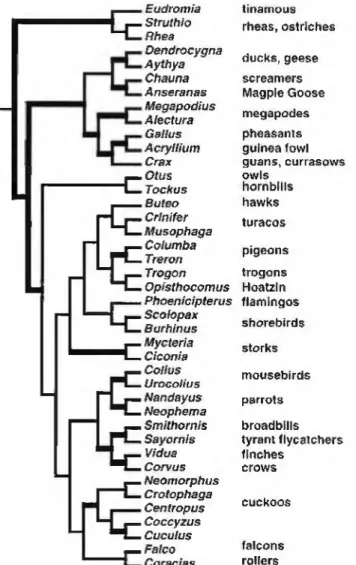
Johansson et al. 2001), and the data sets discussed here also illustrate this point. The trees discussed below will be inter- preted within the framework of bootstrap resampling analy- ses that show sister lineages supported at the 70% leve! (heavy lines in the figures). Using this approach, relationships among the avian higher taxa can be inteipretcd as largely unresolved, producing the neoavian comb. Nevertheless, there are emerg- ing .similarities in phyiogenelic pattem recovered acro,<;s some of these different studies that suggest some commonality of phylogenetic signal. In these and other published cases, the
Eudromia tinamaus Struthio rheas, ostriches Rhea
Dendrocygna
Aythya ducks, geese Chauna screamers Anseranas Magpie Goose Megapodiiis
Alectura megapodes Gallus pheasants Aery Ilium guinea fowl Crax guans, currasows
Otus owls
Tockus hornbllis
Buleo hawks
Crinifer turacos Musophaga
Columba
Treron pigeons Trogon trogon s Opisthocomus Hoatzin Phoenicipterus flamingos Scolopax
Burhinus shorebirds Mycteria storks Ciconia
Colius mouseblrds Urocolius
Nandayus parrots Neophema
Smlthornls broadbills Sayomis tyrant flycatchers Vidua finches
Corvus crows
Neomorphus Crotophaga
Centropus cuckoos Coccyzus
Cuculus
Falco falcons Coraciaa rollers
Figure 27.5, A ptiylogenetie hypothesis for 41 avian taxa based on about 4800 base pairs ol miWLhondrial sequence and &80 base pairs of PEPCK intron 9 nuclear gene using ihree paleognaths as ihe root (Soienson ci al. 2003). Nodes with bootstrap support values ol 70% ;ire shown in hcav)' hlaek, based on maxiiiiiini likelihood and maximum probahiiity analyses of mitoehondrial data and MP analyses of PEPCK intron 9.
primary reason for the neoavian comb is suspected to be insufficient character and/or laxon sampling. As noted above, current evidence suggests that many of these divergences are old and occurred relatively close in time. Thus, we arc opti- mistic that most neoavian relationships will be resolved with additional data (see Discussion, below).
Phylogenetic Relationships among the "Waterbird Assemblage"
Ovcv the years, many autbors have suggested that some or all of the waterbird orders, in particular, seabirds (Procet- lariiformes), penguins (Spbenisciformes), loons (Gaviifonmes), grebes (Podicipediformes), storks, herons, flamingos and al- lies (Ciconiiformes), pelicans, cormorants, and allies (Pele-
AU The Relationships of Animals: Deuterostomes
caniformes), shorebirds and gulls (Charadriiformes), and cranes, rails, and allies ( G m i formes), are related to one an- other (see, e.g., Sibley and Alilcjuist 1990, Hedges and Sibley 1994, Olson and Feduccia 1980a, 1980b, Cracrafl 1988).
Some authors have also linked various lalconifomi families to the waterbird assemblage (Jollie 1976-1977, Rea 1983), including a supposedly close relationship between New Wodd vultures (Caihanidae) and storks (Ligon 1967. Sibley andAhlquist 1990, Avise et al. 1994; but also see Jollie 1976- 1977, Hackett et al. 1995, Heibig and Siebold 1996), As a consequence of these and newer molecular studies, it is now widely ihoughi ihai several of the large traditional orders of waterbirds may not be monophyletic, and this is especially true of the peiccaniforms and ciconiiforms (Cottam 1957, Sibley and Ahlquist 1990, Hedges and Sibley 1994, Siegel- Causey 1997, van Tuinen et al 2001).
The supposition that waterbirds are related to one an- other within neomithines as a whole is not well supported, although the available data are suggestive of a relationship among some of ihem (see above). Only the DNA hybridiza- tion tree of Sibley and Ahlquist (1990) covered all birds, and on their tree (fig. 27.2) the waterbirds and falconiforms are clustered together. Van Tuinen ei al. (2001) recently re- evaluated waterbird relationships and compared new DNA hybridization data with results from about 4062 base pairs of mitochondrial and nuclear sequence data for 20 and 19 taxa, respectively. Their most general conclusion was iheie was relatively little branch support across the spine of ihe tree, indicating that relationships among waterbirds are siill very much uncertain. They did, however, find support for several clades: (1) a grouping of (the shoebill ßciWniccps + pelicans) + hammerkop (icopus). and these in lurn lo ibises and herons, (2) penguins + seabirds (Procellariiformes), and most surprisingly, (3) grebes + flamingos.
Previous studies have had insufficient laxon and charac- ter sampling, or both. Even though large taxon samples based on mitochondrial genes (fig. 27.6), or on the c-myc and RAG- 2 nuclear genes (figs. 27.4, 27.7A), are an improvement on previous work, by themselves or together (fig. 27.8), they are still inadequate to provide strong character support for most clades. Nevertheless, some congruence among these various studies is apparent The c-myi data (fig. 27.4; J. Harshman, M.J.Braun, and C.J, Huddleston, unpubi. obs.), for example, recover (1) (connorants + ganneis) + frigalebirds, (2) (shoe- bills + pelicans) + ibises, (3) grebes + flamingos, and (4) buttonquails + shorebirds. At the same time, groups such as loons, tropicbirds, penguins, and storks do not show any clear pattern of relaúotiships in the '^-myt data or the nuclear/
mitochondrial tree of van Tuinen et al. (2001). What is clear in the L-myc data is thai New World vultures and storks arc distantly removed from one another; New Wodd vultures were not included in the van Tuinen et al. study. The RAG- 2 data (fig. 27,7; J. Cracraft, P. Schikler. and J. Feinstein, unpubi. obs.) also strongly support (Da pelican/shoebitl/
hammerkop clade, (2) a cormorant/anhinga/gannet group-
ing, and (3) various clades within traditional charadrii forms and gmiforms. Both i-myc and RAG-2 + morphology Imk Irigaiebirds to the sulids, phalacrocoracids, and anhingids.
In an attempt to address problems of sparse laxon sam- pling seen in previous studies, S. Stanley,]. Feinstein, and J.
Cracrafl (unpubi. obs.) examined 57 waterbird taxa for 5319 base pairs of mitochondrial and nuclear RAG-2 sequences (fig. 27.6). When paiaeognaihs and Galloanserae are used as ouigroups, the root of the waterbird tree was placed on one of the [WO gruifonm lineages, thus suggesting, in agreement with Sibley and Ahlquist (1990) and van Tuitien et al, (2001), that gruí forms arc outside the other waterbird taxa, although this is not strongly supported given available data. This larger analysis still provides little resolution fur higher level rela- tionships among waterbirds, but it does hnd support for a grebe + flamingo relationship, monopliyly of charadriiforms, and the shoebill + pelicans + hammerkop clade, in agreement with van Tuinen el al. (2001) and ihe c-m>'(; data (fig. 27,4).
The buttonquails (Tumicidae) have traditionally been considered members of ihe order Gruiformes, Recent mo- lecular analyses, however, now place them decisively with the charadriiforms, and indeed ihey are the sister-group of the Lari (Paton ei al, 2003). The t-myc data (fig. 27.4) are consistent with this topology and include a unique indel, uniting tumicids and chradriiforms.
The mitochondrial and RAG-2 data also appear to con- tain phylogenetic signal for other clades even though they do not have high bootstrap values. Thus, when the data are explored using a vanety of methods (e.g., transversion pai- simony), the following groups are generally found (fig, 27,6):
(1) an expanded "pelecaniform" clade thai also includes taxa formerly placed in ciconiifomis (shoebill, hammerkop, ibises, and storks), (2) a grouping of grebes and flamingos with charadriiforms and some falconiforms, and (3) often a mono- phyletic Falconiformes (although the family Falconidae was not sampled), with no evidence of a relationship be- tween storks and New World vultures, Tropicbirds (phae- thoniids) and herons (ardeids) represent divergent taxa that have no stable posirion on the nee. Some of these relaiion- sbips are also seen in other data sets such as the i~myc data (fig, 27.4) and in the mitochondrial data of van Tiainen et al.
(2001),
Phylogenetk Relationships among the Owls (Strigiformes), Swifts and Hummingbirds (Apodiformes), and Nightjars and Allies (Cap rjmu Ig ¡formes)
The DNA hybridization tree (fig. 27.2; Sibley and Ahlquist 1990) recognizes a monophyletic Caprimulgi formes that is the sister group of the owls; these two groups, in turn, are the sister group of the luracos (Musophagidae), and finally, all three are the sister clade of the swifts and hummingbirds (Apodiformes), There is now clear evidence that this hypoth- esis is not correct.
Phylogenetic Relationships among Modern Birds (Neornitíies) 477
Psophia
Grus canadensis Aramus guarauna Gavia pad ficus Gavia immer
Oceanodroma leucorhoa Halocyptena microsoma Puftinus griseus Pterodroma cahow Pterodroma tesson!
Petecanoides magellani Pelecanoides urinatrix Pachyptila crassirostn's Futmarus glacialoides Diomedea nig ripes Diomedea buiiert Oceanites oceánicas Fregetta graiteria
Aechmaphorus occídentalls Podiceps auritus
Taciiybaptus rtificoUis Podylimbus podiceps Phoenicopterus minor Phoenicopterus ruber Aclophilornis africanus Stiltia isabelia
Larus mar i nus Sterna hirundo Alca torda
Charadrius metodius Vanellus chilensis Cattiartes aura Coragyps atratus Pandion tialiaetus Sagittarius serpentarius Fregata magnlficens Fragata minor Morus bassanus Morus serrator Su la sula
Phalacrocorax urlie Anhinga anhinga Ciconia ciconia Mycteria americana Leptoptilos javanicus Balaeniceps rex
Pelecanus erythrorynctios Scopus umbretta
Eudocimus ruber Pygoscelis antárctica Pygosceiis papua äpheniscus humbotdti Phaethon rubricauda Pbaethon lepturus Butorldes virescens Egretta tricolor Ixobrychus sinensis
Psophiidae: trumpeters Gruidae; cranes, limpktn Gavjjdae: loons
Procellariidae: petrels, diving-petrels
Diamediidae: albatrosses
Podicipedidae; grebes Phoenicopterldae: flamingos Jacanidae: Jacanas
Glareolidae: pratincoles Laridae: terns, gulls Alcidae; murres, auks Charadrlfdae: plovers
Cathartidae: New World vultures Accipitridae; osprey
Saglttariidae: Secretarybird Fregatidae: frigate bird s Sulidae: boobies, gannets Phalacrocoracidae: cormorants Anhingidae: anhlngas
Ci con i Ida e; storks Balaeniclpitldae: Shoebill Pelecanidae: pelicans Scopidae: Hammerkop Threskiornithidae: ibises Spheniscidae: penguins Phaethontidae: tropic birds Ardeidae: heron«
Figure 27.6. A phylogenetic (lypothesis I or "wiuerbird"
higher taxa using 4164 base pairs of mitochondrial sequence (cylochromt b, COi, COIJ, COllí) and 1155 base pairs of the RAG- 2 nuclear gene (iransvcrsion weighted) using gruiform taxa as the root (S. Stanley, J. Feinsiein, and J. Cracrafi, unpubt. obs.).
Thick brandies represent intcrfamiliaj cladcs supported by bootstrap values greater than 70% (all families had high bootstrap values but are not shown for simplicity).
Both published and unpublished data have recently in- dicaied that caprimulgiforms are not mouophyletic. Itistead of their traditional placement within caprimulgifonns, owlet- nightjars (Aegothelidae) are most cîosely related to the swifts and hummingbirds, a hypothesis hrst recognized in t-myt nuclear sequences (Braun and Huddleston 2001; fig. 27.4).
This relationship is supported by morphological characters (May r 2002) as well as by combined morphological and RAG- 2 data (fig. 27.7B) and by combined c-myc and RAG-2 data (fig. 27.8). Even with the aegothelids removed from the caprimulgiforms there is presently httle support for the monophyly of the remaining families. The available molecu- lar data for c-myc, RAG-2, or combined c.-myc/RAG-Z (figs.
27.4, 27,7A, 27.8) do not unite them, nor do combined c- myc and RAG-1 fragments (Johansson et al. 2001) or mor- phology (Mayr 2002). The relationships of owls to various
caprimulgiform taxa are also not supported by available se- C[uence data (figs. 27.4, 27.7, 27.8; Johansson ei al. 2001.
Mindell et al. 1997); however, one subsi^cjuenl DNA hybrid- ization Study has supported this hypothesis, in addition to linking owls, caprimulgiforms, and apodiforms (Bleiweiss et al. 1994). Preliminary morphological data also suggest a relaiionship (Livezey and Zusi 2001).
Phylogenetic Relationships among "Higher Land Birds": Cuculiformes, Coraciiformes, Trogoniformes, Coliiformes, and Piciformes
Few avian relationships are as interesting as those associated with the "higher lancl bird" question, and it is a problem with important imphcations for the overall topolog)' of the neomi- thine tree. Historically, groups such as the piciforms, coraci-
tinamous
emus, cassowaries
KIWIS
ostriches rheas
pheasants, chickens mound builders
emboóse le nnagpif se ream ef s Toons . penguins storm-petrels albatrosses 01VI nq-petrels priorS '^
shearwaters petrels storm-petrels
grebes
rails, Sun-grebes cranes, limpkins
trumpeters mesites Sunbittern, Kagu
sen amas
fa'è^^Îs^
pratincoles gulls, terns, auks plovers, oystercatchers buttonquails
stilts, avocets, ttiick-knees tri gate birds
boobies, qannets cormorants, an hing as tropicbirds
pelicans, Shoeblll hammerkop flamingos ibises slorlis nerons
New world vultures osprey
falcons secretary bird
aw|(s¡^ragles
igrouse barn owls owls swifts
Lcnminqbirds
mf
\ir.tiX''-
, . nighljars frog mouths potóos
rogón s bee-eaters
rollers, g round-rollers kingfishers
horn bills, hoopoes todies
mouseoirds puffbirds, jaca mars woodpeckers, indicatorblrds
Old World barbets
toucans. New World barbets Acanlhisilta
Old & New World, su bo seines basal Australian ÔcorvidansO passerldan oscines
Australian robins OcorvidansO
tinamous
ernus, cassowanes
KIWIS
ostriches
pheasants, chickens mound builders ducKs, geese screamers
Ms
shearwaters, petrels diving-petrels penguins albatrosses [imp kin trumpeters cranes rails, sungrebes bustards mesites sen a mas Sunbittern, Kagu iacanas -ratincolesulls, terns, auks plovers
oystercatchers
stilts, avocets, thick-knees buttonquails
frigatebirds boobies, gannetç cormorants, anhingas tropicbirds
pelicans, Shoebill Hammerkop storks"
pises herons
New World vultures osprey
falcons hawks, eagles Secretary Bird owls Hoatzin turacos cucKoos sandgrouse parrots pigeons swifts hummingbirds owlet-niqhtiars Oilblrd
nightjars, potóos frogmouths trogons bee-eaters ground-rollers rollers kingfishers moimots _, mou se bird s puffbirds, jacamars woodpeckers, indicatorblrds Old World barbets
toucans
New World barbets horn bills, hoopoes passeriforms
B
Figure 27.7. (A) A ph y loge net if hypothesis for ncoa\1an taxa using 11 ^2 base piiirs oí the RAG-2 cxon. i,li) A pli y loge ne tic tree based on 1152 base pairs ot tht ]i/\C-2 exon and 166 morphologi- cal characters. Analyses arc all unweighted parsimony. Thick branches have greater than 70%
bootstrap support. Data frornj. Cratraft, P. Sehiklcr. J, Feinstein, P. Beresford. ;irid G.J. Dyke (unpubl. obs,).
Phylogenetic Relationships among Modern Birds (Neornithes) 479
strong support from:
combined data and both data sets combined data only
combined data and one separate data set Aptéryx
Casuarius
Dromaius novaehollandige Rhea americana
Struthio camelus Tinarnus maior Coragyps atraWs Calhartes Tockus Upupa epops Ctiordeiles
Eurostopodus
Batrachostomus Podargus papuensis strigid
Tyto alba oscine Pitta
Sleatornis canpensis Nyctibius
Podiceps Phoenicopterus Spheniscus humboldti Gavia
Pu/fin us Columbia pteroclid Colius
Grus canadensis ratlid
Eurypyga h&lias Ciconia
Opisthocomus hoazin threskiornithid psittacine cacatuine
Turnix Stiltia isabella Burhinus ardeid Phalacrocorax Sula
Phaethon ruiyricauda Balaeniceps rex Petecar)us picid indicator Lybius ramphastid Buceo
Gálbula
musophagid cuculitorm Chloroceryle Momotus
coracild
Trogon
Micrastur gilvicollis
Sagittarius serp&ntarius Buteo
Fregata magnificerts Amazilia
phaethornithine ChaetLira Aegotheles Galtus gallus megapodid
Anseranas semipalrnata Anas platyrtiynchos
H
iforms, passerifoims, caprimulgiforms, and cuculiforms have been associated with one another iti various classifications (e.g., Huxley 1867, Garrod 1874, Fürbringer 1888) and have been loosely called "higher land birds" (e.g., Ülson 1985, Feduccia 1999. Johansson el al. 2001), Here we discuss the relationships within and among the corad i form and piciform birds, their placement on the neomithine tree, and their re- lationships to the passehforms.
Although the cuculiforms, coraciiforms, and piciforms have long been seen as higher" neornithines and often closely related lo passcri forms, this view was turned upside down by the DNA hybridization tree (Sibley and Ahlquist 1990), which postulated that all three groups were at the base of the neoavian tree (fig. 27.2). One of the two traditional groups of piciforms, Pici, was placed near the base of the neoavian tree adjacent to the tumicids, whereas the other, the jacamars and puffbirds (Galbulae), was placed as the sis- ter group to a monophyletic "Coraciae," including traditional coraciilomis and irogons. The passeriforms were placed as the sister group to the entire waterbiid assemblage but were not found to have any dose relationship with either piciform or coraciiform taxa.
At present, none of these relationships can be confirmed or refuted. Available nuclear sequence data for RAG-l (Groth and Barrowclough 1999) as well as the c-myc and fíAC-2 data (figs. 27.4, 27.7) cannot resolve the base of Neoaves, indi- cating that the placement of these (or other) groups within neornithines remains an open question. Recent morphologi- cal and molecular studies, however, are identifying some well- supported clades within these groups. The two major clades of the picifoiTns, Pici and Galbulae, are each strongly mono- phyletic in all studies (see figs. 27.4,27.7A,B, 27.8; Johansson et al. 2001), and evidence increasingly indicates that they are sister taxa. Some data, including RAC-2 (fig. 27.7A) and frag- ments of c-myc and RAC-J (Johansson et al. 2001 ), cannot resolve this issue, but a monophyletic Piciformes is supported by moq^hology (Cracraft and Simpson 1981, Swierczewski and Raikow 1981, Raikow and Cracraft 1983, Mayr et at.
Figure 27.8. Ph y logent tic hypothesis from combined c-niyc and RAG-2 data for 69 taxa, analyzed by unweighted parsi- mony. Branches with bootstrap support greater than 50% are shown. Thick branches have greater than 70% bootstiap suppon. To maximize the lyxon overlap between data sets, equivalent species were combined, and this is reflected in the name given to the terminal node; for example, Gallus gallus was sequeneed for boih genes, but iwn different species were scquenced from Afgothelcs, and species were seciueneed from two different genera of megapodes. Data fromj. Harshman, M.
J, Braun, andj. Cracraft (uiipubl. ohs).
^titO The Relationships of Animals: Deuterostomes
2003), longer c-myc sequences (fig. 27.4), RAG-2 + morphol- ogy (fig, 27.7B), combined c-myc/RAG-2 data (fig. 27.8), and by other nuclear sequences Qohansson and Ericson 2003).
Within Pici, it is now clear that the barbets are paraphyletic and that some or all of the New World taxa are more closely related to toucans (Burton 1984, Sibley and Ahlquist 1990, Lanyon and Hall 1994, Prum 1988, Barkerand Unyon 2000, Moyle 2004) than to other barbets; interrelationships within the barbet and toucan clade still need additional work.
DNA hybridization data were interpreted as supporting a monophyleiic coraciiforms (Sibley and Ahlquist 1990). Al- though recent DNA sequences arc insufficient to test coraci- ifonn monophyly, they do show support for groups of families traditionally placed within coraciiforms. There is now congru- ent suppon, for example, for the monophyly of (1) hombills + hoop(>es/woodhoopoes(rig.';. 27.4,27.7A,B, 27.8; Johansson et al 2001), (2) moimot5+ todies Qohansson et al. 2001), and (3) kingfishers + motmots (figs. 27.4A, 27,7B, 2 7.8; Johansson et al. 2001), and support for (4) the kinghsher/motmot ciade with the rollers (figs. 27.4,27,7B, 27.8; Johansson et al. 2001 ).
Although they are clearly monophyleiic (Hughes and Baker 1999), the relationships of the cuckoos are very un- certain, with no clear pattern across different studies. The distinctive Hoatzin {Opiaihommim hoazin) has been variously placed with galliforms (Cracraft 198Î), cuculiforms (Sibley and Ahlquist 1990, Mindellei al. 1997), or turacos (Hughes and Baker 1999), yet there is no firm suppon in the c-myc (fig. 27.4), mitochondrial and PEPCK data (hg. 27,5), or in those from RAG-2 and morphology (fig. 27,7B; see also Livezey and Zusi 2001) for any of these hypotheses. A rela- tionship to galliforms at least can be rejected: hoatzins are clearly members of Neoaves, not Galloanserae (figs, 27.4, 27,5, 27,7A,B, 27,8; see also Sorenson et al. 2003).
Trogons and mousebirds are each so unique morphologi- cally that they have been placed in their own order, bul both have been allied to coraciiform and/or picifoma birds by many authors (lor reviews, see Sibley and Ahlquist 1990, Espinosa de los Monteros 2000), In recent years trogons have generally been associated with various coraciiforms on the sti'ength of stapes morphology (Feduccia 1975), myology (Maurer and Raikow 1981), and osteology (Ijvezey and Zusi 2001), Mouse- bird relationships have l^een more difficult to ascertain, and no clear picture has emerged. In the mitochondrial-PEPCK data mousebirds group with parrots (fig, 27,5), whereas the RAG-2 gene is uninlormative. The study of Espinosa de los Monteros (2000) linked mouselîirds with trogons and then that clade with parrots. The problem is that all these groups are old, divergent taxa with relatively little intrataxon diversity. Much more data will be needed to resolve their relationships,
Phylogenetic Relationships within the Perching Birds (Passeriformes)
The perching birds, order Passeriformes, comprise almost 60% of the extant species of birds. The monophyly of pas-
seriforms has long been accepted and is strongly supponed bya variety of studies, including those using morphological or molecular data (Feduccia 1974, 1975, Raikow 1982,1987;
see also figs, 27,4,27.5,27.7,27.8). Our current understand- ing of their basal relationships and biogeographic distribu- iion,s strongly suggests that the group is old, with an origin probably more than 79 million years ago, well before the Cretaceous-Tertiary extinction 65 million years ago (e.g., Paton et al, 2002) and on a late-stage Gondwana (Cracraft 2001, Barker et al. 2002, Ericson et al, 2002), Recent mo- lecular work using nuclear genes (Barker et al. 2002,Encson et al. 2002) supports the hypothesis that the New Zealand wrens (Acanihisittidae) are the sister group to the remain- der of the passerines, and that the latter clade can be di\ided into TWO sister lineages, the suboscines (Tyranni) and the oscines (Passeii). Resolving relationships within the subo- scines and oscines has been complex, not only because of the huge diversity (about 1200 and 4600 species, respec- tively) but also because many of the traditional families are neither monophyleiic nor related as depicted in Sibley and Ahlquist's (1990) tree. Nucleargene sequences, however, are beginning to clarify phylogenetic patterns within this large group. The results presented here summarize some ongoing studies of the passerines, primarily using two nuclear genes (RAG-1 and MG-2; F. K. Barker, J, F, Feinstein, P. Schiklfer, A, Cibois, and j. Cracraft, unpubl, obs.) with dense taxon sampling, and represent the most comprehensive analysis of passeriform relationships to date (4126 aligned positions for 146 laxa).
The DNA hybridization data were interpreted by Sibley and Ahlquist (1990) as showing a division between suboscine and oscine passerines with the New Zealand wrens being the sister group to the remaining suboscines. Within the oscines, there were two sister clades. Córvida, which consisted of all Australian endemics and groups related to crows (the so- called "corvine assemblage"), and Passerida for all remain- ing taxa. The phylogenetic hypothesis shown in figure 27.9A, which is based on nuclear gene data (F, K, Barker, J, F, Fcinsiein, P. Schikler, A. Cibois, and J, Cracraft, unpubl.
obs.), depicts a substantially different view of passeriform history. Thus, although the subdivision into suboscines and oscines is corroborated, the New Zealand wrens are the sis- ter group of all other passerines. In addition, numerous taxa of the Australian "co^v^dans" are complexly paraphyletic rela- tive to the passeridans and a core "Corvoidea,"
The suboscine taxon sample is small, but these nuclear data are able to resolve a number of the major clades with strong support (fig, 27,9B), New World and Old World clades are sister groups (Irestedl et al, 2001, Barker et al, 2002). Within the Old World group, the data strongly sup- port ilic pillas as being the sister group of the paraphyletic broadbills and the Malagasy asilies (see also Prum 1993), The New Worid suboscines are divisible into two large clades. The first includes nearly 550 species of New World flycatchers, manakins, and coiingas; although this clade is strongly sup-