
The McGraw-Hill Series in Chemical Engineering stands as a unique historical record of the development of chemical engineering education and practice. Timmerhaus joined the faculty of the University of Colorado, College of Engineering, Department of Chemical Engineering.
PREFACE
The rest of the text discusses methods and important factors in the design of devices and equipment. The text makes extensive use of illustrative examples and sample problems to illustrate the application of principles to practical situations.
PROLOGUE
THE INTERNATIONAL SYSTEM OF UNITS 61)
CHAPTER
INTRODUCTION
CHEMICAL ENGINEERING PLANT DESIGN
PROCESS DESIGN DEVELOPMENT
When the capabilities of the process have been reasonably well established, the project is ready for the development phase. This information is used as a basis for carrying out the additional phases of the design project.
GENERAL OVERALL DESIGN CONSIDERATIONS
An engineer working on a project must maintain a realistic and practical attitude when progressing through the various phases of a project project and must not be influenced by personal interests and desires when deciding whether further work on a particular project is justified. Remember, if an engineer's work continues through the various stages of a design project, it will eventually end with a proposal to invest money in the process.
COST ESTIMATION
However, as mentioned earlier, no design project should proceed to the final stages before cost is considered, and cost estimates should be made throughout the early stages of the design when complete specifications are not available. Fixed costs, direct production costs for raw materials, labor, maintenance, power and utilities must all be included along with costs for plant and administrative overhead, distribution of the final products and other miscellaneous items.
FACTORS AFFECTING PROFITABILITY OF INVESTMENTS
This money is a return of capital, a partial regeneration of the original value of physical assets. It is the chemical engineer's responsibility in this case to select the best process and to incorporate into the design the equipment and methods that will give the best results.
Optimum Economic Design
To meet this need, various aspects of chemical engineering plant design optimization are described in the chapter.
Optimum Operation Design
In reality, it would usually be necessary to consider different converter sizes and operation at a range of different temperatures to arrive at the optimal operation design. Under these circumstances, several equivalent designs would apply, and the final decision would be based on the optimal economic conditions for the equivalent designs.
PRACTICAL CONSIDERATIONS IN DESIGN
Although the optimum economic diameter was 3.43 inches, the good engineer knows that this diameter is only an exact mathematical number and may vary from month to month as prices or operating conditions change. In the engineer's approach to any design problem, it is necessary to be prepared to make many assumptions.
PROCESS DESIGN
DESIGN-PROJECT PROCEDURE
Types of Designs
Feasibility Survey
This analysis can be based on a breakdown of points 9 through 15 as shown in the previous list. Valuable information on material and energy balances can be obtained and process conditions can be examined to provide data on temperature and pressure variation, yields, rates, feedstock and product grades, batch versus continuous operation, material of construction, operating characteristics, and other relevant design variables.
Design
Estimating costs in the preliminary design stages greatly assists the engineer in further eliminating many of the alternative cases. Preliminary design and process development work provides the necessary results for a detailed design evaluation.
Construction and Operation
Plant construction may begin well before the final project is 100 percent complete. The engineer must also be available during the initial start-up of the plant and the early stages of operation.
DESIGN INFORMATION FROM THE LITERATURE
During plant construction, the chemical engineer must visit the plant site to assist in the interpretation of plans and learn methods to improve future designs. Some of the information from the trade bulletin is summarized in an excellent reference book on chemical engineering equipment, products and manufacturers.
FLOW DIAGRAMS
In addition, many manuals have been published that give physical properties and other basic data, which are very useful to the design engineer. Tables presenting relevant process and equipment data are cross-referenced with the drawing.
Problem Statement
However, sufficient detail will be provided to describe the important steps that are necessary to prepare such a preliminary project. The problem presented is a practical problem of a type frequently encountered in the chemical industry; it includes both process design and economic considerations.
Literature Survey
Laboratory data for the sulfonation of dodecylbenzene described in the literature provide additional information useful for a rapid material balance. Some of the calculations related to the alkylation unit are shown below to show the extent of the calculations they sometimes are.
ALKYLATION UNIT EQUIPMENT DESIGN AND SELECTION
Reactor Volume
Choose a 10,000 gal carbon steel tank for benzene storage and a 25,000 gallon carbon steel tank for dodecene storage. Carbon steel Carbon steel Carbon steel Carbon steel Carbon steel Carbon steel Cast iron Glass-lined Wee Fig.
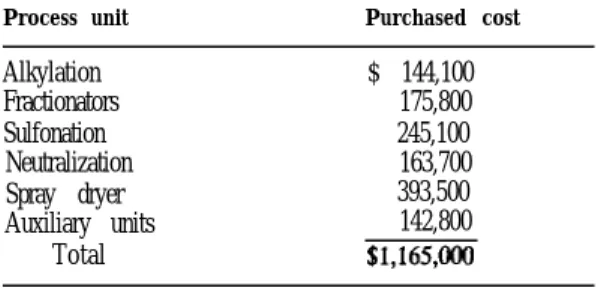
Summary
COMPARISON OF DIFFERENT PROCESSES
When comparing different processes, the advantages of continuous operation over batch operation should always be considered. While batch operation was common in the early days of the chemical industry, most processes have been fully or partially converted to continuous operation.
EQUIPMENT DESIGN AND SPECIFICATIONS
Maximum SCalkWlp ratio based on in- Major variables categorized characterizing actor size or capacity variable Flow rate >lCO:l Heat transfer. The role of the particular equipment in the overall operation must be considered along with the consequences of under-design.
MATERIALS OF CONSTRUCTION
Prepare a material balance and qualitative flow sheet for the production of 7800 kg/h of acetaldehyde using the process described in the previous problem. Make a material balance and qualitative flow sheet for the synthesis gas process described in Prob.
GENERAL DESIGN
HEALTH AND SAFETY HAZARDS
The short-term effect is expressed as LDsO, the lethal dose at which 50 percent of the laboratory animals do not survive. The latter is defined as the upper permissible concentration limit of the material that is believed to be safe for humans, even with exposure of 8 hours per day, 5 days per week over a period of many years.
Sources of Exposure
Liquid aerosols, however, can be produced by any process that provides sufficient energy to overcome the surface tension of the liquid. A toxicity or intrinsic hazard assessment is required for each material identified in the inventory.
Air analysis methods
Exposure-Hazard Control
In the first strategy, measures are taken to prevent the release of toxic pollutants into the air. If such substitution is not possible, then it may be necessary to completely isolate the process from the worker, as is done in the production of HCN (prussic acid).
Fire and Explosion Hazards
Passive fire protection systems require no action at the time of the fire. The amount of energy released from a chemical reaction involving a combustible fuel and oxidizing agent can be estimated from the fuel's heat of combustion.
Safety Regulations
No or no - no part of the intent is achieved and nothing else happens (eg no flow). Except that no part of the intent is achieved and something else entirely happens (eg the wrong material flows).
Fault-tree Analysis
Instead, periodic hazard assessment studies should be used to define the potential hazard of such changes over the lifetime of the facility. In this process, a numerical "Fire and Explosion Index" is calculated based on the nature of the process and the properties of the materials.
Safety Audits
Machine programming, including safe movements, program locks, etc., as well as machine locks. In the text, Lipton and Lynch highlight examples of the types of interactions and hazard management choices that must be made at various stages of planning.
Environmental Regulations
To ensure that a regulation is up-to-date, it must first be found in the most recent edition of the Code of Federal Regulations (CFR). If action has been taken, the Cumulative List will show where the changes can be found in the Federal Register.
Development of a Pollution Control System
Air Pollution Abatement
The main separation forces in a bag filter correspond to those described in the wet collector, i.e. collision or attraction between particles and the bag filter. In general, condensation is not used as a method of removing a solvent vapor from air or other carrier gas unless the concentration of the solvent in the gas is high and the solvent is worth recovering.
Water Pollution Abatement
An effort to improve the biological efficiency of the solid film process has resulted in the development of a useful rotating disk biological contactor. So while BOD removal can be excellent, chemical oxygen demand (COD) removal can be low.
Solid Waste Disposal
Cooling towers can be classified on the basis of the fluid used for heat transfer and on the basis of the power supplied to the unit. In dry cooling towers, the temperature reduction of the condenser water depends on conduction and convection to transfer heat from the water to the air.
PLANT LOCATION
The source of raw materials is one of the most important factors influencing the selection of the factory site. The character and facilities of a community can have quite a bearing on plant location.
PLANT OPERATION AND CONTROL
Templates or small cutouts constructed to a chosen scale are useful for making quick and accurate layouts, and three-dimensional models are often made. The use of such models to ensure that a proposed plant layout is correct has found increasing favor in recent years.
Instrumentation
Maintenance
One of the most important aspects of structural design for the process industry is proper foundation design, taking into account the heavy equipment and vibrating machinery used. In any type of structural design for the process industry, the function of the structure is more important than the form.
STORAGE
Liquids with a vapor pressure above atmospheric must be stored in vapor-tight tanks capable of withstanding the internal pressure. If flammable liquids are stored in vented tanks, flame arrestors must be installed at all openings except for connections made below the liquid level.
MATERIALS HANDLING
When this is done, local and federal regulations must be strictly followed in piping design and specification. In the design of the plant, several types of receiving or transportation facilities should be provided, depending on the nature of the raw materials and products.
PATENT CONSIDERATIONS
If the wind speed is U, 3 m/s, what is the distance d required for safe disposal of the vapor in the air, as evaluated from the connection. Note that when the tank is heated from the fire, it will re-radiate some of the energy it receives from the fire.
COMPUTER-AIDED DESIGN?
These new equations are replaced by the previous ones in the spreadsheet. Douglas and colleagues have developed a program, the PIP-Process Invention Program, available through CACHE, which performs process synthesis.* The core of this approach is to build a process in stages of increasing complexity, using scientific principles and heuristics (rules). thumb) at each step.
FLOW-SHEETING SOFTWARE
Additional process equipment parameters are calculated sufficient to meet power specifications and estimate equipment costs. A general structure similar to that of many of the flow-sheeting programs is shown in Fig.
Degrees of Freedom
In the second case, the identified unit is transferred from the process list to the beginning of the billing list. We approach the iterative recycling calculations by "tearing" the recycled loop, that is, by selecting the current in the loop as the trial or assumed current.
PROBLEMS
For example, replacing a specified constraint such as reactant molar ratio with another, such as the composition of the pure stream. For the next reactor feed, use the AREAC block of the CACHE FLOWTRAN simulation to determine the exit temperature for adiabatic operation at 90 percent conversion of toluene.
COSTAND ASSET
OUTLINE OF ACCOUNTING PROCEDURE
Cost and asset accounting 139 Statements showing the financial position of the business concern are prepared periodically from the ledger accounts. The balance sheet shows the financial position of the business at a given time, while the income statement is a record of the organization's financial profit or loss for a given period of time.
BASIC RELATIONSHIPS IN ACCOUNTING
Any technical accounting study can ultimately be reduced to one of the forms represented by Eq.
THEBALANCESHEET
Most of the changes that occur in the balance sheet are due to income received from the sale of goods or services and costs incurred in connection with the production and sale of the goods or services. The terms gross income or gross receipts used by accountants refer to the total amount of capital received as a result of the sale of goods or services.
Debits and Credits
Profit before provision for tax minus provision for tax Net profit (net profit).
The Journal
The Ledger
In its simplest form, costing is the determination and analysis of the costs of producing a product or providing a service. Cost-of-sales accounts provide the information necessary to determine the profit or loss for each product sold during a specific time interval.
COST
ESTIMATION
The cash flow for the capital investments can usually be expressed as a lump sum or. 6-1 with the depreciation charge (d) entering the cash flow stream for return to the capital pool.
Cumulative Cash Position
Consequently, the removal of depreciation in the cash flow diagram as a charge on profit is achieved at the top of the tree diagram in Fig. 6-2, and it is very important to the understanding of the factors to be considered in cost estimation.
CAPITAL INVESTMENTS
In the example discussed above, where a long-term capital gain would be realized by selling equipment, the capital gain would therefore have been quite large if the company had used a rapid depreciation method. After 1987, however, new federal tax rules have been enacted that can make the capital gains tax the same as the income tax on ordinary income at about 34 percent.
Fixed-Capital Investment
A checklist of items covering a new facility is an invaluable aid in making a thorough assessment of the fixed capital investment. A capital investment estimate for a process can vary from a predetermined estimate based on little information other than the size of the proposed project to a detailed estimate prepared from complete drawings and specifications.
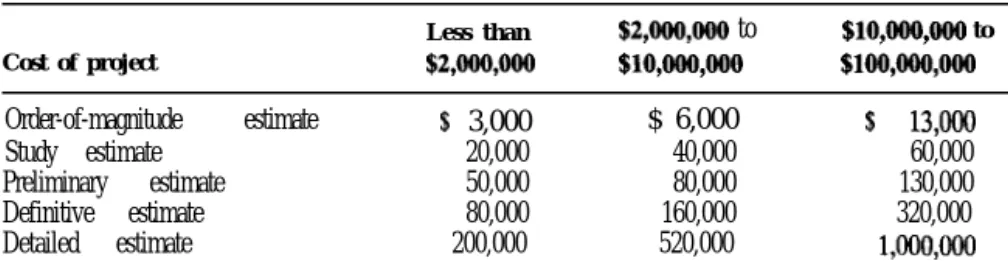
COST INDEXES
Some of these can be used for estimating equipment costs; others apply specifically to labor, construction, materials or other specialized fields. The most common of these indices are the Marshall and Swif equipment indices for all industries and process industries, the Engineering News-Record construction index, the Nelson-Farrar refnev construction index, and the Chemical Engineering Plant Cost Index.
Marshall and Swift Equipment Cost Indexes-f
Nelson-Farrar Refinery Construction Cost Index?
Other Indexes and Analysis
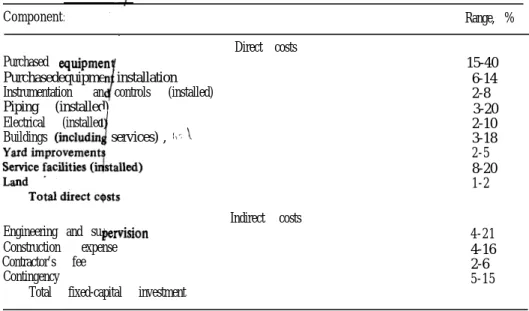
Make a study estimate of the fixed asset investment for the process plant if the cost of the equipment purchased is $100,000. The price of the purchased equipment is the basis of several pre-project methods for evaluating the investment.
Estimating Equipment Costs by Scaling
Engineering and Supervision
Construction Expense
The contractor's fee varies by situation, but can be estimated at approximately 2 to 8 percent of the direct installation costs or 1.5 to 6 percent of the fixed capital investment. Contingencies are often used ranging from 5 to 15 percent of direct and indirect installation costs, with 8 percent considered a reasonable average value.
Startup Expense
This method for estimating investments in fixed assets or total capital requires the determination of the cost of the supplied equipment. Factors for the assessment of investment in fixed assets or total capital investment are given in table 18.