Timothy, "Choosing the Right Words: Developing Guidelines for Choosing Appropriate Strategies: Crisis Response." The correction explicitly shows that mechanisms exist to prevent the recurrence of crisis suffering strategies. The second stage is an event crisis, which begins with a trigger event that signals the onset of the crisis.
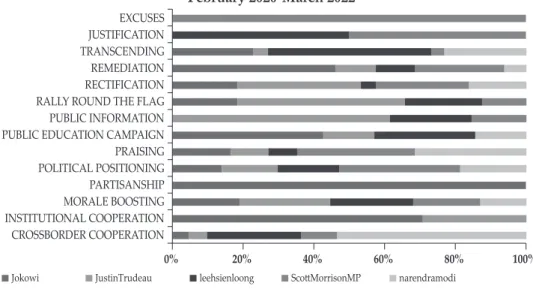
Since the pandemic came into our lives, we understand the virus and its mutations better. At a glance, the table shows changes in the communication strategies of the five leaders from when COVID-19 struck in February 2020 to March 2022. Strengthening strategies were the most commonly used communication strategy in the first three months of the COVID-19 crisis . 19 attack, especially in Singapore, Australia and India.
Changes in communication strategies were also found in the five countries before and during the isolation of the Delta variant.
DISCUSSION
A. Perceived Crisis Responsibility
The government has faced considerable public pressure to deal with the crisis and has assumed considerable responsibility for dealing with the crisis, regardless of the nature of the crisis. However, the incompetence of the government's actions and communications during the crisis may have increased panic among the population and caused serious deterioration of public health as well as the economy. As a result, inadequate COVID-19 responses may have critically damaged the government's reputation and eroded confidence in politicians.
The focus is on improving people's health and the health of the economy," (Prime Minister of India) or, similarly, "Our focus in this #coronavirus crisis continues to be on protecting lives and protecting livelihoods - that means keeping Australians in jobs and businesses in business so when this virus is over we can come back stronger on the other side” (Australian Prime Minister). Politicians emphasized strengthening strategies to prevent the negative effects of the crisis by strengthening the positive perception of themselves or the government organizations they lead. In this case, the politicians showed their positive qualities or the measures they used to eliminate the impact of the crisis.
Respecting this spirit, the Prime Minister's Civil Relief and Emergency Relief Fund has been set up," "I would like to thank Shri Pradeep and Shri Pankaj Rathod of the Cello Group for contributing Rs. Such support from the world of commerce and industry is extremely valuable," and "The PM-CARES Foundation also accepts micro-donations. Let's leave no stone unturned to make India healthier and more prosperous for our future generations." Tweets illustrate how India's prime minister praised the public or business owners who donated to the public fund while framing such an act as an example of national heroism .
Meanwhile, the Prime Ministers of India and Canada used both political positioning and remediation approaches in their tweets, "Today @ RBI took giant steps to protect our economy from the impact of the Coronavirus. The announcements will improve liquidity, reduce cost of funds , middle class and businesses help.” the PM of India), and "Around the world, the COVID-19 situation will continue to evolve rapidly. An Experimental Study of the Situational Crisis Communication Theory and the Moderating Effects of Locus of Control,” Public Relations Review 36, no.
B. The Dynamics of Political Communication and Three-stage Crisis Management
As interconnectedness is increasing rapidly, both developed and developing countries have felt the need to facilitate international cooperation to protect global health and economic growth.36 In addition to avoiding further waves of the virus, especially in poor countries or development, cooperation is also vital for coordinating and ensuring the stability of global production and the global supply chain. 37. When the potential for a full international crisis became clear from the rising death toll and economic despair, all politicians began to engage in a lethal strategy. They used a correction and remediation approach by providing COVID-19 relief or indirect relief to victims (both individual workers and businesses), e.g.
The devastating economic effects of the pandemic have led to the distribution of significant aid from state institutions. A Strategy for International Cooperation in the Era of the COVID-19 Pandemic: Focusing on National Science Funding Data.” In Healthcare, vol. 38 Republic of Indonesia, Ministry of Finance Kemenkeu Tanggap COVID-19: Informasi Terkini, Kementrian Keuangan Republik Indonesia, https://www.kemenkeu.go.id/covid19.
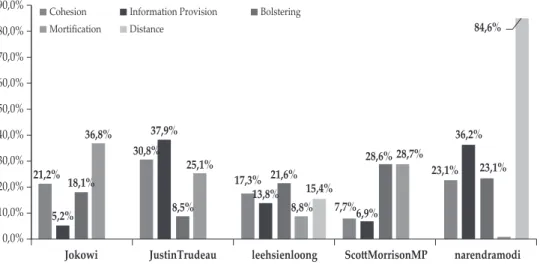
It is interesting to note that a mortification strategy can be employed without politicians having to admit guilt for their incompetence in handling a crisis at the beginning of the pandemic. Crisis communication studies have shown that a mortification approach generates a more positive image of the institution, indicated by perception of a better reputation of it, as well as reduced anger and less negative comments (Chen, 2013; Coombs, 1999; Coombs & . Holladay , 2008; Dardis & Haigh, 2009). It is driven by the aims of a mortification strategy for reducing offending and restoring stability (Dardis . & Haigh, 2009).
The findings show that a mortification strategy attracts significant public engagement (31.9 percent of the preferred number) compared to other strategies. When COVID-19 turned into a full-blown crisis and the core negative effects of the crisis occurred repeatedly due to the emergence of new variants of COVID-19, ample evidence shows that politicians applied three main crisis communication strategies, fading, strengthening and cohesion. . This research study also provides unique insight by examining the dynamics of online crisis communication of politicians during this politicized pandemic.43 This includes delving into how they have created public personas during the COVID-19 crisis and its aftermath.
C. Discrepancies between Existing Theory and The Complexities of COVID-19
Second, in addition to transcendence and praise, the data reveal that morale enhancement and political positioning have emerged as new approaches under the umbrella of reinforcement strategies. In general, an amplification strategy emphasizes the positive attributes of stakeholders (the president/Prime Ministers, governments, non-state entities such as corporations, civil society groups, and the public) when facing the crisis.49 Specifically, the study found that in general, the All world leaders have used heavy political posturing to build a positive image by asserting their political positions or emphasizing individual personality, eg, “Thank you Sue for taking the time to write to me. They lack the basic job protections that most workers have” (Prime Minister of Singapore), and “We've been working around the clock to make sure you have what you need to stay safe and healthy.
World leaders have also used a morale-boosting approach that aims to boost public morale or spirit, through which they often use symbolic presentations such as myths, shared values or cultural identity. Perhaps, through political positioning and morale enhancement, politicians can minimize potential threats to their reputations and allow them to focus on the future. Third, the findings reveal that a cohesion strategy is consistent with Tian and Yang's study.
These scholars define a cohesion strategy as a deliberate promotion of social cohesion, inclusion and institutional cooperation between state and non-state entities to strengthen national unity and solidarity. It should also be noted that all politicians initiate and improve cross-border cooperation by cooperating in mutual economic recovery programs, e.g., "The ASEAN economy is predicted to grow only about 1% this year. Therefore, ASEAN countries should cooperate: first break the chain of virus spread in each country, in the ASEAN region and at the border” (the president of Indonesia).
We suggest that this cross-border collaboration further promotes a cohesion communication strategy, as Tian and Yang,50 but did not detect this approach when they analyzed Trump's or Cuomo's different crisis communication efforts during this global pandemic. Empirical findings reveal that a large proportion of politicians' tweets had a presentational purpose when communicating with various stakeholders and the public on social media. This study contributes to the literature on CCS by examining political dynamics of COVID-19 and how they determine politicians' crisis communication strategies.
D. Contextual Factors and Political Crisis Communication
CONCLUDING REMARKS
Beijing's Political Crisis Communication: An Analysis of Chinese Government Communication in the 2009 Xinjiang Riots.” Journal of Contemporary China. How Publics in the United States and China Respond to Crisis Communication Strategies Through Social Media: A Cross-Cultural Comparative Study.” PhD Dissertation, University of Georgia (2013): n.n. Restoring Reputation in Times of Crisis: An Experimental Study of Situational Crisis Communication Theory and the Moderating Effects of Locus of Control.” Public Relations Review.
Comparing apology with equivalent crisis response strategies: clarifying the role and value of apology in crisis communication. Public Relations Review. Protection of organizational reputation during a crisis : the development and application of situational crisis communication theory. Business reputation assessment. Hierarchical consistency of strategies in image recovery theory: PR practitioners' perceptions of effective and preferred crisis communication strategies. Journal of Public Relations Research.
The Role of CSR in Crises: Integrating Situational Crisis Communication Theory and the Persuasion Knowledge Model". Crisis Communication on Social Media: What Types of COVID-19 Messages Get the Attention? Cornell Hospitality Quarterly (2021). Public-centered approach to crisis communication: A study of consumers' evaluation of an organizational crisis in Hong Kong.".
Fixing the barn door from the horse bolts: The effects of pre-crisis engagement and thunder stealing in crisis communication.”. A Comparative Study of Crisis Communication Strategies Between Mainland China and Taiwan: The Melamine Contaminated Milk Powder Crisis in the Chinese Context.” Public Relations Review. How to Turn Your Friends into Enemies: Causes and Consequences of Client Betrayal in Crisis Communication.” Public Relations Review.
Crisis Communication Online: How Medium, Crisis Type, and Emotion Influenced Public Responses in the Fukushima Daiichi Nuclear Disaster." Public Relations Review. Exploring the Relationship Between Corporate Reputation and Public Crisis Communication on Social Media." Public Relations review.