
Vile's classic introductory text, Politics in the United States, has now been thoroughly revised and updated to take account of the considerable developments in American politics over the past ten years. The book establishes a framework within which to understand the complexities of politics in the most powerful country in the world. 2 Park Square, Milton Park, Abingdon, Oxon OX14 4RN Published simultaneously in the US and Canada by Routledge.
11 The Making of American Domestic Policy 234 12 The Making of American Foreign Policy 259 Postscript: American Politics in the Twenty-First Century 282.
1 A government of limited powers
Alaska was part of the Russian Empire until it was purchased by the United States in 1867. However, the greatest protection for the continued power of the states lies in the decentralized nature of American politics. The twin doctrines of separation of powers and checks and balances characterize the US Constitution.
The impact of the Vietnam War and subsequent extensive Spanish immigration made multiculturalism a real problem in the United States.
2 The nature of American politics
The fascination of the American political system lies in the fact that it represents a complex mixture of all these different ones. Bush won most of the states in the South and a number of Midwestern and mountain states. Roosevelt, who, however, fixed the urban masses in the north and east in the Democratic column.
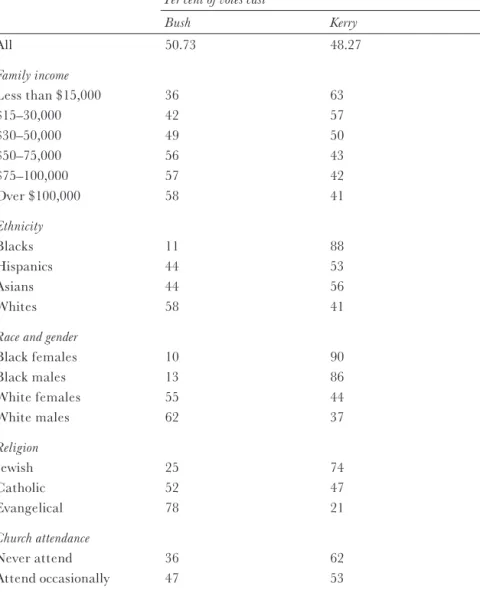
In 2004, 88 percent of black voters cast their ballots for the Democratic Party candidate, John Kerry.
3 The two-party system
The constitutional separation of authority between the federal government and the states is reflected in the realities of the distribution of effective political power. We will examine the central role of the South in the political system in a later chapter. What is politics in America and what role do ideas play in the functioning of the system.
For Kristol, some of the principles of traditional conservatives and libertarians were wrong. Rather, it is to point to the interdependence between the different levels of political activity. The enormous growth in urbanization means that over 80 percent of the total population now lives in cities.
The political structures of the United States are therefore likely to be as complex as the diversity of American political positions suggests. Voters can intervene in the political decision-making process through the initiative, referendum or recall. The machines have lost their power and the great bosses of the past no longer dominate.
At the presidential level, the South's commitment to Republicans is even clearer. The President and the Parties: The Transformation of the American Party System Since the New Deal, Oxford: Oxford University Press.
4 Politics and elections
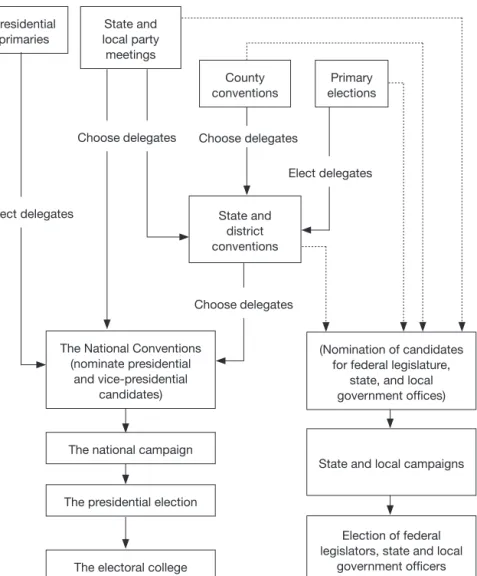
This struggle has been institutionalized through the adoption of the instrument of primaries. In the early years of the Republic, caucuses of congressmen selected candidates for the presidency. In 2004, a similar open situation existed for the nomination of the Democratic Party's presidential candidate.
It is in the national conventions of the parties that their most difficult task is fulfilled: the choice of candidates for the presidency. Some are elected during presidential primaries and, to some extent, support the winners of their state's primaries. It was the strong civil rights proposals in the 1948 Democratic platform that triggered the Dixiecrats' defection.
It is true that the functioning of the Electoral College is not yet a formality. In fact, most states do not allocate electoral college votes this way. By convention, all of a state's Electoral College votes are awarded to the candidate who achieves a plurality, or simple majority, of the state's electoral votes.
In order to win the presidency, it is necessary to obtain an absolute majority (270) of the votes of the Electoral College. Money, in large quantities, remains indispensable to the operation of the American electoral system.
5 Pressure politics
In the same way, parts of the government machine itself can behave like interest groups to protect their position. As we have seen, this consensus is one of the characteristic features of the American ideological scene. However, it is by no means negligible as an explanation of the general workings of American politics.
The flexibility of the political system therefore derives in significant part from the way interest groups operate the cumbersome apparatus of the US government. Fearing federal control, the producers formed a Natural Gas and Oil Resources Committee to keep control in the hands of the states. Agriculture in the United States is an example of how a significant minority group can gain political power disproportionate to its numbers.
With 35 million members, the American Association of Retired Persons has become one of the most powerful groups on the political scene. The almost infinite flexibility of this type of political structure is reflected in the wide variety of methods available to an interest group to achieve its goals. Many groups hover on the fringes of the equilibrium system of politics—the use of the corporate police in the 1920s to suppress the strikers, the Minutemen, the "black power" advocates.
Much legislation important to the statute books of the United States today comes from the offices of interest groups. Finally, interest groups must become involved in the work of the courts and represent their position as forcefully, albeit using different techniques, to judges as to legislators or administrators.
6 Congressional politics
His power compared to that of the House of Representatives increased instead of diminished. Party leaders are elected by a party caucus – or conference – made up of all party members in the House of Representatives or the Senate. However, caucus power has increased, particularly in the House Democrats.
The role of the Speaker of the House of Representatives is very different from that of the Speaker of the British House of Commons. The most effective work in Congress is done outside the House or Senate in standing committees. However, since 1970 there has been a steady decline in the power of the South over the chairmanship of the committees.
Surnames are very important because they are what appoint party members to the standing committees of Congress. It is here that the House Rules Committee exercises its authority. The Rules Committee is not a party committee but one of the permanent committees of the Chamber.
The problem of prioritizing legislation, on which the power of the House Rules Committee is based, presents little difficulty in the Senate. Clauses unrelated to the main subject of the bill are included because Congress knows that the president.
7 Presidential politics
This patronage is not channeled through those members of the president's party who consistently oppose administration policies. Another weapon that the president can use in his role as party leader is publicity. The president can, rarely indeed, appoint members of the opposing party to important positions in the administration.
It is also true that the president appoints the members of the cabinet and can dismiss them. But it is a mistake to view the individual members of the Cabinet as mere creatures of the president. There is also the press secretary, the special counsel to the president and the director of the military office.
Therefore, the relationship of the White House Office with the cabinet is of critical importance. Schulz, who would be named assistant to the President in the White House Office, would retain his Cabinet post as Treasury Secretary. In its report, the Commission stated that "The agencies cooperated, several times.
The office was nominally established in the Ministry of Finance, but the law stipulated that the director of the office should report directly to the president. In addition, it is precisely in the field of foreign affairs that the institutional power of the presidency has the greatest weight.
8 The media and politics
However, with the advent of television and the Internet, the relative influence of the press declined. The first commercial radio station in the United States was established in Pittsburgh in November 1920 and began broadcasting with a report on the election results of that year's presidential election. The real goal is not happiness and the pursuit of happiness for the oppressed of the world.
In the immediate aftermath of the attack on the World Trade Center, there was a significant increase in public reliance on television news. To the three major networks of the immediate post-war period, not only were further networks added, but also hundreds of cable channels. The increasing popularity of the Internet since it became available for public use in the 1990s has inevitably led to its use for political communication.
The politician who used the Internet the most in 2004 was Democrat Howard Dean. The appeal of the Internet to political campaigners is that it can provide a more personal touch than radio and television advertising and is a lot cheaper. The role of the media, especially television, in elections is greatly magnified by the nature of the American political system.
Television focuses on the candidate's personality in a way that no other medium can: the gesture, the body language, the facial expression. There is some doubt about the fairness of the way these debates have been conducted.