This paper uses plausible exogenous variation in state consent laws to evaluate the causal impact of the Pill on the timing of first births and the extent and intensity of women's labor force participation. But "the pill" may have had lasting and far-reaching effects on women's labor market work across performance levels. Goldin and Katz [2002], I exploit a source of plausible exogenous variation to isolate the impact of the pill on women's life cycle labor force participation.
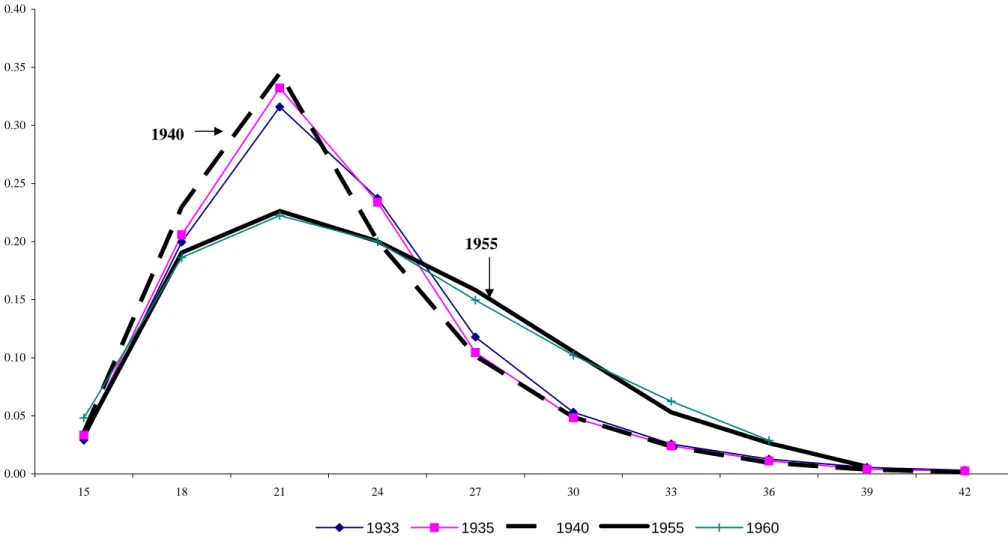
Changes in the distribution of age at first birth also correspond closely to the prevalence of the pill. Instead, they are consistent with the idea that the pill catalyzed changes in labor force participation through the mechanism of birth timing. Recent studies suggest that the pill's potential effect on women's fertility and labor force is small.
Using variation in birth rates may underestimate the impact of the pill for two reasons. While previous empirical studies have emphasized the impact of changes in the number of children on labor supply, the argument here is that early access to the pill may have influenced women's work behavior without affecting completed fertility. Identifying the effect of early access to the pill using variation in state laws. The nature of the birth control pill as a prescription drug makes variation in legal access a useful tool for studying its impact.
The trend toward the legal empowerment of minors began long before the introduction of the pill.
Data and estimation results
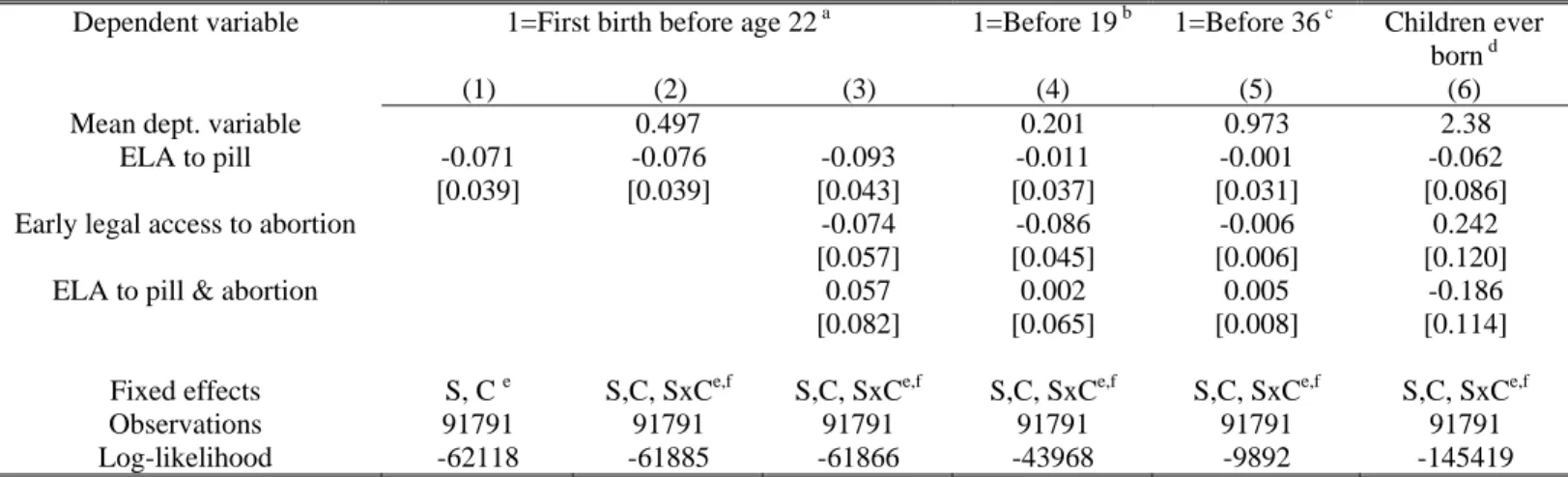
With this data, Goldin and Katz [2002] conclude that in states with liberalized access, pill use was 36 to 40 percent higher among unmarried women aged 17 to 19.22 To further strengthen the argument that liberalized access to the pill indeed By generating the observed labor market effects through the fertility control mechanism, I provide additional evidence that early access facilitated a delay in age at first birth and that only women who delayed childbearing were more likely to be employed in the paid labor market. 24 The decennial census only asks about children currently living in the household, so age at first birth cannot be calculated for women with children living outside the household. For the binary dependent variables in the first five columns, probit specifications are used and the standard errors are corrected for clustering on place of residence and year of birth cells.
28 The inclusion of childless women (zeros for the binary variable for first birth before age 22) means a 16% reduction in As captured by the interaction of early legal access to the pill and abortion, the effects in countries with both types of fertility control are not significantly different. For example, since the laws considered in the analysis generally lowered the age for access to the pill to 18, this should not affect first births before age 18 (conception at age 17).
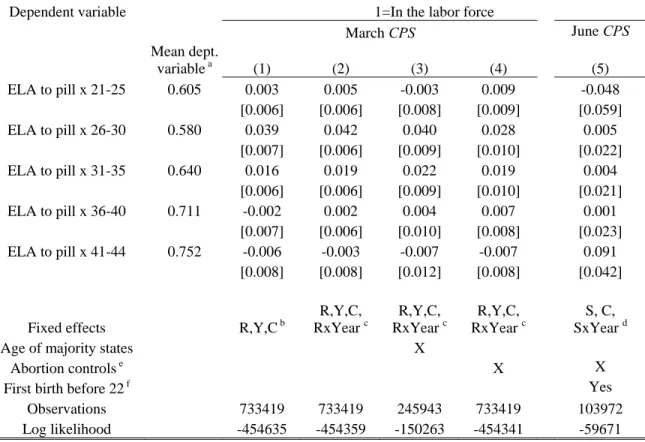
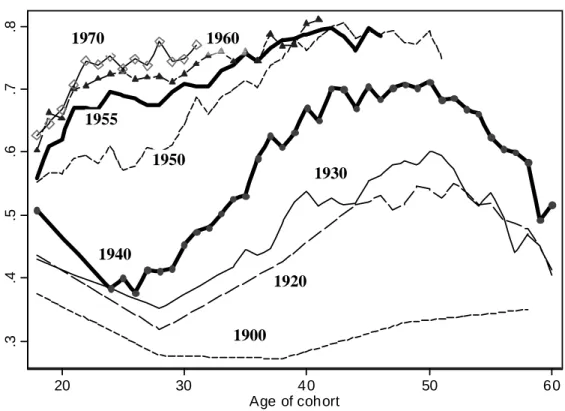
Therefore, the labor market effects reported later in the paper should be seen as arising from improvements in the timing of motherhood rather than from reductions in the number of children. The employment data in the March CPS provide annual employment information from 1964 to 2001 and allow age-specific labor force participation effects to be separated within-cohort from the secular growth in women's market employment. 35 The elements of A are five dummy variables equal to one if a woman falls into the specific age category.
From 1964 to 1988, an inactive individual could say that the reason for not paying was that she was "in school." For women aged 16–30, I estimate a probit model using the baseline specification in Table IV with a binary dependent variable equal to 1 if the woman reported being “in school” rather than in the paid labor force. 37 I also investigate the effect of Vietnam on women's outcomes independent of changes in the age of majority.
If increasing age during Vietnam had different reasons for women to delay marriage, childbearing, or invest more in formal market work, then changes in age at mobilization may be related to women's decisions for other reasons. in addition to access to pills. Changes in the intensity of the labor supply underline the possibility of changing career investments in the form of labor in the market. Because these estimates are conditional on being in the labor force, selection makes them difficult to interpret.
38 Because the March CPS reports intervals for weeks worked before 1976, I use the interval averages suggested by Unicon in the estimate. The inclusion of both occupational and education dummies interacting with A brings the effect of ELA on labor market presence to zero, and the effect on annual hours worked remains only marginally statistically significant at 43.0. in terms of occupation and education, ELA appears to have had little effect on the labor market for women.
More Power to the Pill
However, even these cautious estimates suggest that early access to the pill may account for 3 of the 19 percentage point increase (15 percent) in the labor force participation rate and 370 of the 450 annual increase in work hours (82 percent) among 16-year-old females. up to 30 years old from 1970 to 1990.42. Further study of the importance of oral contraceptives—as well as other methods of reliable contraception—may improve our understanding of the origins of the second demographic transition and epochal changes in women's work in the twentieth century. Evans, “Schooling and Labor Market Consequences of the 1970 State Abortion Reforms,” Research in Labor Economics, XVIII.
Black, Sandra, and Chinhui Juhn, "The Rise of Professional Women: Are Women Responding to the Demand for Skills?" American Economic Review, CX. Current population surveys, March machine-readable data files]/conducted by the Census Bureau for the Bureau of Labor Statistics (Washington, D.C.: Bureau of the Census [manufacturer and distributor Santa Monica, CA: Unicon Research Corporation [ manufacturer and distributor of CPS Utilities], 2003). Department of Health and Economic Welfare (DHEW) Center for Family Planning Program Development (Planned Parenthood-World Population), Family planning, contraception, and voluntary sterilization: an analysis of laws and policies in the United States, each state, and jurisdiction (as of September 1971): a report of the National Center for Family Planning Services, Health Services, and Mental Health Administration (Rockville, MD: US DHEW, publication no.
Goldin, Claudia, "The Historical Evolution of Female Earnings Functions and Occupations," Explorations in Economic History, XXI. Goldin, Claudia og Lawrence Katz, "The Power of the Pill: Oral Contraceptives and Women's Career and Marriage Decisions," Journal of Political Economy, CX. Joseph, Susan McElroy og Seth Sanders, "The Impact of Teenage Childbearing on the Mothers and the Consequences of these Impacts for Government," i R.
Maynard, ed., Children Having Children: Economic Costs and Social Consequences of Teen Pregnancy (Washington, D.C.: The Urban Institute Press, 1997). Rosenbloom, “The Effects of Childbearing on the Labor Supply and Earnings of Married Women: Using Twin Births as a Natural Experiment,” The Journal of Human Resources, XXXIV. Marks, Lara V., Sexual Chemistry: A History of the Birth Control Pill (New Haven, CT: Yale University Press, 2001).
Mincer, Jacob and Solomon Polachek, “Family Investments in Human Capital: Earnings of Women,” The Journal of Political Economy LXXXII (1974), S76-S108. National Archives in College Park, “[Southeast Asia] Combat Area Casualties Current File (CACCF), as of November 1997” (Washington, D.C.: Records of the Office of the Secretary of Defense, Record Group 330, electronic document, 1997). Vere, James P., “Dragon Children: Identifying the Causal Effect of the First Child on Women's Labor Supply with the Chinese Lunar Calendar,” Economics Working Paper Archive at WUSTL 407003 (October 18, 2004).
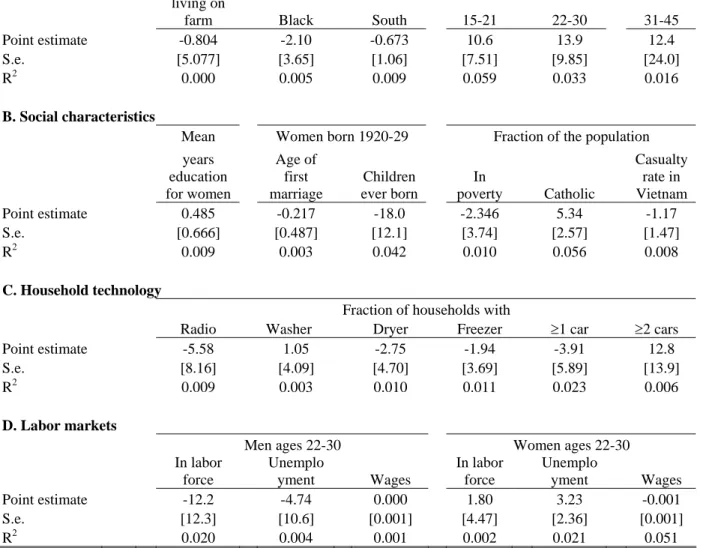
Demographic characteristics
Social characteristics
Household technology
Synthetic birth cohorts are calculated either by using the reported year of birth or, if this value is missing, by subtracting the reported age in years from the survey year. Probits are used for estimation for columns 1 to 5 and least squares regression in column 7. Robust standard errors are given in parentheses and are corrected for clustering in country of residence and year of birth cells.
Y,C, RxYear c
Y,C, RxYear d
First birth rates are calculated as the number of live first births per 1000 women in the appropriate age group. Source: Division of Vital Statistics, National Center for Health Statistics, Statistical Tables on Births, Tables 1 and 2: First Birth Rates by Age of Mother, By Race and Hispanic Origin: United States, Specified Years 1940-1955 and Each Year.