What is the best way to reduce racial inequality and usher in effective social change? Social issues are often examined through the lenses of the top-down approach and the bottom-up approach. Thus, a top-down theorist would argue that electing more African Americans into government positions will reduce racial inequality.
On the other hand, the bottom up approach argues that effective policy implementation lies in the power of the people who implement it at the "street level" (Lipsky 1980).
Paradigms of Race and Social Change…
The complexity of racial inequality has led theorists to develop multiple theoretical paradigms to understand racial inequality. Because my dissertation conceptualizes racial inequality as an economic system, the focus of my research agenda is at the macro level. The issues of class competition and class exploitation are both important to the study of the origins and persistence of racial inequality, but the more important question is how to alleviate them.
Many intellectuals, artists, and activists theorized methods of racial uplift to combat the vast system of racial inequality.
Paradigms of Race Alignment with Models of Social Change
The main theory of the top-down approach (also known as the representative approach) is the minority empowerment thesis. At the height of his career, Du Bois supported the idea of the "Talented Tenth". I will then highlight the similarities between the class paradigm of race and the social movement approach.
The bottom-up approach argues that effective policy implementation resides in the power of the people implementing it at the "street level" (Lipsky 1980). Black Lives Matter is a continuation of the Black freedom struggle that took place in the USA. I will use the current labor movement as a case-in-point of the most promising form of racial inequality relief, an intersectional class approach.
Intersectionality as Remedy
In this study, I focused my argument around the labor movement as a prime example of a bottom-up approach to mitigating racial inequality. Examining the labor movement as an intersectional class movement directly refutes Wilson's (2011) assertion that racial inequality is no longer economic in its features and consequences, but sociopolitical. After the Civil War, interest groups were divided over the group's goals; Labor activists saw the race problem as settled, while civil rights activists saw the issue of race as just beginning to receive the attention it deserved.
Viewing civil rights as a solved problem, the labor movement turned to wage slavery as their next big problem. We are all one family of slaves together; and the labor reform movement is a second emancipation proclamation (Todes 1942: 76; emphasis original, cited in de Leon 2017: 16). This discourse led a once racially united labor movement to split and seek separate means for their material and cultural ends.
The Union's reluctance to address the issues of the civil rights and feminist movements, and the Black Likes Matter movement (Larson 2016) stifled the labor movement's opportunities for growth and ultimately led labor. In the mid-1950s, communists were purged in the US and racial segregation once again weakened the labor movement, causing the decline of unions. The labor movement has had a turbulent and contradictory history, but in periods where it has fought for equality, workers and the general public have made massive political and economic gains.
The labor movement has pushed back throughout history as a promoter of inequality and equality. Similarly, during the Trump era, the AFL-CIO called for the labor movement to be allies of the Black Lives Matter movement, a movement that seeks to eradicate racism in policing (Larson 2016).
Theory & Hypotheses
Ironically, the decline of unions has directly coincided with an increase in overall economic inequality in recent decades (Callaway & Collins 2018). Research has shown that the decline of unions is directly related to income inequality (Card Western and Rosenfeld 2011). In this theoretical approach, women of color are members of two subordinate groups, who can be identified as either female or black.
Unions have evolved from purely economic/class machines into social movement organizations with multicultural goals of racial equality, gender and gender equality, and environmental sustainability. In short, labor power leads to a variety of racial, gender and sexual, and other structural issues that need to be represented. To test a bottom-up social movement approach, I will analyze the relationship between union coverage percentages and racial inequality in homeownership rates by state at the multivariate level.
Similarly, I will analyze the relationship between Black representation and racial inequality in homeownership by state at the multivariate level to test the top-down approach to elite representation. To prove my argument that an intersectional class approach (bottom-up) is a more effective alleviator of racial inequality, I need to show that union coverage has a greater effect on reducing racial inequality than African American political representation.
Methods
The Labor movement in particular is an interesting bottom-up, social movement, approach to examining the issue of racial inequality. Workforce can be conceptualized as an intersectional, bottom-up approach to alleviating racial inequality in production and consumption. To demonstrate this trend, I demonstrate that class is not disconnected from racial identity by analyzing the relationship between labor force and racial inequality in homeownership, because homeownership is a leading goal of consumption within the American Dream.
The deep ties to racial inequality suggest that inequality within homeownership cuts across both race and class. I argue that union coverage is predictive of racial inequality in homeownership rates by state because of its. In this, the ethnicity paradigm and top-down approach assume that equitable Black representation in elite spaces is expected to act as an alleviator of systemic racial inequality.
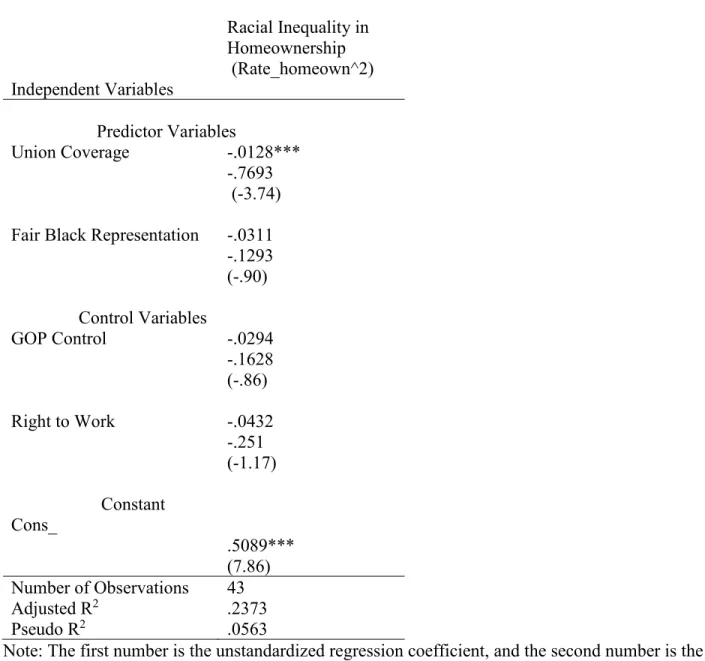
Including a percentage measure produces findings that show that states with high percentages of black representatives actually have more black-white racial inequality in homeownership. I argue that fair racial representation could also explain racial inequality in homeownership, but I suspect that it will have less impact than union coverage. For racial inequality in homeownership, I ran an ordinary least squares regression model to examine the relationship between racial inequality in homeownership and union coverage.
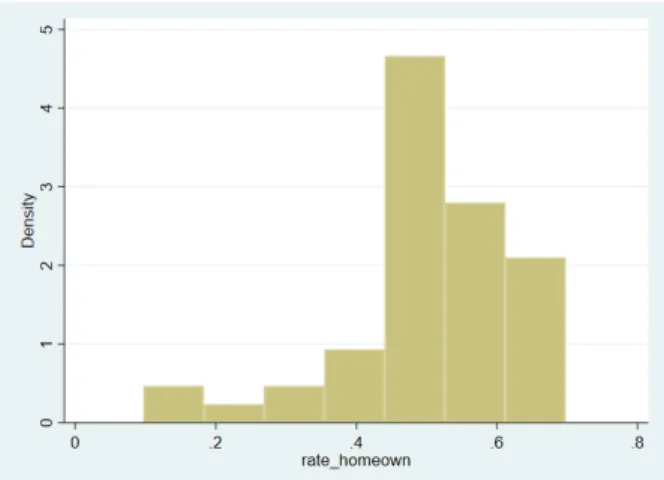
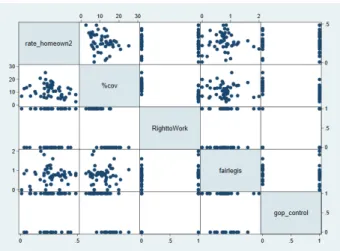
I find that the racial inequality in homeownership (see Figure 1 in the appendix) is negatively skewed, so I square all values of this dependent variable. The Breusch-Pagan/Cook-Weisberg test for heteroscedasticity is not significant, so there is not sufficient evidence that racial inequality in homeownership is not homoscedasticity.
Findings and Discussion
Although small, union coverage has a beneficial, mitigating effect of racial inequality in homeownership rates per capita. state. Thus, states with high union coverage rates have statistically significantly lower rates of racial inequality in homeownership. The rate of African American representation in a state has no statistically significant effect on racial inequality in homeownership.
Thus, I find support for Hypothesis 3. Union coverage rates have a greater effect on reducing racial inequality than black representation. For this I create a binary variable to represent fair, "Fair". Fair is coded 1 for state legislatures that have equal or greater African American representation relative to the size of the African American population and coded zero. In a previous OLS regression, I found that, after meeting the assumptions, states with higher levels of union coverage exhibit lower rates of homeownership among black-white racial inequality.
To use propensity score matching, I must first use a logistic model to estimate the probability that any country has high racial inequality. Using propensity scores, I can compare cases, which makes the distribution of covariates of racial inequality in homeownership the same in the experimental and control groups for each value of the propensity score. Finally, I use a treatment effect test using propensity score matching to isolate the causal effect that fair representation has on racial inequality in homeownership, while controlling for union coverage, right-to-work status, and GOP control.
When I tested the treatment effects using propensity score matching, I found that there is no significant evidence to support the claim that fair representation has any effect on racial inequality in homeownership. Thus, we can assume that fair African American representation, as a percentage and as a binary variable, does not cause or alleviate racial inequality in homeownership, due to the lack of significant findings on treatment effects.

Conclusion
- Union Coverage & Racial Inequality in Homeownership
- Union Coverage & Racial Inequality in Homeownership OLS Regression
- Treatment Effects of Fair Racial Representation
- Treatment Effect of Fair on Racial Inequality in Homeownership
What this study makes clear is that racial inequality can be alleviated by the direct, collective action of the oppressed. Elections alone are not vehicles for alleviating racial inequality, but rather the combined direct action of the poor and working class, men and women, African Americans, whites, Latinos, the disabled, etc. There may be other better measures of bottom-up activities that attempt to mitigate racial disparities such as
My findings inform scholars, policy advocates, and social movement organizations about the importance of intersectional race-class mobilizations to reduce racial and economic inequality. The Killing Fields of the Deep South: The Market for Cotton and the Lynching of Blacks, 1882-1930. Racism without racists: Colorblind racism and the persistence of racial inequality in the United States.
No Union Grievances the Union Cannot Heal': The Struggle for Racial Equality in the United Auto Workers, 1940–1960. Does descriptive representation of the working class "include" women and minorities (and vice versa). Black Reconstruction in America: Toward a History of the Role Black People Played in the Effort to Rebuild Democracy in America, 1860-1880.
Shaping Racial Boundaries at the Dawn of Jim Crow: The Determinants and Effects of Black-Mulatto Occupational Disparities in the United States, 1880. When Affirmative Action Was White: The Untold History of Racial Inequality in Twentieth-Century America.