PPJMITIYE AMERICAN ARMOR.
WALTER HOUGH, Ph. D.
Departmentof Ethnology, U.S. NationalMuseum.
H.
Mis. 184, pt. 240
625PRIMITIVE AMERICAN ARMOR.
By Walter Hough,
Ph. D.,Department of Ethnology, U. S.NationalMuseum.
" CorneliusTacitus dothpleasantlyquipandJest atthemenofwarofour ancientGaules, soarmed, onlytoTuaiutainethemselves,as thej-thathave nomeanseitherto be offended or to raise them- selvesbeingovertbrowne." Montaigne, OfTheParthianAmies.
In the U.
S. I^ationalMuseum there are many examples
ofprimitive American armor. These defensive weapons may be classed
asparrying armor,
orthe
shield,and body armor,
forthe defense
ofthe head, trunk,
legs,and arms. The
subject willbe treated under form, mate-
rial,structure, decoration, function,
mythology, and
distribution.I.
Shield.
The
shieldisthe
firstdefensive weapon both
inpoint
oftime and
of usefulness.While the
shieldon
firstthought may seem merely intended as a covering
forthe vulnerable points of the body,
itsimpor- tance
isfargreater
inparrying. Therefore, with
thisidea
inview, the
shieldmay be
assimple
asthe
plainparrying
stick ofthe Australians, which begins the
classic series ofLane Fox.
If
one bears
inmind
thatdefensive weapons are the concomitants
of offensiveweapons, the development
ofthe
shieldbecomes
clear.Thus, where
missileweapons
are used,the
i)arrying stickisa natural and adequate
defense.Where
missilesare given greater
velocitywith the throwing
strap,the throwing
stick, orthe bow, the
shieldmust cover the body
better. Itwould seem that the broad
shieldisthe counter- growth
ofthe bow.
The
circular shield characterizes theWestern Hemisphere. The North American
shieldisconvex and from
12 to26 inches
indiameter.
The Mexican area
isperhai)San
exception,though the Codices almost invariably depict the round
shield,and the surviving Mexican
shields,on which Mrs.
ZeliaNuttall
is authority,are
circular.*The Nahua
shield
was
"sometimes rounded and sometimes
oval,sometimes rounded on the lower
side."Some
shieldswere
ofan ordinary
size;others were intended
tocover the
entirebody and were constructed
sothat when
not
inuse they could be folded up and
carriedunder the arm.t Latitau conveys the idea that the Iroquois had
shields of difterentshapes.^
As
tomaterial,nearly
allAmerican
shields aremade
ofthick raw-
hide,that
ofthe
buffaloand
elkbeing most
available.Shields worked
*Nuttall, Zelia, ou Aucient Mexican Shields. luteruat. Archiv. fur Ethnologie, Leideu,Vol. v,pt.i,1892,pp.34-53.
tBaiKToft,H.H.,Native Racesof thePacific,Vol.ii,p. 407.
ILafitau,MceursdesSauvagesAin«riquains, Vol.ii,p. 197, Paris, 1724.
627
628 REPORT OF NATIONAL MUSEUM,
1893.out from a
single pieceof wood,
likethose
ofthe Dyaks are found on the Kio Maranon
inSouth America
(tig. 1).*The Viroinia Indians used
"targets made
ofbarcks."t The ^ava-
ioesmade a
shieldof cedar rods twined together with cord
(Cat.No.
8401 U S N.M.), which may be connected with the rod armor
ofthe Athamsc'ans and the
similarcane
shieldsof the Nahuas of Mexico.
Among the
Cerisand Chicoratos of New Mexico, "Another kind
of shieldwas matle of small
laths closelyinterwoven with
cords, insuch a manner
that,when not required
foruse, itcould be shut up
likea
fan,and was
carriedunder the arm."
|" In Tobasco and along the
coast, tortoise shells inlaidwith
gold,Fig.1.
WOODENSHIELD.
Cat. No.7.ViSlU.S.N.M. Peru. Gilto( theTrocaJero Mu.euin. Pans,
Silver, or
copper were commonly used as
shields,"§ asthe Malay
spec-imen from Singapore. Reeds,
grass, hides, orMiequeu-cloth coated with India rubber served
toprotect an Aztec common
soldier.||The
I ne-blo tribes
"carried round
shieldsof basketry,
ofheavily and
closelynetted
cotton, or ofthick rawhide, symbolically^amted.^^1]
^*7roode^s/.i;/i:=Ilat^lisir^ni^^
in.tbe center,forming a step.Two
bentwood
handleswrapped
witlibarkaresprunginto holes.nthe rearo the shield. Decorated withtriangnlarfignres inredand
yellow,resemblmgt^nts.Diam-
eter,33inches. (Cat. No.7.5881, U.S.N. M. Indians of the
Upper Amazon
(Kio Maranon) Peru. Giftof theTrocaderoMuseum,
Pans).tHariot,Thomas, Virginia,p.24.
tBancroft,op.cH.,Vo\.i,p. 579.
VUiancroft,H. H.,op.cit.,Vol. ii,p. 407.
IIBancroft, loc. cit. ,
HCushiug, F. H., article "Pueblos, ' in Johnson's Cyclopedia,from advanced sheets in
new
edition,now
in press.PRIMITIVE AMERICAN ARMOR. 629 The construction
ofthe North Americau
shield isgiven
in detailby George
Oatlin.The ingenious
process
ofcontracting and hardening the hide by
firewas common.
Sioux shield
made
of the skiu of the buffalo's iieek, hardened with glue extracted from the hoofs aud jointsofthesame animal.The
pro- cess of"smoking
the shield" is a verj' curious as well as important one, in theirestimation. For this purposeayoung man
about tocon- struct forhim
a shield digs a hole of 2 feet in depth in the ground,and
as large in diameter as he designs tomake
his shield. Inthis he builds afire,and
overit, a few inches higher than the ground, be stretches the rawhide horizontally over thefire,withlittlepegsdriven through holesmade
near the edges of the skin.The
skin is at firsttwice as large as the size of the required shield; buthavinggot his particularandbestfriends
(who
are invitedonthisoccasion) into a ring todanceand
singaboutitandsolicit the Great Sph'it to instill into itthe
power
to j)rotecthim
harmless againsthisenemies,he spreads over itthe gluewhichisrubbedauddried in, as the skin is heated;and
a secondbusily drivesotherandother pegs, inside of thosein theground, as they are gradually givingaway and
beingpulledup
bythe contrac- tion of the skin.By
this curious process,which
is most dexterously done, the skin is kept tight whilstit contracts to one-half ofits size,
taking up the glue andincreasing inthickness until it is rendered as thick
and
hardasrequired(andhis friends have pleaded long enough tomake
it arrow, and almost ball, proof),when
thedance ceasesand
the fire is put out.When
it iscooled
and
cut intotheshape that he desires, itis often painted with his medicineor totemupon
it, the figureof aneagle,anowl, abuffalo,orother animal,' asthe case
may
•' be,' Cat.Nowhich
hetrusts willguard andpro-tect
him
from harm. It isthen frin<jredwithFig 2.
ABAPAHOESHIELD.
,I'.S.N.M. Daknta. Collectedhi
eagles' quills or otherornaments he
630 REPORT OF NATIONAL MUSEUM,
1893.may
have chosen and slung with a broad leather strap that crosses his breast.These shields are carried
by
all the warriorsin theseregions, for theirprotection in battles, which are almost invariablyfought fromtheir horses' backs*The
shieldwas invariably held on the
leftarm,t usually by a simple
thong- ofbuckskin attached
tothe
interior.Wooden handles, believed
tohave belonged
toPima Indian
shields,were found
ina cave with war clubs on Superstition Mountain
inArizona, by Dr. E. Palmer.
(Cat.
No.
7C028,U.
S.N. M.)
Itis
the custom
ofmost
tribes toput one
ormore covers of dressed buckskin over the
shield,the covers being decorated.|
(See.pi.iand
fig. 2.)
The decoration
ofthe North American
shieldforms one of the most
fruitful
sources
forthe
religious beliefsand
practicesof the
Indians.§The decoration was inspired by a
revelationthrough a dream,
follow-ing among the Crows the
teriible initiationceremony and among
all tribesfollowing an
ordeal.The protection of the
shieldhas
largelybecome
fetichisticand
inmany cases the survival of
thisancient means of defense has been brought about by
its cult relations.The warrior
fraternitiesof the Moki and Zuni
tribeshave an
elabo- rateceremonial of the
shield.||In the Moki ceremony, held
atthe
*Catlin.George,North AmericanIndians, 7thed. Lond., 1848. Vol.i,p. 241.
tSee thepaper
by
Mr.Gushing onManual
Concepts.,American
Anthropologist,V, 1892,p.290.tDESCRIPTION
OF FIGURE
2AND PLATE
I.Fig i? shield.—
Made
of rawhide with cover ofmuslin symbolically painted in green, Vellow, red,andblack.The background
above is yellowand
belowgreenThe
fio-nres are on theyellow portionand representstwo
dragonflies,thesunand
moon.^anowl,andacircle inred outlinedwithgreen.Two
eagleclawsare fastened at oppositesides.A bunch
of eagle feathersisfastenedattheupperedge,and tromitdependsaflannel
band
with rowsof large eagle feathershavinghorsehaircemented to theirends.The
thongsforholding have disappeared; thereremainsathongtor suspension. Diameter 18 inches (Cat. No. 129871,U.S.N.M.
Arapahoe Indians, Dakota. Collectedby
H. M. Creel.)"
, ., .
FlateI,shieldwith2corers.-Theshieldproperisofhardenedbuftalohide of con- vexform, plainin frontwithfour perforationsthrough
which
thethong formingthe handleispassed, (lowerfigure).To
the triangularhandleare attached longcow
tails (floureto right).The
inner cover isof buckskin, gaudily decorated,and
edged witha bandofflannelbordered witheagle feathersand havingawoven band
hang- ingdown,(figuretoleft; back viewof same,upperfigure totheright).The
outercover,whichistoprotect the inner cover
and
the feathers are also paintedand
whitened with pipeclay.Four
charmsareattachedtoit,viz, a curlofcow
s tail, an eagle feather,and two
tuftsofshredded clothwith abitof brass chain, the covers aregashed aroundtheedgeand
suppliedwithagatheringstringforsecuring the cover tightly over theshield.The
completeshieldisshown
intheupperfigure totheleft.A
third painted coverfor this shield hasbeendiscovered. Diameterof shieldproper,15iinches; of shieldwithcovers,17+inches. (Gat.No.8443,U.S.N
.
M.
Comanche
Indians, FortGriftin,Texas. Collectedby
Dr.H. McElderry,U.S.A^J^Mr.
James Mooney
ispreparingapaperupon
thisbranchof the subject. Mrs.Nuttall has treatedonthisaspect of the ^Mexicanshield;loc. cit.,ante, p. 1.
11SeeZuniFetiches, Gushing,2dAn. Rept. Bu.Ethnol.,Pis. x, xi, p.40.
ReportofNationalMuseum, 1893.— Houch.
Plate 1,
Rawhide Shieldwith Covers.
Cat.No.8443,U.S.N.M.
PRIMITIVE AMERICAN ARMOR. 631 winter
solsticeby the warrior
societies,the sun
isrepresented by a
shield,and attack and defense
isgraphically dramatized. The
shields ofthe sun warrior
fraternitiesare decorated with the totems
ofthe individual
societies.A
descriptionof
thisceremony
willsoon be pub'
lishedby Dr.
J.Walter Fewkes.
The various
feathers,hoofs and horns, and skins
ofanimals,
etc.,hung
to shields,are
alsopersonal
fetiches.The
distribution ofthe
shieldshows that most of the American
tribes
possessed the
shield,and a majority appear
tohave had no other weapon
of defense.There
isstrong presumption, however, that the use of body and
shieldarmor was widespread
inAmerica, as
historical noticesshow.
Charlevoix, writing
ofthe
Iroquois,observes that while the western
tribesuse bucklers
of buffalo hide, "itispretty
siu'prising thatother Indian nations never use them."* Lafitau and the
earlier mission- aries,however,
creditthe Iroquoian people with the
shield inthe following words:
Theirshieldswereofozierorbarkcoveredwith oneor
many
peauxpass^es; there aresome made
of verythickskin.They had them
ofallsizesand
allsortsoffigures.t
Some South American
tribeswho use body armor are
said tobe unacquainted with the
shield.Likewise the Eskimo seem
tobe
desti- tute ofthisweapon.
There
areprobably
fiftyAmerican
shields inthe National Museum, some
collected as early as 1830.Several have been handed down from
father tosou
fora period
of sixty-five years.These
shields arefrom the
tribesof the western portion
ofthe
con- tinentand include the Crows, Sioux, Comanches, Kiowas, Navajoes, Utes, Apaches, Pimas, Zunis, Mokis,
etc.II.
Body Armor.
The aboriginal armor
ofNorth America was intended
toprotect the
vitalorgans and
toallow
freemovement
ofthe
limbs.The form assumes that
ofa
sleeveless jacket, coat, orwide band going around the trunk, suspended from the shoulders. The
selection ofdefensive materials and
theiradaptation
todefensive covering
forthe body form an
interestingstudy
innative
invention,while the evidence
inNorth America
ofthe migration
ofinventions awakens no
less interest.Thus we
findthat
atthe period
ofthe disuse
ofarmor by the
aborig- inesthere were
sixtypes
ofbody armor found on the North Amer- ican Continent and contiguous
regions, viz:Plate armor. — Eows
ofoverlapping
plates,perforated and
lashed.Eskimo and Chukchis.
"Charlevoix, F. X. de,Journal of a
Voyage
to North America. Vol. i, p. 338.Lond., 1761.
tLafitau,loc. cit., ii,p.197.
632 REPORT OF NATIONAL MUSEUM,
1893.Slat
armor. — Wooden
slatstwined
together,Sitkans, Shastas,
Iroquois,
Virginia
Indians.Rod armor. — Wooden rods twined
together.Aleuts,
Sitkans,Colum bia Elver
tribes,Klamaths, Hupas,
Irociuois,Virginia Indians,
etc.Band armor. — Bands
ofskin arranged
intelescoping
fashion.Clmkchis.
S]ci)i
armor. — Coats
ofhardened
hide. Tlingits,HaidaSj Hupas,
Chinooks, Navajoes, Mohawks, Shoshones, Pawnees, Comanches,
etc.
Cotton-j)added
armor. — Mexicans, Isthmians, and Peruvians.
Three
well-defined areas,including the above-mentioned types
ofNorth American body armor,
willbe now considered,
viz:(1)
Bering
Strait area,the American shore of Bering
Sea,and the
islandsas
farnorth
asCape Prince of Wales, inhabited by the Eskimo, and the Asiatic
side,inhabited by the Coast Chukchis. (Plate
armor.)(2)
Western
area,extending from Sitka through northern
Californiaand the
centralbasin
toMexico.
(Slat, rod,and skin armor.)
(3)
EaHtern
area,extending from southeastern Canada
to Virginia,inhabited by Algonkian and Iroquoian
tribes. (Slat, or rod,and skin armor.)
The
firsttwo areas are known by actual specimens, while the
thirdarea
is historical.In the
interior ofthe
continent,according
to his- torical notices, severalstocks used armor. There
is, therefore, suffi- cienttestimony
toshow that
ifnot universal the use of armor was
at leastgeneral among the North American
tribes.1.
BERING STRAIT AREA.
The National Museum possesses a number* of examples of Eskimo- Chukchis
platearmor from Cape Prince of Wales, Diomede
Island, St.Lawrence
Island,Alaska, and Cape Wankarem,
Siberia.The most
perfectspecimens are from Cape Prince of Wales and Dio-
mede
Island.(See
pis.2 and
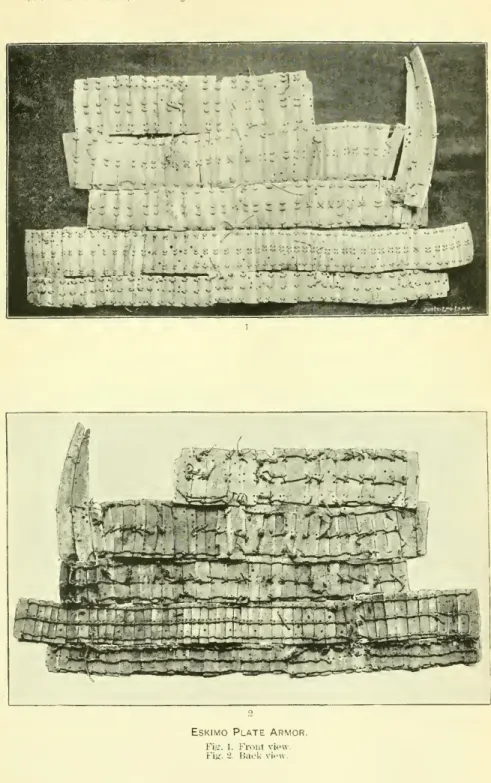
3.)**DESCBIPTIOX OF PLATK 2.
Fig.1,platearmor.
— Made
of threerows of walrus-ivory plates,averaging1 inch inwidthand6inchesinlength.Each
plate contains6 holes, through whichpass rawhidethongs,thus lashing the plates together. These plates areslightlyimbri- cated, asarealsothedifferentrows,so as toward
offmore
effectuallytheweapons
oftheenemy.The
lowerrow
contains 43 plates,and
the middle 38.The
upperrow
consistsoftwo
sections; one containing 10 plates,protecting the breast, the other8 plates,protecting theupperpart ofthe back.A
rawhidestrap passes over the shouldersandsup])ort8the armor. This armor very closely resembles that of .lapan.Length when
spreadout,44 inches. (Cat. No. 153491, U.S.N.M.Eskimo
ofCapePrince of Wales, Alaska. Collectedby H.R. Thornton).Fig. 2, plate armor.
— Fragment
consisting of9 iron plates similar to those on Japanesearmor, andbound
with three lashings ofrawhide. This specimauwas
ReportofNationalMuseum, 1893—Hough. Plate 2.
PRIMITIVE AMERICAN ARMOR. 633
This type
ofarmor
consists of small, flat,oblong
plates ofivory
orbone pierced near
theedges with from 4
to ormore
boles.They
are laslied in serieswith rawhide thongs passing through the
holes,form- ing what
isknown as the
"clove
hitch."The longer edges
ofthe
plates arechamfered
toadmit
ofoverlapping and curving the armor around the body;
itcould thus be
rolledup
insmall compass when not
in use.The
coatwould be formed
offrom
3 to 5imbricating rows
of plates soconstructed, having
offsetsunder the armpits and straps
forthe
shoulders.Sometimes a yoke
ofskin
fittingthe neck and shoulders formed a support
forthe rows
of plates, as inspecimens from
St.Law- rence
Island.The coat
isfastened
atthe back, being
tiedwith thongs
orhaving a toggle and
loop.Iron armor
plateswere dug up
ina marsh
atCape Prince
ofWales
(see pi. 3),
and
plates of ironand copper were found on
St.Lawrence
Island.
There
isan
interestingstatement from Lisiansky, who wrote
hisvoy- ages
in 1805,that the
Tlingits,onthe introduction
of ironand
firearms,adopted a new form of
protection, consistingof a buckskin
striparound the neck with
iron platesattached pendant down the
breast.Nordenskkjold
figuresa
suitofarmor
likethat
ofthe Eskimo from the Chukchis.* In the Museum there
are4
plates of fossilivory from the Chukchis
ofCape Wankarem.
The hoop
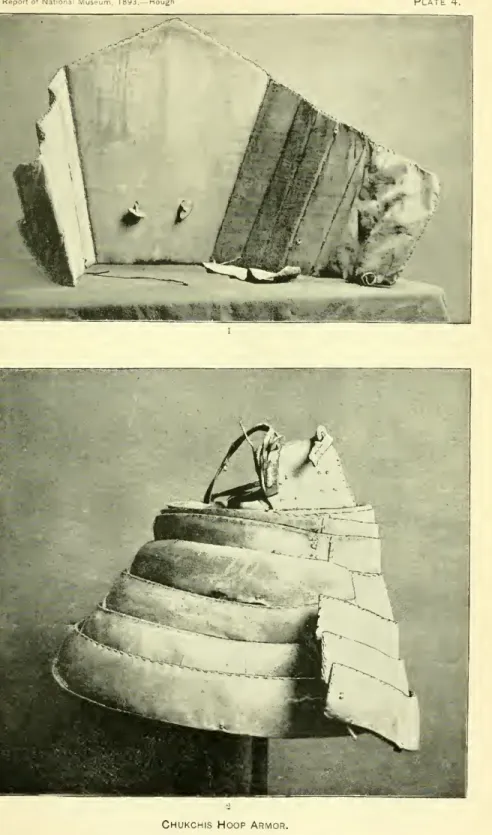
orband armor mentioned
astype 4
(pi. 4, fig. 2) isfound only on the Siberian
side of thisarea and,
as well asthe plate armor,
recallswell-known forms
inJapan. This hoop armor
is interestingas showing the reproduction
of platearmor types
in skin,being made
ofhorizontal bands
of sealskininstead
ofrows
ofivory
i)lates,the rings telescoping together when the armor
isnot
in use.This type may be compared with the banded mail
ofthe Middle Ages, about which there dug up
inabog
nearwhere the ivoryarmor on this platewas
found. Lengthof eachplate, 41inches;width,1^ inches. (Cat. No.1.53492,U.S.N.M.Eskimo
ofCape Prince ofWales,Alaska. Collectedby H. R.Thornton).DESCRIPTION OF PLATE 3.
Plate armor.
— Made
of fiveimbricatingrowsof plates ofwalrusivory ofunequal size inthedifferentrows,piercedwith from6 to 13 holes,lashedwithsealskin thongs.The
vertical edges of the plates are chamfered.The
upperrow
has 40,3 by 1|-inches; second row, 49 plates, 5 by1 inch; third row, 28 plates, 3^
by
If inches;fourth row, 31 plates, by 1^ inches; fifth row, 16 plates, 6
by
1^ inches.Two
pointed plates cutfroma tuskaie laslied toone side,forming a clasp. Thisarmor
was wrapped
aroundthebodyafterthemanner
of acuirassandissaidtohave been an efficacious protection against arrows. In the form,lashing,and adjustment of the platesitisidenticalwithcertaintypes ofJapanesearmor.Width
extended,49 inches; height, 24 inches. (Cat. No. 64290,U.S.N.M.Eskimo
ofDiomede
Island, Alaska. Collectedby
E.W.
Nelson).*Nordenskjold, A.E.,
Voyage
of the Vega,ii,p.478.634 REPORT OF NATIONAL MUSEUM,
1893.lias
been much
discussion.*The upper portion of
thiswar panoply
(pi. 4,t fig. 1) is
unique.
It
serves as a
shieldand resembles the neck fender
ofthe Kingsmill Island armor; designed, without doubt,
toprotect the warrior from attack
inthe
rear,a common occurrence
in allsavage warfare.
The whole armor
isvery heavy and clumsy. The method
ofwearing the
suitisshown
in plate 5.|Captain Hooper says:
Their
war
spearsaudthoseusedin huutingbears aremade
ofsteel,withahandle about6 feetlonj;-.The
bladeiskeptverysharpandh-ighlypolished. Theseweapons
areoften beautifullyiulaidwith brassornamented figures,andare purchased from theRussiantradersatGazhaga.^The Chukchis of Plover Bay formerly wore a
cuirassmade of long
stripsof
baleen,reaching from the neck
tothe middle of the
thigh.The
thickestbaleen was not
selected formaking the armor. The
strips were-
arranged
vertically,en
echelon^and
tiedthrough
perfora- tionson the
edges.Over the
jointswere applied other
stripsof whalebone, as
ina thatch fastened by thongs, passing through
perfora- tions at theiredges and
inthe middle of the foundation
strips.Owing
to
the material aud construction
thisarmor was somewhat
elastic.When spread out
itwas
inshape of a band with cuts below the armpits and having suspending
strapsgoing over the
shoulders,resem- bling the Hupa armor. (See
pi. 15.)The coat was
tied atthe back with
cords,requiring the assistance of another person.
The Chukchis
toldmy informant, Capt. E. P. Herendeen, that
this*Hewitt,John,Ancientarmor,p. 270; alsohooparmor,id.p.256.
tDKSCRIPTlON OF
PLATE
4.Fig. 1, armor.
— Upper
portion of 2437.Made
of sea-lion skin stretched over plates ofwood. Back, shield shaped,formedof2 verticalpieces of three-eighth inchboard lashed togetherwithwhaleboneand
coveredwithhide,which
extends continuously over the wings,being a very large skin turned overand sewed
on theupperedge.The
wingsconsist of4wooden
plates on one sideand
5 on the other,growingshortertowardthe frontand terminating ontheleftside in asection withoutwooden
lining.The
plates aremovable,the hidebeingcreasedatthe joints andinthe creaseislaid arounded thongwhich
isheldatintervalsby
loopsofwhale- bonepassingthroughtheedges of theplates.On
thebackaretwo
whalebonetog- gles forattachmenttothelowerportion.A more
clumsycontrivancethanthisfen- der can scarcelybeimagined. Width,72inches; height, 28inches. (Cat.No.2436, U.S.N.M. Chukchis, EasternSiberia. Collectedby Commodore John
Rogers,U.S.N.Fig.2,hoop armor.
— Made
of sevenbandsofsea-lion skin,5^ inches wide,doubledand whipped
togetherat the edges. These bands are connectedby heavy
thongsand hang
in an enlarging series,like an inverted telescope drinking cup, from a frameofwhalebonecoveredwithhide.The
freeendsof thebandsoverlapin front.A
squarebreastplate ofdoubledhide protects the neck. This armor is the lower portion.of No.2436. Diameter, 36 inches; height, 20inches. (Cat,No.2437,U.S.N.M.Chukchis, EasternSiberia. Collectedby
Commodore John
Rogers, U.S.N.XDESCRIPTION OF PLATE 5.
ChukchisivarriorandfamilI/.—
From
an aquarellemade by W.
Alexander in 1797, showing, after the interpretation of the artist, themethod
ofwearing the armor figuredinpi.4.§Cruise of the Corwin,1881, Washington, 1884,p. 31.
ReportofNationalMuseum, 1893.—Hough. Plate 3.
^
rEskimo Plate Armor.
Fig.1.Frontview.
Fig-.2. Backvi.^\v.
ReportofNatinm Museum 1893.
—
Hougn Plate 4.Chukchis
Hoop
Armor.Fig.1. Upperportion. Cat.No.24:J6,U.S.N.M.
Fig.2. Lowerportion. Cat.No.2-13,",U.S.N.M.
ReportofNationalMuseum, 1893,—Hough. Plate 5.
Chukchis wearing
Hoop
Armor. Plover B;PRIMITIVE AMERICAN ARMOR. ess- armor was used
ingoing over
totrade with the
hostileEskimo of
St.Lawrence
Island,which was dangerous and compelled
sleepless caution.Capt. Herendeen
alsosaw the band armor
(pi.4)among the Chukchis.
Ivory was not observed by Capt. Herendeen,
asthat material
isvery
scarceon the Asiatic
side; but,no doubt, the materials
forplatearmor were procured by barter with
Eskimo. In any
event,fossilivory plate armor was made by the Chukchis.
Driftwood
isalsovery
rareon the Siberian
coast,while on the
islandsand American shore
it isabundant. The quest
for thisindispensable material must have been a strong incentive
forthe Asiatic migrants
to crossthe
straits.As
farasknown the Chuk-
chisdid not use
either hel-mets
orshields.Of
interest incomparison with the Eskimo-Chukchis armor
isthat used by the Giliaks
of Siberia.This
iscomposed of
platesof
ironlashed together
(fig. 3).*They
alsowear an ingeniously constructed
conicalhelmet with a neck
cover.
The Giliak coat
of plaitedthongs,
figured inthe same work, does not occur
inAmerica, but has
itscounterpart
inthe
cocoanut-fibcrarmor
ofthe Polynesians and the
plaitedarmor
ofthe Malays.
The Kamtschadales have bows, arrows,
spears,and a coat of mail made
ofmats
orjilaitedthongs.tThe Kalmucks have
coats ofmail bought from
their neighbors.^:They use
lances.Descending the coast toward Japan, which seems
tobe the
originof the
platearmor ranging from that country
intothe American
continent,we
noticethat the Colletske make use
ofa
leathercoat covered with
lilatesof iron
about
6inches long and
apot-shaped helmet of smaller
plateshaving neck
covers.*Schrenck,L. V.,Reisen
und
Forschungenim
Amur-Lande,1854-56. St.Peters- burg,1891. PI.XLiv.DescriptionofJig.5.—Hehiiet
and
detailofarmorofthe Giliaks of theAmoor,Siberia..Inthe perforations
and
arrangementthisarmorresembles thearmorofthe Eskimo.^Drawing
from Reisen undForschungen im Amur-Lande,1854-'56,by
Dr.LeopoldV»- Schrenck. St.Petersburg,1891.tGrieve,Hist,of Kamtschatka,Gloucester,1764,p.202
XPallas,1,p. 143.
Fig. 3.
GILIAKHELMET AND BODYABMOR. SIBERIA.
AfterSchrenck.
636 REPORT OF NATIONAL MUSEUM,
1893.2.
WESTERN AREA.
In the western area the
slattype of wooden armor seems
tobe cen
tralamong theKoluschans
inthe
north, Avhilethe rod type runs
south-ward and
is centralamong theTinne of
BritishColumbia.
The
slatarmor has some resemblances
tothe Eskimo
coat,and might be regarded
asthe working out of the plate-armor idea
ina region where wood
isabundant and twined weaving common.
The
slatcoat
orcoat of
slatsand rods combined
isalways made
intwo
sections,one
forthe
frontand the other
forthe back, while the rod
coat isina
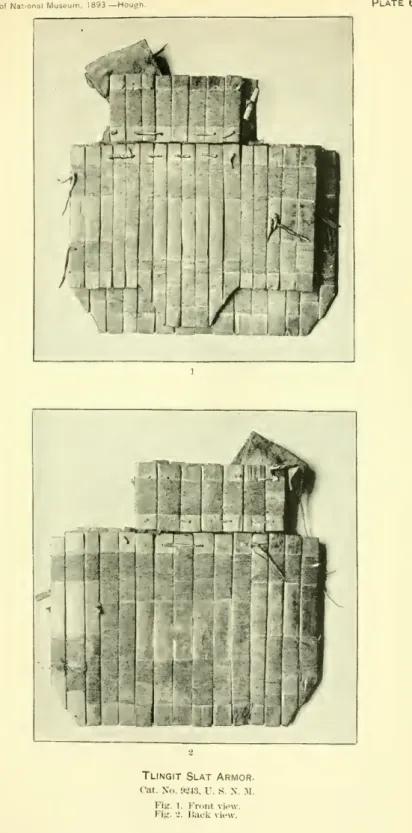
single\nece.Plate 6* shows the
frontand back of the
slat coat,and Plates
7and 8* show the combined rod and
slatarmor. These specimens
arevery
old.The woodwork shows great
skill, especiallythe
inter-locking joinery
atthe edges. The hardest wood procurable was
selected,
and usually sinew cord was employed
to jointhe
slats.Plate
J>,*taken from Niblack
afterLisiansky, shows the parts and method of wearing the
slatarmor.
*DESCRIPTIONS
OF
PLATES 6-9.Plate 6, slat armor.
— Made
of 32 slats of cedar aud otherwood woven
together bylineweavingoflinesinewandotliercord.A baud
ofweaving
of3incheswidthiscarried along thefront atthe topandthe
weaving
iscontinued,downward
intwo
places, meeting a
baud
crossing the bottomand
forming a geometrical figure.The
middleseries of slats,8 innumber,extendsbelowthe other4inches, 3ofwhich
are intact,while 2oneither sideare united,forminga swallowtailaud
allowingthe freebendingofthe thighs.The
front and back are distinct,joinedby
elk-skin cords at thesides.A
section of shortslats,8 in number, is placedinfront ofthe throat,and
asimilar row,7 in number,protects the back of the neck.The
armor is held in placeby
a broadbaud
of elkskin over the right shoulder, audfastenedontheleftsideby
a loopand thong.A
toggleonthe leftsideof thecollar infrontwas
probablyforsuspension of tlie (luiver. Height, 21^ inches; width, 20 inches. (Cat.No.9243, U. S.N.M.Tliugit Indians, Sitka,Alaska. CollectedbyDr.A.H.Hott", U.S.A.)
Plates 7andS,slat armor {back andfront).
— Made
ofslatsaud
rods ofhardwood
lito liinches wide, five-sixteenths inch thick,woven
togetherby means
of fine sinewcordso as toadmitof considerable flexibility.The
rodsandslats arepareddown
toformchannelsfor the reception of the cordweaving.The
frontand
back portions arewoven
separately, being connectedby
cords of leatherontheleft side aud onthe rightside bya loop andtoggle.The
rodson the border of the rear of armorare neatly " toedin."The
neckportionsaremade
up ofshortslatsand sewed
on bymeans
ofa stripofrawhide1^ inches wide.The
shoulder supports are of very thick elk hide, the one on the right being fastened by a slashand
toggle.Width
of reari)()rtion,24inches; height, 20 inches;widthoffrontportion,18inches;
height, 19 inches. (Cat. No. 74437, U. S. N. M. Tlingit Indians, Sitka, Alaska.
CollectedbyJ.,J.McLean.)
Plate
9.— Wooden
helmet secured to the head bystraps fastenedunder the chin (figure in upperleft coruer);wooden mask
or visor, side view,showing
holesfor eyes (middle figure);body
armor (lower left-hand figure);mask
or visor, show- ing buckle,which is heldin the teeth to keepthe visor inplace (Cat.No.71343, U.S.N.M.), Tlingit,(lower right-handfigure); sketchshowingthemethod
ofwearing thearmor; (upper right-handcorner).ReportofNationalMuseum, 1893—Hough Plate 6.
/^
wimy;
1\
i
r
I ':r.~r ....J-^ c^
jj-v
TlingitSlat Armor.
Cat.No.934.3,U.S.N.M.
Fig.1. Frontview.
Fig.2. Backview.
ReportofNationalMuseum,1893—Hough Plate 7.
TlingitSlat and Rod Armor.
Cat.No.74437.U.S. X.31.
Frontview.
ReportofNationalMuseum, 1893.—Hougn Plate 8.
^ W^
TlingitSlat and
Rod
Armor.Cat.No.74437,U.S.N.M.
Backview.
ReportofNationalMuseum.1893.-Hough, Plate 9.
Tlingit
Helmets
and Slat Armor.PRIMITIVE AMERICAN ARMOR. 637 As representative of the northwestern coast
culturethe
Tlingitsand Haidas are most prominent. Captain Cook noticed that
—
They
iucasealmost theentirebodyin awooden
orleathernarmor..They make
a breast plate ofwood and
an arrow-proof coat of thin flexible stripsbonnd
with strings likeawoman's
stays.They wear
helmetswithcuriouslycarvedvisors.*A
kindof jacket, or coat ofmail,made
of thin lathsbound
togetherwith sinewswhich makes
itquiteflexible,thoughso closeasnottoadmit an arrowordart.tIt
seems,
therefore,necessary
to treatthe Northwest Coast
asone
cul-ture
area,where the
artsofthe ethnic
unitscan scarcely be
ditteren- tiated.A
closestudy
asmarked out by Xiblack and shown
inthe
care- ful collectionsof
Lieut.G.
T.Emmons, U.
S.Navy, may disentangle the borrowings of the stocks of
this area.There are 4
suitsof thistype
inthe Museo Arqueologico
inMadrid.
'J
hey were
collectedby the Malespina Expedition of
1791.The exact
localityisnot stated and an account of Malespina's exploration was not published, as
faras
Ican
learn.If
one may judge by the Spanish names which have remained on the map, such as Malespina
Island,CapeMuzou, Cordova Bay, and
others,the Malespina Expedition explored the north
sideof Dixon Entrance and came
incontact with the Haidas
aswell as the
Tlingits.Although there
issome probability of these armors being Haidan,
I incline to believethem
to beTliiigit.During the course of
thisstudy, one piece of armor of unknown
function
inthe National
collectionwas found
tobe a
greave, orarmor
for
the lower
leg (pi. 10). fThis unique piece
disclosesthe hitherto unnoticed
factthat the Northwest Coast warriors were more completely armed than had been imagined. This greave leads
tothe inference that a
similar protectionwas extended
tothe upper
legsand the arms.
With heavy wooden helmet, the
slatcoat and armor
forthe
limbs,we have a
pictureof an Alaskan warrior armed
cap-a-pie.In no way was
this
armor
inferiortothat employed
inancient
orfeudal times
or ata
lateperiod among the Japanese. The resemblance of the specimen
inquestion
tothe Japanese greave
is striking.It is
made up of 12
slightlytapering hard wood
slatsand
8rods woven together with sinew
cord.The portion not covered with weaving bears a totemic
painting.When curved around the
leg,*Bancroft,op.cit. 1,p.105.
tCook,Capt.James, Third Voyage, Vol.ii,p. 372.
tDescriptionof Plate10.
—
Greavemade
upof12 slightlytaperinghardwood
slate and8rodswoven
togetherwithtwistedsinew cord.The weaving
isdiversified in the central portionby
carrying the threads inpairs alternatelyover therods.The
portion not coveredwithweaving
bears a totemic painting.When
thegreaveiscurved aroundthecalfoftheleg,thehollowedoutportions,
which
arealsobeveled,accommodate
the instepand kneejoint. Tiedatthe frontwiththongs.The
holes along theupper edge are probablyfor attaching the greave to thearmorfor the upperleg. Length,15inches;widthofupperedge, 17+inches; widthofloweredge, 16i inches. (Cat.No.74438,U.S.N.M. Tlingit Indians, Alaska. Collectedby
J.J.McLean.
€38 REPORT OF NATIONAL MUSEUM,
1893.tlie
hollowed oat portions accommodate the
instepand knee
joint. Itwas secured by thongs and probably with a band
or garter.The holes along the upper edge
areprobably
forattaching the greave
tothe cuissard.
Charlevoix,
inspeaking of the
Iroquois,says
:
Tbey had
evenformerly akindof mailforthearmsand
thighsmade
ofthesame
material,*i.e.,smallpliable stickspretty wellwrought.!The resemblance between the
culture ofthe west and
eastcoasts of North America
isstriking inother
instances.Many of the
figures inthe Mexican
codicesand sculptures wear a covering around the
calfof the
leg,which may be the greave. In the sculptures from Yucatan
thisgreave
orlegging seems
tobe of horizontal bands and square
plates.The rod type of armor of the western area
iswell represented by specimens
inthe National Museum. All the examples extant range from Sitka
tonorthern
California ina region comparatively
latelyexplored.
The rod and
slattypes
aremixed;
inthe method
oftwining together the elements they are
identical.In some
localitiesthe broad band of rods
isalone found, while among the
Tlingits,or around
Sitka,occur rod armor,
slatarmor, and a combination of both types
inthe same
piece,
as
wellas skin armor.
In form the Aleut armor, instead of following the Eskimo
type,belongs with the rod type of the Indians. The perforation of the
rods,however, and the method of
lashing,show Eskimo handiwork.
D'Orbigny says
: ^'Lesamies defensives
consistaienten une
cottede joncs
tressesqui
leurcouvrait tout
lecorps."|Dr. W. H.
Dall,during
hisexploration of the caves of the Aleutian
Islands,found the armor figured
in pis.11 and
12.§" Under the
*Charlevoix, F.X. de, Vol.i,p. 338,Lond.,1761.
iId., Letters to the Duchess of Lesdiguieres,p.143,Lond.,1763.
iD'Orbigny, Voyages,p.579.
§DESCRIPTION OF
PLATES
11AND
12.Plate 11,rod armor.
— Made up
oftwo
seriesofcedarrods,one-half inchindiame- terand different lengths,painted red.The
lower series containing 68 rods; the upperseries,two
sidesectionsof 10rodsand
a curvedpiece each,anda central sec- tioncontaining 22 rodswith curvedside pieces.The
rods are perforated through eitherendandheldin seriesby
asewingof finelyplaitedsinewcord,thecordbeing brought throughthe holeinthefirstrod,leavingtwo
longends. Theseare brought pasteach otherfronioppositesidesthroughthe hole in the next I'od,and so forth.The
sectionsarejoinedby
a rickracklashing,engaging withthe horizontal sewing.The
rods are perforated from side to aide and a thin rod ofwhalebonedrawn
through,rendering thearmorllexible. Atthelowerand
upper edges of the armor the endsofthe rods are chamfered. Therearetwo wooden
togglesonthe rightside.Plate12,rodarmor.
— Same
coatasshown
inpi. 11, doubledtogether,showing
the positionupon
the bodyinwearing the armor. Thisview shows also a portion of the inner side and the projecting ends of thewhalebone binding stripwhich has been broken. Width, 40 inches; height, 25 inches. (Cat. No. 17249, U.S.N.M.From
a burial caveinthe Island ofAmaknak.
Collectedby
E. Hennig.)ReportofNational Museum,1893—Hougn. Plate 10.
ReoortofNationalMuseum, 1893—Hough. Plate 11
,
PrehistoricAleutian
Rod
Armor.Cat.No.17:249,U.S.N.M.
ReportofNationalMuseum, 1893.—Hough. Plate 12.
PRIMITIVE AMERICAN ARMOR. 639
net was
inserteda
pieceof wooden body armor
(17249)composed of
small,round rods
ofproper
size,united by sinew cords and with
nicelycarved wooden
piecesabout the
arraholes.This
isthe only
pieceof
thisaboriginal armor known
tobe
iu existence. Itwas fastened behind with two loops
ofsinew,
into wliichwooden buttons were
inserted.The small rods of which
it iscomposed were about
three-fourthsof an inch
indiameter, painted
red."
The armor,
slightas
itwas, must have been a
tolerablygood
pro- tectionagainst the bone and stone arrowheads of the natives."*
In the northern portion of
this area,except
inthe Aleutian
Islands,Fig.4.
SHOWINGDETAIL OFWEAVING ROD ANDSLATARMOROFTHENORTHWESTCOAST.
the rod armor
isan oblong band composed
ofpeeled rods
ofuniform length and diameter held
in seriesby bauds
ofweaving
(pi.13).tLieut,
^iblack
says, indescribing
thisarmor, that
—
The
threads are sometimes single and sometimes inpairs,and
aremade
topass overand underthe rods in pairs,butinsuchmanner
that the overlappings alter- nate from onerow
to the nest. This isshown
in detail in fig.4,wherelaand
'Dall,
W.
H.,Remains
of Later PrehistoricMan
in the Caves of the Aleutian Islands,p. 18,SmithsonianContrib.toKnowledge,No.318.tDESCRIPTION OF PLATE 13.
Eod
armor.— Composed
of72 jieeledrods of uniformlengthand
diameter,heldin vertical seriesby
alternatebandsofweavingofwoolenand
sinewcord.The
rods arebunched
inthemiddleof the band.The
endsof the rods are neatlyhollowed out,formingcup cavities,and
there are4equidistant verticalbands of redpaint.This
band was
probablyworn
witha skincoat,both specimens having beensecured fromthesamenative. Thereappearstobenodevice to preventtherodband
slip- ping down. Width,30 inches; height,23.Vinches. (Cat.No.168158,U.S.N.M.Taku
Indians;, southeastern Alaska. Collected
by
HerbertG.Ogdeu.)640 REPORT OF NATIONAL MUSEUM,
1893.U
represent thepart ofone cord,and
2a and 26 represent those of another.The
view represents the upperleft-hand corner of theweaving and two
upperthreads, showing7rods inboth planand
section.As
stated, thismethod
of running the cordsortwineisvariedby
occasionallyrunningthem
in pairs.*Bands
ofrods of
thischaracter are intended
tobe worn under
orover the skin armor,
encirclingthe body below the armpits, and there are no shoulder
strapstoprevent the armor slipping down over the
hips.To the southward the rod band assumes a more
effectiveform.
Itiscut out
forthe arms and has shoulder
straps.Just where
thisform begins
it isnot
possible tosay with exactness, probably
witlithe Tinne. The specimens
arefrom the Shastas, Hupas, and Klamaths of Oregon and
California (pis.14 and
15).t
The following
referencesmay be of
interest:Western Tinnr: '-While on the warpath they
alsowore a kind of armor
or cuirassconsisting of dried
sticksof the same kind of wood, Amelanchier
alnifolia,arranged
in parallelorder and kept together with babiche
lines interlaced in several places.J
The Chinooks wear "a kind of
vest,made of small round
sticksof the
sizeand shape
ofarrows 12 inches long; they are
laid sideby
side,and then sewed together and
fixedon the body
likea
waistcoat."§*
The
Indians of theNorthwestCoast,Niblack, A.P. ReportofSmithsonianInst., PartII, 1888,p.269.tDESCRIPTIOX OF PLATES 14
AND
15.FJate 14, rod armor.
— Made
of 74 strips ofwood
formedby
splitting branches,woven
withnative cord ofwild hemp.The
checkered portion in black iswoven
withcordmade
ofhuman
hair. Short rods areworked
in belowthe armpits. All the rods aresplit at either end,the finishingcordsdrawn
into the split to secure theweaving. In addition the armor isbound
on theupper and loweredgeswith skinsewed
withsinew.The
shoulder straps are ofotter(?) fur.The
surface of the armor shows4horizontal bauds ofred paint. Width,38 inches; height,30inches.(Cat.No.2928, U.S.N.
M.
Shasta Indians, northern Californiaand
Oregon. Col- lectedby
Lieut. G. T.Emmons,
U. S.N.)Plate 15, fig. 1, rod armor {Klnig-klicyst-e-cue-it-tvnl).
— Made
of 118 peeled rods,woven
togetherwithnative twine,bound
with buckskin on upper and loweredges andarmholes. Shoulder straps of leather; 6 horizontal stripes of red cord cross thefrontofthecoat. "Itistiedacross the breastfromleftto right.The
redlines denotethenumber
ofenemiesslain orcaptivestaken; alsothe rankof the wearer.Thisclassofarmor
was
incommon
useamong
theNatanosand Keuuueks
beforethe introduction offirearms, butit isnow
obsolete,nearly. Thisis the onlycomplete suit that Lieut.Ray
could obtain." (TheRay
Collection, Smithson. Rept.,1886, 1,p.230.) Width,41inches; height,21 inches. (Cat.No.126909, U.S.N.M. Huap
Indians,California. Collected
by
Capt. P. H. Ray, U.S.A.)Plate15,fig. 2,rodarmor{Tal-hick).
—
Modern.Made up
of 44 oval rods of pinjwood.
The
cordisofnativehemp
and cordsmade
from sisal,the latter probably derivedfromropes.The weaving
isdiversifiedby
using cords colored redand
yel- low;bound
with buckskin paintedred; shoulder straps ofbuckskin; tying straps atthesides. Width,38inches; height,21 inches. (Cat.No.2094,U.S.X.M. Kla-math
Indians, Oregon. Collectedby
L. S. Dyar.)tMorice,A.G.,theWesternD^nes. Proc.Cauad.Inst.,Vol.xxv,1889,p. 140.
^Ross, Alexander, adventures, etc.,on the Oregon
and Columbia
rivers,Lond., 1849,p. 89.ReportofNationalMuseum, 1893.
—
Hongh. Plate 13.Reportof NationalMuseum, 1833—Hough Plate 14.
Shasta Rod Coat.
Cat.No.3*28,U.S.N.M.
ReportofNationalMuseum, 1893—Hough.
Plate 15.
'-4U?fc4-a4i.-J^
-U
fe-^-ffl.^^^^ '=4a^ j-"»3S-:S
f«r
">"
Rod Coats.
,.,• ""'• Cat.Xo. .^v.,uf,,u o > u ivlamatu rod armor. Cat. No.^09-1.
U.s'
K
M.PRIMITIVE AMERICAN ARMOR. 641 Among
tlieHupas " there
isanother kind
ofarmor made
ofwattles and twine, woven and bound with buckskin. This
isworn
in battle toprotect the body;
itis tied acrossthe breast from
lefttoright.The red
linesdenote the number of enemies
slain orcaptives taken;
alsothe rank
ofthe wearer. This
classof armor was
incommon use among- the Natano and Kenuck Indians before the introduction of
firearms^but
itisnow nearly
obsolete."*The rod coats were put on
likea vest and were
tied in front.The rear
i^ortion, being-a
little longer,protected the back of the neck.
On the western
slopesof the Rocky Mountains and on the Great Plains the natural defensive
i)rotection ofthe great land and sea mammals, transferred by man
to hisown body, becomes,
inturn, hisefticientarmor.
The skins of the
elkand moose on the northwest
coastand the bison
in the interior tothe south furnish
excellentmaterial
fordefensive
clothing.These skins are invariably tanned
torender them
flexible,and are
oftencoated with glue and sand over
certain portions.Father Morice,
inhis cleardescription
ofthe
process,says
:
Anothersortof armor, indigenoustothe
Dene
nation,was
tbe peoesta (wheveiu onesits). Tliish^.dtheformof a sleeveless tunic falling to theknees, so that ifcafforded protectiontothe whole
body
save thebead—
inhardtightstheD(^ues invari- ably sbot kneeling.The
armor or cuirasswas
ofmoose skin,which,when sewed
accordingtotbe proper pattern,was
soakedinwater,thenrepeatedlyrubbed
on tbe sandysbores of astreamorlakeand
driedwiththesandand
smallpebblesadheringthei'eto,after
whicb
itwas
thoroughlycoatedwitba speciesofverytenaciousglue, the principal ingredient ofwhichwas
boiled isinglass,obtainedfrom the sturgeon.Beingagain,before drying,subjectedtoathorough rubbing over sand,itreceived a
new
coating of the aforesaidglue.When
thisprocesshad
beenrepeated three or four times,itformed anarmorperfectlyinvulnerabletoarrowsover the partswhich
were thus protected.!The skin
coatswere always made
inone piece folded
over,sewed above the
shoulders,leavingan
orifice forthe head and with a hole cut out of the
leftside forthe left
arm, the
right sideof
thegarment remaining open.
The skin was
oftendoubled, but more
freciuentlythe coat was reinforced with
pieces of thick hide.Sometimes shoulder guards were added.
It will
be seen that the
leather coatsfrom Sitka are short and
followthe
tyi)eof
slatarmor. This
willbe noticed
inthe "swallowtail"
forthe
protectionof the pubic
region,or which assumes
thisshape by the cutting away of portions of the
skirtover the groins
(pis.16 and
17). fSometimes a
slashwas made over the thigh and
infrontof the
thix)at.*Mason,O.T.,
The Ray
Collection,Rep.SmithsonianInstitution, 1886,p.230.tMorice,A.G.,
The
WesternDones, Proc.Canad.Inst.,Vol.xxv
(Oct., 1889),p.140.\DESCKirXIOX OF PLATES 16
AND
17.Plate 16, Fig 1, skin armor.—
Made
oftwo
thicknesses of caribou hide,scarfed rregularlytosecureflexibility.Hewed
aroundthe borderwith rawhide.Padded
inthetruncated portionwithheavypieces of hide.
The
garment has been patched atthe edges eatenaway by
rats. Formerlyworn
asanundergarmentforprotection against daggers,spears,and
arrows. Outsidewas worn
arodband
asa further pro- tection. Thisspecimenisvery ancientand
primitive,worn
beforethe iutroductioaH. Mis.
184, pt. 241
642 REPORT OF NATIONAL MUSEUM,
1893.The shoulder guards were worked out of the hide
atthe
leftarm- hole
oradded over one
orboth shoulders. On the
frontare one
ortwo loops of buckskin, probably
forthe attachment of the bow and quiver
ordagger.
On the
right sidethe armor was usually
fringed,and m some cases a band
of lighterskin was sewed along the same
side.This baud was
often
decorated.
To the southward the coat seems
tobecome longer and simpler
in outline (pis. 18, 19).*offirearms. Width;21inches; l&ngth, 28inches. (Cat.No.130587,U.S.N.M". Tlingit Indians, Alaska. Lent
by Max
B.Richardson.)
Fig2,skinarmo?-.—
Made
oftannedhide;two
thiclcnesses;sewed
alongthe upper edge.The
"swallowtail" portionisreinforcedwithtwo
extra thicknesses,making
four in all.The
coat isvery heavy.The
.sewing is done with sinew. Width,25 inches; height, 33inches. (Cat.No.60239,U.S.N.M. Tlingit Indians, Alaska. Col- lectedby
.T. J. McLean.)Plate 17, skin armor.
— Made
of one piece of heavy elk skin apparently smoke- tanned, lined inside with another piecesewed
around the lowerportion.Ample
cutsforarm
holes. Overtheleftshoulderisfastenedanepaiiliere,made
ofaheavy piece of foldedhide. For convenienceinputtingon
oroffthearmor, thebaud
over the right shoulderisbuttonedover awooden
toggle. Fastened with thongs onthe rightside.Two
loopsinfront areprobablyforthebow. Width,20|^inches; height, 29inches. (Cat.No.60240,U.S.N.M. Tlingit Indians, Alaska. Collectedby
J. J.McLean.)
*DESCRIPTION OF PLATES 18
AND
19.Plate IS, Fig. 1, skin armor.
—
Frontview.Made
ofvery heavy hide, with cor- rugated appearance, single thickness.A
strip of lighter leather, cut from a paintedgarment,hasbeensewed
totheleftside.A
double shoulder protectorhas been sewedto the left side of the neck opening,and
the skin has been cutand
enlargedby
gussetstoprotectthe right shoulder.A
slitcutintheskirtofthe coat admitsoffreemovemeut
ofthe knee.The
fringeiswrapped
with stripsofgrass, tied,bythongs, ontheleftside.Fig.2,skin armor.
—
Rear view of armor. Curiously,this armormust
have beenworn by
a left-handedman,asit isputoninthe reverse of the other coats described.Width,30inches; height, 37Ainches. (Cat.No.130588,U.S.N.M. Alaska. Lent
by Max
B.Richardson.)Plate10,Fig. 1,skin armor.
— Made
oftannedcaribou skin foldedinthe usualway
amireinforced. Fringed ontherightside.The
coatislongerthanthoseworn
tothe North.The
leather has apparentlybeen stiffenedwith glue.The
featureofthis coat is thattwo
veryheavypieces ofhidego over the shouldersand
formaslitin frontofthe neck.The
buckskinloopsinfrontarefortheattachmentofthe quiver.Width, 32 inches; height, 37 inches. (Cat. No.46464, U.S.N.M. Chilcat Indians, Alaska. Collected
by
Dr.T.H. Bean.)Fig.2, skin armor.
— Made
ofthick tanned elk or moose skin folded twice into oblong formlikea sheet ofnote paper.Sewed
over the shouldersand
strengthened inside byhingepieces.Open
along rightsidetheedges cut into coarse fringe.A
short slit
down
left side below the shoulder leaves apassage for the left arm.About midway
near the rightsideisfastenedawooden
toggle,by
which, probably,was
suspendedthe dagger.The
frontof the coatisdiscoloredand
dentedasthough an attempthad
beenmade
to render the leathermore denseby
hammering.The
leatherhasperhapsalsobeentreatedwithglue, asdescribedby
Father Moriceamong
the Tinnd. Inside the armor atthe
back
isafinelydrnwn and
painted totemina circle lOiinchesindiameter. Width,26inches; height, 36inches. (Cat.No.168159, U.S.N.M.Taku
Indians,Southeastern Alaska. Collectedby
HerbertG. Ogden.)ReportofNationalMuseum,1893.
—
Hough. Plate 16.RepOftofNationalMuseum 1893 -Hough Plate 17.
Alaskan Skin
Armor
with Shoulder Guards.Cat.No (50-240,U.S.N.JI.
ReportofNationalMuseum. 1893.
—
Hough, Plate 1!t r
ML''>'rsv,,.. ' •
;-«»^-
Z
™
^ d
ReportofNationalMuseum. 1853—Hough. Plate 19.