The Performance Appraisal Question and Answer Book:
‘‘An enlightening, practical, and valuable tool. Dick has taken the sometime confusing and frightening problem of performance appraisal and provided effective approaches and answers that can be adapted to any organization.
It is a MUST for the human resources professional’s library.’’
—William K. Hill
Human Resources Director City of Winston-Salem (NC)
‘‘Dick Grote clearly and eloquently presents a very practical guide for navi- gating the often-murky waters of the performance appraisal process. The Performance Appraisal Question and Answer Bookis a must-read for all who are captivated with the notion that the development, administration, and oversight of an effective performance management system is not only possi- ble, but indispensable to the organizational life of any business.’’
—Michael S. Sorrells
Deputy Commissioner for Human Resources Georgia Department of Juvenile Justice
‘‘Much has been written and debated about the value of performance man- agement systems. However, the fact remains that top-performing compa- nies have rigorous performance management systems. The Performance Appraisal Question and Answer Book is a must-have handbook for every manager’s most complex issue: performance.’’
—Don Langewisch
Performance Systems Manager ChevronTexaco Corporation
The
PERFORMANCE APPRAISAL
QUESTION and ANSWER BOOK
A SURVIVAL GUIDE FOR MANAGERS
Dick Grote
American Management Association
New York•Atlanta•Brussels•Buenos Aires•Chicago•London•Mexico City San Francisco•Shanghai•Tokyo•Toronto•Washington, D.C.
available to corporations, professional associations, and other organizations. For details, contact Special Sales Department, AMACOM, a division of American Management Association, 1601 Broadway, New York, NY 10019.
Tel.: 212-903-8316. Fax: 212-903-8083.
Web site: www.amacombooks.org
This publication is designed to provide accurate and authoritative information in regard to the subject matter covered. It is sold with the understanding that the publisher is not engaged in rendering legal, accounting, or other professional service. If legal advice or other expert assistance is required, the services of a competent professional person should be sought.
Library of Congress Cataloging-in-Publication Data Grote, Richard C.
The performance appraisal question and answer book: survival guide for managers / Dick Grote.
p. cm.
Includes index.
ISBN 0-8144-0747-1 (hardcover) ISBN 0-8144-7151-X (paperback)
1. Employees—Rating of. 2. Performance standards. I. Title.
HF5549.5 .R3 G642 2002 658.3⬘125—dc21
2002002171
2002 Dick Grote.
All rights reserved.
Printed in the United States of America.
This publication may not be reproduced, stored in a retrieval system,
or transmitted in whole or in part, in any form or by any means, electronic,
mechanical, photocopying, recording, or otherwise, without the prior written permission of AMACOM, a division of American Management Association, 1601 Broadway, New York, NY 10019.
Printing number
10 9 8 7 6 5 4 3 2 1
Contents
Introduction . . . xv
1. The Importance of Performance Appraisal . . . . 1
1.1 What is ‘‘performance appraisal’’? . . . 1
1.2 Where did performance appraisals come from? . . . 2
1.3 What is the purpose of performance appraisal? . . . 4
1.4 The performance management process in our organization has conflicting purposes. We use it to determine merit increases and performance feedback for work done during the previous twelve months, to determine training needs, and as a key tool in succession planning. Can one procedure really serve all those functions well? 7 1.5 How many meetings should I have with an employee to talk about performance? . . . 8
1.6 All these meetings take too much time. Why should I spend all this time doing performance appraisal when I’ve got much better things to do? . . . 8
1.7 If performance appraisal is truly important, why is it the butt of so many jokes and the target of Dilbert cartoons? . . . 9
1.8 W. Edwards Deming, the quality guru, said that performance appraisals were an organizational evil that should be abolished. Was he wrong? . . . 10
1.9 Even if they try to be objective, managers can’t help but discriminate on the basis of race, sex, age, and other illegal considerations. Isn’t performance appraisal actually a very biased process? . . . 11
1.10 What are the legal requirements for a performance appraisal system? . . . 13
1.11 How do I make sure that our performance appraisal system is legally defensible? . . . 13
v
1.12 Is performance appraisal really necessary? Can’t the benefits that the system provides to organizations and the people in them be
obtained any other way? . . . 19
2. Performance Planning . . . . 21
2.1 What is ‘‘performance planning’’? . . . 21
2.2 What are the manager’s responsibilities in the performance- planning phase of the process? . . . 22
2.3 What are the employee’s responsibilities for performance planning? 24 2.4 When is the best time to set and review expectations? . . . 26
2.5 I have never held a performance-planning meeting. How do I get the planning meeting off to a good start? . . . 26
2.6 What is the difference between ‘‘results’’ and ‘‘behaviors’’? . . . 27
2.7 How do you determine someone’s key job responsibilities? . . . 29
2.8 Some big rocks may be bigger than others; some key job responsibilities are more critical than others. How do you determine the most important items? . . . 32
2.9 How do you determine a method for evaluating someone’s performance in meeting their key responsibilities? . . . 32
2.10 Descriptive measures seem subjective. Don’t we have to be objective when we evaluate someone’s performance? . . . 34
2.11 Where does goal setting fit into the performance-planning process? 36 2.12 How do I pick the right goals? Where should an individual look to find goals and objectives? . . . 37
2.13 How should a goal statement be written? . . . 39
2.14 What are SMART objectives? . . . 41
2.15 How high should I set my performance expectations? . . . 42
2.16 What do I do if the individual disagrees with the goals I want set, or says that my standards are unreasonable or that one of the key job responsibilities I’ve identified is not really part of the job? . . . 44
2.17 How do I wrap up a performance-planning meeting? . . . 44
3. Performance Execution . . . . 46
3.1 What is ‘‘performance execution’’? . . . 46
3.2 What are the manager’s responsibilities in the performance execution phase? . . . 46
3.3 What are the employee’s responsibilities in the performance execution phase? . . . 48
3.4 How should I keep track of employees’ performance? Should I keep a journal? And should I record day-to-day performance or just note the exceptional positive and negative events? . . . 50 3.5 Should employees have access to my performance log? . . . 51 3.6 How do I motivate people to deliver good performance and to
correct performance problems? . . . 52 3.7 What about pay? Isn’t money the only thing that really motivates? 55 3.8 What can a manager do to create the conditions that motivate? . . 57 3.9 What about recognition? Isn’t recognizing an employee who’s done
good work an effective motivational tool? . . . 64 3.10 We’re considering starting an employee-of-the-month program. Is
this a good recognition tool? . . . 65 3.11 Do people need praise every time they do a good job? . . . 67 3.12 I don’t have a budget for awards to recognize people. How can I
recognize their good performance if I can’t demonstrate financially that we appreciate good work? . . . 68 3.13 Is recognition just a matter of heaping on the praise? . . . 69 3.14 How do I actually use recognition? Is there more to it than just
saying, ‘‘Thanks . . . nice job’’? . . . 70 3.15 Won’t some people—the better performers—end up getting more
recognition than others who don’t perform as well? Isn’t that
discriminatory? . . . 72 3.16 Won’t people complain when I deliberately treat some people
better than others? Won’t I be accused of favoritism? . . . 73
4. Performance Assessment . . . . 74
4.1 What is ‘‘performance assessment’’? . . . 74 4.2 What are the manager’s responsibilities for performance
assessment? . . . 75 4.3 What are the employee’s responsibilities in the performance
assessment phase? . . . 77 4.4 What are my boss’s responsibilities in the performance assessment
phase? Does she have to review and approve my appraisals before I deliver them to my staff? . . . 78 4.5 Should I ask the individual whose performance appraisal I am
preparing to make up a list of accomplishments? . . . 80 4.6 Should I ask the individual to complete a self-appraisal using the
company’s performance appraisal form? . . . 82 4.7 I have to write a performance appraisal. Where do I start? . . . 83
4.8 What information do I need to write a valid performance appraisal? 85 4.9 What about collecting data from other people to use on the
performance appraisal form? Would it be a good idea to ask for information from a salesman’s customers, or ask a manager’s
subordinates about her performance as a supervisor? . . . 87 4.10 I’ve asked the employee to write a self-appraisal. Should I use what
the employee has written in the self-appraisal as part of the official appraisal I’m writing? . . . 88 4.11 Should I put more emphasis on the results the individual achieved
or on the way the person went about doing the job? . . . 89 4.12 One of my subordinates works in a different city and I don’t see her
very much. How can I appraise her performance accurately? . . . . 90 4.13 Should I include the employee’s successes and failures in
completing the development plan as part of his formal performance appraisal? . . . 91 4.14 What are ‘‘rating errors’’? . . . 91 4.15 Should I go over the employee’s appraisal with my manager before
I review it with the individual? . . . 92 4.16 How do I go about convincing my boss (assuming her approval is
needed) that one of my people deserves a particularly positive or negative review? . . . 97 4.17 If the appraiser’s boss approves the appraisal before the employee
sees it, hasn’t the door been closed on the possibility of any
changes? . . . 98 4.18 The individual failed to achieve an important objective, but there
were extenuating circumstances. How should I rate her
performance? . . . 99 4.19 In writing the individual’s performance appraisal, should I consider
how well he performs compared with other people in the
department who are doing the same job? . . . 100 4.20 Our performance appraisal form has a rating scale that asks whether
the performance failed to meet expectations/met some expectations/met all expectations/exceeded expectations/far exceeded expectations. If I haven’t discussed my expectations with the employee, how do I rate performance? . . . 101 4.21 Our rating scale is numerical: one, two, three, four, and five, with
five being the highest on the scale. Sally basically did a good job
this year. Should I rate her a three, a four, or a five? . . . 103 4.22 Should employees in new roles be measured and evaluated the
same as employees who have been in a role for a length of time? 104
4.23 How can we take the ‘‘personal’’ out of a review and still give an accurate picture of the employee? For example, Joe’s going through a divorce. His performance has suffered, but I empathize and want to give him a passing review. . . 105 4.24 One of my subordinates does a very good job . . . not breathtakingly
outstanding, but solid and strong and better than average. Should I rate her in our middle category of fully successful or push her evaluation over the line and into the superior category? How do I figure out the right category? . . . 106 4.25 I have a concern about one of my people’s performance, but I
haven’t previously discussed it with him. Is it okay to bring it up for the first time on the performance appraisal? . . . 107
5. Performance Review . . . 110
5.1 What is ‘‘performance review’’? . . . 110 5.2 What are the manager’s responsibilities in the performance review
phase of the process? . . . 110 5.3 What are the employee’s responsibilities in the performance review
phase? . . . 112 5.4 What should I do before the meeting? . . . 114 5.5 Before I sit down to conduct an appraisal discussion with an
individual, is it appropriate to talk with others to get some insights into what I might expect? . . . 118 5.6 How should I open the discussion? . . . 119 5.7 How do I start the appraisal discussion with an individual who has
a great deal of experience and has worked for the company much longer than I have? . . . 121 5.8 It’s easy to discuss the performance appraisal when the individual
and I are in agreement. But what do I do when we disagree about something important? . . . 122 5.9 How do I figure out what the employee is feeling? . . . 125 5.10 How can I get someone to agree with an honest and accurate
performance appraisal rating? . . . 127 5.11 The employee I’m about to review is an unsatisfactory performer
and the appraisal tells it like it is. How should I start the meeting? 127 5.12 What do I do when an employee disagrees with something I have
written on the performance appraisal? . . . 128 5.13 How do I handle those awkward moments that always seem to arise
in performance appraisal discussions? For example, the employee
x Contents
who is silent, or makes excuses, or turns the conversation around so that we are caught up in irrelevancies? . . . 129 5.14 How do I handle defensive reactions? . . . 131 5.15 How should I react when an employee starts crying during the
appraisal discussion . . . or gets mad at me? . . . 133 5.16 When should I talk about the pay increase? . . . 134 5.17 How do I bring the performance appraisal discussion to a successful
close? . . . 135 5.18 What’s the best way to deal with an employee who refuses to sign
the performance appraisal document and refuses to provide his
own comments? . . . 137
6. The Performance Appraisal Form . . . 139
6.1 Is there an ideal performance appraisal form? . . . 139 6.2 How does a company determine which competencies are truly core
competencies? . . . 141 6.3 Why is it better to write the narrative that explains what is meant
by a competency as a description of master-level performance?
Wouldn’t a dictionary definition work just as well? . . . 145 6.4 What’s the difference between organizational core competencies
and job family competencies? . . . 147 6.5 How do I determine the key job responsibilities of a position? . . . 149 6.6 Aren’t goals and projects part of a person’s job responsibilities? Why
does an ideal appraisal form have a separate section for goals and projects? . . . 150 6.7 The last part of the recommended performance appraisal form
covers the individual’s major accomplishments over the course of the appraisal period. Shouldn’t the individual’s achievements be
described throughout the appraisal form? . . . 151 6.8 Are there any other elements that could be included on a
performance appraisal form? . . . 152 6.9 How many different forms should there be? . . . 155 6.10 How many rating levels should there be on the form? . . . 156 6.11 What should we call the different levels? Does it make any
difference whether we use words or numbers? . . . 157 6.12 Should we use different rating scales for assessing different areas
within the form? . . . 161 6.13 Should the form provide for putting different weights on the various
sections? . . . 162
TE AM FL Y
Team-Fly
®6.14 Should the form provide a recommended distribution of
performance appraisal ratings? . . . 163 6.15 Some computer-based performance appraisal systems offer an
electronic form with different traits listed: quality of work, quantity of work, attitude, or dependability. The manager clicks on a one to five scale and then the machine generates the text for the appraisal.
Are these programs a good idea? . . . 165 6.16 Most people do a good job—not outstanding, not
unacceptable—and therefore get rated in the middle category. But they all hate getting rated there. They see it as being labeled as a
‘‘C’’ student. How do we explain that getting the middle rating is not a bad thing? . . . 166
7. The Performance Appraisal Process . . . 169
7.1 What does an effective performance appraisal process look like? . . 169 7.2 We’re getting ready to design a completely new performance
appraisal system from scratch. Where should we start? . . . 170 7.3 What should top management, appraisers, employees, and human
resources professionals expect from a performance appraisal
system? . . . 172 7.4 What kind of training do managers need to do a good performance
appraisal? . . . 174 7.5 Do we need to provide training to employees about our
performance appraisal process? . . . 176 7.6 Should we provide managers with samples of completed appraisal
forms that they can use as models when they have to prepare
performance appraisals? . . . 176 7.7 How can an organization determine whether its managers are doing
a good job in performance appraisal and that the system is working well? . . . 178 7.8 Both appraisers and employees are confused about what the
different rating labels actually mean. How do we solve this
communication problem? . . . 180 7.9 Managers don’t seem to understand all the things that they need to
do and end up waiting until the last minute to meet their performance appraisal activities. Human resources then ends up
playing policeman. What can HR do to help them do a better job? 181 7.10 We use a lot of self-directed work teams in our organization. Should
we evaluate team performance in addition to the performance of individuals? And how do we evaluate the performance of teams? . 183
7.11 We are concerned that people who perform the same may get different ratings from different supervisors. How can we make sure that appraisers apply consistent standards across our organization? 184 7.12 What Is ‘‘upward appraisal’’? . . . 186 7.13 Should forced ranking be part of our performance appraisal
procedure? . . . 188 7.14 We are considering either turning our existing performance
appraisal form into an Internet-based application or purchasing a web-based performance appraisal system. Is either a good idea? . . 191
8. Building Performance Excellence . . . 193
8.1 What does building performance excellence involve? . . . 193 8.2 What influences an individual’s development? . . . 193 8.3 How do I determine where I, or someone on my team, should
concentrate development efforts? . . . 195 8.4 Why is the ‘‘achievement orientation’’ competency so important? 196 8.5 Why is the competency of ‘‘impact and influence’’ so important? 197 8.6 How do I create a development plan that works . . . one that
actually produces results? . . . 198 8.7 Isn’t development the responsibility of the individual? What are the
manager’s responsibilities for developing subordinates? . . . 200 8.8 Most development plans seem to involve little more than just
signing up for training programs. Where does training fit into a
development plan? . . . 202 8.9 How can I use the job itself as a developmental experience? . . . . 203 8.10 Should I evaluate the employee’s success in completing his
development plan as part of the performance appraisal? . . . 205 8.11 I have an employee whose performance is not acceptable. I have
had one or two informal conversations with him, but nothing’s
changed. What should I do? . . . 205 8.12 How do I identify exactly what the gap is between the desired
performance and the employee’s actual performance? . . . 207 8.13 How do I make sure that I’m on solid ground before beginning the
discussion about poor performance? . . . 210 8.14 How do I get the discussion off to a good start? . . . 212 8.15 How do I get someone to agree to change and correct a problem? 214 8.16 How do I document a performance improvement discussion? . . . 215
8.17 The individual’s quality and quantity of work are okay. It’s his
attitude that’s the problem. How do I solve an attitude problem? . 217 8.18 The individual’s performance is very good, but her attendance
record is spotty. How do I convince someone that we need to come to work, on time, every day? . . . 219 8.19 Our discipline system seems harsh and inappropriate for
professional employees with its warnings and reprimands and
suspensions without pay. Is there a better approach? . . . 221 8.20 Why should we suspend the employee as a final step of our
discipline system? Why not just issue a final written warning, or create a performance improvement plan, or place the individual on probation? . . . 223 8.21 If a suspension is the best final step strategy, why should we pay the
employee for the time he is away on suspension? . . . 224 8.22 Will Discipline Without Punishment work in my organization? . . . 224
9. One Final Question . . . 226
9.1 Now that all is said and done, is performance appraisal really all
that important? . . . 226
Index . . . 229 About the Author . . . 237
Introduction
In sophisticated, well-managed organizations, performance appraisal is the single most important management tool. No other management process has as much influence over individuals’ careers and work lives.
Used well, performance appraisal is the most powerful instrument that organizations have to mobilize the energy of every employee of the enterprise toward the achievement of strategic goals. Used well, per- formance appraisal can focus every person’s attention on the com- pany’s mission, vision, and values. But used poorly, the procedure quickly becomes the butt of jokes and the target of Dilbert lampoons.
For over thirty years, I have helped organizations create highly ef- fective, world-class performance appraisal systems. In this time, I have learned what actually qualifies as ‘‘best practice.’’ I have learned how to help companies incorporate the most effective procedures there are for guiding, directing, assessing, and developing human performance.
I have helped them use performance appraisal to achieve important organizational objectives. I have taught their managers how to become masters of this challenging and difficult management technique.
Make no mistake. Performance appraisal is difficult. Doing per- formance appraisal is like being in the Olympics of management. Few people ever get the chance to participate; even fewer are true masters.
My goal in this book is to make you and your organization a true master of performance appraisal.
The questions in this book have come from two sources. First, they have come from the thousands of questions I have responded to from top executives, human resources professionals, managers, and individuals both in my consulting practice in helping companies cre- ate a new appraisal system, and in the management seminars I have conducted to help managers maximize the effectiveness of their exist- ing systems.
Second, questions poured forth from hundreds of managers in response to the e-mail I sent clients, colleagues, and friends just before I began writing this book. I explained the project that I had under- taken and asked them to send me the most difficult and important
xv
questions they had about performance appraisal. They responded al- most overwhelmingly. The questions in this book are real; they repre- sent the actual issues of managers whose goal is to create a climate of performance excellence.
The book begins with an overview of why performance appraisal is an incredibly powerful but underappreciated management tech- nique. Chapters 2 through 5 deal with the four phases of an effective performance management system: performance planning, execution, assessment, and review.
The sixth chapter deals specifically with the performance ap- praisal form. Yes, there is an ideal form. In Chapter 6, I will tell you exactly what an ideal appraisal form looks like—what it contains and how to create one.
But we all know that performance appraisal isn’t a form. It’s a system. In Chapter 7, I will explain exactly how the most effective performance appraisal process works.
Chapter 8 deals with building performance excellence. In this chapter I will cover two critical issues: First, I will describe what actu- ally works in developing human talent. Second, I will tell you how to solve people problems when they arise.
The last chapter is the shortest. In this final chapter, I will respond to only one question. But this question is the most important of all the questions, and the one that truly does deserve a chapter all to itself:
Now that all is said and done, is performance appraisal really all that important? Yes, it is, and I’ll tell you why.
For almost thirty years, I have been a consultant whose work fo- cuses exclusively on performance management. My goal is to help organizations create performance management systems that reward excellence and demand personal responsibility; to help their manag- ers understand how to maximize the contributions of every person on their team. I know that the single most important competency re- quired to build performance excellence is not knowledge or skill or desire: It is courage. I hope this book gives every reader the incentive to muster the courage to build performance excellence into every as- pect of life.
This book will probably generate as many questions as it an- swers. If you have a question—or an insight, or a success story—
please share them with me at [email protected] or visit my website, www.PerformanceAppraisal.com.
The
PERFORMANCE APPRAISAL
QUESTION and
ANSWER BOOK
Chapter 1
The Importance of Performance Appraisal
1.1 What is ‘‘performance appraisal’’?
Performance appraisal is a formal management system that provides for the evaluation of the quality of an individual’s performance in an organization. The appraisal is usually prepared by the employee’s im- mediate supervisor. The procedure typically requires the supervisor to fill out a standardized assessment form that evaluates the individual on several different dimensions and then discusses the results of the evaluation with the employee.
Tell Me More
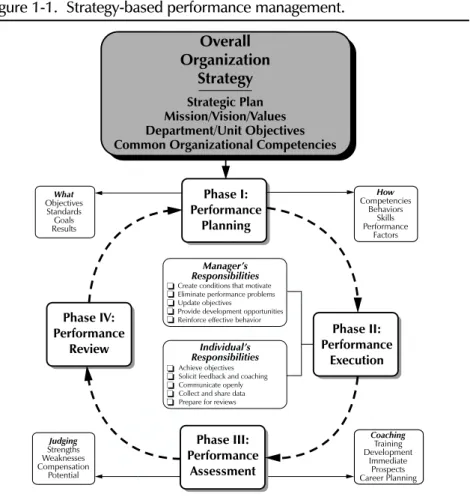
Too often, performance appraisal is seen merely as a once-a-year drill mandated by the personnel department. But in organizations that take performance appraisal seriously and use the system well, it is used as an ongoing process and not merely as an annual event. In these compa- nies, performance appraisal follows a four-phase model:
Phase 1: Performance Planning. At the beginning of the year, the manager and individual get together for a performance-planning meet- ing. In this hour-long session they discuss what the person will achieve over the next twelve months (the key responsibilities of the person’s job and the goals and projects the person will work on) and how the person will do the job (the behaviors and competencies the organization ex- pects of its members). They typically also discuss the individual’s de- velopment plans.
Phase 2: Performance Execution.Over the course of the year the em- ployee works to achieve the goals, objectives, and key responsibilities of the job. The manager provides coaching and feedback to the individ-
1
ual to increase the probability of success. He creates the conditions that motivate and resolves any performance problems that arise. Midway through the year—perhaps even more frequently—they meet to review the individual’s performance thus far against the plans and goals that they discussed in the performance-planning meeting.
Phase 3: Performance Assessment. As the time for the formal per- formance appraisal nears, the manager reflects on how well the subor- dinate has performed over the course of the year, assembles the various forms and paperwork that the organization provides to make this as- sessment, and fills them out. The manager may also recommend a change in the individual’s compensation based on the quality of the individual’s work. The completed assessment form is usually reviewed and approved by the appraiser’s boss. Others—perhaps the department head or the compensation manager—may also review and approve the assessment.
Phase 4: Performance Review. The manager and the subordinate meet, usually for about an hour. They review the appraisal form that the manager has written and talk about how well the person performed over the past twelve months. At the end of the review meeting they set a date to meet again to hold a performance-planning discussion for the next twelve months, at which point the performance management process starts anew.
Of course there may be many individual variations on the basic theme, but most sophisticated companies generally follow this four- phase process. Figure 1-1 illustrates the basic four-phase process.
1.2 Where did performance appraisals come from?
There are early references to performance appraisal in America going back over a hundred years. The federal Civil Service Commission’s merit rating system was in place in 1887. Lord & Taylor introduced performance appraisal in 1914. Many companies were influenced by Frederick Taylor’s ‘‘scientific management’’ efforts of the early twenti- eth century and concocted performance appraisals.
Before World War II, however, very few organizations conducted any formal performance appraisals. A handful of companies and the military were the only ones using the procedure regularly. Most ap- praisals that were done concentrated more on an individual’s personal- ity and traits than on actual achievements against goals and formal analyses of the behaviors that produced those results.
3 The Importance of Performance Appraisal
Figure 1-1. Strategy-based performance management.
Overall Organization
Strategy
Strategic Plan Mission/Vision/Values Department/Unit Objectives Common Organizational Competencies
ObjectivesWhat Standards Goals Results
How Competencies
Behaviors Skills Performance
Factors
Coaching Training Development
Immediate Prospects Career Planning Judging
Strengths Weaknesses Compensation
Potential
Phase IV:
Performance Review
Phase I:
Performance Planning
Phase II:
Performance Execution
Phase III:
Performance Assessment
Manager’s Responsibilities Create conditions that motivate Eliminate performance problems Update objectives
Provide development opportunities Reinforce effective behavior
Achieve objectives Solicit feedback and coaching Communicate openly Collect and share data Prepare for reviews
Individual’s Responsibilities
❏❏
❏❏
❏
❏❏
❏❏
❏
Source: Grote Consulting Corporation.
Then, in the 1950s Peter Drucker’s novel idea of management by objectives (MBO) and Douglas McGregor’s bookThe Human Side of En- terprise,which introduced his notions of Theory X and Theory Y, gained a lot of attention. A few companies moved from a mere trait assessment to the development of a procedure that concentrated on goal setting and made the appraisal process a shared responsibility between the individual and the manager. From the work of Drucker and McGregor, the performance appraisal procedure has grown to the point where a huge majority of companies now have a formal appraisal system.
Tell Me More
‘‘Effective development of managers,’’ McGregor wrote in a 1957Har- vard Business Reviewarticle, ‘‘does not include coercing them (no matter
TE AM FL Y
Team-Fly
®how benevolently) into acceptance of the goals of the enterprise, nor does it mean manipulating their behavior to suit organizational needs.
Rather, it calls for creating a relationship within which a man can take responsibility for developing his own potentialities, plan for himself, and learn from putting his plans into action.’’
Drucker’s initial proposal of an MBO process to replace trait ap- praisals and McGregor’s integration of a ‘‘Theory Y’’ approach into the appraisal process produced a change in the way organizations went about assessing the contributions of their members. General Electric was singled out by McGregor as an example of a company that was using an MBO/Theory Y approach to performance appraisal. GE con- ducted a truly scientific study in the early 1960s to test the effectiveness of its annual, comprehensive appraisal approach. It found that:
Criticism has a negative effect on achievement of goals.
Praise has little effect one way of the other.
Performance improves most when specific goals are established.
Defensiveness resulting from critical appraisal produces inferior performance.
Coaching should be a day-to-day, not a once-a-year activity.
Mutual goal setting, not criticism, improves performance.
Interviews designed primarily to improve a man’s performance should not at the same time weigh his salary or promotion in the balance.
Participation by the employee in the goal-setting procedure helps produce favorable results.
These findings remain today as valid as they were when GE first devel- oped them.
Performance appraisal as a management tool spread quickly in the 1950s, when about half of 400 employers surveyed reported using appraisal systems. Today, depending on the survey, somewhere be- tween three-quarters and nine-tenths of all companies use a formal per- formance appraisal procedure.
1.3 What is the purpose of performance appraisal?
Performance appraisal serves over a dozen different organizational pur- poses:
Providing feedback to employees about their performance Determining who gets promoted
Facilitating layoff or downsizing decisions Encouraging performance improvement Motivating superior performance Setting and measuring goals Counseling poor performers
Determining compensation changes Encouraging coaching and mentoring
Supporting manpower planning or succession planning Determining individual training and development needs Determining organizational training and development needs Confirming that good hiring decisions are being made Providing legal defensibility for personnel decisions Improving overall organizational performance Tell Me More
Providing Feedback.Providing feedback is the most common justi- fication for an organization to have a performance appraisal system.
Through its performance appraisal process the individual learns ex- actly how well she did during the previous twelve months and can then use that information to improve her performance in the future. In this regard, performance appraisal serves another important purpose by making sure that the boss’s expectations are clearly communicated.
Facilitating Promotion Decisions.Almost everyone in an organization wants to get ahead. How should the company decide who gets the brass rings? Performance appraisal makes it easier for the organization to make good decisions about making sure that the most important positions are filled by the most capable individuals.
Facilitating Layoff or Downsizing Decisions. If promotions are what everybody wants, layoffs are what everybody wishes to avoid. But when economic realities force an organization to downsize, perform- ance appraisal helps make sure that the most talented individuals are retained and that only the organization’s marginal performers are cut loose.
Encouraging Performance Improvement.How can anyone improve if he doesn’t know how he’s doing right now? A good performance ap- praisal points out areas where individuals need to improve their per- formance.
Motivating Superior Performance. This is another classic reason for having a performance appraisal system. Performance appraisal helps motivate people to deliver superior performance in several ways. First, the appraisal process helps them learn just what it is that the organiza- tion considers to be ‘‘superior.’’ Second, since most people want to be seen as superior performers, a performance appraisal process provides them with a means to demonstrate that they actually are. Finally, per- formance appraisal encourages employees to avoid being stigmatized as inferior performers (or, often worse, as merely ‘‘average’’).
Setting and Measuring Goals. Goal setting has consistently been demonstrated as a management process that generates superior per- formance. The performance appraisal process is commonly used to make sure that every member of the organization sets and achieves effective goals.
Counseling Poor Performers.Not everyone meets the organization’s standards. Performance appraisal forces managers to confront those whose performance is not meeting the company’s expectations.
Determining Compensation Changes. This is another classic use of performance appraisal. Almost every organization believes in pay for performance. But how can pay decisions be made if there is no measure of performance? Performance appraisal provides the mechanism to make sure that those who do better work receive more pay.
Encouraging Coaching and Mentoring. Managers are expected to be good coaches to their team members and mentors to their prote´ge´s.
Performance appraisal identifies the areas where coaching is necessary and encourages managers to take an active coaching role.
Supporting Manpower Planning.Well-managed organizations regu- larly assess their bench strength to make sure that they have the talent in their ranks that they will need for the future. Companies need to determine who and where their most talented members are. They need to identify the departments that are rich with talent and the ones that are suffering a talent drought. Performance appraisal gives companies the tool they need to make sure they have the intellectual horsepower required for the future.
Determining Individual Training and Development Needs. If the per- formance appraisal procedure includes a requirement that individual development plans be determined and discussed, individuals can then make good decisions about the skills and competencies they need to acquire to make a greater contribution to the company. As a result, they increase their chances of promotion and lower their odds of layoff.
Determining Organizational Training and Development Needs.Would the organization be better off sending all of its managers and profes- sionals through a customer service training program or one on effective decision making? By reviewing the data from performance appraisals, training and development professionals can make good decisions about where the organization should concentrate company-wide train- ing efforts.
Validating Hiring Decisions.Is the company hiring stars, or is it fill- ing itself with trolls? Only when the performance of newly hired indi- viduals is assessed can the company learn whether it is hiring the right people.
Providing Legal Defensibility for Personnel Decisions.Almost any per- sonnel decision—termination, denial of a promotion, transfer to an- other department—can be subjected to legal scrutiny. If one of these is challenged, the company must be able to demonstrate that the decision it made was not based on the individual’s race or handicap or any other protected aspect. A solid record of performance appraisals greatly facilitates legal defensibility when a complaint about discrimi- nation is made.
Improving Overall Organizational Performance.This is the most im- portant reason for an organization to have a performance appraisal sys- tem. A performance appraisal procedure allows the organization to communicate performance expectations to every member of the team and assess exactly how well each person is doing. When everyone is clear on the expectations and knows exactly how he is performing against them, this will result in an overall improvement in organiza- tional success.
1.4 The performance management process in our organization has conflicting purposes. We use it to determine merit increases and performance
feedback for work done during the previous twelve months, to determine training needs, and as a key tool in succession planning. Can one procedure really serve all those functions well?
One of the fundamental problems with performance management is that we load one system with too many expectations.
It is very difficult for one management system to serve so many objectives well, particularly when there is pressure from managers to reduce the number of meetings required and to streamline the form to a one-page document.
Here’s a workable solution. First, communicate the importance of performance appraisal to everyone in the organization. In particular, let everyone know that the process is used as a fundamental determinant of many decisions that affect people in a very personal way. Second, review your appraisal instrument to make sure that it can provide the data the organization and appraisers need to serve all of the different purposes (realize that this may make the appraisal form more complex and comprehensive). Finally, consider using different processes and holding separate meetings to deal with each of the areas that a perform- ance management system addresses.
1.5 How many meetings should I have with an employee to talk about performance?
You should have a minimum of two meetings. You’ll hold one at the beginning of the year—the performance planning meeting—where you will talk about the important results to be achieved over the next twelve months. In this meeting you and your subordinate will review the job description, the organization’s mission and vision and values state- ments, your department’s goals, and the most important items on the performance appraisal form.
The second mandatory meeting will be at the end of the year, after you have written the appraisal and had it approved by your boss. This is the performance review meeting. You and the individual will discuss the performance appraisal, talk about the individual’s achievements over the past twelve months, review his development needs, and then plan for the next twelve months.
Besides these two mandatory meetings, however, good managers meet with their people to talk about performance on a routine and regular basis. They also conduct a formal midterm review halfway through the year.
1.6 All these meetings take too much time. Why should I spend all this time doing performance appraisal when I’ve got much better things to do?
Does performance appraisal take too long? Let’s calculate just how much time the performance management process takes. The planning
meeting lasts forty-five minutes to an hour, once a year. Writing some- body’s performance appraisal takes another hour, maybe an hour and a half. And the performance appraisal discussion takes about forty-five minutes with most people.
That’s about three hours. Add another three hours for preparation, thinking, and planning. Now you’re up to six hours per person.
There are exactly 2,000 work hours in a year (8 hours a day
⳯
5 days a week⳯
50 weeks a year⳱
2,000). Six hours therefore represents 0.3 percent of a manager’s time devoted to performance management for each employee. What ‘‘better things’’ do you have to do?Too often, the complaint about performance management taking too much time results because neither appraisers nor appraisees have a clear picture of exactly what is expected of the process and what the benefits of an effective performance management process are. Obvi- ously, if people don’t understand why they are doing something and they don’t know how to do it well, it will seem like a timewaster.
1.7 If performance appraisal is truly important, why is it the butt of so many jokes and the target of Dilbert cartoons?
There are several reasons performance appraisal doesn’t work as well as it might:
No Ownership.Too often, neither the manager nor the individual has any sense of ownership. They weren’t involved in the design or administration of the system. They frequently are not trained to use it effectively. Finally, human resources rarely asks about their reactions to and opinions of the system (and ignores any suggestions they make to improve it).
Bad News. Managers don’t like to deliver negative messages to people with whom they must work, and whom they often like on a personal basis. Employees don’t like to be told that they are not quite as good as they think they are. Negative messages generate defensive reactions and promote hostility, rather than serve as useful perform- ance feedback.
Adverse Impact. Both managers and employees know that bad reviews adversely impact a person’s career. Managers are conscious of the permanence of the paper trail that follows formal appraisal and are often hesitant to commit negative feedback to writing.
Scarce Rewards. The organization usually offers few formal re- wards for taking the process seriously and probably no informal re- wards. On the other hand, there may be many informal rewards for not delivering unpopular messages.
Personal Reflection.Managers hesitate to give unfavorable apprais- als for fear that the appearance of unsatisfactory work by a subordinate will reflect badly on the manager’s ability to select and develop subor- dinates. Lack of candor in evaluation is a way of hiding one’s dirty laundry.
EEO Terror.Managers fear that if they give an honest but unsatis- factory appraisal to a black or handicapped employee, they’ll be hauled off to court for discrimination.
Although it’s easy to poke fun at performance appraisal (and the way performance appraisal is carried out by many managers and many organizations makes it a worthy candidate for Dilbert lampoons), per- formance appraisal performs a function of enormous value to an orga- nization and to all of its members. Performance appraisal answers the questions that everyone in an organization genuinely asks: Boss, how am I doing? Is my work satisfactory? Do I have a bright future here?
1.8 W. Edwards Deming, the quality guru, said that performance appraisals were an
organizational evil that should be abolished. Was he wrong?
Yes. Deming and others in the quality movement correctly noted that individuals are rarely the responsible parties when quality problems arise. More frequently, poor quality is a function of system breakdowns and bad processes, not individual failures. Deming urged organiza- tions to concentrate on system problems and not human problems.
That approach may work well for operations management, but it leads to seriously defective people management procedures.
Tell Me More
Deming made a simple observation: All processes and operations are either within tolerance or they are out of tolerance in a positive or nega- tive direction. That same principle is the one under which performance
appraisal operates. An individual’s performance is either that which the organization expects, or it varies in a positive way and exceeds expectations, or it varies in a negative way and fails to meet expecta- tions. Performance appraisal is simply the application of a central idea of the quality movement to the human dimension.
But there is a flaw in applying quality principles to human per- formance. Quality experts operate on the basis that if operations are performing properly and according to standard, they should be left alone. Attention should be concentrated only on those aspects that vary from the norm. If this notion is applied to human performance, the great majority of workers in an organization will be ignored by the organization because their performance is not out of whack in either a positive or negative direction.
To ensure high quality of products and processes, it may be impor- tant to let alone things that are operating properly and concentrate on the exceptions. In managing human performance that approach is a serious mistake. One of the most frequent complaints people have of their organizations is that they get little attention when they do what is expected. Only when they truly excel (which, for most people, is rare) or completely screw up (which also is rare) do they get any attention from the boss.
Performance appraisal forces managers and organizations to focus on the fact that the great majority of employees are doing exactly what the organization expects of them and that the company recognizes and reinforces their contributions.
1.9 Even if they try to be objective, managers can’t help but discriminate on the basis of race, sex, age, and other illegal considerations. Isn’t performance appraisal actually a very biased process?
No. While many people believe that managers discriminate, either de- liberately or unconsciously, in their appraisal ratings, research on per- formance appraisal indicates that performance ratings are remarkably bias-free.
Tell Me More
In a major research project published in Psychological Bulletin, Frank Landy and James Farr reviewed all of the research that had been con-
ducted over a thirty-year period on performance ratings. They studied every aspect of performance ratings: the effect of different rating for- mats and the influence of varying rater and ratee characteristics.
What part did age and sex and race and education play? Here’s what they found:
Sex.‘‘In the majority of studies, there has been no consistent effect of rater sex on ratings obtained in various contexts.’’ In other words, men are neither tougher nor more lenient than women. Nor do men rate women more gently or strictly than they do other men, or vice versa. Sex appears to be irrelevant.
Race.They were able to find one study in which supervisory raters gave higher ratings to subordinates of their own race than to subordi- nates of a different race. But that study also indicated that the differ- ence in ratings was only on the order of 2 percent—more important to the statistician or academician than to the line manager or human resources professional. As far as peer ratings, the research shows that race has no effect.
Age.Two different studies explored whether age made any differ- ence. One study found that younger supervisors were less lenient than older ones; the other found no difference at all.
Education. Only one study indicated that the supervisor’s educa- tion level has any effect on how supervisors rated subordinates. The raters concluded that rater education was of no practical importance.
The Landy and Farr report did repudiate one universally accepted piece of folk wisdom—that peers are tougher on each other than bosses are. Peers are not tougher than bosses, they discovered. Three different studies reported that supervisors were less lenient in their ratings than were the peers of the ratee. Two other studies also found that supervi- sors were more consistent in their ratings than were peers.
Performance appraisal is not inherently discriminatory. There are several reasons for inaccurate accusations of discrimination. First, con- sider an organization whose managers have not done a very good job of telling people the truth about their performance over the years. A new manager with tougher standards and a greater willingness to tell people about their shortcomings takes over the work group. Now peo- ple who for years have been rated as fully acceptable will be evaluated as unacceptable. Unwilling to accept this new and more realistic evalu- ation of their contributions, the poor performers will raise the discrimi- nation flag.
13 The Importance of Performance Appraisal
Second, people in general have higher opinions of their perform- ance than is warranted. The person who receives a ‘‘marginal’’ rating may interpret a poor review as a function of the appraiser’s bias rather than her own poor performance.
Third, some people who are protected by reason of race, sex, or national origin will use that as a shield to avoid working hard and producing results. They figure that they can scare weak managers into giving them an inflated review by threatening legal action if the boss tells the truth about them. Too often, unfortunately, they’re correct.
1.10 What are the legal requirements for a performance appraisal system?
First, there is no legal requirement that a company must have a per- formance appraisal system. No law compels an organization to review the performance of its members, just as no law requires a company to produce annual budgets or provide good customer service. Conducting performance reviews, creating budgets, and giving good service are simply accepted management practices and very good ideas.
If a company does choose to have a performance appraisal system, it must be sure that the system complies with the laws. In the eyes of the law a performance appraisal is an employment test. It is thus scrutinized in a manner similar to that of other aspects of the employ- ment process: initial recruitment, selection and hiring, promotion, com- pensation, and termination. As a result, the legal requirements for performance appraisal systems are similar to those for other selection tests.
1.11 How do I make sure that our performance appraisal system is legally defensible?
No appraisal system is immune to legal challenge. Nonetheless, the risk of legal difficulties can be minimized if seven basic good management practices are followed.
1. Base the performance appraisal on an analysis of the job.
2. Define your performance dimensions in behavioral terms and support assessments with observable, objective evidence.
3. Keep things simple.
TE AM FL Y
Team-Fly
®4. Monitor and audit for discrimination.
5. Train raters to assess performance accurately and to conduct effective appraisal discussions.
6. Provide for upper-management review before the appraisal is reviewed with the individual.
7. Provide some appeal mechanism.
Tell Me More
Base the performance appraisal on an analysis of the job. Courts are skeptical of subjective, trait-based rating systems for two reasons: They leave an enormous amount of room for the biases of raters to influence the outcomes, and they are not directly related to specific job responsi- bilities. Organizations, however, are not required to conduct exhaustive analyses of each job in the company as a condition of doing perfor- mance appraisal. A job analysis can be built directly into the appraisal process itself.
When an individual and manager discuss the important goals and objectives that the individual will address during the course of the year and against which his performance will be appraised, that’s a job analy- sis. If a manager evaluates the specific behaviors and expected conduct and demeanor required to perform according to the company’s expec- tations, and then discusses these expectations and their importance with each subordinate, that’s a job analysis.
When a supervisor and subordinate together determine what re- sults the subordinate should concentrate on producing over the upcom- ing year, and they also discuss how the subordinate will go about generating those results—the behaviors and competencies that must be demonstrated—a legitimate job analysis has been conducted.
Define your performance dimensions in behavioral terms and support assessments with observable, objective evidence.Not every job is amenable to results-based, quantitative measurement. For many jobs, success de- pends on such attributes as cooperation, dependability, customer rela- tions, attitude, and other even more abstract attributes.
Are these attributes important? Of course—no one would argue that they are not critically important. Who would want an employee who is uncooperative, undependable, hostile with customers, and surly toward everyone else? Can they be measured and described? Of course they can. The challenge comes in finding a way to measure and evalu- ate these critical but intangible attributes.
Completely quantifiable measures of performance do not always
exist. If they did, everyone would use them. In fact, if there were com- plete numerical measures for every aspect of every job, performance appraisal systems themselves would probably not be necessary—the data would speak for themselves. But with most jobs, there are few absolutely direct and impartial measures of an individual’s perfor- mance, particularly when successful performance is less dependent on performing countable acts than it is on such vital but elusive responsi- bilities as the ability to recognize and take advantage of opportunities, the ability to build a committed work team, or the ability to recognize obstacles before they become serious interferences.
The answer is to describe the performance in behavioral terms.
Write a description of what a master performer in each of these areas would be likely to do. Provide this description to the appraiser and ask the appraiser to assess how often the individual performed in the way described.
By changing the rating scale to eliminate the requirement that raters evaluate the goodness or badness of performance (e.g., unsatis- factory/fair/competent/superior) and replacing it with a scale that re- flects how often the individual performs as a true master might (e.g., rarely/sometimes/frequently/always), the organization reduces the possibility of legal challenge and increase the ability of the rater to conduct a more meaningful discussion.
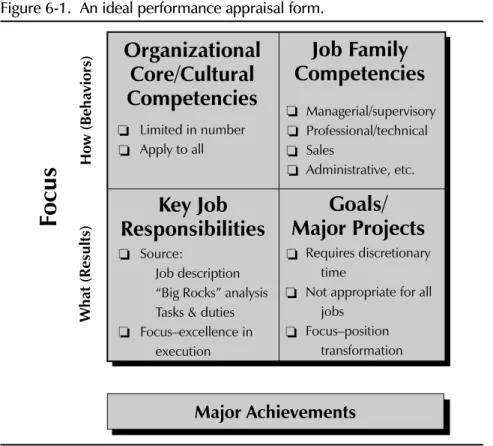
Keep things simple.Complex forms that attempt to provide a total and complete evaluation of every aspect of the individual’s perform- ance only frustrate managers and allow their biases to overcome their objectivity. The ideal performance appraisal form (discussed in detail in Chapter 6) asks the appraiser to evaluate the individual in five areas:
1. Organizational Core Competencies.These are the skills, attributes, traits, or behaviors that are expected of everyone in the organization, regardless of job or organizational level. ‘‘Ethics and integrity’’ and
‘‘customer focus’’ might be core competencies that everyone in the company will be expected to demonstrate.
2. Job Family Competencies.These are the competencies that apply to major job families. ‘‘Job family’’ is a convenient way to think about groupings of individual jobs that share characteristics. Some typical job families are managerial/supervisor, sales, professional/technical, and operations. ‘‘Planning and organizing’’ and ‘‘conceptual thinking’’
might be competencies assessed of everyone whose job is in the profes- sional/technical job family, whereas ‘‘safety’’ may only show up on the form used for employees whose job falls into the operations job family.
3. Key Job Responsibilities. These are the major responsibilities or duties of the individual’s position. An ideal job description would spec- ify exactly what the key job responsibilities are.
4. Projects and Goals. These are the individual’s activities that go beyond the specific tasks and duties outlined in a job description.
5. Major Achievements.Every performance appraisal form should require the manager to identify a small number of major accomplish- ments of the individual over the course of the year.
Monitor and audit for discrimination.Two areas need to be monitored to make sure that the organization faces the least amount of risk from legal challenge: first, the company’s performance appraisal procedures themselves; second, the personnel decisions that are based on perform- ance appraisal data.
The first area involves determining whether the average appraisal results of members of a protected class are significantly different from the results of the majority. However, if a complete statistical analysis of a large organization were made, it’s unlikely that there would be no departments or other organizational units where the average evaluation of one group of employees (e.g., black female employees) was not sig- nificantly lower than the average rating given another group of em- ployees (e.g., white males). Does this mean that the company is discriminating against black females in favor of white males? No. These are normal and expected variations. Even if the average appraisal re- sults of a protected class are significantly different from those of the majority, it does not follow that the appraisals are biased or that the appraisal system is automatically illegal.
Hot Tip
If the company’s performance appraisal system ends up with the assignment of each individual to a specific rating category (e.g., marginal, fair, compe- tent, superior, and distinguished), an analysis should be made to determine whether there is any significant difference in the ratings given to minority group members versus the ratings of organization members as a whole.
The second area to monitor is the way decisions that are based on performance appraisal are made. In addition to making sure that the performance appraisals themselves are not discriminatory, it is equally
important to make sure that personnel decisions that are based on data that the appraisals provide—compensation, promotion, selection for special training programs, termination—are also nondiscriminatory.
Monitoring and auditing cannot solve problems. They can bring troublesome situations to light. Once the organization knows where it stands, corrective action can be taken where the need is greatest.
Train raters to assess performance accurately and to conduct effective appraisal discussions. Ideally, every organization should conduct a for- mal and comprehensive training program that all managers are re- quired to attend as a precondition for their conducting performance appraisals. They should also conduct annual refresher training for all appraisers just before they begin the annual task of assessing perform- ance and discussing the results.
In the absence of this ideal, virtually every organization can afford to conduct a one-hour briefing session to help raters carry out their responsibility with some minimal degree of confidence. Just providing this minimal level of training alone, in addition to the actual benefits it provides in assuring more accurate appraisals, also is useful in case the organization is charged with discrimination growing out of perform- ance appraisal.
Even if training raters is not possible at all, there is probably no reason why raters cannot be provided with a page or two of instruc- tions covering the most important aspects of the performance evalua- tion process with some basic suggestions for discussing performance reviews that will reduce the organization’s exposure to legal challenge.
At a minimum, all appraisers need to be told to:
Be prepared to provide specific examples to support perfor- mance ratings, particularly those where the employee is rated as less than satisfactory.
Avoid any discussion that refers to a person’s membership in a protected group.
Maintain rapport and a positive atmosphere during the discus- sion, even when discussing problem areas and the consequences of failure to improve. Many discrimination complaints result not from direct acts of discriminating but from an individual’s belief that he was treated unfairly or caught off guard by an unexpect- edly low rating that was not fully explained and justified.
Finally, just giving appraisers a few examples of well-completed appraisal forms can increase their ability to do a good job.
Provide for upper-management review before the appraisal is discussed with the individual.Most organizations require the manager who com- pletes the appraisal form to have it reviewed and approved by his boss before it is given to the employee. This is a good idea. Managers who might be capricious or arbitrary (let alone directly discriminatory) in their appraisal assessments may tend to be a tad more cautious know- ing that their direct supervisor must review and approve what they have written first.
Upper managers should be encouraged to do more than rubber- stamp the appraisals that are sent up to them for review. Most of the time, senior managers have a reasonably good idea of the overall qual- ity of performance of the people in their department, even though the individuals may be two or three organizational levels down. If the vice president who’s reviewing a bunch of performance appraisals simply takes one appraisal and says to the appraiser, ‘‘I was surprised to see that you ended up rating Patty as superior (or distinguished or un- satisfactory). Tell me about how you came up with that rating,’’ this question alone will encourage increased diligence in performance as- sessment in the future.
Provide some appeal mechanism.Today, virtually every employee of every organization has an appeal mechanism he can use to contest a perceived unfair appraisal—the legal system. Since employees do in fact have a way to challenge unfair appraisals, providing them with an internal means to appeal what they believe to be an unfair performance appraisal without having to go outside the organization can be a cheap form of insurance against unnecessary lawsuits.
One immediate appeal mechanism simply involves allowing the individual who believes himself to be the victim of an inaccurate ap- praisal to state his side of the story as a formal part of the record. Most appraisal forms contain a space for employee comments. Employees should be encouraged to use it.
Hot Tip
If the employee wants to submit a statement to be appended to the ap- praisal to provide a counterbalancing argument to assessments made in the formal appraisal itself, don’t deny the person the right to do so. Frequently serious problems can be headed off completely if the manager says, ‘‘I’m sorry we don’t see eye to eye about this, Jack, even though we’ve now discussed it in some detail. While I won’t change the way I have written
your appraisal, I certainly want to encourage you to write a statement to be attached to my appraisal if you genuinely feel that what I have written is not correct.’’
1.12 Is performance appraisal really necessary?
Can’t the benefits that the system provides to organizations and the people in them be obtained any other way?
Yes, performance appraisal is really necessary. And, no, there is no bet- ter way to obtain the benefits.
There are several books that argue in favor of abolishing perform- ance appraisals altogether. But the procedures they recommend are merely workarounds; the steps they recommend to create an alternative to performance appraisal are the same ones that any effective organiza- tion will use to develop a world-class performance appraisal system.
Too many companies remain in denial about the benefits that a well-executed performance management system generates. They may articulate the importance of transforming their stale, best-effort culture into a tough-minded, results-driven one, but fail to understand that performance appraisal is the best tool available for muscle-building an organization.
Tell Me More
Some companies do appreciate just what a well-designed, forcefully managed performance management system can do to ensure the execu- tion of organizational strategy. In 1999 I agreed to serve as the subject matter expert for a national benchmarking study of best practices in performance management that the American Productivity & Quality Center (APQC) and Linkage, Inc. were undertaking. My first task was to identify those companies that were in fact doing stellar work in per- formance appraisal, and then convince them to share their processes and techniques with the seventeen sponsor organizations that were po- nying up $16,000 each to learn their secrets.
Identifying the companies that are performance management mas- ters wasn’t that difficult. But convincing them to reveal what they were doing? A different story. Several flatly refused. Many of America’s
most-admired companies just said no when offered the chance to be recognized as best-practice models in performance management.
Each one gave the same reason for declining to share their forms and procedures. They saw their performance management processes as a genuine source of competitive advantage and were unwilling to let any outsider peek. One human resources vice president put it bluntly when he turned me down: ‘‘We would no more show our performance appraisal form to a bunch of outsiders than The Coca-Cola Company would let you come in and look over the secret formula for Coke.’’
Organizations with world-class performance management sys- tems do things that the also-rans don’t. They insist that all managers maintain consistent, demanding standards for everyone—and they keep raising those standards. They work relentlessly to identify their highest potential managers and professionals and develop them quickly. They move marginal performers aside so they don’t block the path of talent; they eliminate noncontributors swiftly. They treat their human resources departments as partners, staff them with the highest caliber talent available, and insist that they be active agents for change.
The best organizations create performance management systems that are (as Einstein said the solution to any problem should be) as simple as possible—but no simpler. They decide exactly what perform- ance they want to encourage and what performance they want to purge. They identify the competencies that are core to the organiza- tion’s overall success and demand that everybody be held accountable for performing like a master. They willingly tolerate complex, multi- page forms and a process that demands frequent mee