Nancy Evangelista for her reflections, analysis, and incisive questions that helped me strengthen this project. She showed faith in my clinical skills early in my graduate career and helped me find or create opportunities to advance those skills. Also, I greatly appreciate his willingness to accompany me to a week-long summer course on Hierarchical Linear Modeling.
Introduction
How parental involvement in schools varies by level of family attainment. What is the relationship between parental involvement in school levels and the level of parental support. How parental involvement at home varies according to the level of family outreach by the school.
Review of the Relevant
Factor loadings for exploratory factor analysis with Varimax rotation of school-scale parental involvement. This result indicates that approx. 17% of the difference in parental involvement in schools is between schools. The results of the parent-level model indicate that SES, family type, race, and English proficiency are significant predictors of parental involvement in schools.
The calculation of the Δ r2 shows that 49% of the between-school variance in parental involvement in schools is explained by Level 2 variables. Results from the parent-level model indicate that SES and minority status are significant predictors of parental involvement in schools. The calculation of the Δ r2 shows that 0.2% of the between-school variance in parental involvement in schools is explained by level 2 variables.
Specifically, parental SES was found to be associated with parental involvement in schools and involvement in home education. This study provided a unique perspective on parental involvement in schools and at home through study. Adding a third level to this model could explain a larger amount of variance in parental involvement in schools and involvement in home education.
School programs and teacher practices for parent involvement in inner-city elementary and middle schools. School programs and teacher practices for parent involvement in inner-city elementary and middle schools. Testing a model for the organizational prerequisites for parental involvement and satisfaction with public education.
Method and Procedures
Variables
An exploratory factor analysis using a varimax rotation was conducted to examine the underlying component structure of the parent involvement items. Factor analysis on each respective scale resulted in the extraction of a single factor for parental school involvement and a single factor for homeschooling involvement. Parental involvement in school was measured by asking parents about their participation in various activities (contacted the school, attended an open house or back-to-school evening, attended a PTA/PTO meeting, attended a parent-teacher conference, attended a meeting). school or class event, volunteered and participated in fundraising).
The underlying structure of parental involvement in school questions was examined using an exploratory factor analysis with a varimax rotation. Creating the scale by using an average of the items instead of the sum of missing data in the sample. The Home Environment and Cognitive Stimulation section of the Parent Interview Questionnaire contained items measuring that of the parents.
I recoded these items to correspond to parent involvement in schools scale. As shown in Table 6, exploratory factor analysis using a varimax rotation determined that the home education engagement scale items loaded on a single factor that explained 42.3% of the variance in the data. Again, using the mean to represent parental involvement in the home count accounted for any missing data.
The creators of the ECLS-K dataset constructed continuous and categorical SES composite variables from a series of questions from the parent interview.
Variables
I originally conceptualized measures of school policies and practices related to inclusion as fitting into two categories: family outreach and parents. Family notification Please indicate how often your school provides activities that follow each other. Support for parents Does your school offer any of the following programs or services for parents and families?
I excluded the item that measured the frequency of "written reports (report cards) about the child's performance sent home" because of the lack of variability in responses. Similarly, I eliminated the measure of offering "fairs or social events to raise funds for the school" because it seemed too similar to the measure of frequency of "school performances." Applying exploratory factor analysis with varimax rotation to these data revealed 3 primary ones. Factor loadings for exploratory factor analysis with Varimax rotation of family outreach and parental support.
The first component extracted from the factor analysis consisted of questions about whether the school offered parent education programs, adult literacy classes, family literacy classes, and health social services. The second component extracted from the factor analysis included questions regarding the frequency of PTA meetings, parent-teacher conferences, home visits, invitations to school events, parent workshops, and invitations to classroom programs. Chronbach's alpha coefficient for this scale was .588 and improved to .602 by excluding the question about the frequency of PTA meetings.
I determined that the frequency of PTA meetings would be kept separate from the degree of family contact.
Background Variables
It was necessary to find a proxy measure of SES for private schools to avoid the loss of a significant number of cases. I found that all private schools could be categorized as high SES, as only 11.1% of parents of children in private schools were considered low SES. I further tested this possibility by conducting a one-way between subjects Analysis of Variance (ANOVA) of parental SES in low-SES public schools, high-SES public schools, and private schools.
Specifically, C4PW0 is a weight created for use with the fourth wave of the parent interview in the spring with Grade 1 data as specified in the ECLS-K User's Manual. HLM takes into account the hierarchical structure of the data by deriving coefficients (beta) from all group units. A separate analysis was performed for each outcome variable (parental involvement in schools or involvement in home education).
Level one of the HLM model is an estimate of the effects within the school and is also called the partial conditional model. Within-school effects are the characteristics of the individual students and their families that are associated with the dependent variables. The third and final step of this two-level HLM analysis was to estimate the effect of school on parent involvement.
The second level is also called the fully conditional model and is an examination of the dependent variable (already adjusted for the individual school characteristics in the Level 1 model) as a function of school-level characteristics.
Results
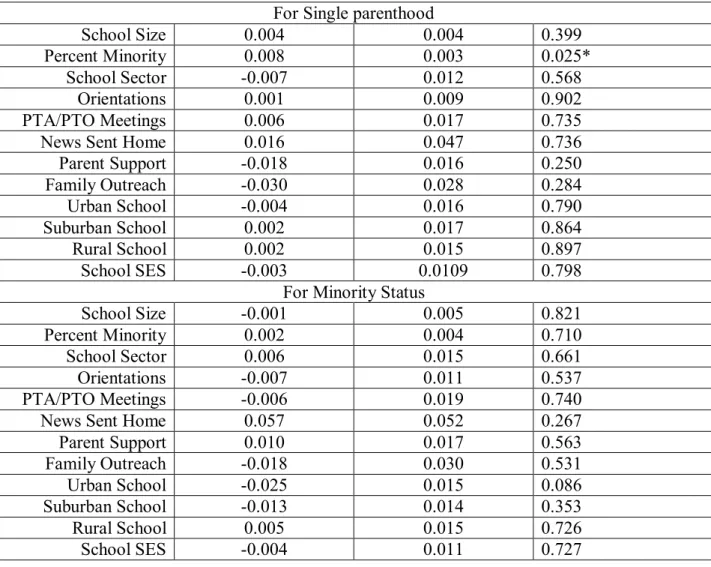
The Level 1 or partially conditional model includes socioeconomic status (SES), minority status, English proficiency, and single parent status as predictors of parental school involvement. On average, parental involvement in schools is significantly and positively related to parental SES (γ = .101 p = <.001). One unit increase in SES is associated with a gain of 0.101 in the level of parental involvement in schools.
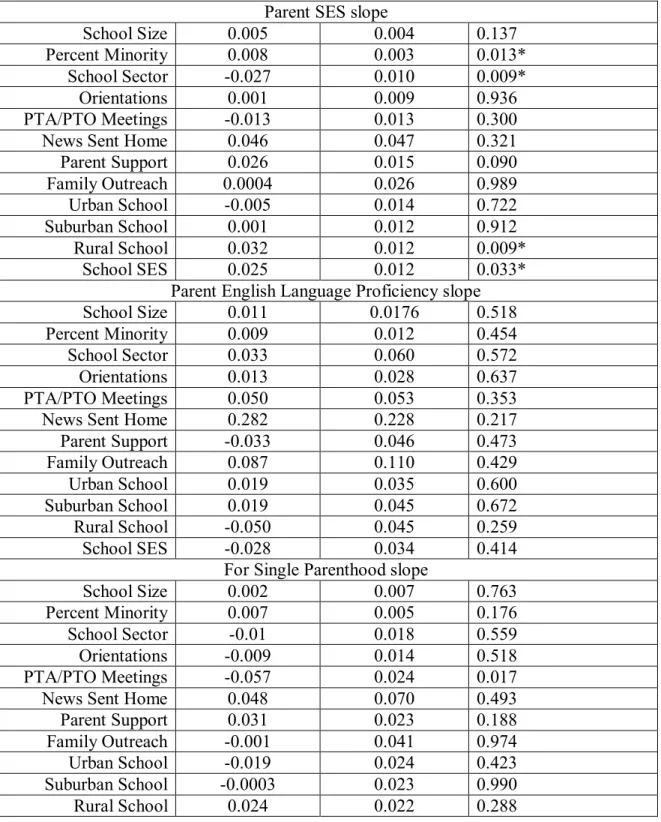
This result indicates that single parents reported 0.041 lower scores on parental involvement in schools. Taken as a whole, these findings suggest that parent-level variables accounted for approximately 16% of the within-school variance in parental involvement in schools. This result suggests that SES in schools with a higher percentage of minorities has a greater impact on parental involvement in schools.
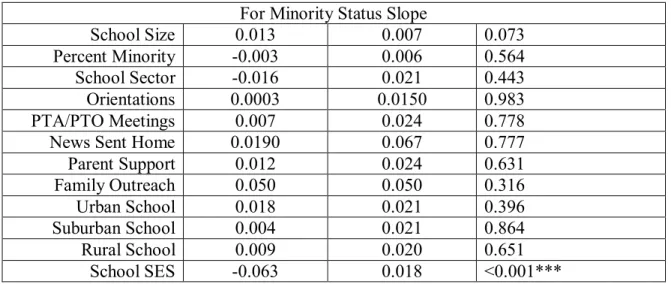
This relationship suggests that parental SES has a stronger association with parental involvement in public schools. In schools with larger differences in overall school SES, the SES of individual parents had a greater influence on parental involvement in schools. This result suggests that for minority parents, school SES has a greater impact on parental involvement in schools.
This relationship indicates that parental SES had a stronger relationship with parents' home educational involvement in private life.
Discussion
The relationship between the measure of parental involvement in schools and the measure of parental support and offering parent orientation programs was not significant, even after. Parents' minority status was positively associated with parental involvement in schools and home education involvement, meaning that non-minority (white) parents reported more. The relationship between parental involvement in schools and single parent status was negative, meaning that single parents showed significantly less involvement in schools than married parents.
SES has the greatest influence on parent involvement in schools and homeschooling involvement in schools with a higher percentage of minorities. The results of the current study have important implications for educational policy and efforts to improve the level of parental involvement in schools. The school policies and practices examined in this particular study were not found to increase the level of parental involvement in the school and home environment.
The practices examined in this study are largely used in US schools; however, they were not found to have a significant effect on parental involvement in school or on homeschooling involvement. This idea is supported by the fact that there have been significant changes in parental involvement in schools. In addition, it would have been helpful if parental involvement in school questions more closely reflected the parent support and family involvement measures from the principal's questionnaire.
It is necessary to continue to investigate the effects of school-level characteristics on parental involvement in school and on homeschooling involvement. The results of this study demonstrate the importance of conceptualizing parental involvement in their children's schooling as a multidimensional construct. It appears that parents exhibit different behavioral patterns when it comes to involvement in education at home and parental involvement at school.