107
■PREPARING YOUR EMAIL MARKETING STRATEGY
6
Preparing Your Email Marketing Strategy
Now is the time to kick off the most fun, frustrat- ing, and rewarding experience you can have: cre- ating your email campaign. This chapter and the next three form a calendar, guiding you through the details that will make you the best at your newfound craft. In this fi rst month, you will lay the foundation for your campaign efforts. These are the most critical areas to build in the right way, because they will drive the success of anything else you do in your email campaign.
Chapter Contents
Week 1: Preparing Your Resource Arsenal Week 2: Building the Blueprint for Success Week 3: Counting Down to “Go Time”
Week 4: Testing Your Way to the First Campaign
108
CHAPTER 6:PREPARING YOUR EMAIL MARKETING STRATEGY ■
dive into the strategy and content creation.
Over the years, the best way we have found to manage this process effectively is to create a comprehensive resource arsenal, which includes at a minimum the following items:
Checklists Many kinds of checklists exist: general, strategic, creative, technical, and assessment. See Appendix B for some of our favorite checklists created by the Email Experience Council.
Technology These include the hardware and software (onsite or via an ESP) for delivery, database, analysis, and best practice validation. See Chapter 5 for details.
Research Make sure you are armed with historical and benchmarking statistics, trends, compliance-related information and insights, and even competitive knowledge.
Creative Creative checklists include lists of what your competitors are doing, including sending frequency, their creative design, best practices for templates (which are covered in Chapter 7), and the best strategies for designing for people who are reading emails on the go (these are discussed in Chapter 8).
Strategy Resource Sites and Blogs These can keep you up-to-date on the latest research, give you fodder regarding a best practices debate, or even give you an outlet to ask an expert a question or two. See Appendix A for some of our favorite sites.
Case Studies Throughout the book you’ll find case studies that enable you to learn first- hand from the experience of others about what works and what could be done better.
The focus of this week is to gather all the elements needed for your resource arsenal and then build the argument to get those elements funded that have an associ- ated cost. Each day, you can spend one hour on a critical initiative that will send you on a trip to the bank Friday afternoon with that signed check:
Monday: Getting smart
Tuesday: Evaluating tools and resources Wednesday: Budgeting
Thursday: Related marketing initiatives Friday: Getting the boss to sign the check
109
■WEEK 1: PREPARING YOUR RESOURCE ARSENAL
Wr i t e T h i s D o w n:
It is estimated that more than 500,000 individuals per week access “self-help”websites and online resources relating to email campaign design, development, and execution.
Googling email marketing help generates hundreds of results pertaining to where people can piece together guid- ance. The challenge with this is, Who has time to sort through all those entries?
Searching for help when you are in a panicked or rushed mode will make you frustrated. Many times, the authors of this book have actually sifted through a number of these web pages only to find statistics that are undated, out- dated, or even inaccurate. This is not the type of experience you need when beginning your emailing efforts.
Monday: Getting Smart (the Seven Essential Truths About Email Marketing)
Getting smart about email marketing doesn’t mean knowing all the answers. It means knowing what makes email marketing work and what type of resources you need to build something effective. A rule known as the chunking principle states that the mind can retain no more than seven items of information without memory loss. Because we want you to retain most of what you read, we have decided to condense what you need to know about email marketing into seven key truths. These are facts you should post on a wall somewhere. As you delve into email marketing, you will be challenged to remember these truths. So please, use today’s hour wisely and keep this section handy.
Truth 1: Email Has Evolved into a Cornerstone of Our Lives
Omniture reports that more than 21 trillion emails were sent in the United States in 2007. These were, by no means, all marketing-based messages. One of the key truths about email you need to retain is that email marketing is just one small facet of a stan- dard person’s “email life”. People use email today for many purposes, both personal and business. In many cases, the use of email is less about reading marketing messages and more about the improved facilitation of life.
And let’s just put the argument to bed right now that only people of a certain age use email—it is just not true. In 2007, eMarketer surveyed the use of online access by various age ranges, and Table 6.1 shows the results.
씰Table 6.1 Selected Weekly Online Activities of U.S. Internet Users, by Age Millennials
(13–24)
Generation X (25–41)
Baby Boomers (42–60)
Matures (61–75) Watching and reading personal
content created by others
71% 56% 40% 36%
Reading and posting on message boards
51% 43% 29% 22%
Socializing 62% 41% 25% 18%
Participating in a discussion forum 34% 33% 24% 19%
Source: eMarketer
110
CHAPTER 6:PREPARING YOUR EMAIL MARKETING STRATEGY ■
sion of personal and life-related communications. This will ensure that your design efforts consistently create a strong brand impact and a sense of personalized loyalty and interest among your readers.
Truth 2: Email Marketing Best Practices Change, All the Time
This is one truth that will help you maintain an edge over your competition. Think about it: When email marketing fi rst started, the world was a different place. Email marketing was new, list growth was simple, spam was a type of meat, and the best practices written at the time did a great job of covering what to do in that environ- ment. By about four years ago, the volume of spam changed best practices in our indus- try, and the CAN-SPAM legislation discussed in Chapter 5 was enacted in response to email’s evolution. Best practices changed for creative, list growth, and delivery. Even as recently as early 2008, changes in the way that email unsubscribes are handled were introduced to ensure that the perception of email marketing remains positive.
What this means to you is that you must always look at the dates of research, case studies, and best practices and hold them up to the standards of the current day’s trends.
Truth 3: Any Type of Messaging Done Electronically Is Email Marketing
Even today, there is still a perception that email marketing is one channel, mobile mar- keting a second, RSS a third, and even social networking a fourth. In these instances, many companies treat these as separate marketing channels. In today’s online world, it is becoming increasingly diffi cult to keep these channels separate because they each act as drivers to the other.
Well, we have news for you! Any message sent electronically is considered email marketing.
Why is this a truth you need to know? It’s because the lines among these types of messaging channels will continue to blur as time goes on, and soon the world will rely on “personal messaging” regardless of the location or the device. These media are all driven through Internet channels and require permission and selection of mes- sage interests/types. This means everything you are thinking about for email will also become critical to future messaging strategies for your company. As the famous phi- losopher Yoda once said, “Choose wisely you must.”
111
■WEEK 1: PREPARING YOUR RESOURCE ARSENAL
Truth 4: Email Addresses Mean Money; Don’t Ignore Your Non-responders
We recently heard a speaker at an email conference ask the audience this question:
“Who here invests in increasing the delivery rate of their emails?” Almost 90 percent of the hands went up. He then asked another question: “Who here spends money to acquire new customers?” Again, 90 percent of the hands went up. And then he asked this: “Who here builds programs to monitor and target those people who provide you their email address but never respond to an email you send versus just removing them from your list after a certain time?”
After the crickets stopped chirping, he went on to explain that his company’s research has indicated that less than 50 percent of a list will ever respond to email campaigns. And research that Jeanniey has done shows that even if someone on your list is not responsive, once they have provided an email address, they will purchase 150 percent more than those who shop at your company but do not opt in.
This means your list value has expanded. It is worth more than just the opens and clicks it drives. You should always plan to evaluate the purchase or response power that people on your list provide through all channels to identify their value.
Truth 5: This Is Not “The Farmer in the Dell”
Remember that grade-school song? The last line is, “The cheese stands alone.” That’s not a smart attitude for email marketing. Many people in marketing assume that email marketing is similar to the “cheese” in this song—a stand-alone messaging chan- nel that drives revenue and strengthens relationships. The truth is, elements of email marketing live in every aspect of our messaging world. Forms sit on websites, capture points happen both online and offl ine, banners drive to landing pages with forms, and searches drive to deep pages that encourage engagement.
If email stood alone, none of these would be relevant. But for successful email marketing, you cannot afford not to think about all the touch points of your email marketing campaign.
Truth 6: Technology Partners Often Act Like Military Members
In the Chapter 3 analysis of email marketing technology, you saw that vendors can be tremendously helpful partners. That said, it has often been our experience that technol- ogy partners can easily slip into a “don’t ask, don’t tell” mentality. Many times, these partners wait for you to ask for a service, feature, or support effort before they provide it to you. The problem with that is that if you don’t know what you are missing, you don’t know what to request. It is for this reason that we encourage you to read the case studies on technology partners’ sites—not just your own technology partner but the top ten technology partners. By doing so, you will be able to see, in context, what types of services and features you should and could be getting out of your partner.
112
CHAPTER 6:PREPARING YOUR EMAIL MARKETING STRATEGY ■
do from your successes. In most cases, the best mistakes you make are not planned.
When you don’t have productive mistakes to learn from, ignoring the rules and trying something crazy to see how it fl ies can work pretty well, too. We certainly don’t mean to imply that you should ignore the law. You defi nitely shouldn’t. But, you should think of new ways to share emails and try them with a sample of your database.
Some of the most successful “rule-breaking campaigns” of the past have included the following:
C
• reating an email that scrolls sideways S
• haring an “unsubscribe” confirmation landing page that offers ways to opt back in
P
• osting a call to opt in at the end of a video on YouTube S
• ending an email with a blank subject line
Now that you know the seven truths of email, you can use them to evaluate your tools and resources.
Tuesday: Evaluating Tools and Resources
On this second day, we are going to continue having fun by getting all our tools and resources together. Whether this is your fi rst time creating an email marketing plan or you are a veteran, you have our guarantee that you will take away something useful from this section.
A sound email strategy presents new opportunities for overall business improve- ment by putting into place tools and processes that can solve current performance problems and open new avenues to bolster sales and customer satisfaction.
Before selecting or even evaluating new technology solutions, an organization should start by determining the overall objective and scope of their email program, then identifying current problems and obstacles to meeting this objective, and fi nally creating an inventory of current resources. Once a company has a clear understanding of what it wants to achieve, what’s keeping it from getting there, and what is already in place, then it can develop an evaluation and selection plan to fi nd the solution and defi ne the processes to fulfi ll its email strategy. You can use our handy quiz to help determine what your areas of focus should be.
113
■WEEK 1: PREPARING YOUR RESOURCE ARSENAL
The Naked Truth About Email
This is a true story. For privacy reasons (and other reasons you will read about), the names have all been left out or changed.
Company A called its email marketing vendor and requested that its account manager help them create a very special video email. The video would be coming from the CEO of the global organi- zation and share critical news and insights about recent changes.
Everything was moving along just fine. The CEO’s video was shot, edited, and uploaded into the email shell. A subject line was suggested: “An Important Video Message from the CEO: Recent Changes.” Both the vendor and Company A understood that this was a long subject line but thought it would increase the open and viewership rates of the message.
Unfortunately, while the production of the email was happening, changes were taking place at the vendor. One of the video producers had to be let go from his job.
Now, normally that wouldn’t be a big deal—but in this case, you won’t believe what happened.
The morning the CEO’s video email was being sent, the recently unemployed video producer hacked into the web server and switched out the video that was supposed to play, replacing it with a video of a naked, alternative lifestyle fashion show.
For the first ten minutes of the launch, whenever an employee clicked the “important video from the CEO regarding recent changes,” they saw quite a show. The issue was corrected ten minutes after launch, but it left a lasting impression.
Besides being a funny story for anyone in email (except the CEO), this error created something else within the company: curiosity and an ongoing interest in seeing what was in every email sent from the CEO.
For the next twelve months, every email sent from the CEO received almost 100 percent open rates within two minutes of receiving the message. Everyone looked for the next mistake. Even the company’s CEO learned how to use this mistake as a way to improve response and included random video clips that looked like they would turn into something scandalous.
It was an awful mistake, it was a great response, and it was a new way to market inside a com- pany that no one had thought of before.
114
CHAPTER 6:PREPARING YOUR EMAIL MARKETING STRATEGY ■
a) Yes b) No
c) I don’t know
2. I work for a company that has:
a) More than 100 employees b) 15–99 employees
c) Fewer than 14 employees
3. The role of the emails I send needs to be:
a) To drive high open and click rates, and possibly purchases or leads.
b) Multipurpose: sell, retain, provide service, and more.
c) Every email I send needs to make money for my company.
4. I can build specific landing pages to support email or email address capture.
a) No, my company uses one landing page for all media.
b) Yep, sure—the more, the better.
c) If they are premade, or free, yes; otherwise, no.
5. My email database is the company database.
a) No, we have a CRM solution.
b) Yes.
c) You mean my email service provider can be my database?
6. How much of a budget do you have to invest in email technology or resources?
a) More than $100,000 annually (or $.01 per email sent on average) b) $25,000–$100,000 (or $.005 per email sent on average)
c) As little as possible, but as much as is needed to make emails work
Answer key:
Give yourself 5 points for every “a” answer you selected.
Give yourself 2 points for every “b” answer you selected.
Give yourself 0 points for every “c” answer you selected.
0–11 points: “Down and Dirty”: You are a marketer with one focus: get it done profit- ably or else. In the list in the next section, you should look for technologies or services with one asterisk (*) next to them.
115
■WEEK 1: PREPARING YOUR RESOURCE ARSENAL
12–20 points: “Workin’ It”: With some investment dollars, you are a shrewd marketer who has many priorities and who needs technology that supports a multichannel mix with minimal excess expense. In the list in the next section, look for technologies or services with one or two asterisks (**) next to them.
20 points or more: “Fit and Fabulous”: Your high-visibility company requires that each role in your organization remain focused on key aspects of communication that create the ultimate experience. That said, you need to remain within the boundaries of your group’s efforts when implementing programs to ensure a common voice and brand is maintained. In the list in the next section, look for technologies or services with one (*), two (**), or three asterisks (***) next to them.
Knowing What Technologies or Services You May Need
Once you have determined the focus you have for your email programs and the goals you want to accomplish, you can effectively begin to evaluate which technology will best support your efforts.
Now would be a good time to revisit Chapter 2 to gain some key insights on email delivery providers. Keep in mind, though, that delivery services are not the only technology out there. Listed next are the different types of email resources (outside of email service providers) you will want to review. You’ll fi nd contact information for all the vendors in each category in Appendix A.
Statistics and best practices:
Email Experience Council’s Whitepaper Room**
Center for Media Research*
MarketingCharts*
EmailStatCenter*
MarketingSherpa**
JupiterResearch***
Forrester Research***
eMarketer***
Email-specii c design or design analysis:
Smith-Harmon**
MailChimp*
Bunnyfoot**
Eyetools*
116
CHAPTER 6:PREPARING YOUR EMAIL MARKETING STRATEGY ■
Return Path**
Pivotal Veracity**
Lyris*
Analytics and testing:
Omniture WebTrends Coremetrics
Email list growth:
Datran Media**
Yesmail**
For each of these areas, you will need to begin doing research to see which vendors to review. We suggest you keep them all in your back pocket. You will be sur- prised to see how they will come in handy down the road.
Wednesday: Budgeting
Drafting an email marketing budget can be a daunting task. It seems oddly simple in the beginning, but it quickly becomes riddled with complexities and challenges.
To begin with, you should make a list of every type of expense you think you may need. (Yes, if you haven’t noticed already, planning for email marketing requires lots of lists.) There is a lot of research out there that will help you justify the budget you’re proposing for email, including the recent survey results from Datran Media, as illustrated in Figure 6.1.
Once you’ve demonstrated to management the benefi ts of email marketing, what you need to focus on is making sure you have the money to account for all the email costs. In Chapter 4, we listed all the types of costs you should consider, including the following:
L
• ist replacement fees D
• esign T
• esting D
• ata support M
• ad money
117
■WEEK 1: PREPARING YOUR RESOURCE ARSENAL
Increase its use of email marketing 82.4%
Same (15.3%)
Print (16.5%)
(Decrease its use of email marketing, 2.4%)
(Cable, 7.1%) (Broadcast, 10.6%)
(Uncertain, 8.2%)
(None of the above, 9.4%) (Mobile, 1.2%)
(RSS, 2.4%)
Higher than other channels 55.3%
(Roughly equal to the other channels, 25.9%) (Lower than the other channels, 18.8%)
Email 80%
37.6%
37.6%
70.6%
Display
34.1%
Ad Network Search
Send newsletter 80%
78.8%
67.1%
Drive sales
Increase up-sell or cross-sell opportunities
Send transactional message 50.6%
52.9%
70.6%
Reactive dormant customers Enhance customer relationships
64.7%
Increase brand awareness and/or lift Mobile
(Broadcast, 17.6%) (Cable, 10.6%)
71.8%
Display Search
51.8%
24.7%
Direct 41.2%
1. Compared to 2007, in 2008, your company is likely to?
2. In 2008, do you expect your company's email marketing ROI to be?
3. Which advertising media buys perform strongly for your company? (select all that apply)
4. Which media channels do you think complement the email media channel? (select all that apply)
5. Has or does your company plan to employ email to do any of the following? (select all that apply)
(None of the above, 4.7%)
Conduct A/B/C content or creative split testing 74.1%
Pay for email marketing based on a CPC or CPA model, 58.8%
Measure email marketing’s effect on sales 64.7%
Yes 81.2%
18.8%
No
Yes 67.1%
Not sure 30.6%
We target based on actions 56.5%
63.5%
We target based on demographics and/or geography
(We target based on psychographics or interests, 42.1%) (We don’t send targeted campaigns, 20%)
(Test creative rendering across “inbox” devices, 36.5%) (Pay for email marketing based on a CPM model, 29.4%)
(Serve banner ads within newsletters or other email campaigns, 36.5%) (Measure email marketing’s effect on brand lift, 25.9%)
(No, 2.4%)
(Unaware that this was possible, 12.9%) Yes
No 23.5%
(Measure email marketing’s effect on customer satisfaction and/or loyalty rates, 36.5%)
63.5%
(Not sure, 10.6%) Yes
No 20%
69.4%
6. Do you currently send targeted email campaigns?
7. If your company currently sends targeted email campaigns, which if any of the following applies?
(select all that apply)
8. Does your company currently or plan to do any of the following?
9. Do you believe email has helped boost sales through other channels?
10. Do you plan on integrating marketing messages in your transactional emails in 2008?
11. Do you currently use and/or plan on using an outside vendor for email marketing?
Figure 6.1 Datran 2008 annual marketing and media survey results
118
CHAPTER 6:PREPARING YOUR EMAIL MARKETING STRATEGY ■
investment, but the dividends are phenomenal. The networking alone at email- specific events will provide months and years of higher return on investment.
T
• echnical design resources. In an earlier section, we mentioned including funds for technical support with your email vendor, but sometimes you will need to pay an outside company to design and test Flash, animation, video, or other new components.
M
• obile messaging and RSS integration tests. Although these may appear to fall outside your budget or realm of responsibility, they really don’t. Planning for a mobile test with email is going to be the cornerstone to future email marketing strategies.
P
• reference center design. This was introduced briefly in Chapter 2 and will be covered in more detail later in this chapter and in Chapter 8 (which looks at preference centers for the mobile channel). But for now, what you need to know is that designing a preference center can become a costly initiative and will need its own budget line.
Budget Timing and Assessment
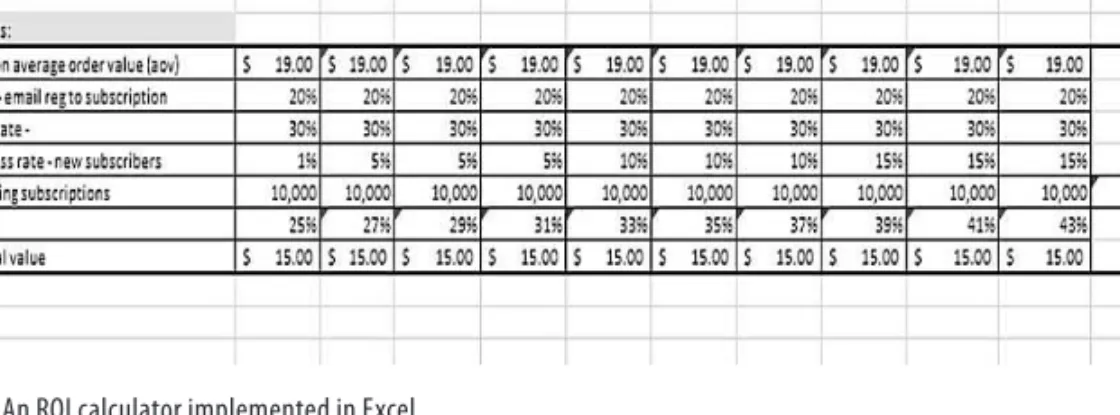
Once you have your line items listed and associated costs of doing business identi- fi ed, the next step to take today is to build an ROI calculator. Using this tool, you can calculate the expected response rate for each email sent and how many emails need to be sent in order to drive the return on investment. Some people choose to build these to determine what type of response rates they need to justify the cost. Others build them to determine how much they can spend based on the projected ROI. Either case is fi ne. Just make sure you build one. It should look something like the example shown in Figure 6.2. (The data were created for presentation purposes only and do not refl ect any company’s actual budget or business plan.) It should be a living document that you update and manipulate weekly at a minimum.
N o t e:
You can download a copy of the SampleROI.xls calculator from this book’s web page atwww.sybex.com/go/emailmarketinghouraday.
119
■WEEK 1: PREPARING YOUR RESOURCE ARSENAL
Figure 6.2 An ROI calculator implemented in Excel
Thursday: Related Marketing Initiatives
You are now locked and loaded with knowledge about the email marketing space. You have a list of the types of services and technologies you can leverage and will need a budget (including an ROI forecasting document) in place as well as. What’s next?
Remember the third truth from Monday’s focus: Anything you do in the world of marketing has an email component. Regardless of whether you work for a large or small company, and whether your job is focused only on email or includes broader efforts, email will impact almost everything your company does. Today, your job is to review every aspect of marketing or advertising that your company may be doing and to see where and how email could or should be making an impact.
This is probably one of email marketing’s most fun activities because it is very visual. By creating an email “look book,” you will be able to effectively determine whether you need to make any changes to your budget to support other programs, design additional creative, or develop tests to supplement what you have noted.
You will also be surprised by your fi ndings. Recent studies have shown that branding in email creative is consistent across all communications for only about 5 percent of companies. This is natural for large companies that work with multiple agencies. It is also expected for very small companies that implement efforts over time, as their services grow, often leaving older branding elements in play because of lack of resources or a volume demand to change it. So, where should you start?
The fi rst place to look is at your print advertising. If your company is doing a print campaign, your creative may look something like the Sephora ad shown in Figure 6.3.
CHAPTER 6:PREPARING YOUR EMAIL MARKETIN
Figure 6.3 A print ad for an email opt-in
This print campaign is built specifi cally to ask people to opt in to an email effort. If your advertising group is doing something like this, good for them! But, do you know what type of email is being sent once someone opts in? Or even what is hap- pening to the name once it is in your database? If not, you should defi nitely fi nd out.
Also note that addresses coming in from a print experience deserve an email welcome message that references the source.
The second element to check is your customer service center. Once someone is live on the phone, is your representative asking for email address permission? Is there
121
■WEEK 1: PREPARING YOUR RESOURCE ARSENAL
a workfl ow built to drive these customers to receive the right follow-up email or send them the most appropriate branding information? In Figure 6.4, American Express integrates the right brand with dynamic messaging, which is passed along to the email team to continue the messaging appropriately.
Key content themes are pulled from the database and dynamically populated into a
follow-up email:
Personalized “intent to spend”
Key business management themes (cash flow, cost savings, expense consolidation, and so on)
Rewards, topics of interest, site links Personalized greeting and representative salutation
Figure 6.4 An American Express dynamic email
If advertising and customer service have matters under control, move along to examine your corporate site. These sites often post research, press releases, and news coverage, which a visitor can share with a friend or colleague. That is fantastic news, as long as it is consistent with your efforts. Many companies fall short in this area because their pages ask to capture email addresses but then do nothing with them.
Figure 6.5 is an example from Nestle that shows the investor relations opt-in box. It does a good job of capturing profi le information, but is it linked to other types of emails, or even using space inside the emails to promote the benefi ts of opt-in with other Nestle products? It is not.
Finally, the last large area you will want to review is your online media planning efforts. If you are a business-to-business company, your focus is on driving leads. Here is a great example of a banner that offers a free trial:
Once again, it is your job to determine what happens to the email address once someone provides it for the download.
CHAPTER 6:PREPARING YOUR EMAIL MARKETIN
Figure 6.5 Nestle corporate opt-in
The impact of other marketing efforts on email grows constantly. Your job as an email marketer is twofold: to create the best email programs you can and to optimize them as you go. But it’s also to ensure that any email marketing opportunities that arise thanks to your company’s efforts are managed and effectively utilized in a way that creates the most positive brand experience around.
For each of these areas, ask yourself these questions:
I
• s there a chance an email address can be collected?
I
• s there a chance an email message will be sent?
W
• here does this data go?
W
• hat kind of messaging is sent?
C
• an I use this person’s data in the future for my program, and if so, how?
These questions will help you build a valuable resource for collecting new and highly active email addresses when you are looking for ways to increase your data- base size.
123
■WEEK 1: PREPARING YOUR RESOURCE ARSENAL
Friday: Getting the Boss to Sign the Check
It’s D-day. You have spent the week researching what you need to know about email and what technologies and services you think will be of the most help to you. You’ve estimated the costs associated with your intended efforts, and you have identifi ed areas of your website that will add value to your current programs. The meeting with the boss is set, and all you need to do is get the check signed.
Whether you are asking for $50 or $5,000 or $500,000, asking your boss for money to support your email marketing programs is going to require some discussion about the value of the email program to the company overall. We hope that by now you have picked up a few of the key highlights from earlier chapters in this book. These include the following:
E
• mail is more valuable to you than just one-time sales; email address opt-in is an indicator of high-value customers.
E
• mail marketing happens in every area of the company; it is a critical branding element.
E
• mail marketing saves significant dollars; sending an email saves more than 90 percent compared to postal mail.
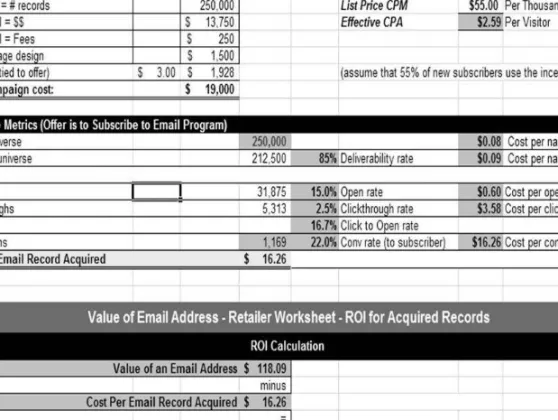
To help support these facts and enable C-level executives to understand the value of supporting email marketing, the Email Experience Council created a report outlin- ing the value of email addresses to a company, shown in Figure 6.6. Use these elements to help develop your plan of attack when you speak with your boss.
N o t e:
You can download a copy of the ValueofEmailAddress.xls calculator from this book’s web page at www.sybex.com/go/emailmarketinghouraday.Your goal in this communication is to demonstrate the holistic power of email in the areas listed earlier. We urge you to stay away from tactical elements such as open rates and even click-through rates.
Wr i t e T h i s D o w n:
Nearly three-quarters of email marketers said in a recent survey that they plan to spend either the same amount or more on email marketing in 2008 as they did last year, according to the 2008“E-Mail 2008: Top 10 Research Findings and Practical Ways to Increase E-Mail Performance” report. (Source:
MarketingSherpa)
CHAPTER 6:PREPARING YOUR EMAIL MARKETIN
Figure 6.6 Calculating the value to a company of an email address
Week 2: Building the Blueprint for Success
Once the ink on the check for your email marketing program dries, it is time to get down to business. During the second week, your focus will be on designing the core plans and validating the destinations for your efforts. This can be either data related or creative driven. Skipping any section in this week can set your program efforts back signifi cantly, and as you will see, there are many examples of ways you can approach these topics. Of course, the examples are being shown to illustrate concepts and will need to be customized to your company’s specifi c needs and goals. There is no one- size-fi ts-all in email. So if you are ready, get your pen and paper, and get ready for this week’s events.
Monday: Evaluating your current house fi le and fi le size needs Tuesday: Creating the acquisition plans
Wednesday: Focusing on the opt-in process and customer preference centers Thursday: Reviewing the opt-out process
Friday: Making sure your landing pages are a good place to land
125
■WEEK 2: BUILDING THE BLUEPRINT FOR SUCCESS
Monday: Evaluating Your Current House File and File Size Needs
We have a friend who works at the Heinz factory in Pittsburgh, Pennsylvania. Her job is to schedule the delivery of Heinz products to grocery stores in the Midwest. It is a really challenging job because it has to take into consideration all of the following factors:
B
• ased on sales of products and prior-year trends, when is the current shipment expected to run out?
H
• ow much does the new shipment need to contain in order to maximize pricing and delivery timing?
W
• hat will the contingency plan be if/when a grocer calls with an emergency order they need filled within 12 hours (especially if the truck needs to get to a dock and be loaded)?
W
• hat is the plan if the store is unable to sell the items because of a drastic change in the weather, the economy, or other uncontrollable occurrences?
How is she able to organize and manage all these elements dynamically and ensure there is no excess or lack of product? Somehow she is able to effectively create a process and workfl ow that allows her to forecast and manage to change.
When you think about it, we have the same need in our profession. Somehow, you need to effectively forecast the amount of interaction and turnover the names in your email databases will generate so that you can budget and plan for list growth initiatives at the right times and achieve optimal results. You have to do this without going over budget or losing valuable ground.
In 2006, Silverpop conducted a list growth survey of 321 marketers. As reported by Direct magazine, it found that when asked to name their list growth tactics, almost two-thirds of the email marketers surveyed cited offl ine advertising and direct market- ing. More than half mentioned trade shows or online marketing and web searches.
Viral marketing was third. The study also revealed a gap between planned list-building tactics and those seen as successful. For example, 24 percent intend to use viral mar- keting, but only 10 percent see it as successful.
These are interesting insights, but before you can get into worrying about how to grow you list, you need to evaluate how effective your list is.
Wr i t e T h i s D o w n:
The average size of an email marketing database ranges from 20 to 60 percent of the total marketing database. (Source: Email Experience Council)H
• ow big is your file compared to your company’s total marketing database?
Knowing this will help determine the total impact your current file can ulti- mately have. For example, if your file size is less than 20 percent of your entire
126
CHAPTER 6:PREPARING YOUR EMAIL MARKETING STRATEGY ■
years tend to not respond nearly as well as newly acquired email addresses. If you have an old file, you may very well want your starting technique to be in the areas on your website where you can attract some “fresh blood.”
W
• hat is the average annual purchase of a person on your email list compared to names not on your list? Although Forrester data indicates that the average person who opts in to your emails will purchase 138 percent more than someone who does not provide you with an opt-in email address, you should check the validity of this with your list. If your list of email opt-ins is not performing at the same rate as your offline list, your starting point may need to be the source of your email opt-in capture.
These three elements will get you well on your way to answering some critical questions not only about how large your list is but also about its effectiveness. Once you have this information, you will be in a good position to compare the size and response to your budget numbers, discussed in the previous section. This exercise will give you a clear indicator of how much you need to grow and what the starting points should be.
Staying on track with list growth is an important factor to focus on. Many times, we have seen people put the best plans into place and then have them fall through as soon as THEY LOSE THEIR FOCUS. Without your list, you will not be able to market. Don’t lose sight of that.
Tuesday: Creating the Acquisition Plans
Now that you know how much you need to grow and have some indication of where you may need to start, it is time to put together the plan for growing your acquisition efforts. You will have a number of choices to make. Based on your budget and your time, and results of tests, your plan can be expected to change and develop over time.
We strongly encourage you to launch your acquisition plans slowly over time. Test not only for the effectiveness of meeting name-capturing goals but also for the results these new names have for your company. Do they perform in the fi rst 30 days? Are they still effective 90 days after adding them to the list? Are there high spam or complaint rates? All these elements are factors in determining what type of list growth efforts and acquisition plans will work best for you.
127
■WEEK 2: BUILDING THE BLUEPRINT FOR SUCCESS
An Intelliseek survey by Forrester Research on U.S. consumers’ trust or distrust by type of advertising found that roughly two-thirds of respondents said they trusted emails they signed up for. This confi rms what many industry experts have known all along. Email marketing is a powerful relationship-building tool. So, how does an orga- nization implement a successful email loyalty program?
According to a study on worldwide email messaging by the market research fi rm IDC, daily email traffi c is now estimated at message sent after 60 billion.
Without question, the easiest way to fi nd relevant email addresses is to ask every con- sumer who visits your website for theirs. It’s simple enough, but most sites do not gen- erate enough online traffi c to drive a high volume of opt-ins. And without a suffi cient volume of site traffi c to capture elusive opt-in addresses to drive strong relationships between buyer and seller; business owners will lose valuable market share faster than it takes the deliverability status on an unsolicited email to bounce. So, what can you do to generate site traffi c?
The answer: channel surf. Start by using as many channels as possible to drive online interests and grow a company database. A marketer’s push and pull tactics can range from one, many, or all of the following channels to help create a steady fl ow of site traffi c:
K
• eyword buys
I
• n-store point-of-sale displays T
• rade shows L
• ist rental V
• iral and cross promotion C
• o-registration C
• all center D
• irect mail C
• ustomer care P
• roduct warranty registration C
• o-marketing P
• artnership/third-party channels
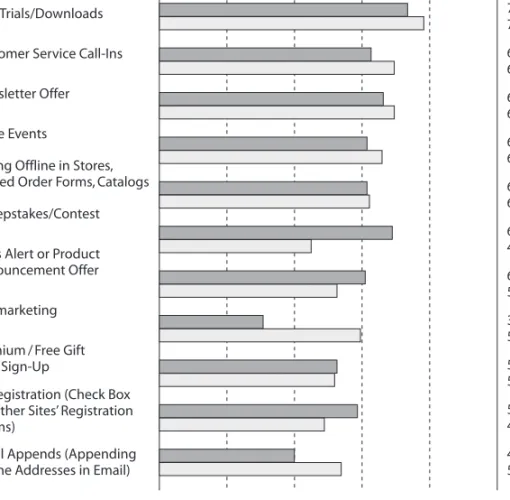
The data in Figure 6.7 illustrate different inbound channels available to online marketers and how effective each channel is at generating opt-ins.
List acquisition doesn’t need to be expensive. It can work very effectively given the right focus. However, we do recommend you never put more than 15 percent of your list growth strategy into one effort. This could cause serious issues and repercus- sions should something go wrong.
128
CHAPTER 6:PREPARING YOUR EMAIL MARKETING STRATEGY ■
100%
0% 20% 40% 60% 80%
Free Trials/Downloads
77%
Customer Service Call-Ins 63%
68%
Newsletter Offer 65%
68%
Trade Events
62%
Asking Offline in Stores, 66%
Printed Order Forms, Catalogs 62%
Sweepstakes/Contest 63%
67%
Sales Alert or Product 44%
Announcement Offer 61%
53%
Telemarketing
33%
59%
Premium / Free Gift
with Sign-Up 53%
52%
Co-registration (Check Box on Other Sites’ Registration Forms)
57%
47%
Email Appends (Appending Offline Addresses in Email)
40%
54%
SOURCE: MARKETINGSHERPA; EMAILMARKETINGSURVEY, OCTOBER 2005
Figure 6.7 Ways to drive opt-ins
Wednesday: Focusing on the Opt-In Process and Customer Preference Centers
Assuming your strategy of “reaching out” to use as many channels as possible to gener- ate a steady fl ow of site traffi c is successful, what next? The next step, and probably the most important in your effort, is to generate responsive and long-term opt-in permis- sion approval.
This requires a focus on the best practices of today (remember, we said you need to watch these all of the time) to develop the best customer experience.
To make it easy on you, we asked Cliff Seltzer of PureSend to craft the following list of the current best practices in opt-in and preference centers; Cliff also provided the phenomenal creative examples. Use this as a “tear me out” checklist to keep next to
129
■WEEK 2: BUILDING THE BLUEPRINT FOR SUCCESS
the email marketing truths, and you will always have something you will fi nd useful in design and strategy meetings:
A
• prominent call to opt-in on all home and landing pages. A survey by
JupiterResearch on how U.S. marketing executives capture consumer addresses found that 60 percent of all opt-ins came from the online registration process.
N
• on-obtrusive link to all policies. Links that enable readers to access the “about us” section and terms and conditions often engender a sense of trust.
F
• requency options. Giving your readers the ability to receive information more or less frequently can reduce unsubscribes up to 25 percent.
S
• ample content. Sharing an example of what your email will look like helps set expectations.
M
• ultichannel options (SMS, print, PDA). Offering readers the ability to sign up for your information through a variety of ways gives readers a sense of control.
C
• ontent-type format (HTML/text/PDA). This is a new trend, which you will read more about in Chapter 8.
L
• ots of content customization options. The most successful email programs offer the ability to personalize messages (see the Petco example in Chapter 2).
E
• asy unsubscribe. Based on updated CAN-SPAM laws, a one-click opt-out is critical.
S
• hort and long registration options. The email address is the only item that is truly required; many users will start at this level until you’ve earned their trust.
In fact, a recent MarketingSherpa study on how to get more opt-ins found that 88 percent of users say they are willing to spend time answering questions about their tastes and interests online, and 25 percent said they would spend more than six minutes fi lling out an online registration form.
C
• lear expectations. Set expectations on what will be delivered.
R
• easons for subscribing. Spell out the reasons the person should be subscribing.
T
• rust certificates. Provide trust certificates somewhere on the page.
D
• elivery times. Request specific delivery time, with time zones. This is a tough one for many ESPs who can’t get email out fast enough to promise a specific time, so you may think of it as a future goal.
Opt-in Examples
Figures 6.8 and 6.9 illustrate opt-in interfaces from Olympus and Saks Fifth Avenue.
CHAPTER 6:PREPARING YOUR EMAIL MARKETIN
Figure 6.8 Olympus email opt-in page
131
■WEEK 2: BUILDING THE BLUEPRINT FOR SUCCESS
Figure 6.9 Saks Fifth Avenue email opt-in page
Another example is from Continental Airlines, which has always followed best practices in its opt-in strategy. Here are Continental’s most important advantages:
• It has preference centers. Early on, Continental established best practices in pref- erence centers. Figure 6.10 shows an example.
• It takes chances. Continental was an early adopter of RSS and mobile messag- ing. We had the chance to work with Continental a few years ago and were impressed by its willingness to look toward the future.
• Its welcome messages speak to the consumer. Many of Continental’s frequent flyers have been impressed with the way the airline creates messaging that will help make flight planning and execution easier. Continental was among the first airlines to use email to alert customers to check in online and provide service updates via email mobile messaging. These transactional messages aren’t viewed as interruptive at all. They’re appreciated.
CHAPTER 6:PREPARING YOUR EMAIL MARKETIN
Setting up a plan for email acquisition, although it’s essential, is only as effective as the opt-in methodology that is used. Once someone opts in, both best practices and CAN-SPAM say you must provide a simple, clear, one-click way to opt out. In review- ing your company’s opt-out process, the fi rst question you want to ask yourself is,
“How well are we currently handling opt-outs?” As with the exercise to determine which elements of your advertising marketing program/website currently support an email conversation, this is also a good place to start gauging the effectiveness of your opt-out process.
In 2008, eROI, an integrated marketing service company, conducted an analysis of how companies are enabling people to opt in and opt out. Their fi ndings contain insights you need to know when beginning to design your opt-out strategy.
A summary of their fi ndings indicates that less than half of marketers used a confi rmation process to validate opt-in requests. The difference between getting an opt-in approval and getting a confi rmed opt-in can create signifi cant differences in response rates for future emails.
To entice subscribers, 88 percent of companies reported offering a newsletter subscription, and 29 percent reported offering access to preferred content. Rewards came in second, with 24 percent offering discounts and coupons and 22 percent pre- senting a contest of some sort. When you are designing your opt-in strategy, these sta- tistics and numbers can assist you in knowing what the rest of the market is offering.
133
■WEEK 2: BUILDING THE BLUEPRINT FOR SUCCESS
Although people are looking for an exchange of value in order to provide their email address, they do not always need to be given gifts or larger rewards in exchange.
An additional set of fi ndings from this same report indicated that most market- ers provide a “thank you” page as the landing page. Yet most marketers don’t take advantage of it, because only 29 percent of email marketers reiterate the benefi ts of subscribing. Data management was another area where companies were not up to speed. According to eROI, 65 percent of email marketers don’t pass content on to another system. Although this could be acceptable for some companies, it could be an issue with CAN-SPAM compliance for others. So please, take note of the way your data fl ows moving forward.
Another insight is that after opting out, 90 percent of email marketers do not follow up with subscribers, leaving a huge opportunity for additional channel commu- nication. Just because they don’t want to receive email does not necessarily mean they don’t want to hear from you in the future through a different channel. Of those that do follow up, 5 percent use direct mail, and 4 percent follow up via telephone.
Friday: Making Sure Your Landing Pages Are a Good Place to Land
This week has been pretty intense. You’ve looked at some crucial topics: driving traffi c to your site, driving opt-ins to your database, securing preferences, and even managing opt-outs. There is only one item missing for the week, and that is the need to review every landing page on your website.
Landing pages are tricky, because there may be policies or guidelines that gener- ate restrictions. Some companies have policies that require only one version of a land- ing page to be used regardless of the media entry point. Other companies do not allow certain types of cookies to be put in place, so content users’ clickstreams cannot be tracked. In same cases, this makes it diffi cult to validate the impact that the landing page content or design has on conversion. In any case, there is one consistent truth:
If you send an email with a link in it, the respondent who clicks, it has to land some- where. Even if you are not responsible for the website strategy, you are responsible for making sure the email marketing experience remains on-brand and consistent and that it creates a positive outcome.
The Recipe for Successful Landing Pages
Just as you would with any other recipe, the fi rst step in creating a successful landing page experience is to take a look around the kitchen (your company) and determine the resources you have available. Cooking up a successful landing page strategy will require you to have the following:
Y
• our landing page policy. Is it one-size-fits-all, or can it be customized by media type?
134
CHAPTER 6:PREPARING YOUR EMAIL MARKETING STRATEGY ■
the page. How will you know what happened to them after that?
Event Challenge: Cisco and the Wordy Event Effort vs.
AAAA and the Visual Invite
Cisco sent out an email to promote a webinar. It also presented online banners and other media.
All efforts drove to the same landing page (which required lots of explanation since banner ads can’t contain it all). This was a pretty poor experience for the readers. Those who made it through the text of the email were presented with the same information on the landing page. It was tough to find a link to register.
135
■WEEK 2: BUILDING THE BLUEPRINT FOR SUCCESS
Event Challenge: Cisco and the Wordy Event Effort vs.
AAAA and the Visual Invite (Continued)
AAAA was promoting an event at the same time. It, too, had a one-stop-landing-page rule. The difference with its email was that AAAA knew it. Instead of making the email do all the hard work, AAAA chose a more visual and high-level style of messaging that drove people to a fact- filled destination where they could continue learning and searching.
Continues
136
CHAPTER 6:PREPARING YOUR EMAIL MARKETING STRATEGY ■
The path was integrated for the AAAA respondents. This is a key element to consider when creat- ing any email campaign.
The next step is to build your landing page strategy. Defi ne what needs to hap- pen when someone clicks your email. This is important, because it will enable you to make sure the copy and layout of your email are appropriate based on the destination.