Preschoolers’ word learning when highlighting lexical or phonological awareness Jordan Crawford
Under the direction of Dr. Megan Saylor Vanderbilt University
Abstract
Lexical awareness, or the ability to recognize a word as unfamiliar, is a skill that children develop between the ages of 3 and 4. Past research suggests that adults can structure questions during a joint-book reading in a way that promotes children’s lexical awareness and increases word learning. In the present study, we tested 3-4 year old children (N=63) on a word-learning task in the context of an electronic storybook. When a novel word was presented in the book, children were either asked if they knew the word or if the word sounded like a familiar word.
They were then given a description of the word without visual input and asked to identify the referent’s picture. Children who were asked about the meaning of a word did not learn more words than did children who were asked about the phonology of the word. However, children’s word learning in both conditions was significantly better than chance. Word learning was not related with language or cognitive abilities.
An important step for children in word learning is the ability to recognize when they do not know a word. This skill requires a level of metacognition that develops during the preschool years (Bartsch & Wellman, 1995; Montgomery, 1992). One aspect of this metacognition is lexical awareness, or knowledge of one’s own vocabulary. Once children recognize they have a lexical gap they can seek out information about the word (e.g., by asking questions). Previous work suggests that only children with large vocabularies tend to do so; they are more likely to ask about the meaning of a word than children with smaller vocabularies (Jacobson, 2014). This suggests that children who already have large vocabularies may have an easier time gaining more vocabulary (Stanovich, 1986). However, the direction of the relationship is unclear: does having a larger vocabulary confer the ability to realize when children do not know a word and ask for a definition, or do children who are predisposed to asking question have larger vocabularies? One way to investigate the direction of the relationship is for adults to scaffold lexical awareness by asking preschoolers questions about their word knowledge. In this study, we examine whether the kinds of questions adults ask children during a joint book reading increase children’s lexical awareness and word learning.
Although older children and adults are able to recognize when they do not know a word, younger children have not fully developed this ability (Flavell, 1979; Klin, Guzman & Levine, 1997). Children develop the ability to recognize when they do not know a word around age three or four (Marazita & Merriman 2004). This ability might help children learn the meaning of a word, as the recognition that a word is unknown can prompt the search for a definition.
Merriman and Marazita (2004) argued that there are two processes that support children’s recognition that they do not know a word. First, they must recognize that the sound form is unfamiliar (word-cued awareness). Second, they must realize that they do not know the name for
a certain type of thing (meaning-cued awareness). Merriman and Marazita (2004) tested word- cued awareness by asking children if made up words and real words are actual words or not.
Rejecting the made-up words and accepting the real words demonstrated mastery of this task.
Results showed that there is in increase in awareness of lexical ignorance, or children’s ability to recognize that they do not know a word, from ages three to four.
Children’s awareness of lexical ignorance can be supported by exposure to words, actions, and objects that differ in familiarity. For example, asking children to sort words into known and unknown words with a visual aid leads to greater accuracy on lexical awareness tasks (Merriman & Maritza, 2004). It also leads to greater accuracy in pairing of a novel word with a novel action (Merriman, et al. 1996). These results suggest that children may benefit from being prompted to consider whether they know the meaning of an unfamiliar word prior to hearing a definition. One way children could be prompted to consider their own lexical awareness is if an adult asks them a question about the meaning of an unfamiliar word. This might happen during joint book reading.
Dialogic reading is an established reading technique that involves asking questions during joint book reading (Whitehurst, Falco, Lonigan, Fischel & Debaryshe, 1988), and has been shown to aid in word learning (Senechal & Cornell, 1993; Senechal & Monker, 1995;
Whitehurst et. al., 1988). In using dialogic reading to manipulate lexical awareness during book reading, children can be asked about the novel vocabulary as well as other elements of the story.
Asking if a child knows the meaning of novel items could promote awareness of lexical ignorance and lead to word learning. Another possibility is that asking any type of question might heighten preschoolers’ attention to the text and promote word learning.
In a previous study, Jimenez, Ryan and Saylor (2015) examined preschoolers’ lexical
awareness. Three- and four- year olds were asked to identify the visual referent of a novel word in the context of a picture book. In the study, there were three conditions that differed according to what the experimenter said after the novel word was mentioned. In the lexical awareness condition, the researcher asked the participant if he or she knew what the novel word meant after a novel word was mentioned (e.g. Do you know what a grimp is?). In the distractor-question condition, participants were asked about an element of the story that was not related to the target word (e.g. Do you have a garden?). In the no-question condition, participants were not asked a question following the mention of a novel word. After the question was asked, participants were given a description of the target word. They were then presented with an image of the target and images of two distractors and asked to point to the picture of the word about which they had just heard. As predicted, children in the lexical awareness condition learned more words than those in the control conditions. These results indicate that asking children if they know the meaning of a novel word leads to increased word learning.
However, it is unclear based on this study whether the lexical awareness question was actually helping children realize that they did not know the meaning of a word. Research has shown that mere exposure of a child to novel vocabulary words in a joint storybook reading is sufficient to stimulate an increase in vocabulary acquisition (Sénéchal & Cornell, 1993). Thus, it is possible that children in the lexical awareness condition were simply paying more attention to the description of the novel word because they had just been asked a question about it. In other words, children could have better retained the definition of the novel word not because they understood their own ignorance, but because attention was drawn to the word itself. Since the lexical awareness condition contained mention of the novel word but neither the distractor- question nor the no-question conditions did, it is possible that the repeated exposure to the novel
word that children in the lexical awareness condition received conferred an advantage over children in the control conditions. To address this possibility, we designed a second study to further determine whether asking questions prompting children to consider the meaning of a word actually increases their awareness of lexical ignorance.
In the present study, we used the same procedure and materials as the previous study (Jimenez, Ryan & Saylor, 2015). However, rather than the three conditions from the previous study, we included two conditions in this experiment that would better identify if asking children if they know the meaning of a novel word increases their awareness of lexical ignorance. The lexical awareness condition was similar in this study to the lexical awareness condition in the previous study; however, we changed the phrasing of the question in the present study to draw more attention to the meaning of the word rather than just the word itself. For example, we asked
“Do you know what the word grimp means?” Rather than include distractor and no-question control conditions, we included a phonological question condition in which we asked
participants if the novel word rhymes with a familiar word (e.g. “Does the word tooth sound like the word grimp?”). This condition aimed to draw attention to the sound of the word rather than the meaning of the word. Both conditions in the present study contain the novel word, so any differences in performance cannot be attributed to the fact that only participants in the lexical awareness condition were asked a question that contained the novel word. We predicted that children in the lexical awareness condition would learn more words than would children in the phonological question condition, if the question in the previous study led them to evaluate whether they knew the word meaning. It is also possible that children will show equal learning across the two study conditions, if mentioning the novel word is sufficient to lead children to attend to the definition.
We also tested skills that may influence word learning and lexical awareness, such as short-term memory, object representation and existing language ability. We predicted that children with more robust memory, object representation, and language abilities will learn more words during our task. By testing cognitive abilities we hope to more fully explain the
developmental trend in lexical awareness.
Methods Participants
Sixty-three 3-4 year olds (range 36-60 months, M=46.5 months, 28 females) were recruited from childcare centers in the southeastern United States. Participants were typically developing, had intact hearing, and heard English in their household 70% of the time or more.
Design
All participants completed five tasks in the same order: the electronic picture book, lexical awareness task, forward digit span, the Test of Early Language Development -3 (TELD- 3; Hresko, Reid, & Hammill, 1999), and an object representation task called the Vanderbilt Expertise Task-Kid (VET-Kid). Children who were tested in childcare centers completed the first four tasks on one day and then completed the VET-Kid task a few days later. Children who were tested in the laboratory completed all five tasks on the same visit.
Participants were assigned to one of two conditions (lexical awareness and phonological question) so that ages and gender were distributed equally across both conditions.
Materials
Electronic picture book. Participants were read an electronic picture book from a laptop.
The picture book was created for the experiment, and contained six novel target words that were names of novel creatures. In the story, a brother and sister did various activities, such as play in a
garden and eat ice cream, and found novel creatures. Participants viewed illustrations from a laptop while the experimenter read the story text from a binder (See figure 1).
For test trials, children were presented with each target item with two distractors. The distractors matched the target in color but differed in location and shape. One of the distractors was another novel creature and one was a familiar creature in an unfamiliar color (e.g. a blue cow). The order of the target items and the order of the dimensions were counterbalanced across participants (See figure 2).
Lexical awareness task. We created a task that assessed participants’ lexical awareness.
Participants were asked to identify the novel word in twelve word pairs. The word pairs
contained one novel word (e.g. wex) and one familiar word (e.g. cat). The familiar words in the pairs increased in difficulty as the task progressed. For example, the first word pair consisted of the words zav and ball, whereas the last word pair consisted of the words voquex and hydrant.
To ensure that participants were familiar with the familiar words, we administered a known word performance task following the lexical awareness task. An image of each familiar word was presented with two distractor images in a PowerPoint presentation. The experimenter said the familiar word and participants were asked to point to the picture of the word. Familiar words that participants identified incorrectly were not counted as erroneous if the participant also incorrectly identified the novel word in the lexical awareness task, as both words would have been novel in that situation. In other words, if a participant was unable to identify a picture of a word in the known word performance task that was intended to be familiar (such as the word hydrant), then that word would actually have been novel for the participant. In that case, both the intended familiar word and the novel word would have been unknown to the child, so failure to correctly identify the intended novel word would not have been a true error on the part of the
participant.
Forward digit span. The forward digit span is a test of short-term memory. The child was told that he or she would hear some numbers and was instructed to repeat the numbers. The test started out with a two-digit number series. Each number series represented one item, and two items comprised a trial. After each trial, the number of digits in the series increased by one digit.
The test continued until the child incorrectly repeated both items in a trial.
Test of Early Language Development-3 (TELD-3). The TELD-3 assesses overall spoken language development. It was designed for children ages 2 to 7 years-11 months as a research tool for language development. For each item, the child is given a verbal direction and then shown a stimulus object or picture. The child is then asked to respond to prompts for each item. The child’s response is scored.
Object representation task. The VET-Kid object representation task is an adapted test of perception that measures children’s ability to identify objects based on representation. In other words, it was used to determine how well each participant could mentally represent an object.
This task was an adaptation of the Vanderbilt Expertise Task (McGugin, Richler, Herzmann, Speegle, & Gauthier, 2012), which was originally designed for use with adults. We tested
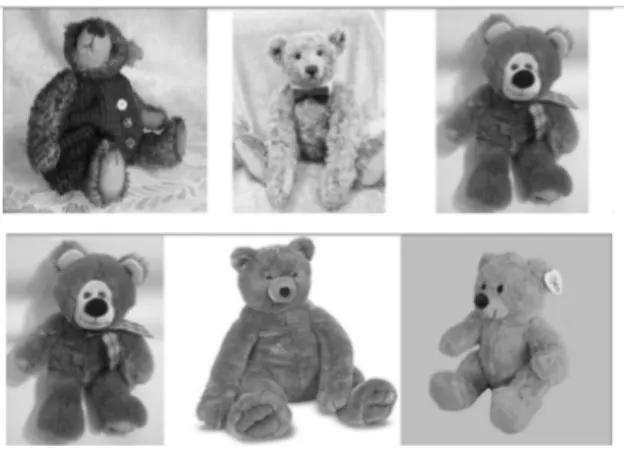
children on three different categories: teddy bears, toy cars, and sneakers. Children were asked to remember three exemplars from a category (e.g. three teddy bears). During training, participants were shown the three exemplars. In the trial phase, participants were presented with an
arrangement of items in the same category as the exemplars, one of which was the exemplar shown during the training phase. Participants were asked to identify which of the objects they had previously been shown (See figure 3 for examples of exemplars).
During the first nine trials, participants were asked to identify pictures of items that were
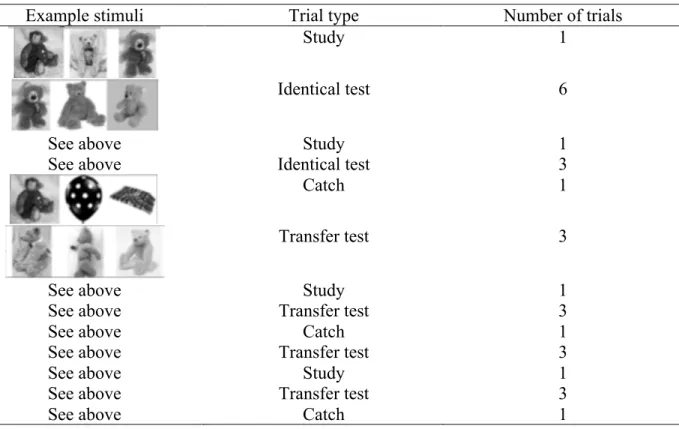
identical to the ones they had seen in the training phase (i.e. from the same angle). They received feedback on the first nine trials; if they chose an incorrect item, they were shown the correct item. The children then completed twelve transfer trials. In these trials, they were shown the exemplars from a different angle. Feedback was not provided on these twelve trials. Three catch trials where the target object was paired with unrelated distractors were interspersed to ensure participant’s attention and boost confidence (see Table 1 for design matrix).
Procedure
To begin, participants were seated at a table next to the experimenter. Participants were shown electronic illustrations of a picture book on a laptop while the experimenter read the story text from a binder. The two conditions (lexical awareness and phonological question) differed according to the question the experimenter asked after the first mention of a novel target word.
In the lexical awareness condition, the experiment asked if the participant knew what the novel word meant after the experimenter read it (e.g. “Do you know what the word grimp means?”). The correct answer to the question was “no,” as all of the target words were made-up.
If the participant answered “yes,” the experimenter asked him or her to provide a definition.
After being asked for a definition, most participants admitted that they did not know. However, some participants made up a definition. In these cases, they were told that they did not know what the word meant because it was a new word.
In the phonological question condition, participants were asked if the novel word rhymed with a familiar word (e.g. “Does the word tooth sound like the word grimp?”). The words never rhymed, so participants were expected to say “no.” As in the lexical awareness condition, if participants answered “yes,” they were first asked how the words sounded the same. If they made up an answer, they were told that the words do not sound the same.
After a novel word was mentioned and either the lexical awareness question or phonological question was asked, participants were provided with a description of the novel creature on three dimensions: color, location, and shape (e.g. “A grimp is orange, has a droopy nose, and lives in trees.”). The descriptions were given without a visual referent.
After the description was read, participants were presented with three images: an image of the novel target creature and two distractor creatures. The placement of the target words and distractors were counterbalanced across trials and participants. There were six target words and six different target-word presentation orders for each condition.
Halfway through the picture book after three of the six novel creatures had been presented, participants were tested on their recall of the creatures. The experimenter instructed children that they would be shown some of the creatures they had just seen. Participants were shown slides containing two pictures, one of the target creature and one of a distractor creature.
The novel creatures were shown in the same order they appeared in the storybook. Participants were asked to identify the creature for which they heard a definition (e.g. “Which one is the grimp?”). The experimenter continued reading the story, and this process was repeated again at the end of the story with the final three novel creatures.
After participants were read the picture book, they completed the lexical awareness task.
Participants were told they were going to play a game with words, and that they would hear one
“old” (familiar) word and one “new” (novel) word. Participants were given an example of an old word and a new word (e.g. book versus floopy-doopy). In the instructions, participants were told an old word was a word they had heard before and that they knew what it meant. A new word was a word they had never heard before and that they did not know what it meant. Participants were asked to say the new word– the word they had never heard before. They were given two
practice trials. If they responded incorrectly by saying the old word, the experimenter asked them if they knew what the old word meant and guided them to the correct answer. Once participants provided the correct answer to the two practice trials they proceeded to the test trials.
Before each word pair was presented, participants were reminded to say the new word.
After every fourth word pair, they were reminded that “new words are words that [the participants] have never heard before.” The order of familiar and novel words was counterbalanced across items.
A known-word performance task was administered following the lexical awareness task to test participants’ knowledge of the familiar words. Participants were presented with a three- item forced-choice task in which they selected the familiar referent from among two distractors.
If the participant failed to identify the familiar word on the known word performance task, those items were not counted as errors. The number of errors was used as the measure of performance.
Participants were then administered a forward digit span task to measure short-term memory. Their language abilities were tested using the TELD-3. Lastly, the VET-Kid task was used to test object representation.
Results
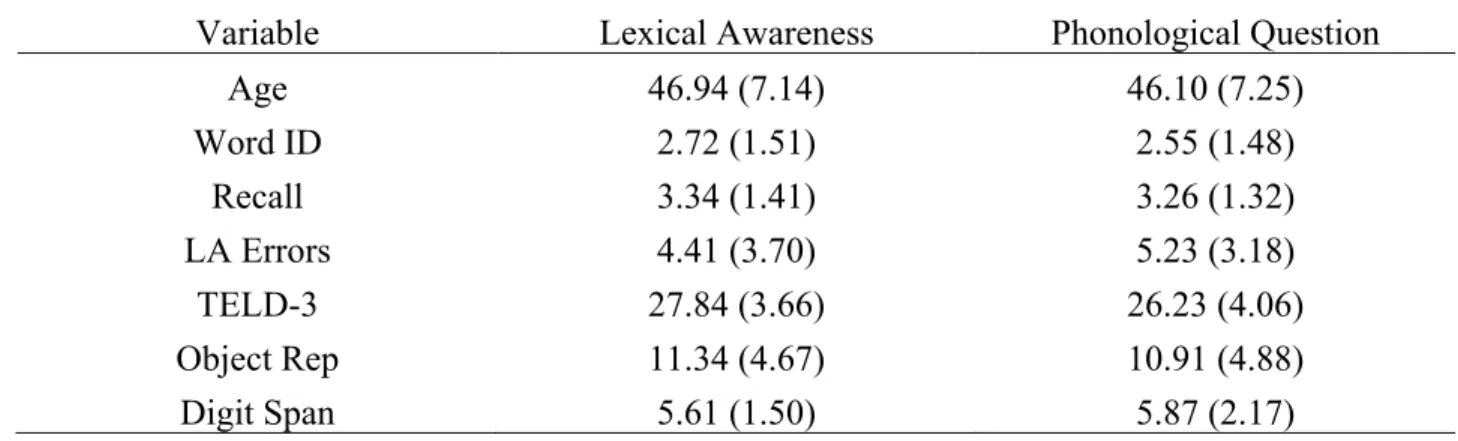
In order to confirm that there were no differences in cognitive or language abilities between participants in the two conditions, independent samples t-tests were conducted. These analyses revealed no differences in age, lexical awareness, TELD-3, digit span, or object representation between the participants in the two conditions (see Table 2).
To investigate whether children in the lexical awareness condition were more likely to learn novel words than were children in the phonological question condition, a planned independent samples t-test was conducted. Results of this analysis revealed no differences in
word learning between the lexical awareness condition (M=2.72, SD= 1.50) and the phonological question condition (M=2.55, SD=1.48, p=.65).
To determine if children were able to identify words above what would be expected by chance, we conducted tests against chance for both conditions. In both the lexical awareness condition and the phonological question condition, word learning was above chance: lexical awareness (t(31)=2.70, p=.01) and phonological question (t(30)=2.06, p=.048).
We also measured children’s recall of novel words halfway through the storybook reading and again at the end to investigate whether children remembered the novel words after they were first presented. We conducted tests against chance for children’s recall of the novel words. Recall was not above chance in either the lexical awareness condition (M=3.34, SD=1.41) or the phonological question condition (M=3.26, SD=1.32) , and was therefore excluded from further analysis: lexical awareness (t(31)=1.38, p=.176) and phonological question (t(30)=1.09, p=.284).
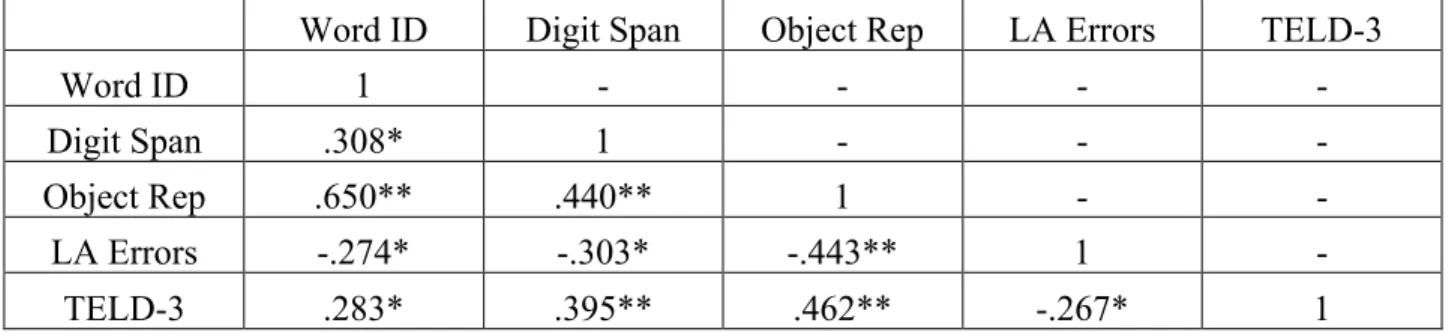
Bivariate correlations were conducted to determine whether memory, lexical awareness, language ability, or object representation was related to word learning. The analysis indicated that word learning was correlated with language and memory abilities: TELD-3 (r(61)=.283, p=.025), digit span (r(60)=.308, p=.015), lexical awareness (r(60)=-.274, p=.031), and object representation (r(58)=.337, p<.01) (see Table 3 for correlation matrix). However, after
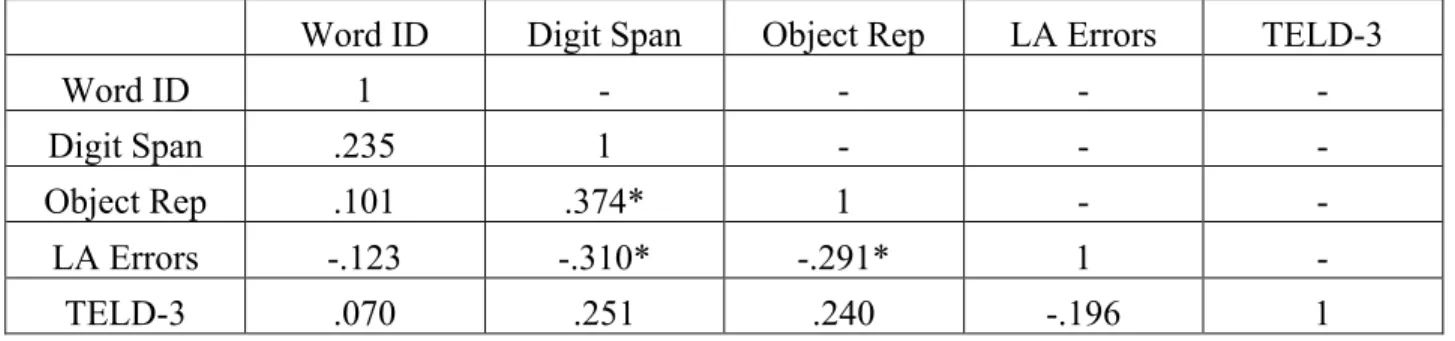
controlling for age in a partial correlation, we no longer found significant correlations between word learning and language or memory: TELD-3 (r(46)=.075, p=.613), digit span (r(46)=.235, p=.107), lexical awareness (r(46)=-.123, p=.404), and object representation (r(46)=.101, p=.494) (see Table 4 for correlation matrix). Although significant correlations between word learning and language and memory abilities disappeared after controlling for age, there was a correlation
between age and the outcome variable.
Discussion
In this study, we investigated whether asking children questions about novel words during a book reading can help them learn words. Our results replicate previous findings that questions structuring children’s lexical awareness result in above-chance word learning. We also examined whether questions that draw attention to the meaning of the word increases word learning relative to questions that draw attention to word form. Our results indicate that asking children questions about novel words during a book reading can help them better learn those words, but that whether the question draws attention to word meaning or word phonology does not significantly impact learning.
We predicted that word learning would be greater in the lexical awareness condition than in the phonological question condition on the basis of results obtained from the previous study on lexical awareness. However, our findings revealed that children learned words equally well across our two conditions. In the previous lexical awareness study, neither control condition contained a question relevant to the novel word: one control condition asked a distractor question about the content of the story, while no question was asked in the other control condition. Only the lexical awareness condition in the previous study contained a question about the novel word (Jimenez, Ryan & Saylor, 2015). However, both the lexical awareness condition and the
phonological question conditions in the present study asked questions relevant to the novel word.
Therefore, the lack of significant differences between conditions in this study may be because both conditions asked questions about the novel word and contained mention of that word an equal number of times.
Even though the lexical awareness question and the phonological question emphasized
different aspects of the novel word (i.e. meaning versus phonology), they both drew attention to it. Children in the lexical awareness condition learned words above what would be expected by chance. This finding replicates results from the previous lexical awareness study, supporting the idea that structuring children’s lexical awareness through question asking can help them learn new words. In contrast to the results of the previous lexical awareness study, children in the control condition of the present study also learned words above what would be expected by chance. Children in the control conditions of the past study, who were either asked a question not about the novel words or were asked no question at all, did not learn words above chance. It is possible then that asking children any question about a novel word during a book reading increases their attention to that word and the subsequent attention they pay to a definition of the word, resulting in better word learning. This is consistent with research suggesting that mere exposure to novel vocabulary words in joint-book reading is sufficient to promote word learning (Sénéchal & Cornell, 1993).
Finally, we asked whether individual differences in language ability, object representation, and memory predict word learning better than age. After initial bivariate correlations revealed correlations between word learning and every measure of cognitive and language ability, partial correlations controlling for age indicated that none of our cognitive or language measures were correlated with word learning. This was surprising because past research has found that age and language abilities are important predictors of word learning during joint book reading (Sénéchal, 1995). A possible explanation for these results is that the task relied heavily on children’s memory abilities. Definitions of novel words were provided without visual referents to the objects. Thus, children had to mentally retain features of an object from a definition rather than immediately label the visual referent.
The failure of the lexical awareness task, in which children were asked to identify the unfamiliar word in a series of word pairs, to correlate with success on the word learning task may indicate that children do not automatically employ that awareness during the preschool years.
While they might sometimes recognize that they do not know a word, they may be unsure about how to act on the knowledge of their ignorance.
Although we tested children on their recall of the novel words halfway through the storybook and then again at the end, this measure was excluded from analysis due to children’s poor performance in both conditions. This task seemed to be too difficult for preschoolers. Even without the recall test, the novel word-learning task weighed heavily on children’s memories.
The initial presentation of the novel creature occurred without an immediate visual referent of the definition. The addition of another task asking children to label an object based on features they had previously held in their mind likely overloaded their memory abilities. In the future, it would be interesting to design a measure of word recall that allows preschoolers a less
challenging opportunity to demonstrate their word learning in order to determine if they are retaining what they learned or are simply demonstrating word identification.
This research provides evidence that asking children questions about novel words, even if the questions do not relate to the word’s meaning, can help children acquire vocabulary from books. It also suggests that adults can structure questions during a joint book reading to help children attend to definitions better and lead to increased word learning.
References
Bartsch, K., and Wellman, H. M. (1995). Children talk about the mind. New York: Oxford University Press.
Flavell, J. H. (1979). Metacognition and cognitive monitoring: A new area of cognitive–
developmental inquiry. American Psychologist, 34(10), 906–911. doi:10.1037/0003- 066x.34.10.906
Hresko, W. P., Reid, D. K., & Hammill, D. D. (1999).The Test of Early Language Development- 3(TELD-3). Austin, TX: Pro-Ed.
Jimenez, S., Ryan, K., & Saylor, M. (2015). Aiding preschoolers’ word-learning by scaffolding lexical awareness. Unpublished manuscript, Department of Psychology and Human Development, Vanderbilt University, Nashville, Tennessee.
Klin, C. M., Guzman, A. E., and Levine, W. H. (1997). Knowing that you don’t know:
Metamemory and discourse processing. Journal of Experimental Psychology: Learning, Memory, and Cognition, 23(6), 1378–1393.
Marazita, J. M., & Merriman, W. E. (2004). Young children’s judgment of whether they know names for objects: The metalinguistic ability it reflects and the processes it involves.
Journal of Memory and Language, 51(3), 458–472.
McGugin, R. W., Richler, J. J., Herzmann, G., Speegle, M., & Gauthier, I. (2012). The Vanderbilt Expertise Test reveals domain-general and domain-specific sex effects in object recognition. Vision Research, 69, 10–22.
Merriman, W. E., Evey-Burkey, J. A., Marazita, J. M., and Jarvis, L. H. (1996). Young two-year- olds’ tendency to map novel verbs onto novel actions. Journal of Experimental Child Psychology, 63, 466–498.
Merriman, W. E., & Marazita, J. M. (2004). Young children’s awareness of their own lexical ignorance: Relations to word mapping, memory processes, and beliefs about change detection. In D. T. Levin (Ed.), Thinking and Seeing: Visual Metacognition in adults and children. (57-73). MIT Press.
Sénéchal, M., & Cornell, E. H. (1993). Vocabulary Acquisition through Shared Reading experiences. Reading research quarterly, 28(4), 360–374.
Sénéchal, M., Thomas, E., & Monker, J. (1995). Individual Differences in 4-Year-Old Children’s Acquisition of V ocabulary During Storybook Reading. Journal of Educational
Psychology, 87(2), 218–229.
Stanovich, K. E. (1986). Matthew effects in reading: Some consequences of individual differences in the acquisition of literacy. Reading Research Quarterly, 21, 360–406.
doi:10.1598=RRQ.21.4.1
Whitehurst, G. J., Falco, F. L., Lonigan, C. J., Fischel, J. E., Debaryshe, B. D., & Caulfield, M.
(1988). Accelerating Language Development Through Picture Book Reading.
Developmental Psychology, 24(4), 552–559.
Table 1: VET-Kid object representation task design matrix
Example stimuli Trial type Number of trials
Study 1
Identical test 6
See above Study 1
See above Identical test 3
Catch 1
Transfer test 3
See above Study 1
See above Transfer test 3
See above Catch 1
See above Transfer test 3
See above Study 1
See above Transfer test 3
See above Catch 1
Table 2: Means and standard deviations of study measures
Variable Lexical Awareness Phonological Question
Age 46.94 (7.14) 46.10 (7.25)
Word ID 2.72 (1.51) 2.55 (1.48)
Recall 3.34 (1.41) 3.26 (1.32)
LA Errors 4.41 (3.70) 5.23 (3.18)
TELD-3 27.84 (3.66) 26.23 (4.06)
Object Rep 11.34 (4.67) 10.91 (4.88)
Digit Span 5.61 (1.50) 5.87 (2.17)
Table 3: Correlations
Word ID Digit Span Object Rep LA Errors TELD-3
Word ID 1 - - - -
Digit Span .308* 1 - - -
Object Rep .650** .440** 1 - -
LA Errors -.274* -.303* -.443** 1 -
TELD-3 .283* .395** .462** -.267* 1
Table 4: Partial correlations controlling for age
Word ID Digit Span Object Rep LA Errors TELD-3
Word ID 1 - - - -
Digit Span .235 1 - - -
Object Rep .101 .374* 1 - -
LA Errors -.123 -.310* -.291* 1 -
TELD-3 .070 .251 .240 -.196 1
Figure 3 11
Figure 1: Example illustration and text from electronic storybook
Figure 2: Example of novel and distractor creatures
Figure 3: Sample stimuli from VET-Kid object representation task