PRESENCE IN ABSENCE: D.W. GRIFFITH’S PATRIARCHAL PARADISE IN HIS TRUST AND HIS TRUST FULFILLED
By
Sarah Louise Childress
Thesis
Submitted to the Faculty of the Graduate School of Vanderbilt University
in partial fulfillment of the requirements for the degree of
MASTER OF ARTS in
English
August, 2005
Nashville, Tennessee Approved:
Paul D. Young Lynn Enterline
LIST OF FIGURES
Figure Page
1. Triangle of Mediated Desire... 6
2. Introduction of Triangular Relationship Configuration ... 7
3. Colonel-Father Prepares to March Off to War ... 8
4. Designation of the Sword Iconic Proxy ... 10
5. The Sword Is Brought Home to the Family ... 12
6. The Reconfiguration of the Triangle... 15
As a result of the social upheaval generated by the Civil War and Reconstruction, black men and white women began breaking out of the racial and gender roles prescribed by slavery and domesticity. Anxious white males believed this disregard for traditional roles had the potential to explode the traditionally unambiguous U.S. socio-political hierarchy into a multitude of blurred power possibilities, an event that could culminate in the dissolution of white male supremacy.
D.W. Griffith, the “father” of classical narrative cinema, envisioned his own solution to this boundary overstepping. In 1911, he turned to the Old South to create an historical romance that recreated the clearly defined and respectfully observed white patriarchal system of the antebellum South. In His Trust and His Trust Fulfilled, his first two-reeler for Biograph, D.W. Griffith creates an allegorical Southern plantation family through which he reaffirms traditional racial and gender roles, asserts the inherent stability of patriarchal ideologies and structures, and underscores the “natural” suitability of each family member for their respective role in the patriarchal hierarchy. By deriving the films’ narrative complications from “Yankee” interference, Griffith is also able to indict the modern industrial system, affiliated with the North, which frees black males and white females for public circulation and instigates breaching of racial and gender boundaries.
Griffith’s plantation-family allegory is built upon a principle of presence-in-absence.
To illustrate the stability of patriarchy, he creates within this family a patriarchal presence strong enough to be maintained even in the absence of a white male figure. Griffith enacts this presence-in-absence system through a triangulated structure that replicates the
naturalized determinism and inequality of patriarchy by re-inscribing the comparative assessments that establish the characters and rankings of individuals within the hierarchy.
Griffith uses standards of presence and absence, completeness and lack, to characterize the system ideal and its correlated subordinates, as well as the relationships between them.
Griffith uses a principle of three to inscribe this triangulated structure into the fabric of both films. He places the characters within the cinematic plane to construct an actual triangular positioning that reflects their rank within the patriarchal family. By using these presence-in-absence devices, Griffith produces a utopian vision of a naturalized, stable patriarchal system that is self-sustaining, transmitted and re-inscribed by its faithful, trusting members.
When critics want to analyze Griffith’s position on patriarchy they look to The Birth of a Nation, and only examine His Trust and His Trust Fulfilled for what they reveal about Griffith’s progress towards Birth. Most of this critical work focuses on Griffith’s experimentation with the powerful imagery he draws on for Birth: the phallic sword, faithful slave, epic Civil War battle scene and the devastating effects of the war1. For example, Michael Rogin, in “‘The Sword Became A Flashing Vision:’ D.W. Griffith’s The Birth of a Nation,” posits the Trust films as the first instance of Griffith’s use of the phallic sword, and begins his analysis of how this symbol works in Birth by looking at its usage within these films. Rogin’s exploration of the patriarchal symbolism in Birth, and its origination in the Trust films, begins to give us a basic understanding of what His Trust and His Trust Fulfilled can tell us about Griffith’s purposeful use of images. In this
1Refer to the following for examples of critical discussion on the Trust films: Thomas Cripps, Slow Fade To Black: The Negro in American Film, 1900-1942, New York: Oxford University Press, 1977: 27-30;
Michael Rogin, “‘The Sword Became a Flashing Vision’: D.W. Griffith’s The Birth of a Nation, Ed. Robert Lang, The Birth of a Nation, New Brunswick, New Jersey: Rutgers University Press, 1994: Section V;
Richard Schickel, D.W. Griffith: an American Life, New York: Simon and Schuster, 1984;Paolo Cherchi Usai (Ed.), The Griffith Project: Volume 4 Films Produced in 1910, London: British Film Institute Publishing, 2000.
paper, I want to focus more extensively on the Trust films to explore Griffith’s developing use of rhetorical imagery and his strategic employment of profilmic and filmic techniques to imprint emblematic structures within a film. In the Trust films, Griffith creates images of the family members that reproduce cultural types, yet these images also produce new meanings of their own based upon his fashioning. Similarly, Griffith’s use of the Old South plantation family also allows him to reproduce within these films a familiar hierarchical structure, while simultaneously producing his own interpretation of this structure’s significance. Thus, Griffith’s Trust family allows him to reproduce and produce images and structures that express his insistence on patriarchal stability.
In contrast to Birth’s unstable patriarchal system that must be rehabilitated through a violent reinstatement of white male hegemony, Griffith creates within the Trust films a patriarchal system that is naturally stable. By rooting this system in the allegorical plantation family, with its strong father figure and extended social network of
dependents, Griffith reaffirms traditional racial and gender roles. These roles, in turn, naturalize the patriarchal system by illustrating the inherent determinism of each member to their specified role. As Peter Bardaglio points out: “In the organic model that served as the ideal of the Old South, people were supposed to know their own places as well as what part they played in the overall functioning of society. Two fundamental assumptions governed the relationships between male and female, and master and slave: (1) women and blacks were naturally suited for subordination, and (2) the male head of the
household and master was naturally fitted to command this subordination” (27). This natural determinism and inequality is reflected directly in the composition of Griffith’s
plantation family. The allegorical family allows Griffith to assert the sustainability of the patriarchal system, since it is maintained and passed along within the family structure.
In Birth, Griffith uses a patriarchal representative, the “Little Colonel,” to re- establish the stability and traditional institutions of the white patriarchal system. In the Trust films, however, he creates a patriarchal presence strong enough to be maintained in the absence of a white male figure. Griffith articulates this presence-in-absence principle in both the narrative and structure of the Trust films. On the narrative level, the presence of the patriarch ensures a stable environment for the patriarchal family members, within which certainty, security and harmony can reign, where the events of life unfold “as they should.” But the contrasting absence of the patriarch provides the films’ central narrative tension, the creation of the “trust”: the successful transmission and re-inscription of patriarchy through the transfer of the daughter from father to husband. Though the absence of the patriarch drives the narrative, the persistent presence of the patriarchal system underlies the structure of both films. The structure provided by this continuous patriarchal presence guarantees that the black and female characters remain subordinate figures within the narrative, even though there is not a white male patriarch to specify their subordination. The actions of these characters thus remain reactions as they contend individually with the absence of the patriarch and their responsibility to the trust.
Griffith initiates this presence-in-absence structure by forcefully imprinting the patriarchal presence so its momentum can be maintained in the absence of the white male figure. He then secures the structure into place by organizing the relationships and
characterizations within the patriarchal family into a triangular configuration that
replicates an actual social hierarchy, founded upon assessed degrees of completeness and lack. I will analyze this presence-in-absence triangular structure to determine how
Griffith uses it to create his vision of a stable patriarchal system. In the first section of this paper, I will look at how Griffith asserts the internalized stability of the patriarchal system by establishing triangulated relationships among the characters that demonstrate their dependence upon and trust in patriarchy. In the second section, I will examine how Griffith uses typed characterizations to create images that produce and reproduce the natural suitability of each member to their hierarchized role within the presence-in- absence triangular structure.
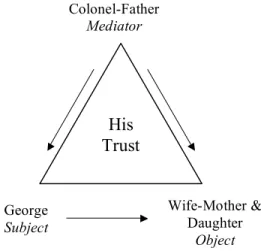
The presence-in-absence construct Griffith uses to structure the patriarchal system within the Trust films is identical to René Girard’s “mediator of desire” model2. In Girard’s model, an omnipresent Mediator determines the Object of desire for the Subject, as well as the Subject’s actions in relation to the Object. The Mediator is always
“radiating toward both the subject and the object” (Girard 2), and by doing so creates a triangular relationship structure. “From the moment the mediator’s influence is felt, the sense of reality is lost and judgment paralyzed” (Girard 4). In this way, the Mediator controls the desires, goals and actions of every other member inhabiting the triangle. The Subjects and Objects composing the triangle internalize this mediation, appropriating the desire of the Mediator as their own. This triangle of mediated desire is innately stable and self-perpetuating because of this internalization, and is thus a useful tool for examining Griffith’s construction of the stable patriarchal system within the Trust films.
2For more information, see Chapter 1 of René Girard, Deceit, Desire, & the Novel: Self and Other in Literary Structure, Trans. Yvonne Freccero, Baltimore: The Johns Hopkins University Press, 1965.
Figure 1: Triangle of Mediated Desire
Griffith’s establishes his triangulated presence-in-absence relationship configuration in the introductory title card of His Trust: “My Wife and Child – George Take Good Care Of Them.” With this directive, Griffith appoints the Colonel-Father as Mediator by having him assign the Subject (George) and Object (Wife-Mother and Daughter) of the trust’s triangular structure. In this way, the trust becomes the mediated desire that underlies the narrative and structure of both films. The subordinate characters, by
working together to fulfill the trust, also fulfill their individual desires. They are content, and have no desire to overstep the bounds of their roles in the trust, or the patriarchal system that underlies it. In contrast, the troubled relationships in Birth are based upon the challenges of the subordinates to the patriarchal system – to the determinism of their roles and to the authority of the white males to mediate the relationships within the system.
This internal pressure is what weakens the system and sparks the white warrior-sons to violently reassert its, and their, hegemony. But the triangular structure of mediated desire within the Trust films produces internal stability strong enough to keep the patriarchal system intact, even in the face of external pressure.
His Trust
Colonel-Father Mediator
George Subject
Wife-Mother &
Daughter Object
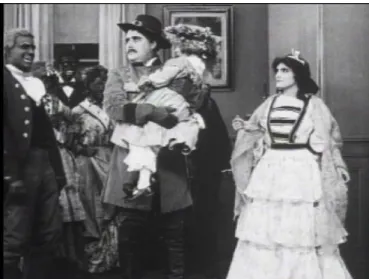
Griffith introduces the triangular presence-in-absence structure visually at the start of His Trust in order to generate a forceful initial imprinting of the patriarchal presence. He places the main characters within the cinematic plane in such a way as to construct a triangular positioning that reflects their hierarchical relationship. The Colonel-Father Mediator stands at the triangle’s apex in the foreground, and the Subject and Object are located in the midground, in a secondary position, at each base angle of the triangle (George on the left, the Wife-Mother on the right). The eyelines within this structure also confirm the positioning within the triangle. George and the Wife-Mother consistently keep the Colonel-Father in view, while his eyes are free to look around, and gaze upon
whatever he chooses. Through casting, wardrobe and body language, Griffith expresses in the Colonel-Father’s physical form the vigor and ubiquity of the patriarchal presence. The Colonel-Father, the tallest figure in the triangle, has pale white skin, penetrating eyes, an abundant mustache and a self-assured, military bearing. In his military officer’s uniform, Griffith presents him as a strong father figure within both private and public spheres.
Figure 2: Introduction of Triangular Relationship configuration
By placing the Colonel-Father in the apex position, Griffith is able to consolidate his patriarchal authority. This foregrounded position also gives the spectator closer access to his character, thereby promoting affiliation. By placing George and the Wife-Mother in the midground, but close to the Mediator, Griffith indicates their importance within the narrative. A chorus of house slaves resides in the background, at the bottom of the hierarchy. They, along with the backdrop of the plantation house, play a small but emphatic role in the narrative as illustrations of the power of the patriarch and the patriarchal system3.
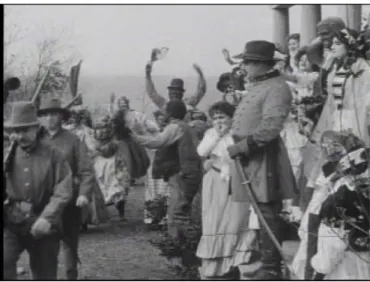
Figure 3: Colonel-Father Prepares to March Off to War
Griffith maintains this mediated presence-in-absence structure as the action extends beyond the family base of the plantation home. Preparing to go to battle, the Colonel- Father stands at attention, waiting to join the other men as they march off to War, as George and the Wife-Mother take up their left-right secondary support configuration
3In this introductory sequence, the Colonel-Father invites the Daughter into the apex of the triangulation, but she does not take up her own position within the configuration – yet. At this point, her role as
marriageable daughter (and focus of the Trust) is not yet fulfillable, so she floats freely within this initial arrangement.
behind him. After the Colonel-Father joins the men, George and the Wife-Mother fall into place behind him, then stop, again in their left-right support positions. Framed by their representative groups – George by the celebrating slaves, the Wife-Mother by the tearful white women waving farewell – these two remain frozen for over ten seconds in a tableau vivant of leave-taking, support, and connection, as they watch the patriarch march off to battle. In this sequence of shots, Griffith fixes the infinite flexibility of the triangle, making it an extremely versatile, and inescapable, instrument of patriarchy.
By establishing the triangle structure’s flexibility, Griffith demonstrates how it can be maintained in the physical absence of the Colonel-Father. In His Trust, while the Colonel-Father leads his troops into battle, Griffith uses parallel editing to establish an emblematic action to connect the Colonel-Father to the other members of the patriarchal family4. Griffith positions the Wife-Mother at the door of the main room in the plantation house and has her look out into the space beyond. He then juxtaposes this pose with shots of the Colonel-Father on the field of battle. The Wife-Mother’s emblematic action is repeated at key moments of the narrative: immediately before the Colonel-Father
marches off to War, when he dies in battle and when the Wife-Mother receives the sword of the dead Colonel-Father. Her emblematic action becomes a signifier of the Colonel- Father, or rather of his presence-in-absence. Though he is absent (because he is faithful to the Southern patriarchal system and fights in a war to defend it), this emblematic action sustains his presence within the patriarchal family system.
After the Colonel-Father’s death, Griffith assigns a series of iconic proxies to symbolize his uninterrupted presence-in-absence, and continued mediation, within this
4See Chapter 8 of Tom Gunning, D.W. Griffith & The Origins of American Narrative Film: The Early Years at Biograph. Urbana: University of Chicago Press, 1994.
triangular family structure. Though the Colonel-Father’s death removes his physical body from the established triangulation, these iconic proxies take his place within it – ensuring that the patriarchal system remains fixed and stable. Griffith establishes the patriarch- proxy connection by having the Colonel-Father designate each proxy. The first iconic proxy is the sword. As Mason Stokes points out in The Color of Sex, the sword has a multi-faceted role in Southern literature: it is used to preserve Southern institutions through the slaying of all enemies, its descent usually occurs in the service of nation- building and white supremacy, and – as a phallic symbol – it is passed between women to confer continued white male dominance5. In this way, the sword simultaneously
represents and replicates the patriarchal system.
Figure 4: Designation of the Sword Iconic Proxy
Griffith begins imprinting the sword as the Colonel-Father’s proxy from the beginning of His Trust, having it figure as an integral part of his characterization. The
5For more information, see Mason Stokes, “Introduction” and “White Sex: Thomas Dixon Jr. and the Erotics of White Supremacy” in The Color of Sex: Whiteness, Heterosexuality, and the Fictions of White Supremacy, Durham: Duke University Press, 2001: 1-22 and 133-157.
Colonel-Father enters the introductory scene with his hand on its hilt, and his hand remains in this position throughout the scene. He only removes it from this position on two occasions: to embrace the Wife-Mother and Daughter, and to appoint them as trust objects (which he accomplishes with a wave of his sword-gripping hand). The sword is prominently foregrounded throughout most of the Colonel-Father’s scenes, but most notably when he, in three-quarter profile, shakes George’s hand to seal him to his trust.
The sword again takes up a conspicuous position when the Colonel-Father uses it to salute the Confederate troops, and when he brandishes it to initiate his final battlefield charge. In this way, Griffith presents the sword as a weapon of institutional preservation, nation-building and white supremacy, while simultaneously signifying its conjunction with the Colonel-Father. The Colonel-Father’s dramatic final charge culminates in his mortal wounding, and his dying behest to his brothers-in-arms, as they cradle him in his final moments, is that they deliver the sword to his family. He dies once the promise is made, content in the knowledge that his part in the patriarchal trust has been fulfilled6, and that the sword will be sent to inhabit and mediate within the established patriarchal structure in his place.
6 Whether a continuity slip or a purposeful narrative element, the Colonel-Father does not die until he assigns the sword as his iconic proxy. He is shot and seems to die upon reaching the heavily-armed Union ramparts he and his troops have charged. He drops the Confederate battle flag he is carrying (which he must have picked up on his way across the field), the sword falls from his hand as he collapses to the ground, and then he throws up his arm to heaven and falls facedown, remaining in that position even as the soldiers from the second, successful charge mill around (and over) him. But once the Union forces are routed, the Colonel-Father revives for his final request.
Figure 5: The Sword Is Brought Home to the Family
Once the sword returns to the family, it immediately begins its work of mediation and subordination. George, the Subject of the presence-in-absence triangle, and the Wife- Mother, the Object, accept the sword and hang it in a prominent position (high on the wall above the mantle in the plantation home). In its position there, and later when it hangs on the wall in George’s cabin, the sword takes on iconic, and surveillant,
significance. Because of the sword’s proxy mediation within the Trust patriarchal family, there is no threat of miscegenation within the Trust films. The Wife-Mother and Daughter can live for several years in George’s cabin without any hint of miscegenation because the strength of the white patriarchal system remains intact and unchallenged. In Birth, however, the challenges of subordinates to the patriarchal system are sexualized into events of miscegenation in order to justify the violent reassertion of the system. In Birth, the sword signifies the need for vengeance to protect the system from subordinate challenges, while in the Trust films it signifies uninterrupted deference to the patriarchal system.
Because His Trust and His Trust Fulfilled were released separately, Griffith needed to replicate and reinforce this uninterrupted deference within the second film. He needed to re-imprint in His Trust Fulfilled the significance of the proxy, and the presence-in-absence structure, underlying the trust in order to ensure continued subordinate compliance in the absence of a white male figure7. As the title suggests, His Trust Fulfilled centers in the fulfillment of the trust, the reinsciption and transmission of patriarchy, which requires the transfer of the Daughter from father to husband (who will become a father-patriarch in turn). To fulfill the trust, then, Griffith needs to transform the Daughter from “Daughter” to
“Marriageable Woman.” He accomplishes this narratively by having the Daughter petition to be sent away to a “seminary,” the site of her transformation. Before she leaves for school, Griffith characterizes her as a willful girl; her only defense is to cry when she does not get her way. When she returns from the seminary, however, it is obvious that she has been educated, but only in the methods of attracting a husband. In a key scene that will determine the success of her transformation, when she meets her future husband for the first time, the book in her hand serves only as a prop for the attractive pose she adopts.
Though the Daughter may appear to be empowered in her position of implied independence (freedom from her parents as an orphaned child, empowered through access to education, and autonomous in her public circulation as she goes away to school), any potential for self-determination is precluded by her symbolic role as a vessel for patriarchy. The
Daughter’s independence culminates in dependence – marriage, which is coded in the film as a happy ending8.
7At the beginning of each film is a notice stating “‘His Trust’ is the first part of a life story, the second part being ‘His Trust Fulfilled,’ and while the second is the sequel to the first, each part is a complete story in itself.”
8This ending could be read as an object lesson for the New Woman, whom the Daughter might be seen to resemble given her unattached situation and ability to circulate.
Griffith also reinforces continued deference to the system in His Trust Fulfilled by restructuring the presence-in-absence triangle used in His Trust. Given the steps
necessary to fulfill the trust, the Daughter must take over the Subject role from George, since she is the only character able to transmit and re-inscribe the patriarchal system.
George, as a black man, cannot play a direct role in finding a husband for the Daughter, or otherwise provide for her marriage9. The sword, as the patriarchal proxy, retains its mediating presence at the apex. In his faithfulness to the trust, but still within a role delimited by the presence of the proxy sword10, George also becomes a mediating influence. Griffith moves him to the apex position in the triangular presence-in-absence structure, and he begins his work as a behind-the-scenes guardian for the Daughter.
Finally, the Husband moves into the Object position within the triangle, since he is the object of the fulfilled trust. The Daughter must be removed from the position as Object of the mediated desire triangulation she inhabited in His Trust since she appears to be quickly approaching puberty at the beginning of Fulfilled. Because of her role in the trust and the sexuality this role necessitates, she cannot be the object of a black man’s desire, nor can she be conjoined with the Wife-Mother. Thus, the Daughter must be
disassociated from the Wife-Mother, physically separated from George and repositioned on her own within the triangle.
9In Fulfilled, Griffith clearly establishes George as the source of funds for the Daughter’s physical care and education, but George is conspicuously absent as the Daughter meets and prepares to wed her husband.
George is present after the wedding occurs (as the bride and groom exit the church), but appears nowhere during the courtship.
10 Griffith often shows George in Fulfilled clutching the sword. They become fused together here as symbols of the stability and strength of the patriarchal presence, both acting as iconic proxies for the Colonel-Father.
Figure 6: The Reconfiguration of the Triangle
Griffith begins this reconfiguration of the presence-in-absence triangle at the very beginning of His Trust Fulfilled. He starts Fulfilled by killing off the Wife-Mother. As a widow with a child, she no longer has ties to, or exchange value within, the patriarchal system. She has already fulfilled her procreative role and, with the death of her husband and the destruction of her husband’s property, she is no longer under the protection or socio-economic support of a patriarch. She has outlived her usefulness within the system and no longer has a place within it, so Griffith removes her from the structure and the narrative of this second film. Griffith physically separates George from the Daughter by removing her from his household and direct protection. He inserts a white lawyer into the process as a middle-man who bridges the gap between George and the white world within which the Daughter must live. But this white lawyer does not push George out of the triangular configuration. Griffith constructs the lawyer as an unsympathetic character, someone who does not understand the importance of the trust and the Daughter’s role within it. His lack of sympathy and understanding only amplifies the intensity of George’s fidelity to the patriarchal system, and his new role as proxy Mediator of the
Trust Fulfilled
Sword & George Iconic Proxy
Mediators
Daughter Subject
Husband Object
newly-reconfigured triangle. In Fulfilled, deference to the patriarchal system thus persists within the family, and continues to structure their relationships with each other, and with the patriarchal trust.
In this second section, I will examine how Griffith uses typed characterizations to create images that produce and reproduce the “natural” suitability of each member to their hierarchized role within the presence-in-absence triangular structure. By using stereotypes for his characterizations, Griffith attempts to naturalize the patriarchal system, making its hierarchical structure appear to be a natural offshoot of each member’s inherent characteristics, and their place within the hierarchy to be naturally determined by these same characteristics. With these cultural types, Griffith is also able to invoke the presence-in-absence dialectic of his patriarchal system. Stereotypes evoke the presence of certain characteristics while insisting upon the absence of others. Griffith characterizes George, the Wife-Mother and Daughter so they represent a lack. They are incomplete in relation to the patriarchal ideal, as embodied in the Colonel-Father, and they need each other to realize completeness, hence the triangulated relationship with one another and with the Mediator patriarch. This interdependent structure makes the
characters dependent upon the patriarchal system, and thus faithful to it.
The Colonel-Father is the standard of completeness for the entire patriarchal system, representing the ideal of white masculinity. The Colonel-Father strides into each of his scenes and exudes confidence with every gesture. His body language, also appropriately military with ramrod posture and authoritative bearing, allows him with one sweep of his hand to command: he commands George to his trust with a handshake, while, with a sweep of his other hand, he creates the trust object “my wife and child.” In this way, he
exemplifies strength in the midst of weakness, and defines the ultimate position of authority and autonomy. He is a complete self in a self-defined world.
Characterized as powerful, authoritative and autonomous, the Colonel-Father also embodies the strength and stability of the patriarchal system. In contrast, Birth’s Dr.
Cameron, at the mercy of subordinates, embodies a weakened patriarchal system; he is old, enfeebled and dependent, and must be replaced by his virile son. The Colonel-Father, however, never weakens. He commands to the very end of his life, and refuses to die until he, with his own hands, ensures the continuation of the patriarchal system by designating his successor within it (the iconic proxy sword). In this way, Griffith demonstrates the Colonel-Father’s natural suitability to inhabit the superior, idealized role within the triangular presence-in-absence structure.
Griffith personifies George, the most fully-characterized subordinate figure within the Trust patriarchal system, as lacking the power, authority and autonomy of the white male patriarch. Because of this lack, George represents an idealized black masculinity.
He is naturally subservient to the ideal white masculinity. George recognizes his own lack, as illustrated by his consistently obsequious and subservient body language. As a result, he idealizes and identifies with the white patriarch. Griffith also underwrites a sense of natural dependence into this relationship. George is unable to survive in the “real world” outside of the patriarchal family structure because of his inherent incompleteness.
Without the protection of the Colonel-Father, George becomes impoverished in his support of the Daughter, indicated by his ragged clothes and bare cabin at the end of His Trust Fulfilled. At one point, he is reduced to attempted theft because of his penury. But since George trusts in the white patriarchal system and idealizes white masculinity, he checks himself and immediately returns the wallet. This idealization works as a governor.
George will not seek the power to change his ranking within the system. Thus, Griffith does not sexualize him as he does the “New Negroes” in Birth who seek to aggrandize their inferior socio-political position. George has eyes only for the white master, and his only desire is to fulfill “His Trust11.”
Even in the absence of the Colonel-Father, George remains faithful to the patriarchal trust. The death of the Colonel-Father might seem to release George from white male authority and control, especially since George is the Subject of the triangular relationship structure. Also, if one interprets the “His” in His Trust as referring to George, instead of the Colonel-Father, George could be seen to take over the protagonist position from the dead white male, thereby taking on an active, mediating role within the patriarchal family12. But George’s trust in the patriarchal system keeps him faithful to his pledge to
“take good care” of the Wife-Mother and Daughter, and he demonstrates his commitment to his promise in his obeisance to the sword after the Colonel-Father’s death. In fact, Griffith uses the sword to castrate George symbolically. As seen in the introductory and leave-taking “triangles,” and in the proxy acceptance scene, Griffith consistently pairs George with the Wife-Mother in moments of relation with the Colonel-Father and his proxy sword. In this way, Griffith places George with the “women” among whom the phallic sword descends. This connection is sealed when the Wife-Mother bequeaths the sword to George before she dies. In his continuously subordinate, worshipful body
language, George remains deferent to the sword and what it symbolizes. He has eyes only for the master, and for the master’s trust.
11George’s trust within and in the patriarchal system also illustrates the “good” of the slavery system.
George is content with his lot, and is protected by it. He has the satisfaction of fulfilling his trust, and of being trusted by the ideal white patriarch.
12In his analysis of the films in Slow Fade To Black, Thomas Cripps sees George as taking over the role and duties of the white male.
George’s body connotes his lack of power, authority and autonomy, and his natural subservience to the patriarchal system. Griffith uses an actor in blackface (Wilfred Lucas) to portray George. For Rogin, blackface is a tool employed by white men to control boundary breakdown within the patriarchal system, since the “referent was not allowed to possess his representation” (283). With blackface, black men are kept out of an identity- and category-prescribing sphere held by whites within which a strict definition of race is created by appropriation and denial. George’s blackface is an echo of the larger presence- in-absence of the Trust films. As Eric Lott asserts, blackface is an investiture in black bodies that manifests the particular desire to try on the accents of “blackness,” and demonstrates the permeability of the color line. Blackface is less a sign of absolute white power and control than of panic, anxiety, terror and pleasure arising from contradictory racial impulses at work13. George is a white man representing a black man and thus becomes neither and both simultaneously. The burnt cork on his face designates him as
“black”, but the objectivity of his “black” face is also a subjective fiction. He appears to be a black man, but he is a black figment of the white imagination, both in that he is overwritten upon a white man, and because he is a character written by white society.
This might appear to place him in a specific category, but it is not a “real” racial category. His blackness is a fiction based on the blurring of racial boundaries.
George further blurs racial boundaries in his distinct position as the most fully- drawn, and sympathetic, character in the Trust films, and in his position within the presence-in-absence structure as the Subject of the trust in the first film and as Proxy Mediator in the second. Because of this, George resembles Ben Cameron. Both men
13For further detail, see the Introduction of Eric Lott’s Love and Theft: Blackface Minstrelsy and the American Working Class, New York: Oxford University Press, 1993.
affirm and help re-inscribe the patriarchal system. They do so by wielding the phallic sword, one in deference the other in vengeance, and by re-instituting the patriarchal family – Ben by marrying Elsie Stoneman, George by looking after the Daughter so she can marry. Both men are protagonists within their respective films because of their fidelity to the patriarchal trust.
Griffith characterizes the Wife-Mother to symbolize a lack of power within the patriarchal family. As an idealized female subordinate, she is naturally a model of femininity, fragile and virtuous. As a white Southern woman, the apparatus necessary to the continuation of the white race, she is by necessity a model of purity, but at risk for contamination. Both of these models lack power within the patriarchal family, but Griffith does endow the Wife-Mother with the strength she needs to fulfill her idealized roles. As a Wife, she is strong in defense of her purity, ensuring that her “holiest of holies” receives only the proper desire of the white husband-father. In this way too she lives up to her appointed role as the Object of white male, Mediator desire. As a Mother, she would have been expected to be strong in her defense of the patriarchal standards that had molded her into a model Wife-Mother. Her trust would have been to raise her
daughter within that model so that she could take her place as a Wife-Mother in turn, and by doing so appoint another Father into the patriarchal family system. But her strength remains delimited by her lack. Like George, the Wife-Mother idealizes and identifies with the power of white masculinity because of her natural lack. The patriarchy offers her protection, a defense against the rigors and challenges of the “real world” for which she is so ill-suited that she depends upon the protection of a black man, albeit a faithful family slave, rather than venture into the world on her own.
This characterization of the Wife-Mother reflects how Griffith uses performance style to imagine the natural purity and fragility, the lack of power, of white females within his patriarchal family system. She has very little character development, and is simply a cipher, the “Wife-Mother,” a placeholder in the text of the film. In this way, she resembles Mother Cameron and, to a great extent, Margaret Cameron as Griffith
characterizes them within Birth. Because of this, her physical body is less important than the expression of her significance within the patriarchal family dynamic, which is why performance style is key to her characterization. Roberta Pearson in her study of the transformation of performance styles in Griffith’s Biograph films explores the evolution of how Griffith used histrionic (the generic, highly-stylized, self-consciously theatrical) and verisimilar (more realistic, individualistic and individualizing) acting styles. In the Trust films, Griffith hybridizes these two styles in order to create an emotional type for his white female character. The Wife-Mother is strong and distant in her purity. “As the proud, resentful Southern woman that held on to herself until the last moment, the actress did excellent work” (The New York Dramatic Mirror, Jan 25, 1911 p 30). Her stony, imperious bearing is seen as appropriate to her role as guardian of virtue and racial purity.
But these superficially verisimilar techniques are offset by her broad, histrionic “gestural soliloquies” and placement within overly-charged emotional scenes14. These emotional outbursts render her ultimately hysterical, incapacitated by emotion to the point of death.
14Gunning sees Griffith’s hybrid histrionic-verisimilar style during this period manifested in shots where the actress is directed to play the scene with her back to the audience (228). This technique had been used as a special effect throughout the history of the theater, but it took on a new resonance during the
development of the verisimilar technique as a marker of highly-emotional reactions to a particular situation.
A key scene for the Wife-Mother within His Trust occurs as she witnesses the destruction of the family home, the final remnant of her tie to (and protection within) the patriarchal system. During this scene, she stands with her back to the camera, a picture of fortitude in the face of catastrophe. But she turns from this scene in a dazed state, and allows George to lead her to, and then into, his cabin. Her next major scene, at the beginning of His Trust Fulfilled, is her death scene.
Though the Wife-Mother’s gendered objectification relegates her to a lesser tier in the patriarchy, her whiteness and the strength she is allotted in her dual position of Wife- Mother give her greater status in relation to the other subordinate figure, the black male.
Within the film, the Wife-Mother expresses this higher ranking through her body language in relation to George. This relationship is most noticeable within the “horsie”
scene juxtaposed with a scene of the Colonel-Father on the battlefield. In this scene, early on in His Trust, George offers to play “horsie” for the Daughter in order to distract her from the Colonel-Father’s absence. When he moves to end the game, the Wife-Mother shoves him back down, more firmly wrapping the Daughter’s arms around his neck in a veritable chokehold. George renews his efforts, while the Daughter beams from his back.
By juxtaposing the Wife-Mother’s rough treatment of George with her emblematic action that connects the Colonel-Father to the patriarchal family at home, Griffith expresses the natural hierarchy within the family, and within the patriarchal system at large. While the Colonel-Father defends the Southern patriarchy on the battlefield, the subordinate members enact their own defense by remaining true to their typified existence and hierarchical relationships.
Griffith characterizes the Daughter as compliant, lacking autonomy in her role as iconic proxy for the transmission of patriarchy. She is the vessel of patriarchy, and thus a pure signifier. Thus she, like her mother, is a type, acting purely as a marker for her intended role. But as illustrated by the “horsie” scene, she has the most status within the family hierarchy among the subordinates, primarily because she carries within her the power of the Colonel-Father. She signifies the present-absent patriarch. Nevertheless, she is still subordinated by her necessary compliance with the transmission of patriarchy. In contrast with Flora Cameron, the Daughter never exceeds the boundaries prescribed for
her by the patriarchal system, and thus is rewarded, instead of punished, by the system.
The Daughter finds completion when the trust is fulfilled, when she finds a husband equal to her father, and appoints him to his new role of Husband-Father. She fulfills her ultimate desire to become a Wife-Mother, and the patriarchal cycle begins anew.
Griffith characterizes the Daughter only enough to articulate her Subject role, and transition from willful “Daughter” to “Marriageable Woman” to “Wife.” Her
performance style by necessity remains histrionic so that it clearly communicates her transformation. First, she exemplifies bitter tears, then modest glances and finally the beatific smile of fulfillment and security. Through the medium of wardrobe, Griffith uses her body to present this transition and to convey the family hierarchy. Her wardrobe transitions along with her, from girlish short skirts with pantalets to fashionable dress and hat to wedding gown. Griffith also uses the contrast between her continuously elegant clothing and George’s increasingly tattered rags to illustrate the extent of his sacrifice, and fidelity to the patriarchal family.
In the Trust films, Griffith creates a paradisiacal vision of a strong patriarchy. His self-sufficient and well-ordered family system looks after the needs of its members, who naturally depend upon and trust in the system’s organization and protection. Because of this trust, the family members willingly participate in maintaining the stability and transmission of patriarchy. In Griffith’s romantic vision, there is no hint of challenge or change, even in the face of external pressure. In fact, external pressure only highlights the effectiveness of the system.
Griffith attempts to paper over cracks in the patriarchal system by insisting upon the unwavering strength of the system. But as quickly as Griffith hangs the paper, it slides
down to reveal what he is attempting to conceal. Black is white, objects are subjects, miscegenation is present in its absence, and women cannibalize each other. Each body simultaneously accepts and refuses to comply with the category demands and hierarchical roles imposed upon it. Each relationship Griffith creates shifts under the pressures
imposed upon it by the patriarchal trust, as Objects become Subjects and Subjects
become Mediators. Griffith’s allegorical family inflames, instead of stifles, the explosive potential of these presence-in-absence devices to self-destruct, and destroy the patriarchal family they underwrite.
But Griffith refused to give up Trust’s paradisiacal vision. In Birth, he tears the paper aside to reveal the “facts” about the weaknesses in the patriarchal system, and who is responsible for creating them. He produces a morality tale in the garb of an “historical facsimile” to demonstrate how the system can, and must, be repaired. The patriarchal paradise lost must be regained, and Birth demonstrates the system’s violent re-
institutionalization. This film culminates in the founding of two white patriarchal families capable of giving birth to a restored and re-stabilized white patriarchal system. At the end of Birth, Griffith returns to his vision of patriarchal paradise, a paradise he insists must exist – the stabilized, naturalized patriarchal family, the family of His Trust and His Trust Fulfilled.
APPENDIX
Film Credits from The Griffith Project: Volume 4 His Trust
Filming date: November 5-18, 1910
Location: Fort Lee, New Jersey/New York Studio not noted Release date: January 16, 1911
Release length: approximately 996 feet Copyright date: January 19, 1911 Director: D.W. Griffith
Script: Emmett Campbell Hall [“The Trust”]
Camera: G.W. Bitzer
Cast: Wilfred Lucas (George); Dell Henderson (Colonel Frazier); Claire McDowell (His wife); Edith Haldeman (Their child); Guy Hedlund, Kate Toncray?, Adolph Lestina?
(Black servants); Alfred Paget (Messenger); Alfred Paget, Adolph Lestina, Francis J.
Grandon (Confederate soldiers); Mack Sennett, Joseph Graybill, W.C. Robinson (Union soldiers); Jeannie MacPherson, W. Chrystie Miller, Charles H. West, Vivian Prescott, Lottie Pickford (At farewell)
His Trust Fulfilled
Filming date: November 5-18, 1910
Location: Fort Lee, New Jersey/New York Studio not noted Release date: January 19, 1911
Release length: approximately 999 feet Copyright date: January 24, 1911 Director: D.W. Griffith
Script: Emmett Campbell Hall [“The Trust”]
Camera: G.W. Bitzer
Cast: Wilfred Lucas (George); Claire McDowell (His wife); Gladys Egan (Her daughter, as a child); Dorothy West (Her daughter, as an adult); Verner Clarges (John Gray, the lawyer); Grace Henderson (Landlady); Harry Hyde (The English cousin); Jack Pickford [blackface], ? (Youths); Guy Hedlund, Adolph Lestina, Clara T. Bracey? (Freed slaves);
Marion Sunshine, Guy Hedlund, Clara T. Bracey, Jeannie MacPherson, John T. Dillon [blackface] (In wedding group)
NOTE: Although released separately, His Trust and His Trust Fulfilled may be seen as Griffith’s first two-reel film. They were reissued by Biograph on July 4, 1916.
BIBLIOGRAPHY
Bardaglio, Peter. Reconstructing the Household: Families, Sex, and the Law in the Nineteenth-Century South. Studies in Legal History. Chapel Hill: University of North Carolina Press, 1995.
Bhabha, Homi K. “Are You A Man Or A Mouse?” Constructing Masculinity. Eds.
Maurice Berger, Brian Wallis, and Simon Watson. New York: Routledge, 1995. 57-65.
Butler, Judith. Bodies That Matter: On the Discursive Limits of “Sex.” New York:
Routledge, 1993.
---. “Melancholy Gender/Refused Identification.” Constructing Masculinity. Eds.
Maurice Berger, Brian Wallis, and Simon Watson. New York: Routledge, 1995. 21-36.
Campbell, Jr., Edward D.C. The Celluloid South: Hollywood and the Southern Myth.
Knoxville: The University of Tennessee Press, 1981.
Courtney, Susan. Hollywood Fantasies of Miscegenation: Spectacular Narratives of Gender and Race, 1903-1967. Princeton: Princeton University Press, 2005.
Cripps, Thomas. Slow Fade To Black: The Negro in American Film, 1900-1942. New York: Oxford University Press, 1977.
Dyer, Richard. White. London: Routledge, 1997.
Feagin, Joe R. and Hernán Vera. White Racism: The Basics. New York: Routledge, 1995.
Gaines, Jane M. Fire & Desire: Mixed-Race Movies in the Silent Era. Chicago: The University of Chicago Press, 2001.
Geduld, Harry M., ed. Focus On D.W. Griffith. Englewood Cliffs, N.J.: Prentice-Hall, Inc., 1971.
Gilmore, Paul. The Genuine Article: Race, Mass Culture, and American Literary Manhood. Durham: Duke University Press, 2001.
Girard, René. Deceit, Desire, & the Novel: Self and Other in Literary Structure. Trans.
Yvonne Freccero. Baltimore: The Johns Hopkins University Press, 1965.
Gunning, Tom. D.W. Griffith & The Origins of American Narrative Film: The Early Years at Biograph. Urbana: University of Chicago Press, 1994.
Hodes, Martha. “The Sexualization of Reconstruction Politics: White Women and Black Men in the South after the Civil War.” Journal of the History of Sexuality. 3.3 (1993):
402-417.
hooks, bell. Black Looks. Boston: South End Press, 1992.
---. “Doing It For Daddy.” Constructing Masculinity. Eds. Maurice Berger, Brian Wallis, and Simon Watson. New York: Routledge, 1995. 98-106.
Lang, Robert, ed. The Birth of a Nation. New Brunswick, New Jersey: Rutgers University Press, 1994.
Lott, Eric. Love and Theft: Blackface Minstrelsy and the American Working Class. New York: Oxford University Press, 1993.
Michaels, Walter Benn. Our America: Nativism, Modernism, and Pluralism. Durham:
Duke University Press, 1995.
Middleton, Peter. The Inward Gaze: Masculinity & Subjectivity in Modern Culture.
London: Routledge, 1992.
Morrison, Toni. playing in the dark: whiteness and the literary imagination. Cambridge:
Harvard University Press, 1992.
Nelson, Dana. The Word in Black and White: Reading “Race” in American Literature, 1638-1867. New York: Oxford University Press, 1992.
Pearson, Roberta E. Eloquent Gestures: The Transformation of Performance Style in the Griffith Biograph Films. Berkeley: University of California Press, 1992.
Rogin, Michael. “‘The Sword Became a Flashing Vision’: D.W. Griffith’s The Birth of a Nation. Ed. Robert Lang. The Birth of a Nation. New Brunswick, New Jersey: Rutgers University Press, 1994. 250-293.
Sedgwick, Eve Kosofsky. Between Men: English Literature and Male Homosocial Desire. New York: Columbia University Press, 1985.
Schickel, Richard. D.W. Griffith: an American Life. New York: Simon and Schuster, 1984.
Silva, Fred, ed. Focus on The Birth of a Nation. Englewood Cliffs, J.J.: Prentice-Hall, Inc., 1971.
Silverman, Kaja. The Threshold of the Visible World. New York: Routledge, 1996.
Stokes, Mason. The Color of Sex: Whiteness, Heterosexuality, and the Fictions of White Supremacy. Durham: Duke University Press, 2001.
Usai, Paolo Cherchi, ed. The Griffith Project: Volume 4 Films Produced in 1910.
London: British Film Institute Publishing, 2000.
Woodward, C. Vann. Origins of the New South 1877-1913. Baton Rouge: Louisiana State University Press, 1971.
FILMOGRAPHY
Griffith, D.W. His Trust. Biograph, 1911.
Griffith, D.W. His Trust Fulfilled. Biograph, 1911.
Griffith, D.W. The Birth of a Nation. Epoch Producing Corp., 1915.