83
5
Principles and Processes in Implementing KM
Policy implementation refers to the connection between the expression of governmental intention and the achievement of results in the world of action . . . [it is] the set of actions induced among those who are required by a public policy to cooperate and perhaps coordinated toward the achievement of the mandate.
(O’Toole 1996)
The technology-centered approach to knowledge management solutions and implementation has been, arguably, the single most damaging element of knowledge management in practice. It is, perhaps, the single most important reason that the proper approach to knowledge management has not been used by most of those who have so ventured.
(Hylton 2002) This book is not about the executive and legislative designers of public policy. Rather, it is about the thousands of men and women who are charged with the responsibility of implementing policy. They do this in hundreds of different agencies and smaller units spread throughout the agencies and offices of the federal, state, and local governments. As used in this text, implementation refers to the processes agency staff must follow when re- quired by a public policy to cooperate and coordinate their efforts to com- ply with a mandate (O’Toole 1996). More specifically, it is about how these government workers manage the exploitation of an agency’s intel- lectual capital.
Many management processes and procedures, including financial, human resources, and information and communications systems to name but a few, have long been available to assist government workers in the implementa-
tion process (Kettl 2002). However, these tools, processes, and procedures may also exercise conflicting influence and control over the way that gov- ernment programs and initiatives are administered. Because government managers must answer to political pressures, they often do not have the luxury of refusing to implement a management directive or initiative. Examples in- clude the strategic planning, enterprise architecture, President’s Management Agenda, and e-government mandates.
In the twenty-first century, managing an agency’s knowledge has become one of the most important of all organizational procedures and processes.
Information—and the knowledge creation and sharing that information en- ables—is a basic and necessary factor in the complex process of government transformation. Knowledge management has donned the mantle of a presi- dential mandate; it is a vital component in the President’s Management Agenda. KM principles and systems are essential contributors to the suc- cessful implementation of the agenda’s transformations, including e-govern- ment, as Kettl has noted:
In the twenty-first century . . . information has become essential. As com- puterized information technology and e-government spread, and as more government work occurs across organizational boundaries, information offers the most effective bridge [to transformed governance]. Information technology makes possible instantaneous, boundary-free communications, and that communication is necessary for coordinating twenty-first century work. (Kettl 2002, 169)
A measure of influence, guidance, and control over the information and information technology is necessary if government reformers are to be convinced that information and knowledge are put to work effectively and efficiently. Not surprisingly, an excellent way of achieving this guid- ance and control has been shown to be through the implementation of knowledge management principles. The importance of the implementa- tion process has been emphasized with its elevation to one of two funda- mental principles underlying successful KM applications (emphasis added):
1. Top management should guide the development of an overall policy on corporate information and knowledge and enthusiastically sup- port its use throughout the organization.
2. Appropriate steps should be taken to effectively implement the policy and ensure that it is followed and applied throughout the organiza- tion. (Gaston 1997)
Chapter Objectives
The objectives for this chapter include gaining an understanding of the fol- lowing knowledge topics:
• What is involved in implementing a KM program?
• What is a knowledge base, and how does an agency go about identify- ing its contents and locations?
• What are some of the fundamental principles and practices involved in implementing KM?
• What is a knowledge audit, what does it do, and what steps are involved in conducting one?
• What role does a knowledge repository hold in collecting, storing, and making readily available information about an agency knowledge base?
• When and where should federal government managers develop com- munities of practice (CoPs) to address program priorities, particularly those that cross boundaries within and outside agencies?
• How can federal, state, and local agencies create and manage such infor- mal action-learning groups as communities of practice? How can they be launched and how can managers help them achieve desired results?
How KM Pays Its Way
Before continuing, it is important to determine what it is about knowledge and knowledge management programs that makes them worth the price of their adoption. Three concepts of knowledge correspond with the idea that investments in knowledge management systems can earn a quick return by contributing to the successful implementation of such important government initiatives as e-government, homeland security, privatization and market-based delivery of government services, collaboration, and performance manage- ment (Voss, Roeder, and Marker 2003).
First, the knowledge held by an organization’s people and the many inter- ested and involved individuals from outside of the agency constitute what should be recognized and nurtured as an agency’s intellectual capital. Intel- lectual capital is the basis for planning and shaping implementation of all public policy.
Many different sources contribute to the intellectual capital in public-sec- tor organizations. The implementation of policy involves the cooperation and collaboration of the many different stakeholders that have a direct and indirect influence on agency performance. These stakeholders’ actions range from directives issued by legislative policymakers to the participation of the
polity. Intellectual capital refers to an organization’s recorded and remem- bered information, experiences, and human talent—its knowledge base. The term knowledge asset also suggests a management understanding that infor- mation is a critical part of the asset base of the government agency. Without knowledge management systems in place such information and knowledge is typically either improperly or inefficiently warehoused or, too often, sim- ply lost. This has been particularly true in large, physically dispersed public- sector agencies; the problem will be exacerbated with the expected wholesale retirement of baby boom–generation managers. The implementation chal- lenge is to find what knowledge the agency has and how to make it available for continued use.
Second, the combined knowledge management concepts of learning or- ganizations and best-practices process optimization are core elements in the management models being applied in the President’s Management Agenda (PMA). The goal of these two concepts is to optimize organization processes with regard to time, costs, and quality through knowledge management. Net- works acquire and distribute knowledge across agencies and across organi- zational functions.
Third, identification and management of an agency’s knowledge base is a fundamental concept underlying all processes in e-government. The term knowledge base has traditionally referred to the data collected by the knowl- edge-acquisition and compilation phases of information systems. In the past, a knowledge base was defined as “the absolute collection of all expertise, experience, and knowledge of those within any organization” (Voss, Roeder, and Marker 2003). But that definition must now be broadened to include every imaginable organizational intellectual asset, whether it resides within the agency or with one of the agency’s stakeholders. In the context of this contribution, a central goal is to build a knowledge base under the premise of a relevant methodology.
Implementing KM
There are at least two ways to approach the question of what is involved in implementing a KM program. One is to look at the issue sequentially, enu- merating a list of steps everyone needs to follow if the implementation is to be successful. One such list proposed that implementation follow a five-step process, as follows (Gaston 1997):
1. Form a knowledge committee to create policies and standards and lead implementation.
2. Appoint a chief knowledge officer.
3. Make supporting announcements within the agency.
4. Make or coordinate needed revisions to related policies, such as:
a. Information resources management b. Strategic information systems planning c. Information security
d. Budget approval processes.
5. Create and implement a knowledge policy.
This list of implementation steps offers good advice to the KM-program planner. However, a major difficulty with the sequential approach is that each implementation is situation and time specific. Therefore, agency managers might be better armed by using the list (or any other author’s list) as a guide only and instead focusing on the fundamental processes that are involved in a KM program.
Implementing IM isn’t easy, whether it is in government or industry. Far more implementation initiatives fail than succeed. The Knowledge Manage- ment Roundtable, a community of practice sponsored by the International Center for Applied Studies in Information Technology at George Mason University, surveyed a sample of business and government KM managers to determine what worked and what did not work. The sample agreed on the top three difficulties that contribute to KM failures (ICASIT 2003):
• KM not being a priority of senior management.
• A lack of a knowledge-sharing culture in the organization.
• Lack of time or priorities of knowledge users.
The study also identified three challenges for people trying to implement KM: showing the business benefits of KM, motivating the workforce to use KM once it is up and running, and keeping top management involved.
Three Basic Processes
Amrit Tiwana (2002) identified three basic processes of knowledge man- agement: knowledge acquisition, knowledge sharing, and knowledge utili- zation. Acquisition is the process of developing and/or creating intellectual capital, including insights, skills, experiences, and relationships. This is typically a chief province of information technology, which employs tech- nology in a variety of ways and with a variety of objectives to capture data and develop databases, and uses such tools as key-word scanners, note-
capture tools, and electronic whiteboards in support of knowledge acquisi- tion. Knowledge repositories are a way to categorize and store collected knowledge.
Knowledge sharing is disseminating and making available the collected knowledge of the agency and its staff. Knowledge sharing is enabled through a social process made possible by an organizational culture that honors and rewards sharing activities. There are, of course, many ways to distribute knowl- edge. Many of these involve the application of information technology tools, such as expert systems, Web portals, and the like. Informal discussions over coffee are another way.
Knowledge utilization is the process of integrating knowledge into the agency. One increasingly important method to accomplish this task is by establishing and promoting greater use of communities of practice. Commu- nities of practice are informal groups of individuals with a common interest in a topic or a program connected in electronic networks to share members’
experience, knowledge, and advice.
Fundamental Process at the State Department
The first attempt of the U.S. Department of State to institute a KM program began in 1999 with the Foreign Affairs Systems Integration (FASI) project.
Although unsuccessful, the FASI plan was an attempt to acquire a standard system that featured a Web-based portal, applications, and tools for im- proved interagency communications, information sharing, and knowledge management to support the U.S foreign affairs overseas offices. The pro- gram was set up within the department’s Bureau of Information Resource Management (IRM). A 2002 review found that the FASI program was not meeting expectations. It was unable to identify system requirements, con- sider alternatives, ensure interagency commitment, and conduct overseas testing of the system. In 2002, the State Department’s newly appointed undersecretary for management formed an information technology review group, led by an outside consultant, to study the department’s IT uses and capabilities. According to the director of the e-diplomacy initiative, the task force was charged with putting the Department of State’s core busi- ness practices and users’ requirements “in the driver’s seat,” and assisting department bureaus to translate those requirements into appropriate infor- mation technology (Holmes 2003).
After a wide series of interviews with department employees, the consult- ant determined that KM is a major part of the Department of State’s busi- nesses. As such, he recommended that it not be part of the IRM, but instead be transferred to a central office under the leadership of the under secretary
for management, and that the FASI experiment be terminated. A new office, out from under IT management, would help the department to focus its ef- forts on managing knowledge to accomplish the following and other busi- ness issues:
• Capturing the knowledge of foreign service officers (FSOs) to ease the transition of their replacements as they rotate positions at overseas mis- sions every two to three years.
• Safeguarding against potential knowledge losses when about 45 per- cent of the department’s workforce becomes eligible to retire by the end of FY 2006.
• Overcoming current problems with antiquated, inefficient, and incom- patible IT systems at overseas posts, which hamper FSOs from getting the information they need, when they need it, to conduct the department’s diplomatic mission.
• Improving communications, collaboration, and knowledge exchange across the department’s decentralized organizational structure and among the Foreign Service’s core political, economic, administrative, consu- lar, and public diplomacy areas.
In June of 2002, the undersecretary for management accepted the recom- mendations and formally established the office of e-diplomacy. Implementa- tion of KM began immediately. The stated mission of the e-diplomacy office was:
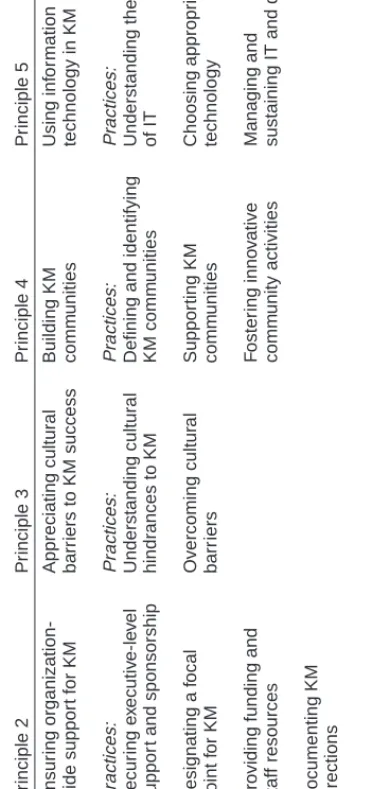
[T]o enhance the Department’s foreign affairs leadership by promoting a knowledge-sharing culture and making new technologies readily available to help provide faster, more effective service to internal and external cus- tomers. This mission reflects the commitments of the Secretary and Under Secretary for Management to putting secure and innovative systems at head- quarters and overseas missions to support diplomacy in the new century, ensuring that the systems meet business needs, and making better use of the knowledge and experience resident in the Department. (DOS 2003, 5) The State Department’s Office of the Inspector General (OIG) conducted a study of the KM activities of a number of other federal, international, and private-sector organizations in its development of an implementation strat- egy for the department. The OIG found that five key processes or principles seemed to be present in most of the KM programs they examined. Table 5.1 is an overview of the five principles and some examples of the practices associated with each principle.
Table 5.1 Successful KM Implementation Principles and Practices Principle 1Principle 2Principle 3Principle 4Principle 5 Recognizing the benefitsEnsuring organization-Appreciating culturalBuilding KMUsing information of KM to the organizationwide support for KMbarriers to KM successcommunitiestechnology in KM Practices:Practices:Practices:Practices:Practices: Understanding theSecuring executive-levelUnderstanding culturalDefining and identifyingUnderstanding the role KM conceptsupport and sponsorshiphindrances to KMKM communitiesof IT Recognizing theDesignating a focalOvercoming culturalSupporting KMChoosing appropriate benefits of KMpoint for KMbarrierscommunitiestechnology Identifying critical businessProviding funding andFostering innovativeManaging and needs as a basis for KMstaff resourcescommunity activitiessustaining IT and data Appreciating differentDocumenting KM approaches todirections applying KM Managing and measuring KM results Source: DOS 2003, p. 10.
KM at the State Department
Since its implementation in 2002, the office of e-diplomacy has used the principles identified by the inspector general to implement several ongoing KM programs. One of its first actions was to establish an intranet to provide information, Internet links, and other resources to aid employees wanting to know more about knowledge-sharing tools and techniques. The KM office also provided software tailored to support classified information exchange and knowledge sharing by department bureaus and missions around the world.
A third early e-diplomacy task was to survey KM initiatives and systems that already existed in the Department of State, with the eventual goal of sharing best practices and coordinating efforts to avoid duplication. The Bu- reau for Administration, Center for Administrative Innovations (A/CAI) was the most comprehensive KM program found. Beginning in July 2001, A/CAI employed a variety of methods to compile and share information on how to make the department’s administrative operations “best-in-class,” and to net- work with other agencies to capture information on effective strategies for improving administrative services.
A fourth e-diplomacy program was overseeing collection of user require- ments for developing a State Messaging and Archive Retrieval Toolset. The department planned to replace its outdated telegram and e-mail technology with a secure, state-of-the art, Web-based system for handling all types of documents. The project used KM practices to determine the best approach to system design and implementation. Other KM early activities included par- ticipating in designing and implementing an open-source information sys- tem, a G8 knowledge management project (Web site), and leading a department-wide collaborative application technology solutions forum.
Measuring E-Diplomacy Program Performance
The Department of State’s FY 2005 performance summary identified three key management priorities: one focused on people (“right-sizing”), the sec- ond on facilities (embassy security, construction, and maintenance), and the third on systems. The systems priority was constructed around a knowledge management framework. Called the State Messaging and Archive Retrieval Toolset (SMART), the purpose of the program is to develop a simple, secure, and user-driven system to support foreign affairs activities around the world.
Designed to replace the department’s old cable system, SMART uses a Web- based technology platform that gives users the ability to share information quickly and economically.
Moreover, it gives department managers and the diplomatic community
enhanced communications capabilities and provides the building blocks for great implementation of knowledge management programs and procedures (DOS 2004).
The last item to be rated in the plan was the department’s progress on the strategic goal of Management and Organizational Excellence: Knowledge Management and Leadership. Results were contained under four categories:
Table 5.2
Partial Results of 2005 Performance Review on KM and Leadership
Actions being taken Expected results of actions
• Improving department intranet site to • The department’s institutional collect, integrate, and share knowledge is made available to its knowledge more efficiently own professionals and to other
foreign affairs, intelligence, and homeland security agencies
• Strengthening collaboration and • Special expertise is easier to locate information sharing with USAID
through a new connection between DOS and USAID
• Creating a global task force on • Employees are more productive and new diplomacy to exploit technology applications more efficient
in new diplomatic and public diplomacy engagement strategies
• Exploiting key technologies to improve the department’s performance worldwide
• Making greater use of classified and unclassified government networks for information exchange and
collaboration
• Developing the State Messaging and Archive Retrieval Toolset, to provide diplomats and managers with enhanced communications and knowledge management tools
• Selecting a vendor to develop a solution for a design/demonstration of a messaging solution to be piloted to over 3,000 users in domestic and overseas locations
• In FY 2005, beginning worldwide deployment of the SMART system
Source: DOS 2004. FY 2005 Performance Summary.
findings, recommendations, actions being taken, and expected results. The actions being taken and expected results points are displayed in Table 5.2.
Moving Beyond Implementation
The three fundamental concepts of knowledge discussed earlier in the chapter
—knowledge as intellectual capital, knowledge as a facilitator of management transformation, and the greatly expanded scope of knowledge—may also be extended to reflect key KM practices. These practices may be seen as answers to the following implementation process questions: What knowledge does the agency have? What knowledge does the agency need? And, how can the agency know that its strategies, program plans, and decision making aren’t simply ex- amples of reinventing the wheel? The basic collecting, sharing, and saving ac- tivities of knowledge management may provide answers to these questions.
Knowledge audits can tell an agency manager what knowledge is resident in the organization and its people; program planning and performance re- views can help an administrator identify gaps in his or her knowledge; and communities of practice and knowledge repositories can tell a decision maker what previous solutions worked and what did not work. Knowledge audits, communities of practice, and knowledge repositories are discussed in greater detail in the following sections.
Conducting a Knowledge Audit
In the private sector, knowledge management implementation has encoun- tered more problems and been forced to endure a larger failure rate than knowledge management in government. Industry consultant Dr. Ann Hylton and others have pointed to the failure of KM programs in business to begin with a comprehensive audit of the extent and location of the knowledge that exists in the organization. In many of the reported failures, the initial knowl- edge analysis stopped with locating the knowledge spelled out in documents and other printed sources. The analysts failed to locate, capture, organize, and disseminate the tacit knowledge contained in the minds of the organization’s workers (Baxter 2002). The purpose, scope, and focus of a knowledge audit is explained in Box 5.1.
The Australian Government’s Information Management Office (AGIMO) has developed a comprehensive checklist of issues and actions that agency managers seeking to adopt KM practices should follow (AGIMO 2004). The first item on the checklist was: conduct a knowledge audit. AGIMO defined a knowledge audit as an inventory of available knowledge assets and re- sources. AGIMO added that the purpose of an audit is to identify and com-
pare the gap between the ideal or desired state of agency knowledge and the existing knowledge environment. The rationale for conducting an audit is because knowledge gaps can impede innovation, block opportunities for per- formance improvement, or hamper technology implementations. Knowledge audits may be conducted at the agency, group, section, or team level, or even the level of the entire public service.
The types of questions the Australian Information Management Office recommended be asked in an information audit include the following:
• What knowledge does the organization need to acquire or develop?
• Where are knowledge flows impeded?
• How can knowledge be better shared and organized?
• What knowledge resources are currently in use?
• What are the current and future benchmarks for knowledge use?
Box 5.1
So What Is a Knowledge Audit? What Will It Investigate and Evaluate?
The knowledge audit (k-audit) is the all-important first major phase, stage, or step of a knowledge management initiative. It is used to pro- vide a sound investigation into the organization’s knowledge “health.”
The k-audit is a discovery, verification, and validation tool, providing fact finding, analysis, interpretation, and reports. It includes a study of corporate information and knowledge policies and practices, and of corporate information and knowledge structure and flow.
The knowledge audit serves to help the audited unit, whether the whole organization or part of it, to determine whether it “knows what it knows” and “knows what it doesn’t know” about its existing knowl- edge state. It will also help it to unearth what it should know to better leverage knowledge for business and competitive advantage. This en- lightenment sets the agenda for the knowledge management initiative, program, and implementation.
A complete knowledge audit will evaluate the organization’s knowl- edge environment, its knowledge ecology—primarily the corporate knowledge structure and the enhancing social and behavioral culture of the people within the organization. The k-audit examines knowl-
edge sources and use: how and why knowledge is acquired, accessed, disseminated, shared, and used. Most importantly, the knowledge au- dit investigates the perceptions of knowledge management effective- ness through the knowing eyes of the knowledge people, the true knowledge workers.
The knowledge audit offers a full and detailed examination, review, assessment, and evaluation of an organization’s knowledge abilities, its existing knowledge assets and resources, and its knowledge man- agement activities. It will help the audited unit to determine what knowl- edge is being managed and how well it is being managed. The audit helps to make the knowledge in the audited unit visible, understand- able, and appreciated.
At the most detailed level, the knowledge audit investigates and evalu- ates the company’s information systems, its processes, and its knowl- edge-enabling tools and technology. It will examine how well current processes support knowledge capture, storage, access, dissemination, use, and sharing. Ultimately, the knowledge audit will reveal knowledge man- agement strengths, weaknesses, opportunities and threats/risks, knowl- edge flow, and gaps, using scientific knowledge auditing methods, systems, and analysis tools. The main knowledge-auditing tools are the knowl- edge survey, the knowledge inventory, and knowledge mapping.
Source: Hylton 2002. Used with permission.
Once a knowledge audit is complete, KM managers turn to ways that the agency’s identified knowledge—and the knowledge held by relevant indi- viduals and outside organizations—is nurtured and multiplied. One way this is done is through encouraging the formation of communities of practice.
Forming Communities of Practice
The knowledge base of an organization is typically spread among many dif- ferent individuals, units, groups, and external stakeholders. A key task of knowledge management is to provide a means for the many diverse knowl- edge holders to share their knowledge and experience. One of the most pow- erful and efficient ways this is done is through the mechanisms of an informal community of persons with like concerns or interests. These communities of like-minded individuals, in fact, are often referred to as “the lifeblood of KM
programs,” and one of the “key building blocks in the organization and man- agement of [agency] innovation and creativity” (AGIMO 2004; Ash and Cohendet 2004).
Two similar but fundamentally different labels are often used interchange- ably when referring to these groups: communities of interest and communi- ties of practice. As a result, they are often mistakenly taken for one another.
Agencies also use a variety of other terms to describe either or both of these groups, such as learning networks, knowledge communities, competency networks, and others (Wenger, McDermott, and Snyder 2002). However, it is important to remember that the two are different; communities of interest are not communities of practice, although communities of practice may also in- corporate communities of interest.
A community of interest is a particular type of network that features peer- to-peer collaborative activities to build member skills as well as organiza- tional and societal capabilities. Communities of interest are people who share a common interest in a topic but who do not necessarily depend upon each other’s contributions to advance their knowledge. A community of practice, however, is a group of people voluntarily agreeing to work with one another to exchange and share knowledge that is gained from experience and that is of- ten not available in any other form or from any other source. A community of practice is held together by an informal bond of shared purpose and experi- ence; members willingly share the learning and knowledge they have devel- oped through their experience in discussions, stories, examples, arguments, and even disagreements. This sharing is facilitated by group discussions, one- on-one conversations, private reading about new ideas, or watching other knowl- edge workers disagree over cutting-edge issues (Ash and Cohendet 2004).
How Communities of Practice Facilitate Change
Among the many benefits public-sector managers have identified for com- munities of practice are these three recommendations for what the federal government can do to spur improvements at the local level on a national scale (Snyder and Briggs 2004):
1. Sponsor and support local communities of practice to achieve out- comes that require ongoing innovation and action-learning. A federal community of practice can serve as a community sponsor, provide strategic focus, make available seed funding, and provide institutional legitimacy. Also, federal community coordinators can help develop a learning agenda for local participants, build the community, and lead outcome-oriented initiatives. The federal agency can also serve as com-
munity champions, provide support staff to bridge formal-unit barri- ers, coach community initiatives, and liaise with sponsors and stake- holders.
2. Coordinate community goals with agency imperatives and policy mandates. Coordination actions include linking the community’s learning agenda with agency objectives; leveraging community ca- pabilities by implementing them in recognized service-delivery sys- tems; and partnering with community of practice members to accelerate the spread of good ideas.
3. Make it possible to leverage the power of the federal government in order to broaden the scope and scale of pilot projects. Leveraging can turn a relatively small investment in infrastructure and senior executive attention into the means for more learning networks and thereby achieve results not otherwise possible.
Leveraging Core Dimensions
The effectiveness of a community of practice depends on strength in three core dimensions: its domain, community, and practice. Domain refers to the focus and identity of the group. For example, a domain of a community of practice in the homeland security area might be airport security. Community refers to the relationships and interactions among the members of the com- munity. The airport security community might involve members of local, state, and federal law enforcement agencies, fire and medical agencies, anti- terrorism agencies, airport management, airlines and support organizations, and others. Practice refers to the community’s best practices, methods, and learning activities that give members of the community their particular edge.
For the airport security example, practice might include a collection of inter- national best practices examples of airport security programs. The binding cord that holds the community together might be a combined commitment to ensuring that the nation has a secure, safe, and efficient air travel system.
Practice also refers to the special skills of the subgroups of a larger CoP. In airport security, a special interest group within a CoP might be law enforce- ment personnel; another might be fire fighting professionals; and another might be communications personnel. The dimensions of domain, commu- nity, and practice are, of course, highly interrelated. Sample components that help to define each dimension include the following:
1. Domain
• The domain of a community of practice can be the issues or prob- lems that practitioners battle with or what they consider essential to the task.
• In some cases, it is particularly challenging to set the boundaries for a domain; they can be too narrow or too broad.
• Members typically have a strong interest in the topic and an under- standing of how it can contribute to an organization’s effectiveness.
• In the political context, legitimacy and attention is given to domain, to the citizens affected by it, and to the practitioners who care about it.
2. Community
• This includes community members at various levels: conveners, core group, and active and peripheral memberships. Leadership by an effective community coordinator and core group is essential.
• Members exhibit feelings of trust, openness, belonging, shared common values and commitment, and commitment to others in the network.
3. Practice
• Practice refers both to methodologies and to skills. It includes the
“best practices” exemplars in the domain. These can be contained in documents, or exist as the tacit skills of skilled, knowledgeable staff.
• Practice includes the techniques, methods, stories, tools, and pro- fessional attitudes of the members.
• In addition, it includes learning activities engaged to build, share, and apply the practice.
CoPs with State and Local Governments
Snyder and Briggs (2004) determined that at least four types of situations exist in which managers in federal agencies might want to establish commu- nities of practice with state and local governments:
Building new capabilities: Departments or agencies could convene and cul- tivate a community of stakeholders at the national level in order to provide guidance and leadership for the variety of federal mandates and policy direc- tives or best practices that state and local agencies must or might implement.
Increasing current capability levels: In many cases, the problem is not to build a new capability, but rather to lift an established capability to a new level—or even to simply maintain it at its existing high performance levels.
This situation occurs regularly in those agencies in which key personnel are regularly rotated from position to position, or posting to posting, as with military and State Department personnel.
Integrating new capability dimensions: Communities of practice are good for integrating new dimensions into established operations. For example, fed- eral agencies have been mandated to incorporate a variety of e-government capabilities to reduce operational costs and to increase citizen access and convenience. State and local governments are following suit as fast as their
intellectual and financial resources allow. As technological advances occur, the CoP might be the best source for disseminating information about such advances in tools, procedures, and policies.
Attracting, retaining, and developing talent: Every agency in the fed- eral government—like organizations nationwide—is faced with a demo- graphic “time bomb” that threatens to see nearly half their employees retire by 2010. One way that communities of practice can build organizational capabilities is by providing professionals a forum for sharing their learning with new or younger staff members. The CoP can also be a forum through which new hires may test ideas and innovations. Possibly most important, it can also be a place for building relationships and gaining a sense of commitment and professional identity with colleagues. The informal sense of belonging among practitioners and associated opportunities for profes- sional development may be the most beneficial capacity that government organizations have that enables them to attract, retain, and develop top talent. The army’s very successful CompanyCommand community of prac- tice is an example.
Communities of Practice in Practice
By 2005, there were hundreds if not thousands of communities of practice effectively functioning at the federal, state, and local government levels, and their numbers keep growing every year (O’Hara 2004). These range in size from fewer than five members to the more than 7,000 members of the army’s CompanyCommand CoP. And some may be even larger. The smallest community sponsored by the Department of Health and Human Services (DHHS)—the SAS Users’ Group—listed just two members. The two largest DHHS communities were the Division of Medicare Opera- tions–Chicago, with 353 members, and the Survey and Certification Website CoP, with 309 members. A typical example at DHHS is the Knowledge Management Integration community of practice, with 38 members. The mission of the group is to integrate KM efforts throughout the department’s management services group, while increasing knowledge exchange inter- nally. The integration CoP listed the availability of five recent information libraries: knowledge management courses, DHHS taxonomy, a link to FAA taxonomy, retirement CDs, and an informational brochure for a 2005 KM Fair.
Almost every agency has at least one currently functioning CoP. For ex- ample, the DHHS communities of practice home page lists 38 CoPs, the Federal Highway Administration sponsors more than 20 communities, and the Federal Aviation Administration has more than 10 communities. The fed-
eral Chief Information Officers (CIO) Council’s knowledge management working group has listed these special interest groups (SIGs) within the CoP (KM.gov 2004):
• Communities of Practice. This “CoP on CoPs” is a government-wide network of people interested in learning about and sharing experiences in establishing and supporting CoPs as a means to address compelling business needs within their organizations.
• Knowledge Retention. This community is sharing information of col- lecting and archiving knowledge that might be lost due to employee retirements.
• Taxonomy and Semantics. This SIG is being formed in response to questions and concerns about taxonomies, thesauri, indexing, topic maps, ontologies, and how the semantic web activities support KM in government. The mission statement of this CoP is displayed in Box 5.2.
• Technology and KM.gov Content. This special community SIG assesses technologies claiming to support or enhance knowledge management efforts. KM.gov is the federal government’s communications tool (e.g., journals and a Web site). Box 5.3 includes a list of some of the technol- ogy tools used in running a community of practice.
• Policy and Outreach. The purpose of this group is to educate such stake- holders as the administration, Congress, and other public policy organi- zations about knowledge management and how it can help the federal government achieve its objectives.
Starting the Company Commanders’ CoP
Writing for Federal Computer Week, Colleen O’Hara (2004) identified the U.S. Army’s CompanyCommand community of practice as possibly the most successful of the many federal government CoPs then in operation. The story of how that community was born was told by two of its founders at the March 2, 2004, meeting of the Knowledge Roundtable in Washington, D.C.
Army majors Nate Allen and Tony Burgess were neighbors and com- pany commanders in the same Brigade at Lanai, Hawaii. The two officers met as often as possible during the evenings to share experiences about what was going on in their companies. They soon concluded that it would be great if other company commanders could easily share their ideas with like-minded leaders across the army. Every captain they spoke with agreed that finding a better way to share their concerns was a great idea. How- ever, at the time, no forum existed that made it possible. And, after com-
Box 5.2
Mission Statement of the KM.gov Taxonomies and Semantics SIG
The Taxonomies and Semantics SIG is a community of practice whose members have a common interest in both the theory and prac- tice of taxonomies and semantics. As a community of practice, mem- bers identify areas of common interest and the SIG provides opportunities to learn and share knowledge. The scope of interest for this SIG potentially is very broad. The SIG does not limit the scope, rather provides boundaries by defining what is meant by “taxonomies”
and “semantics.”
Taxonomies are defined simply as the structures used to organize information. . . . From an information science perspective . . . taxono- mies may take on one or a combination of several types of structures—
they may be simple flat structures, hierarchies, network/plex structures, or faceted taxonomies. Each of these kinds of structures serves as a different kind of information management and access purpose. All are critical for supporting today’s complex information solutions and are integral components of today’s complex information systems.
Semantics are at base the processes that use or create values for taxonomies. Without semantics, taxonomies are simple or elaborate but empty structures. Officially, semantics is a branch of linguistics that deals with the study of meaning, changes in meaning, and the principles that govern the relationship between sentences or words and their meanings. . . . Semantics involves the study of the relationships between signs and symbols. From an information perspective, seman- tics also involves effective information communication within and across languages, information surrogation, information organization, and discovery.
The SIG supports several types of activities, including informal open lunch discussion sessions, formal speaker and panel programs, online discussions, and knowledge interchange. The SIG also alerts members to educational and training events, conferences, associations, journals in the field, and new books on these topics.
Source: Hsu 2004.
Box 5.3
Some Technologies Used in Running Communities of Practice
• Face-to-face conferences
• Experts’ and panel presentations
• Online discussions
• Chat rooms
• “Brown bag” luncheon presentations
• “Water cooler” meeting areas
• In-agency coffee houses
• After-work social events
• Teleconferences
• Special face-to-face meetings
• Special projects
• On-site visits and informal one-to-one interactions
• Federal agency–champion visits to local partner communities
• One-to-one interactions by phone and e-mail
• Intranets
• Web sites [information published for all network members]
• Listservs [information sent to selected external groups and members]
Sources: AGIMO 2004; Lesser and Storck 2001.
pleting their assignments most commanders were transferred to other positions, which left them no way to continue to tap into the collected knowledge after they were gone. More critical, newly appointed com- pany commanders did not have any way to find out how others dealt with similar problems. The rapid growth of the Internet presented a solution to their problem.
By chance, the two ran into a volunteer, Steve Sweitzer, who designed a Web page for them for no charge. In just two months, they had collected a team of officers who contributed their input and time to make the CoP a success. By 2005, membership had grown to more than 7,000. With this growth came an increasingly wider scope for the community. The vision of the CoP became, “Every company-level leader worldwide connected in a vibrant conversation about leading and building combat-ready teams” (O’Hara
2004). Allen and Burgess would like to see every company-level leader in the army—past, present, and future—connected in a conversation about build- ing effective units.
Companycommand..army.mil also supports “ProReading,” a professional reading program service for company commanders. This program provides the army’s more than 20,000 company-level leaders with “best practices”
models of how their fellow officers mesh professional reading with mis- sion accomplishment by showing members how dedicated commanders
“made it happen.”
The Role of Knowledge Repositories
One of the great advantages of the community of practice system is that the community is able to function as a virtual, living storehouse—or repository—
of knowledge (Lesser and Storck 2001). As such, it makes it possible for members to reuse the knowledge and experience gained by other members.
Most government communities of practice maintain some form of elec- tronic library as a repository of their collected knowledge. When the knowl- edge of an organization is collected and organized in relevant, shared categories, it makes it easy for other and newer members of an organiza- tion to access and apply the knowledge they need. Such a system is an efficient means of recycling intellectual capital, making it possible for agen- cies to achieve more with their increasingly limited resources. According to Lesser and Storck, such repositories provide a number of important ben- efits (2001, 838):
• They provide a common virtual workspace, where members store, or- ganize, and download prior presentations, tools, and other material com- munity members consider valuable.
• The presence of a meta-data system not only allows users to access and use information, it also adds to the credibility of the data by let- ting the user know the name of the individual who initially developed the information.
• The inclusion in the repository of human interventions, such as con- tent managers or teams, ensures that the collected information remains new and relevant. Content managers can also serve as “traffic cops,”
able to direct searchers to particularly relevant sources the searcher might otherwise miss.
• Storehouses also provide a mechanism for evaluating the trustworthi- ness and reciprocity of members by providing a record of who shares what and when.
An example of how a knowledge repository functions within a commu- nity of practice framework is NASA’s Virtual Research Center (VRC), a Web- based project-management information and knowledge-sharing system implemented in 1997 (NASA 2002). The system uses such knowledge man- agement tools as a document manager, an action item tracker, a calendar, a team directory, a threaded discussion tool, and an activity log. By 2002, the VRC community of practice had more than 3,300 registered members, work- ing on over 175 project teams, and with nearly 15,000 files stored in VCR team libraries.
As NASA continued to grow the community, it initiated such projects as developing ways to incorporate object-oriented software technologies, and become the environment for both knowledge management and collaborative engineering. Resources such as a threaded discussion tool will provide teams the capability to describe their experiences and thought processes. A search engine gives users the capacity to search through seventy-five different re- pository file formats for keywords.
Conclusion
Three concepts of knowledge support the idea that investments in knowl- edge management systems can contribute to successful implementation of such important government programs as e-government, homeland security, privatization and market-based delivery of government services, collaboration, and performance management: (1) the knowledge held by an organization’s people and individuals from outside of the agency constitute an agency’s intellectual capital. Intellectual capital refers to an organization’s recorded and remembered information, experiences, and human talent; (2) knowledge management concepts of learning organizations and best-practices process are core elements in the President’s Management Agenda (PMA). These two concepts optimize organization time, costs, and quality through KM pro- cesses; (3) identification and management of an agency’s knowledge base underlies all processes in e-government.
The Knowledge Management Roundtable determined that three difficul- ties contribute to KM failures: KM not being a priority of senior manage- ment; lack of a knowledge-sharing in the organization; and lack of time or KM priorities of knowledge users.
Three basic processes of knowledge management are: knowledge ac- quisition, knowledge sharing, and knowledge utilization. Acquisition is the process of developing and/or creating intellectual capital, including insights, skills, experiences, and relationships. Knowledge sharing is dis- seminating and making available the collected knowledge of the agency
and its staff. Knowledge sharing is enabled through a social process made possible by an organizational culture that honors and rewards sharing activities. Knowledge utilization is the process of integrating knowledge into the agency.
The three fundamental concepts of knowledge—knowledge as intellec- tual capital, knowledge as a facilitator of management transformation, and the greatly expanded scope of knowledge—may also be extended to reflect key KM practices.