PRINCIPLES OF HUMAN ECOLOGY
Peter J. Richerson
Department of Environmental Science and Policy
University of California, Davis Monique Borgerhoff Mulder Department of Anthropology University of California, Davis
Bryan J. Vila Department of Sociology
University of Wyoming
The general format and content of this manual © 1991, 1993, 1995, 2001 by Peter
J. Richerson
Stylistic modifications and enriched content © 1992, 1993 by Bryan J. Vila
and Monique Borgerhoff Mulder
Acknowledgments
Human Ecology is a nascent field for which there is no satisfactory textbook.
We have essentially written our own by exanding our lecture notes during the past several years. The book has been evolving, mainly with the help of our students and teaching assistants at Irvine and Davis. We very much appreciate their patience with past imperfect versions and their generous help with constructive criticism.
The book is still imperfect. We beg your indulgence and invite your comments and critiques. We are especially interested in ferreting out presentations that are dull, incorrect, or confusing, expanding those features and sections that you find exciting and enlightening, and discoving major gap in our coverage. Let us know!
Jennifer Pollock, Elaine Fang, and Jane Foster helped immensely in scanning in figures, entering and proofing text, and in other chores which greatly improved the quality of the text.
Much of Chapters 11-14 and 23 derives
from Richerson’s collaborative work with
Robert Boyd, without whose contribution
they would not exist. One of the early
intructors in this course, Davis
anthropologist William G. Davis, helped
establish the basic form of the course over
about a decade of co-teaching it with
Richerson. His stamp is still strong on
Chapters 2-7. We especially thank them,
but also absolve them from any
resposiblity for the use to which their ideas have been put here.
Many colleagues over the years have improved our ideas about himan ecology in spritited discussions and helpful pointers to the literature. Most of them are recognized our citations to their work here.Barbara Sherry of Simon and Schuster Custom Publishing and her coworkers are responsible for the very professional appearance of this version of the material.
Peter Richerson, Monique Borgerhoff Mulder, and Bryan Vila
Give comments to any of the authors or send to:
Peter Richerson, Professor Division of Environmental Studies
University of California Davis Davis, CA 95616 [email protected]
Table of Contents
Chapter 1. What Is Human Ecology?
Relationship between human ecology, biological ecology, and the social sciences.
A synthetic or open discipline. Coping with complexity and diversity. Classical
"discoveries," "concepts," and "models."
Hypotheses and plausibility arguments.
Virtues of general models.
Chapter 2. Environment, Technology, and Culture. Discovery of human diversity in time and space. Concepts of culture and the "culture core." The
discovery of regularities in the relationship between technology, environment, and evolutionary level in human societies.
Part II. Human Natural History Chapter 3. Hunting and Gathering Societies. Implications of dependence on wild plants and animals for demographic variables, settlement patterns, and social organization.
Chapter 4. Horticultural Societies.
Implications of plant and animal
domestication for demographic variables, settlement patterns, and social
organization.
Chapter 5. Pastoral Societies.
Implications of an emphasis on livestock
herding on demographic variables,
settlement patterns, and social
organization.
Chapter 6. Agrarian Societies.
Implications of advances in agricultural technology for demographic variables, settlement patterns and social organization.
Chapter 7. Commercial/Industrial Societies. Implications of an emphasis on trade and manufacturing for demographic variables, settlement patterns, and social organization.
Part III. Processes of Human Evolution Chapter 8. Basic Demographic Concepts.
Models of population growth and
regulation. Concept of age structure. The population concept.
Chapter 9. Natural Selection and Biological Evolution. The discovery of biotic diversity and evolution. Basic models of biotic evolutionary processes.
Chapter 10. The Sociobiology
Hypothesis. Relevance of natural selection to human behavior. Evolutionary theory of behavior. Some human examples.
Chapter 11. Mechanisms of Cultural Evolution. The population concept applied to culture. Basic models of the
mechanisms of cultural change. The similarities and differences between organic and cultural evolution.
Chapter 12. Natural Selection on Cultural Variation. Discovery that human decision-making powers are weak.
Model of the consequences of selection on
cultural variation. Costly information
hypothesis; an amended proposal for the relationship between genes and culture.
Chapter 13.Evolution of Social
Organization. The evolutionist’s concept of altruism (or the economist’s of public goods). Models of kin and group selection.
Discovery that cooperation rare in nature.
A model of the adaptive advantages of conformist transmission. A model of group selection on cultural variation, a
hypothesis to explain the large scale of human cooperation.
Chapter 14. Evolution of Symbolic Traits. Concept of symbols. Discovery of human symbolic diversity. A model of the indirect bias mechanism. The runaway process, a hypothetical mechanism to underpin group-functional and functional theories of symbolic diversity.
Part IV. Systemic Interactions 1. Demographic Processes
Chapter 15. Population Regulation in Human Societies. Fundamental importance of demography to understanding human behavior.
Demographic diversity in time and space.
Malthusian, Ricardian, and Boserupian models. The European demographic transition.
Chapter 16.Crime and Criminology.
Concepts of crime versus criminality.
Ecological, micro-level and macro-level
factors. Causes and correlates of crime.
2. Society/Society Interactions
Chapter 17. Commerce and Trade. The concept of division of labor. The "Law of comparative advantage" model of the benefits of the international division of labor. Monopoly and other coercive models of trade. Trade as a stimulus to technical evolution.
Chapter 18. Warfare and Population Displacement. A game-theoretic model of violent conflict. Varieties of warfare.
Demographic effects. Role in technical progress. Other forms of inter-societal competition.
Chapter 19. Diffusion of Innovations.
Patterns in the spread of ideas within and between societies. Empirical evidence for direct and indirect bias mechanisms.
Hypothesis that diffusion of innovations between societies is responsible for rapid evolution.
Chapter 20. Disease Exchanges.
Discovery of role of disease in human population interactions. Concept of endemic versus epidemic diseases.
Epidemiological models. Disease patterns as a function of level of technical
development. The evolution and exchange of new diseases.
3. Technology/Environment Interactions.
Chapter 21. Technology and Environmental Deterioration:
Preindustrial Societies. Concepts of
environmental deterioration and
coevolution. Examples of positive and
negative feedbacks of environmental alterations by preindustrial people.
Overkill hypothesis for Terminal Pleistocene extinctions. Role of
environmental "deterioration" in cultural evolution.
Chapter 22. Technology and
Environmental Deterioration: Industrial Societies. Argument that industrial
societies have as strong interactions with their environment as preindustrial ones.
Concept of public choice. Concepts of risk and uncertainty. Role of value conflicts and limited information in limiting adaptive responses to environmental degradation. Voting paradox model.
Part V. Evolutionary Transformations of Human Ecological Patterns.
Chapter 23. Macroevolution:
Microevolutionary Processes and the History of the Human Species. Concept of micro versus macroevolution (time scales). Concept of uniformitarianism.
Punctuational versus gradual models.
Externalist and internalist models of historical process.
Chapter 24. Origin of the Human
Adaptive Pattern. The discoveries of the Pleistocene climatic pattern and of the mosaic pattern of hominid evolution.
Externalist and internalist hypotheses of hominid evolution.
Chapter 25. The Origin of Plant and
Animal Domestication. The discovery of
the Neolithic. Externalist and Internalist
hypotheses to explain the origins of agriculture.
Chapter 26. The Origin of States and Stratification. Historians’ and
archaeologists’ discoveries regarding the development of complex societies.
Functional (voluntaristic) versus coercive hypotheses for the origin of states.
Chapter 27. The Development of Commercial and Industrial Societies.
The concept of modernity. Hypotheses regarding the failure of agrarian states to routinely modernize. Hypotheses to explain why the key breakthrough to modernity occurred in Europe.
Chapter 28. Summary and Review. A summary of the ecological perspective on human behavior.
What Is Human Ecology?
Part I. Introduction
Chapter 1. What is Human Ecology?
Chapter 2. Environment, Technology, and Culture
2 What Is Human Ecology?
Chapter 1. WHAT IS HUMAN ECOLOGY?
Another Unique Species
(Title of Robert Foley’s 1987 book on evolutionary human ecology)
I. Introduction
What is human ecology? Human ecology is an approach to the study of human be- havior marked by two committments. First, human ecologists think that humans should be studied living systems operating in complex environments. The human sciences are bal- kanized into several social science, humanistic, and human biological disciplines. Ecolo- gists are used to thinking that systemic nature of individual organisms and populations of organisms mean that we typically have to understand how diverse parts of the system op- erate together to produce behavior. The traditional human science disciplines take people apart; human ecologists endeavor to put us back together. Breaking complex problems down to operationally tractable parts is a great strategy, but only so long as some are co- mitted to puting them back together in the end! Second, human ecologists think that hu- mans are subject to very similar ecological and evolutionary processes as any other species.
Of course, humans are unique, and this fact has important consequences. However, we think that the deep rifts between human biologists and social scientists (and between scien- tists and humanists for that matter) are a deeply embarassing scandal that honest scholars are obligated to repair as expeditiously as possible.
Why study human ecology? As Dr. Vila puts it: “I regard the study of human ecology as much more than an enjoyable intellectual challenge. I’ve spent the majority of my adult life dealing with human aggression and violence: as a young Marine in Viet Nam; as a street cop in Los Angeles; as a police chief in the emerging island nations of Micronesia; and as one of the people responsible for planning for the continuity of our national government in the event of a nuclear war. These experiences have led me to believe that it is imperative that we gain a fundamental understanding of why humans sometimes cooperate and behave altruistically—and why they sometimes act in the opposite fashion.”
The lack of good, well-verified answers to the big questions in human ecology, and in the human sciences more generally, is a bit scary. Our high level of ignorance of the caus- es of human behavior is not reassuring. Several of the ideas we will introduce are positively chilling. For example, we will discuss the idea that arms races and the dangerous game of war are virtually a natural phenomenon and thus extremely difficult to control. We will also discuss evidence that there is no guarantee that human collectivities can act according to
What Is Human Ecology? 3
simple norms of rationality, and how absurd cultural norms can arise through simple sys- tematic processes involving positive feedback (i.e., vicious cycles). Sleepless nights can re- sult from the realization that we share the planet with a large, dangerous, unpredictable animal—each other. Writing some lectures in this course sometimes feels a bit like writing the script for a horror movie, except that it really happens! Perhaps the most important prac- tical message of this course is this:
Of course, people are often beautiful, charming and certainly always interesting. For scientists, there is the challenge of the unknown. If people were well understood they’d also be boring. Let us not overdo the misanthropy!
Welcome to the frontier! Human ecology is an area of science where the frontier problems of the discipline can be presented to an upper division class. We’ll try to expose you to this frontier as the quarter progresses. You will see that we have more interesting hypotheses than firm answers, and no little amount of plain confusion.
We hope that you will enjoy this aspect of the course. The frontier is where the real problems are at for a practicing scientist. Most of them learn to enjoy operating on the edge of the known, trying to convert ignorance and confusion into tolerably reliable knowledge.
Actually working on the scientific frontier to reduce chaos, error, and confusion to orderly knowledge is apt to be confusing, boring, and hard work—like life on a real frontier. Sci- entists suffer all this for the occasional thrill that comes from discovering an important bit of new knowledge for oneself. Most science is a poor spectator sport; you need a couple of years of post-graduate education just to work your way up to the frontier. Human ecology, because it deals with relatively neglected problems, has a more approachable frontier. We hope you’ll enjoy like on the frontier
THE PRACTICAL MESSAGE:
We do not yet know enough about humans to reliably control our more dangerous and de-
structive behaviors. Until we do, the human adventure is liable to be often a little more ex-
citing than one would like. No need to panic right here right now, but, as you know from the
newspaper things can get hairy!
4 What Is Human Ecology?
II. Basic Concepts of Human Ecology A. Basic Definition
Human ecology is the study of the interactions of humans with their environments, or the study of the distribution and abundance of humans. This definition is based directly on conventional definitions of biological ecology. Ecology is usually defined as the study of interactions of organisms with their environments1and each other. More pointedly, it can be defined as the study of the distribution and abundance of organisms. This definition is deceptive. It implies much more than it says explicitly because virtually everything that humans are or do (and the same goes for any species) affects their distribution and abun- dance. Thus, using the term “human ecology” actually expresses a broad ambition to un- derstand human behavior.
B. Borrowing Concepts from Biology
The basic rationale for human ecology is that concepts and methods shared with the biological sciences ought to be useful to understand human behavior. Our behavior is taken to be just a special case of general ecological processes (as any particular species is a spe- cial case). This idea has a long history—in demography, for example. Malthus’ pioneering ideas about human population explosions played a large role in Darwin’s thinking about all populations. Darwin’s ideas about natural selection in turn have had a large influence on how we think about humans. As Foley’s title in the epigraph indicates, humans may be a peculiar beast, but then so is every other species. We agree with Foley that humans can’t stand in some splendid isolation from the rest of nature.
It the next lecture we introduce the classic “culture core” model of how we’re nec- essarily connected to the environment. To preview, people have to make a living by extract- ing resources from the environment. So do all organisms. Typical organisms use organic structures directly to moke a living; lions kill prey with their teeth and monkeys grind hard seeds with their teeth. People do a little of the same, but most of our adaptations revolve around complex traditional skills we have learned from others. Human populations have a given basic set of tools (technology), whatever their evolving cultural tradition has devel- oped to that point. The details of the toolkit will vary adaptively in the context of the given type. For example, hunting societies that live in environments rich in aquatic resources will
1. Environment is defined as the circumstances, objects, or conditions by which one is surrounded.
These usually include the complex of physical, chemical, and biotic factors (e.g., climate, soil, and living things) that act upon an organism or an ecological community and ultimately determine its form and survival. When discussing humans, “environment” often includes the aggregate of social and cultural conditions that influence the life of an individual or community. The definition leaves it up to the analyst what to put inside the population and what outside in the environment. Always watch this move closely!
What Is Human Ecology? 5
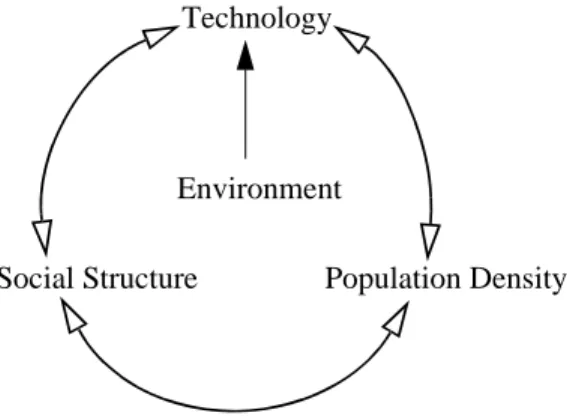
use harpoons, whereas desert dwellers will lack such devices. Our technological traditions are so variable from place to place and time to time that ecologically we function as if we were many different species. The application of a given technology in a given environment will strongly influence (or at least strongly constrain) the density of people that can be sup- ported and the effort that must be devoted to subsistence. Population density (and the pos- sibilities for aggregation into large settlements versus the need to stay dispersed to exploit extensive resources) will determine (strongly constrain) social organization. Complex so- cial interactions require many people, which is impossible in a dispersed, low density soci- ety. The extreme specialists (e.g. college professors and students) require that food production be efficient per producer, so that a few producers can support us “parasites” [ev- er hear a farmer grumble about city-dwelling parasites? If not, we’ll bet you don’t know many farmers.]. At the same time, societies must mobilize the same basic technology in dif- ferent ways, depending upon the resources the environment offers. At least environment, technology, demography, and social and political organization ought to highly systemic with the primary causal arrows leading from environment and technology to demography to social and political organization. Perhaps even some symbolic features of culture like re- ligion may have some systematic relationship to ecology (see Figure 1-1) As we’ll see in more detail in Lecture 2, technology, social institutions (the cultural rules that organize so- ciety and politics) and any other elements of culture that impact technology and demogra- phy, are important parts of the human ecological system. Julian Steward, a pioneering human ecologist, called these parts of culture the “culture core.” He meant to distinguish this ecologically relevant core from many aspects of culture that may not be closely related to ecological processes. What language one speaks is not a core feature for example be- cause all languages are functionally equivalent, at least to a first approximation..
C. What Will We Use From Biology?
The basic common core of ecology and evolution is sometimes called population bi- ology. Human ecology borrows a complex of ideas from population biologists. The most basic of these are the ideas of population growth and regulation in a single population, as developed by demographers. If we add heritable variation, such as genetic variation to the population, then different types will compete. Some will survive and reproduce better than others, and the more fit types will replace the less fit. This is Darwin’s idea of natural se- lection. Since the effect of natural selection depends upon the environment--a variant that fails in one environment may succeed in another--natural selection tends to produce diver- sity. We often say that it adapts organisms to the environment that they live in. Then, we need to think about individuals of a population interacting with each other as well as the outside environment. The evolution and ecology of social interactions is often called socio-
6 What Is Human Ecology?
biology. Next, we can try to use community ecology, the study of how individuals and pop- ulations interact with each other via, competition, predation, parasitism, and mutualism.
For example, if competitors are too similar in their resource use, the more efficient user of resources drives out the less. This is called competitive exclusion, and is rather like natural selection at the level of species instead of genes. Ecological communities tend to be com- posed of specialized species, each occupying a unique ecological niche. It is often useful to think of the community of organisms plus the interacting abiotic factors on a give site as a system of interacting parts, and ecosystem. We also need to recall that the organisms have effects on environments as well as vice versa. The important early 20th Century evolution- ist R.A. Fisher called this environmental deterioration. Often, when one population evolves, say cheetahs become leaner and faster, the environment deteriorates as far as prey like impala are concerned. Now, selection will start to favor faster, more alert impala too, which then deteriorates the environment for cheetah. This cyclical round of deterioration and evolutionary response is termed coevolution.
All of you undoubtedly have a passing familiarity with at least some of these con- cepts. If your knowledge is rusty, not to worry. We’ll review these them in some detail be- fore we apply them to humans.
D. Borrowing by Homology
We can apply ecology and evolution to humans as just another animal. This is mak- ing use of homology. Humans really are a species of ape after all. We share many basic an- atomical features with other apes, as well as subtler things. For example, all apes have a very long juvenile dependent period compared to most mammals, and there is likely to be some common evolutionary ecological reason why we share this feature and common con-
Technology
Environment
Population Density Social Structure
Figure 1-1. Diagrammatic representation of Culture Core
concept (see Fig. 2-3 for another representation ).
What Is Human Ecology? 7
sequences for the rest of our behavior and relations to the environment. Apes have very ru- dimentary abilities to learn language. Many people are studying ape protolanguage with the idea that the brain structures that permit apes to have a little language served as the basis for our much expanded capacities. We have a lot in common with all of the mammals and have some interesting parallels to the social insects.
Comparative evolutionary ecologists often cast a wide net in animal comparisons, under the assumption that all ecologically similar creatures will follow a similar logic.
Wolves, lions, porpoises, tuna, and army ants are not very closely related, but they are all social predators. Some human populations are also social predators. Perhaps, ultimately be- cause of the imperatives of natural selection, they follow the same basic rules of optimal foraging as other social predators. Perhaps even rarified types like fly fishermen follow some of the patterns expected of solitary foragers. Human sociobiologists have derived a variety of predictions from general evolutionary optimal behavior models to apply to hu- mans, often with good success.
E. Borrowing by Analogy
Some of the unique attributes of the human species are only loosely analogous to commonly studied biological phenomena. We may still wish to borrow ideas from biology because the human phenomenon is similar enough to the non-human to get a good inspira- tion for theory or method from the borrowing. There is actually a long history of borrowing analogies back and forth between biology and social science. “Natural selection” is derived from an analogy with plant and animal breeding--artificial selection. The ecologists’ term
“community” is derived from an analogy with human communities. Analogies are a dan- gerous form of borrowing if the similarities are too superficial, and especially if the bor- rower is unaware of where the two phenomena being compared part company. Perfect analogies are rare. On the positive side, if theory or method happen to be better developed in one discipline than another, then intelligent borrowing using analogy saves a lot of time.
It turns out that social scientists have tended to neglect population phenomena compared to population biologists. In the key area of Darwinian evolutionary theory, by the 1970s social scientists had fallen perhaps 40 years behind. As biologists and biologically inspired social scientists discovered this neglect, the current generation of cultural evolutionists embarked on a number of controversial, but on the whole successful, analogical projects.
Several analogies have attracted attention:
Culture is like genes: Humans are unusual in the degree to which we get our behavior by imitation from our parents and others. Getting ideas by imitation is somewhat analogous to genetic transmission. What difference does it make if you learn how to make a pot from mom versus inheriting a gene for potmak-
8 What Is Human Ecology?
ing from her? Either way, if you make good pots, your survival and your kids survival may be enhanced relative to people who make bad pots. Of course, we have to be careful. Culture is also unlike genes in a number of respects. We explore this analogy in detail in lectures 12-15.
Human societies are like species: In most species, all populations have the same basic adaptation. Human adaptations are much more diverse. Some pop- ulations are mainly plant eaters, others are mainly predators. Some predatory populations emphasize fish, others once hunted mammoths. We want to under- stand how this diversity can arise, and why specific humans have the adapta- tions they do. Of course, humans are a single biological species; different populations interbreed freely and successfully. Much of the human ecology that we explore in the next 5 lectures and in Part III of the course is based on the analogy of ecologically specialized human societies to species.
Human societies are like ecological communities: Within any one human so- ciety, there are a few to many subgroups specialized to do different things.
Minimally, human societies usually specialize tasks by age and gender. Hu- man gender roles are often as different as typical species adaptations in natural communities. In complex societies like ours, there are often hundreds or thou- sands of differentiated occupations requiring very substantially different skills to be successful, and specialized intergating organizations linking all the occu- pational specialists into a rather tightly integrated social system. A big city with its massive flows of matter and energy in and out together with its com- plex human community is a large ecosystem unto itself.
Human societies are like bee, ant, and termite colonies: Only a few species live together in large numbers and cooperate extensively. Biologists call these species ultra-social. Many of the more social of the social insects have hun- dreds of thousands of individuals each the colony, all cooperating, dividing tasks, and the like. Humans are also counted among the ultra-social animals, although the means we use to achieve ultra-sociality are apparently quite dif- ferent. The workers in insect colonies are close relatives, usually sisters, or brothers and sisters in the case of termites. How humans achieve a similar re- sult by other mechanisms than family solidarity is an important topic.
Humans are like peacocks, bowerbirds, song-sparrows, flowers, and tropical fish: We are a gaudy, noisy lot. Biologists suppose that the beautiful plumage of birds, their singing, and even the colorful displays of flowers, are analogous to advertizing. Male peacocks may be signalling the quality of their genes to mates. Singing birds are often warning neighbors to stay off their territories.
Flowers are advertising the quality of their nectar reward to insect pollinators.
Darwin was so struck by the analogy between animal and human signalling that he put his main discussion of humans and his main discussion of signalling in the same book, The Descent of Man and Selection in Relation to Sex (1871).
Human language is the most spectacular of our signalling capabilities, and in important respects goes beyond anything animals do. Nonetheless, we do all the things that animals do with signals, right down to “borrowing” feathers and fur from the animals themselves!
What Is Human Ecology? 9
F. Testing Human Ecology
Ecology and evolutionary biology are sources of hypotheses to test. Students of hu- man behavior have commonly made use of theory from these more general sciences, but they have used a lot of other sources of inspiration as well. It is always an open question how much the uniqueness of any species requires adjustment and amendment to account for its specific behavior.
We will thus entertain hypotheses and arguments from a number of areas of study with varying degrees of skepticism about the possibility of using the ecological approach to study to humans. Many anthropologists, for instance, attribute causal priority to patterns of meaning embedded in symbolic processes (e.g. culture-specific systems of belief in the supernatural). They feel that symbolic processes allow us to invent the world we live in largely independently of influence by the practical, real-world problems of survival, repro- duction, and competition that fascinate ecologists. Similarly, historians often invoke com- mon sense causal explanations for particular events, but are quite skeptical about the possibility of constructing more general explanations that have the character of the “laws”
of ordinary sciences like ecology. As usual in science, when the dust settles there are only two real tests of a hypothesis, its logical coherence and its ability to account for the data.
We begin with the big claim that humans are just “another unique species” and try to see if we can knock some holes in it.
The ecological perspective has been responsible for some of the greatest successes in the social sciences, and it is really the only perspective to offer a plausible scheme for understanding human behavior synthetically. We think that population biology (biological ecology plus evolution) offers the best source of theoretical inspiration for the social sci- ences. On the ecological side, humans do have to win a living from variable and sometimes hostile environments, just like any other organism. On the evolutionary side, humans are the products of organic evolution, and the cultural evolution that supplements organic evo- lution in our case has many analogies to the evolution of genes. However, it is clear that the peculiarities of humans are very important, and thus that we have to keep an open mind about modifications and amendments as we borrow from biology. Just how unique we are is an interesting question.
Humans are a problem for modern Darwinism mainly because of the complexities caused by culture. Social scientists too (e.g., Durkheim 1933:266-268) have long noted adaptive patterns of human behavior. But for the most part, these adaptations are cultural, not genetic. Humans make extremely elaborate use of learned traditions rather than genetic
10 What Is Human Ecology?
specializations to cope with environmental variations. Compare, for example, the highly specialized clothing, shelters, and boats that permit the Eskimo to subsist as hunters in the high arctic with the mostly anatomical adaptations of polar bears to almost the same suite of resources. The Eskimo do have a few biological adaptations to the arctic (their short, stout stature helps conserve heat), but they are obviously still basically a tropical animal many degrees of latitude out of their “natural” range. A really sophisticated set of tools has allowed them to finesse the biological limits imposed by humans’ tropical ancestry. The whole of the 20th Century refinement of the theory of adaptation, based on a synthesis of Darwin’s ideas about the nature of evolutionary forces and Mendel’s ideas about the mech- anism of organic inheritance, is not directly relevant to the main means of human adapta- tion, culture, as exemplified by Eskimo adaptations to the arctic.
Given culture, how much can we borrow from biology? Several interesting questions arise: Can we borrow the biologist’s ideas about adaptation and apply them to humans?
How exactly shall we make a place for cultural mechanisms within a Darwinian frame- work? or Are social scientists best off to largely ignore biology and start afresh with a cul- tural theory of adaptation at the outset? Opinion on these points varies very widely, as was already noted. Many social scientists and other scholars, such as symbolic anthropologists, argue that humans are such an extreme special case because of their ability to think, use symbols like language, and so forth, and that very little of the variation we observe in hu- man behavior is adaptive. Humans, the story goes, are able to transcend the environmental limitations that impose natural selection on other organisms. Darwin’s co-discoverer of the theory of natural selection, Alfred Russel Wallace, held this opinion.
G. Summary
Thus, the big questions in the course are:
(1) How should we deal with the unique properties of humans?
(2) How large a role do the unique properties of humans leave for the ecolog- ical approach and the concept of adaptation?
(3) How should we modify ecological and evolutionary theory to account for those unique properties?
Darwin and Huxley shattered the easy assumption that humans are utterly divorced from the rest of nature in the 1870s, and more than a century later we are still struggling to work out the implications of this challenge: Are humans really anything very special? If so, special in what way? What are the evolutionary origins of the differences?
The extreme opinions sketched above are merely the end points of a continuum of possible hypotheses. Various degrees of applicability of the biological concepts and various amounts of amendment are quite possible. In our opinion, the sensible middle ground in this
What Is Human Ecology? 11
debate is too little explored. Many scholars, rather childishly, would rather argue and agree to disagree than think hard about the problem.
III. Objectives of the Book A. Convey a Broad, General Understanding of Human Behavior
Human ecology is a synthetic cross-discipline. The ecological approach is attractive to many scientists because it provides a broad view, congenial to the synthesis of the con- tributions of the many disciplines that are required to understand human behavior. Much as the whole field of biology is united by the neo-Darwinian synthetic theory of evolution, so human ecologists seek to develop an “umbrella theory” to unite and make sense out of the specialized contributions of the narrower disciplines. The basic concepts mentioned above, genes, culture, and environment, cover immense ground in terms of disciplines involved as well as phenomena on the ground. And all of these can interact in various ways to affect human behavior. Human ecology is the only intellectual tradition to take this truism wholly into account. Figure 1-1 is a diagrammatic representation of this view of human ecology as a sort of synthetic super-disciplinary approach.
Many disciplines contribute to human ecology because our behavior is complex and diverse. Individuals who have taken the ecological/evolutionary approach to humans in- clude biologists, anthropologists, psychologists, sociologists, demographers, historians, geographers, geophysicists, and economists. The justification for having so many disci- plines is the complexity and diversity of human behavior. We are affected by the laws of physics, by our biological capabilities, and by the skills and knowledge available to us. We are diverse in the sense that human behavior is very different in different places and at dif- ferent times, even when environments are very similar. The various simple societies of the past were as different in their adaptations as most animal species (compare the! Kung of the Kalahari Desert with the Eskimo), not even to mention the differences between simpler and more complex societies. Complexity and diversity obviously offer a severe challenge to un- derstanding humans. A complex web of causal processes and historical constraints influ- ence the least thing we do. No one person can hope to understand all of them in any detail.
This kind of synthesis is important to meet the criterion of the “seamlessness of na- ture.” In the scientific enterprise, disciplines cannot legitimately exist in isolation because all the phenomena of the natural world actually do interact. Disciplines are useful human artifacts, but their boundaries are artificial. At the minimum, this furnishes an important check on theories in any one discipline (imagine a theory of the flight of birds that ignores or contradicts the physical principles of gravity, drag and lift, or a theory of aerodynamics
12 What Is Human Ecology?
that predicts that birds should not be able to fly). In the case of human behavior these con- sistency checks also need to be applied. For example, humans do have genes, and must have been subject to natural selection on them. A social science theory that asserts that this fact is unimportant (as some seem to do) must be suspect. Unless there is a careful justification for such a claim, it looks like a rejection of the doctrine of the seamlessness of nature. For most of the history of human ecology, synthesis was more pious hope than achieved reality.
Progress at the present time is very rapid, however, and the main lines of a successful syn- thesis are visible.
General understanding is important and everyone has a world view. The trouble is that our world views normally tend to be tacit and unexamined. It is the role of a general education course to open our broad views of the world to the daylight. General understand- ing is not pedantic nonsense but a most useful kind of information. We believe that the best way to find, understand and solve many theoretical and applied problems is to begin by ar- ticulating that problem to a general scheme. Many people, even people highly sophisticated about their specialty, often have only vague and ill structured general schemes. In this case, conventional prejudices and untutored intuition have to be substituted for knowledge. A lit- tle knowledge is dangerous, the saying goes, but it is perhaps less dangerous than no knowl- edge! In the broad areas of human knowledge most related to your specific interests and
Figure 1-1. Relationship of Human Ecology to the traditional academic disciplines.
Human Ecology
Archaeology
Paleontology
Geology
Evolution- ary Biology Biological
Ecology Human
Biology Geography
History Economics Political Science
Psychology
Sociology
Anthropology
What Is Human Ecology? 13
activities, you will be better off with as sound a general understanding as you can manage.
Areas in which you are not an expert are sure to impinge on those where you are. A sound, general, synthetic2understanding sometimes alerts one to dangers and opportunities from other areas, and suggests when someone else ought to be consulted. Most of all, it allows you to consider approaches and ideas drawn from outside your specialty and helps you communicate your ideas to others in their terms. These are tools for you to think with.
The trick is to mix general and specific approaches: No perfect solution to the diver- sity and complexity problems exists. One trick ecologists and evolutionary biologists use to advantage is to mix general and specific approaches to problems. In this course we will sacrifice much detail, but we will try to cover most of the important processes that affect human behavior in order to get a synthetic general understanding.
Sacrificing details is necessary to cover enough ground to obtain a general view, but it is potentially catastrophic because the details always turn out to be important. For ex- ample, our examination of inter-society interactions will be very far from sufficiently de- tailed to form the basis for formulating a foreign policy for the U.S. Such tasks require considering a multitude of details, such as how much military power the U.S. can exert, at what cost, with carrier task forces in a crisis in the Persian Gulf.
On the other hand, we hold that attending only to a detailed level of analysis in hu- man affairs (or scholarship) is as bad as depending only on generalities. There are far too many potentially crucial details of far too many kinds for any individual to grasp more than a tiny fraction of them. At the level of generality we adopt here, a sort of overall view of the problem of interest can be maintained. This gives the student, statesman, professional, or ordinary citizen a basis for organizing and questioning the requisite squads of experts. It gives the scholar, technical expert and manager an outline of the explanatory tools of dis- ciplines other than his own, and a basis for appropriate choices of supplementary education and cross-disciplinary colleagues for the problem at hand. In the complex questions sur- rounding human behavior, whether applied or academic, the “big picture” matters as well as the details. At any rate, a belief in the utility of a simplified, but general and integrated, understanding underlies the organization of the course.
Use your own expertise to calibrate the errors made by a too general analysis. Most of you already have considerable expertise in some field we touch on in this course. You have all accumulated some significant life experiences. We hope you will think about the
2. By synthetic, we mean that it is composed from pieces drawn from many different intellectual and academic sources.
14 What Is Human Ecology?
relationship of your own discipline and experiences to this general picture, and thus supply the other half of the trick of mixing general and specific approaches to the same problem.
As we touch on your expertise, you’ll get a feeling for the costs of simplifying to get the general view. At the same time, we hope that you will be able to see how a general under- standing might make your own expertise more broadly applicable, and suggest from where you might usefully borrow ideas.
The attempt at completeness of coverage also forces us to think about gaps in our understanding of ourselves. What we don’t know about humans is at least as important and interesting as what we do know. Nothing is more practical than knowing when you are on soft ground! By “don’t know” we mean both what nobody knows because science hasn’t gotten that far, and what one personally doesn’t know. For basic scientists, gaps in knowl- edge are interesting because that is where the action is. (We love the gaps that practical peo- ple hate because filling them is our calling!) Thus, in addition to classical ideas, the course will also cover a number of controversial and speculative areas, where concepts are ill-for- mulated, multiple conflicting hypotheses remain unresolved, and spirited controversy abounds. For example, we will examine the controversial hypotheses of human sociobiol- ogists, and the muddy conceptual waters surrounding the relationship between historical and scientific forms of explanation.
B. Convey Classical Ideas and Contemporary Controversies
You can view this course as a sort of “Best of the Disciplines” collection of classical ideas, together with an account of the most interesting contemporary controversies, using evolutionary ecology to provide structure. Whatever you end up thinking about the ecolog- ical approach, we hope you’ll agree at the end of the course that there were a lot of inter- esting ideas discussed. There are four rather different kinds of ideas we will deal with, discoveries, concepts, models, and hypotheses. This four-part classification of the main ideas is intended to help you break the course material down into digestible chunks. We urge you concentrate on formulating in your own words a thumbnail sketch of each of the discoveries, concepts, models, and hypotheses presented in the lectures. The Lecture Out- line in the Preface is meant to be used as a key to the basic concepts we use in the course.
If you’ve got 25-50 accurate words on most of them you will do fine in the course. The syn- thetic linkages between the various ideas will come pretty easily once your fund of well un- derstood pieces is large enough because the ecological approach is naturally systemic.
Discoveries are knowledge about the world in which we have high confidence.“Sci- entific facts” might be another word for discoveries. Copernicus and his fellow Enlighten- ment astronomers discovered that the Earth moves around the Sun, Darwin discovered
What Is Human Ecology? 15
some interesting finches on the Galapagos, Salk discovered a polio vaccine, etc. The disci- plines that study complex/diverse subject matters tend to have many small discoveries but fewer really big ones by comparison to the reductionistic disciplines like physics. Never- theless, there are a few really big ones, particularly the very discoveries of the immense bi- otic and cultural diversity in the contemporary world, and of the complex evolutionary history that generated this diversity. We will devote a fair fraction of this class to sketching an outline of human diversity.
Analyzed closely, scientific discoveries are composed of concepts and models, and are one extreme type of hypothesis—an empirically well-verified one.
Concepts are essentially definitions. We have been discussing the concept of human ecology by starting with a definition and tracing out some of its ramifications. Concepts do not seem very scientific perhaps, since definitions are arbitrary. However, some concepts are very productive of scientific discoveries. They “cut nature at her joints” as philosophers say.
For example, in this course we will devote a lot of attention to the concept of a pop- ulation. A population is a set of variable individuals that routinely interbreed with each oth- er, and which typically have many ecological factors in common. Darwin, and his contemporaries and followers, developed this concept to replace the typological concept of species used by the earlier generation of taxonomists like Linneaus. This concept forms the foundation for modern ecology and evolutionary biology (sometimes collectively called population biology). Similarly, the concept of culture was formulated in the mid-19th Cen- tury by Edward Tylor and his contemporaries and followers in anthropology, and was even- tually used to replace the highly ethnocentric concept of a graded scale of human sophistication. The accurate study of human diversity derives from the use of this concept.
In later lectures, you will see how much contemporary debates can be understood in terms of how to relate humans as biological populations to humans as bearers of culture. “Popu- lation” and “culture” are examples of classic scientific concepts that are still doing “work”
for us.
Hypotheses are candidate explanations of some interesting body of empirical data.
Typically, a hypothesis is assembled out of several component models. Current usage does not really make a rigid distinction between models and hypotheses. However, using the term “model” often implies an intent to investigate logical structure, while hypothesis im- plies an intent to investigate the match between an idea and the real world. A hypothesis should suggest measurements or experiments where a model might not.
16 What Is Human Ecology?
As an increasing body of evidence suggests that a particular hypothesis is sound, it begins to look more and more like a discovery. Since no scientific idea is ever immune from further empirical and theoretical challenge, no well-tested hypothesis ever becomes an ab- solutely incontestable fact. When a well-tested hypothesis attains the status of a discovery is a judgment call. For example, Darwin’s hypothesis that natural selection is the single most important evolutionary force can probably now be rated a discovery, but as late as about 1940 it would surely have to be judge still a hypothesis only. Ditto for Tylor’s cul- tural hypothesis for human diversity.
Models are outlines of how important processes might work. We will consider sev- eral different kinds of models: simple, complex, general and specific. Prototypical exam- ples are the computer simulations or actual mechanical models that engineers build of bridges, aircraft, and the like, and use to try test design ideas on a small scale. Likewise, economists build complex models to try to predict how the economy will behave. Econo- metric models are notoriously unreliable, especially by comparison with engineering mod- els. They are defeated by the complexity and diversity of economic systems.
Oddly enough, it turns out that simple models are one of the most useful tools for studying complex\diverse problems. They are part of a three-step method for studying these problems.
First, we try to decompose complex problems into modules that are simple enough so that the resulting pieces are easily modelled. The proper concepts are most useful for this purpose. We want pieces that we can really understand and think about3.
Second, we try to build two kinds of models of the pieces. The first type are good simple, general models. General models need not accurately represent any particular man- ifestation of a process, such as natural selection or rational choice, but they ought to give the general flavor of the whole class. As it were, we are here trying to cope with the problem of complexity by largely neglecting diversity. It is with models of this type that we will be mostly concerned in this class. The second type are specific models that usually do try to accurately mimic a specific example of a process. In diverse fields, the number of these is potentially very large (every individual species or society is going to require its own model for some purposes), although it is often fairly easy to understand them once you understand the simple general model that typifies the class.
Third, we start putting the pieces back together to understand how systems work in
3. And ones that have been “cut at the joints”. That is, concepts that separate a complicated prob- lem into meaningful pieces.
What Is Human Ecology? 17
something like their full complexity. Usually, we still try to keep things as simple as pos- sible, as this step can get out of hand. It is easy to throw a few component submodels to- gether and get something that is too complex to understand. In a computer simulation this often happens with shockingly few pieces. It is easy to do what economists and ecologists sometimes do--build a model that is both very difficult to understand and which is a lousy predictor. People trained in the physical sciences, where complexity is serious enough, but diversity is much less, often find biology and the social sciences puzzling and frustrating because it is so hard to get models that are both precise and general. Physical scientists speak of the “laws of nature” (e.g. the 1st and 2nd laws of thermodynamics). Evolutionary biologists and social scientists gave up this terminology 30 or 40 years ago when we real- ized that every simple law we formulated had significant exceptions, and attempts to make more complex laws broke down because no tolerable amount of complexity reduced the number of exceptions much.
Models come in several flavors. There are mathematical models, and their relatives the computer simulation. These have the advantage of being formally precise, and are es- pecially good for making sure that the model is at least logically correct. There are verbal models. These are prose descriptions of a process. Their virtue is that they capture intuitions well. Their fault is that they are very hard to specify precisely enough that their logic can be thoroughly checked. There are actual physical models like the engineers build. These are not much used in ecology and social science, but their close relative, the experimental mod- el, is widely employed. The real world in all its glory cannot be brought into the lab, but significant hunks of it can, or experiments can be conducted in the field. Essentially, we use experimental controls to force only one or a few processes to contribute to variation in our experimental system in order to understand this process in isolation. Thus, there is a striking similarity between the simple models theorists use and an experiment. Often, experiments to test general models use a convenient experimental organism to represent the empirical world in a general way. Thus, Drosophila is very commonly employed as a convenient proxy for all animals in evolutionary studies. Undergraduates are the organism of choice as models of all people in social psychological studies. Actually, undergraduates make excel- lent experimental organisms; you are reasonably tractable, follow instructions, and take care of your own housing and food. You are much cheaper and easier to use than chimpan- zees for example. However, there are strict limits, enforced by the Human Subjects Com- mittee, on what sort of experiments you can be subjected to!
Ecology, evolutionary biology, and the social sciences are roughly speaking about half way through the project of having a decent toolkit of models for most interesting prob-
18 What Is Human Ecology?
lems you can name. The disaggregation of concepts is well advanced (not to say that useful new concepts do not turn up from time to time), and we have many nice models of the basic elements of biotic and social systems. However, we often can’t put back together what we’ve torn apart! The best one can do at the present time is have a sort of toolkit of simple models with which to approach a problem. Given a reasonable good toolkit, one can often piece together a pretty good idea of what is happening. This course aims to build up your toolkit of models, if you want to look at it that way.
IV. Bibliographic Notes
This is just a list of the papers that proved useful for writing up these lectures in case you might want to get deeper into the topic some day:
Literature cited:
Durkheim, Emile. 1933. The Division of Labor in Society. Translated by George Simpson.
New York: The Free Press.
Key books and papers that provide useful general introductions to human ecology:
1. Papers by anthropologists emphasizing cultural ecology:
Harris, M. 1979. Cultural Materialism: The struggle for a science of culture. New York:
Random House. Interesting, but rather polemical and hence to be read skeptically.
Johnson, A.W. and T. Earle. 1987. The Evolution of Human Societies: From Foraging Group to Agrarian State. Stanford: Stanford University Press.
Moran, E.F. 1979. Human Adaptability: An introduction to ecological anthropology. North Scituate, Mass.: Duxbury Press. Emphasizes the ecosystem concept as an organizing principle. Early historical chapters excellent.
Orlove, B.S. 1980. Ecological anthropology. Ann. Rev. Anthropol. 9:235-73. Good modern review.
Vayda, A.P., and B.J. McCay. 1975. New directions in ecology and ecological anthropol- ogy. Ann. Rev. Anthropol. 4:293-306.
2. Archaeologists have made much use of ecological ideas:
Foley, Robert. 1987. Another Unique Species: Patterns in human evolutionary ecology. Es- sex, England: Longman.
Klein, R.G. 1989. The Human Career: Human Biological and Cultural Origins. Chicago:
University of Chicago Press.
3. Sociologists have not written much lately to my knowledge:
Duncan, O.D. 1964. Social organization and the ecosystem. In, R.E.L. Ferris (ed.), Hand- book of Modern Sociology. Chicago: Rand McNally.
Lenski, G. and J. Lenski. 1982. Human Societies: An Introduction to Macrosociology. New York: McGraw Hill.
Young, G. 1974. Human ecology as an interdisciplinary concept: a critical inquiry. Advanc- es in Ecological Research 8: 8-105.
What Is Human Ecology? 19 4. There is a thriving literature in cross-cultural psychology with an ecological flavor:
Berry, J.W. 1976. Human Ecology and Cognitive Style: Comparative Studies in Cultural and Psychological Style. New York: John Wiley. See also the Journal of Cross-cul- tural Psychology.
E.E. Werner. 1979. Cross-cultural Child Development. Monterey, CA: Brooks/Cole.
5. Reviews of the use of evolutionary ideas in the social sciences can be found in:
Campbell, D.T. 1975. On the conflicts between biological and social evolution and be- tween psychology and moral tradition. Am. Psychol. 30: 1103-1126. Campbell’s own work on cultural evolution is extensive, but this is a good starting point for that as well.
Smith, E.A. and B. Winterhalter. 1992. Evolutionary Ecology and Human Behavior. New York: Aldine. This edited volume contains many additional references to the human sociobiology literature.
Ingold, T. 1986. Evolution and Social Life. Cambridge: Cambridge University Press. This book is by a social scientist critical of biology-based approaches to human behavior.
6. Introductions to Evolutionary Biology and Ecology in general:
Begon, M., J.L. Harper, and C.R. Townsend. 1990. Ecology: Individuals, Populations, and Communities. Cambridge Mass.: Blackwell.
Dawkins, R. 1986. The Blind Watchmaker. New York: Norton. An excellent non-technical introduction.
Ridley, M., 1993. Evolution. Boston: Basil Blackwell.
7. Additional reading:
There is a fairly good scientific journal, Human Ecology, which has a good selection of empirical and theoretical papers, and book reviews. If you have a taste for the classics, Darwin’s Descent of Man and Selection in Relation to Sex is worth reading. A. Alland (1985) has edited up a selection Human Nature: Darwin’s View (Columbia Univ. Press) which is pretty good. However, the introductory essay is badly flawed in my humble opin- ion. Read Richerson and Boyd’s review in BioScience(1988:430-434) for reasons for dis- agreeing with Alland.
Several good general collections of papers have been put together over the years, al- though none are very recent:
Cohen, Y.I. (ed.) 1968. Man in Adaptation. (Two Volumes). Chicago: Aldine.
Richerson, P.J. and J. McEvoy III (eds.). 1976. Human Ecology. North Scituate, Mass.:
Duxbury.
Vayda, A.P. (ed.) 1969. Environment and Cultural Behavior. Garden City NY: The Natural History Press.
Environment, Technology and Culture 2-19
Chapter 2. ENVIRONMENT, TECHNOLOGY AND CULTURE
[The] fundamental procedures of cultural ecology are as follows: First, the interrelationship of exploitative or pro- ductive technology and the environment must be analyzed.
Julian H. Steward, 1955 I. Introduction A. Technology as Cultural Adaptation
Julian Steward argued that technology was the window between the natural world and human society and culture. As we saw in the last lecture people are unlike other ani- mals in the extent of their culture. We cannot safely use the ordinary theory of ecology and evolution from biology without taking culture into account. However, culture is a huge mass of socially transmitted preferences, attitudes, knowledge, concepts and so forth. Lan- guage, religion, political opinions, dress customs, and many other things are learned.
Among all these parts of culture, technology is, according to Steward, the obvious place for the human ecologist to start, because it is the way that we make our living in the world that couples us directly to the rest of nature. Like any other organism, we have to acquire re- sources from the environment to survive and reproduce. Using technology we learn from others rather than anatomical adaptations does not alter the fundamental need to make a liv- ing. Steward was perfectly willing to imagine that other parts of culture were important, and could have ecological explanations, but he insisted that if this was so, it would be because they somehow affected technology. For example, a cultural system of gender rules deriving from religion has obvious ecological consequences if it restricts the use of important forms of technology to half of the population, as is often the case.
Steward was one of the pioneers of the field of cultural ecology. One of the great con- tributions of cultural ecologists was to furnish us with a taxonomy of human cultures based on subsistence relations. We will use this taxonomy in this course. It turns out to be a great scheme to systematically organize the great mass of things we know about human behavior.
Ask Steward’s first question How do they make a living? and much else falls into place.
Human ecology has gone a long way since the pioneering work of the original cultural ecol- ogists, but there is still no better first question. The success of the cultural anthropologists’
classification scheme is evidence that they got the importance of the process of adaptation via technology roughly right. Cultural ecologists were thus key pioneer contributors to hu- man ecology.
2-20 Environment, Technology, and Culture
The purpose of this lecture is to use the history of cultural ecology as means to intro- duce you to some of the main issues in applying ecological and evolutionary ideas to hu- mans.
B. An Example—Alkali Cooking of Maize
The humble example of corn cooking techniques nicely illustrates how ecological and evolutionary ideas apply to cultural patterns. Corn (maize) is an important part of the diet of many subsistence cultivators in the world. In the early 1970s Solomon Katz, a bio- logical anthropologist interested in cultural ecology, studied the common, but not univer- sal, practice of boiling corn in alkaline solutions such as wood ash, to make masa harina, hominy, or similar products. (Tortillas are made of masa harina, not plain corn meal.) It turns out that boiling corn in this way makes more of the amino acid lysine available.
Lysine is the amino acid that is least abundant in corn, relative to human nutritional needs.
Alkali treatment in the New World is strongly correlated with dependence on corn; societ- ies that are heavily dependent on corn treat it, but those that have access to ample game or other sources of proteins rich in lysine do not. Given that alkali treatment is troublesome but effective in increasing lysine, this looks like a highly adaptive process. Score one point for the ecological approach.
Some sort of evolutionary process must have produced the ecological correlation.
Corn is also a widely used staple in the Old World, (especially in Africa) but alkali treat- ment is absent. Africans have depended on corn for only a few hundred years, while the crop is indigenous to America and has been cultivated for thousands of years. People may be smart, but the small, statistical effects of alkali treatment on health and welfare must be hard to discover. Some complex process operating over long spans of time must act to “cre- ate” cultural adaptations much like natural selection “creates” organic adaptations. Score a point for the need for an evolutionary theory of cultural adaptation.
Alkali treatment is a typical Stewardian technological adaptation, not an organic one. Alkali treatment is an item of traditional culture among many American cultivators. It is a technological adaptation, not a genetic one. As we have noted, very many human “ad- aptations” are of this sort. One might go so far as to say that the main human genetic ad- aptation is the neural and anatomical machinery to use culturally acquired technology as an adaptive device. We have big brains to acquire the requisite ideas by culture, and our upright posture frees our hands to implement them.
A limitation of the cultural ecologists’ explanations was that they lacked much of a theory of the processes of cultural adaptation and evolution. While the patterns of correla- tion between practices and environment, and the long time needed for them to arise, exem-
Environment, Technology and Culture 2-21
plified by alkali cooking, are compelling at one level, a convincing, detailed account of how such things happen was lacking. Compared to the great attention population biologists have given to the processes of organic evolution, social scientists’ accounts of cultural evolution are quite underdeveloped. Rectifying this incompleteness is currently one of the most im- portant frontiers of human ecology, and some major problems are still unsolved. .
C. Cultural Anthropologists’ Critique
A second important issue is that many cultural behaviors don’t look very adaptive.
For example, folk medicine is often based on the idea that treatments of diseases should bear some relationship to the diseases that they are supposed to cure. Under this theory, Eu- ropean folk medicine used liverworts (small, primitive terrestrial plants) to cure liver dis- ease because liverworts look like livers, and fox lungs to cure respiratory ailments because of the purported respiratory prowess of foxes. This idea became accepted medical theory in the l8th century under the label “doctrine of signs.” A Benevolent Creator would have given such hints to his favorite species. God would advertise His remedies, like painkiller and laxative makers, so to speak. Today, it is clear that such a theory is useless. Score one for the skeptics of the ecological approach.
The doctrine of signs was more than just an elementary mistake, it was part of a much larger Western supernatural belief system. The most spectacular of these possible exam- ples of maladaptation are bound up with complex systems of supernatural beliefs. The doc- trine of signs was an adjunct to the peculiarly rationalized theology of medieval and modern European Christianity. Religion and other ideological, extra-rational belief systems are common motivations for apparently debilitating and dangerous beliefs ranging from lavish expenditures of resources for propitiating gods to suicidal sacrifices in holy wars. At the very least, justifying the doctrine of signs with a religious argument based on the assump- tion of a Benevolent Creator who would leave signs inhibited a more rational approach to medicine. Even worse, some empiricists like Galileo were actively harassed by the Church as heretics; not a few scientists were killed by the Inquisition. Religions of course do often promote quite adaptive behavior; for example, belonging to conservative Christian faiths seems to protect people from substance abuse.
Keep in mind that skepticism is the main en- gine of scientific progress, the scientist's rule is to try to doubt every explanation with the proviso that the least dubious one is pro-
visionally accepted.
2-22 Environment, Technology, and Culture
Quite aside from religion, much more mundane symbolic rituals consume vast quan- tities of human time and resources to no obvious benefit. This Fall many of us wasted 3 hours most Sundays watching our favorite football team. Perhaps we even enjoyed it, at least when they won. How could such behavior conceivably be adaptive? Most of you can probably invent an adaptive hypothesis for sports fans’ behavior, but how much confidence do you have in it?
Many social scientists argue that non-adaptive processes are much more important than adaptive ones in determining human behavior. For cultural ecologists, following Steward, technology is a large, open window through which the natural world lights up a large fraction of culture. The critics of ecology think the window is small and opaque, and that culture is largely insulated from nature by thick walls. Technology may be a window on the natural world all right, but the size of the window, the color of the glass, the direction it faces, and every other thing about it are determined by our language, political and social system, supernatural belief system and the like. If the ecological/evolutionary approach is to be wholly successful, it must make a place for symbolic behavior and consider they hy- pothesis that culture sometimes produces non-adaptive or maladaptive behavior.
II. Discoveries of Human Diversity and Uniqueness A. Introduction
Social scientists of the 19th and 20th Centuries documented the immense variety of human behavior in time and space and some striking differences between contemporary be- havior and that of other animals. We call these discoveries, because the broad outlines of the data don’t change much as new information comes available. We will constantly draw upon the general results on diversity and uniqueness in the rest of the course to outline (1) just what it is human ecology (and/or the rest of the social sciences) has to explain, and (2) sources of data to test hypotheses. Aside from these uses, some familiarity with both is an important part of a general education!
B. Human Diversity
The discovery of human diversity is the great contribution of classical anthropology, archaeology and history. Human behavior is very different from place to place and time to time.