8629, consisting of the posterior half of the skull, the left ramus, the axis, and the third and fourth cervical vertebrae. The type specimen, now preserved at the Paleontological Institute of the University of Uppsala, Sweden, consists of a partially disarticulated skull, with the posterior half of the characteristic crest hanging off. The teeth of the functional series are very worn and extend slightly below the alveolar margin on the inner side.
The horn core in size, shape and curvature is very similar to that of the type specimen. The description of the cervical and caudal vertebrae and of the pelvic and thoracic arches together with. The carapace's very rough surface decoration (see p. 14) is quite characteristic of this species, and this feature alone.
The posterior lobe has a length of 120 mm and a width at the base of 155 mm, ending in front of the posterior edge of the carapace. It is larger than the type specimen, and the flat surface of the plastron indicates that it is a female. The carapace is missing most of the outer edge except the front, but the ventral carapace is complete except for a small part of the posterior lobe.
The anterior lobe is strongly notched at the junction of the gular-humeral shields, as in the type.
REPTILIA OF KIRTIAND FORMATION GILMORE 169 BAENA NODOSA Gilmore
Both type specimens were from the Belly River Formation, Upper Cretaceous of Alberta, Canada. I would amend this definition by adding the following characters: Five or six vertebrae, last vertebral separated from posterior border by supracauclal scutes. DesoHption.— The specimen selected as the type lacks iiortions of the lateral borders and is somewhat depressed by vertical pressure.
The shell has a sub-quadangular outline, longer than wide, with a broadly rounded front and truncated posterior margin. In this specimen the plastron projects strongly in front of the anterior border of the carapace, as in Teskel; however, this feature may be due in part to the crushing to which the specimen has been subjected. The shell surface is undulating and unornamented except for low-lying ridges that are sparsely scattered over the supramarginal and marginal areas.
The central part of the Ciuapacc is quite smooth, with a slight hint of a center keel front and rear.
EEPTILIA OF KIRTLAND FOEMATION GILMORE 171 The few anterior neurals that can be traced out have the same
172 PROCEEDINGS OF THE NATIONAL MUSEUM VOL. S3
EEPTILIA OF KIETLAND FORMATION GILMORE 173 Table 2
The original characterization of the genus is no longer adequate, so I propose the following amended diagnosis. Plastron extending strongly beyond anterior margin of carapace; wide bridges, stretching far ahead. Since the first peripherals extend 13 mm in front of the bottom of the middle recess above the neck, the total length of the kara-jDace is 374 mm.
The shape of the carapace is similar to the other species, being broad, not strongly raised, and having a broad central ridge on the neck. The plastron extends well beyond the carapace line, but is otherwise similar to those of Baena species. REPTILIA OF KIETLAND FORMATION GILMORE 175 The surface of the carapace is wavy, and there is a vertebra outside.
REPTILIA OF KIETLAND FORMATION GILMORE 175 The surface of the carapace is undulating, and outside the verte-
176 PROCEEDINGS OF THE NATIONAL MUSEUM VOL. S3
EEPTILIA OF KIRTLAND FORMATION GILMOEE 177
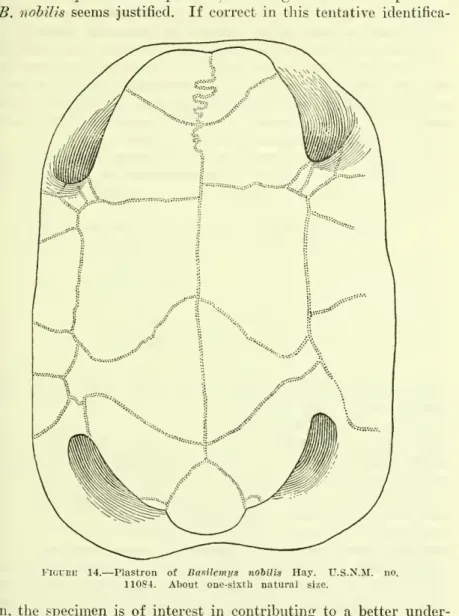
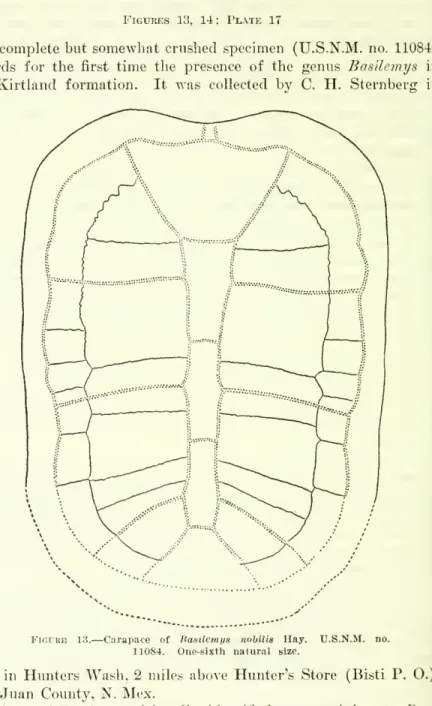
A complete but somewhat crushed specimen (U.S.N.M. no. 11084) records for the first time the presence of the genus Basilemys in the Kirtland Formation. This specimen is tentatively identified as belonging to Basilemys nobilis Hay (1911, pp) whose type is said to be from the overlying Ojo Alamo Formation.
REPTILIA OF KIETLAND FORMATION GILMOEE 179
180 PROCEEDINGS OF THE NATIONAL MUSEUM VOL. 83
KEPTILIA OF KIRTLAND FORMATIOK GILMOEE 181 The gular scutes are greatly reduced in size and are widely sepa-
182 PROCEEDINGS OF THE NATIONAL MUSEUM VOL. 83
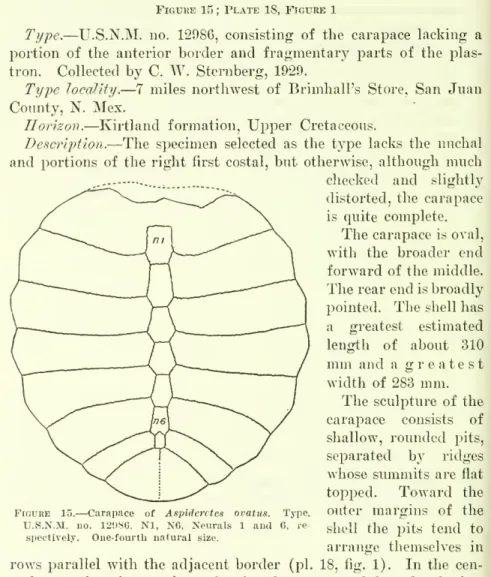
EEPTILIA OF KIRTLAND FORMATION GILMOEE 183 There are seven neurals of the usual coffin shape, the seventh being
EEPTILIA OF KIRTLAND FORMATION GILMOEE 183There are seven neurals of the usual coffin shape, of which the seventh. The shield's sculpture consists of a network of rounded edges surrounding shallow pits. On the nuchal translucency and proximal parts of the ribs, the pits are irregular but evenly distributed.
The shape of the outer end of the first costal also serves to distinguish vorax from austei^s. The family of angelfish or sea-spars in the Kirtland Formation appears to be represented by a single tooth (Fig. 17), which was associated with the scales of Lepisostcus and the teeth of Miiledapcus to the southwest. If this identification is correct, the specimen is interesting as the first representative of Squatinidae found in the Cretaceous of North America.
These samples allow a better diagnosis than previously possible, resulting in a more accurate assessment of the fauna represented by the Kirtland Formation. The Hadrosauridae are represented by the genera Parasaurolophus and Kritosaurus^botof, which elsewhere occur only in the Belly River, Canada; Ceratopsidae of the genus Pentaceratops and a chasmosaurid, the latter also a form of Belly River, but its occurrence in Kirtland needs further verification before its assignment can be certain. Lull (1933) considers the genus Pentaceratops to have a more advanced stage of horn development than that found among the Belly River ceratopsians and considers it to be the closest complement to those of Edmon.
In light of the recently described Chasmosaurus kaisenl (Brown, 1933), from Belly River, with high brow horns and well-developed nasal horns, it seems to me that this conclusion no longer holds. The evidence afforded by the known Dinosauria is overwhelmingly in favor of considering the Kirtland formation as equivalent to the Belly River of Canada, as previously suggested by Brown et.

REPTILIA OF KIRTLAND FORMATION GILMORE 187 Gilmore. Additional evidence favoring such a conclusion is found
LITERATURE CITED Beown, Barnum
On a new species of Aspiclcrctes from the Belly River Formation of Alberta, with additional information on the carapace structure of Boremys pulchra.