Proceedings of the United States
National Museum
SMITHSONIAN INSTITUTION
•WASHINGTON, D.C.
Number3652
Isopoda and Tanaidacea from Buoys
in
Coastal Waters
of theContinental United
States,Hawaii, and the Bahamas
(Crustacea)^
By Mihon
A. MillerThis article is based on collections
made
duringWorld War
IIby
the author
and
other biologistsemployed by Woods Hole
Oceano- graphic Institutionon
a survey of marine fouling.The
researchwas
conducted under supervision of Dr. Alfred C. Redfieldand
the late Dr. LouisM.
Hutchins. Itwas done
undercontract with theBureau
of Ships, U.S.
Navy,
with invaluable logistic supportfrom
the U.S.Coast Guard.
The
author wishes to express deep appreciation to Dr. Redfield for his guidanceand
encouragementon
thisand
otherwartime
investigationson
the marine fouling problem.The
authoris indebted to Mrs.
Lynn Rudy
for illustrationsand
other assistance inthe preparationofthispaper.Thanks
aredue
also toDr.Thomas
E.BoA\Tnan of the U.S. National
Museum
for a critical review of the manuscript.' Contribution No. 1816 from Woods Hole Oceanographic Institution, Mass., and a contribution from the Department of Zoology, University of California, Davis.
2Department ofZoology, Universityof California, Davis 95616.
1
2 PROCEEDINGS OF THE NATIONAL MUSEUAI
vol. 125 Fouling communities include not only various sessile organisms (barnacles, mussels,bryozoans, tubeworms,
tunicates,sponges, algae, etc.) that attach themselves tosubmerged
structures, but alsomany
free-living forms associated with them.
The
free-living animalsmay
feed
on
the sedentary forms, find coveramong
them,and
exhibit various degrees of symbiosis with them.Among
the nonsedentary formscommonly
found in the fouling association are isopods, tanaidaceans,and
other Crustacea.The
isopodsand
tanaidaceans reported in this paper were ex- tractedfrom
samplesof foulingscrapedfrombuoys and
theirmoorings inthecoastalwaters of the United States.As
mentioned above, these collections weremade
duringWorld War
II in connection with a survey of marine fouling conductedby Woods Hole
Oceanographic Institution. Biological objectives included determination of theamount and
kinds of fouling, rates of accretion, regionaland
seasonal variation,and
ecological factors affecting establishment of fouling organisms.Much
valuable systematic, ecological,and
distributional datamay
be derivedfrom
investigations of this sort.Such
informa- tion is needed badly formost
invertebrate groups, especially in regions inwhich
the biotahas not been investigated adequately.Besides intrinsic interest, the biological data also
might have
practical applicationin the developmentof
more
effectivemethods
for control of fouling. Additionally, itwas
thought that dataon buoy
fouling could provide clues as to theoriginand
possibly the courseof drifting minesand
military flotsam. Cosmopolitan or widely dis- tributed forms obviouslywould
be of little or no value as tracers.Attached forms clearly
would
serve the purpose better than free- livino- types. Inany
event, the distributional limits of species thatmight
be found onbuoys would have
to be established definitely beforeany
valid conclusions could be dra\\Ti. Unfortunately, our present biogeographicalknowledge
ofmost
invertebrates is too in- complete to be ofmuch
help in determining origin or drift.The
results of the marine fouling survey are incorporated in a treatiseon
marine foulingand
its prevention that has been pub- lishedby Woods Hole
Oceanographic Institution (1952).The
present paper extends the preliminary account of the Isopodaand Tan-
aidacea given in that publication.Methods. — The buoy
foulingsurveywas
initiated in 1943. Biologists were assigned to various naval districts with authorization toaccom-
pany buoy
tenders of the U.S. CoastGuard
in order to investigate foulino-on buoys when
they were relieved, serviced, or otherwise tended. Generally, at this time, thebuoy
with mooring chainand
anchor were hoisted onto the deck,which
gave the biologists an opportunity for observationand
sampling.ISOPODA
AND TANAIDACEA — MILLER
PACIFIC
so IOC
TKlLOMETiRS
FIGURE1:BU0V STATIONS
• = Isopodo-rarwid sites(numbered)
O= Other stations
Figure L
—
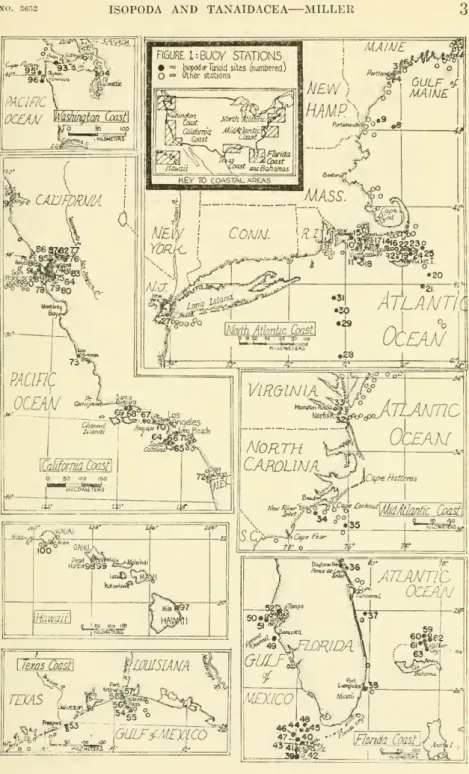
Buoystations of the foulingsurvey4 PROCEEDINGS OF THE NATIONAL MUSEUM
vol. 125The
379buoys examined
(fig. 1) were distributed as follows: 229 along the Atlantic coastfrom Newfoundland
to Florida, 58 in the GulfofMexico
(southand
westcoastofFloridaand
Texas), 77 along the Pacific coastfrom
California to Washington, six in theBahamas, and
nine in theHawaiian
Islands.Owing
to lack of opportunity for the biologists to sample thebuoys
alongsuch a longstretch of coast, the largestgap
in the collections lies between central Californiaand
northern Washington.At
each station, square foot samples were scrapedfrom
thebuoy
at the waterline, at three
and
sixfeet depthsand
subsequentfathom
(6 feet=1.83 meters) intervals below the surface, depending
on
the sizeofthebuoy. Linear footscrapings alsoweremade from
thebridleand mooring
chains atfathom
intervals to the bottom. Likewise, a square foot samplewas
takenwhen
possiblefrom
the anchor block.Occasionally, samples were taken
from
submarine nets or othersubmerged
installations. After weights, volumes,and
other dataon
the fouling were taken, the samples (or aliquots) were preservedand
shipped toWoods
Hole, Mass., for sorting.At
each station, the usual hydrographic data were recorded (water temperature, transparency, etc.)and
water samples for salinity determinations were taken.At Woods
Hole, the fouling samples were sorted intomajor
tax-onomic
groups for later identificationby
specialists. After large organisms were removed,the residuewas
scanned withamicroscopefor small forms.A
total of 2028 samplesfrom
379buoys
were sorted,an
average of five to six per buoy.The
100 stations atwhich
isopods and/or tanaidaceans were found arenamed
in table 1. Their location isshown
in figure 1, along withbuoys
in thesame
area atwhich none
ofthese crustaceanswas
found.Results. —
Collection dataare presentedand summarized
in tables 1and
2and
figures 1and
2. Isopods were takenfrom
95 buoys, or about one-fourth of the 379 sampled. Tanaidaceans were foundon
only 14 buoys, or 3.7 percent of those sampled. Fivebuoys
yielded tanaidaceans butno
isopods.No
isopods or tanaidaceans were found in the following vicinities(number
ofbuoy
stationssampled
in each area in parentheses):Newfoundland
(19); Eastport,Me.
(12);Mt.
Desert,Me.
(13);Penobscot Bay,
Me.
(10);Delaware Bay
(24); Chincoteague Bay, Va. (6);Cape
Fear,N.C.
(2);Cape Romain,
S.C. (5);and Ameha
Island, Fla. (6). Doubtless, both groups occurin theseareas, perhaps even
on
buoys, but were missed in thesamphng.
The
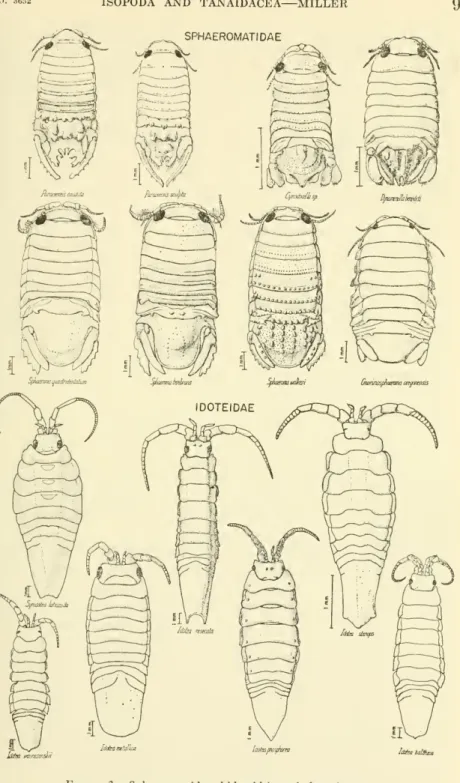
collection comprises 26 species of Isopoda belonging to 16 genera distributedamong
sevenfamilies (fig. 2).These
represent four of the seven aquatic suborders (FlabelHfera, Vahdfera, Asellota,and
Anthuridea).The
three suborders not represented are the Epicaridea,ISOPODA
AND TANAIDACEA — MILLER
h
Q
090Q
6 PROCEEDINGS OF THE NATIONAL MUSEUM
vol. 125Gnatliiidea,
and
Phreaticoidea—
the fostparasiticon
other Crustacea, the second ectoparasitic in the larval stageon
fish,and
the third found only infreshwater in Australiaand South
Africa.The
seven isopod famiUes are represented unequally, both innum-
bers ofspecies
and
inoccurrences (table2).To
the total of26 species, the Sphaeromatidaeand
Idoteidae contributed eight each, the Janiridae four, the Jaeropsidaeand
Anthiu-idaetwo
each,and
the Cirolanidaeand
Excorallanidae one each.The
inequahty is evenmore
evidentwhen
the frequency of occurrence is considered "with sj)haeromids being foundon
45 buoys, idoteidson
48, janiridson
13, jaeropsidson
five, anthurids onlyon
two, and cirolanidsand
excoral- lanidson
one each.The
Tanaidacea arerepresentedby
only three species belonging to three generaand
two famihes, Paratanaidaeand
Tanaidae.The
one paratanaid species, the cosmopolitan Lejdochelia dubia,was
foundon
the Atlantic coast side; thetwo
tanaids were takenon
the Pacific coast.The
29 species in thebuoy
collection were di\'ided almost evenlyby
the continent—
13 isopod speciesand
one tanaidacean takenon
the Atlantic side only (including the Gulf coastand
theBahamas), and
13 isopod speciesand two
tanaidaceans taken onlyon
thePacific side (including one species found only in Hawaii).No
specieswas
foundon
both the easternand
western coasts, but the widely dis- tributedSphaeroma
walkeri were foundon buoys
inHawaii and
Florida.
Of
the 100buoys from which
isopodsand
tanaidaceans were taken,most
(78) contributed only a single species.Two
species were taken from 16 buoys, three speciesfrom
five buoys,and
four speciesfrom
one (Station48, FloridaKeys
region).Considering depthoccurrence (table 2),
we
note that 50 percent of records of capture of isopods (disregardingnumber
of specimens) were within one meter of the waterlineon
buoys,and
that about another 25 percent occurredbetween
1 to 5 metersfrom
the surface.In the famihes Sphaeromatidae
and
Idoteidae,more
than half of the records (53 percentand
55 percent, respectively) for each family areat to 1 meterdepth,and
about three-fourthsoftheir occurrences are within five meters of the surface. Janiridsshow
the greatest range of occurrence,from
to 55.4 meters, with Janira alta being recorded at the greatest depth for all isopods (on the anchor block set at 55.4 meters depth).None
of the Jaeropsidae, Cirolanidae, Excorallanidae, or Anthuridaewas
found within a meter of the surface,and none
of the last three famihesnamed was
taken at lessthan five meters of the surface. In fact, the single excorallanid
and
NO. 3652 ISOPODA
AND TANAIDACEA — MILLER 7
Ihetwo
anthui'ids were takenfrom
the anchor ofbuoys
set at depths of 14.1, 11.1,and
15.4 meters. Tanaidaceans rangedfrom
the surface to thebottom
de])ths of 10 to 20 meters with the majority of occur- rences (10 out of 18) below five metersand
themedian
depth atwhich buoys
were set.The
nimiber of speciesand
the occurrences of tanaidaceansand
of several isopod famihes are too smallformore
than cursory analysis.The
possible relationship of motihtj'- ^^'ithdepthofoccurrence vnh.be discussedlater.
In the following systematic review of the collection, the collection sites
and
previously reported locahties for each species are given along ^nth pertinent remarkson
their systematics, ecology,and
distribution.
Order ISOPODA
Suborder FLABELLIFERA
This sizable suborder (1400 species;
Waterman and
Chace, 1960)is represented in the fouling collection
by
10 species belonging to seven generadistributedamong
threefamilies—
Sphaeromatidae (eight species), Cirolanidae (one species),and
Excorallanidae (one species).Sphaeromatids were found
on
45 buoys, but each of the othertwo
families
was
takenfrom
only one buoy.Family Sphaeromatidae
The
sphaeromatids comprise a prominent group in the collection not only innumber
of species (eight), but also in theabundance
of specimens.S\vimming
ability is relatively well developed inmany members
of this family,and
this doubtless enablesthem
to gain access to buoys.Woodboring
sphaeromatids probablyhave
been transportedonwooden
shipbottoms and
indriftwoodtonew
localities.All the sphaeromatids in the
buoy
collection fall intotwo
of the three "groups" in Hansen's (1905) subfamily Sphaerominae,namely
thehemibranchiataeand
euhranchiatae.The
hemibranchiate genera areSphaeroma
(three species)and
Gnorimosphaeroma (one species).The
eubranchiate genera are Paracerceis (two species), Dynamenella (one species),
and
Cymodocella (one species).The
Sphaerominae platy- branchiatae arenot represented.Unfortunately, as
Monod
(1931b) remarked, the systematics of the Sphaeromatidae is in a state of confusion.The
confusion stemsfrom
thetremendoussexualdimorphism
in thisfamily, coupled wdthparallel adaptations forcongiobation.Females and immature
maleshave
been describedas different species,eveninseparate genera,from
adult males.Variation
among
individuals of thesame
sizeand
sex adds to the taxonomic difficulties, as attestedby
long synonymies.Another com-
plication, especially in widespread species, is that local races or sub-
8 PROCEEDINGS OF THE NATIONAL MUSEUM
vol. 125species probably
have
developed as a consequence of longgeographic or ecological segregation of populations.There
is also the possibility of hybridization between related alienand
native species. Misidenti- fications, of course, distort the distributional picture; hence, authors should indicate the uncertainties in their determinationsand
their reasons for them.Such
information also is valuable in systematic revision.Group HeniLbranchiatae
SpJiaeroma quadridentatum SayFigure 3
Localities.
—
Virginia: near Norfolk (Stations 32, 33). Florida:Tampa Bay
(Station 52).
Remarks. —
Richardson (1905b) listsSphaeroma
quadridentatumfrom many
localities along the Atlantic seaboardfrom
southernNew
England
toKey
West,Fla.Intermediatecollectionsitesincludewaters in the vicinity ofCape
Charles City, Va.; St. Catherine Island, Ga.(type-locality);
and
Beaufort, N.C.The buoys from which
thisspecieswas
collectedlie withinitsknown
range.The
availableecological data indicate that the species prefersmuddy
bottoms.Nierstrasz (1917) reported this species
from
the Mediterranean, butMonod
(1931b) lists the Mediterranean forms in thesynonymy
of
Sphaeroma
serratum (Fabricius)H.
MilneEdwards.
EarUer,Monod
(1930) following Torelli (1930), also
had
equated S. quadridentatum fromtheeastcoastofNorth America
withS. serratum. Afterexamining topotypes of the former, however, he concluded that thetwo
were separate species.He
pointed out the following three distinctions: (1)In S. quadridentatum, there are four well-defined teeth on the outer border of the uropodal exopod, whereas the
number
of teeth varies in S. serratum (occasionally four)and
they are often irregular crenula- tions,making
it difficult to determine the precisenumber.
(2)The
posterior part of the telson in males ofS. quadridentatum tends to be excavated dorsally with upturned borders, while in S. serratum it is
vaulted
more
regularly. (3) In S. quadridentatum, there arefewer setae in the distalrow
on the propodus of pereopod I than in *S'. serratum.The buoy
specimens confirm these observations.Sphaeromawalkeri Stebbing Figure 3
Localities.
—
Florida:Ponce
deLeon
Inlet (Station 36), SarasotaNew
Pass (Station 49),Egmont Channel
(Station 51). Hawaii: Hilo (Station 97).Remarks. —
Previous reports indicate thatSphaeroma
walkeri iswidely but spottily distributed as follows. India: Gulf of
Manaar
(Jokkenpidd:Parr,Marichchukaddi, ChevalPaar,and
GalleHarbour,ISOPODA
AND TANAIDACEA — MILLER
SPHAEROMATIDAE
9
Figure3.
—
Sphaeromatidandidoteid isopodsfrom buoys10 PROCEEDINGS
OFTHE NATIONAL MUSEUM
vol. 125Ceylon
—
type-localities) (Stebbing, 1905); Travancore (Trivandrum)(Pillai, 1955);
Bombay
(Joshiand
Bal, 1959).Red
Seaand
SuezCanal
(Stebbing, 1910; Omer-Cooper, 1927;Monod,
1933). Africa:Egypt
(Alexandria) (Larwood, 1940);
Durban Bay
(Stebbing, 1917;Monod,
1931b). South America: Brazil (Loyola e Silva, 1962).
New
South Wales: Blackwattle Bay, DarlingHarbour
(Baker, 1928).With
the addition of the above-listed localities in Floridaand
Hawaii, the recorded distribution ofSphaeroma walked
is extended into the central Pacificand
the northern hemisphere of theNew
World. Its spotty, circumglobal distribution
and
the fact that it has been takenfrom
the hulls of boats (Larwood, 1940;Monod,
1933) strongly suggestdispersalby
shipping.Although the single specimen
from HHo was damaged
badly, itwas
clearly conspecific with intact specunens collected
by
the author inAugust
1961 fromHanamaula
Bay, Kauai,and no
differencecould be found between theHawaiian
specimensand
thosefrom
Florida.The
collectionofspecimensof
Sphaeroma walked from two
widely separatedHawaiian
islandsand from
three localities on both the eastand
west coasts of Florida indicates that this species isfaMy
well established in thesetwo
regions. Itwould
be of great interest toknow when
andhow
these isopods were introduced!The
identification of thebuoy
specimens asSphaeroma
walkeri seems certain, although there aresome
discrepancies betweenthem and
Stebbing's (1905) original description.At
least they conform as well to his description asdo
sphaeromatidsfrom
other localities thathave
been assigned to that speciesby
several authors.They show
the distinctive pattern of tuberculation, the characteristicnumber
of lateral teeth on the uropodal exopod,and
the posteriorly dished telsonwith arounded, ui)turned crenate border.Our
specimens differfrom
the original description ofSphaeroma
walkeri primarily in showing epuneral sutures on the first as well as on the sLx subsequent pereonal segments. Stebbing states unequivo- cally that the "side plates" (epimera) of the firstsegment
of pereon of this species are "unsutured." His figures, both dorsaland
lateral views, agree with the text showing epimeral sutures on all but thefirstpereonal segment.
Twelve
years later, however, thesame
author (Stebbing, 1917) figuresamale and
femaleofthisspeciesfrom Durban
Bay, SouthAfrica, bothlackmg
epimeral sutures on all sevenpereonal segments. (Stebbing's 1910 report of this speciesfrom
theRed
Sea givesno
description orfigures.)The
figures ofS. walkerifrom
different localities givenby
other authors (e.g., Pillai, 1955) clearly indicate epimeral sutures on all pereonal segments including the first, as in our specimens.One must
conclude either that Stebbing did not attachany
signifi-NO. 3652 ISOPODA
AND TANAIDACEA — MILLER
11 cance to epimeral sutures, or that the sphaeromatidsfrom Durban Bay
that he identified as hisSphaeroma walked might
belong to a closely related species, possibly S. venutissimumMonod, The
fact that his figures of theseshow
other differencesfrom
the original descriptionof S.walked
lendscredence tothelatterview.For
instance, the African specimenshave
tubercles on thehead
that are not indi- cated at all in his description or figures of the type.They
alsohave
eight or nine teeth on the uropodal exopod instead of the prescribed six or seven. (Although Stebbing's description of
Sphaeroma walked
states there are six or seven teeth on the outer
margin
of the uropod, hisfiguresshow
only five.He
doubtless countedasa tooth thepointed apex of the exopod.) It is difficult to believe that so eminent an authority as Stebbing could erroneously assign specimens to a species he hmiselfdescribed, albeitmany
years earlier.Other differences between the
buoy
specimensand
the description ofSphaeroma
walkerimay
be characterized asnormal
variation.Most
specimenshad
five lateral teeth on the outer branch of theuropod
(thetypicalnumber),butafew
had
fourorsLx.Sometimes
thenumber
varied between the
two
sides of a specimen.Most had two
tubercles on the dorsal side of the endopod, but severalhad
threeand
one specimenhad
only one.The
distinctness of the tuberculation, particu- larly on the thoracicsegments, increaseswiththe size of thespecimen.Sphaeroma terebransBate Figure 3
Localities.
—
FloridaKeys
(Station42).Texascoast:nearFreeport (Station 53), off Sabine Pass (Stations 54-58).Remarks. — The
sphaeromatidsfrom buoys
off the Texas coast are assigned withsome
hesitation toSphaeroma
terebrans. This is a variable species widely distributed inwarm
waters (salt, brackish,and
fresh) of both the Oldand New Worlds
(Nierstrasz, 1931;Van Name,
1936). Reported localities includemany
in India (Stebbing, 1904; Erlanson, 1936; Pillai, 1954); equatorialand
southern Africa (Barnard 1920, 1940; Brianand
Dartevelle, 1949; Stebbing, 1910);Australia (Baker, 1926;
Caiman,
1921; McNeill, 1932);Siam and Sumatra
(Chilton, 1926); St. John's River (fresh water) at Palatka, Fla. (Richardson, 1905b);Escambia
River, Fla.,and
Sabine River, Tex.(Wurtz and Roback,
1955);and
Brazil (type-locality). Menziesand
Frankenberg (1966) report itfrom
Georgia, but as S. destructor.Dr.
Thomas
E.Bowman
of the U.S. NationalMuseum
informsme
(in Utt.) that it also has been reported
from
Virginiaby Wass
(1963) but apparentlywas
carried there on a ship from Florida.The
above- cited Florida location is the type-locality of S. destructor Richardson, which has been considered asynonym
of S. terebransBate by most
12 PROCEEDINGS OF THE NATIONAL MUSEUM
vol. 125authors despite Miss Richardson's stout defense for its distinctness.
Her
S. peruvianumfrom honeycombed wood
in oyster beds in Peruand
her S. retrolaevisfrom Japan
are regarded as distinctfrom but
closely related to S. terebrans.
As
isopodsofthisspeciescommonly
arefound burrowingindecayed wood, bridgeand
wharf pilings, deadmangrove
roots, etc., dispersalby
shipsand
driftwood seems a likely explanation for its widespread distribution.As
with other widely distributed species, geographic and/or ecological segregationmay
result, in time, in reproductive isolation of local populationsand
subsequent speciation.The
specific identification of theTexas
specimens is questioned primarilybecause the sculpturing of the dorsal surface, as far as thiscan be determined, does not conform entirely to the descriptions of this feature in S. terebrans. According to the descriptions, the dorsal surface on the posterior part ofthe
body
iscovered with granulesand
tubercles of various sizes, the larger ones ofwhich
bear tufts ofminute
hairs,and
there are tuberculated transverse ridgeson
the posterior thoracic segments. Well-developed paused tubercles are said to be characteristically presenton
the last one ortwo
thoracicand on
thetwo
pleonal segments.The
literature indicates, however, a certainamount
of variation in sculpture pattern as well as in other characteristics.Considerable individual variation in tuberculation
was
observed in theTexas
specimens.The
smaller ones were smooth, as in S.quadridentatum, or only minutely granular
and
transverse thoracic ridges were only slightly evident. Larger specimens usually were coated "wdthmud,
especially on the hinder part,which
obscured the tubercles. Several previous authorsmentioned
thesame
difficultywith
mud.
In our specimens, the coating adhered so tightly that,when
attempts weremade
toremove
it, the underlying exoskeleton also peeled off. Nevertheless, itwas
possible to observe that our specimenshad
finely tuberculated transverse ridgeson
the posterior thoracic segmentsand
tubercleson
the pleonand
pleotelson.Some
specimensshowed
large paired tubercles on the pleon, others did not,and
the patternwas
not consistent. In some, therewas
evidence oftwo paramedian
rowsoftuberclesonthepleotelson,as in S. quoyanaM. Edwards.
Gnorimosphaeromaoregonensis (Dana)Menzies Figure 3
Localities.
—
California:San
FranciscoBay
area (Stations 74-78, 80, 84-87, 91). Washington: Umatillo (Station 95), QuiUayute River (Station 96).Remarks. —
This species, first describedby Dana
(1852) as Sphae-NO. 3652 ISOPODA
AND TANAIDACEA — MILLER 13 roma
oregonensis, subsequently has been placed in Exosphaeroma, Neosphaeroma,and
currently, since Menzies (1954), in Gnorimo- sphaeroma. Alenzies subdivided it intotwo
subspecies, G. oregonensis oregonensisand
G. o. lutea, but Riegel (1959)on
the basis ofmor-
phological, physiological,
and
ecological evidence elevated thetwo
subspecies to fullspecies status.Menzies states that G. oregonensis oregonensis ranges
from
Alaska toSan
FranciscoBay,
Calif., with the type-locality inPuget
Sound,Wash. He
listsmany
records of distribution in this range. It occurs primarily in the intertidal zone to depths of 12 fathoms (20.8 meters) but has been taken atsubmerged
nightlightsnearthe surface (Hatch, 1947; Menzies, 1954). It apparently tolerates in nature awide rangeofsalinities, asitwas
found onbuoys
intheupperreaches ofSan
FranciscoBay
(Suisun Bay, etc.) near the Sacramento-San Joaquin deltawhere
salinities are low (oligohaline)and on buoys
outside thebay and on
the open seacoast outside theGolden Gate
and
along the coastof Washington.Group Eubranchiatae
Paracerceiscaudata(Say)Hansen Figure 3
Localities.
— North
Carolina:Cape Lookout
region (Stations 34, 35). Florida: Port Everglades (Station 38), FloridaKeys
(Stations 39-41, 44, 47, 48), Sarasota (Station 49),Tampa Bay
(Station 50).Bahamas: Walker Cay
(Station 62).Remarks. —
Richardson (1905b) recordsmany
localities for Para-cerceis caudata (under the
name
Cilicaea caudata) rangingfrom Egg
Harbor, N.J.,southward
to the Florida Keys, theBahamas,
Porto Rico, Yucatan,and
theBermudas. Reported
depths arefrom
the surface to 25 fathoms (46 meters)among
algaeand
grassand from
coral reefs.
The buoy
collections of this species areweU
within itspreviously recorded geographic
and
depth range. It appears to be predominantly awarm
water species of the easternNorth American
coast.
Pronounced
sexualdimorphism
in this species results intaxonomic difficulty unless samples includemature
males.Females
alone are notoriously difficult to identify correctlyand
evenhave
been de- scribed as distinct species (e.g.,Dynamene
bermudensis represents the female of Paracerceis caudata).SmaU
females of Paracerceis caudata in thebuoy
collection, especiallyonefrom
Satan ShoalBuoy
(Station 39) nearKey
West, resemble the description ofDynamene
angulata Richardson (1901).The
latterwas
described onlyfrom
female speci-mens
foundby Mr. Henry Hemphill
atNo Name Key,
Fla. It has14 PROCEEDINGS OF THE NATIONAL MUSEUM
vol. 125not been reported subsequently
from any
other locality.The
possi- bility is suggested that, as in the above-cited case ofD. bermudensis, D. angulata is also a juniorsynonym
of P. caiidafa.The
fact that Richardson (1905b) reported both P. caudataand
D. angulatafrom
No Name Key,
however, indicates that shemust have
regarded theseforms as distinct species. It
would
be inadvisable, therefore, to rele- gateD. angulata to thesynonymy
ofP. caudata without criticalcom-
parison of Richardson's types ^vith femaleand immature male
speci-mens
of P. caudatafrom
thesame
region.Paracerceissculpta (Holmes)Hansen Figure 3
Localities.
—
California:San
DiegoHarbor
(Station 72). Hawaii:Hilo Harbor,
Hawaii
(Station 97); Pearl Harbor,Oahu
(Stations 97, 98).Remarks. —
Richardson (1905b) reports Paracerceis sculptafrom
onlytwo
southern Californialocalities,San Clemente
Islandand San
Diego. In the author's collection there are specimens of this species collectedby
MarjorieOakley Brown
inMorro Bay,
Calif, (unpubl.data),
which
ismore
than200milesnorthofthepreviousknown
range.The
present records of this species inHawaii
greatly extend its distri- bution. Probablyitwas
transported on the hulls ofnavalships plyingbetween San Diego and
Hiloand
Pearl Harbor.Several other species of this genus occur along the Pacific coast, but
none
of these were taken in thebuoy
survey.One
of these is a widelyranging species, P.cordata Richardson,which
occurs along the Pacific coastofNorth America from
Catalina Island, Calif., to Popoff Islandand
the Aleutian Islands. (There is a biggap
in its recorded distribution, however,between
the Alaskanlocalitiesand Mendocino County
in northern California. Hatch, 1947, does notmention
it inWashington and
adjacentregions.)Dynamenella benedicti (Richardson)Richardson Figure 3
Locality.
—
California:South San
FranciscoBay
(Station 84).Remarks. —
Richardson (1905b) lists Dynamenella benedictifrom Monterey
Bay, Calif.,its only recorded localitytomy
knowledge.The
present record, therefore, extends its range considerably northward.
Cymodocellaspecies Figure 3
Locality.
— Bahamas: Walker Cay
(Station 61).Remarks. — A
single, small female sphaeromatid in rather poor condition is assigned withsome
uncertainty to the genus CymodocellaN«- 3652 ISOPODA
AND TANAIDACEA — MILLER 15
Pfeffer. It possesses
many
of the attributes ascribed to the related genus Dynamenella, but the characteristic tubular posterior exten- sion of the pleotelson with a slit along the underside places it in Cymodocella.The
genericplacement is questionable, however, forseveral reasons.In Hansen's (1905)
key
to the Sphaerominae euhranchiatae,Cymodo-
cella (as well as
DynameneUa)
falls into the section characterizedby
the exopod of the third pleopod being unjointed; but in the present specimen that structure is Particulate.
The
apical tube is not as long as in other species of the genus.The
rami of the uropod lamellar, as prescribed,and
apically toothed, but subequal in length, whereas in typical Cymodocella the exopod is supposed to be con- siderably shorter than the endopod. Finally, because of theimmatu-
rity of the only specimen, the sexual characteristics of generic value could notbe ascertained.
Five species of Cymodocella are
known —
the antarctic-antiboreal C. tubicauda Pfefferand
four African speciesfrom
theCape
ofGood Hope
region; namely, C. algoensis (Stebbing) Stebbing, C. cancellata Barnard, C. pustvlata Barnard,and
C. sublevis Barnard.The
facts that the present specimen does not fit the description ofany
of theseand
thatitis thefirst record of thegenus in the northernand
western hemispheres indicate itmay
represent anew
species.Pending
exami- nation of additional material—
hopefully,mature
specimens—
of both sexes, itseems best to deferfulland
formal description.Family Cirolanidae
The
family Cirolanidae is represented in thebuoy
collectionsby
asingle specimen.
CiroJanaparvaHansen Figure 4
Locality.
— Hawaiian
Islands: Port Allen,Kauai
(Station 100).Remakks. — The
family Cirolanidae is represented in thebuoy
col- lectionsby
a single specimen of Cirolana parva. This species has previously been reportedfrom many
tropical localities including:Georgia (Menzies
and
Frankenberg, 1966); Florida, Gulf of Mexico,West
Indies,and
theBahamas
(Richardson, 1905b);Jamaica
(Rich- ardson, 1912);Cameroon and South
Africa(Monod,
1931a, 1933);Mozambique
(Barnard, 1914);Red
Seaand
SuezCanal
(Stebbing, 1910;Monod,
1931and
1933);Ceylon(Stebbing, 1905);Siam
(ChQton, 1926); Polynesia: Rikitea (NobiH, 1907),Samoa
(Hansen, 1890);Indonesia:
Timov,
Aru, et al. (Nierstrasz, 1931).The
present report of this species in theHawaiian
Islands extends its distribution into the central Pacific.The
author also has collecteditfrom
reefs around16 PROCEEDINGS OF THE NATIONAL MUSEUM
the islands of Kauai,
Oahu, and
Hawaii.The major gap
in the near circumtropical distribution of this species is the eastern Pacific. Its absence theremay
bedue
merely to the fact that this area has not beenexplored sufficiently.JAEROPSIDAE JANIRIDAE
CIROLANIDAE. EXCORALLANIDAE. ANTHURIDAE TANAIDACEA
Accalslhum sp
LtcanmanasJiii/s Sii^^fuymm sp
Figure 4.—Jaeropsid, janirid, cirolanid, excorallanid, and aiithurid isopods, and tanai- daceans from buoys.
NO. 36R2 ISOPODA
AND TANAIDACEA — MILLER 17 Family Excorallanidae
Excorallanasubtilis(Hansen) Richardson FiGUKE 4
Locality.
—
Florida:Tampa Bay
(Station 50).Remarks. — Hansen
(citedby
Richardson, 1905b) records Excoral- lanasubtilisfrom
St.Thomas, West
Indies.She
alsohesitatingly refers to this speciestwo male
specimensfrom
Florida (specific locality not given) in the collection of the U.S. NationalMuseum.
These fit the description except for the lack of thetwo
large tubercles at the base of the terminal abdominal segment.The
specimenfrom
Florida, an ovigerous female, agrees nicely with the description except that thetwo
tubercles on the pleotelson are not as large as those figuredby
Richardson. Probably the presenceand
size of these tubercles are variable characteristics.Suborder VALVIFERA
This suborder (containing
some
600 species;Waterman and
Chace, 1960) isrepresentedin thecollectionby
eight species, allinonefamily, takenfrom
48 buoys.Of
thetwo
valviferanfamiliesknown
inNorth
America, theAstacil- lidae (=Arcturidae)and
the Idoteidae, only the latter is represented in thebuoy
collections. This family occurs mainly in the temperate zoneand
boreal zones, whereas astacillids are characteristic of stUl colderwaters.Both
families, however,have
representativesin tropical orsubtropicalwatersand
therangesofsome
extendintowarm
waters.Valviferansin general, however, are represented poorlyin the tropics.
In the
buoy
collections only one of eight idoteid species {Idotea resecata)was
found south of 35°northlatitude.Family Idoteidae Subfamily Idoteinae
Only two
idoteidgenerawerefound,bothin thesubfamilyIdoteinae towhich most
idoteidsbelong: Idotea, withsixspecies,and
Synidotea, with two.The
six species of Idotea were divided evenlybetween
the Atlanticand
the Pacific coasts.They
probably are ecological equiva- lents.Both
species ofSynidoteawere found onbuoys
along the Pacific coast. SynidoteaispredominantlyaNorth
Pacificgenus with onlytwo
circumarctic or circumboreal speciesknown from
theNorth
Atlantic.As
previously mentioned,some
idoteids, as well as sphaeromatids, aregood
swimmers,which
accounts for their relatively greater fre-quency
onbuoys
than themore
sedentary isopods.Two
species, Idotea balthica{=marina) and
/. metallica,have
been reportedfrom
widelyseparatedlocalitiesinboth northernand
southernhemispheres.281-333—68 2
18 PROCEEDINGS OF THE NATIONAL MUSEUM
vol. 125Both
specieshave
been takenfrom
floating seaweed,which
suggests a possiblemeans
of dispersal.Idoteaphosphorea Harger Figure 3
Localities.
—
Gulf ofMaine
(Stations 1-3, 5, 6).Nantucket Sound and
vicinity (Stations 11-14, 16-26).New York
area (Station 27).Kemarks. —
Richardson (1905b) gives the distribution of Idotea phosphorea as "Coast ofNew England
to Halifax,Nova
Scotia,and
the Gulfof St.Lawrence;Runmaro,
Stockholms Skargord," atdepthsfrom
the surface to 18 fathoms (about 33 meters),among
seaweed,and m
thestomach
of haddock. In the present study, itwas
takenfrom
21buoys from New York
to the Gulf of Maine, all within itspreviously recorded range.
Generally found within three meters of the surface, it also
was
taken at variousdepthsdown
to about 23 meters.On
onebuoy
(Sta- tion 23),more
than 35 specimenswere taken. Thisspecieswas
found on the greatestnumber
ofbuoys
in the entire collection.Idotea kalthica(Pallas) Figure 3
Localities.
—
Gulf ofMaine
(Stations 4, 5).Nantucket Sound
(Stations 10, 15, 18).
Remarks. — The
nomenclature of this widely distributedand
doubtless variable species hashad
a controversial history.The name
Idotea
marina
(L.) has appeared in the literature both as a juniorand
seniorsynonym
of /. baltica (Pallas) (also spelled "balthica," the origmal spelling of Pallas). Holthuis (1949) reviewed the caseand
concluded that /. marinawas
correct.He
later (1956) reversed him-self, however, apparently persuaded
by
the arguments ofNaylor
(1955).
Hurley
(1961) transfers theNew
Zealandrecords of /. baltica to I. marina.Gruner
(1965) uses I. balthica [sic]and
listsamong
itssynonyms
/.marina
of Richardson (1905b)and
Holthuis (1949).He
does not mention
Hurley
(1961) but says that the question of occur- rence of 7. balthica [sic] inNew
Zealand (as well asJava, Brazil,and
theRed
Sea)must
be reexamined.Richardson's (1905b) listoflocalities (given below) forIdoteabaltica (Pallas) is essentially similar to her earlier list (1901) for /.
marina
(L.) in
which
the formerwas
includedamong
other synonyms.Both
herlists incorporate the distributions givenby
Miers (1883),Harger
(1873),
and
previous authors. Richardson's (1905b) list is as follows:Atlantic coastfrom Nova Scotiaand Gulf of St. Lawrence to North Carolina;
Bermudas; Barbados; also Mediterranean, Black and Caspian seas; west coast of Europe to Great Britain; shores of the Netherlands; in German Ocean and
NO. 3652 ISOPODA
AND TANAIDACEA — MILLER 19
Baltic Sea; Bohusland, Sweden (W. Sachs); Runmaro, Stockholms skargord
(J. Lindahl); on Scandinavian and Finland coasts; South America, at Desterro and Rio Janeiro, Brazil;
New
Zealand; RedSea; Java.Hansen
(1916) considers Richardson incorrect in listing thisspeciesfrom
Brazil,New
Zealand, theRed
Sea,and
Java.He
contends that these localities were listedby
Miers (1883) for /.marina and under
thatname
Miers"had mixed up
at least fourand
probably five or six species."As
previously mentioned,Gruner
(1965) also considers theselocalityrecords questionable.Idotea halthica (=baltica=marina) subsequently has been reported
by many
authorsfrom many
localities:North
Sea (Zirwas, 1910) Icelandand
the Faroes (Hansen, 1916); Ireland (Tattersall, 1912) Great Britain (Naylor, 1955); the Netherlands(Koumans,
1928 Holthuis, 1949, 1956); Alexandria,Egypt
(Larwood, 1940); Australia (Hale, 1924),New
Zealand (Hurley, 1961);New Guinea
(Nierstraszand Schuurmans
Stekhoven, 1941).Gruner
(1965)summarizes
localities mentionedby
previous authorsand
recognizes several subspecies: Idotea halthica halthicaDahl
(Baltic Sea), /. h. tricuspidata Dalil (North Sea), /. h. hasten
Audouin
(Mediterranean),and
/.h. stagneaTinturier-Hamelin (Mediterranean,on
the coast of Roussillon).Richardson (1905b) gives depths for /. haltica
from
the surface to 119 fathoms (220 meters)and
states it has been foundon
floating seaweed,among
algaeand
eelgrass, in sandand
gravel,and from
the stomachs of smelt. Zirwas (1910) found iton
floatingwood
or algae.Hansen
(1916) states depth records are misleading as "the animals,which
canswim
rather welland
frequentlyliveamong
floating algae,have
been taken in the instrumentwhen
itwas
hauled up."Gruner
(1965) statesthat thisspecies iseuryhaline, sometimes foundin water with salt concentrations as low as 3.5 °/oo. It is sublittoral, usually does not go deeper than 20 meters, but has been found at depths of 340 meters. In the present study, this specieswas
foundon
five buoys, all in theNew England
region, always within a meter of the surface.Idotea metallicaBosc Figure 3
Localities.
— New York
area (Stations 28-31).Remarks. —
Idotea metallica, a widely distributed, nearly cosmo- politan species, has been reportedfrom many
localities including the Atlantic coastfrom
FloridaKeys
toNova
Scotia, Greenland, Iceland, Britain, Ireland, Mediterranean Sea, Indian Ocean, northwestern Australia,New South
Wales,New
Zealand, Sumatra, Borneo, Sea of Japan,Cape
ofGood Hope,
Antarctic, Montevideo, Straits ofMa-
gellan, Chile,
and
Patagonia (Richardson, 1905b, 1909; Gurjanova,20 PROCEEDINGS
OFTHE NATIONAL MUSEUM
vol. 1251936;
Dow and
Menzies, 1957; Naylor, 1957;Nordenstam,
1933;Thielemann, 1910; Hurley, 1961; Menzies, 1962; Hansen, 1916).
Reported depths for Idotea metallica are
from
the surface to 91 fathoms (166 meters). It has been foundon
floating fucus.Dow and
Menzies (1957) report this species (forma typica Carausu) ascom- monly
taken in surface planl^ton tows in the Mediterranean. Their analysis ofstomach
contents indicates its food consists principally ofbrown
algae, possibly Sargassum.They
conclude that thisform
is a pelagic surface-dwelling isopod. Their conclusion is supportedby
the presentstudy as allspecimensof thisspecieswere taken at the surface levelon
fourbuoys
set inopen and
relatively deep water (59-76 meters) atsome
distance (50-100 ormore
kilometers) east ofLong
Ishxnd and south of Massachusetts.
Idotea (Pentidotea) resecata (Stimpson)Menzies Figure 3
Localities.
—
California:Anacapa
Island(Station67),SantaBarbara
(Station69),San Simeon
(Station 73).Remarks. —
Idotea resecata rangesfrom
southern California to Alaska (Richardson, 1905b; Hatch, 1947; Menzies, 1959)mth many
localities reported along the coasts of California (San Pedro to
Humboldt
Ba}'-), Washington,and
British Columbia.The
author has collected specimens of this species atLos Coronados
Ishinds offSan
Diego, alocalitythatextendsitsknown
rangeconsiderablysouthward.According to Richardson (1905b), it is found
between
tidemarks among
rocks, seaweed, kelp, eelgrass, etc. at depthsfrom
surface to 3.5 fathoms (about 6.4 meters).Dow and
Menzies (1959), however, consideritas thePacificOcean
counterpartofIdoteametallica, atruly pelagic species.The buoy
collections ofIdotearesecatawere well within itsrecorded rangeof distribution,which
extends several thousand miles along the Pacific coast ofNorth America from
subtropical to boreal waters.This species apparently has a ^nde temperature tolerance.
Idotea (Pentidotea) wosnesenskii (Brandt)Menzies Figure 3
Localities.
—
California:San
FranciscoBay
area (inside the bay:Stations 75, 81, 84; outside: Stations 88, 89). Washington: Strait of
Juan
deFuca
(Station 93),Puget Sound
(Station 94), outer coast at Quillayute (Station 96).Remarks. —
Idotea wosnesenskii iscommon
in temperateand
cold waters along the entire Pacific coast ofNorth America from
central CaHfornia to Alaskaand
in the Bering Sea, Sea of Ochotsk,and
Kamchatka
Sea (Richardson, 1905b; Thielemann, 1910; Gurjanova,Nc. 3652 ISOPODA
AND TANAIDACEA — MILLER 21
1936; Nierstraszand Schuurmans
Stekhoven, 1941; Hatch, 1947), Richardson (1905b) gives its southern limit asMonterey Bay,
Calif.,but
Thielemann
(1910) states it occurs as far south asSan
Diego.Menzies
and Barnard
(1959),however, do notlist itamong
themarine isopods of the southern California coastal benthos.The
author has specimensfrom San
Simeon,some
100 miles north of PointConcep-
tion,
which
divides thewarm
watercoastalfaunaofsouthernCaliforniafrom
the colder water fauna of centraland
northern California, Richardson (1905b) records depthsfrom
the surface to 9 fathoms (16.4 meters). It is foundcommonly on
kelp exposed atlow
tide.On
buoys, itwas
foundgenerally ator near the waterline.Idotea (Pentidotea)stenops (Benedict)Menzies Figure 3
Locality,
—
California:San Simeon Bay
(Station 73).Remarks, —
Idotea stenops has been reportedfrom Monterey
Bay,Calif, (Richardson, 1905b);
Coos
Bay, Oreg, (Hatch, 1947),The
author hascollecteditamong
algaeinthelow
intertidalzoneatseveral localities along the central California coastfrom Moss Beach
(San AlateoCounty)
to StockhoffCove (Sonoma
County).No
depths are reported in the literature for this species.On
thebuoy
atSan
Simeon, itwas
found at the surface "wdthIdotea resecata.Synidotea laticaudaBenedict Figure 3
Localities.
—
California: greaterSan
FranciscoBay
(Stations 76, 79, 82, 83, 87).Remarks. — The
distribution of Synidotea laticauda is limited to greaterSan
FranciscoBay,
with localities recorded in all three di- visions—
southern (lower), middle (central),and
northern (upper) divisions (Richardson, 1905b; Filice, 1958; author's collection).The
northern division includesSan
Pablo Bay, Carquinez Straits,and
SuisunBay
as far inland as Pittsburg near themouth
of the Sacra-mento-San
Joaquin River delta. It has never been collectedon
theopen
coast outside the bay.On
buoys, Synidotea laticaudawas
taken at various depthsfrom
the surface to 7.4 meters. Richardson (1905b) records it at 12.3 meters.On
several buoys, largenumbers
of these isopods were taken feedingon
hydroids Bimeriafranciscana Torrey.Many
environmental factors, alone or in combination, doubtless limitthedistribution of this species toSan
FranciscoBay.Prominent among
these are salinity, temperature, turbidity, oxygencontent,and
tidal
and
river currents. Quite as important ecologically as average conditions with regard to these factors are the fluctuationsand
extremes. Special conditions are createdby
thegeographyof thisbay
22 PROCEEDINGS
OFTHE NATIONAL MUSEUM
vol. 125system,
which
features anarrow
entrance (Golden Gate),two
longnarrow
divisions extending northwardand
southwardfrom
the middle section,and
thecombined
discharge into the northernarm
oftwo major
rivers—
theSacramento and San
Joaquin. In addition tomechanical effects, the
complex
interaction of the inflow of theseand
lesser rivers
and
streams with the diurnal ebbingand
flooding tides through theGolden Gate
results in significantfluctuations, especially in salinityand
temperature.Salinities at the localities for this species range
from
polyhaline to oligohaline.At
Fort Point, at theGolden Gate
entrance toSan
FranciscoBay and
less than a mile seawardfrom
Station 83 (Crissy Field Buoy), salinities average 30-31%o. From
there,average salin-ities decrease progressively inland to about 27-29 °/oo in the middle southerndivision
and
to about 25°/oo atthesouthernend
ofSan
Pablo Bay, to 15-16%o
at Crockett at the seawardend
of CarquinezStraits, to 10 °/oo at Martinez at the other end ofthe straits,to 1 °/oo atPittsburg,
and
to 0.3%o
atAntioch(Miller, etal.,1928;Filice,1954).As
to temperature, the study of Miller, et al, (1928), conducted in July 1923, indicates that the lowest average siu-face temperatures are foundattheentranceto thebay
(14.1°C at Fort Point) withincreases to 17.8°C atOakland
in the middle bay, to 20.6°C atDumbarton
Bridge in the southern part,and
to 19.1°C at Crockettin the north- ern arm.As
to other factors, turbidity isrelativelyhigh at thetwo
endsof thebay
system, especially at the northernend owing
to siltfrom
the rivers.Toward
themouth
of the bay, the waterbecomes
clearer with turbidity normally negligible at theGolden
Gate.As might
be ex- pected, oxygen content is higher in the colder, less polluted water at thebay
entrance. In the upperbay, it is almost invariablybelow the saturation point (Filice, 1954). Filicecould findno evidence,however, that therewas
a correlation between depressed oxygen valuesand
the presence of wastes, or that theamounts
ofoxygen
present affect thebottom
faunainany
way.Judging
from
envu'onmental conditions at the various collection sitesinSan
Francisco Bay, I conclude that Synidotea laticaudais able to tolerate a wide rangeof salinities, temperaturefluctuations, turbid- ity,and
other estuarine conditions. I will present evidence in aforth-coming
paper(mth
R. J. Menzies) that it probably is a relict of awarm
water species that occurred in thebay
region in earlier timeswhen warm
waters extended farnorthward
along the Pacific coast.Synidoteaspecies
Locality.-
—
^California:San
FranciscoBar Channel
(Station 90).Remarks. — One
specimen too badlydamaged
for positive specificidentification
was
takenfrom
thebuoy
chainatadepthof 14.8meters.N"- 3652 ISOPODA
AND TANAIDACEA — MILLER 23
It is probablySynidotea bicuspida (Owen), as thisis awidely distrib- uted cold water species found along the Pacific coast as far south as
San
FranciscoBay,on
the Atlantic coast as far southasLabrador, in the Arctic Ocean,and
in the Sea of Japan. It has been collectedfre-quently both inside
and
outsideofSan
FranciscoBay.
Suborder ASELLOTA
The
Asellota (comprising 500 species;Waterman and
Chace, 1960) wererepresented in thebuoy
collectionsby
sixspecies (including one subspecies) in fivegenera, belonging to thetwo families,Janhidaeand
Jaeropsidae.Two
janirid species in separate genera were foundon
Atlantic coastbuoys; threespeciesand
onesubspeciesin threegenera were takenfrom
Pacific coast buoys.Family Janiridae
This family contains 35 genera
and
136 species, evenly distributed around the world with three-fifths of the species restricted to the continental shelves (Wohf, 1962).Janiraalta(Stimpson)Harger Figure 4
Localities.—
GulfofMaine
(Stations 7-9).Remarks. —
Richardson (1905b) reportsJaniraaltafrom
thefollow- ing locahties:"Long
Island; Massachusetts Bay, nearEastport, Me.;GuK
of ]\Iaine;Grand Menan; Bay
ofFundy;
120 miles south of Halifax;Grand Banks;
Clarke's Ledge; 30 miles east of Sable Island;off
Chesapeake Bay." Hansen
(1916) reportsit as takenby
the Ingolf at asingle stationwestofIceland. Richardson (1905b) records depths of35 to 487 fathoms (64-886 meters), but Wolff (1962) gives a range of to 1384 meters. In thepresent study, specimens were taken at40and
55.4 meters. Apparentlyit ranges into moderately deep water in the northernand
western Atlantic.The buoy
collections areweU
withinits recorded range.
Carpias bermudensis Richardson Figure 4
Localities.^
—
-Florida: east coast (Station 37);Key West
region (Stations 45, 48).Remarks. —
Previously reportedonlyfrom
theBermudas
(Richard- son, 1902, 1905b), Carpias bermudensiswas
found at three stations off the coasts of Florida. This extension of itsknown
range is not surprising in view of the affinities of Carribbeanand Bermudan
faunas. It will likely be found elsewhere in the Antilles. Indeed, it