The National Museum is particularly anxious to obtain additional material of the critical species discussed in detail below-. Spelling of Chinese place names and their identification in various publications in French, German, English.
ART. 25 CHINESE AMPHIBIANS AND REPTILES STEJNEGER 11 HYLA ARBOREA JAPONICA Guenther
It is interesting to note that just as this species appears to be found in Formosa in the same locality as 31.hey?no7isi, so Mr. Sowerby's slot of M.fssipes from Yen-ping-fu included is also a specimen of M. Fukien in perfect harmony with the cloise zoogeographic relation of that island to the mainland.
ART. 25 CHINESE AMPHIBIANS AND EEPTILES STEJNEGER 13 MICROHYLA HEYMONSI Vogt
18 PROCEEDINGS OF THE NATIONAL MUSEUM Vol.66 Rana esculenta Sowebby, in Clark and Sowerby, Through Sheu-Kan, 1912, p. Of this widespread and common frog, most of the recent collections contain numerous examples, as will be seen from the following summary.
ART. 25 CHINESE AMPHIBIANS AND REPTILES STEJNEGER 21
From the list of measurements of this specimen given below, the interorbital space compared with that of the type appears to be much narrower relative to the eyelid, and the latter wider, a dis-. 24 PROCEEDINGS OF THE NATIONAL MUSEUM Volume 66 olate, pointed forward, and the horizontal groove much marked.

ART. 25 CHINESE AMPHIBIANS AND EEPTILES STEJNEGEB 25
ART. 25 CHINESE AMPHIBIANS AND REPTILES STEJNEGER 27
The second relates to a slip—to me quite inexplicable—in the description of the female from Japan, of which I said (p. 128) that the tibiotarsal articulations "just touch without overlapping." I re-. 25 CHINESE AMPHIBIANS AND REPTILES STEJNEGER 31with the peculiarity of the Chinese specimens that the skin does not,.
ART. 25 CHINESE AMPHIBIANS AND REPTILES STEJNEGER 31 with the peculiarity of the Chinese specimens that the skin is not,
Color (in alcohol): Purple-brown above with indistinct and irregular dark markings and indication of crossbars on the legs;
ART. 25 CHINESE AMPHIBIANS AND EEPTILES STEJNEGER 33 m m
Hallowell recorded it from Hongkong; Mueller of Lilong and Boettger of Canton and Mount Lofu-shan, all in the province of Kwangtung. Both agree closely with the beautiful figure of the head and neck of the speci-.
AKT. 25 CHINESE AMPHIBIANS AND EEPTILES STEJNEGER 35 Order SQUAMATA
She kindly replied that the dorsal skin was uniformly granular without any tubercles peculiar to G. I am therefore strongly inclined to believe that the tubercles of Sow^erby's specimen are the result of an admixture of G.
ART. 25 CHINESE AMPHIBIANS AND REPTILES STEJNEGER 37
There are therefore still doubts about the relevance of some of the older records. In addition to the material on which Barbour and Dunn founded the species, namel}', the type No. The largest is as large as the type, even more brilliantly colored, and with a much higher and better developed nuchal crest, which in the original description of the type is characterized as "very weak".
40 PROCEEDINGS OF THE NATIONAL MUSEUM VOL. 66
Nelly de Kooij,^^ it is not easy to point out any radical difference between the two species, but with the aid of the figures given in Ph. When diagnosing the genus, the body should be covered with small smooth scales. The genus Phrynocephalus, in which Boulenger on the publication of the first volume of the Catalog of Lizards in the British Museum.
ART. 25 CHINESE AMPHIBIANS AND REPTILES STEJNEGER 43 by the contrast of the characters in combination, but that is of but
ART.25 CHINESE AMPHIBIANS AND REPTILES STEJNEGER 43by the contrast of the characters in combination, but it is of but. This action looks very venomous, and strongly suggests the vicious swing of the scorpion's deadly caudal weapon. The lower surface of the tail is pale vermilion, while a crimson-mauve spot occurs behind each limb.
ART. 25 CHINESE AMPHIBIANS AND REPTILES STEJNEGER 45
AET. 25 CHINESE AMPHIBIANS AND EEPTILES STEJNEGER 47 EUMECES CHINENSIS (Gray)
48 PROCEEDINGS OF THE NATIONAL MUSEUM VOL. 66
ART. 25 CHINESE AMPHIBIANS AND REPTILES STEJNEGER 49 EUMECES PEKINENSIS Stejnegrer
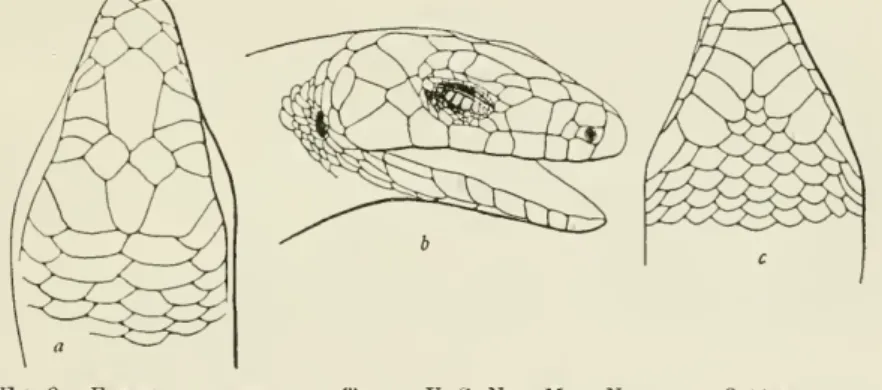
In the scales of the head the most noteworthy difference is the relatively smaller size of the frontal nasals, the supranasals in both of these specimens l:)in contact behind the rostral. Jatiscutatus may have been mistakenly brought from Japan to the opposite shore of the Sea of Japan. Sowerby and Fukien, are distinctly lower with consequent differences in the proportions of the various head-guards; the number of lamellae under the fourth toe is smaller;.

ART. 25 CHINESE AMPHIBIANS AND REPTILES^ STEJNEGER 57 TAKYDROMUS SEPTENTKIONALIS Guenther
58 PROCEEDINGS OF THE NATIONAL MUSEUM VOL. 6G
25 CHINESE AMPHIBIANS AND EEPTILES STEJNEGER 59Diagnosis, – Head one and three quarters to twice as long as Diagnosis, – Head one and three quarters to twice as long as wide; anterior supraocular very small, usually indicated by a tiny grain; enlarged dorsally in eight longitudinal series, the two median smaller; abdominal muscles in six series, smooth or very weakly keeled; .. four pairs of chin shields; two inguinal pores on each side; nasal contactbehind rostral; tail two and a half times to three times the length of head and body. Description of the type instance. Adult female: separated rostrally .. from internasally by anterior nostrils in broad contact; .. posterior loreal much larger than anterior; internasal as long as j)refrontals which are about two-thirds the length of the frontal; Variation. The variations of the five specimens in proportions and structural details can be seen in the accompanying tables.
ART. 25 CHINESE AMPHIBIANS AND EEPTILES STEJNEGER 61
AKT. 25 CHINESE AMPHIBIANS AND REPTILES STEJNEGER 63 EREMIAS ARGUS Peters
ANGUIDAE
34;within 200 miles of Foochow," already recorded by me, the National Museum has recently received from C. This specimen, which is without cross-drawings, is (in alcohol) of a pale bluish gray above, a little darker on the six-median scalerows;. The skulls are essentially like Boulenger's type figure, except that the occipitals are slightly larger and better differentiated.
ART. 25 CHINESE AMPHIBIANS AND REPTILES STEJNEGEE 65
66 PROCEEDINGS OF THE NATIONAL MUSEUM,
ART. 25 CHINESE AMPHIBIANS AND EEPTILES STEJNEGER 67
The scale formula of the three other names will appear on further analysis to be compound. As the chief distinction of A\ hahereri is supposed to be the smoothness of the three outer scale rows, and as this character has been shown to be of no significance, there can hardly be any objection to Boulenger's example in relation to N. Da- laen- to follow. saen, SW of Ningpo; Formosa). In both specimens the rostral is almost as wide as it is high, the interparietal suture is as long as the frontal and longer than the latter's distance from the tip of the snout, and the diameter of the eye is equal to the width of the frontal in the middle.
ART. 25 CHINESE AMPHIBIANS AND REPTILES STEJNEGER 69
However, the color is very different, except for the absence of dark borders on the supralabials. Boulenger's type has "the four anterior upper labials grayish-olive like the upper surface of the head, the remainder uniformly yellowish white like the lower surface" and our specimen has them all dark, but that seems of little importance and may be related to the larger size of the latter (718). mm.
ARI-. 25 CHINESE AMPHIBIANS AND REPTILES STEJNEGER 71 ing on the mid line with the corresponding pattern of the other side
65404-7 and 66437, from Foochow, all from Sowerby, representing adults and young, testify to the uniformity of this species in the said region. These patterns show very little individual variation, and it is particularly interesting to observe how constant the consolidation of the long supralabial heel is.
ART. 25 CHINESE AMPHIBIANS AND REPTILES STEJNEGEB 73
Graham at Wenchwan, on the road to Sungpan, Szechwan, which
ART. 25 CHINESE AMPHIBIANS AND EEPTILES STEJNEGER 77 and having seven snpralabials on one side and eight on the other
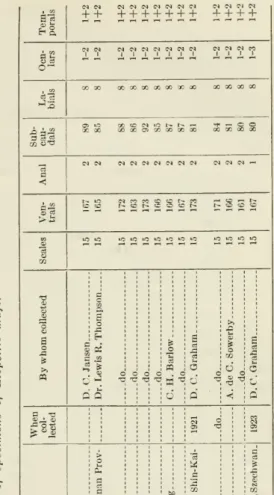
This series throws considerable light on the individual variations of species of which only two specimens have previously been recorded. In this connection we recall that the typical species of the genus, TrirhinopholisnucJialis Boulenger, from the mountains of Burma, is also characterized by the presence of a loreal. ARTICLE 25 CHINESE AMPHIBIANS AND REPTILES STEJNEGER 79 There are considerable differences in the arrangement of the temporals.
ART. 25 CHINESE AMPHIBIANS AND REPTILES STEJNEGER 79 In the arrangement of the temporals there is considerable vari-
No further specimen has come to the National Museum since the publication of Herpetology ofJapan, 1907 (p. 307), where a specimen, probably from Hong Kong, was described and figured. Sowerby, two collected at Tientsin and one at Hangchow, Chekiang, therefore not far from the type locality of the species. One of the specimens is a juvenile male taken in southern Manchuria on the Yalu River about 180 miles from its mouth.
82 PEOCEEDINGS OF THE NATIONAL MUSEUM VOL. 66
AET. 25 CHINESE AMPHIBIANS AND REPTILES STEJNEGER 83 ELAPHE DIONE (Pallas)
Regarding the temporals, it should be noted that the second row on one side in both specimens is significantly disturbed by being broken and. It should be further noted that while it is doubtful whether the young specimen can be said to possess even an indistinct ventral lateral keel, in the grown specimen there is a very distinct one, however. blunt, keeled, thus bringing it closer to E. conspicillata, to which it belongs. obviously related as Guenther first suggested. Finally, the old specimen, contrary to what is the case in the Japanese species, shows the peculiar color pattern as distinct as the young specimen, except that the red ground color, judging from the appearance in alcohol, is very duller grey-brown, and the light dorsal tablets are of the same shade as the brown ground colour.
CHINESE AMPHIBIANS AND REPTILES STEJNEGER 85
Another, mutilated specimen (No. 59729) without a particular locality, but with the collector's number 370, has 17 scale rows; eighth labial, fourth and fifth touching eye; two preoculars and two postoculars; temporal 2-1-3; frontal not in contact with preocular. Whether the normal nimiber of supralabials in this species is nine or eight, as stated in the Herpetology of Japan (p. 351),. In view of the recent revival of the genus Masticophis by Professor Ortenburger axid, since Peters originally described the present species as Masticophis spinalis, I have retained this term without prejudice until further studies will confirm the validity of this genus and its applicability confirmed to refer the present species to it.
ART. 25 CHINESE AMPHIBIANS AND REPTILES STEJNEGER 87 ZAOCYS DHUMNADES (Cantor)
88 PROCEEDINGS OF THE NATIONAL MUSEUM VOL. 6S
Sowerby sent a typical example of this species from near Yenpingfii, Fiikien (No. 65393) which has the following scale formula: sc. The National Museum has not received any additional material of this species, but I would place on record, U. The curious fact that several of the Formosan species show greater resemblance to species from Szechwan and the Himalayan region than to those of the intermediate re . -.
AET. 25 CHINESE AMPHIBIANS AND REPTILES STEJNEGER 93 Family BOIGIDAE
Four specimens have recently been added to the national collection, two (No. from the southwestern part of Hunan Province by Dr. LewisR. Thompson, one (No. 64646) from Kuliang by C. In Herpetology of Japan (p. 450) I referred to "the small compact group consisting of the species Agkisti'odon halys, hlom-. The width of the upper, narrow part of the rostral, measured at the level of the suture between the nasals and nasals, greater than half the length of the suture. between the anterior and rostral nasals.
ART. 25 CHINESE AMPHIBIANS AND REPTILES STEJNEGEE 99
The student of Chinese (and Japanese) soft-shelled turtles .. is faced with an extremely complicated problem, which due to its special circumstances may remain unsolved. In the rivers from Hongkong north to the Amur, and also in Formosa and Japan, there are one or more forms of the genus A7)iyda, which by some writers have been treated as a single species, while by others they have been regarded as " "formenkreiss" consisting of perhaps up to 5 differentiated subspecies to treat nomen- The difficulties are mainly due to (1) lack of material; (2) great variability of these animals; (3) breakdown of barriers natural.
ART. 25 CHINESE AMPHIBIANS AND EEPTILES STEJNEGER 105
51G) was largely incorrect, partly due to lack of material and partly due to the choice of dermal armor length as the unit (100) of comparison. In other respects they also match the Japanese specimens, but as they still fall within the plastron size range of the other mainland specimens, I prefer to call them A. They differ in several respects, notably in having a much greater interorbital width, but no corresponding specimens forms in both North and South I hesitate to pronounce them otherwise.
INDEX
110 INDEX
INDEX 111
112 INDEX
INDEX 118
114 INDEX
INDEX 115