Abstract: To meet the budget needs in the development sector, the Indonesian Government in 2012 issued Sharia-based long-term securities known as PBS Sukuk. This policy is intended to attract investors to invest funds in several government projects to reduce the burden on the state revenue and expenditure budget (APBN). This research was conducted to analyze Government policy in the issuance of PBS Sukuk which was studied from the Islamic economic perspective. Data collection was carried out through interviews and documentation taken from primary and secondary sources. The results of this study show that the issuance of PBS Sukuk shows significant growth which was indicated by the increasing government income obtained from PBS Sukuk from year to year. This phenomenon not only illustrates the success of the economic instruments launched by the government but also proves that Islamic-based economic instruments can develop and compete in the world of capital markets. The phenomenon also shows that sharia economics has an important role in helping the government, especially in the field of infrastructure development and it can be expected that it will gradually reduce the concept of usury that has been going on so far.
Keywords: Project Based Sukuk, Sharia economy, infrastructure development in Indonesia Abstrak: Dalam rangka memenuhi kebutuhan anggaran pada sektor pembangunan, Pemerintah Indonesia pada tahun 2012 menerbitkan surat berharga jangka panjang berbasis syariah yang dikenal dengan PBS Sukuk. Kebijakan ini dimaksudkan untuk menarik investor agar menanamkan dananya pada sejumlah proyek pemerintah sehingga mengurangi beban anggaran pendapatan dan belanja negara (APBN). Penelitian ini dilakukan untuk menganalisis kebijakan Pemerintah dalam penerbitan Sukuk PBS yang dikaji dari perspektif ekonomi Islam. Pengumpulan data dilakukan melalui wawancara dan dokumentasi yang diambil dari sumber primer dan sekunder.
Hasil penelitian ini menunjukkan bahwa penerbitan Sukuk PBS menunjukkan pertumbuhan yang signifikan yang ditunjukkan dengan meningkatnya pendapatan pemerintah yang diperoleh dari Sukuk PBS dari tahun ke tahun. Fenomena ini tidak hanya menggambarkan keberhasilan instrumen ekonomi yang dicanangkan pemerintah, namun juga membuktikan bahwa instrumen ekonomi berbasis syariah mampu berkembang dan bersaing di dunia pasar modal. Fenomena tersebut juga menunjukkan bahwa ekonomi syariah mempunyai peran penting dalam membantu pemerintah khususnya dalam bidang pembangunan infrastruktur dan diharapkan secara bertahap dapat mengurangi konsep riba yang telah berlangsung selama ini.
Kata kunci: Sukuk Berbasis Proyek, ekonomi syariah, pembangunan infrastruktur di Indonesia
Project-Based Sukuk (PBS) and Its Implementation in Economic Development in Indonesia
Taufiq Kurniawan1 & Asmak Ab Rahman2
1Ph.D. Candidate, Department of Syariah and Economics, Academy of Islamic Studies, University of Malaya, Kuala Lumpur – Malaysia.
2Senior Lecturer, Department of Syariah and Economics, Academy of Islamic Studies, University of Malaya, Kuala Lumpur – Malaysia
E-mail: 1[email protected], 2[email protected]
Published regularly : June 2019 DOI: https://doi.org/10.24042/adalah.v16i1.3988
Introduction
The problem of infrastructure development has become an urgent issue that needs to be addressed immediately by the Indonesian Government.
This is because, currently, the condition of Indonesia's infrastructure is still far from ideal, both in terms of quantity and quality. This occurs in line with the increasing number of population from year to year, all of whom require additional public facilities.
In Islam, one of the Government's tasks, apart from upholding virtue (al-Amr bi al-Ma'rûf) and prohibiting evil (al-Nahy 'an al-Munkar), is to optimize economic development for the welfare of its people. One model of government that upholds virtue is if the government supports, assists, and thinks about obtaining sources of funds for the economic development of its people. A trustworthy government is a government that does not want its people to continue living in poverty and backwardness.
As a country whose majority population is Muslim, even the largest in the world, Indonesia is obliged to carry out economic development (al- tanmiyyah al-iqtishâdiyyah) which was previously called the welfare of the earth ('Imârah al-Ardh). It is an obligation that has been established by Allah (taklîf syar 'i) to humans, as mentioned in the Qur'an:
ا َه ْي ِف ْم ُ
كَر َم ْعَت ْسا َو ِ ض ْر َ ا ْ
لا َن ِّم ْم ُ ك َ
ا َش ْ ن َ
ا َو ه ُ
...He (Allah) created you from the earth (land) and made you prosperous [meaning: humans make citizens of the world dominate and prosper the world]..." (Al-Hud 11: 61).
The word isti'mâr (verb: ista'mara) in the verse means a request, demand, or command (thalab) from Allah wanting humans to create prosperity on earth through development efforts. The demands from Allah are absolute so the law must be implemented by humans.1
Meanwhile, according to the Global Competitiveness Report 2014-2015 from the World Economic Forum, Indonesia's infrastructure competitiveness received a score of 4.4 and was ranked 56th out of
1 Nur Fitria, ‘Kontribusi Ekonomi Islam dalam Pembangunan Ekonomi Nasional, Ekonomi Islam, 2.03 (2016), p. 30 <https://doi.org/10.29040/jiei.v2i03.3>.
144 countries. This achievement is still behind several other ASEAN countries, such as Malaysia (score 5.5, ranked 25th), Singapore (score 6.5, ranked 2nd), and Thailand (score 4.6, ranked 48th).2 In the Global Competitiveness Report 2017-2018, however, Indonesia's infrastructure competitiveness score increased to 4.5 and was ranked 52nd out of 137 countries. Likewise in 2017-2018, Indonesia's ranking increased again compared to 2014-2015, although at the Asean level, Indonesia is still behind Malaysia (score 5.5, ranked 22nd), Singapore (score 6.5, ranked 2nd), and Thailand (score 4.7, rank 43).3
In response to these demands and needs, the Indonesian Government, since 2014 especially in the era of President Joko Widodo's administration, has begun to focus its attention on accelerating infrastructure development to create higher economic growth. Throughout the period of the Working Cabinet led by President Joko Widodo, infrastructure development has continued to be promoted,4 focusing on infrastructure development, in the form of roads, toll roads, ports, airports, and other public facilities constructions in areas that need it.5This can be seen from the large amount of infrastructure built in almost all regions of the Unitary State of the Republic of Indonesia (NKRI). By doing so, the Government expects that it can directly increase the acceleration of a country's economic and social development. Improvements in electricity, transportation, and telecommunications infrastructure can directly reduce production costs and reduce the time needed to carry out economic activities, which then has an impact on increasing productivity and production capacity of economic actors in the country.6
2 Klaus Schwab, Ed., The Global Competitiveness Report 2014-2015, (Geneva: The World Economic Forum, 2014), pp. 214, 260, 334, 360.
3 Klaus Schwab, Ed., The Global Competitiveness Report 2017-2018 (Geneva: The World Economic Forum, 2017), pp. 148–49, 192–93, 286–87, 262-263.
4 Wurjanto Nopijantoro, ‘“Surat Berharga Syariah Negara Project Based Sukuk (SBSN PBS),’:
sebuah Instrumen Alternatif Partisipasi Publik dalam Pembiayaan Infrastruktur’, Akuntansi Auditing dan Keuangan Vokasi, 1.2 (2018), p. 391 <https://doi.org/10.35837/subs.v1i2.259>.
5 ‘Presiden Jokowi: Infrastruktur Untuk Pertumbuhan Ekonomi Lebih Tinggi’ <https://
publikasi/berita/presiden-jokowi-infrastruktur-untuk-pertumbuhan-ekonomilebih-tinggi/> [accessed, on March 23, 2019].
6 Erika Sefila Putri dan Wisudanto, ‘Struktur Pembiayaan Pembangunan Infrastruktur di Indonesia Penunjang Pertumbuhan Ekonomi’ (presented at the Simposium I Jaringan
The government also hopes that Indonesia can catch up with the quantity and quality of infrastructure in various sectors and succeed in improving its position in the ranking of ASEAN countries such as Malaysia and Thailand
As President Joko Widodo said, the Indonesian nation cannot become a developed country if people in all corners of the archipelago cannot enjoy electricity. Likewise, it is difficult for Indonesia to become the world's maritime axis if Indonesia does not have a port where large ships that will transport products from within the country can dock.
Similarly, it is also difficult for Indonesia to become a sovereign nation in the food sector, if the number of reservoirs and irrigation canals irrigating agricultural land throughout Indonesia is very limited.7 This illustration shows that the existence of infrastructure for the public interest is very necessary for the welfare of the Indonesian people.
Currently, the government's program priorities are improvements of public facilities in the fields of electricity, transportation, and telecommunications, including many other supporting infrastructures.
Indeed, the existence of adequate infrastructure for the public interest is very necessary for the welfare of the Indonesian people. This is in line with one of the government's duties to serve the people for their welfare.8 A country that builds many public facilities to serve its people is a country that cares about its people (pro-people). With proper and adequate infrastructure conditions in this country, it is believed that
Perguruan Tinggi untuk Pembangunan Infrastruktur Indonesia, Paper, Simposium I Jaringan Perguruan Tinggi untuk Pembangunan Infrastruktur Indonesia, 2016), pp. 222–28; Andrio Firstiana Sukma, ‘Efek Pengganda Infrastruktur Pekerjaan Umum dalam Perekonomian Provinsi Bali (Multiplier Effect of Public Works Infrastructure in Bali Province)’, Journal of Regional and City Planning, 26.2 (2015), 100-110–110 (p. 102) <https://doi.org/10.5614/
jpwk.2015.26.2.3>.
7 President Joko Widodo' <https://www.facebook.com/story.php?story_fbid=7563357845 55273&id= 390581294464059> [accessed on March 23, 2019].
8 Teraik Kogoya, Benu Olfie, and Olly Esry Laoh, ‘Partisipasi Masyarakat Terhadap Pembangunan Infrastruktur Jalan Desa di Kabupaten Lanny Jaya-Papua’, Jurnal Berkala Ilmiah Efisiensi, 15.02 (2015), p. 1 https://ejournal.unsrat.ac.id/index.php/jbie/article/view/8343 [accessed on October 23, 2019]; Anggatia Ariza, ‘Pengaruh Pertumbuhan Ekonomi dan Belanja Modal Terhadap Indeks Pembangunan Manusia (IPM) dalam Perspektif Islam’, Al-Maslahah, 12.1 (2016), p. 2 <https://doi.org/10.24260/almaslahah.v12i1.348>.
Indonesia will be able to accelerate its economic and social development and compete with other more developed countries in the world.9
The question now is, however, that carrying out state infrastructure development requires quite a lot of funds while the development of State income from conventional sources tends to be slow and insufficient to finance all the State's growing needs. For this reason, since 2011 the government has begun designing several strategies to obtain sources of income, one of which is through sharia economic instruments, namely Project Based Sukuk (PBS).
Research Method
This research discusses the implementation of Sukuk PBS in economic development in Indonesia as well as analyzes how Sukuk PBS plays a role in encouraging the acceleration of development in Indonesia, especially in infrastructure development. This research uses a political economy approach combined with Islamic economic principles.
The data needed for this research was collected through interviews and documentation methods. The interview method was carried out with several figures involved in PBS Sukuk issuance activities, both from government circles, economic observers, and practitioners; Meanwhile, the documentation method is carried out by collecting and studying written notes or information contained in literature books, journals, newspapers, magazines, or other documents that are relevant to the research topic.
Results and Discussion
Infrastructure Project Financing Strategy in Indonesia
As it was explained in the previous section, one way to increase a country's economic growth is through infrastructure development. The availability of good infrastructure will affect economic growth.10 The
9 Totok Wahyu Abadi, Nunung Prajarto, and dan Budi Guntoro, ‘Performance E-Government Untuk Peningkatan Partisipasi Masyarakat dalam Pembangunan Infrastruktur di Kabupaten Sidoarjo’, Jurnal Kawistara, 4.3 (2014), p. 238 <https://doi.org/10.22146/
kawistara.6379>.
10 Fiona Lamari and Meilita Evita Ayomi Dita Rarasati, ‘An Exploratory Study of
creation of relations between regions will spur labor mobility between regions while at the same time encouraging the realization of equitable development. The availability of adequate infrastructure will encourage the formation of new investments, and new jobs, which means creating an increase in community income. Likewise, the availability of energy and transportation infrastructure can encourage the transfer of natural resources from surplus areas to deficient regions.11 Thus, the equalization of infrastructure development will affect the increase in income when there is an increase in productivity and the development of investment funds carried out by economic actors.12
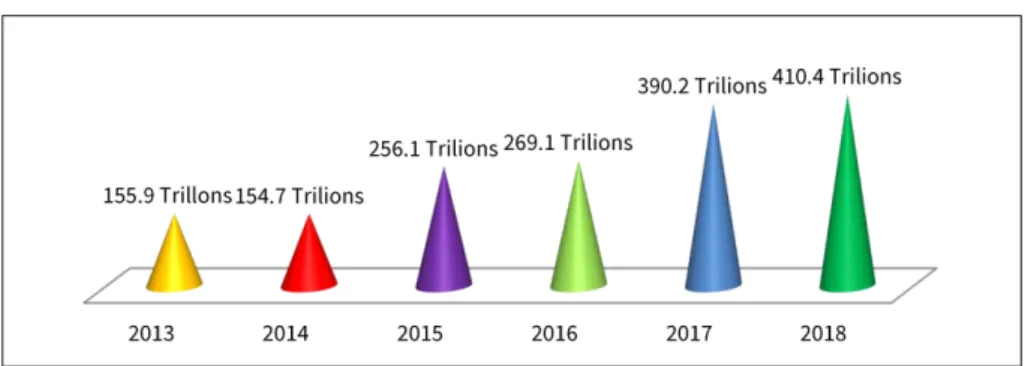
The Government of Indonesia is aware that the problem of infrastructure availability is one of the main obstacles faced by investors when doing business in Indonesia. For this reason, the Government of Indonesia has worked hard to overcome this problem since 2015 by raising the state budget for infrastructure development.13 This can be seen from the data displayed in the graph below:
Sukuk Utilisation for Transportation Infrastructure Development in Indonesia’, Makara Journal of Technology, 22.1 (2018), 53–59 (p. 53) <https://doi.org/10.7454/mst.v22i1.3581>;
Hayat Abdullah, ‘Realokasi Kebijakan Fiskal: Implikasi Peningkatan Human Capital dan Pembangunan Infrastruktur terhadap Pertumbuhan Ekonomi dan Kesejahteraan Masyarakat’, Jurnal Bina Praja: Journal of Home Affairs Governance, 6.2 (2014), 117–28 (pp. 124–25)
<https://doi.org/10.21787/
jbp.06.2014.117-128>.”
11 Waluyo Zulfikar, ‘Dampak Sosial, Ekonomi dan Politis dalam Pembangunan Bandara Udara Kertajati di Kabupaten Majalengka’, Jurnal Caraka Prabu, 1.01 (2017), 58–77 (p.
59); Adris A. Putra and Susanti Djalante, ‘Pengembangan Infrastruktur Pelabuhan dalam Mendukung Pembangunan Berkelanjutan’, Jurnal Ilmiah Media Engineering, 6.1 (2016), p.
434 <https:// ejournal.unsrat.ac.id/index.php/jime/article/view/11627> [accessed on March 23, 2019].
12 Wisudanto and Erika Sefila Putri, ‘Struktur Pembiayaan Pembangunan Infrastruktur di Indonesia Penunjang Pertumbuhan Ekonomi’ (presented at the Simposium I Jaringan Perguruan Tinggi untuk Pembangunan Infrastruktur Indonesia, Paper, Simposium I Jaringan Perguruan Tinggi untuk Pembangunan Infrastruktur Indonesia, 2016), pp. 68..
13 Directorate of State Budget Development, Directorate General of Budget, 2018 State Budget Information, ed. Director of APBN Preparation (Jakarta: Directorate General of Budget, 2018), 19. For 2019 budget requirements for infrastructure development are expected to exceed Rp.4,700 trillion, read: Nopijantoro, ‘Surat Berharga Syariah Negara Project Based Sukuk (SBSN PBS),’ pp. 391–92.
Diagram 1: Infrastructure Budget in APBN 2013-2018 (Trillion Rupiahs)
Source: APBN Directorate, Directorate General of Budget
As with other government projects, infrastructure projects cannot be separated from funding requirements. Because funds have an important role in infrastructure development, the Government must have an appropriate strategy to encourage community involvement to meet these needs.14 Without the support of a good financing concept, infrastructure development will result in a debt trap for the country. This means that infrastructure development must pay attention to a mature financing structure and investment concept so that it can produce a positive multiplier effect for the country.15
The multiplier effect on the national economy will not be too large if the funds obtained are used to finance the government's routine operational activities. Therefore, apart from covering the APBN deficit, the orientation of Sovereign Sukuk issuance must also be directed as a source of investment for infrastructure development in the fields of transportation, telecommunications, energy, etc. The issuance of Sovereign Sukuk, for instance, is aimed at accelerating port development in Eastern Indonesia and other strategic areas that will have a significant impact on the development of domestic industry. Likewise, airport infrastructure, and inter-regional toll roads, especially on large islands such as Sumatra,
14 Ferdy Posumah, ‘Pengaruh Pembangunan Infrastruktur Terhadap Investasi di Kabupaten Minahasa Tenggara’, Jurnal Berkala Ilmiah Efisiensi, 15.3 (2015), pp. 1–2 <Https://Ejournal.
Unsrat.ac.Id/Index.Php/Jbie/ Article/View/8776> [Accessed on March 23, 2019].
15 Wisudanto, p. 222
Kalimantan, and Sulawesi, as well as other projects, will encourage increased trade traffic, both imports and exports. In this way, the multiplier effect resulting from infrastructure development will be very large and have a positive impact on the State Revenue and Expenditure Budget (APBN). 16
Project Based Sukuk (PBS)
The term Sukuk comes from Arabic which means “certificate”. Sukuk in the Islamic capital market is similar to bonds (debt securities) found in conventional capital markets, namely letters or certificates from parties who need funds. The difference between Sukuk and bonds is that bonds are debt securities, while Sukuk is more of a certificate of ownership in an asset. In addition, Bonds require the party who owes the debt to pay interest to the party who provides the debt; whereas in Sukuk, the practice of interest like this is not justified by sharia, because it contains elements of riba (usury). 17 Thus, Sukuk, in this case, can answer one of the needs for halal financial instruments, which for Muslims in particular is an urgent need.
PBS Sukuk is a type of Sovereign Sukuk issued by the Indonesian government since 2012. PBS Sukuk is divided into two versions, the first is Sukuk with an underlying project mechanism, and the second is Sukuk with a project financing mechanism. Sukuk issued with an underlying project mechanism are used to finance the APBN in general.
Meanwhile, Sukuk issued a project financing mechanism (PBS) that is used specifically to finance certain projects planned in the APBN. These two types of Sukuk are relevant to current developments because the government needs very large funds to build various infrastructures in Indonesia.
16 Eri Hariyanto, ‘Efektivitas Penerbitan Sukuk Negara Sebagai Instrumen Pembiayaan APBN’, Indonesian Treasury Review: Jurnal Perbendaharaan, Keuangan Negara Dan Kebijakan Publik, 2.1 (2017), 79–98 <https://doi. org/ 10.33105/itrev.v2i1.15>.
17 Eka Siskawati, “Perkembangan Obligasi Syariah di Indonesia : Suatu Tinjauan” Jurnal Akuntansi & Manajemen Vol .5 No.2, December 2010 ISSN 1858-3687 pp. 1-9
The difference between PBS Sukuk and non-PBS Sukuk lies in the use of funds originating from the issuance of the Sovereign Sukuk.
Non-PBS Sovereign Sukuk are used to finance the APBN in general, especially to cover the budget deficit; while the issuance of PBS Sukuk is used to finance certain activities or projects implemented by ministries or agencies. In other words, Non-PBS Sukuk are intended to finance projects that have been determined in the State Revenue and Expenditure Budget, so they are general in nature; while PBS Sukuk is only intended to finance certain projects (special in nature). The funds obtained from the issuance of Sukuk are directly intended or devoted to financing projects that have been determined in the State Revenue and Expenditure Budget (APBN) and cannot be used for other purposes. 18
Objectives and Benefits of Project-Based Sukuk (PBS)
Initially, the orientation of state Sukuk issuance was aimed more at covering the state budget deficit. This orientation is legally permissible because the Indonesian government needs very large funds to support state spending needs, while tax revenues are not yet able to meet these needs. Although legally this orientation is not a problem, the multiplier effect on the national economy will not be too large, especially if the funds obtained are used to finance routine government operational activities. Therefore, apart from covering the APBN deficit, the orientation of state Sukuk issuance must also be directed as a source of investment for infrastructure development in the fields of transportation, telecommunications, energy, etc.19
In line with the above interests, at the next stage, PBS Sukuk is specifically intended only to finance government projects, not for other purposes. The issuance of Sovereign Sukuk to finance projects is one of the innovations developed by the government to create an alternative source of effective and efficient project financing. The main purpose of
18 Wurjanto Nopijantoro, p. 396.
19 Irfan Syauqi Beik, ‘Memperkuat Peran Sukuk Negara dalam Pembangunan Ekonomi Indonesia’, AL INFAQ, 2.2 (2011), pp. 68–69 <http://ejournal.uika-bogor.ac.id/index.php/
alinfaq/article/view/80> [accessed on March 23, 2019].
issuing Sovereign Sukuk is to finance infrastructure projects that have been allocated in the State Revenue and Expenditure Budget (APBN).20
There are several benefits that the Government can obtain by issuing Sovereign Sukuk. First, diversification of APBN funding sources;
Through the state Sukuk instrument issued for project financing, the government has several alternative sources of financing, especially those originating from the issuance of Government Securities (SBN);
Second, accelerating the process of developing infrastructure projects;
Third, fostering a nation capable of being independent in carrying out national development; Here the public can participate directly in financing government projects through purchasing the Sukuk; Fourth, developing sharia financial markets; The issuance of sovereign Sukuk for project financing brings the growth phase of sharia finance in Indonesia to a higher stage; 21 Fifth, improve public services; It is hoped that the issuance of Sukuk souvenirs for project financing will further improve services to the community, especially in providing funding sources for infrastructure development; Sixth, increasing transparency in government activities; In line with sharia financial principles that encourage transparency in all activities, the issuance of sharia-based Sovereign Sukuk instruments is expected to further encourage transparency in government activities.22
Apart from seeking other sources of income, the government also seeks community participation. Community participation in APBN financing can be done on two sides, namely on the income side and the financing side. On the income side, citizens' contribution to state revenue is through taxes. Paying taxes is mandatory for people who can afford it and as proof of compliance with laws and regulations. This tax payment obligation can also be accompanied by the threat of punishment for those who neglect it.23
The second alternative is through the financing side. From this perspective, the active role of the community is voluntary (not mandatory)
20 Dahlan Siamat, P. 178
21 Dahlan Siamat, ed., pp. 178–79.
22 Dahlan Siamat, ed., p. 179.
23 Wurjanto Nopijantoro, pp. 390–91.
while the benefits obtained can be received directly because they are in the form of returns. The form can be in the form of purchasing state Sukuk, or a collaboration scheme between the government and the private sector (public-private partnership). Or through existing schemes, namely by buying conventional bonds or Sharia state Sukuk.24
Project-Based Sukuk (PBS) Issuance Process
As explained earlier, PBS Sukuk is a Sovereign sukuk that is devoted to financing government projects. The issuance of Sovereign Sukuk for project financing is one of the innovations developed by the government to provide an effective and efficient alternative source of project financing. The main purpose of the issuance of the sovereign sukuk is to finance infrastructure projects that have been allocated in the State Budget (APBN).25
When the government requires additional funds to finance infrastructure and has confirmed the number of costs required, the government will issue PBS sukuk by auction sale which will be announced several days in advance. The auction winners will be announced after a few days the announcement of the sale of sukuk by auction is closed.26
So that Sovereign Sukuk can provide direct benefits for infrastructure development, the Indonesian government has developed a series of Sukuk specifically issued to finance project development. On October 11, 2011, the government for the first time auctioned Sovereign Sukuk under a project known as PBS Sukuk. The PBS Sukuk that were auctioned for the first time were the PBS001 series and the PBS002 series.27
In 2012, the PBS series of Sukuk was issued periodically through an auction mechanism. This issuance is a form of implementation of the APBN financing strategy through the Sovereign Sukuk. In 2013 the government began issuing Sukuk based on certain project areas or specifically for certain projects listed in the APBN. The issuance of
24 Wurjanto Nopijantoro, pp. 390–91.
25 Dahlan Siamat, ed., p. 178.
26 Manggiarto, D.S, issue PBS sukuk, in an interview, 2015.
27 Dahlan Siamat, ed., p. 72.
Sovereign Sukuk based on certain projects has been well received by various parties and is considered a solution to the lack of financing for infrastructure projects that require large funds.28 In the view of Islamic law, this is also not a problem as long as the source of funds is aimed at the welfare of the community at large.
When the PBS Sukuk was to be issued, the government first asked for DSN-MUI's sharia opinion regarding the Sukuk which was prepared using the IMMB concept. After thoroughly reviewing several things including the structure of the Sukuk used, the contracts and agreements contained in the issuance of the Sukuk, as well as other documents including the method and process of issuance, parties who have authority and expertise in the field of sharia stated that the Sukuk published does not conflict with Islamic principles.29 After PBS obtains a Sharia opinion, the government no longer needs to ask DSN-MUI for a Sharia opinion for the publication of the next series. Even so, the government still has to follow the guidelines and regulations regarding the issuance of PBS Sukuk that have been previously established.
In the formation process, PBS Sukuk requires several contracts/
agreements where, among these contracts, there is one contract which is main in nature, and several contracts that are supporting in nature, which then form the PBS Sukuk instrument. The basic contract is the al-Ijarah (rental) contract with the structure of the ijârah property being leased (Ijârah al-Maujûdât al-Mau'ûd Bisti' jarihâ) (IMMB)); while, the supporting contracts include the al-bay' (sale and purchase), wakâlah (representation) agreement, and the promise to sell and to buy back (al-wa'd bi al-bay' wa al-syira'). 30
Islamic Law Perspective regarding the legality of Loans or Fundraising through PBS Sukuk Instruments
KH. Ma'ruf Amin, former Chairman of the Indonesian Ulema Council (MUI), stated that Indonesia, despite its major population
28 Dahlan Siamat, ed., pp. 72–73.
29 Siamat, ed., p. 34.
30 Dahlan Siamat, ed., p. 68.
adhering to Islam, is neither Dâr al-Islâm (Islamic country), nor Dâr al-Kufr (infidels), nor Dâr al-Harbi (Enemy Country), but is Dar al- 'Ahdi (a country of agreement). The concept of Dâr al-'Ahdi (a country of agreement ) was once built by the Prophet Muhammad SAW when he came to Medina in 622 AD. There the Prophet Muhammad SAW together with the Muslims of Medina and all of the non-Muslim followers made a joint agreement known as the "Medinah Charter". This charter was supported by all elements of the society and became a legal agreement that must be obeyed by all religious communities, including the Muslims.
Even though Indonesia does not have the status of an Islamic country, this country has implemented several characteristics of Islamic government by making several policies that make it easier for the Muslim community to perform worship and practice the teachings of their religion. Through Sukuk financing that took place during 2013- 2017, the government built several facilities that support the interests of Muslims such as Mosques, Hajj dormitories, religious affairs offices, marriage halls, school buildings, or campuses that are Islamic State Universities (UIN). Besides, the government also built public facilities such as the construction of dual tracks and elevated railroad tracks, roads and flyovers, and the management of water resources.31 All of that is a form of economic development that is directed to prosper the earth (‘imârah al-ardh). On this basis, therefore, all economic development policies implemented by the Indonesian government, as long as they still have good aims and do not conflict with Islamic law, are mandatory for all Indonesian Muslims to obey them.
Furthermore, From an Islamic perspective, development must be carried out based on prioritizing urgent needs (Dharûriyyah), ordinary needs (Hâjiyah), and complementary needs (Tahsîniyyah). Prioritizing economic development for ordinary situations over urgent situations is a form of injustice in attitude or policy. For example, a country builds two very luxurious football stadiums in one city, even though in that city there are still many damaged roads that make it difficult for people to get to work,
31 Eri Hariyanto, p. 83.
markets, schools, mosques, and so on. This example is a form of economic development injustice because it prioritizes complementary and does not prioritize ordinary needs. Infrastructure has a very important role in the Indonesian economy. This is because economic growth in Indonesia is influenced by the availability of infrastructure such as electrification, paved roads, and clean water. The development and availability of infrastructure such as electricity, roads, and clean water play an important role in the rate of economic growth in Indonesia. If the government's role in providing infrastructure is not optimal, it is quite certain that the smooth development of the economy will encounter many obstacles. 32
Furthermore, there are differences of opinion among Muslim economists in viewing Sukuk, both as investment instruments and debt instruments.
Some classify it as an investment instrument33 while some consider it a debt instrument. 34 Regardless of whether the Sukuk instrument is a debt instrument or an investment instrument, the Sukuk issuer is still the party who needs money to finance certain purposes. It could also be said that the Sukuk issuer does not have enough money, or even does not have the money to build the project. So in such circumstances, is it normal for Sukuk issuers to take debt or raise funds to build infrastructure? This question also applies to the Indonesian government as a Sukuk issuer. In Islamic law, is the government justified in borrowing or collecting money by issuing PBS Sukuk to build infrastructure in Indonesia? As previously discussed, economic development is mandatory, including infrastructure development. Because the government must meet people's needs and
32 Novi Maryaningsih, Oki Hermansyah, and Myrnawati Savitri, ‘Pengaruh Infrastruktur Terhadap Pertumbuhan Ekonomi Indonesia’, Buletin Ekonomi Moneter dan Perbankan, 17.1 (2014), 62–98 (pp. 67–68) <https://doi.org/10.21098/bemp.v17i1.44>.
33 Norma Rosyidah, ‘Optimalisasi Fungsi Barang Milik Negara (BMN) Melalui Sukuk Sebagai Instrumen Pembiayaan Nasional’, Jurnal Ekonomi dan Bisnis Islam (Journal of Islamic Economics and Business), 1.2 (2016), 161–72 (P. 162) <Https://Doi.Org/10.20473/
Jebis.V1i2.1436>; Ika Indriasari, ‘Analisis Pemilihan Sukuk Sebagai Instrumen Investasi’, Stability: Journal of Management and Business, 1.1 (2018), P. 95 <Https://Doi.Org/ 10.26877/ Sta.
V1i1.2619>; Anna Nurlita, ‘Investasi di Pasar Modal Syariah dalam Kajian Islam’, Kutubkhanah, 17.1 (2015), 1–20 (p. 9).
34 Dzubaidah Bt Zainal Abidin dan S. Shahida, ‘Sukuk “Asset-Based” Berbanding Sukuk
“Asset-Backed”: Kes Kemungkiran Sukuk”’ (Paper, Persidangan Kebangsaan Ekonomi Malaysia ke VIII (PERKEM VIII), 2019), p. 1.
improve their quality of life. Infrastructure development that is built based on community needs is one way to prosper the earth, as referred to in the word of Allah in Surah Hud: 61.35
In connection with the discussion about debts and receivables, in Islamic Law’s perspective, the issue of debts and receivables is included in the al-mu'âmalât chapter (economic relations between humans). Seen from the Sharia perspective no text suggests someone is in debt. There is a text, however, that shows that it is not wrong for someone to be in debt as mentioned in the Al-Qur'an in surah al-Baqarah: 282. The verse shows that Islam allows debt and receivable transactions and also explains the need to record these debt and receivable transactions. Even though this verse only emphasizes the need to record debts, it also indirectly shows that if someone wants to get into debt then his action is not prohibited at all. Debting is an act permitted in Islam, but the ability to pay off debts must also be a consideration for those who want to borrow. 36 The ability to take on debt can be linked to fulfilling principle needs (Dharûriyyah) to achieve the goals of the Shari'ah (Maqâshid al- Syar'iyyah) namely maintaining human benefit in this world and the hereafter. 37 If the objectives of Islamic law are linked to the concepts of Dharûriyyah (basic needs), Hâjiyah (ordinary needs), or Tahsîniyyah (complementary needs), then the issue of the purpose of debt can also be linked to these concepts.
Moreover, actions or policies for taking out debt must pay attention to several aspects, including the issue of debt needs, whether they fall into the Dharûriyyah, Hâjiyah, or Tahsîniyyah categories. If the need for debt is included in the category of basic needs (Dharûriyyah), for example, to maintain the continuity of religious life (Hifzh al-Dîn), health (Hifzh
35 Surtahman Kastin Hasan dan Sanep Ahmad, Ekonomi Islam: Dasar dan Amalan, Ed.
2 (Kuala Lumpur: Dewan Bahasa dan Pustaka, 2005), pp. 330–33.
36 Winda Afriyenis, ‘Perspektif Ekonomi Islam Terhadap Utang Luar Negeri Pemerintah dalam Pembangunan Ekonomi Indonesia’, Maqdis: Jurnal Kajian Ekonomi Islam, 1.1 (2016), 1–16 (p. 11).”
37 Muhammad Hisyam Mohamad, ‘Pendekatan Islam dalam Pengurusan Hutang’, dalam Paradigma Ekonomi & Integrity: Sudut Pandang Islam (Kuala Lumpur: Penerbit Institut Kefahaman Islam Malaysia (IKIM), 2014), pp. 26–27
al-Nafs), continuity of generations (Hifzh al-Nasl), welfare (hifzh al-Mâl) and intelligence/noble morals (Hifzh al-'Aql). then there is no reason to say that it is something prohibited by the Shari'a. This is because the five aspects above are none to achieve Maqâshid al-Syar'iyyah (the goal of the Shari'a), namely maintaining human benefit in this world and the afterlife.
In practice, the funds collected from the PBS Sukuk that apply in Indonesia are used to finance the construction of public infrastructure/
facilities such as Hajj Dormitories, Religious Offices, Marriage Halls, Schools, or State Islamic University (UIN) Campuses, including double track trains, highways and flyovers, water resources, 38 and airports.39 The constructions of Hajj hostels, religious affairs offices, marriage halls, Islamic boarding schools, and the State Islamic University (UIN) campuses were carried out to maintain the continuity of religious life (Hifzh al-Dîn).
Likewise, the development of water resources is carried out to maintain a healthy life (Hifzh al-Nafs). Similarly, the construction of marriage halls is also carried out to preserve life (Hifzh al-Nasl). The development of water resources is also carried out to maintain reasonable continuity of life (Hifzh al-'Aql). Meanwhile, the construction of transportation facilities such as double-track trains, highways, and flyovers, including airports, can be seen as a wasilah (intermediary) to protect religion (Hifzh al-Dîn), soul (Hifzh al-Nafs), descendants (Hifzh al-Nasl). and intellectuality (Hifzh al-'Aql). 40
Based on the study above, as the practice of borrowing through PBS Sukuk to build infrastructure in Indonesia is related to the situation of Dharûriyyah (basic needs), Hâjiyah (ordinary needs), or Tahsîniyyah (additional needs), then the debt law in this case is permissible. This is because the need for debt to finance infrastructure projects can be classified as Dharûriyyah
One thing to note is that although debt for infrastructure development in Indonesia is not prohibited, as long as it does not conflict with Sharia provisions,41this policy needs to be reduced, even to be eschewed. The
38 Eri Hariyanto, ‘Efektivitas Penerbitan Sukuk Negara Sebagai Instrumen Pembiayaan APBN’, p. 1.
39 Ikhsan Rifaldi, S.ST.Ak., M.Si, in a meeting with the author, 2018.
40 Hariyanto, ‘Efektivitas Penerbitan Sukuk Negara Sebagai Instrumen Pembiayaan APBN’, p. 1.
41 Muhammad Hisyam Mohamad, p. 27.
main reason is that, based on experience so far, lending countries tend to set various conditions that may be detrimental to Indonesia. Moreover, from the perspective of equal relations between countries and sovereignty, Indonesia's position will be slightly "lower" in international diplomacy, because it has the "stamp" as a debtor country.
Therefore, as an alternative, it is necessary to look for other efforts that can support financing for infrastructure development, and for this reason, the best option is through Sukuk. Sukuk is indeed better than direct debt because in Sukuk the relationship of equality between Indonesia and investors is visible. Apart from that, foreign intervention that is detrimental to the country can also be minimized, and the country can manage its potential resources better.42
The Role of PBS Sukuk in Accelerating Infrastructure Development in Indonesia
The Government is fully aware that the problem of infrastructure availability is one of the main obstacles faced by investors when going to do business in Indonesia. Therefore, since 2015, the Government of Indonesia has worked hard to overcome the problem of insufficient infrastructure by raising the state budget.43
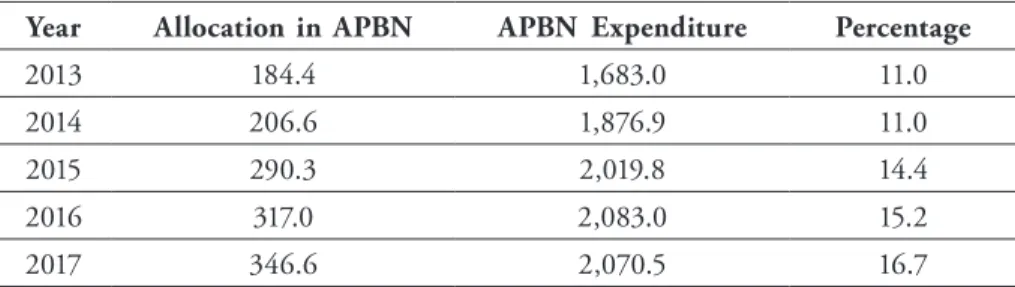
The Indonesian government continues to increase productive spending, especially to finance the development of connecting infrastructure between regions, facilities, and infrastructure for electricity, housing, sanitation, clean water, and other urgent needs. 44 This can be seen from the infrastructure financing budget which continues to increase from year to year, as shown below.45
42 Irfan Syauqi Beik, ‘Memperkuat Peran Sukuk Negara dalam Pembangunan Ekonomi Indonesia’, AL-INFAQ, 2.2 (2011) <http://ejournal.uikabogor.ac.id/index.php/al-infaq/article/
view/80> [accessed on March 23, 2019]. Arie Rachmat Soenjoto and Hilda Lutfiani, ‘Konsep dan Aplikasi Sukuk Negara dalam Pembiayaan Defisit APBN di Indonesia’, Islamic Economics Journal, 2.2 (2016), pp. 83–84 <https://doi.org/ 10.21111/ iej.v2i2.1389>.
43 Directorate of State Budget Development, Directorate General of Budget, 2018. pp. 391–92.
44 Reifa Qisthi Mitsaliyandito and Tika Arundina, ‘Dynamic Relationship between Sovereign Bond and Sukuk Market Developments in Indonesia’, Pertanika: Social Sciences and Humanities 26 (2018), 27–38 (pp. 34–35).
45 Eri Hariyanto, ‘Memahami Project Based Sukuk (PBS)’, Direktorat Jenderal Pengelolaan
Table 1: Infrastructure Financing Budget from Year to Year Year Allocation in APBN APBN Expenditure Percentage
2013 184.4 1,683.0 11.0
2014 206.6 1,876.9 11.0
2015 290.3 2,019.8 14.4
2016 317.0 2,083.0 15.2
2017 346.6 2,070.5 16.7
Source: Ministry of Finance of the Republic of Indonesia
Indonesian economic experts estimate the need for funds to increase Indonesia’s economic growth until the end of 2019 reaches around Rp.2,900 trillion. To meet this need, the Government promotes the relationship between the private sector through the pattern of cooperation between the government and the private sector, including State-Owned Enterprises (BUMN).46
In addition to these steps, the Government also made breakthroughs by gathering community participation in financing the country’s development through the issuance of a Sovereign Sukuk specifically for infrastructure financing (Project Sukuk). As mentioned in Act Number 19 of 2008 concerning Government Islamic Securities or Sovereign Sukuk, Sovereign Sukuk can be issued to finance the general budget deficit and finance government infrastructure. This government’s effort received a positive response from the public as indicated by the increase in PBS issuance from year to year as shown in the following table.47
Table 2: Increase in PBS Issuance from Year to Year No Year Budget (trillion) Type of Projects
1 2013 IDR 0,7 Construction of a double-track railway 2 2014 IDR 1,371 Construction of the double-track railroad
and construction of the Hajj hostel
Pembiayaan dan Risiko Kementerian Keuangan, 2017 <https://www.djppr.kemenkeu.go.id/
page/ load/1807> [accessed on March 23, 2019].
46 Hariyanto, ‘Memahami Project Based Sukuk (PBS)’; Rizky Suci Ramadayanti, Dedy Mainata, and Angrum Pratiwi, ‘Peran Sukuk Negara dalam Pembiayaan Infrastruktur’, Al- Tijary,2.2 (2017), 155–76 (pp. 156–57) <https://doi.org/10.21093/at.v2i2.788>.
47Hariyanto, p. 5.
No Year Budget (trillion) Type of Projects
3 2015 IDR 7,135
Construction of elevated track railways, construction of the State Islamic University (UIN) campus, construction of religious affairs offices and marriage halls.
4 2016 IDR 13,677
Construction of double track and railroad overpasses, construction of roads and flyovers across Sumatra, construction of UIN campus, haj hostel and religious affairs office.
5 2017 IDR 16,76
Implementation of train services, construction of roads and water resources, construction of UIN campus, Hajj hostel and religious affairs office.
Source: Directorate of Sharia Finance, 2016
The increasing PBS budget that is budgeted by the government from year to year not only illustrates that PBS has an important role in helping the government in economic development48 but it also shows that investor acceptance of instruments using the concept of sharia in the capital market has also increased.49 The advantage of PBS compared to conventional funding systems or foreign-party loans is that it can provide solutions that do not exist in other systems, namely anti-usury.
This is evidenced by the case that occurred in 2013, where one project in the transportation department in Indonesia, whose funding was sourced from foreign loans, was the most problematic project at the time. However, when the project funding was taken over using the PBS Sukuk instrument, the problem was resolved well.50
It is difficult to argue that PBS Sukuk has good potential to assist the country in infrastructure development. On April 27, 2015, the total value of the outstanding sovereign Sukuk was around Rp.245,165760 trillion.
Of the total outstanding Sukuk, SPNS Sukuk only ranged at 1.63%, IFR Sukuk 6.77%, PBS Sukuk 23.2%, retail Sukuk 28.5, SNI Sukuk 26.35%
48 Hariyanto, ‘Efektivitas Penerbitan Sukuk Negara Sebagai Instrumen Pembiayaan APBN’, pp. 95–96.
49 Muhammad Ardi, ‘Pengaruh Sukuk Terhadap Pertumbuhan Ekonomi Indonesia’
Iqtishaduna, 9.1 (2018), 85–97 (P. 96).
50 Manggiarto D.S, issue PBS sukuk, in an interview, 2015
and SDHI Sukuk 13.58%. In this composition, although PBS Sukuk ranks third in the percentage of Sukuk series that have outstanding compositions, the trend for Sukuk that continues to increase is PBS series Sukuk.51
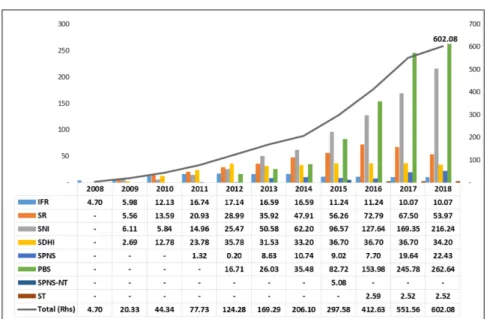
The following is a diagram of outstanding sovereign Sukuk in trillion rupiahs as of May 31, 2018:52
Diagram 2: Outstanding Sovereign Sukuk
Source: Directorate of Sharia Financing, Directorate General of Financing and Risk Management, Ministry of Finance of the Republic of Indonesia, 2018.
The diagram above shows that the outstanding PBS Sukuk continues to increase every year. The most significant increase occurred in 2016 to 2018, because in the past three years, the composition of outstanding PBS Sukuk was in the highest position compared to other sovereign Sukuk.
As of May 31, 2018, data showed that the outstanding sovereign Sukuk was Rp.602.08 trillion (18 percent of the total outstanding government securities). In this composition, PBS Sukuk has a portion of 7.8 percent from 18 percent of the total outstanding sovereign Sukuk.
51 Manggiarto, D.S, issue PBS sukuk, in an interview, 2015.
52 Anggoro Pridityo, ‘File PowerPoint Sukuk Negara Market Update as of May 31, 2018’, 2018.
Diagram 3: The Percentage of Sovereign Sukuk Outstanding in 2018
Although the data in diagram 3 shows that the outstanding sovereign Sukuk is much smaller than the outstanding state bonds, which is 18 percent compared to 82 percent, the development of sovereign Sukuk has increased quite well from year to year (as illustrated in diagram 2). This shows that the Islamic financial market in Indonesia and the Sharia Sukuk market continue to develop rapidly, even though its size compared to the conventional market is still very small.53
Diagram 4: The Percentage of Outstanding Each Type of Sovereign Sukuk from Total Government Securities in 2018
Source: Results of Data Processing from the Sharia Financing Directorate, Directorate General of Financing and Risk Management, Ministry of Finance of the Republic of Indonesia, 2018.
53 Anik and Iin Emy Prastiwi, ‘Pengembangan Instrumen Sukuk dalam Mendukung Pembangunan Infrastruktur’, Jurnal Ilmiah Ekonomi Islam, 3.03 (2017), 173–80 (p. 173)
<https://doi.org/10.29040/jiei.v3i03.129>.
This data shows an increase in the number of PBS Sukuk in circulation from year to year; in the last two years, 2017-2018, the outstanding was at the top compared to other types of sovereign Sukuk.
This shows that the role of PBS Sukuk which is specifically to fund state infrastructure development has helped the Indonesian Government in meeting development funding needs. This phenomenon is an opportunity for Islamic financial institutions or Indonesian Muslim investors to invest their funds to develop the Indonesian state from the infrastructure aspect through products with a Sharia concept. Through this instrument, the worries of some people who are afraid of their funds falling into investments that contain elements of usury will disappear.54
Conclusion
To cover the infrastructure financing budget needs which continue to increase from year to year, the Indonesian Government has innovated by issuing special state Sukuk for infrastructure financing, namely Sharia- based Project Sukuk (PBS). In its development, the publication of PBS has received a positive response from capital market investors, as shown by the increasing PBS budget allocated by the government from year to year. This proves that PBS plays a role in helping the government to develop the country's economy while also showing that instruments designed using Sharia concepts are increasingly in demand by investors.
In the future, it is hoped that this economic instrument will continue to grow and develop so that it will gradually reduce the concept of usury that has been circulating. in the capital market.
Author Contribution
This research was a collaborative effort between the authors, with Taufiq Kurniawan and Asmak Ab Rahman each contributing distinct and complementary roles. Taufiq Kurniawan led by conceptualizing the study,
54 Juaris, Raja Masbar, and Chenny Seftarita, ‘Analysis of The Effect of Monetary Policy on Government Sharia Securities (SBSN) in Indonesia’, Sriwijaya International Journal of Dynamic Economics and Business, 2.2 (2018), 109–22 <https://doi.org/10.29259/sijdeb.v2i2.109-122>.
providing input on the methodology, and analyzing the data. Menwhile, Asmak Ab Rahman is mainly involved in curating the data, presenting the data, writing the original draft, and refining articles through editing.
Both authors worked in close collaboration, and reviewed, refined, and approved the final manuscript.
Bibliography
Abadi, Totok Wahyu, Nunung Prajarto, and dan Budi Guntoro, ‘Performance E-Government Untuk Peningkatan Partisipasi Masyarakat dalam Pembangunan Infrastruktur di Kabupate Sidoarjo’, Jurnal Kawistara, 4.3 (2014) <https://doi.org/10.22146/kawistara.6379>
Abdullah, Hayat, ‘Realokasi Kebijakan Fiskal: Implikasi Peningkatan Human Capital dan Pembangunan Infrastruktur terhadap Pertumbuhan Ekonomi dan Kesejahteraan Masyarakat’, Jurnal Bina Praja: Journal of Home Affairs Governance, 6.2 (2014), 117–28 https://
doi.org/10.21787/ jbp.06.2014.117-128
Afriyenis, Winda, ‘Perspektif Ekonomi Islam Terhadap Utang Luar Negeri Pemerintah dalam Pembangunan Ekonomi Indonesia’, Maqdis : Jurnal Kajian Ekonomi Islam, 1.1 (2016), 1–16
Anik, and Iin Emy Prastiwi, ‘Pengembangan Instrumen Sukuk dalam Mendukung Pembangunan Infrastruktur’, Jurnal Ilmiah Ekonomi Islam, 3.03 (2017), 173–80 <https://doi.org/10.29040/jiei. v3i03.129>
Ardi, Muhammad, ‘Pengaruh Sukuk Terhadap Pertumbuhan Ekonomi Indonesia’, Iqtishaduna, 9.1 (2018), 85–97
Ariza, Anggatia, ‘Pengaruh Pertumbuhan Ekonomi dan Belanja Modal Terhadap Indeks Pembangunan Manusia (IPM) dalam Perspektif Islam’, Al-Maslahah, 12.1 (2016) <https://doi.org/10.24260/ Almaslahah.
V12i1.348>
Beik, Irfan Syauqi, ‘Memperkuat Peran Sukuk Negara dalam Pembangunan Ekonomi Indonesia’, AL-INFAQ, 2.2 (2011) <http://ejournal.uikabogor.
ac.id/index.php/al-infaq/article/view/80> [accessed on March 23, 2019]
D.S, Manggiarto, issue PBS Sukuk, in an interview, 2015
Fitria, Tira Nur, ‘Kontribusi Ekonomi Islam dalam Pembangunan Ekonomi Nasional’, Jurnal Ilmiah Ekonomi Islam, 2.03 (2016) <https://doi.
org/10.29040/jiei.v2i03.3>
Hariyanto, Eri, ‘Efektivitas Penerbitan Sukuk Negara Sebagai Instrumen Pembiayaan APBN’, Indonesian Treasury Review: Jurnal Perbendaharaan, Keuangan Negara dan Kebijakan Publik, 2.1 (2017),79–98 <https://
doi.org/10.33105/itrev.v2i1.15>
———, ‘Memahami Project Based Sukuk (PBS)’, Direktorat Jenderal Pengelolaan Pembiayaan dan Risiko Kementerian Keuangan, 2017
<https://www.djppr.kemenkeu.go.id/page/load/1807> [accessed on March 23, 2019]
Indriasari, Ika, ‘Analisis Pemilihan Sukuk Sebagai Instrumen Investasi’, Stability: Journal of Management and Business, 1.1 (2018) <https://
doi.org/10.26877/sta.v1i1.2619>
Juaris, Raja Masbar, and Chenny Seftarita, ‘Analysis of The Effect of Monetary Policy on Government Sharia Securities (SBSN) in Indonesia’, Sriwijaya International Journal of Dynamic Economics and Business, 2.2 (2018), 109–22 <https://doi.org/10.29259/sijdeb.
v2i2.109-122>
‘KH Ma’ruf Amin: Indonesia Bukan Negara Islam, Tetapi Negara Kesepakatan’ [accessed on March 23, 2019]
Kogoya, Teraik, Benu Olfie, and Olly Esry Laoh, ‘Partisipasi Masyarakat Terhadap Pembangunan Infrastruktur Jalan Desa Di Kabupaten Lanny Jaya-Papua’, Jurnal Berkala Ilmiah Efisiensi, 15.02 (2015) https://ejournal.unsrat.ac.id/index.php/jbie/article/view/8343 [accessed on March 23, 2019]
Maryaningsih, Novi, Oki Hermansyah, and Myrnawati Savitri, ‘Pengaruh Infrastruktur Terhadap Pertumbuhan Ekonomi Indonesia’, Buletin Ekonomi Moneter dan Perbankan, 17.1 (2014), 62–98 <https://doi.
org/10.21098/bemp.v17i1.44>
Meilita Evita, Fiona Lamari, Ayomi Dita Rarasati, ‘An Exploratory Study of Sukuk Utilisation for Transportation Infrastructure Development in Indonesia’, Makara Journal of Technology, 22.1 (2018), 53–59
<https://doi.org/10.7454/mst.v22i1.3581>
Mitsaliyandito, Reifa Qisthi, and Tika Arundina, ‘Dynamic Relationship between Sovereign Bond and Sukuk Market Developments in Indonesia’, Makara Journal of Technology, 22.1 (2018), 53–59 <https://
doi.org/10.7454/mst.v22i1.3581>
Mohamad, Muhammad Hisyam, ‘Pendekatan Islam dalam Pengurusan Hutang’, in Paradigma Ekonomi & Integrity: Sudut Pandang Islam. Kuala Lumpur: Penerbit Institut Kefahaman Islam Malaysia (IKIM), 2014.
Nopijantoro, Wurjanto, ‘Surat Berharga Syariah Negara Project Based Sukuk (SBSN PBS): sebuah Instrumen Alternatif Partisipasi Publik dalam Pembiayaan Infrastruktur’, Akuntansi Auditing dan Keuangan Vokasi, 1.2 (2018), 390–406 <https://doi. org/10.35837/subs.v1i2.259>
Nurlita, Anna, ‘Investasi di Pasar Modal Syariah dalam Kajian Islam’, Kutubkhanah, 17.1 (2015), 1–20
Posumah, Ferdy, ‘Pengaruh Pembangunan Infrastruktur Terhadap Investasi di Kabupaten Minahasa Tenggara’, Jurnal Berkala Ilmiah Efisiensi, 15.3 (2015) <https://ejournal.unsrat.ac.id/index. php/jbie/
article/ view/8776> [accessed on March 23, 2019]
‘Presiden Joko Widodo’ <https://www.facebook.com/story.php?story_fbi d=756335784555273&id= 390581294464059> [accessed on March 23, 2019]
‘Presiden Jokowi: Infrastruktur Untuk Pertumbuhan Ekonomi Lebih Tinggi’ [accessed on March 23, 2019]
Pridityo, Anggoro, ‘File PowerPoint Sukuk Negara Market Update as of May 31, 2018’, 2018
Putra, Adris A., and Susanti Djalante, ‘Pengembangan Infrastruktur Pelabuhan dalam Mendukung Pembangunan Berkelanjutan’, Jurnal Ilmiah Media Engineering, 6.1 (2016) <https://ejournal. unseat.ac.id/
index.php/jime/article/view/11627> [accessed on March 23, 2019]
Ramadayanti, Rizky Suci, Dedy Mainata, and Angrum Pratiwi, ‘Peran Sukuk Negara dalam Pembiayaan Infrastruktur’, Al-Tijary, 2.2 (2017), 155–76 <https://doi.org/10.21093/at.v2i2.788>
Rifaldi, S.ST.Ak., M.Si, Ikhsan, in a meeting with the author, 2018 Rosyidah, Norma, ‘Optimalisasi Fungsi Barang Milik Negara (BMN)
Melalui Sukuk Sebagai Instrumen Pembiayaan Nasional’, Jurnal Ekonomi dan Bisnis Islam (Journal of Islamic Economics and Business), 1.2 (2016), 161–72 <https://doi.org/10.20473/jebis.v1i2.1436>
S. Shahida, Dzubaidah Bt Zainal Abidin, ‘Sukuk “Asset-Based” Berbanding Sukuk “Asset-Backed”: Kes Kemungkiran Sukuk” (Paper, Persidangan Kebangsaan Ekonomi Malaysia ke VIII (PERKEM VIII), 2019).
Sanep Ahmad, Surtahman Kastin Hasan, Ekonomi Islam: Dasar dan Amalan, Ed. 2. Kuala Lumpur: Dewan Bahasa dan Pustaka, 2005.
Amalan, Ed. 2. Kuala Lumpur: Dewan Bahasa dan Pustaka, 2005.
Schwab, Ed., Klaus, The Global Competitiveness Report 2014-2015. Geneva:
The World Economic Forum, 2014.
———, The Global Competitiveness Report 2017-2018. Geneva: The World Economic Forum, 2017.
Siamat, ed., Dahlan, Sukuk Negara: Instrumen Keuangan Berbasis Syariah. Jakarta: Direktorat Pembiayaan Syariah, Direktorat Jenderal Pengelolaan Utang, Kementerian Keuangan RI, 2014.
Siskawati, Eka “Perkembangan Obligasi Syariah di Indonesia : Suatu Tinjauan” Jurnal Akuntansi & Manajemen Vol .5 No.2, December 2010 ISSN 1858-3687 pp. 1-9
Soenjoto, Arie Rachmat, and Hilda Lutfiani, ‘Konsep dan Aplikasi Sukuk Negara dalam Pembiayaan Defisit APBN di Indonesia’, Islamic Economics Journal, 2.2 (2016) https://doi.org/10.21111/ iej.v2i2.1389 Sukma, Andrio Firstiana, ‘Efek Pengganda Infrastruktur Pekerjaan Umum
dalam Perekonomian Provinsi Bali (Multiplier Effect of Public Works Infrastructure in Bali Province)’, Journal of Regional and City Planning, 26.2 (2015), 100-110–110 <https://doi.org/10.5614/
jpwk.2015.26.2.3>
Syariah, Direktorat Pembiayaan, Kumpulan Fatwa Dewan Syariah Nasional- Majelis Ulama Indonesia Terkait Surat Berharga Syariah Negara (Sukuk Negara), Ed. 4. Jakarta: Kerjasama Kementerian Keuangan RI dengan Dewan Syariah Nasional - Majelis Ulama Indonesia, 2014.
Wisudanto, Erika Sefila Putri, ‘Struktur Pembiayaan Pembangunan Infrastruktur di Indonesia Penunjang Pertumbuhan Ekonomi’ (Paper Presented at the Simposium I Jaringan Perguruan Tinggi untuk Pembangunan Infrastruktur Indonesia, 2016), pp. 222–28
Zulfikar, Waluyo, ‘Dampak Sosial, Ekonomi dan Politis dalam Pembangunan Bandara Udara Kertajati di Kabupaten Majalengka’