International Journal of Social Science and Business Volume xx, Number xx, 2022, pp. xx-yy
P-ISSN: 2614-6533 E-ISSN: 2549-6409
Open Access: https://dx.doi.org/10.23887/ijssb.v6i1
International Journal of Social Science and Business, Vol. xx, No. xx, 2022, pp. xx-yy 3
International Journal of Social Science and Business, Vol. xx, No. xx, 2022, pp. xx-yy 5
International Journal of Social Science and Business, Vol. xx, No. xx, 2022, pp. xx-yy 7
International Journal of Social Science and Business, Vol. xx, No. xx, 2022, pp. xx-yy 9
Prospects of Digitalization of MSMEs Business Expansion in Sepakat Village (Kutai Kartanegara Regency – Indonesia)
Yohanes Kuleh1*, M. Amin Kadafi2, Zainal Ilmi3
1,2,3 Department of Management, Faculty of Economics and Business, Universitas Mulawarman, Samarinda, Indonesia
A B S T R A C T
As the innovation in technology and communication, the development of the internet in Indonesia continues to increase every year. The development of increasingly sophisticated technology caused this with many features of online buying and selling applications. The presence of the online store makes lifestyle changes in society. This study analyzes the barriers and constraints of Micro, Small and Medium Enterprises (MSMEs) to joining online stores. After getting the results of the analysis, it is then carried out to plan a development strategy. This research uses a qualitative-observation method. The object of the research is Sepakat Village, which is a guided village of the Faculty of Economics and Business, Mulawarman University. The village was chosen because there are so many MSMEs that have been established for the size of one village because of MSMEs in the inland fisheries sector and are part of MSMEs in Kukar Regency.
Since the establishment of Sepakat Village, there has never been a digital business introduction program. It takes a strategy to develop the digitalization of online business businesses for MSMEs by using the principles of good business rules and ethics. Ease and efficiency are the key factors of people’s preferences in online transactions. The benefits of this study are not only institutional strengthening but also expanding knowledge for the MSME industry, revitalizing village technology, and motivating business traditions from what were previously only short term, now have more comprehensive prospects.
ABSTRAK
Sebagai inovasi di bidang teknologi dan komunikasi, perkembangan internet di Indonesia terus meningkat setiap tahunnya. Perkembangan teknologi yang semakin canggih menyebabkan hal tersebut dengan banyaknya fitur aplikasi jual beli online. Kehadiran toko online membuat perubahan gaya hidup di masyarakat. Penelitian ini menganalisis hambatan dan kendala Usaha Mikro, Kecil dan Menengah (UMKM) untuk bergabung dengan toko online. Setelah mendapatkan hasil analisis, selanjutnya dilakukan perencanaan strategi pengembangan. Penelitian ini menggunakan metode observasi kualitatif. Objek penelitian adalah Desa Sepakat yang merupakan desa binaan Fakultas Ekonomi dan Bisnis Universitas Mulawarman. Desa tersebut dipilih karena banyaknya UMKM yang telah berdiri untuk ukuran satu desa karena UMKM di sektor perikanan darat dan merupakan bagian dari UMKM di Kabupaten Kukar. Sejak berdirinya Kampung Sepakat, belum pernah ada program pengenalan bisnis digital. Dibutuhkan strategi untuk mengembangkan digitalisasi bisnis online bagi UMKM dengan menggunakan prinsip kaidah dan etika bisnis yang baik. Kemudahan dan efisiensi menjadi faktor utama preferensi masyarakat dalam bertransaksi online. Manfaat kajian ini tidak hanya penguatan kelembagaan tetapi juga perluasan pengetahuan bagi industri UMKM, revitalisasi teknologi desa, dan memotivasi tradisi bisnis yang sebelumnya hanya bersifat jangka pendek, kini memiliki prospek yang lebih komprehensif.
1. INTRODUCTION
Technology is developing rapidly and continues to change from year to year (Awaluddin et al., 2022). Therefore, the latest digital marketing trends will continue to emerge that are adapted to the conditions and situations in that year. The growth of the e-commerce market in Indonesia continues to increase every year, even more so this year with the pandemic (Dianda & Pandin, 2021). Many consumers who previously never shopped online now have to rely on digital shopping platforms to meet their needs A R T I C L E I N F O
Article history:
ReceivedMarch 19, 2021 Revised April 03, 2021 Accepted May 01, 2021 Available online May 25, 2021
Keywords:
MSMEs, qualitative-obervation, digitization, online business, strategy, village
Kata Kunci:
UMKM, pendekatan kualitatif, digitalisasi, bisnis online, strategi, desa
This is an open access article under the CC BY-SA license.
Copyright © 2022 by Author. Published by Universitas Pendidikan Ganesha.
Comment [i-[1]: Abstract should contain:
- Existing problems
- The type and research approach used - Research subject
- Conclusions, and research implications Abstract in range of 150-180 words
Comment [i-[2]: Try to explain the gap analysis and urgency by linking it to previous research and evidence based in the field. The introduction must begin with addressing the problems that occur, emphasizing the urgency of the research, and the focal point of the research being carried out. Then, only then will it be supported by empirical and theoretical facts. Be straightforward and specifics.
Please rearrange. RE: The urgency of research that is connected with evidence from objects of observation and relevant previous publications is discussed. Addition of 1 special paragraph (before the research objectives are detailed).
International Journal of Social Science and Business, Vol. xx, No. xx, 2022, pp. xx-yy 11
(Vasic et al., 2019). This growth is also inseparable from the development of infrastructure and digital penetration in Indonesia. E-commerce has also become an alternative for many Indonesians to find and buy products. This year, almost all internet users in Indonesia, to be exact, 88% have purchased online products. The digital economy in Indonesia itself is mainly driven by those born after 1990 who actively adapt digital technology and spend more time on the internet (The Sirclo, 2020).
According to Uluwiyah (2020), e-commerce growth in Indonesia increased sharply, 91% during the pandemic, while internet user penetration also jumped 73.7%. Until now, internet users in Indonesia have reached 82 million people, and with this achievement, Indonesia is ranked 8th in the world. Of the number of internet users, 80% of them are teenagers aged 15-19 years (Julita et al., 2021). This condition shows that the e-commerce business has good economic value, so business actors must use it, especially micro, small and medium enterprises (MSMEs). Micro-enterprises must well use this because electronic commerce is a new type of creative business that can boost the Indonesian economy. As one of the main pillars of the country's developing economy, MSMEs can prove their resilience when an economic crisis occurs (Muliadi et al., 2020). The presence of e-commerce is one of the main trade channels for MSMEs, with a wide range of sales to international and more specific target markets. Hasanat et al. (2020) reported the use of e-commerce platforms, which reached 49% to sell online. The pandemic that limits people’s activities is forcing entrepreneurs to increasingly implement digitalization. The condition that occurs is that there are still many MSME actors who are reluctant to jump into digital platforms because they find it difficult to access and partner with the marketplace (Nagy et al., 2018). Now, 13% of culinary MSMEs go online, the remaining and 87% have not gone online in Indonesia (Wijaya et al., 2022).
MSME actors are still faced with several challenges, including: (1) Digital knowledge, where sellers must understand new online features to use them properly, (2) From an operational perspective, namely appropriate facilities for the production and storage of goods in a larger size in order to maintain product quality, and (3) Prepare competent human resources (Shaikh et al., 2021; Mazumdar &
Alharahsheh, 2019). Digitization solves the problems faced by SMEs today. Therefore, a strong collaboration between the government and digital platforms is needed to revive MSMEs in the food and beverage sector in Indonesia. The government must prepare a national economic recovery scheme, including in MSME actors (Hakim, 2021).
Firmandani et al. (2021) project that e-commerce growth in Indonesia will increase by over 40%
in 2021. This increase is in line with the shift in people’s lifestyles towards digital and the growing digitalization of the payment system. According The Jakarta Post (2021), e-commerce transactions in Indonesia are predicted to reach Rp 403 trillion in 2021. This number grows 51.6% from the previous year’s Rp 266 trillion. The development of the world of e-commerce is currently increasing, and some conveniences it provides make many people interested (Maulany, 2019). E-commerce or electronic commerce is a mechanism for managing business electronically, where the focus is on individual buying and selling business transactions via the internet (Lucking-Reiley & Spulber, 2001). This internet-based electronic technology brings together sellers and buyers directly and exchanges goods without having to meet face to face like in traditional markets. The presence of e-commerce has shortened the time to communicate with each other, between companies and other business entities. This is because, with e- commerce, the process is faster, intensive and cheaper than market management. Sales of goods online have beat the existing stores in the market. This is because of several factors, such as ease of trust and satisfaction with the system.
There is a similar pattern in 2020, where the survey shows the number of E-commerce businesses in Indonesia 2020 at 2,361,423 units (Hartanto, 2020). This shows that the growth of e- commerce in Indonesia is experiencing very rapid growth. The development of micro and medium entrepreneurs balances this kind of condition. Many micro business actors have switched to digitally buying and selling transactions. In addition, the data also shows that trends and online shopping patterns carried out by millennials and generation Z heavily influenced the development of e-commerce in Indonesia. This generation really likes to look for references and compare prices in digital stores (Rahmawati et al., 2018). They see the features and promo programs organized by the online store before they decide to buy an item. Moreover, the millennial generation does not hesitate to recommend to friends and people around them to prefer shopping online.
The existence of the concept of e-commerce as an online store is an attribute of the changes presented in this 4.0 generation of shop innovation (Mata & Quesada, 2014). E-commerce players, including the advantages provided by the facilities provided by various online shops, freely gained when buying and selling at online stores is that sellers do not need to create their own website or website for buying and selling online. These sites require a fairly high cost and need starting activities so that many
easy. Registrants only fill out the form provided by including an email address, then create a username and password, then verify and can have their own online store.
Through online business, there are many benefits, but there are some dynamics that are often found in online stores in Indonesia. Some of these problems are the difficulty of building buyer trust.
Shopping online has its own uniqueness compared to shopping patterns in traditional markets (Verhoef et al., 2021). Its uniqueness is in terms of uncertainty, anonymity, lack of control, and the potential for taking opportunities by sellers. Consumers who buy through online stores face situations where the buyers themselves sometimes cannot control the fulfilment of their expectations with certainty. If he buys at an online store, they cannot see directly the goods he is going to buy, let alone meet directly with the seller.
Based on this, there must be trust between the seller and the buyer to carry out a buying and selling transaction through an online store.
Another factor that can influence online purchasing decisions is convenience (Sima et al., 2020).
Using mobile phones connected to the internet in everyday life seems to have become a primary need today. The internet makes it very easy to do activities, especially in buying and selling transactions through online stores. This convenience can be felt by cellphone users when they want to buy goods practically, then only by connecting them to the internet. Various desired goods appear immediately and consumers just choose them. The goods that have been selected can then be paid for, which can also be done online and then just wait for the delivery period. They can make online transactions anywhere and anytime without depending on time and place, as in traditional markets.
Using technology by consumers through online stores affects business development. If traditional traders do not address properly it, especially MSMEs, the longer the sales will decrease because they cannot compete with online stores (Borisova et al., 2020). With such a situation, it is necessary to have a new breakthrough for MSMEs to face increasingly fierce business competition through online stores today. This makes it necessary to make improvements to MSMEs and maintain good customer and consumer relationships for the long term (Udayana et al., 2021). Improvements that need to be done is to use proof emotional media through a marketplace, namely an online store. Another benefit of online stores for MSMEs is that they can increase MSME productivity and marketing through online networks that can connect directly with consumers. Online marketing for small and newly started MSMEs is suitable because it is cost-effective by not needing to provide outlets to display their products. It can control independently marketing without having to recruit employees, working time is also unlimited and has a wider market reach.
As the innovation in technology and communication, the development of the internet in Indonesia continues to increase every year. The development of increasingly sophisticated technology caused this with many features of online buying and selling applications. The main polemic that has become a point of concern is the gap in MSME creativity. Specifically, MSMEs in Sepakat Village are not supported by facilities that are inclusive in operating digital businesses. For example, production systems that are conventional and product distribution processes that still apply traditional patterns, thereby reducing product sales, weakening market attractiveness, breaking business partnerships with online stores, and automatically influencing buyer interest. In principle, there are challenges in today's SMEs, including weaknesses in driving technology (Ahmad et al., 2020).In the marketing context, SME sustainability can be supported by an innovative and modern business strategy. Talking about the era of smart industrialism, the concerns of SMEs in developing markets are currently showing a striking situation after technological sophistication has entered expansively (Braito et al., 2021). Deeper understanding of cross- border commitments, Bangladesh's economy which is driven by the majority of SMEs, actually experiences obstacles in the right business plans, especially knowledge and technological skills that are disproportionate (Islam & Hossain, 2018). An example from a developing country like Bhutan. A total of 168 SMEs were found to have poor infrastructure and financial problems. The existence of special requirements in setting up SMEs in cities with prominent villages has proven to not grow SMEs as an integral part (Moktan, 2012).
Unfortunately, the size of this good market potential has not been captured by MSMEs in Sepakat Village (Loa Kulu District). They still rely on traditional markets with regular customers who usually make purchases. If this continues, the development of MSMEs without being supported by online stores in the long term will surely reduce sales (Hartono et al., 2021). Based on this, it is necessary to design a strategy for building a digital village. A remote area that has the potential to be developed into a digital village in Loa Kulu District is Sepakat Village. The village is the village that has MSMEs in Tenggarong City (Kutai Kartanegara Regency, Indonesia). With this research, we expected it to elaborate a digital village development strategy in Sepakat Village, which is categorized as an independent village.
International Journal of Social Science and Business, Vol. xx, No. xx, 2022, pp. xx-yy 13
2. METHODS
The working method implemented is qualitative-observation, with a constructivist approach (Mogashoa, 2014; Muhammad, 2021). Researchers go directly to the location by seeing and feeling the phenomena that occur in MSMEs, especially their business businesses, then analyze and describe them.
Considering that the material is sourced from primary data, data analysis measurements are only targeted at studying the characteristics of constraints and obstacles to MSMEs in Sepakat Village. Afterwards, the urgency of the two aspects is articulated from a narrative perspective.
Interview criteria invite key informants to explore universal problems related to local MSMEs through a forum. The procedure in this focus group discussion (FGD) focuses on six elements, including stakeholders (local government and village officials), MSME activists, banking, community/customary stakeholders, and the media initiated by academics. Technically, these parties are given time, opportunity, and space to evaluate and channel arguments to develop MSMEs holistically. Each of them also exchanges experiences as a vital session to collaborate with each other. It will contain the alternative solutions got in an “agreement” that is concerned with the partnership.
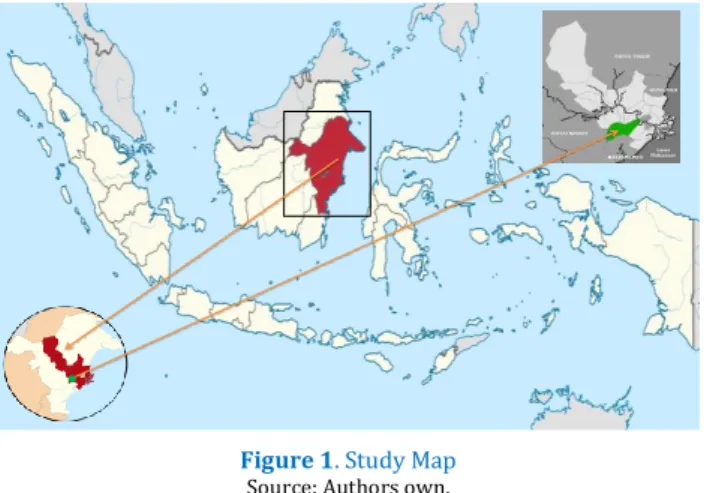
Figure 1. Study Map Source: Authors own.
The research location in Sepakat Village in Kutai Kartanegara Regency (see Figure 1). Researchers conducted structured interviews with respondents who used online promotions, respondents who did not use online marketing and the management of the Sepakat Village. The urgency of choosing the study site is based on the striking regional disparity compared to other areas in East Kalimantan Province. Then, the researchers looked at the aspects of MSME management in Sepakat Village, which were not yet optimal. It should be noted that MSMEs in Sepakat Village are a “pilot project” by the central government as fostered MSMEs whose status and performance are not yet professional.
3. RESULTS AND DISCUSSIONS Results
Based on data got from village officials, there has never been a proposed idea of a “Smart Village”
as a digital village program to facilitate micro, small and medium enterprises (MSMEs) in marketing their products so that they are better known to the wider community. A broad market share will make the level of sales even higher. MSME actors have realized this in Sepakat Village. Independently, they have introduced their products through social media such as Facebook and Instagram, then slowly later through e-commerce such as Bukalapak.com, tokopedia.com, blibli.com.
Even though they have marketed products through e-commerce with their own labels and ownership by SMEs, what has happened is that the transition from traditional to online sales is still considered very difficult. There are still many MSME owners in Sepakat Village who are comfortable selling goods traditionally. They already have regular customers who order goods immediately and have them delivered to the customer’s shop. Some of the regular customers of the MSMEs in Sepakat Village are fish buyers from nearby cities, such as Samarinda and Balikpapan. The driving force for the UMKM in Sepakat Village is more in inland fisheries as river fish cages by supplying fish seeds, consumption fish and
Comment [i-[3]: Focus on the type of research and the approach used, research procedures, subjects, data collection (including the instruments used) and data analysis used. Explain clearly how and the implementation of the method used. RE: This phase is summarized in the first paragraph on methods. An implicit description of the analysis is also added.
take care of online marketing. They do not yet have sufficient human resources to manage their business through online stores (Sima et al., 2020). This causes the digital village development program in Sepakat Village to be quite stagnant. MSME actors are used to selling their goods to traditional markets (Hartono et al., 2021). If this is done, it is not too dangerous for development in the short term. However, the current fact is the internet era, where there is a shift in consumers who originally bought traditionally in the market to switch to online stores that are efficient. The buyers do not need to come directly to the traditional market, they only need to press a mobile phone that is connected to the internet and order the desired item. Based on this, an appropriate development strategy is needed to deal with the ongoing industrial revolution 4.0 era (Ellitan, 2020). The MSMEs of the Sepakat Village must be aware so that they are able to seize the opportunities provided by the online store.
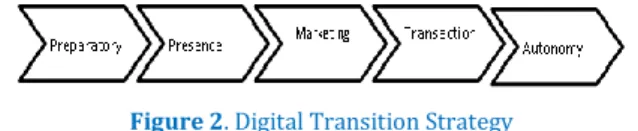
Based on the theory, the transformation of MSMEs into online stores, there are five approaches that have been raised to serve as pilot strategies that will be developed in the MSMEs of Sepakat Village.
The strategy for developing MSME productivity through digitization is planned as shown in Figure 2.
Figure 2. Digital Transition Strategy
Source: (Weis & Speridakos, 2011; Snyder, 2002; Abdul Kadir & Mohd, 2021).
First, preparatory is the first step in developing a strategy in the process of supporting digital villages. This step is carried out by preparing MSME actors to carry out marketing independently. Done by MSME actors or assisted by their technology literate relatives. Because many of the MSME actors are still low on technology mastery, many of them are pessimistic at first when these MSME actors do not master technology. Yet when they get used to it, it will be easy to find a solution to their fear.
Information technology is developing quick, business changes are shifting without us realizing we are already living side by side and its market share is almost causing concern and there are even some big companies that have to close their businesses. The presence of this information technology has messed up the existing market. It can even be said to damage the existing business order. At this preparatory stage, the steps taken are starting from changing the mindset or mindset of MSME actors. Businesses that can survive are businesses that can adapt to change. The winners are those who take part in making the changes themselves. It forced those who cannot survive to go bankrupt or lose market share. Instilling a mindset to always learn needs to be instilled from the start of developing a digital village.
Change does not stop at changing mindsets, but continues with follow-up by adjusting the pattern of business being carried out and the pattern of work that will be done. MSME actors can run their business 24 hours a day to market their products, because no matter how good and how well, the quality of the products produced will be of no use if the market is not aware of its existence. Products that are marketed traditionally have limitations, namely the scope is narrow, the distribution area is only within a certain radius and when you want to market products to other areas in the traditional way, it requires high costs. When it is done continuously, it will affect the swelling costs that must be incurred. Meanwhile, with digital marketing, the process can be minimized and even the promotion costs to be zero or there is no need to budget costs because they only take product photos and then post or offer them on social media.
Moral and material support is very much needed so that these business actors can enter the existing competition, both from academia, government agencies or trade and industrial offices, to help MSME actors. Given the enormous impact that will be obtained by MSMEs when they can enter business competition and an increase in the number of buying and selling transactions carried out online. When the obstacles experienced by MSME actors can be solved and they found a solution, it is hoped that MSME actors have confidence and can have enthusiasm in running a business.
The stages in this activity can be as discussions and assistance about digital businesses that are carried out only with smartphones and quota fees, which are currently relatively affordable.
Communication and discussion with MSMEs must be carried out intensely considering that the development of digital business is changing quickly. Once the media used is always changing from one period to the next based on trends that occur in society. This differs from the previous business pattern where business actors can easily survive with and without changing their business pool for a long period up to 20 years to 40 years. Digital business is different, because this year it could be a trend, the next year it will be abandoned. Putri et al. (2020), Prameswari et al. (2017), and Syaifullah et al. (2021) highlighted that online stores for MSMEs can increase productivity and marketing.
International Journal of Social Science and Business, Vol. xx, No. xx, 2022, pp. xx-yy 15
Second, presence plays a vital part in introducing MSME actors to digital marketing. The active role of MSME actors marks business actors to spend their time in making activities successful in attending mentoring programs and discussions about the extent of mastery of business actors regarding the use of digital marketing technology. Starting from social media to mastery of e-commerce whose product coverage area can be further and more trusted by the market in Indonesia because of a system that can minimize forms of fraud and fraud in buying and selling transactions carried out online. This is in line with the publications of Lakshmanan & Agarwal (2014) and Reinartzet al. (2019), that online stores are a change that is presented in generation 4.0 with the advantages of shopping innovation.
This stage is also an approach to MSME actors with regular discussions and conveying an understanding that using information technology is easy, can be done anytime and anywhere. Seriousness in attending meetings and activeness in the discussion process to find solutions related to the problems faced are important because this is a step from mentoring to realize a digital village.
Digital marketing, where the increasing number of internet users in Indonesia is a breath of fresh air for business actors to introduce their products to the public. This means that the more internet users there are, the wider the market share that will be entered for product distribution. The shopping pattern of the people who have switched to electronic transactions is an excellent opportunity to be used as a new business model. So that in the end the goal of business actors who want to get high profits can be realized because the product can be distributed directly without going through the distribution chain and without having to pay property rental costs which are increasingly expensive because of an increase every year.
With digital marketing, it can do the process of product marketing and product distribution from home by implementing digital marketing. This digital marketing stage is by teaching how to create e-mails which will later market products. Teaches how to use email from writing, replying to marketing products through email marketing. Interaction that can be done face-to-face and sending e-mail solves make the marketing process efficiency itself. Giving the address and type of business on google map is considered important, so that when people are searching the map, it will be suggested what is needed and this is also a medium to introduce their products to people who are accessing google map and notify google map users about the existence of the business by addresses that can be seen up to photos of clear locations along with directions to the business location of MSME actors.
It taught social media to market products, the creation of social media accounts is carried out starting from making Facebook because users are among the highest in Indonesia and the coverage area is also wider because almost all citizens of the world use it. On Facebook, marketing can be done for free or paid by using Facebook ads. Of course, there are advantages and disadvantages when choosing options in marketing products through Facebook. When you use Facebook ads, it taught you how to make the right ads according to the demographics and psychographics of the target market so that the paid ads can reach the right market and people. Likewise, the use of Instagram and other social media applications that can control the marketing of products to potential customers.
Helping MSME actors in making e-commerce in online stores in Indonesia is no less important to teach. It taught business actors to create at least one user account at online stores such as Bukalapak, Tokopedia, Shopee, OLX and others. The inhibiting factor in this activity program is the busyness of MSME actors, the number of activities carried out routinely and draining energy, training time becomes expensive. Mastering the use of digital marketing for the older generation is helped by the existence of substitutes such as their children or grandchildren (millennial generation and generation Z) who are already accustomed to using digital technology. Ideally, MSMEs without being supported by online stores will reduce their sales (Harel, 2021).
Transaction integration. This session is a pattern in which it will carry out the transaction process, so it is important to provide assistance in providing understanding to business actors to use and transact using electronic transactions. Using mobile banking, using e-money and digital transactions that are still rarely used or even many of them have never done it before. The transaction process is basically a simple process, but because of the fear of business actors, this has become a hard step. It is necessary to provide understanding and ensure that the use of this electronic transaction is safe as long as it is used in the right way and an understanding of the correct use of the application. The limitations of human resources in using electronic transactions need to be a concern because it is useless for many products to be ordered, but the transaction time cannot respond properly. The customer has paid for the product, but many of the MSME actors have not responded quickly so that the customer is disappointed and gives a low rating on the online store owned by the MSME. Because when the reputation in the online store is low, it will affect the absence of trust by potential customers who visit the online store. So that at this stage, it is necessary to get serious attention to carry out intensive help, so that what is only expected can be carried
MSMEs. From the hope from this stage is that MSME actors can compete and be able to compete in entering e-commerce competition. The large number of similar business actors should not discourage business actors, the high number of competition which even among business actors lowers prices and competition at low prices does not dampen the intention of MSME actors to continue to transform their business into a digital business. The government’s role as a regulator and facilitator must continue to be carried out to foster and guide business actors so that they can continue to be independent in managing their businesses. A level of independence of MSME, actors must be maintained so that in the end they can produce and inspire MSME actors to continue to be able to adapt to existing business conditions.
Partners between the government and the Indonesian Chamber of Commerce and Industry (KADIN) to create a community and classify similar businesses, expanding the network of fellow business actors in the region is a step that needs to be taken, motivational encouragement must be carried out intensely so that there is confidence in business actors in the face of increasingly fierce business competition. It is hoped that the formation of a community and networking among business actors will have a good impact on business actors. Fellow business actors can cooperate with each other, or support each other in running a business. The mindset of competition among similar business actors must continue to be realized, which in the end hopes to create a mutually beneficial cooperation will quickly be realized. With the formation of a community among MSME actors, it becomes a material consideration for the government to issue a policy related to the difficulties and problem solving experienced by business actors with a coaching program that is carried out continuously. In the coaching process, it is necessary to create an organizational structure and regional coordinator in each sub-district or region. Which in the end will be a bridge that connects MSME managers with government officials tasked with fostering MSMEs.
Business ideas and problems will be easy to find solutions to when there is a community. The role of the government is as a good regulator in realizing business actors expect what. At this stage, there are several things that can be identified, including the ability of MSMEs to run a digital business. This is the capital to be creative and innovate to adapt to the conditions and business competition that occurs. The obstacle that has the potential to occur is the number of MSMEs which have many members, so that it makes it difficult for the MSME community to determine the priority of the program to be implemented tug of war of interest always occurs. Self-awareness from fellow business actors to let each other go if there is no support for the MSME group has not been realized is important. The existence of a good communication between members of the MSME community to create a digital village allows fellow MSME members to interact with each other, anticipate, explore problems, and solve problems faced by MSME actors (Jati et al., 2017; Saini, 2014).
The crucial point is the verification of interviews and FGDs, where the most core fact of the sustainability of MSMEs in Sepakat Village is the ease of business permits. Here, the interaction between stakeholders must accommodate the dimensions of MSME problems. The essence that has been discussed also leads to financial modify efforts, mapping of business potential, competent institutional network, data visualization and analysis, widening the literacy lens, digital transformation, to reconstructing an inclusive MSME standart.
Discussions
Online marketing through online stores helps companies, especially small and medium businesses, to promote and market their products or services. Online marketing can also open up new opportunities and markets that did not exist before due to time, distance and communication constraints.
With online marketing that is wide open to be accessed, consumers have the opportunity and have access to know the products that will be offered and are interested in doing online shopping.
Online shopping is an activity in purchasing goods and services through a medium, namely an online store. Online shopping activities usually include business to business and business to consumers.
Based on previous research, it is stated that online shopping is a business for consumers because the purchases that have been made are purchasing activities made directly by consumers and not for resaling their products. Online shopping activities are individual or retail transactions with individual buyers, so online shopping is a buying decision made by individuals online. In online marketing, there are 7 stages including situation analysis, e-marketing strategic planning, objectivities, e-marketing strategy, implementation plan, budget, and evaluation plan (van Laer & Lurie, 2016; Setini & Darma, 2019).
The first stage is the start of a business which is carried out by conducting a SWOT analysis, namely the strengths, weaknesses, opportunities and threats experienced by MSMEs. This Strengths, Weaknesses, Opportunities, and Threats (SWOT) analysis is part of systematically identifying various factors in order to formulate a strategy to be applied by the company. The analysis is carried out based on
Comment [i-[4]: The discussion needs to be elaborated. This discussion needs to be added implicitly, what are the results of this research? Does it answer the goal? Make arguments that lead to the concept of how the research results, give novelty emphasis to the discussion.
The discussion still needs to be elaborated. Discuss the research results, then relate them to previous relevant research. Enter the interpretation of the findings, and generalize the findings into an established theoretical framework. Explain in detail, and provide generalizations at the end of the discussion.
RE: The emphasis on novelty in the object of study is highlighted. In addition, there is an in-depth study of case studies from other countries related to the concept of village MSME development. Additional literature arguments are described in the last paragraph of the discussion.
International Journal of Social Science and Business, Vol. xx, No. xx, 2022, pp. xx-yy 17
the logic found by an analyst to maximize the strengths and opportunities that can be exploited, then only seen from the internal and external factors of the business. Internal factors here are strengths and weaknesses, while external factors are opportunities and threats that come from outside the company.
This is important to note because to map the position of the business which coordinates are located, which in the end will not be used to make a decision.
This e-marketing strategic planning stage has seven steps that can bridge the evaluation and analysis process to get opportunities in a market. This method is done by identifying what customer needs have not been met so far, and then identifying which customers the company will target. The next step is to assess the advantages associated with the competition that occurs. Assessing the existing resources in a company is important to do. It is useful for providing offers, assessing market readiness about the use of technology, which will ultimately determine the opportunities that exist concretely and to assess opportunities and attractiveness to customers. The formulation of this e-marketing planning strategy includes segmentation, target market, product differentiation, and positioning of the business.
The purpose of e-marketing includes several aspects, namely starting from the task, quantity and time allocation. It related the task here to what is being achieved. Quantity is they produced how much, while the time frame can be interpreted when it is executed. Online marketing mostly has a goal to meet an increasing market, the number of excellent reviews, efforts to increase revenue, cost efficiency for promotion, achieve brand image, increase database volume and how to achieve the goals of Customer Relationship Management (CRM) itself. What is meant by CRM here is how to increase customer satisfaction, how often to purchase and how the customer refers the product to other buyers. Another goal is to improve supply chain management by increasing coordination among members, increasing the number of partners, and increasing efforts to optimize inventory.
The online marketing strategy in question includes a strategy on the relationship management in order to achieve a goal related to product, price, place, and promotions (4Ps). In the implementation phase focuses, the company must decide to achieve its goals by implementing effective and creative strategies. Marketers must determine the marketing mix according to the 4P criteria. This strategy is then implemented by drawing up a plan for its implementation. MSMEs must check that the marketing that has been carried out is properly implemented. Starting from preparing staff, organizational structure, departments, customer service and other factors that come from outside the company.
The key to strategic planning is how to identify the results that will result from an investment.
During the planning process, marketers will work to keep track of revenues and costs at all times in order to monitor the results achieved. The rating judges reports from online stores how many stars the online store has obtained which is then used to view results and records to determine customer satisfaction.
Another function is to monitor information regarding the budget that will be accounted for revenue forecast calculations need to be made as well as intangible benefits or intangible benefits got. Cost savings and e-marketing costs also benefit from this condition.
Planning an online promotion is usually carried out and then evaluated, whether the success of the planning is based on an evaluation carried out in the future. The type of evaluation depends on the objectives and plans that have been drawn up. In determining the output of MSME marketing, one can use a technique commonly called a balanced scorecard, which serves to measure the success of selling products owned by MSMEs through online stores.
Sales is defined as a science and art to influence a person or person by a seller. The goal is to invite others to buy the product to be offered (Harrison et al., 2014). Sales productivity here is the level or number of products and services that can be sold so that exchanging products or services occurs. The more products sold, the more productive the business that has been run will be.
Referring to Law number 20 of 2008 concerning MSMEs, which is a productive business owned by individuals or individual business entities under the criteria for micro-enterprises as regulated in the regulation covers three corridors (Wijaya et al., 2022). First, a small business includes a productive economic business that is already independent and is carried out by people, by individuals or by a business entity that is not a subsidiary and is not a branch of a company that is owned, controlled and as an instrument directly or indirectly from a business that is owned, controlled or meet the criteria for a medium or large business. Second, a medium-sized business is a productive economic business that has been independent, carried out by individuals or carried out by a business entity that is not part of a subsidiary that is owned, controlled, or becomes a consortium of small businesses or part of large businesses with a total net worth and the amount of annual sales proceeds as stipulated. Finally, such as micro-enterprises, where part of business activities is to expand employment opportunities and to provide economic services to the community which also plays a role in the process of equity, increasing
Comment [i-[5]: Try not to use too short paragraphs. Try to include at least 3-5 sentences in one paragraph. RE: In particular, this paragraph has been combined into the paragraph below as an integral part.
role of large businesses and State-Owned Enterprise (BUMN).
The foundation in the principles and efforts to empower MSMEs referring to government regulations is described in two perspectives, namely the principle of empowerment and the objectives of MSMEs. From the principle aspect, increasing independence and togetherness so that the entrepreneurial spirit possessed by MSMEs continues to grow to produce a work by making their own products, creating alignments in public policies such as being transparent, accountable and fair, then business development based on the potential of an area and its market orientation. are expected to be in accordance with the competencies possessed, stimulate competitiveness, and carry out the implementation, implementation, planning and control that are carried out in an integrated manner. On the one hand, the purpose of empowering MSMEs is to create a national economic structure that is balanced, developed and just, develops the capabilities of MSME actors into a strong and independent business in its management, and accommodates the contribution of MSMEs in development, income distribution, creation of employment, poverty alleviation, and national economic growth.
The development of the sales strategy of MSME results by using an online business, namely by buying and selling online. Buying and selling online is defined as the process of transacting goods and services through electronic media, especially through the internet (Küster et al., 2016). Some online sales now prefer online store service providers compared to creating their own online store website (Vasic et al., 2019). Some online media that are trending in Indonesia include Bukalapak.com, tokopedia.com, blibli.com, shopee, Lazada and other online stores. Buying and selling through online media is a sale and purchase contract, carried out through internet facilities to carry out product exchange transactions as goods or services. This online sale and purchase is an agreement made jointly by determining certain characteristics, namely by paying first and then the goods will be sent later. Buying and selling online can also be interpreted as buying and selling using internet media. The transaction process does not have to meet between the seller and the buyer directly. However, payment is made first before sending the product through the delivery service. The characteristic of such transactions in Islam is that it is permissible, because it is the same as the sale and purchase contract of “salam” and “istishna”. While buying and selling istishna is a transaction with a payment system that is it postponed immediately or postponed according to the agreement and the delivery of the goods (Ziyadah, 2021).
There are two types of commodities that are traded, namely products or services as digital or non-digital. Buying and selling online itself is for various kinds of non-digital commodities. As for non- digital commodities, such as ebooks, software, script data as files, and submitted directly to consumers either via download or email. Commodities traded in MSMEs are still conservative or non-digital (Maksum et al., 2020). The goods produced by MSMEs are finished goods such as uniforms, apparel, robes and batik.
The online business, in the view of Islamic economics, is divided into the form of halal or haram, legal or illegal. Online businesses that are prohibited in Indonesia are gambling transactions, buying and selling of illicit goods such as liquor, haram food and illegal goods with no clear brand and production (Amalia et al., 2019). So, the legal basis for online business in Islam in principle is that it is permissible as long as there are no prohibited elements or elements in the business process (Mohammed, 2013). This online buying and selling transaction is only based on the description or description provided by the seller and when the buyer agrees, then the law is already valid. Of course, the product description must be under the condition of the product. If it does not match, then the buyer also has the right not to continue the purchase process or cancel the purchase of the product.
Almost two decades ago, the government’s commitment to support the empowerment of MSMEs in Indonesia has produced strong local entrepreneurs from various fields. When Covid-19 wreaks havoc on the economic downturn in many countries, MSMEs are the only ones that stand out the most, are solid, and are like a “driver pillar”. Most importantly, what needs to be highlighted are the obstacles faced by MSMEs in the marketplace, such as high competition between traders, dependence on marketplace managers, and selling in over one marketplace so that sometimes they don’t focus on responding to buyer chats and the fear of MSME actors will be difficult to join in the marketplace and limited digital knowledge.
Meanwhile, the MSME strategy in conducting business in the marketplace is to provide express delivery facilities, discount programs and free shipping, always update stock of goods, provide convenience for ordering goods by consumers, take part in training held by marketplace managers, and always provide feedback to consumers.
Tambunan (2011; 2019) views that MSMEs hold impressive control over the structure of economic growth (GDP) over time, which stimulates 61% of the strategic economic sector. Thus, as much as 97% of the national workforce is absorbed in MSMEs. This achievement is inseparable from the level of capability, creativity, innovation, and strong consistency of government programs such as the allocation of people’s business credit (KUR). The lack of marketing in building Indonesian MSMEs, indicates low SME
Comment [i-[6]: Try not to use too short paragraphs. Try to include at least 3-5 sentences in one paragraph. RE: Specifically, this paragraph has been corrected. The reviewers' comments were agreed upon by the authors to include several supporting arguments.
International Journal of Social Science and Business, Vol. xx, No. xx, 2022, pp. xx-yy 19
productivity. This is in contrast to today's large companies that show productivity strength on a macroeconomic scale.
Interestingly, the Indonesian government has provided credit financing to MSME managers through access to insurance, guarantees for microfinance institutions, low interest rate subsidies, and a guarantee fee scheme that reaches MSME groups and clusters to villages or areas outside urban areas. The government also always encourages MSMEs to always make systematic improvements to accelerate the national economic recovery (PEN) with a regulatory framework for market support, capital, legal legality for product certainty, and supporting an integrated production cycle (Nursini, 2020). The relation with this paper emphasizes renewable concepts, such as the introduction of digital business for MSMEs in Sepakat Village which leads to autonomy, transaction services, marketing connections, presence, and preparation. In line with these five frameworks, several empirical arguments are highlighted. In India, for example, in several decades, MSMEs have played a role in maintaining economic-social balance.
Unfortunately, while this labor-intensive field has stimulated job creation, it is not yet considered self- sufficient (Maheshkar & Soni, 2020). It is alleged that the performance of MSMEs has not been optimally reformed, where too to weak managerial skills, external shocks have also occurred due to inadequate financial institutions in facilitating MSMEs. From a similar country, for example the case that addresses Bihar. In this Indian state, the growth of MSMEs as an accelerator in reducing the poverty gap seems to be running normally. Surprisingly, the inability of the competitiveness of MSMEs there is caused by the inability of management to protect product excellence, which has implications for promotion and technological inefficiency (Prakash et al., 2021). Reflecting on Saudi Arabia, the main obstacle in the survival of MSMEs is the hostile business environment. Logically, various problems are described, including: bureaucracy, financial access, training crises, credit options, and policy changes according to the field of MSME activity (Zamberi Ahmad., 2012). During the 2009–2017 duration, active SME turnover at local and national levels in Romania is expected to have a positive impact on investment turnover.
Statistically, in the context of innovation, it is acknowledged that there is a positive correlation with turnover (Gherghina et al., 2020). The consequences of the entrepreneurial growth of SMEs in Pakistan over the past few years have been financial constraints, management failures, and uncertainty over the status of infrastructure (Khan, 2022). Interestingly, although SMEs are seen as economic engines in many nations, they are still an obstacle to financing small projects in Palestine. The main trigger is poor organizational management in channeling incentives to small businesses (Bayyoud & Sayyad, 2016). On the dark side, the legal framework that is designed as an alternative, has proven not to protect the interests of SMEs.
4. CONCLUSION
The motive in this paper is mapping MSMEs in Sepakat Village to join online shops from the landscape of business barriers and constraints. Based on exploration over time, more complex ideas are offered to enrich understanding of the function of MSMEs. The development of MSME productivity in Sepakat Village through introducing digitalization of MSME product marketing has developed little at the moment, although some have used online store applications. The lack of public interest influenced this because of the habit that has often been done, namely by selling it to regular customers. However, along with the times, MSMEs must innovate to sell their products to online stores. So we need the right strategy so that MSMEs in Sepakat Village can develop their products to be sold in online stores. The strategies are prepatory, presence, portals, transaction integration and autonomy. The MSME movers of the Sepakat Village must carry this step out, which in this case is to form a digital community working group, but it requires policies from village officials and support from the millennial generation. In addition, support from academics is very much needed to provide strategic references that will later be formulated in the face of business developments that are always changing. It is hoped that after the strategy can be implemented, the productivity of MSMEs in Sepakat Village will increase. This is in line with the Kutai Kartanegara district government program, namely creating a prosperous Kukar community. Among the 23twenty three dedications, there are five5 aspects that directly touch the perpetrators of Micro, Small and Medium Enterprises (MSMEs), these dedications are the “Kukar Ready to Work”, “Kukar Kaya Festival”, “Idaman Small Business”, “Idaman Creative Kukar”, “Creative Kukar Idaman”, and
“Environmentally Friendly Business World”.
Most importantly, what needs to be highlighted are the obstacles faced by MSMEs in the marketplace, such as high competition between traders, dependence on marketplace managers, and selling in over one marketplace so that sometimes they don’t focus on responding to buyer chats and the
Comment [R7]: Try to avoid using numbers in your conclusions. This conclusion is too long. It is better to focus on the meaning of the findings. RE:
Content that is considered too excessive in the conclusion section, is changed into a discussion session that explains explicitly.
Comment [i-[8]: Please give an emphasize at the meaning and impact of the research findings, without numbering, symbols, or any cite sources. RE:
Adding 2 sentence in the first paragraph to the conclusion as an affirmation of the research focus.
goods by consumers, take part in training held by marketplace managers, and always provide feedback to consumers.
There are several academic implications and practical recommendations for researchers, business people, communities, and local governments, including making the marketplace a permanent partner for MSME actors in Sepakat Village in developing their market, a kind of partnership between local governments and the marketplace. This will be a great opportunity for business actors to actualize the potential of their production and marketing activities. Incessantly conduct socialization regarding alternative development of MSMEs through the marketplace and how the implementation techniques are, so that the business being carried out can still survive during the pandemic. Revitalize your own local/regional marketplace, with easy requirements, easy to use, and minimal administrative costs.
Furthermore, using this facility to sell their own food products. Choose a well-known, clear and trusted local marketplace. Actualizing business accounts in several marketplaces,. Actively post product pictures and testimonials. Participate in events or promos held by the marketplace. Serve customers in a friendly and fast manner. Frequent training on the development of e-commerce. In choosing an image, choose a good item (clearer, brighter, not cut off), attractive (attracting potential buyers, clear description, clean background), photos can be taken directly through the camera, cellphone camera or via Instagram photos that you already have. Writing clear product descriptions and describing according to the products being sold. Provide interesting information and promotional words for the type of product. The last thing is to determine a selling price can compete with competitors, which is to provide an attractive price.
Reflection for future research, it is necessary to consider parameters relevant to the classification and types of SMEs in more detail as an assessment of several scales.
5. ACKNOWLEDGE
The Village apparatus of Sepakat has approved the data in this work. Therefore, we really appreciate all forms of supported provided. The authors also thank the Faculty of Economics and Business (Mulawarman University) for providing internal financing related to APC.
6. REFERENCES
Abdul Kadir, N. B., & Mohd, R. H. (2021). The 5Cs of positive youth development, purpose in life, hope, and well-being among emerging adults in Malaysia. Frontiers in Psychology, 12, 641876.
https://doi.org/10.3389/fpsyg.2021.641876.
Ahmad, N. H., Iqbal, Q., & Halim, H. A. (2020). Challenges and opportunities for SMEs in industry 4.0.
Pennsylvania: IGI Global.https://doi.org/10.4018/978-1-7998-2577-7.
Amalia, S., Maria, S., Roy, J., Darma, D. C., & Pusriadi, T. (2019). Underground economy: the shadow effect of human trafficking. LIFE: International Journal of Health and Life-Sciences, 5(1), 137-153.
http://dx.doi.org/10.20319/lijhls.2019.51.137153.
Awaluddin, M., Amalia, S., & Suharto, R. B. (2022). Welcoming industry 4.0 competition by accelerating it digitization: Stories from Indonesia. Jurnal Sosioteknologi, 21(1), 45-59.
https://doi.org/10.5614/sostek.itbj.2022.21.1.6.
Bayyoud, M., & Sayyad, N. (2016). Challenges and obstacles that small and medium enterprises face in terms of financing in Palestine. Journal of Accounting, Auditing and Finance, 4(2), 49-60.Retrieved from http://www.eajournals.org/wp-content/uploads/Challenges-and-Obstacles-That-Small- And-Medium-Enterprises-Face-In-Terms-Of-Financing-in-Palestine-1.pdf.
Borisova, A., Borisova, E., Kirichenko, E., & Dmitrieva, L. (2020). Digital technologies in retail: Is there animpact on businesses?. SHS Web of Conferences, 80(1), 01021.
https://doi.org/10.1051/shsconf/20208001021.
Braito, N., Ceccanti, D., & Huynh-Olesen, A. (2021). Challenges and concerns for small and medium-sized enterprises (SMEs) doing business in third countries. Belgium: Policy Department for External
Relations, European Union. Retrieved from
https://www.europarl.europa.eu/thinktank/en/document/EXPO_BRI(2021)653629.
Dianda, A., & Pandin, M. G. R. (2021). E-commerce in strengthening the economy during the Covid-19 pandemic: A historical review. Jurnal Ekonomi dan Bisnis Jagaditha, 8(2), 179-186.
https://doi.org/10.22225/jj.8.2.2021.179-186.
Ellitan, L. (2020). Competing in the era of industrial revolution 4.0 and society 5.0. Jurnal Maksipreneur Manajemen Koperasi dan Entrepreneurship, 10(1), 1-12. https://doi.org/10.30588/jmp.v10i1.657.
Comment [i-[9]: References should come from 90% of research articles published in indexed journals. Add at least 35-40 reputable journals published in the last 8 years, and use Mendeley. Use a maximum of 3 book sources. Adjust the reference writing system by referring to the guidelines for author. Include the DOI/url from the article.
Avoid sources that come from the final project (thesis/dissertation), laws, or decrees from government bureaucracies. Use journal articles, books (if you have to). RE: Several citations relevant to this research were added, including sources from reputable books and journals.
International Journal of Social Science and Business, Vol. xx, No. xx, 2022, pp. xx-yy 21
Firmandani, W., Sya’bania, A. S., Abdani, F., & Madani, E. (2021). Analysis of Indonesian consumer online shopping behavior during the Covid-19 pandemic: A shopee case study. The International Journal of Business Review, 4(2), 191-202. https://doi.org/10.17509/tjr.v4i2.40524.
Gherghina, Ș. C., Botezatu, M. A., Hosszu, A., & Simionescu, L. N. (2020). Small and medium-sized enterprises (SMEs): The engine of economic growth through investments and innovation.
Sustainability, 12, 347. https://doi.org/10.3390/su12010347.
Hakim, L. (2021). The policy model of digital-based micro-business assistance for economic recovery during the pandemic. Indonesian Private Law Review, 2(2), 85-94.
https://doi.org/10.25041/iplr.v2i2.2312.
Harel, R. (2021). The impact of COVID-19 on small businesses’ performance and innovation. Global Business Review. https://doi.org/10.1177/09721509211039145.
Harrison, P., Massi, M., & Chalmers, K. (2014). Beyond door-to-door: The implications of invited in-home selling. The Journal of Consumer Affairs, 48(1), 195-221.https://doi.org/10.1111/joca.12027.
Hartanto, S. (2020). Addressing the tax challenges of e-commerce transactions. International Journal of Financial, Accounting, and Management, 2(1), 29-39. https://doi.org/10.35912/ijfam.v2i1.162.
Hartono, B. D., Diponegoro, A., & Yuliawan, I. (2021). The advantages of the micro equity model for MSME business resilience in Yogyakarta during pandemic. Journal of Management and Entrepreneurship, 23(2), 167–176. https://doi.org/10.9744/jmk.23.2.167-176.
Hasanat, M. W., Hoque, A., & Hamid, A. B. A. (2020). E-commerce optimization with the implementation of social media and SEO techniques to boost sales in retail business. Journal of Marketing and Information Systems, 3(1), 1-5. https://doi.org/10.31580/jmis.v3i1.1193.
Islam, M. S., & Hossain, M. F. (2018). Constraints to small and medium-sized enterprises development in Bangladesh: Results from a cross-sectional study. The European Journal of Applied Economics 15(2), 58-73.https://doi.org/10.5937/ejae15-17015.
Jati, H., Astuti, I., & Fernandez, D. (2017). Partnership models and income of micro-small enterprises as Gerbang Emas funds beneficiaries in East Flores Regency. Jurnal Perspektif Pembiayaan Dan Pembangunan Daerah, 5(1), 13-26. https://doi.org/10.22437/ppd.v5i1.3854.
Julita, J., Arianty, N., & Bahagia, R. (2021). Model of social and economic characteristics of MSMEs in utilizing online media to increase people'spower in Batang Kuis District. Morfai Journal, 1(1), 81- 98. https://doi.org/10.54443/morfai.v1i1.50.
Khan, M. A. (2022). Barriers constraining the growth of and potential solutions for emerging entrepreneurial SMEs. Asia Pacific Journal of Innovation and Entrepreneurship, 16(1), 38-50.
https://doi.org/10.1108/APJIE-01-2022-0002.
Küster, I., Vila, N., & Canales, P. (2016). How does the online service level influence consumers’ purchase intentions before a transaction? A formative approach. European Journal of Management and Business Economics, 25(3), 111-120. https://doi.org/10.1016/j.redeen.2016.04.001.
Lakshmanan, G., & Agarwal, V. (2014). E-shopping: an extended technology innovation. Journal of Research in Marketing, 2(1), 119-126. https://doi.org/10.17722/jorm.v2i1.40.
Lucking-Reiley, D., & Spulber, D. F. (2001). Business-to-business electronic commerce. The Journal of Economic Perspectives, 16(1), 55-68. https://doi.org/10.1257/jep.15.1.55.
Maheshkar, C., & Soni, N. (2021). Problems faced by Indian micro, small and medium enterprises (MSMEs).
Small Enterprises Development, Management & Extension Journal, 48(2), 142–159.
https://doi.org/10.1177/09708464211064498.
Maksum, I. R., Rahayu, A. Y. S., & Kusumawardhani, D. (2020). A social enterprise approach to empowering micro, small and medium enterprises (SMEs) in Indonesia. Journal of Open Innovation: Technology, Market, and Complexity, 6(3), 50. https://doi.org/10.3390/joitmc6030050.
Mata, F. J., & Quesada, A. (2014). Web 2.0, social networks and e-commerce as marketing tools. Journal of Theoretical and Applied Electronic Commerce Research, 9(1), 56-69.
http://dx.doi.org/10.4067/S0718-18762014000100006.
Maulany, R. (2019). Obstacles to e-commerce implementation in Indonesian Communities. Abstract Proceedings International Scholars Conference, 7(1), 1842-1854.
https://doi.org/10.35974/isc.v7i1.2007.
Mazumdar, A., & Alharahsheh, H. (2019). Key challenges and barriers facing small & medium enterprises (SMEs) in Bangladesh. South Asian Research Journal of Business and Management, 1(3), 118-120.
https://doi.org/10.36346/SARJBM.2019.v01i03.005.
Mogashoa, T. (2014). Applicability of constructivist theory in qualitative educational research. American International Journal of Contemporary Research, 4(7), 51-59. Retrieved from