2018
Protecting, promoting and supporting breastfeeding in facilities providing
maternity and newborn services: the revised
BABY-FRIENDLY
HOSPITAL INITIATIVE
Protecting, promoting and supporting breastfeeding in facilities providing
maternity and newborn services: the revised
BABY-FRIENDLY HOSPITAL INITIATIVE
© World Health Organization and the United Nations Children’s Fund (UNICEF) 2018
This joint report reflects the activities of the World Health Organization (WHO) and the United Nations Children’s Fund (UNICEF).
Some rights reserved. This work is available under the Creative Commons Attribution-NonCommercial-ShareAlike 3.0 IGO licence (CC BY-NC-SA 3.0 IGO; https://creativecommons.org/licenses/by-nc-sa/3.0/igo).
Under the terms of this licence, you may copy, redistribute and adapt the work for non-commercial purposes, provided the work is appropriately cited, as indicated below. In any use of this work, there should be no suggestion that WHO or UNICEF endorses any specific organization, products or services. The unauthorized use of the WHO or UNICEF names or logos is not permitted. If you adapt the work, then you must license your work under the same or equivalent Creative Commons licence. If you create a translation of this work, you should add the following disclaimer along with the suggested citation: “This translation was not created by the World Health Organization (WHO). WHO is not responsible for the content or accuracy of this translation. The original English edition shall be the binding and authentic edition”.
Any mediation relating to disputes arising under the licence shall be conducted in accordance with the mediation rules of the World Intellectual Property Organization (http://www.wipo.int/amc/en/mediation/rules).
Suggested citation. Protecting, promoting and supporting breastfeeding in facilities providing maternity and newborn services: implementing the revised Baby-friendly Hospital Initiative 2018. Geneva: World Health Organization and the United Nations Children’s Fund (UNICEF), 2018. Licence: CC BY-NC-SA 3.0 IGO.
Cataloguing-in-Publication (CIP) data. CIP data are available at http://apps.who.int/iris.
Sales, rights and licensing. To purchase WHO publications, see http://apps.who.int/bookorders. To submit requests for commercial use and queries on rights and licensing, see http://www.who.int/about/licensing.
Third-party materials. If you wish to reuse material from this work that is attributed to a third party, such as tables, figures or images, it is your responsibility to determine whether permission is needed for that reuse and to obtain permission from the copyright holder. The risk of claims resulting from infringement of any third-party- owned component in the work rests solely with the user.
General disclaimers. The designations employed and the presentation of the material in this publication do not imply the expression of any opinion whatsoever on the part of WHO or UNICEF concerning the legal status of any country, territory, city or area or of its authorities, or concerning the delimitation of its frontiers or boundaries. Dotted lines on maps represent approximate border lines for which there may not yet be full agreement.
The mention of specific companies or of certain manufacturers’ products does not imply that they are endorsed or recommended by either WHO or UNICEF in preference to others of a similar nature that are not mentioned. Errors and omissions excepted, the names of proprietary products are distinguished by initial capital letters.
All reasonable precautions have been taken by WHO and UNICEF to verify the information contained in this publication.
However, the published material is being distributed without warranty of any kind, either expressed or implied.
The responsibility for the interpretation and use of the material lies with the reader. In no event shall either WHO or UNICEF be liable for damages arising from its use.
Printed in Switzerland.
Foreword v Acknowledgements vi
Executive summary vii
Scope and purpose viii
1. Introduction 1
1.1. Breastfeeding matters 1
1.2. The Baby-friendly Hospital Initiative: an overview 2
1.3. Strengths and impact of the Baby-friendly Hospital Initiative 3 1.4. Challenges in implementing the Baby-friendly Hospital Initiative 5 1.5. Revision of the Ten Steps to Successful Breastfeeding and the implementation guidance 7
Revision of the Ten Steps to Successful Breastfeeding 7
Revision of the country-level implementation guidance 9
2. The role of facilities providing maternity and newborn services 11
2.1. Critical management procedures to support breastfeeding 12
Step 1: Facility policies 12
Step 2: Staff competency 14
2.2. Key clinical practices to support breastfeeding 15
Step 3: Antenatal information 15
Step 4: Immediate postnatal care 16
Step 5: Support with breastfeeding 18
Step 6: Supplementation 19
Step 7: Rooming-in 20
Step 8: Responsive feeding 20
Step 9: Feeding bottles, teats and pacifiers 21
Step 10: Care at discharge 22
2.3. Coordination 22
2.4. Quality-improvement process 22
3.2. Policies and professional standards of care 26
3.3. Health professional competency building 27
3.4. External assessment 28
3.5. Incentives and sanctions 29
3.6. Technical assistance to facilities 31
3.7. National monitoring 32
3.8. Communications and advocacy 33
3.9. Financing 34
4. Coordination of the Baby-friendly Hospital Initiative with other breastfeeding
support initiatives outside facilities providing maternity and newborn services 35
5. Transition of BFHI implementation 37
5.1. Countries with a well-functioning national “Baby-friendly” hospital designation programme 37 5.2. Countries without an active or successful BFHI programme 37
Annex 1. Ten Steps to Successful Breastfeeding – revised 2018 version: comparison
to the original Ten Steps and the new 2017 WHO guideline 39 Annex 2. Ten Steps to Successful Breastfeeding in lay terms 43
Annex 3. External review group members 45
References 47
It is estimated that over 820,000 deaths among children under age 5 could be prevented worldwide every year if all children were adequately breastfed. Breastfeeding promotes brain development, reduces the risk of obesity in children, and protects women against breast and ovarian cancer and diabetes. Facilities that provide maternity and newborn services have a unique role in providing new mothers and babies with the timely and appropriate support and encouragement they need to breastfeed successfully, saving governments money while saving lives.
Almost 30 years ago, the World Health Organization (WHO) and the United Nations Children’s Fund (UNICEF) came together to advocate for the protection, promotion and support of breastfeeding in facilities providing maternity and newborn services. The 1989 Joint WHO-UNICEF statement included a list of measures that came to be known as the Ten Steps.
Translated into more than 25 languages, the joint WHO–UNICEF Statement became the centrepiece for the Baby Friendly Hospital Initiative. Since 1991, maternity wards and hospitals applying the Ten Steps have been designated
“Baby-friendly” to draw public attention to their support for sound infant-feeding practices.
To date, nearly all the countries of the world have implemented the BFHI, helping save infants’ lives and support mothers’ health. But many countries still struggle to maintain the programme and take it to full scale.
Starting in 2015, WHO and UNICEF coordinated a process to review the scientific evidence behind the Ten Steps and to strengthen implementation of the Initiative, which included systematic literature reviews, a thorough examination of the success factors and challenges of the BFHI, and a BFHI Congress in 2016, at which 130 countries came together to discuss the new directions needed to reach universal coverage and sustainability of the BFHI.
The updated guidance published here reflects this collaborative effort to build a more robust programme that will sustain improved quality of care over time. It describes practical steps that countries can and must take to protect, promote and support breastfeeding in facilities providing maternity and newborn services. The guidance emphasizes the importance of applying the Ten Steps in all facilities, for all babies, whether premature or full term, born in private or public facilities, or in rich or poor countries.
WHO and UNICEF are committed to supporting breastfeeding as an effective and cost-effective way to promote the survival, nutrition, growth and development of infants and young children, to protect the health and well-being of their mothers, and to help all children to reach their full potential. We believe the Ten Steps offer health facilities and health workers around the world the guidance they need to help more mothers to successfully breastfeed. Together, we can give every newborn the healthiest start in life.
Dr. Tedros Adhanom
Director-General of the World Health Organization (WHO)
Henrietta H. Fore
Executive Director of the United Nations International Children’s Fund (UNICEF)
Acknowledgements
The development of this guidance document was coordinated by the World Health Organization (WHO) Department of Nutrition for Health and Development and the United Nations Children’s Fund (UNICEF) Nutrition Section, Programme Division. Dr Laurence Grummer-Strawn and Ms Maaike Arts oversaw the preparation of this document.
We gratefully acknowledge the technical input, planning assistance and strategic thinking of the external review group throughout the process (in alphabetical order): Ms Genevieve Becker, Dr Ala Curteanu, Dr Teresita Gonzalez de Cosío, Dr Rukhsana Haider, Dr Miriam H Labbok, Dr Duong Huy Luong, Dr Chessa Lutter, Dr Cria G Perrine, Ms Randa Saadeh, Dr Isabella Sagoe-Moses and Ms Julie Stufkens.
Over 300 participants in the 2016 Baby-friendly Hospital Initiative (BFHI) Congress, representing 130 countries and numerous non-governmental organizations, donors and professional associations, provided invaluable insights to the successes of and challenges for the BFHI, and outlined many of the priorities for future activity. We would like to thank the members of the BFHI Congress planning committee for their insights in shaping this useful meeting (in alphabetical order): Ms Maite Hernández Aguilar, Ms Funke Bolujoko, Dr Anthony Calibo, Ms Elsa Giuliani, Ms Trish MacEnroe and Ms Agnes Sitati.
We would like to express our gratitude to the following colleagues for their assistance and technical input throughout the process (in alphabetical order): WHO – Ms Shannon Barkley, Dr Francesco Branca, Ms Olive Cocoman, Dr Bernadette Daelmans, Ms Diana Estevez, Ms Ann-Lise Guisset, Dr Frances McConville, Ms Natalie Murphy, Ms Thahira Shireen Mustafa, Dr Lincetto Ornella, Dr Juan Pablo Peña-Rosas, Dr Pura Rayco-Solon, Mr Marcus Stahlhofer, Dr Helen Louise Taylor, Dr Wilson Were and the WHO regional nutrition advisers; UNICEF – Dr Victor Aguayo, Dr France Bégin, Mr David Clark, Dr Aashima Garg, Dr David Hipgrave, Ms Diane Holland, Ms Irum Taqi, Ms Joanna Wiseman Souza Dr Marilena Viviani, Dr Nabila Zaka, and the UNICEF regional nutrition advisers and regional health advisers.
We gratefully acknowledge the input from the 300 external reviewers who commented on the draft document in October 2017, and the staff, volunteers and members of the BFHI Network, La Leche League (LLL), the International Baby Food Action Network (IBFAN), the International Lactation Consultants’ Association (ILCA) and the World Alliance for Breastfeeding Action (WABA), who provided additional input. We are grateful for the input of Dr Pierre Barker on quality-improvement processes.
Finally, we would like to thank the many BFHI coordinators and hospital administrators who have implemented the BFHI at national, regional and facility levels over the past 27 years. Their hard work and passion for the health of mothers and babies has strengthened the initiative throughout the world.
Executive summary
The first few hours and days of a newborn’s life are a critical window for establishing lactation and for providing mothers with the support they need to breastfeed successfully. Since 1991, the Baby-friendly Hospital Initiative (BFHI) has helped to motivate facilities providing maternity and newborn services worldwide to better support breastfeeding.1 Based on the Ten Steps to Successful Breastfeeding (the Ten Steps),2 the BFHI focuses on providing optimal clinical care for new mothers and their infants. There is substantial evidence that implementing the Ten Steps significantly improves breastfeeding rates.
The BFHI has been implemented in almost all countries in the world, with varying degrees of success. After more than a quarter of a century, coverage at a global level remains low. As of 2017, only 10% of infants in the world were born in a facility currently designated as “Baby-friendly”.3 Countries have found it difficult to sustain a BFHI programme, with implementation often relying on specific individual and external resources. The programme has characteristically been implemented as a vertical intervention focused on designating facilities that volunteer to take part in the programme and can document their full adherence to the Ten Steps. Facilities may make changes in their policies and procedures to obtain the designation, but these changes are not always sustainable, especially when there are no regular monitoring systems in place.
In 2015, the World Health Organization (WHO) and the United Nations Children’s Fund (UNICEF) began a process to re-evaluate and reinvigorate the BFHI programme. Case-studies, key informant interviews, a global policy survey and literature reviews were conducted to better understand the status and impact of the initiative. Systematic literature reviews were commissioned to carefully examine the evidence for each of the Ten Steps. WHO convened a guideline development group to write the WHO guideline Protecting, promoting and supporting breastfeeding in facilities providing maternity and newborn services4 and an external review group to update the guidance on country- level implementation of the BFHI. The main concepts and outline of the updated implementation guidance were discussed extensively at the BFHI Congress in October 2016, involving approximately 300 participants from over 130 countries. The draft updated guidance document was disseminated through an online consultation in October 2017 and comments from over 300 respondents were considered in the final revisions of the document.
This updated implementation guidance is intended for all those who set policy for, or offer care to, pregnant women, families and infants: governments; national managers of maternal and child health programmes in general, and of breastfeeding- and BFHI-related programmes in particular; and health-facility managers at different levels (facility directors, medical directors, chiefs of maternity and neonatal wards). The document presents the first revision of the Ten Steps since 1989. The topic of each step is unchanged, but the wording of each one has been updated in line with the evidence-based guidelines and global public health policy. The steps are subdivided into (i) the institutional procedures necessary to ensure that care is delivered consistently and ethically (critical management procedures); and (ii) standards for individual care of mothers and infants (key clinical practices). Full application of the International Code of Marketing of Breast-milk Substitutes5 and relevant World Health Assembly Resolutions (the Code),6 as well as ongoing internal monitoring of adherence to the clinical practices, have been incorporated into step 1 on infant feeding policies.
The implementation guidance also recommends revisions to the national implementation of the BFHI, with an emphasis on scaling up to universal coverage and ensuring sustainability over time. The guidance focuses on integrating the programme more fully in the health-care system, to ensure that all facilities in a country implement the Ten Steps.
Countries are called upon to fulfil nine key responsibilities through a national BFHI programme, including establishing or strengthening a national coordination body; integrating the Ten Steps into national policies and standards; ensuring the capacity of all health-care professionals; using external assessment to regularly evaluate adherence to the Ten Steps; incentivizing change; providing necessary technical assistance; monitoring implementation; continuously communicating and advocating; and identifying and allocating sufficient resources.
1 World Health Organization, United Nations Children’s Fund. The Baby-friendly Hospital Initiative: monitoring and reassessment: tools to sustain progress. Geneva: World Health Organization; 1991 (WHO/NHD/99.2; http://apps.who.int/iris/handle/10665/65380).
2 Protecting, promoting and supporting breast-feeding: the special role of maternity services. A joint WHO/UNICEF statement. Geneva: World Health Organization; 1989 (http://apps.who.int/iris/bitstream/10665/39679/1/9241561300.pdf).
3 National implementation of the Baby-friendly Hospital Initiative. Geneva: World Health Organization; 2017 (http://apps.who.int/iris/bitstre am/10665/255197/1/9789241512381-eng.pdf?ua=1).
4 Guideline: protecting, promoting and supporting breastfeeding in facilities providing maternity and newborn services. Geneva: World Health Organization;
2017 (http://apps.who.int/iris/bitstream/10665/259386/1/9789241550086-eng.pdf?ua=1).
The BFHI focuses on protecting, promoting and supporting breastfeeding in facilities providing maternity and newborn services. It is understood that many other interventions are needed to ensure adequate support for breastfeeding, including in antenatal care, postpartum care, communities and workplaces, as well as adequate maternity protection and Code legislation. It is critical that the BFHI programme is integrated with all other aspects of breastfeeding protection, promotion and support.
By reinvigorating the BFHI and ensuring that all facilities adhere to evidence-based recommendations on maternity and newborn care, breastfeeding rates can be substantially increased and the health of mothers and children dramatically improved.
Scope and purpose
This document contains the latest version of the guidance for implementing the Baby-friendly Hospital Initiative (BFHI) (1) in facilities providing maternity and newborn services, as well as guidance for coordination and management of the BFHI at national (or subnational where applicable) level.
The core purpose of the BFHI is to ensure that mothers and newborns receive timely and appropriate care before and during their stay in a facility providing maternity and newborn services, to enable the establishment of optimal feeding of newborns, which promotes their health and development. Given the proven importance of breastfeeding (2), the BFHI protects, promotes and supports breastfeeding, while enabling timely and appropriate care and feeding of newborns who are not breastfed.
This document complements the World Health Organization (WHO) Guideline: protecting, promoting and supporting breastfeeding in facilities providing maternity and newborn services (3). It also complements existing Standards for improving quality of maternal and newborn care in health facilities (4), Guidelines on the optimal feeding of low birth- weight infants in low- and middle-income countries (5), WHO recommendations: intrapartum care for a positive childbirth experience (6) and other guidance documents on maternal and newborn care. It is crucial that the BFHI is implemented within a broader context of support for breastfeeding in families, communities and the workplace. This document does not address these areas specifically.
The intended audience of this document includes all those who set policy for, or offer care to, pregnant women, families and infants: governments; national managers of maternal and child health programmes in general, and of breastfeeding- and BFHI-related programmes in particular; and health-facility managers at different levels (facility directors, medical directors, chiefs of maternity and neonatal wards).
1. Introduction
1.1. Breastfeeding matters
Breastfeeding is the biological norm for all mammals, including humans. Breastfeeding is critical for achieving global goals on nutrition, health and survival, economic growth and environmental sustainability. WHO and the United Nations Children’s Fund (UNICEF) recommend that breastfeeding be initiated within the first hour after birth, continued exclusively for the first 6 months of life and continued, with safe and adequate complementary foods, up to 2 years or beyond (7). Globally, a minority of infants and children meet these recommendations:
only 44% of infants initiate breastfeeding within the first hour after birth and 40% of all infants under 6 months of age are exclusively breastfed. At 2 years of age, 45%
of children are still breastfeeding (8).
Immediate and uninterrupted skin-to-skin contact and initiation of breastfeeding within the first hour after birth are important for the establishment of breastfeeding, and for neonatal and child survival and development.
The risk of dying in the first 28 days of life is 33% higher for newborns who initiated breastfeeding 2–23 hours after birth, and more than twice as high for those who initiated 1 day or longer after birth, compared to newborns who were put to the breast within the first hour after birth (9). The protective benefit of early initiation extends until the age of 6 months (10).
Exclusive breastfeeding for 6 months provides the nurturing, nutrients and energy needed for physical and neurological growth and development. Beyond 6 months, breastfeeding continues to provide energy and high-quality nutrients that, jointly with safe and adequate complementary feeding, help prevent hunger, undernutrition and obesity (11). Breastfeeding ensures food security for infants (8).
Inadequate breastfeeding practices significantly impair the health, development and survival of infants, children and mothers. Improving these practices could save over 820 000 lives a year (2). Nearly half of diarrhoea episodes and one third of respiratory infections are due to inadequate breastfeeding practices. Longer breastfeeding is associated with a 13% reduction in the likelihood of overweight and/or prevalence of obesity and a 35% reduction in the incidence of type 2 diabetes (2).
An estimated 20 000 maternal deaths from breast cancer could be prevented each year by improving rates of breastfeeding (2).
Recent analyses have documented that increasing rates of breastfeeding could add US$ 300 billion to the global economy annually, by helping to foster smarter, more productive workers and leaders (13). In Brazil, adults who had been breastfed for at least 12 months earned incomes that were 33% higher than for those who had been breastfed for shorter durations (14). Inadequate breastfeeding has a significant impact on the costs of health care for children and women (15, 16). Mothers who feed their infants on formula are absent from work more often than breastfeeding mothers, owing to a higher frequency and severity of infant illness (17).
Recent analyses have documented that increasing rates of breastfeeding could
add US$ 300 billion to the global economy annually
Breastfeeding is a non-polluting, non-resource- intensive, sustainable and natural source of nutrition and sustenance.
Breast-milk substitutes add to greenhouse gas emissions at every step of production, transport, preparation and use. They also generate waste, which requires disposal.
Greenhouse gases include methane, nitrous oxide and carbon dioxide; a recent report estimated the carbon dioxide emissions resulting from manufacture of infant formula in Asia at 2.9 million tons (18).
In humanitarian settings, the life-saving potential of breastfeeding is even more crucial (7). International guidance recommends that all activities to protect, promote and support breastfeeding need to be increased in humanitarian situations, to maintain or improve breastfeeding practices (19).
Breastfeeding is a vital component of realizing every child’s right to the highest attainable standard of health, while respecting every mother’s right to make an informed decision about how to feed her baby, based on complete, evidence-based information, free from commercial interests, and the necessary support to enable her to carry out her decision (20).
Improving breastfeeding can be a key driver for achievement of the Sustainable Development Goals (21). Breastfeeding can be linked to several of the goals, including goals 1 (end poverty in all its forms everywhere); 2 (end hunger, achieve food security and promote sustainable agriculture);
3 (ensure healthy lives and promote well-being for all at all ages) 4 (ensure inclusive and quality education for all and promote lifelong learning); 5 (achieve gender equality and empower all women and girls); 8 (promote sustained, inclusive and sustainable economic growth, employment and decent work for all); 10 (reduce inequality within and among countries); and 12 (ensure sustainable consumption and production patterns).
1.2. The Baby-friendly Hospital Initiative: an overview
The first few hours and days of a newborn’s life are a critical window for establishing lactation and providing mothers with the support they need to breastfeed successfully.
This support is not always provided, as illustrated by a review of UNICEF data showing that 78% of deliveries were attended by a skilled health provider, but only 45%
of newborns were breastfed within the first hour after birth (8, 22). Although breastfeeding is the biological norm, health professionals may perform inappropriate procedures that interfere with the initiation of breastfeeding, such as separation of the mother and infant;
delayed initiation of breastfeeding; provision of pre- lacteal feeds; and unnecessary supplementation. These procedures significantly increase the risk of breastfeeding challenges that lead to early cessation. Families need to receive evidence-based information and counselling about breastfeeding and must be protected from commercial interests that negatively impact on breastfeeding.
In 1989, WHO and UNICEF published the Ten Steps to Successful Breastfeeding (the Ten Steps), within a package of policies and procedures that facilities providing maternity and newborn services should implement to support breastfeeding (23). The Innocenti Declaration on the protection, promotion and support of breastfeeding, adopted in Florence in 1990 (24), called for all governments to ensure that every facility providing maternity and newborn services fully practises all 10 of the Ten Steps.
In 1991, WHO and UNICEF launched the Baby-friendly Hospital Initiative (BFHI) (1), to help motivate facilities providing maternity and newborn services worldwide to implement the Ten Steps. Facilities that documented their full adherence to the Ten Steps, as well as their compliance with the International Code of Marketing of Breast-milk Substitutes (25, 26) and relevant World Health Assembly (WHA) resolution (the Code) (27), could be designated as
“Baby-friendly”. WHO published accompanying evidence for each of the Ten Steps in 1998 (28).
The first few hours and days of a newborn’s life are a critical window for
establishing lactation and providing mothers
with the support they need to breastfeed
successfully
Several global health-policy documents have emphasized the importance of the Ten Steps. WHA resolutions in 1994 and 1996 called for specific action related to the BFHI (29, 30). The 2002 Global strategy for infant and young child feeding called upon all facilities providing maternity and newborn services worldwide to implement the Ten Steps (7). At the 15th anniversary of the Innocenti Declaration (24) in 2005, the Innocenti partners issued a call to action, which included a call to revitalize the BFHI, maintaining the global criteria as the minimum requirement for all facilities and expanding the initiative’s application to include maternity, neonatal and child health services and community-based support for lactating women and caregivers of young children (31).
The BFHI package was updated in 2006 after extensive user surveys, and relaunched in 2009 (32). The updated package reflected the new evidence for some of the steps (steps 4 and 8 for example) and their interpretation, and specifically addressed the situation of women living with HIV. It included guidelines for “mother-friendly care” and described breastfeeding-friendly practices in other facilities and communities. Standards for providing support for “non-breastfeeding mothers” were included, as the initiative encompasses ensuring that all mothers, regardless of feeding method, get the feeding support they need. The package included updated training and assessment tools.
The specific
maternity‑care practices could reduce the odds of early termination of
breastfeeding 13-fold
In 2012, the WHA endorsed six targets for maternal, infant and young child nutrition, including achieving a global rate of exclusive breastfeeding in the first 6 months of life of at least 50% (33, 34). The policy briefs and comprehensive implementation plan for the targets include expansion of the BFHI (34). The 2014 Second International Conference on Nutrition (ICN2) Framework for Action (35), which forms the underpinnings of the United Nations Decade for Action on Nutrition (36), called for policies, programmes and actions to ensure that health services protect, promote and support breastfeeding, “including the Baby- friendly Hospital Initiative”. The Global monitoring framework for maternal, infant and young child nutrition, endorsed by the WHA in 2015 (37), includes an indicator on the percentage of births occurring in facilities that have been designated as “Baby-friendly” (38).
Almost all countries in the world have implemented the BFHI at some point in time. Coverage within most countries has remained low, however. In 2011, it was estimated that 28% of all facilities providing maternity and newborn services had been designated as “Baby- friendly at some point in time” (39). However, as of 2017, WHO estimated that only about 10% of babies in the world were born in a facility currently designated as “Baby-friendly” (40). The impact of the initiative is probably greater than this number implies, since facilities might implement several of the Ten Steps without having reached designation as “Baby- friendly”, but there are currently no global systems to assess this.
1.3. Strengths and impact of the Baby-friendly Hospital Initiative
Substantial evidence has accumulated that the BFHI has the potential to significantly influence success with breastfeeding. In Belarus, a group-randomized trial undertaken at the end of the 1990s increased the rate of exclusive breastfeeding at 3 months to 43% in hospitals that implemented the Ten Steps, compared to only 6% in the hospitals that did not receive the intervention (41).
A systematic review of 58 studies on maternity and newborn care published in 2016 demonstrated clearly that adherence to the Ten Steps impacts rates of breastfeeding (early initiation immediately after birth, exclusive breastfeeding and total duration of any breastfeeding) (42).
This review found a dose– response relationship between the number of BFHI steps women are exposed to and the likelihood of improved breastfeeding outcomes. Avoiding supplementation of newborns with products other than breast milk (step 6) was demonstrated to be a crucial factor in determining breastfeeding outcomes, possibly because, in order to implement this step, other steps also need to be in place. Community support (step 10) proved crucial to maintaining the improved breastfeeding rates achieved in facilities providing maternity and newborn services (42).
One study based in the United States of America (USA) found that adherence to six of the specific maternity- care practices could reduce the odds of early termination of breastfeeding 13-fold (see Fig. 1) (43).
35 30 25 20 15 10 5 0
Ann M. DiGiroiamo et al. pediatrics 2006; 122:S43-S49
0 1 2 3 4 5 6
% of mothers who stopped breastfeeding before 6 weeks
Number of “Baby-friendly” practices reported 30.0
26.9
21.5
15.5 13.7
6.2 3.2
Fig. 1. Among women who initiated breastfeeding and intended to breastfeed for >2 months, the percentage who stopped breastfeeding before 6 weeks, according to the number of Baby-friendly hospital practices they experienced (43)
Experiences in BFHI implementation from that time showed that national leadership (including strong national involvement and support) was key to successful implementation of the BFHI. National- or facility-level adaptation, ongoing facility-level monitoring, and making the BFHI part of the continuum of care were also found to be important for BFHI implementation (44).
A recent article about the USA, which reviewed two national policy documents and 16 original studies, confirmed the BFHI’s success in facilitating successful breastfeeding initiation and exclusivity (45). The duration of breastfeeding also appears to increase when mothers have increased exposure to Baby- friendly practices.
However, current mechanisms for tracking breastfeeding are suboptimal and therefore limited reliable data are available on the duration of breastfeeding. Of the 10 steps of the BFHI, step 3 (antenatal education) and step 10 (postnatal breastfeeding support) were mentioned as the most challenging steps to implement (45); however, these two steps have the potential to significantly impact breastfeeding practices.
In anticipation of the 25th anniversary of the BFHI, WHO and UNICEF undertook a broad-based assessment of the current status of the initiative. A global survey among all WHO Member States on the implementation at country level was conducted in June to August 2016, with responses received from 117 countries (40). In-depth case-studies on how the initiative has operated in 13 countries were solicited from ministries of health, non-governmental BFHI coordinators and UNICEF staff; key informant interviews with the BFHI coordinators (including government officials and staff of non-governmental organizations (NGOs) in 22 countries) provided additional insights regarding challenges and lessons learnt over the first 25 years of the initiative (40, 46).
The information gathered in the case-studies and key informant interviews (40, 46) indicates that the implementation of the BFHI has led to improvements in health professionals’ capacity, as well as strengthened protection, promotion and support of breastfeeding, in large numbers of facilities providing maternity and newborn services, thereby possibly contributing to increased rates of early initiation of breastfeeding across the globe. The systematic approach to improving facility policies and practices, and the visibility and rewarding nature of the designation “Baby-friendly”, are appreciated by many actors.
For facilities that were designated, the process of becoming Baby-friendly was often transformative, changing the whole environment around infant feeding. In many countries, becoming designated has been a key motivating factor for facilities to transform their practices. As a consequence of this, care in these facilities became more patient centred; staff attitudes about infant feeding improved; and skill levels dramatically increased. Use of infant formula typically dropped dramatically, and the use of nurseries for newborn babies was greatly reduced.
The quality of care for breastfeeding clearly improved in facilities that were designated as “Baby-friendly”.
The case-studies and interviews also captured several challenges, which are described in the next section.
1.4. Challenges in implementing the Baby-friendly Hospital Initiative
Several key challenges in BFHI implementation emerged from the above-mentioned assessments.
In summary, the feedback from the case-studies and key informant interviews indicates that the vertical and often project-type implementation of the BFHI, while a strength in achieving specific and short-term goals, has proved to be a barrier to reaching a high coverage of the practices recommended in the Ten Steps, as well as to the sustainability of these practices and to monitoring of the initiative. Specific challenges mentioned are listed next.
• National and facility-level implementation often depends more on having committed individuals or
“champions” and less on building and strengthening sustainable systems. When former champions are no longer associated with the BFHI, continuity of interventions is often affected.
• The processes of providing technical assistance to facilities; training and maintaining assessors;
implementing assessments and re-assessments;
and communicating about the initiative all require resources on an ongoing basis. For many countries, these resources are provided by external donors and not incorporated in the regular government budget. When donors shift funds to other priorities, this impacts on the BFHI.
• National governments, especially in low- and middle- income countries, have generally focused only on public facilities.
• A key challenge is the building and maintenance of staff capacity of facilities providing maternity and newborn services to protect, promote and support breastfeeding. Although the BFHI guidance mentions the importance of pre-service training as well as in- service training, the assessment processes and tools have a strong focus on in-service training. In virtually all countries and territories that responded to the case- studies or key informant interviews, the incorporation of breastfeeding in pre-service education (including medical and nursing schools and similar institutions for other professions) has been insufficient. This has created barriers for implementation and maintenance of the BFHI, since ongoing in-service training is very human- and financial-resource intensive.
• Additionally, trainers need to be recruited or, when health professionals themselves, spend time away from their regular job, and the trainees are also taken away from their regular tasks. While it is possible to undertake electronic and online courses, it may be costly to develop these, particularly when participant fees need to be paid to a commercial entity; such courses cannot fully replace the need for face-to-face skills-building and skills assessment and they will still keep trainees away from their main task. It has also proven difficult, in a 20-hour course, to change health professionals’ behaviour, when they have implemented practices in a certain way for years.
• The focus on individual facilities instead of national standards of care makes it challenging to achieve high coverage of recommended facility practices.
• At the level of individual facilities, the focus of the BFHI has often been on achieving “Baby-friendly”
designation. It has frequently been challenging to sustain the changes made. Many facilities appear to make changes in their policies and procedures to obtain the designation, but then drift back into old ways over time, especially when there are no regular monitoring systems in place. As a result, it is difficult to know the extent to which designated facilities continue to adhere to the BFHI criteria.
• Step 10 of the original Ten Steps (23), on fostering the establishment of breastfeeding support groups, has proven very difficult to implement for most facilities providing maternity and newborn services, since many of these do not have sufficient staff to work outside of their own facility. In most settings, maternity and newborn facilities have not been held accountable for outreach into the community.
• Full compliance with the Code (25–27) has also been a challenge for many facilities. Distributors of breast-milk substitutes have often been found to violate the Code by providing free or subsidized supplies to facilities or governments, and/or providing promotional materials to health facilities or health professionals. Facilities often find it difficult to resist these offers in the face of tight operating budgets.
Companies that market breast- milk substitutes often exert political influence at multiple levels, to weaken standards on the protection of breastfeeding and make it difficult for facilities to achieve the Baby- friendly standards.
In 2016, the Pan-American Health Organization published a report on the BFHI in the Americas, in which they examined the years in which BFHI designations or re- designations occurred (47). The report showed that for most countries in the region, BFHI designations or re-designations occurred almost exclusively in a single 5-year window of time. Some countries designated many facilities in the 1990s but then stopped; others started later but then stopped; and a few countries have only recently been designating facilities. However, no country conducted more than a handful of designations outside of a peak 10-year period (see Fig. 2 for two examples).
These results suggest that it is difficult for countries to sustain an ongoing designation and re-designation programme for more than a few years.
Whereas the Ten Steps were focused on the in-facility care of healthy, full-term infants, many countries have expanded the concept of “Baby- friendly” into other areas of breastfeeding support outside of facilities providing maternity and newborn services, as suggested in the 2009 revision of the BFHI guidance (32). While these programmes have successfully improved the quality of maternal and infant care in many countries, international standards have not been developed to give a specific set of criteria and evaluation tools for programmes, leading to diversity in application worldwide. Guidelines are needed to improve breastfeeding support groups outside of facilities providing maternity and newborn services, as they each have unique aspects that cannot be addressed within the BFHI.
The large numbers of countries implementing the BFHI on the one hand, and the low percentage of designated facilities on the other hand, demonstrate the broad reach the initiative has achieved, but also indicate the
need for continued improvement in maternity and newborn care. As long as adherence to the Ten Steps is limited to only selected facilities, inequities in the quality of health care for newborns will persist. Achieving adherence by all facilities will require redoubled efforts and new approaches.
It is difficult for countries to sustain an
ongoing designation and re‑designation programme for more
than a few years
The case-studies and key informant interviews (40, 46) showed that countries have adapted the BFHI guidance to their own situation and possibilities. This has resulted in several excellent examples of management and operational processes that can facilitate the sustainable implementation and scale- up of practices that support breastfeeding. These examples, as well as a broad set of general lessons learnt and recommendations for achieving the protection, promotion and support of breastfeeding in facilities providing maternity and newborn services at scale, obtained from the case-studies and key informant interviews, and combined with an intensive consultative process with the external review group (see section 1.5), form the basis for this revised implementation guidance.
40 35 30 25 20 15 10 5 0
Number of hospitals
Years MEXICO
1991-
1995 1996- 2000
0
38
1 10 6
2001-
2005 2006- 2010 2011-
2014 18
16 14 12 10 8 6 4 2 0
Number of hospitals
Years PARAGUAY
1991-
1995 1996- 2000
1 1
0 0
17
2001-
2005 2006- 2010 2011-
2014
Fig. 2. Number of hospitals designated or re-designated by 5-year period in Paraguay and Mexico (47). Reproduced by permission of the publisher from: Pan American Health Organization, World Health Organization Regional Office for the Americas. The Baby Friendly Hospital Initiative in Latin America and the Caribbean: current status, challenges, and opportunities. Washington (DC): Pan American Health Organization; 2016 (http://iris.paho.org/
xmlui/bitstream/handle/123456789/18830/9789275118771_eng.pdf?sequence=1&isAllowed=y)
1.5. Revision of the Ten Steps to Successful Breastfeeding and the implementation guidance
In 2015, WHO and UNICEF began the process of reviewing and revising both the Ten Steps to Successful Breastfeeding and the implementation guidance for countries on how to protect, promote, and support breastfeeding in facilities providing maternity and newborn services. Using the standard WHO guideline development process (48), WHO established a guideline development group. Detailed description of the process for developing the 2017 WHO Guideline: protecting, promoting and supporting breastfeeding in facilities providing maternity and newborn services (3), including the systematic literature reviews on each step, is published elsewhere (3). In addition, WHO convened an external review group to provide additional expert guidance to the guideline development group and to develop the revised implementation guidance for countries, presented in this document.
The external review group met three times in face- to-face meetings (December 2015, April 2016 and October 2016) and held numerous conference calls and reviewed draft documents via email. The case-studies and interviews with national BFHI leaders described above provided important insights to the external review group in shaping the implementation guidance. An early draft of this guidance was presented at the BFHI Congress in October 2016 (49). Approximately 300 participants from over 130 countries, and 20 development partners (NGOs, international professional associations and donors), discussed the guidance in small workgroups over the course of 3 days, and gave extensive input to the revisions.
The updated guidance was disseminated through an online consultation in October 2017 and comments from over 300 respondents were considered in the final revisions of the document.
This updated guidance covers only those activities that are specifically pertinent to the protection, promotion and support of breastfeeding in facilities providing maternity and newborn services. The care of small, sick and/or preterm newborns cannot be separated from that of full- term infants, as they both occur in the same facilities, often attended by the same staff. As such, the care for these newborns in neonatal intensive care units or in regular maternity or newborn wards is included in the scope of this document. However, since this document focuses on global standards and is not a clinical guide, it does not provide in-depth guidance on how to care for small, sick and/or preterm newborns but merely outlines the standards and key steps for breastfeeding and/or the provision of human milk to this group. More specific guidance on the feeding of small, sick and/or preterm newborns is available elsewhere (5, 50).
While the 2009 BFHI guidance suggested including
“mother-friendly” actions focusing on ensuring mothers’
physical and psychological health (32), this updated BFHI guidance does not include guidance on these aspects. This guidance explicitly recommends countries to integrate the Ten Steps into other programmes and initiatives for maternal and newborn health. In-depth, relevant, evidence-based guidance on the quality of care of maternal health is already available elsewhere (4), but it is important for all health professionals, whether or not they are responsible for delivery or newborn care, to be fully aware of mother-friendly practices and how they can affect the mother, baby and breastfeeding, so that they can ensure these practices are implemented and achieve the intended quality-of-care benefits. For this reason, a summary of this guidance is provided in section 2.
Similarly, this document does not cover criteria for Baby-friendly communities, Baby-friendly paediatric units or Baby-friendly physicians’ offices. Support for breastfeeding is critical in all of these settings, but is beyond the scope of this document.
Revision of the Ten Steps to Successful Breastfeeding
The 2017 WHO Guideline: protecting, promoting and supporting breastfeeding in facilities providing maternity and newborn services (3) examined the evidence for each of the original Ten Steps that were originally published in 1989 (23). Based on the new guidelines, this implementation guidance rewords the Ten Steps while maintaining the basic theme of each step. The core intent of the steps remains the same as the 1989 version of the Ten Steps, namely protecting, promoting and supporting breastfeeding in facilities providing maternity and newborn services. The guidance separates the first two steps, which address the management procedures necessary to ensure that care is delivered consistently and ethically, and the other eight steps, which spell out standards for clinical care of mothers and infants.
The updated Ten Steps are presented in Box 1.
Step 1 on facility breastfeeding policy has been modified to include three components. Application of the Code (25–27) has always been a major component of the BFHI but was not included as part of the original Ten Steps. This revision explicitly incorporates full compliance with the Code as a step. In addition, the need for ongoing internal monitoring of adherence to the clinical practices has been incorporated into step 1. Internal monitoring should help to ensure that adoption of the Ten Steps is sustained over time.
Some of the steps have been simplified in their application, to ensure that they are feasible and applicable for all facilities. To ensure that every infant who is born in a facility has equitable access to the best quality of care, the steps must be within reach of every facility, not just a select few. For example, step 2 on training staff focuses more on competency assessment to ensure that staff have the knowledge, competence and skills to support breastfeeding, rather than insisting on a specific curriculum. Step 5 on providing mothers with practical support on how to breastfeed does not emphasize one type of milk expression, but focuses more on issues of positioning, suckling, and ensuring the mother is prepared for potential breastfeeding difficulties.
Step 9 on the use of feeding bottles, teats and pacifiers now focuses on counselling mothers on their use, rather than completely prohibiting them. The evidence for a complete prohibition of their use was found to be weak, since the systematic review conducted in the guideline development process found little or no difference in breastfeeding rates between healthy term infants who used feeding bottles, teats or pacifiers in the immediate postpartum period and those who did not (51). Among preterm infants, the systematic reviews on non-nutritive suckling did not find a difference in breastfeeding-related outcomes and found a positive impact on the duration of hospital stay (52, 53). For preterm infants, the use of feeding bottles and teats is still discouraged.
Step 10 on post-discharge care focuses more on the responsibilities of the facility providing maternity and newborn services to plan for discharge and make referrals, as well as to coordinate with and work to enhance community support for breastfeeding, rather than the specific creation of mother-to-mother support groups.
The core intent of the Ten Steps...
is to protect,
promote and support breastfeeding
Box 1. Ten Steps to Successful Breastfeeding (revised 2018)
Critical management procedures
1. a. Comply fully with the International Code of Marketing of Breast-milk Substitutes and relevant World Health Assembly resolutions.
b. Have a written infant feeding policy that is routinely communicated to staff and parents.
c. Establish ongoing monitoring and data-management systems.
2. Ensure that staff have sufficient knowledge, competence and skills to support breastfeeding.
Key clinical practices
3. Discuss the importance and management of breastfeeding with pregnant women and their families.
4. Facilitate immediate and uninterrupted skin-to-skin contact and support mothers to initiate breastfeeding as soon as possible after birth.
5. Support mothers to initiate and maintain breastfeeding and manage common difficulties.
6. Do not provide breastfed newborns any food or fluids other than breast milk, unless medically indicated.
7. Enable mothers and their infants to remain together and to practise rooming-in 24 hours a day.
8. Support mothers to recognize and respond to their infants’ cues for feeding.
9. Counsel mothers on the use and risks of feeding bottles, teats and pacifiers.
10. Coordinate discharge so that parents and their infants have timely access to ongoing support and care.
Revision of the country-level implementation guidance
This implementation guidance proposes a number of revisions to the implementation of the BFHI, to facilitate nationwide scale-up and ensure sustainability over time.
The guidance focuses on integrating the protection, promotion and support of breastfeeding more fully into the health-care system, including in private and public facilities. The modifications and increased feasibility serve the purpose of increasing newborns’ access to breastfeeding in all facilities, not only a select few.
The guidance focuses on integrating…
more fully into the health‑care system
The guidance also incorporates, or is aligned with, other WHO or UNICEF technical guidance documents, including the Guidance on ending the inappropriate promotion of foods for infants and young children (54), the 2016 WHO/UNICEF Guideline: updates on HIV and infant feeding (55), the WHO Standards for improving quality of maternal and newborn care in health facilities (4) and the WHO Framework on integrated people-centred health services (56).
This updated guidance is aimed at strengthening the health system and proposes a less vertical management and implementation structure, requiring fewer resources dedicated specifically to the initiative. It aims to coordinate the strategies for integrated people-centred health services (56) and strengthen the quality-improvement aspects already present in the BFHI.
Box 2 summarizes the key updated directions for BFHI implementation, as described in detail in section 3 and section 4.
Box 2. Summary of updated directions for implementation of the Baby-friendly Hospital Initiative
1. Appropriate care to protect, promote, and support breastfeeding is the responsibility of every facility providing maternity and newborn services. This includes private facilities, as well as public ones, and large as well as small facilities.
2. Countries need to establish national standards for the protection, promotion and support for breastfeeding in all facilities providing maternity and newborn services, based on the updated Ten Steps to Successful Breastfeeding and global criteria.
3. The Baby-friendly Hospital Initiative must be integrated with other initiatives for maternal and newborn health, health-care improvement, health-systems strengthening and quality assurance.
4. To ensure that health-care providers have the competencies to implement the BFHI, this topic needs to be integrated into pre-service training curricula. In addition, in-service training needs to be provided when competencies are not yet met.
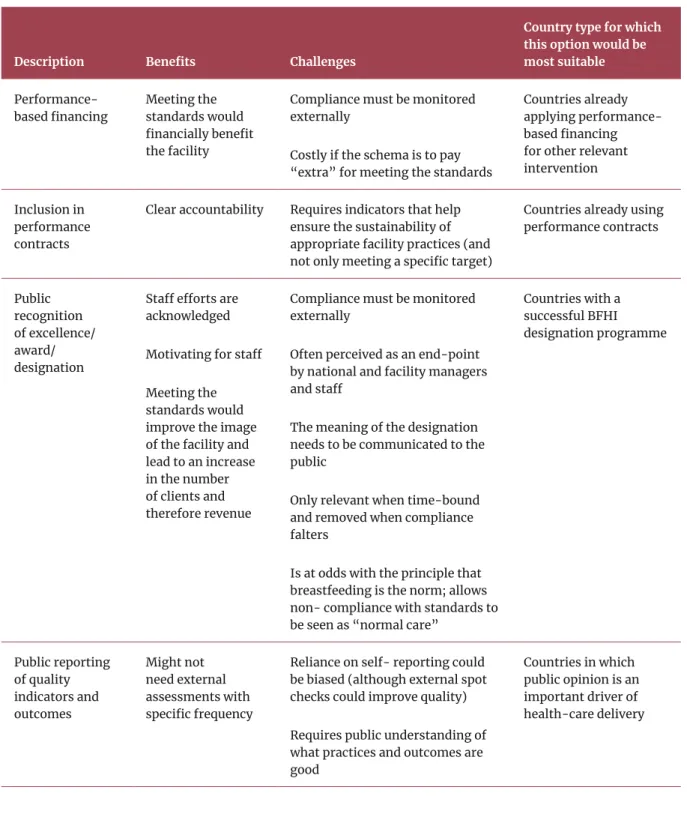
5. Public recognition of facilities that implement the Ten Steps and comply with the global criteria is one way to incentivize quality improvement. Several other incentives exist, ranging from compliance with national facility standards to performance-based financing.
6. Regular internal monitoring is a crucial element of both quality improvement and ongoing quality assurance.
7. External assessment is a valuable tool for validating the quality of maternity and newborn services. External assessments should be sufficiently streamlined into existing mechanisms that can be implemented sustainably.
This page is intentionally blank.
2. The role of facilities providing maternity and newborn services
The core purpose of the BFHI is to ensure that mothers and newborns receive timely and appropriate care before and during their stay in a facility providing maternity and newborn services, to enable the establishment of optimal feeding of the newborn, thereby promoting their health and development. Given the proven importance of breastfeeding, the BFHI protects, promotes and supports breastfeeding. At the same time, it also aims to enable appropriate care and feeding of newborns who are not (yet or fully) breastfed, or not (yet) able to do so.
Families must receive quality and unbiased information about infant feeding. Facilities providing maternity and newborn services have a responsibility to promote breastfeeding, but they must also respect the mother’s preferences and provide her with the information needed to make an informed decision about the best feeding option for her and her infant. The facility needs to support mothers to successfully feed their newborns in the manner they choose.
In line with the WHO Framework on integrated people- centred health services (56), it is important to ensure that
“all people have equal access to quality health services that are co-produced in a way that meets their life course needs and respects social preferences, are coordinated across the continuum of care, and are comprehensive, safe, effective, timely, efficient and acceptable; and all carers are motivated, skilled and operate in a supportive environment”. A specific aspect of this is providing care in a culturally appropriate manner, including providing materials in languages that all clients understand.
The Ten Steps do not encompass all aspects of quality maternity and newborn care. “Mother-friendly” birthing and postnatal care practices have been identified that are important for the mother’s own well- being and the respect of her dignity and her rights (4). Many of these “mother-friendly” practices also help to enable breastfeeding (57). It is important that women are not submitted to unnecessary or harmful practices during labour, childbirth and the early postnatal period.
Such practices include, but are not limited to, unnecessary (i.e. without a medical indication) use of the following:
episiotomy, instrumental vaginal childbirth and caesarean section. Women should also be encouraged to adopt the position of their choice during labour. In addition, women and newborns must be treated with respect, with their dignity maintained and their privacy respected; they must not be subjected to mistreatment (58); and they must be able to make informed decisions. Women also need to be able to have a birth companion of their choice.
With regard to HIV, the 2016 WHO/UNICEF guideline on HIV and infant feeding (55) recommends that national or subnational health authorities should set recommendations for infant feeding in the context of HIV, and decide whether health services will mainly counsel and support mothers known to be living with HIV to either (i) breastfeed and receive antiretroviral drug interventions; or (ii) avoid all breastfeeding. Where authorities recommend breastfeeding plus antiretroviral therapy, this includes early initiation of breastfeeding, exclusive breastfeeding for the first 6 months of life and continued breastfeeding, with adequate and safe complementary feeding, up to at least 12 months;
breastfeeding may be continued up to 24 months or beyond (similar to the general population), while the mother is fully supported for adherence to antiretroviral therapy. Where authorities recommend avoiding all breastfeeding, skilled and coordinated support for infant feeding is needed to improve the safety of replacement feeding. The BFHI can be implemented in both contexts.
Facilities providing maternity and newborn services need to comply with the Ten Steps. The 2018 version of the Ten Steps is separated into critical management procedures, which provide an enabling environment for sustainable implementation within the facility, and key clinical practices, which delineate the care that each mother and infant should receive. The key clinical practices are evidence-based interventions to support mothers to successfully establish breastfeeding. The Ten Steps are outlined in Box 1 and described in detail in section 2.1 and section 2.2. The specific recommendations in the new WHO Guideline: protecting, promoting and supporting breastfeeding in facilities providing maternity and newborn services (3) are also presented in the text, with the relevant recommendation number added. Annex 1 shows how the revised Ten Steps incorporate all of the new WHO guidelines (3) and how they relate to the original Ten Steps.
While each of the Ten Steps contributes to improving the support for breastfeeding, optimal impact on breastfeeding practices, and thereby on maternal and child well-being, is only achieved when all Ten Steps are implemented as a package. The text that follows should be read in this light.
2.1. Critical management procedures to support breastfeeding
Facilities providing maternity and newborn services need to adopt and maintain four critical management procedures to ensure universal and sustained application of the key clinical practices. The first three of these, application of the Code (25–27), development of written policies, and operation of monitoring and data-management systems, are all part of the first step on facility policies.
Step 2 deals with the need to ensure the capacity of all facility staff.
Step 1: Facility policies
The International Code of Marketing of Breast- milk Substitutes and relevant World Health Assembly resolutions (25–27)
Step 1a: Comply fully with the International Code of Marketing of Breast-milk Substitutes and relevant World Health Assembly resolutions.
Rationale: Families are most vulnerable to the marketing of breast-milk substitutes during the entire prenatal, perinatal and postnatal period when they are making decisions about infant feeding. The WHA has called upon health workers and health-care systems to comply with the International Code of Marketing of Breast-milk Substitutes (25, 26) and subsequent relevant WHA resolutions (27) (the Code), in order to protect families from commercial pressures. Additionally, health professionals themselves need protection from commercial influences that could affect their professional activities and judgement. Compliance with the Code is important for facilities providing maternity and newborn services, since the promotion of breast-milk substitutes is one of the largest undermining factors for breastfeeding (59). Companies marketing breast-milk substitutes, feeding bottles and teats are repeatedly found to violate the Code (60). It is expected that the sales of breast-milk substitutes will continue to increase globally, which is detrimental for children’s survival and well-being (13, 61). This situation means that ongoing concerted efforts will be required to protect, promote and support breastfeeding, including in facilities providing maternity and newborn services.
Implementation: The Code (25–27) lays out clear responsibilities of health-care systems to not promote infant formula, feeding bottles or teats and to not be used by manufacturers and distributors of products under the scope of the Code for this purpose. This includes the provision that all facilities providing maternity and newborn services must acquire any breast-milk substitutes, feeding bottles or teats they require through normal procurement channels and not receive free or subsidized supplies (WHA Resolution 39.28 (62)).
Furthermore, staff of facilities providing maternity and newborn services should not engage in any form of promotion or permit the display of any type of advertising of breast-milk substitutes, including the display or distribution of any equipment or materials bearing the brand of manufacturers of breast-milk substitutes, or discount coupons, and they should not give samples of infant formula to mothers to use in the facility or to take home.
In line with the WHO Guidance on ending the inappropriate promotion of foods for infants and young children, published in 2016 and endorsed by the WHA (54), health workers and health systems should avoid conflicts of interest with companies that market foods for infants and young children. Health- professional meetings should never be sponsored by industry and industry should not participate in parenting education.
Global standards:
• All infant formula, feeding bottles and teats used in the facility have been purchased through normal procurement channels and not received through free or subsidized supplies.
• The facility has no display of products covered under the Code or items with logos of companies that produce breast-milk substitutes, feeding bottles and teats, or names of products covered under the Code.
• The facility has a policy that describes how it abides by the Code, including procurement of breast-milk substitutes, not accepting support or gifts from producers or distributors of products covered by the Code and not giving samples of breast-milk substitutes, feeding bottles or teats to mothers.
• At least 80% of health professionals who provide antenatal, delivery and/or newborn care can explain at least two elements of the Code.
Infant feeding policy
Step 1b: Have a written infant feeding policy that is routinely communicated to staff and parents.
Rationale: Policy drives practice. Health-care providers and institutions are required to follow established policies.
The clinical practices articulated in the Ten Steps need to be incorporated into facility policies, to guarantee that appropriate care is equitably provided to all mothers and babies and is not dependent on the preferences of each care provider. Written policies are the vehicle for ensuring patients receive consistent, evidence-based care, and are an essential tool for staff accountability. Policies help to sustain practices over time and communicate a standard set of expectations for all health workers.
Implementation: Facilities providing maternity and newborn services should have a clearly written breastfeeding policy that is routinely communicated to staff and parents (recommendation 12). A facility breastfeeding policy may stand alone as a separate document, be included in a broader infant feeding policy, or be incorporated into a number of other policy documents. However organized, the policy should include guidance on how each of the clinical and care practices should be implemented, to ensure that they are applied consistently to all mothers. The policy should also spell out how the management procedures should be implemented, preferably via specific processes that are institutionalized.
Global standards:
• The health facility has a written infant feeding policy that addresses the implementation of all eight key clinical practices of the Ten Steps, Code implementation, and regular competency assessment.
• Observations in the facility confirm that a summary of the policy is visible to pregnant women, mothers and their families.
• A review of all clinical protocols or standards related to breastfeeding and infant feeding used by the maternity services indicates that they are in line with BFHI standards and current evidence- based guidelines.
• At least 80% of clinical staff who provide antenatal, delivery and/or newborn care can explain at least two elements of the infant feeding policy that influence their role in the facility.
Monitoring and data-management systems
Step 1c: Establish ongoing monitoring and data-management systems.
Rationale: Facilities providing maternity and newborn services need to integrate recording and monitoring of the clinical practices related to breastfeeding into their quality-improvement/monitoring systems (see section 2.4).
Implementation: Recommended indicators for facility- based monitoring of the key clinical practices are listed in Appendix 1, Table 1. Two of the indicators, early initiation of breastfeeding and exclusive breastfeeding, are considered “sentinel indicators”. All facilities should routinely track these indicators for each mother–infant pair. Recording of information on these sentinel indicators should be incorporated into the medical charts and collated into relevant registers. The group or committee that coordinates the BFHI- related activities within a facility needs to review progress at least every 6 months.
During concentrated periods of quality improvement, monthly review is needed. The purpose of the review is to continually track the values of these indicators, to determine whether established targets are met, and, if not, plan and implement corrective actions. In addition, if the facility has an ongoing system of maternal discharge surveys for other quality-improvement/quality- assurance assessments, and it is possible to add question(s), one or both indicators could be added for additional verification purposes or periodic checks.
Additional process indicators for monitoring adherence to the key clinical practices are also recommended. These indicators are particularly important during an active process of quality improvement and should be assessed monthly during such a process. Once acceptable levels of compliance have been achieved, the frequency of data collection on these additional indicators can be reduced, for example to annually. Ho