91
The Role of Psychological Capital and Readiness for Change in Rural Tourism: A Phenomenological Study
Hana Angriyani Mardika
Magister in Human Resources Development, Faculty of Postgraduate School, Universitas Airlangga
Bambang Suharto
Human Resources Development,
Faculty of Postgraduate School, Universitas Airlangga [email protected]
(Corresponding author)
Dimas Novian Aditia Syahputra
PT. Raja Teknik Solusi [email protected]
Abstract
Many villages aspire to boost their tourism industry, but numerous ones face challenges due to limited ownership of three key elements: economic assets, intellectual capital, and social capital. However, a more critical factor contributing to the development of rural tourism is Psychological Capital (PsyCap). This research aims to assess the implementation of PsyCap and the readiness for change among small and medium-sized enterprise (SME) actors, serving as the primary driving force behind rural tourism. The study employs a qualitative approach, utilizing data collection techniques such as documentary studies, observation, focus group discussions (FGDs), and interviews. The participants include five MSME actors and three coordinators of the Tourism Awareness Association (Pokdarwis) in Durensari village, Trenggalek. The data were analyzed using NVivo 12. The findings reveal that human resources, including local tourism associations and a strong sense of community unity, demonstrate positive psychological capital, contributing to the outstanding success of their tourism village despite starting with very limited financial, intellectual, and social resources. The adaptive attitudes of these participants reflect their readiness for change. Further discussion is explained in the article.
Keywords: Rural Tourism, Psychological Capital, Readiness for Change
Received 13 January 2024/Accepted 7 March 2024 ©Author all rights reserved
Introduction
The trend of rural tourism has captured global attention among academics and practitioners over the past decade, including in Indonesia. While prior research on Psychological Capital (PsyCap)
92
and readiness for change in the disruptive era has been conducted (Armenakis et al., 1993;
Grözinger et al., 2022; Kirrane et al., 2017; Luthans et al., 2014), there is a gap in specific research examining PsyCap and readiness for change for Micro, Small, and Medium Enterprises (MSMEs) players in tourism villages from the perspective of HR psychology within the tourism service industry. Nevertheless, the concept of PsyCap is deemed relevant in meeting the demands of MSMEs in tourism villages, potentially bolstering the country's economy in the present and sustainable future.
Aligned with the dynamics of PsyCap among MSME players in rural tourism development, Mtapuri and Giampiccoli (2019) may be the first researchers to indicate a shift in trends from overcrowded massive tourism (Triarchi & Karamanis, 2017) to a village atmosphere offering nature, tranquility, a healthy environment, and the cultural hospitality of the local community as an escape from routine life. This shift has turned rural areas into alternative tourist destinations closely observed worldwide, with rural tourism predicted to continue rising from 2022 to 2033 at an annual growth rate for market valuation of 6.8% (Future Market Insights, 2023).
In contrast to other researchers, Guo and Jordan's (2022) study reveals negative impacts of rural tourism trends on MSME development in villages, causing conflicts and social jealousy. These conflicts arise due to communities not ready to accept changes, making them unprepared to become local entrepreneurs or uncomfortable in adapting to outside investors. Social jealousy may stem from differences in benefits received by residents.
In Indonesia, Micro, Small, and Medium Enterprises (MSMEs) are pivotal in driving tourism villages, drawing attraction from locally produced elements, often highlighting the area's potential (Saefudin et al., 2019). The participation of village communities in showcasing local culture, natural resources, or historical value through MSMEs is crucial for the advancement of tourism village development (Komppula, 2014). Strong MSMEs in tourism villages have a positive impact, spreading optimism for both the community and the MSMEs within it (Manzoor et al., 2021).
93
This study focuses on MSMEs falling under the type of business in the Indonesian tourism industry, located in the tourism village of Durensari in Trenggalek, chosen for its considerable tourism potential. The village has experienced consistent growth in tourist visits, even recovering sharply after the pandemic in 2022.
Durensari Sawahan Tourism Village in Trenggalek has been recognized as one of the best tourism villages in Indonesia, receiving the highest award, the Indonesia Tourism Village Award (ADWI), in 2023. This award, given to villages with significant potential, indicates the exemplary performance of MSMEs within the village.
To optimize MSMEs in this tourism village, attention must be paid to the Psychological Capital (PsyCap) possessed by MSME players. Research indicates that PsyCap is a vital resource for small and medium-sized companies, particularly during crises (Grozinger, 2022). The study employs PsyCap theory (Luthans and Morgan, 2017), readiness for change (Holt et al., 2007), and Rural Tourism (Rosalina et al., 2021) to understand the HR readiness of MSME players in this tourism village to face change, focusing on positive traits like hope, optimism, resilience, and self-efficacy (Luthans and Morgan, 2017).
Psychological capital in Rural Tourism
This study incorporates three theories: PsyCap theory (Luthans, 2004), readiness for change (Holt et al., 2007), and rural tourism (Nair et al., 2015). The rationale behind utilizing the PsyCap theory lies in its depiction of PsyCap as the fundamental ability and capital of individuals, serving as the primary foundation for acquiring other forms of capital (Luthans, 2004). The readiness for change theory is employed because it pertains to the psychological state of individuals when confronting change (Riddell & Roisland, 2017), making it closely intertwined with PsyCap.
Moreover, due to its strong correlation with psychological conditions, this study opts for the readiness for change theory over other organizational change theories, recognizing it as the pivotal factor supporting individual initiatives for change (Holt et al., 2007; Armenakis et al., 1999).
94
Subsequently, the rural tourism theory is employed to investigate how the PsyCap of MSME players in Durensari Sawahan Tourism Village contributes to enhancing readiness for change. This exploration is deemed crucial as tourism management must consider aspects outlined in the rural tourism theory.
The decision to prioritize the PsyCap theory over other theories like leadership is grounded in its ability to mobilize the entire human resources of MSME players, transcending the focus solely on leadership individuals. Luthans (2004) argues for moving beyond human and social capital, asserting the need to concentrate on developing PsyCap, emphasizing "who you are" and "who you become."
Tang (2020) underscores the implications of the PsyCap theory in the business realm, particularly in HR development for all management levels. Positive changes in HR PsyCap within an organization are posited to positively influence readiness for change (Kirrane, 2017). The accomplishments of MSME players in Durensari Tourism Village make them an ideal case study for understanding how to apply PsyCap to enhance readiness for change, with the aim of providing a model for adaptation by other tourism villages in Indonesia.
Readiness For Change in Rural Tourism
Readiness for Change is conceptualized as a psychological state encompassing attitudes, beliefs, and intentions in confronting change (Riddell & Roisland, 2017). The overall positive change in employees' PsyCap within an organization is known to enhance readiness for change (Kirrane, 2017). The MSME players in Durensari Tourism Village, Trenggalek, are considered an apt setting to learn how the application of PsyCap can bolster readiness for change in their tourist village.
Furthermore, acknowledging previous research (Armenakis et al., 1993; Grözinger et al., 2022;
Kirrane et al., 2017; Luthans et al., 2014), which has explored PsyCap and readiness for change in organizations during this disruptive era, none have specifically delved into PsyCap and readiness for change among MSME players in rural tourism. This research addresses this gap, analyzing the implementation of PsyCap by MSME players in Durensari tourist village, renowned for its achievements, to facilitate its adaptation and emulation by other tourist villages in Indonesia.
95 Research Questions
Building on the introduction, the researcher formulates the research problems addressed in this study as follows:
1. How does the implementation of Psychological Capital (PsyCap) by micro, small, and medium enterprise (MSME) actors in the Duren Sari Trenggalek tourist village enhance readiness for change?
2. What factors drive the implementation of PsyCap among MSME actors in the Duren Sari Trenggalek tourist village to enhance readiness for change?
Method Design
This research adopts a qualitative phenomenological approach influenced by Heidegger.
Phenomenology, as conceptualized by Heidegger (1962), aims to comprehend human existence through their concrete life experiences in the world. Heidegger stresses the importance of moving beyond mere descriptions of experiences to delve into how humans exist in the world and engage with the meanings inherent within it. This qualitative research methodology involves an in-depth examination of a limited number of subjects to uncover patterns and models within the observed context (Creswell, 2009). The context observed in this study pertains to the role of Psychological Capital (PsyCap) among Micro, Small, and Medium Enterprises (MSMEs) in fostering readiness for change within the realm of rural tourism.
Data Collection
This research employed documentary studies, interviews, Focus Group Discussions (FGDs), and observations. Primary data collection encompassed qualitative methods, including in-depth interviews and FGDs with stakeholders from the Community-Based Tourism Group (POKDARWIS) and MSMEs in the Durensari region. The study underscores the significance of human capital from the local community in rural tourism development in Durensari. Ten informants, comprising MSME owners and management from the Trenggalek area, participated in
96
in-depth interviews conducted on July 17, 2023. The interview questions were tailored to explore the four pillars of PsyCap: Hope, Self-Efficacy, Resilience, and Optimism.
Documentation studies involved referencing secondary data from various sources, including the Trenggalek Government's Central Statistics Agency (BPS), the official website of the Ministry of Tourism and Creative Economy of the Republic of Indonesia, the Durensari tourist village's official Instagram account, and documents provided by the head of the Tourism Awareness Association (Pokdarwis). Observation findings included photographs depicting conditions in the Durensari village taken by the researcher.
Informants
For the FGDs, eight informants were selected, including the head of Pokdarwis in Durensari Tourism village, two Pokdarwis coordinators overseeing MSMEs, and various MSME actors specializing in homestays, culinary services, entertainment activities (Reyeng Bamboo Production), and tourist attractions (Murai birds breeding) within the Durensari tourist village.
Data Analysis
Data analysis was conducted using NVIVO 12 through reflexive thematic analysis, a method suitable for exploring and interpreting qualitative datasets. This involved identifying patterns, themes, and important elements in the collected data, categorizing them into larger clusters based on similarities or conceptual relationships, and drawing conclusions to address the research formulation.
Trustworthiness
Primary data collection techniques included observation, interviews, and FGDs, with location observation following the concept of "living in" within the tourist village to grasp the community's daily life. Data triangulation, particularly source triangulation, was employed by comparing perspectives from different informants. Secondary data included documents or photos provided by informants, illustrating the application of PsyCap by MSME actors in the Durensari village.
97 Limitations
This research focused solely on internal MSME actors, excluding interviews with customers who visited MSMEs in the Durensari tourist village. Despite being external parties impacted by MSME performance, customers were not included in discussions as the research concentrated on the application of PsyCap to MSME actors in enhancing readiness for change.
Result
Psycap Implication in Durensari Tourism Village, Trenggalek.
Based on interviews conducted with a Homestay owner affiliated with the Pokdarwis of Durensari village, the following sentiments were expressed:
"I am already old. Who will continue this struggle in the future? I might as well pave the way.
We have fallen far behind, especially in terms of energy and thinking. Young people have a broader perspective and are more diligent in doing things. It's different for the elderly; their thoughts remain dreams because they are physically weak." – (Homestay owner and Pokdarwis member)
The informant hopes that the youth in Durensari village actively engage in Pokdarwis activities to sustain the development of the tourism village. The interview data suggest that business operators desire continuity in their efforts by preparing a younger generation with more vigor, wider perspectives, and greater technological skills. In their view, the aspirations of MSME entrepreneurs are tied to Psycap, fervently envisioning the future with positive energy and devising sustainable plans to achieve their goals. They believe that the robust asset required for MSME endeavors is a collaborative synergy between the young and old generations, similar to within a business organization. The collaboration between the young and old generations involves working wholeheartedly, as they share a common hope of advancing the village's endeavors to contribute to the prosperity of everyone involved.
From field research findings, it is evident that the Pokdarwis coordinator and MSME entrepreneurs in Durensari village exhibit exceptionally high self-confidence in advancing the
98
village. They stress that their primary assets are self-assurance and boldness. Their confidence grows stronger as they secure victories in various village tourism competitions. From the researcher's observations, this confidence manifests in their courage to participate in village tourism competitions at the district, provincial, and national levels. Although some individuals lacked confidence and doubted the capabilities of MSME entrepreneurs in competitions, eventually, they dared to step forward and achieved results, as seen in Table 1.1, which lists the various recent awards won by Durensari tourism village.
"It's not made up; it's exactly as it happened. So, if there's a plan, maybe it's like 'oh, it might be orchestrated.' So, in this case, maybe it was luck, perhaps unintentional, without any preparation, and such. That's how it happened, and there was an announcement... that we won.
Maybe it's Allah who decides, again." – (Culinary MSME owner and Pokdarwis member)
The culinary MSME informant in Durensari village believes that this tourism village has the potential to excel compared to other tourism villages due to its numerous awards. The informant also believes that their achievements are the result of genuine capabilities and efforts without pretense in offering hospitality to tourists. Their confidence stems from their belief that every success in this tourism village is also due to divine intervention and involvement.
99 Table 1
Latest Awards Table for Durensari Tourist Village
No. Award Name Acquisition
Time Description 1. The 'Indonesian Tourism Village Award' bestowed
by the Ministry of Tourism and Creative Economy of the Republic of Indonesia stands as the pinnacle recognition for rural tourism in Indonesia.
2023 National level.
2. Awarded by the Indonesian Museum of Records (MURI) for having the largest durian forest area among tourist villages.
2023 National level.
3. Mr. Sandiaga Uno, the Minister of Creative Economy, awarded 3rd place in the Institutional and Cleanliness, Health, Safety, Environment Sustainability (CHSE) category.
2023 National level.
4. Recipient of the Hundred Tourism Villages Awards (SADEWA) in Trenggalek Regency, honored in the Best Tourism Product category.
2022 Regional level.
5. Acknowledged among the top 500 Tourism Villages
by ADWI. 2022 National level.
6. Recognized as a Self-sufficient and Prosperous Smart
Tourism Village at the provincial level. 2022 Regional level.
7. Secured the 1st place for Best Food in the 100 Tourism Villages (SADEWA) in Trenggalek Regency, along with the distinction of Best Food Packaging at the district level.
2022 Regional level.
8. Best Food Packaging at the district level. 2022 Regional level.
9. Distinguished as the Best Destination implementing
New Normal Tourism at the national level. 2020 National level.
10. Acknowledgment for the homestay ranked third in
Kaliasem II. 2019 Regional level.
Sources: (The observation results in the form of an award certificates were photographed by the researcher with the permission of the head of Pokdarwis., 2023)
The self-efficacy possessed by business owners in this village undoubtedly brings about superior competitiveness in the human resources of Durensari village. This competitive edge in human resources is evident through numerous awards received. Aside from receiving the highest recognition in the field of tourism from the Indonesian Ministry of Tourism (Indonesia Tourism
100
Village Award, 2023), Sawahan Durensari tourist village has also earned numerous accolades in other major competitions, as listed in the table.
The MSME actors and the Pokdarwis coordinator, as the organization overseeing the activities of this tourist village, consistently exhibit resilience in advancing Durensari village despite facing pressures, particularly from the villagers themselves. Their resilience is not only towards internal factors but also demonstrated by their ability to navigate through the COVID-19 pandemic, during which the tourism sector faced significant challenges. They continue to strive for improvement in the MSMEs they are involved in, even with limited financial resources. The resilience of the informant, who is the Pokdarwis coordinator,
"Even before, there was a time when friends were cleaning the river and its surroundings, for example, today someone cleans, then a few days later cleans again, and there were times when they were pelted. They were shouted at too." (Pokdarwis coordinator)
The consistency of Pokdarwis activities despite initial pessimism from many villagers, even facing aggressive non-verbal violence towards Pokdarwis members while they were involved in Pokdarwis activities, such as throwing stones at those cleaning the river, is evident. It's important to note that the river in Durensari village is a favorite destination for tourists due to its river tubing attraction. The informant believes that consistency and resilience are crucial. Continuous learning and improvement are deemed essential to advance this tourist village.
"Why have I stayed committed for 8 years, relaxed and enjoying it? Even though everyone else dispersed, it still went on, focused. Even yesterday, when I joined the competition, my friends said, 'Let's not join, we might not win.' But I, in my heart, didn't know why I was so optimistic.
Anyway, it was prepared thoroughly, not thinking about the outcome. Didn't think about the result, but eventually won. Used my own money, ma'am. The prize even covered it. God provides, maybe out of pity for our hard work." (Head of Pokdarwis)
The Head of Pokdarwis shows optimism that Durensari village can excel compared to other tourist villages in Indonesia, believing that with hard work, the results will follow. This optimism
101
is seen in the efforts to continuously develop this tourist village, despite initial skepticism and lack of support from villagers. Even at the beginning, to participate in competitions, the Head of Pokdarwis had to use personal funds.
This research reveals evidence that the condition of this tourist village aligns with the Psychological Capital (Psycap) theory. Traditional economic capital, which refers to tangible assets or financial capital, is no longer considered the most critical factor. The MSMEs in Durensari village possess limited financial and physical building assets. Similarly, human capital focusing on experience, knowledge, and skills of MSME actors in this village is not the primary asset. Social capital, which involves "who you know," is also limited for MSME actors in this village. Compared to these three capitals (traditional economic, human, and social), according to Psycap theory, what makes Durensari tourist village successful is that beyond these capitals, there is something more crucial—Psycap held by the human resources, the MSME actors. This Psycap relates to hope, belief, resilience, and optimism regarding the progress of tourism in this village.
Results on the readiness for change among MSME actors in Durensari village
Readiness for change among MSME actors in the Pokdarwis village of Durensari is assessed based on four components: self-efficacy, management support, appropriateness, and personal benefit.
The informant, who is the owner of a culinary MSME, demonstrates self-efficacy by feeling confident and believing that the MSMEs in this tourist village excel because of the unique services and products offered, which differ from other tourist villages, and also due to relatively cheaper prices.
"Yes, ma'am, you have to be confident and believe. This village is often used as an example, like by Panggul village. There were 9 different neighborhoods visited." (Culinary MSME actor in Durensari tourist village)."
102
Figure 1: Visit from another tourist village to Durensari village.
Source: (Personal documentation by the owner of culinary MSME Informant,2023)
It's not surprising that many tourist villages visit Durensari village for benchmarking to learn how to manage MSMEs as a unified entity in a tourist setting. As illustrated in Figure 1, this figure depicts a benchmarking visit from Joho tourist village, commonly known as Dewi Joho in Kediri, on September 4, 2023. Management support from Pokdarwis can cover various aspects, including guidance, training, access to resources, coordination during events, and promotional assistance for MSME actors.
Figure 2: Details of the eco-friendly tourism promotion uploaded in Durensari.
Source: (Instagram desawisatadurensari.id, 2023)
103
Management support for Pokdarwis management may encompass sustainable natural resource management, product promotion as depicted in Figure 2, or services based on natural characteristics, and strategic marketing advice that leverages the village's natural uniqueness. On the official social media platform, such as the Instagram account owned by Durensari village, details of the Durensari village tour packages are displayed to promote an eco-friendly tourism village, managed by the Pokdarwis coordinator of Durensari village. Following management support, readiness for change is also influenced by appropriateness. This suitability represents individuals' beliefs about whether a change is suitable for the organization.
"At first, there were many durians here, so I was thinking about what to do with them. I needed a solution for the durians. Then, together with friends, we discussed it and got the idea that if there are guests coming here for tourism, they will also visit the durian orchard. So, this durian- based grendul dish was created." (Owner of a culinary MSME in Durensari village)
This data indicates that the informant, as a culinary MSME actor in the tourist village, wants to emphasize the village's branding as a durian village, presenting dishes related to processed durians.
This demonstrates that changes in cultural attributes must be done cautiously and with active involvement from the local community. This ensures that the changes can highlight the village's cultural richness without causing degradation to its cultural uniqueness.
In the context of a tourist village, this component of readiness for change refers to the beliefs and perceptions of the local community and stakeholders involved in the tourist village regarding the personal benefits they will gain from the implementation of changes in the village.
"For me, it's to add to the main experience. Meeting people, or these guests, makes me happy.
Especially when we become close, it adds to the acquaintances." (Owner of Bamboo Reyeng producer MSME)
This encompasses a positive outlook on the positive impact that the development of a tourist village can bring, such as increased prosperity. Thoughts about these personal benefits can
104
motivate the local community and involved parties to support and actively participate in change initiatives in the tourist village, as stated by the informant, who is a Bamboo Reyeng producer.
The Impact of PsyCap Implementation in Enforcing Readiness to change in Durensari Village
The success of Durensari village is strongly supported by the MSMEs under the auspices of Pokdarwis. Enhancing the competitiveness of human resources, strengthening Community-Based Tourism (CBT), and ensuring quality assurance are crucial elements for ensuring the sustainability of the tourism sector in this village.
Competitiveness of Human Resources (HR)
The competitiveness of human resources in this tourist village can be seen from the significant track record of change that has occurred since the village was very dirty, with residents even disposing of waste improperly, until it became clean. In fact, by 2023, it even achieved the national championship for Cleanliness, Health, Safety, and Environment (CHSE) as depicted in figure 3.
Figure 3: The determination of the head of Pokdarwis as the leader of Durensari tourist village. Source: (Documentation by the Head of Pokdarwis, 2023)
105
"When there were many who didn't assist me, there was an event yesterday. Even though I had to do this and that, even though there were many guests, how will I manage it?" (Head of Pokdarwis, 2023).
The perseverance of Durensari's head of Pokdarwis often yields good results. The competitiveness of this tourism village leader is considered quite high, evident from the number of prestigious awards successfully garnered by Durensari village.
Strengthening Community-Based Tourism (CBT)
The reason some villagers were initially pessimistic was due to the fact that the majority of the Durensari village residents have traditionally worked as farmers and fishermen, making the tourism sector an entirely new initiative for the village. Some of the skeptical residents also considered that the cleanliness and beauty of the village were initially far from adequate standards to become a tourism destination, as indicated by an informant who is a Pokdarwis coordinator, thereby casting doubt on the village's potential in the tourism sector.
"Back then, it was incredibly dirty. It couldn't be used for bathing or washing; it was just very filthy. Everything was thrown into the river; it was really filthy at that time. Thanks to the existence of Pokdarwis and the initiation of this tourism village program, there's been an awakening in the community" (Pokdarwis Coordinator, 2023).
As the tourism program began to take shape, the villagers who were initially pessimistic started to participate as a unified tourism village unit to collectively maintain the cleanliness and beauty of the village, spurred by a newfound sense of comfort. The river that was previously used as a place for bathing and to dispose of various waste was consistently cleaned by Pokdarwis members together as a unified effort in Community-Based Tourism (CBT).
Quality assurance
Quality assurance is a crucial foundation in building a positive reputation and trust among tourists towards rural tourism destinations. The implementation of Psycap among MSME actors can
106
motivate them to maintain quality standards in the services and products they offer.
Consequently, rural tourism destinations can sustain their appeal and meet tourists' expectations.
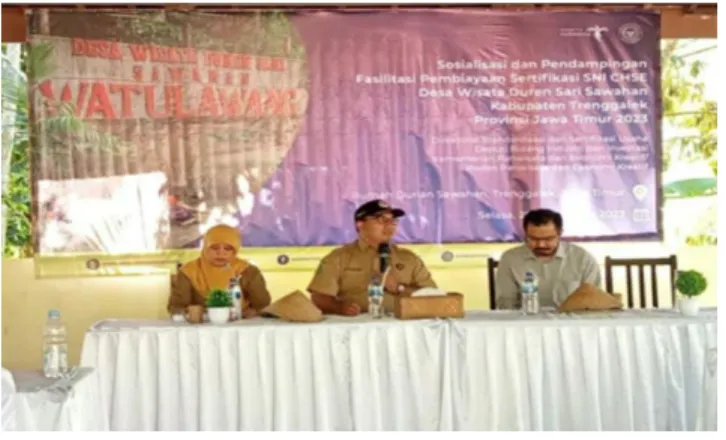
Figure 4: SNI Certification Funding Assistance Program for CHSE, Source: Documentation by the Head of Pokdarwis, 2023.
Pokdarwis Durensari maintains quality by participating in the Indonesian National Standards (SNI) certification assistance program for Cleanliness, Health, Safety, Environment Sustainability (CHSE) in tourism destinations. This mentoring program, conducted by the Directorate of Business Standardization and Certification under the Ministry of Tourism and Creative Economy of the Republic of Indonesia, commenced on September 26, 2023, in Durensari village, Trenggalek, as depicted in Figure 4.
Discussion
According to the research by Wang and Zhang (2022), there are negative impacts of transforming villages into tourist villages, one of which is gentrification. Gentrification manifests as negative impacts on the surrounding community in the form of space function renewal, changes or relocation of space, decreased job opportunities, degradation of local culture replaced by new cultures, and reduced affordable housing due to the influx of newcomers into an area. However, this does not apply to Durensari village because the existence of a tourist village has increased job opportunities in the village by absorbing local labor through MSME. The Pokdarwis
107
administrators, along with MSME practitioners in Durensari village, must adopt local culture in their products, enhancing the unique experiences they offer.
This aligns with the assertion that PsyCap is the initial capital for readiness to undergo change (Luthans and Morgans, 2017). PsyCap can drive human resources to overcome challenges and make significant changes in the work environment (Aybas and Acar, 2017). The Pokdarwis administrators and MSME practitioners in Durensari's tourist village also have self-efficacy within PsyCap, signifying an individual's belief in their ability to accomplish tasks or responsibilities they face, reflecting a confident attitude in achieving satisfying outcomes (Luthans, 2006).
According to the Doxey theory, the presence of tourism tends to trigger euphoria and self- confidence within the community (Doxey, 1975), although there are often parties that consider the arrival of the tourism industry to bring many challenges and negative impacts. Similarly, in this village, some feel a lack of personal valency, resulting from their initial lack of optimism regarding the emergence of this new industry in Durensari village. Consequently, these parties influence other residents to tend to ignore the tourism industry. Beyond neglect, there often arise signs of resistance or antagonistic attitudes among the community, occasionally leading to acts of vandalism. The pessimistic attitudes of some parties ultimately contribute to the decline in the self-efficacy of human resources in that area.
Fortunately, in the Durensari tourist village, there is an organizational leader who consistently initiated exploration, pioneered, and struggled to develop tourism with high self-efficacy—Mrs.
Unik, the head of Pokdarwis in this tourist village. She consistently works on improving the self- efficacy of villagers involved in Pokdarwis, showcasing successful examples in this tourist village, and setting an example through hard work, smart work, and sincere dedication.
Furthermore, resilience indicates the ability to adapt and grow when faced with pressure or challenges (Sejits et al., 2015). MSME practitioners and Pokdarwis coordinators demonstrated adaptation to the pressures from the local community, who were pessimistic and even vandalized their activities. Their adaptation includes continuous learning and innovation by collaborating with
108
the government or other tourist villages for learning, training, and benchmarking, expanding tourist destinations, enhancing services, and broadening the reach of their tourism products.
Thus, the number of tourists continues to increase, benefiting the village's prosperity.
The theory of resilience also highlights the importance of consistency in advancing a community or region (Dendup et al., 2022). Consistency in community or regional development is reflected in their efforts to consistently develop the tourist village, even when faced with resistance or limited initial resources. The Pokdarwis administrators, especially the head of Pokdarwis, consistently seek funds and a good reputation for the development of Durensari's tourist village by participating in various competitions to gain relationships with sponsors and government grants. This illustrates that the Pokdarwis administrators and MSME practitioners in Durensari village have applied PsyCap in the form of resilience—a capacity to rise and become better when faced with problems and difficulties to achieve success (Luthans and Morgan, 2017).
Regarding optimism, in positive psychology, optimism plays a vital role in shaping individuals' perceptions of challenges, opportunities, and their abilities to overcome obstacles (Zhu and Deng, 2020). Optimism is a catalyst for change, where the optimism of MSME practitioners under the Pokdarwis guidance in running their business eventually helped change the pessimistic attitudes of other villagers into support and optimism. The change in the views of initially pessimistic residents to optimistic ones stems from observing and experiencing changes in the village's aesthetics, road facilities, public facilities, and the community's well-being due to the optimistic attitudes at the start of the village's development. Optimism influences how individuals or communities in rural areas see potential and opportunities around them. Optimistic individuals tend to be more open to new ideas, innovations, and opportunities for developing rural tourism.
Challenges like limited resources and accessibility, as experienced in Durensari village's journey to become a tourist village, can be better handled by optimistic individuals. Optimism prompts the Durensari village to respond to challenges with creativity in finding sustainable solutions.
For example, implementing digital tools to attract tourists. However, digital implementation also encountered challenges, such as using accommodation-providing digital applications like Oyo and
109
Mister Aladin, where changes in the digital aspect did not align with local norms and culture. This was because several guests arriving through these applications were not married, causing concern among the locals. Yet, with the optimism of Pokdarwis administrators and members, they sought other solutions using other applications, such as social media, more reliable for MSME practitioners for marketing activities because they can still control business models and regulations for guests.
Data collected from interviews show that MSME practitioners under Pokdarwis have attempted to display positive PsyCap within their members to advance Durensari's tourist village By developing these four components of PsyCap, MSME practitioners in Durensari village can better overcome challenges and have psychological readiness for change (Luthans, 2002; Luthans and Youssef, 2017).
Research conducted by Jabbarian and Chegini (2017) states that PsyCap has a positive influence on readiness for change. Therefore, it can be said that these research findings align with Kirrane (2016), who suggests that individuals need to develop PsyCap to enhance their readiness to face organizational changes.
From the interview data processed using NVIVO 12 software, it is evident that the most discussed topic is the transformation in Durensari village from a community mainly engaged in farming fields and gardens to a village highlighting its tourism. The topic of optimism is the second most frequent topic in the interview results. All informants agreed that the initial capital for establishing these MSMEs, which later formed this tourist village, was solely driven by the spirit and desire to progress.
All informants also agreed that despite the prevalent pessimism, the positive environmental impacts resulting from this change have shifted pessimism towards optimism. The change in the attitude of MSME practitioners grew due to an increased belief in themselves that they can lead the change towards a tourist village that can uplift Indonesia's reputation. This shift in attitude was also triggered by the personal benefits felt by village residents after Durensari became a
110
tourist village, such as better roads, a cleaner and greener environment, and improved hygiene since no one uses the river for "toilet activities” called “Mandi, Cuci, Kakus (MCK)”.
The Pokdarwis of Durensari village, as the coordinator of activities in the tourist village, played a significant role in the development of MSMEs in this village. One of their contributions was scheduling to accommodate guests and coordinating activities for group visitors. This is crucial considering that most villagers are farmers and fishermen with tight schedules. With this scheduling, MSME practitioners can manage their time between farming and serving guests as MSME practitioners and Pokdarwis members.
The government also significantly contributed to the development and increased readiness for change among Durensari residents by providing various training sessions to establish new MSMEs or enhance existing MSME services, thereby advancing the community. Additionally, the government played a significant role in exposure through various competitions, enhancing the village's recognition and bringing positive social impacts to the local community.
Despite becoming a tourist village, the residents of Durensari village continue to preserve local wisdom and the comfort of their community by implementing rules aligned with the norms and beliefs of the local people. For instance, implementing separate homestay locations for non-couple visitors aims to maintain cultural harmony within the Durensari village community amid changes.
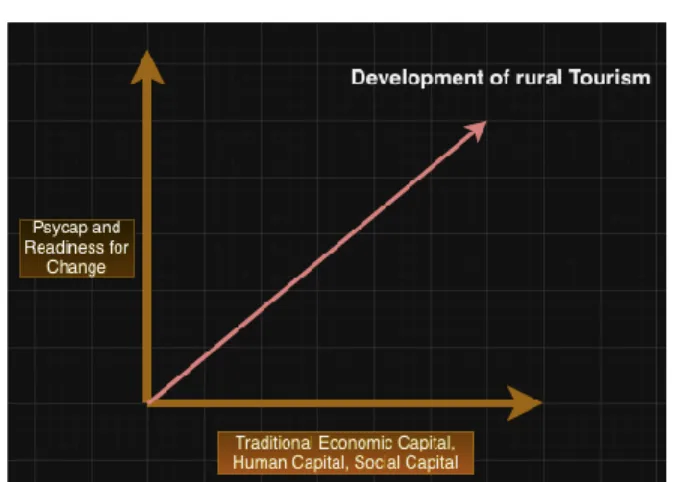
Thus, self-efficacy, management support, appropriateness, and personal benefits act as transformers of a pessimistic PsyCap into a positive one. Therefore, one curve emerges from the analysis of this research result.
111
Figure 5. The curve of Rural Tourism Development
As indicated in the curve of Figure 5, the development of rural tourism is supported by high PsyCap and Readiness for Change. Economic capital, human capital, and social capital will directly correspond to the high PsyCap and readiness for change possessed by the human resources in the tourism village, as illustrated in the case of Durensari village tourism.
Conclusion
The positive PsyCap displayed by a small portion of village residents and Pokdarwis administrators, as the early pioneers of the Durensari tourist village, has the ability to change the attitudes of other village residents who were initially pessimistic about the changes occurring within Durensari. Despite the lack of financial assistance from the Village-Owned Enterprises (Bumdes) for the MSMEs driving the Durensari tourist village, it turns out that Durensari village, with very limited financial capital for pioneering tourism, is still able to realize an outstanding tourist village due to the initial PsyCap possessed by some Pokdarwis administrators and MSME operators in the village. This demonstrates that the application of PsyCap in Durensari village plays a role in enhancing readiness for change. The development of rural tourism is supported by high PsyCap and Readiness for Change, where economic capital, human capital, and social capital will follow and correspond directly to the high PsyCap and readiness for change possessed by the human resources in that tourism village, similar to what is happening in Durensari village tourism.
Recommendations
112
It is recommended to conduct further research using quantitative methods because the quantitative approach can aid in generalizing the findings of this study to a larger population. While qualitative studies provide in-depth insights, a quantitative approach might be necessary to test the extent to which these findings can be applied to a broader population. In this research, the sample taken was limited to Durensari Village; thus, it cannot be generalized to other tourist villages. For future research, it is necessary to conduct a study with a larger sample using a quantitative approach to generalize the research.
References
Armenakis, A. A., Harris, S. G., & Mossholder, K. W. (1993). Creating readiness for organizational change. Human Relations, 46(6), 681–703. doi:
/10.1177/001872679304600601
BPS Kabupaten Trenggalek (2023). Kabupaten Trenggalek Dalam Angka Tahun 2023. BPS Kabupaten Trenggalek.
Creswell, John W. (2009). Research design: Qualitative, quantitative, and mixed methods approaches. SAGE Publications.
Dendup, Ngawang & Tshering, Kuenzang & Choda, Jamyang. (2022). Community-Based Tourism as a Strategy for Building Climate Resilience in Bhutan. 10.1007/978-981-16-0680-9_25.
Doxey, G. 1975 A Causation Theory of Visitor–Resident Irritants: Methodology and Research Inferences. The Impact of Tourism. In the Sixth Annual Conference Proceedings, pp.195- 198. San Diego: The Travel Research Association.
Future Market Insights. (2023, February 1). Rural Tourism Market. Retrieved from
Grözinger, A.C., Wolff, S., Ruf, P.J., Moog, P. (2022). The power of shared positivity:
organizational psychological capital and firm performance during exogenous crises. Small Bus Econ 58, 689–716. doi: 10.1007/s11187-021-00506-4
Guo, H., & Jordan, E. J. (2022). Social exclusion and conflict in a rural tourism community: A case study from Likeng Village, China. Tourist Studies, 22(1), 42–60. doi:
10.1177/14687976211039067
Heidegger, M. (1962). Keberadaan dan Waktu. Oxford: Penerbitan Blackwell.
Holt, D. T., Armenakis, A. A., Feild, H. S., & Harris, S. G. (2007). Readiness for organizational change: The systematic development of a scale. Journal of Applied Behavioral Science, 43(2), 232–255. doi: 10.1177/0021886306295295
Jabbarian, J., & Chegini, M. G. (2017). The Effect of Perceived Organizational Support on Employee Resistance to Change: A Study on Guilan Municipal Staff. Journal of History Culture and Art Research, 5(4), 642. doi: 10.7596/taksad.v5i4.627
113
Kirrane, M., Lennon, M., O'Connor, C., & Fu, N. (2017). Linking perceived management support with employees’ readiness for change: The mediating role of psychological capital. Journal of Change Management, 17(1), 47–66. doi: 10.1080/14697017.2016.1214615
Komppula, R. (2014). The Role of Individual Entrepreneurs in the Development of Competitiveness for a Rural Tourism Destination-A Case Study. Tourism Management 40(1), 361-371. doi: 10.1016/j.tourman.2013.07.007
Luthans, F., Luthans, K.W., & Luthans, B.C. (2004). Psychological capital: Beyond human and social capital. Business Horizons,47(1), 45-50 doi: 10.1016/j.bushor.2003.11.007
Luthans, J. B., Luthans, B. C., dan Avey, K. W. (2014). Building the Leaders of Tomorrow: The Development of Academic Psychological Capital, J. Leadersh. & Organizational Stud., 21(2), 191–199. doi: 10.1177/1548051813517003
Luthans, F., & Youssef-Morgan, C. M. (2017, March 21). Psychological Capital: An Evidence- Based Positive Approach. Annual Review of Organizational Psychology and Organizational Behavior, 4(1), 339–366. doi: 10.1146/annurev-orgpsych-032516-113324
Manzoor, F., Wei, L., & Sahito, N. (2021). The role of MSMEs in rural development: Access of MSMEs to finance as a mediator. PloS one, 16(3).
doi: 10.1371/journal.pone.0247598
Mtapuri, O., & Giampiccoli, A. (2019). Tourism, community-based tourism and ecotourism: a definitional problematic. South African Geographical Journal, 101(1), 22-35. doi:
10.1080/03736245.2018.1522598
Nair, V., Munikrishnan, U. T., Rajaratnam, S. D., dan King, N. (2015). “Redefining Rural Tourism in Malaysia: A Conceptual Perspective.” Asia Pacific Journal of Tourism Research 20(3), 314- 337, doi: 10.1080/10941665.2014.889026
Riddell, R. V., & Roisland, M. T. (2017). Change readiness. Faculty of School of Business and Law at University of Agder, 17–25. doi: 10.1002/9781119967316.ch2
Rosalina, Putu Devi, et al. (2021). Rural tourism: A systematic literature review on definitions and challenges.” Journal of Hospitality and Tourism Management, 47, 134–49. doi:
10.1016/j.jhtm.2021.03.001
Saefudin, E., Budiono, A. & Halimah, M (2019) Pengembangan Desa Wisata Pendidikan di Desa Cibodas Kabupaten Bandung Barat. Sosiohumaniora:, 21(1), 1-10. doi:
10.24198/sosiohumaniora.v21i1.19016
Tang J. J. (2020). Psychological Capital and Entrepreneurship Sustainability. Frontiers in psychology, 11, 866. doi: 10.3389/fpsyg.2020.00866
Triarchi, E., & Karamanis, K. 2017. The evolution of alternative forms of Tourism : a theoretical background. Business & Entrepreneurship Journal, 6(1), 39–59. doi:
10.5296/wjbm.v3i1.11198
Zhu, H.; Deng, F. How to Influence Rural Tourism Intention by Risk Knowledge during COVID- 19 Containment in China: Mediating Role of Risk Perception and Attitude. Int. J. Environ.
Res. Public Health 2020, 17, 3514. https://doi.org/10.3390/ijerph17103514