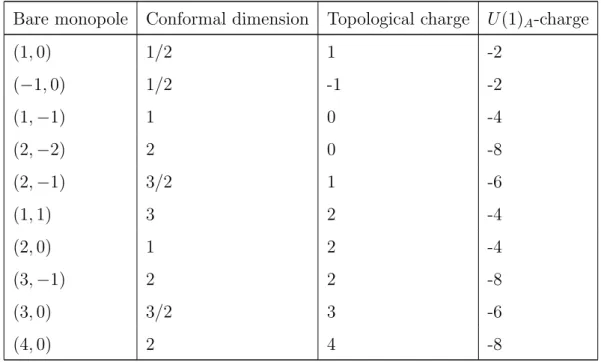
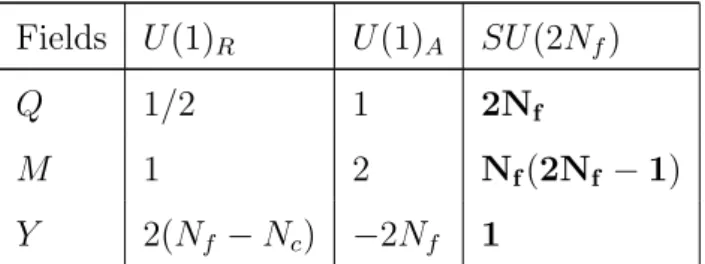
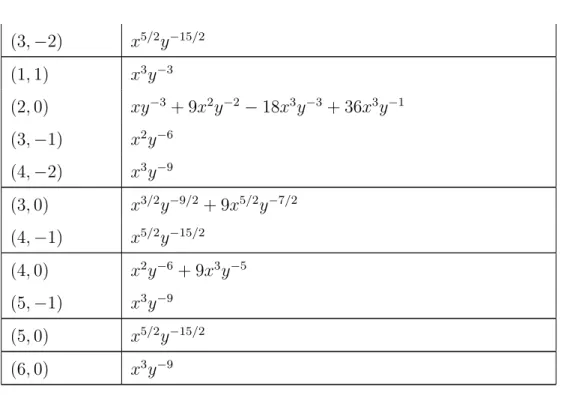
The introduction of magnetic monopole operators in the approximation with the gauge fields eliminates this mismatch in the two descriptions of the same physics. One of the theories that Intriligator and Seiberg analyzed in their paper [10] is anN = 4 gauge theory with gauge group U(1)3 and matter fields in the bifundamental representation of each of the pairs of U(1) gauge factors.
Introduction
Even before the discovery of the ABJM model, it was mentioned in [7] in connection with the hidden flavor symmetries proposed by Intriligator and Seiberg [10]. In Section 3, we study monopole operators in gauge theory N = 4 U(N) with associated and fundamental hypermultiplets.
Supersymmetry Enhancement in the ABJM Model
- Field Content, Action, and Symmetries
- Deformation to Weak Coupling
- Monopole Operators
- Strategy of the Computation
- Quantization of the Deformed ABJM Theory
- Quantum Numbers of Bare Monopoles
- Gauss Law Constraint
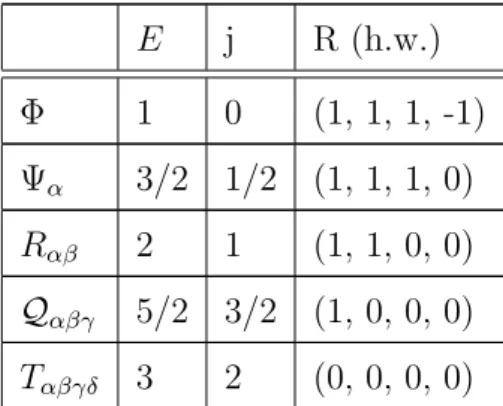
- Superconformal Multiplet of the Stress-Tensor
- Evidence for Duality at k = 1
- Protected States and Enhanced Supersymmetry
- Construction of States Corresponding to Conserved Currents
Equations of motion of the ABJM theory imply kTrF µ = kTr ˜F µ, that is, the two currents can be identified. Assuming that BPS states survive in the deformed theory (we will justify this assumption below), we expect to see them as elements of Fock space built on a bare monopole.
N = 4 SQCD with an Adjoint Hypermultiplet
- Field Content and RG Flow
- Symmetries and Their Expected Enhancement
- Deformation to Weak Coupling
- Spectrum of Protected Scalars
- Symmetry Enhancement
Let us now discuss the B-model symmetries and their expected improvement in the infrared. Note that the BPS and anti-BPS states in the ¯35 representation constructed primarily lie in this free sector of the theory.
Discussion
Gauge Group SU (N )
For N >1 we have an additional set of scalars of conformal dimension 1 leading to another copy of Spin(8) R-symmetry. The theory at t = 0 thus has two copies of N = 8 superconformal symmetry consistent with the predictions of duality.
Adding More Flavors
In the extreme infrared limit, one can replace the multi-Taub-NUT space with an orbifold C2/ZNf. For Nf >1, orbifolding breaks N = 8 supersymmetry down to N = 4, so we do not expect to have improved SUSY in the infrared.
Concluding Remarks
One can realize the gauge theory N = 4 U(N) with one associated and Nf fundamental hypermultiplet via the system of N D2-branes and Nf D6-branes in type IIA string theory. An infrared description of this system provides N M2-branes in multi-Taub-NUT space with Nf centers.
Appendix A. Quantization in a Monopole Background
For the first case we work in the unitary gauge which sets the corresponding σs to zero, so the action is. The only difference between fermions in the vector multiplet and fermions in the hypermultiplet is an additional factor r = expτ in the action for the latter.
Appendix B. Casimir Energies
Rather, these are Chern-Simons theories of matter, which are already superconformal at the classical level. These theories are not parity invariant at the classical level, while all known N = 8 d= 3 theories are parity invariant. In the ABJM description of the same system, this decomposition appears only at the quantum level [1].
The Moduli Space
The supposed N = 8 supersymmetry algebra must act trivially on the topological sector, therefore we need to analyze for which M, N and k the free theory of the moduli has N = 8 supersymmetry. This theory is a supersymmetric sigma model whose target space is the quotient of CN by the discrete subgroup of U(N) that preserves the diagonal form of the matrices Aa and Bb. Zk itself can be identified with the Zk subgroup of the U(1) subgroup of U(4) consisting of scalar matrices.
Monopole Operators and Hidden N = 8 Supersymmetry
The BPS scalars we are looking for have a non-zero U(1)T charge and are therefore monopole operators [7]. These states are completely analogous to the BPS scalars for the U(N)2×U(N)−2 ABJM theory developed in [1] (see Eq. (13) in this paper). We can also verify that no other GNO loadings cause BPS scalars with ∆ = 1.
Superconformal Index and Comparison with Other N = 8 Theories
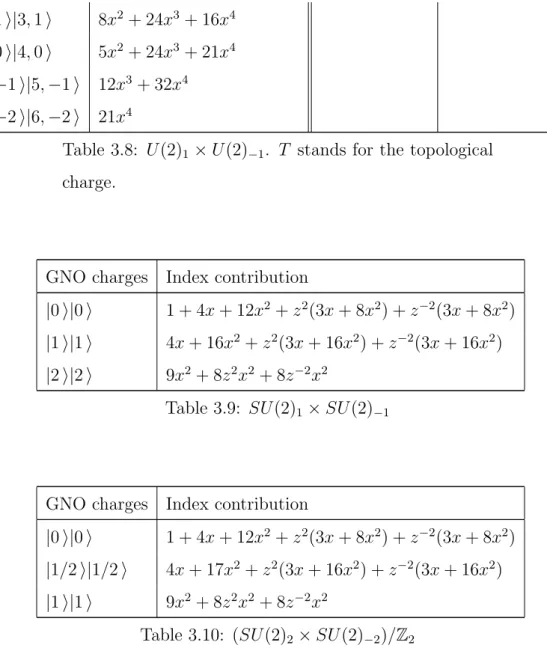
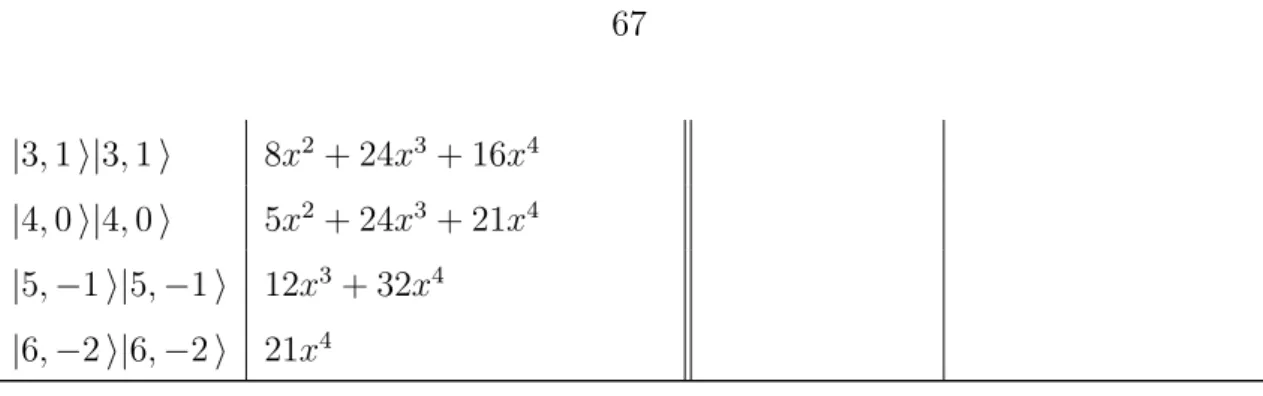
The index receives contributions only from states satisfying {Q, Q†}=E−r−j3 = 0, where Q is one of the 32 supercharges and r is the U(1) R-charge. In each topological sector, the indices match in leading order in x as a result of the identical spectra of the lowest dimensional BPS scalars. The result is a double expansion in x and z with powers of z that multiply the contributions of the corresponding topological charge.
Comparison with BLG Theories
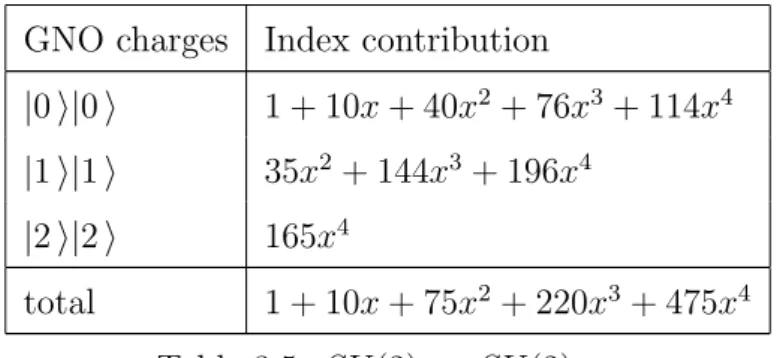
The topological charge QT on the ABJM side corresponds to the charge of a subgroup U(1) of Spin(6) which we denote as U(1)t.3 Thus we have to compare the index ABJM in a particular topological sector with the index BLG in a sector with a particular charge U(1)t. For a fixed topological load on the ABJM side and the corresponding load value U(1)t on the BLG side which manifests in the index as a power of z, the contribution to the index comes from a sum over the various GNO charges. , and the two sums happen to coincide term by term. For example, in the topological sector T = 1 on the ABJM side the contribution from the charge GNO |n,1−ni|n,1−ni is equal to the contribution from the charge GNO |n−1/2i|n−1/ 2i to the power first ofz on BLG side.
Appendix A. Protected BPS States
One copy is visible at the classical level, while the BPS scalars of the other copy carry GNO charges, so it is intrinsically quantum mechanical in origin. The presence of the second copy of N = 8 superalgebra indicates that at the quantum level both these theories decompose into two non-interacting N = 8 SCFTs. In the specific case of a U(N + 1)k×U(N)−k ABJ theory and ∆ = 1, such "regular short multiples" do not exist at the value of the deformation parameter t = ∞, because.
Appendix B: Superconformal Indices for N = 8 ABJM, ABJ, and BLG Theories 59
An important class of dualities of four-dimensional gauge theories are Seiberg dualities, which relate minimally supersymmetric N = 1 SQCD theories with the gauge group SU(Nc) and Nf. It is a duality between the infrared limits of N = 2 gauge theories with basic matter and unitary or symplectic gauge groups. Another class of three-dimensional dualities for N = 2 and N = 3 theories with Chern-Simons terms was introduced by Giveon and Kutasov [40].
Index for N = 2 Theories
SCS0 ({n}, a) is actually the weight of the bare monopole with respect to the gauge group, and a is in a Cartan subalgebra. The function f =fch+fv depends on the content of vector multiplets and hypermultiplets. The second sum is over the weight ρ of the representations of the gauge group in which the chiral fields Φ live. There are many ways to set the theory on S2×S1 parameterized by the choice of the R current [43].
Aharony Duality for Unitary Groups
Indices for Dual Pairs of Theories with Unitary Gauge Groups
The conformal dimensions of magnetic theory fields are easy to find using the duality dictionary. Duality links the monopole operators of electric theory to the chiral (composite) fields of magnetic theory. We find perfect agreement for every value of the topological charge up to the third power in x.
Chiral Ring
- Examples
- General Discussion
- Scalar BPS States in the Deformed Theory
- Illustration of the General Conclusions
Now we can look for counterparts of the chiral ring operators in the distorted theory. When the interactions are turned on, they are coupled with a fermion and are not present in the original theory as a non-trivial element of the chiral ring. Another conclusion is that not all elements of the chiral ring are present in the distorted theory.
Aharony Duality for Symplectic Groups
Similar to the case of single measurement groups, the index of the measurement group stands for Nf. Therefore, we expect it to couple with a fermion on the way from weak coupling to the original theory and not be present as a non-trivial element of the chiral ring in the original theory. In case (i), all bare monopole operators of electrical theory are non-trivial elements of a chiral ring and are generated by the minimal bare monopole operatorY: if Tn>0 is a bare monopole operator with GNO charge n >0, then Tn> 0 =Yn.9.
Appendix A. Contribution to Indices from Different GNO Sectors
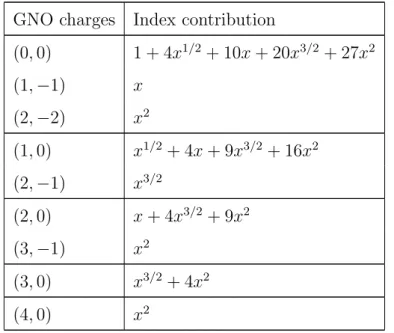
Analogous to the case of unit gauge groups, all bare monopoles with GNO charges that differ from (n,0, ..,0) random BPS states are in the distorted theory. In other words, the index suggests that it interacts with a fermion with GNO charge (2,0) and appropriate U(1)A charge. GNO charge coincides with the topological charge for the bare monopole, but differs for excited states due to the fact that fields carry v± topological charge.
Appendix B. Relations Between Generators of the Chiral Ring
Appendix C. Consistency of the Chiral Ring
In the second scenario, there is no corresponding fermionic superpartner for each bare monopole. However, two conditions must be met for a bare monopole to become Q-exact in the original theory. The non-uniform evolution leads to a radially quantized IR fixed point of the theory at R3 in the distant future.
Models
A Brief Review of Monopole Operators
If we require the monopole operator to preserve some supersymmetry (such operators can be called BPS operators), the matter fields must also be singular, so that the BPS equations are satisfied near the insertion point. Namely, if we have a superconformal theory, we can perform radial quantization to obtain a supersymmetric theory on R×S2 whose states are in one-to-one correspondence with the local operators of the original theory on R3. The quantum numbers match on both sides of the correspondence with the energies of the states equal to the conformal dimensions of the corresponding operators.
Review of the Method
D 4 and D 5 Quivers
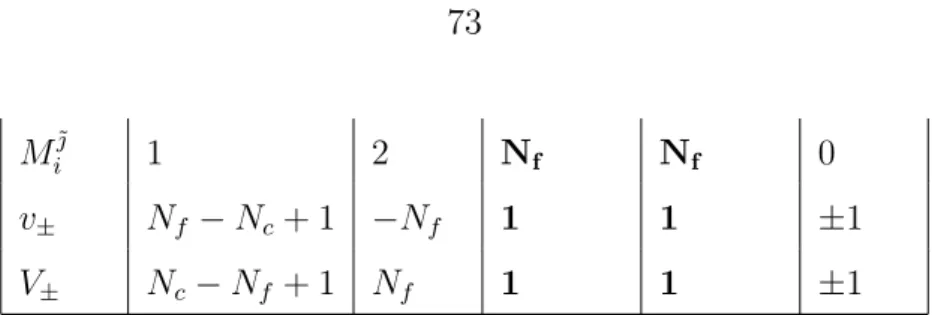
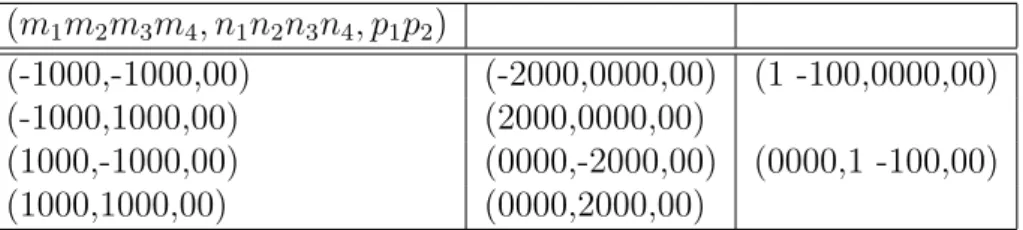
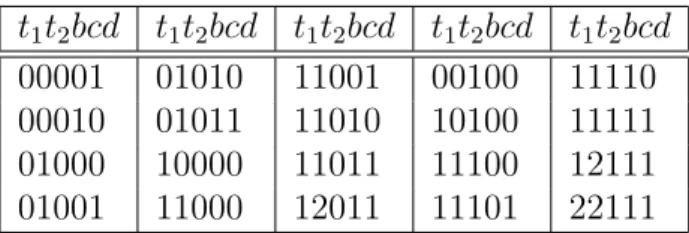
Because there are no fundamental hypers, there is a decoupled U(1) gauge subgroup manifested in the invariance of the energy of bare chiral monopoles. In the basis (h1, h2, h3, h4) where {t1+t2 =h2−h4, b=h3+h4, c =h3−h4, d=h1−h2} it is clear that the scalars together with 4 nontopological chiral scalars trφ (they are superpartners of four topological currents and are the lowest components of the chiral manifolds trΦ) are in adjacency representation of so(8). The condition nf ≥2nc−1 is necessary, because if it is not satisfied, one gets a bare monopole with non-positive energy that is magnetically charged under the corresponding gauge subgroup and magnetically neutral under all the remaining factors in the full gauge group .

E 6,7,8 -type Quivers
Engineering Nonlinear Quivers
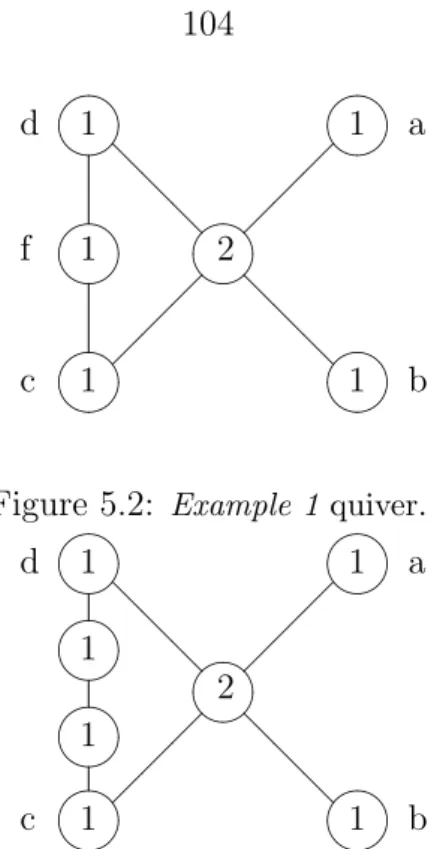
In the next section, we give some examples of nonlinear theories with a free symplectic symmetric group. This is because the expression for the energy of bare monopoles in the engineering theory is the sum of those in the original theories and the positive contribution of the new hypermultiplet. Bare monopoles with E = 1/2 correspond to the lowest component scalars in free twisted hypermultiplets.
Quiver Theories with Nonunitary Gauge Groups
G 2 Case
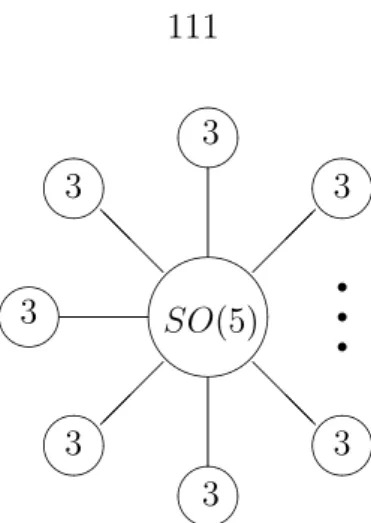
The root space is a two-dimensional vector space R2, in which positive simple roots can be taken as. 5.7) The Cartan algebra is a two-dimensional vector space dual to R2, which can be identified with it using the standard metric. This is a theory with gauge group G2×U(4)2 that corresponds to the quiver with a bifundamental hyper of G2×U(4) for both U(4) factors.6 The symmetry group isSp(2)free×U(1 )2. The two topologically neutral states in the third column of Table 5.1 correspond to two scalarstrΦ of the two gaugeU(3).
SO(5) Case
The SU(2)f free factor is free in the sense that the currents are built from a doublet of free fields, which are bare monopole operators with energy E = 1/2. The gauge group is SO(5) ×U(3) with one hypermultiplet in the bifundamental representation and two hypermultiplets in the representation. It is possible to give a description of this theory, in which the free part and the mutual part of the IR theory are already factorized in the UV Lagrangian [19].
Unitary Quivers
Appendix A
- D-type Quivers
- E 6 Quiver
- E 7 Quiver
- E 8 Quiver
After we set the flux for the node X to zero, the energy for bare monopoles is given by the expression
Appendix B
Only a small fraction of interacting superconformal field theories are known to have a Lagrangian description, and sometimes even in these cases the entire superconformal Lagrangian structure is not seen. This makes it clear that the classification of superconformal quantum field theories does not reduce to the classification of superconformal Lagrangians. In the second part of the chapter we use this result to explain another "empirical" fact - the fact that so far no purely N = 7 superconformal field theories have been found.
N = 6 Superconformal Field Theories
These characteristics are: the existence of the superconformal algebra, unitarity, and the existence of the stress tensor. The lowest component of the stress-tensor multiplet is an SO(3) scalar and absolutely antisymmetric rank-four SO(N)R tensor5 with conformal dimension 0 = r1 = 1. Below we argue that this is indeed the case: each N = 6 superconformal field theory has a global U(1) symmetry whose current lives at the second level of the stress tensor multiplet along with the R currents.
N = 7 Superconformal Field Theories
In this chapter we have considered examples of global symmetry enhancement by monopole operators in three-dimensional N = 4 gauge theories. Witten, “SL(2,Z) action on three-dimensional conformal field theories with Abelian symmetry”, arXiv:hep-th/0307041. Yokoyama, "Index to three-dimensional superconformal field theories with general charge assignments R," [arXiv:1101.0557[hep-th]].