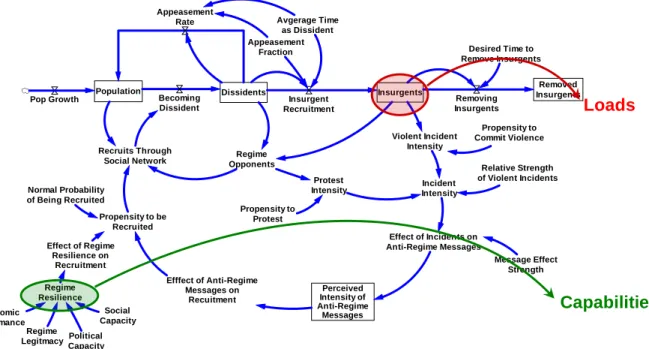
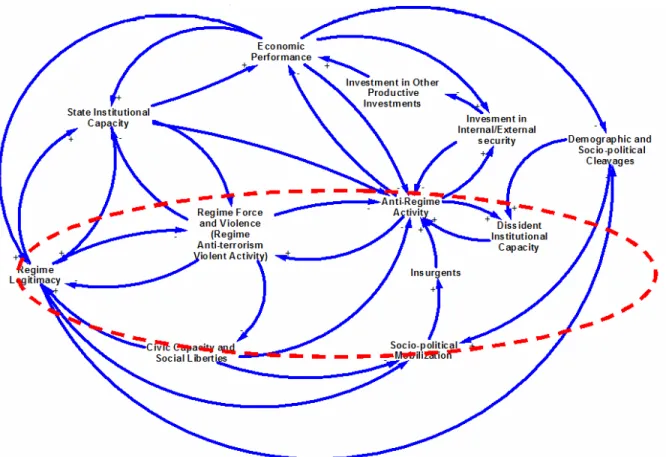
The loss of state stability in various parts of the world poses a major threat to the US. One of the most recognizable indications of state instability is the outbreak of civil war. This theorem is embedded in a model of high-level state stability and helps formulate the system dynamics model.
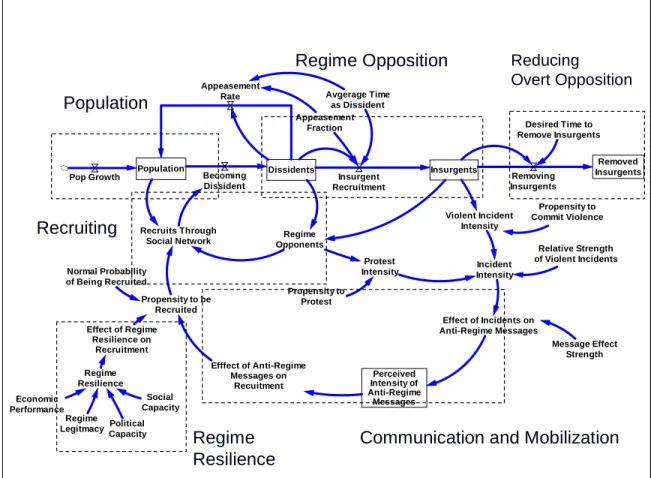
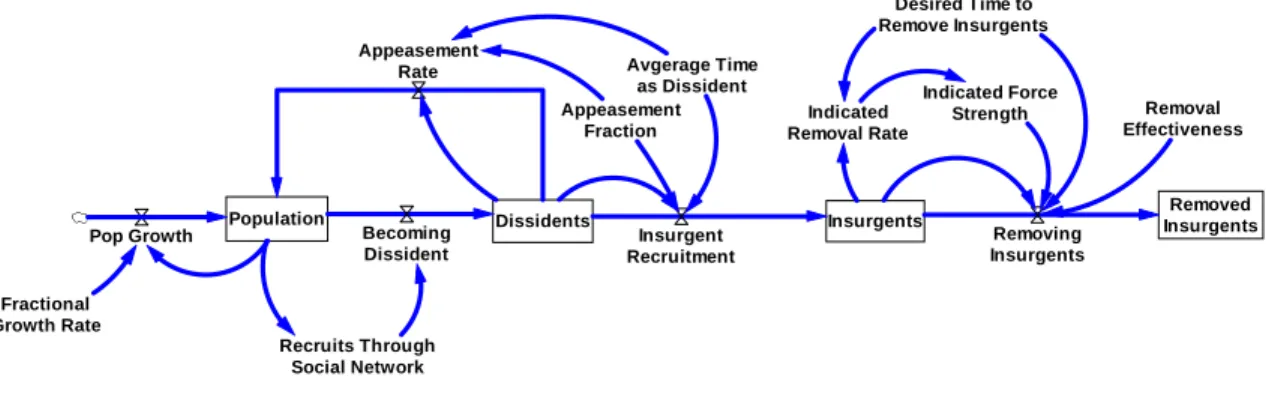
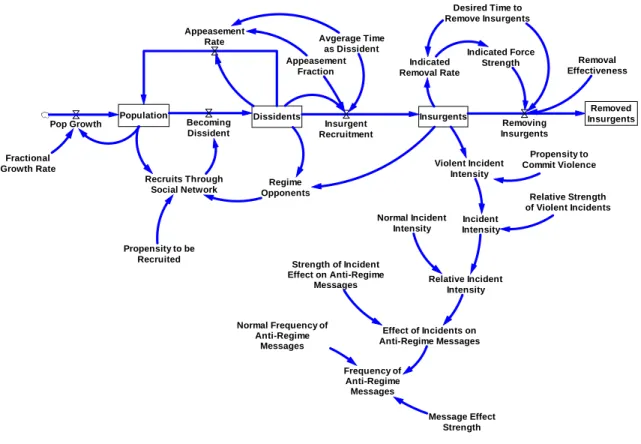
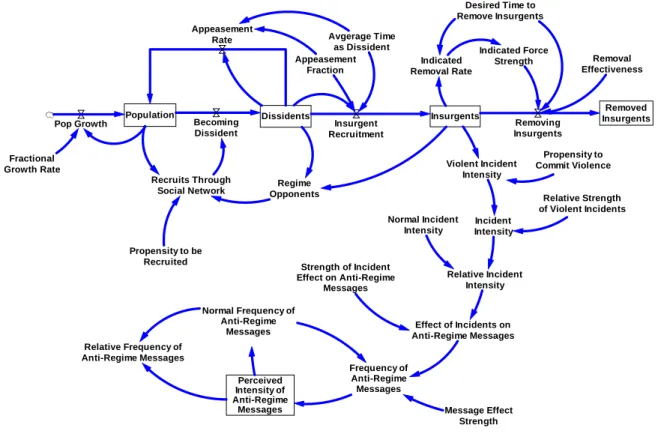
Based on all these considerations, we chose to 'drill down' into the dynamics of dissident and insurgent recruitment given the resilience of the state and its ability to manage anti-regime activities.4. Throughout the process, we considered how different policies would affect the dynamics of the model. The model shows the sources and consequences of insurgent recruitment, constrained and limited by the resilience of the regime and the extent to which the state can manage anti-regime activities.
The capabilities of the state and the resilience of the regime operate in such a way that recruitment by insurgents is counteracted. The rest of this section presents the main components of the model and articulates the basic logic in the course of "unfolding" the structure of the system's behavior. Appendix A lists some sources of information that support each link in the model.
The Role of Perceptions and Cognition
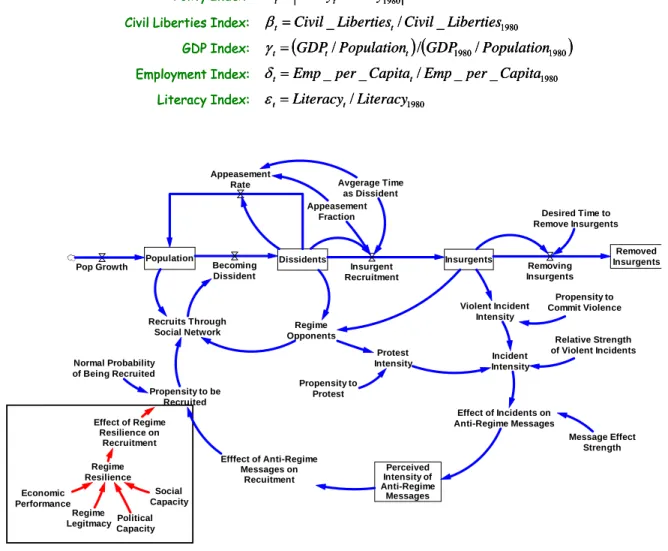
At the same time, we recognize that perceptions may differ from actual behavior and there may be differences in the effectiveness of such attempts to limit the flow of anti-regime messages. As anti-regime messages become more frequent than usual, the relative frequency of anti-regime messages increases, enhancing the recruitment of dissidents and rebels.
Regime Resilience
The effects of anti-regime messages on dissident recruitment are accounted for, as shown in Figure 7, where the “normal probability of being recruited” is changed (increased or decreased) as a result of the “effect of anti-regime messages on recruitment”. ” and “Effect of Regime Resistance on Employment” for the calculation. In light of our earlier discussion of capacity versus strain, regime resilience can be viewed as a measure of a country's long-term capacity. The literature finds that the resilience of a country is inversely related to the occurrence of civil war.
We find empirical support for this relationship when we compare the state resilience function with the determinants of civil war as determined by Hegre et al. They were able to produce a measure that determines the likelihood of a civil war breaking out. As we would expect, for country A, the relative risk of civil war decreases as the calculated resilience index increases, as shown in Figure 8.
A detailed discussion of the factors and calculation of the relative risk of civil war (RCW) used in Figure 8 can be found in Appendix B: "Hegre-Relative Risk of Civil War Memo.".
Review of Loads vs. Capabilities
If we re-examine the use of policies specifically designed to curb message flows by reducing civil liberties, we see that in the short term such policies can reduce communication capabilities, but in the long term such policies can undermine the social capacity of the state. and will therefore undermine the resilience of the regime. This is an example of the potentially counterintuitive "second-order" effects of some approaches to dealing with insurgents. As a result, there are fewer channels for messages to circulate, but these messages are more effective in turning individuals into dissidents and rebels because individuals are less satisfied with the regime.
Therefore, the state and regime should be wary of enforcing short-term controls with detrimental effects and should instead develop and promote policies aimed at improving the state's capabilities, which in turn balance the burden will bring.
Results of Proof of Concept Model
Decline in Regime Resilience
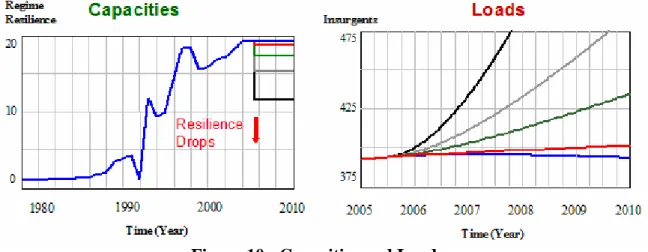
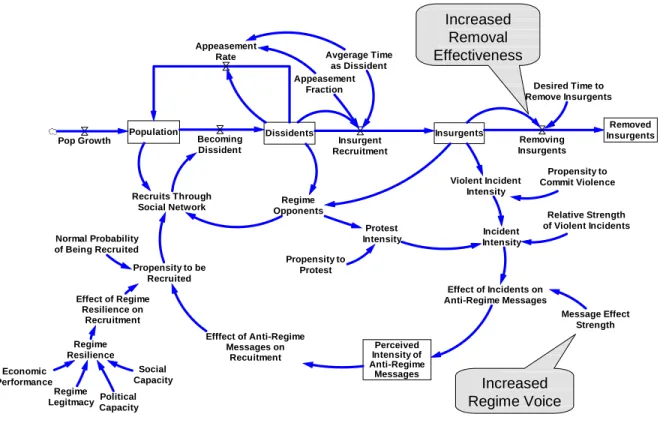
Recall our interest in identifying the conditions in which the loads on the system exceed the capacities to manage the loads. In Figure 10 we show several simulations, in the base case, depicted by the blue line, the number of insurgents is decreasing from 2006. The simulations introduce several possible sudden drops in regime resilience (left graph) and the corresponding response in the number. of insurgents generated by that reduction in state capacity (right graph).
Under the initial "base" case10 (shown as the blue lines in both the capacity and load graphs), we see a small reduction in upsets and loads on the system over time. But as the other scenarios show, even small decreases in state capacity change the direction of future insurgency growth and increase the burdens on the system – and thus a 'tipping point'. 11. If viewed in black and white, each of the four declines in resilience is matched with the four rising curves of Insurgent Loads.
The drop in resistance has caused the system to pass a critical threshold or tipping point, so that the reinforcing recruitment process now dominates the overall behavior of the system. This result shows the sensitivity of the system to the choice of policy regulations necessary for the stability of the country. Increased removal efficiency We previously found that controlling the circulation of anti-regime messages (through curfews and other restrictions on civil liberties) would reduce the number of anti-regime messages in the short term.
This means that the power of anti-regime messages can be diluted in an acceptable way. Although using better insurgent removal policies14 reduces the number of insurgents at any given time relative to the base case, the base path does not change, but the insurgents do. The political alternative of reducing the rhetoric results in a fundamental shift in the behavior of the system towards a long-term reduction in the number of insurgents.
The system has crossed the tipping point and is now on the way to long-term stability because the political intervention has significantly weakened the reinforcing recruitment processes. The recruitment processes are too weak to overcome the state capabilities, so the balancing loops that maintain stability dominate the behavior of the system.
Conclusion
System Dynamics and the Lessons of 35 Years," in The Systemic Basis of Policy Making in the 1990s, Kenyon B De Greene, ed. The slide titles and "yellow oval" on the following pages indicate which link is supported by the linked citations. Kowalchuk, "The Discourse of Demobilization: Shifts in Activist Priorities and Framing of Political Opportunities in a Peasant Land Struggle,” The Sociological Quarterly, Vol.
The longer Time to Remove Insurgents, the slower it is to remove insurgents, and the larger the stockpile of insurgents builds up downstream. Back As the incident intensity increases, the effect of incidents on anti-regime messages increases. Effect of incidents on anti-regime messages influences the perceived intensity of anti-regime messages.
Smith, “The Politics of Negotiating the Terrorist Problem in Indonesia,” Studies in Conflict & Terrorism, Vol. When the economy is worse, anti-regime messages are more likely to find a captive audience. Back The greater the effect of regime resilience on recruitment, the greater the tendency to be recruited.
APPENDIX B
Hegre-Relative Risk of Civil War Memo
- INTRODUCTION
- Hegre et al.’s Approach
- RRCW and Regime Resilience
- THE RRCW METHOD 1 Dependent Variable
- Independent Variables and Control Variables
- Operational Definitions 1 The Variables
- The Coefficients
- CALCULATING THE RRCW
- EVALUATION
This measure is constructed by examining 152 countries with a civil war, including any case where a country experiences a regime change.16 Formally defined, a civil war is "an internal war in which "(a) military action was involved, (b) the national government at the time was actively involved, (c) effective resistance (as measured by the ratio of deaths of the weaker to the stronger forces) occurred on both sides, and (d) at least 1,000 combat deaths resulted;'" (Hegre) , et al. with internal citation from Singer and Small, 1994: part 3).The reason for creating a newer model is because of the significant ways in which both war and politics have changed over this period.Regime change proximity: This is the time that has passed since the regime last changed.
It is located in the Polity IV dataset and is listed as "durable" or "expensive." It is listed in years, but should be multiplied by -1 (since a more recent regime change means greater likelihood of civil war), divided by days, and its exponent taken to be consistent with the strengths of the other measures and to eradicate the negative value. Level of democracy: This is a measure that represents the level of democracy in a country, from 10 which is a perfect democracy, to -10 which is an autocracy. Level of democracy squared: The logic for squaring the level of democracy is that much theory and research has suggested that strong autocracies are just as stable as strong democracies, and that states with weak regimes are the most vulnerable to conflict and civil war.
Proximity to Civil War: This is a measure of the number of days since the last civil war ended. Proximity to Independence: This is a measure of the time since a country was founded or involved in a regime change. This value must be multiplied by -1, divided by days, and its exponent taken to make it again consistent with the powers of the other measures.
Neighboring civil war: This is a dummy variable for whether a neighboring country is in civil war. It is constructed by examining the Correlates of War database to see if a civil war is occurring in a neighboring country. Development Level: This is a measure of development level and is provided by the Correlates of War database.
This measure can be found in Appendix B of Hegre, et al.'s paper, along with a list of the civil wars that were included in the analysis. Each of the above values is multiplied by a specific coefficient (x1 to x10), as determined by regression analysis.