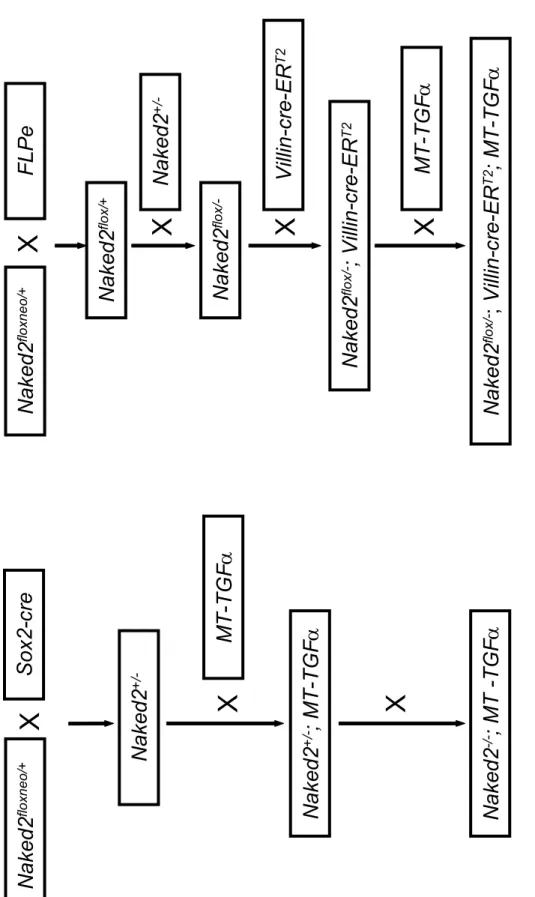
Enhanced green fluorescent protein EGFP EGFR Epidermal growth factor receptor eIF-4E Eukaryotic translation initiation factor 4E Tyrosine kinase inhibitor EKI EGFR. To address these shortcomings, I have examined the regulation of Naked2 expression in the context of canonical Wnt signaling and epidermal growth factor receptor (EGFR) signaling, and generated a targeted conditional knockout of Naked2 in mice.
Human colorectal cancer
In late-onset adenomas, mutations in the TGF-β receptor type 2 are detected (Grady, Rajput et al. 1998). In Drosophila development, EGFR signaling antagonizes Wg signaling, both in segmental patterning of the larval epidermis (Szuts, Freeman et al. 1997; Sanson 2001) and eye development (Freeman and Bienz 2001).

EGFR signaling and EGFR ligands EGFR and EGFR signaling
However, aberrant overexpression of TGFα is frequently observed in most solid tumors compared with their normal counterparts (Salomon, Brandt et al. 1995). EGF is equally transported to the apical and basolateral plasma membranes (Dempsey, Meise et al. 1997).
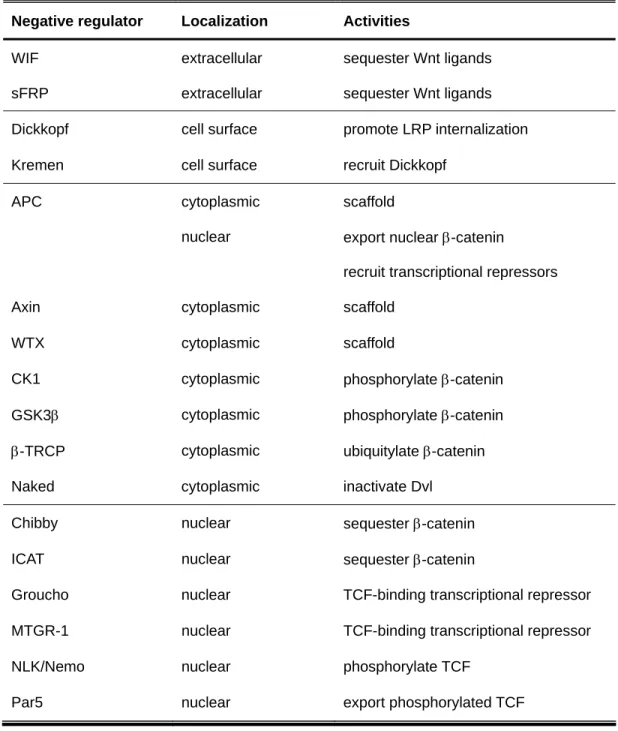
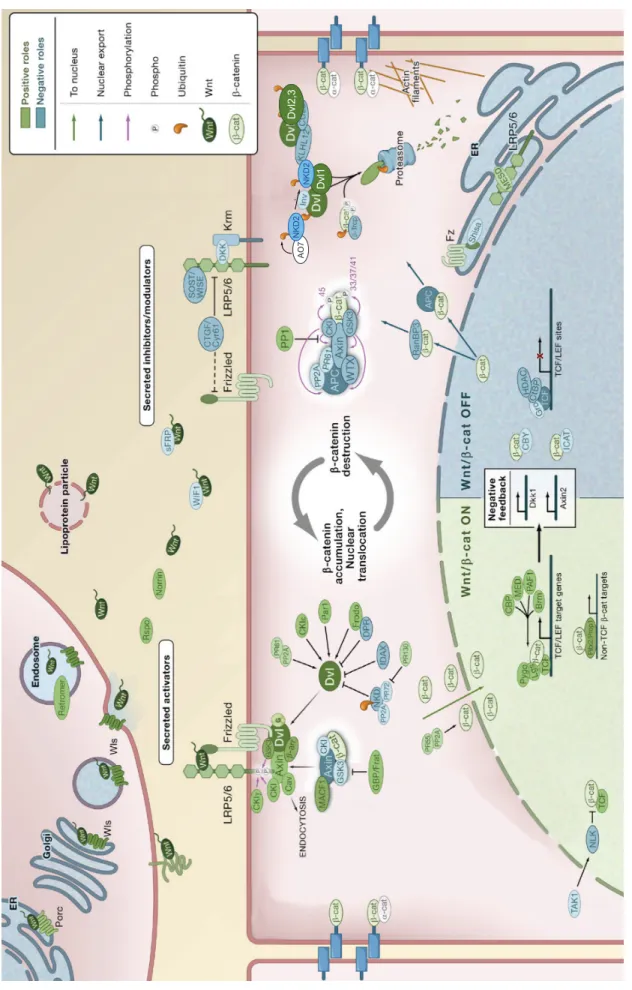
Wnt signaling and its negative regulators Current model of canonical Wnt signaling Current model of canonical Wnt signaling
Takemaru and Moon 2000) and SWI/SNF (switching-defective and sucrose non-fermenting) component BRG1 (Barker, Hurlstone et al. 2001). In addition, activation of target genes also depends on Legless (BCL9) and Pygopus (Kramps, Peter et al. 2002;.
Naked2 in TGFα trafficking and Wnt signaling Naked protein family Naked protein family
A ladder of ubiquitinated Naked2 was detected, and the ladder's composition shifted toward higher molecular weight species in the presence of MG132. In the lower panel, the blot was stripped and reprobed with VU308 to demonstrate that comparable amounts of Naked2 were immunoprecipitated. The presence of immunoreactive forms migrating at higher molecular weights is consistent with polyubiquitylated Naked2, which was confirmed by reprobing with Naked2 antibody (data not shown).
The identification of polyubiquitylated Naked2 is consistent with it being a short-lived protein, as shown in the previous degradation assays (Fig. 2.1). Consistent with proteasomal degradation, in the presence of MG132, not only was overall Naked2 ubiquitylation enhanced, but there was also a compositional shift toward higher molecular weight forms of ubiquitylated Naked2 (Fig. 2.2A, lane 8). We also observed polyubiquitylation of endogenous Naked2 in parental MDCK cells (data not shown).
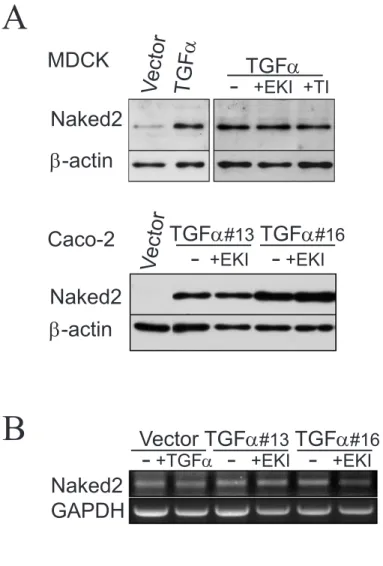
We found a marked increase in endogenous Naked2 protein levels in MDCK cells stably overexpressing TGFα (Fig. 2.3A, MDCK lanes 1 and 2). An even more dramatic upregulation of Naked2 protein was observed when TGFα was stably overexpressed in Caco-2 cells, a human colorectal cancer cell line (Fig. 2.3A, Caco-2 lanes 1, 2 and 4).

MDCK
This effect was also observed in Caco-2 cells, the rapid degradation of endogenous Naked2 was dramatically attenuated when TGFα was stably overexpressed (Fig. 2.4A, Caco-2). Consistent with the stabilization of Naked2 by TGFα overexpression, the intensity of total ubiquitylated Naked2 was significantly reduced by TGFα in an in vivo ubiquitylation assay in transiently co-transfected HEK293 cells (Fig. 2.4B, left panel—lanes 4 and 5 ). As a control, western blotting of whole cell lysates showed comparable expression of transfected Naked2 and ubiquitin with or without co-expression of TGFα (Fig. 2.4B, right panel).
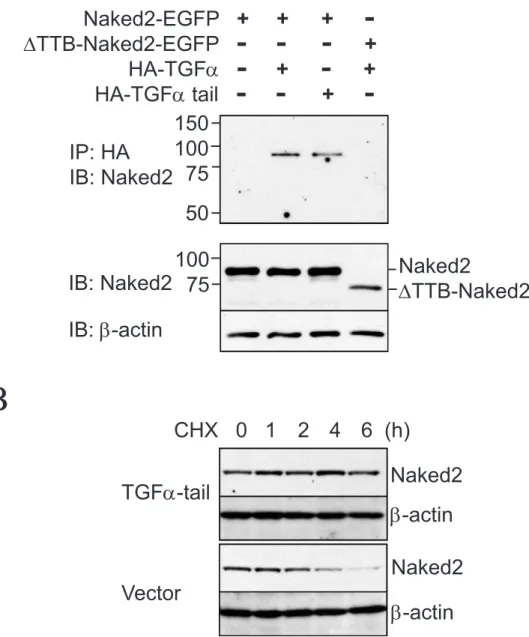
Based on our findings that the TTB domain of Naked2 directly interacts with the cytoplasmic tail of Golgi-processed TGFα (Li, Franklin et al. 2004) and that TGFα upregulation of Naked2 persists despite pharmacological blockade of TGFα cell surface cleavage and EGFR activity tyrosine (Fig. 2.3), we predicted that 1) the TGFα tail alone would be sufficient to stabilize Naked2 and 2) internal deletion of Naked2's TTB domain would abolish this effect (Fig. 2.10C, D ). To test the first prediction (Fig. 2.10C), we constructed a TGFα tail expression plasmid containing the TGFα cytoplasmic tail (39 residues) preceded by its N-terminus. As we predicted, the TGFα tail alone delayed the degradation of Naked2 when stably co-expressed in MDCK cells (Fig. 2.5B).
To investigate the second prediction (Fig. 2.10D), an internal deletion of the TTB motif (ΔTTB-Naked2-EGFP) was generated (see Materials and Methods). As expected, co-immunoprecipitation experiments in transiently transfected HEK293 cells showed that the ΔTTB-Naked2-EGFP mutant no longer interacts with HA-tagged TGFα (Fig. 2.5A, upper panel lane 4). Stably overexpressing full-length TGFα did not protect the ΔTTB-Naked2-EGFP mutant from rapid degradation in MDCK cells (Fig. 2.6A).
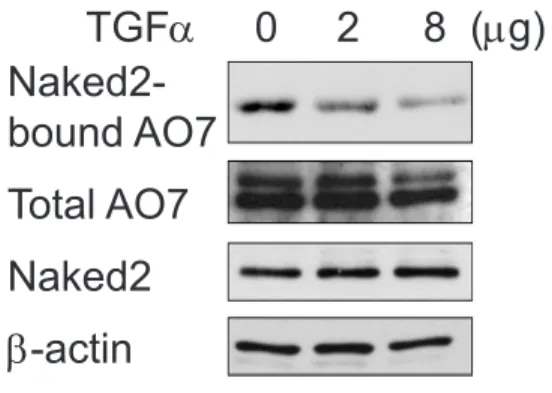
HEK293 cells were transiently transfected with DTTB-Naked2-EGFP and HA-ubiquitin with or without TGFα. In contrast to wild-type Naked2, ubiquitylation of the DTTB-Naked2 mutant was not inhibited by TGFα expression. Because of the direct interaction between TGFα and Naked2, we considered that reduced Naked2 ubiquitylation could be due to hindered access of a ubiquitin ligase to Naked2 when TGFα binds.
HA-tagged AO7 was pulled down by the GFP antibody when EGFP-tagged Naked2 was co-expressed, but not EGFP alone (Figure 2.7B, lanes 1 and 2). Therefore, we used FLAG-tagged AO7-RM as a dominant negative to test whether AO7 is involved in Naked2 ubiquitination. Overexpression of AO7-RM dramatically reduced the level of Naked2 ubiquitination in an in vivo ubiquitylation assay in HEK293 cells (Figure 2.8A, lane 3).
In addition, we also performed an in vitro ubiquitylation assay that used recombinant human E1, UbcH5B (E2), HA-tagged ubiquitin, and a bacterially expressed C-terminal truncation of AO7,GST-AO7T, which is constitutively expressed better than the full length protein (Lorick, Jensen et al. 1999).

IP: GFP IB: GFP
EGFP
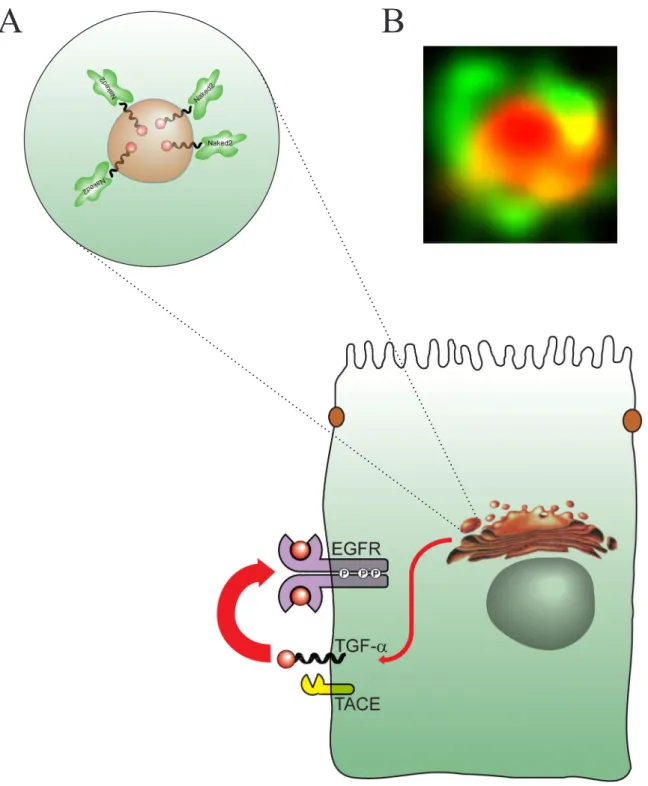
It recognizes basolateral sorting determinants in the cytoplasmic tail of Golgi-processed TGFα, coating TGFα-loaded exocytic vesicles (Li, Franklin et al. 2004). AO7 has previously been shown to mediate RING finger-dependent autoubiquitylation in vitro (Lorick, Jensen et al. 1999). The first EGFR-independent action of TGFα was described by Derynck and colleagues (Shum, Reeves et al. 1994).
Interestingly, the target of this effect, Naked2, plays a critical role in the exocytic delivery of TGFα (Li, Franklin et al. In addition, 5 perfectly matched TCF binding sites have been identified in the putative promoter of human Naked1 gene (Yan, Wiesmann ) et al. 2001). Given the additional roles of Naked2 in maintaining normal basolateral TGFα trafficking (a proximal event of EGFR axis) (Li, Franklin et al.
TOPflash (containing the binding site for the Tcf/LEF family of transcription factors fused to a luciferase reporter gene) or FOPflash (negative control) reporter plasmids (van de Wetering et al., 1997) were used to monitor the activation of canonical Wnt - signal to indicate. by ΔN89 β-catenin. A direct correlation has been established between canonical Wnt signaling and expression of Drosophila Naked Cuticle and vertebrate Naked1 (Wharton, Zimmermann et al. More directly, several putative TCF binding sites have been identified in the human Naked1 promoter region (Yan, Wiesmann et al. (2001).
Naked2
LiCl
24 hrs
Compared to the mouse Naked1 promoter, the Naked2 promoter contains a similar number of putative TCF binding sites; however, the orientation of these TCF-binding elements (TBE) differs (Fig. 3.4A). When we subcloned the most proximal 1.5 kb sequence (pro1.5) from the putative promoter into the pGL3-Basic (promoterless) vector, it showed strong promoter activity (Fig. 3.4B). In contrast, when we extended the sequence to 2.1 kb (pro2.1 in Fig. 3.4A), promoter activity was significantly reduced.
Different fragments of the Naked2 promoter (shown as gray bars) were subcloned from the mouse genome. Luciferase reporter (pGL3) driven by various Naked2 promoter fragments or the control SV40 promoter was transiently expressed in HEK293 cells. Strong induction of TOPflash reporter activity showed a significant activation of β-catenin/TCF transcription factors by ΔN89 β-catenin (Fig. 3.4C).
Subsequent luciferase assays demonstrated a reduction in promoter activity in all three Naked2 promoter fragments (Fig. 3.4C), suggesting that the Naked2 promoter is repressed by canonical Wnt signaling. These results may provide a molecular basis for the differential regulation of Naked2 expression by canonical Wnt signaling compared to Naked Cuticle and Naked1. We observed reduced Naked2 protein levels in colorectal cancer samples compared to their adjacent normal colonic mucosa (Fig. 3.5A).

Naked2 a-tubulin
A recent study reported that the mouse Naked2 gene is a direct transcriptional target of Hoxc8, a member of the homeobox gene family, through a long-range enhancer region (Lei, Juan et al. 2007). However, a Wnt-binding protein SFRP has been shown to attenuate canonical Wnt signaling in colorectal cancer cells with loss of functional APC (Suzuki, Watkins et al. 2004). Another EGFR ligand, AR, is also preferentially delivered to the basolateral membrane and cleaved by the same enzyme (Sunnarborg, Hinkle et al. 2002; Gschwind, Hart et al. 2003).
However, soluble AR binds more efficiently to HSPGs than to EGFR and thus may exist in a depot form (Schuger, Johnson et al. 1996). In addition, our recent cell culture-based studies have demonstrated unique functions of Naked2 in basolateral cell surface distribution of TGFα (Li, Franklin et al. 2004;. In polarized epithelial cells, EGF is evenly distributed in the plasma apical and basolateral membrane (Dempsey, Meise et al. 1997).
In contrast, TGFα and AR are preferentially sorted to the basolateral membrane where they are cleaved by TACE/ADAM17 (Brown, Meise et al. 1998; Two basolateral sorting determinants have been found in the cytoplasmic tail of TGFα (Dempsey, Meise et al. 2003).Given the early expression of Naked2 in various tissues of the mouse embryo (Wharton, Zimmermann et al. 2001), we used a conditional strategy to avoid possible embryonic lethality.

GAPDH
34;Tumor suppressor CYLD: negative regulation of NF-kappaB signaling and beyond." Cell Mol Life Sci. 34;Autocrine interaction between TGF-alpha and the EGF receptor: quantitative requirements for induction of the malignant phenotype." Oncogene. 34; Phosphatidylinositol 3-kinase activity in epidermal growth factor-stimulated matrix metalloproteinase-9 production and cell surface association." Cancer Res.
34;Tumorigenesis in the multiple intestinal neoplasia mouse: redundancy of negative regulators and specificity of modifiers.". 34;Mouse Nkd1, a Wnt antagonist, exhibits oscillating gene expression in the PSM under the control of Notch signaling.". 34;APC and oncogenic KRAS are synergistic in enhancing Wnt signaling in intestinal tumorigenesis and progression.
34;Myristoylated Naked2 accompanies transforming growth factor alpha at the basolateral plasma membrane of polarized epithelial cells." Endocr Relat Cancer. 34;Epidermal growth factor receptor level and function predict metastatic potential of colon cancer cells thick of man." Clin Cancer Res.
34;Overexpression of TGF-alpha in transgenic mice: induction of epithelial hyperplasia, pancreatic metaplasia, and mammary carcinoma." Cell. 34;Stoichiometric interaction of the epidermal growth factor receptor with the clathrin-associated protein complex AP-2." J Biol Chem.