1
The Response of Islamic Study Groups (Majelis Ta’lim) on Islamic Banking and Their Preferences on Sharia Products Study Case In Bandung
(Indonesia)
Sri Fadilah1, Dikdik Tandika1, Sri Suwarsi1, Turnad Lenggo Ginta*2
1Univeritas Islam Bandung (Unisba), Bandung, Indonesia
2SEGi University College, Kota Damansara, Malaysia
______________________________________________________________________________________
Abstract
This research is concerned with the response of islamic study groups (majelis ta’lim in Indonesia) to islamic banking and syari’a products. It is well known that syari’a banking applies non-interest system. By applying this system, it is expected that syari’a banking will be the best choice for those societies. Survey method was used in this research. It was conducted in Bandung (Indonesia), including both mosque-based and non-mosque based islamic study groups in 2006. Ten majelis ta’lim were chosen as the samples. The result shows that 77.9% out of the samples give positive responses to the islamic banking, showing that 49.3% out of 77.9% samples even have already been the customers of islamic banking. The preferences of those groups to the islamic banking products are also indicated by the recognized, the present chosen, and the future chosen products. The highest preference the products of fund collection is mudharabah (72.25%). The products of fund distributions vary from mudarabah (38.94%), musyarakah (26.4%) and murabahah (18.48%).
Keyword: Majlis ta’lim, Response, Preference, Sharia bank product
_______________________________________________________________________
* Corresponding author
2
The Response of Islamic Study Groups (Majelis Ta’lim) on Islamic Banking and Their Preferences on Sharia Products : Study Case In Bandung (West Java, Indonesia)
1. Introduction
New paradigm in an economic system lately among economists is often discussed by both academicians and practitioners. The emergence of a new concept which has not been accepted by society, because there is no understanding of these concepts. One concept that is often discussed today, is the concept of Islamic banking. This concept of applying the principles of Islamic Shari'a in banking transactions. Khoirunissa (2002) explains the main principle applied is the financial transaction, a form of storage and distribution of funds that do not bear interest (interest free banking).
The evaluation of bank performance is a must (Frida et al, 2005). To conduct the evaluation, it is not enough to evaluate the achievement of the financial aspects of banking only. There were other variables that allegedly deeply affected, among others, such as public confidence in the use of banking services. It can be seen from how the community responses to the performance which are achieved so far.
So, it is very important to evaluate the society responses as a banking performance appraisal. Those informations are required as efforts to strategically develop the sharia banks. The response of society is meant by how public responses to the role of islamic banking, both the role of collection and disbursement of funds and the role of expectations that arise in the community associated with that role.
Several studies related to community responses (Khoirunnisa, 2002) have been done in analyzing the factors driving customers to save on sharia banks using economic and religious preferences. The studies show the relationship between both economic and religious preferences when customers decided to save the Islamic bank, which is driven by the desire for worldly satisfaction and ukhorowi.
Another study conducted by Nasser, Jamal, and Al-Khatib (1999) showed that the factors that encourage people to save in the islamic banks because of the bank's reputation, of religious reasons and of benefits. From these studies, there are two factors that encourage customers to choose the Islamic bank, i.e. both religious and economic factors.
On the other side, those two factors remain conflicting. Religious factors give more emphasis on how the islamic banks apply the principles of Islam, while the economic factors emphasize more on how the benefits received and how the costs borne by the customers. Therefore, religious factor is not enough to encourage people to choose islamic banks. It is due to the dominations of economic factors in choosing a sharia bank.
3
The above study was also supported by Naser (1999) indicating that a public disappointment to the service of islamic banks, so they don’t choose an islamic bank’s product. From the point of sharia banks, this condition can be ignored, but it must be tried to give efforts to convince the public in supporting the growth and development of islamic banking, especially in the Indonesian muslim community.
Islamic societies can be seen from religious activities such as teaching activities in the majlis informal gatherings. Teaching activities in the majlis study groups can be divided into two types, mosque based study groups, where the teaching activities are conducted in the mosque, and non-mosque based study groups, where the activities are not conducted in the mosque. Based on the description above, this study investigates the response of the majelis ta’lim to sharia banking and their preferences to islamic bank products. The study was done in the city of Bandung, west java, Indonesia.
2. Data
2.1 Research Scope
This research was conducted with the respondent of members of both mosque- based and non-mosque based study groups. Bandung was selected as the research area because of some reasons:
(1) There are many good mosque-based and non-mosque study groups and non mosque mosque than other cities.
(2) The emergence of islamic banks in the city of Bandung are more compared to other cities.
The majlis study groups are as follows:
1. Salman ITB Bandung
2. Masjid Istiqomah Bandung
3. Masjid PUSDAI Bandung
4. Masjid Persis Bandung
5. Majlis Ta’lim Hizbut Tahrir Bandung 6. Masjid Daarut Tauhid Bandung 7. Majlis Ta’lim Percikan Iman 8. Masjid Mujahidin Bandung 9. Masjid Agung Bandung
10. Masjid Al Huda Cipadung Bandung
2.2 Sampling Technique Population and Sample
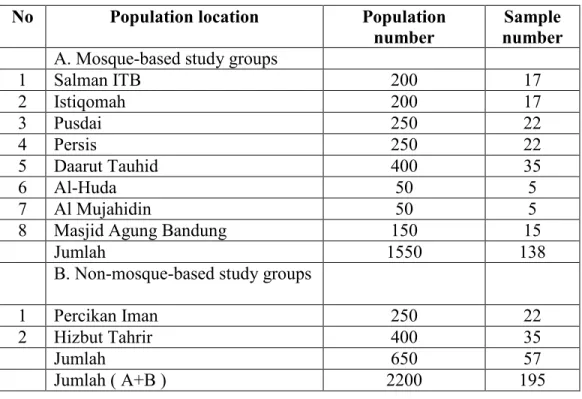
The population in this study is mosque and non-mosque based islamic study groups in Bandung. It is about 1550 and 650 populations of mosque and non- mosque based study groups, respectively. So the total of the population are more than 2200 members of the majlis ta’lim (study groups) as shown in Table 1.
4
Because the population was divided into several locations, sampling method used was stratified random sampling method. Further sampling is simple random from each stratum in accordance with a predetermined number of samples.
It is determined that N = 2200, and primary sampe, n = 195.
Table 1: Sample and population
No Population location Population number
Sample number A. Mosque-based study groups
1 Salman ITB 200 17
2 Istiqomah 200 17
3 Pusdai 250 22
4 Persis 250 22
5 Daarut Tauhid 400 35
6 Al-Huda 50 5
7 Al Mujahidin 50 5
8 Masjid Agung Bandung 150 15
Jumlah 1550 138
B. Non-mosque-based study groups
1 Percikan Iman 250 22
2 Hizbut Tahrir 400 35
Jumlah 650 57
Jumlah ( A+B ) 2200 195
In accordance with the above title, the objective of this research are as follows:
1. Majlis ta'lim community response towards islamic banking in Bandung.
2. Majlis ta'lim preferences towards islamic bank product in Bandung.
3. Islamic bank products (fund raising and distribution of funds products).
5
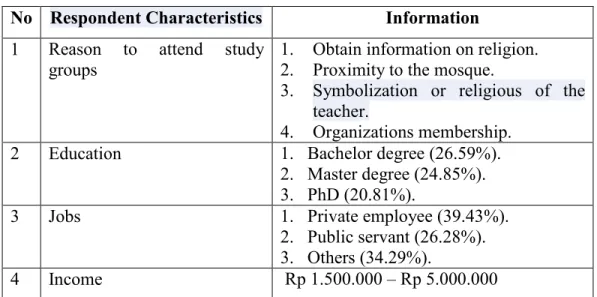
2.3 Respondent Characteristics
Table 2: Respondent characteristic
No Respondent Characteristics Information 1 Reason to attend study
groups
1. Obtain information on religion.
2. Proximity to the mosque.
3. Symbolization or religious of the teacher.
4. Organizations membership.
2 Education 1. Bachelor degree (26.59%).
2. Master degree (24.85%).
3. PhD (20.81%).
3 Jobs 1. Private employee (39.43%).
2. Public servant (26.28%).
3. Others (34.29%).
4 Income Rp 1.500.000 – Rp 5.000.000
3. Methodology and Results
The method used in this study was the survey of islamic study groups in the city of Bandung, both mosque-based and non-mosque based study groups. The data was analyzed with descriptive analysis techniques.
3.1 The response of study groups to islamic banks
Based on survey results, it is revealed that the response from the study groups to Islamic banks due to stimulation from outside of the respondent. Many stimuli that cause the response such as from where the source of the information are obtained, heard and seen, resulting in a response or attitude to the existence of islamic banks, as shown in Table 3.
6
Table 3: Response towards Islamic banking
No Response towards islamic banking
Information 1 Medium of transfer 1. Newpapers (16.8%),
2. Television(15.1%), 3. Brochure (11.5%), 4. Magazine (10%), 5. Radio (9.4%).
6. Friends (13.8%)
7. Majlis ta’lim (study groups) (6.2%) 2 Understanding and knowledge
of Islamic banking
- Ever heard about islamic banks (77.9%)
- Never heard about islamic banks (22.1%)
3 Frequency heard about islamic banking
10 time – 25 time each respondent 4 Factors are considered to be
the islamic bank customers
1. Themselves (45.8 %).
2. Knowledge of the respondent (30%).
3. Friend’s factor (33.3 %) 4. Advertisement (16.7%) 5. Teachers’ factor (31.4 %)
5 Factors to consider to save
money in the islamic banks
1. Implementation of sharia (33.5%).
2. Religion environment (24%).
3. Religion (31%).
4. Other condition, such as psychology (2,5%).
5. The concept of revenue sharing (24%).
6 Factors considered in selecting the Islamic bank.
1. Credibility/trust/security (24.7%).
2. Status of the bank (19.4%) 3. Location (17.7%)
4. Friendly and professional services 5.9%
5. Favorable profit sharing (17.2%) 6. ATM Facilities (2.2%).
7. Others (12.9%)
3.2 Study Groups Preferences Against Islamic Banking Products
Based on information provided by members, there is only 49.70% of the members has become a sharia bank customers, and 50.30% yet to become a customer.
Reasons respondents of the response is reflected in the Table 4.
7
Table 4: Preferences Against Islamic Banking Products No Preferences Against
Islamic Banking Products
Information 1 The reasons have not
become Islamic bank customers
1. Respondents did not have knowledge of islamic banks (29.06%).
2. Islamic bank locations difficult to reach (22.63%).
3. Conventional banks have more products (11.96%).
4. Islamic bank is not operating in their area
(11.11%).
5. Islamic bank facilities inadequate compared to conventional banks (8.23%.
6. Islamic banks have not proved its superiority (6.58%).
2 The reasons have become islamic bank customers
1. Respondents noted that the islamic bank system operates with no interest (32.99%).
2. Islamic sharia-based banks (31.47%).
3. More profitable because it adopted sharing system (21.69%).
4. Islamic banks have implemented systems
partnership (10.66%).
5. Because of Fatwa of Ulama (6.60%).
3.2.1. Study Groups Preferences Against Fund Raising Product
The fund raising products offered by islamic banks are classified in 8 (eight) types of products which are selected by the respondent, as follows:
1. Mudharabah (72.59%)
2. Deposits (savings) pilgrimage (7.25%) 3. Zakat/infaq/shadaqah (5.23%).
4. Educational funds (4.85%).
5. Islamic finance institution pension funds (3.09%).
6. Al wadiah (2.93%).
7. Mutlaqoh mudharabah (2.13%).
8. Muqqayah (1.92%).
8
From that information, it seems that the mudaraba saving is best options as fund raising product of islamic bank products, followed by hajj and zakat collection/infaq/shadaqah.
Other considerations are the determining factors in product selection of fund raising products, such as:
1. Respondents see the time needed to open a new account is relatively fast (48.50%).
2. time needed is moderate (36.10%).
3. Low cost (36.78%).
3.2.2 Study Groups Preferences Against Disbursement Products
The respondents (study groups) who have been in the islamic bank customers are categorized in 4 (four) status, namely:
1. Depositor funds (64.76%).
2. Users of funds (6.67%).
3. Depositary and users of funds (27.62%).
4. Users of other banking services (0.95%).
Furthermore, the products distribution of funds selected by the respondents are as follows:
1. Mudharabah (profit sharing) 38.94%.
2. Musyarakah (in collaboration) 26.40%.
3. Murabaha (sale and purchase) 18.48%.
4. Bai Bithaman Ajil (installment sales) 9.24%.
5. Al-Ijarah (lease) 6.43%.
In general, products of mudharabah financing was indicated as the most favorite product. It simply suggests that the principle of "profit sharing" in an islamic bank is most well known. Moreover, the other products need to be disseminated intensively to the public, especially people (Muslims) who are in various majlis ta’lim (study groups) in the city of Bandung. In addition to more intensive socialization efforts, other can be done, such as:
1. Intensifying branch offices.
2. Increasing variety of physical service facilities.
3. Reproduce a variety of other services.
4. Concluding Remarks
Based on the discussion in the previous section, it can be obtained several conclusions, as follows:
1. Majlis ta'lim (study groups) responses positively to islamic bank products.
This is supported by the self-encouragement and of knowledge and understanding of the principles of religious (Islamic) to push himself willing to become an Islamic bank customers.
9
2. From a number of the groups show a preference to choose "Savings Mudharabah". Furthermore, for the product distribution of funds, as follows : (1) Financing mudharabah ( 2) Financing musyarkah and (3) Financing murabaha.
Based on the discussion in, it can be submitted suggestions, as follows:
1. In order for the positive response shown by the community council study groups can be realized by increasing the number of Islamic bank customers, so socialization to introduce islamic banking should be increased (particularly to the community council study groups).
2. To improve product preferences provided by the islamic bank, improving services, the system on line, opening a branch office / cash, especially around the large mosque is something that is needed.
References
Al Qur’anul Karim dan Terjemahan, Departemen Agama Republik Indonesia. (Surah 2:
Ayat: .278-279)
Adiwarman, Karim (2003), “Islamic Bank: Analysis of Fiqh and Financial”, III T Indonesia, Jakarta. P.27
Asnita Frida Sebayang, Dudung Abdurrahman, Ima Amaliah dan Nunung Nurhayati.
2005,” Shariah Bank Performance in West Java: Stressing of Implication Intermediation Shariah Bank in West Java”. Research result of Economic Faculty of Unisba Cooperation with Central of Indonesian Bank at 2005, Bandung.P. 15
Delta Khoirunissa, 2002, ”People Preferences to Shariah Bank: Case Study of Bank Muamalat Indonesia dan Bank BNI Syariah”, Paper in National of Simposium I Sistem Ekonomi Islam. Yogyakarta.P. 17
Heri Sudarsono, 2003 ,”Shariah of Bank and Financial Institution: Description and Ilustration”, Ekonosia, FE UII, Yogyakarta. P.23
Muhammad, 2005, “ Shariah Bank: Problem and Prospect of Economical in Indonesia”, First Edition, Graha Ilmu, Yogyakarta.P.41
Nasser, Kamal, Jamal, Ahmad dan Khalid Al Khatib, 1999, “Islamic Banking: A Study of Customer Satisfaction and Preferences in Jordan”, The International
Journal of Banking Marketing for The Financial Services Sector, Vol 17 No 13:
135-150.
Philip Kotler . 1989. “Marketing Management: Analysis, Planning, Implementation
& Control”, 12th edition, New York: Prentice Hall.P. 150
10
Stephen Robbin, 2003. “Organizational Behaviour”, Indonesian Edition, Part I dan II, PT Indeks Gramedia, Jakarta.P.112
Undang-Undang Perbankan No. 10 Tahun 1998, Bank Indonesia.
Kamus Besar Bahasa Indonesia”, Edisi ke 3 (1990), Departemen Pendidikan dan Kebudayaan Republik Indonesia, Penerbit Balai Pustaka, Jakarta.
1
Parallel Session 1
Day 1 (Thursday) Date: 5 August 2010 Time: 10.30 am‐12.30 pm
Chairperson: Siti Haryati Shaikh Ali Theme: Economics/ Islamic Banking
Venue: Gamelan 1
No. Paper‐ID Title Authors Time
1. 062 Employers’ Expectations And Observations On Accounting Interns’ Skills
Inayah Abdul Aziz, Yunita Awang, Rohana Yusoff, Yusliena Yusoff
10.30 ‐ 10.45
2. 110 The Influence Of Usability And Enjoyment On Electronic Customer Relationship
Management Performance In Jordan Mobile Communication Services
Samsudin Wahab,
Khaled Abed Mufleh Al Momani, Nor Azila Mohd Noor
10.45 ‐ 11.00
3. 111 Service Provider‐Customer Relationship: To What Extent Are Customers In
Terengganu Being Respected?
Siti Haryati Shaikh Ali, Nelson Oly Ndubisi
11.00 ‐ 11.15
4. 071 Environmental Perception From Students' View: Cerbis For Higher Education Management
Yunita Awang, Khalipah Ibrahim, Goh Ying Soon
11.15 ‐ 11.30
5. 069 Proposed Two‐Phase Research Methodology For Forecasting Future Competencies Of
Managers An Exploratory And Cross Comparative Study In Multinationals And Mutlicultural Business
Environment
Saquib Yusaf Janjua, Sobia Javaid
11.30 ‐ 11.45
2
Chairperson: Najah Lukman
Theme: Economics/ Islamic Banking
Venue: Gamelan 2
No. Paper‐ID Title Authors Time
1. 084 Islamic Microfinance: Viable Approaches for Islamic Banking Application
Wan Noor Hazlina Wan Jusoh 10.30 ‐ 10.45
2. 032 World Population Growth Rate Zetie Natasya Binti Mohd Shah, Fadli Fizari Bin Abu Hassan Asari, Ungku Nur Hasyirah Binti Ungku Iskandar,
Syairah Aimi Binti Zulkifli
10.45 ‐ 11.00
3. 031 The Day of the Week Effect in the Saudi Stock Exchange: A Non‐linear Garch Analysis
Talat Ulussever, Ibrahim Guran Yumusak,
Muhsin Kar
11.00 ‐ 11.15
4. 024 Agriculture: A Study On Factors For Sustainable Production
Norsuziana Binti Ahmad Khairuddin,
Fadli Fizari Bin Abu Hassan Asari, Zalipah Binti Zakaria,
Nur Hidayatul Asyikin Binti Ramlan,
Siti Nabila Bin Shapruddin
11.15 ‐ 11.30
5. 029 Co‐Movement Of Output And Price In Malaysia: Empirical Evidence
And Macroeconomic Policy Implications
Salina kassim,
Turkhan Ali Abdul Manap
11.30 ‐ 11.45
6. 028 The Modeling Of Malaysia Crude Oil Production Using Autoregressive Integrated Moving Average (Arima) Model
Ruzaidah Sulong @ A. Rashid, Nazuha bt. Muda@Yusoff, Zamzulani bt Mohamed
11.45 – 12.00
3
Chairperson: Dr. Samsudin Wahab
Theme: Human Resource/ Management
Venue: Gamelan 3
No. Paper‐ID Title Authors Time
1. 099 Relationship between Age and Size of Firm on Corporate Entrepreneurial Behavior among Employees
Zarinah Abu Yazid, Al‐Mansor b. Abu Said
10.30 ‐ 10.45
2. 067 Verbal Aggression Encounters And Workplace Bullying Experiences:
Consequences On Hotel Trainees' Emotional Dissonance
Mohd Onn Rashdi B. Abd Patah, Wan Nazriah bt. Wan Nawawi, Salleh b. Mohd Radzi
10.45 ‐ 11.00
3. 066 A Study On The Factors Contributing To The Work
Environment Improvement: A Case Study Of Teachers Perception At Sek Men Keb Ahmad Boestaman, Sitiawan, Perak
Mazlan Bin Che Soh, Mohd Fadzli Bin Abdul Latif, Nazatullaini Bt Mohd Sharif
11.00 ‐ 11.15
4. 073 Perception Of Using Technology And The Level Of Technostress Experienced By Commercial Bank Employees
Maimunah Mohd Shah, Roshidi Hassan, Roslani Embi
11.15 ‐ 11.30
5. 074 The Effect of Personality on the External Auditors’ Ability to Detect the Likelihood of Fraud
Nahariah Jaffar, Hasnah Haron,
Takiah Mohd Iskandar, Arfah Salleh
11.30 ‐ 11.45
4
Chairperson: Dr. Sunil Gupta
Theme: SME/ Marketing
Venue: Gamelan 4
No. Paper‐ID Title Authors Time
1. 112 An Exploratory Study Of Understanding
“Impact Of Sales Quota On Salesperson’s Job Satisfaction &
Performance
Sunil Gupta, Shabnam Mehta
10.30 ‐ 10.45
2. 121 The Development of Internal Control for SME
Shazalina Mohamed Shuhidan, Nur Nariza Mod Arifin,
Anita Che Hassan, Siti Rokyah Md Zain
10.45 ‐ 11.00
3. 120 Developing A Comprehensive Model Of Organizational Learning Practices Towards Sustaining Competitive Advantage Among Malaysian SMEs
Norudin Mansor, Mohd Rafi Yaacob
11.00 ‐ 11.15
4. 117 Examining The Effect Of Company's Size And Resources On The Relationship Between Stakeholders' Pressure And Environmental Strategies In The Malaysian Palm Oil Industry
Mohd Rafi Yaacob, Mohd Nor Hakimin Yusoff
11.15 ‐ 11.30
5. 119 The Exercise Of Succession Planning: The Case Study Of Five Small Medium Enterprises (Smes) Companies In Klang Valley, Malaysia
Norzanah Mat Nor, Norlela Jamaluddin, Norikhti Faqriah Azimie, Nurjihan Fadzil
11.30 ‐ 11.45
6. 114 Entrepreneurial Strategic Alliances and Partnership of Marketing and Retailing in Small and Medium Enterprises in Agro Sapling Supply Chain
Wan Haslin Aziah Wan Hassan, Lee Tan Luck,
Mahani Mohamed Anuar, Syaidatul Zarina Mat Din, Syaherah Abd. Malik
11.45 ‐ 12.00
5
Parallel Session 2
Day 1 (Thursday) Date: 5 August 2010 Time: 3.45 pm ‐ 5.30 pm
Chairperson: Nurmuslimah Kamilah Abdullah Theme: SME / Marketing
Venue: Gamelan 1
No. Paper‐ID Title Authors Time
1. 115 E‐business Adoption amongst Small Medium Enterprises in Terengganu
Azyanee Luqman, Nurmuslimah Kamilah Abdullah
3.45 ‐ 4.00
2. 116 Women Participation In SME Business A Case Study Of Sindh Province
Faiz Muhammad Shaikh, Muhammad Sohail Nazar
4.00 ‐ 4.15
3. 123 The difference between micro and small business toward entrepreneurial
commitment and relationship with n‐Ach in the Terengganu Craft industry
Zainuddin Zakaria, Muhammad Abi Sofian, Abdul Halim
4.15 ‐ 4.30
4. 118 Craft makers: a significant study on entrepreneurial creativity and competitive advantage
Muhammad Abi Sofian, Abdul Halim,
Zainuddin Zakaria
4.30 ‐ 4.45
5. 106 Impact Of Online/Internet Marketing On Computer Industry In Malaysia In Enhancing Consumer Experience
Hamed Armesh, Davoud Nikbinb, Solmohammad Bastamc
4.45 ‐ 5.00
6
Chairperson: Najihah Marha Yaacob
Theme: Economics / Islamic Banking
Venue: Gamelan 2
No. Paper‐ID Title Authors Time
1.
080 Roles Of Contract Law In Technology Transfer
Mustafa 'Afifi Bin Ab. Halim, Haliza A. Shukor
3.45 ‐ 4.00
2. 078 Perkhidmatan Skim Takaful: Manifestasi Kekuatan Ukhuwah Islamiyyah
Hussin Salamon, Buerah Bt Tunggak, Zanirah Bt Mustafa
4.00 ‐ 4.15
3. 085 An Analysis On Vehicle Financing:
A Case Study At Bank Islam Malaysia Berhad
Hasbullah Othman 4.15 ‐ 4.30
4. 033 Developing A New Loss‐Based Process Capability Index
Mohammad Abdolshah, Rosnah Mohd. Yusuff, Md. Yusof b. Ismail, Tang Sai Hong
4.30 ‐ 4.45
5. 027 Empirical Analysis Between Human Capital And Economic Growth In Malaysia From 1975 To 2009: An Ardl Approach
Nurul Wahilah Bt. Abdul Latif, Nora Yusma Bt. Mohamed Yusof,
Tan Kwe Lu
4.45 ‐ 5.00
7 Chairperson: Shazalina Bt. Mohamed Shuhidan
Theme: Human Resource/ Management
Venue: Gamelan 3
No. Paper‐ID Title Authors Time
1. 096 The Response of Islamic Study Groups (Majelis Ta’lim) on Islamic Banking and Their Preferences on Sharia Products Study Case In Bandung (Indonesia)
Turnad Lenggo Ginta, Sri Fadilah,
Dikdik Tandika, Sri Suwarsi
3.45 ‐ 4.00
2. 095 A Study on Self‐Regulated Learning and Academic Performance of Accounting Students in East Coast Region
Sharifah Buniamin, Azrinawati Mohd Remali, Hasmaizan Hassan, Mohd Amran Jaafar
4.00 ‐ 4.15
3. 091 The Implementation Of E‐Government In Malaysia
Mashitah Binti Mohamed Esa, Nor Azian Abdul Rahman, Zarith Delaila Abd Aziz
4.15 ‐ 4.30
4. 057 The Implementation Of Customer Relationship Management (CRM) On A Local Regional Government Bank At West Java
Adam Faritzal, Sri Wiludjeng, Alfiah Hasanah
4.30 ‐ 4.45
5. 059 Poor, Power And Politics: The Question Of Labour Restiveness In Nigerian Colleges And Universities
Austin N. Nosike, Nkasiobi S. Oguzor, Addison M. Wokocha , Jacinta A. Opara
4.45 ‐ 5.00
6. 061 Strategies, Funding And Expenditure For Human Resource Development
Haslinda Abdullah 5.00 ‐ 5.15
8
Chairperson: Hajjah Rohana Yusoff
Theme: Finance/ Islamic Banking
Venue: Gamelan 4
No. Paper‐ID Title Authors Time
1. 046 The impact of macroeconomic variables on the stock market movements in 5 ASEAN countries: A panel data analysis
Mohd Rizal Miseman, Wan Mansor Wan Mahmood
3.45 ‐ 4.00
2. 055 Risk, Capital And Efficiency Evidence From Japanese Cooperative Banks
Tara Deelchand 4.00 ‐ 4.15
3. 054
Assessing The Variables Of Personal Characteristics Affecting The Formation Of Investment Intentionality: Case Of Unit Trust
Tan Kwe Lu, Azlina Abdullah,
Nurul Wahilah Abdul Latif, Irene Ting Wei Kiong
4.15 ‐ 4.30
4. 052 The Analysis Of Possible Bankruptcy Using Altman Z‐Score Model Of Financial Report Analysis In Listed
Telecommunication Company At Bei
Suskim Riantani, Alfiah Hasanah, Rendy Devriana
4.30 ‐ 4.45
5. 050 Evidence Of Global Financial Shocks Transmission: Changing Nature
Of Stock Markets Integration During The Us 2007 Financial Crisis
Salina Kassim 4.45 ‐ 5.00
6. 049 Would Bond Market more viable investment alternative to the stock market
Nor Farradila Abdul Aziz, Maizura Mohd Isa
@Kamaruddin,
Mohd Khalimi Ashraf Mohamed Rethuan
5.00 ‐ 5.15
9
Parallel Session 3
Day 2 (Friday) Date: 6 August 2010 Time: 8.00 am‐10.15 am
Chairperson: Mohd Onn Rashdi Abd Patah
Theme: Human Resource / Management / Marketing
Venue: Gamelan 1
No. Paper‐ID Title Authors Time
1. 068 Employee Share Option Scheme And Employees' Motivation
Rebecca Yew Ming Yian, Rose Ruziana Samad
8.00 ‐ 8.15
2. 093 The Influence Of Geopolitical Factors On Country Risk: Reviewing The Emerging Markets Of Southeast Asia
Rini Suryati Sulong 8.15 ‐ 8.30
3. 092 Evaluating The Features Of Electronic Payment Methods In Iranian Bank Users' View
Mehrdad Madhoushi, Fatemeh Hamidi Nava
8.30 ‐ 8.45
4. 094
The Effects Of Ingratiation On Employee Career Success
Sakinah Mat Zin 8.45 ‐ 9.00
5. 098 The understanding of customer relationship management among Agrobank's staff
Zalinawati Abdullah, Norudin Mansor, Mohd Yusry MohdRejab
9.00 ‐ 9.15
6. 076 Loyalty Among Academics At Uitm Terengganu
Nor Aini Hassanuddin, Sakinah Mat Zin, Rohana Yusoff, Yunita Awang
9.15 ‐ 9.30
7.
075
Human Factors Influence Safety
Behavior And Lifestyle: A Malaysian Study
Nik Azlina Nik Abdullah, Siti Farhana Hasanudin, Shaiful Annuar Khalid, Rozihana Shekh Zain
9.30 ‐ 9.45
8. 101 Fast Food Restaurant Industry Scenario In Malaysia: College Students' Perceptions
Ahmad Esa Abdul Rahman, Sharifah Nadzrah Syed Omar,
Mohd Salehuddin Mohd Zahari,
Shifa Faizal
9.45 ‐ 10.00
10
Chairperson: Lee Tan Luck
Theme: Economics / Finance
Venue: Gamelan 2
No. Paper‐ID Title Authors Time
1. 039 Building And Sustaining Organizational Revitalization In The Management Of Change: A Framework For Malaysian Public And Private Financial Institutions
Azahari Jamaludin, Fais Ahmad
8.00 ‐ 8.15
2. 056 Analysis of the Implementation of Marketing Information System in Supporting the Effectiveness of Al‐
Murabahah Financing (Study Case in Cilegon Mandiri Sharia Banks)
Turnad Lenggo Ginta, Sri Fadilah,
Mega Ayu
8.15 ‐ 8.30
3. 003 The Effect Of Capital Account Openness On Economic Growth: Panel Data Evidence
A.Mohd Faizal, Siong Hook Law
8.45 ‐ 9.00
4. 034 Long run relationships betwen inflation and growth
Tismazammi Mustafa,
Wan Mansor Wan Mahmood, Azmahani Bt Yaacob @ Othman
9.00 ‐ 9.15
5. 026 Factors Affecting Human Development Index
Nursufee Binti Khir,
Fadli Fizari Bin Abu Hassan Asari, Aliya Batinah Hatiah Binti Omar, Afifah Binti Ramli,
Noorazlina Binti Ahmad
9.15 ‐ 9.30
6. 030 Time Series Modelling and
Forecasting of Malaysia’s Export Values
Siti Nor Habibah binti Hassan, Mahendran Shitan,
Mohd Aizuddin Mohd Yusoff
9.30 ‐ 9.45
11
Chairperson: Rohayati Jusoh
Theme: Economics / Islamic Banking
Venue: Rebana 3
No. Paper‐ID Title Authors Time
1. 079 Islamic Personal Financing Product In Malaysia: Underlying Contracts, Issues And Solutions
Ibtisam @ Ilyana Ilias, Azlily Mat Lazin,
Mohd Fadhli Mohd Faudzi
8.00 ‐ 8.15
2. 022 Fundamental Factors In Household's Expenditure For The East Coast Of Peninsular Malaysia
Noorhaslinda Kulub Abd. Rashid, Aslina Nasir,
Nik Hashim Nik Mustapha
8.15 ‐ 8.30
3. 021 Exchange Rate and the Demand for Export in China
Noorazlina binti Ahmad,
Fadli Fizari bin Abu Hassan Asari, Sakinah binti Mat Zin
8.30 ‐ 8.45
4. 020 Survey of Currency Derivative Usage by Indian SMEs
N. Mukund Sharma 8.45 ‐ 9.00
5. 019 Factors That Influence Road Accident In The Whole World
Mohd Izzat Syafiq Bin Rohaman, Fadli Fizari Bin Abu Hassan Asari, Mohd Ridzuan Bin Mohd Haris, Ghazali Bin Abd Jalil,
Mohammad Ridzuan Bin Mohamed Hauza
9.00 ‐ 9.15
6. 023 An Econometrics Analysis For Divorce Causes
Nor Adiliah Binti Mohd Basri, Fadli Fizari Bin Abu Hassan Asari, Nurul Azwin Binti Mahd Rajuli, Salmah Binti Hasan,
Nik Syazwani Binti Sang Pri
9.15 – 9.30
12
Chairperson: Yunita Awang
Theme: Human Resource/ Management/ Marketing
Venue: Gamelan 4
No. Paper‐ID Title Authors Time
1. 088 Identifying and ranking the effective factors in BPO by means of fuzzy approach in Tehran renovation organization
hessam zandhessami, zeineb molaei, Ghazaleh Goudarzi
8.00 ‐ 8.15
2. 087 Benefits of the Balanced Scorecard versus the other Strategic Planning Methods in Developing Iranian educational organizations
Hamid Tohidi, Aida Jafari,
Aslan Azimi Afshar
8.15 ‐ 8.30
3. 104 World Wrestling Entertainment
(WWE):The Monopolist of the Wresting Industry
Fadli Fizari Bin Abu Hassan, Asari,Afifah Binti Ramli, and Azemi Bin Che Hamid
8.30 ‐ 8.45
4. 072 The Culture and Development Index (CDI): Measuring Values and Attitudes Associated with Development in Selected Asian and Latin American Countries
Joseph I. B. Gonzales 8.45 ‐ 9.00
5. 063 The Perception Of Integrity Of Three Public Agencies In Kuala Terengganu
Iskandar Hasan Tan Abdullah, Asri Salleh,
Rusnah Ismail, Nazlin Emieza Ngah
9.00 ‐ 9.15
6. 058 The Unfinished Agenda: A Reflection On The Challenges Of Teaching And Learning For Higher Education In Nigeria
Austin N. Nosike 9.15 ‐ 9.30
7. 060 Role Conflict And Role Ambiguity As Factors In Work Stress Among Managers, A Case Study Of Manufacturing Sector In Pakistan
Faiz Muhammad Shaikh, Heman Das Luhno, Munwwar Ali Kartio
9.30 ‐ 9.45
13
Parallel Session 4
Day 3 (Saturday) Date: 7 August 2010 Time: 8.00 am ‐ 10.00 am
Chairperson: Haslenna Hamdan
Theme: Finance / Islamic Banking
Venue: Gamelan 1
No. Paper‐ID Title Authors Time
1. 077 An Investigation Of Islamic Bank Selection Criteria In Malaysia
Asma' Rashidah Idris, Khadijah Nik Muhammad Naziman,
Siti Sarah Januri
8.00 ‐ 8.15
2. 037 An Empirical Study on Banks’ Clients’
Sensitivity towards the Adoption of Arabic Terminology Amongst the Islamic Banks.
Amirul Afif Muhamat, Norfaridah Ali Azizan, Mohammad Nizam Jaafar, Mohd Faizal Sulaiman, Amalina Amir
8.15 ‐ 8.30
3. 036 Enterprise Risk Management (ERM) Practices and its Determinants: Evidence from Malaysian Public Listed Companies
Ahmad Rizal Bin Razali, Ahmad Shukri Yazid, Izah Mohd Tahir
8.30 ‐ 8.45
4. 035 Estimating Operational Risk Capital Charges for Indonesian Rural Banks
Abdul Mongid , Izah Mohd Tahir
8.45 ‐ 9.00
5. 051 Capital Structure of property companies in Malaysia
Salwani Affandi,
Wan Mansor W. Mahmood
9.00 ‐ 9.15
6. 053 Are Stock Market Returns Related To The Weather Effects Factors? : Empirical Evidence From Malaysia.
Suzaida Bakar,
Noraina Mazuin Sapuan
9.15 ‐ 9.30
14
Chairperson: Tismazammi Mustafa
Theme: Economics
Venue: Gamelan 2
No. Paper‐ID Title Authors Time
1. 016 Gross Value Added of Agriculture Sector in Bangladesh: An Econometric Investigation
Mina Mahbub Hossain , Mehdi Rajeb,
Liton Chakraborty
8.00 ‐ 8.15
2. 015 Conservation and Economic Generation of Indigenous Community in Integrated Tropical Fruits Reforestation
Lee Tan Luck, Mohd Amin Ahmad, Mohamad Isa Yahya, Zailani Shafie, Zamri Miskam
8.15 ‐ 8.30
3. 014 A Dynamic Panel Data: Causality Test On Export Led Growth Hypothesis
Kamarudin Bin Othman, Fathiyah binti Ismail,
Roseziahazni binti Abd Ghani
8.30 ‐ 8.45
4. 013 Impact Of Fta On Malaysia Trade Pattern
Izuddin Bin Idris, Zulkornain Bin Yusop
8.45 ‐ 9.00
5. 012 Energy Use In Agriculture Sector: Input‐
Output Analysis
Azlina Abdullah, Hussain Ali Bekhet
9.00 ‐ 9.15
6. 011 A CGE Analysis of Income Tax Policy in Indonesia
Hidayat Amir , John Asafu‐Adjaye, Tien Duc Pham
9.15 ‐ 9.30
15
Chairperson: Cheng Fan Fah
Theme: Economics
Venue: Gamelan 3
No. Paper‐ID Title Authors Time
1. 010 Trade Integration, Regional
Production Networks And Regional Economic Cooperation In East Asia
Chunxiang Xu 8.00 ‐ 8.15
2. 009 A Cointegration Tests On Malaysian Government Securities (Mgs) Spreads And Inflation
Cheng Fan Fah, Annuar Nasir
8.15 ‐ 8.30
3. 008 Determinant of Malaysia Economic Growth
Azmahani Bt Yaacob @ Othman, Tismazammi bt Mustafa,
Fadli Fizari bin Abu Hassan Asari
8.30 ‐ 8.45
4. 007 The Determinants Of Non‐Tariff Barriers In Malaysia’s Agricultural Sector
Azlina Hanif, Rokiah Alavi,
Gairuzazmi Mat Ghani, Jarita Duasa
8.45 ‐ 9.00
5. 006 Globalization And Post‐Communism:
Myths And Realities Of The Labour Market In Central And Eastern Europe (Cee)
Austin Njiribeako Nosike 9.00 ‐ 9.15
6. 004 Consumers' Demand For Rice Attributes In Malaysia
Ahmad Hanis Izani Abdul Hadi, Jinap Selamat,
Mad Nasir Shamsudin, Alias Radam
9.15 ‐ 9.30
16
Chairperson: Sakinah Mat Zin
Theme: Finance/ Islamic Banking / Accounting
Venue: Gamelan 4
No. Paper‐ID Title Authors Time
1. 081 Subprime Mortgage Crisis: Causes and Islamic Approach to Avert It
Norazidah Shamsudin 8.00 ‐ 8.15
2. 048 Does Exchange Rate Risk Matter for Exports? A Case of Malaysia
Noor Zahirah Mohd Sidek, Mohammed B. Yusoff, Jarita Duasa,
Gairuzazmi M. Ghani
8.15 ‐ 8.30
3. 047 First Time FRS Adoption Among Top Malaysian Public Listed Companies
Najihah Marha Yaacob, Ayoib Che Ahmad
8.30 ‐ 8.45
4. 045 Internet Financial Reporting Of Malaysian Companies
Mohd Noor Azli Bin Ali Khan, Noor Azizi bin Ismail
8.45 ‐ 9.00
5. 044 Implementation Of ERP Governance In Malaysian Manufacturing Companies
Mahlindayu Tarmidi @ Tokhid 9.00 ‐ 9.15
6. 043 Analysis On The Impact Of Foreign Exchange Differences On The Financial Performance Of Malaysia Public Listed Companies
Lee Seng Fatt, Kweh Qian Long
9.15 ‐ 9.30
7. 086 Corporate Governance And Corporate Failure In The Context Of Agency Theory
Azlinda Mohamad, Faizah Darus, Rohayati Jusoh
9.30 ‐ 9.45
17
Parallel Session 5
Day 3 (Saturday) Date: 7 August 2010 Time: 10.15 am – 12.00 pm
Chairperson: Azyanee Luqman
Theme: Finance/ Accounting
Venue: Gamelan 1
No. Paper‐ID Title Authors Time
1. 002 An Overview Of Forensic Auditor In InvestigatingFrauds And Misconduct
Syuhaila Bt Razak,
Shazalina bt Mohamed Shuhidan, Azizah bt Mohd Noor
10.15‐10.30
2. 001 Movement Of Hidden Reserves:
Empirical Evidence From Malaysia
Henny Hazliza Mohd Tahir, Mohd Halim Kadri,
Rosmawati Haron, Muhd Kamil Ibrahim
10.30‐10.45
3. 042 An Empirical Study Of The Use Of Financial, Non‐Financial And Subjective Measures For Performance Evaluation By Industrial Companies In Bahrain
P. L. Joshi, Rajesh Kumar, Jasim AlAjmi
10.45‐11.00
4. 041 The Hang Seng Stock Market Forecast Evaluation: A Case Study Using Volatility Power Transformation
Chin Wen Cheong, Zaidi Isa,
Abu Hassan Shaari Mohd Nor
11.00‐11.15
5. 040 Pre‐IPO Characteristics and Post‐IPO Operating Performance in Malaysia
Catherine S F Ho,
Raja Aerol Shariza Raja Amir Hamzah
11.15‐11.30
6. 122 Accounting functions outsourcing and SMEs: empirical evidence from Iran
Yahya Kamyabi, S.Susela Devi
11.30‐11.45
7. 090 An Analysis of Computerized
Accounting System Security Threats in Malaysian Public Listed Companies
Mahlindayu Tarmidi @ Tokhid, Mehdi Rajeb,
Liton Chakraborty
11.45‐12.00
18
Chairperson: Iskandar Hasan Tan Abdullah Theme: Economics / Finance
Venue: Gamelan 2
No. Paper‐ID Title Authors Time
1. 005 Diversification Benefits across the Global Islamic Equity Markets
M. Shabri Abd. Majid, Salina Hj. Kassim
10.15‐10.30
2. 017 Toward Bracketing The Seasonal Export‐Import Of Bangladesh:
A Time Series Analytical Approach.
Mina Mahbub Hossain , Mehdi Rajeb
10.30‐10.45
3. 038 Technical Efficiency of Jordanian Banking Sector based on DEA Approach
Ammar Jreisat, Satya Paul
10.45‐11.00
4. 999 The Behavior Of Malaysian Stock Market: Evidence From Nonlinear Unit Root Test
Turkhan Ali Abdul Manap, Mohd Azmi Omar
11.00‐11.15
5. 083 Enforcement Of Islamic Banking And Financial Law S In The Civil Courts Of Malaysia: A Legal Analysis
Ruzian Markom, Anita Abdul Rahim, Sharina Ali Pitchay
11.15 ‐ 11.30
6. 025 A Proposed Econometrics Modelling for Education Tourism in Malaysia: With Selected Macroeconomics and Microeconomics Variables
Nurmadihah Jusoh,
Fadli Fizari Bin Abu Hassan Asari, Rhaudhah Anis Binti Hamid Abd Kadir
11.30 – 11.45
19
Chairperson: Ju Soon Yew
Theme: Marketing / Management / Human Resource
Venue: Gamelan 3
No. Paper‐ID Title Authors Time
1. 108 The Effect Of Intellectual Capital On Firm's Performance:
Evidence From Servicing And Non‐Servicing Sectors In Malaysia
Irene Ting Wei Kiong, Chan Yee Chuann, Lean Hooi Hooi
10.15‐10.30
2. 107 Indonesia and 3G: A Global Scenario
Indrawati, Murali Raman, Kok‐Wai Chew
10.30‐10.45
3. 105 The Effects Of Security And Privacy Information On Trust &
Trustworthiness And Loyalty In Online Marketing In Malaysia
Hamed Armesh, Davoud Nikbinb, Solmohammad Bastamc
10.45‐11.00
4. 109 Maximum Profit Margin in Marketing and Retailing of Tropical Fruits Supply Chain for Local and Far Eastern Market Region
Noorita Mohammad, Lee Tan Luck,
Mariam Binti Setapa , Nurdia Azlin Binti Ghazali , Khairunnisa Rahman
11.00‐11.15
5. 064 An Empirical Study Of The Relationship Between Performance Appraisal And Employee Outcomes
Ju Soon‐Yew, Azman Ismail, Zamri Ismail,
Nurhana M. Rafiuddin, Norashikin Sahol Hamid, Sharidatul Nadia Binti Ahmad Dapli,
Rozanariah Mohd Sani, Kong Lai‐Kuan
11.15‐11.30
6. 113 MP3 In Malaysia: Creativity or Piracy?
Tismazammi Mustafa,
Fadli Fizari Bin Abu Hassan Asari, Ungku Nur Hasyirah Binti Ungku Iskandar
11.30‐11.45
20
Chairperson: Kong Lai Kuan
Theme: Marketing/ Management / Human Resource
Venue: Gamelan 4
No. Paper‐ID Title Authors Time
1. 102 Trust And Commitment: Do
They Influence Relationship Satisfaction? A Look At Malaysian Car Dealers
Nor Azila Mohd Noor, Selvan Perumal, Zolkafli Hussin
10.15‐10.30
2. 065 Interaction between Leaders and Followers as an Antecedent of Job Performance
Kong Lai‐Kuan, Azman Ismail,
Ahmad Azan Ridzuan, Hamran Mohamad, Norashikin Sahol Hamid, Fatimah Kuzi, Chiong Siok‐Tiong , Ju Soon‐Yew
10.30‐10.45
3. 100 Communication Kiosks:‐ The Potential Of Communication Kiosks Services Towards Public Area
Afizan Amer, Irwan Ibrahim, Maz Izwan Mazalan, Nur Hidayah Abdul Rahman
10.45‐11.00
4. 103 The effect of Servicescape to Customer Loyalty
Deasy Aseanty, Syta Kristihandini
11.00‐11.15
5. 089 Prioritization of Technology Transfer Methods to
Downstream Petrochemical Industries in Developing Countries
Hessam Zandhessami, Abolfazl Moradian, Pouya Majd Pezeshki
11.15‐11.30
6. 097 Newly proposed tourism
development project: what are the reaction of the local communities
Wan Abdul Manan Wan Muda, Norudin Mansor,
Azemi Che Hamid
11.30‐11.45
7. 070 Union Organization And
Effectiveness: A Case Study Of Kesatuan Pekerja‐Pekerja Perusahaan Otomobil Nasional Sdn Bhd
Suhaila Mohamed, Nor Intan Adha Hafit, Zuhaina Mustapa
11.45‐12.00