DOI: 10.19105/karsa.v29i2.4458
| 440
Received: 22 Mar 2021, Accepted: 10 Jul 2021, Published: 29 Dec 2021
The Responses of The Islamic Higher Education Students Against The Interpretation of The Quran’s Violent Verses
and Hadith in Riau
Zarkasih
Fakultas Tarbiyah, Universitas Islam Negeri Sultan Syarif Kasim, Riau, Indonesia
email: [email protected] Niki Dian Permana
Fakultas Tarbiyah, Universitas Islam Negeri Sultan Syarif Kasim, Riau, Indonesia
email: [email protected] Aliff Nawi
School of Education, Universiti Utara Malaysia (UUM), Sintok, 06010 Bukit Kayu Hitam, Kedah, Malaysia
email: [email protected] Rian Vebrianto
Fakultas Tarbiyah, Universitas Islam Negeri Sultan Syarif Kasim, Riau, Indonesia
email: [email protected] Musa Thahir
Fakultas Tarbiyah, Universitas Islam Negeri Sultan Syarif Kasim, Riau, Indonesia
email: [email protected]
DOI: 10.19105/karsa.v29i2.5215
441 |
Abstract
The understanding of spiritual doctrine becomes the reason, and it causes an escalation in violence in the name of religion. Misinterpreting the Qur'an verses causes the doer to legalize the violence they do. This article presents the responses of Islamic higher education students in Riau Province and Riau Islands about the interpretation of violent verses in the Qur’an and Hadith. The sample consisted of 251 students from UIN Sultan Syarif Kasim in Riau, STAIN Bengkalis, and STAIN Abdurrahman Saleh in Riau Islands using a random sampling technique. Using descriptive analysis, the students’ responses against the interpretation of violent verses were categorized as fairly positive at 61%. It indicates that 39% of the students had a negative response.
Hence, this study recommends the importance of efforts to “neutralize”
the students’ understanding of the three Islamic higher education in Riau to prevent their tendency to have harsh or even radical understanding and responses.
[Pemahaman terhadap doktrin spiritual menjadi latar belakang dan menyebabkan eskalasi kekarasan atas nama agama. Kehadiran mis- interpretasi terhadap teks-teks Alquran dan hadis tidak jarang si pelaku melegalkan tindakan kekerasan yang telah dilakukannya. Artikel ini menyajikan respon mahasiswa perguruan tinggi keagamaan Islam di Provinsi Riau dan Kepulauan Riau tentang penafsiran terhadap “teks- teks kekerasan” di dalam Alquran dan Hadis. Sampel penelitian terdiri atas 251 mahasiswa dari UIN Sultan Syarif Kasim Riau, STAIN Bengkalis, dan STAIN Abdurrahman Saleh Kepulauan Riau dengan teknik pengambilan secara acak. Dengan analisis deskriptif diperoleh hasil bahwa respon mahasiswa terhadap tafsir teks-tek kekerasan termasukdalam kategori cukup positif, yaitu 61%. Ini artinya masih ada 39% mahasiswa yang responnya negatif. Oleh karena itu, penelitian ini merekomendasikan perlunya dilakukan upaya-upaya untuk
“menetralisasi” pemahaman mahasiswa di ketiga Perguruan Tinggi Keagamaan Islam di Riau, sehingga pemahaman dan respon mereka tidak cenderung kepada keras apalagi mengarah ke radikal. Upaya- upaya tersebut dapat berwujud penyuluhan atau melalui forum-forum kajian keagamaan dan juga melalui mata kuliah oleh dosen pengampu mata kuliah yang relevan.]
Keywords: violent verses; response; misinterpretation; radical understanding
DOI: 10.19105/karsa.v29i2.5215
| 442
Introduction
An understanding and the practice of religious teaching in daily life will generally bring believers to avoid anarchistic characteristics.
Each faithful person does not want a conflict causing bloodshed, oppression, or murder to kids, oppression to all groups of people from all aspects, and the like. The noble purpose of human life is similar to the noble goal of religious teaching, namely, creating peace and happiness for the believers.1
Ironically, in reality, the fact is inversely proportional to the idealism above. On the one hand, religion teaches noble wisdom, values, peace, and anti-violence, and on the other hand, religious teaching can guide people with stubborn and unkind faces.2 It mainly happens if their religion or belief is humiliated, disrespected, or insulted by other people.3
In practice, Aisyah,4 Wibisono,5 and Ioakimis6 says the difference in a religious entity has caused the harshest, most protracted, and broadest conflict causing the most casualties. In the negative image, religion has contributed to war, oppression, and violence. Religion has
1 I Nyoman Winia et al., “Building The Youths Characters Through Strengthening Of Hindu Religious Education,” Vidyottama Sanatana: International Journal of Hindu Science and Religious Studies 4, no. 1 (2020): 119–125, https://doi.org/10.25078/
ijhsrs.v4i1.1416.
2 Abdul Jalil, “Dakwah MMI (Mengurangi Kekerasan Sosial Pada Diskusi Di LKiS Yogyakarta),” al-Balagh: Jurnal Dakwah dan Komunikasi 1, no. 1 (2016): 1–22, https://doi.org/10.22515/balagh.v1i1.44.
3 Silvio Waisbord, “Mob Censorship: Online Harassment of US Journalists in Times of Digital Hate and Populism,” Digital Journalism 8, no. 8 (2020): 1030–1046, https://doi.org/10.1080/21670811.2020.1818111.
4 St. Aisyah, “Konflik Sosial Dalam Hubungan Antar Umat Beragama,” Jurnal Dakwah Tabligh 15, no. 2 (2014): 189–208, https://doi.org/https://doi.org/10.24252/
jdt.v15i2.348.
5 M. Yusuf Wibisono, “Agama, Kekerasan dan Pluralisme dalam Islam”, Kalam 9, no.
2 (2015): 187–214, https://doi.org/10.24042/klm.v9i2.328.
6 Vasilios Ioakimidis and Nicos Trimikliniotis, “Making Sense of Social Work’s Troubled Past: Professional Identity, Collective Memory and the Quest for Historical Justice,” The British Journal of Social Work, no. March (2020): 1–19, https://doi.org/
10.1093/bjsw/bcaa040.
DOI: 10.19105/karsa.v29i2.5215
443 | become a tyranny, and it is reflected that people can do oppression, violence, and cause conflict in the name of God that eventually results in Clash of Civilizations (CoC).7
Clash of Civilizations (CoC) is a theory stating that someone’s cultural identity and religion will be the primary source of a conflict in the world after the cold war. This theory is explained by a political scientist, Samuel P. Huntington, in his speech in 1992 at American Enterprise Institute, and then it is developed in an article of Foreign Affairs in 1993 entitled “The Clash of Civilizations?”8
For centuries, with the weaknesses and lacks we have, nearly all people agree with the vital role of religion in maintaining the development of human civilizations. Spiritual doctrines and metaphysics of religion will potently defend against the escalation of greater violence (massive). However, the problem is when it is realized that doctrinal issues do not always dominate religion. Still, it becomes real when the teachings are comprehended and practiced in social practices.
In Islam, Adawiyah & Pramuka9, and Hatta10 says the concept of faith in someone is not scored as perfect if it is not seen in reality, both individual and social. The manifestation of faith in the noble behavior in this life will result in a predicate of piety. Musni11 and
7 Eli Alshech et al., “Self-Radicalized Western Salafi-Jihadis and Hilltop Youth in the West Bank Similar Radical Thought, Completely Different Practice,” Journal of Religion and Violence 8, no. 2 (2020): 153–195, https://doi.org/10.5840/jrv 202091776.
8 Vasilis Trigkas, “On Global Power Differentials, Moral Realism, and the Rise of China: A Review Essay,” Journal of Contemporary China 29, no. 126 (2020): 950–
963, https://doi.org/10.1080/10670564.2020.1744392.
9 Wiwiek Rabiatul Adawiyah and Bambang Agus Pramuka, “Scaling the Notion of Islamic Spirituality in the Workplace,” Journal of Management Development 36, no.
7 (2017): 877–898, https://doi.org/10.1108/JMD-11-2014-0153.
10 M. Hatta, “Media Sosial Sebagai Sumber Keberagamaan Alternatif Remaja dalam Fenomena Cyberreligion,” Dakwah: Jurnal Kajian Dakwah dan Kemasyarakatan 22, no. 1 (2018): 1–30, https://doi.org/http://doi.org/10.15408/dakwah.v22i1.12044.
11 La Musni, “Pola Pendidikan Pluralisme Agama; Studi Di Desa Wayame Kecamatan Teluk Ambon Kota Ambon,” Jurnal An-Nur 6, no. 2 (2014): 301–321. https://jurnal annur.ac.id/index.php/An-Nur/article/view/51.
DOI: 10.19105/karsa.v29i2.5215
| 444
Brown12 says that religion as a social reality, thus, does not only contain normative-doctrinal teaching aspects, but it also contains a variable of a believer, teaching comprehension, religious institutions, sacred places, and ideological construction that the believers defend. Therefore, if there is any conflict between religions, several variables are involved, and another follows to strengthen the others even though another teaching aspect can be a preventative variable.
Max Weber concludes that a social group’s structure and action are from their commitment against a specific belief system that also becomes the original intention, standards of behavior, and the legitimacy of power. By not regarding the pros and cons, in the social reality, it cannot be denied that religion is a factor for a certain quantity that affects the formation of the social model above besides other factors, such as economy and politics. One of the manifestations of the functions is that religion can be an integrative factor for believers and become a disintegrative factor. Among the believers with different religions, primarily, religion is understood absolutely and exclusively.13
Hence, dealing with violent actions, such as the violence on behalf of a religion, a fight among students, and the like, needs a study that reveals the causal factors to know whether they are strongly related to the doer’s understanding of the religious verses that he/she believes.
This kind of study is urgent, let alone conducted to youths and students who become the nation’s heir and religion. The fatal mistakes in understanding religion do not only become the disintegrative factor, but it also results in the breakup of a country that has already reached a century.
Also, the potency of Riau province in understanding violent verses has not been analyzed further and specifically. However, BNPT
12 Katherine E. Brown, “Religious Violence, Gender and Post-Secular Counterterrorism,” International Affairs 96, no. 2 (2020): 279–303, https://doi.org/10.
1093/ia/iiaa010.
13 Samsul Munir, “Politik Pendidikan Islam Berbasis Multikultural: Konsep Dan Strategi Pembelajaran Agama Islam Dalam Mewujudkan Islam Rahmatan Li Al- ‘ Ālamīn”, Dirosat 2, no. 2 (2017): 149–182, https://doi.org/10.28944/dirosat.v2i2.105.
DOI: 10.19105/karsa.v29i2.5215
445 | in 2017 showed that the potential radicalism among the people in Riau province 2017 reached the number that should be concerned, namely 55.63 from a range of 0 to 100. This number is categorized as mediocre to strong. Rai Setiabudhi et al.,14 and Syafar15 says that the highest potency of radicalism is reflected by the dominant factor of potential radical understanding at 61.89 (assertive) and the potential radical behavior at 56.10 (mediocre); this is also inextricably linked to misunderstanding against the violent verses. The data warns us to be careful against wrong understanding and help to revitalize the understanding based on the noble values desired by Allah SWT and the messenger to create a conducive and peaceful society; consequently, this study becomes one of the real deterrence.
In addition, the report taken from Wahid Foundation in 2016 showed that, based on the potential radicalism among the Islamic Religious Activists at senior high school, it was collected 541 respondents (33%) who believed that Imam Samudra, Amrozi, et al. are Muslim people who practiced true jihad, 609 respondents (37%) believed that Osama bin Laden is a martyr, 163 respondents (10%) supported Sarinah bomb attack; the 96 respondents (6%) supported ISIS.16 The ISIS movement and the like acts have been selling violent verses and making them a weapon to improve ghayrah and the spirit of Muslim people who have a poor understanding. Similarly, the university students become agents of change and educated people at the ivory tower. However, we still do not know how far their understanding of vviolent verses is.
14 I Ketut Rai Setiabudhi et al., “Urgensi Kewaspadaan Dini Dalam Rangka Memperkuat Persatuan dan Kesatuan Bangsa”, Jurnal Magister Hukum Udayana (Udayana Master Law Journal) 7, no. 2 (2018): 250–266, https://doi.org/10.24843/jmhu.2018.v07.i02.p09.
15 Muhammad Syafar, “Pemberdayaan Masyarakat Berbasis Masjid Untuk Menangkal Radikalisme Islam di Banten”, Lembaran Masyarakat: Jurnal Pengembangan Masyarakat Islam 4, no. 2 (2018): 103–122, https://doi.org/10.32678/lbrmasy.
v4i2.1185.
16 Alamsyah M Dja’far et al., Intoleransi Dan Radikalisme di Kalangan Perempuan Riset Lima Wilayah di Bogor, Depok, Solo Raya, Malang, dan Sumenep (Jakarta:
Wahid Foundation, 2017).
DOI: 10.19105/karsa.v29i2.5215
| 446 Methods
This study was a literature review (survey) using a mixed- method (qualitative and quantitative).17 After conducting the development of instruments, the pilot project would be performed. It was proceeded (by a survey) to public Islamic higher education students in Riau against the interpretation of violent verses in the Quran and hadith.
The study was intended to map out the understanding of the students of public Islamic higher education (PTKIN) in Riau and Riau Islands in responding to the interpretation of violent verses in the Qur’an and hadith. The research procedure and instrument used here could be explained: the analysis stage was conducted to answer the study’s objective, and then a survey was conducted. The instrument used in this study was in the form of a questionnaire that would be distributed to three public Islamic higher education in Riau (UIN Sulthan Syarif Kasim dan STAIN Bengkalis) and Riau Islands (STAIN Abdurahman Saleh). To know the students’ level of understanding and the responses at PTKIN in Riau and Riau Islands that were being investigated, SEM analysis and SPSS 22 were used. The total respondent was 251 while the respondents’ distribution based on higher education was as follows:
the total respondent from UIN Sultan Syarif Kasim Riau was 93 students (37.1%), from STAIN Bengkalis was 93 students (37.1%), and from STAIN Abdurrahman was 65 people (25.9%). The following analysis result was used to map out, design, and develop the program product to improve the students’ deterrence in dealing with the propaganda against the abuse of violent verses.
For the need analysis, design, and planning by using document analysis and the analysis of research profile related to violent verses in the Qur’an and hadith. The development of the instrument was conducted through a model for improving the deterrence of the students
17 John W. Creswell, Educational Research: Planning, Conducting, and Evaluating Quantitative and Qualitative Research (4th ed.) (Boston: Pearson Education, Inc, 2012).
DOI: 10.19105/karsa.v29i2.5215
447 | of PTKIN in Riau and Riau Islands. At the same time, the validity and experiment were done using the analysis of Cronbach’s Alpha with SPSS 22. The data were analyzed and processed using SPSS 22. The result of the analysis was used as a basis for developing the data collection program and mapping out the understanding of the students of PTKIN in Riau and Riau Islands. The data shows how the students’
understanding and the factors affecting the students’ competency in understanding and the radical attitude related to violent verses.
Results
This study uses the respondents who fulfilled the requirements to be analyzed. The percentage could be illustrated from the 251 respondents collected according to gender, namely, 89 male students (35.5%) and 162 female students (64.5%). The data explained that the female respondent was more than the male respondent.
The total respondent based on the study program was as follows:
146 students (58.2%) from the Islamic studies program, 55 students (21.9%) from social sciences and humanities (including language program), and 50 students (19.9%) from science and technology program. The data explained that most respondents were from the Islamic studies program. Meanwhile, according to their grade, 57 respondents (22.7%) were first-semester students, 87 respondents (34.7%) were third-semester students, 83 respondents (33.1%) were the 5th-semester students, 24 respondents (9.6%) were the 7th, 9th, 11th- semester students. The data explained that most of the respondents were 3rd-semester students. The respondents' educational background before entering higher education was as follows: 119 respondents (47.4%) from senior high school, 84 respondents (33.5%) from Islamic senior high school, 19 respondents (7.6%) from vocational high school, and 29 respondents (11.6%) from senior high/Islamic senior high/Vocational high school at Islamic boarding school. The data explain that most of the respondents were senior high graduates.
Students’ Response
To know the students’ responses regarding the interpretation of violent verses in the Qur’an and hadith, the researcher asked several
DOI: 10.19105/karsa.v29i2.5215
| 448
questions in the questionnaire to the 251 respondents. Fourteen question items or questions related to the understanding (interpretation) of verses in the Qur'an and hadith are presented in Table 1 through 14 below.
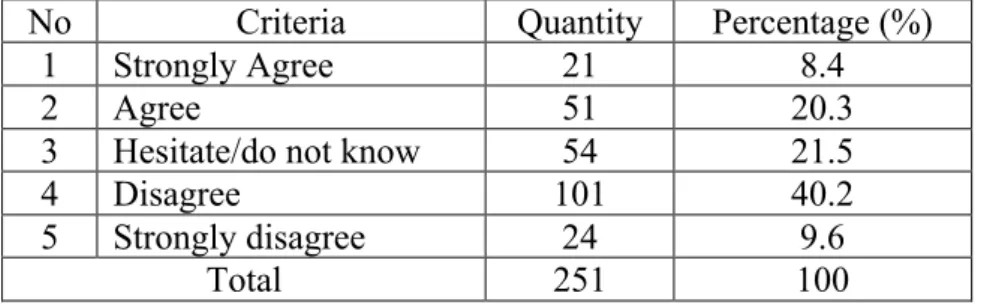
Table 1. Students’ Responses against the Use of Qur’an as Religious Proposition for the Permissibility to Kill Non-Moslems
No Criteria Quantity Percentage (%)
1 Strongly Agree 21 8.4
2 Agree 51 20.3
3 Hesitate/do not know 54 21.5
4 Disagree 101 40.2
5 Strongly disagree 24 9.6
Total 251 100
From Table 1 above, it is known that 21 people (8.4%) strongly agree, 51 people (20.3%) agree, 54 people (21.5%) hesitate/do not know, 101 people (40.2%) disagree, and 24 people (9.6%) strongly disagree with the religious proposition. It indicates that the respondents disagree if Moslem people use this verse as the religious proposition or reason for allowing them to kill infidels or non-Moslems.
As the explanation above, the historical side of this verse is far from being legitimacy for the violence against people with different beliefs without any reason, let alone it is performed in Indonesia. The verse above provides a command to Moslems to fight against infidels only for protecting themselves, not for attacking them without any reason.18 If we understand it well, this verse is not intended to allow people to attack other people with different beliefs, whereby their existence does not disturb our activity to pray. It is because non-Moslem people in Indonesia do not restrict Moslems to practice. Therefore, we do not need supervision towards violence towards non-Moslems. Qur’an
18 Rustam Ibrahim, “Jihad Dalam Literatur Pesantren Salaf,” Jurnal Teologia 23, no.
1 (2012): 175–191. https://journal.walisongo.ac.id/index.php/teologia/article/view/
1799.
DOI: 10.19105/karsa.v29i2.5215
449 | as a Hudan/guidance should be able to harmonize people with their differences. Rhoades et al.19 and Lufaefi20 says that the Quran becomes the antidote for peace among differences, including Indonesia. It includes the verses stated above; if we try to interpret it from its Asbabun Nuzul or the contexts and occasions of the Revelation, it means we do not legalize the violence at all without reason for self-defense and without being attacked first.
Table 2. The Students’ Responses against the Understanding of Expelling Non-Moslems or Infidels From Moslems’ Hometown
No Criteria Quantity Percentage (%)
1 Strongly Agree 6 2.4
2 Agree 40 15.9
3 Hesitate/do not know 50 19.9
4 Disagree 136 54.2
5 Strongly disagree 19 7.6
Total 251 100
From Table 2 above, it is known that six people (2.4%) strongly agree, 40 people (15.9%) agree, 50 people (19.9%) hesitate/do not know, 136 people (54.2%) disagree, and 19 people (7.6%) strongly disagree with the statement. It indicates that the respondents disagree with the actions of expelling non-Moslem people from Moslems’
hometown according to the verse above.
The requirements that should be fulfilled are not attacking non- Moslems or expelling them from Moslems' hometowns.21 The verse
19 Ashley L. Rhoades et al., Promoting peace as the Antidote to Violent Extremism, (Santa Monica, Calif: RAND Corporation, 2020).
20 Lufaefi, “Telaah Penafsiran Ayat-Ayat Kekerasan: Upaya Mewujudkan Perdamaian dalam Bingkai KeIndonesiaan,” Refleksi 16, no. 1 (2017): 1–28, http://journal.uinjkt.ac.id/index.php/refleksi/article/view/9730.
21 Pranoto Hadi et al., “Group Guidance Services with Self-Regulation Technique to Improve Student Learning Motivation in Junior High School (JHS),” Educational Research and Reviews 11, no. 24 (2016): 2146–2154, https://doi.org/10.5897/err2016.2955.
DOI: 10.19105/karsa.v29i2.5215
| 450
above is one of the verses that are often used as a religious proposition by extremists for the permissibility in attempting to allow violent actions under the name of jihad by attacking anyone who has a different belief.22 Since it has been legalized in the Qur’an, they never feel that their actions are in contrast with Islam.23 The verse above is permission by Allah to fight against idolaters. However, it does not mean that this verse can be used for violent verses like it is when seeing “differences” in other people. If it is seen from its Asbabun Nuzul, prophet Muhammad and Moslems received unpleasant treatment. They were physically oppressed by idolaters in Makkah for a long time, while the Moslems could not do anything before these verses were revealed.24 That is, the historical context of the verses is revealed.
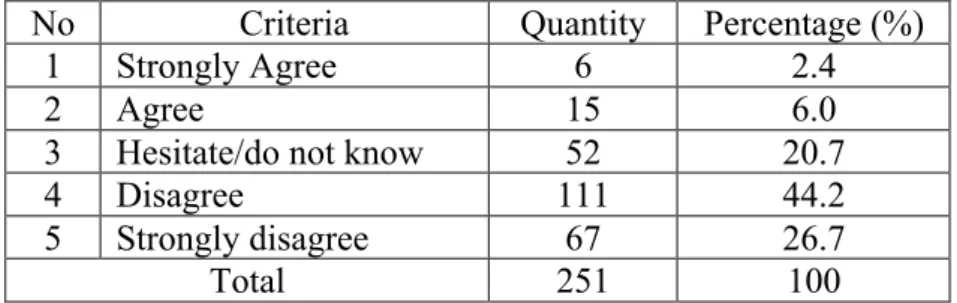
Table 3. The Students’ Responses against the Understanding of Terror Actions like Bombing done by Amrozi et al.,
in the Islamic Context
No Criteria Quantity Percentage (%)
1 Strongly Agree 6 2.4
2 Agree 15 6.0
3 Hesitate/do not know 52 20.7
4 Disagree 111 44.2
5 Strongly disagree 67 26.7
Total 251 100
Table 3 show that it is known that six people (2.4%) strongly agree, 15 people (6%) agree, 52 people (20.7%) hesitate/do not know, 111 people (44.2%) disagree, and 67 people (26.7%) strongly disagree
22 Lufaefi, “Telaah Penafsiran Ayat-Ayat Kekerasan: Upaya Mewujudkan Perdamaian Dalam Bingkai KeIndonesiaan,” 1–28.
23 Lufaefi, “Telaah Penafsiran Ayat-Ayat Kekerasan: Upaya Mewujudkan Perdamaian Dalam Bingkai KeIndonesiaan,” Refleksi 16, no. 1 (2017): 1-28, http://journal.uinjkt.
ac.id/index.php/refleksi/article/view/9730.
24 Lufaefi, “Telaah Penafsiran,” 1-18.
DOI: 10.19105/karsa.v29i2.5215
451 | with the religious proposition. It indicates that the respondents disagree that terror actions like bombing done by Amrozi et al. are legal or legitimate in the Islamic context.
The terror actions are not Islamic teachings;25 explained that terror behavior is not included in the study of Jihad in Islam since Islam prohibits crimes, such as violence and murder, without any reason, and they are not justified by religion. Reveals that the findings showed the source of terrorism is the culture as a mythological hero and the desire to put revenge and actions in contrast with the principle of Islamic teachings.26
There is no justification for the desire to do suicide bombing actions. The desire to suicide is an action prepared and determined by other people’s teachings.27 The effect of the behavior needs an accurate action, as stated by Vicente Llorent-Bedmar et al.,28 It is vital to warn the dangers of implementing preventative activity against violent radicalization. Nevertheless, it revealed that Muslim countries, such as Indonesia, had a low risk of terrorism.29
Table 4. The Students’ Responses against the Understanding of the Current Primary Jihad is to Fight Against Non-Moslems
25 Imam Khodri TF, “Konsep Jihad Perspektif Sivitas Pesantren di Sumenep (Kajian Hadis Dalam Kitab Bulǔgh Al-Marăm Min ’Adillat Al- Aḥkȃm Karya Ibn Hajar Al-
‘Asqalȃnȋy),” (Ph.D. dissertation, Surabaya: Universitas Islam Negeri Sunan Ampel, 2020).
26 Jilani ben Touhami Meftah, “Roots of Sadistic Terrorism Crimes: Is It Islam or Arab Culture?,” Aggression and Violent Behavior 42, September-October (2018): 52–60, https://doi.org/10.1016/j.avb.2018.06.003.
27 Robertus Robet and Rusfadia Saktiyanti Jahja, “Bunuh Diri Teroris Sebagai Tindakan Ideologis,” in Seminar Nasional Ikatan Sosiologi Indonesia (Makassar:
Universitas Negeri Jakarta, 2018), 1–12.
28 Vicente Llorent-Bedmar et al., “Islamic Religion Teacher Training in Spain:
Implications for Preventing Islamic-Inspired Violent Radicalism,” Teaching and Teacher Education 95, (October 2020):1-12, https://doi.org/10.1016/j.tate.2020.
103138.
29 Imane El Ouadghiri and Jonathan Peillex, “Public Attention to ‘Islamic Terrorism’
and Stock Market Returns,” Journal of Comparative Economics 46, no. 4 (2018): 936–
946, https://doi.org/10.1016/j.jce.2018.07.014.
DOI: 10.19105/karsa.v29i2.5215
| 452
No Criteria Quantity Percentage (%)
1 Strongly Agree 37 14.7
2 Agree 99 39.4
3 Hesitate/do not know 35 13.9
4 Disagree 63 25.1
5 Strongly disagree 17 6.8
Total 251 100
Table 4 shows, it is known that 37 people (14.7%) strongly agree, 99 people (39.4%) agree, 35 people (13.9%) hesitate/do not know, 63 people (25.1%) disagree, and 17 people (6.8%) strongly disagree with the religious proposition. It shows that the respondents agree if the current primary jihad is to fight against non-Moslems.
Ma’afi and Muttaqin divide the definition into two types of meaning: the narrow meaning (specific) that jihad by struggling against infidels at the battlefield, and a broad meaning (general) that a Moslem’s sincerity in worshipping to seek Allah's pleasure.30 In addition, in his study, he divided the definition of jihad into two meanings: physical and universal.31 The first meaning leads to a struggle by devoting energy, wealth, and soul to attack infidels. This kind of meaning is commonly found in Islamic jurisprudence books (fiqh) literature. In contrast, the universal meaning covers practicing jihad in every kind of goodness in all aspects of life.
Table 5. The Students’ Responses against the Understanding of Asking Permission to Non-Moslems to Build A Place of Worship
No Criteria Quantity Percentage (%)
30 Asnan Purba and Imam Kamaluddin, “Urgensi Jihad Masa Kini dalam Persepektif Islam,” Ijtihad: Jurnal Hukum dan Ekonomi Islam 13, no. 2 (2019): 131–145.
https://ejournal.unida.gontor.ac.id/index.php/ijtihad/article/view/3538..
31 M. Ainul Yaqin, Pendidikan Multikultural: Cross-Cultural Understanding Untuk Demokrasi dan Keadilan (Yogyakarta: Pilar Media, 2005).
DOI: 10.19105/karsa.v29i2.5215
453 |
1 Strongly Agree 29 11.6
2 Agree 40 15.9
3 Hesitate/do not know 48 19.1
4 Disagree 118 47.0
5 Strongly disagree 16 6.4
Total 251 100
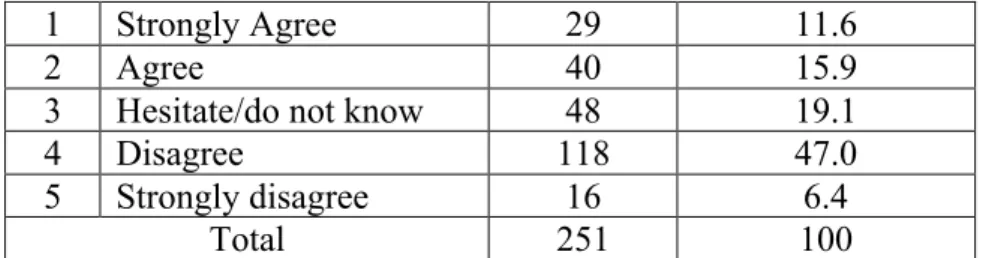
From Table 5 above, it is known that 29 people (11.6%) strongly agree, 40 people (15.9%) agree, 48 people (19.1%) hesitate/do not know, 118 people (47%) disagree, and 16 people (6.4%) strongly disagree with the religious proposition. It indicates that the respondents disagree if the government (Muslim people) should permit non- Moslems to build a place of worship since it is considered helping them with sinful actions.
The government that is administered by Moslems, if following the basic principle of Prophet Muhammad, will have the tolerance behavior as revealed by Abdul & Minarti Romnan32 that tolerance is respecting, allowing to build or have different or contrasting interpretations.33 Islam is Rahmatalillalamin, or peace for all creations filled with tolerance values. Tolerance behavior is highly needed to prevent radicalism, as stated by Marianti34 that one of the four primary education for anti-terrorism is recognizing the existence of other religions.
Table 6. The Students’ Responses against the Understanding of Shopping at Shops owned by Non-Moslems
32 Abdul and Minarti Romnan, “Toleransi Semu pada Relasi Kelompok Keagamaan dalam Islam,” In Prosiding Seminar Fisip Universitas Jenderal Soedirman vol. 6 (2019): 669–680, http://jurnal.lppm.unsoed.ac.id/ojs/index.php/Prosiding/article/
view/1237.
33 Irman and Yusefri, “Radikalisme Agama Perspektif Al-Qur’an dan Konseling,” Al- Fuad Jurnal Imiah Sosial Keagamaan 2, no. 2 (2018): 9–21, https://ojs.iainbatu sangkar.ac.id/ojs/index.php/alfuad/article/view/1439.
34 Marianti, “Konsep Pendidikan Anti-Terorisme Relevansinya Bagi Pendidikan Islam,” Toleransi: Media Komunikasi Umat Beragama 12, no. 1 (2020): 48–60. http://
ejournal.uin-suska.ac.id/index.php/toleransi/article/view/10637.
DOI: 10.19105/karsa.v29i2.5215
| 454
No Criteria Quantity Percentage (%)
1 Strongly Agree 29 11.6
2 Agree 40 15.9
3 Hesitate/do not know 48 19.1
4 Disagree 118 47.0
5 Strongly disagree 16 6.4
Total 251 100
Table 6 shows that, it is known that 29 people (11.6%) strongly agree, 40 people (15.9%) agree, 48 people (19.1%) hesitate/do not know, 118 people (47%) disagree, and 16 people (6.4%) strongly disagree with the religious proposition. It shows that the respondents disagree if shopping at shops owned by non-Moslems is also not allowed since it is included as helping them to be successful or rich, and the wealth is not used for piety to Allah.
The purchase and sale transaction to non-Moslems based on the Islamic point of view is not a problem; even, during the lifetime of the Prophet Muhammad, according to Solihah35 the purchase and sale transaction to non-Moslems did not exist, and during the lifetime of the Prophet, most non-Moslems performed purchase and sale transactions with Moslems. As a Moslem, we should perform a fair purchase and sale transaction as stated by Amli Syaifullah and Lukmanul Hakim,36 that fair transactions in the Islamic economy should be done well to achieve Falah (salvation, happiness, and well-being) in the world and afterlife.
A Moslem should be wise in choosing products from non- Moslems. Currently, Moslems are not simply people with the Islamic
35 Solihah, “Pandangan Islam Terhadap Non Muslim Berjualan Perlengkapan Muslim,” (Master Thesis, Banten: Universitas Islam Negeri SMH, 2018).
36 Hamli Syaifullah and Lukmanul Hakim, “Transformasi Keadilan Transaksi Dalam Ekonomi Islam: Tinjauan Fiqih Muamalah,” Misykat al-Anwar: Jurnal Kajian Islam dan Masyarakat 28, no. 2 (2017): 1–20, https://jurnal.umj.ac.id/index.php/MaA16/
article/view/3840.
DOI: 10.19105/karsa.v29i2.5215
455 | religion, but consumers who ensure if the products are Halal.37 A banking transaction also reveals that Sharia bank promotion can also increase non-Moslems’ willingness to be customers.38
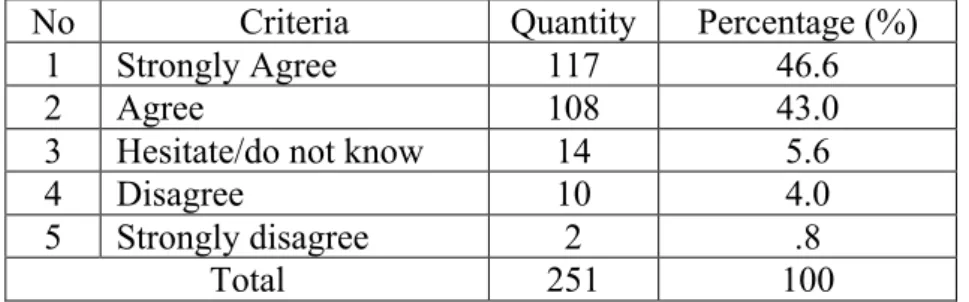
Table 7. The Students’ Responses against the People’s Understanding of Sealing Immoral Places
No Criteria Quantity Percentage (%)
1 Strongly Agree 117 46.6
2 Agree 108 43.0
3 Hesitate/do not know 14 5.6
4 Disagree 10 4.0
5 Strongly disagree 2 .8
Total 251 100
Table 7 shows, it is known that 117 people (46.6%) strongly agree, 108 people (43%) agree, 14 people (5.6%) hesitate/do not know, ten people (4%) disagree, and two people (0.8%) strongly disagree with the religious proposition. It shows that the respondents strongly agree that people should close immoral places by giving seals.
Discussion
Immoral places should be appropriately followed up for the peacefulness of religious people, yet it needs preachers around immoral places. Gus Miek realizes that the number of Islamic preachers around
37 Miftakhul Janah, “Pengaruh Kesadaran Halal dan Sertifikasi Halal Terhadap Minat Beli Produk Mi Samyang (Studi pada Masyarakat Muslim di Kecamatan Kebumen),”
(Undergradute Thesis, Kebumen: STIE Putra Bangsa, 2015), 1–12, https://www.scribd.com/document/490547909/145501916-pdf.
38 Lina Marlina and Gina Rosdiana, “Faktor-Faktor Yang Mempengaruhi Minat Non Muslim Menjadi Nasabah Bank Syariah di Tasikmalaya,” E-Qien: Jurnal Ekonomi dan Bisnis 7, no. 1 (2020): 15–22. https://stiemuttaqien.ac.id/ojs/index.php/OJS/
article/view/110.
DOI: 10.19105/karsa.v29i2.5215
| 456
immoral places, such as a nightclub and other places, is less.39 The enforcement of al-amr bi al-al-ma’rūf wa an-nahy an al-munkar (to call to do good and prevent evil deeds) done by Wilayatul Hisbah to prevent abuse of places from immorality.40
The activity of closing immoral places has been widely done as reported by a study conducted by Ariyansyah & Masyhur41 and Misbar
& Amri42 that Front Pembela Islam/FPI (Islamic Defenders Front) has helped discipline and close the immoral places. Lodging is currently considered an immoral place, so it needs sharia-based lodging. It is revealed that sharia lodging is operated as a popular business according to Islamic teachings to prevent immorality.43
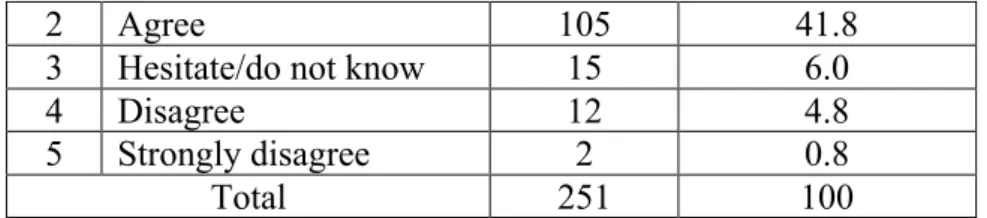
Table 8. The Students’ Responses against the Sweeping and Raid towards Entertainment Places during the Time Ahead of the Ramadan
No Criteria Quantity Percentage (%)
1 Strongly Agree 117 46.6
39 Kholis Mu’amalah, “Merdeka Belajar Sebagai Metode Pendidikan Islam dan Pokok Perubahan (Analisis Pemikiran K. H. Hamim Tohari Djazuli),” Jurnal Tawadhu 4, no.
1 (2020): 977–994, https://ejournal.iaiig.ac.id/index.php/TWD/article/view/218.
40 Dasni Wati, “Peran Wilāyah Al-Ḥisbah Kota Banda Aceh Dalam Mencegah Penyalahgunaan Tempat Salon Kecantikan Sebagai Sarana Maksiat (Implementasi Qānūn Aceh Nomor 6 Tahun 2014 Tentang Hukum Jināyah),” (Undergraduate Thesis, Banda Aceh Darussalam: Universitas Islam Negeri Ar-Raniry, 2020), https://reposi tory.ar-raniry.ac.id/id/eprint/13155.
41 Rendi Ariyansyah and Masyhur, “Identitas Agama dan Pola Gerakan Sosial (Studi Kasus Front Pembela Islam di Kota Palembang),” Ampera: A Research Journal on Politics and Islamic Civilization 1, no. 1 (2020): 49–60,
http://jurnal.radenfatah.ac.id/index.php/Ampera/article/view/5206/2886.
42 Andrian Misbar and Amsal Amri, “Sikap Masyarakat Terhadap Pola Komunikasi Pencegahan Nahi Munkar Kelompok Front Pembela Islam (Studi Penelitian di Gampong Weu Raya Kecamatan Lhoknga, Kabupaten Aceh Besar),” Jurnal Ilmiah Mahasiswa FISIP 4, no. 2 (2019): 5–6; 1-12,
http://jim.unsyiah.ac.id/FISIP/article/view/10843.
43 Bima C. P. Morodjojo et al., “Hotel Syariah di Manado,” Jurnal Arsitektur Daseng 9, no. 1 (2020): 320–326, https://ejournal.unsrat.ac.id/index.php/daseng/article/view/
30168.
DOI: 10.19105/karsa.v29i2.5215
457 |
2 Agree 105 41.8
3 Hesitate/do not know 15 6.0
4 Disagree 12 4.8
5 Strongly disagree 2 0.8
Total 251 100
From Table 8, it is known that 117 people (46.6%) strongly agree, 105 people (1.8%) agree, 15 people (6%) hesitate/do not know, 12 people (4.8%) disagree, and two people (0.8%) strongly disagree with the religious proposition. It shows that the respondents strongly agree that preventative action for evil deeds can be done sweeping and raiding against entertainment places (to be closed). In contrast, the time ahead of Ramadan's holy month and the closing of restaurants at noon by specific community organizations or a group of people.
The Islamic movement with jihad is defined as a struggle to fight and destroy tyranny.44 The struggle can be in the form of rebellion against the sovereign who does not practice the teachings and Allah’s rules using methods, such as doing terror actions in the form of destroying places considered as places to do immoral actions. The meaning of jihad is then shifted and known as a struggle for destroying merciless tyranny.45 This meaning is seen in several activities of Islamic group members against gambling places and hotels that are considered a place of immorality. It is ironic that the Islamic groups enthusiastically destroy immoral places and want to die as a jihadist. They ignore their wife’s life and children’s life or livelihood, whereas providing their family with living allowances is jihad.
Table 9. The Students’ Responses Against the People’s Understanding of Implementing the Penalty of Hand Amputation to Thieves
if the Value of Stolen Goods Reaching Nisab
44 Mahmuddin, “Budaya Kekerasan dalam Gerakan Islam: Studi Tentang Penegakan Doktrin Amar Makruf Nahi Mungkar pada Ormas Front Pembela Islam (FPI) Kota Makassar,” Jurnal Diskursus Islam 1, no. 1 (2013): 85–99, http://journal.uin- alauddin.ac.id/index.php/diskursus_islam/article/view/6584.
45 Mahmuddin, “Budaya Kekerasan,” 85–99.
DOI: 10.19105/karsa.v29i2.5215
| 458
No Criteria Quantity Percentage (%)
1 Strongly Agree 38 15.1
2 Agree 109 43.4
3 Hesitate/do not know 53 21.1
4 Disagree 45 17.9
5 Strongly disagree 6 2.4
Total 251 100
Table 9 shows, it is known that 38 people (15.1%) strongly agree, 109 people (43.4%) agree, 53 people (21.1%) hesitate/do not know, 45 people (17.9%) disagree, and six people (2.4%) strongly disagree with the religious proposition. It shows that the respondents agree that Islamic community organizations or certain community groups in our country implement the penalty of hand amputation to thieves if the value of stolen goods reaches nisab.
The penalty of hand amputation has been commanded during the lifetime of Allah’s Messenger (may peace be upon him) in a hadith from A’ishah: Narrated A’ishah, from Allah’s Messenger, he said, “The hand of the thief shall only be cut off if he steals a quarter of a Dinar or more”.
[hadith Narrated by Muslim chapter 3, p. 1312]. In the Quran, it is also explained in Surah Al-Ma’ida verse 38: [As for] the thief, the male, and the female, amputate their hands in recompense for what they earned [i.e., committed] as a deterrent [punishment] from Allah; moreover, Allah is Exalted in Might and Wise.
Besides, Fathur Rahman46 and S.S. Wati47 says that Islam severely punishes the thief by amputating his hand. It is viewed from the
46 Fathur Rahman, “Transformasi Hukum Islam dalam Kerangka Pikir Ibnul Qayyim Al-Jauziyah,” Tasamuh: Jurnal Studi Islam 11, no. 2 (2019): 1–16; 365-380, https://
doi.org/10.47945/tasamuh.v11i2.167.
47 Siti Sulistia Wati, “Pencurian Yang Dilakukan Anak Di Bawah Umur Menurut Hukum Islam Dan Hukum Positif,” Academica: Journal of Multidisciplinary Studies 2, no. 2 (2018): 345–355, http://ejournal.iainsurakarta.ac.id/index.php/academica/
article/view/2264.
DOI: 10.19105/karsa.v29i2.5215
459 | opinion by Sam S. Souryal et al.,48 that the penalty of hand amputation in Islam is not in contrast with Jews and Christians. The opinion by Hasbi ash Shiddieqy that the penalty of hand amputation is currently not relevant unless there is support and it should meet the terms and conditions.49
Indonesia cannot implement the law; it has been explained by M.
Syafi’ie50 the opinion by Indonesian Mujahideen Council (Majelis Mujahidin Indonesia/MMI), Jama’ah Ansharut Tauhid (JAT), Nahdhatul Ulama (NU), and Muhammadiyah regarding the penalty of hand amputation is strongly restricted by Human Rights Norms.
Table 10. The Students’ Responses against the People’s Understanding of Starting (Preceding) to Greet by saying “Good Morning” or
“Good Afternoon” to Believers of Other Religions is not Permissible
No Criteria Quantity Percentage (%)
1 Strongly Agree 23 9.2
2 Agree 52 20.7
3 Hesitate/do not know 71 28.3
4 Disagree 95 37.8
5 Strongly disagree 10 4.0
Total 251 100
From Table 10 above, it is known that 23 people (9.2%) strongly agree, 52 people (20.7%) agree, 71 people (28.3%) hesitate/do not know, 95 people (37.8%) disagree, and ten people (4%) strongly
48 Sam S. Souryal et al., “The Penalty of Hand Amputation for Theft in Islamic Justice,” Journal of Criminal Justice 22, no. 3 (1994): 49–265, https://doi.org/10.1016/
0047-2352(94)90021-3.
49 Muhamad Muslih, “Peran Fikih Indonesia Dalam Modernisasi Hukum Islam (Perspektif Undang-Undang Nomor 1 Tahun 1974),” Nurani Hukum 2, no. 1 (2019):
61-74, https://jurnal.untirta.ac.id/index.php/nhk/article/view/5477/0.
50 M. Syafi’ie, “Pemikiran Organisasi Islam Tentang Penerapan Hukum Pidana Islam:
Tinjauan Hukum Hak Asasi Manusia,” Undang: Jurnal Hukum 2, no. 2 (2020): 225–
264, https://doi.org/10.22437/ujh.2.2.225-264.
DOI: 10.19105/karsa.v29i2.5215
| 460
disagree with the Islamic argument. It shows that the respondents disagree that starting (preceding) to greet by saying “good morning” or
“good afternoon” to believers of other religions is not permissible.
Imam Nawawi and Islamic scholars agree that greeting non- Moslems is forbidden, and if we want to respond to their greeting, we should say “wa’alaikum” or “alaikum”. However, greeting by saying good morning or good afternoon is permissible. Al Qurthubi said that the hadith stating the greeting first to the people of the dhimma (Non- Muslims living in an Islamic state) is prohibited since it is a sign of respect, while infidels do not deserve it51. Hadith by Abu Hurairah stated, “do not greet them (infidels) first!”, if there is no reason for greeting first, such as friendship, an inevitable necessity with them, neighborhood matters, or trips.52 Islamic scholars have different arguments about the meaning of Allah’s words about Abraham when calling his father, but his father refused to respond, then Abraham said
“salamun’alaik”.
Jumhur al-‘ulama or the majority of scholars suggested that the meaning of greeting in this discussion is musalamah (peace) as participation, not as tahiyyah/salutation (respect). Ath-Thabari suggested that the meaning of salamu’alaika is peace be upon human, so it is not permissible to greet the infidels first.53 Greeting non-Moslems is forbidden, but responding to the greeting is obligatory only saying wa’alaikum. Most Salafi scholars allow Moslems to greet non-Moslems.
51 Ajid Thohir, Historisitas dan Signifikansi Kitab Manaqib Syekh’Abdul Qâdir Al- Jîlã̋̌nî Dalam Historiografi Islam (Jakarta: Kementerian Agama RI Badan Litbang dan Diklat Puslitbang Lektur & Khazanah Keagamaan, 2011).
52 Syofrianisda, “Kajian Hadith Tentang Salam Dalam Buku Fiqih Lintas Agama (FLA),” Universum 11, no. 1 (2017): 113–130, https://doi.org/10.30762/universum.
v11i1.590.
53 Hakis and Ammy Rila Tuasikal, “Kebermaknaan Salam Dalam Kehidupan Sosial Masyarakat,” Jurnal Fakultas Ushuluddin dan Dakwah IAIN Ambon 8, no. 1 (2014):
1–10, https://anzdoc.com/download/kebermaknaan-salam-dalam-kehidupan-sosial- masyarakat-oleh-ha.html.
DOI: 10.19105/karsa.v29i2.5215
461 | Table 11. The Students’ Responses against the People’s Understanding
of Seeking Refuge from the Punishment of Hell-fire and the Forgiveness of Non-Moslems is not Permissible
No Criteria Quantity Percentage (%)
1 Strongly Agree 6 2.4
2 Agree 37 14.7
3 Hesitate/do not know 57 22.7
4 Disagree 97 38.6
5 Strongly disagree 54 21.5
Total 251 100
Table 11 shows, it is known that six people (2.4%) strongly agree, 37 people (14.7%) agree, 57 people (22.7%) hesitate/do not know, 97 people (38.6%) disagree, and 54 people (21.5%) strongly disagree with the Islamic argument. It shows that the respondents disagree that seeking refuge from Hellfire punishment and forgiveness for non-Moslems is not permissible.
The respondents’ introductory statement is based on the Qur’an, Surah At-Tawbah verse 113–114, namely:
“It is not for the Prophet, and those who believe, to pray for the forgiveness of idolaters even though they may be near to kin (to them) after it hath become clear that they are people of hell- fire. The prayer of Abraham for the forgiveness of his father was only because of a promise he had promised him, but when it had become clear unto him that he (his father) was an enemy to Allah, he (Abraham) disowned him. Lo! Abraham was soft of heart, long-suffering.”
However, there is a tradition to pray for non-Moslems in Metro Lampung society; it refers to ’urf (custom).54 Even though as a Moslem
54 Nurul Afifah, “Tradisi Mendoakan Orang Non Muslim Menurut Konsep Fiqih (Urf) dan Ushul Fiqh di Kota Metro,” Al-Tarbawi Al-Haditsah: Jurnal Pendidikan Islam 3,
DOI: 10.19105/karsa.v29i2.5215
| 462
who does not pray for non-Moslems, a Moslem should protect themselves and stand up for Rahmatan lil aalamin (A mercy to all creation), as stated by M Sabron Sukmanul55 that Islam is a religion of rahmatan lil ’aalamiin and do not quickly call other people who have different beliefs as infidels.
Table 12. The Students’ Responses against the People’s Understanding that Salvation Only Exists in Islam, Jews and Christians who Know
Islam and Do not Revert to Islam until They Dead Will be People of Hell-Fire
No Criteria Quantity Percentage (%)
1 Strongly Agree 1 0.4
2 Agree 8 3.2
3 Hesitate/do not know 40 15.9
4 Disagree 111 44.2
5 Strongly disagree 91 36.3
Total 251 100
Table 12 shows, it is known that one person (0.4%) strongly agree, eight people (3.2%) agree, 40 people (15.9%) hesitate/do not know, 111 people (44.2%) disagree, and 91 people (36.3%) strongly disagree with the Islamic argument. It shows that the respondents disagree that salvation only exists in Islam; for Jews and Christians who know Islam and do not revert to Islam until dead, they will be people of hell-fire. The response of “disagree” by the respondents related to Allah’s words in the Qur’an in Surah Muhammad verse 12:
“Indeed, Allah will admit those who have believed and done righteous deeds to gardens beneath which rivers flow, but those
no. 2 (2018): 30–51, http://www.syekhnurjati.ac.id/jurnal/index.php/tarbawi/article/
download/3238/1960.
55 Sabron Hakim, “Distorsi Humanisme dalam Konsep Islam Rahmatan Lil’aalamiin di Indonesia (Studi Internalisasi Humanisme dalam Islam),” Al-Afkar 3, no. 1 (2020):
1–19, https://al-afkar.com/index.php/Afkar_Journal/article/view/74.
DOI: 10.19105/karsa.v29i2.5215
463 | who disbelieve themselves and eat as grazing livestock eat, and the Fire will be a residence for them.”
The Salafi sect returns the basic principle of Islam to the Qur’an and Hadith, thought and mind only justifies them.56 This fundamental principle becomes the respondents’ reference in answering the statement about Jews and Christians who know Islam, but they disagree.
Table 13. The Students’ Responses against the People’s Understanding of Each Person who Does Heresy Will Be in Hell
No Criteria Quantity Percentage (%)
1 Strongly Agree 40 15.9
2 Agree 83 33.1
3 Hesitate/do not know 67 26.7
4 Disagree 47 18.7
5 Strongly disagree 14 5.6
Total 251 100
Table 13 shows, it is known that 40 people (15.9%) strongly agree, 83 people (33.1%) agree, 67 people (26.7%) hesitate/do not know, 47 people (18.7%) disagree, and 14 people (5.6%) strongly disagree with the Islamic argument. It shows that the respondents agree that each person who does heresy will undoubtedly be in hell.
56 Wildana Latif Mahmudi, “Pertumbuhan Aliran-Aliran dalam Islam dan Historinya,”
Bangun Rekaprima 5, no. 2 (2019): 70–84, https://jurnal.polines.ac.id/index.php /bangun_rekaprima/article/view/1578.
DOI: 10.19105/karsa.v29i2.5215
| 464
Based on the citation in a study by Aziz,57 Effendi,58 and Nadia,59 it is stated that every new thing in religion is bid’ah (heresy), and each bid’ah (heresy) is misguidance, and each misguidance will put the doer in hell. However, Musri stated that bid’ah (heresy) has several levels; it is not easy to judge someone having deviant behavior.60
Table 14. The Students’ Responses against the People’s Understanding of Working at a Conventional Bank with Riba (Usury) Laws is
Included as Mutual Help Prohibited by Religion
No Criteria Quantity Percentage (%)
1 Strongly Agree 2 0.8
2 Agree 14 5.6
3 Hesitate/do not know 48 19.1
4 Disagree 120 47.8
5 Strongly disagree 67 26.7
Total 251 100
Table 14 shows, it is known that two people (0.8%) strongly agree, 14 people (5.6%) agree, 48 people (19.1%) hesitate/do not know, 120 people (47.8%) disagree, and 67 people (26.7%) strongly disagree
57 M. Shohibul Aziz, “Pribumisasi Hukum Islam dalam Pesantren,” Usratuna 1, no. 2 (2018): 74–93, https://ejournal.staida-krempyang.ac.id/index.php/usratuna/article/
download/144/104.
58 Muhammad Nur Effendi, “Pendidikan Al Irsyad dan Kontribusinya Sehingga Organisasi Tersebut Memenuhi Terhadap Pendidikan Islam,” Jurnal Darussalam 20, no. 2 (2019): 93–106, http://ojs.iai-darussalam.ac.id/index.php/darussalam/article/
view/31.
59 Zunly Nadia, “Living Hadits. Penggunaan Hadits dalam Ceramah Agama di Radio Majlis Tafsir Al- Qur’an,” Bina’ al-Ummah: Jurnal Ilmu Dakwah dan Pengambangan Komunitas 15, no. 1 (2020): 55–82, http://ejournal.radenintan.ac.id/index.php/
alummah/article/view/6703.
60 Slamet Muliono Redjosari, “Salafi dan Stigma Sesat Radikal,” ISLAMICA: Jurnal Studi Keislaman 13, no. 2 (2019): 305–324, http://repository.uinsby.ac.id/id/eprint/
202/1/Slamet%20Muliono%20Redjosari_Salafi%20dan%20Stigma%20Sesat- Radikal.pdf.
DOI: 10.19105/karsa.v29i2.5215
465 | with the Islamic argument. It shows that the respondents disagree that working at a conventional bank that implements Riba (Usury) laws is included as mutual help forbidden by religion.
Riba is forbidden in Islam. According to a study by Adam,61 Arifin & Misaeropa,62 Bohari & Syarifuddin,63 Hasriani et al.,64 Ihsan et al.,65 Rahayu & Nurhayati,66 Rasenda et al.,67 Sarono,68 Setiawan,69Riba is an unlawful behavior that has been explained in the Qur’an and Hadith.70 classified Riba into riba for consumption in Surah Ar-Rum,
61 Noor Latiffah Adam and Nordin Abu Bakar, “Shariah Screening Process in Malaysia,” Procedia - Social and Behavioral Sciences 121, no. September (2014):
113–123, https://doi.org/10.1016/j.sbspro.2014.01.1113.
62 Muhammad Patri Arifin and Misaeropa, “Penafsiran Ali Al-Shobuni Tentang Ayat-Ayat Riba,” Al-Munir: Jurnal Ilmu Al-Qur’an dan Tafsir 1, no. 1 (2019): 135–
163, http://jurnalalmunir.com/index.php/al-munir/article/view/26.
63 Ambo Dalle Bohari and Syarifuddin, “Comparative Thought Ian A Fazlur Rahman and M . Syafii Antonio About Bunga Bank,” Jurnal Ekonomi Syariah Indonesia 10, no. 1 (2020): 62–68, https://ejournal.almaata.ac.id/index.php/JESI/article/download/
1350/1339.
64 Hasriani et al., “Analisis Penerapan Pelarangan Riba Terhadap Mahasiswa STAI Al- Azhar Gowa,” Al-Azhar Journal of Islamic Economics 2, no. 1 (2020): 12–24, https://www.ejournal.staialazhar.ac.id/index.php/ajie/article/view/40/30.
65 Fanani Mafatikul Ihsan et al., “Historiografi Kausa Legal Bunga (Riba) Di Indonesia,” Ulûmuna: Jurnal Studi Keislaman 6, no. 1 (2020): 1–12, http://ejournal.
kopertais4.or.id/madura/index.php/ulumuna/article/view/3955.
66 Annisa Eka Rahayu and Nunung Nurhayati, “Telaah Kritis Pemikiran Abdul Mannan Tentang Riba dan Bunga Bank,” Islamic Banking : Jurnal Pemikiran dan Pengembangan Perbankan Syariah 6, no. 1 (2020): 47–68, https://doi.org/10.36908/
isbank.v6i1.131.
67 Rasenda Rasenda et al., “Implementasi K-NN Dalam Analisa Sentimen Riba Pada Bunga Bank Berdasarkan Data Twitter,” Jurnal Media Informatika Budidarma 4, no.
2 (2020): 369, https://doi.org/10.30865/mib.v4i2.2051.
68 Agus Sarono, “Explorasi Hukum Riba dari Berbagai Macam Pandangan serta Penerapan Ilmu Hukum dalam Aplikasinya,” Diponegoro Private Law Review 7, no.
1 (2020): 657–667, https://ejournal2.undip.ac.id/index.php/dplr/article/download/
8173/4296.
69 Iwan Setiawan, “Pengembangan Bisnis Tanpa Riba,” Tahkim 13, no. 2 (2017): 17- 30, https://jurnal.iainambon.ac.id/index.php/THK/article/view/716.
70 Fitri Maghfirah, “Diskursus Interpretasi Ayat Riba dan Relevansinya dengan Bunga,” Hukum Islam 20, no. 1 (2020): 95–119, http://ejournal.uin-suska.ac.id/index.
php/hukumislam/article/view/8481/5319.
DOI: 10.19105/karsa.v29i2.5215
| 466
riba for semi-production and consumption in Surah Al-Baqara, and riba for production, purchase, and sales in Surah Al-Imran.
Based on the presented data above, it can be concluded that the percentage is 61.08%. Consequently, it can conclude that the total percentage of students’ responses against “violent” verses in the Qur’an and hadith is 61.08%, with the “good” category. It is proven from the data analysis that 61.08% is in the range of between 61% to 80% based on the established category, namely good.
Conclusion
As suggested in the introduction, this study aimed to explore and know the responses of the students of Islamic higher education (PTKIN) in Riau. Based on the data presentation and analysis, it can be concluded that the responses of the students of Islamic higher education (PTKIN) in Riau against the interpretation of violent verses are categorized in the
“Good” or “positive” category. It is because the collected percentage of their responses to the questions proposed by the researcher is 61.08%.
This percentage is in the “good” category (61%-80%). Furthermore, this study also reveals no significant difference between male and female respondents related to their responses to violent verses.
Even though the result of this study shows that the responses of the students of Islamic higher education (PTKIN) in Riau against violent verses are categorized as “good” or “positive”, the percentage of their responses is a little bit above the average, namely 61.08%. It means that around 40% of them have negative responses. Regarding this discussion, the researcher recommends the importance of the efforts to “neutralize”
the students’ understanding of the three Islamic higher education in Riau so that their understanding and responses will not tend to be harsh or even close to radical. The efforts can be in the form of community outreach or Islamic religious forums and through course lectures by the lecturers of the relevant course.
Bibliography
Adam, Noor Latiffah, and Nordin Abu Bakar. “Shariah Screening
DOI: 10.19105/karsa.v29i2.5215
467 | Process in Malaysia.” Procedia - Social and Behavioral Sciences 121, no. September 2012 (2014): 113–123. https://doi.org/10.
1016/j.sbspro.2014.01.1113.
Adawiyah, Wiwiek Rabiatul, and Bambang Agus Pramuka. “Scaling the Notion of Islamic Spirituality in the Workplace.” Journal of Management Development 36, no. 7 (2017): 877–898. https://doi.
org/10.1108/JMD-11-2014-0153.
Afifah, Nurul. “Tradisi Mendoakan Orang Non Muslim Menurut Konsep Fiqih (Urf) dan Ushul Fiqh Di Kota Metro.” Al-Tarbawi Al-Haditsah: Jurnal Pendidikan Islam 3, no. 2 (2018): 30–51.
http://www.syekhnurjati.ac.id/jurnal/index.php/tarbawi/article/do wnload/3238/1960.
Aisyah, St. “Konflik Sosial Dalam Hubunga Antar Umat Beragama.”
Jurnal Dakwah Tabligh 15, no. 2 (2014): 189–208. https://doi.org/
10.24252/jdt.v15i2.348.
Alshech, Eli, Badi Hasisi, and Simon Perry. “Self-Radicalized Western Salafi-Jihadis and Hilltop Youth in the West Bank Similar Radical Thought, Completely Different Practice.” Journal of Religion and Violence 8, no. 2 (2020): 153–195. https://doi.org/10.5840/jrv 202091776.
Arifin, Muhammad Patri, and Misaeropa. “Penafsiran Ali Al-Shobuni Tentang Ayat-Ayat Riba.” Al-Munir: Jurnal Ilmu Al-Qur’an dan Tafsir 1, no. 1 (2019): 135–163. http://jurnalalmunir.com/index.
php/al-munir/article/view/26.
Ariyansyah, Rendi, and Masyhur. “Identitas Agama dan Pola Gerakan Sosial (Studi Kasus Front Pembela Islam di Kota Palembang).”
Ampera: A Research Journal on Politics and Islamic Civilization 1, no. 1 (2020): 49–60. http://jurnal.radenfatah.ac.id/index.php/
Ampera/article/view/5206/2886.
Aziz, M. Shohibul. “Pribumisasi Hukum Islam dalam Pesantren.”
Usratuna 1, no. 2 (2018): 74–93. https://ejournal.staida- krempyang.ac.id/index.php/usratuna/article/download/144/104.
Bohari, Ambo Dalle, and Syarifuddin. “Comparative Thought Ian A Fazlur Rahman and M. Syafii Antonio About Bunga Bank.”
Jurnal Ekonomi Syariah Indonesia 10, no. 1 (2020): 62–68.
https://ejournal.almaata.ac.id/index.php/JESI/article/download/1
DOI: 10.19105/karsa.v29i2.5215
| 468
350/1339.
Brown, Katherine E. “Religious Violence, Gender and Post-Secular Counterterrorism”. International Affairs 96, no. 2 (2020):279–
303. https://doi.org/10.1093/ia/iiaa010.
Creswell, John W. Educational Research: Planning, Conducting, and Evaluating Quantitative and Qualitative Research (4th ed.).
Boston: Pearson Education, Inc, 2012.
Dja’far, Alamsyah M., Libasut Taqwa, and Siti Kholishoh, Intoleransi dan Radikalisme di Kalangan Perempuan Riset Lima Wilayah di Bogor, Depok, Solo Raya, Malang, dan Sumenep. Jakarta: Wahid Foundation, 2017.
Effendi, Muhammad Nur. “Pendidikan Al Irsyad dan Kontribusinya Sehingga Organisasi Tersebut Memenuhi Terhadap Pendidikan Islam.” Jurnal Darussalam 20, no. 2 (2019): 93–106.http://ojs.iai- darussalam.ac.id/index.php/darussalam/article/view/31.
Hadi, Pranoto. Nurul Atieka, Agus Wibowo, Siti Nurlaila, and Sudarmaji “Group Guidance Services with Self-Regulation Technique to Improve Student Learning Motivation in Junior High School (JHS).” Educational Research and Reviews 11, no.
24 (2016): 2146–2154. https://doi.org/10.5897/err2016.2955.
Hakim, Sabron. “Distorsi Humanisme dalam Konsep Islam Rahmatan Lil’aalamiin di Indonesia (Studi Internalisasi Humanisme dalam Islam.” Al-Afkar: Journal for Islamic Studies 3, no. 1 (2020): 1–
19.https://al-afkar.com/index.php/Afkar_Journal/article/view/74.
Hakis, and Ammy Rila Tuasikal. “Kebermaknaan Salam dalam Kehidupan Sosial Masyarakat.” Jurnal Fakultas Ushuluddin dan Dakwah IAIN Ambon 8, no. 1 (2014): 1–10.https://anzdoc.com/
download/kebermaknaan-salam-dalam-kehidupan-sosial-masya rakat-oleh-ha.html.
Hasriani, Hasriani. Wa Ode Titisalfia, Ammar Munir, and Ardhina Nur Aflaha. “Analisis Penerapan Pelarangan Riba Terhadap Mahasiswa STAI Al-Azhar Gowa.” Al-Azhar Journal of Islamic Economics 2, no. 1 (2020): 12–24. https://www.ejournal.staial azhar.ac.id/index.php/ajie/article/view/40/30.