Revision of the Western Atlantic Clingfishes of the Genus Tomicodon
(Gobiesocidae), with Descriptions of Five New Species
REY T. WILL IAN
HSON1AN CONTRIBUTIONS TO ZOOLOGY • NUMBER
SERIES PUBLICATIONS OF THE SMITHSONIAN INSTITUTION
Emphasis upon publication as a means of "diffusing knowledge" was expressed by the first Secretary of the Smithsonian. In his formal plan for the Institution, Joseph Henry outlined a program that included the following statement: "It is proposed to publish a series of reports, giving an account of the new discoveries in science, and of the changes made from year to year in all branches of knowledge." This theme of basic research has been adhered to through the years by thousands of titles issued in series publications under the Smithsonian imprint, commencing with Smithsonian Contributions to Knowledge in 1848 and continuing with the following active series:
Smithsonian Contributions to Anthropology Smithsonian Contributions to Botany Smithsonian Contributions to the Earth Sciences Smithsonian Contributions to the Marine Sciences
Smithsonian Contributions to Paleobiology Smithsonian Contributions to Zoology
Smithsonian Folklife Studies Smithsonian Studies in Air and Space Smithsonian Studies in History and Technology
In these series, the Institution publishes small papers and full-scale monographs that report the research and collections of its various museums and bureaux or of professional colleagues in the world of science and scholarship. The publications are distributed by mailing lists to libraries, universities, and similar institutions throughout the world.
Papers or monographs submitted for series publication are received by the Smithsonian Institution Press, subject to its own review for format and style, only through departments of the various Smithsonian museums or bureaux, where the manuscripts are given substantive review.
Press requirements for manuscript and art preparation are outlined on the inside back cover.
Lawrence M. Small Secretary
Smithsonian Institution
S M I T H S O N I A N C O N T R I B U T I O N S T O Z O O L O G Y • N U M B E R 6 2 1
Revision of the Western Atlantic Clingfishes of the Genus Tomicodon (Gobiesocidae),
with Descriptions of Five New Species
Jeffrey T. Williams and James C. Tyler
Smithsonian Contributions and Studies Series
AN IMPRINT OF SMITHSONIAN BOOKS Washington, D.C.
2003
A B S T R A C T
Williams, Jeffrey T, and James C. Tyler. Revision of the Western Atlantic Clingfishes of the Genus Tomicodon (Gobiesocidae), with Descriptions of Five New Species. Smithsonian Con- tributions to Zoology, number 621, 26 pages, 13 figures, 1 table, 2003.—Extensive collecting efforts involving rotenone sampling throughout the Caribbean Sea during the last four decades have vastly increased the numbers of specimens of cryptic fishes in museum collections.
Among such collections containing clingfishes of the genus Tomicodon Brisout de Barneville taken by ourselves and others, we have discovered numerous Caribbean species of Tomicodon in addition to those recognized by W.F. Smith-Vaniz in 1968 (T.fasciatus (Peters, 1859) and T.
rhabdotus Smith-Vaniz, 1968). We recognize herein eight more species: three for which names are available—T. rupestris (Poey, 1860), T. australis Briggs, 1955, and T. reitzae Briggs, 2001 (the last erroneously described as a species from the eastern Pacific Ocean); and five species described as new herein—T. briggsi, T. clarkei, T. cryptus, T. lavettsmithi, and T. leurodiscus.
OFFICIAL PUBLICATION DATE is handstamped in a limited number of initial copies and is recorded in the Institution's annual report, Annals of the Smithsonian Institution. SERIES COVER DESIGN: The coral Montastrea cavernosa (Linnaeus).
Library of Congress Cataloging-in-Publication Data Williams, Jeffrey T.
Revision of the western Atlantic clingfishes of the genus Tomicodon (Gobiesocidae), with descriptions of five new species / Jeffrey T. Williams and James C. Tyler.
p. cm. — (Smithsonian contributions to zoology ; no. 621) Includes bibliographical references (p.).
1. Tomicodon. I. Tyler, James C , 1935- II. Title. III. Series.
QLl.S54no. 621 [QL638.G6]
590 s—dc21 [597.62]
2003054263
® The paper used in this publication meets the minimum requirements of the American National Standard for Permanence of Paper for Printed Library Materials Z39.48—1984.
Contents
Page
Introduction 1 Methods 2 Acknowledgments 3 Genus Tomicodon Brisout de Barneville, 1846 4 Key to the Atlantic Species of Tomicodon 4 Tomicodon australis Briggs, 1955 4 Tomicodon briggsi, new species 8 Tomicodon clarkei, new species 9 Tomicodon cryptus, new species 10 Tomicodon fasciatus (Peters, 1859) 12 Tomicodon lavettsmithi, new species 14 Tomicodon leurodiscus, new species 17 Tomicodon reitzae Briggs, 2001 18 Tomicodon rhabdotus Smith-Vaniz, 1968 21 Tomicodon rupestris (Poey, 1860) 22 Distribution 24 Literature Cited 26
Revision of the Western Atlantic Clingfishes of the Genus Tomicodon (Gobiesocidae),
with Descriptions of Five New Species
Jeffrey T. Williams and James C. Tyler
Introduction
Cryptic fishes, those that are hidden from view, are a major component of the shallow-water, tropical marine shorefish fauna around the world, but most are rarely seen in life. Our knowledge of cryptic fishes is based primarily upon specimens obtained through rotenone sampling. Collecting efforts by re- searchers using rotenone in the Caribbean Sea during the last four decades have vastly increased the numbers of specimens of cryptic fishes in museum collections. The clingfish genus Tomicodon Brisout de Barneville, 1846, is an example of a group for which many more preserved specimens have become available for study. Although individuals of Tomicodon rarely are seen in life, they are relatively common in rotenone collec- tions from shallow, rocky surge zones. In addition to surge zones, three records of Tomicodon indicate they occur in other habitats as well. Szelistowski (1990) recorded a Pacific species that occurred on mangrove roots. Mejia et al. (1994) discussed the occurrence of T. fasciatus (Peters, 1859) associated with mixed sea grass and calcareous rubble /shell habitats from the Caribbean coast of Colombia. We report herein the occurrence of T. clarkei, new species, in a hole in a branch of Acropora coral and T. lavettsmithi, new species, in mangrove roots and in coral rubble, both from cays off Belize.
Peters (1859) described the first clingfish, Arbaciosa fascia- tus, from the Atlantic Ocean. Prior to 1955, the generic name Arbaciosa Jordan and Evermann was used for most of the few clingfishes then known from the Pacific Ocean and for the single species then known from the Atlantic Ocean. In Briggs'
Jeffrey T. Williams, Department of Systematic Biology, National Mu- seum of Natural History, Smithsonian Institution, Washington, D.C.
20560-0159. James C. Tyler, National Museum of Natural History, Smithsonian Institution, Washington, DC. 20560-0106, USA.
Reviewers: Carole C. Baldwin and Stanley H. Weitzman, Department of Systematic Biology, National Museum of Natural History, Smithso- nian Institution, Washington, D.C. 20560, USA.
(1955) monographic revision of the Gobiesocidae, the generic name Arbaciosa was considered a junior synonym of Tomic- odon Brisout de Barneville, 1846, which then came into com- mon usage. Briggs (1955) also listed two species names {A.
minuta Meek and Hildebrand, 1928, and Gobiesox rupestris Poey, 1860) as junior synonyms of T. fasciatus, and he de- scribed a new subspecies (T. fasciatus austral is) from Brazil. In
1968, Smith-Vaniz described a new species, T. rhabdotus, from the Lesser Antilles. Subsequently, Briggs (2001:745) described the new species T. reitzae, and in so doing he gave the locality of the holotype and only known specimen as the "Pacific coast of Colombia," but the latitude and longitude he gave for the type locality, Isla Grande, places it in the Caribbean Sea off the coast of Colombia near Cartegena. Thus, based upon the litera- ture available at that time, three species and two subspecies were recognized from the western Atlantic Ocean and 12 spe- cies were recognized from the eastern Pacific Ocean.
Our collections taken at Belize, Tobago, and Navassa Island (a territory of the United States between Haiti and Jamaica) contained specimens of Tomicodon that were not identifiable as any of the three recognized western Atlantic species (T. fascia- tus, T. rhabdotus, T. reitzae) or two subspecies (T. f australis, T. f. fasciatus). Our efforts to determine their specific identities led us to conclude that the specimens from these three localities represent four undescribed taxa. Furthermore, our examination of comparative specimens in collections from the Caribbean Sea and southwestern Atlantic Ocean revealed one additional new species and the two previously unrecognized nominal taxa among specimens previously identified as the supposedly com- mon and widespread T. fasciatus.
Of the six nominal Caribbean Tomicodon taxa, we recognize T. rupestris (Poey, 1860) and T. australis Briggs, 1955, as valid species in addition to T. fasciatus, T. reitzae, and T. rhabdotus.
Arbaciosa minuta is retained as a junior synonym of T. fasciatus.
We redescribe T. reitzae on the basis of numerous specimens in collections from the Bahamas, the Antilles, and the northern coast of South America. We describe five species as new (71
SMITHSONIAN CONTRIBUTIONS TO ZOOLOGY
briggsi, T. clarkei, T. cryptus, T. lavettsmithi, and T. leurodis- cus), bringing the total number of valid western Atlantic spe- cies of Tomicodon to 10. An analysis of the phylogenetic rela- tionships among the species of Tomicodon must await a comprehensive study of all 22 Tomicodon taxa, including the
12 from the eastern Pacific Ocean.
METHODS
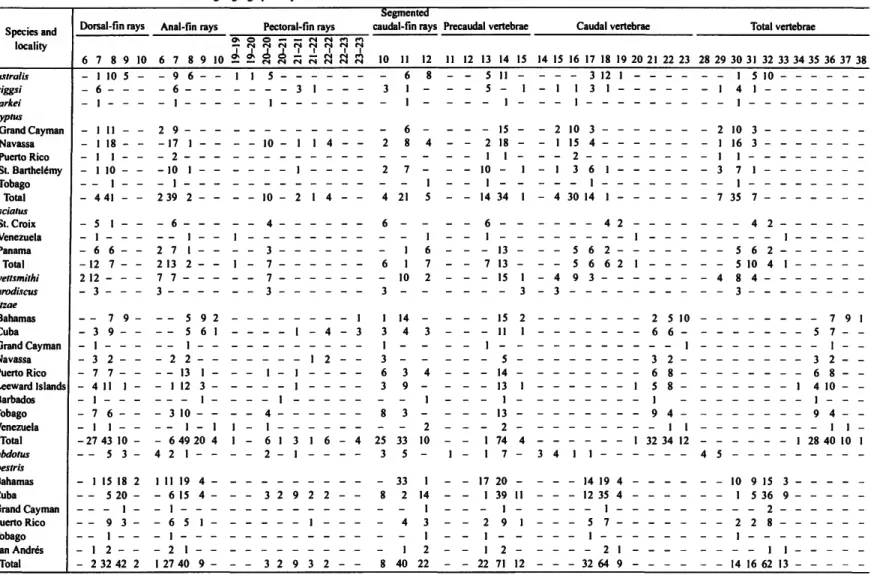
Methodology and terminology follow Briggs (1955), with the following exceptions and clarifications. All available local- ity data are given for specimens of the new species and for those used in our redescription of T. reitzae; abbreviated data are given for other taxa. All of our counts of vertical fin-ray el- ements were taken from radiographs, whereas Briggs' (1955) counts were taken by external examination of specimens. We found it difficult to obtain accurate counts by external exami- nation alone.
Counts of pectoral-fin rays include the rudimentary upper- most ray, which is often slender and inconspicuous. Pectoral- fin elements are difficult to discern, and it requires diligence to obtain accurate counts. The ventralmost rays are obscured by a membrane from the pelvic disk attaching to the basal region of the pectoral fin at about the level of the third or fourth ventral- most ray.
The relative positions of the dorsal- and anal-fin origins were taken from radiographs, as were vertebral and associated counts. The first element of the dorsal fin and the first of the anal fin are reduced and hidden by fleshy tissue; thus, they are not externally discernable.
Counts of caudal-fin rays from radiographs include only the segmented rays. We found that Briggs' (1955) method (fol- lowed by Smith-Vaniz, 1968) of counting only the "free tips"
of principle caudal-fin rays yielded inconsistent values for the smaller-sized species. All species examined have procurrent- ray counts falling in the range of four to eight, both dorsally and ventrally. The several species for which we have large sample sizes have variable procurrent-ray counts within the range of four to eight, but all species typically exhibit a range of five to seven. Procurrent-ray counts are not given in the de- scriptions or tabulated.
Vertebral counts from radiographs are presented as a for- mula: precaudal + caudal = total count (Briggs (1955) did not provide vertebral counts). The first caudal vertebra is distin- guished from the posteriormost precaudal vertebra by having a distinct, although often short, hemal spine. Specimens some- times show varying degrees of fusion of the penultimate and antepenultimate centra, indicated by the presence of two neural and/or hemal spines on what appears to be one centrum. This complex was counted as one, unless a distinct vertical fusion line between the two centra could be clearly discerned.
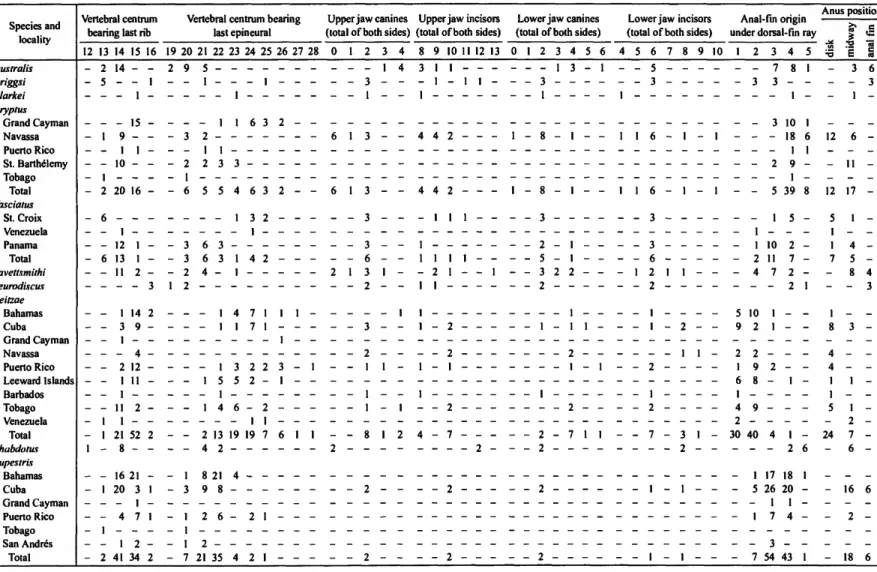
The characterization of the series of epineural bones and ribs (pleural) is given as the number of the posteriormost vertebra, counting from the first precaudal vertebra, bearing an epineural or rib (both often tiny) on one or both sides. Occasionally, an
epineural may be completely lacking from the vertebra directly anterior to the last vertebra that bears an epineural.
The anterior and posterior margins of the pelvic disk are of- ten curled under; we extended the membrane to an estimated natural condition to measure disk length in preserved speci- mens. The anterior margin of the disk varies among species from being smooth to bearing well-developed flaps (Figure 1).
We recognize two categories—smooth versus crenulate. The smooth category includes pelvic disks with anterior margins that vary from being smoothly rounded to having broad, low, weak convexities. The crenulate category includes margins varying from prominently crenulate to deeply lobed with pro- jecting flaps or papillae.
Upper- and lower-jaw tooth counts are presented separately.
Counts of canine teeth include the combined total from the left and right sides (canines are positioned at each end of the cen- tral row of trifid incisors). Counts of trifid incisors also are pre- sented as the total number of incisors from both sides (previous publications—e.g., Briggs, 1955, 2001, and Smith-Vaniz, 1968—gave the number of pairs of teeth). It is sometimes diffi- cult to classify individual teeth as canines versus incisors. The lateralmost tooth on each side of the central row of trifid inci- sors has a typical canine shape, but it may be the same size as the incisors. The one or two teeth adjacent to the lateralmost canine are sometimes intermediate in morphology between in- cisors and canines. We categorize teeth with a single pointed cusp as canines, even when they are slightly flattened. The typ- ical incisors of Tomicodon are trilobed, although the lateral- most incisors may be bilobed in rare cases.
The belly refers to the area between the posterior insertion of the pelvic disk and the anus.
We recognize three categories for position of the anus: (1) closer to the posterior margin of the pelvic disk than to the anal fin (near disk); (2) closer to the anal-fin origin than to the pel- vic disk (near anal fin); and (3) about midway between the pos- terior disk margin and the anal-fin origin (midway). The mid- way category includes positions slightly anterior or posterior to the midpoint. The relative position of the anus is the only pro- portional character we found to be useful in distinguishing these species. We recorded most of the measurements de- scribed by Briggs (1955) and found none useful in distinguish- ing the species of Tomicodon. We present data for only a few standard descriptive measurements in the species descriptions.
In most cases, specimens of Tomicodon must be dissected to determine the sex; thus, only a small sample of the specimens from any given locality was sexed. Counts of eggs were made for the right ovary. The left ovary is similar in size and shape to the right ovary and contains eggs of similar size and number.
Distinguishing characters for each taxon are provided in the identification key and are not repeated as a separate section in the individual species accounts.
Catalog numbers for specimens deposited in the National Museum of Natural History (NMNH), Smithsonian Institution (SI), are preceded by the acronym USNM (United States Na- tional Museum, whose collections are now part of the NMNH).
NUMBER 621
B
FIGURE 1.—Ventral view of pelvic disk of preserved specimens of Tomicodon lavettsmithi (top; USNM 365813, 26.7 mm SL) and of T. clarkei (bottom;
USNM 358693, 14.1 mm SL). A, B, and C are regions of the disk discussed in the text; crenulate and smooth refer to condition of the anterior margin of the disk.
ACKNOWLEDGMENTS
We have been assisted in a variety of ways by many people.
In the Division of Fishes, Department of Systematic Biology, National Museum of Natural History, Smithsonian Institution, we are especially indebted to D.G. Smith for providing keen in- sight into several taxonomic problems within Tomicodon; we particularly thank J.M. Clayton, S.J. Raredon, L.F. Palmer, S.
Smith, and K.A. Murphy for specimen processing and radiog- raphy. J.H. Mounts (NMNH), S.J. Raredon, and S. Smith pro- vided helpful suggestions on the use of image processing pro-
grams. M.H. Sabaj, E.B. Bohlke, and J.G. Lundberg of the Academy of Natural Sciences of Philadelphia (ANSP); R. Rob- ins and S. Gardieff of the Florida Museum of Natural History (UF); and M.A. Rogers of the Field Museum of Natural History (FMNH) provided loans of specimens. O.M. Lasso-Alcala, Museo de Historia Natural La Salle (MHNLS) and Museo Oceanologico Hermano Benigno Roman, Estacion de Investi- gaciones Marinas de Margarita (MOBR-EDIMAR), Venezuela, lent specimens and provided information. P. Bartsch and H.
Landesberg, Humboldt-Universitat zu Berlin, Museum fur Naturkunde, searched for the type specimens of T. fasciatus and provided information about the publication dates of W.C.H. Pe- ters' papers. M.L. Smith, Conservation International, provided information on the status of F. Poey's type specimens in Cuba.
For extensive help with field collecting at various Caribbean localities during which we obtained the clingfishes reported herein, we thank the following colleagues (listed in alphabeti- cal order): R. Allum (Quest Foundation), I. Augustine (Tobago Marine Fisheries Section), C.C. Baldwin (NMNH), S.D. Blum, Jr. (California Academy of Sciences), E.B. Brothers (EFS Con- sultants), E. Caesar (Tobago Marine Fisheries Section), R.E.
Clark, Jr. (NMNH), R.D. Clarke (Sarah Lawrence College), B.B. Collette (U.S. National Marine Fisheries Service), W.P.
Davis (Environmental Protection Agency (EPA)), W.N. Esch- meyer (California Academy of Sciences), C.R. Gilbert (Florida Museum of Natural History), C. Hansen (NMNH), J.D. Hardy (U.S. National Marine Fisheries Service), J.C. Howe (NMNH), G.D. Johnson (NMNH), R.S. Jones (University of Texas), P.
Keener (College of Charleston), S. Love (NMNH), L.
Micheletti (Quest Foundation), M. Nizinski (U.S. National Ma- rine Fisheries Service), T. Petersen (Quest Foundation), M.J.
Schotte (NMNH), C.L. Smith (American Museum of Natural History), D.G Smith (NMNH), M.L. Smith, A. Sundberg (Uni- versity of Delaware), C. Thacker (Los Angeles County Mu- seum), C.L. Thacker (University of Florida), D.M. Tyler (Smithsonian Books), A. Wight (Quest Foundation), and the Captain and crew of the M/V Quest.
We thank R.E. Clark, Jr., for photographs of live specimens of T. lavettsmithi and T.B. Griswold (National Aeronautics and Space Administration) for photographs of preserved specimens of T. clarkei, T. cryptus, and T. leurodiscus. W.P. Davis pro- vided behavioral observations of T. lavettsmithi maintained in aquaria in Belize and Florida. W.F. Smith-Vaniz (United States Geological Survey, Gainesville) and L.A. Rocha (University of Florida) provided preserved specimens and photographs of fresh specimens recently collected in the U.S. Virgin Islands.
K. Ruetzler and M.R. Carpenter (both of NMNH) provided support for work in Belize through the Caribbean Coral Reef Ecosystems Program, of which this paper is contribution num- ber 621. The Discovery Channel's Animal Planet series pro- vided funding for the Navassa Expedition.
We thank S.H. Weitzman (NMNH) and C.C. Baldwin for many helpful comments on the manuscript. We also thank Meredith Ray McQuoid (Smithsonian Books) for careful edit- ing of the paper.
SMITHSONIAN CONTRIBUTIONS TO ZOOLOGY
Genus Tomicodon Brisout de Barneville, 1846
Tomicodon Brisout de Barneville, 1846:144 [type species: Tomicodon chilensis Brisout de Barneville, 1846; by subsequent designation by Jordan, 1919:228 (see also Eschmeyer, 1990)].
Arbaciosa Jordan and Evermann in Jordan, 1896:230 [type species: Gobiesox humeralis Gilbert, 1890 (see also Eschmeyer, 1990); by original designation].
DISTINGUISHING CHARACTERS.—This g e n u s is d i s t i n - guished from other western Atlantic gobiesocid genera by the combination of a single row of flattened incisors (at least some trifid) on both jaws and the absence of papillae in disk region C (see Figure 1). Additional characteristics of the genus may be found in Briggs (1955).
Key to the Atlantic Species of Tomicodon
1. Anterior margin of pelvic disk smooth, without fleshy tabs [Figure 1] 2 Anterior margin of pelvic disk crenulate, with fleshy tabs [Figure 1] 5 2. Anus nearer to anal-fin origin than to pelvic disk 3 Anus nearer to pelvic disk or midway between disk and anal-fin origin 4 3. Anal-fin origin at vertical from base of dorsal-fin ray 2 or 3; anal-fin rays 7; pectoral- fin rays 21 T. briggsi Anal-fin origin at vertical from base of dorsal-fin ray 4 or 5; anal-fin rays 6; pectoral-
fin rays 20 T. leurodiscus 4. Head and body without dark bars; dorsal-fin rays 7 T. clarkei
Head and body with dark bars; dorsal-fin rays usually 8 T. crypt us 5. Head and body with sharply defined narrow pale bars on dark backgound
T. rhabdotus Head and body pale tan with broad dark bars or irregular blotches 6 6. Two strongly contrasting, pupil-sized dark spots on dorsum, one on each side above pectoral-fin base T. fasciatus Dorsum above pectoral-fin base without two distinctive dark spots 7 7. Fleshy base of pectoral fin bicolored, with dorsal half covered by brown blotch, ven- tral half unpigmented T. rupestris Fleshy base of pectoral fin with melanophores covering at least dorsal three-fourths and often all of base, frequently with two dark diagonal bars on a dusky background 8 8. Anus usually nearer to pelvic disk than to anal-fin origin; anal-fin origin usually at vertical from base of dorsal-fin ray 1 or 2; total number of vertebrae 34-38 (usual- ly 35 or more) T. reitzae Anus usually nearer to anal-fin origin or midway; anal-fin origin usually at vertical from base of dorsal-fin ray 3 or 4 (often of 2 for T. lavettsmithi); total number of vertebrae 29-32 9 9. Nasal flap tiny (length much less than diameter of nasal opening); dorsal-fin rays 6 or 7; caudal vertebrae usually 15 or 16 T. lavettsmithi Nasal flap usually well developed (length about equal to diameter of nasal opening);
dorsal-fin rays 8 or 9 (one with 7); caudal vertebrae usually 17 or 18 . . . T. australis
Tomicodon australis Briggs, 1955
FIGURE 2
Tomicodon fasciatus australis Briggs, 1955:67 [type locality: San Francisco do Sul, Santa Catarina, Brazil; holotype, USNM 88042].
DESCRIPTION (Table 1).—Dorsal-fin rays 7-9 (mode 8).
Anal-fin rays 7 or 8. Pectoral-fin rays 19 or 20 (mode 20). Cau- dal-fin segmented rays 11 or 12. Vertebrae 13-14+17-19=
30-32 (mode 14+18=32); last rib on vertebra 13 or 14 (mode 14); last epineural on vertebra 19-21 (mode 20). Anal fin origi-
nating at vertical from base of dorsal-fin ray 3-5 (usually 3 or 4). Upper jaw with 3 or 4 canines (mode 4), 8-10 incisors.
Lower jaw with 3-6 canines (mode 4), 6 incisors. Anterior margin of pelvic disk crenulate, with well-developed flaps. Pel- vic disk region A with 6 or 7 irregular rows of papillae; region B with 6 or 7 irregular rows (region C without papillae and not repeated in species descriptions that follow). Anus position varying from midway to near anal-fin origin, usually nearer anal-fin origin. Anterior nostril usually with well-developed dermal flap, flap sometimes tiny.
NUMBER 621
FIGURE 2.—Dorsal (top) and lateral views of a preserved specimen of Tomicodon australis (USNM 88042, 24.7 mm SL, holotype) from the southeastern coast of Brazil.
Body elongate, rounded in cross section. Head length 26.5%-30.1% SL (x =28.5%). Head width 19.8%-24.5% SL (x =21.8%). Pelvic disk small, length 23.3%-25.9% SL (x = 24.4%). Longest known specimen 26.8 mm SL.
Mature ovaries large, cigar-shaped, extending most or all of length of body cavity. One 25.7 mm SL specimen (USNM 87802) with well-developed ovaries, right ovary containing more than 50 eggs. Largest eggs among examined specimens about 0.6 mm in diameter in two females, 20.1 mm SL and 25.3 mm SL (both USNM 87808). Genital papilla of females short and conical with somewhat pointed tip; male papilla a slen- der, elongate tube.
ECOLOGICAL HABITAT AND DISTRIBUTION.—No informa-
tion is available on the ecological habitat of this species. It is known only from Rio de Janeiro and Santa Catarina on the coast of southeastern Brazil.
PRESERVED COLOR PATTERN (Figure 2).—Specimens seem
to retain their pigmentation pattern after preservation.
Males: Head and body with dark brown bars on tan back- ground. Head with five narrow dark bars radiating from eye:
anteriormost bar from eye to middle of upper lip, extending anteriorly and meeting similar bar from other side; remaining bars extending posteroventrally from eye to just below vent- rolateral curvature of head; posterodorsalmost bar extending from eye to border of opercle. Underside of head pale, with dark brown spots on each side of lower lip. Approximately six hourglass-shaped, dark saddles along dorsal profile: anterior- most saddle on top of head, posteriormost on top of caudal pe- duncle. Body laterally bearing approximately 9-11 narrow dark bars separated by broader pale interspaces: anteriormost bar behind pectoral-fin base, posteriormost bar on caudal pe-
duncle. Dark lateral bars from anal-fin origin to caudal-fin base reaching ventral midline. Belly and region anterior to anal-fin origin pale. Dorsal fin generally dark brown with ir- regular pale streak submarginally. Anal fin varying from pale to having a dark blotch over bases of anterior four or five rays. Caudal fin pale basally and distally, with two interven- ing broad, dark bars separated by a pale interspace. Pelvic disk pale. Pectoral fin and base with two or three slightly ir- regular, diagonal dark bars: first (anteriormost) bar extending from beneath dorsal attachment of gill cover posteroventrally to base of ventral pectoral rays; second bar beginning on bases of dorsalmost pectoral rays and paralleling first bar to about middle of fin; third bar, when present, beginning at midlength of dorsalmost rays and paralleling second bar in dorsal half of fin.
Females: Similar to males except lateral bars irregular and forming mottled pattern along sides of body; only posterior- most one or two bars with a few scattered melanophores reach- ing ventral midline.
FRESH COLORATION.—Field note in jar with holotype states
"markings were jet black, transverse bands sort of double on sides."
ETYMOLOGY.—The specific epithet is based upon the Latin australis, meaning southern, referring to the southwestern At- lantic distribution (Briggs, 1955).
MATERIAL EXAMINED (Abbreviated).—BRAZIL. USNM
88042 (24.7 mm SL, male, holotype of Tomicodon fasciatus australis); paratypes of T. f. australis: USNM 87799 (1: 24.3 mm SL), USNM 87800 (1: 21.5 mm SL), USNM 87801 (1:
22.0 mm SL), USNM 87802 (11: 19.0-26.8 mm SL), USNM 163663 (1:23.8 mm SL).
TABLE 1.—Frequency distributions for selected characters of western Atlantic species of Tomicodon. Localities are arranged geographically from north to south and clockwise around the Caribbean.
Species and locality austral is brigg.ii
i i cryptus
Grand Cayman Navassa
Da -* D '
St. Barthetemy Tobago
Total fasciatus
Total
/ H lU '
reitzae Bahamas Cuba Grand Cayman Puerto Rico Leeward Islands Barbados Tobago
Total
• i t
rupestris Bahamas Cuba Grand Cayman Puerto Rico Tobago
Total
Dorsal-fin rays 6 7 - 1 - 6
- 1 - 1 - 1 - 4 c 1
- 12 7 \7
i
- 3 - 1
-J
- 7 - 4 - 1 - 7
1
8 10
11 18 10 1 41
•
7
7 9 i 1 11 6 t - 2 7 43
- 1
i - 2
c
15 5 9 1 ->
32 9 10 5 _
- - - - _ _ - -
_ _
9 - - -
_ _ 1 - - - 10 -
• l
18 2 20 -
i 3 _
42 2
Anal-fin rays 6 7 - 9
1
2 9 - 1 7 - 1 0
| 2 39
J 7 2 13 7 7 3
2 - 1 - 3 - 6 4 7 1 11 - 6 j - 6
1
8 6
1 1 2
i 1 2
5 5
i
i 13 12 10 l 49
1
19 15 5
i 1 27 40
9 -
- _ -
_
9 6
1 3
•
-
20
4 4 1
9 10 _
- _ -
_
2 1
_ - -
i
4
- - -
-
19-19
1
- _ -
1
- _
_ - - i
1
- - -
-
Pectoral-fin rays 19-20 20-20
1 5
1
- 10 _ _ - 10
A
3 - 7 7
• i
- - _ -
- 1 - _ - 4
1
- 6
T
- -
- 3 - -
- 3
20-21
_
- _ -
_
- _
_ _ - 1
- 2 -
2
21-21
-
1 1 2
_
- 1
1 1 - 3 i
- 9 -
9
21-22
-
1 _ 1
_
- - 1
-
-
1
- 2 1
3
22-22
-
4 _ 4
_
- 4
- - 6
- 2 -
2 22-23 23-23 - -
- - _ _ - -
_ _
- 1 - 3
_ _ - - - - - 4
- - - - - -
- -
Segmented
caudal-fin rays Precaudal vertebrae 10
- 3
- 2 2 -
4 f.
6 3 1 3 1 3 6 3 -
8 25
- 8 - - - 8
11 6 1 1 6 8 7 - 21
j
1
10
14 4 -
3 9 -
3 33
« 33 2 -
4 -
1 40
12 11 8 - -
- 4 - -
1 5 -
]
7 - 2
- 3 -
4 - -
1 -
10 -
1
1 - 14 -
i
3 - l 2 22 -
12 13 _ 5 - 5
- - - 2 - 10
i
- 14
1 - 7
- - - _ I
_ _ - - - -
- 1 1 - 17 - 1 - 2
1 i
- 22 14 11 -
* 15 18
* - 34
13 13
| c
15 11 5 14 13 1 n
-) 74 7
20 39 l 9
71 15 -
1
- - 1 1
_
• 3 2 1
_ 1 -
4
- 11
1
12 14 15
- - - 1
- 2 - 1 - 1 - 4
_ _ 4 3 - - - -
_ _ - - - -
_ _
\ 4 - - - - - -
- -
Caudal vertebrae 16
- 1
i
10 15
i
3 30
5 5 9
- -
_ - -
_
- - -
- 17
3 3
3 4 6 ] 14
6 3
- -
_ - -
_
i
14 12 5
1
32 18 12 1
- - 1 1
A
1
6
- -
_ - -
_
19 35 l 7
64 19
1
- - _ -
2
- -
_ - -
_
4 4 -
* 9
20 21 - _
- - - - _ _ - -
1 -
- 2 - 6
•J
- 6 1 5 - 1 q
1 32
- - - - _ _
_ _ 22
_
- -
-
_
5 6
8 8
A
1
34
- - -
- 23
-
- - _ -
_
10 _
i
_ - -
i
12
- - -
- 28 29
- - I
- 2 - 1 i - 3 - 7
_ _ 4
- - _ _
_ _ - - - -
_ _ A S
- - - -
- -
- - 30
1
A 1
10 16
t
7
i
35
« 5 o
•J
- -
_
- -
_
10 1 2 i
14
Total vertebrae 31
5 I
3 3 1 7
A
A
10
A
- _
_ - -
_
9 5 2
16 32 10
- - _ -
4
- -
_ - -
_
15 36 8 I
62 33
-
- - _ -
i
1
_ _
_ - -
_
3 9 -
i 13
34 35 - -
- - - - _ _ - -
_ _
_ _ - 5
3 - 6 1 4 - 1 q
1 28
- - - - - -
- - 36
-
- - _ -
_
7 7 1
8 10 -
A
1
40
- - -
- 37 38
- -
- - _ _ - -
_ _
9 1 _ _
_ _ - _
1
10 1
- - - _ - -
- -
TABLE 1.—Continued.
Species and locality
Vertebral centrum bearing last rib
Vertebral centrum bearing last epineural
Upper jaw canines Upper jaw incisors Lower jaw canines (total of both sides) (total of both sides) (total of both sides)
Lower jaw incisors (total of both sides)
Anal-fin origin under dorsal-fin ray
Anus position
12 13 14 15 16 19 20 21 22 23 24 25 26 2 7 28 0 1 2 3 4 8 9 10 1 1 1 2 13 0 1 2 3 4 5 6 4 5 6 7 9 10 1 2 3 4 5 £
E 1
australis briggsi clarkei cryptus
Grand Cayman Navassa Puerto Rico St. Barthelemy Tobago
Total fasciatus St. Croix Venezuela Panama
Total lavettsmithi leurodiscus reitzae
Bahamas Cuba Grand Cayman Navassa Puerto Rico Leeward Islands Barbados Tobago Venezuela
Total rhabdotus rupestris
Bahamas Cuba Grand Cayman Puerto Rico Tobago San Andres
Total
- 2 14 -
— 5 — — _ 2 1 -
- 1 4 3 1 1 - - - - 1 3
3 _ _ _ i _ i i _ _ _ 3 _ _ 1 _ _ ! _ _ _ _ _ _ _ i _ _
1 - - 5 - - - - - - 7 8 1 3 _ _
- - - 15 - - 1 9 - - - - 1 1 - - - 10 - - _ 1 _ _ _ - 2 20 16 - - 6 - - -
- — 1 3 2 - - 1 1 2 2 3 1 - - 6 5 5
1 6 3 2 - - - - - - - _ - _ _ _ _ _ _ _ _ _ _ _ _ _ _ _ _ _ _ _ _ _ _ _ 6 1 3 - - 4 4 2 - - - 1 - 8 - 1 - - 1 1 6 - 1 - 1 -
3 - - 4 6 3 1 3 - 1
2 - - 6 1 3 - - 4 4 2 1 — 8 — 1 — — 1 1 6 - - 1 - -
1 0 1 18 6 1 1 9 - 1 - 39 8
5 -
- 12 1 6 13 I - 11 2
- - 1 14 - - 3 9
3 1 2 -
3 6 3 3 6 3 2 4 - 2 - -
_ _ _ _ _ _ _ _ 3 _ _ ! _ _ _ _ _ 1 4 2 - - - _ - 6 - - 1 1 1 1 — — 1 — — — — — 2 1 3 1 - - 2 1 1
2 - 1 5 - 1 - - 3 2 2 - - 2 _ _ _ _
1 2 1 1 - - 2 - - -
- 1 - 2 - 4
2 - 7 - 2 - 2 1 - 1
- 1 4 7 1 1 7 1
1 1 - - - - - 1 1
3 - - 1 1 - 1 1 - - - 1 - 2 - -
5 10 9 2
1 - - 1 - -
- - 2 12 - - 1 1 1 - - 11 2 - 1 1 - - 1 21 52 1 - 8 - - - 16 21 - I 20 3
- - 1 - 1 5 - - 1 - 1 4
3 2 2 5 2 -
3 - 1 1 _ _
2 - - - - 2 1 1 - 1 - 1
2 - - 1 - 1
1 1 -
2 - - 2 13 4 2 8 21 9 8
6 - 2 - 1 1 19 19 7
2 2 1 9 6 8 I _
2 - - - 1 -
6 1 1 - _ _ _ 2
1 2 4 - 7 - - _ _ _ _ _ _ 2
2 - 7 1 1 2 _ _ _ _
7 - 3 1 - - 2 -
4 9 2 - 30 40
4 7 1 - 1 2 6 - 2 1
1 - 2 6 18 I 20 - 1 - 4 - - - 1 2
- 2 41 34 2 - 1 2 -
7 21 35 4 2 1 - 7
- 3 6 - - 3 1 -
12 6 - - 11 - 12 17 - 5 1 - 1 - - 1 4 - 7 5 - - 8 4 - - 3 1 - - 8 3 - 4 - - 4 - - 1 1 - 1 - - 5 1 - 2 - 24 7 - - 6 -
- 16 6 - 2 -
43 1 - 18 6
Tomicodon briggsi, new species
FIGURE 3
DESCRIPTION (Table 1).—Dorsal-fin rays 7. Anal-fin rays 7.
Pectoral-fin rays 21 or 22 (mode 21). Caudal-fin segmented rays 10 or 11 (mode 10). Vertebrae 13-15 + 15-18 = 29-31 (mode 13 + 17 = 30); last rib on vertebra 13 or 16 (mode 13);
last epineural on vertebra 21-25. Anal-fin origin positioned at
SMITHSONIAN CONTRIBUTIONS TO ZOOLOGY
vertical from base of dorsal-fin ray 2 or 3. Upper jaw with 2 canines, 9-12 incisors. Lower jaw with 2 canines, 6 incisors.
Anterior margin of pelvic disk smooth. Pelvic disk region A with 6 or 7 irregular rows of papillae (papillae of innermost row larger than others and longitudinally elongate, best devel- oped in larger specimens); region B with 7 irregular rows.
Anus near anal-fin origin. Anterior nostril without dermal flap.
FIGURE 3.—Dorsal and lateral views of preserved specimens of Tomicodon briggsi: A, representative of faded pigmentation pattern (USNM 360612, 16.0 mm SL, female, holotype) from St. Croix, U.S. Virgin Islands; B, specimen with more of pigmentation pattern retained after preservation (FMNH 93758, 11.1 mm SL, female, paratype) from Carrie Bow Cay, Belize.
NUMBER 621
Body elongate, rounded in cross section. Head length 29.9%-32.5% SL (x =31.2%). Head width 20.7%-26.6% SL (x =23.6%). Pelvic disk small, length 21.3%-22.7% SL (x = 22.0%). Longest known specimen 17.3 mm SL.
Mature ovaries flattened dorsoventrally, restricted to postero- dorsal half of body cavity. Two paratypes, 15.4 and 16.0 mm SL (both USNM 365845), with well-developed ovaries, right ovary of each with about 28-30 eggs. Largest egg diameter among specimens examined about 0.15 mm. Sexually mature 11.1 mm SL paratype (FMNH 93758) with about 12 eggs in right ovary. Genital papilla of females forming a slender tube, with base of tube only slightly broader than distal portion (males similar) and with tip rounded to pointed.
ECOLOGICAL HABITAT AND DISTRIBUTION.—Specimens from the Grenadines and Belize were collected in areas with a mix of sand bottom and coral. Habitat data are unknown for specimens collected at St. Croix. Known depth range is 0-12 m.
PRESERVED COLOR PATTERN (Figure 3).—Pigmentation ap- parently fades after preservation.
Males: Head and body with faint bars composed of pale brown reticulations on straw-colored background. Head with five very faint, narrow bars radiating from eye: anteriormost bar from eye extending anteriorly almost to middle of upper lip; bar beneath middle of eye short, with slight bifurcation into short anteriorly and posteriorly directed portions; remaining bars extending from eye posteroventrally for a distance about equal to eye diameter, except posterodorsalmost bar merging with reticulate bar on top of head. Underside of head pale, without obvious melanophores. Interorbital space with scat- tered melanophores forming reticulate pattern extending poste- riorly and merging with reticulate nape bar; nape bar extending ventrally onto dorsalmost pectoral-fin ray. Dorsum of body with approximately four faint reticulate bars with narrow, dusky interspaces posterior to nape bar; all four body bars ex- tending ventrally to about middle of side of body; first two bars positioned between nape and dorsal-fin origin; next bar at dor- sal-fin origin; last bar on caudal peduncle. Belly pale. Dorsal fin with streak of scattered melanophores along distal one- fourth of fin; basal three-fourths of fin unpigmented. Anal fin without melanophores. Caudal fin with streak of melanophores along dorsal and ventral borders from posterior end of caudal peduncle to middle of fin; upper and lower edges of each fin ray outlined with melanophores in midregion of fin; remainder of caudal fin translucent (see Figure 3A, lateral view). Pelvic disk unpigmented. Pectoral-fin base unpigmented, but one specimen with faint reticulations on base.
Females: Similar to males.
FRESH COLORATION.—Unknown.
ETYMOLOGY.—The species is named in honor of John C.
Briggs, Georgia Museum of Natural History, in recognition of his pioneering monograph on clingfish systematics.
MATERIAL EXAMINED.—Holotype: u.s. VIRGIN ISLANDS.
St. Croix: USNM 360612 (16.0 mm SL, female); sta 726;
A.H. Ruse; collection date unknown, cataloged at USNM in 1875.
Paratypes: BELIZE. Carrie Bow Cay: FMNH 93758 (1:
11.1 mm SL, female); coral at S end of island, bottom sand with good coral development; 0-1 m depth; G-78-4; D.W.
Greenfield, T. Greenfield, C. Rakocinski; r o t e n o n e . GRENADINES. Little St. Vincent Island: ANSP 126691 (1: 12.8 mm SL) off NW point of Little St. Vincent (NE of Carriacou Island), white sand bottom with low coral heads, 120 m from shore; 10.5-12 m depth; TE-13; J.C. Tyler, W.N. Eschmeyer, G Koven; 27 Jun 1965; rotenone. U.S. VIRGIN ISLANDS. St.
Croix: USNM 365845 (4: 15.0-17.3 mm SL); collected with holotype.
Tomicodon clarkei, new species
FIGURE 4
DESCRIPTION (Table 1).—Dorsal-fin rays 7. Anal-fin rays 7.
Pectoral-fin rays 20. Caudal-fin segmented rays 11. Vertebrae 14+16=30; last rib on vertebra 15; last epineural on vertebra 23. Anal-fin origin positioned at vertical from base of dorsal- fin ray 4. Upper jaw with 2 canines, 8 incisors. Lower jaw with 2 canines, 4 incisors. Anterior margin of pelvic disk smooth (membrane thin, flexible, and only weakly and broadly crenu- late). Pelvic disk region A with 5 irregular rows of papillae; re- gion B with 5 irregular rows. Anus position midway. Anterior nostril without dermal flap.
Body elongate, rounded in cross section. Head length 30.5%
SL. Head width 17.7% SL. Pelvic disk small, length 20.6% SL.
Mature ovaries elongate and cylindrical. Holotype (14.1 mm SL; USNM 358693) with well-developed ovaries, right ovary with about 8 eggs, largest egg about 0.4 mm in diameter. Geni- tal papilla long, slender, and recessed into longitudinal groove.
ECOLOGICAL HABITAT AND DISTRIBUTION.—This species is known from a single specimen from Carrie Bow Cay, Belize.
The specimen was collected at a depth of 5 m from a 130 cm high colony of dead Acropora palmata by using quinaldine.
The holotype was observed underwater with its head slightly protruding from a hole surrounded by pink calcareous algae on the undersurface of a coral branch about 80 cm above the sub- strate. Despite years of observing and collecting with quinal- dine the small, hole-dwelling fishes (by JCT, especially chaenopsid tube blennies) in the spur-and-groove formations at Carrie Bow Cay, we believe this is the first (and only) speci- men of Tomicodon to have been observed or collected from that habitat and locality thus far. Careful and modest application of rotenone, which rarely has been used in that habitat at the Car- rie Bow Cay marine laboratory, might yield additional speci- mens of this elusive species.
PRESERVED COLOR PATTERN (Figure 4).—Pigmentation faded rapidly after preservation of the only known specimen (R.D. Clarke, pers. observ., 1999).
Female: Head and body of holotype straw colored, without broad, dark bars; irregular cluster of melanophores on nape, a
10 SMITHSONIAN CONTRIBUTIONS TO ZOOLOGY
FIGURE 4.—Dorsal and lateral views of the preserved holotype of Tomicodon clarkei (USNM 358693, 14.1 mm SL) from Carrie Bow Cay, Belize.
few other melanophores along dorsum to about midpoint of body. Head with approximately five very faint, narrow bars ra- diating from eye: anteriormost bar radiating from eye to middle of upper lip, extending anteriorly and meeting similar bar from other side; posterodorsalmost bar extending from eye to border of opercle. Underside of head unpigmented. Belly, dorsal fin, anal fin, caudal fin, pelvic disk, pectoral fin, pectoral base, and remainder of body unpigmented.
FRESH COLORATION.—Color observations were made by R.D. Clarke at the time of collection.
Holotype tanish overall with orangish pink cast, about same color as the patch of pinkish calcareous algae surrounding the hole from which it was collected; specimen without prominent markings when examined fresh under a compound microscope.
ETYMOLOGY.—The species is named in honor of Raymond D. Clarke, Professor of Biology at Sarah Lawrence College, Bronxville, New York, who collected the holotype and only known specimen during his studies of the behavioral ecology of chaenopsid blennies at Carrie Bow Cay, Belize.
MATERIAL EXAMINED.—Holotype: BELIZE. Carrie Bow Cay: USNM 358693 (14.1 mm SL, female); spur-and-groove formation off E side of island; 16°48.15'N, 88°04.91'W; 5 m depth; R.D. Clarke; 27 Jul 1999.
Tomicodon cryptus, new species
FIGURE 5
DESCRIPTION (Table 1).—Dorsal-fin rays 7 or 8 (mode 8).
Anal-fin rays 6-8 (mode 7). Pectoral-fin rays 20-22 (mode 20).
Caudal-fin segmented rays 10-12 (mode 11). Vertebrae 13-15 + 15-18=29-31 (mode 14+16=30); last rib on vertebra 13-15 (usually 14 or 15); last epineural on vertebra 20-26. Anal-fin
origin positioned at vertical from base of dorsal-fin ray 3-5 (mode 4). Upper jaw with 0-2 canines (mode 0), 8-10 incisors.
Lower jaw with 0—4 canines (mode 2), 4-10 incisors. Anterior margin of pelvic disk smooth. Pelvic disk region A with 6 or 7 irregular rows of papillae; region B with 6 or 7 irregular rows.
Anus position varying from midway to near disk. Anterior nos- tril usually with small dermal flap, flap sometimes tiny or ab- sent on one side.
Body elongate, rounded in cross section. Head length 28.3%-35.8% SL (x =31.5%). Head width 19.1%-27.2% SL (x =22.6%). Pelvic disk moderate in size, length 2 6 . 7 % - 31.0% SL (x =28.3%). Longest known specimen 19.0 mm SL.
Mature ovaries elongate and cylindrical. One 14.5 mm SL paratype (USNM 365860) with well-developed ovaries, right ovary with about 10 eggs, largest egg about 0.6 mm in diame- ter. Genital papilla of females forming a slender tube, with base of tube only slightly broader than distal portion (males similar), and with tip rounded to pointed.
ECOLOGICAL HABITAT AND DISTRIBUTION.—Specimens
have been collected from depths of 0-8.5 m in high-energy surge zones of rocky shores, including tide pools at the Baha- mas, Navassa Island, Grand Cayman, Puerto Rico, Mona Is- land (Puerto Rico), St. Barthelemy, and Tobago.
PRESERVED COLOR PATTERN.—Pigmentation faded rapidly in all but a few specimens after preservation (JTW, pers. ob- serv.). The holotype is one of the few exceptional specimens that has retained much of its pigmentation pattern after preser- vation.
Males (Figure 5A): All pigmentation completely, or almost completely, faded on most specimens soon after preservation in ethanol. Some specimens (e.g., the holotype), however, in ajar with faded individuals retaining prominent dark bars and
NUMBER 621 11
FIGURE 5.—Dorsal and lateral views of Tomicodon cryptus: A, preserved specimen (USNM 358700, 13.4 mm SL, holotype) from Navassa Island (between Haiti and Jamaica); B, fresh specimen (USNM 365861, 13.8 mm SL, paratype) from Navassa Island.
blotches; one jar of specimens collected in 1973 containing some specimens with prominent dark markings, others com- pletely faded.
Head and body with brown bars on straw-colored back- ground. Head with five narrow, dark bars radiating from eye:
anteriormost bar radiating from eye to middle of upper lip, ex- tending anteriorly and meeting similar bar from other side; bar beneath middle of eye usually bifurcating into anteriorly and
posteriorly directed portions; remaining bars extending from eye posteroventrally to just below ventrolateral curvature of head; posterodorsalmost bar extending from eye to border of opercle. Underside of head with pale background; scattered melanophores on lip flap on each side of lower jaw. Interorbital space dusky; scattered melanophores on snout and posterior in- terorbital region. Approximately six dark brown broad bars with narrow, dusky interspaces along body and saddling dorsal
12 SMITHSONIAN CONTRIBUTIONS TO ZOOLOGY
midline: anterior bar on nape; next two bars extending ven- trally, bifurcating at about midbody and forming inverted Y, its tips terminating before reaching midventral line of belly; fourth bar also forming inverted Y, with tips reaching ventral midline, forming continuous double band (ventrally)/single band (dor- sally) around body; remaining bars forming continuous broad bands around body; last bar encircling caudal-fin base. Belly pale. Dorsal fin with dark brown blotch over basal one-half of about anteriormost four or five rays, remainder pale. Anal fin with few scattered melanophores at bases of anterior two or three rays, remainder pale. Caudal fin unpigmented posterior to bar encircling bases of caudal rays. Pelvic disk unpigmented.
Pigmentation on pectoral fin and base faded or absent in many specimens; in specimens with color pattern persisting in preser- vative, a large brown blotch covering all but ventral border of pectoral lobe and extending out about one-half length of pecto- ral-fin rays over upper three-fourths of pectoral fin.
Females: Similar to males except bars more irregular and without obvious bifurcations; pectoral blotch restricted to lobe and basal one-fourth length of pectoral-fin rays.
FRESH COLORATION.—The following description is based upon 35 mm Kodachrome photographs (one presented in black and white in Figure 5B) of two males (13.6 and 13.8 mm SL) and one female (12.8 mm SL) from Navassa Island (NAV 99-5).
Males with dark brown bars and bands separated by pinkish maroon interspaces dorsally, changing to bright white inter- spaces midlaterally and ventrally; snout and pale regions be- tween bars under eye pinkish; all fins with pinkish cast. Fe- males with mottled, dark brown bars anteriorly separated by olive-brown interspaces; posterior bands olive, separated by pinkish interspaces; four bright white, approximately pupil- sized spots along ventrolateral side of body between pectoral- fin base and anal-fin origin; dark bars above pectoral-fin base and on head with bluish white mottling around borders; pale ar- eas beneath eye and on opercle pinkish; pinkish white spots on body just above pectoral-fin base; snout and interorbital region pinkish brown; all fins with pinkish cast.
ETYMOLOGY.—The specific epithet is from the Greek kryp- tos, meaning hidden or secret, and refers to the cryptic colora- tion that conceals specimens of this species in their habitat.
GEOGRAPHIC VARIATION.—Our data indicate only one modal shift for meristic characters—i.e., in the precaudal verte- bral count from 13 at St. Barthelemy (10 of 11 specimens) and Tobago (1 of 1) to 14 at Navassa Island (16 of 18) and Grand Cayman (15 of 15).
MATERIAL EXAMINED.—Holotype: NAVASSA ISLAND. USNM
358700 (13.4 mm SL, male); tide pools and surf zone at shore just E of Northwest Point; 18°25.81'N, 75°01.57'W; 0-2 m depth; NAV 99-15; C. Thacker, M. Smith; 2 May 1999; roten- one.
Paratypes: CAYMAN ISLANDS. Grand Cayman: ANSP 105056 (16: 4.0-13.6 mm SL); SW corner of island, rocky shore in front of Seaview Lodge; 0.5-3.5 m depth; sta 1; C.R.
Gilbert, J.C. Tyler; 20 Oct 1964; rotenone. ANSP 178031 (1:
12.4 mm SL); S side of island, Prospect Point, just E of South Sound; 1-2 m depth; sta 3; C.R. Gilbert, J.C. Tyler; 21 Oct 1964; rotenone. NAVASSA ISLAND. USNM 359404 (3: 7.8- 14.6 mm SL); tidepools above surf zone and adjacent surf area just E of Northwest Point; 18°25.81'N, 75°01.54'W; 0-0.4 m depth; NAV 99-14; C. Thacker, M. Smith; 2 May 1999; roten- one. USNM 365858 (1: 10.3 mm SL); steep rock wall at shore just E of Northwest Point, steep rock wall with brown algae and sea fans, with sand flat beginning at a depth of 7.5 m;
18°24.84'N, 75°01.69'W; 3-8.5 m depth; NAV 99-7; J.T. Will- iams, B.B. Collette, L. Micheletti, R. Allum; 29 Apr 1999; ro- tenone. USNM 365859 (2: 10.7, 13.6 mm SL); at shore on tip of Northwest Point, undercut area with wall dropping off to a depth of about 4.5 m; 18°25.78'N, 75°01.22'W; 0-6 m depth;
NAV 99-1; J.T. Williams, B.B. Collette, C. Thacker, L.
Micheletti, M. Miller; 29 Apr 1999; rotenone. USNM 365860 (7: 10.0-14.5 mm SL); collected with holotype. USNM 365861 (23: 8.2-14.3 mm SL); shore at undercut of island at Northwest Point, surf zone in deeply undercut (about 3 m) cliff, encrusting bryozoa abundant; 18°25.82'N, 75°01.74'W; 0-4.5 m depth; NAV 99-5; J.T. Williams, B.B. Collette, C. Thacker, L. Micheletti, M. Smith; 30 Apr 1999; rotenone. PUERTO RICO. Mono Island: ANSP 178029 (2: 11.8-13.4 mm SL);
near anchorage, sand and rock-covered bottom with calcareous algae and shallow caves at shore; 18°O5'30"N, 67°56'30"W;
0-1 m depth; W.F. Smith-Vaniz, P.L. Colin; 6 Oct 1978;
rotenone. ST. BARTHELEMY. He Syndare, Port Gustavia:
ANSP 106115 (1: 13.6 mm SL); W edge of the smaller of the two islets that make up the Syndares, boulders and short grass in surge zone, 0-3 m from shore; 0-1.5 m depth; TE-53; J.C.
Tyler, W.N. Eschmeyer; 13 Jul 1965; rotenone. ANSP 123662 (11: 9.0-15.3 mm SL); all other data same as ANSP 106115.
Nontype Specimens: BAHAMAS. Exuma Cays: UF 212746 (30: 9.0-13.5 mm SL); CRR-BWI52; H.A. Feddern et al.; 23 Aug 1963. COLOMBIA. Isla de Providencia: UF 25717(1:
19.0 mm SL); CRG 69-20; C.R. Gilbert, J.C. Tyler et al.; 12 Aug 1969. PUERTO RICO. Puerto Yabucoa: ANSP 115676 (1: 16.4 mm SL); sta 3; N. Foster, J. Loos; 14-15 Jul 1969.
TOBAGO. Mt. Irvine: ANSP 178030 (1: 15.4 mm SL); J. and H. Randall; 3 May 1964.
Tomicodon fasciatus (Peters, 1859)
FIGURE 6
Sicyases fasciatus Peters, 1859:412 [type locality: Puerto Cabello, Venezuela;
type specimen lost; neotype, USNM 365854, Panama, designated in "No- menclatural Discussion," below].
Arbaciosa minuta Meek and Hildebrand, 1928:928 [type locality: Colon, Pana- ma; holotype, USNM 81523].
DESCRIPTION (Table 1).—Dorsal-fin rays 7 or 8 (mode 7).
Anal-fin rays 6-8 (mode 7). Pectoral-fin rays 19 or 20 (mode 20). Caudal-fin segmented rays 10-12 (usually 10 or 12). Ver- tebrae 13-14+16-20 = 30-33 (mode 14 + 17orl8 =31); last rib on vertebra 13-15 (mode 14); last epineural on vertebra