He made a large editorial contribution to the first edition of this book, always respecting what I was trying to convey. His way of communicating the connection between practice and concept was very important not only to this book, but also to the way my colleagues and I present the workshops.
AN INTRODUCTION TO CULTURE
I believe in understanding one's own culture and one's own assumptions and expectations of how people "should" be.
The impact of culture on business
These premises are derived from their culture of origin, the culture in which they work, and the culture of the organization that employs them. Employees may not accept that individual members of the group excel in a way that exposes the shortcomings of other members.
How proven formulas can give the wrong result
The question is not whether a hierarchy in the Netherlands has six levels, like a similar company in Singapore, but what the hierarchy and these levels mean to the Dutch and Singaporeans. Where the meaning is quite different, for example a "chain of command" versus "a family", then human resource policies developed to implement the former will seriously miscommunicate in the latter context.
Culture is the way in which people solve problems
The patient asks the doctor, "What's wrong with me?" The doctor replies, "Pneumonia." "What causes pneumonia?" "It's caused by a virus." "Interesting," says the patient, "what causes the virus?" The doctor shows signs of severe irritation and the discussion dies down. Very often this is a sign that the questioner has hit on a basic assumption or, in the words of Collingwood2, an absolute assumption about life.
The basis of cultural differences
Americans generally start from scratch and what matters is their current performance and their plan to "get there" in the future. This is nouveau riche for the French, who prefer the ancien pauvre; they have a great sense of the past and relatively less focus on the present and future than Americans.
Structure of the book
THE ONE BEST WAY OF ORGANISING DOES NOT EXIST
What the gurus tell us
However, studies in the 1970s showed that the effectiveness of certain methods does depend on the environment in which we work. We must note that these contingency studies are still looking for one best way in particular circumstances.
Neglect of culture in action
Recently, most so-called "contingency" studies have asked how the key structures of the organization vary in accordance with larger variables in the environment. Although the case is real, the names of the company and the participants are fictitious.
Culture as a side dish?
Johnson's last attempt to introduce a more "human" side to the debate about the implementation of techniques and political instruments was useless. Financial manager, Mr. Finley, echoed the sentiment of the entire management team: “We all know that cultural differences are diminishing with the increasing reach of the media.
An alternative approach
One way is to view a business as a system designed to perform functions and tasks in an efficient manner. People are employed to perform these functions using machines and other equipment.
SUMMARY
We may label them if we want, but we cannot expect them to understand or accept our definitions unless they match their own.
THE MEANING OF CULTURE
The concept of culture
In cultural training workshops, we often start by asking the participants: "What does the concept of culture mean to you?" The more difficult question is perhaps: "Can you name something that is not covered by the concept of culture?".
The layers of culture
A typical Dutch question that may follow is: "Why do you respect authority?" The most likely Japanese reaction would be either confusion or a smile (perhaps hiding their annoyance). It is not difficult to change culture when people are aware that the survival of the community is at stake, where survival is considered desirable.

Culture directs our actions
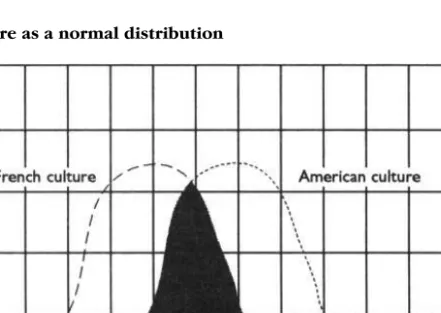
Culture as a “normal distribution”
Americans might describe the French as having the behavioral characteristics shown in section A of the graph, or the tail of the normal distribution. First, a stereotype is a very limited view of the average behavior in a particular environment.
Cultures vary in solutions to common problems and dilemmas
The shared meanings that are the essence of culture are man-made, are incorporated in the people within a culture, yet transcend the people in the culture. The categories of culture that emerge from the solutions that cultures choose will be the subject of the next seven chapters.
RELATIONSHIPS AND RULES
In addition, the company became aware that the best sales people were often leaving the firm for higher-paid competitors. Five salespeople left the company because they were convinced the system treated them unfairly.
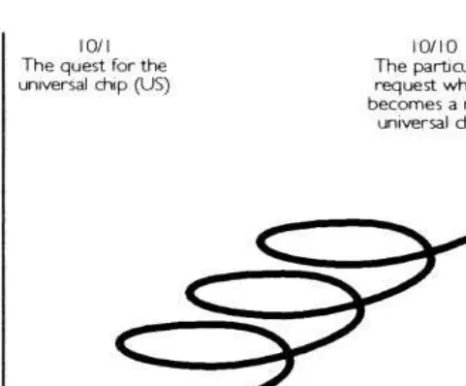
The universal versus the particular
The particularist will probably be more dismissive of the fact that it caused distress to poor Jennifer. He will easily earn the 30% bonus, although this will be small in relation to his total income, supplemented by his wife's and by his share of the acquisition payment.
Universalist versus particularist orientations in different countries
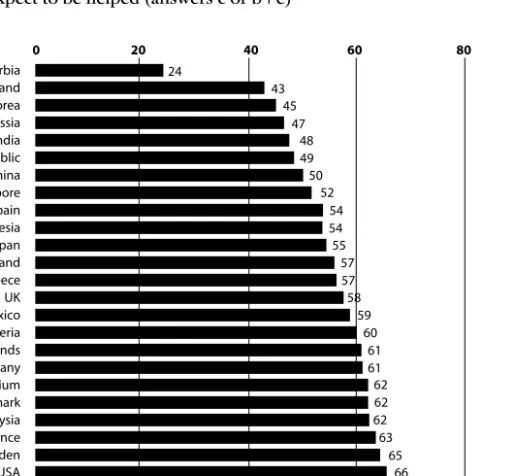
1b As a friend, he has some right to expect me to testify about the lower figure. 1c As a friend, he has no right to expect me to testify about the lower figure.

Universalism versus particularism in international business
The so-called universally applicable law was no longer considered relevant in the eyes of the Arabs. Instead of the job description and evaluation "picking" the person who best fulfills it, the person was first informally and intuitively selected and then wrote their description and evaluation.

Reconciling universalism and particularism
I suspect that with every inch, one of the Japanese would leave the room in despair. If the relationship is good enough, we can easily change the details of the contract later, e.g.
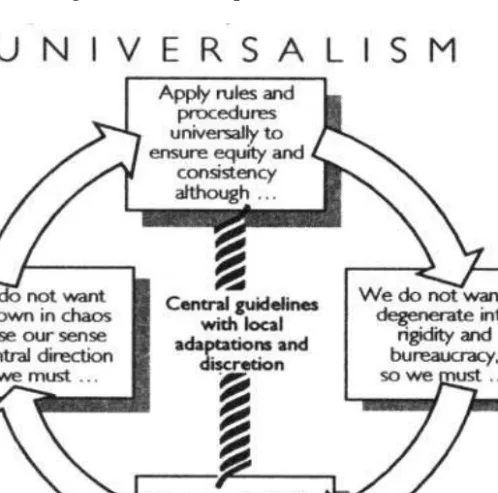
Test yourself
This type of question is asked to assess participants' preference for a perfect universal answer (1); complete particularistic response (2); a particularistic response aligned with a universal orientation (3); and a universalistic response aligned with a special relationship (4). Will excellent workers be encouraged or discouraged in their work by those who cut their wages to pay them.
Practical tips for doing business in universalist and particularist cultures
Will the local leadership cooperate wholeheartedly in this change or find ways around it. Does local management have the power to organize sales territories so they can choose who performs well in certain areas.
THE GROUP AND THE INDIVIDUAL
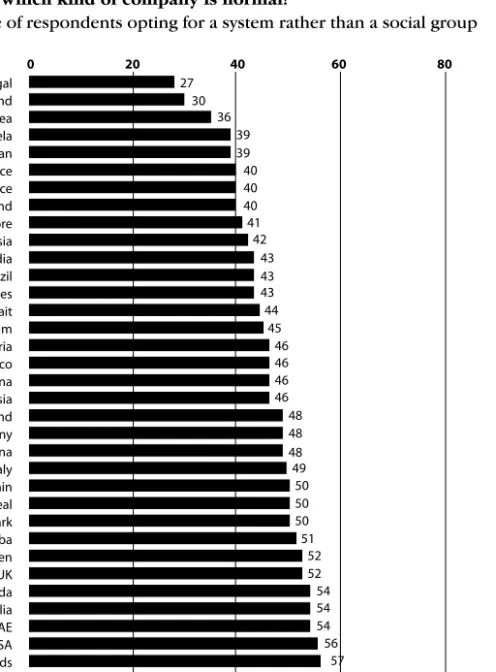
That the Japanese are not significantly more group-oriented in their responses to this question than the French is particularly interesting; also that the Chinese score, albeit only slightly, as more individualistic than the Indians.

Concepts of individualism and communitarianism
It prevailed in the United States, but is still strongly opposed by the French Catholic tradition. French business may have been forever affected by the pro-business French Liberal Party being in power when France suddenly fell to the Nazis in 1940.
Does modernisation imply individualism?
Individualism has been adopted or opposed by various political factions throughout the history of countries, and the strength of that ethic today depends largely on the fortunes of its advocates. Later, in the nineteenth century, French socialists pointed to the positive effects of individualism while outlining a new independence from traditional structures and rejecting the authority of religious, economic, and intellectual hierarchies.
Which community?
This question prompts a number of assessments that are consistent with the previous question, but we can also identify a number of shifts. The French tend to identify with la France, la famille, le cadre; Japanese with corporation; the former Eastern Bloc with the Communist Party; and Ireland with

Is individualism a corporate requirement?
The expansion of the division of labor would result in the individual sharing fewer characteristics with other individuals in the same society. The individualistic culture views the individual as “the end” and improvements to communal arrangements as the means to achieve it.
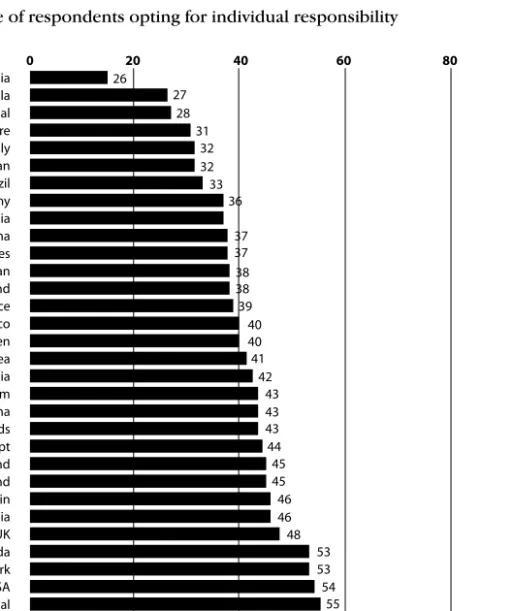
Individualism versus communitarianism in international business
Individualism versus communitarianism in international business. the Dutch manager's proposal that they should vote or they should vote. Quite often he or she may be the top negotiator in the group and is an interpreter rather than a translator.
Individualism, communitarianism and motivation
It had seemed so obvious in the Missouri meetings, but now he had doubts. In general, he explained, they could detect a correlation between the use of this system and computer sales, although it should be noted that a similar system had failed miserably in the production department.
Differences in organisational structure
Western motivation theories allow individuals to grow from their early, and therefore primitive, social needs to an individually brilliant self-actualization at the top of the hierarchy. The Japanese idea of the highest good consists of harmonious relationships within and with the patterns of nature; the primary orientation is to other people and to the natural world.
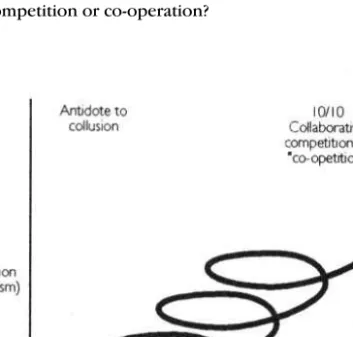
Reconciling individualism and communitarianism
At the beginning is the group: how can I, as an individual, serve the group better? In addition to avoiding shame, reconciliation lies in the fact that the group has taken care of the individual's mistake and no additional punishment is needed.
Practical tips for doing business in individualist and communitarian cultures
FEELINGS AND RELATIONSHIPS
Affective versus neutral cultures
It is easy for British, North Americans or Northwestern Europeans to sympathize with Johnson or Bergman about “excitable” Italians. As Pascal wrote, “The heart has its reasons of which reason is ignorant.” But he was French.
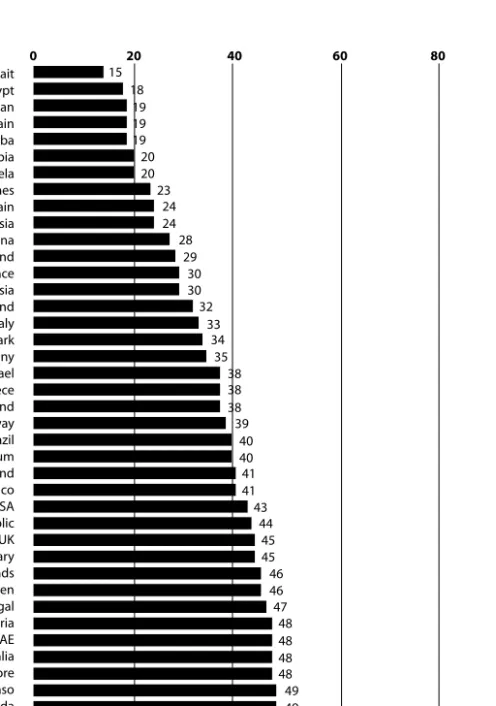
Degrees of affectivity in different cultures
Similarly, you can mock the "walls" that separate reason from emotion, or argue that because of the leakage that often occurs, they should be thicker and stronger. If the insiders are all laughing, the outsider feels left out, deprived of the emotional release that others have enjoyed.
Intercultural communication
Then why did you greet me?" "Because you seemed to know me, sir." The professor realized that in the US, eye contact between strangers is only supposed to last for a second. Leonel learned quickly, and when he was in Surinam he looked the other grandmother straight in the face to show respect.

Reconciling neutral and affective cultures
I believe that the clarity of my message will allow me to control even more emotional turmoil in the future. Answering "2" supports a neutral starting point for more effective display of emotions in the future.
Practical tips for doing business in neutral and affective cultures
2 If you discover whose work, energy and enthusiasm is invested in which projects, you will be more likely to appreciate stubborn positions. 3 Look for small clues that the person is happy or angry and reinforce their importance.
HOW FAR WE GET INVOLVED
Specific versus diffuse cultures
To their astonishment and dismay, the Italians "thrown a tantrum" in the middle of a meeting over serious professional issues. To call “the idea” crazy is to call them crazy and to doubt their ability to represent the cultural views of fellow Italians.
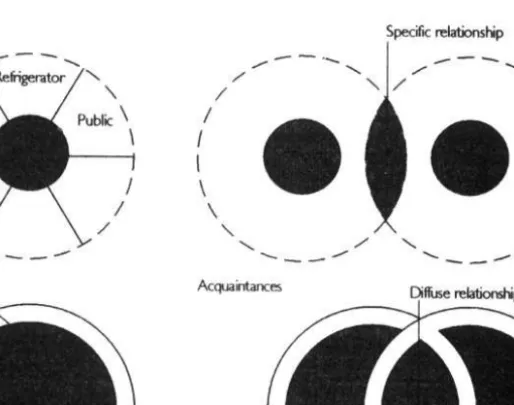
Negotiating the specific—diffuse cultural divide
Here you "surround" the stranger, getting to know him broadly and get to the specifics of the business only later when trusting relationships have been established. In the specific approach you don't waste time winning and eating a person who isn't fully committed to the specifics of the deal.
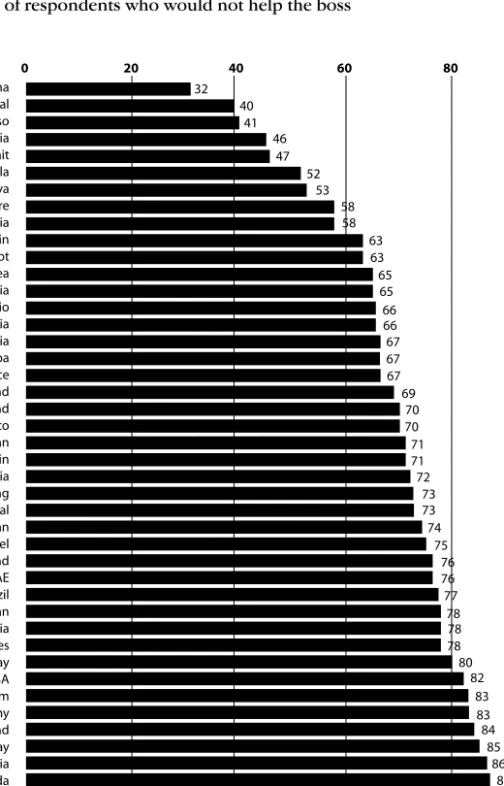
The effect of specific—diffuse orientation on business
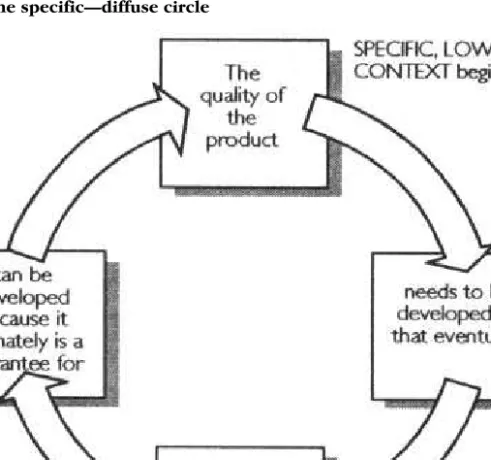
All of this forms "the circle before it gets to the point" that we saw in Figure 7.4. But for the Chinese doctor who worked closely with the Dutch doctor and whom he considered a "father figure", the criticism was a cruel accusation, a total rejection and a betrayal of mutual trust.
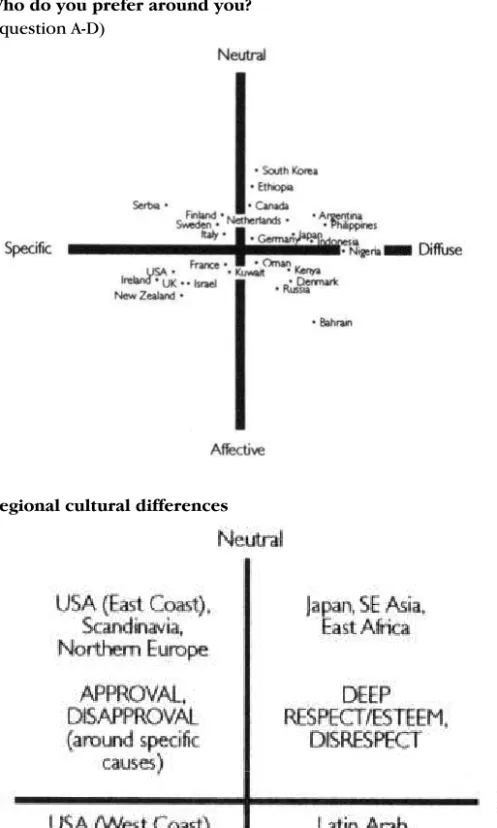
The mix of emotion and involvement
B People doing their job, minding their own business and giving you the freedom to do the same (specific and neutral: approval). C People who try to improve themselves and have certain ideals and goals in life (diffuse and neutral: esteem).
Reconciling specific—diffuse cultures
Similarly, mark “I” the approach you think would be preferred by your closest colleagues at work, and mark “2” the approach you think would be their second choice. This question very clearly reveals four alternative approaches to the criteria that should be used to define organizational effectiveness.

Practical tips for doing business in specific and diffuse cultures
4 Clear, precise and detailed instructions are considered to ensure better compliance or give employees the opportunity to dissent in clear terms. 4 Ambiguous and vague instructions are considered to allow for subtle and responsive interpretations allowing employees to exercise personal judgment.
HOW WE ACCORD STATUS
While hoping Munoz could succeed, Johnson was amazed to see him return the Italians to the conference room within minutes. However, it was immediately clear that Munoz was now backing the Italians' call for modifications to the pay-for-performance plan.
Status-by-achievement and economic development
Egypt Nepal Uruguay Argentina Czech Republic Spain Cuba Bulgaria Hungary Romania South Korea Poland Indonesia Ethiopia Austria Japan Greece China Oman Venezuela Netherlands Russia Mexico Hong Kong Brazil Philippines Israel Italy France Switzerland Thailand India Singapore Kenya Portugal Germany Finland Denmark Nigeria Sweden UK New Zealand Ireland Canada Australia USA Norway. Kuwait Saudi Arabia Austria Oman Thailand India Hong Kong Serbia Philippines Kenya Burkina Faso Bahrain Cuba Argentina Brazil Belgium Switzerland South Korea Russia Germany Ethiopia Pakistan Bulgaria Japan Singapore Greece Italy Poland China Mexico Spain Hungary France Portugal Austria Czech Republic Sweden Canada US UK New Zealand Finland Denmark Ireland Norway.

Ascription and performance
What seems to happen is that some very successful business cultures assign status to people, technologies or industries that they expect will be important to their future as an economy, with the result that those people and sectors receive special encouragement. You therefore have a choice of assigning electronics status before the production results expire or afterwards.
Achievement- and ascription-oriented cultures’
The interweaving of attributing and achieving orientations is a feature of the world's leading economies, Japan and Germany. Or attributing can drive performance, as when key industries are first targeted and then won by “national champions”.
The Thai lost his reserve for a moment and shouted: "We can get you a new Mercedes by tomorrow, but Suzukis take much, much longer." The GM asked him to see what he could do to speed up the process. This will not be effective in the long term, and in the short term it can be very expensive.
Towards reconciliation
Such a referral could be paid and valued in the same way as being in charge in an achievement-oriented culture, perhaps with an allowance for culture shock. In the great American tradition, turnaround managers started at the top of Figure 8.3 and focused on the reward people could receive for their achievements.

Practical tips for doing business in ascription- and achievement-oriented cultures
HOW WE MANAGE TIME
The concept of time
The way we think about time is intertwined with the way we plan, strategize and coordinate our activities with others. The experience of time means that we can consider a past event now (out of sequence as it were), or anticipate a future event.
Orientations to past, present and future
Sequentially and synchronically organised activities
Then he rudely continued his conversation as if I wasn't even in the room with him. I'm running late..” the scheduler will complain, as if he himself were a train or airline.
Measuring cultural differences in relation to time
Arrange these circles in the way you want that best shows how you feel about the relationship between the past, present and future. When you are done, label each circle to show which is the past, which is the present, and which is the future.
Time horizon
It is clear that the relatively long-term vision of the Japanese contrasts with that of the Japanese. However, there are some notable differences between long-term orientation to the past, perceived extension of the present, and a long-term view of the present.
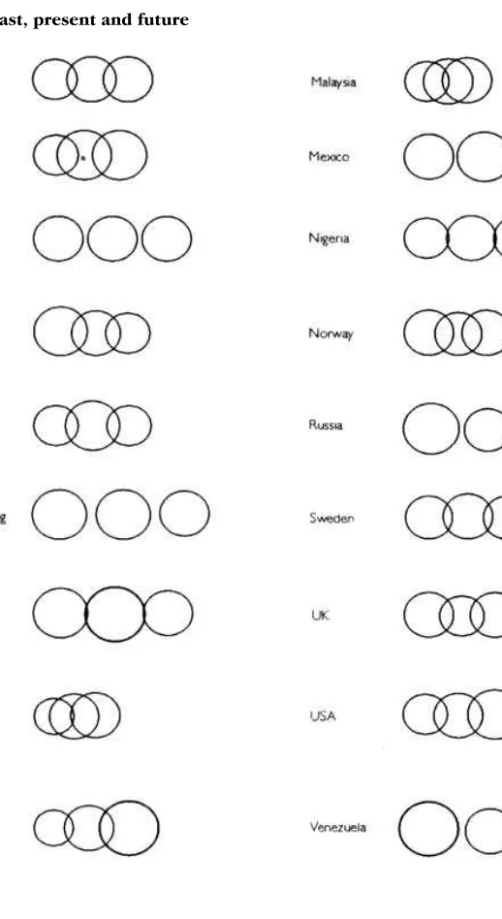
Time orientations and management
However, because the individual winner cannot do much about the distant future—there are simply too many events that can happen—the US's idea of the future is short-term, something controllable from the present. On the other hand, when a person's Hollywood career is "only as good as their last performance," the future is a sequence of episodes of relative success and failure.
Managing change in a past-oriented culture
A long presentation of the historical background of the French state-owned company was prepared for the minister and his team. As far as the French were concerned, indefinite after-sales service was part of the contract.
Planned sequences or planned convergence?
Likewise, the details of the equipment were less important to the Mexicans than the responsiveness of the supplier, since they could not know what problems might arise in the future. Instead of the efficiency of getting from A to B in the shortest possible time, there is the efficiency of developing closer relationships in the long term.
Reconciling the sequential and the synchronic
4 Just-in-time synchronization of processes and with customers is the key to shorter cycle times. Indicate “1” the approach you think would be preferred by your closest colleagues at work and “2” the approach you think would be their second choice.
Practical tips for doing business in past-, present- and future-oriented cultures
2 An employee's entire history with the company and future potential is the context in which their current performance is viewed. 3 Discuss with the employee his/her ultimate aspirations in the context of the company; in what ways are these accomplished.
HOW WE RELATE TO NATURE
Controlling nature, or letting it take its course
Only 19% of Japanese believe it's worth trying to control the weather, and only 22% of Chinese; only 21% of Swedes, but 36% of Britons. The British, Germans and Americans are above the middle of the range, but by no means among the top scorers.
Control and success
You follow the way of the sword (Kendo) or the warrior (Bushido), their practices and disciplines, until they become part of your life. To understand the laws of mechanism it was necessary to predict and control the operation of nature's machinery, that is, to internalize the laws of nature and then show that nature obeyed you.
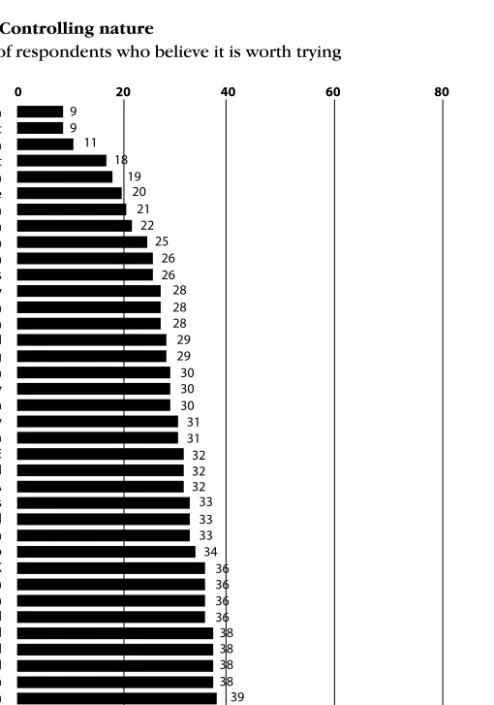
How important is a culture’s orientation to nature?
According to evolutionary biologists, it's the environment that decides which creatures fit and which don't, so by extension markets decide, not managers. Mintzberg points out that, in any organization, those who interact with customers have already devised strategies to cope with daily problems.4 The task of top management is therefore to take these emergent strategies and give them recognition, status and formal sanction. to those who have proved most valuable.
Managing between different orientations to nature
But it is a mistake to assume that accepting outside guidance is the same as internalizing it or using it successfully. Moreover, when things are not going well for our people, it is a mistake to rush or blame them.
Is modern management a battle between private agendas?
Doing either would weaken group morale by adding to the arbitrariness of events and tempt sales personnel to put their own advantage before customers. People who attempt to fulfill these functions are then paid according to the complexity and difficulty of the function and how well they performed it and how they used their (internally directed) judgment.
Reconciling internal and external control
Mark "I" for the approach you think your closest colleagues at work would favor, and "2" for the approach you think would be their second choice. The design of the organization as an open system that operates within a larger system enables the development of orientations directed inwardly and outwardly.
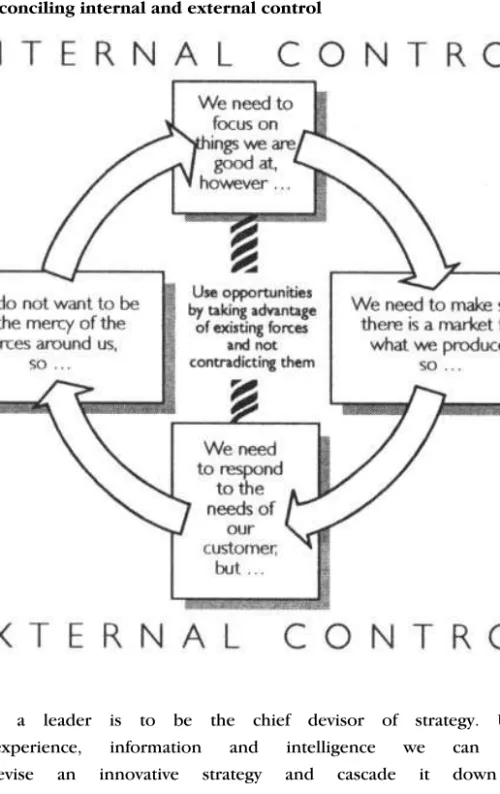
Practical tips for doing business in internal- and external-oriented cultures
4 Management-by-objectives works if everyone sincerely wants to focus on shared objectives and if these persist. 4 Management-by-environment works when everyone makes a genuine effort to adapt to external demands as they change.
NATIONAL CULTURES AND CORPORATE CULTURE
Different corporate cultures
This allows us to define four types of corporate culture, which differ significantly in how they think and learn, how they change and how they motivate, reward and resolve conflicts. Why, for example, do norms and procedures that seem to work so well in one culture lose their effectiveness in another.
The family culture
Above the leader's power may be that of the state, the political system, society, or God. This was a simple case of a clash between the American's task orientation and the Venezuelan's family orientation.

The Eiffel Tower culture
Thus, the bureaucracy in the Eiffel Tower is a depersonalized, rational-legal system in which everyone is subject to local rules, and these rules prescribe a hierarchy that supports and enforces them. Studying at the Eiffel Tower means accumulating the skills needed for the right role and hopefully additional skills to get higher positions.

The family and the Eiffel Tower in conflict
He repeatedly told them that he didn't need them to stay late, he just needed them to get to work on time. Heinz explains that he told Antonio that he doesn't want to bully or harass employees, he just wants to stick to agreements, deadlines and schedules.
The guided missile culture
Because every variety of engineering must work harmoniously with every other, the best form of synthesis must be discovered on the job. This culture tends to be individualistic as it allows a wide variety of different specialized people to work with each other on a temporary basis.
The incubator culture
However, this commitment is less to people per se than to the world-changing, society-redemptive nature of the work being undertaken. All participants are on the same wavelength and search together empathetically for a solution to the shared problem.
Which countries prefer which corporate cultures
Making out with subordinates in the Eiffel Tower can be seen as a potentially inappropriate advance. Asking to be put in a group with a special friend is a subversive act in the guided missile culture.

General
TOWARDS INTERNATIONAL AND TRANSNATIONAL MANAGEMENT
It is true that time is both a passing sequence of events and a moment of truth, a “now” in which past, present and future take on new meanings. I believe that to the extent that this reconciliation occurs, companies will be successful. So we can learn everything by discovering how others have journeyed to their own position.
Problems for the cross-cultural manager
Because we are all different, we have so much to share with each other. It's not about how much to decentralize, but what to decentralize and what to stay at the company's headquarters.
International and transnational companies
In cultural matters, as in the relationship of the sexes, difference can be the main source of attraction. In the economy of the future, knowledge is king and influence flows from wherever that knowledge resides.
Human-resource management in the future
The growth of information