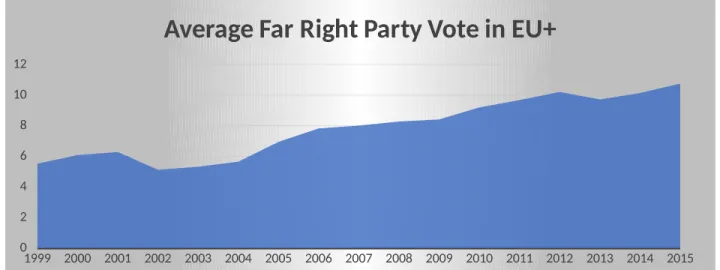
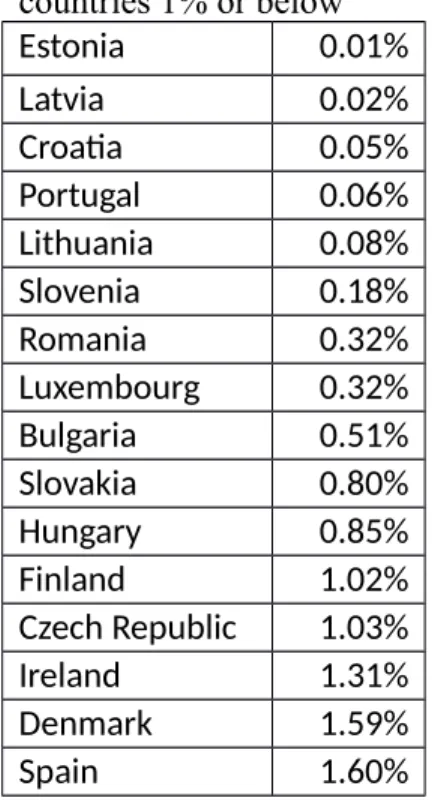
The electoral success of the far right is as dramatic as it is unprecedented, and it has proven itself. The extreme right is mainly interested in the national interest end of the asylum debate.
Far-Right Party and Asylum Policy
Can higher numbers of asylum seekers or refugees lead to more votes for the extreme right? This conclusion contrasts with the link between electoral far-right success and a more restrictive asylum policy.
Asylum Recognition Rates
The data overwhelmingly showed that terrorist attacks on domestic territory had a very negative impact on the rate of asylum recognition (464). Dimitar Toškov's analysis of asylum applications and recognition rates follows many of the same theoretical frameworks and research agendas as this thesis.
Perspective of Refugees
An extensive study on a sample of asylum seekers in the United Kingdom revealed that narrative through interviews. Koenemund found that EU countries with more open migrant integration policies had higher numbers of asylum applications (38).
The far right and asylum generosity
So perhaps a better measure of the influence of the far right is not in their direct policy making, but rather the influence they exert in pulling immigration to the forefront of the political agenda. In response to the electoral success of far-right parties, mainstream parties on both sides of the political spectrum may react to the order to appeal to those far-right party voters by adjusting their political agendas, thus showing . Through the distinctive nature of the far-right party as radical or extreme, far-right parties can influence immigration policy and the debate around the issue at points far beyond their parliamentary seats.
Far-right parties' even more subtle and harder-to-measure rhetoric on immigration affects the media, public attitudes and perceptions. In summary, electorally successful far-right parties influence asylum migration through direct policy-making, indirect political agenda-setting and discursive elements. Recent events have brought the refugee crisis to the forefront of many national debates, with far-right parties protesting in large numbers against accepting refugees into their countries, such as the Austrian FPÖ's demand to keep them out (Wodak).
To measure this cumulative effect, my theory follows the rationale that growing influence of far-right parties would be reflected by less generous (stricter) asylum outcomes.
The far right and asylum preference
To what extent does the influence of a far-right party deter an asylum seeker from seeking refuge in the destination country. Regardless, the analysis showed that many asylum seekers are active decision-makers in the migration process, even though they face limited options (63). In the European context, the Dublin Regulation is another important factor regarding the country in which asylum seekers apply, as it determines where asylum seekers should apply for refugee status.
Regardless, as revealed by the Dublin Regulation, many asylum seekers try to avoid seeking asylum in border states, showing that it is still a fact that asylum seekers exhibit an element of choice when deciding where to apply for asylum . Since a country with stronger influence from far-right parties would likely have shown more overt opposition to refugees, that country would be perceived as a less desirable destination for an asylum seeker. Even if a refugee is not directly aware of such a political situation, migrant networks, agents and other social connections may work in more subtle ways to steer asylum seekers away from the deterrent factor of a far-right party.
If all this is true, the country should become a less popular destination for asylum seekers as the far right grows in popularity.
Research Design
Measuring the Far Right
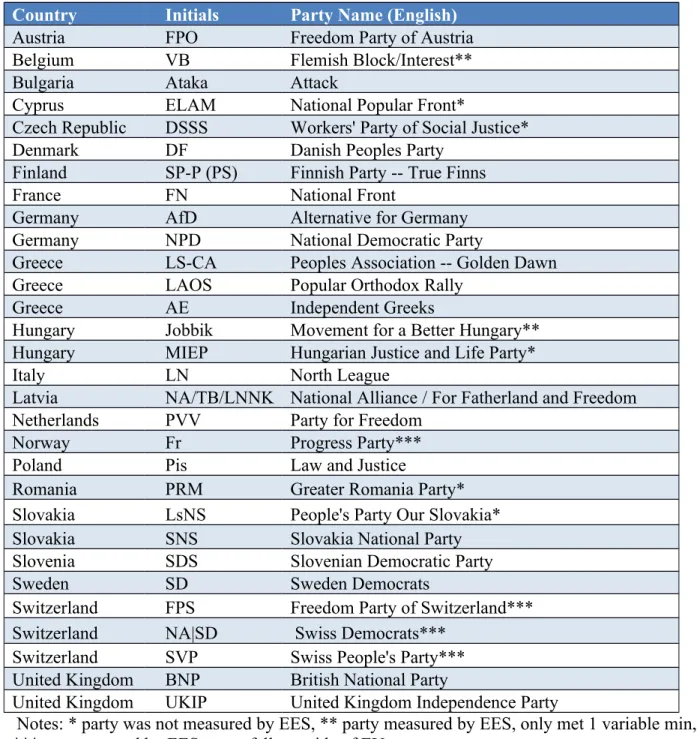
Although parliamentary election data do not fully capture the influence of far-right parties, for the purposes of this investigation, election data remain the best option. I use the vote share for far-right parties to act as the independent variable since I am examining any measurable relationship with the asylum process. Vote percentages for each parliamentary party were available from the Parliaments and Government (ParlGov) database for all European Union countries and Norway and Switzerland, allowing consistency of data between countries (Döring).
To calculate the data annually, I use the same percentage of far-right party votes each year from one election to the next.
Measuring Asylum Generosity
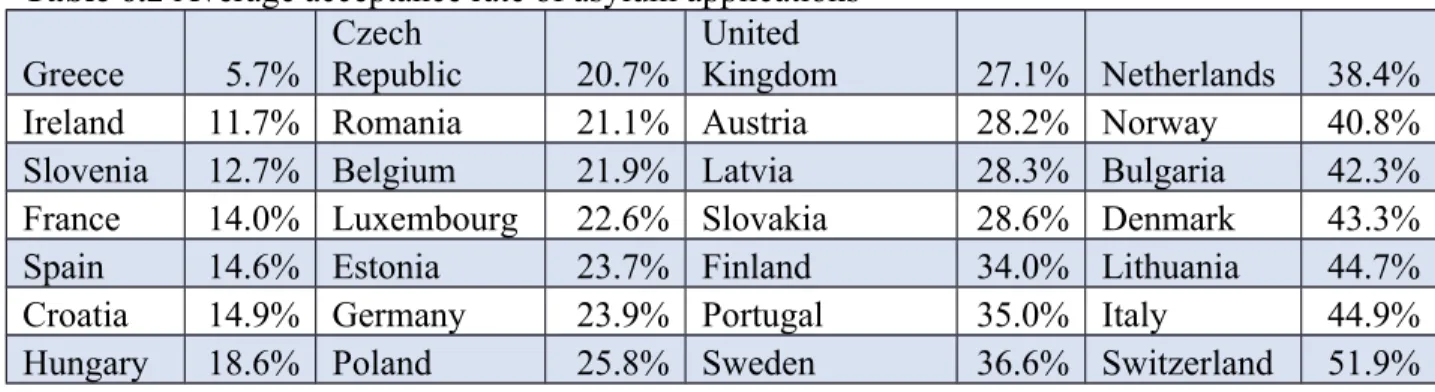
The accepted asylum application rate is calculated as a percentage of all positive decisions relative to the total number of decisions on asylum applications. applies to one in which the applicant receives one of the following: refugee status, subsidiary protection status or humanitarian status. The exact wording of the 1951 Geneva Convention definition of a refugee is as follows: someone “because of a well-founded fear of persecution on grounds of race. The applicant shall be refused any protection or asylum of the country for which the person applied.
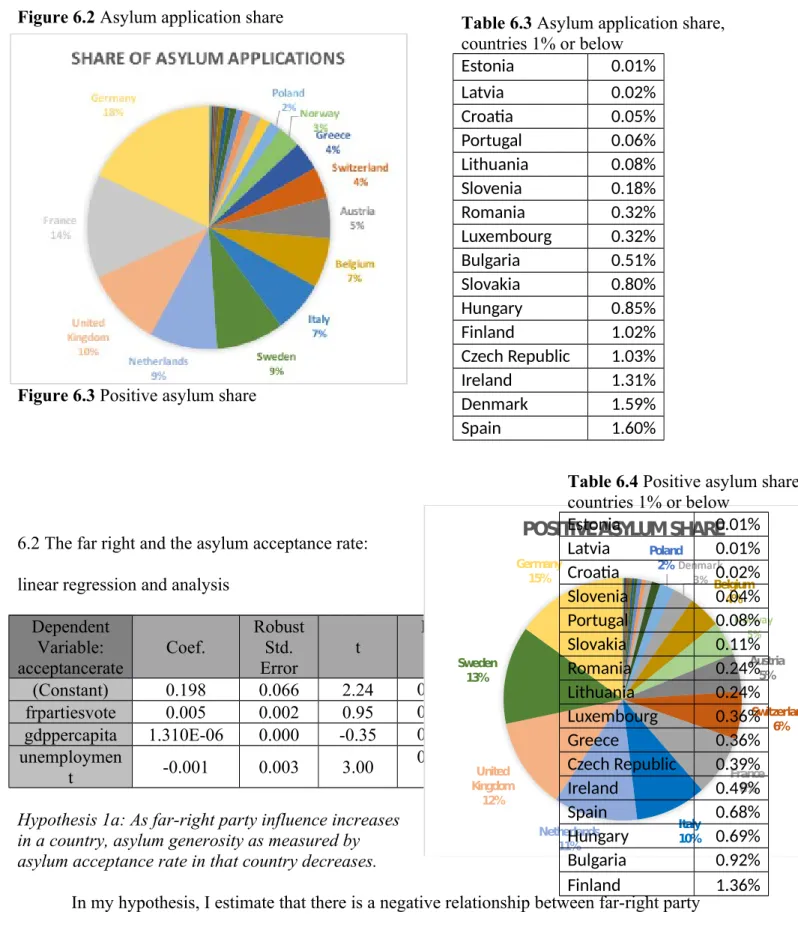
The data is run at the first instance level of the asylum procedure, so decisions that are initially rejected, appealed and then changed to a different decision at subsequent levels of the asylum procedure are not represented in the analysis. The second dependent variable calculated to represent asylum generosity is a country's share of positive asylum claims across all 30 countries in this study. In other words, the 'positive asylum rate' is calculated as a percentage of the 30 countries' total positive asylum decisions.
By calculating a country's share instead of using the country's total positive asylum decisions, I can compare the percentage of all positive asylum decisions by destination country, so annual data is more comparable over time.
Measuring Asylum-Seeker Preference
Another dependent variable calculated to represent asylum generosity is a country's proportion of positive asylum applications across all 30 countries in this study. positive share of asylum," annually I use data as follows: . sum of positive applications of the country sum of positive applications of all 30 countries. By calculating the share of the country instead of using the total positive asylum decisions in the country, I can compare the percentage of all positive asylum decisions per target country, so to make the annual data more comparable over time.refugee wave) are normalized according to the total number of applications received in the European region.
Control Variables
Overview of Data
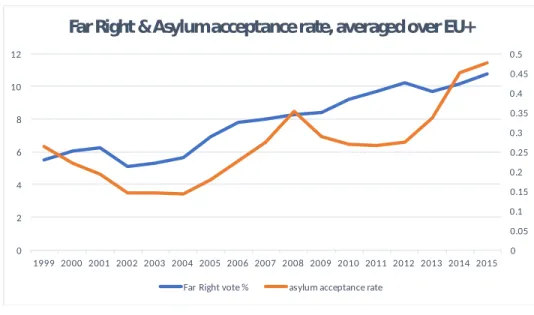
In my hypothesis, I estimate that there is a negative relationship between the increase in the number of votes for far-right parties and the acceptance rate of asylum seekers. So the more votes for the far-right party, the higher the acceptance rate of asylum applications. In any case, this positive correlation contrasts with my hypothesis that asylum recognition rates are negatively affected by the influence of the extreme right party.
Hypothesis 1b: As the influence of the far-right party increases in a country, asylum generosity, measured by the positive asylum rate in that country, decreases. In my second hypothesis of the same theory, I predict that there is a negative correlation between increases in far-right party vote numbers and the proportion of positive asylum applications. In other words, if country X experiences an increase in the far-right party's vote, then the country will administer stricter asylum admissions.
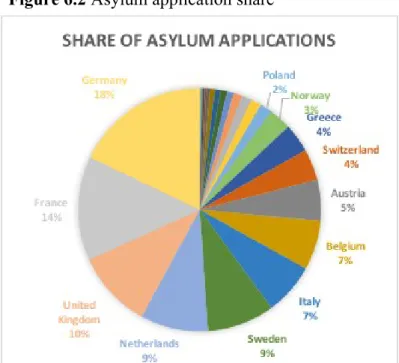
Then the extreme right party does not seem to have any influence on the asylum admission rate. In my asylum preference hypothesis, I predict that there is a negative correlation between a country's far-right party's vote increase and their share of asylum applications. This means that the data shows that an increase in the far right party's vote does not lead to any change in the proportion of asylum applications.

The far right and asylum acceptance rate: linear regression and analysis
The far right and positive asylum share: linear regression and analysis
The linear regression analysis shows that the number of votes for far-right parties and the positive asylum share have a statistically very insignificant relationship with a p-value of .803, and the coefficient value is 0. We can safely accept the null hypothesis – there seems to be no of an empirical relationship between the vote of the extreme right-wing party in a country and their positive asylum share. The small negative correlation between unemployment and the positive asylum share is logically correct for many reasons.
The measurement of positive asylum rate is intended to examine the results of refugee applications without being biased by the recent refugee crisis. But if we use a value that is country X's share of all positive asylum outcomes in the region for the year in question, then country X's asylum subsidy is calculated in relation to other states. Even if the influx was ten times as great as the previous year, as long as the country itself has a smaller share of the number of positive asylum outcomes in the region, then the tightened asylum policy would be statistically recognized.
Furthermore, the top six countries of the asylum application share are also the top six countries of the positive asylum share.
The far right and application share: linear regression and analysis
However, in linear regression of the total accepted applications, far-right party votes are still statistically insignificant, thereby ruling out that possibility. The linear regression analysis reveals that far-right party vote and asylum application share also have an insignificant relationship with a p-value of .777 as well as the coefficient value of 0. Again, we can accept the null hypothesis; there is no empirical link between a country's far-right party vote and its asylum application share.
This supported null hypothesis is not so surprising, since the degree to which far-right party electoral choices translate into fewer asylum-seeker claims warrants numerous dynamics to hold even the possibility of being significant. And finally, the negative aspects of a strong right-wing extremist party in a destination country may not be of great importance or even considered significant for a refugee. The aim of this study was to examine the empirical evidence of outcomes on refugees and asylum seekers as caused by the growing influence of far-right parties in Europe.
Votes for far-right parties do not correlate with lower levels of a state's asylum generosity, nor does far-right party popularity deter asylum seekers from applying for asylum—at least statistically. Cas Mudde argues in his 2012 article that the grossly disproportionate scholarly attention overemphasizes and creates many claims about the importance and power of the far-right party family. Explaining Far Right Preferences in Europe by Distinguishing Perceived Cultural and Economic Ethnic Threats.” Comparative Political Studies.