INTERNATIONAL SEMINAR ON
ROAD SUSTAINABILITY AND GREEN TECHNOLOGY NUSA DUA, BALI
Tourism Area , BTDC
http://www.westinnusaduabali.com
PRESENTATION
Title : Road Fund for Sustainable Road Maintenance
Session : VA
CURRICULUM VITAE
Name :
Name on Badge :
Gender :
Affiliation/Institution : Country/Nationality : Skill / Experience :
Email :
INTERNATIONAL SEMINAR ON
ROAD SUSTAINABILITY AND GREEN TECHNOLOGY NUSA DUA, BALI- INDONESIA APRIL 23RD TO 25TH, 2014
Venue :Westin Resort Hotel,
Tourism Area , BTDC Lot N-3, Nusa Dua 80363, Bali, Indonesia http://www.westinnusaduabali.com
PRESENTER INFORMATION
Road Fund for Sustainable Road Maintenance VA - Sustainability Planning And Practices
Gatot Rusbintardjo, C.E, M.R.Eng,Sc., Ph.D.
Gatot Rusbintardjo, P.h.D Mr
Universitas Islam Sultan Agung (UNISSULA) Semarang Indonesia
Highway Engineering, sub-skill : Pavement Materials Lecture for Technical Division UNISSULA Indonesia
ROAD SUSTAINABILITY AND GREEN TECHNOLOGY , 2014 Indonesia
Road Fund for Sustainable Road Maintenance
Gatot Rusbintardjo, C.E, M.R.Eng,Sc., Ph.D.
Universitas Islam Sultan Agung (UNISSULA) Semarang
: Pavement Materials and Lecture for Technical Division UNISSULA-Semarang-
1
ROAD FUND FOR SUSTAINABLE ROAD MAINTENANCE
Gatot RusbintardjoDepartment of Civil and Environment Engineering, Faculty of Engineering Universitas Islam Sultan Agung (UNISSULA) Semarang, Indonesia.
[email protected]; IRDA ID member: B-308
Abstract
It can be denied that most of roads condition in Indonesia is worst. It is because maintenance works is not properly conducted because of insufficiently, unsustainably, and inconsistency on allocating budget for maintenance. Insufficient or uncertain budgetary allocations to road maintenance have resulted in road deterioration that has significantly increased production and transport costs. To avoid this problem, highway professionals advocate the establishment of dedicated road funds, managed by independent road boards made up of road user representatives. So far roads maintenance in Indonesia is financed using the government budget allocation. It is difficult to give guarantee to the sustainable road maintenance if the finance for road maintenance takes from the government budget allocation. Therefore in this paper will be introduced road fund, the road maintenance funding system widely used in some countries that road conditions can be well maintained. The conclusion isthat the road fund needs to be applied to maintenancethe road in Indonesia.
Keywords: Road, deteriorate, maintenance, road fund, budget system, sustainable 1. INTRODUCTION
Growing economic activities and rapidly changing markets in most developing countries have generated demand for the expansion of public road network. The sustenance of the full benefit of the road network requires adequate maintenance since road deterioration is endemic due to the effects of the weather, traffic volume, traffic loading and inadequate design standards. Effective road maintenance regime requires good management and adequate funding. Adequate funding is mandatory because there is an inevitable, ongoing and never ending consequence of recurrent expenditure for road maintenance needs after the initial road construction.
Sustainable funding for road maintenance has however proven to be particularly difficult for many developing countries Many developing countries manage a road system which is larger than they can afford (World Bank, 1981). Therefore there is need to maximize the returns on the limited funds available. Maximization of available funds is ascertained by the relative effectiveness at which funds are allocated toward the achievement of a set purpose. It requires setting priorities for competing road types such as the trunk, urban and feeder roads on the basis of defined criteria. Day (1988) describes the process as complex and Howe, (1994) notes it to be a binding constraint in the operation of the road maintenance system.
Roads maintenance in Indonesia financedfrom the government budget allocation that is State Income and Expenditure Budget or APBN stand for AnggaranBelanjadanPendapatan Negara for National roads, and Regional Income and Expenditure Budget or APBD stand for AnggaranBelanjadanPendapatan Daerah for
2 Provincial and District (Kabupaten) as well as Municipal roads. It is difficult to give guarantee to the sustainable road maintenance if the finance for road maintenance takes from the government budget allocation, Moreover, if the decision to use the fund allocation is based on political negotiation. The fact that the road maintenance in politicalpoint of view is not interesting compared to the construction of a new road, Toll road, rehabilitation, social activity or education. In addition lack of awareness of the importance of road maintenance, lack of understanding of economic consequences if the road maintenance is not conducted properly, becomes the difficulty factor to get into supporting fund for the maintenance.
Therefore it is necessary to look for the appropriate budgetinstead of government budget to ensure sustainable and effective funding for road maintenance in Indonesia.
Nevertheless, before outlining and describing road fund, will be discussed in advance about road maintenance, what is important and what is the impact to the transportation cost, safety if it neglected. Second-generation of road fund which have been established since 1990 will be described in this paper.
2. ROAD MAINTENANCE
Roads are among the most important public assets in many countries. Road improvements bring immediate and sometimes dramatic benefits to road users through improved access to hospitals, schools, and markets; improved comfort, speed, and safety; and lower vehicle operating costs. For these benefits to be sustained, road improvements must be followed by a well-planned program of maintenance. Without regular maintenance, roads can rapidly fall into disrepair, preventing realization of the longer term impacts of road improvements on development, such as increased agricultural production and growth in school enrollment.
Postponing road maintenance results in high direct and indirect costs. If road defects are repaired promptly, the cost is usually modest. If defects are neglected, an entire road section may fail completely, requiring full reconstruction at three times or more the cost, on average, of maintenance costs. The World Bank (2005) estimates that repair costs rise six times after three years neglect and 18 times after five years neglect. To avoid such escalating costs, World Bank suggest first, allocate(s) its available funding resources to ideal maintenance actions (e.g., reseals and overlays) and thereafter to more extensive maintenance actions (e.g., rehabilitation) and finally to new construction. (SANRAL 2004).
Delayed maintenance has indirect costs as well. Neglected roads steadily become more difficult to use, resulting in increased vehicle operating costs (more frequent repairs, more fuel use) and a reluctance by transport operators to use the roads. This imposes a heavy burden on the economy: as passenger and freight services are curtailed, there is a consequent loss of economic and social development opportunities.
But any countries have tended to favor new construction, rehabilitation, or reconstruction of roads over maintenance. This has led to a steady increase in the backlog of roads repairs and loss of development impact.
3 2.1. What is maintenance?
The goal of maintenance is to preserve the asset, not to upgrade it. Unlike major road works, maintenance must be done regularly. Road maintenance comprises
“activities to keep pavement, shoulders, slopes, drainage facilities and other structures and property within the road margins as near as possible to their as constructed or renewed condition” ( PIARC 1994).It includes minor repair and improvements to eliminate the cause of defects and to avoid excessive repetition of maintenance efforts.
For management and operational convenience, road maintenance is categorized as routine, periodic, and urgent, which each of that category is described as follows:
Routine maintenance, which comprises small scale works, conducted regularly, aims “to ensure the daily pass ability and safety of existing road in the short run and to prevent premature deterioration of the roads” (PIARC 1994). Frequency and activities varies but is generally once or more a week or month.
Periodic maintenance, which covers activities on a section of road at regular and relatively long interval, aims “to preserve the structural integrity of the road” (WB maintenance website). These operations tend to be large scale, requiring specialized equipment and skilled personnel. They cost more than routine maintenance works and require specific identification and planning for implementation and often even design. Activities can be classified as preventive, resurfacing, overlay and pavement reconstruction. Resealing and overlay works are generally undertaken in response to measured deterioration in road conditions.
Repaving is needed about every eight years.
Urgent maintenance, is undertaken for repairs that cannot be foreseen but require immediate attention, such as collapsed culverts or landslides that block a road.
Maintenance does not include rehabilitation, building shoulders, or widening roads. If the sections to be rebuilt constitute more than 25 percent of the road’s length, the works is rehabilitation, not maintenance.
2.2. How to manage road maintenance
To be sure that road maintenance is not neglected; it needs to be incorporated into project and sector strategies. That requires a clear and realistic strategy for road network management that attends to the following key principles:
As a rule of thumb, 80 percent of traffic flow over 20% of the road network. This core network is often the responsibility of the national government’s ministry. These most heavily trafficked roads should receive priority for full routine and periodic maintenance.
Often when construction or rehabilitation has been completed by the national road agency, responsibility for maintenance remains unclear or is handed over to the
“community”. Therefore its need clearly assign to specific institutions “ownership” of roads and responsibilities for development, maintenance, and priority setting. Good practice indicate that the agencies that implements the road construction or
4 rehabilitation be responsible for subsequence routine and periodic maintenance (MalmbergCalvo, 1988).
Involve all agencies and institutionsassociated with national, regional (province), district (kabupaten), and local community levels as well as road user and other stakeholders in identifying road issues and planning road interventions. Other stakeholders include organizations dealing with tourism, health care, rural development, agriculture, and mining, road user association community organizations, nongovernmental organizations, and businesses.
Determine the overall level of funding requiredand the balance among construction, rehabilitation, and maintenance. Priority for maintenance funds should go to the road that functionally important and in reasonably in good condition. Routine maintenance should be included as a cost component in donor-funded road construction projects even if maintenance is fully funded by government resources, to ensure that it is not neglected.
Develop standards for improving roads.Design standards and maintenance practices should be reviewed to ensure sustainability of the entire road network.
Include maintenance of bridge, road signs, sidewalks, and other road structures.Neglected road structures and sign lead to increase accidents and, in case of bridge deterioration, can lead to road closures and network disruptions.
2.3. Examples of neglecting maintenance
There are many examples from countries all over the world of the direct cost of neglecting maintenance. Following is the examples from Norway and some African countries.
In Oslo, Norway a bridge deck did not have adequate waterproof membrane. It could have been done as a simple job for a cost of approximately 0.6 million US Dollars. The jib was not given preference to and was therefore not done. The result was that the whole bridge after some years had to be torn down and replace by a new bridge. The total cost for the new bridge was 15 million US Dollars. In addition came, the cost for the users, because they had to travel on lengthy detours for a long period of time.
In Kenya, years of inadequate maintenance left the main Nairobi – Mombasa road highly vulnerable. In 1997 heavy rain damages two bridges and several sections of road. The result was that the users experienced moths of national disruptions as long stretches of the roadbecame unusable in the rains and very difficult in dry weather.
In Tanzania, failure to improve a simple stream crossing caused damage to 3 kilometers of road – and led to lengthy delays. The result was a bill five times higher than would have been needed to make the original repair.
In Sub-Saharan Africa, 150 billion US Dollars was spent in 3 decades building roads. Maintenance was neglected and a third of that investment has now been lost. The result is that 50 billion US Dollars of key national assets are gone.
2.4. Reducing of transport costs
5 Empirical evidence suggests that well maintained roads reflect in savings in vehicle operating cost (VOC). This is from reduced fuel and oil consumption, vehicle maintenance, tyre wear and vehicle depreciation, (World Bank, 1998). An illustration of the relative discounted life cycle costs of maintenance spending scenarios is provided in Figure 1. For, a traffic level of about 1000 vehicles/day a road in good condition will require 2 percent of discounted total costs to be spent on maintenance. However if maintenance funds are reduced, VOC’s are likely to increase by about 15 percent. If there is complete neglect of maintenance, a paved road will eventually start to disintegrate and annual VOC will increase by 50 percent and if continued will result in the need for new road development. Heggie (1995) estimates that each dollar spent on patching on an annualized basis, saves at least US $3. Robinson, et al, (1988) suggests a 10 fold or more returns on each dollar spent on patching.
Figure 1. Relative Proportions of Road and Vehicle Costs in Total Transport Cost (Adapted from Schliesser and Bull, 1993).
2.5. The influence of road maintenance on safety
A significant number of road accidents and fatalities can be directly attributed to the state of the road network. For example, inadequate skid resistance on neglected roads can contribute to traffic accidents. Potholes pose a threat to all road users, particularly to cyclists and motorcyclists. The correction of such defects through road maintenance interventions can reduce the number of road accidents. However, improved riding quality from road maintenance interventions can also have negative impacts from increased speeds which can result in accident fatalities.
3. PRESENT ROAD MAINTENANCE IN INDONESIA
Indonesia have totally 372.237 km length of road consist of National roads 34.629 km; Toll roads 742 km; Provincial roads 48.681 km; and District (Kabupaten)/Municipal roads 288.185 km (BinaMarga, 2008). Except Toll roads, maintenance of National, Provincial, and Kabupaten/Municipal roadsis financed byAPBN and APBD as have been mentioned in the introduction.
6 All of maintenance works include routine maintenance are conducted by contract system. For some segment of roads, maintenance works done by using Performance Basedmaintenance contract, where contractor makes a bid based on their assessment of the work to be undertaken to keep the road in a specified condition. Provided the road is kept up to standard the contractor will be paid according to the bid irrespective of the work undertaken. Penalties are included if a specified standard is not achieved and special provisions are made for severe road damage due to unforeseen situations such as extreme weather.
Implementation of routine maintenance works base on contract system basically against the routine maintenance philosophy. As mentioned above, principle of road maintenance is comprises small scale works, conducted regularly, aims “to ensure the daily pass ability and safety of existing road in the short run and to prevent premature deterioration of the roads” Frequency and activities varies but is generally once or more a week or month, and performed during whole year. That is why routine maintenance must be done by self-management system or in Indonesia called “swakelola”. By contract base system Contractor will only do the works which have been stipulated in the contract. This cause the roads are not maintain properly.
Financing arrangements are crucially important. Without an adequate and stable flow of funds, road maintenance policies will not be sustainable. That is an important part of the problem of maintenance works, why does not work well. Flood occurred during last January to February 2014 in almost all of areas in Java island, has worsening the roaddamaged. The damages is not only caused by the floods but also because lack of properly maintenance and because under standard specification of construction.
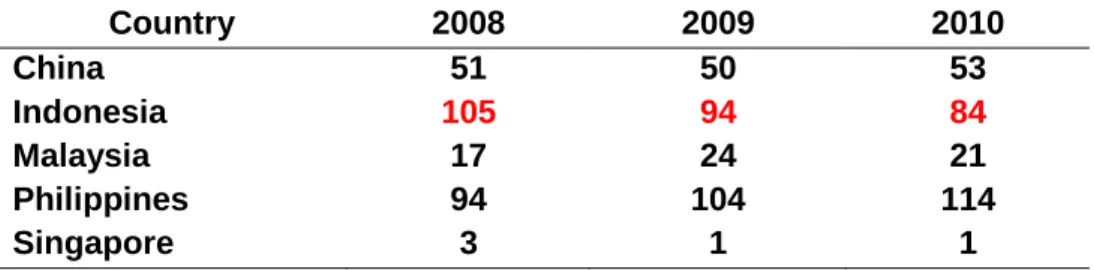
Successfulness of road maintenance in Indonesia by using the above finance system can be seen from Table 3.1 that shows the level of competitiveness of road condition issued by World Economic Forum among five countries, China, Indonesia, Malaysia, Philippines, and Singapore, The number in the table said that smaller of the number show the better of the road condition. With the average number of road condition 94 for the judgment in 2008, 2009, and 2010, road condition in Indonesia is categorized worst. Moreover if compare to Malaysia, the close neighboring country which already use road fund for road maintenance operations, where the average number of road condition is 21 for the same period of judgment.
Table 1. Competitiveness level of road condition for three years among five countries
Country 2008 2009 2010
China Indonesia Malaysia Philippines Singapore
51 105
17 94 3
50 94 24 104
1
53 84 21 114
1 Source: World Economic Forum.
The shortcoming of maintenance works are due to those financing system can be described as follows:
7 1. Bureaucracy in approving the budget, the decision to use the fund allocation is based on political negotiation. This resulted in erratic and frequently delayed general budget procedures and reviews
2. The budget allocation of road sector from APBN/D is also often insufficient even for maintenance. On this condition, the budget allocated for the maintenance is often the first to be neglected, and make the road cannot be maintained properly.
3. Road maintenance is politically unattractive – new road construction and road rehabilitation is more visible and produces greater political prestige.
4. Different Ministries have to struggle with the same type of questions and policies in their own filed, e.g. education, health, housing, elderly care, environment etc.
5. The Road Authorities have not been able to develop reasonable tools to predict the changes in maintenance standards resulting from different levels of grants.
6. The Road Authorities have not been able to document the consequences of what will happen to the roads when there is a lack of funds.
7. Working with maintenance is still looked upon even today by professional people as a low status occupation.
4. THE ROAD FUND
The purpose of the road fund is to provide an adequate, stable, and sustainable flow of funds for road maintenance and rehabilitation and to enhance the transparency between revenues collected from road users and the spending on the road network. It would further provide a direct linkage between the road users and the road agencies that are spending the money to provide an agreed service.
Road fund involves an off-budget road maintenance financing arrangement created as the main source of finance for road maintenance. It operates on as “user charge” system to generated revenues. It should be strongly noted that the funds collected for the Roads Fund are not taxes but are road user’s money.
4.1. History
It emerged in some developed countries as far back as the early nineties. For example the UK set up a Road Improvement Fund from 1910 to 1920; Japan established the Road Improvement Special Account in 1954; the United States of America (USA) established the Highway Trust Fund in 1956 and New Zealand established their Land Transport Fund in 1953. The advantage is that money can be accumulated and spent over several years on road maintenance without being constraint by the government budgeting cycle.
In the 1960s and 1970s many countries in Africa, Asia, and Latin America established road funds as an extra budgetary arrangement, and known as “first- generation” of road fund. Earmarking of a stream of revenues (often from fuel taxes) was introduced for use by the road department or agency, with the intention of insulating maintenance expenditures from erratic and frequently delayed general budget procedures and reviews (Johansen 1989). Often the World Bank requested that these funds be set up to protect its investment from economically inefficient asset deterioration.
8 Note:
Earmarking refers to the pre-commitment of taxes to support or fully fund pre- specified expenditure items. These revenues may be channeled through the general treasury or may be paid directly to a dedicated fund.
First-generation road funds were established in the 1960s and 1970s as extra- budgetary arrangements through which an earmarked stream of tax revenues was put at the disposal of a road department or agency.
However, from a macroeconomic point of view, analysis have criticized earmarking because it infringes on the policymaking powers of state executives and legislative and reduces the leverage and flexibility of central governments (Deran, 1965). Therefore the World Bank and the International Monetary Fund (IMF) have discouraged first-generation road funds in practice on general macroeconomic grounds (World Bank, 1986). Even within the transport sector, some analysts have argued that the preferential access of road funds to lucrative revenue sources, such as gasoline taxes, hinders development of a more balanced, multimodal transport system.
The performance of state road agencies continues to be a matter concern.
Therefore a new “second-generation” is being established in the 1990s as part of an agenda to commercialize the road sector. This process runs parallel with the privatization of state enterprises. Second-generation road fund are funded by levies or surcharges designated as user charges and identified separately from general taxation.
Revenues are paid directly into a fund managed by a road fund board whose membership is chosen to represent users. The road board determines both the level of charges and the allocation of expenditures.
Note:
Second-generation road funds moved away from using earmarked tax revenues in the 1990s. Instead, they are funded by levies or surcharges designated as
“user charges” and identified separately from general taxation.
4.2. The Objectives and Strategies of Second-Generation Road Fund
The Second-Generation Road Fund is established for which the following objectives and strategies:
Promote accountability and transparency in public roads financing and management.
Help develop capacity of local construction industry and implementing agencies.
Ensure efficient and effective utilization of funds.
Enforce excellence and professionalism in service delivery.
Strategies related with those objectives are:
Cultivate an ethical culture within Road Fund Administration and other stakeholders, Subscription to tip-offs anonymous.
Develop service level agreements with implementing agencies; Regular discussions of results of audits with implementing agencies, contractors and consultants.
Monitor utilization of funds through audits; Regular publication of funds disbursed for various programmes.
9
Implement an appropriate performance assessment system; retention of highly skilled and motivated staff.
In addition, Road Fund also established for which the following provisions apply:
1. All monies collected as roads tolls imposed on fuel, transit fees, heavyvehicle licenses, vehicle overloading fees, or from any other source at the rate or rates tobe determined by Parliament from time to time shall be paid into the Fund.
2. All monies collected as roads tolls shall be deposited in the account of the Fund.
3. At least ninety percent of the money deposited in the Fund shall be used for maintenanceand emergency repair of classified roads.
4. Not more than ten percent of the money deposited in the Fund shall be used for roadsdevelopment in accordance withthe plans and budgets approved by the Parliament.
4.3. Manage of road fund
In order Road Fund is able to manage and implemented properly, some of the following are required:
1. Established and protected by the Act, and implemented based on government and regional regulation.
2. To be managed independently based on business principle.
3. Control by Board of Road Fund that the member consist of government representative, private sector which have interests in the road conditions.
4. Full of responsibility to the public to the performance and to the conditions of the road, measured by the indicators:
a. Focus to the road users that have paid to get a good level of service their asking.
b. Road users have the right to determine the tariffs.
c. Budget allocations are determined based on proper road survey and optimization of Integrated Road management System (IRMS).
d. The government may not intervention on determining budget allocation.
4.4. Road Fund Acts and Road Fund Board
In order to give the Road Fund some legal force and secure more stable financing for road maintenance and the management, Road Fund must be established by Road Fund Acts which are also includethe Road Fund Board.
Functions of the Board with respect to Road Fund Acts are:
1. To advice the Ministry of Public Works on new sources of roads and fuel tolls, adjustment of rates of existing tolls and on regulations for the collection of road tolls for the purpose of ensuring an adequate and stable flow of funds to road operations.
2. To apply the money deposited into the Fund for the purpose approved by the House of representative.
10 3. To set out procedures foe agents with respect to the collection of roads and fuel
tolls for the purpose of Fund.
4. To ensure full collection and transfer of collected roads and fuel toll to the Funds account.
5. To develop and review periodically the formula for allocation and disbursement from the Fund to Directorate General BinaMarga (DGMB), to the government of Provincial and Kabupaten/Municipal, and advise to the Minister of Public Works.
6. To recommend to the Minister of Public Works, the government of Provincial and Kabupaten/Municipal to undertake road management at a level that is suitable and affordable.
7. To disburse funds from the Road Fund to DGBM and government of Provincial and Kabupaten/Municipal.
8. To ensure that the operations of DGBM and the government of Provincial and Kabupaten/Municipal and Road Fund are technically and financially sound.
9. To monitor the use of the funds disbursed to DGBM and the government of Provincial and Kabupaten/Municipal for the purpose of the objects of the Fund.
10. To appoint the Road Fund Manager and Road Fund Accountant.
11. To appoint, subject to approval by the Controller and Auditor General an auditor or auditors to carry out the audit of the Fund.
12. To make any other recommendations to the Minister of Public Works as it considers necessary to enable the Board to achieve its objectives.
In addition, the Board requires:
Enter into performance agreements with DGBM or the government of Provincial and Kabupaten/Municipal to which money from the Fund is disbursed.
Submit an annual report to the Minister of Public Works within three months, after the end of each financial year based upon its own activities and of those organizations to which money was disbursed.
4.5. Second Generation Road Fund: Emerging Good Practice
New Zealand is the good example on implementing road fund. Although it was originally established in 1953, the New Zealand road fund has been regularly restructured over the years (most recently in 1996) and is probably the best example of emerging good practice. The key was the establishment of a Crown entity in 1996 known as Trans-fund which:
1. was set up as an Independent road fund administration,
2. has a five person oversight board which is nominated by the responsible minister following consultation with people from the land transport industry,
3. one of the existing members of the board is appointed as chairman,
4. revenues come from motor vehicle registration fees, a gasoline levy and weight- distance charge which are graduated according to axle weight,
5. all revenues are collected under contract,
6. off-road usage gasoline is exempted (the system uses rebates)
7. transit New Zealand and local authorities apply for funds on the basis of cost- benefit analysis and the outcome of a Road Maintenance Management System (RMMS)
11 8. there are cost share arrangements with local authorities based on ability to pay, 9. technical, financial and procedural audits are carried out on a regular basis and, if
funds are used improperly, the road agency has to repay them to Trans-fund, and 10. The road fund is supported by sound basic legislation (in form of the Transit New
Zealand Amendment Act 1995).
Likewise, the South African road fund (established in 1935), the Japan Road Improvement Special Account (established in 1954) and the U.S. Federal Highway Trust Fund (established in 1956), though not second generation road funds, have several useful features which are worth mentioning as part of a review of emerging good practice (Heggie and Vickers, 1998, Heggie, 1999). Interestingly, these second generation road funds tend to be strongly supported by the Ministry of Finance, since they offer greater transparency, better financial management and tighter financial controls. Road agencies tend to be less enthusiastic for the same reasons – the road fund forces them to justify their programmes and holds them accountable for results.
Japan, 60 years have passed since then, now has an approximately have 1,189,000 km length of road network that includes 7,800 km of expressway and 54.000 km of national highways. While the number of automobiles owned in Japan was only 140,000 immediately after World War II, it is now 75 million. Japan Road Fund financed 11 successfully five-year highway developments plan (1953 – 2007) using road user charges earmarked only for roads!!
Several other road funds are also starting to produce noteworthy examples of emerging good practice. A new choice examples covering: (1) the oversight board; (2) day-to-day management; (3) changing the level of the road tariff (road user charges);
(4) ways of dividing funds between different road agencies; (5) exemption systems; (6) disbursement procedures; and (7) legislation.
CONCLUSIONS
From the descriptions of the important of road maintenance, the present road maintenance in Indonesia, and Road Fund, the following conclusions can be drawn:
1. Finance maintenance system using government budget allocation resulted the road maintenance cannot be performed sustainably. The reasons are:
The budget allocation for road maintenance is depending on political decision and not depends on the needs, usually becomes the last priority compared to the construction of new roads or toll road.
Much of the bureaucracy on allocating maintenance cost caused the road maintenance cannot well implemented.
2. The worst of road condition in Indonesia because of lack of road maintenance cause high transportation costs and low level of safety, the highest number of road accident.
3. Many countries have implemented and success of using Road Fund for their road maintenance since Road Fund is more accountable and more transparence in public financing and management as well as ensure efficient and effective utilization of funds.
From those conclusions, it is recommended the establishment of dedicated road funds for road maintenance as soon as possible not to delay, managed by independent road boards.
12 REFERENCES
Dardak, A.H. (2008). Keberadaan Jaringan Jalan Mendukung Fungsi Penyelenggaraan Transportasi Darat. - RakornisBidangPerhubunganDarat. Surabaya, 4 – 6 Nopember 2008.
Day A. (1998). Meeting the needs of the community; Social Issues in Road and Transport Planning – Facing the Future main Road, Lecture Series, for Main Roads, Western Australia, Perth Australia. Alison Day & Associate.
Day, Howe, J. (1994). Infrastructure investment in Bangladesh - Who Really Benefit and How? IHE Working Paper IP-6 Delft, the Netherlands. Fourth Workshop of the European Network of Bangladesh Studies – Driebergen – Ziest the Netherlands.
Deran, Elizabeth Y. 1965. “Earmarking and Expenditures. A Survey and a New Test.”
National Tax Journal 18:354-61.
Heggie, I. (1995). Management and Financing of Roads. An Agenda of Reform. World Bank Technical Paper 275. World Bank, Washington D.C.
Heggie, Ian G. and Piers Vickers. 1998. Commercial Management and Financing of Roads. Technical Paper 409, World Bank, Washington, D.C.
Heggie, Ian G. 1999. Commercially managed road funds: managing roads like a business, not like a bureaucracy. Transportation 26: 87 – 111, Kluwer Academic Publishers Netherlands.
Johansen, Frida, ed. 1989. “Earmarking, Road Funds and Toll Roads. A World Bank Symposium.” ReportINU 45, World Bank Washington, D.C.
MalmbergCalvo, C. 1988. Options for Managing and Financing Rural Transport Infrastructure. World Bank Technical Paper No. 411, World Bank, Washington DC.
PIARC (World Road Association) 1994. International Road Maintenance Handbook;
Practical Guideline for Rural Road Maintenance, Volume I of IV. Roadside areas and Drainage. Financed and coordinated by ODA and TRL.
Robinson, R., Danielson, U., Snaith, M. (1988). Road Maintenance Management Concept and Systems. London Basingstoke Macmillian Press..
SANRAL (South African Road Agency, Ltd) 2004. Annual Report 2004: Sustainability Report. Pretoria, South Africa.
World Bank (1981), The Road Maintenance Problem and International Assistance.
Washington D.C., World Bank.
World Bank 1986. “Road Funds from Earmarked Sources: Interim Guidelines.
“Transportation Note 1. May. Washington D.C.
World Bank (1988). Road deterioration in Developing Countries. Washington DC.