Introduction
The primarily Neotropical Eumaeini (Lycaenidae:
Theclinae) have diversified extensively in montane habitats, especially in contrast to the primarily Neo- tropical and similarly diverse Riodinidae (Robbins 2004a). Among the Eumaeini, about 95% of the 150 species in the Micandra Section are montane
(Robbins 2004b). And half of the 12 genera of the Micandra Section are endemic to Andean habitats between 700 and 4,500m elevation. This paper is a revision of Timaeta, one of the Andean endemics, and is the first phylogenetic analysis of a primarily montane lycaenid genus in the Eumaeini.
The Andean lepidopteran fauna is remarkably rich,
(Lycaenidae: Theclinae: Eumaeini): an Andean montane forest endemic
Robert K. Robbins & Robert C. Busby
Taxonomy of the Andean lycaenid hairstreak genus Timaeta Johnson et al. and its fifteen sexually dimorphic species is detailed for the first time. Species accounts summarize nomenclature, distribution, habitat, behavior, and distinguishing traits, as well as noting why each species is considered distinct under a biological or phylogenetic species concept and how males and females were associated.
An identification key for males and a nomenclatural checklist are included.
Nomenclatural actions include the description of Timaeta christina Robbins &
Busby sp. n., Timaeta matthewi Busby & Robbins sp. n., Timaeta walteri Busby &
Robbins sp. n., Timaeta roberti Busby & Robbins sp. n., Timaeta cospata Robbins
& Busby sp. n., Timaeta pilosa Robbins & Busby sp. n., Timaeta gabriela Busby
& Robbins sp. n., and Timaeta romero Robbins & Busby sp. n.. Timaeta neblina (Salazar & K. Johnson, 1997) is a new synonym of Timaeta eronos (H.H. Druce, 1890). A phylogenetic analysis is based on 17 coded morphological characters and yields two most parsimonious 30-step trees. Successive weighting does not change tree topology. The node chosen to delimit Timaeta is the one that had the highest jackknife support and was most stable with past usage. Generic names Trochusinus K. Johnson, Salazar & Vélez, 1997 and Jagiello Bálint & Wojtusiak, 2000 are confirmed as synonyms of Timaeta K. Johnson, Kruse & Kroenlein, 1997. Recent revisions of primarily Andean butterfly genera have had a significant proportion of previously unnamed species, and Timaeta fits this pattern with eight of 15 species previously undescribed. Most sister lineages within Timaeta are sympatric, and more than half the species occur between 1500m and 2000m in eastern Ecuador.
This pattern of sympatry is similar to that of primarily lowland eumaeine genera, but contrasts with repeated reports of elevational allopatry/parapatry in Andean butterflies and birds.
R.K. Robbins, Department of Entomology, PO Box 37012, NHB Stop 105, Smithsonian Institution, Washington, DC 20013-7012 USA. [email protected] R.C. Busby, 7 Countryside Way, Andover, MA 01810-6041 USA.
Tijdschrift voor Entomologie 151: 205–233, Figs. 1– 75, Tables 1-2. [ISSN 0040–7496]. http://www.nev.nl/tve
© 2008 Nederlandse Entomologische Vereniging. Published 1 December 2008.
but because it has been chronically undersampled, many previously undescribed butterfly and moth species are only now being discovered (Willmott et al. 2001, Brehm et al. 2005, Peña & Lamas 2005).
The Andean butterfly fauna has been repeatedly noted to consist of elevationally allopatric/parapatric species (Adams 1985, Pyrcz & Wojtusiak 2002, Hall 2005, Bollino & Costa 2007), and a similar pattern has also been reported in Andean birds (Remsen
& Cardiff 1990, Bates & Zink 1994). Alternately, most species in another Andean butterfly genus were sympatric with their sister lineages (Willmott et al.
2001), as also occurs in primarily lowland Neotropi- cal lycaenid genera (Robbins 1991, 2005, Robbins
& Duarte 2005, Robbins & Busby In Press). The number of phylogenetic analyses of Andean lepidop- teran genera is yet too few to determine the preva- lence of elevational parapatry/allopatry among sister lineages and is unexplored in the Eumaeini.
The goals of this paper are taxonomic and biogeo- graphic. The taxonomic goal is to present evidence for the monophyly of Timaeta and for a classification of its 15 sexually dimorphic species that is slightly modified from that in Robbins (2004b). Specifically, we characterize Timaeta and its included species, describe eight new species, explain why we consider each to be distinct under a biological or phylogenetic species concept, note the evidence that we used to associate males and females, and infer phylogenetic relations among Timaeta species. The biogeographic goal is to summarize information on diversifica- tion and sympatry among Timaeta species using the inferred phylogeny and distributional data. We specifically ask whether a pattern of sympatry or elevational allopatry/parapatry predominate among sister lineages in Timaeta.
Taxonomic history
Timaeta belongs to the Eumaeini because it has ten forewing veins, “greyhound shaped” male genitalia lacking a juxta, hairy eyes, and a male foretarsus that is fused, stubby tipped, and used for walking (Eliot 1973). Timaeta was placed provisionally in the Micandra Section of the Eumaeini (Robbins 2004b) because it has female genitalia with fan-shaped signa (they occur also in the Hypostrymon and Lampros- pilus Sections), blue scales on the ventral forewing of males (they occur also in the Eumaeus, Brangas, and Atlides Sections), and several male forewing vena- tion characters (Schatz & Röber 1885-1892, Clench 1971) that are not yet well-documented. Regard- less of whether this placement is correct, Temecla Robbins and Phothecla Robbins appear to be the closest relatives of Timaeta on the basis of characters listed in Robbins and Duarte (2004). In preliminary
analyses of DNA sequences from 163 Eumaeini, including two Timaeta and one Temecla species, Temecla + Timaeta is monophyletic (Quental et al.
in prep.).
The generic nomenclature of Timaeta and its pro- posed synonyms, Trochusinus K. Johnson, Salazar
& Vélez and Jagiello Bálint & Wojtusiak (Robbins 2004b), has been unstable because diagnostic char- acters in the original descriptions were inaccurate.
For example, “caecum comprising one fourth or less of aedeagus” was proposed as a diagnostic character of male Timaeta (Johnson et al. 1997a:24), but no eumaeine species has been reported to have a caecum length greater than one fourth of the aedeagus. Lack of androconia was noted as a diagnostic character of male Trochusinus (Johnson et al. 1997b:4), but two species that they placed in Trochusinus (eronos H.H. Druce and balzabamba Goodson) have con- spicuous androconia along the posterior edge of dor- sal hindwing vein Cu2 (Draudt 1919-1920, D’Abrera 1995, Figs. 19, 29, 65). Jagiello (J. molinopampa Bálint & Wojtusiak was the only included species) was described “… also on the grounds of differ- ences in genital morphology” (Bálint & Wojtusiak 2000:183), but these differences were not detailed, and the genitalia are very similar to those of T. timaeus (Figs. 36, 38, 51-52).
The species level taxonomy of Timaeta has also been unresolved. Wing pattern sexual dimorphism makes associating males and females difficult. For example, Draudt (1919-1920) did not correctly associate the sexes of any species known at the time, D’Abrera (1995) correctly associated the sexes of one species, and Bálint & Wojtusiak (2000) did not correctly identify the female of T. molinopampa. Most species are rare in collections, making it difficult to assess variation. Finally, the inaccurate original generic characterizations of Timaeta and its synonyms have caused confusion, with some Timaeta species being transferred from or to genera that do not belong to the Micandra Section (Robbins 2004b, detailed below).
Extensive field work in Ecuadorian and Peruvian montane forest in the past decade has more than quadrupled the number of Timaeta specimens avail- able for study, provided new data on distribution and variation, and allowed many male and female pheno- types to be associated for the first time. This new information makes a revision of Timaeta feasible.
Materials and methods
The generic and species level taxonomy is based on an analysis of morphological variation among 171 male and 34 female pinned specimens of Timaeta
from various museum and private collections, as noted below. Each species account includes notes on nomenclature and history, morphological variation, how the sexes are associated (females of three species are yet unknown or unrecognized), geographical dis- tribution, elevation, and male “territorial” behavior.
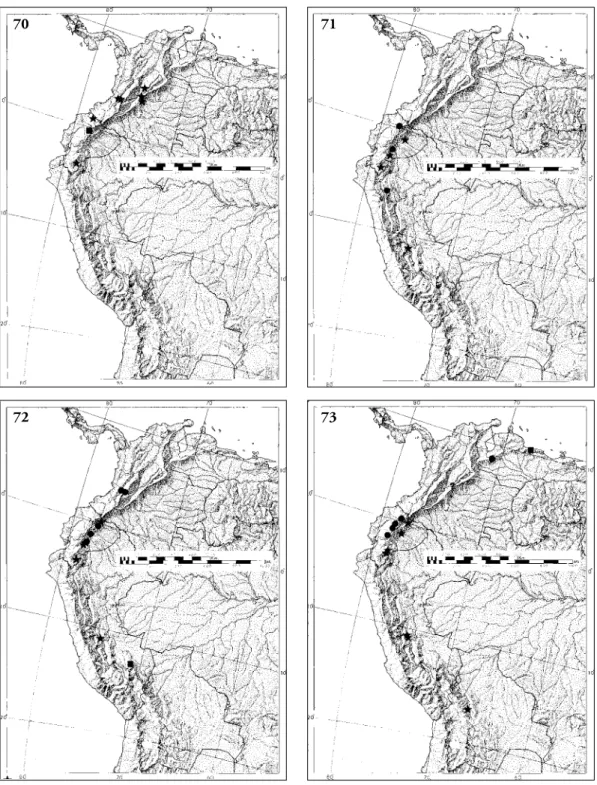
The evidence supporting the hypothesis that each available name represents a distinct species under a biological and/or phylogenetic species concept is dis- cussed. Distribution of each species is mapped. In a few cases, the distributions of “unrelated” Timaeta species are combined on a single map for the purpose minimizing the number of maps needed. Months are abbreviated by their first three letters. Brackets are used for information not explicitly noted on holotype labels and for descriptions of the labels. All paratype labels are light blue.
The taxonomy in this paper is largely based on morphology of the males, as has been suggested for genera in which it is difficult to associate males and females (Robbins 2004a). Males of Timaeta in col- lections outnumber females by about 5 to 1. Males have androconial characters that females lack. Holo- types of eight of the ten previously available names (two are synonyms) in Timaeta species are males.
Genitalic terms follow those in Klots (1970), as mod- ified for the Eumaeini in Robbins (1991). Wing vein terminology follows Comstock (1918). Androconial terminology follows Robbins (1991). All other mor- phological terms follow Snodgrass (1935).
Acronyms for the collections from which data were gathered are as follows:
AME Florida Museum of Natural History (for- merly Allyn Museum of Entomology), University of Florida, Gainesville, FL, AMNH American Museum of Natural History, USA
New York, NY, USA
BMNH Natural History Museum, London, UK CMNH Carnegie Museum of Natural History,
Pittsburgh, PA, USA
DZUP Universidade Federal do Paraná, Paraná, Curitiba, Brazil
FROM Francisco Romero Collection, Maracay, Venezuela
JHKW Jason Hall and Keith Willmott Collection, Smithsonian Institution, Washington, DC, USA
MCCV Mauro Costa Collection, Caracas, Ven- ezuela
MECN Museo Ecuatoriano de Ciencias Naturales, Quito, Ecuador
MNHN Muséum National d’Histoire Naturelle, Paris, France
MIZA Museo del Instituto de Zoología Agrícola, Maracay, Venezuela
MUSM Museo de Historia Natural, Universidad Nacional Mayor de San Marcos, Lima, RCB Perú Robert C. Busby Collection, Andover,
MA, USA
SMF Forschungsinstitut und Naturmuseum Senckenberg Frankfurt, Frankfurt-am- Main, Germany
SMNS Staatliches Museum für Naturkunde, Stuttgart, Germany
UNCC Museo de Historia Natural, Universidad Nacional de Caldas, Manizales, Colombia USNM National Museum of Natural History,
Smithsonian Institution, Washington, DC, USA
ZMHB Museum für Naturkunde der Humboldt- Universität, Berlin, Germany
ZSM Zoologische Staatssammlung, München [= Munich], Germany
A summary of the new classification is presented in the format of the previous checklist for the Eumaeini (Robbins 2004b). A key is presented to facilitate identification of males. Characters for identifying females are included in the species accounts, but the identification of some females is still uncertain.
Taxonomy
Timaeta K. Johnson, Kruse & Kroenlein
Timaeta K. Johnson, Kruse & Kroenlein, 1997: 23 n.
gen., type species: Pseudolycaena timaeus C. Felder &
R. Felder, 1865 (by original designation).
Trochusinus K. Johnson, Salazar & Vélez, 1997: 4 n. gen., type species: Thecla trochus H.H. Druce, 1907 (by original designation). Robbins, 2004b: 120 (syn. n.).
Jagiello Bálint & Wojtusiak, 2000: 184 n. gen., type spe- cies: Jagiello molinopampa 2000 (by original designa- tion). Robbins, 2004b: 120 (syn. n.).
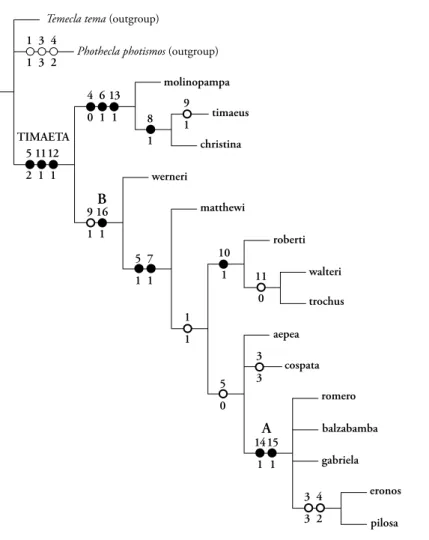
Diagnosis. The synapomorphies that characterize Timaeta in the phylogenetic results (“unambigu- ous changes only”, Fig. 74) are (1) posterior edge of labides in lateral aspect dorso-ventrally flat (charac- ter 5), (2) male ventral hindwing cubital spot brown (character 11, “reversed” in T. trochus and T. walteri), and (3) male hindwing tails absent (character 12).
Two sexual dimorphisms in Timaeta are conspicu- ous even though their occurrences are homoplastic.
First, males lack an orange-red ventral hindwing cubital spot and females have it. Second, males lack hindwing tails while the females possess them. The first dimorphism occurs in no other eumaeine genus
of which we are aware, but males of two Timaeta spe- cies have the orange cubital spot, which is a reversal according to the phylogenetic results (Fig. 74).
The second dimorphism also occurs in Micandra platyptera and some species of Erora, and is homo- plastic within Timaeta because females of T. molin- opampa and T. werneri lack tails.
Head. The antennal stalk has 14-18 white ringed segments, and the club is incrassate with the ventral nudum confined to club, which may be dark yel- low or orange. The amount of white scaling along the length of the stalk is variable, with more white scales in T. molinopampa. The frons is typical of the Eumaeini with ventrally oriented gray-brown flat scales intermixed with rather robust, but thin dark gray or black scales protruding outwards that give a
“hairy” appearance. The number of protruding scales is greatest in T. molinopampa and least in T. aepea, which is consistent with the observation that the number of these scales increases with elevation. Five species have blue scales along the lateral edges of the frons in males, as noted in the phylogenetic charac- ters. Otherwise, the head is not sexually dimorphic except that length of the third segment of the labial palps is generally a bit longer in females.
Forewing length. Varies from about 9 to 18 mm.
Wing shape, venation, and pattern (Figs. 1-35). Males of most species have rounded wings, epitomized by the wings of T. aepea (Fig. 17), but the hindwings of T. christina are elongate (Figs. 3-4). A hindwing anal lobe is absent or vestigial except in T. christina and T. molinopampa. The “loss” of hindwing vein M2 in both sexes is an excellent generic character in those 12 Timaeta species in which it occurs (see phylogenetic results). The ventral forewing postme- dian line, which is often obscured in males, extends from the costal margin to the inner margin, unlike some co-occurring eumaeine genera, such as Lathecla Robbins.
Androconia (Figs. 63-65). Males of T. timaeus and T. christina have androconia in the anterior portion of the dorsal hindwing and at the base of the ven- tral forewing, a combination of scent patches that is widespread in the Eumaeini. Five species have a
“comb” of piliform black setae along the posterior edge of dorsal hindwing vein Cu2 with additional androconia at the base of these scales (Fig. 65).
This structure is otherwise unreported in the Eumaeini.
Genitalia (Figs. 36-62). Male genitalia are typical of the Micandra Section (see characters in Robbins &
Duarte 2004), including absence of brush organs (sensu Eliot 1973). The peculiar rounded tips of the valvae (Figs. 36-40, character 1) is reported within the Eumaeini only in some Timaeta and Temecla, but
its “loss” within Timaeta appears to be homoplastic (Fig. 74). The female genitalia are not especially dis- tinctive except for their “fan-shaped” signa, again typical of many Micandra Section genera. Shape of the posterior end of the ductus bursae and its lamel- lae is the primary differentiating structure among Timaeta female genitalia, but we yet lack sufficient information on intraspecific variation to determine the extent to which females can be identified by these structures.
Distribution and seasonality. Timaeta is restricted to the Andes from northern Venezuela to Bolivia at elevations from 750 to 3200m. Although the vast majority of specimens reported in this paper were collected between August and December, this pat- tern may well be an artifact of the months when col- lectors were most often in the field.
Checklist
Timaeta K. Johnson, Kruse & Kroenlein, 1997 Syn. Trochusinus K. Johnson, Salazar &
Vélez, 1997
Syn. Jagiello Bálint & Wojtusiak, 2000 timaeus (C. Felder & R. Felder, 1865)
(Pseudolycaena) . . . .Colombia Syn. circinata (Hewitson, 1874) (Thecla)
. . . . Bolivia Syn. lecromi (K. Johnson, Eisele & . . .
MacPherson, 1993) (Androcona) . . . .
. . . . Colombia christina Robbins & Busby, sp. n. . . . Peru molinopampa (Bálint & Wojtusiak, 2000) (Jagiello) . . . . Peru werneri (Salazar, Vélez, Cardona & K. John- son, 1997) (Trochusinus) . . . . Colombia matthewi Busby & Robbins, sp. n. . . . . Ecuador walteri Busby & Robbins, sp. n. . . . . Ecuador trochus (H.H. Druce, 1907) (Thecla) . . Colombia roberti Busby & Robbins, sp. n. . . . . Ecuador aepea (Hewitson, 1874) (Thecla) . . . . Ecuador cospata Robbins & Busby, sp. n. . . . .Peru eronos (H.H. Druce, 1890) (Thecla) . .Colombia Syn. neblina (Salazar & K. Johnson, 1997)
(Micandra), syn. n. . . . . Colombia pilosa Robbins & Busby, sp. n. . . . Ecuador gabriela Busby & Robbins, sp. n.. . . Ecuador romero Robbins & Busby, sp. n. . . . . Venezuela
balzabamba (Goodson, 1945) (Thecla) . . . . .
. . . .Venezuela; Ecuador
Wing pattern key for male Timaeta 1. With a conspicuous hindwing anal lobe (e.g.,
Fig. 4) . . . . 2 – Without a hindwing anal lobe (e.g., Fig. 1) . . . 3 2. A scent patch in the middle of the dor-
sal hindwing and at the base of the ventral forewing, hindwing outer margin smooth (Fig. 3) . . . . T. christina – No androconia, hindwing outer margin scal-
loped (Fig. 5) . . . . T. molinopampa 3. Scent patch in the anterior half of the dor-
sal hindwing and at the base of the ventral forewing (Fig. 1) . . . . T. timaeus – Hair-like androconia along posterior edge of
dorsal hindwing vein Cu2 (e.g., Fig. 21) . . . . 4 – No evident androconia (e.g., Fig. 11) . . . . 7 4. Without blue scales on the ventral forewing
(although when viewed with a microscope, there may be a few scattered blue scales, Fig. 27) . . . . T. romero – With green-blue scales in the posterior distal
part of the ventral forewing and the discal cell almost entirely dark brown (Fig. 23) . . .
. . . . T. gabriela – With blue scales covering a large part of the
ventral forewing, including the distal part of the discal cell (e.g. Fig 19) . . . . 5 5. With blue scales in the distal part of the ven-
tral forewing extending anterior of the blue in the discal cell, with dark scales at the end of the discal cell, and with lightly marked marginal and postmedian lines on the ventral hindwing (Fig. 19) . . . . T. eronos – With a uniform patch of brilliant blue scales
covering the median portion of the ventral forewing, including the distal part of the dis- cal cell (e.g. Fig. 21) . . . . 6 6. With a broad, well defined black marginal
border on the dorsal forewing from the costal to the inner margin and with a dark margin- al border on the ventral forewing extending from the apex to the inner margin (Fig. 21)
. . . . T. pilosa – With a somewhat diffuse marginal border on
the dorsal forewing and with a dark marginal border on the ventral forewing that extends from the apex to vein Cu2 (e.g. Fig. 29) . . . .
. . . . T. balzabamba 7. Hindwing anal angle not smoothly rounded,
with a small black tuft of scales on the ventral surface (e.g., Fig. 15) . . . . 8 – Hindwing anal angle rounded, without a
small black tuft of scales on the ventral sur- face (e.g., Fig. 17) . . . . 10 8. An orange/red cubital spot on the ventral
hindwing (e.g., Fig. 11) . . . . 9 – Without an orange/red cubital spot on the
ventral hindwing (Fig. 15) . . . . T. roberti 9. Dorsal surface a rich blue. Ventral forewing
with a light dusting of blue scales in the pos- terior distal part of the wing (Fig. 11) . . . . . . . . T. walteri – Dorsal surface green or green-blue. Ventral
forewing with green-blue scales concentrated in the posterior 2/3 of the wing (Fig. 13) . . .
. . . . T. trochus 10. Dorsal wing color green-blue (e.g., Fig. 9) . . 11 – Dorsal wing color blue (e.g., Fig. 7) . . . . 12 11. Dorsal forewing with “crisp” marginal bor-
der. Green-blue scales restricted to the pos- terior and distal part of the ventral forewing.
Postmedian lines on both the ventral forew- ing and hindwing present (Fig. 9) . T. matthewi – Dorsal forewing with “diffuse” marginal bor-
der. A light “dusting” of green-blue scales in the middle of the ventral forewing. No post- median line visible on the ventral hindwing (Fig. 17) . . . . T. aepea 12. Dorsal forewing mostly bright blue with a
well defined black border (Fig. 7) . . . . T. werneri – Dorsal forewing with blue restricted to the
area posterior of vein Cu1 (Fig. 30) . . T. cospata
Timaeta timaeus (C. Felder & R. Felder)
Figs 1-2, 31, 36, 51, 63, 66
Pseudolycaena timaeus C. Felder & R. Felder 1865: 248.
Thecla timaeus Hewitson 1867:80. D’Abrera 1995: 1133.
Timaeta timaeus Johnson et al. 1997a: 24 comb. n., / lec- totype in BMNH examined, see type locality discus- sion below.
Thecla circinata Hewitson, 1874:19. Johnson et al. 1997a:
24, ? lectotype in BMNH, Bolivia. D’Abrera 1995:
1133, syn. n.
Timaeta circinata Robbins 2004b: 120 lectotype exam- ined.
Androcona lecromi K. Johnson, Eisele & MacPherson 1993:8. Le Crom & Johnson 1997: pl. XVIII, holo- type ? in UNCC illustrated.
Timaeta lecromi Robbins 2004b: 120 syn. n., comb. n.
Diagnosis and recognition as a distinct species. Tima- eta timaeus forms a clade with T. christina and T. molinopampa, supported by three synapomorphies (Fig. 74). Superficially, this lineage can be distin- guished from other Timaeta by the presence of hindwing vein M2 in both sexes. Timaeta timaeus is sympatric with T. christina (known only from males), but occurs at a lower elevation than T. molinopampa. Males are differentiated from both by lack of a hindwing anal lobe. The lesser extent of the dorsal hindwing scent patch also consistently
differentiates males from those of T. christina (detailed in next species account). Many elements of the ventral wing pattern differentiate both sexes of T. timaeus from those of T. molinopampa (Figs. 5-6).
There is no evident elevational variation in these dif- ferentiating wing pattern characters.
Description of male. Mean forewing length=16.25 mm, SD=0.979, N=10. Wing pattern (Fig. 1), wing venation (Fig. 31), genitalia (Fig. 36), and androco- nia (Fig. 63) illustrated.
Description of female. Mean forewing length=
16.70 mm, SD=1.567, N=10. Wing pattern (Fig. 2) and genitalia (Fig. 51) illustrated.
Variation. Female underside ground color varies from reddish brown to dark maroon-brown, but it is unclear if this variation is seasonal. It does not seem to be correlated with elevation.
Reasons for associating males and females. Draudt (1919-1920:756) noted that the ventral wing pat- tern of T. circinata “is marked exactly like timaeus”, but placed them in different species groups.
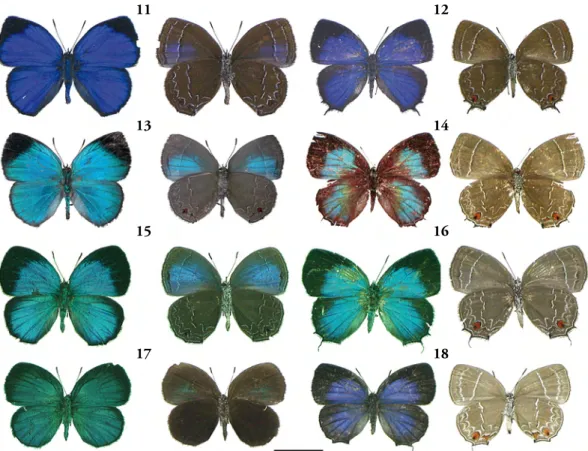
D’Abrera (1995) treated Thecla circinata as the male of T. timaeus. Johnson et al. (1997a) sug- gested that T. timaeus and T. circinata were likely to be sexes of the same species. Our sample indicates that T. timaeus and T. circinata occur in the same Figs 1-10. Timaeta adults (dorsal surface on left, ventral surface on right). 1, T. timaeus male (Ecuador, Zamora- Chinchipe); 2, T. timaeus female (Ecuador, Morona-Santiago); 3, T. christina male holotype (Peru, Amazonas), anal lobes bent downwards so they are barely visible, see following figure; 4, T. christina male (Ecuador, Tungu- rahua), dorsal hindwing androconia barely visible, but see figure 63; 5, T. molinopampa male (Ecuador, Loja);
6, T. molinopampa female (Ecuador, Loja); 7, T. werneri male (Ecuador, Esmeraldas); 8, T. werneri female (Ecuador, Pichincha); 9, T. matthewi male holotype (Ecuador, Morona-Santiago); 10, T. matthewi female (Ecuador, Morona- Santiago). Scale 1 cm.
1
3
5
7
9
2
4
6
8
10
habitats, and no other male-female association has been proposed. It is possible that our study series of T. timaeus includes females of T. christina. However, there is no indication that variable characters, such as size, shade of blue on the dorsal wings, and extent of dorsal blue color, are bimodal. Further, males of T. christina have not been recorded from Colombia, the type locality of T. timaeus.
Habitat and elevation. Montane forest between 1500 and 2200m elevation.
Male behavior. Three males set up mating territories in a clearing at the edge of the Rio Mackay, Tungu- rahua, Ecuador (1°23.9’S, 78°17.0.94’W), 1700m at 1452, 1452, and 1522 hours about 3m above the ground on 6 Sep 1999 (vouchers in USNM).
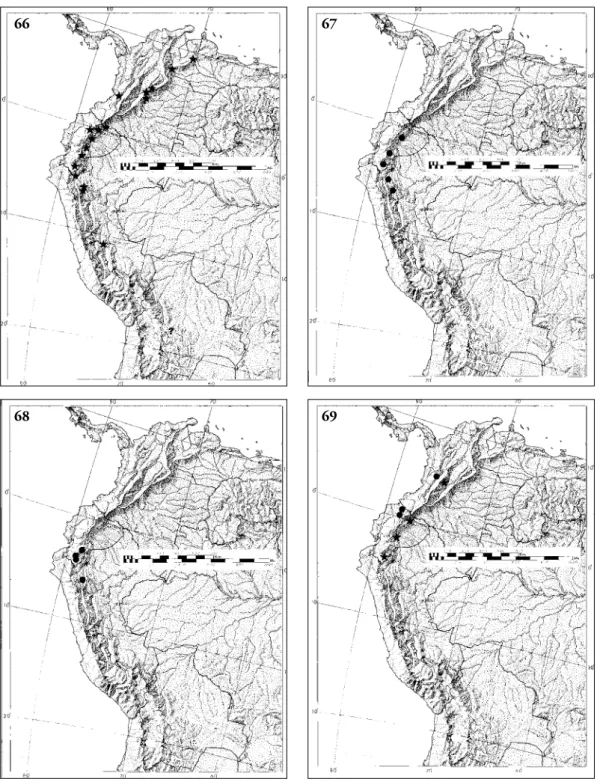
Distribution (Fig. 66). Occurs from Venezuela to Bolivia. In Colombia and Ecuador, it is found on both the eastern and western slopes of the Andes.
Type locality. Although Felder and Felder (1865)
described Pseudolycaena timaeus from Bogotá, Nova Granada, Johnson et al. (1997a) designated a Felder Collection lectotype from Venezuela with a
“Rothschild Bequest B.M. 1919-1, B.M. Type No Rh. 579” label. The lectotype matches the original figure of P. timaeus very well, but photographs of this specimen from the 1970s show that it lacks a Ven- ezuela locality label and that the Rothschild Bequest number is 1939-1, not 1919-1. Indeed, it would be an invalid lectotype if it had a Venezuela locality label. Despite the incorrect information in Johnson et al. (1997a), the original figure is definitive, and identification poses no problems.
Material examined. 37 males (3 genitalic dissections), 18 females (2 genitalic dissections), the female lecto- type of T. timaeus, the male lectotype of T. circinata, photographs of the male holotype of T. lecromi, and photographs of two Venezuelan males (MCCV).
Figs 11-18. Timaeta adults (dorsal surface on left, ventral surface on right). 11, T. walteri male holotype (Ecuador, Pichincha); 12, T. walteri female (Ecuador, Pichincha); 13, T. trochus male (Ecuador, Zamora-Chinchipe);
14, T. trochus female (Ecuador, Zamora-Chinchipe), base of dorsal wings “stained”; 15, T. roberti male holotype (Ecuador, Morona-Santiago); 16, T. roberti female (Ecuador, Morona-Santiago); 17, T. aepea male (Ecuador, Morona-Santiago); 18, T. aepea female (Ecuador, Morona-Santiago). Scale 1 cm.
11 12
13 14
15 16
17 18
Timaeta christina Robbins & Busby, sp. n.
Figs 3-4, 37, 64, 67
Type material. Holotype ? Peru, AM, Mendoza, Quebrada Yanahuayco, 1600-1800m, 06[º]24[’]S/
77[º]26[’]W, viii [Aug 19]98, [leg.] B. Calderón.
Deposited MUSM (Fig. 3). [One white label, a red holotype label.]
Paratypes (9?). Ecuador: 1? Tungurahua, Rio Machay, 1900m, 1 Dec 1997, leg. J.P.W. Hall &
K.R. Willmott (Fig. 4, JHKW); 1? Tungurahua, km.
14 Limón-Gualaceo Rd., 1950m, 30 Sep 1997, leg.
J.P.W. Hall & K.R. Willmott (JHKW); 2? Zamora- Chinchipe, San Francisco, casa de Arcoiris, km. 23 Loja-Zamora Road, 2100m, 3º59.30’S 79º5.58’W, 25 Nov 2003, leg. K.R. Willmott (JHKW); 1? Zamora-Chinchipe, aqueduct above Rio San Fran- cisco, Loja-Zamora Road, 2000m, 4 Feb 2002, leg.
K.R. Willmott (JHKW); 1? Zamora-Chinchipe, km. 24 Loja-Zamora Road, nr. Sabanilla, Qbda. San Ramon, 1700m, 3º58.16’S 79º03.75’W, 27, 29 Oct 1997, leg. K. R. Willmott (MECN); 1?, Zamora- Chinchipe, Romerillos, 1600m, Nov 1999, leg.
I. Aldas & R.C. Busby (RCB); Peru: 2? Amazonas, Abra Pardo Miguel, 2200m, 05º42’S 77º48’W, 18 Nov 1996 (USNM), 19 Nov 1996 (MUSM).
Diagnosis and recognition as a distinct species. Tima- eta christina forms a clade with T. timaeus and T. molinopampa (Fig. 74). Males of T. christina have an elongate hindwing with an anal lobe (Figs. 3, 4) while males of T. timaeus have a rounded hindwing without an anal lobe (Fig. 1). The ventral wing pat- tern of male T. christina is easily distinguished from that of male T. molinopampa (Figs. 3-5). Females of T. christina are unknown or unrecognized, as noted already. Timaeta christina is sympatric with T. timaeus, but occurs at lower elevations than T. molinopampa. There is no evident elevational variation in those wing pattern characters that dif- ferentiate it, but the number of known specimens of T. christina is yet small.
Description of Male. Mean forewing length 17.13 mm, SD=0.876, N=8. Wing pattern (Figs. 3-4), genitalia (Fig. 37), and androconia (Fig. 64) illus- trated. The male genitalia are indistinguishable from those of T. timaeus. The scent patch on the dorsal hindwing covers a larger area than that of T. timaeus.
Specifically, wing cell Cu1-Cu2 always has androco- nia whereas in T. timaeus they are absent or restricted to the basal part (Figs. 63-64). Because these andro- conia are mixed with regular wing scales, the andro- conial patch in T. christina is not as readily apparent as that in T. timaeus.
Description of Female. Unknown or unrecognized.
Etymology. This beautiful species is named for
Christine Lamas Weinberg, daughter of Gerardo Lamas. Lamas first recognized this species as distinct.
The name is a non-latinized noun in apposition and is indeclinable.
Type locality. Mendoza (Amazonas State), where lepi- dopterist Benigno Calderón lives, is located in wet montane forest on the eastern slopes of the Andes.
Habitat and elevation. Montane forest between 1600 and 2200m elevation.
Male behavior. According to J. Hall and K. Willmott, males perch on vegetation on the side of streams, much like males of T. timaeus. In some cases, males of T. christina perch up to 10m above the ground.
Distribution (Fig. 67). Eastern slope of the Andes in Ecuador and northeastern Peru.
Material examined. The type series of 10 males (3 genitalic dissections).
Timaeta molinopampa (Bálint & Wojtusiak)
Figs 5-6, 32, 38, 52, 68
Jagiello molinopampa Bálint & Wojtusiak 2000: 187 Holo- type ? Peru, Amazonas, Molinopampa in MUSM.
Timaeta molinopampa Robbins 2004a: 120 comb. n.
Diagnosis and recognition as a distinct species. Tima- eta molinopampa forms a clade with T. christina and T. timaeus (Fig. 74), but occurs at higher elevations.
It is differentiated most easily by its unique wing pat- tern (Figs. 5, 6), which does not seem to vary with elevation.
Description of Male. Mean forewing length=13.65 mm, SD=1.101, N=20. Wing pattern (Fig. 5), wing venation (Fig. 32), and genitalia (Fig. 38) illustrated.
No evident androconia.
Description of Female. Mean forewing length=14.50 mm, SD=0.707, N=2. Wing pattern (Fig. 6) and genitalia (Fig. 52) illustrated.
Reasons for associating males and females. The under- side wing patterns of the male and female are argu- ably more similar to each other than to those of any other eumaeine species. They are the only Timaeta with scalloped hindwing margins (Figs. 5, 6). Both sexes occur in the same habitat. Both male and female genitalia are exceedingly similar to those of T. timaeus. Bálint and Wojtusiak (2000) proposed a different female for this species, but its underside wing pattern is considerably different from that of the male. The illustration of the female genitalia in Bálint and Wojtusiak (2000) is not sufficiently detailed to determine its generic placement.
Habitat and elevation. Montane vegetation (bushes and occasional short trees) between 2500 and 3200m elevation.
Distribution (Fig. 68). Eastern slope of the Andes in
southeastern Ecuador and northeastern Peru.
Material examined. 33 males (2 genitalic dissections), 2 females (1 genitalic dissection), and a photograph of the male holotype and a figure of its genitalia.
Timaeta werneri (Salazar, Vélez, Cardona &
K. Johnson)
Figs 7-8, 33, 39, 53, 69
Trochusinus werneri Salazar, Vélez, Cardona, & K. Johnson, 1997: 9 Holotype ? Colombia, Chocó, San José del Palmar in UNCC.
Timaeta werneri Robbins 2004a: 120. comb. n.
Diagnosis and recognition as a distinct species. Both sexes of T. werneri can be readily differentiated by wing pattern (Figs. 7, 8). The female lacks tails (shared only with T. molinopampa) and has two orange-red ventral hindwing cubital spots with black “pupils”.
The large blue patch on the ventral hindwing of males with the immaculate black hindwing differen- tiates the male. Also, the shape of the rounded valva tips with a straight medial margin (Fig. 39) is other- wise unrecorded in the Eumaeini. And among the 12 species lacking hindwing vein M2, T. werneri is the only species with the male genitalia dorsal cornutus more than half the length of the ventral one.
Description of Male. Mean forewing length=13.05 mm, SD=0.071, N=2. Wing pattern (Fig. 7), wing venation (Fig. 33) and genitalia (Fig. 39) illustrated.
No evident androconia.
Description of Female. Mean forewing length=12.15 mm, SD=0.495, N=2. Wing pattern (Fig. 8) and genitalia (Fig. 53) illustrated.
Reasons for associating males and females. The tailless females of T. werneri are distinctive, as noted in the description above. They are sympatric with males of T. werneri, T. balzabamba, and T. trochus, but have a different ventral postmedian line than males of T. trochus or T. balzabamba (a vestigial postmedian line is present in some males).
Habitat and elevation. Wet montane forest from 800 to 1700m elevation.
Distribution (Fig. 69). Western slope of the Colom- bian and Ecuadorian Andes.
Material examined. 2 males (1 genitalic dissection), 2 females (1 genitalic dissection), a photograph of the male holotype and the “stylized” illustration of its genitalia in the original description.
Timaeta matthewi Busby & Robbins, sp. n.
Figs 9-10, 40, 54, 69
Type material. Holotype ? Ecuador, Morona- Santiago, 1 km E. Rio Abanico, 1600m, 2°15.4’S,
78°11.7’W, 02 October 2001, Robert C. Busby, leg.
Deposited USNM (Fig. 9). [One white label, a red holotype label.]
Paratypes (4?). Colombia: 1? Central Cordillera, Cañon del Tolima, 1700m, Coll. Fassl (SMF). Ecua- dor: 1? Morona-Santiago, 14 km. W. of Macas, Rio Abanico, 1600m, 22 Sep 1999, leg. Robert C. Busby (RCB); 1? Morona-Santiago, 14 km. W. of Macas, Rio Abanico, 1600m, 16 Sep 1999, leg. Robert C.
Busby (RCB); 1? Sucumbíos, 2 km El Reventador- Lumbaqui Rd, 1º 01.5’S 77º 30.6’W, 1500m, 29 Dec 2005, leg. Robert C. Busby (MECN).
Diagnosis and recognition as a distinct species.
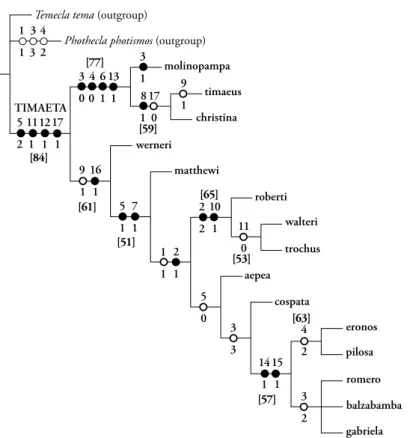
Timaeus matthewi is a phylogenetically distinct spe- cies (Figs. 74, 75). Among those 12 species lack- ing hindwing vein M2, it shares valva tips that are rounded only with T. werneri (Figs. 39-50), but can be differentiated from this species by its wing pattern (Figs. 7-10) and by the medial edge of the valva tips being curved (Fig. 40).
Description of Male. Mean forewing length=12.50 mm, SD=1.225, N=5. Wing pattern (Fig. 9) and genitalia (Fig. 40) illustrated. No evident androco- nia.
Description of Female. Mean forewing length=11.60 mm, SD=0.849, N=2. Wing pattern (Fig. 10) and genitalia (Fig. 54) illustrated.
Etymology. This handsome species is named for Mat- thew W. Busby. He is the son of Robert C. Busby, who first realized that this species is distinct from T. roberti, a species with a similar wing pattern. The name is a noun in apposition and is indeclinable and non-latinized.
Type locality. The Rio Abanico locality is about 14 km west of Macas (map distance) and is heavily forested.
Other Specimens Examined. The type series is restricted to males. Ecuador: 1/ Morona-Santiago, Nueve de Octubre, 2º12.2’S 78º13.1’W, 1800m, 2 Oct 2000, Robert C. Busby, leg. (RCB); 1/ Zamora- Chinchipe, Zamora (ridge W of town), 1450m, 20 May 2000, leg. Robert C. Busby (USNM).
Reasons for associating males and females. One female of T. matthewi was found at the same area as males.
Both sexes have the same postmedian line on the ventral wings—most notably the forewing postme- dian line at the coastal margin is strongly curved.
Distribution (Fig. 69). Central Colombia to eastern Ecuador.
Habitat and elevation. Montane forest at elevations between 1450 and 1800m.
Male behavior. Ecuadorian males set up mating ter- ritories in the early afternoon around 1330 hours on steep hillsides within the forest perching at a height
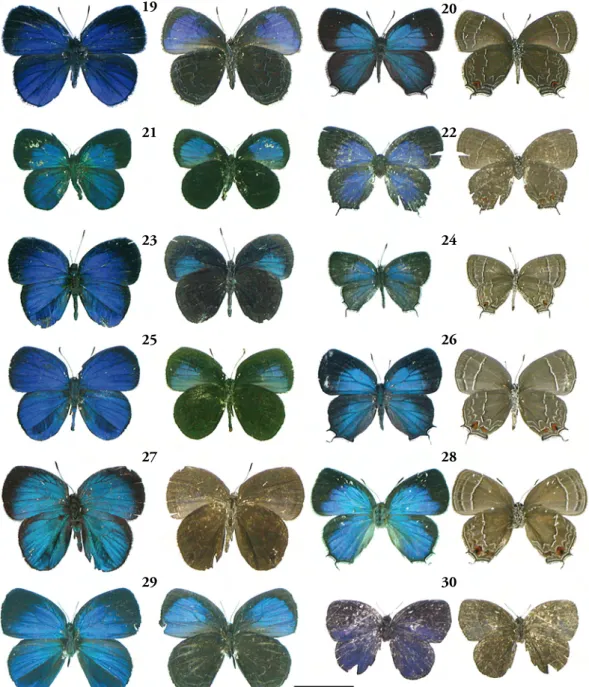
Figs 19-30. Timaeta adults (dorsal surface on left, ventral surface on right). 19, T. eronos male (Ecuador, Napo);
20, T. eronos female (Ecuador, Morona-Santiago); 21, T. pilosa male holotype (Ecuador, Morona-Santiago);
22, T. pilosa female (Peru, Junin); 23, T. gabriela male, in copula (Ecuador, Sucumbios); 24, T. gabriela female, in copula (Ecuador, Sucumbios); 25, T. gabriela male holotype (Ecuador, Morona-Santiago); 26, T. gabriela female, (Ecuador, Pastaza); 27, T. romero male holotype (Venezuela, Aragua); 28, T. romero female (Venezuela, Aragua);
29, T. balzabamba male (Colombia, Meta?); 30, T. cospata male holotype (Peru, Cusco). Scale 1 cm.
19 20
24 23
21 22
25 26
27 28
29 30
of 6-8m above the ground on the sunny edge of tree- fall gaps.
Material examined. 5 males (3 genitalic dissections) and 2 females (1 genitalic dissection).
Remarks. The wing pattern of male T. matthewi is similar to that of T. roberti, but is smaller and lacks the black scales at the anal angle of the ventral hind- wing (see below).
Timaeta trochus species group
The T. trochus species group (T. trochus, T. walteri, T. roberti) is distinguished by a small tuft of black scales at the anal angle of the ventral hindwing of males (a few individuals of T. timaeus have a similar patch of scales) and a posteriorly pointing process
(>1.5 mm) lacking setae on the male genitalia valva (Fig. 75). The species in this group have indistin- guishable male genitalia (Figs. 41-43). The lamella postvaginalis (female genitalia) differs in shape slightly among the three species (Figs. 55-57), but we do not have enough information on variation to know if these differences are distinguishing. Indeed, we are somewhat uncertain whether we have cor- rectly distinguished females of T. trochus. Males of T. trochus and T. walteri have an orange ventral hind- wing cubital spot (except in worn individuals), which occurs in no other Timaeta species. All three species occur at different elevations in western Ecuador, but our sample sizes of T. trochus and T. roberti are small, and T. walteri is known from one locality.
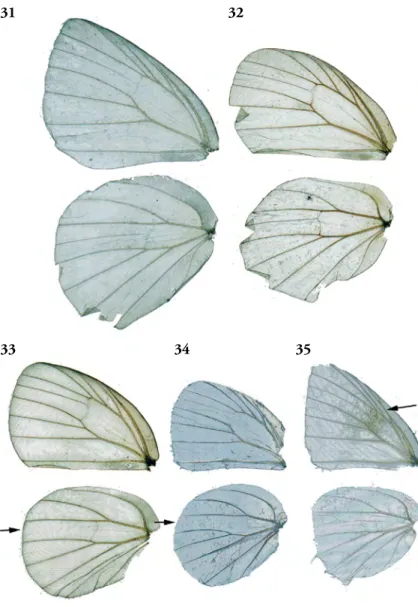
Figs 31-35. Wing venation (forewing on top). 31, T. ti- maeus male (Ecuador, Tungu- rahua); 32, T. molinopampa male (Ecuador, Loja); 33, T. werneri male (Ecuador, Pichincha)—arrow points to missing hindwing vein M2; 34, T. pilosa male (Peru, Junín)—arrow points to missing hindwing vein M2, androconia along the poste- rior edge of hindwing vein Cu2 not visible, see figure 65; 35, Temecla tema male (Peru, Madre de Dios)—ar- row points to anastomosis of veins Sc and R1, as noted in Robbins & Duarte (2004).
31 32
33 34 35
36 37
38 39
40 41
42 43
Timaeta walteri Busby & Robbins, sp. n.
Figs 11-12, 41, 55, 70
Type material. Holotype ? Ecuador, Pichincha Province, 30 km. W. of Aloag, 2200m, 19-20.x[Oct]. 1991, leg.
Robert C. Busby. Deposited USNM (Fig. 11). [One white label, a red holotype label.]
Paratypes. (5? & 5/). Ecuador, Pichincha, 30 km.
W. of Aloag, 2200m, leg. R.C. Busby: 2? 19-20 Oct 1991 (RCB, USNM), 1? 24 Oct 1992 (RCB), 2? 15 Oct 1992 (RCB), 1/ 10 Oct 1996 (Fig. 12, USNM), 1/ 24 Oct 1992 (RCB), 1/ 31 Oct 1992 (RCB), 1/ 13-15 Oct 1988 (labeled 72 km. E. of Santo Domingo, but it is the same locality, RCB); 1/ 26 km. W. of Aloag, 2400m, 28 Oct 1994, leg. Robert C. Busby (RCB).
Diagnosis and recognition as a distinct species.
Timaeus walteri is the phylogenetic sister of T. trochus (Figs. 74, 75), but size, dorsal color, and shape of the forewing dorsal border consistently differentiate males. The dorsal color of male T. walteri is a rich blue while that of male T. trochus is green or green- ish-blue throughout its range (Figs. 11, 13). Timaeus walteri occurs at higher elevations than T. trochus in western Ecuador (albeit, the data are insufficient to conclude much). Because wing pattern and genitalic structures in T. trochus do not vary with elevation (from 760-2500m elevation), it appears unlikely that T. walteri is an ecotypic variant of T. trochus.
Description of Male. Mean forewing length=13.63 mm, SD=1.013, N=6. Wing pattern (Fig. 11) and genitalia (Fig. 41) illustrated. No evident androconia.
Description of Female. Mean forewing length=13.10 mm, SD=0.742, N=5. Wing pattern (Fig. 12) and genitalia (Fig. 55) illustrated.
Etymology. This handsome species is named in honor of Walter C. Price Jr. for his support of the research of Robert C. Busby in Ecuador. This support led to many new discoveries reported in this paper, includ- ing the recognition of T. walteri as a distinct species.
The name is a noun in apposition and is indeclinable and non-latinized.
Type locality. The road from Aloag to Santo Domingo descends through a large valley from highlands above 3000m to the lowlands. It is a major thoroughfare in which the native vegetation is gradually be replaced by agriculture.
Reasons for associating males and females. The ven- tral postmedian lines are the same in both sexes.
A series of males and females were both collected at
the type locality, and no other Timaeta species have been found in this area.
Habitat and elevation. Montane forest on the west- ern side of the Ecuadorian Andes between 2200 and 2400m elevation.
Male behavior. Males set up mating territories on a group of small trees (4-5 meters in height) at the bot- tom of a steep streambed between 1200 and 1230 hours. Females were found at several locations less than 1 km distant along the Aloag/Santo Domingo Road, mostly landing on low vegetation at the edge of the mountain slope.
Distribution (Fig. 70). Western Ecuador.
Material examined. The type series of 6 males (1 genitalic dissection) and 5 females (1 genitalic dis- section).
Timaeta trochus (H.H. Druce)
Figs 13-14, 42, 56, 70
Thecla trochus H.H. Druce, 1907: 573 Colombia, Muzo, Rio Minero, 2500 feet in BMNH, holotype ? illus- trated. D’Abrera 1995: 1134 holotype ? illustrated.
Trochusinus trochus K. Johnson et al. 1997b: 7 comb. n.
Timaeta trochus Robbins 2004a: 120. comb. n., holotype examined.
Diagnosis and recognition as a distinct species. Timaeus trochus is the phylogenetic sister of T. walteri (Fig. 74, 75), but differs as noted in the previous spe- cies account
Description of Male. Mean forewing length=12.06 mm, SD=0.702, N=5. Wing pattern (Fig. 13) and genitalia (Fig. 42) illustrated. D’Abrera (1995) sug- gested that there might be a “discocellular androco- nial patch” on the dorsal forewing, but we find no evident androconia.
Variation. Males are green above (Fig. 13), but a male from Rio Aguacatal (Colombia) has more of a blue tint, being intermediate between the dorsal colors in figures 11 and 13.
Description of Female. Mean forewing length=13.10 mm, SD=0.566, N=2. Wing pattern (Fig. 14) and genitalia (Fig. 56) illustrated.
Reasons for associating males and females. Both sexes have the same ventral postmedian line and have been found in the same valley in Zamora-Chinchipe Province, Ecuador, albeit at different elevations.
Habitat and elevation. 760-2500m in a variety of
Figs 36-43. Male genitalia. 36, T. timaeus (Ecuador, Tungurahua); 37, T. christina (Ecuador, Zamora-Chinchipe);
38, T. molinopampa (Ecuador, Loja); 39, T. werneri (Ecuador, Pichincha); 40, T. matthewi (Ecuador, Morona- Santiago); 41, T. walteri (Ecuador, Pichincha); 42, T. trochus (Colombia, Cundinamarca); 43, T. roberti (Ecuador, Morona-Santiago). Scale 1 mm.
Figs 44-50. Male genitalia. 44, T. aepea (Ecuador, Morona-Santiago); 45, T. cospata (Peru, Cusco);
46, T. eronos (Colombia, Tolima); 47, T. pilosa (Ec- uador, Morona-Santiago); 48, T. gabriela (Ecuador, Morona-Santiago); 49, T. romero (Venezuela, Aragua);
50, T. balzabamba (Ecuador, Cotopaxi). Scale 1 mm.
44 45
46 47
48 49
50
montane habitats. The only two specimens from the western slope of the Ecuadorian Andes are from 800- 900m.
Distribution (Fig. 70). Both slopes of the Andes in Colombia and Ecuador, as well as the interior moun- tains of Colombia.
Remarks. Timaeta trochus has the widest elevational range of any species in the genus. A male from Pacho, Colombia (SMF) was illustrated in Draudt (1919- 1920) as Thecla trochus. Material examined. 6 males (3 genitalic dissections), 2 females (2 genitalic dissec- tions), and the male holotype in BMNH—its genitalia were stylistically rendered in Johnson et al. (1997b).
Timaeta roberti Busby & Robbins, sp. n.
Figs 15-16, 43, 57, 71
Type material. Holotype ? Ecuador, Morona- Santiago, Nueve de Octubre, 2º12.2’S 78º13.1’W, 1800m, 22 September 2000, Robert C. Busby, leg.
Deposited USNM (Fig. 15). [One white label, a red holotype label.]
Paratypes (8? & 1/). Ecuador, Morona-Santiago Province: 1? & 1/ Rio Abanico, 1600m, 2°15.0’S 78°12.1’W, 11 Sep 2000 (Fig. 16), 23 Sep 2000, Robert C. Busby, leg. (USNM, RCB); 5? Nueve de Octubre, 2º12.2’S 78º13.1’W, 1800m, 29 Sep 2001, 2 Oct 2000, 3 Oct 2000, 3 Oct 2000, 15 Sep 2006, leg. Robert C. Busby (USNM, MECN, RCB);
2?18 km Macas-9 de Octubre Road, (Rio Abanico), 2º15.3’S, 78º12.2’W, 1600m, 2 Oct 2004, I. Aldas, R.C. Busby, leg. (USNM), 11 Jan 2006, D.H. Ahr- enholz, R.C. Busby, leg. (RCB). Napo Province: 1? Tena, ca. 450m, Aug 1956, coll. J. Förster (ZSM).
Because Tena is in the lowlands in close proximity to higher elevations via the roads to Baeza and to Baños, we presume that this specimen was actually collected in the mountains. No Timaeta is otherwise known from the immediate vicinity of Tena.
Diagnosis and recognition as a distinct species. Superfi- cially, the color and wing pattern of T. roberti is most similar to that of T. matthewi (Figs. 9-10, 15-16), but T. roberti forms a clade with T. trochus and T. walteri (Figs. 74, 75). Despite geographical vari- ation in male dorsal color and shape of the dorsal forewing border in T. roberti (detailed below), these two characters plus the lack of a ventral hindwing orange cubital spot in the male definitively dis- tinguish T. roberti from T. trochus and T. walteri (Figs. 11, 13, 15). Although its geographical range overlaps that of T. trochus and T. walteri, T. roberti has not been found at exactly the same locality as either and appears to be restricted to 1500-1800m elevation.
Description of Male. Mean forewing length=13.73 mm, SD=1.603, N=11. Wing pattern (Fig. 15) and genitalia (Fig. 43) illustrated. No evident androco- nia.
Variation. Male dorsal color varies from green in eastern Peru and Ecuador to green-blue in western Ecuador. Width of the male dorsal forewing bor- der in figure 15 is typical of specimens from eastern Ecuador, but the border in the one male from Peru is about half the width. In western Ecuador, width of the border varies between these extremes.
Description of Female. Mean forewing length=13.6 mm, N=1. Wing pattern (Fig. 16) and genitalia (Fig. 57) illustrated.
Etymology. This handsome species is named for Rob- ert C. Busby Jr., son of Robert C. Busby, who first recognized that this species is distinct from T. mat- thewi. The name is a noun in apposition and is inde- clinable and non-latinized.
Type locality. About 17 km west of Macas (map dis- tance), the Nueve de Octubre locality in 2000 was a ridge with disturbed vegetation in an otherwise heav- ily forested area. The vegetation has suffered further degradation since then.
Other Specimens Examined. Because of geographical variation in male wing pattern, we restrict the type series to specimens from eastern Ecuador. Ecuador, Pichincha Province: 1? Maquipucuna, nr. Nanega- lito, 1550m, 28 Nov 1992, leg. R. A. Raguso, 1130 hours, perched 10’ up, dappled light (USNM); 1? Maquipucuna, nr. Nanegalito, 1700m, 2 Dec 1992, leg. R. A. Raguso, 1100 hours, 20’ perch, light gap (USNM); 2? Palmito Pamba, km. 5 rd. Nanegal- G. Moreno, 1500-1700m, 15 Oct 1996, leg. J.P.W.
Hall & K. R. Willmott (JHKW), 25 May 2007, R. Aldas, R.C. Busby, leg. (RCB). 1? Peru, AM, Quebrada Yanahuayco, 1800m, 06º24’S 77º26’W, Dec 2004, leg. B. Calderón (MUSM).
Reasons for associating males and females. The ventral postmedian lines of males and females are nearly identical. The female was collected on a ridge fre- quented by males.
Distribution (Fig. 71). Western and eastern Ecuador and northeast Peru.
Habitat and elevation. Montane forest at elevations between 1500 and 1800m. Unlike T. trochus, there is little variation in the elevation at which this species occurs, despite being known from three disparate localities.
Male behavior. Males in eastern Ecuador set up mat- ing territories on vegetation 3-4 meters above the ground along ridge tops. While most frequently encountered between the hours of 1200 and 1300 hours, an occasional male has been seen as late as 1530 hours. Males in western Ecuador set up mating
territories on hilltops, treefall gaps, forest edges, and along trails between 1100 and 1430 hours (under the names Thecla balzabamba and T. eronos, Raguso
& Gloster 1996, vouchers in USNM).
Material examined. 16 males (4 genitalic dissections) and 1 female (1 genitalic dissection).
Timaeta aepea (Hewitson)
Figs 17-18, 44, 58, 71
Thecla aepea Hewitson 1874: 165 / from Ecuador in BMNH.
Timaeta aepea Robbins 2004b: 120 / syntype examined, comb. n.
Diagnosis and recognition as a distinct species. Tima- eta aepea is phylogenetically distinct (Figs. 74, 75) and occurs at lower elevations than any other Tima- eta species on the eastern slope of the Andes. Male forewings and hindwings of T. aepea are rounded with no distinguishable apex on either wing and no discernable elongation at the hindwing anal angle, as is the case in some Timaeta species such as T. molin- opampa and T. christina. The dorsal wing color is usually a more intense green color than that of any other Timaeta. The ventral forewing has a small scat- tering of green scales in contrast to the much more brightly marked ventral forewings of most other Timaeta species.
Figs 51-62. Female genitalia. 51, T. timaeus (Colombia, Cundinamarca); 52, T. molinopampa (Ecuador, Loja);
53, T. werneri (Ecuador, Pichincha); 54, T. matthewi (Ecuador, Morona-Santiago); 55, T. walteri (Ecuador, Pichin- cha); 56, T. trochus (Ecuador, Loja); 57, T. roberti (Ecuador, Morona-Santiago); 58, T. aepea (Ecuador, Morona- Santiago); 59, T. eronos (Ecuador, Napo); 60, T. pilosa (Peru, Junin); 61, T. gabriela (Peru, Junin); 62, T. romero (Venezuela, Aragua). Scale 1 mm.
51 52 53 54 55 56
57 58 59 60 61 62
Description of Male. Mean forewing length 12.27 mm, SD=1.053, N=13. Wing pattern (Fig. 17) and geni- talia (Fig. 44) illustrated. No evident androconia.
Variation. Some males have remnant portions of a postmedian line on both the forewing and hindwing.
While most males are green dorsally, occasional ones have a blue tint.
Description of Female. Mean forewing length 12.50 mm, SD=0.707, N=2. Wing pattern (Fig. 18) and genitalia (Fig. 58) illustrated.
Nomenclature. This species was described from at least one Ecuadorian female in Hewitson’s collec- tion from Buckley. There is an old female lacking an abdomen in the Hewitson collection from Ecua- dor (BMNH) that has been labeled “B.M. type No.
Rh. 885” with “Thecla aepea Hew.” handwritten on a round, red-circular type label. This specimen matches the original figure, and our identification of this species is based on the wing pattern of this specimen.
Reasons for associating males and females. Three males and two females were collected within three meters of each other at Mendez (Morona-Santiago, Ecua- dor) (see male behavior notes below). These are the only male and female Timaeta specimens known from the eastern Andes below 1100m elevation.
Distribution (Fig. 71). Eastern Ecuador and Peru.
Habitat and elevation. This species occurs in areas with relatively intact forest remnants and also in more disturbed landscapes with small patches of remnant forest surrounded by cultivated land, pre- dominantly cow pastures. With recorded elevations between 900 and 1100m, Timaeta aepea occurs con- sistently at lower elevation than any other Timaeta in the eastern Andes (T. trochus is unrecorded below 1250m in the eastern Andes and there is one old, dubious record of T. gabriela at 750m).
Male behavior. Males set up mating territories at dif- ferent times at different localities. In Puyo (Pastaza), males consistently perched on a single plant about two meters high between 0900 and 1000 hours (observations made over a decade). In Mendez (Morona-Santiago), males of T. aepea were observed on two different hilltops about 500m apart. On one hill, the males perched on tall grass at the top edge of a cow pasture between 1130 and 1230 hours. Two females were collected in an adjacent hedgerow, but no courtship was observed. On the second hill, males perched on an isolated bush about two meters high between the forest and a cow pasture between 1030 and 1330 hours.
Remarks. D’Abrera (1995) illustrated a male and female of T. aepea from Peru. The male is actually a female Timaeta of uncertain identity. The female appears to be correctly identified. This is the first
time that a male has been associated with the female syntype.
Material examined. 14 males (3 genitalic dissections), 2 females (1 genitalic dissection), and a female syn- type in BMNH.
Timaeta cospata Robbins & Busby, sp. n.
Figs 30, 45, 72
Type material. Holotype ? Peru: Cusco, Qda. Morro Leguia, 13º08’[S] 71º33’[W], 30 Aug 1989, 1950-2150m, Leg. R. Robbins. Deposited MUSM (Fig. 30). [One white label, a green dissection label, a red holotype label.]
Paratypes. None.
Diagnosis and recognition as a distinct species. We rec- ognize T. cospata as a distinct species with reluctance because it is known from only one male that is in poor condition. Although we cannot assess varia- tion within this species, it is phylogenetically distinct (Figs 74, 75). It forms a clade with T. aepea and the T. eronos complex (5 species). The latter complex shares two synapomorphies (characters 14 & 15) that T. cospata does not possess (Figs 74, 75). The wing pattern and male genitalia of T. cospata and T. aepea have many differences (Figs. 17, 30, 44, 45), and these species occur, so far as is known, at widely disjunct elevations. The male of T. cospata is imme- diately distinguishable by the wide black border on the anterior half of the dorsal forewing.
Description of Male. Mean forewing length 11.1 mm, N=1. Wing pattern (Fig. 30) and genitalia (Fig. 45) illustrated. No evident androconia.
Description of Female. Unknown or not recognized.
Etymology. This name is arbitrary, non-latinized, and indeclinable. It is intended to draw an association with the Cosnipata Valley where the type was col- lected.
Type locality. The road from Paucotambo (3600m) to Atalaya (500m) steeply descends the heavily for- ested Cosnipata Valley. The holotype was collected in a light rain along the side of the road.
Distribution (Fig. 72). The type locality.
Habitat and Elevation. Wet montane forest at 1950- 2150m.
Material examined. The holotype male and its geni- talia.
Timaeta eronos species group
The T. eronos species group (T. eronos, T. pilosa, T. romero, T. balzabamba, and T. gabriela) is charac- terized by a unique ‘comb’-like scent patch along the posterior edge of dorsal hindwing vein Cu2 and by blue scales at the lateral edge of the frons (characters
14 & 15). Shape of the male and female genitalia, however, are quite variable among these species and do not characterize the group.
Timaeta eronos (H.H. Druce)
Figs 19-20, 46, 59, 72
Thecla eronos H.H. Druce 1890: 151 ? Interior of Co- lombia in BMNH. D’Abrera 1995: 1134 holotype ? illustrated.
Trochusinus eronos K. Johnson et al. 1997b: 7 comb. n.
Timaeta eronos Robbins 2004b: 120 holotype ? examined, comb. n.
Micandra neblina Salazar & K. Johnson 1997: 6 Holo- type / from Manizales, Colombia in UNCC, but see below.
Timaeus neblina Robbins 2004b: 120. syn. n. of T. aepea.
Herein syn. n. of T. eronos.
Diagnosis and recognition as a distinct species. The genitalia and wing pattern of Timaeta eronos are distinct from the other four species in the T. eronos complex (Figs. 19-29, 46-50, 59-62). Shape of the male genitalia saccus (characters 3 & 4) supports a sister group relationship with T. pilosa (Figs. 74), with which it is sympatric.
Description of Male. Mean forewing length 12.86 mm, SD=0.627, N=7. Wing pattern (Fig. 19) and genitalia (Fig. 46) illustrated. Androconia are typical of the T. eronos group.
Description of Female. Mean forewing length 11.88 mm, SD=0.650, N=4. Wing pattern (Fig. 20) and genitalia (Fig. 59) illustrated.
Nomenclature. Johnson et al. (1997b) described Micandra neblina from a single Colombian female, but did not illustrate its genitalia or provide verbal character evidence to support their statement that the holotype is a female. However, they illustrated the holotype (deposited in UNCC), and their fig- ure legend lists the holotype as a male. The verbal description is consistent with the illustrated male, and the putative type in UNCC is the illustrated male, but its current locality label lists the date of collection as 26 May 1984, not August 1980, as stated in the original description.
Reasons for associating males and females. Both sexes have a similar postmedian line on the ventral hindwing. Both co-occur at Rio Abanico, Macas, Morona-Santiago Province, Ecuador.
Distribution (Fig. 72). Eastern Ecuador, central Colombia, and western Colombia.
Figs 63-64. Dorsal hindwing androconia in Timaeta. 63, T. timaeus (Ecuador, Tunghurua); 64, T. christina (Ecua- dor, Tunghurua), arrow points to androconia distal of the discal cell.
63 64