THE ROLE OF ACCEPTANCE IN PTSD SYMPTOMATOLOGY AMONG A NONCLINICAL SAMPLE
by
Amanda Elizabeth Gerard
A thesis submitted to the faculty of The University of Mississippi in partial fulfillment of the requirements of the Sally McDonnell Barksdale Honors College.
Oxford May 2015
Approved by
___________________________________
Advisor: Dr. Todd Smitherman ___________________________________
Reader: Dr. John Young
___________________________________
Reader: Dr. Michael Allen
© 2015
Amanda Elizabeth Gerard ALL RIGHTS RESERVED
Acknowledgements
To everyone who has supported and encouraged me throughout my time working on my thesis, I extend my gratitude. In particular, I wish to thank Dr. Todd Smitherman not only for acting as my advisor, but also for all of his support throughout my academic endeavors at The University of Mississippi. I would also like to thank the graduate and undergraduate students of the UM Migraine and Behavioral Health Laboratory for their support throughout my past two years in the lab. Finally, I would like to thank the faculty of the Sally
McDonnell Barksdale Honors College for challenging me to go above and beyond in the classroom and to write a document of which I am very proud.
Abstract
Studies have demonstrated the role of various psychological factors such as
avoidance in PTSD (Marx & Sloan, 2005; Badour et al., 2012), but research examining the role of acceptance is limited. The few studies performed in the area have demonstrated significant associations between acceptance and PTSD symptomatology (Tull et al., 2007;
Vujanovic et al., 2009) in addition to providing evidence that acceptance-based treatments can be effective for PTSD (Orsillo & Batten, 2005; Batten & Hayes, 2005). The current study aimed to expand previous research by using a large nonclinical sample and controlling for several relevant comorbidities. It was hypothesized that acceptance would be a significant predictor of PTSD symptom severity after controlling for relevant comorbidities. Data were collected from 4095 undergraduate students (65.7% female, 78% white/Caucasian, M age = 19.07) who reported experiencing a traumatic event and received course extra credit for completing an online questionnaire battery. Participants completed the PTSD Checklist (PCL; Weathers et al., 1993) and the Life Events Checklist (LEC; Blake et al., 1995) to determine previous traumatic event exposure and current PTSD symptom severity. Other questionnaires included the Depression, Anxiety, and Stress Scale (DASS; Lovibond &
Lovibond, 1995), and the Acceptance and Action Questionnaire – II (AAQ-II; Bond et al., 2011). A hierarchical linear regression was performed to determine the degree to which AAQ-II scores would predict PCL scores above and beyond identified significant covariates.
Predictors were added into a hierarchical regression to explore the relationship between acceptance and PTSD symptom severity beyond covariates of sex, depression, anxiety, and stress. Acceptance significantly predicted PTSD symptom severity (ΔR2 = .13; p < .001) after controlling for sex (ΔR2 = .002; p < .05) and all three subscales of the DASS (ΔR2 = .27; p <
.001). Results were similar to those expected and confirmed the original hypothesis. The findings are consistent with previous research and provide further support for the notion that avoidance and acceptance are both relevant considerations in the diagnosis and treatment of PTSD. Outcomes highlight the need for continuing research examining factors that could contribute to the development, maintenance, and treatment of PTSD.
Table of Contents
Introduction………..…1
Methods………..…13
Results………17
Discussion………..19
References………..24
Tables………...…..36
Appendices……….38
Introduction PTSD: A General Outline
Posttraumatic stress disorder (PTSD) can develop after a person is exposed to a traumatic event such as sexual assault, warfare, a motor vehicle accident, or a natural disaster. PTSD is unique in comparison to other psychological disorders because of the strong emphasis that is placed on an external causal factor, and diagnosis of PTSD requires that a person has been exposed to a “Criterion A” stressor that involves direct or indirect exposure to a wide variety of traumatic events. With the publishing of the DSM-V, some new criteria (listed as A-H) for diagnosis of PTSD have been recently established and are
summarized below. Criteria “A” through “C” require that the survivor experience one or more of the outlined criteria for each section, while criteria “D” and “E” require that two or more of the outlined criteria be met (American Psychiatric Association, 2013).
In the DSM-V, “Criterion B,” or the “intrusion symptoms” criterion, includes some of the most characteristic symptoms of PTSD such as flashbacks, distressing dreams, and
psychologically or physically intense responses to reminders of the traumatic event.
“Criterion C,” or the “avoidance” criterion, consists of avoidance of stimuli associated with the traumatic event, including thoughts, feelings, people, and places that may elicit a reminder of what happened. “Criterion D,” or the “negative alterations in cognitions and mood” criterion, includes a range of negative psychological states such as anger, guilt, or adverse thoughts such as “the world is completely dangerous” that develop after the traumatic event. “Criterion E,” or the “alterations in arousal and reactivity” criterion, includes changes in arousal levels such as hypervigilance, insomnia, or self-destructive behavior. Criteria “F,” “G,” and “H” specify that symptoms must be present for at least one
month, that the survivor must experience significant distress related to the symptoms, and that symptoms are not due to another illness or substance (APA, 2013).
Since the DSM-V is a relatively new publication, most existing PTSD research has utilized diagnostic criteria from the DSM-IV (American Psychiatric Association, 1994) or earlier. Although the two sets of criteria are similar in many ways, there are key differences.
The DSM-V criteria outlines more clearly what exactly qualifies as a “Criterion A” traumatic event by specifically including more scenarios in particular such as sexual assault and
repeated exposure that is common in careers such as police work and first response. In addition, though the DSM-IV outlined three specific diagnostic clusters (APA, 1994), the DSM-V outlines four clusters by separating the previous avoidance/numbing cluster into two distinct criteria. Research comparing the DSM-IV and DSM-V criteria indicates that the DSM-V criteria is more selective, resulting in a 6% decrease in the number of people who qualify as experiencing a “Criterion A” traumatic event (Calhoun et al., 2012) and an approximately 25% decrease in diagnoses of PTSD (Forbes et al., 2011).
As evidenced by the many potential symptoms associated with the disorder, PTSD can be highly debilitating, resulting in functional impairment that may include severe interpersonal problems such as marital issues or job loss (Piotrowski & Range, 2014). The timeline associated with PTSD varies from person to person. Some people may not
experience symptoms of PTSD until years after the traumatic event has occurred, but most have symptoms within three months of exposure (Piotrowski & Range, 2014). A recent study by North and Oliver (2013) found that 97% of PTSD-diagnosed sample individuals
experienced symptoms within one month of traumatic event exposure, and all diagnosed participants developed symptoms within six months. Although it is often a chronic disorder,
remission is common. One study found a 42.9% rate of remission for untreated participants who originally met full PTSD criteria (Perkonigg, et al., 2005), while a meta-analysis found a similar untreated average remission rate of 44.0% after an average observation time of 40 months (Morina, Wicherts, Lobbrecht, & Priebe, 2014).
Why a person develops PTSD after exposure to a traumatic event is a very active area of research. According to previous research, approximately 81.3% of men and 74.2% of women are exposed to a traumatic event at some point during their life (Stein, Walker, Hazen, & Ford, 1997), yet only 7.8% of all people will meet the full DSM-IV diagnostic criteria for PTSD during their lifetime (Kessler, Sonnega, Bromet, Hughes, & Nelson, 1995).
Current research aims to determine what causes some people to develop PTSD while others exposed to similar events do not.
Risk Factors
Many factors have been associated with PTSD, especially those involving the traumatic event itself. The experience of multiple trauma types is associated with a higher likelihood of developing PTSD and a lower likelihood of experiencing PTSD remission compared to people with fewer trauma types (Kolassa et al., 2010). The intensity of the traumatic event can also be a strong predictor of PTSD symptomatology, with more intense or personal traumatic events associated with greater symptomatology. For example, a study of Hurricane Katrina evacuees found that the intensity of exposure to the event was
significantly associated with use of avoidant coping strategies, which in turn were associated with higher levels of PTSD symptoms (Sprang, 2009).
The type of traumatic event a person experiences also plays a role in PTSD
symptomatology. Concerning disaster-related PTSD, episodes of mass violence are linked
with the highest rates of PTSD (Norris et al., 2002). Although many studies point to the presence of some psychological issues such as depression, anxiety, and suicidality after natural disasters (Başoglu, Kılıç, Şalcıoglu, & Livanou, 2004; Kar, Jagadisha, Sharma, Murali, & Mehrotra, 2004), the severity of psychological sequelae varies from that of other disasters (Sprang, 2009). Previous studies have demonstrated that rates of psychological problems such as PTSD, depression, and anxiety after exposure to a traumatic event are lower for natural disasters than man-made disasters. For example, a meta-analysis examining disaster types found that 38.9% of study samples affected by mass violence demonstrated very severe post-event impairment, while only 12.5% of natural disaster-affected samples exhibited very severe impairment (Norris et al., 2002). These findings are further supported by a meta-analysis of PTSD remission rates, which indicated that PTSD caused by a natural disaster had the highest average remission rate (Morina, et al., 2014).
Another study performed on traumatic event type found that the amount of betrayal inherent in a traumatic event, meaning that the event was enacted by someone with whom the victim had a close relationship, had an effect on difficulties with emotion regulation. The betrayal level of a trauma was a significant predictor of emotion regulation difficulties, with high betrayal traumas resulting in higher levels of emotion regulation difficulties (Goldsmith, Chesney, Heath, & Barlow, 2013). Because difficulties with emotion regulation are linked to increased PTSD symptomatology (Tull, Barrett, McMillan, & Roemer, 2007), this study indicates that the amount of betrayal inherent in a trauma may be correlated with higher levels of PTSD symptomatology. Interpersonal traumatic events such as physical attacks and sexual assaults have also been associated with especially high levels of PTSD development (Müller et al., 2014).
Other risk factors for PTSD do not involve the traumatic event. For example, females typically have a higher risk factor for PTSD compared to males. The first National
Comorbidity Survey found that 10.4% of women developed PTSD at some point in their lives as opposed to 5.0% of men, indicating that women are approximately twice as likely to develop PTSD (Kessler et al., 1995). Risk differs between military and civilian populations, but other possible risk factors associated with PTSD across populations include race, age at trauma, abuse in childhood, lack of social support, life stress, and both personal and familial psychiatric history. Existing studies indicate that there is a wide degree of variation in potential risk factors for PTSD, and no one factor plays a single determining role in whether or not a person will develop PTSD (Brewin, Andrews, & Valentine, 2000).
Psychological Factors
With lifetime comorbidity rates between PTSD and another psychiatric disorder being 80% or higher, comorbidity is a relevant consideration in the examination of PTSD (Helzer, Robins, & McEvoy, 1987; Breslau, Davis, Andreski, & Peterson, 1991). The most common comorbidities associated with PTSD are various anxiety, mood, or substance use disorders.
These include but are not limited to simple phobia, social phobia, agoraphobia, panic disorder, major depressive disorder, and alcohol/substance use disorders. Of these, major depressive disorder has the highest rate of comorbidity with PTSD, being present in one-third of those with PTSD or significant symptoms of PTSD (Müller, et al., 2014). Studies have also demonstrated an association between PTSD and attempted suicide and/or suicidal thoughts, even after controlling for psychological comorbidities (Krysinska & Lester, 2010).
Current research indicates that there are three general patterns of PTSD and comorbid disorders. The first and largest class consists of people who have PTSD, but generally have
no comorbidity or less comorbidity than the second and third classes. The second class consists of people who predominately have comorbid mood and/or anxiety disorders. Finally, the third class consists of people who have comorbid substance use disorders and may also display mood and/or anxiety disorders (Müller, et al., 2014; Galatzer-Levy, 2013). This third class generally consists of more males than females (Müller, et al., 2014). Rates of suicidality and PTSD symptom severity tend to be higher in people belonging to the second or third class of comorbidity (Galatzer-Levy, 2013).
In addition to the diagnostic comorbidities, two psychological areas of focus in PTSD research are experiential avoidance and, conversely, acceptance. When considering that avoidance is part of one of the main four PTSD symptom clusters required by the DSM-V (APA, 2013), it is not surprising that both constructs have been linked to PTSD. Some
studies have asserted that the DSM-IV’s avoidance/numbing cluster of PTSD diagnosis is the most strongly associated with PTSD-related functional impairment (Rona et al., 2009), and previous research has indicated that avoidance symptoms are one of the most consistent indicators of a person’s likelihood to meet PTSD criteria (Nemeroff et al., 2006).
Experiential avoidance occurs when a person chooses not to acknowledge negative thoughts or feelings, and instead attempts to change the type or frequency of these
phenomena (Hayes, Wilson, Gifford, Follette, & Strosahl, 1996). In some ways, experiential avoidance can be adaptive for trauma victims if it helps them identify and avoid similar traumatic experiences. However, learning to associate a threat with certain feelings or thoughts can lead to long-term negative consequences such as deficits in coping with everyday problems (unrelated to trauma) that lead to similar feelings, ultimately impacting recovery and quality of life (Kashdan, Morina, & Priebe, 2009). In addition, experiential
avoidance restricts chances for people to experience positive reinforcement, perpetuating their belief that anything associated with a traumatic event is bad or undesirable (Thompson
& Waltz, 2010). As a result, experiential avoidance can actually prolong PTSD
symptomatology, inhibit emotional processing necessary for fear extinction, and foster social isolation and depression.
Experiential avoidance can occur in many different forms, many of which have been associated with PTSD. Alexithymia is an experientially avoidant tendency characterized by difficulty recognizing and describing emotions in oneself or in others (Sifneos, 1973).
Previous studies have demonstrated links between alexithymia and PTSD (Yehuda et al., 1997; Zlotnick, Mattia, & Zimmerman, 2001), and some researchers have suggested this may be due to the similarities between alexithymia and the emotional numbing symptoms of PTSD (Badura, 2003). Thought suppression is another common type of experiential avoidance, and in the context of PTSD it is characterized by constant attempts to prevent thoughts of the traumatic event. Thought suppression has also been associated with increased PTSD symptom severity (Tull, Gratz, Salters, & Roemer, 2004). Finally, avoidant coping is a type of experiential avoidance in which people respond to reminders of the traumatic event by distracting themselves in some way—by attending to negative emotions rather than taking problem-solving actions to address the stressor itself (Thompson & Waltz, 2010). Previous studies have indicated that although avoidant coping strategies can be helpful in the short term, in the long run they are associated with increased PTSD symptomatology in PTSD- prone populations such as victims of sexual assault (Valentiner, Foa, Riggs, & Gershuny, 1996) and motor vehicle accidents (Nightingale & Williams, 2000).
Because experiential avoidance is a topic of promising research in the field of PTSD, attention has also turned to potential relationships between PTSD and acceptance.
Acceptance is defined as a person’s ability to recognize a negative internal experience without attempting to avoid or change it, and it allows people to change their focus from controlling their thoughts and feelings to acting in accordance with their personal priorities (Hayes et al., 1996). Acceptance does not mean that people necessarily evaluate a thought or experience as positive or negative, but that they recognize and accept that it is occurring without attempting to avoid or change it (Thompson, Arnkoff, & Glass, 2011). With the wealth of literature supporting the relevance of avoidance in PTSD research, expanding investigation to look more closely at acceptance is a logical next step.
Experiential Avoidance, Acceptance, and PTSD
Many people with PTSD use experiential avoidance in an attempt to diminish
thoughts and feelings related to their traumatic experiences, which may actually contribute to their PTSD symptoms. In multiple studies, experientially avoidant techniques have been correlated with higher levels of psychological distress (Forsyth, Parker, & Finlay, 2003;
Plumb, Orsillo, & Luterek, 2004; Tull et al., 2004). Furthermore, previous research in PTSD development and treatment has demonstrated many different relationships between PTSD and experiential avoidance, and some research suggests that attempts to avoid negative emotional experiences can not only maintain, but also worsen PTSD symptomatology (Marx
& Sloan, 2005; Plumb et al., 2004; Badour, Blonigen, Boden, Feldner, & Bonn-Miller, 2012). Other researchers have reached similar conclusions, arguing that PTSD is both caused and sustained by attempts at controlling or avoiding negative feelings and memories related to a traumatic event (Orsillo & Batten, 2005). Thus, research in this area suggests that some
of the strategies PTSD patients are using in attempt to alleviate their PTSD symptoms may actually be contributing to the propagation of their symptoms. It is not completely clear whether tendencies toward experiential avoidance are most relevant to PTSD development or whether they arise as a function of experiencing a traumatic event and PTSD (Thompson, Arnkoff, & Glass, 2011).
Many other research studies have demonstrated that experiential avoidance is related not only to PTSD development and maintenance, but also to the severity of PTSD in a variety of PTSD-prone populations. In a study of childhood maltreatment, experiential
avoidance significantly mediated the relationship between childhood maltreatment and PTSD symptoms during adolescence. Results indicated that maltreated children who were more willing to face negative private events were likely to experience fewer symptoms of PTSD within 12 months of the maltreatment. (Shenk, Putnam, & Noll, 2012). In another study of crack/cocaine dependent patients in treatment, emotional avoidance was significantly correlated with PTSD symptom severity even after controlling for gender and anxiety symptoms (Naifeh, Tull, & Gratz, 2012). Similarly, in military veterans with chronic PTSD, greater avoidant coping at intake into a treatment facility was significantly associated with more severe PTSD symptoms at discharge from the facility. Likewise, the severity of PTSD symptoms at discharge predicted higher levels of avoidance at a follow-up interview (Badour et al., 2012). Finally, another study of military veterans found that experiential avoidance accounted for significant variance in PTSD symptom severity after controlling for
personality differences and other well-established predictors of PTSD (Meyer, Morissette, Kimbrel, Kruse, & Gulliver, 2013).
Experiential avoidance has also been associated with PTSD symptoms in nonclinical populations. Multiple studies with undergraduates experiencing a traumatic event have demonstrated that experiential avoidance is associated with PTSD symptom severity after controlling for various factors (Plumb et al., 2004; Thompson & Waltz, 2010). Similarly, other studies of undergraduates have found that numerous types of experiential avoidance moderated the relationship between exposure to various traumas and PTSD symptom severity (Land, 2011; Orcutt, Pickett, & Pope, 2005). The studies performed on
undergraduate samples demonstrate that the relationship between experiential avoidance and PTSD symptoms can potentially be extended to nonclinical populations as well as
populations exposed to a wide variety of traumatic events.
Although not studied as extensively as experiential avoidance, acceptance has also been linked with symptoms of PTSD. Many studies involving PTSD and acceptance focus more on the effects of acceptance-based treatments, especially Acceptance and Commitment Therapy (ACT; Hayes, Strosahl, & Wilson, 2011), in various clinical samples rather than the direct relationship between acceptance and PTSD symptoms. ACT is a multi-faceted
treatment that aims to decrease experiential avoidance by increasing a patient’s psychological flexibility and acceptance. Although ACT is not disorder-specific, studies have indicated that ACT can be effective in treating PTSD symptoms in addition to common comorbidities such as anxiety and depression (Orsillo & Batten, 2005; Twohig, 2009). Another study indicated that ACT can be an effective treatment for comorbid PTSD and substance use disorders. The researchers asserted that this may be because both disorders can be conceptualized as
disorders of avoidance, and decreasing avoidance is a main focus of ACT (Batten & Hayes, 2005). In a similar study focused on war veterans, veterans experienced decreases in PTSD
symptom severity, fear of sleep, and depression after ACT (Blackledge, Ciarrochi, & Deane, 2009). Although ACT does not explicitly address symptoms associated with PTSD (Hayes et al., 2011), these results indicate that increasing acceptance can still combat such symptoms while addressing ACT’s main goal of improving quality of life and functioning.
The studies performed on acceptance and PTSD in nonclinical samples have found results similar to those expected based on results of ACT studies. One such study found that mindfulness, and nonjudgmental acceptance especially, accounted for differences in PTSD avoidance symptom severity after controlling for experiential avoidance (Thompson &
Waltz, 2010). In another study focusing on undergraduates who had experienced a traumatic event, lack of emotional acceptance was associated with PTSD symptom severity after controlling for negative affect (Tull, Barrett, McMillan, & Roemer, 2007). Finally, a study of adults without Axis I psychopathology found that acceptance was significantly correlated with PTSD symptoms after controlling for negative affectivity and the number of trauma types experienced (Vujanovic, Youngwirth, Johnson, & Zvolensky, 2009). Although relatively few studies have been conducted on acceptance and PTSD in nonclinical
populations, preliminary results are promising and indicate a need for more research in the area.
Current Study
The current study aims to build upon previous research by further examining the relationship between acceptance and PTSD symptomatology. This study expands upon current research by using a nonclinical sample much larger than those used previously, controlling for numerous comorbidities, and representing a wide variety of traumatic events, making the study potentially relevant to many PTSD-affected populations. When considering
the aforementioned research, it was hypothesized that acceptance would be a significant predictor of PTSD symptom severity after controlling for relevant covariates.
Methods Participants
Participants were 4095 undergraduate students at the University of Mississippi who received course extra credit for participating in the survey. 65.7% of participants were female (n = 2690), and 34.3% were male (n = 1405), with an age range of 18 – 55 years (M = 19.07, SD = 2.14). 78.0% identified as white/caucasian, 15.3% as black/African American, and 6.7% as another race or multiracial. Participants also represented a wide range of Greek affiliations, with 36.3% being current Greek members, 23.9% planning to “go Greek” during the semester, and 39.5% not being Greek and having no plans to go Greek.
Materials
Demographic Questionnaire. Participants reported demographic information as queried via a series of computer-administered questions.
Acceptance and Action Questionnaire – II. The Acceptance and Action
Questionnaire – II (AAQ-II; Bond et al., 2011) is a 7-item self-report measure of experiential avoidance and acceptance. Participants are asked to evaluate statements such as “I’m afraid of my feelings” and “Emotions cause problems in my life,” rating each item on a scale of 1 (never true) to 7 (always true). Scores for each item are summed, with higher scores
indicating higher levels of experiential avoidance and lower scores indicating higher levels of acceptance. In preliminary studies, mean scores were 28.34 in a clinical population and 18.51 in a nonclinical population, indicating that scores between approximately 24 and 28 likely denote a clinical amount of distress (Bond et al., 2011). The AAQ-II has previously demonstrated a mean alpha coefficient of .84 (.78-.88) across six samples and a test-retest
reliability of .79 after 12 months, indicating it measures the same construct as the original AAQ but with better internal consistency (Bond et al., 2011).
PTSD Checklist. The PTSD Checklist (PCL; Weathers, Litz, Herman, Huska, &
Keane, 1993) is a 17-item self-report measure of DSM-IV PTSD symptom occurrence and severity. Two versions of the PCL exist: the PCL-C, which is used for civilians, and the PCL-M, which is used for individuals who have undergone military experiences. The two different versions of the PCL allow it to be adapted for a variety of populations. Participants indicate which of 17 symptoms they have experienced in the past month and rate the severity of each symptom on a scale of 1 (not at all) to 5 (extremely). Scores can be summed to determine PTSD symptom severity and may range from 17 to 85. In a nonclinical group, the average score was 29.4 (Ruggiero, Ben, Scotti, & Rabalais, 2003). The PCL has been studied as a measure of PTSD diagnosis, and studies generally conclude that a cutoff score of 44 or 50 provides the highest level of diagnostic accuracy (Ruggiero et al., 2003; Blanchard et al., 1996; Weathers et al., 1993). The PCL has high test-retest reliability (r = .96) (Weathers et al., 1993) in addition to a high internal consistency, with a Cronbach’s alpha coefficient of .94 (Ruggiero et al., 2003).
Life Events Checklist. The Life Events Checklist (LEC; Blake et al., 1995) is a 17- item self-report measure of traumatic events. Participants are asked to report a wide variety of potential traumatic events that have occurred throughout their lifetime in addition to how the events were experienced (e.g., happened to me, witnessed it, learned about it). For the purpose of this study, all three degrees of exposure were included when using the LEC to determine previous exposure to a traumatic event. Previous studies indicate that the LEC is a
reliable predictor of trauma exposure with a mean kappa value of .61 for all items, and it has reasonable test-retest reliability (r = .82, p < .001) (Gray et al., 2004).
Depression, Anxiety, Stress Scales-21. The Depression, Anxiety, Stress Scales-21 (DASS; Lovibond & Lovibond, 1995) is a shortened form of a 42-item self-report measure evaluating depression, anxiety, and stress. Respondents are asked to rate each of 21 items on a scale of 0 (did not apply to me at all) to 3 (applied to me very much, or most of the time).
Individual scores are doubled for the DASS-21, and items are summed separately to indicate severity of depression, anxiety, and stress, which are indexed as subscales. Each subscale can have a maximum score of 42. Previous research has found mean scores of 4.12, 2.18, and 1.43 for the depression, anxiety, and stress subscales, respectively, in a nonclinical sample and average subscale scores ranging from 6.35 to 25.54 in a variety of clinical samples (Antony, Bieling, Cox, Enns, & Swinson, 1998). The DASS has demonstrated good internal consistency, with alpha coefficients of 0.91 for depression, 0.81 for anxiety, and 0.89 for stress (Lovibond & Lovibond, 1995).
Procedure
The previous measures were included as part of a larger online survey battery of undergraduates, who were given course credit for their participation. Surveys completed between the semesters of Fall 2011 and Fall 2014 were included. Of those 5869 surveys, 1213 respondents denied experiencing a traumatic event and 561 were missing data regarding whether they experienced a traumatic event. These individuals were thus excluded, retaining a final sample of 4095 participants who reported experiencing a traumatic event.
Statistical Analyses
Preliminary analyses via t-tests and Pearson correlations were used to determine relationships between the variables of interest and potential covariates. Subsequently, a hierarchical linear regression was conducted to assess the degree to which AAQ-II scores would “predict” PCL scores beyond the identified covariates of sex and DASS subscale scores. Finally, a second set of t-tests was used to compare differences in PCL and AAQ-II scores among three different groups as a function of different ways to classify PTSD vs non- PTSD: a PCL score greater than 44, a PCL score greater than 50, and categorical scoring criteria for PTSD according to the DSM-V. Participants in the latter group reported experiencing a “Criterion A” traumatic event via the LEC, one or more symptoms of re- experiencing from “Criterion B”, one or more symptoms of avoidance from “Criterion C”, two or more symptoms of alterations in cognition/mood from “Criterion D”, and two or more symptoms of arousal/reactivity from “Criterion E.” Two components of the DSM-V criteria were not included on the DSM-IV-based administered version of the PCL and thus were not included in categorical scoring. These were “negative beliefs about oneself” from “Criterion D” and “reckless/self-destructive behavior” from “Criterion E” (APA, 2013). Statistical analyses were run using SPSS version 22 and required criterion for statistical significance was p < .05.
Results
The 4095 undergraduates included in the sample reported an extensive variety of traumatic events, as shown in Table 1. Participants also reported a wide variety of ages at the time of their worst traumatic event ranging from 0 to 45, with a mean age of 14.54 (SD = 4.10). PCL scores ranged from 17 to 85 with a mean value of 32.29 (SD = 13.52). Mean scores on the DASS subscales were 6.00 (SD = 6.40), 6.09 (SD = 7.23), and 9.96 (SD = 7.95) for the anxiety, depression, and stress subscales, respectively.
The mean AAQ-II score for males was 19.18 (SD = 8.26), while the mean score for females was 20.68 (SD = 8.96), resulting in a significant difference between sexes; t (3962) = -5.15; p < .001. Significant sex differences in PCL total scores also emerged, with women scoring higher on the PCL than men (32.63 [13.79] for women vs 31.63 [12.96] for men); t (3831) = -2.17; p < .05. All three measures of the DASS were positively correlated with both the PCL and the AAQ-II. Correlations between the PCL and the DASS were r = .45 (p <
.001) for anxiety, r = .46 (p < .001) for depression, and r = .48 (p < .001) for stress. Similarly, correlations between the AAQ-II and the DASS were r = .47 (p < .001) for anxiety, r = .55 (p
< .001) for depression, and r = .53 (p < .001) for stress. Thus, sex and these three DASS subscales were used as covariates in the regression analyses.
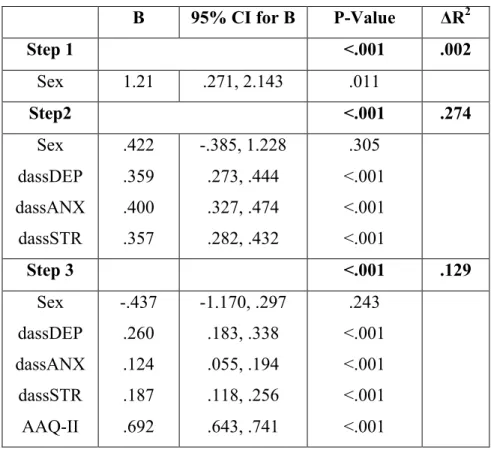
In the first regression after controlling only for sex, 35% of unique variance in PCL scores was accounted for by AAQ-II scores (ΔR2 = .35; p < .001). Results of the second hierarchical regression are summarized in Table 2. This regression entered sex in block one, scores from the DASS depression, anxiety, and stress subscales in block two, and scores from the AAQ-II in block three. Sex accounted for a relatively small amount of variance within the sample (ΔR2 = .002; p < .05), while DASS subscale scores accounted for 27.4% of
variance in PCL scores (ΔR2 = .27; p <.001). After all relevant covariates were added into the regression, AAQ-II scores still accounted for 12.9% of unique variance in PCL scores (ΔR2 = .129; p < .001). Thus, results supported the original hypothesis that acceptance would be a significant predictor of PTSD symptom severity after controlling for relevant variables and comorbidities.
Finally, t-tests were used to compare AAQ-II scores as a function of using differing ways of categorizing PTSD vs non-PTSD via the PCL. Roughly one-fifth (20.9%) of participants had a PCL score of 44 or higher, while 72.7% of participants had a PCL score below the cutoff. There was a significant (p < .001) difference in AAQ-II scores between groups, with an average score of 18.07 (SD = 7.41) in participants below the cutoff and an average score of 27.59 (SD = 8.98) in participants above the cutoff. When using a PCL cutoff of 50, 14.6% of participants had a PCL score of 50 or higher, while 79.0% of participants had a PCL score below the cutoff. Similar results to the first analysis were found, with those above the cutoff scoring significantly higher (p < .001) on the AAQ-II than those below (28.28 [9.36] vs 18.69 [7.74]). Using categorical scoring of the PCL, 17.8% of participants met criteria indicative of PTSD, while 75.8% did not. This method of categorization revealed a moderately significant difference (p < .05) in AAQ-II scores between groups, with an average of 27.34 (SD = 8.95) for those with PTSD and 18.54 (SD = 7.81) for those not meeting the scoring criteria.
Discussion
As hypothesized, acceptance was a significant predictor of PTSD symptom severity even after controlling for both demographic (i.e., sex) and psychological (i.e, depression, anxiety, stress) variables associated with these constructs. Mean AAQ-II and PCL scores were similar to those found previously in other nonclinical samples (Bond et al., 2011;
Ruggiero et al., 2003). The relationship between acceptance and PCL scores was striking, with a large effect size after controlling for sex alone and a medium effect size remaining even after additionally controlling for depression, anxiety, and stress. Interestingly, after controlling for sex, AAQ-II scores accounted for more unique variance (35%) than
depression, anxiety and stress combined (27%). When the results from the current study are considered with similar studies, which found comparable effects after controlling for other variables such as experiential avoidance, number of trauma types experienced, and negative affectivity, acceptance is clearly pertinent to PTSD independent of its relationship with other psychological factors. Overall, the study provides further support for the notion that
avoidance and acceptance are both very relevant considerations in the diagnosis and treatment of PTSD.
The purpose of this study was to explore the relationship between acceptance and PTSD symptomatology in a nonclinical population. Results were in line with expectations and similar to those found in previous studies of nonclinical samples (Thompson & Waltz, 2010; Tull et al., 2007; Vujanovic et al., 2009), but they also differ in some ways. For example, the study by Tull et al. (2007) also found a significant but smaller association between acceptance and PCL total scores. Their measure of difficulties with emotional regulation, which included an acceptance subscale, accounted for 5% of unique variance in
PCL scores. This discrepancy could be due to various procedural differences, as the Tull et al. study utilized the Difficulties in Emotion Regulation Scale (DERS; Gratz & Roemer, 2004) to measure acceptance rather than the AAQ-II and controlled for negative affect and income rather than the covariates used in the current study.
Another study by Thompson and Waltz (2010) found that the related concept of mindfulness, and nonjudgmental acceptance especially, was associated with PTSD avoidance symptom severity after controlling for several measures of experiential avoidance, including the AAQ. However, this association was also weaker than that in the current study
(semipartial correlation coefficient of .04 for nonjudgemental acceptance). This could be attributable to the use of different measures such as the Five Facet Mindfulness
Questionnaire (FFMQ; Baer, Smith, Hopkins, Krietemeyer, & Toney, 2006). Finally, the study by Vujanovic et al. (2009) also found a smaller relationship between nonjudgmental acceptance and increased PTSD symptoms using the Kentucky Inventory of Mindfulness Skills (KIMS; Baer, Smith, & Allen, 2004) and the Posttraumatic Diagnostic Scale (PDS;
Foa, 1995) as measures. The accepting without judgment subscale of the KIMS demonstrated semipartial correlations ranging from .02 to .05 with the PDS and its subscales after
controlling for negative affectivity and number of trauma types. The participant group of the current study is similar to those used in the previous nonclinical studies in most aspects other than sample size, with the sample consisting of adults who have experienced a traumatic event but do not necessarily meet full criteria for PTSD.
Implications for Treatment
Although relatively effective treatments for PTSD are currently in use, including exposure therapy and cognitive behavioral therapy, the growing body of literature
demonstrating a link between acceptance and PTSD may help to further improve treatments for this debilitating condition. A cross-sectional study such as the current analysis is, of course, insufficient to effectively demonstrate any causal relationship between acceptance and PTSD symptomatology. However, further experimental research on this relationship could confirm a need for incorporating more acceptance-based strategies, such as ACT, in the clinical treatment of PTSD.
Acceptance-based treatments could be particularly useful for patients who are unable or unwilling to undergo more intense treatments such as exposure therapy. Exposure
treatment, though the most well-established treatment for PTSD, can sometimes pose
problems for some individuals, including suidicality, impulsivity, and dissociation (Becker &
Zayfert, 2001). Integrating an acceptance component into exposure therapy may be useful for helping these individuals better tolerate subsequent exposure. In addition, acceptance-based therapies can be effective for psychological issues beyond fear that are common in PTSD patients, such as sadness, guilt, and shame. Commonly used treatments, especially exposure therapy, are not as effective as acceptance-based therapies in treating these often co-
occurring issues (Walser & Hayes, 2006). If further studies reinforce the preliminary link between acceptance and PTSD, and if treatment studies verify the utility of acceptance in treating PTSD, it would be prudent to consider adding acceptance-based treatments as a useful complement to current practices in PTSD treatment.
Strengths, Limitations, and Future Directions
The current study builds upon previous research by incorporating several strengths.
First, the study utilized a very large (n = 4095) nonclinical sample, much larger than those used in previous studies. For example, previously mentioned studies of nonclinical
populations used sample sizes of n = 378 (Thompson & Waltz, 2010), n = 239 (Vujanovic et al., 2009), and n = 108 (Tull et al., 2007). Participants reported a wide range of traumatic events and ages at which events occurred, making the results potentially generalizable to a variety of PTSD-affected young adults. In addition, the current study attempted to take DSM- V criteria into account, while most previous studies utilize the DSM-IV criteria. Finally, numerous common comorbidities were controlled for, including sex, depression, anxiety, and stress.
However, the present study also had limitations. The sample consisted solely of undergraduate students, and it is unknown how these results might translate to other samples or to individuals seeking treatment for PTSD. This is a problem throughout PTSD and
acceptance-based literature, and the majority of the studies currently published on acceptance focus on nonclinical samples. Those studies utilizing clinical samples tend to focus more on the effects of acceptance-based treatments rather than directly examining the relationship between acceptance and PTSD symptomatology. Further research should focus on clinical samples and attempt to look more closely at the concept of acceptance rather than
acceptance-based treatments alone.
In addition, the data were self-report and cross-sectional, meaning that the
directionality of the PTSD—acceptance relationship cannot be determined. Causality and directionality should be addressed in further research by utilizing longitudinal designs. This would allow researchers to track acceptance in people without PTSD at baseline and
correlate baseline acceptance with progressive PTSD development after traumatic event exposure. Similarly, current research does not provide any indication of whether higher levels of pre-trauma acceptance might reduce the likelihood of PTSD development, or
whether people who do not develop PTSD after trauma might employ acceptance-based techniques post-trauma. Further research should utilize study techniques that could more definitely address these relationship directionalities.
Finally, although the study sought to address the DSM-V diagnostic criteria as much as possible, the measures used in the study were based on DSM-IV criteria. Future research utilizing the DSM-V criteria for PTSD would be beneficial, as most current research was published before its release.
Conclusion
The findings of this study add to a growing body of literature demonstrating that acceptance is an important factor in the study of PTSD. When considering the wide body of research already demonstrating links between PTSD and the related concept of avoidance, acceptance seems to be an especially relevant area for further research. Overall, PTSD is a highly complex disorder that is influenced by a variety of factors, some of which are well understood and others of which are not. Understanding the role acceptance might play in PTSD development and maintenance would help clarify remaining questions regarding PTSD, but acceptance is certainly not a definitive indicator of whether or not a person will develop PTSD post-trauma. When examined in the context of previous research in the area, the current study provides further affirmation that more research examining acceptance and PTSD is warranted. Exploring this relationship could lead to better understanding of PTSD development, maintenance, and treatment outcomes.
References
American Psychiatric Association. (1994). Diagnostic and statistical manual of mental disorders: DSM-IV.
American Psychiatric Association. (2013). Diagnostic and statistical manual of mental disorders: DSM-5.
Antony, M. M., Bieling, P. J., Cox, B. J., Enns, M. W., & Swinson, R. P. (1998).
Psychometric properties of the 42-item and 21-item versions of the depression anxiety stress scales in clinical groups and a community sample. Psychological Assessment, 10(2), 176.
Badour, C. L., Blonigen, D. M., Boden, M. T., Feldner, M. T., & Bonn-Miller, M. (2012). A longitudinal test of the bi-directional relations between avoidance coping and PTSD severity during and after PTSD treatment. Behaviour Research and Therapy, 50(10), 610-616. Retrieved from
http://search.ebscohost.com/login.aspx?direct=true&db=psyh&AN=2012-24120- 005&site=ehost-live&scope=site
Badura, A. S. (2003). Theoretical and empirical exploration of the similarities between emotional numbing in posttraumatic stress disorder and alexithymia. Journal of Anxiety Disorders, 17(3), 349-360.
Baer, R. A., Smith, G. T., & Allen, K. B. (2004). Assessment of mindfulness by self- report: The kentucky inventory of mindfulness skills. Assessment, 11(3), 191-206.
doi:10.1177/1073191104268029 [doi]
Baer, R. A., Smith, G. T., Hopkins, J., Krietemeyer, J., & Toney, L. (2006). Using self-report assessment methods to explore facets of mindfulness. Assessment, 13(1), 27-45.
doi:13/1/27 [pii]
Başoglu, M., Kılıç, C., Şalcıoglu, E., & Livanou, M. (2004). Prevalence of posttraumatic stress disorder and comorbid depression in earthquake survivors in turkey: An epidemiological study. Journal of Traumatic Stress, 17(2), 133-141.
Batten, S. V., & Hayes, S. C. (2005). Acceptance and commitment therapy in the treatment of comorbid substance abuse and post-traumatic stress disorder A case study. Clinical Case Studies, 4(3), 246-262.
Becker, C. B., & Zayfert, C. (2001). Integrating DBT-based techniques and concepts to facilitate exposure treatment for PTSD. Cognitive and Behavioral Practice, 8(2), 107- 122.
Blackledge, J. T., Ciarrochi, J., & Deane, F. (2009). Acceptance and commitment therapy:
Contemporary theory, research and practice Australian Academic Press.
Blake, D. D., Weathers, F. W., Nagy, L. M., Kaloupek, D. G., Gusman, F. D., Charney, D.
S., & Keane, T. M. (1995). The development of a clinician‐administered PTSD scale.
Journal of Traumatic Stress, 8(1), 75-90.
Blanchard, E. B., Jones-Alexander, J., Buckley, T. C., & Forneris, C. A. (1996).
Psychometric properties of the PTSD checklist (PCL). Behaviour Research and Therapy, 34(8), 669-673.
Bond, F. W., Hayes, S. C., Baer, R. A., Carpenter, K. M., Guenole, N., Orcutt, H. K., . . . Zettle, R. D. (2011). Preliminary psychometric properties of the acceptance and action questionnaire-II: A revised measure of psychological inflexibility and experiential avoidance. Behavior Therapy, 42(4), 676-688. Retrieved from http://0-
search.ebscohost.com.umiss.lib.olemiss.edu/login.aspx?direct=true&AuthType=ip,url,ui d&db=bxh&AN=BACD201200002390&site=eds-live&scope=site
Breslau, N., Davis, G. C., Andreski, P., & Peterson, E. (1991). Traumatic events and posttraumatic stress disorder in an urban population of young adults. Archives of General Psychiatry, 48(3), 216-222. Retrieved from http://0-
search.ebscohost.com.umiss.lib.olemiss.edu/login.aspx?direct=true&AuthType=ip,url,ui d&db=psyh&AN=1991-21437-001&site=eds-live&scope=site
Brewin, C. R., Andrews, B., & Valentine, J. D. (2000). Meta-analysis of risk factors for posttraumatic stress disorder in trauma-exposed adults. Journal of Consulting and Clinical Psychology, 68(5), 748.
Calhoun, P. S., Hertzberg, J. S., Kirby, A. C., Dennis, M. F., Hair, L. P., Dedert, E. A., &
Beckham, J. C. (2012). The effect of draft DSM‐V criteria on posttraumatic stress disorder prevalence. Depression and Anxiety, 29(12), 1032-1042.
Foa, E. B. (1995). Posttraumatic stress diagnostic scale National Computer Systems Minneapolis, MN.
Forbes, D., Fletcher, S., Lockwood, E., O'Donnell, M., Creamer, M., Bryant, R. A., . . . Silove, D. (2011). Requiring both avoidance and emotional numbing in DSM-V PTSD:
Will it help? Journal of Affective Disorders, 130(3), 483-486.
doi:http://dx.doi.org/10.1016/j.jad.2010.10.032
Forsyth, J. P., Parker, J. D., & Finlay, C. G. (2003). Anxiety sensitivity, controllability, and experiential avoidance and their relation to drug of choice and addiction severity in a residential sample of substance-abusing veterans. Addictive Behaviors, 28(5), 851-870.
Galatzer-Levy, I. (2013). Patterns of lifetime ptsd comorbidity: A latent class analysis.
Depression & Anxiety (1091-4269), 30(5), 489-496. doi:10.1002/da.22048
Goldsmith, Rachel E.Chesney, Samantha A.Heath, Nicole M.Barlow,M.Rose. (2013).
Emotion regulation difficulties mediate associations between betrayal trauma and symptoms of posttraumatic stress, depression, and anxiety John Wiley & Sons, Inc.
doi:10.1002/jts.21819
Gratz, K. L., & Roemer, L. (2004). Multidimensional assessment of emotion regulation and dysregulation: Development, factor structure, and initial validation of the difficulties in emotion regulation scale. Journal of Psychopathology and Behavioral Assessment, 26(1), 41-54.
Gray, M. J., Litz, B. T., Hsu, J. L., & Lombardo, T. W. (2004). Psychometric properties of the life events checklist. Assessment, 11(4), 330-341. Retrieved from http://0-
search.ebscohost.com.umiss.lib.olemiss.edu/login.aspx?direct=true&AuthType=ip,url,ui d&db=eric&AN=EJ689719&site=eds-live&scope=site;
http://dx.doi.org/10.1177/1073191104269954
Hayes, S. C., Wilson, K. G., Gifford, E. V., Follette, V. M., & Strosahl, K. (1996).
Experiential avoidance and behavioral disorders: A functional dimensional approach to diagnosis and treatment. Journal of Consulting and Clinical Psychology, 64(6), 1152.
Hayes, S. C., Strosahl, K. D., & Wilson, K. G. (2011). Acceptance and commitment therapy : The process and practice of mindful change (2nd edition). New York, NY, USA:
Guilford Press.
Helzer, J. E., Robins, L. N., & McEvoy, L. (1987). Post-traumatic stress disorder in the general population. New England Journal of Medicine, 317(26), 1630-1634.
Kar, N., Jagadisha, Sharma, P., Murali, N., & Mehrotra, S. (2004). Mental health consequences of the trauma of super-cyclone 1999 in orissa. Indian Journal of Psychiatry, 46(3), 228-237.
Kashdan, T. B., Morina, N., & Priebe, S. (2009). Post-traumatic stress disorder, social anxiety disorder, and depression in survivors of the kosovo war: Experiential avoidance as a contributor to distress and quality of life. Journal of Anxiety Disorders, 23(2), 185- 196.
Kessler, R. C., Sonnega, A., Bromet, E., Hughes, M., & Nelson, C. B. (1995). Posttraumatic stress disorder in the national comorbidity survey. Archives of General Psychiatry, 52(12), 1048-1060.
Kolassa, I., Ertl, V., Eckart, C., Kolassa, S., Onyut, L. P., & Elbert, T. (2010). Spontaneous remission from PTSD depends on the number of traumatic event types experienced.
Psychological Trauma: Theory, Research, Practice, and Policy, 2(3), 169-174.
Retrieved from
http://search.ebscohost.com/login.aspx?direct=true&db=psyh&AN=2010-19144- 002&site=ehost-live&scope=site
Krysinska, K., & Lester, D. (2010). Post-traumatic stress disorder and suicide risk: A systematic review. Archives of Suicide Research, 14(1), 1-23. Retrieved from http://search.ebscohost.com/login.aspx?direct=true&db=psyh&AN=2010-02018- 001&site=ehost-live&scope=site
Land, K. (2011). Examining the role of experiential avoidance specific to post-trauma symptoms . (2011-99040-444). Retrieved from
http://search.ebscohost.com/login.aspx?direct=true&db=psyh&AN=2011-99040- 444&site=ehost-live&scope=site
Lovibond, P. F., & Lovibond, S. H. (1995). The structure of negative emotional states:
Comparison of the depression anxiety stress scales (DASS) with the beck depression and anxiety inventories. Behaviour Research and Therapy, 33(3), 335-343.
doi:http://dx.doi.org/10.1016/0005-7967(94)00075-U
Marx, B. P., & Sloan, D. M. (2005). Peritraumatic dissociation and experiential avoidance as predictors of posttraumatic stress symptomatology. Behaviour Research and Therapy, 43(5), 569-583.
Meyer, E. C., Morissette, S. B., Kimbrel, N. A., Kruse, M. I., & Gulliver, S. B. (2013).
Acceptance and action Questionnaire—II scores as a predictor of posttraumatic stress disorder symptoms among war veterans. Psychological Trauma: Theory, Research, Practice, and Policy, 5(6), 521.
Morina, N., Wicherts, J. M., Lobbrecht, J., & Priebe, S. (2014). Remission from post- traumatic stress disorder in adults: A systematic review and meta-analysis of long term outcome studies. Clinical Psychology Review, 34(3), 249-255. Retrieved from
http://search.ebscohost.com/login.aspx?direct=true&db=psyh&AN=2014-13191- 007&site=ehost-live&scope=site
Müller, M., Vandeleur, C., Rodgers, S., Rössler, W., Castelao, E., Preisig, M., & Ajdacic- Gross, V. (2014). Factors associated with comorbidity patterns in full and partial PTSD:
Findings from the PsyCoLaus study. Comprehensive Psychiatry, 55(4), 837-848.
Naifeh, J. A., Tull, M. T., & Gratz, K. L. (2012). Anxiety sensitivity, emotional avoidance, and PTSD symptom severity among crack/cocaine dependent patients in residential treatment. Cognitive Therapy and Research, 36(3), 247-257. Retrieved from
http://search.ebscohost.com/login.aspx?direct=true&db=psyh&AN=2012-12569- 010&site=ehost-live&scope=site
Nemeroff, C. B., Bremner, J. D., Foa, E. B., Mayberg, H. S., North, C. S., & Stein, M. B.
(2006). Posttraumatic stress disorder: A state-of-the-science review. Journal of Psychiatric Research, 40(1), 1-21.
Nightingale, J., & Williams, R. M. (2000). Attitudes to emotional expression and personality in predicting post-traumatic stress disorder. British Journal of Clinical Psychology, 39(3), 243-254. doi:10.1348/014466500163266
Norris, F. H., Friedman, M. J., Watson, P. J., Byrne, C. M., Diaz, E., & Kaniasty, K. (2002).
60,000 disaster victims speak: Part I. an empirical review of the empirical literature, 1981-2001. Psychiatry: Interpersonal and Biological Processes, 65(3), 207-239.
Retrieved from http://0-
search.ebscohost.com.umiss.lib.olemiss.edu/login.aspx?direct=true&AuthType=ip,url,ui d&db=psyh&AN=2002-18997-003&site=eds-live&scope=site
North, C. S., & Oliver, J. (2013). Analysis of the longitudinal course of PTSD in 716 survivors of 10 disasters. Social Psychiatry and Psychiatric Epidemiology, 48(8), 1189- 1197. Retrieved from
http://search.ebscohost.com/login.aspx?direct=true&db=psyh&AN=2013-25979- 001&site=ehost-live&scope=site
Orcutt, H. K., Pickett, S. M., & Pope, E. B. (2005). Experiential avoidance and forgiveness as mediators in the relation between traumatic interpersonal events and posttraumatic stress disorder symptoms. Journal of Social and Clinical Psychology, 24(7), 1003-1029.
Orsillo, S. M., & Batten, S. V. (2005). Acceptance and commitment therapy in the treatment of posttraumatic stress disorder. Behavior Modification, 29(1), 95-129. doi:29/1/95 [pii]
Perkonigg, A., Pfister, H., Stein, M. B., Höfler, M., Lieb, R., Maercker, A., & Wittchen, H.
(2005). Longitudinal course of posttraumatic stress disorder and posttraumatic stress disorder symptoms in a community sample of adolescents and young adults. The American Journal of Psychiatry, 162(7), 1320-1327. Retrieved from
http://search.ebscohost.com/login.aspx?direct=true&db=psyh&AN=2005-07349- 015&site=ehost-live&scope=site
Piotrowski, N. A., Ph.D., & Range, L. M., Ph.D. (2014). Post-traumatic stress disorder.
Magill’s Medical Guide (Online Edition), Retrieved from http://0-
search.ebscohost.com.umiss.lib.olemiss.edu/login.aspx?direct=true&AuthType=ip,url,ui d&db=ers&AN=86194496&site=eds-live&scope=site
Plumb, J. C., Orsillo, S. M., & Luterek, J. A. (2004). A preliminary test of the role of experiential avoidance in post-event functioning. Journal of Behavior Therapy and Experimental Psychiatry, 35(3), 245-257.
Rona, R. J., Jones, M., Iversen, A., Hull, L., Greenberg, N., Fear, N. T., . . . Wessely, S.
(2009). The impact of posttraumatic stress disorder on impairment in the UK military at the time of the iraq war. Journal of Psychiatric Research, 43(6), 649-655.
Ruggiero, K. J., Del Ben, K., Scotti, J. R., & Rabalais, A. E. (2003). Psychometric properties of the PTSD Checklist—Civilian version. Journal of Traumatic Stress, 16(5), 495-502.
Shenk, C. E., Putnam, F. W., & Noll, J. G. (2012). Experiential avoidance and the
relationship between child maltreatment and PTSD symptoms: Preliminary evidence.
Child Abuse & Neglect, 36(2), 118-126.
Sifneos, P. E. (1973). The prevalence of 'alexithymic' characteristics in psychosomatic patients. Psychotherapy and Psychosomatics, 22(2), 255-262.
Sprang, G., & LaJoie, A. S. (2009). Exposure, avoidance, and PTSD among hurricane katrina evacuees. Traumatology, 15(2), 10-19. doi:10.1177/1534765609331607
Stein, M. B., Walker, J. R., Hazen, A. L., & Forde, D. R. (1997). Full and partial
posttraumatic stress disorder: Findings from a community survey. The American Journal of Psychiatry, 154(8), 1114-1119.
Thompson, B. L., & Waltz, J. (2010). Mindfulness and experiential avoidance as predictors of posttraumatic stress disorder avoidance symptom severity. Journal of Anxiety Disorders, 24(4), 409-415.
Thompson, R. W., Arnkoff, D. B., & Glass, C. R. (2011). Conceptualizing mindfulness and acceptance as components of psychological resilience to trauma. Trauma, Violence &
Abuse, 12(4), 220-235. doi:10.1177/1524838011416375 [doi]
Tull, M. T., Gratz, K. L., Salters, K., & Roemer, L. (2004). The role of experiential
avoidance in posttraumatic stress symptoms and symptoms of depression, anxiety, and somatization. The Journal of Nervous and Mental Disease, 192(11), 754-761.
doi:00005053-200411000-00004 [pii]
Tull, M. T., Barrett, H. M., McMillan, E. S., & Roemer, L. (2007). A preliminary investigation of the relationship between emotion regulation difficulties and posttraumatic stress symptoms. Behavior Therapy, 38(3), 303-313. Retrieved from http://search.ebscohost.com/login.aspx?direct=true&db=psyh&AN=2007-12535- 010&site=ehost-live&scope=site
Twohig, M. P. (2009). Acceptance and commitment therapy for treatment-resistant
posttraumatic stress disorder: A case study. Cognitive and Behavioral Practice, 16(3), 243-252.
Valentiner, D. P., Foa, E. B., Riggs, D. S., & Gershuny, B. S. (1996). Coping strategies and posttraumatic stress disorder in female victims of sexual and nonsexual assault. Journal of Abnormal Psychology, 105(3), 455.
Vujanovic, A. A., Youngwirth, N. E., Johnson, K. A., & Zvolensky, M. J. (2009).
Mindfulness-based acceptance and posttraumatic stress symptoms among trauma- exposed adults without axis I psychopathology. Journal of Anxiety Disorders, 23(2), 297-303.
Walser, R. D., & Hayes, S. C. (2006). Acceptance and commitment therapy in the treatment of posttraumatic stress disorder. Cognitive-Behavioral Therapies for Trauma, , 146.
Weathers, F. W., Litz, B. T., Herman, D. S., Huska, J. A., & Keane, T. M. (1993, October).
The PTSD checklist: Reliability validity, and diagnostic utility. Paper Presented at the Annual Meeting of the International Society for Traumatic Stress Studies, San Antonio, TX,
Yehuda, R., Steiner, A., Kahana, B., Binder-Brynes, K., Southwick, S. M., Zemelman, S., &
Giller, E. L. (1997). Alexithymia in holocaust survivors with and without PTSD.
Journal of Traumatic Stress, 10(1), 93-100. Retrieved from http://0-
search.ebscohost.com.umiss.lib.olemiss.edu/login.aspx?direct=true&AuthType=ip,url,ui d&db=sih&AN=307558&site=eds-live&scope=site
Zlotnick, C., Mattia, J. I., & Zimmerman, M. (2001). The relationship between posttraumatic stress disorder, childhood trauma and alexithymia in an outpatient sample. Journal of Traumatic Stress, 14(1), 177. Retrieved from http://0-
search.ebscohost.com.umiss.lib.olemiss.edu/login.aspx?direct=true&AuthType=ip,url,ui d&db=sih&AN=11308669&site=eds-live&scope=site
Table 1. Percentage of Participants Experiencing LEC Traumatic Event Types (n = 4095)
Number on LEC Type of Trauma
Number of Participants
Endorsing
Percentage of Participants
Endorsing
1 Natural Disaster 1770 43.22%
2 Fire/Explosion 331 8.08%
3 Transportation Accident 2073 50.62%
4 Accident at Home, Work, or Recreational Activity
791 19.32%
5 Exposure to Toxic
Substance
116 2.83%
6 Physical Assault 873 21.32%
7 Assault with a Weapon 228 5.57%
8 Sexual Assault 286 6.98%
9 Other
Unwanted/Uncomfortable Sexual Encounter
615 15.02%
10 Combat/War-Zone
Exposure 43 1.05%
11 Captivity 39 0.95%
12 Life-Threatening
Illness/Injury
361 8.82%
13 Severe Human Suffering 130 3.17%
14 Sudden, Violent Death 164 4.00%
15 Sudden, Unexpected
Death of Someone Close
1438 35.12%
16 Caused Serious Injury, Harm, or Death to
Someone Else
190 4.64%
17 Other Stressful Event 911 22.25%
Note: Numbers reflect the proportion of participants who reported that the event happened to them personally.
Table 2. Hierarchical Multiple Regression Predicting PCL Total Scores B 95% CI for B P-Value ΔR2
Step 1 <.001 .002
Sex 1.21 .271, 2.143 .011
Step2 <.001 .274
Sex dassDEP dassANX dassSTR
.422 .359 .400 .357
-.385, 1.228 .273, .444 .327, .474 .282, .432
.305
<.001
<.001
<.001
Step 3 <.001 .129
Sex dassDEP dassANX dassSTR AAQ-II
-.437 .260 .124 .187 .692
-1.170, .297 .183, .338 .055, .194 .118, .256 .643, .741
.243
<.001
<.001
<.001
<.001
Note: dassDEP = DASS-21 depression subscale scores; dassANX = DASS-21 anxiety subscale scores; dassSTR = DASS-21 stress subscale scores; AAQ-II = AAQ-II scores
Appendix A
AAQ-II
Below you will find a list of statements. Please rate how true each statement is for you by circling a number next to it. Use the scale below to make your choice.
1 2 3 4 5 6 7
never
true very seldom
true seldom
true sometimes
true frequently
true almost always
true always
true
1. My painful experiences and memories make it difficult for me to live a life that I
would value. 1 2 3 4 5 6 7
2. I’m afraid of my feelings. 1 2 3 4 5 6 7
3. I worry about not being able to control my worries and feelings. 1 2 3 4 5 6 7 4. My painful memories prevent me from having a fulfilling life. 1 2 3 4 5 6 7
5. Emotions cause problems in my life. 1 2 3 4 5 6 7
6. It seems like most people are handling their lives better than I am. 1 2 3 4 5 6 7
7. Worries get in the way of my success. 1 2 3 4 5 6 7
This is a one-factor measure of psychological inflexibility, or experiential avoidance. Score the scale by summing the seven items. Higher scores equal greater levels of psychological inflexibility.
Bond, F. W., Hayes, S. C., Baer, R. A., Carpenter, K. M., Guenole, N., Orcutt, H. K., Waltz, T., &
Zettle, R. D. (in press). Preliminary psychometric properties of the Acceptance and Action Questionnaire – II: A revised measure of psychological inflexibility and experiential avoidance.
Behavior Therapy.