The Role Of Social Media Marketing Activities In Increasing Brand Loyalty
M. Haikal Sultana Abdullah1* and Aekram Faisal2
1,2Department of Management, Faculty of Economi and Business, Universitas Trisakti, Jakarta, Indonesia
Email Address:
[email protected]*, [email protected]
*Coressponden Autor
Abstract: The purpose of this study was to analyze the positive influence of social media marketing activities on brand loyalty both directly and through the mediating role of community engagement and brand engagement. The sample taken is with the criteria of individuals who have purchased fashion products on social media in the last 1 year. This study uses primary data obtained through questionnaires distributed to 211 respondents.
Data were analyzed using the Structural Equation Model (SEM). The results of this study indicate that social media marketing activities do not have a direct (positive) influence on brand loyalty, but social media marketing activities have a positive influence on brand loyalty through the mediating role of community involvement and brand involvement.
Keywords: Social Media Marketing Activities; Community Engagement; Brand Engagement; Brand Loyalty
Abstrak: Tujuan penelitian ini adalah menganalisis pengaruh positif dari social media marketing activities terhadap brand loyalty baik secara langsung maupun melalui peran mediasi community engagement dan brand engagement. Sampel yang diambil adalah dengan kriteria berupa individu yang pernah membeli produk fashion di media social selama 1 tahun terakhir. Penelitian ini menggunakan data primer yang diperoleh melalui kuesioner yang didistribusikan kepada 211 responden. Data dianalisis menggunakan metode Structural Equation Model (SEM) dengan bantuan program SPSS dan AMOS.
Hasil dari penelitian ini menunjukkan bahwa social media marketing activities tidak memiliki pengaruh (positif) secara langsung terhadap brand loyalty, namun social media marketing activities memiliki pengaruh positif terhadap brand loyalty melalui peran mediasi dari community engagement dan brand engagement.
Kata Kuci: Aktivitas Pemasaran Media Sosial; Keterlibatan Komunitas; Keterlibatan Merek; Dan Loyalitas Merek.
INTRODUCTION
In this era, creative industry technology in Indonesia is growing rapidly. With the development of this technology, it provides many conveniences for humans, such as making it easier to communicate and find information. With the existence of smartphone
technology, it has many uses for its users. In Indonesia, technological developments are quite large. With increasing technology, Indonesia is expected to become a developed country. Currently, technology plays a major role for society. Knowledge, for business people, SMEs and companies that create products services, as entertainment for playing games, as a means of effective and efficient communication and others, with the development of creative industry technology in Indonesia this provides an opportunity for existing human resources to make big opportunities included in business (Kompas.com).
The Covid – 19 virus outbreak at the end of 2019 made many people reduce their activities such as not meeting many people in crowded places such as shops, markets and super markets which made it difficult for people to meet and shop for their daily needs. every day, with periodic updates carried out by the government to reduce the covid – 19 outbreak, it encourages people to shop online through social media applications (Chandra et al., 2020).
At this time many people use social media to obtain information, communicate and purchase products provided by social media, the development of internet technology can be utilized by business people, companies and others such as making it easier to carry out promotions, advertising and providing product-related information. marketed on the social media (Emini and Zeqiri, 2021). The number of social media users in Indonesia continues to increase every year. Companies can take advantage of social media as an efficient marketing tool, the types of social media known to the public vary widely. According to (Puspitarini and Nuraeni, 2019) among the many types of social media, social media that are currently in demand by Indonesians include You tube, Tik tok, Facebook, Instagram, and Twitter. With the arrival of the Covid - 19 virus at the end of 2019, people reduced their activities outside the home, because the government stipulated a large social order update (PSBB), namely the completion of certain activities of residents in an area to avoid a wider spread. With this regulation from the government, many of their companies, the fashion industry, fashion shops and others have experienced a decline in sales.
So that company owners must know how to increase sales, according to (Fetais et al., 2022) that social media marketing activities have an influence on brand loyalty, the existence of social media marketing can help business actors to increase brand loyalty they offer to consumers . However, there is another research conducted by (Lamkadem and Ouiddad, 2021) stating that there is no direct effect of social media marketing on brand loyalty. Partially the research conducted by (Fetais et al., 2022) states that social media marketing activities have an influence on community engagement and community engagement also has an influence on brand loyalty, so that this community engagement variable can act as a mediating variable between social media marketing activities variables. on brand loyalty.
And partially also in research conducted by (Emini and Zeqiri, 2021) states that there is an influence between social media marketing on brand engagement and research conducted by (Mork̄unas, 2022) states that brand engagement has an influence on brand loyalty. So the researchers proposed adding a mediating variable from the relationship between the two.
THEORETICAL REVIEW
Social Media Marketing Activity (SMMA). Social media is defined as an online application program, platform, or media that facilitate interaction, work together, or share content (Seo and Park, 2018). Social media is also a place where they have the same desire to share thoughts, exchange ideas and comments (BİLGİN, 2018). Marketing activities are also described as social processes in which individuals and groups get what they need and want (Khan, 2019). The existence of social media can facilitate any kind of communication including in marketing can connect directly with customers and can reduce costs, messages sent using social media can also increase consumer attitudes towards brands (Khan, 2019).
This research social media marketing activity leads to good brand recognition so that people who use social media can see and be attracted to the brand being promoted (Khan et al., 2022). Marketing communications must be able to move in view of the new digital environment to make it easier for customers to interact with brand accounts on social media (Zarei et al., 2022). Brand companies utilize social media as a communication tool to customers such as Facebook, Instagram and Twitter applications (Maulid et al., 2022).
In online situations, social media and social networks are related, but there are differences, social networks lead to the use of social media while media is an effort to be able to communicate with people (Ebrahim, 2020). From a marketing point of view, social media is a market where there are sellers and buyers who interact with each other with a network (Wang et al., 2019).
From these various definitions, the researcher concludes that social media marketing is a form of activity from choosing social media to utilizing social media to be used as a marketing tool by involving consumers in the formation of communication to working together online by business people, where it is useful. to mutually provide value from the existence of a brand product or other achievement of marketing goals on social media or the business itself.
(Fetais et al., 2022) explained that social media marketing consists of five dimensions, namely entertainment, interaction, trendyness, customization, and word of mouth (WOM).
Entertainment. Entertainment is the ability to satisfy one's needs from emotional enjoyment (Lamkadem and Ouiddad, 2021). Entertainment is the main element that invites the participant's attitude to continue, which creates good emotions/feelings about the brand in the minds of consumers who use social media (BİLGİN, 2018). Entertainment is an important part of changing customers towards brands, and if brands spread posts via social media with content that can entertain consumers or users, they will interact with brand social media accounts, this affects companies that can find brand awareness and build image (Lamkadem and Ouiddad, 2021).
Entertainment carried out through social media platforms can improve consumer- brand relations, brand awareness, brand knowledge, brand image, brand equity and purchase intention (Fetais et al., 2022). Entertainment on social media can provide fun games (Seo and Park, 2018). Entertainment on social media can encourage someone in positive terms, increase participating behavior and they will use social media continuously (Seo and Park, 2018).
Customization. Customization is the extent to which services can be aligned to meet a person's choice, for example the Brubery and Gucci brands rely on social media which can convey messages personally to customers so that the product purchased is appropriate (Wang et al., 2019). Customization directs, as stated by (Lamkadem and Ouiddad, 2021).
In an increase that adjusts services, messages and efforts on marketing in providing consumer satisfaction, customization on social media based on contact with individual users is the main thing, the difference with conventional advertising media, is it optimal if it provides information to customers individually, and this adjustment used as a strategy to generate positive control of customer satisfaction (Seo and Park, 2018). Social customization is also a tool for companies to communicate to customers about brands in increasing brand loyalty (Seo and Park, 2018).
Customization allows businesses to send personalized messages about the advantages of their brands to strengthen consumer-brand relationships in the social media platform group of customer value (Fetais et al., 2022). In social media marketing, customization is making contacts that can relate to other people, this function is what distinguishes it from conventional media (Lamkadem and Ouiddad, 2021). Customization, namely the extent to which the services provided are in accordance with what the customer wants based on his request (Ebrahim, 2020). Customization as an element of action creates customer satisfaction for business relationships with individual users (BİLGİN, 2018).
Interaction. Interaction is consumer opinion regarding the extent to which social media provides consumer services for sharing content and views from the company to other consumers. This is one-way communication between the company and customers (Ait Lamkadem and Ouiddad, 2021). Interaction is an impetus to expand social media to its users (Lamkadem and Ouiddad, 2021). Interaction is also a change in communication between brands and consumers (Wang et al., 2019). Social interaction is the main factor in creating content in the form of information for customers, social media can give consumers space to exchange ideas (Wang et al., 2019). Social interaction shows the process by which people communicate, work and play together in a community environment (Maulid et al., 2022).
Interaction refers to the transfer of information and perceptions with others, and interactions in this regard also change the bonds between brands and consumers (Zarei et al., 2022). Interaction is an important driver for people seeking information on social media (Zarei et al., 2022). Many business people take advantage of online interactions between users by inviting their customers to make purchases (BİLGİN, 2018). Traditional communication channels are different from now, social media provides interaction features, content sharing and cooperation with customers (BİLGİN, 2018).
Trendiness. Trendiness can be defined as providing the latest information about the products or services provided (Seo and Park, 2018). Trendiness in social media describes the ability of a particular brand on a social media platform to convey the latest and trendy information about the brand (Fetais et al., 2022). Trendiness includes other elements of social media marketing activities providing and informing consumers of updated information about product brands (BİLGİN, 2018).
Interaction is also a change in communication between brands and consumers (Wang et al., 2019). Social interaction is the main factor in creating content in the form of
information for customers, social media can give consumers space to exchange ideas (Wang et al., 2019). Social interaction shows the process by which people communicate, work and play together in a community environment (Maulid et al., 2022). Interaction refers to the transfer of information and perceptions with others, and interactions in this regard also change the bonds between brands and consumers (Zarei et al., 2022).
Interaction is an important driver for people seeking information on social media (Zarei et al., 2022).
Many business people take advantage of online interactions between users by inviting their customers to make purchases (BİLGİN, 2018). Traditional communication channels are different from now, social media provides interaction features, content sharing and cooperation with customers (BİLGİN, 2018).
Electronic word of mouth. Electronic word of mouth (E-wom) is a new communication platform that provides a means of sharing news and opinions via the internet from business people to consumers and then from consumer to consumer (Maulid et al., 2022). E-wom is defined as unofficial communication between buyers and potential buyers regarding brands, products or services that have goals not supported by advertisers (Lamkadem and Ouiddad, 2021).
Word of mouth explains information to other people to assist in making a decision (Lamkadem and Ouiddad, 2021). E-wom is a tool that enhances social media users to interact and communicate with other customers to convey their opinions and experiences regarding the product brands they buy (Fetais et al., 2022). Electronic word of mouth (E- wom) directs positive or negative responses to a product from customers (Lamkadem and Ouiddad, 2021). Consumers who are loyal to brands tend not to acknowledge e-wom and are more inclined to spread good statements online (Maulid et al., 2022), according to (Maulid et al., 2022).
E-wom is a tool that has a good effect on inviting other people to buy a product which then suggests it to others (Maulid et al., 2022). E-wom marketing is done through experience (Zarei et al., 2022), the purpose of social media marketing activities is to get new customers, increase sales, strengthen word of mouth communication and create consumer loyalty/loyalty (BİLGİN, 2018).
Brand Engagement. Brand Engagement on social media is defined as the level of consumer involvement and relationship with brands on social media platforms (Zalm, 2017). Pro-and involved interactions between consumers and brand social media platforms are examples of social media brand involvement (Zalm, 2017).
There are different definitions of customer engagement, many educated people define customer engagement based on psychological, organizational and psychological perspectives (Emini et al., 2021). The concept of brand involvement includes the interaction between consumers and brands (Zalm, 2017). In recent years, social media platforms have become important for conducting marketing activities (Zalm, 2017). The importance of brand loyalty is because there is brand involvement with consumers, in virtual communities, consumer brand involvement can provide the development of emotional relationships with customers and generate brand loyalty (Zalm, 2017).
Brand engagement is an important element for measuring brand performance and the results are positive on average, brand relationship and purchase intention (Delbaere et al.,
2021). Brand involvement is often stated as a part of social marketing for companies in growing brand equity (Xi and Hamari, 2019). According to (Salameh and Zamil, 2020) consider brand involvement as a response to consumers' own volition towards a brand that was formed in spending time, costs and other resources from outside purchasing and consumption, brand involvement influenced by the millennial generation makes a fashion brand progress.
Brand engagement consists in engaging the consumer community (Delbaere et al., 2021). With great opportunities and rapid developments in digital technology, businesses are excited to increase brand engagement on digital platforms (Delbaere et al., 2021).
Measuring brand involvement can be seen that there is a strong relational bond between brands and consumers, with relational opinions that can result in consumer contributions in activities related to brands and end in transactions (Salameh and Zamil, 2020).
On social media companies can build consumer engagement and their brands that can maintain these relationships, such as social media brands provide or provide a message space for consumers to express their wishes for the brand, such as providing comments on the company, or creating content about the brand, so that consumers benefit from this relationship, this is an important interaction to create a good relationship (Zalm, 2017).
Community Engagement. Community Engagement is a process that brings goals and benefits to both individuals and groups to build a long-term relationship with shared interests in the community (Kumar and Kumar, 2020). Much attention of educated people goes to customer engagement on social media platforms (Fetais et al., 2022). Previous research explained that community involvement is based on interactions with other consumers/customers in certain social media and considers it part of social media engagement. Previous research agrees that community involvement is a multidimensional construction consisting of cognitive, affective and behavioral aspects (Fetais et al., 2022).
Successful community engagement is where ideas and perceptions are changed from time to time through a process of feedback information that varies from community to community (Kim et al., 2020).
Cognitive engagement refers to the level of caring and deep connection with a person during interaction with a social media brand community. Engagement requires absorption and attention to circumstances (Park and Ha, 2021). Affective involvement is related to the level of positive feelings that occur during interactions using social media related to brands, previous research has tested that affective aspects are an important part of engagement (Park and Ha, 2021). Behavioral involvement is defined as a person's effort and time spent interacting with the objects involved (Park and Ha, 2021). In online brand communities, consumer participation and contribution to that community enhances interactions between consumers and brands involved with the community (Park and Ha, 2021).
Community involvement is not a special design but is part of the process of direct displacement and renewal (Kim et al., 2020). Based on this definition, I can conclude that community/community involvement is a cooperative relationship that is structured for the long term interest with community members who have a shared vision to overcome problems and strive to bring benefits to the common good (Kumar and Kumar, 2020).
Brand Loyalty. Brand Loyalty is defined as the positive effect of loyal customers on business performance (Zalm, 2017). The concept of brand loyalty is defined as an attachment to buying a preferred product or selling point continuously, which results in making purchases more than once (Zalm, 2017). Brand loyalty is an important event for company marketing, because loyal customers are not sensitive to price changes (Zalm, 2017).
Companies can have the opportunity to create loyalty through social media marketing, with friendship, family and co-workers, when one of them uses a brand that is marketed through social media, he will tell people around him using social media (Haudi et al. ., 2022). Loyalty can be measured through consumer feelings with the intention to buy a brand (Fetais et al., 2022). The first knowledge regarding brand loyalty is centered on a behavioral perspective on purchasing patterns or opportunities to make repeat purchases (Ebrahim, 2020). Brand loyalty is an attitude of repurchasing the same brand, a decision that reflects brand awareness (BİLGİN, 2018). Consumers are loyal to companies that provide more value than competitors' offerings (Khan, 2019).
According to (Song et al., 2019) that brand loyalty is connected with repeated buying behavior, brand loyalty is interrelated with a commitment to promote certain products or services that are preferred. Consumers tend to insist on buying the same brand and do not accept to switch to other brands. Even though competitors have tempted customers to switch to their brands, brand loyalty makes consumers have a certain favorable impression compared to other brands. Related and profitable relationships with customers are the main keys to forming a trust that can increase loyalty (Park and Ha, 2021).
The existence of an attachment to repurchasing, subscribing to a product/service that is liked consistently in the future, can cause someone to buy a product with the same brand even though there are situational influences and marketing efforts that can cause a shift in behavior towards the previous brand (Park and Ha , 2021).
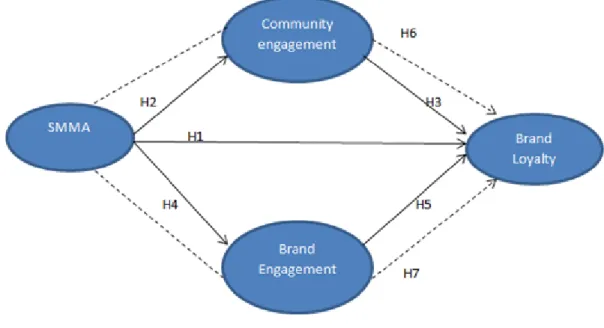
Figure 1. Research Model
The Figure above is the reasearch model in this study, there are 7 hypotheses, namely : H1: there is a positive effect of social media marketing activities on brand loyalty
H2: there is a positive influence of social media marketing activities on community engagement
H3: there is a positive effect of community engagement on brand loyalty H4; there is a positive effect of social media marketing on brand engagement Brand engagement and brand loyalty
H5: there is a positive effect of brand engagement on brand loyalty
H6: there is a positive influence of social media marketing activities on brand loyalty mediated by community engagement
H7: there is a positive effect of social media marketing activities on brand loyalty mediated by brand engagement
Hypotesis Development. In this research hypothesis, it will be explained about social media marketing activity that can affect community engagement, brand engagement and brand loyalty.
Sosial media marketing activity and brand loyalty. Previous studies have suggested that there is a significant relationship between SMMa and brand equity (Kim and Ko, 2012).
(Fetais et al., (2022) found a positive impact of SMMa on brand loyalty. SMMa has an important influence on brand image and brand awareness (Fetais et al., 2022). Conducted a meta-analysis study to investigate the relationship between SMA and brand loyalty and reported a positive relationship. Based on this discussion, the following hypothesis can be formulated:
H1: there is a positive effect of social media marketing activities on brand loyalty.
Sosial media marketing activity and community engagement. Community involvement can illustrate the existence of a consumer-brand relationship (Fetais et al., 2022). This idea can be explained as a psychological position, which reflects that consumers like certain brands. It can be concluded from the existing literature that there is a positive relationship between SMMA and engagement (Fetais et al., 2022). Elements of interactivity on social media can improve affective, cognitive and consumer behavior aspects (Fetais et al., 2022).
In different social media platforms such as (Instagram, Facebook and Twitter) consumers can discuss their ideas, like content, reply to Twitter and chat with others who discuss certain brands can strengthen consumer engagement (Fetais et al., 2022). interaction can occur when consumers share ideas, evaluations and feedback (Fetais et al., 2022).
Trendiness helps consumers think that the brand being offered is rising or famous, and can also give consumers enthusiasm in finding the latest information about brands on social media, for example, brands that are trending are discussed by consumers about products from that brand on social media platforms. (Fetais et al., 2022). In the context of fashion brands, there is a positive relationship between SMA and brand involvement in self-concept. Based on this discussion, the hypothesis can be formulated:
H2: there is a positive influence of social media marketing activities on community engagement.
Community engagement and brand loyalty. The existence of a bond between engagement and brand loyalty is rooted in the context of social media, occurring in previous literature (Fetais et al., 2022). positive thing about the relationship between engagement and brand loyalty from previous studies (Fetais et al., 2022). positive relationship between the dimensions of involvement (consumer-related processes, affective part) and brand loyalty (Fetais et al., 2022). In the context of fashion brands (Fetais et al., 2022) explained that there is a positive relationship between brand involvement in self-concept and brand loyalty. Based on this discussion, the hypothesis can be formulated:
H3: there is a positive effect of community engagement on brand loyalty.
Social media marketing activity and brand loyalty. In the context of fashion brands, there is actually a positive relationship between SMMa and brand involvement in self- concept (Fetais et al., 2022). Currently many people use social media platforms to interact and share information with others, this is due to information technology which has changed the way people, companies communicate and interact. With the advent of information technology, social media users are increasing day by day, so companies must find ways for brands to communicate with their target market. The expansion of social media makes companies more active with marketing activities through social media (Emini and Zeqiri, 2021), a digital marketing strategy makes a company think about building relationships with customers (Emini and Zeqiri, 2021). Marketing activities affect brand awareness (Seo and Park, 2018), and on brand engagement (Emini and Zeqiri, 2021). Based on this discussion, the hypothesis can be formulated:
H4: there is a positive effect of social media marketing on brand engagement Brand engagement and brand loyalty
Many scientific sources focus on brand involvement and brand loyalty as inseparable steps to carry out higher order investigations that occur with customer – brand relationships (Mork̄unas, 2022). (Mork̄unas, 2022) has thought well of brand engagement as a direct proxy for brand loyalty. Given all types of affective, cognitive and behavioral involvement (Park and Ha, 2021), there are few studies that consider this relationship to be trivial, since many mediating effects have been documented (Mork̄unas, 2022). So to test this relationship, the hypothesis can be formulated:
H5: there is a positive effect of brand engagement on brand loyalty
Social media marketing activities towards brand loyalty mediated by community engagement.
H6: there is a positive influence of social media marketing activities on brand loyalty mediated by community engagement.
Social media marketing activities on brand loyalty mediated by brand engagement.
H7: there is a positive effect of social media marketing activities on brand loyalty mediated by brand engagement
METHODS
Population. The unit of analysis included in this study are people who have bought fashion product brands online on social media in the last 1 year. The data used in this study is cross-sectional data or data collected over a certain period of time through a questionnaire.
The survey provided was in the form of a Google form which was distributed directly to respondents in bulk.
Samples. This study used a non-probabilistic sampling technique using purposive sampling. Purposive sampling is sampling that is limited to certain respondent criteria that can provide the information needed according to several criteria determined by the researcher (Sekaran and Bougie, 2016). The criteria for respondents who met the requirements for this survey were people who had bought fashion product brands online on social media in the past year. To determine the minimum sample size for this study, the authors refer to the statement in (Heir et al., 2019).
Here, the number of sample respondents is the formula (5 to 10) the number of indicators used in the number of samples used, a good number in the Structural Equation Model (SEM) test, which ranges from 200 to 400 samples. There are 38 indicators in this study, so the number of respondents used is 190 – 380 respondents. Referring to the minimum number of samples submitted by (Hair et al., 2019), for the SEM method, namely 200 respondents, the researchers are targeting a total of 244 respondents to avoid data dropping out. However, the number of respondents who fit the adjusted analysis unit criteria was 211 respondents to be processed.
Data collection. The data used in this research is primary data. That is, data collected directly from respondents by researchers to answer the problem formulation and research objectives through a questionnaire in the form of a google form.
Measures. In this study there were four variables, namely social media marketing activities measured by 10 items, community engagement measured by 20 items, brand engagement measured by 3 items and brand loyalty by 5 items adapted from (Fetais et al., 2022; Emini and Zeqiri., 2021; Morkunas., 2022). Each item used for the variable is described in the appendix. The measurement scale used to measure indicators of the variables tested is a five-point Likert scale from 1 (strongly disagree) to 5 (strongly agree).
RESULTS
Description of the respondent's identity is one of the data analysis techniques used to provide an overview of the identity of the respondents in this study by grouping them into several groups based on consumer profiles, namely; gender, age, education level, occupation, income and social media that are often used. The respondent criteria that are the source of this research data are consumers who have purchased fashion products online
through social media. The total number of respondents who were taken as a source of research data was 211 respondents with a total percentage of (100.000 percent).
Table 1. Profil of Respondents
Frequency Percent
Gender Male Female
77 134
36.500 63.500 Age
12 to 27 Years (Gen z)
28 to 41 Years (Gen Y/ Milenials) 42 to 57 Years (Gen X)
58 to 76 Years (Baby Boomers)
140 29 38 4
66.400 13.700 18.000 1.900 Last Education
Primary School Junior High School Senior High School S1 (Bachleor) S2 (Master) S3 (Doctoral)
1 0 77 129
3 1
0.500 0.000 36.500 61.100 1.400 0.500 Profession
Student Enterpreneur
Government employees Private employees Other
124 29 25 19 14
58.800 13.700 11.800 9.000 6.700 Monthly income level
IDR 1.000.000 to 3.000.000 IDR 3.001.000 to 5.000.000 IDR 5.001.000 to 7.000.000 IDR 7.001.000 to 10.000.000 IDR 10.000.000
136 38 20 10 7
64.500 18.000 9.500 4.700 3.300 Most visited social media
Instagram Facebook Twitter Tik Tok
104 39 13 55
49.300 18.500 6.200 26.000
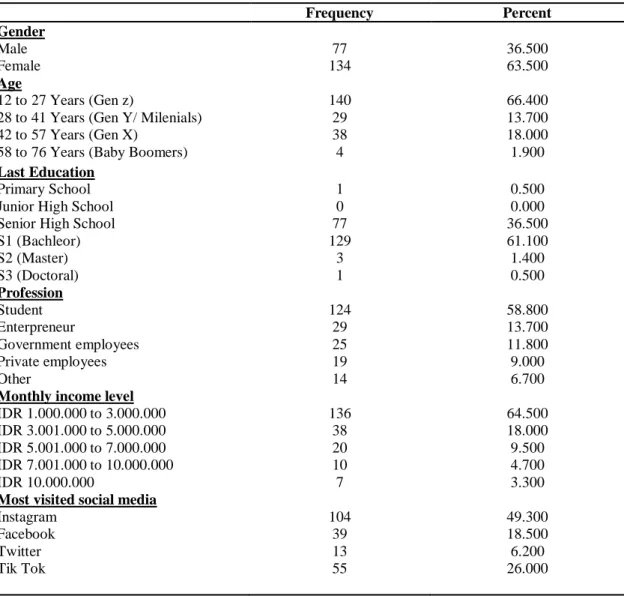
Based on Table 1 it can be seen that the number of respondents based on gender, male gender respondents were 77 (36.500 percent) and female respondents were 134 (63.500 percent).
Then based on age, the number of respondents with an age range of 12 to 27 years (Gen Z) was 140 (66.400 percent), respondents with an age range of 28 to 41 years (Gen Y/Millennials) were 29 (13.700 percent), respondents with an age range of 42 to 57 years (Gen X) of 38 (18.000 percent), and respondents with an age range of 58 to 76 years (Baby Boomers) of 4 (1.900 percent).
Then based on the last level of education, the number of respondents with the last elementary education level was 1 (0.500 percent), respondents with the last junior high school education level were 0 (0 percent), respondents with high school/equivalent
education level were 77 (36.500 percent), respondents with education S1 (Bachelor) by 129 (61.100 percent), respondents with educational level S2 (Masters) by 3 (1.400 percent) and respondents with the last educational level S3 (Doctoral) by 1 (0.500 percent).
Then based on work, the number of respondents with student jobs was 124 (58.800 percent), respondents with self-employed jobs were 29 (13.700 percent), respondents with civil servant jobs were 25 (11.800), respondents with private employee jobs were 19 (9 percent) , and the number of respondents with other jobs was 14 (6.700 percent).
Then based on the level of income per month, the number of respondents with an income level of IDR 1,000,000 to IDR 3,000,000 per month is 136 (64.500 percent), respondents with an income level of IDR 3,000,0001 to IDR 5,000,000 per month are 38 (18 percent), respondents with an income level of IDR 5,001,000 to IDR. 7,000,000 per month by 20 (9.500 percent), respondents with an income level of IDR 7,000,001 to IDR 10,000,000 per month by 10 (4.700 percent) and respondents with an income level greter than IDR 10,000,000 per month by 7 (3.300 percent) ).
And finally based on social media that is often visited, respondents who frequently visit social media Instagram are 104 (49.300 percent), respondents who are frequently visited by social media Facebook are 39 (18.500 percent), respondents who often visit social media Twitter are 13 (6.200 percent) and 55 (26 percent) respondents who frequently visit Tik Tok social media.
The research instrument test aims to test the instrument by testing the validity and reliability of the questionnaires that have been filled in by respondents to test the instrument so that valid and reliable measuring instruments can be obtained. The validity test is used to determine the appropriateness of the statement on the questionnaire (indicator) in measuring a variable. To test the validity of each item statement in the questionnaire, a factor analysis will be carried out which compares the value of factor loading with standard factor loading (Hair et al., 2019). The respondent data collected was 211, so the factor loading acceptance limit for this study was 0.400 (Hair et al., 2019). The reliability test was carried out to measure the level of consistency between indicators in measuring variables (Sekaran and Bougie, 2016). If a metric used to measure a variable is declared reliable, then the metric is considered consistent in measuring that variable and can be used to support research. The reliability test in this study used the Cronbach's alpha test with the following conditions (Sekaran and Bougie, 2016). If the value of Cronbach's alpha greather than 0.600 then the questionnaire is declared reliable.
Table 2. Result of validaty and reliability test
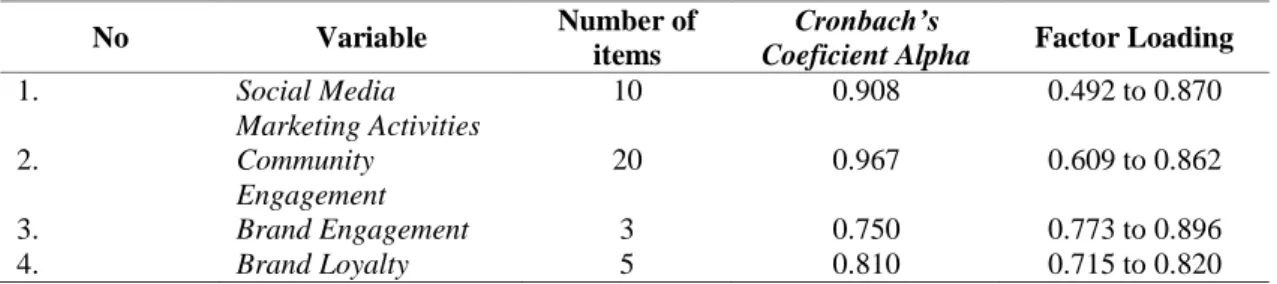
Based on the results of the validity and reliability tests in Table 2, it can be concluded that testing the validity of each statement item from the social media marketing
No Variable Number of
items
Cronbach’s
Coeficient Alpha Factor Loading
1. Social Media
Marketing Activities
10 0.908 0.492 to 0.870
2. Community
Engagement
20 0.967 0.609 to 0.862
3. Brand Engagement 3 0.750 0.773 to 0.896
4. Brand Loyalty 5 0.810 0.715 to 0.820
activities variable as a whole has a factor loading value of greather than 0.400 and a Cronbach's alpha value of greather than 0.600. Therefore, all statements used to measure community engagement, brand engagement, and brand loyalty variables can be said to be valid (correct) and reliable.
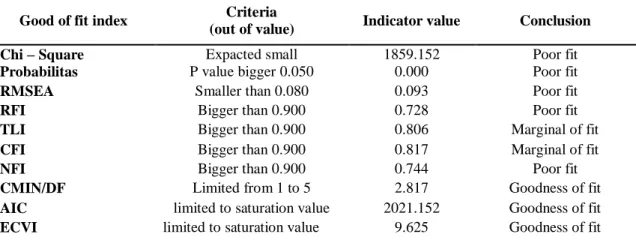
Before testing the hypothesis, testing the goodness of fit or model suitability will be carried out first. The goodness of fit test aims to find out whether a model proposed by researchers is feasible (Hair et al., 2019).
Table 3. Research Goodness of Fit Test Results
Good of fit index Criteria
(out of value) Indicator value Conclusion
Chi – Square Expacted small 1859.152 Poor fit
Probabilitas P value bigger 0.050 0.000 Poor fit
RMSEA Smaller than 0.080 0.093 Poor fit
RFI Bigger than 0.900 0.728 Poor fit
TLI Bigger than 0.900 0.806 Marginal of fit
CFI Bigger than 0.900 0.817 Marginal of fit
NFI Bigger than 0.900 0.744 Poor fit
CMIN/DF Limited from 1 to 5 2.817 Goodness of fit
AIC limited to saturation value 2021.152 Goodness of fit
ECVI limited to saturation value 9.625 Goodness of fit
Source : Output Amos 23
Based on the results of the goodness of fit test it was stated that the model used in this study passed the goodness of fit test, because there were 3 indicators that met the model suitability criteria, namely the CMIN/DF value of 2.817, the AIC value of 2021.152, and the ECVI value of 9.625. thus, the model used is in accordance with the data obtained and can be continued to the next testing stage.
The hypothesis testing in this study was to compare the p-value and alpha (error rate) of 0.050 (Hair et al., 2019). Requirements in making a decision to test the hypothesis are if the p-value smaller than 0.050 and the estimated value is positive then Ho is rejected or Ha is accepted. So that there is a positive influence between the independent variables to the dependent variable. If the p-value bigger 0.050 then Ho is accepted or Ha is rejected.
So there is no influence from the independent variable to the dependent variable.
To test the hypothesis with a mediating role, this study used the bootstrapping method developed by (Hayes, 2018), using PROCESS v3.0 on SPSS by looking at the 95 percent confidence interval based on bootstrap results on 211 samples, with the provisions if the BootLLCI and BootULCI ranges from the indirect effect results do not include a value of zero (0), then it can be concluded that the estimation is significant and a mediating effect occurs. If the BootLLCI and BootULCI ranges from the indirect effect results include a value of zero (0), then it can be written that the estimate is not significant and there is no mediating effect.
Table 4. Result of hypothesis testing
Hypotesis Estimate P-Value Decision
H1: Social Media Marketing Activities have a positive influence on Brand Loyalty
Negative 0.053 0.498 H1 Not Supported
H2: Social Media Marketing Activities have a positive influence on the Engagemnet Community
0.548 0.000 H2 Supported
H3: Community Engagement has a positive influence on Brand Loyalty
0.351 0.000 H3 Supported
H4: Social Media Marketing Activities have a positive influence on Brand Engagement
0.736 0.000 H4 Supported
H5: Brand Engagement has a positive influence on Brand Loyalty
0.269 0.000 H5 Supported
Hypotesis BootLLCI BootULCI Decision
H6: community engagement mediates the influence of social media marketing activities on brand loyalty
0.0447 0.2052 H6 Supported
H7: brand engagement mediates the influence of social media marketing activities on brand loyalty
0.0732 0.1804 H7 Supported
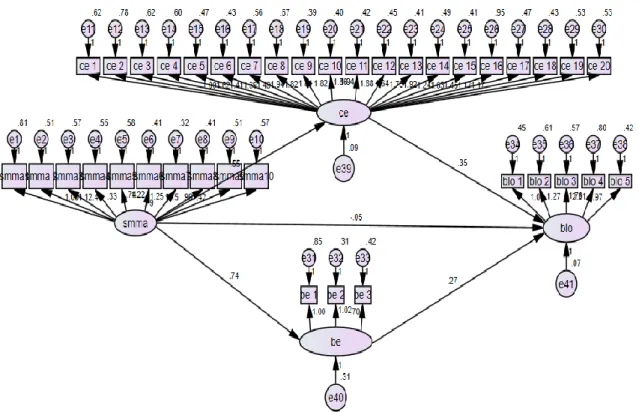
Based on the results of hypothesis testing in Table 4, the first hypothesis has a p- value of 0.498 bigger 0.050 and the estimated value obtained is negative 0.053, then Ho is accepted and Ha is rejected, so the first hypothesis is not supported because the p-value is greater than 0.050 and negative estimate value.
The second hypothesis has a p-value of 0.000 smaller 0.050 and the estimated value obtained is 0.548, so Ho is rejected and Ha is accepted, so the second hypothesis is supported because the p-value is smaller than 0.050 and the estimated value is positive.
The third hypothesis has a p-value of 0.000 smaller 0.050 and the estimated value obtained is 0.351, so Ho is rejected and Ha is accepted, so the third hypothesis is supported because the p-value is smaller than 0.050 and the estimated value is positive.
The fourth hypothesis has a p-value of 0.000 smaller 0.050 and the estimated value obtained is 0.736, so Ho is rejected and Ha is accepted, so the fourth hypothesis is supported because the p-value is less than 0.050 and the estimated value is positive. The fifth hypothesis has a p-value value of 0.000 smaller 0.050 and the estimated value obtained is 0.269, then Ho is rejected and Ha is accepted, so the fifth hypothesis is supported because the p-value is smaller than 0.05 and the estimated value is positive.
The sixth hypothesis tests the effect of social media marketing activities on brand loyalty mediated by community engagement. Based on the results of hypothesis testing in table 4, the BootLLCI (0.044) and BootULCI (0.205) range values from the indirect results do not include a zero value (0), it can be concluded that community engagement mediates the influence of social media marketing activities on brand loyalty.
The seventh hypothesis tests the effect of social media marketing activities on brand loyalty mediated by brand engagement. Based on the results of hypothesis testing in table 4, the BootLLCI (0.0732) and BootULCI (0.1804) range values from the indirect results do not include a zero value (0), it can be concluded that brand engagement mediates the influence of social media marketing activities on brands loyalty.
Figure 2. Result of the structural model
Source : AMOS 23
DISCUSSION
Based on the results of testing the first hypothesis, it can be concluded that social media marketing activities have no positive effect on brand loyalty. That is, social media marketing activities cannot influence customers/consumers to increase brand loyalty offered from brand industry social media accounts such as fashion brands that consumers want, the information is quite difficult to obtain, fashion brand companies do not provide good service to consumers, content about fashion on social media is less attractive. The results of this study are not in accordance with the results of previous research conducted by (Fetais et., al 2022) which states that social media marketing activities have a positive effect on brand loyalty. However, there is research conducted by (Lamkadem and Ouiddad, 2021) which states that social media marketing has no direct effect on brand loyalty. So that we can know that in this hypothesis there is no positive influence from social media marketing activities on brand loyalty, which means consumers cannot describe their loyalty to product brands marketed through social media, why is that because we can see
in table 4, it can be seen that the pvalue of hypothesis 1 is greater than 0.05 and the estimate is also negative.
Based on the results of testing the second hypothesis, it can be concluded that social media marketing has an effect on community engagement. With community involvement, a brand directly influences people to follow the community on social media such as, having a brand community on social media makes consumers feel enthusiastic, many consumers are interested in joining brand communities on social media, interacting with brand communities makes consumers excited , consumers can exchange ideas with community members. The results of this study are in accordance with the results of previous research conducted by (Fetais et al., 2022), where the results of this study state that there is a positive effect of social media marketing activities on community engagement. in this study states that there is a relationship between social media marketing and community engagement, in which in the second hypothesis there is a positive influence from social media marketing on community engagement, meaning that with social media, business people can create a community for their brand that can attract consumers to join the community that has been created by the company. We can see in table 4 in the second hypothesis that the pvalue is less than 0.05 and the estimate is also positive
Based on the results of testing the third hypothesis, it can be interpreted that community engagement has an effect on brand loyalty. With a brand community on social media, many people join the community to get information about the brand and become loyal to the brand, consumers also invite other people to join the community, consumers can also ask friends in the community for help, and they consumers do not provide community information to foreigners who are considered as competitors of the brand product community. The results of this study are in accordance with the results of previous research conducted by (Fetais et al., 2022), where the results of this study state that there is a positive effect of community involvement on brand loyalty. So that we can see that this community involvement has a good impact on the company, namely it can make consumers loyal to the product brands they use, and we can also find out why this hypothesis has a relationship, which can be seen in table 4 in the 3rd hypothesis, the p value smaller than 0.05 and the estimate is positive.
Based on the results of testing the fourth hypothesis, it can be concluded that social media marketing activities have an effect on brand engagement. The existence of social media marketing activities can affect brand involvement, because many branded companies are marketing on social media to more easily reach potential consumers who are interested in their brand, many also from consumer friendships with people who use the same brand on social media, consumers also get related information brands they like on social media, and by advertising these products on social media, consumers are interested in buying online. The results of this study are in accordance with previous research conducted by (Emini and Zeqiri, 2021), where the results of this study state that there is a positive influence from social media marketing activities on brand engagement.
that business people can use social media as a means of marketing by advertising their brand on social media, creating content about their brand on social media can help them with brand advertising issues, and of course this makes it easier for companies to do marketing, because nowadays people – people prefer to use their smartphones to shop online rather than buying directly to the store, we can see in table 4 in the 4th hypothesis
that the pvalue is less than 0.05 and the positive estimate explains that there is a positive influence of social media marketing activities on brand engagement.
Based on the results of testing the fifth hypothesis, it can be concluded that brand engagement has an effect on brand loyalty. With the involvement of brands marketed on social media, people will be interested in buying, so they will be loyal to the brand, consumers think the brand they use is a necessity, consumers can also buy this brand at any time. The results of this study are in accordance with previous research conducted by (Mork̄unas, 2022), where the results of this study state that there is a positive effect of brand involvement on brand loyalty. That with the involvement of the brand, consumers can be loyal to the brand, such as the brand gives its consumers a sense of satisfaction because the brand has quality according to what is needed by consumers so that they will continue to buy the product with the same brand, we can find out why there is a positive relationship between brand engagement and brand loyalty, namely in table 4 in the 5th hypothesis that the pvalue is smaller than 0.05 and the estimated value is also positive.
Based on the results of testing the sixth hypothesis, it can be concluded that social media marketing activities have an indirect effect on brand loyalty mediated by community engagement. with community involvement indirectly loyal consumers to brands purchased through social media. The results of this study Partially the research conducted by Fetais et al., (2022) states that social media marketing activities have an influence on community engagement and community engagement also has an influence on brand loyalty, so that this community engagement variable can act as a mediating variable between social variables media marketing activity on brand loyalty.
Based on the results of testing the seventh hypothesis, it can be concluded that social media marketing activities have an indirect effect on brand loyalty mediated by brand loyalty. With indirect brand involvement, consumers become loyal to brands purchased through social media. Partially also in research conducted by Emini & Zeqiri, (2021) states that there is an influence between social media marketing on brand engagement and research conducted by Mork̄unas, (2022) states that brand engagement has an influence on brand loyalty. So that this brand engagement variable can act as a mediating variable between social media marketing activities and brand loyalty variables.
CONCLUSION
Based on the results of the research and discussion that has been described, it can be concluded that social media marketing activities do not have a positive effect on brand loyalty. This means that the factors that exist in social media marketing activities do not directly influence consumers to be loyal to the brands offered on social media. Social media marketing activities have a positive effect on community engagement. this means that the factors that exist in social media marketing activities directly affect the involvement of the community (customers) to create a community based on the brands they buy on social media. Community engagement has a positive effect on brand loyalty.
This means that community involvement made by consumers based on the same brand can directly influence loyal consumers to that brand. Social media marketing activities have a positive effect on brand engagement. This means that the factors that exist in social media marketing activities can directly affect brand involvement, such as business actors using social media to advertise and promote their brands. Brand engagement has a
positive effect on brand loyalty. This means that the existence of brand involvement can directly influence customers to be loyal and loyal to the brand. Community engagement mediates the influence of social media marketing activities on brand loyalty. This means that with the involvement of the community indirectly the factors that exist in social media marketing activities can influence consumers/customers to be loyal/loyal when buying a product through social media. Brand engagement mediates the influence of social media marketing activities on brand loyalty. This means that with indirect brand involvement, the factors that exist in social media marketing activities can influence consumers/customers to be loyal/loyal to product brands purchased on social media.
Managerial Implications. To increase brand loyalty, company managers can increase social media marketing activity, as a means to promote brands and sell the products they make/create, because using social media the prices are more affordable and easier to reach consumers, so managers can increase company brand loyalty. effectively and efficiently.
To increase brand loyalty, company managers can increase community engagement by means of companies holding community forums, creating brand community programs, so that these brand communities have activities that direct them to participate in introducing the company brand to other potential customers and providing information about brand names. they use it to other people, by conveying a good impression of the product brand, so that those (customers) who join the community can be loyal and loyal to the brand used.
To increase brand loyalty, company managers can increase brand involvement such as attractive logos and taglines, be active on social media, create attractive and informative websites, attend events, so that by doing this all companies can get customers easily and increase sales.
Limitation. First, this study only discusses social media marketing activities, community engagement, brand engagement and brand loyalty variables. And this research is not evenly distributed based on age restrictions.
Further Reasearch. Future researchers can add other variables such as brand awareness which can mediate the effect of social media marketing activities on brand loyalty according to (Emini and Zeqiri, 2021). Future researchers can use age as a moderating variable, so we can find out whether there are differences in the results of this study.
REFERENCES
Ait Lamkadem, S., and Ouiddad, S. (2021). Towards creating an effective customer brand engagement through social media marketing: A model proposal. International Journal of Business and Management Invention (IJBMI) ISSN, 10(4), 28–36.
https://doi.org/10.35629/8028-1004012836.
Baskoro, D. (2022, oktober 18). Bisnis Fasjion Era digital, besarnya peran influencer dan media sosial. Retrieved november 1, 2022, from kompas.com:
https://lifestyle.kompas.com/read/2022/10/18/130429120/bisnis-fashion-era- digital-besarnya-peran-influencer-dan-media-sosial?page=4.
BİLGİN, Y. (2018). the Effect of Social Media Marketing Activities on Brand Awareness,
Brand Image and Brand Loyalty. Business and Management Studies: An International Journal, 6(1), 128–148. https://doi.org/10.15295/bmij.v6i1.229.
Chandra, A. R., Wimeina, Y., and Khairat, A. (2020). Penggunaan Media Sosial untuk Berbelanja Online Saat Pandemi Covid-19. Jurnal Konsep Bisnis Dan Manajemen, 7(1), 58–71. https://doi.org/10.31289/jkbm.v7i1.4285.
Delbaere, M., Michael, B., and Phillips, B. J. (2021). Social media influencers: A route to brand engagement for their followers. Psychology and Marketing, 38(1), 101–112.
https://doi.org/10.1002/mar.21419.
Ebrahim, R. S. (2020). The Role of Trust in Understanding the Impact of Social Media Marketing on Brand Equity and Brand Loyalty. Journal of Relationship Marketing, 19(4), 287–308. https://doi.org/10.1080/15332667.2019.1705742.
Emini, A., and Zeqiri, J. (2021). Social Media Marketing and Purchase Intention: Evidence From Kosovo. Ekonomska Misao i Praksa, 30(2), 475–492.
https://doi.org/10.17818/emip/2021/2.8.
Fetais, A. H., Algharabat, R. S., Aljafari, A., and Rana, N. P. (2022). Do Social Media Marketing Activities Improve Brand Loyalty? An Empirical Study on Luxury Fashion Brands. Information Systems Frontiers. https://doi.org/10.1007/s10796- 022-10264-7.
Hair F. Joseph Jr., William C. Black, Barry J. Babin, Rolph E. Anderson (2019).
Multivariate Data Analysis (8 th Edition). Annabel Ainscow.
Haudi, Handayani, W., Musnaini, Suyoto, Y. T., Prasetio, T., Pital-Oka, E., Wijoyo, H., Yonata, H., Koho, I. R., and Cahyono, Y. (2022). The effect of social media marketing on brand trust, brand equity and brand loyalty. International Journal of
Data and Network Science, 6(3), 961–972.
https://doi.org/10.5267/j.ijdns.2022.1.015.
Hayes, A. F. (2018). Introduction to mediation, moderation, and conditional process analysis. A Regression- Based Approach New York. Guilford.
Khan, M. M. (2019). The Impact of Perceived Social Media Marketing Activities: An Empirical Study in Saudi Context. International Journal of Marketing Studies, 11(1), 134. https://doi.org/10.5539/ijms.v11n1p134.
Khan, M., Rubab, S., Mumtaz AWAN, T., Khan, M., Malik, N., Daniyal, M., Zaryab ASHRAF, M., and Samad KAKAR, A. (2022). The Relationship Between Social Media Marketing Activities and Brand Attachment: An Empirical Study from Pakistan. Abdul Samad KAKAR / Journal of Asian Finance, 9(6), 219–0230.
https://doi.org/10.13106/jafeb.2022.vol9.no6.0219.
Kim, G., Newman, G., and Jiang, B. (2020). Urban regeneration: Community engagement process for vacant land in declining cities. Cities, 102(April), 102730.
https://doi.org/10.1016/j.cities.2020.102730.
Kumar, J., and Kumar, V. (2020). Drivers of brand community engagement. Journal of Retailing and Consumer Services, 54(September), 101949.
https://doi.org/10.1016/j.jretconser.2019.101949.
Maulid, D. L., Hurriyati, R., and Hendrayati, H. (2022). The Impact of Social Media Marketing on Consumer Purchase Decisions. Proceedings of the 6th Global Conference on Business, Management, and Entrepreneurship (GCBME 2021), 657(3). https://doi.org/10.2991/aebmr.k.220701.045.
Mork̄unas, M. (2022). Revealing Differences in Brand Loyalty and Brand Engagement of
Single or no Parented Young Adults. IIM Kozhikode Society and Management Review, 227797522211087. https://doi.org/10.1177/22779752221108797.
Novika, H. (2021, juli 10). tantangan penggunaan jejaring sosial dalam pemasaran berbasis online pada pelaku usaha. Retrieved november 1, 2022, from jurnalpost.com: https://jurnalpost.com/tantangan-penggunaan-jejaring-sosial- dalam-pemasaran-berbasis-online-pada-pelaku-usaha/23146/#.
Park, J. S., and Ha, S. (2021). Developing brand loyalty through consumer engagement with brand communities in social media. Asian Journal of Business Research, 11(1), 83–102. https://doi.org/10.14707/ajbr.210100.
Puspitarini, D. S., and Nuraeni, R. (2019). Pemanfaatan Media Sosial Sebagai Media Promosi (Studi Deskriptif pada Happy Go Lucky House). Jurnal Common, 3(1), 71–
80. https://doi.org/10.34010/COMMON.V3I1.1950.
Salameh, A. A. M., and Zamil, A. M. A. (2020). The effects of reward systems and organizational structure on tacit knowledge sharing. Management Science Letters, 10(10), 2229–2236. https://doi.org/10.5267/j.msl.2020.3.012.
Seo, E. J., and Park, J. W. (2018). A study on the effects of social media marketing activities on brand equity and customer response in the airline industry. Journal of Air Transport Management, 66(September 2017), 36–41.
https://doi.org/10.1016/j.jairtraman.2017.09.014.
Sekaran, U., and Bougie, R. (2016a). Research Methods for Bussiness (7th Edition).
WILEY.
Song, H. J., Wang, J. H., and Han, H. (2019). Effect of image, satisfaction, trust, love, and respect on loyalty formation for name-brand coffee shops. International Journal of Hospitality Management, 79(December 2018), 50–59.
https://doi.org/10.1016/j.ijhm.2018.12.011.
Wang, Y., Ahmed, S. C., Deng, S., and Wang, H. (2019). Success of social media marketing efforts in retaining sustainable online consumers: An empirical analysis on the online fashion retail market. Sustainability (Switzerland), 11(13).
https://doi.org/10.3390/su11133596.
Xi, N., and Hamari, J. (2019). The relationship between gamification, brand engagement and brand equity. Proceedings of the Annual Hawaii International Conference on System Sciences, 2019-Janua, 812–821. https://doi.org/10.24251/hicss.2019.099.
Zalm, A. F. Van Der. (2017). Social Media impact of consumer acculturation in the context of Brand Loyalty CC-BY-NC. Cc-By-Nc.
Zarei, A., Farjoo, H., and Bagheri Garabollagh, H. (2022). How Social Media Marketing Activities (SMMAs) and Brand Equity Affect the Customer’s Response: Does Overall Flow Moderate It? Journal of Internet Commerce, 21(2), 160–182.
https://doi.org/10.1080/15332861.2021.1955461.
Appendix 1: Questionnaire
Social Media Marketing Activities
No. Questionnaire 1 2 3 4 5
1 I upload content about the fashion brands that I use on social media
2 I convey fashion brand information on social media platforms
3 The fashion brands I want to buy on social media provide good service
4 The fashion brand that I want, the information is easy to get on social media
5 I use fashion brands that are trending on social media
6 I provide the latest information about fashion brands on social media platforms
7 I give my opinion about the fashion brands that I use on social media
8 I give opinions about fashion brands that I buy on social media
9 I like to use fashion brands that I upload on social media
10 Content on social media about fashion looks interesting
Community Engagement
No Quistionnaire 1 2 3 4 5
1 The community of fashion brands on social media makes me feel enthusiastic
2 I feel involved with the issues that exist in the fashion brand community on social media 3 I follow this social media community because
it's interesting
4 I feel happy when interacting with the community on social media platforms
5 Interacting with the fashion brand community on social media gives me encouragement 6 I usually spend time interacting with
community friends on social media
7 When I interact with community friends on social media I go too far (get carried away) 8 It's hard to leave the community chat while in
the middle of an interaction
9 I share my thoughts/ideas with the community on social media
10 I'm looking for free time to be able to interact with the community on social media
11 I provide interesting content in social media communities
12 I also help the fashion community on social media
13 I asked community friends about the social media fashion community
14 I asked for help from community friends on social media
15 I ask other users to get involved in the brand community on social media
16 I do not provide information related to the fashion brand community to other people (competitors)
17 I am optimistic to provide information related to the fashion brand community
18 I like to follow the discussion of the fashion brand community that I use on social media 19 I support the fashion brand community on
social media
20 I get ideas or information from fashion brand communities on social media
Brand Engagement
No Quistionnaire 1 2 3 4 5
1 I make friends on social media with people who use the same brand
2 I follow the brand information that I use through social media
3 Social media got me interested in the brand Brand Loyalty
No Quistionnaire 1 2 3 4 5
1 I assume the brand I use is the one that suits my needs
2 I can buy this brand anytime
3 This brand is the only brand I prefer to use 4 If this brand is not available, I get annoyed 5 I consider loyal/loyal to the brands I use