Horror film is an extremely successful, but at the same time culturally illegal genre that spans the history of cinema. Brigid Cherry offers a comprehensive overview of the horror film and examines how the genre works. Cherry examines the way horror films create images of blood and the uncanny through film technology and effects, and provides an account of the way cinematic and stylistic devices create responses of terror and disgust in the viewer.
Horror further explores the role of the horror film in society and culture, looking at how it represents different identity groups and engages with social anxiety, and examines the way horror is viewed and viewed by society. Routledge Film Guidebooks offer a clear introduction to and overview of important filmmakers, movements or genres. 2 Park Square, Milton Park, Abingdon, Oxon OX14 4RN Published simultaneously in the US and Canada by Routledge.
To purchase your copy of this or any of the thousands of Taylor & Francis or Routledge eBooks, go to www.eBookstore.tandf.co.uk.
ACKNOWLEDGEMENTS
THE HORROR GENRE: FORM AND FUNCTION
So it's probably best to think of the horror genre as a collection of related but often very different categories. Before that, it is worth considering the changing nature of the horror genre and the difficulties in defining it. According to such a model, the X-factor of the horror film can be taken as a supernatural monster, say.
Shadow plays a similar role in the horror film, often in the moments of tension that center on the appearance of the monster. What if the purpose of the genre label as used by any of these groups is different. In the case of the slasher film (and by extension the horror film as a whole), this feeds into the idea that the horror film belongs to low culture rather than art, resulting in the denigration of horror in general.
Furthermore, the view that the horror film audience is predominantly male persists in many areas of the film industry. This argument suggests that audiences can be very important in constructing definitions of the genre (back to the claim that genres are cultural artifacts, and what we believe they are). Indeed, she suggests that the stronger the physical response, the better an example of the genre.

HORROR AESTHETICS AND AFFECT
With this in mind, horror cinema can be defined in terms of the viewing experience. One of the best ways to determine how these effects are created is to focus on the aesthetics of horror – the horror genre has clearly established itself. This is emphasized in the review's summary, which links a terrifying story and dazzling aesthetic: shock and bloodshed.
Similarly, the creators of trailers and posters will act out the intended effects of the film. The history of horror cinema is, in one respect, the history of technological development and innovation in film. Coupled with the hand-held camera style and the use of the Raimi-cam (a camera attached to a board that was held low to the ground by two people as they ran with it to film the sequences where the entity appears to be rushing towards the cabin) this creates a very subjectively terrifying experience (which also, given the excess with which it is used, contributes to the darkly comic tone of the films).
This shot creates the effect of the character moving forward while the background appears to recede. She also states that this is 'the most frequently cited example in film history of the use of non-realistic sound in a narrative film. The breaking of the silence thus becomes the moment of death, evoked in the film's title.
So sound is an essential part of the film (in fact, as many reviewers note, it is the most important aspect of the film). For example, in early American horror films, the special effects sequences in The Phantom of the Opera were machine colored in a three-color system using stencils (Cook 2004: 351). However, aside from using body parts as props, the effect sequences themselves are not very detailed.
EvenNight of the Living Dead as late as 1968 still employed black and white (for George Romero this was a matter of economy more than anything else). A good example of the butt cut comes at the very beginning of The Texas Chain Saw Massacre. Hutchings (1993b: 87) describes this in terms of the technology of fear: 'a willing submission to the "mechanical" effects of horror'.
The idea of the sublime in The Texas Chain Saw Massacre can be contrasted with the reputation it has as a gore film.
HORROR CINEMA AND ITS PLEASURES
It is difficult to say how the concept of the unconscious plays out for the viewer. Wood argues that the return of the repressed is central to the horror narrative in the form of the monster. In the American horror film, normality comes into conflict with these subordinate groups in the form of the monster (and it is a very easy exercise to identify examples of horror film monsters in all these categories).
It is mother/other here and not just something else, as it is linked to the concept of the archaic mother. Food and the consumption of food (passage from the outer Other to the inner self) thus means crossing the border. He argues that effects films (and obviously body horror can be included here) enable the viewer to simply 'get lost in play, […] in the rush of the immediate experience'.
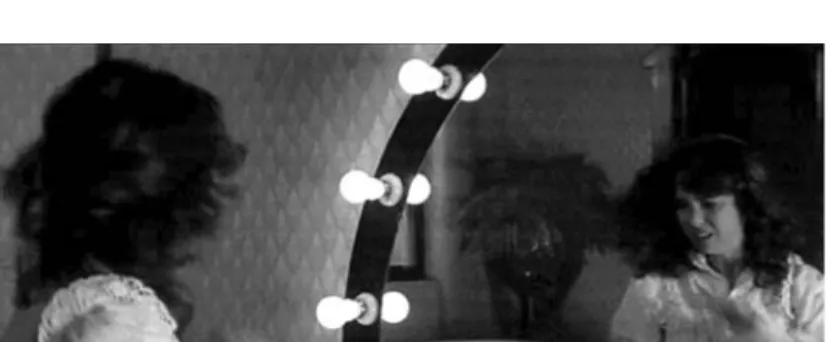
A horror film does just that - things that should remain in the dark are shown in the light of projected images. This, however, changes so that the mirror image gradually becomes an image outside itself. Slasher movies are known for their use of point-of-view shots (in fact, it's become something of a cliché).
Ebert argued that the very absence of the killer on screen (which appears through point-of-view shots and camera movements) means that the viewer identifies with the camera in its objectification of the (dismembered) female body. Such a construction of the gaze in the film seems rather reactionary (women are mostly denied gaze, but when they master it, they are punished by looking at the monstrous Other and their own death). In the final moments of the film, she becomes a monstrous woman to take revenge on the man who wronged her.
The trope of the vampire who cannot be seen in the mirror is an interesting one. Clover's statement that the radical potential of the horror film lies in the way in which it forces identification between the male viewer and the female victim can be expanded. One of the most important interventions in the cognitivism versus psychoanalysis debate was The Philosophy of Horror by Noel Carroll (1990).
Importantly, it also engages with the sociocultural and political ideologies encoded in the film, as does Wood's account of the return of the oppressed.
HORROR AND THE CULTURAL MOMENT
As Paul Wells (2000: 3) says, 'the history of the horror film is essentially a history of anxiety in the twentieth century'. Mark Jancovich's work is a good example of the way horror stories can take political ideology into account. On the other hand, it can be interpreted as a reflection of the way people are conditioned into standardized patterns of behavior by American society itself (Capitalism).
It is useful here to think about how this stripping away of identity and individuality is reworked in later versions of the film. Against this background, depersonalization can be read in the context of the end of the Cold War (which saw America lose a key role as a world superpower that kept communism at bay), the first Gulf War (which saw US military imperialism . of multinational corporations to protect the oil supply), and Bush Sr's clashes with environmentalism (the plot also concerns the monitoring of toxic waste, which can be read as the threat of undermining the ecological catastrophe that the US military-industrial complex nothing to avoid). At best, however, it remains a precarious institution, and the role of the father presents a particular problem.
The way the role of the military has changed is also important, from an institution indistinguishable from aliens in the 1990s to the mechanism for the survival of the human race (or the individual in American society) in the 2000s. For example, one of the early formulating elements of American horror film (and one so iconic that it's still reproduced today in contemporary films like Edward Scissorhands as well as other popular culture staples like The Simpsons) is the torch-wielding mob that invades. the monster until his (apparent) death. Indeed, Harper sees the film as "one of the most important cultural records of its era" (late 1960s).
Although never mentioned by any of the other characters, the hero is African American. Technology advanced at a much faster pace than ever before in the last decades of the twentieth century and technological (along with accompanying media and communication) change became a constant. In addition, a mockumentary The Curse of the Blair Witchaabout the background to the Blair Witch and the missing students was shown on The Sci-Fi Channel in the lead up to the movie's release.
Moving image technology thus becomes the central focus and often the source of the horror. In that way, it may also interestingly link back to theories about the gaze in horror films.).