Capstone EFL Portfolio
English as a Foreign Language (EFL)
Teaching English to Speakers of Other Language(TESOL) Hailing Zheng
Peabody College, Vanderbilt University Spring 2018
Abstract
This capstone portfolio demonstrates my theoretical understanding of the desires and needs of students learning English as a second language, and my competence of the implementation of theories in my teaching in EFL article context.
Within the first part of this project, I state my role as a language trainer with the Philosophy of teaching announcement. By reviewing principle from sociocultural, linguistic, and pedagogical perspectives, I exhibit how I am able to bridge between theory and practice. In the second section, I demonstrate my comprehensive understanding of eight critical TESOL domains from perspectives of learners and learning, learning environment, curriculum, and instruction. For each domain, I use at least one artifact of my previous work as evidence to illustrate my competence in English teaching. In the third part, I raise several critical issues in EFL education in China and discuss further implications for the development of English teaching in China.
TABLE OF CONTENT
Part I Philosophy of Teaching ...4
Part II Demonstration of Profession Knowledge ...9
Domain 1 Planning ...9
Domain 2 Instructing ...15
Domain 3 Assessing ...20
Domain 4 Identity and Context...34
Domain 5 Language Proficiency...39
Domain 6 Learning...41
Domain 7 Content...46
Domain 8 Commitment and Professionalism...50
Part III Implication for Future Teaching ...53
Philosophy of Teaching
Overall, I believe learning is most likely to happen in an environment that is supportive, comfortable, and challenging. In Vygotsky’s theory of learning and development, he proposed a pedagogical approach that effective learning should create students’ “zone of Proximal development”, which is in advance of their development, through instruction and interacting with peers (Vygotsky, 1978). Pedagogically, the ZPD concept is seen as a scaffolding, a structure of "support points" for performing an action (Obukhova, & Korepanova, 2009). Guided by this, I would provide scaffolding for my students to help them learn how to deal with challenging tasks before they could complete this tasks on their own (Hammond & Gibbons, 2005). Furthermore, Krashen’s (1982) Affective Filter hypothesis addresses the importance of high motivation, self-confidence and low anxiety in second language acquisition. In light of this, I will try my best to ensure the effective language acquisition of my students, which can be achieved by my dedication to creating a relaxing and comfortable learning environment where they are motivated to learning English.
In order to achieve this goal, I will try to build on the things students already know and do, and encourage their active engagement with authentic contexts. Guided by this goal, first of all, I believe students’ funds of knowledge can be utilized to facilitate the curriculum development and classroom instructions through including culturally relevant resources in classroom materials and actual lessons. Integrating children’s funds of knowledge and understandings into teaching is an effective teaching method (de Jong, 2011). Based on this notion, I will learn about students’ background, cultures, families and
prior experiences, and then make a connection between what they are familiar with and new knowledge. To achieve this, I can invite students’ family members to my classroom frequently. Involving parents in the classroom setting not only helps teachers understand their students better, but also is a direct and effective way to bring more “funds of knowledge” into classrooms. In order to fully make use of my students’ cultures, I will organize some cultural activities in order to respect and value my students’ diverse cultures and identities.
Another broad theory that guides my thinking is constructivism. Founded by Jean Piaget (1980), constructivism emphasizes the importance of the active involvement of learners in constructing knowledge for themselves. In my classroom, students are thought to use background knowledge and concepts to assist them in their acquisition of novel information. To design effective teaching environments, Smith (2002) suggests that teachers need a good understanding of what children already know when they come into the classroom. Also, the curriculum should be designed in a way that builds on the student's background knowledge and is allowed to develop with them. In light of this, my teaching aims to promote active learning, discovery learning, and knowledge building. In other words, learning is a discovery and exploration process for my students. And My role should be like a facilitator who encourages students to explore principles for themselves and to construct knowledge through answering open-ended questions and solving real-world problems.
Furthermore, achieving this goal also requires a learner-centered instruction (Brown, 2000), which focuses on or account for learner’s needs, styles, and goals. In my classroom, the focus of activity should shift from the teacher to the learners. These methods include
active learning, problem solving, answering questions, formulating questions of their own, discussing, explaining, debating, or brainstorming during class. In addition, cooperative learning is a potential teaching strategy that students work in teams on problems and projects under conditions that make sure positive interdependence and inductive teaching and learning.
What’s more, I believe communicative language teaching approach (CLT) has some great scaffolding implications in encouraging students’ active engagement with authentic contexts, which advocates real communication and meaningful tasks in second language acquisition (Brown & Frazier, 2001). Guided by this approach, the tasks for students should be meaningful and able to elicit real interactions between students and teachers and among peers. In the foreign language classrooms, I will provide my students with authentic texts and authentic materials so that my students can make meaning what they are learning.
Apart from providing students meaningful learning materials, I also implement Krashen’s (1982) input hypothesis of second language acquisition in my teaching where my students acquire language through comprehensible input and achieve proficiency by conducting meaningful communication. Based on this idea, I will make sure that my students are exposed in adequate amount of comprehensible and authentic learning materials, which includes newspapers, magazines, televisions, movies, songs, literatures, multimedia and so on.
With this ambitious goal, I find it helpful to use a backward design approach and translate and translate method, and I see great potential in multimedia. As a specific instruction, “backward design” as a useful tool to create lesson plans. Wiggins (2005) states that having a clear goal is helpful for educators to focus on our planning and guide
purposeful action toward the intended results. Thus, with this approach, identifying the desired results can be the first step for my lesson plans and the next step is to determine the acceptable evidence. Specifically, I should clearly realize what students should know, understand, and able to do. Also, according to backward design, it is necessary for me to think about a unit or course in terms of the collected assessment evidence needed to document and validate that the desired learning has been achieved. These two steps make me first “think like an assessor” before designing specific units and lessons, and thus to consider how I will determine whether my students have reached the desired understandings. With clearly identified results and appropriate evidence of understanding in mind, it is time to fully consider the most appropriate instructions and scaffoldings.
In order to achieve this goal, I believe the instructional idea proposed by Goodwin and Jimenez (2015) is promising in second language acquisition and content learning for English language learners. They suggest that students who participate in translate activities improve their strategic reading, translation, and engagement, which lead to their reading comprehension. With the precondition of providing my students with abundant bilingual texts (bilingual dictionaries, bilingual novels, and so on), I will select challenging texts or let my students themselves select the challenging texts to translate in teamwork. In order to make most use of this approach, I will teach students necessary strategies of how to translate, engage in collaborative work, and analyze/reflect on translation. Furthermore, I believe Content and Language Integrated Learning (CLIL) (Marsh, 2012) has the potential to help me achieve my goal. According to CLIL, language is seen in real-life situations in which students can acquire the language and this method is based on language acquisition
rather than enforced learning. Also, it can help students improve their overall and specific language competence within wider cultural context.
Finally, I believe that information technology could bring innovation and vitality to traditional educational instructions, and I will take advantage of multimedia learning that refers to the use of visual and auditory teaching materials that may include video, computer and other information technology (Mayer, 2009). Recently, technology has been gaining popularity in classroom teaching and learning. Sitzmann (2011) indicates that teachers and technologists are looking for new and innovative ways to design learner-centered learning environments effectively and try to engage learners more in the learning process. In my future teaching, I will encourage my students to take advantage of the abundant learning resources online and teach them necessary digital tools to make learning effective and entertaining.
In conclusion, as a language teacher, it is necessary for me to be equipped with the professional knowledge to provide my students with effective learning approaches. Also, in my future career, I will work with my colleagues to form a supportive, challenging and comfortable learning environment, create authentic and diverse contexts, and negotiate with school as well as district decision makers to implement the best programs for my students. Incorporating students’ family members and cultures into the classroom teaching and learning is also necessary in my philosophy of teaching in order to build the relationship between the community and schools. In this way, students can gain full supports both from their communities and schools.
Demonstration of Profession Knowledge Domain 1
Planning Artifacts 1
Reading Class Lesson Plan (A Long Walk to Water & The House on Mango Street) In this part, I will use the lesson plan I have created for one lesson I taught during my practicum in the third semester in order to illustrate how I scaffold students’ learning, meet learner’s goal, and encourage engagement. This lesson plan was created for 9th grade English language learners whose native languages are all Spanish. The content objective of this lesson plan was to teach students how to segment an essay and summarize the main idea. And the language objective was that students can find out the unfamiliar words in chapter 16 and use various sources to understand the meaning of these words (See Artifacts A). Through making this lesson plan and reflecting on it, I have realized the importance of a lesson plan and have learned a number of strategies of making lesson plans for my future career.
There are 9 students (16-18 years old) in the 8th & 9th grade ELD classroom and all of them speak fluent Spanish as their native language and none of them are ready for the WIDA ACCESS test because of their limited English proficiency. Specifically, according to one student’s WIDA Screener test results, whose English competence is more proficient than his peers, his Screener overall level is Entering, which means his English output is pretty limited. As for their previous schooling, these students more or less received formal education in their home countries.
Because of the limited space in the main building at John Overton High school, all of the ELA classrooms (portables) were placed on an open space which is close to a construction area. Sometimes the noises made by the construction interrupted the classroom learning and teaching. Also, the separation from the regular classrooms might make these ELLs have less opportunities to practice their English with students who are native speakers. However, the classroom environment was the same as the regular classroom and these 9th grade ELLs are provided with books, computers, portfolios and other facilities like the students in the regular classroom. Different from previous years, the enrollment of English language learners this year is pretty low and there are only 7 students in 9th grade ELD classroom. Thanks to the small number of ELLs, those students can get more individual instructions and attention from the classroom teachers. Also, because of the small number, the three classroom teachers (a math teacher, a science teacher, and a language art teacher) have adopted a co-teaching method, which means the math teacher and language art teacher assist the science teacher in the science classes, for example. Co- teaching not only eases the burden of these teachers, but also provides more chances for peer interaction and learning.
A Long Walk to Water is a grade 6-8 level required reading for English Language Learners. This novel begins as two stories, told in alternating sections, about a girl in Sudan in 2008 and a boy in Sudan in 1985. The girl, Nya, is fetching water from a pond that is two hours’ walk from her home: she makes two trips to the pond every day. The boy, Salva, becomes one of the "lost boys" of Sudan, refugees who cover the African continent on foot as they search for their families and for a safe place to stay (A Long Walk to Water, Linda
Sue Park). My mentor teacher just has finished teaching the first 15 chapters. So my lesson focused on chapter 16 which illustrates Salva’s new life in America and his preparation and journey to Southern Sudan to find his lost family and sick father.
In the process of making this lesson plan, I adopted several theories I have learned during my study at Peabody College. de Jong (2011) suggests that integrating children’s funds of knowledge and understandings into teaching is an effective teaching method. Moll and his colleagues advocate that funds of knowledge of English language learners can facilitate them in both language and content learning (Moll et al, 1992). So in my lesson plan, I particularly designed some activities to take advantage of my students’ funds of knowledge for purpose of teaching. In planning the activity of vocabulary learning, my students could learn their unfamiliar English words with the help of the bilingual dictionary (print or digital dictionary). Because all my students are fluent in Spanish, they could learn these English words effectively with both the Spanish and English translations. What’s more, there is another example that I make use of my students ‘funds of knowledge’ to promote their reading comprehension. In the mini lesson 2, I designed an activity where my students were invited to share their first three months of life in America. This activity made my students compare their lives to Salva’s life when they just come to the United States. In this way, my students could make connections to the target texts and they could realize that their “funds of knowledge” could promote their reading comprehension. In my future teaching, I will continue to make connections between the prior knowledge of my students and the lesson content.
Apart from making use of students’ funds of knowledge, this lesson plan is designed under learner-centered instruction (Brown, 2000), which focuses on or account for
learner’s needs, styles, and goals. Inspired by this idea, when designing the Word Highlighting task, I gave students the freedom to choose their own unfamiliar words.
Giving the opportunities for students to choose their own learning words was not only a good way motivate students to focus on their need, but also made them feel comfortable and valued in my class.
In the third semester, I happened to learn the Translate—the new strategic approaches for English Learners, which is proposed by Goodwin and Jimenez (2015). “Translate approach suggests that students who participate in translate activities improve their strategic reading, translation, and engagement, which leads to their reading comprehension.”
In my lesson plan, I designed a translate activity which should be conducted in small groups.
The specific instructional resources in this method include providing students with bilingual dictionaries and texts, computers with access to translation software, and group work guidelines. Inspired by Goodwin and Jimenez’s suggestions, I planned to teach my students the strategies of how to translate and collaborate with group members. Given that all my students had limited English proficiency, the translate activity only focused on translating some challenging vocabularies. If their English competence was improved in the future, I will choose several challenging texts for them to translate, which can promote more input and interactions among students. One of the reasons I designed this activity is that translation has become a familiar activity for many English language learners since they have the experience of translating for their families (orellana, Reynolds, Dorner, &
Meza, 2003), and instructions in translation could help students recognize that it is a cognitive and linguistic resource useful for reading and comprehending English texts (Martínez, 2013). Furthermore, this translate approach can help teachers who do not speak
students’ languages engage students productively with these techniques (bilingual texts, translation activity teamwork, translation sharing opportunity), while bilingual teachers can quickly determine whether students’ translations adequately convey information found in the original text (Goodwin and Jimenez, 2015). This is an example that I can understand my students’ proficiency both in L1 and L2. After translation, I also planned to invite students to explain their work, which drives their metalinguistic and metacognitive development. For instance, students gained an enhanced awareness of their first language and new understanding of English by showing me that there are lots of similar words (the process of comparing two languages) in English and Spanish so that they can find an easy way to learn these words with the help of their ‘funds of knowledge’ (de Jong, 2011).
What’s more, I made use of a useful instruction--“backward design” in creating this lesson plan. Wiggins (2005) states that having a clear goal is helpful for educators to focus on our planning and guide purposeful action toward the intended results. Thus, with this approach, I first identify the desired results that my students can know how to summarize the main idea of chapter 16 (A Long Walk to Water) and they can learn their unfamiliar words through translate approach (Goodwin & Jimenez, 2015). Then I determined the acceptable evidence that I should clearly realize what students should know, understand, and able to do. In my lesson plan, I can understand my students well through their marked unfamiliar words and the translate activity. Based on this collected assessment evidence, I can justify whether the desired learning has been achieved. With clearly identified results and appropriate evidence of understanding in mind, it is time to fully consider the most appropriate instructions and scaffoldings. In this case, considering my students’ limited
English proficiency, I only let my students to translate their unfamiliar words since the challenging texts as translation task should be inappropriate for them.
In conclusion, this lesson plan clearly shows my understanding and implementation of my teaching of philosophy. In my next domain (Instruction), I will focus on one of my lessons (this lesson is based on this lesson plan) I taught during my practicum in order to determine whether this is a successful lesson plan or not.
Domain 2: Instructing
Artifact 2: Lesson Teaching at John Overton High School (Video)
In this part, I choose the lesson I taught during my practicum in the third semester.
This lesson is taught based on the lesson plan I introduced in the domain 1. Therefore, I won’t introduce the learners, curriculum, and classroom environment again. However, it is necessary to add other aspects that the lesson plan didn’t include.
Overall, the total time of my lesson was 90 minutes and I divided it into two major section. The first section was vocabulary learning and the second part was to summarize the main idea of chapter 16. The day I delivered my lesson was on October 31st (Halloween) and I wore the costume of Snow White. So in the opening of my lesson I asked them whether they liked my costume in order to make connection to Halloween and get their attention. Since there were two students who just came to this school, I guided them to write down their preferred names on the card on their desks. Waiting until everyone was done, I introduced the topic and the content (Chapter 16) of my lesson. Then, I turned to the white board and began to introduce the content and language objectives of this lesson.
The content objective was that “I can summarize the main idea of chapter 16 and understand the story.” The language objective was that “I can find out the unfamiliar words and know the meaning of those words.”
The first task was to listen to the audio (8:23 minutes). While listening to the audio, students needed to mark their unfamiliar words with crayon. When the audio was over, I looked around students’ highlighted and unfamiliar words and found that each of them marked at least 10 words. This is an example of a simple formative assessment that gave
me useful information about my students.
The following task was vocabulary translation and learning in a small group. I divided the 9 students into three groups of three. These students brought their handouts to their designated table and one classroom teacher (The language art teacher, science teacher, and math teacher all come to my class to help me) was responsible to one table. The task of this activity for each group was to select 10 words from their highlighted unfamiliar words and make bilingual word cards for these selected vocabulary. In each table, there is a bilingual dictionary (Spanish-English), a computer with access to internet, and 10 empty index cards.
Also, students were welcome to use their mobile phones to translate the selected English words into Spanish. Once one table finished the bilingual word cards, the three teachers and I started to guide students to discuss and explain their translation works. Waiting until each table had finished the discussion, I gave them another five minutes to memorize these words. Because those students were informed in advance that they were going to have a Word Guessing Game, I could sense the animated atmosphere and each student actively and excitedly participated in the wording learning and memorization. This is an effort that I made my class entertaining with the help of multimedia and fun games. After a three- minute break, it came to the second part of my lesson. When all my students sat down, I began to guide my students to divide chapter 16 into three sections which are Salva’s new life in America, Salva’s preparation to Southern Sudan, and Salva’s journey to Southern Sudan.
By analyzing the lesson from a macro perspective, I think the lesson structure and sequence of activities provided opportunities to leverage these students’ rich conceptual, cultural, and linguistic recourses. First of all, the text (Chapter 16) was about Salva’s (an
immigrant from a refugee camp) new life in America and his preparation and journey to Southern Sudan. This story was notable in this context because of the way it connected with my students’ own experiences, potentially allowing them to build new understandings on that prior knowledge. Also, students’ native language was welcome in my class and I even invited the science teacher and some students who can understand me to explain in Spanish what I said to other students who had confusion. This is an example of how I tried to create activities that built on and welcomed students’ funds of knowledge, including their first languages.
What’s more, according to learner-centered instruction (Brown, 2000), the instruction techniques should focus on or account for learner’s needs, styles, and goals. In the Word Highlighting task, students had the freedom to choose their own unfamiliar words. Instead of choosing words by myself, it was my students themselves clearly knew their needs.
Giving the opportunities for students to choose their own learning words was not only a good way to motivate students to focus on their needs, but also made them feel comfortable and valued in my class. I felt like this was important because it would lower their affective filter and help them learn the language better.
As I explained in my philosophy of teaching, multimedia learning refers to the use of auditory and visual teaching resources which may include video, computer and other information technology (Mayer, 2009). And these digital tools can be used to facilitate the classroom teaching and learning. In the translation task, students used computers, bilingual dictionary, their mobile phones, and other tools to find the Spanish meaning of those selected and unfamiliar words. One of the purposes of this activity was to make students
solve the problems by themselves through searching for answers using various tools. In my lesson, my students in this activity have figured out the meanings of their unfamiliar vocabulary and achieved their goal of learning challenging vocabulary with different techniques including explanation, discussion, open-ended questions and so on. What’s more, one of the reasons why I think this was worthwhile was that learning not only occurs inside the classroom settings, but can happen anywhere. When students are outside classroom, they can use their mobile phones and other methods to solve language problems like what they did in my lesson. In the information age, we should teach our students digital literacies so that they can take advantage of their mobile phones and computers for solutions both in daily and academic life.
What’s more, Goodwin and Jimenez (2015) suggest that students who participate in translate activities improve their strategic reading, translation, and engagement, which lead to their reading comprehension. Because of the English proficiency level of my students (based on the WIDA test results and my classroom observation), I made the translation task less challenging for them and to let them translate English words into their native language (Spanish), instead of having them translate a sentence or a short paragraph. This can a example that I make efforts to apply the theory of ZPD in my teaching. According to my classroom observation and by reviewing the lesson video, this translation activity elicited rich interactions among students both in English and Spanish. In my teaching, I provided my students with specific instructional resources including bilingual dictionaries and texts, computers with access to translation software, and group work guidelines. Inspired by Goodwin and Jimenez’s suggestions, I taught my students the strategies of how to translate
and collaborate with group members. Actually, translation is already a familiar activity for my students since they translate for their families. With this translate method, I recognized translation as a cognitive and linguistic resource useful for reading and comprehending texts (Martínez, 2013). For instance, after translation, I invited students to explain their work, which drives metalinguistic and metacognitive development (Goodwin and Jimenez 2015). For instance, students gained an enhanced awareness of their first language and new understanding of English by showing me that there are lots of similar words in English and Spanish so that they can find an easy way to learn these words with the help of their ‘funds of knowledge’ (de Jong). Furthermore, this translate approach can help teachers who do not speak students’ languages engage students productively using these techniques whereas bilingual teachers can quickly determine whether students’ translations adequately convey information found in the original text (Goodwin and Jimenez 2015). This is an example that I can understand my students’ proficiency both in L1 and L2.
In conclusion, this lesson almost achieved the goals of my lesson plan in the first domain. However, this lesson was designed for English language learners whose English proficiency is very limited, so some of instructional ideas and teaching techniques won’t applicable to English learners in China or adult learners. Thus, in my following domains, I will turn my attention to groups who are English learners in China, proficient English learners from Indian community, and immigrant adults in the United States.
Assessment Domain 3: Assessing
Artifacts 3: Assessment Practices Assessment course practicum
In the domain of Assessment, I choose an Assessment project I have done during my practicum in the third semester. This assessment project lasted around 4 months. Guided under the instructions in the course (EDUC 3760 Assessment of ELL), I assessed the English proficiency of one student named Dan using various assessment methods during my practicum. The following is the introduction of my assessment student.
Dan is a 9th grade student at John Overton High school and is 16 years old in a Level 1 ELA (English language arts) classroom. He comes from EL Salvador and has been in the United States for one year with his parents and three sisters. Although his parents have no jobs currently, his family still can lead a decent life since his parents own a store in EL Salvador. For Dan’s previous education experiences, he completed the 6th grade in EL Salvador. However, his education in his home country was interrupted by his several visits to America. In other words, his didn’t receive a complete elementary and middle school education in EL Salvador. In his opinion, the subjects he has learned in his home county are similar to the subjects in America, which includes math, science, English, gym, and arts.
As for Dan’s linguistic background, he is proficient in his native language—Spanish.
Based on my classroom observation, he can fluently communicate with his science teacher in Spanish who has been in Mexico for many years and speaks Spanish as native speakers.
Also, the science teacher said to me that Dan’s Spanish is better than his other classmates
whose native languages are Spanish. He can read and understand academic and complex texts in Spanish when he was doing a research-based project in a science class. What’s more, he is happy to explain what the teachers said to his partners in Spanish when they didn’t understand the classroom teachers.
Given that Dan has just come to America for one year and didn’t receive systematic and authentic instructions in English learning, it is understandable that he has limited English proficiency. According to my observations, Dan cannot independently speak a complete English sentence during classroom discussions and conversations. When I interviewed him, he couldn’t understand my questions and couldn’t respond to these questions in English. Fortunately, the science teacher helped me to translate my questions to Dan. Though he has a hard time in learning English, his goal for this semester is to try his best to master this language. What’s more, he told me that he enjoys practicing English when he was shopping at malls and other public places. Since one of his sisters moved to the United States when she was 6 years old and speaks fluent English, he always practices English with his sister.
In my process of assessment, I believe it is risky to rely solely on one assessment (e.g.
tests) to assess my students. Usually, the classroom teacher use tests to assess his students most of time. However, sometimes an ELL student is a little slower to read or decipher material, so a time constraint on a test won’t give them sufficient time to complete the test.
Test as the main assessment method is likely to result in students’ anxiety, which is not helpful to promote students’ motivation, confidence and second language acquisition. Just because a student didn’t finish a test, it doesn’t mean they don’t understand the material.
Also, the English-dominant classroom only exhibits students’ English proficiency, their
native language competence is always ignored. But in fact, students’ L1 can facilitate their L2 learning (Schweers, 1999) Therefore, I chose to use several assessment methods to fully evaluate Dan’s English language proficiency.
Classroom Observation-SOLOM. In my classroom observations, I used Student Oral Language Observation Matrix to measure Dan’s Oral language proficiency. Basically, the SOLOM is a rating scale that teachers can use to assess their students’ command of oral language on the basis of what they observe on a continual basis in a variety of situations – class discussions, playground interactions, encounters between classes. By using the SOLOM, the teacher matches a student’s language performance in a five domains – listening comprehension, vocabulary, fluency, grammar and pronunciation – to descriptions on a five-point scale for each (See Table 1). The scores for individual domains can be considered, or they can be combined into a total score with a range of five through 25, where approximately 19 or 20 can be considered proficient.
According to my observations, I noticed that Dan can understand most of what was said at slower than normal speed with some repetitions because he often explained what the teachers said to his partners in Spanish. Therefore, he got 3 points in compression session. For the fluency, Dan’s speech is so halting and fragmentary that conversation is virtually impossible. For instance, in math classes, Dan needed to use the sentence structures written on the white board to have a math conversation with his partner. When the sentence structures on the white board were erased, Dan could only speak a few words in these sentences structures. In addition, in language classes, he seldom responds to the teacher’s questions and was eager to answer these questions in Spanish. So I gave him one point in fluency session. When looking at the vocabulary chart and considering his
proficient Spanish, though Dan’s English output was not productive, I still gave him 3 points since he knows certain number of English vocabulary since English and Spanish share many words in common. Dan’s pronunciation problems are so severe that his speech virtually unintelligible. In my opinion, his English pronunciation was negatively influenced by his native language. Thus, I gave him one point in this session. Because the overall output made by Dan was not enough for me to measure his competence in Grammar, I decided to assess this session in my later observations. All in all, Dan’s English performance was far from being proficient.
Table 1
Dan’s Scores of WIDA Online Screener. Fortunately, I got the permission from my mentor teacher and Dan to present the results (See Table 2) of the test in my paper that Dan took on September, 20th, 2017. According to the results of the test, Dan’s proficiency level is Entering (1.0-1.9). Basically, the test result is consistent with my assessment conclusion
by using the SOLOM. Specially, like I mentioned before in my observations, Dan’s comprehension and listening competence are good since he always explained what the teacher said to his partners in Spanish. Thus, it is reasonable that Dan got highest point (3 points) in Screener Listening session. When analyzing my observations, I also indicated that Dan had hard difficulty in speaking because of the pronunciation problems and limited output. This conclusion also can be explained by Dan’s Screener Speaking score (Entering:
1 point). However, I agree with Dan’s science teacher that WIDA Online Screener cannot fully measure Dan’s whole English competence because some factors like test time and exam tension might influence his test performance. Additionally, Dan has made great progression both for his native language and English after taking the test. Therefore, the initial results of WIDA Online Screener cannot appropriately represent his current English Proficiency Level and cannot necessarily reflect his ZPD. In order to assess Dan’s English proficiency level, I adopted other assessment tools to better understand Dan’s English competence.
Table 2
Domain Raw Score Results
1. Screener Listening 3 Developing: Developing (3.000) 2. Screener Speaking 1 Entering: Entering (1.000) 3. Screener Reading 1 Entering: Entering (1.000) 4. Screener Oral Language 1 Entering: Entering (1.000) 5. Screener Literacy 1.5 Entering: Entering (1.000) 6. Screener Overall 1 Entering: Entering (1.000)
Classroom Observation. Dan is the most hardworking student in the 9th grade ELA classroom. He takes notes carefully and responds to the classroom teachers actively. If he
didn’t understand some points, he will keep asking questions about his confusion in Spanish. Also, he is willing to help other students who might need explanation for teachers’
questions in Spanish. In reading and science classes, Dan apparently understands the content knowledge well (See examples on Table 3). When I noticed that Dan read some complex Spanish texts (the environmental features of desert and tropical forest) online in research-based projects, he could understand all of them (In this science research project, I worked with Dan. He found a quite academic article in Spanish about environmental features of desert and tropical forest online and finish his project perfectly based on this article). But he didn’t have the English to transfer his understanding from Spanish into English. With the purpose of knowing Dan’s gap between Spanish and English, I designed other two assessments (Benchmark Assessment and Picture Writing Test).
Table 3
Example 1(Science Class):
Science Teacher: What are the names of these regions?
Dan: West and Northeast Example 2 (Science Class):
Science Teacher: What’s geography?
Dan: Surface
Science Teacher: Part of it.
Dan: Planeta (In Spanish) ( Planeta means Planet in English)
Example 3 (Reading Class):
Reading Teacher: Tell me a noun Dan: He
Reading Teacher: Tell me a verb Dan: Jump, Run, Is, Sit, Eat
…
Reading Teacher: How many nouns are in this sentence?
Dan: 2
Benchmark Assessment. Dan’s took WIDA Screener Online test on 20th September, 2017, which was almost 6 months ago. I believe this test result no longer represents his English competence. Also, the SOLOM was only to assess Dan’s oral English proficiency.
Thus I decided to evaluate his reading ability using a Benchmark Assessment. The purpose of using the Fountas & Pinnell Benchmark Assessment Systems is to determine Dan’s independent and instructional reading levels. Also, I was able to observe Dan’s reading behaviors one-on-one, engage in comprehension conversations that go beyond retelling, and make informed decisions that connect assessment to instruction. According to the reading teacher, I can only give him the level 1 test and he was not ready for the level 2.
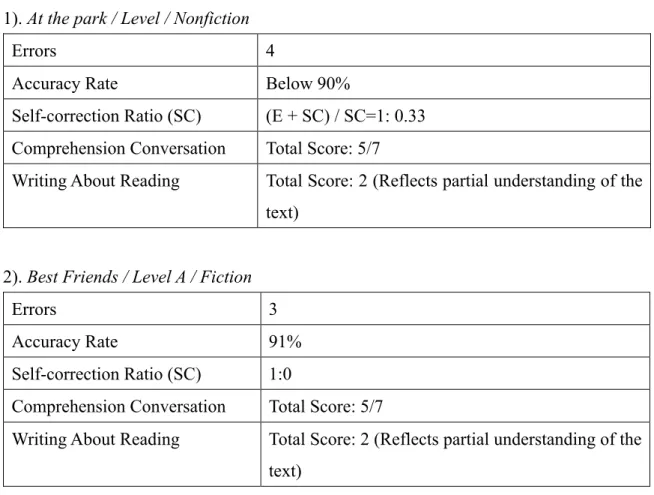
Based on the Benchmark Assessment System, the level 1 means the test takers (ELL) are in the Kindergarten Level, which can be interpreted as Emergent stage. During this assessment, Dan was required to read the sentences in the test book and answer several comprehension questions. The first part is nonfiction reading and second part is fiction reading. The table below (Table 4) shows the test results, which means that Dan had poor reading comprehension in English considering his age and his current English proficiency level showed by the results.
Table 4 Benchmark Assessment System 1). At the park / Level / Nonfiction
Errors 4
Accuracy Rate Below 90%
Self-correction Ratio (SC) (E + SC) / SC=1: 0.33 Comprehension Conversation Total Score: 5/7
Writing About Reading Total Score: 2 (Reflects partial understanding of the text)
2). Best Friends / Level A / Fiction
Errors 3
Accuracy Rate 91%
Self-correction Ratio (SC) 1:0
Comprehension Conversation Total Score: 5/7
Writing About Reading Total Score: 2 (Reflects partial understanding of the text)
Picture Writing Test. As I mentioned in previous parts, Dan is proficient in his L1 in terms of speaking and reading. But I didn’t see many opportunities for Dan to write in Spanish. In order to figure out his overall competence in Spanish, I created Picture Writing assessment for Dan. What’s more, this test required Dan to illustrate the selected pictures both in Spanish and English and thus I can see Dan’s writing ability both in English and Spanish. In addition, the gap between Dan’s L1 and L2 can be clearly visible. Generally, the main task of this test was to describe eight pictures (Table 5) both in English (L2) and Spanish (L1). When doing this test, Dan cannot even write an English word to describe those pictures, so I helped him come up some ideas from each picture. Most of time, I
described those pictures orally in English and then Dan wrote them in English. Compared to Dan’s English sentences, he not only exactly wrote the main idea of those pictures using appropriate vocabulary, but also showed great grammar knowledge in Spanish. However, Dan showed limited vocabulary and poor syntax knowledge in English according to the test result. Therefore, the gap between Dan’s L1 and L2 is pretty large.
Table 5
English: 2 boys and gril a play
Spanish: 2 ninos y una nina jugando (Two children and a girl are playing)
English: Boy is red a book Tha boy wear glass
Spanish: El nino esta leyndo eon sos lentes (The child is reading with his glasses)
English: The a 100 dollar
Spanish: Es 100 dolares (It's 100 dollars)
English: They are flawers
Spanish: La flor (The flower)
English: Boy is in fran off the class
Spanish: Él es tímido (He is shy)
English: a wommen is sma
Spanish: La senora esta alegre (The lady is cheerful)
English: Sigarro can not smog
Spanish: No se pvede fumar (You can not smoke)
English: Panda is sleps
Spanish: El panda está dormido (The panda is asleep)
Based on these assessment methods, I have reflected on these results and came up with several scaffolding suggestions and developed a systematic assessment toolkit for the future assessment for Dan and my future teaching career.
Based on the assessment results, there is a large gap between Dan’s L1 and L2. So the main recommended scaffolding is to transfer his L1 into L2 and make Dan’s L1 help his English learning. This recommendation is supported by recent theorizing about translanguaging. According to Canagarajah (2011), translanguaging is the process whereby multilingual speakers utilize their languages as an integrated communication system. In order to extend Dan’s language repertoire, I suggest that the classroom teachers should fully take advantage of Dan’s proficient Spanish so as to achieve the transmission of his L1 and L2. For example, the reading teacher can choose some required English novels (for 9th grade ELL students) which have good Spanish translations. During this semester, Dan has been reading and learning two Novels: A Long Walk to Water written by Linda Sue Park and A House on Mango Street written by Sandra Cisneros. However, the reading teacher only provided a great Spanish version for the novel “The House on Mango street”
and I found out that Dan was more willing to read and learn “The house on Mango Street”
than “A Long Walk to Water”. Overall, reading bilingual texts can promote and enhance Dan’s comprehension in L2 since he can utilize his understanding of the L1 text to comprehend the L2 text (Schweers, 1999).
Providing bilingual learning materials is not only helpful in reading class, but also effective in vocabulary, syntax and grammar learning for Dan. For instance, in the picture writing test, Dan showed great vocabulary, syntax, and grammar knowledge in Spanish.
When observing the reading teacher teach parts of speech to Dan, he had great difficulty in
telling the nouns, verbs, adjectives and so on. Apparently, however, Dan can use part of speech correctly in his L1. Furthermore, his competencies of tense, sentence structure and vocabulary are great. So I recommended that the classroom teachers provide Dan bilingual texts in teaching both content knowledge and language skills. Other translanguaging strategies include making Dan take notes about his reading in both English and Spanish and letting him discuss what he is learning in both languages with his partners. Encouraging them to use a bilingual dictionary to do contingent translation and providing Dan bilingual vocabulary lists are also helpful for better comprehension and understanding in L2.
Furthermore, Goodwin and Jimenez (2015) suggest that students who participate in translate activities improve their strategic reading, translation, and engagement, which enhances their reading comprehension. I also suggest that the classroom teachers organize some translate activities. For example, the reading teacher can group students into small groups and let them translate two or three juicy sentences from the English reading texts that are most likely to elicit rich interactions and metacognitive thinking. Another advantage of doing this activity is that all the students in Dan’s classroom can speak fluent Spanish. So they can translate the same sentences and thus can discuss the same topics together. During collaborative translation activity, Dan can both practice his Spanish and English. After translation, Dan and his partners can discuss, explain, and compare their translations with students from other small groups or pairs. The translate method explicitly focuses on helping Dan and his peers recognize the meaning-making potential of translation to comprehension.
Dan and his classmates need to take exams on each Friday and the content of the exams contains both subjects and languages. Also, he is required to take the summative
assessment at the end of each semester, which are often high stakes. In order to supplement the summative assessment, I designed a detailed assessment plan for Dan and his reading teacher.
1). Daily Assessment
The reading teacher can daily assess Dan’s reading ability and comprehension using Reading A-Z. This leveled reading project can also be reading scaffolding. In addition, the reading teacher can use RUBRICS (SOLOM & WIDA Performance & 6+1 traits) to daily assess Dan’s content and language ability in activities like storytelling, presentation, role playing, debating and so on.
2). Weekly Assessment
The reading teacher make students create portfolios which contain students’ daily completed assignment sheets. These assignment sheets in the portfolio can be great resource for assessment. The classroom teacher can meet Dan individually once a week to look through and review the portfolio in order to evaluate Dan’s understanding and progression in the content and language skills of each week.
3). Monthly Assessment
The reading teacher can continue to use the Benchmark Assessment to track Dan’s progression. This assessment results not only directly provide the classroom teacher with Dan’s strengths and weaknesses in English, but also are reliable resources for scaffolding.
Since this assessment take around 20 minutes, I recommend the reading teacher to give Dan this assessment twice a month.
4). Quarterly Assessment
The reading teacher can work with the science teacher to evaluate Dan’s Spanish
reading proficiency using Spanish Reading Inventory once each semester. The development of Dan’s L1 is also important to his L2 learning and future development.
5). Yearly Assessment
According to the results of the assessment mentioned above, the reading teacher can select an appropriate date for Dan to take the ACCESS 2.0 for placement in regular classroom.
In conclusion, through this assessment project, I realized the importance of using various assessment methods to assess the English proficiency of my students. As an English teacher, assessing students’ L1 proficiency is also significant in my future teaching.
Although this project is based on an English language learner in the United States, I believe it can greatly contribute to my future teaching and assessment in China.
Domain 4: Identity and Context Artifact 4: Foundations Fieldwork Experiences
In this domain, I use my field trip experience in the first semester to demonstrate my understanding of the importance of who learners are and how their communities, heritage and goals shape learning and expectations of learning. Also, this field trip makes me recognize the importance how context contributes to identity formation and therefore influence learning.
Professor Sharon took my classmates and me to visit several Asian and Mexican supermarkets. The main task of this field trip was to find cultural artifacts. I was fascinated by a slogan of the Indian supermarket we visited - Celebrating Our Food...Our culture.
When I ask one cashier about the meaning of this slogan, she told me they will celebrate their important festival Dawali, and some cultural and traditional products sold in the supermarket are related to the festival. Another artifact I took is some Hindi books which are freely provided for local Indian Immigrants. I saw a website on the top of the photo where there are lots of information provided for Indian immigrants in Nashville.
In order to know more about Indian immigrant community, I visited one temple named Sri Saibaba Temple in Nashville where all the Indian immigrants can visit and worship. In addition, Sri Saibaba Temple provides free language, religious and yoga courses for children from Indian community every Sunday. I interviewed three couples, one consultant and one volunteer who I met in Sri Saibaba Temple, and two of those couples have children and the third couple has no child. I was most impressed by the first couple and their children I interviewed. The couple have been in American for 10 years,
and their two boys were born here. The couple both gained bachelor’s degrees in India and their current career is related to Soft technology. The mother told me that although English is commonly used in Indian schools, she only spoke English in lectures and used Telugu with her family members and friends when she was in India, which means the input, interactions and output were not enough for her to be proficient in English. Now, she can communicate fluently with local people but still has some listening problems. In this situation, her elder son would translate to her in Telugu. She also told me the most effective way for her to learn English is to communicate with local people and the value of Indian culture educates her to be open to learn all the positive things and keep a clean mind. Her elder son named Uday now studies at one elementary school in Nashville, who is competent in English and has great enthusiasm for science. Her mother tells him Indian traditional stories every night and brings him to Sri Saibaba Temple to attend Sunday courses every week. He told me he likes Indian traditional culture and always find opportunities to tell their cultures to his teachers. However, his teachers don’t utilize his funds of knowledge in teaching. English is the only language which can be used in classroom settings and the classroom teacher seldom involve Indian culture into curriculum. However, Uday visits India once a year to attend summer camp activities. He indicates that the homework of Indian students is much more than his homework in America and thinks less homework results in his weakness in math and writing.
The second couple I interviewed have been in America for 15 years. They also indicated that they don’t have difficulty in communicating with local people except some slangs. They usually mix English and Telugu for communication at home, which is a good way to preserve their native language and culture. Then their only son ages five who can
speak English and Telugu. The third couple without children have been in America for 8 years and they are both physicians. English is their first language and they don’t have difficult in communicating with local people. The consultant told me what he wants to improve most is the accent and fluency. And the volunteer told me that about 200 children come to this temple to attend language, religious and yoga courses. All of them think Sri Saibaba Temple is a sacred place for their community to keep a harmonious relationship and preserve their culture and languages.
By reflecting on this field trip, I draw on some theories which can be helpful to value my students’ identity and cultures in my future teaching career. According to Ports et al.
(1999), Transnationalism refers to the movement of people, media, language, and goods between distinct nation states, particularly that which flows in both directions and is sustained over time” Apparently, the Indian community I interviewed bring their languages, cultures, and values to the United States and these things can be sustained over time. As an English teacher, to learn and understand my students’ cultures and identity is essential for my teaching. This field trip makes me realize it is important to engage myself in the community of my students. Only in this way can I how to make use of their cultures and identity when designing my lessons. Also, for English language learners, living in America now doesn't mean they cut off the contact with their hometown, since many immigrants participate in transnational activities. In my opinion, I can take advantage of these authentic translational literacies in my teaching. For example, in writing tasks, it might be a good idea to let my students write about a narrative story which illustrate their connections to
their hometown. My students might find this is an interesting topic to write about since it is closely related to themselves. I also anticipate that my students can bring various and vivid stories to share with peers, which not only promote the interactions between students and teacher and among students, but also make my students feel valued.
Another theory is funds of knowledge which is proposed by de Jong (2011). He indicates that integrating children’s funds of knowledge and understandings into teaching is an effective teaching method. Pedagogically, I designed an activity that aims to make use of students’ funds of knowledge after this field trip. This activity named Designing Our Dream House, and this design activity helps students learn new words of the different parts of house and its furniture easily and effectively. Guided by “funds of knowledge”, I will encourage my students to compare the different styles of houses and furniture in their hometown. In this way, students can not only learn more new English words of various house styles from all over the world, but also can think creatively and critically to design their dream house and compare different house styles. For example, Asian Indian American students would bring some traditional architecture styles into their dream house, which might quite different with other students. By working in a group, students will interact more to compare different house styles, and Asian Indian students may be proud that others show interest in their culture. Besides, a house is a safe, warm and united place for family members to rest and express love. This kind of concept might make the classroom a warmer and cooperative place in the heart of students.
As the interview indicates, the Indian culture tends to share their culture and spirits and is open to learn all the positive things. The conversations with Uday and his parents make me know their indent and cultures very well. Although this is only a field
trip, I will continue to use this way (visiting parents and talking with them and their children) in my future teaching. Take the conversation with Uday for example, I know he is willing to bring his cultures and values and share with their peers. After knowing this, I might think of some learning activities which is related to his cultures in my class so as to encourage his active engagement and participation. What’s more, Uday mentioned that his weakness in math and writing was due to few assignments and he expressed his willingness to improve his competence in math and writing after comparing the teaching methods between India and America. If I know more about his experiences and ideas, I might make a teaching and learning plan which targets for Uday’s needs. This is an example that I implement the learner-centered instruction (Brown, 2000) in my class, which focuses on or account for learner’s needs, styles, and goals.
Domain 5: Language Proficiency
I have been learning English for more than ten years. I was first introduced to English when I was in middle school. This new language posed me a big challenge because it was totally strange and I had difficulty in memorizing so much vocabulary. Under the pressure of entrance examinations, the most common practice for me and my peers to learn English were taking countless standardized exams and rote memorization. Although oral English is an important component in second language acquisition, speaking is not a required part in curriculum so I didn’t have many opportunities practice my oral English. As for the vocabulary and grammar instruction I received, they were largely drills instead of being communication oriented. When entering into high school, my English teacher included some authentic texts to complement the textbooks. For instance, each week I had to learn a short story in “New Concept English” (a popular English learning book in China) which is written by a native speaker. What’s more, my English teacher played an English song for each English class. Not only appreciating this song, I was required to fill out some missing words in the lyrics. Although I still needed to take a large amounts of tests, I found learning English is very interesting. With this motivation and my hard work, I gained 135 (the full score is 150). This score gave great confidence in continuing to learn Linguistic culture (English) as my major at college.
After I started my undergraduate life, I got a lot of opportunities to continue to learn English as well as the cultures, literature, and history, geography of English-speaking countries. When I was a sophomore, I participated in an Exchange program that I spent 30 days at Montclare University in learning Tourism Management Course and then spent another 5 months at Walt Disneyland (Orlando, Florida) as a cast member. This precious
experience provided me lots of opportunities to practice my English in an English-speaking country. As a cashier, I needed to use English to communicate with my coworkers, my bosses, and my guests. What’s more, I also took a course named Corporate Communication at Disney College. Through taking this course, my academic language proficiency has been improved. When coming back to China, I passed a standardized test called the TEM8 designed for English major college students. My spoken part was rated as A and the highest level for spoken test is A+. During my spare time, I took part in extra-curricular activities such as English debating test and English speech contest. As a member in Dalian Model United Nations, I attended several influential conferences and was awarded as Outstanding Delegate twice. The other impetus for me to learn English is that I had to take TOEFL and GRE tests which are required tests for studying in America. Thus, I dedicated much of my time in learning new words, practicing speaking, watching English movies and TV series.
As a graduate student at Vanderbilt University, my English learning styles and methods have been changed greatly. Being surround by native speakers and exposed to authentic learning materials, my English competence is improved largely by attending professional courses and participating social activities.
Domain 6: Learning Artifacts 5: Linguistic Data and Theoretical Analysis Paper
In this domain, the artifact I chose is a linguistic project for the course entitled with Linguistics/Second Language Acquisition in the classroom which I took 2016 fall semester. In my linguistic paper, I mainly introduced second language acquisition theories together with sample analysis of a Chinese girl I worked with. Fei (age 21) is a junior student in Dalian University of Foreign languages. She comes from a northern city and speaks fluent Chinese Mandarin as her first language. She majors in International law and English. Fei starts learning English at 3rd grade in primary school and has been learning English over 14 years. When she was in high school, she took an oral English training class in a private institution. Last summer vacation, she went to Beijing to attend an IELTS training class for 2 months. It is worth mentioning that Fei is a member of Model United Nations and has attended several English conferences.
When I ask Fei’s major, she pronounces the word “law /ô/” as /lao/. Although I pointed out the mistake to her, she still mispronounces it several times. Fei indicates that she has pronounced /lau/ for so many years that it is hard for her to get rid of it. However, Fei can pronounce the phoneme / ô / in other words such as “paw”, “four”, “ball” and so on. Also, Fei pronounces the word “lack /läc/ as “lake /lec/”. The two phonemes /ä/ and /e/
are so familiar that many Chinese students cannot tell the differences between them. But this does not mean Fei cannot pronounce /ä/ in other words. She can pronounce “math”,
“dad”, “bad” and the like correctly.
I only found these two pronounced phonemes in these recordings and cannot figure out the reason why Fei cannot pronounce them. Based on the analysis of Yang’s phonological competence, she has entered into the fossilization stage. By contrast, Fei’s initiative in learning English is strong and tries her best to seek opportunities to practice her oral English. In this case, English teachers should find ways to motivate students to learn English rather than letting them think learning a second language is a tiresome task.
For instance, teachers can play English movies and English songs regularly to students.
These learning material is not only entertaining to them, but also authentic English texts which help teachers create meaningful and context-based learning environment
By using the Text Content Analysis Tool, the total word of the oral transcription and writing sample is 352 and 348, and the total unique words are 197 and 193 respectively.
According to this tool, the lexical density of the oral transcription is 33.75% and the writing samples is 55.97%. By definition, the Lexical Density Test is a Readability Test designed to show how easy or difficult a text is to read. Obviously, the academic writing samples are more difficult to read than the oral transcription. In other words, Fei’s oral vocabulary is less than the writing vocabulary. We also can say that there is a gap between the amount of speaking words and writing words.
More specifically, there is a gap between Fei’s receptive oral vocabulary and productive oral vocabulary when I analyzed the oral transcriptions. For example, Fei used word meaning frequently to replace one certain word to convey her ideas. When she said that one of her flatmates doesn’t eat meat, I pointed out that she can use “vegetarian” to express her ideas. She also told me she never uses “vegetarian” in her oral English but
knows the meaning when the word appears in other’s discourse. In this case, I can argue that “vegetarian” is not Fei’s productive oral vocabulary but receptive oral vocabulary.
Similar conditions can be seen in words like “Junior, Senior, final exam, encyclopedia”.
As far as I am concerned, the gap between Fei’s oral and writing vocabulary is due to the time difference spent on these two parts. Although she reads some articles from the newspaper 3 times a week, there are no interactions and the articles she reads are not her true output. Lacking sufficient practice and professional instruction could be primary factors that result in her some high frequency and misuse of words and phrases in her oral transcriptions. In order to get rid of these, Fei should seek opportunities to interact more in English, and use a voice recorder to record her conversations with others and listen to these recordings carefully to find out some areas for improvement. Besides, Fei should use more synonyms to replace her high frequency of words and phrases consciously. When accustomed to using various expressions, Fei’s oral English skill would be improved tremendously. The last suggestion is that Fei should write down her misused expressions when listens to her recordings and other people point out her misused words and phrases.
On the whole, Fei made a number of mistakes on the use of articles both in her spoken and written language (See Artifacts 5) lists some mistakes on inflection and article in her spoken and written language). However, the problem of singular and plural forms of nouns and verbs in her oral transcriptions is more remarkable than in the writing samples.
Admittedly, a lack of practice on speaking English results in Fei’s frequent incorrect use of the inflection. What’s more, another explanation is that Chinese characters don’t change in the part of speech when represent the meaning of past tense and plural form. Since Fei has
more time to concentrate on the usage of inflection and revise the incorrect forms, she cannot do anything with her incorrect inflection when she recognized she have made some mistakes. Correcting her wrongly spoken expressions in conversation only contributes to disfluency and repetition.
Based on the analysis of Fei’s pragmatic competence, I have some recommendations for Fei to improve her pragmatic competence. Goodwin and Jimenez (2015) suggest that students who participate in translate activities improve their strategic reading, translation, and engagement, which enhances their reading comprehension. Therefore, Fei could literally translate speech acts from their first language into English. Translation could make Fei consciously aware of differences between the native and target language speech acts.
Another strategy is that Fei should improve her listening skills by listening native radio station programs. On the one hand, Fei can improve her English listening skills and thus grasp the meaning of other’s utterance quickly and understand the intention of others easier.
On the other hand, Fei could also mimic how speakers in radio programs converse on an expert level. In this case, Fei should carefully consider how Grice’s maxim theory (1975) are applied in the conversation of native speakers.
In addition, given that Fei’s lack of interactions and output in English, I recommend that Fei’s English teachers adopt a learner-centered instruction (Brown, 2000), which focuses on or account for learner’s needs, styles, and goals. In my classroom, the focus of activity should shift from the teacher to the learners. These methods include active learning, in which students solve problems, answer questions, formulate questions of their own, discuss, explain, debate, or brainstorm during class; cooperative learning, in which students work in teams on problems and projects under conditions that assure both positive
interdependence and individual accountability; and inductive teaching and learning, in which students are first presented with challenges (questions or problems) and learn the course material in the context of addressing the challenges.
What’s more, I believe communicative language teaching approach (CLT) has some great scaffolding implications for Fei’ English teacher in encouraging students’ active engagement with authentic contexts, which advocates real communication and meaningful tasks in second language acquisition (Brown & Frazier, 2001). Guided by this approach, the tasks for Fei should be meaningful and able to elicit real interactions. Fei’s teacher can also provide her with authentic texts and authentic materials so that she can make meaning what she is learning. Apart from providing her with meaningful learning mate