4016 Sensitivity of the correlation tail to the potential model 4017 Scaling approach for 56Fe (dual form) 0. The momentum distribution enters directly into the theoretical derivation of the cross section and can thus be easily extracted.
Chapter 2
Quasielastic Electron Scattering
Elementary Electron Scattering Theory
We only consider the Born approximation (or one-photon exchange) to plane waves for the incident electron and the final state. West's derivation of the y-scale involved what is known as a comprehensive cross section, meaning that the final state of the target is undefined.
Derivation of the Inclusive Cross Section
The Impulse Approximation
Scaling in Nuclear Targets
The latter is generally written as 2.27), where MA-l is the mass of the remaining nucleus - preferably in the excited state. Now we see an explicit dependence on q of the structure factor, which can give us deviations from scaling at the final Q 2 .
Overview of World's Results
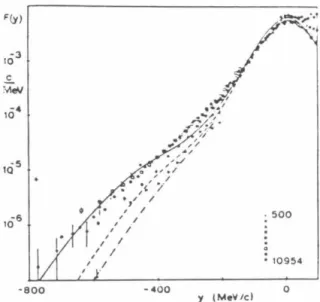
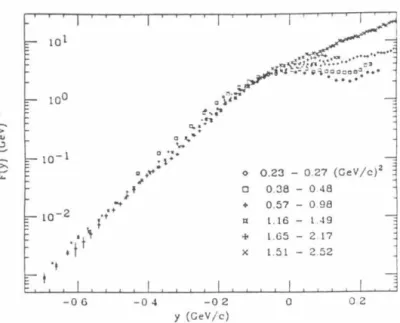
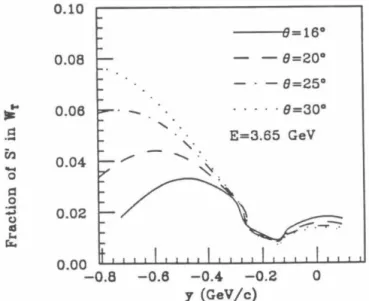
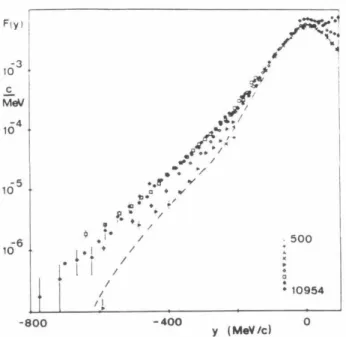
If the data set is reanalyzed using the correct factor, the scaling function is different from Sick's, and in dense analysis the approach to scaling is top-down (Fig. 2.12)[33]. The solid curve is the result of the "correct" analysis for all the kinematics considered and is also the asymptotic limit of Sick's analysis.
Scattering with Other Probes
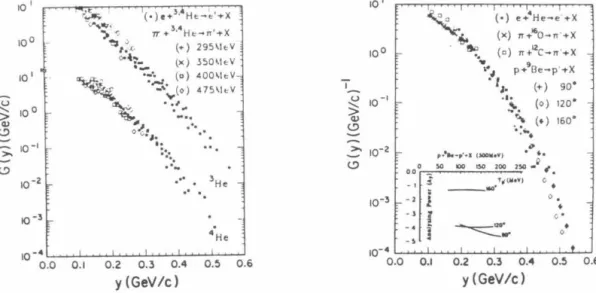
Gurvitz analyzed pion nucleus and proton nucleus scattering data from TRI-UMF at lower Q2 [36] and found scaling behavior there as well (Figure 2.19).
Chapter 3
Many-Body Theory for Nuclear Matter
It is a non-relativistic technique that reduces the sum over all orders of perturbation theory to a simple integral equation. It also represents a sum to all orders of perturbation theory, but also takes into account Pauli trapping of states and the interaction of the mean field of a particle with the bulk of the system. It is calculated via the Bethe-Goldstone equation, and the mean field interaction is calculated independently using Brueckner-Hartree-Fok (BHF).
The G matrix changes the perturbation expansion from one in the number of interactions to one in the number of particles that can interact. The derivation of both T- and G-matrix algebra and also their application to real problems will be discussed in this chapter. The representation used for perturbation theory (Goldstone diagrams) will be introduced along with the relevant rules.
- The T- and G-Matrices
- Brueckner-Hartree-Fock for Nuclear Matter
- RSC 1.42 fm- 1 1.42 fm- 1
- Chapter 4
The sign of the diagram is ( -1)h+e+o, where is its number of hole lines, e is the number of energy denominators, and o is the number of one-body potential operators in the diagram. The "standard" definition of the one-particle potential comes from the Hartree-Fock expressions in the G-matrix expansion. The qualitative behavior of the potential is such that for moments above 2kF it is negligible with respect to the kinetic energy term (Figure 3.7).
Another useful quantity for measuring the strength of the two-particle-two-hole interaction is the wound integral. The ripple is a measure of the change in the wave function due to interactions. This is simply the sum of the energies of the two hole states in the expression.
In Table 3.1, the division of the wound into partial wave channels is given for both RSC and Paris potentials. The exact values of the saturation properties are in fact quite sensitive to the number of partial waves considered and the methods for taking into account contributions for higher partial waves.

Structure Function of Nuclear Matter
Momentum Distributions of Finite Nuclei
Much work has been done on this topic, using both mean-field approximations and two-body cluster-type extensions. The mean field approximation suffers from the lack of short-range correlations in the wave function. It is clear that the mean field wave functions in the tail are missing an order of magnitude.
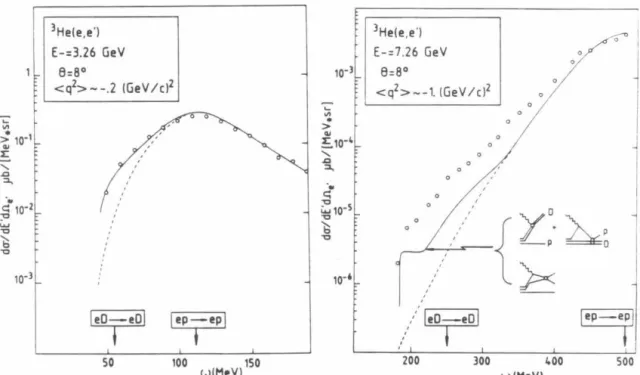
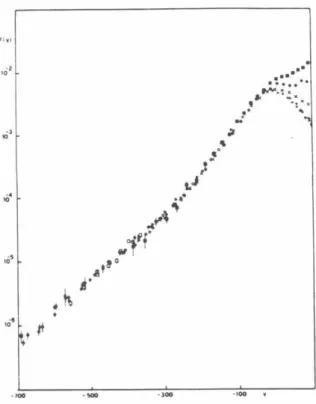
This encourages us to believe that we can accurately calculate the momentum distribution for the deuteron. Here the Faddeev equations are an exact solution of the non-relativistic three-body system. As we can see, the theoretical F(y)'s don't match the data at all, even in Q2.
Curve Cis the mean field result; A and B are the full momentum distributions using RSC and the dTRS potential respectively. UNC is the result of the single particle basis used, SSCB is the dTRS potential, RSC is the Reid Soft Core potential and HJ is the Hamada Johnston potential (from Ref. [54]).

Momentum Distribution of Nuclear Matter
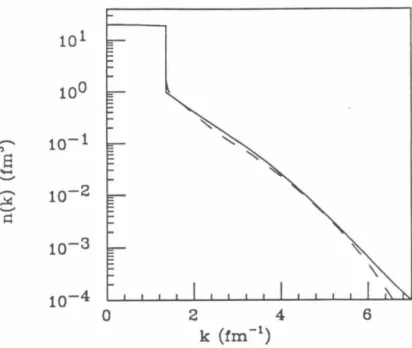
It is a strong test of the numerical techniques to satisfy this condition (the factor (2rr)3 is present to make the normalization as given in equation 4.3). On the log scale, the effect of correlations for k < kF is not noticeable, and on the linear scale (Fig. 4.6) they are only marginal (about 10%). This agrees with what we know about the wound integral, which is essentially the mean deviation of the correlated and free distributions to kF (within a constant).
We should try to determine which physical properties the tail of the distribution is most sensitive to. An immediate point is that we do not do our calculation at the saturation density, and we may wonder what effect this might have on the strength of the tail. Another factor that affects the strength of the momentum distribution in the region of interest is the tensor interaction between nucleons.
We do this by removing all G-matrix contributions of the form G LL+2 and G L+2L · In each case, removing tensor effects can reduce the force by an order of magnitude in the range 1.5 fm-1 < k exhaust. < 4 fm-1. The dashed line is the free Fermi gas, and the solid line is for the RSC potential.
Discussion of Results
This is necessary due to the non-relativistic nature of our computation, and the implications of this will be discussed later in this section. In the 1A, :F rapidly approaches F(y), but we are interested in studying any deviation that might occur from the 1A due to the effects of final state interactions. Since we are actually interested in the Q2 dependence of the scaling approximation, these kinematic sets will be examined in terms of the .
However, this does not correspond to the zero energy transfer point of the true scattering process and we will discuss that problem later. We can try to remove the detailed dependence on the exact nature of the potential by normalizing the results and the data so that the asymptotic result of each is unity. The agreement is much better now, but now we need to address the problem of the cut-offs.
We propose to make an arbitrary replacement of the two-body form with the one-body form. The kinematics of the run comes from an initial beam energy of 4 GeV, and a scattering angle of 30°.
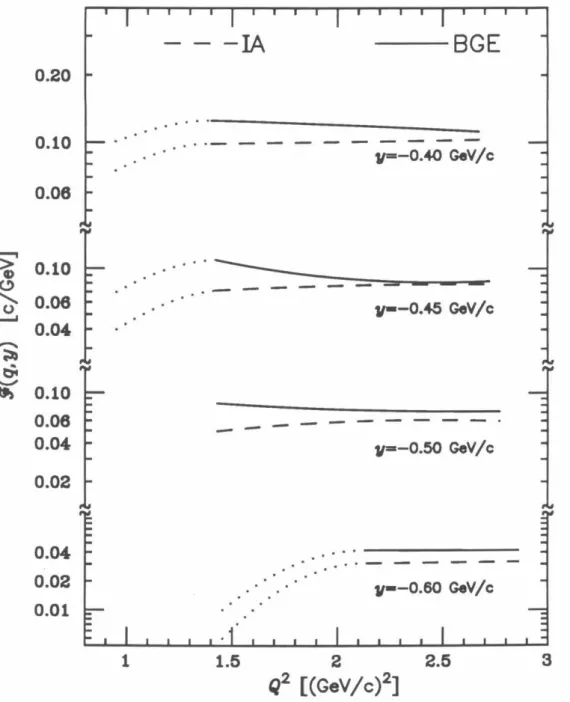
IA BGE
Q 2 [(GeV/c) 2 ]
IA --BGE
Note that the theoretical results can vary by an order of magnitude depending on the probabilistic model used.
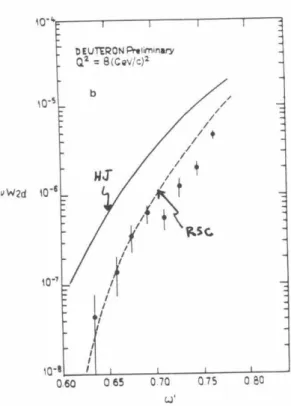
4 BGE
Other Results and Future Directions
Most other work to date on scaling analysis problems has emphasized problems with the kinematic factor and also with the definition of y. Gurvitz and Rinat studied scaling function extraction using four different models for the scattering reaction (all nonrelativistic) on a single particle in a potential well (64). They found significant effects, but were very uncertain about the practicality of extending their results to the relativistic realm.
Vari and co-workers have studied the effects of six- and nine-quark bags on the scattering cross section if they are real and significant degrees of freedom in the nucleus. Pirner and Vary found that they could reproduce wW2 (as described in Chapter 2) for 3He using this type of model(65], and this would have the immediate effect of deriving a scaling function. The hope exists to obtain data sufficient to be able to extract the longitudinal and transverse structure functions of the cross section separately This is done by fixing Q2 and varying the scattering angle.
25], who found that WL appears to lack robustness at the center of the quasi-elastic peak compared to naive estimates of the Fermi gas (which gave a reasonable fit to Wr. If theorists could independently fit the cross-section and the longitudinal section, then we can strengthen our understanding reaction mechanism and also the behavior of nucleon form factors in the medium.
Chapter 5
Summary and Conclusions
Appendix I
Evaluation of G-Matrix Elements
The delta function removes the center-of-mass integration, and then we can integrate over the angular component of the relative momentum ka to get. To solve the integral equation, we use the method from Haftel and Tabakin [60), which is a direct solution of the equation using matrix methods. There is another term needed for the quadratic spin-orbit term of the Paris potential.
It is now fairly straightforward to write U(k) in terms of partial wave amplitudes as where p is the density of nucleons in nuclear matter and P = lk+k1l/2. Following the example of Jeukenne et al. the actual analytical form for this region is not very critical. The points used for placement actually overlap the two regions to ensure a smooth continuation of the potential.
A final topic to be discussed is the behavior of the adjoints of the G matrices. This is an important point when considering RPA-type charts and also some of the important charts in the.
Appendix II
Detailed Algebraic Expansions of Diagrams
- Diagram (a)
- Diagram (b)
- Diagrams (c) and (d)
- Diagram (e)
- Diagrams (f) and (g)
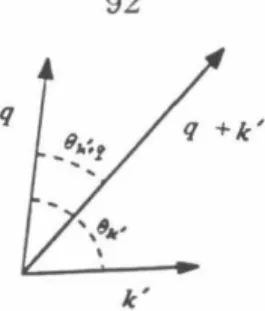
It's interesting because it now has q as part of the argument for a G-matrix element. Here we will see how angular momentum mixing works in all the other diagrams. The main effect of this in the analytical structure is to change the angular momentum couplings between the two interactions in the diagram.
We can see that there is closure in k0, so we have 8Ll'8Jj· However, the closure does not work over k', so all combinations of l and L' must be considered. Integrals can now be performed using Gauss-Legendre quadrature, which was discussed in the main text. At this point, it suffices only to list the general expression and angular momentum expansion for each of the remaining diagrams.
We can rewrite the expression for 59 under exchange of the two particles in the initial state to yield. Of course we are not in the Q2-+ oo limit, but q is much larger than kF, and it may well be a good approximation.
![Figure 2.9 F(y) extracted from quasielastic scattering on 2 H (from Ref. [18])](https://thumb-ap.123doks.com/thumbv2/123dok/10401021.0/32.799.214.571.96.350/figure-f-extracted-quasielastic-scattering-h-ref-18.webp)