Full Terms & Conditions of access and use can be found at
http://www.tandfonline.com/action/journalInformation?journalCode=tsed20
Download by: [University of Massachusetts] Date: 03 September 2017, At: 07:31
International Journal of Science Education
ISSN: 0950-0693 (Print) 1464-5289 (Online) Journal homepage: http://www.tandfonline.com/loi/tsed20
Characterising the development of the
understanding of human body systems in high- school biology students – a longitudinal study
Zohar Snapir, Catherine Eberbach, Orit Ben-Zvi-Assaraf, Cindy Hmelo-Silver
& Jaklin Tripto
To cite this article: Zohar Snapir, Catherine Eberbach, Orit Ben-Zvi-Assaraf, Cindy Hmelo-Silver &
Jaklin Tripto (2017): Characterising the development of the understanding of human body systems in high-school biology students – a longitudinal study, International Journal of Science Education, DOI: 10.1080/09500693.2017.1364445
To link to this article: http://dx.doi.org/10.1080/09500693.2017.1364445
Published online: 31 Aug 2017.
Submit your article to this journal
Article views: 7
View related articles
View Crossmark data
Characterising the development of the understanding of human body systems in high-school biology students – a longitudinal study
Zohar Snapira, Catherine Eberbachb, Orit Ben-Zvi-Assarafa, Cindy Hmelo-Silvercand Jaklin Triptoa
aDepartment of Science and Technology Education, Ben-Gurion University of the Negev, Beersheba, Israel;
bNational Science Foundation, Division of Research on Learning in Formal and Informal Settings, Arlington, VA, USA;cSchool of Education, Center for Research on Learning and Technology, Indiana University, Blooming, Indiana, USA
ABSTRACT
Science education today has become increasingly focused on research into complex natural, social and technological systems. In this study, we examined the development of high-school biology students’ systems understanding of the human body, in a three- year longitudinal study. The development of the students’system understanding was evaluated using the Components Mechanisms Phenomena (CMP) framework for conceptual representation. We coded and analysed the repertory grid personal constructs of 67 high-school biology students at 4 points throughout the study.
Our data analysis builds on the assumption that systems understanding entails a perception of all the system categories, including structures within the system (its Components), specific processes and interactions at the macro and micro levels (Mechanisms), and the Phenomena that present the macro scale of processes and patterns within a system. Our findings suggest that as the learning process progressed, the systems understanding of our students became more advanced, moving forward within each of the major CMP categories. Moreover, there was an increase in the mechanism complexity presented by the students, manifested by more students describing mechanisms at the molecular level. Thus, the‘mechanism’category and the micro level are critical components that enable students to understand system-level phenomena such as homeostasis.
ARTICLE HISTORY Received 17 June 2016 Accepted 2 August 2017
KEYWORDS
Biology education; cognition;
qualitative research
Introduction
Science education research is becoming increasingly focused on the study of complex systems, based on the notion that understanding complex systems is a necessary part of being a scientifically literate citizen (NGSS, 2013). The perception of complex systems and their function has become central to various disciplines, including the different scien- tific disciplines, sociology and economics (Yoon,2008).
© 2017 Informa UK Limited, trading as Taylor & Francis Group CONTACT Orit Ben-Zvi-Assaraf [email protected]
Downloaded by [University of Massachusetts] at 07:31 03 September 2017
This centrality is due in part to the fact that complex systems are a fundamental aspect of many different scientific domains. This is especially true of the biological sciences. For example, the processes that take place within an organism (physiology), the interaction between organism and environment (environmental biology), and interactions among different organisms within and across species (ecology) are all best described in terms of complex systems (Hmelo-Silver, Marathe, & Liu,2007).
Another factor that contributes to their prominence is the fact that complex systems are prevalent at all scales–from the micro scale of a single cell (such as a fertilised human egg) to macro complex systems such as cities or ecosystems (Yoon et al.,2016). In the field of biology, complex systems are ubiquitous at all levels. For example, complex molecular net- works are found within individual cells, connecting signals from the extra-cellular environment to intracellular responses (Chasman, Siahpirani, & Roy, 2016). Complex systems are also found in the physiology of individual organisms, maintaining homeosta- sis in a variety of different dimensions, like blood sugar and body weight (Rosenbaum &
Leibel,2016). In biological societies, such as social insect colonies (ants for example), inter- actions between organisms, which are complex systems of their own, form additional complex systems (Greenwald, Segre, & Feinerman, 2015). Natural systems are typically dynamic and changing over time; they are often held in states of equilibrium with other interdependent systems, and the interactions within and between them can be unpredict- able. Disturbing this web of interconnections can have major implications as effects cascade across associated networks (Stewart,2012).
As the study of complex systems has grown over the past two decades, and much of scientific inquiry has become involved in working to understand complex systems (Bar- Yam, 1997), the science education curriculum has become increasingly focused on the study of complex systems as well. This is unsurprising considering the nature of the world in which our students live– one increasingly governed by complex systems that are dynamic, self-organising and continually adapting (Jacobson & Wilensky, 2006;
Lesh, 2006). The Next Generation Science Standards (NGSS, 2013) highlight the value of engaging in systems thinking, relating structure and function, and engaging in scientific practices such as modelling to address themes that cross-cut the sciences. As a result of this focus on students’ comprehension of systems, science education has seen a substantial growth in research into complex systems understanding, as well as into students’abilities to deal with complex natural, social and technological systems (Hmelo-Silver & Azevedo, 2006; Jacobson,2001).
This focus on complex systems studies has brought with it challenges for both learners and educators (Ben-Zvi Assaraf & Orion,2005; Hmelo-Silver & Pfeffer,2004; Plate,2010).
Several studies have shown that understanding the structural and behavioural aspects of complex systems is challenging for science students (Jacobson & Wilensky,2006), since understanding complex systems does not only require looking at their parts in the context of the whole system, but also at their interactions with other complex systems that surround them (Bar-Yam,1997). Developing a broad and logical perception of the structures in systems and of the multi-variable web of relationships between them is dif- ficult, because these relationships are not intuitively obvious (Duncan & Reiser, 2007;
Jacobson,2001). Relationships across different levels of complex systems are also often implicit, with subsidiary causality (Hmelo-Silver & Azevedo,2006; Jacobson,2001).
Downloaded by [University of Massachusetts] at 07:31 03 September 2017
It is possible that some of these challenges could be addressed by teaching systems from a broader point of view, one which includes references to the variety of scientific and social aspects that a complex system can incorporate. This novel approach to science education, spearheaded by the Next Generation Science Standards (NGSS,2013), posits that science education should develop a scientific literacy that allows students to look broadly at–and think intelligently about–topics in science and technology, as well as their social impli- cations (i.e. science, technology, society–STS). According to this approach, science edu- cation should include references to socio-scientific issues (SSI), which ‘represent real problems, faced by scientists and other citizens, whose solutions remain undetermined and are not problems merely in the context of classroom explorations’ (Zeidler &
Sadler, 2007, p. 201). Fensham (2012) notes that SSIs can vary widely in complexity, based on the degree of interdisciplinarity and uncertainty they involve, and that different levels of complexity require different approaches on the part of teachers wishing to teach them. While Fensham acknowledges that SSIs rating high on the complexity scale can be daunting topics, to which‘few science teachers are equipped to do justice,’he adds that‘the urgency and responsibility of including key SSI that relate to social and environmental health in school science is so great that they cannot be avoided on these grounds’(p. 15).
One of the core topics taught in the Israeli high-school biology curriculum is the human body. The human body is highly relevant to students, and engaging them in its complexity can therefore promote not only the contextual understanding of the human body, but also a more generalised scientific conception of how complex systems operate. Conceiving the human body as complex system, composed of multiple components at various organis- ation levels that interact with each other, may also promote broader understanding of bio- logical processes in general (Raved & Yarden,2014).
The human body is a highly complex system, since each of its subsystems is a complex system on its own. Understanding the systemic nature of the human body is therefore challenging for students (Ben-Zvi Assaraf, Dodick, & Tripto, 2013; Hmelo-Silver &
Azevedo,2006). This paper presents a three-year longitudinal study in which we charac- terised the long-term development of human body systems understanding amongst high- school biology students. We used the Repertory Grid tool (Kelly, 1955) to gather data about the students’ systems understanding, and mapped the gradual development of that understanding using the Components Mechanisms Phenomena (CMP) model pro- posed by 2nd and 4th authors (Hmelo-Silver, Jordan, Eberbach, & Sinha, 2016). In doing so, we sought to answer the question: Does the students’ perception of the human body system change as they move through their three years of biology studies?
If so, how?
Theoretical background What are complex systems?
A complex system functions through the mutual interaction of its various components, which work together to bring about a singular function. The interactions within the system are influenced by feedback loops and they are usually nonlinear (Ladyman, Lambert, & Wiesner, 2013; Richardson, Cilliers, & Lissack, 2001). Understanding complex systems is fundamental to understanding science. But, because they are
Downloaded by [University of Massachusetts] at 07:31 03 September 2017
composed of multiple interconnected levels that interact with one another in dynamic ways, complex systems are very difficult to understand (Hmelo-Silver et al.,2007).
A complex system can be generally described as an entity consisting of a large number of structures, at different levels of organisation (micro and macro), in which various pro- cesses occur. With regard to biological systems, 4th author (Hmelo-Silver et al., 2007) defined structures as either microscopic (like cells) or macroscopic (like organs), adding that ‘the micro level refers to the level of individual elements of a system, whereas macro refers to the aggregate level’ (pp. 308–309). Thus, in the context of the human body, the micro level includes cells and molecules, and the macro level includes tissues, organs and systems. Marbach-Ad and Stavy (2000), who investigated students’ expla- nations of genetic phenomena, also divided these explanations into references to the micro level and the macro level. They found that the micro level included both references to the microscopic/cellular level (i.e. to genes and chromosomes) and to the submicro- scopic/molecular level (e.g. DNA, genetic material). In the context of genetics, the macro level included references to genetic‘traits’(e.g. eye colour).
Another key aspect of a complex system is its dynamism and self-organisation. Hmelo- Silver, Holton, and Kolodner (2000) defined the dynamic system as a coherent whole com- posed of multiple components working cooperatively both on a single level and between levels. Because of the dynamic nature of the connection between the system’s different levels of hierarchy, complex systems are difficult to understand, even for experts (Hmelo-Silver & Azevedo,2006). A nonlinear complex dynamic system is made up of numerous individual agents (or elements) whose independent interactions result in emer- gent and complex behaviour not exhibited at the level of the individual elements (Chi, 2005). Natural science literature refers to this kind of phenomenon as self-organisation, in which macroscopic order emerges spontaneously without plan, algorithm or control structure. The manner in which complex systems communicate, respond to perturbations, and self-organise is understood by studying the dynamic processes through which they evolve over time, but studies have shown that students still lack a basic understanding of central complex systems ideas like self-organisation and evolution by natural selection (Yoon,2008). As Kitano (2002) has noted, to understand (biological) systems we must
shift our notion of‘what to look for’in biology from a mere examination of the system’s com- ponents, to an understanding of its structure and dynamics. This is due to the fact that a system is not just an assembly of genes and proteins; its properties cannot be fully understood merely by drawing diagrams of their interconnections. (p. 1662)
Even though the research on complex systems is diverse, it shares some basic common assumptions about complex systems. Goldstone and Wilensky (2008) summarised these as follows: (a) many natural systems operate at multiple distinct levels of organisation; (b) such systems involve nonlinear interactions among the system’s elements including posi- tive and negative feedback loops; (c) even when the only interactions that exist in a system are among its individual elements, important macroscopic descriptions can still be applied to the system as a whole and are critical for understanding its patterns; (d) system-level patterns can emerge without any force explicitly striving for the pattern, through the self-organised activity of many interacting elements and (e) the same system pattern can often be found in diverse domains, and it is useful to describe systems in sufficiently general terms such that these commonalities can be revealed (p. 467).
Downloaded by [University of Massachusetts] at 07:31 03 September 2017
The human body as a complex system
The literature on systems understanding provides various definitions of the term‘system.’
Broad definitions emphasise the significance of the interactions between the system com- ponents, such as– ‘A system is an entity that maintains its existence and functions as a whole through the interaction of its parts.’This group of interacting, interrelated or inter- dependent parts that form a complex and unified whole also has a specific purpose, which is the outcome of the interactions between the system’s components (Bar-Yam,1997; Ben- Zvi Assaraf & Orion,2005).
The human body is a complex biological system composed of multiple subsystems working in coordination. Its function can be viewed as a set of structures that interact with each other to create a chain of events, operating the entire system. The interactions between components at various organisation levels permit the whole human body system to act as more than the sum of its parts, and to maintain stability (Ben-Zvi Assaraf et al., 2013).
The subsystems of the human body are also complex. The human cardiovascular system, for example, is composed of many different kinds of cells (representing a micro level of the system), which form the tissues of the organs (at the macro level) that work together as a system. The blood is composed of several different kinds of cells suspended in plasma. All of these are components of the system, representing the various levels of its hierarchy. The system’s functions include cells and plasma transporting oxygen, carbon dioxide and nutrients, fighting infections, and clotting, all representing matter transport both within the system and to other body systems (i.e. the system’s dynamism). The blood is circulated in the body through different blood vessels–arteries, veins and capil- laries (each of which has a different structure that serves its function), and the heart pumps the blood by creating pressure differentials that drive movement through the vessels (Marieb & Hoehn,2012).
Adding to the intrinsic complexity of the cardiovascular system is the fact that it is in constant interaction with other systems in the body. These interactions with other body systems are what allows the body to maintain homeostasis. What happens in the body during physical exercise, for example, highlights the interaction between the circulatory and the respiratory systems, which is integrated by the nervous system. At the onset of physical exercise, elevated carbon dioxide and H+ levels serve as signals at the micro level. These signals are processed in the nervous system, which in turn influences the pacemaker in the heart at the macro level, so that the heart beats faster. Blood flow to the working muscles is also increased (Randall, Burggren, French, & Eckert, 2002). At the same time, the respiratory system is also influenced by the same signals processed in the nervous system, so that the respiration rate increases. Breathing occurs constantly throughout life, enabling the exchange of oxygen and carbon dioxide in the lungs’ alveoli, regulating their levels in the body. The respiratory movements are driven by neural circuits in the central nervous system (i.e. the brainstem and the spinal cord). Breathing is under precise control, so gas exchange is matched to the metabolic demand in the body tissues.
This is true during resting breathing, and also during times of increased metabolism and demand for oxygen such as physical exercise (Bell, 2006; Smith, Abdala, Borg- mann, Rybak, & Paton, 2013).
Downloaded by [University of Massachusetts] at 07:31 03 September 2017
As this example shows, exercise promotes a complex chain of integrated changes that enables the delivery of sufficient oxygen and nutrients to the working muscle. As a result of this integrated activity, during physical exercise more oxygen is delivered to the mitochon- dria in the cells, and cellular respiration provides enough ATP, through the process of cel- lular respiration, to carry on the tissue demand. This example serves as a glimpse of the incredible complexity and interconnectivity that enables the human body to maintain homeostasis, which is crucial for its ability to remain alive and functional.
The importance of understanding the complexity of the human body
Understanding complex systems can promote knowledge transfer and enable cross-ferti- lisation between disciplines (Goldstone & Wilensky, 2008). There are two large-scale approaches commonly used in promoting and analysing systems understanding. The first, which was explicated by – among others – Yoon (2008), Wilensky and Reisman (2006) and Jacobson and Wilensky (2006), is a domain general approach in which stu- dents must first understand the attributes that are common to different systems and then apply them to a specific context. The second approach is domain specific, in which students analyse the behaviour of a particular system in the context of solving a problem. In this approach, system understanding skills act as a cognitive tool that permits a student to analyse different characteristics of a system (Ben-Zvi Assaraf &
Orion,2005; Duncan & Reiser,2007).
The Structure, Behaviour, and Function (SBF) Model of systems understanding posited by Liu and Hmelo-Silver (2009) and Goel, Rugaber, and Vattam (2009) expresses this domain specific approach. The constituents of the SBF model are: Structures–the physical structures in the system (like the lungs in the respiratory system, the alveoli in the lungs), Behaviour–the mechanism that allows the structures to carry out their function (like the chest moving to allow for gas exchange, the electrical pulses moving through the nerve cells), Function – the output of the system (e.g. the respiratory system transports oxygen to the organs) (Hmelo-Silver et al.,2000).
Though the SBF is widely used to analyse systems understanding (Goel et al.,1996;
Hmelo-Silver et al.,2007; Hmelo-Silver & Pfeffer,2004), it is not without its challenges.
The distinction between behaviour and function can be confusing, as it depends on context. For example, in an aquarium system, fish respiration is a behaviour that releases waste products, but when analysing the fish as a system, respiration can be viewed as a function and gas exchange and various cellular reactions as behaviours (Hmelo-Silver &
Pfeffer,2004). Thus, 2nd and 4th authors (Hmelo-Silver et al.,2016), modified the Struc- ture Behavior Function (SBF) model, creating an alternative conceptual framework called CMP. This framework provides a representation of all the system’s attributes, including the structures (Components) within the system, the specific processes and interactions (Mechanisms) that occur between them, and the macro scale of processes and patterns within a system–the Phenomena.
With regard to the human body, using the CMP conceptual framework can also be a useful scaffolding tool. For example, it can help students understand key concepts like negative feedback– an increase in a system variable that prompts action in the system which leads to a decrease in that same variable. Negative feedback is fundamental to main- taining homeostasis in systems like the human body. The body’s blood sugar level, for
Downloaded by [University of Massachusetts] at 07:31 03 September 2017
example, is maintained at a homeostatic level of about 70–110 mg glucose/dL. This occurs through negative feedback: following the digestion of carbohydrates, glucose is absorbed from the small intestine (i.e. the digestive system) into the blood. The elevated blood glucose level serves as a signal, promoting the secretion of insulin from the pancreatic beta cells. Insulin promotes the absorption of glucose from the blood into the body cells, thus decreasing the blood glucose level. To understand the phenomenon of negative feedback, one must recognise the components (e.g. small intestine, carbohydrates, glucose and insulin), and the mechanisms (digestion, secretion and absorption) involved. Thus, the systemic nature of the human body, and that of other biological systems, maps well to CMP.
The principle of negative feedback also applies to the activity of other hormones in the body, to maintaining regular body temperature, and even to artificial systems, like a ther- mostat triggering air-conditioner activity when the room temperature rises. Thus, learning about negative feedback in one system can promote an understanding of other complex systems. This is also true for other common principles in complex systems, so that learn- ing about such complex systems exposes students to new frameworks of explanations, and to methodologies that are important in various environments (Jacobson & Wilensky, 2006).
To understand complex systems, including the human body, one must be able to recog- nise not only the structures in the system, but also the mechanisms of the interactions between them, and the outcomes of these interactions (Bechtel & Abrahamsen, 2005;
Goldstone & Wilensky,2008). What makes the interactions between the system’s com- ponents hard to understand is that they constantly change, as they are influenced by changes within the system and in its surrounding environment (Hmelo-Silver et al., 2007). Experts’ understanding of complex systems is characterised by being able to reason effectively about the functional roles and behavioural mechanisms that the struc- tural elements in the system play (Hmelo-Silver et al.,2007). An understanding of the system’s behaviours and functions should therefore correlate to an elaborate network of ideas representing key phenomena and their interrelationship, representing a deep under- standing of a complex system. Experts have also been shown to be capable of explaining the perceptually salient aspects of the system (e.g. external respiration) in terms of phenomena that are less perceptually salient (e.g. central nervous system control, cellular level phenomena) (Liu & Hmelo-Silver,2009). Thus, understanding the mechanisms–the interactions between the system’s components–is a characteristic of an expert’s mental model of a system, and has been found to be lacking in novices (Hmelo-Silver &
Pfeffer,2004).
To overcome the difficulties of understanding the systemic nature of the human body, a new biology curriculum called ‘Human Biology: Emphasising the Role of Homeostasis’
was introduced into the Israeli high-school education system in 2003. It was thought that unifying human biology around homeostasis would provide students with a more complete picture of the human body, allowing them to integrate its multiple components.
Exploring homeostasis should also enable a deeper understanding of the complexity of the human body, as homeostasis explains both the interactions between the body and its environment, and the processes that occur on different organisational levels within the system (Tripto, Ben-Zvi Assaraf, & Amit,2013).
Downloaded by [University of Massachusetts] at 07:31 03 September 2017
The students studied the standard national curriculum for biology majors. The 10th and 11th grade curriculum included three mandatory chapters that represent three levels of organisation: the micro level of the cell, and the macro levels of (a) organism and (b) society and eco system. In 10th grade the curriculum includes 3–4 weekly hours of biology and covers an introduction to the human body with an emphasis on homeostasis, designed to portray humans as an example of an organism that func- tions as a single, complete entity through communication between all of its systems.
Throughout this year the students learn about seven human body systems: vascular, nervous, immune, endocrine, respiratory, digestive and urinary. In 11th grade the stu- dents study 5–6 weekly hours of biology, in which they cover two subjects. First is the cellular level, which focusses on the structure and function of cells as a unit of life shared by all living organisms. The second subject introduces students to the society and ecosystem level, addressing the interaction between organisms and their environ- ment. The final third of the 11th grade school year is devoted to reviewing the material on all the human body systems, emphasising homeostasis, from the cellular level to the organism level, in preparation for the matriculation exams. In 12th grade the students take 6 weekly hours of biology and topics vary between schools, with teachers choosing two elective subjects from a list provided by the national curriculum. The students in our population studied nutrition, evolution and microorganisms.
Methodology
Methodological framework for exploring systems understanding–CMP
The assessment of systems understanding and its development should be based on a con- ceptual framework that makes it possible to identify the participants’ level of systems understanding (Keynan, Ben-Zvi Assaraf, & Goldman,2014). In this study, we used the CMP framework (Hmelo-Silver et al., 2016) to evaluate the development of human body systems understanding in high-school students. Hmelo-Silver et al. (2016) described the CMP framework as a conceptual representation designed to support student learning about ecosystems by connecting evidence to models in order to construct explanations. In
Table 1.CMP model categories.
Category Definition
Components C1 Location of component
C2 Description of property or properties of component(s)
C3 Description of component’s feature or property in relation to mechanism(s)
Mechanisms M1 Location of a process or a description of some interaction or activity between components and processes or between processes
M2 M1 category and some description or identification of materials taking part f a specific mechanism
M3 M2 category and (a)howprocesses use components; or (b) the sequence of the process Phenomena P1 Definition of problem context broadly speaking. The overall behaviour or property of the
system that results from a certain mechanism or a process
P2 Definition of problem context broadly speaking. The overall behaviour or property of the system that results from many interactions
P3 P2 category, and some description of what materials are a part of the mechanism contributing to the phenomena, or how the phenomena are achieved
Downloaded by [University of Massachusetts] at 07:31 03 September 2017
our study we adapted and expanded this model by further dividing each of the three CMP dimensions into multiple, increasingly complex levels (Table 1). The CMP framework builds on the assumption that systems understanding entails a perception of all the system’s categories, including structures (components) within the system, specific pro- cesses and interactions (mechanisms), and phenomena that present the macro scale of processes and patterns within a system.
This study examined high-school students’understanding of the body’s systemic nature throughout the three years of their high-school biology education. To do this, we charac- terised the students’perceptions according to their place within the CMP framework at several stages during the study. Using the detailed CMP framework allowed us to notice subtle changes in the students’ systems perception, thus providing a picture of the development of their human body system understanding. In this paper, we will present the changes that occurred in the students’ perception of the human body system over the three years of the study.
Research setting
The study was conducted in 4 stages, with 67 high-school students who chose to study biology as one of their high-school majors. We followed these students over the three years of their high-school biology studies. Data were collected at four stages of the learning process: the beginning of 10th grade (stage 1), the end of 10th grade (stage 2), the end of 11th grade (stage 3) and the end of 12th grade (stage 4).
Research population
The research population consisted of high-school biology students (n= 67). All of the stu- dents studied the same curriculum, since Israel has a centralised education system. The biology syllabus for this age group centres around a curriculum called‘Human Biology:
Emphasizing the Role of Homeostasis.’The students were gathered from two schools in two different school districts, which were chosen for their willingness to cooperate with the researchers. We took care to ensure that urban and rural schools, boys and girls, should all be represented in similar proportions. All of the students in the study had chosen biology as their major, and had learned about seven human body systems overall (cardiovascular, nervous, immune, endocrine, respiratory, digestive and urinary), with an emphasis on human body homeostasis.
Research approach
In this study we collected extensive, in-depth data from a large number of individual par- ticipants. Our strategy was first to‘zoom in’on the individual students, gathering as much information about each as possible, and then to‘zoom back out’ –generalising from this information to identify their system language and comparing their products (repertory grids) in four stages of the learning process. This methodology can provide important insights and knowledge – in this case about how students perceive the complexity of the human body as a system.
Downloaded by [University of Massachusetts] at 07:31 03 September 2017
Research tools and their analysis The repertory grid technique
The data that we analysed using the CMP framework was obtained through the Repertory Grid Technique, which is based on Kelly’s Personal Constructs Psychology. Kelly’s per- sonal construct psychology states that the world is ‘perceived’ by a person in terms of
the‘meaning’that person applies to it, and that people develop their personality, attitudes,
concepts and perception of reality upon systems of‘personal constructs.’Kelly developed a methodology for exploring these systems of personal constructs using repertory grids. This technique is a form of highly structured interview, which assigns relationships to personal constructs and given objects of discourse (Kelly,1955).
Although originally developed for the field of psychology, the repertory grid technique is generally acknowledged as a reliable way to represent how a person thinks (Ben-Zvi Assaraf & Orion, 2010; Bencze, Bowen, & Alsop, 2006; Bezzi, 1999; Rozenszajn &
Yarden,2015). As such, the repertory grid technique has been used for qualitative, inter- pretive research (Edwards, McDonald, & Young,2009), including education research. In relation to system understanding, Latta and Swigger (1992) argue that the repertory grid can identify a subject’s conceptual models, and thus identify the aspects of a system that are most commonly misunderstood.
Kelly’s repertory grid technique is used in educational research to explore learners’per- ceptions through the personal constructs they create. It has been used to provide insight about subjects’capacity to identify dynamic relationships within systems, to make gener- alisations and to identify hidden dimensions of systems. Repertory grids have also been used to track systems understanding of earth systems (Ben-Zvi Assaraf & Orion,2010), of the human body system (Ben-Zvi Assaraf et al., 2013), and of ecological systems (Keynan et al.,2014). In the current study we used the Repertory Grid as a tool for eval- uating the development of systems understanding in the context of the human body, as reflected in the study participants’position within the CMP framework.
The building blocks of the repertory grids areelements(the topics of study, within the domain of the investigation),constructs(the participants’ideas about these elements) and ratings(relations among elements and constructs as viewed by the participants). Elements can be obtained in two ways. In one, the researcher supplies the elements to the partici- pants, who focus only on creating the constructs. The second approach is to ask the par- ticipants to provide the elements themselves (Latta & Swigger, 1992). In this study, the elements were 15 terms related to the human body system, which were provided by the researchers. The elements were: enzymes, cellular respiration, diffusion, metabolism, surface area to volume ratio, cell membrane, internal environment, homeostasis, cell, blood circulation, hormones, cardiovascular system, respiratory system, digestive system and endocrine system. These elements, representing components at both the micro and the macro levels of the human body, as well as mechanisms and phenomena, were chosen after consultation with 20 high-school biology teachers, who were asked to list the most important human body system concepts students should know. The reasoning for using elements provided by the researchers was to provide a shared basis of compari- son for exploring the development of the students’ understanding of the human body system (Keynan et al.,2014). Using this single list of elements made it possible to: (a) compare the perception of these elements amongst multiple students; (b) compare the
Downloaded by [University of Massachusetts] at 07:31 03 September 2017
change in how individual students perceived and used each element over time; (c) deter- mine how the concepts that the biology teachers deemed most important were being employed by the students in their constructs.
Constructs represent the participants’interpretations of the elements and the relation- ships between them. There are different processes to elicit constructs. This study employed the most common method–the triadic elicitation process, in which the participants are asked to compare three elements and describe in what ways two are alike and differ from the third (Edwards et al.,2009; Hunter & Beck,2000). The students were asked to ran- domly choose three elements and explain to the interviewer some aspects in which two of the elements are similar and the third is different (see examples below). This triad game process was repeated eight times for each participant. Throughout all eight cycles, the students were interviewed about the answers they provided –the interviewer asked questions to clarify the differences and similarities between the elements as these students perceived them. Thus, the constructs were elicited by the researchers, during the interview, from the students’ explanations of similarities and differences. This process produced eight constructs for each student, representing his/her own mental model.
A construct, according to Kelly, is a complex image or idea, and understanding the nature of a construct requires knowledge of both the similarities and the differences between a triad of elements. The word or phrase used to describe the similarity and the difference is determined by the research participant, who uses it to create a bipolar description relating to one component of the investigation (Hunter & Beck, 2000). For example, a student given the three terms‘digestive system,’ ‘respiratory system’and‘diffu- sion’might say‘digestive system and respiratory system are similar because they are both systems, and diffusion is different because it is matter transfer.’ From this sentence, the researcher would deduce the construct‘a system/not a system.’
In the second stage of the interview, the students were given a grid with 15 columns and 8 lines. In the columns were written the 15 system-related terms, and each line contained one of the 8 bipolar constructs the students had created earlier. The students were then asked to rate, on a scale of 1–5, the strength of relation between each element and each of their constructs. For example, for the construct a system/not a system, the students could indicate a connection of 5 to the digestive system, but a connection of 1 for homeo- stasis. The grid presented inFigure 1is an exemplar repertory grid generated by Keren, one of the study participants, during stage one of her learning process. The vertical list on the bottom right shows the elements (related to the human body system, provided by the researchers). The horizontal statements on either side of the grid are the (bipolar) constructs Keren created from the element triads. The central grid numbers rep- resent the ratings of connections between the elements and constructs she made.
The elements, the constructs created by each student, and their ratings for connec- tions between elements and constructs, were mapped on the grid using RepGrid&RepNet software. Building on the ratings for the strength of relation between each element and the constructs, the software calculates correlations between the elements and between the constructs, presenting them as trees of relations – a tree of relations for the elements (lower right in Figure 1) and a tree of relations for the constructs (upper right in Figure 1).
The more similar the ratings are for two constructs or for two elements, the higher they are correlated by the programme. For example, in the grid presented in Figure 1, the
Downloaded by [University of Massachusetts] at 07:31 03 September 2017
elements ‘cellular respiration’ and ‘cell’ are highly related, as the student rated their relations to the constructs at almost the same value for all constructs (see the central grid numbers). Thus, the programme calculated the correlations between this pair of elements at about 90%. Such a correlation indicates a high cognitive link between these elements in the student’s mind (Jankowicz, 2004). On the other hand, the elements
‘metabolism’ and‘surface area to volume ratio’ are correlated at only 70% by the pro-
gramme, since the ratings for their relations with the constructs are different in most cases.
A high level of connection between particular elements or constructs allows us to ident- ify cognitive links between those elements or constructs, thus presenting an image of the participant’s personal mental model–a precise statement of the way in which the partici- pant thinks about or gives meaning to the topic in question (Jankowicz,2004).
Analysis of repertory grid data
Prediger and Lengnink (2003) grounded the repertory grid technique as a method within qualitative research by positioning it between two methodological extremes. One extreme is the completely standardised questionnaire offering multiple choice answers only, which does not give participants the opportunity to express their thoughts in their own language, and thus produces reductive results that sometimes cannot adequately explore their implicit theories. The other extreme is the free interview without any structured guide- lines. This kind of knowledge elicitation is not reductive, its results are not easily compar- able and the processes of interpretative analysis are, in some cases, too sophisticated for evaluating learning processes. Kelly (1955) developed the repertory grid technique as a highly structured interview, formalising the interactions of interviewer and interviewee and putting into relations personal constructs and given objects of discourse (the repertory Figure 1.An exemplar repertory grid of the first stage of the study.
Downloaded by [University of Massachusetts] at 07:31 03 September 2017
grid elements). Repertory grids provide a structured method of data collection that sim- plifies the analysis of the interview, but without imposing the language in which the par- ticipants express their implicit theories and personal constructs.
Our repertory grid data was analysed in three stages. The first was eliciting the con- structs from the students’ explanations about the similarities and differences among the three elements in each triad game (see detailed explanation above). In the second stage of analysis, the elicited constructs were grouped into primary categories according to the CMP framework, namely components (C), mechanisms (M) and phenomena (P) (Hmelo-Silver et al.,2016). Then subcategories (seeTable 1) were developed using quali- tative data analysis (Creswell, 2007). This third stage was an inductive process, which included several steps. First, we adapted the CMP conceptual framework, proposed by Hmelo-Silver et al. (2016) to the context of the human body. For the constructs created by the study participants to be fully reflected by the CMP conceptual framework, we then used the data (constructs) gathered by the repertory grid technique at the first stage of the study to define the CMP subcategories (Table 1). The subcategories then went through several iterations of adjustment and refinement. The subcategories under each major category were divided by level of complexity, with an intrinsic hierarchy.
For example, constructs falling under the mechanism category were divided into three levels: first, constructs referring mainly to the location of a process or describing some interaction or activity between components and processes were categorised under the cat- egory‘M1’ (‘Related/unrelated to blood circulationinthe cardiovascular system’). Next, constructs presentingnot onlythe mechanism’s location but also referring to the materials taking part in it were categorised into the mechanism category‘M2’(‘Related/unrelated to blood circulationproviding materials to cells’). This constructs thatin addition to the pre- vious criteria,also contained a description of how the process is performed or its sequence were categorised into the category‘M3’(‘Related/unrelated to transportation of oxygen to cellsby diffusion’). Upon completion of this process, we used the revised CMP subcate- gories to further analyse the data.
Upon completion of this process, we used the revised CMP subcategories to further analyse the data. The following is a brief description of the nine CMP subcategories.
Components
The most basic feature of each system, including that of the human body, is its structural components. This is presented in its simplest form at theC1category, which refers to the location of body system components (e.g.Related/unrelated to enzymes in the digestive system).
TheC2category refers to a description of componentproperties. For example, a stu- dent’s explanation of the connection between the elements‘enzymes,’ ‘diffusion’and‘cel- lular respiration’as‘Enzymes are different from diffusion and cellular respiration, since they are proteins’ refers to the enzymes’ property of ‘being proteins.’ A construct formed from this explanation isRelated/unrelated to enzymesasproteins. TheC3category includes descriptions of components in relation to mechanisms (Related/unrelated to increase of surface area to volume ratio ‘The endocrine system is the exception; the larger the surface area to volume ratio is, the faster and more efficiently enzymes work).’This category bridges the component and the mechanism categories.
Downloaded by [University of Massachusetts] at 07:31 03 September 2017
Mechanisms
Understanding complex systems like the human body requires the ability to recognise the processes occurring within them that enable them to function (e.g. osmosis, oxygen transportation and degradation). In the CMP framework, constructs referring to pro- cesses are included in the mechanism categories. TheM1 category refers to thelocation of processes or descriptions of interactions between components or processes, the most basic conception of processes within the system (e.g.Related/unrelated to blood circula- tion in the cardiovascular system, Related/unrelated to diffusion in blood circulation).
Systems understanding requires the identification not just of mechanisms, but also of the molecules taking part in them. This is presented in the M2 category, which addresses the micro level of molecular processes in the system. Students presenting this level mention processes while using molecules to build relationships within the system (e.g.Related/unrelated to blood circulation transporting materials for cellular res- piration ‘Homeostasis is the exception; blood circulation provides oxygen for cellular respiration).’
Thorough systems understanding also requires a comprehension of how the processes occurring in a system use the components in that system. TheM3category represents such sophisticated systems understanding. This category refers not only to the materials (at the micro level) taking part in a process, but also tohow processes use the componentsin the system, or to the sequence occurring in a process. For example:Related/unrelated to effect of hormone secretion on target organs‘Metabolism is the exception. The endocrine system secretes hormones to the blood stream, and these hormones signal the target organs to secrete hormones or other materials.’
Phenomena
To understand the complexity of the human body, as well as that of other complex systems, one must be able to recognise the outcomes of the various mechanisms operating in the system, leading into the general patterns affecting the behaviour of the system as a whole. These outcomes of the system’s mechanisms are represented by the phenomena categories in the CMP framework.
The first phenomena category,P1, refers to an overall behaviour or property of a system that isthe result of an interactionwithin that system. Students presenting this level demon- strate some recognition of the patterns characterising a system’s behaviour (e.g.Related/
unrelated to maintaining homeostasis by providing oxygen by the respiratory system‘The respiratory system needs to work, supply oxygen to the body to maintain homeostasis in the human body’).
Higher systems understanding requires the ability to recognise that phenomena are not achieved by a single interaction within the system, but due to anetwork of interactions leading to the system’s overall behaviour. The P2 category represents this level of systems understanding (Related/unrelated to homeostasis maintaining a stable internal environment).
TheP3category refers to the ability tointegrate the different processesthat bring about the phenomena in the system, including the sequence of events and the materials/mol- ecules participating in the various processes. For example: Related/unrelated to
Downloaded by [University of Massachusetts] at 07:31 03 September 2017
maintaining homeostasis and transportation of materials in the cardiovascular system,‘The endocrine system is the exception. The cardiovascular system transports food matter and gasses into the cells and enables their performance of their required activities, thus main- taining homeostasis – internal environment.’ In this example, the materials ‘food’ and
‘gasses’(molecules) are transferred (a process) via the cardiovascular system to the cells,
enabling the phenomenon of homeostasis.
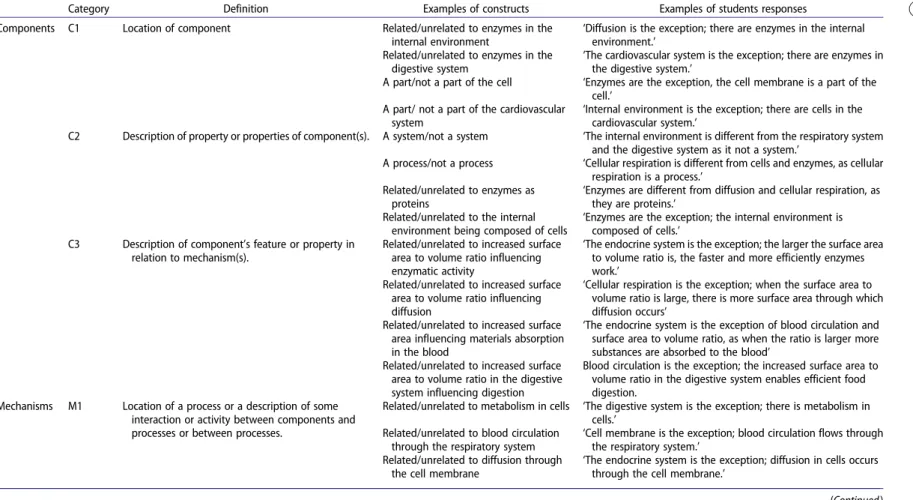
Table 2provides additional examples of constructs in the various CMP subcategories.
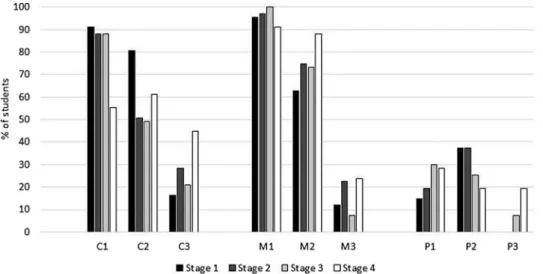
In order to investigate the influence of studying high-school biology on the develop- ment of the students’ system understanding of the human body, the distribution of the number of students who demonstrated constructs in each of the nine CMP subcategories was calculated, for each of the study’s stages (seeFigure 2in the results section). For val- idity purposes, the researchers worked separately on analysing the repertory grid data and dividing it into the CMP subcategories, and the results were compared and discussed until agreement was reached. Finally, the unit of analysis was the grid constructed by the RepGrid&RepNet software (seeFigure 1for exemplar grid) for each of the 67 participating students.
It is important to emphasise that in the context of repertory grids in educational research, bipolarity can refer to one of two situations. It can be used to describe objects using characteristics that are bipolar by nature, like a system/not a system, a part of blood circulation/not a part of blood circulation. But it can also refer to characteristics that are not bipolar by nature, likerelated/unrelated to enzymes in the internal environ- ment, related/unrelated to cells. The strength stated by the participant would then refer to how much this characteristic is or is not expressed. In both situations, the constructs reflect the participants’ views and understandings, allowing the researchers to identify what the participants mean without putting words in their mouths (Jankowicz, 2004).
The aim of the grid analysis was to identify significant relations among the elements and constructs, as reflected in the trees of relations created by the software. Correlations of 80% and above are considered significant (Kelly,1969).
Figure 2.Percentage of students (N= 67) presenting each CMP subcategory at each stage of the study.
Downloaded by [University of Massachusetts] at 07:31 03 September 2017
Table 2.Examples of constructs in the various CMP subcategories.
Category Definition Examples of constructs Examples of students responses
Components C1 Location of component Related/unrelated to enzymes in the
internal environment
‘Diffusion is the exception; there are enzymes in the internal environment.’
Related/unrelated to enzymes in the digestive system
‘The cardiovascular system is the exception; there are enzymes in the digestive system.’
A part/not a part of the cell ‘Enzymes are the exception, the cell membrane is a part of the cell.’
A part/ not a part of the cardiovascular system
‘Internal environment is the exception; there are cells in the cardiovascular system.’
C2 Description of property or properties of component(s). A system/not a system ‘The internal environment is different from the respiratory system and the digestive system as it not a system.’
A process/not a process ‘Cellular respiration is different from cells and enzymes, as cellular respiration is a process.’
Related/unrelated to enzymes as proteins
‘Enzymes are different from diffusion and cellular respiration, as they are proteins.’
Related/unrelated to the internal environment being composed of cells
‘Enzymes are the exception; the internal environment is composed of cells.’
C3 Description of component’s feature or property in relation to mechanism(s).
Related/unrelated to increased surface area to volume ratio influencing enzymatic activity
‘The endocrine system is the exception; the larger the surface area to volume ratio is, the faster and more efficiently enzymes work.’
Related/unrelated to increased surface area to volume ratio influencing diffusion
‘Cellular respiration is the exception; when the surface area to volume ratio is large, there is more surface area through which diffusion occurs’
Related/unrelated to increased surface area influencing materials absorption in the blood
‘The endocrine system is the exception of blood circulation and surface area to volume ratio, as when the ratio is larger more substances are absorbed to the blood’
Related/unrelated to increased surface area to volume ratio in the digestive system influencing digestion
Blood circulation is the exception; the increased surface area to volume ratio in the digestive system enables efficient food digestion.
Mechanisms M1 Location of a process or a description of some interaction or activity between components and processes or between processes.
Related/unrelated to metabolism in cells ‘The digestive system is the exception; there is metabolism in cells.’
Related/unrelated to blood circulation through the respiratory system
‘Cell membrane is the exception; blood circulation flows through the respiratory system.’
Related/unrelated to diffusion through the cell membrane
‘The endocrine system is the exception; diffusion in cells occurs through the cell membrane.’
(Continued)
Z.SNAPIRETAL.
Downloaded by [University of Massachusetts] at 07:31 03 September 2017
Category Definition Examples of constructs Examples of students responses Related/unrelated to diffusion in cellular
respiration ‘Enzymes are the exception; there is diffusion during cellular respiration.’
M2 M1 category and some description or identification of materials taking part of a specific mechanism.
Related/unrelated to transportation of
oxygen to cells ‘Metabolism is the exception; the oxygen for cellular respiration reaches the cells through the respiratory system.’
Related/unrelated to hormones transportation in the cardiovascular system
‘Diffusion is the exception; the endocrine system transports hormones through the cardiovascular system.’
Related/unrelated to diffusion of materials in the cardiovascular system
‘The digestive system is the exception of cardiovascular system and diffusion, as diffusion of materials from the capillaries to the cells takes place in the cardiovascular system.’
Related/unrelated to diffusion of
materials through cell membrane ‘Enzymes are the exception; cell membrane is highly related to the process of diffusion, as materials pass through the cell membrane.’
M3 M2 category and (a)howprocesses use components;
or (b) the sequence of process.
Related/unrelated to transportation of molecules to cells for cellular respiration by the cardiovascular system
‘The digestive system is the exception; the cardiovascular system transports glucose and oxygen to the cells to maintain cellular respiration.’
Related/unrelated to oxygen and carbon dioxide circulation in the body
‘Enzymes are the exception; The lungs in the respiratory system intake oxygen and transfer it in the blood until it reaches all the cells. Cellular respiration uses oxygen and produces carbon dioxide, exhaled from the lungs.’
Related/unrelated to absorption of molecules from the digestive system to the blood circulation
‘Cell membrane is the exception of the digestive system and blood circulation; after the food is digested, the molecules of the various food groups are absorbed to the blood.’ Related/unrelated to diffusion of
nutritions through the cell membrane ‘Internal environment is the exception; the nutritional materials enter the cell and pass the cell membrane by means of diffusion.’
Phenomena P1 Definition of problem context broadly speaking. The overall behaviour or property of the system that results from certain mechanism or a process.
Related/not related to cellular respiration maintaining homeostasis
‘Blood circulation is the exception; cellular respiration enables maintaining of homeostasis.’
Related/unrelated to blood circulation assisting in maintaining homeostasis
‘Cell membrane is the exception; blood circulation assists in maintaining body homeostasis.’
Related/unrelated to energy production in cellular respiration
‘Cellular respiration is different from internal environment and diffusion, as cellular respiration occurs in order to produce energy.’
(Continued)
INTERNATIONALJOURNALOFSCIENCEEDUCATION17
Downloaded by [University of Massachusetts] at 07:31 03 September 2017
Table 2.Continued.
Category Definition Examples of constructs Examples of students responses
Related/unrelated to diffusion maintaining the cell internal environment
‘Cellular respiration is the exception; diffusion occurs in order to maintain the cell internal environment.’
P2 Definition of problem context broadly speaking. The overall behaviour or property of the system that results from many interactions.
Related/unrelated to homeostasis maintaining a stable internal environment
‘Surface area to volume ratio is the exception; homeostasis maintains a stable internal environment in the body.’ Related/unrelated to homeostasis
maintaining body temperature
‘Homeostasis is different from cells and cell membrane, as it is an activity that maintains body temperature.’
An activity done in the body to gain stability/not an activity done in the body to gain stability
‘Surface area to volume ratio is the exception of homeostasis and diffusion, which are both activities done in the body to gain stability.’
Related/unrelated to the ability to
maintain steady state ‘Homeostasis is the exception of the digestive system and the respiratory system, as homeostasis is the ability of the organism to maintain steady state.’
P3 P2 category, and some description ofwhatmaterials are a part of the mechanism contributing to the phenomena, orhowthe phenomena are achieved.
Related/unrelated to homeostasis occurring through feedback mechanisms
‘Homeostasis is different from cells and cell membrane, as homeostasis occurs through feedback mechanisms.’ Related/unrelated to the cardiovascular
system maintaining homeostasis by changing blood transportation
‘Cellular respiration is the exception; the cardiovascular system maintains homeostasis in the human body. For example, if it is cold, the cardiovascular system transports blood to the heart instead of the fingers.’
Related/unrelated to cellular respiration
producing ATP/energy ‘Hormones are the exception; cells perform the process of cellular respiration, a process that produces ATP–energy available for the cell.’
Related/unrelated to cellular respiration producing ATP/energy required for cell existence
‘Metabolism is the exception. Thanks to the respiratory system we breathe and the body receives its energy required to function.
Thanks to the oxygen received, the cells perform cellular respiration in the mitochondrion, where ATP is produced, thanks to which energy is produced, enabling the cells existence and the body to function in the best possible way.’
Z.SNAPIRETAL.
Downloaded by [University of Massachusetts] at 07:31 03 September 2017
Results
In this section we offer an overall view of the data from all the students in the population, which paints a general picture of the changes in perception that they underwent as a group and shows the development of their human body system understanding throughout their three years of high-school biology education.
Changes in CMP category distribution
To answer our research question, ‘Does the students’ perception of the human body system change as they move through their three years of biology studies? If so, how?’ we followed the changes in the CMP framework category distribution presented by the students over the three years of the study. To do this, we counted the number of students who created constructs in each CMP subcategory at each stage of the study, and calculated their percentage out of the whole study population. The four columns for each of the CMP subcategories inFigure 2represent the four stages of the study (in which each participant created another repertory grid). Thus, for example, the figure shows that 91% of the stu- dents created constructs falling under the C1 subcategory at the first stage of the study, and only 55% did so at the fourth stage. The overall results are shown inFigure 2, in which the CMP framework subcategories are presented in ascending order of complexity.
(1) Components
The Israeli high-school biology curriculum emphasises the human body’s systemic nature, focusing on several body systems (e.g. the digestive, cardiovascular and endocrine systems). These systems are taught at all levels–from the micro level of molecules and cells to the macro levels of organs and systems, including their components and the pro- cesses occurring within each, culminating in a view of the overall behaviour of the system and the human body as a whole.
The most basic feature of each system is its structural components. Indeed, in the first three stages of the study, over 90% of the students presented constructs in the C1 category (Figure 2), referring to the location of body system components (e.g.related/unrelated to enzymes in the digestive system). On the other hand, in the last stage of the study, there was a significant decrease in the number of students presenting constructs in the C1 category (χ2(3,N = 67) = 37.03,p< .0001). Only 55% of the students presented constructs in this category at the end of the study.
Constructs in the C2 category include a description of component properties. For example, a student’s explanation of the connection between the elements‘enzymes,’ ‘dif- fusion’and‘cellular respiration’as‘Enzymes are different from diffusion and cellular res- piration, since they are proteins’refers to the enzymes’property of ‘being proteins.’The construct formed from this explanation wasrelated/unrelated to enzymes as proteins. At the beginning of the learning process, 81% of the students presented such constructs.
At this stage, two constructs were predominant:‘a system/not a system’and‘a process/
not a process’ (e.g. ‘The internal environment is different from the respiratory system and the digestive system because it is not a system’). These two constructs are quite simple and do not require deep scientific systems understanding. At the later stages of
Downloaded by [University of Massachusetts] at 07:31 03 September 2017
the study, as the students’level of systems understanding developed, significantly fewer students presented such constructs (χ2(3,N = 67) = 17.54,p= .0005).
The C3 category includes constructs describing components in relation to mechanisms (e.g.related/unrelated to increase of surface area to volume ratio‘The endocrine system is the exception; the larger the surface area to volume ratio is, the faster and more efficiently enzymes work).’ This category bridges the component and the mechanism categories.
There was a significant rise (χ2(3, N = 67) = 15.61,p= .0014) in the number of students presenting constructs in this category from the beginning of the study to its end. The number of students presenting constructs in the C3 category rose from 16% at the first stage to 28% at the second stage. However, between the second and third stage of the study, the number of students presenting such constructs decreased (from 28% to 21%).
It should be noted that the curriculum at this stage of the learning process (the 11th grade) was focused on molecular processes in the cell (e.g. mitosis, osmosis and trans- lation), and ecology (e.g. habitat, food web and energy transfer). Although during this school year the students learned about the micro level, focusing on the cell and molecular processes, the connection to the human body was not emphasised explicitly. The time difference between learning explicitly about the human body and the time the students were interviewed at the third stage of the study might explain the decline in the number of students presenting constructs in the C3 category.
Overall, comparing the end of the study with its beginning shows that fewer students focused on the basic levels of the components categories in the CMP framework, which refer only to the location (C1) or to the obvious properties (C2) of the components. On the other hand, more students represented the more sophisticated C3 category, connecting the system components to mechanisms.
(2) Mechanisms
Understanding complex systems like the human body requires the ability to recognise the processes occurring within them that enable them to function (e.g. osmosis, oxygen transportation and degradation). In the CMP framework, constructs that refer to processes are included in the‘mechanism’categories. The higher levels of this category require rec- ognition of the micro level of the system, since this is the level at which process are explained.
In our study, almost all of the students presented constructs referring to mechanisms right at the beginning of the learning process. It is worth noting that all of these students had chosen to major in biology and had learned biology throughout junior high school, so they began the study with some understanding of the human body.
Constructs in the M1 category, including constructs referring to the location of pro- cesses or descriptions of interactions between components or processes, are the most basic constructs referring to processes within the system. As shown in Figure 2, over 96% of the students presented constructs in this category in stage 1 of the study. The pro- cesses and body systems referred to in these constructs are varied (related/unrelated to blood circulation in the cardiovascular system, related/unrelated to enzymes supporting the function of the digestive system, related/unrelated to diffusion in blood circulation).
Constructs in the M1 category were dominant throughout the study, and there was no
Downloaded by [University of Massachusetts] at 07:31 03 September 2017