335
Seabird and Colonial Wading Bird Nesting in the Gulf of Panama
GEORGE R. ANGEHR1AND JAMES A. KUSHLAN2
1Smithsonian Tropical Research Institute and Panama Audubon Society, Smithsonian Institution, STRI, Unit 0948, APO AA 34002-0948
2P.O. Box 2008, Key Biscayne, FL 33149, USA Corresponding author; Internet: [email protected]
Abstract.—The Gulf of Panama is a highly productive marine ecosystem at the southern edge of North America.
Although the Gulf’s aquatic bird populations have been remarked upon by ornithologists for over 50 years, nesting populations have been neither systematically studied nor completely characterized. In 2005 and 2006, the entire Gulf of Panama was inventoried to document the nesting status of seabirds and other colonial waterbirds. Over 50,000 birds of 20 species nesting at 57 sites were documented. Seabirds nested during the dry season, the period of oceanographic upwelling. Coastal colonial waterbirds nested at the end of the dry season and in the early wet season, when inland feeding habitats were optimal. Brown Pelicans (Pelecanus occidentalis) were the most numerous seabird with over 4,800 nests and 10,000 individuals counted. Over 3,600 Neotropic Cormorant (Phalacrocorax brasilianus) nests and over 2,200 Magnificent Frigatebird (Fregata magnificens) nests were documented. Cattle Egrets (Bubulcus ibis) were the most abundant colonial wading birds, followed by Great Egrets (Ardea alba). Great Egrets were the first wading birds to nest, Cattle Egrets the last. Seven sites contained over 1,000 nests. Colony locations and numbers differed markedly from the historic literature. Some historic information is erroneous, but other differences reflect changes in distribution. More nesting Brown Pelicans and Sooty Terns (Sterna fuscata) and fewer Neotropic Cormo- rants were found than expected from the literature. New sites documented included some of global or regional con- servation importance. This paper presents the first breeding records for Panama of Little Blue Heron (Egretta caerulea), Glossy Ibis (Plegadis falcinellus), and Bridled Tern (Sterna anaethetus), and third record for Cocoi Heron (Ardea cocoi). There is no evidence for long-term declines of seabirds or colonial wading birds in the Gulf of Panama.
Populations reaching conservation thresholds globally or biogeographically include Brown Pelican, Bare-throated Tiger-Heron (Tigrisoma mexicanum), White Ibis (Eudocimus albus), Glossy Ibis, and Bridled Tern. The Black-crowned Night-Heron (Nycticorax nycticorax) exceeded conservation thresholds for Central America. Six new sites of global importance for bird conservation were identified and the continued importance of another site confirmed. The continued health of the waterbird populations of Panama will depend on environmental education and protection of important colony sites from disturbance and development. Received: 29 September 2006, accepted 25 May 2007.
Key words.—Bay of Panama, booby, colonial wading birds, colonial waterbirds, colonies, cormorant, distribu- tion, egret, frigatebird, Gulf of Panama, heron, ibis, Important Bird Areas, Panama, Pearl Islands, pelican, popula- tions, Ramsar, seabirds, tern.
Waterbirds 30(3): 335-357, 2007
Lying at the cross-roads of much of the New World’s avifauna and supporting a num- ber of racially distinctive birds on its many isolated islands, the Gulf of Panama has played an important role in ornithological history. Despite a half-century of recognition of its biological and conservation impor- tance, the Gulf’s nesting aquatic bird popu- lations have remained surprisingly little doc- umented. There has never been a compre- hensive survey of seabird and colonial water- bird nesting sites, nor much information at all along the coast or on near shore islands.
The best known aquatic birds of the Gulf of Panama are the migratory shorebirds, a mil- lion or more of which use the upper Bay of Panama annually (Morrison et al. 1998; Watts
1998; Angehr 2003; Buehler et al. 2004). As a result this area is considered a Wetland of In- ternational Importance under the Ramsar Convention, a component of the Western Hemisphere Shorebird Reserve Network, and a globally Important Bird Area.
Knowledge of other aquatic birds is an- other matter. Incidental observations on sea- birds and colonial waterbirds were made as part of general avifaunal studies by Bovallius in the Pearl Islands in 1882 (Rendahl 1920), Brown in the Pearls in 1900 and 1904 (Bangs 1901; Thayer and Bangs 1905), Wetmore in various places from 1944-1963 (Wetmore 1946, 1952, 1965; Olson 1997), Butler as part of coastal shorebird surveys (Butler et al.
1992, 1998), and Angehr (2003) as part of his
336 WATERBIRDS
Important Bird Area studies in 2000. Ridgely, Delgado, and Angehr also summarized as- pects of existing nesting site information (Delgado 1985; Ridgely and Gwynne 1989;
Angehr 2003). Angehr determined 49 sites in Panama to be of global importance to bird conservation and 39 sites to be of national importance. Birds at sea have been surveyed by Murphy in 1925, 1944, and 1956 (Murphy 1936, 1944a, b, c, 1956; Wetmore 1965), Rob- ins (1958) in July 1957, Loftin (1991) in 1968-1969, and Spear and Ainly (1999). The best known waterbird species is Brown Peli- can (Pelecanus occidentalis), especially those nesting in the Taboga island group (Mari- dueña 1979; Montgomery 1982; Montgom- ery and Martínez 1984; Martínez 1981, 1983, 1984; Daguerre 2000). Batista (1981) cen- sused pelicans at sea in the Pearls during the breeding season. Few of these data docu- mented actual breeding numbers. Other sea- birds and colonial wading birds have been far less studied (Villalaz 1987; Tejera 1989).
The purpose of the present study was to delineate definitively the status and distribu- tion of seabirds and other colonial water- birds of the Gulf of Panama. This study was the first complete census in the Gulf and
adjacent shores, determining breeding sites, breeding numbers, and estimating overall nesting population sizes. The study reports new records of nesting species for Panama, identifies sites of global and national impor- tance for conservation, compares these find- ings to the literature, and evaluates implica- tions of these findings.
STUDY AREA
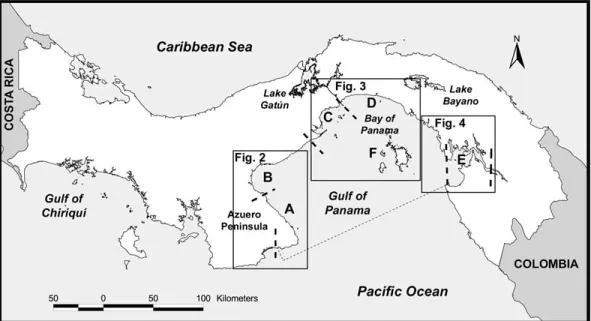
The study area was the Gulf of Panama inside a line from Punta Mala in Los Santos Province to Punta Ga- rachiné in Darién Province, plus the Islas Frailes just to the south of Punta Mala. The study area was divided into the following subregions: 1) eastern Azuero Peninsula;
2) Parita Bay; 3) western Bay of Panama from Chame Bay to the Panama Canal, including the Otoque and Taboga island groups; 4) eastern Bay of Panama from the Panama Canal to Punta San Lorenzo; 5) Gulf of San Miguel from Punta San Lorenzo to Punta Garachiné, extending inland as far as the confluence of the Ríos Tuira and Balsas; and 6) the Pearl Islands (Fig. 1). The study included offshore waters within the Gulf, near shore and offshore islands, and the coastline including rivers flowing into the Gulf and their associated marshes and swamps. Habitats included marshes and mangrove swamps, shallow bays, sandy beaches, rocky shores, in- tertidal mud flats, and offshore islands, salinas, wet pas- tures, shrimp farms, and coastal areas next to Panama City and other built-up areas.
The oceanography of the Gulf of Panama is key to un- derstanding its bird communities. Semi-diurnal tides on
Figure 1. Panama. Survey area boundary indicated by a dotted line, and the boundaries between subregions by dashed lines. Subregions: A. eastern Azuero Peninsula; B. Parita Bay; C. western Bay of Panama; D. eastern Bay of Panama; E. Gulf of San Miguel; F. Pearl Islands. Nesting sites in the insets are shown in Figures 2-4.
PANAMA SEABIRDS 337
average flux five meters, peaking seasonally at over seven meters. Such tides expose enormous coastal mud flats abutting the mainland in the eastern and western Bay of Panama and in the Bay of Parita. In some places these ex- tend out several km at low tide. Here and along outer shores and islands, sandy and rocky beaches and rocky bars are made available for bird foraging twice a day. The Gulf of Panama covers 12,880 km2 and features a subma- rine valley running from the Río Bayano to the Pacific Ocean, deepening to the edge of the continental shelf (Delgado 1998). During the dry season, from late De- cember through April, steady northeast trade winds blow across the Isthmus of Panama and push surface waters away from the coast, creating upwelling conditions by al- lowing colder nutrient-rich water to rise and support phytoplankton blooms. These blooms nourish large pop- ulations of Pacific Anchoveta (Cetengraulis mysticetus) and other small fishes, which tend to move toward shore in the Bay of Panama (Schaefer et al. 1958; Delgado 1998).
Large fishes, especially Albacore (Thunnus alalunga) and Yellow-fin Tuna (Thunnus albacares), feed on these bait- fish. Seabirds feed by diving and plunging onto the fish shoals, especially over tuna. As a result of the abundance of food, pelagic seabirds tend to nest on offshore islands in the mid to late dry season. Most colonial wading birds (herons and ibises), on the other hand, nest along the coast or near-shore islands starting towards the end of the dry season and early wet season. A massive inflow of freshwater from the Panama Canal occurs year round, providing foraging habitat along the Bay of Panama coast for colonial waterbirds and coastal seabirds, espe- cially pelicans, cormorants, and boobies. Thus influ- enced by seasonal deep water upwelling and by fresh water inflow from rivers and the Panama Canal, the Gulf provides an extremely rich environment for waterbirds.
METHODS
A complete inventory was made of waterbirds along shores, islands, and coastal wetlands of the Gulf of Pan- ama in 2005 and 2006. Survey periods were chosen to encompass the early and later parts of the nesting sea- sons of seabirds, the early parts of the nesting season of terns, and most of the nesting season of colonial wading birds. Aerial surveys were conducted on 17-20 April and 2-27 July 2005, flying a Cessna 172 over 1,900 km at alti- tudes below 300 m, covering the entirety of the Gulf of Panama and adjacent wetlands. All previously-known nesting sites were over-flown, as were all islands and all coastal streams. All islands within the Gulf of Panama more than five kilometers offshore were visited by boat.
We counted the numbers of nests from the boat, from the ground, or, for those colonies not otherwise accessi- ble, from the airplane. Foraging and roosting birds also were tallied from the air or boat. We visited colony sites by boat or ground on 20-30 April 2005, 18-19 June 2005, 28-30 July 2005, and 20-25 February 2006. Some sites in the Gulf of San Miguel were visited by C. Montañez on 15-17 August 2006.
Nesting sites, nesting populations, and total popula- tions are reported. Nesting sites were determined from the inventory results. The greatest number of nests counted at each site during the April-August period was used to estimate the breeding population. Data from February, the beginning of a new nesting cycle for seabirds was used for comparative purposes. Total pop- ulations for calculating conservation population thresh-
olds were estimated conservatively as three times the number of nests, that is, a pair plus one young (Delaney and Scott 2002). A main goal of our study was to identify or confirm sites of importance to conservation of con- gregatory waterbirds in Panama, compared to the re- sults of Angehr (2003). Criteria for identification of global IBAs included the presence of >1% of a biogeo- graphic population of a congregatory waterbird species, or >1% of the global population of a seabird popula- tion, and for identification of national IBAs the pres- ence of >1% of the national population of a congregatory waterbird or seabird species. Under the definitions used by BirdLife International, of the spe- cies nesting in Panama shearwaters, boobies, tropic- birds, and frigatebirds are considered to be seabirds, and the remainder waterbirds. Total population figures from Kushlan et al. (2002) and BirdLife International and Conservation International (2005) were used to cal- culate 1% levels for global or biogeographic popula- tions. Reference populations for species reaching the 1% threshold in our study area include Brown Pelican (290,000 global, 175,000 neotropical), Bare-throated Tiger-Heron (Tigrisoma mexicanum) (10,000 global and neotropical), White Ibis (Eudocimus albus) (100,000 neotropical), Glossy Ibis (Plegadis falcinellus) (10,500 neotropical), and Bridled Tern (Sterna anaethetus) (15,500 neotropical). In addition, Black-crowned Night- Heron (Nycticorax nycticorax) exceeded the 1% level for Central America (10,000).
RESULTS
Colony Sites
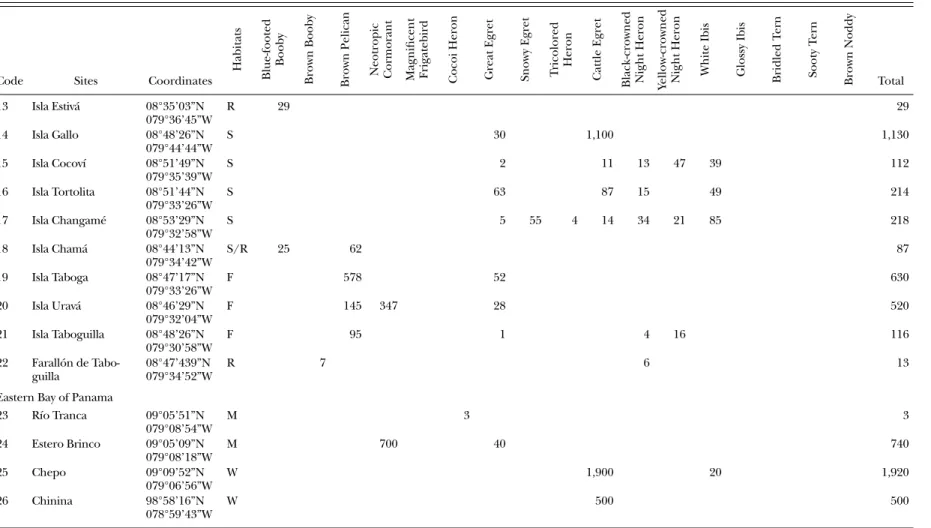
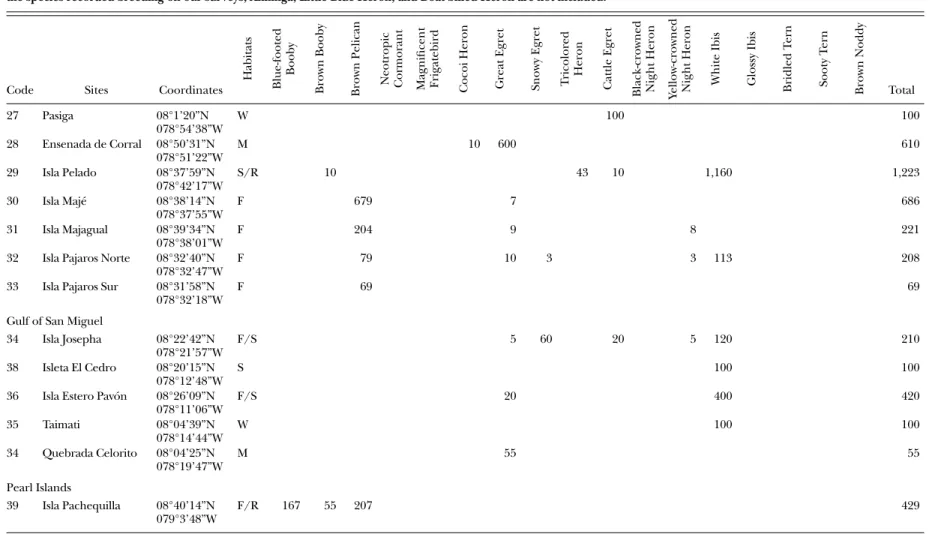
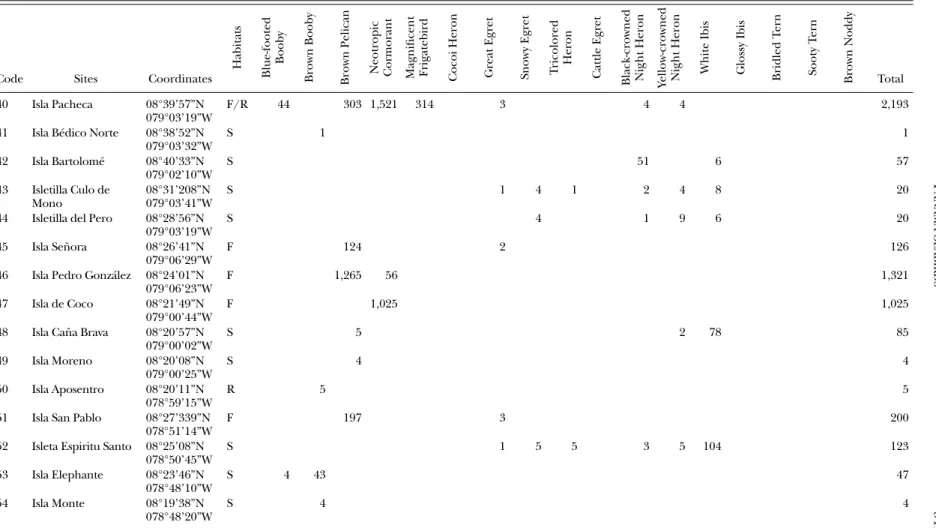
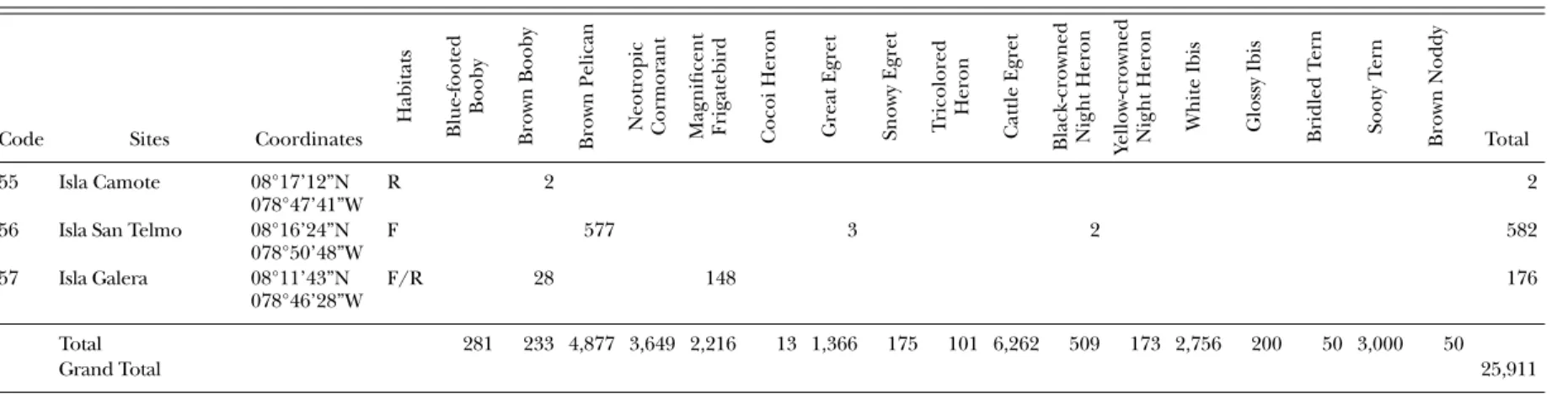
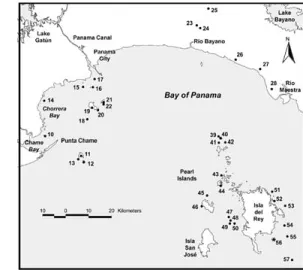
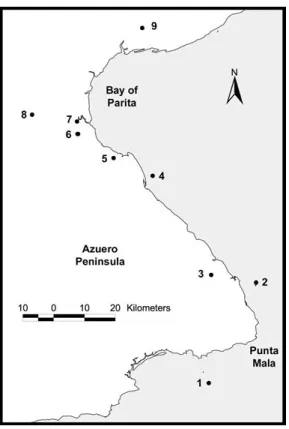
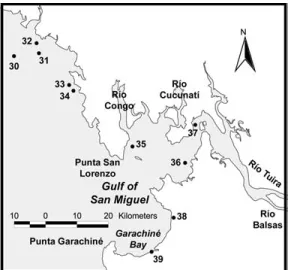
Seabirds and other colonial waterbirds nested at 57 sites (Table 1, Figs. 2-4). Most colonies were in the Pearl Islands and the western Bay of Panama (19 and 13, respec- tively). The largest was at the Islas Frailes del Sur off the coast of the Azuero, with over 3,100 nests of a total of three species. Other sites with more than 1,000 combined nests were Isla Pacheca (with over 2,100 nests), Chepo, and Islas Pedro González, Iguana, Pelado, Gallo, Taborcillo, and de Coco. Four sites each held over 1,000 nesting pairs of a species: Sooty Terns (Sterna fuscata) on Islas Frailes del Sur; Magnificent Frigatebirds (Fregata magnificens) on Isla Iguana; Brown Pelicans on Isla Pedro González; and Neo- tropic Cormorants (Phalacrocorax brasilianus) on Islas Pacheca and de Coco. Pelagic terns and frigatebirds nested mainly along the southern Azuero coast. Most colonial wading birds (herons and ibises) nested in coastal wetlands or on near-shore islands along the Bay of Panama. Cormorants, pelicans and boobies, as well as some herons and ibises,
338WATERBIRDS Table 1. Seabird and colonial wading bird nesting sites in the study area. Column 1: code numbers for sites are keyed to Figs. 2-4. Column 2: coordinates are given to the nearest minute for the approximate center of the colony or island. Column 3: principal habitats used by nesting birds at each site: R = rocks and cliffs, S = scrub and herbaceous vegetation;
W = freshwater wetland; F = tall non-mangrove forest; M = mangroves. Figures given for each species are the number of nests or pairs counted at the site. Of the species recorded breeding on our surveys, Anhinga, Little Blue Heron, and Boat-billed Heron are not included.
Code Sites Coordinates
Habitats Blue-footed Booby Brown Booby Brown Pelican Neotropic Cormorant Magnificent Frigatebird Cocoi Heron Great Egret Snowy Egret Tricolored Heron Cattle Egret Black-crowned Night Heron Yellow-crowned Night Heron White Ibis Glossy Ibis Bridled Tern Sooty Tern Brown Noddy Total
Eastern Azuero Peninsula
1 Islas Frailes del Sur 07°20’11”N 080°08’24”W
R 18 50 3,000 50 3,118
2 Isla Iguana 07°37’33”N 080°00’07”W
S 1,300 1,300
3 Laguna de Pocrí 07°39’44”N 080°07’34”W
W 700 700
4 Peñón de la Honda 07°56’05”N 080°18’05”W
S 20 20
Parita Bay
5 Chitré Airport 07°59’11”N 080°24’43”W
W 40 7 200 5 10 262
6 Los Pocitos 08°03’49”N 080°31’31”W
W 40 1 300 341
7 Cenegón del Mangle 08°05’33”N 080°30’52”W
M 100 300 400
8 Ciénaga del Rey 08°07’08”N 080°38’54”W
W 180 600 20 200 1,000
9 El Rosario 08°22’35”N
080°20’23”W
W 50 200 250
Western Bay of Panama
10 Isla Taborcillo 08E40’17”N 079E44’26”W
S 16 37 47 200 349 49 358 1,056
11 Isla Otoque 08°36’05”N 079°36’02”W
F 152 152
12 Isla Boná 08°34’27”N
079°35’30”W
F/R 12 60 132 454 658
PANAMA SEABIRDS339 13 Isla Estivá 08°35’03”N
079°36’45”W
R 29 29
14 Isla Gallo 08°48’26”N 079°44’44”W
S 30 1,100 1,130
15 Isla Cocoví 08°51’49”N 079°35’39”W
S 2 11 13 47 39 112
16 Isla Tortolita 08°51’44”N 079°33’26”W
S 63 87 15 49 214
17 Isla Changamé 08°53’29”N 079°32’58”W
S 5 55 4 14 34 21 85 218
18 Isla Chamá 08°44’13”N 079°34’42”W
S/R 25 62 87
19 Isla Taboga 08°47’17”N 079°33’26”W
F 578 52 630
20 Isla Uravá 08°46’29”N 079°32’04”W
F 145 347 28 520
21 Isla Taboguilla 08°48’26”N 079°30’58”W
F 95 1 4 16 116
22 Farallón de Tabo- guilla
08°47’439”N 079°34’52”W
R 7 6 13
Eastern Bay of Panama
23 Río Tranca 09°05’51”N 079°08’54”W
M 3 3
24 Estero Brinco 09°05’09”N 079°08’18”W
M 700 40 740
25 Chepo 09°09’52”N
079°06’56”W
W 1,900 20 1,920
26 Chinina 98°58’16”N
078°59’43”W
W 500 500
Table 1. (Continued) Seabird and colonial wading bird nesting sites in the study area. Column 1: code numbers for sites are keyed to Figs. 2-4. Column 2: coordinates are given to the nearest minute for the approximate center of the colony or island. Column 3: principal habitats used by nesting birds at each site: R = rocks and cliffs, S = scrub and her- baceous vegetation; W = freshwater wetland; F = tall non-mangrove forest; M = mangroves. Figures given for each species are the number of nests or pairs counted at the site. Of the species recorded breeding on our surveys, Anhinga, Little Blue Heron, and Boat-billed Heron are not included.
Code Sites Coordinates
Habitats Blue-footed Booby Brown Booby Brown Pelican Neotropic Cormorant Magnificent Frigatebird Cocoi Heron Great Egret Snowy Egret Tricolored Heron Cattle Egret Black-crowned Night Heron Yellow-crowned Night Heron White Ibis Glossy Ibis Bridled Tern Sooty Tern Brown Noddy Total
340WATERBIRDS
27 Pasiga 08°1’20”N
078°54’38”W
W 100 100
28 Ensenada de Corral 08°50’31”N 078°51’22”W
M 10 600 610
29 Isla Pelado 08°37’59”N 078°42’17”W
S/R 10 43 10 1,160 1,223
30 Isla Majé 08°38’14”N
078°37’55”W
F 679 7 686
31 Isla Majagual 08°39’34”N 078°38’01”W
F 204 9 8 221
32 Isla Pajaros Norte 08°32’40”N 078°32’47”W
F 79 10 3 3 113 208
33 Isla Pajaros Sur 08°31’58”N 078°32’18”W
F 69 69
Gulf of San Miguel
34 Isla Josepha 08°22’42”N 078°21’57”W
F/S 5 60 20 5 120 210
38 Isleta El Cedro 08°20’15”N 078°12’48”W
S 100 100
36 Isla Estero Pavón 08°26’09”N 078°11’06”W
F/S 20 400 420
35 Taimati 08°04’39”N
078°14’44”W
W 100 100
34 Quebrada Celorito 08°04’25”N 078°19’47”W
M 55 55
Pearl Islands
39 Isla Pachequilla 08°40’14”N 079°3’48”W
F/R 167 55 207 429
Table 1. (Continued) Seabird and colonial wading bird nesting sites in the study area. Column 1: code numbers for sites are keyed to Figs. 2-4. Column 2: coordinates are given to the nearest minute for the approximate center of the colony or island. Column 3: principal habitats used by nesting birds at each site: R = rocks and cliffs, S = scrub and her- baceous vegetation; W = freshwater wetland; F = tall non-mangrove forest; M = mangroves. Figures given for each species are the number of nests or pairs counted at the site. Of the species recorded breeding on our surveys, Anhinga, Little Blue Heron, and Boat-billed Heron are not included.
Code Sites Coordinates
Habitats Blue-footed Booby Brown Booby Brown Pelican Neotropic Cormorant Magnificent Frigatebird Cocoi Heron Great Egret Snowy Egret Tricolored Heron Cattle Egret Black-crowned Night Heron Yellow-crowned Night Heron White Ibis Glossy Ibis Bridled Tern Sooty Tern Brown Noddy Total
PANAMA SEABIRDS341 40 Isla Pacheca 08°39’57”N
079°03’19”W
F/R 44 303 1,521 314 3 4 4 2,193
41 Isla Bédico Norte 08°38’52”N 079°03’32”W
S 1 1
42 Isla Bartolomé 08°40’33”N 079°02’10”W
S 51 6 57
43 Isletilla Culo de Mono
08°31’208”N 079°03’41”W
S 1 4 1 2 4 8 20
44 Isletilla del Pero 08°28’56”N 079°03’19”W
S 4 1 9 6 20
45 Isla Señora 08°26’41”N 079°06’29”W
F 124 2 126
46 Isla Pedro González 08°24’01”N 079°06’23”W
F 1,265 56 1,321
47 Isla de Coco 08°21’49”N 079°00’44”W
F 1,025 1,025
48 Isla Caña Brava 08°20’57”N 079°00’02”W
S 5 2 78 85
49 Isla Moreno 08°20’08”N 079°00’25”W
S 4 4
50 Isla Aposentro 08°20’11”N 078°59’15”W
R 5 5
51 Isla San Pablo 08°27’339”N 078°51’14”W
F 197 3 200
52 Isleta Espiritu Santo 08°25’08”N 078°50’45”W
S 1 5 5 3 5 104 123
53 Isla Elephante 08°23’46”N 078°48’10”W
S 4 43 47
54 Isla Monte 08°19’38”N 078°48’20”W
S 4 4
Table 1. (Continued) Seabird and colonial wading bird nesting sites in the study area. Column 1: code numbers for sites are keyed to Figs. 2-4. Column 2: coordinates are given to the nearest minute for the approximate center of the colony or island. Column 3: principal habitats used by nesting birds at each site: R = rocks and cliffs, S = scrub and her- baceous vegetation; W = freshwater wetland; F = tall non-mangrove forest; M = mangroves. Figures given for each species are the number of nests or pairs counted at the site. Of the species recorded breeding on our surveys, Anhinga, Little Blue Heron, and Boat-billed Heron are not included.
Code Sites Coordinates
Habitats Blue-footed Booby Brown Booby Brown Pelican Neotropic Cormorant Magnificent Frigatebird Cocoi Heron Great Egret Snowy Egret Tricolored Heron Cattle Egret Black-crowned Night Heron Yellow-crowned Night Heron White Ibis Glossy Ibis Bridled Tern Sooty Tern Brown Noddy Total
342WATERBIRDS
55 Isla Camote 08°17’12”N 078°47’41”W
R 2 2
56 Isla San Telmo 08°16’24”N 078°50’48”W
F 577 3 2 582
57 Isla Galera 08°11’43”N 078°46’28”W
F/R 28 148 176
Total 281 233 4,877 3,649 2,216 13 1,366 175 101 6,262 509 173 2,756 200 50 3,000 50
Grand Total 25,911
Table 1. (Continued) Seabird and colonial wading bird nesting sites in the study area. Column 1: code numbers for sites are keyed to Figs. 2-4. Column 2: coordinates are given to the nearest minute for the approximate center of the colony or island. Column 3: principal habitats used by nesting birds at each site: R = rocks and cliffs, S = scrub and her- baceous vegetation; W = freshwater wetland; F = tall non-mangrove forest; M = mangroves. Figures given for each species are the number of nests or pairs counted at the site. Of the species recorded breeding on our surveys, Anhinga, Little Blue Heron, and Boat-billed Heron are not included.
Code Sites Coordinates
Habitats Blue-footed Booby Brown Booby Brown Pelican Neotropic Cormorant Magnificent Frigatebird Cocoi Heron Great Egret Snowy Egret Tricolored Heron Cattle Egret Black-crowned Night Heron Yellow-crowned Night Heron White Ibis Glossy Ibis Bridled Tern Sooty Tern Brown Noddy Total
PANAMA SEABIRDS 343
nested in the Pearl Islands and on the Taboga, Otoque-Boná, and Majé-Majagual groups.
Nesting Populations
Overall 25,911 nests were found, ac- counting for almost 52,000 seabirds and oth- er colonial waterbirds nesting in and near the Gulf of Panama. The most abundant spe- cies was Cattle Egret (Bubulcus ibis); the next most numerous in order being Brown Peli- can, Neotropic Cormorant, and Sooty Tern.
Blue-footed Boobies (Sula nebouxii) nest- ed in very small numbers at five sites, on cliffs and small rocky stacks. Interestingly, no Blue-footed Boobies were found nesting dur- ing February 2006, even at sites where they had bred in 2005. Although commonly seen roosting on the outer islands of the Pearls, Blue-footed Boobies are relatively rare, scat- tered, and perhaps irregular as breeders.
Brown Boobies (Sula leucogaster) nested in similar sites as Blue-footed Boobies but were more widely distributed, at eleven colo- ny sites in April. The following February, many non-breeding birds were found, in- cluding many young from the previous year.
Male Brown Boobies in the western Pacific are distinctive in having silvery heads, a char- acter that is very obvious in the Gulf birds during the early nesting period.
Brown Pelicans were strikingly abundant in the Gulf. Brown Pelicans nested at 18 sites supporting 4,877 nests. Additionally, in April 2005, 10,003 individuals were counted away from nesting sites. Since nearly all nests had an adult bird in attendance, adding the to- tals suggest that the total number of adult birds was about 14,000. The largest concen- trations were on Islas Pedro González and Señora in the Pearl Islands (1,389 nests), Isla Majé and nearby islands (Majagual and Pa- jaros Norte and Sur) in the eastern Bay of Panama (1,031 nests), and the Taboga group (including Taboga, Uravá, Taboguila, and Chamá) in the western Bay of Panama (880 nests). Most sites were on large to medium- sized, well-forested islands. In late June all nesting in the Pearl Islands had terminated.
But nesting began again in February, when birds in all nesting stages from eggs through very large young were found, suggesting the
Figure 2. Waterbird nesting sites in the eastern Azuero Peninsula and Parita Bay. 2005-2006. See Table 1 for code numbers.
Figure 3. Waterbird nesting sites in the western Bay of Panama, eastern Bay of Panama (part), and Pearl Is- lands 2005-2006. See Table 1 for code numbers.
344 WATERBIRDS
extreme prolongation of the nesting season in Panama. Greatest numbers of foraging and roosting pelicans were observed in the Bay of Panama, especially near the Panama Canal and Panama City, where they no doubt benefit from the nutrient-rich waters.
Neotropic Cormorants were also abun- dant throughout the Gulf. Over 3,600 nests were found at five sites in 2005. These birds occurred by the hundreds and even thou- sands in some locales. Over 1,600 were count- ed feeding and roosting along the eastern Bay of Panama including along the shores of Panama City. Cormorants used various nest- ing sites, including large and small forested offshore islands and coastal mangroves. Col- onies at two sites, Islas Pacheca and de Coco, totaled over 1,000 nests each. Nesting had finished by June but was beginning again in February 2006. Nesting at that time had not begun on Isla Pacheca but was underway in Islas de Coco and Moreno, the latter a site where they had not nested in 2005. Even so early in the season in 2006, 2380 nests were on these two islands alone. These data sug- gest that the size and location of cormorant colonies may differ from year to year.
A few Anhinga (Anhinga anhinga) nests were found at colonies in the Parita Bay re- gion in July, at Laguna de Cerro Negro and Ciénaga del Rey. Eight females were seen at
the Laguna de Pocrí on 24 April, and males and females there and at Chitré Airport in July, but no nests were found at these sites.
Over 2,000 Magnificent Frigatebird (Fre- gata magnificens) nests were found at four sites, the largest at Isla Iguana along the southern Azuero Coast. On Isla Iguana, most nests were in tall grass and scrub, but else- where they were in trees. Frigatebirds are a common sight throughout the Gulf, espe- cially feeding in association with gulls and pelicans in the Bay of Panama, terns on the southern Azuero coast, and with pelicans and herons on inland freshwater ponds in the eastern Azuero.
Cocoi Heron (Ardea cocoi) has only re- cently been documented to nest in Panama, extending to Central America the range of this South American species. Three Cocoi Heron nests were found in April and ten nests in July at Ensenada de Corral, and also three nests in August at Río Tranca near the Río Bayano, both sites in the eastern Bay of Panama. At Ensenada de Corral the nests were in the tops of tall mangroves within the large colony of Great Egret (Ardea alba) at this site, while the nests at Estero Tranca were not associated with other species.
Great Egret was a common bird through- out the Gulf of Panama, the second most abundant heron after Cattle Egret. Within the Bay of Panama, near the city, they fre- quent mudflats during low tide, while nest- ing and roosting on the offshore islands of Changamé and Taboga. Great Egrets oc- curred year-round off the city of Panama:
over 50 were counted along the shore there in April and overall over 250 birds were counted away from nesting sites. Great Egrets (along with Cocoi Herons) were clearly the earliest of the herons to nest, starting in February in the Pearl Islands and toward the end of the dry season near shore.
Great Egrets fed not only in mangroves and along mudflats but also not uncommonly in the surf along sandy and on rocky beaches.
They nested in small numbers on many small islands within the Gulf and in larger num- bers in mangroves and inland wetlands;
1,366 nests were found at 27 sites. The larg- est colony, 600 nests, was in an extensive area
Figure 4. Waterbird nesting sites in the eastern Bay of Panama (part) and Gulf of San Miguel. 2005-2006. See Table 1 for code numbers.
PANAMA SEABIRDS 345 of mangroves just west of the Ensenada de
Corral, where the egrets occupied a line of tall trees along a river channel. The second largest colony, 180 nests, was at Ciénaga del Rey, a small marsh near Santa María, some 16 km inland along the Río Santa María in the Parita Bay region. Nesting was well un- derway during the April census, with most birds incubating or with small young. By July most birds had large young.
Snowy Egrets (Egretta thula) were thinly but widely dispersed along the coast. They were found nesting in small numbers at eight sites, all but one (Chitré Airport) on small islands, either near-shore or in the Pearl Islands. The largest colony was 55 nests on Isla Changamé.
Adults and young of the year Little Blue Herons (Egretta caerulea) were present along the eastern Azuero coast and Parita Bay dur- ing the April and June surveys. On 29 July, we observed a large juvenile perched in a tree begging from an adult at the El Rosario col- ony. At dusk, five adults and five juveniles changing into adult plumage flew in to roost in the colony. These observations document the nesting of the species in the area.
Tricolored Herons (Egretta tricolor) were common in small numbers all along the coast. They were found nesting at seven sites, all but one of them (Laguna de Cerro Ne- gro) on small nearshore islands.
Cattle Egrets (Bubulcus ibis) were com- mon throughout the region, especially in the cattle-raising and agricultural areas inland of the eastern Azuero coast. This was the most numerous waterbird, with over 6,200 nests re- corded at 17 sites. Cattle Egrets were only be- ginning to nest in April but were fully nesting in July. Most sites were in small shallow fresh- water ponds or marshes, including the larg- est colony at Chepo, 19 km inland, with 1,900 nests. Some colonies were on near-shore is- lands, including the second largest colony at Isla Gallo, 1,100 nests, 1.3 km offshore. The farthest offshore they were observed nesting was a surprising 9 km at Isla Pelado.
Black-crowned Night Herons nested at 14 sites, usually in small numbers at each.
The exception was Isla Taborcillo, where 349 nests were found in April. Birds appeared to
leave this site soon after breeding, since only about ten adults and 20 juveniles were there by late July. Most sites were on small near- shore or offshore islands, although a few were in freshwater marshes.
Yellow-crowned Night Herons (Nyctinassa violacea) fed commonly on the mud flats near Panama City and may be one of the most abundant herons in the area. They bred in tight groups, and this species was found nest- ing at 13 sites, all on small near-shore or off- shore islands. The largest colonies were at Is- las Taborcillo, with 49 nests, and Cocoví, with 47. Like Black-crowned Night-Herons, they appeared to leave Taborcillo after breeding, since none were found there in July.
Two juvenile and two adult Boat-billed Herons (Cochlearius cochlearius) were seen at Cenegón del Mangle, where nesting had previously been documented by F. Delgado (pers. comm.).
White Ibis was a common bird, especially in the eastern and western Bay of Panama and along the eastern Azuero Coast, but also on many small islands. Nesting was begin- ning in the western Bay of Panama during April, but was already underway in the east- ern Bay. Most nesting had finished by July.
They were found nesting at 17 sites, the larg- est, with 1,160 nests, being on Isla Pelado, a rocky island 9 km off the mainland. Other- wise they nested in colonies of 10s to low 100s of nests. Ibises very typically nested on very small islets covered with cactus, as well as in the more usual freshwater wetlands.
Glossy Ibis, 450 adults, in near-breeding condition plumage were seen in rice fields near Santa María in April. Breeding was clearly documented for the site as on 29 July we observed and photographed a large nest- ling at the Ciénaga del Rey colony. Glossy Ibis remained common at the colony site and widespread in rice fields for several km surrounding this colony in late July.
Bridled Terns nested on the tops of rock cliffs of the larger island of Frailes del Sur in April. About 50 pairs were found occupying niches suitable for nesting and some also were observed copulating.
A large colony of Sooty Terns (Sterna fus- cata), 3,000 nests, occupied the bare flat
346 WATERBIRDS
rocky tops of both the larger and the smaller islands of Frailes del Sur in April. Visible nests appeared to be at egg stage in April.
About 50 Brown Noddies (Anous stolidus) were found nesting in niches below the cliff tops around the north end of the larger is- land of Frailes del Sur in April.
Incidental observations were made of several non-breeding seabird and waterbird species during the study. One Great Blue Heron (Ardea herodius) was seen on 23 April at Playa Venado on the southern Azuero coast, and another at Punta Chame on 30 July. Bare-throated Tiger-Herons were fre- quently observed foraging along beaches in the Pearl Islands, and two nests were found in February on Isla San José. Densities in the archipelago may exceed a pair for every two kilometers of coastline, suggesting a total population of over 350 individuals. Two for- aging groups of Roseate Spoonbills (Platalea ajaja) were seen, containing about a dozen adults each, in shallow ponds just east of the mouth of the Río Tocumen and just north of the mouth of the Río Chico 24-27 July. A sin- gle individual spoonbill was seen near the mouth of the Río Congo in Darién on 7 July.
A nesting colony may exist in the mangroves at the mouth of the Río Bayano. A group of 40 Wood Storks (Mycteria americana) were ob- served foraging in a small pond on the Río Salado at the head of the Estero de Mensabé in the eastern Azuero on 19 April. On 27 July three groups, of about 30 storks each, were observed roosting at various sites around the edge of the mangroves at the mouth of the Río Bayano. Laughing Gulls (Larus atricilla) (1,740 individuals) were recorded along the coast during surveys. A flock of more than 200 Common Terns (Sterna hirundo) was seen feeding between Islas Mogo Mogo and Casaya in the Pearl Islands on 27 April.
DISCUSSION
Distribution of Nesting Waterbirds in Panama
Beyond the Gulf of Panama, seabirds and other waterbirds nest in Panama in several areas: along the Caribbean coast, inland,
and in the Pacific in the Gulf of Chirique.
Birds nesting in Panama only on the Carib- bean coast include Red-billed Tropicbird (Phaethon aetherus) and Audubon’s Shear- water (Puffinus lherminieri) at one site each;
Brown Boobies nest at three Caribbean sites (Griscom 1928; Peters 1931; Wetmore 1959a, b, 1965; Angehr 2003). Surprisingly, there are no known breeding sites for colo- nial wading birds anywhere on the Caribbe- an slope of Panama. The reason for the scar- city of seabirds along the Caribbean coast is that trade winds blow toward shore and pre- vent upwelling. A few colonial waterbirds nest in inland Panama, notably Neotropic Cormorant and Cocoi Heron at the Lake Bayano reservoir in eastern Pacific Panama, (Ridgely and Gwynne 1989; Araúz and Gor- rachátegui 2000). Anhinga and Boat-billed Heron also nest inland in hard-to-find monospecific colonies. In the Gulf of Chiriqui, like the Caribbean, upwelling is re- stricted, because mountains block the trade winds. Seabirds known to nest in the Gulf of Chiriqui are Brown Pelican, Magnificent Frigatebird and perhaps Brown Booby (Wet- more 1965; Ridgely and Gwynne 1989; Olson 1997). Anhinga, Great Egret, Cattle Egret, Black-crowned Night-Heron, Boat-billed Heron, Wood Stork and White Ibis also nest in the Gulf of Chiriquí (Delgado 1985;
F. Delgado in Ridgely and Gwynne 1989;
Angehr 2003; Jiménez and Aparicio 2002).
Due to the restricted nesting of seabirds elsewhere in Panama, the censuses reported in this paper, in the Gulf of Panama, appear to account for 95%-100% of the known pop- ulations of colonial waterbird species nesting in Panama, except those restricted to the Caribbean. That the Gulf of Panama sup- ports the preponderance of waterbirds in Panama is due to a combination of its season- al upwelling, inflow of extensive rivers and mangrove swamps, and the availability of for- aging opportunities in agricultural areas, shrimp ponds, and salinas along the coast.
Inactive Sites
Several colony sites reported in the litera- ture were not found to be active in this study.
PANAMA SEABIRDS 347 These include Islas Cangrejo and Saboga in
the Pearl Islands, Farallón de Chirú, Peñón de la Honda (also known as Isla Villa), and the Río Pedasí. On Isla Cangrejo (08°29’56”N, 078°57’16”W), ‘several hun- dreds’ of Magnificent Frigatebirds were re- ported breeding in 1882 (Rendahl 1920). If this did occur as reported, the site was evi- dently abandoned before 1960, as it was not reported by Wetmore on his visit to Isla del Rey that year nor found on surveys by Mari- dueña in 1979. On Farallón de Chirú (08°21’14”N, 080°06’41”W), Wetmore re- corded pairs of Blue-footed Boobies, Brown Pelicans and Magnificent Frigatebirds in 1957 (Olson 1997), but we found no nesting.
On Peñón de la Honda, off the eastern Azue- ro coast, Wetmore in 1957 found a colony of 75-100 pairs of Frigatebirds, as well as Brown Pelicans and Black-crowned Night-Herons (Olson 1997). By the mid 1980s, it seems that only Cattle Egrets and White Ibis nested there (Delgado 1985) and this study found only 20 Cattle Egrets nesting in July. The condition of these islands today appears to be similar to that described by Wetmore in 1957, so the reason for their abandonment is not obvious.
However, Cangrejo and Farallón de Chirú are both close to towns (San Miguel and Far- allón, respectively) and may have been sub- ject to disturbance. A colony of Neotropic Cormorant, Great Egret, and Cattle Egret on the Río Pedasí (07°33’48”N, 080°01’45”W) (F. Delgado, pers. comm. in Angehr 2003) was not found by us. Nesting by boobies, cor- morants, and frigatebirds was reported on Saboga (08°37’20”N, 079°03’40”W) but not Pacheca in 1904 (Thayer and Bangs 1905).
However, given descriptions of a major colo- ny on Pacheca in 1882 (Rendahl 1920) which still persists, and the lack of any evident rea- son for abandonment of Saboga, which re- tains extensive forest, we think it likely that the latter never supported a colony but was confused with Pacheca by Thayer and Bangs.
Priority Sites for Conservation
Many sites censused satisfy global or na- tional criteria for Important Bird Areas for the conservation of seabirds or congregatory
waterbirds in Panama. These are discussed in geographical order below.
Along the Eastern Azuero Coast, the Islas Frailes del Sur, recognized as a national IBA by Angehr (2003), are of outstanding impor- tance as the only breeding site for Bridled Tern and Brown Noddy in Panama, and for Sooty Tern in Panama or Central America.
Its 3,000 nests make it the largest single waterbird or seabird colony in Panama. With a population of 150 individuals of Bridled Tern, the site supports one percent (within the range of error of our estimate) of the neotropical population and is of global im- portance. The islands are not legally protect- ed and should become wildlife refuge, al- though it seems they are under little threat due to the difficulty of landing. Isla Iguana continues to hold the largest colony of Mag- nificent Frigatebird in Panama. It is protect- ed as the Isla Iguana Wildlife Refuge.
Parita Bay holds several important sites.
Although decreasing in size, Cenegón del Mangle, recognized as a national IBA by An- gehr (2003), continues to be an important nesting site and is fortunately protected as a wildlife refuge. The newly found sites of Ciénaga del Rey and Laguna de Cerro Negro are on private land, as is the previously known El Rosario colony. Ciénaga del Rey and the area around it, with 450 Glossy Ibis, support 4.3% of the neotropical population and is of global importance. These sites may best be protected by working with landown- ers to ensure the sites are not drained and the colonies are not molested.
In the western Bay of Panama, Isla Tabor- cillo is of outstanding importance, contain- ing the third-largest colony of White Ibis, 358 nests, and by far the largest colony, 349 nests, of Black-crowned Night-Herons—almost 70% of all the nests of the latter species we found on our surveys. For White Ibis, with 1,074 individuals, it exceeds one percent of the neotropical population, and for Black- crowned Night-Heron, with 1,047 individu- als, the site exceeds one percent of the Cen- tral American population. It also had the most Tricolored Herons and Yellow-crowned Night-Herons, the third largest count of Snowy Egrets, and was used by three other
348 WATERBIRDS
species as well. It was recognized as a nation- al IBA by Angehr (2003), but now qualifies at the global level. A small tourist develop- ment, including a hotel and other attrac- tions, has been built in the central part of the island. The heron colony, which occupies scrub at the island’s southeastern end, is be- ing managed as a private reserve, and entry into the colony and disturbance of the colo- ny is prohibited by the owner (R. Hübner, A.
Albrecht, pers. comm.). The greatest threat to the colony is sand-dredging offshore, the sand being used in construction. Maps from the 1960s indicate that the island, which is essentially a large sandbar, has been reduced from 40 ha at that time to only 25 ha today, most likely due to uncontrolled extraction of sand. Trees at the edge of the colony have been undermined by erosion. If sand extrac- tion in the vicinity of the island is not con- trolled, it is likely this important site will not survive long.
In the Otoque group, Isla Boná, recog- nized as a national IBA by Angehr (2003) contains the second largest colony of Magnif- icent Frigatebirds in Panama and together with Otoque itself and Estivá is an important site for pelicans and boobies. Except for two small fishing villages on Otoque, the island remains well forested. Forested Boná and rocky Estivá are uninhabited and little al- tered. Although little threatened at present, the southern part of Otoque, where the peli- can nesting area is located, together with Boná and Estivá, should be recognized as a national IBA and merit formal protection.
Although the size of its colonies has de- clined, the Taboga group remains the third- largest site for Brown Pelicans in Panama, and Uravá contains an important colony of Neotropic Cormorants. The Taboga Wildlife Refuge (including Uravá) and Taboguilla were recognized as global level IBAs, and Chamá as a national level IBA, by Angehr (2003). With a current population of 2,640 Brown Pelicans, the group has 1.5% of the neotropical population, and continues to be of global importance. (Taboguilla, however, no longer qualifies globally by itself, although Taboga-Uravá does.) There is small town that is a popular tourist destination on the north
side of Taboga, but the forested southern side and all of Uravá are contained in the Taboga Wildlife Refuge. The reserve is affected to some extent by fires set by iguana hunters, and garbage from the town has been dumped in part of it (Daguerre 2000), but the nesting area for pelicans is generally intact. There is a large fishmeal processing plant on Taboguil- la, but the forest on the rest of the island is mainly intact. It would be worthwhile to in- corporate the presently unprotected south- ern part of Taboguilla, Farallón de Taboguilla (a nesting site for boobies), and Chamá into the Taboga Wildlife Refuge.
Three small islands to just to the west of the Pacific entrance of the Panama Canal, Changamé (recognized as a national IBA by Angehr 2003), Tortolita, and Cocoví, contain small but diverse heron colonies, which to- gether include 35% of all Snowy Egrets and 27% of all Yellow-crowned Night-Herons on our count, as well as five other species. De- spite heavy marine and pleasure and fishing- boat traffic in the area, the colony on Chan- gamé has existed since at least 1941 (Wet- more 1965). Protection would be warranted for Changamé and its neighboring islets, which should be incorporated in the IBA.
The upper Bay of Panama, extending from just east of Panama City to the Río Mae- stra, as has been noted before, is an area of global importance for migratory and winter- ing shorebirds (Angehr 2003). Several near- by sites are also critical for several species of colonial waterbirds. Isla Majé and the associ- ated islands of Majagual and Pajaros Norte and Sur are in aggregate a globally impor- tant site for Brown Pelican, with a popula- tion of 3,093, or 1.7% of the neotropical population. Nearby Isla Pelado contained 43% of all the nesting White Ibis on our counts, as well as Brown Boobies. This is an intriguing colony site. It is as surprising that White Ibis and Cattle Egrets nest so far off shore as it is that Brown Boobies nest so close to the coast. The group as a whole had 1,273 White Ibis nests, or 3,819 individuals, total- ing 3.8% of the neotropical population These islands are jointly of global impor- tance and well worthy of preservation as a wildlife refuge. The mangroves and mudflats
PANAMA SEABIRDS 349 of the adjacent mainland, including the
Ensenada de Corral with its major colony of Great Egret and Cocoi Heron, were recog- nized as a global IBA for migratory shore- birds, the Chimán Wetlands, by Angehr (2003). The Rio Bayano mangroves, recog- nized as a national IBA by Angehr (2003), contains the third-largest colony of Neotro- pic Cormorant in Panama at Estero Brinco.
The upper Bay of Panama, with the incorpo- ration of the Ensenada de Corral and the Río Bayano mangroves as well, was declared a Wetland of International Importance under the Ramsar Convention in 2003. Threats are many. It is likely not a coincidence that ibis have chosen small, distant Isla Pelado, cov- ered by spiny plants, as a nesting site, sug- gesting that protection from human distur- bance is hard to find in the region. Draining for agriculture has destroyed much of the freshwater wetlands surrounding the Bayano mangroves, and over-use of pesticides and agrochemicals in this area may also be a problem. Fortunately the colony at Ensena- da de Corral is so inaccessible that at least at present it is little threatened.
The colony at Chepo, the third largest waterbird nesting site in Panama, was partial- ly cleared in early 2006 by the local landown- er (W. Adsett, pers. comm.). It remains to be seen how this will affect nesting in this colo- ny. Although most of the birds were Cattle Egrets, a widespread and abundant species, this event illustrates the vulnerability of colo- nies on private land in that there are no reg- ulations to protect them.
In the Gulf of San Miguel, Islas Josepha and Estero Pavón on the north side of the Gulf of San Miguel together contain 520 nests of White Ibis, or 22% of the Panama to- tal, and with 1,560 individuals exceed 1.5%
of the neotropical population of this species.
The adjacent Congo and Cucunatí Estuary Mangroves were recognized as a potential IBA by Angehr (2003) on the basis of occur- rence of migratory shorebirds, and inclusion of these nesting sites would confirm this area as a global-level IBA. Quebrada Celorito and Taimati lie within the Ensenada de Gara- chiné Wetlands IBA (Angehr 2003), a global- ly important site for migratory shorebirds.
The Pearl Islands in aggregate are of glo- bal importance for both Brown Pelican (14,142 individuals, or 8.2% of the neotropi- cal population) and Bare-throated Tiger- Heron (>350 individuals, or >3.5% of the global population). The most important sites within the archipelago are discussed in- dividually below.
Isla Pacheca is the single most important nesting site in the archipelago, supporting the highest total number of nests, 2,143, in- cluding the largest single colony of Neotro- pic Cormorants in Panama in 2005 as well as significant numbers of Brown Pelicans and Magnificent Frigatebirds. The island is pri- vately owned, and the owner protects the for- est and the birds. Pacheca, together with nearby Pachequilla and Bartolomé were rec- ognized as a national IBA by Angehr (2003).
Pedro González and neighboring Señora currently have the single largest concentra- tion of nesting Brown Pelicans in Panama.
The population of 4,167 represents 2.4% of the neotropical population and is thus of global importance; the islands were recog- nized as national IBAs by Angehr (2003).
The islands are privately owned, and there is a small fishing village on Pedro González.
The forest on both islands has been exten- sively disturbed by shifting agriculture, and much of the coastal area is occupied by tall second growth. This does not seem to have been detrimental to nesting by pelicans, which often placed their nests in tall Cecropia and other second-growth trees. All nests on Pedro González were on the coast of the western half; this area and nearby Señora merit protection. Isla de Coco is the site of the second largest colony of Neotropical Cormorants in Panama (largest in the Febru- ary 2006 survey). This small, forested island is uninhabited and does not appear to be un- der any immediate threat. Nonetheless it and nearby Islas Aposentro and Moreno merit protection as a reserve for cormorants and boobies. Isla San Telmo, which has the fourth largest colony of Brown Pelican in Panama, is partly owned by ANCON, Pana- ma’s largest non-governmental conservation organization. There are some buildings and other structures on the island which are not
350 WATERBIRDS
currently in use, and the island is uninhabit- ed and mostly forested. The site, which was recognized as a national IBA by Angehr (2003), deserves protection. Isla Galera, rec- ognized as a national IBA by Angehr, is of im- portance as one of only five known colonies of Magnificent Frigatebird in Panama. It is uninhabited, little disturbed, and very sce- nic. Isla San Pablo contains four percent of Panama’s nesting Brown Pelicans, and is also uninhabited and little disturbed. Although relatively few boobies were found on Islas Camote and Monte, recognized as a national IBA by Angehr (2003), they probably contin- ue to nest there. Isla Elephante had 21% of the nesting Brown Boobies on our surveys.
All these islands merit full protection.
The Pearl Islands are at present sparsely inhabited. Other than heavily-developed Isla Contadora, there are only a few fishing vil- lages of a few hundred to a few thousand in- habitants each; most of the smaller islands are either uninhabited or have at most a few houses. There is substantial interest on the part of both the Panamanian government and private individuals in large-scale tourism development in the archipelago, so this be- nign situation is not expected to last. At present there are no officially protected ar- eas in the archipelago, but proposals for the protection or conservation management of certain areas are currently being formulated (H. Guzmán, pers. comm.). Formal protec- tion of the most sensitive sites in this globally important region is urgently needed.
Based on information from the present study, the following national-level IBAs iden- tified in Angehr (2003) would not qualify for that status on the basis of presence of colo- nially nesting species: Pablo Arturo Barrios Wildlife Refuge (site of the former nesting colony on the Río Pedasí), Peñón de la Hon- da Wildlife Refuge (although it still qualifies for migratory shorebirds), Farallón de Chirú, Isla Saboga, and Isla Cangrejo.
Species Status
The status of Blue-footed Booby in Pana- ma has been somewhat unclear in that they have reported only to have nested in small
numbers in several localities (Ridgely and Gwynne 1989). In 2005, we were able to con- firm breeding on seven islands, three of which (Islas Estivá, Chamá, and Elephante) were not previously known. Although Wet- more (1965) reported the largest colony to be at Boná, in 2005 the largest concentration was at Pacheca and Pachequilla, whereas Boná had only twelve nests. Some previously reported (Farallón de Chirú, Peñón de la Honda, Monte) and suspected (Farallón de Taboguilla, Pacheca, Galera) nesting sites (Sturgis 1928; Wetmore 1965; Olson 1997; M.
Allen, pers. comm. in Angehr 2003) were not active. In February 2006, we revisited most of the sites active in 2005, finding no nesting and few birds in high color. Our data togeth- er with historical information suggest why the status of Blue-footed Boobies was unclear, since they appear to nest irregularly in the Gulf of Panama, both in location and timing.
The Brown Booby has been considered the most widespread booby of the Gulf of Panama (Ridgely and Gwynne 1989), and this seems to be the case; we found them nesting at ten sites and individuals certainly were overall more abundant and more wide- spread than were Blue-footed Boobies. Of the nine previously reported sites (Thayer and Bangs 1905; Hallinan 1924; Rendahl 1924;
Wetmore 1965; Maridueña 1979), we con- firmed six (Farallón de Taboguilla, Galera, Boná, Pachequilla, Monte, and Camote) but did not find nesting at three (Pacheca, Saboga, and Bartolomé) in either 2005 or 2006. As not- ed previously, we think the record of nesting on Saboga was in error. But we did find them nesting at five unreported sites (Islas Frailes del Sur, Bédico Norte, Pelado, Palenque, and Elephante). Generally, the numbers of nests found early in the nesting season in 2006 mir- rored those of the late nesting season in 2005, suggesting that our totals of about 230 pairs is a reasonable estimate of the nesting popula- tion. In February 2006, about half the roosting birds we saw were juveniles, suggesting that the 2005 season was successful.
Ornithologically, the Gulf of Panama is the Gulf of Pelicans. They seem to be every- where, and our counts suggest a population exceeding 14,000 adult birds, or 21,000 if
PANAMA SEABIRDS 351 juveniles are taken into account, 7.2% of the
global population. One can scarcely travel the waters of the Gulf without encountering flocks of Brown Pelicans. Most of the peli- cans we saw actively foraging were in the up- per Bay of Panama. Pelicans traveled be- tween colonies and roosts in the western Bay and Pearl Islands to the upper Bay of Pana- ma to feed, distances of 35-50 km. If these pelicans are of the subspecies carolinensis, the Gulf is its largest concentration. However based on both morphology and behavior (E. Schreiber, pers. comm.), we suspect that this is a taxonomically distinct population, which, if confirmed, increases the conserva- tion importance of the nesting islands of the Gulf. Our census of pelican colonies at the beginning of the nesting season in 2006 was one third to half of the nests of the late 2005 season, suggesting our 2005 estimate is real- istic for the Gulf of Panama. Our population estimate does pale in comparison to the oft- cited estimate of 100,000 pelicans in the Gulf, based on 30-50,000 birds reported as nesting on Taboga-Uravá, and another 30,000 nesting in the Pearl Islands in 1981 (Montgomery 1982). These past figures are puzzling, however, because estimates of Mar- idueña (1979), Daguerre (2000) and our own surveys all found numbers an order of magnitude lower. We do not regard Mont- gomery’s estimates as likely—he provided no information on his methodology, no de- tailed figures on individual sites, and no indi- cation that he counted only nests. It would seem he included counts of all individuals from an area and of course, estimates of in- dividuals should not be transformed into a nesting population estimate. Montgomery and Martínez (1984) reported that the num- ber of pelicans in the Gulf increases several- fold during the northern winter, and Mari- dueña estimated 10,000 pelicans at sea near Isla Pedro González on 22 March 1979, but found only 139 nests there on 4 May. We be- lieve our estimate of about 14,000 nesting birds is appropriate likely at historic levels, and still a meaningful number of pelicans.
It is clear from a comparison of our data with that of published information that Brown Pelicans have a tendency to shift nest-
ing sites and concentrations within the Gulf.
Taboga and its satellites Taboguilla and Uravá, with up to 1,476 nests (Maridueña 1979, Daguerre 2000), was historically the largest known colony, but together with Chamá had only 880 nests in 2005. The larg- est colony we found, 1,389 nests, was on Isla Pedro González and its satellite Señora, where Maridueña found only 270 nests in 1979. The next largest concentration we found, 1,031 nests, was at the previously un- reported site of Islas Majé, Majagual and Pa- jaros Norte and Sur near Chimán. It is likely Wetmore would have seen some of these col- onies during his field work in the area in February 1950 had they existed then. A colo- ny on Galera was seen by Wetmore in 1960 but not by Maridueña in 1979 nor by us. Wet- more did not observe a colony on San Telmo in 1960, but Maridueña found 113 nests there in 1979, and by 2005 the colony had grown to 577 nests. Similarly, Maridueña sur- veyed Pachequilla and San Pablo in 1979 finding no pelican nests, while we found about 200 nests at each of these sites. These changes show the capacity of pelicans to shift their nesting sites over time within the Gulf.
It is difficult to assess any long term changes in numbers throughout the Gulf, in that no previous study has censused the entire area.
The most extensive previous survey, by Mari- dueña, included just the Taboga group and the Pearl Islands, recording 2,119 nests. Our total for these same areas was almost 70%
greater, so any decrease at Taboga has been more than compensated for by increases in the Pearl Archipelago.
Reasons for changes in Pelican nesting distribution are far from clear. They do not seem to be related to human disturbance as Taboga and Uravá, where nesting numbers have decreased, are protected as the Taboga Wildlife Refuge and the forest in the nesting area appears largely intact. Perhaps subtle ef- fects of human co-occupancy of the island have a cumulative effect. Pedro González and Señora, the largest present colonies, are in second-growth forest on unprotected is- lands. Changes in local nesting populations seem more likely to be due to patterns of pro- ductivity within the Gulf.