
To my family, friends and counselors who have kept me on track this past year and helped me through my struggles. It couldn't have been easy to raise us nine children, but you did it without complaint and without regret, and for that we will always be grateful. The purpose of this research is to study Brazil's current pacification efforts in the favelas of Rio de Janeiro.
But in 2008, Rio's state government began deploying a new law enforcement program to rid favelas of gangs and crime before hosting the 2014 FIFA World Cup and 2016 Summer Olympics. By examining existing empirical studies, this study focuses on whether Rio's security efforts will ultimately succeed in meeting the goal of pacifying the favelas and reducing drug trafficking and violence. The results of this study show that Rio's pacification program is unlikely to be a solution for long-term stability in the region unless security personnel can incorporate genuine.
Introduction and background
Even though Brazil's economy has been on the rise for many years, now with the seventh largest economy in the world; it still has third world problems. In the midst of this, one might ask the obvious question of what, if anything, has been done to eliminate these problems. The main program currently in use, and the subject of this thesis, is the implementation of Unidade de Polícia Pacificadora (UPPs) in Rio's favelas (UPP, n.d.).
However, since Brazil's history is heavily dominated by militarism, covering public safety remains an extremely difficult problem for law enforcement agents. For the future safety of both international tourists and natives, it is important to analyze Rio's security programs and research the best methods to prevent and deal with high crime areas. First, security individuals interviewed during this study may have a bias towards Rio's pacification program; this makes it difficult to determine how much truth was told in interviews versus false information given to make the show look good.
Review of Literature
From the beginning of the very first favela in the late 1890s, these informal communities were always seen as something the Brazilian government was ashamed of. Due to a 'crisis' in rural areas, rural-urban migration increased significantly due to the reduction of agricultural work and a boost in industrialization (Magalhaes & Xavier, 2003). Severe homelessness problems in the city of Rio de Janeiro continued to increase in the early 1900s.
This new alliance between left-wing militants and ordinary street criminals resulted in the Red Command becoming one of the more 'professional' crime syndicates in South America. In addition, members of the Red Command are known to extort protection fees from favela businesses. The “code” is also applied with the aim of manipulating their control over the favelas and preventing the police from entering the tráfico area (drug traffickers in the favela) (Neuwirth, 2002).
This issue is perceived as one of the main drivers of violent crime in the region, but unfortunately there has not been much empirical analysis of gangs in Latin America. One of the strategies the report found to be working included extra police patrols in crime hotspots to reduce crime in those areas. Not only is it one of the largest systems in the world, Brazil's prison population is also one of the most crowded.
The chances of solving this problem are low due to the high rate of criminal recidivism in the country. The creation of the peace policing program was based on the idea of "community policing", where 24-hour police units maintain a physical presence within the favelas. Critics have also pointed out that the only favelas the government seems to be targeting are those in the city's affluent areas (Daily Mail Reporter, 2013).
Because of the many positive attributes associated with peacekeeping police units, I will attempt to address their current achievements in the following paragraphs. One of the key issues surrounding the program will be the task of regaining the trust of the residents in the areas with the presence of the UPP. According to the official website of the UPP, the main goals of the program were as follows:
Research Design and Methodology
Are there other ways to reduce crime and violence in the favelas besides constant police presence and interference. In addition to these aspects, I also wanted to stay in agencies that were actively involved in the pacification program. These agencies consisted of the State Public Security Department, the Military Police, and the Civilian Police.
Federal officer with 25 years of experience in the Departamento de Polícia Federal (Federal Police Department; equivalent to the United States' FBI). Senior inspector with 25 years of experience in the Civil Police and Public Security Department. One of the difficulties during the interview process was conducting the interviews in Portuguese.
The reasons for doing this were to get a more accurate answer to the questions asked and to make the interviewees more comfortable using their native language since most did not know how to speak English very well. I kept a notepad to write down anything that caught my eye about the questions asked or additional information the interviewee relayed. What are the tactics that UPP and BOPE use to reduce drug trafficking and stabilize favelas.
Based on existing empirical studies, what is the likelihood that these new tactics will succeed. A more detailed analysis of the answers to the above questions will be further discussed in the results section of Chapter 4. All interviewees also added that it is unrealistic for outsiders to believe that the UPP can pacify the entire state of Rio indefinitely.
Finally, when asked, the majority of interviewees refrained from commenting on whether the UPP program was placed there solely for the purpose of reducing international concern when it was chosen to host the 2014 World Cup and the 2016 Olympic Games.
Results and Summary
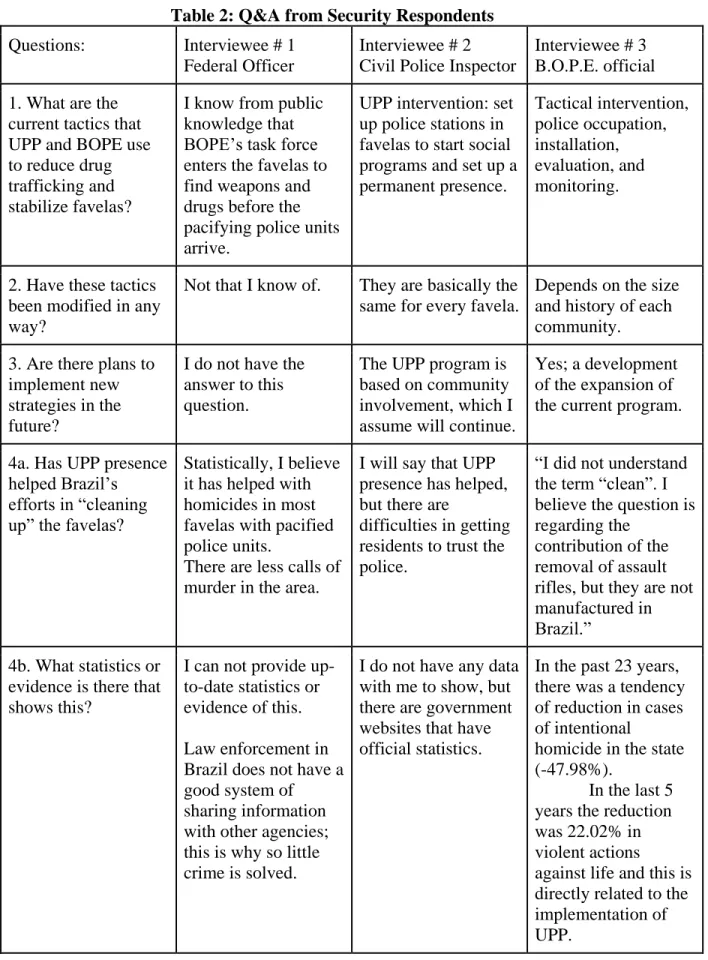
This interviewee is a member of BOPE, and states that "a more effective border control over the entry of weapons and drugs would greatly help" in efforts to reduce crime and violence in the favelas. Regarding the main questions of this study (as discussed in Chapter 3), I found that Rio de Janeiro's police forces have no new strategies in place for the future; at least not in public. I don't have any data with me to show, but there are government websites that have official statistics.
To measure the operational efficiency within institutions involved in delivering better results in the control of crime in the state in strategic, tactical and. Brazil is a country that solves only 3 – 5% of its crimes, so I think the tactics of UPP will help with the drug problems and other crimes in the favelas. Because of the many years of police abuse and abuse of the people during Brazil's dictatorship.
The public security department of the state, in particular the military police and, alternatively, the civil police. On the other hand, there is relevant literature on this topic, as well as information from one of the. An increase in the number of missing persons was also noted during the last years of UPP implementation.
Since my study did not reveal any new tactics that UPP plans to use in the future beyond their current practices, it is too early to tell the success of anything they might add in the next few years. Right now, however, there is still a debate between law enforcement, the media, and the public as to what true success is. According to a BOPE interviewee, there are many people who do not believe that pacification efforts are sustainable in a logical sense, given the number of favelas to be reached in the state of Rio and the state's ability to "produce the police" that would coped with the demand.
As mentioned earlier, some of the future strategies that the interviewees proposed to the government consisted of basic social and education/sanitation programs within the country.
Discussion and Conclusion
The Rio state government's efforts to reduce crime in Rio de Janeiro are of particular importance because it established the Rio Peaceful Police Units and introduced the steps these units take to maintain peace and stabilize the favelas. The initial purpose of this research was to study Brazil's current pacification efforts in Rio de Janeiro's favelas. It is true that the homicide rate has decreased in the state of Rio de Janeiro recently, but in other areas of Brazil violent crime has increased, possibly due to drug traffickers moving to other areas outside of Rio and becoming involved. in turf wars with other gangs. .
As for the question of any new or future tactics they intend to use, from what I gather, Rio de Janeiro's police forces do not have any new strategies in place for the future, at least not publicly. While community policing may work in the United States and elsewhere, there is a possibility that it may not work in Brazil. In addition to security efforts, other factors are needed to create peace in the favelas.
Retrieved from http://www.newsrecord.co/did-brazil-spend-too-much-on-the-fifa-world-cup/. Retrieved from http://www.dailymail.co.uk/news/article-2342458/Cleaning-Brazils-dangerous-favelas-How-armed-police-waging-war-vicious-drug-cartels-rule-slums-Rio- battle-makes-city-safe-eyes-world-turn-2016-Olympic-Games.html. Retrieved from http://www.insightcrime.org/news-analysis/rio-de-janeiro-stray-bullet-problem-resurges.
The case of Rio de Janeiro, Brazil, Understanding Slums: Case studies for the Global Report on Human Settlements, Urban Slums Report. Retrieved from http://www.insightcrime.org/news-analysis/latin-america-dominates-list-of-worlds-most-violent-cities. Bastard Child of Dictatorship: Comando Vermelho and the Birth of the "Narco Culture" in Rio de Janeiro." Luso-Brazilian Review.
Rio de Janeiro's favelas marked on city maps after decades of 'invisibility' Retrieved March 20, 2015, from Retrieved from http://www.latina.com/lifestyle/news/missing-persons-rise-rio-de-janeiro-brazil. Favela pacification in Rio de Janeiro: why the program works and what the lessons are for other countries.


