Selection
C H A P T E R
5
• • • •
A key feature of the labour market of the current era is its competitiveness, caused by a rise in the number of jobs and a decline in the traditional sources of labour. For the hospitality industry it is likely to be extremely competi- tive as other service industries expand or emerge and compete for labour.
The consequence is that organizations will have to put much more effort into designing attractive jobs and conditions, using effective recruitment methods and developing applicant-friendly selection techniques.
These techniques will have to serve the dual purpose of ensuring that the proper candidates are selected and also that the employing organization is sold effectively, remembering always that many candidates may also be customers of the enterprise.
The selection process
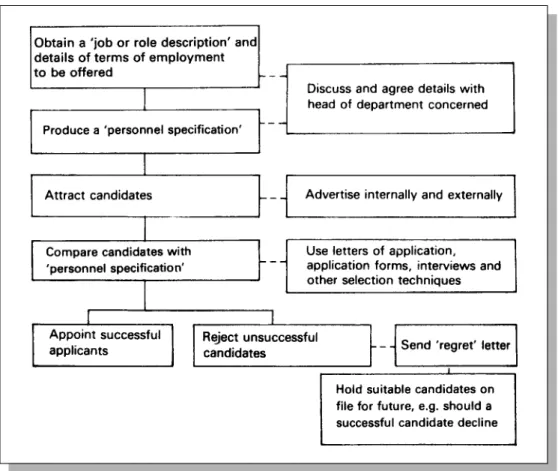
One of a manager’s major responsibilities is to initiate action but to do this he or she has to receive and inter- pret information in order to arrive at conclusions that will lead to the right action. The further up the hierar- chy of management that people move the more they exercise skills of judgement and the less they carry out routine and supervisory tasks. In fact, a senior man- ager’s job should normally be devoted almost entirely to making decisions that implement action and to designing systems that enable better decisions to be made. The skill of selecting staff is concerned entirely with this same process. In filling a vacancy a manager obtains information, sorts it, compares it, makes con- clusions and implements action. This is illustrated in Figure 5.1.
Effectively Resourcing the Hospitality Organization
A manager will use the selection procedure normally for three different occasions:
1 To choose the most suitable person from several applicants to fill one vacancy.
2 To choose the right job from several for an applicant or several applicants.
3 Where there is only one applicant for a vacancy, to decide whether to appoint that applicant and, if so, to know his or her strengths and weaknesses so that additional supervision or appropriate training can be given, or so that the job can be modified.
In order to do this the manager should go through the procedure (described in Chapters 3 and 4) of preparing a comprehensive job or role description and personnel specification. Correct advertising will attract candidates and it is then the manager’s job to ensure that information is obtained from candidates in a way that enables a comparison to be made with the personnel specification. From this procedure the most suitable applicant will emerge.
To assist in selection a variety of tools are available to the manager, including letters of application, application forms, interviews, group selection procedures, assessment centres and a range of tests sometimes referred to as psychometric tests.
• • • • 74
Figure 5.1 The selection procedure simplified
Selection
Selection procedures attempt to predict, as accurately as possible, a person’s likely performance in a particular job or, where there are several vacancies, the job in which he or she is most likely to be successful. Most selection methods are of a
‘historical’ nature, i.e. they base their predictions about future performance on a person’s past performance. Other methods, such as group selection procedures, set out to predict future performance by simulating the type of work the candidates will have to perform. However, most people accept that, economic and human con- siderations apart, the best method is to employ a person for a period of time and then, if they prove satisfactory, to offer them the job. This is obviously not a practi- cal method, although trial periods are used both consciously and unconsciously in most industries. Selection procedures, however, need to be designed in order to elicit the most useful and appropriate information in the most economical way.
The personnel specification
In attempting to assess or to measure a person’s suitability for a job it is important to know what characteristics are to be measured. The range and description of these characteristics can be vast and in many cases almost meaningless to the uninitiated. Some interview assessment forms contain a long list of items including charm, punctuality, honesty, integrity, ability, etc. Many of these are supposed to be assessed (or guessed) at an interview.
Most characteristics or patterns of behaviour, however, can be grouped under several broad headings and two methods of assessment in particular are of inter- est. The National Institute of Industrial Psychology (NIIP) system uses seven broad headings and J. Munro Fraser’s plan uses five (Figure 5.2). The fivefold system is a system for measuring to what degree an individual possesses each of
75 • • • • Figure 5.2 A summary of two approaches to staff selection
THE SEVEN-POINT PLAN (NIIP).
The seven-point plan covers:
1 Physical make-up — health, physique, appearance, bearing and speech.
2 Attainments — education, qualifications, experience.
3 General intelligence — fundamental intellectual capacity.
4 Special aptitudes — mechanical, manual dexterity, facility in the use of words or figures.
5 Interests — intellectual, practical: constructional, physically active, social, artistic.
6 Disposition — acceptability, influence over others, steadiness, dependability, self-reliance.
7 Circumstances — domestic circumstances, occupations of family.
THE FIVEFOLD GRADING SYSTEM (MUNRO FRASER).
The fivefold grading system covers:
1 Impact on others — physical make-up, appearance, speech and manner.
2 Acquired qualifications — education, vocational training, work experience.
3 Innate abilities — natural quickness of comprehension and aptitude for learning.
4 Motivation — the kinds of goals set by the individual, his consistency and determination in following them up, his success in achieving them.
5 Adjustment — emotional stability, ability to stand up to stress and ability to get on with people.
Effectively Resourcing the Hospitality Organization
five points or groups of characteristics. Most managers will not wish to use rigidly such systems, instead they may wish to develop their own. It is impor- tant, however, to be consistent and to ensure that such specifications are not discriminatory in any way.
In producing a personnel specification, therefore, inclusion of such aspects with indications of desirable characteristics or precise requirements creates a ‘pen pic- ture’ of the person required. During the subsequent selection procedure, candidates should be assessed or measured in the same way, making it a relatively simple task to identify the person with the assessment nearest to the personnel specification. He or she should be the most suitable of the candidates.
Letter of application
Generally, it is not advisable to use letters of application as a selection method, any more than the telephone, without the support of an interview or other method.
However, well-designed advertisements can ask applicants to give sufficient infor- mation from which some candidates can be chosen for interview. A typical sentence at the end of an advertisement would read: ‘Kindly write giving details, include education, training, experience, and earnings to . . .’
The main occasion when selection will depend only upon an application letter is when applicants live at some distance, usually overseas. In such cases the cost of travel excludes the possibility of interviewing. Previous empoyers’ references then become extremely important.
To attempt to make an appointment purely on the strength of information con- tained in a letter is very risky but if done, references and a full curriculum vitae should certainly be obtained first.
Telephone and internet applications
Some employers have developed methods for using the telephone and the internet systematically as the first step in the selection procedures. When an applicant telephones he or she is interviewed via the telephone, the interviewer using a telephone interview questionnaire. The employer is able, as a con- sequence, to decide on the next step in the process. The internet is used in a simi- lar way.
Application forms
The application form is used primarily to gather together relevant details so that the selector has this information at his or her fingertips and can make fair comparisons with the personnel specification and with other candidates’ applications.
When designing an application form it is important to remember that it may have to serve several purposes such as
1 deciding whom to invite for an interview 2 being used as an interview assessment form
3 documenting employees and obtaining referees’ names and addresses
• • • • 76
Selection
4 providing a reserve list of potential employees
5 measuring the effectiveness of various recruitment media 6 analysing the labour market
7 obtaining agreement for medical examination, reference enquiries, etc.
The information required on an application form will, therefore, include some or all of the following:
1 position applied for
2 personal data – name, address, telephone number, nationality
3 education – schools, subjects studied, exams passed and further education 4 professional qualifications
5 experience – jobs, duties, responsibilities, employers, earnings, reasons for leaving
6 skills – e.g. word processing (which applications?), PBX, languages 7 military experience – branch of the service, rank attained, experience
8 personal circumstances – when available, prepared to travel or to move, current holiday plans
9 medical history
10 interests – hobbies, sports, other activities
11 record of offences. Note: This is subject to the Rehabilitation of Offenders Act.
Note: Questions relating to sex, marital status, children, age may be discriminatory and have to be considered very carefully (usually after legal advice). If asked, the purpose should be for discrimination monitoring purposes i.e. to demonstrate that no discrimination occurs.
The exact nature and extent of the information asked for will depend on the type of job and the employer’s administrative requirements, but it should be con- fined to information necessary for sound assessments to be made. It is not appro- priate, therefore, for one blanket-type form to be used for all job categories. The type of form used for senior executives, which asks about professional qualifica- tions and total employment history, would not be suitable for an unskilled worker such as a room attendant, where the last five years’ work history may be quite sufficient.
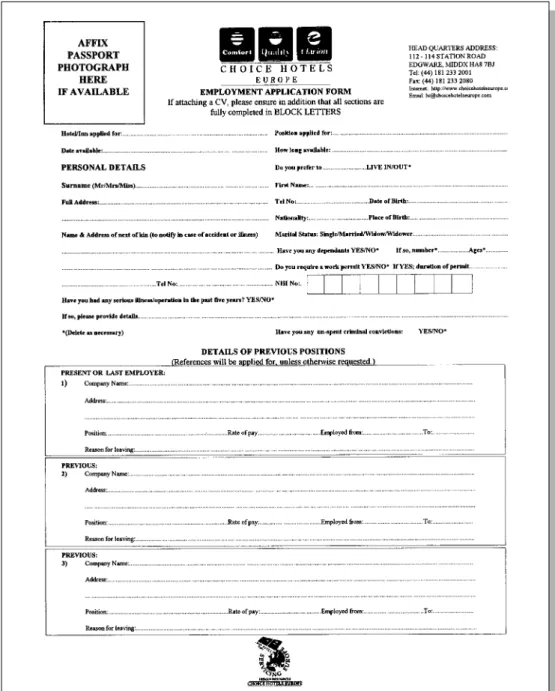
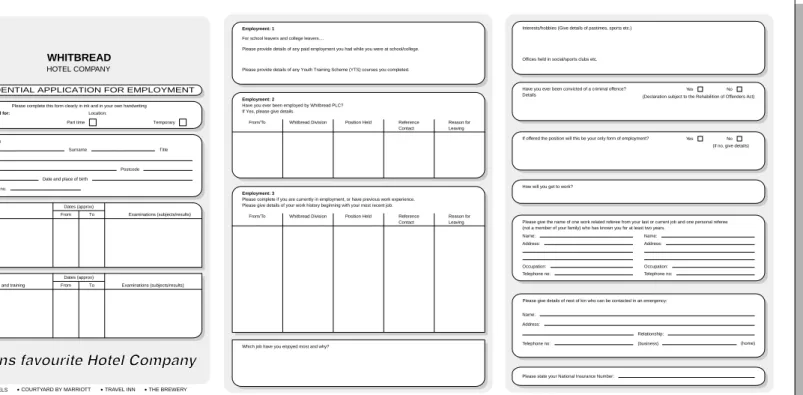
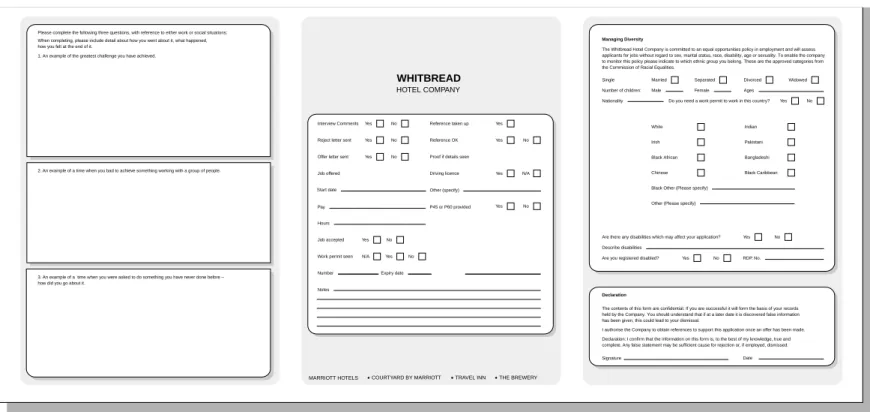
In the design of an application form, legal aspects also have to be considered, particularly discrimination legislation. Questions about marital status and num- ber of children, for example, may be permitted so long as everyone, regardless of sex, is asked such questions, and decisions are not based on this information to the exclusion of other information. See Figures 5.3 and 5.4 for examples of application forms.
The interview
The next step after candidates have completed and submitted their applications, or discussed their qualifications on the telephone, is to invite selected candidates in for interviews. The interview is the most commonly used method of selection. It is also considered by many to be one of the least effective, largely because it bears no resemblance to what a person is likely to be employed to do and also because few
77 • • • •
Effectively Resourcing the Hospitality Organization
managers are properly trained in interview techniques. In one survey of graduate recruits, 52% reported that their selection interviews had left them with a poor impression of the company, due to lack of skill on the part of the interviewer (Personnel Management, October 1989). Consequently, many bad appointments are made because the candidates have not had the opportunity to show their paces,
• • • • 78
Figure 5.3 Application form for non-management positions Source: Reproduced by courtesy of Choice Hotels Europe.
Selection
or because the interviewer could not interpret rightly the available information.
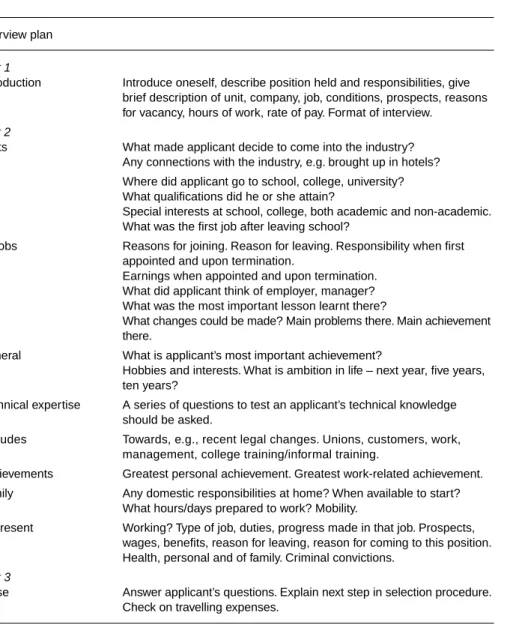
It is not possible in this book to discuss interviewing in depth, but excellent books have already been written on the subject (see the further reading at the end of this chapter). In conducting an interview, however, it is important to keep to a plan (see Figure 5.5 for an example), and the simplest method is to follow chronological order – starting at childhood and working up to the present day.
Questions normally become more searching as one approaches current or more
79 • • • • Figure 5.3 continued
Figure 5.4 A typical extended application form Source: Reproduced by courtesy of Marriot Hotels.
CONFIDENTIAL APPLICATION FOR EMPLOYMENT
Please complete this form clearly in ink and in your own handwriting Position applied for:
Full time
Location:
Part time Temporary
Education Schools
Dates (approx)
From To Examinations (subjects/results)
Dates (approx)
Examinations (subjects/results)
Further education and training From To
Personal details
Forenames Surname
Address
Title
Postcode
Age Date and place of birth
Home telephone no.
WHITBREAD
HOTEL COMPANY
MARRIOTT HOTELS • COURTYARD BY MARRIOTT • TRAVEL INN • THE BREWERY
Employment: 1
Employment: 2
Have you ever been employed by Whitbread PLC?
If Yes, please give details.
For school leavers and college leavers....
Please provide details of any paid employment you had while you were at school/college.
Please provide details of any Youth Training Scheme (YTS) courses you completed.
From/To Whitbread Division Position Held Reference
Contact
Reason for Leaving
Employment: 3
Please complete if you are currently in employment, or have previous work experience.
Please give details of your work history beginning with your most recent job.
From/To Whitbread Division Position Held Reference
Contact
Reason for Leaving
Which job have you enjoyed most and why?
Interests/hobbies (Give details of pastimes, sports etc.)
Offices held in social/sports clubs etc.
Have you ever been convicted of a criminal offence?
Details (Declaration subject to the Rehabilition of Offenders Act)
Yes No
(if no, give details)
Yes No
If offered the position will this be your only form of employment?
How will you get to work?
Please give the name of one work related referee from your last or current job and one personal referee (not a member of your family) who has known you for at least two years.
Name:
Address:
Name:
Address:
Occupation:
Telephone no:
Name:
Address:
Occupation:
Telephone no:
Please give details of next of kin who can be contacted in an emergency:
Relationship:
(business)
Telephone no: (home)
Please state your National Insurance Number:
Figure 5.4 continued
Managing Diversity
The Whitbread Hotel Company is committed to an equal opportunities policy in employment and will assess applicants for jobs without regard to sex, marital status, race, disability, age or sexuality. To enable the company to monitor this policy please indicate to which ethnic group you belong. These are the approved categories from the Commission of Racial Equalities.
Single Married Separated Divorced Widowed
White Indian
Irish Pakistani
Chinese Black Caribbean
Black African Bangladeshi
Yes No
Are there any disabilities which may affect your application?
Declaration
The contents of this form are confidential. If you are successful it will form the basis of your records held by the Company. You should understand that if at a later date it is discovered false information has been given, this could lead to your dismissal.
I authorise the Company to obtain references to support this application once an offer has been made.
Declaration: I confirm that the information on this form is, to the best of my knowledge, true and complete. Any false statement may be sufficient cause for rejection or, if employed, dismissed.
Signature Date
Yes No
Nationality Do you need a work permit to work in this country?
Black Other (Please specify)
Other (Please specify)
Describe disabilities
Yes No
Are you registered disabled? RDP. No.
Male Female Ages
Number of children:
Job accepted Yes No
Interview Comments Yes No Reference taken up Yes
Reject letter sent Yes No Reference OK Yes No
Offer letter sent Yes No Proof if details seen
Work permit seen N/A Yes No
Job offered Driving licence Yes N/A
Start date Other (specify)
Notes
Number Expiry date
Pay P45 or P60 provided Yes No
Hours
WHITBREAD
HOTEL COMPANY
MARRIOTT HOTELS • COURTYARD BY MARRIOTT • TRAVEL INN • THE BREWERY Please complete the following three questions, with reference to either work or social situations:
When completing, please include detail about how you went about it, what happened, how you felt at the end of it.
1. An example of the greatest challenge you have achieved.
3. An example of a time when you were asked to do something you have never done before – how did you go about it.
2. An example of a time when you bad to achieve something working with a group of people.
3. An example of a time when you were asked to do something you have never done before – how did you go about it.
Effectively Resourcing the Hospitality Organization
• • • • 82
Interview plan Part 1
Introduction Introduce oneself, describe position held and responsibilities, give brief description of unit, company, job, conditions, prospects, reasons for vacancy, hours of work, rate of pay. Format of interview.
Part 2
Facts What made applicant decide to come into the industry?
Any connections with the industry, e.g. brought up in hotels?
Life Where did applicant go to school, college, university?
What qualifications did he or she attain?
Special interests at school, college, both academic and non-academic.
What was the first job after leaving school?
All jobs Reasons for joining. Reason for leaving. Responsibility when first appointed and upon termination.
Earnings when appointed and upon termination.
What did applicant think of employer, manager?
What was the most important lesson learnt there?
What changes could be made? Main problems there. Main achievement there.
General What is applicant’s most important achievement?
Hobbies and interests. What is ambition in life – next year, five years, ten years?
Technical expertise A series of questions to test an applicant’s technical knowledge should be asked.
Attitudes Towards, e.g., recent legal changes. Unions, customers, work, management, college training/informal training.
Achievements Greatest personal achievement. Greatest work-related achievement.
Family Any domestic responsibilities at home? When available to start?
What hours/days prepared to work? Mobility.
At present Working? Type of job, duties, progress made in that job. Prospects, wages, benefits, reason for leaving, reason for coming to this position.
Health, personal and of family. Criminal convictions.
Part 3
Close Answer applicant’s questions. Explain next step in selection procedure.
Check on travelling expenses.
Figure 5.5 An example of what can be included in an interview plan
recent experiences, and these later questions must therefore be designed to test fully a person’s claimed level of competence and likely level of achievement.
Main types of interview
The most common method is the individual interview, i.e. one interviewer inter- views one candidate at a time. Although this method usually enables the candidate to relax more quickly, there is the risk of bias or preference – particularly if the inter- viewer’s decision is made independently of other colleagues.
Selection
The second method is a panel interview or selection board – very common in the public sector. This will usually consist at least of the line manager concerned and a personnel specialist. This approach reduces the risk of bias, particularly as the panel increases in size. However, for many candidates a panel interview can be a daunting experience, particularly as some panels are constituted more for political reasons than for expertise. The format of the panel interview can be var- ied by candidates being seen individually in turn by each member of the selec- tion panel.
There is one type of interview sometimes referred to as a ‘stress’ interview. The intention is to create a stress situation to see how an applicant reacts. It is only valid if a person is likely to encounter stress situations (e.g. difficult customers) regularly and such interviews should only be administered by trained interview specialists.
Even so, there are serious doubts about the ethics of conducting such an interview without giving the candidate prior notice – in which case much of the effect of the stress interview will be lost. The methods of selection used by the armed services tend to create such situations but this is because the military are likely to be sub- jected to severe stress.
Some do’s and don’ts
The following do’s and don’ts should be useful.
Do
1 Have a clear job or role description, personnel specification, details of condi- tions, and an interview plan that contains prepared technical questions.
2 Use a quiet, comfortable room.
3 Suspend all phone calls and other interruptions.
4 Introduce yourself, be natural and put the candidate at ease.
5 Explain clearly the job, conditions of employment and prospects.
6 Ask questions that begin with when, where, why, who, what and how. This avoids receiving ‘yes’ and ‘no’ as an answer and encourages the candidate to talk.
7 Avoid asking unnecessary questions already answered on the application form.
8 Listen and let the candidate talk freely, but at the same time guide and control the interview.
9 Encourage the candidate to ask questions.
10 Close the interview firmly and explain the next step in the procedure.
11 Treat all candidates as though they are potential employees and customers.
12 Write up your assessment immediately after each interview (see Figure 5.6 for an example).
If necessary make notes during an interview, but do explain to the candidate that this is necessary so that nothing of importance will be forgotten.
Don’t
1 keep the candidate waiting 2 oversell the job
3 conceal unpleasant facts about the job 4 interrupt or rush the interview
83 • • • •
Effectively Resourcing the Hospitality Organization
• • • • 84
Figure 5.6 Selection interview appraisal report (for a senior appointment) Source: Croner’s Personnel Records, with kind permission of Croner Publications.
Selection
5 preach to the candidate
6 read out to the candidate what is on the application form: he or she filled it in and knows it already
7 ask questions that indicate the answer
8 ask questions that only get ‘yes’ or ‘no’ for an answer 9 allow the first impression to influence the whole interview 10 ask unnecessary personal questions
11 raise hopes unnecessarily
12 leave candidates with a bad opinion of your organization; they may be potential customers in other contexts.
13 wait until the end of the day or even till the following day to write up your assessments.
85 • • • • Figure 5.6 continued
Effectively Resourcing the Hospitality Organization
The three C’s – contact, content, control
There are many different approaches to developing and practising interview tech- nique; readers interested in taking the subject further should read the books listed at the end of this chapter. One simple approach for the non-specialist HR or personnel manager to use as a guide is one referred to as the three C’s – contact, content, control.
‘Contact’ refers to the ability to make contact with the candidate, to develop a rapport. This is achieved by setting out to enable the candidate to relax so that the real person comes through. This is a difficult situation to achieve because for many candidates the interview can be very nerve-racking.
However, a number of techniques, usually combined, can help, such as those listed below:
• Interview in an informal setting, but where there are no risks of disturbances or of being overheard.
• Avoid having a desk between the interviewee and yourself – a desk creates a psychological barrier.
• Offer a cup of tea or coffee.
• Invite a candidate to smoke if he or she wishes.
• Discuss common ground, e.g. a hotel, company, manager, town, football team, known to both of you (this information is easily found in a good application form).
• Use body language, e.g. move towards the candidate to emphasize that you are interested in what is being said.
• Use encouraging statements such as ‘That’s interesting’, or ‘Tell me more about that’.
‘Content’ is concerned with the two most important issues of selection – competency and compatibility. Can the person do the job, i.e. will he or she be competent?
Secondly, will he or she fit into the team, i.e. be compatible? Thus the interview must cover all the important ground, including a person’s technical competence, ability to get on with others and maybe their ability to take on increased responsibilities. It is particularly difficult to judge a person’s future potential but one useful piece of infor- mation can be provided by a person’s perspective of what is challenging. The ques- tion ‘What is the biggest work-related responsibility you have ever had?’ can be very informative. One person may answer, ‘To have catered for 5000 at an agricul- tural show’, whereas another candidate may answer, ‘To have prepared a cold buffet for 200.’ Such answers enable the interviewer, having checked the facts, to deter- mine which of the applicants is more likely to fit in with the employer’s scale of expectations.
Another important piece of information useful in predicting a candidate’s growth potential is their career progression chart. From this, one can look for growth in responsibility, such as size of establishment, number of subordinates, standards (e.g. star rating) and earnings over a period of time. Figure 5.7 shows three hypo- thetical career paths.
Manager A (aged 33) has had an erratic career, manager B (aged 33) appears to be on a growth path and manager C (aged 40) has plateaued out. If all three were applying for a position with, say, around 150–200 subordinates, everything else
• • • • 86
Selection
being equal, then manager B appears to be most likely to be suited for the posi- tion. Obviously, many other factors have to be considered such as the number of job changes or promotions in each person’s career and the reasons for the changes.
Another important aspect of ‘content’ is to ensure that the interviewer commu- nicates all the necessary information to the candidate, pleasant and unpleasant (e.g. unsocial hours). The interview is, after all, a two-way process.
‘Control’ refers to the interviewer’s ability to ensure that the interview plan is completed in the time allocated. This will require the skill to guide the candidate through the career and technical questions and to bring the candidate back if he or she begins to wander from the subject – without changing the ‘contact’ or rapport being built up.
One final rule and a useful one by which an interviewer’s skill can be measured is to estimate the amount of time devoted by the interviewer to listening and to talk- ing. Generally, the less the interviewer talks the better he or she is at formulating questions, listening and making the right assessment.
Group selection procedures and assessment centres
The main weakness of the interview is that it relies on one technique only. This weakness can be compensated for to some extent by training and by involving a number of people in the process. One way of improving the reliability of a selec- tion method, however, is to introduce more techniques so that the combination of techniques exposes more of a candidate’s skills, personality traits, etc. to scrutiny.
This is increasingly done through assessment centres or group selection proce- dures, which trace their roots back to methods used to select officers for the armed services.
These are specialized techniques and should always be conducted by people trained in their design, operation and interpretation. The purpose of a group selec- tion procedure is to observe candidates’ behaviour in a situation or in a variety of
87 • • • • Figure 5.7 Comparative career progression chart
Effectively Resourcing the Hospitality Organization
situations similar to those they would have to face in the organization. A group selection procedure could include
1 analysis of problems with reports and presentations 2 group discussions and debates
3 business games and in-tray exercises 4 individual interviews
5 tests – aptitude, personality, interest 6 informal drinks and dinner
7 simulating an element of the job for which the candidate is applying, e.g. selling conference facilities.
Group selection procedures and assessment centres are normally used to identify personality traits, skills, etc. and to predict behaviour that is difficult to assess in an interview or from personal history. These traits may include leadership ability, per- suasiveness, self-confidence, ability to stand up to pressure, and mental flexibility.
Such procedures are used both for recruiting new employees (usually senior) and for assessing the promotion potential of existing employees.
Psychometric tests
The testing of individuals in education, at work and in other aspects of their lives has been going on in various forms for many years. Its main industrial purpose is to help to predict future performance in particular fields by understanding individual and group behaviour. As with other selection procedures, testing assists in identifying the most suitable person for a job and in identifying the most suitable jobs for individuals.
Claims are made that well-constructed tests predict performance better than most other selection measures (Best Test Practice, 1991). It is reported that 85% of organiza- tions now use tests (IPM/Mori, 1994), although such a percentage in the hospitality industry is most unlikely due to the large number of small employers.
Most tests can normally be administered only under the supervision of a trained person. The five main groups of tests are as follows.
Intelligence (IQ) tests
These measure the stage of development of intelligence in children and the intelli- gence of adults relative to the general population. The mean score is 100. Such tests are commonly used to determine whether a person will be able to cope with certain intellectual tasks.
Attainment tests
These measure the degree to which a person has acquired knowledge or skill.
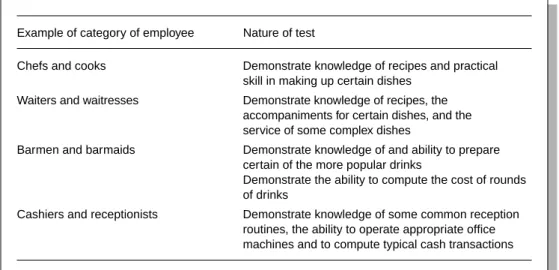
Applicants for jobs such as cashier, book-keeper or other clerical positions could be given simple attainment tests which could easily be devised by supervisors along with a personnel or training specialist. But it is important, in designing such tests, to recognize that failure to do the test may not indicate total unsuitability, but only a need for training. Many more skill or attainment tests, including those shown in Figure 5.8, could be used in this industry.
• • • • 88
Selection
Aptitude tests
This group of tests identifies an individual’s innate suitability for particular types of work and can indicate whether a person would be more suited to one type of work rather than another.
Interest tests
These tests indicate broadly which type of work an individual would prefer, such as: indoor, outdoor, computational, gregarious, individual, routine, creative. It is important to stress that an interest in, or preference for, particular work need not indicate an aptitude for that work. However, where an aptitude for a certain type of work is supported by an interest in the same type of work, the chances of that indi- vidual succeeding are likely to be much higher.
Personality tests
These tests determine an individual’s reactions to different situations, from which general conclusions can be drawn about likely future behaviour. They are concerned mainly with measuring non-intellectual characteristics. In particular most attempt to measure how a person relates to the world around him or her and they do this by measuring the degree to which the person possesses certain personality traits, such as drive, stability, persuasiveness, self-confidence, intro- version and extroversion. Some personality tests, such as Raymond Cattell’s 16PF (Sixteen Personality Factor Questionnaire), are claimed to be extremely comprehensive, covering most aspects of personality encountered in normal individuals.
89 • • • •
Example of category of employee Nature of test
Chefs and cooks Demonstrate knowledge of recipes and practical skill in making up certain dishes
Waiters and waitresses Demonstrate knowledge of recipes, the accompaniments for certain dishes, and the service of some complex dishes
Barmen and barmaids Demonstrate knowledge of and ability to prepare certain of the more popular drinks
Demonstrate the ability to compute the cost of rounds of drinks
Cashiers and receptionists Demonstrate knowledge of some common reception routines, the ability to operate appropriate office machines and to compute typical cash transactions
Figure 5.8 Attainment tests – examples of uses
Effectively Resourcing the Hospitality Organization
In some countries, France for example, graphology is used. Graphology is the study of handwriting in order to determine personality. In the UK and many other countries it is, however, not considered to be a reliable method of testing for employment purposes.
Test batteries
It will be clear that each of the groups of tests mentioned above, with one or two possible exceptions, attempts to measure limited aspects of an individual. These are intelligence, attainment, aptitude, interests and personality. Each individual employed, however, needs levels or aspects of each of these characteristics and using one type of test only may not do the person justice. As a result some selection specialists use a battery or variety of tests that measure several of those aspects of a person that may be considered of importance. Additionally, a test battery may be only part of an overall procedure incorporated, for example, in a group selection procedure or assessment centre.
There is concern that tests may have a disparate impact, i.e. their use may result in discriminating against, or in favour of, one or more groups. Codes of practice concerning the use of tests have been produced by the Institute of Personnel and Development and by the Commission on Racial Equality.
References
It is important to remember that references are only as reliable as the judgement of the person giving them, and because of the fear some employers have of putting a bad or indifferent reference in writing, many written references are worthless. The best procedure for obtaining references, therefore, is to telephone referees and to discuss a candidate’s application on the telephone. This discussion should be writ- ten up afterwards so that it can be put into a person’s file (remember that under the Data Protection Act the subject may have the right to see this). Alternatively, a stan- dard letter or questionnaire asking previous employers to confirm certain details can be used (Figure 5.9).
References must only be sought after candidates have been offered an appoint- ment subject to references, since they may not have informed their current employer of their plans to move – unless, of course, they have given specific per- mission for references to be applied for before an offer of appointment is made (which is common in the public sector).
Successful selection, i.e. placing suitable people into the right jobs, is vital to the prosperity of an organization. But selection can only be successful if it is carried out methodically, and this requires a clear job description and personnel specification, plus a system that ensures that the most suitable candidates are attracted and identified. This will require well-designed advertisements and application forms that elicit appropriate information. Interviews and other selec- tion techniques, as outlined above, will then have to be conducted enabling the assessor to predict, as accurately as possible, a candidate’s performance if he or she were to be appointed. This will involve knowing which characteristics are desirable and it will also involve using techniques that identify or measure those same characteristics.
• • • • 90
Selection
Future trends
For the industry’s smaller employers the need to adopt more effective selection techniques, or at least to apply commonly used ones more effectively, is vital.
Larger organizations need to examine not only the techniques they use but
91 • • • • Figure 5.9 A reference enquiry letter
Source: Reproduced by courtesy of Choice Hotels.
Effectively Resourcing the Hospitality Organization
also where the emphasis is placed. Currently, for example, most applicants are eliminated before interview on the basis of their application form – among the least reliable of the selection tools. The most systematic methods are used on the smallest number, those who remain after the first screening. Maybe more effort needs to be devoted to ensuring that the good candidates who currently are lost through the initial screening are not lost, by using more sys- tematic methods in the earlier stages of the process such as through telephone or internet interview. This would require considerably more thought in design- ing recruitment literature, so that self-selection plays a bigger part in bringing forward a smaller number of candidates, who are better candidates, followed maybe by self-administered tests. It is very likely that the internet will help this process.
Careful selection is an investment in team building and though it is more time-consuming and hence more costly than haphazard recruitment, the reduction in labour turnover which normally results, together with the conse- quent improvement in efficiency and customer satisfaction, should make it worthwhile.
Further Reading and References
Armstrong, M. (1999) A Handbook of Human Resource Management, 7th edn, London: Kogan Page.
Beardwell, I., Holden, L. and Claydon, T. (2004) Human Resource Management—A Contemporary Approach, 4th edn, Harlow: Prentice Hall.
Best Test Practice(2001) London: Savill & Holdsworth.
D’Annunzio-Green, N., Maxwell, G. and Watson, S. (2002) Human Resource Management—
International Perspectives in Hospitality and Tourism, London: Continuum.
Eder, R. W. and Ferris, G. R. (1989) The Employment Interview, London: Sage.
Goldsmith, A., Nickson, D., Sloan, D. and Wood, R. C. (1999) Human Resource Management for Hospitality Services, London: International Thomson Business Press.
Goss-Turner, S. (2002) Managing People in the Hospitality Industry, Kingston-upon-Thames:
Croner Publications.
Institute of Personnel Management (1991) Best Test Practice, Wimbledon: Institute of Personnel Management.
Institute of Personnel Management/Mori (1994) Recruitment Methods, Wimbledon: Institute of Personnel Management.
Lucas, R. (2004) Employment Relations in the Hospitality and Tourism Industries, London:
Routledge.
Pugh, D. S. and Hickson, D. J. (1997) Writers on Organizations, 5th edn, London: Penguin.
Rae, L. (1991) The Skills of Interviewing: A Guide for Managers and Trainers, 2nd edn, Aldershot:
Gower.
Riley, M. (1996) Human Resource Management in the Hospitality and Tourism Industry, Oxford:
Butterworth-Heinemann.
Sisson, K. (ed.) (1989) Personnel Management in Britain, Oxford: Blackwell.
Torrington, D., Hall, L. and Taylor, S. (2002) Human Resource Management, 5th edn, Harlow:
Pearson Education.
• • • • 92
Selection
Questions
1 Describe the objectives of selection, the alternative methods and the various steps you would normally expect to find in a systematic selection procedure.
2 Discuss which you consider to be the most effective selection method and why.
3 Compare and contrast interviews, psychological tests and group assessment procedures.
4 Discuss what changes are likely to be made in the future to improve selection procedures.
5 Evaluate the approach to selection used by an employer you know well.
93 • • • •