Thesis by Myles Benton Herbert
In Partial Fulfillment of the Requirements for the degree of
Doctor of Philosophy
CALIFORNIA INSTITUTE OF TECHNOLOGY Pasadena, California
2014
(Defended April 28th, 2014)
2014 Myles Benton Herbert
All Rights Reserved
ACKNOWLEDGMENTS
I would first like to thank my advisor, Bob Grubbs, who made all of the work described in this thesis possible. Since joining the group, Bob has been exceptionally supportive and confident in my ability to perform productive research. He has given me independence in choosing which projects to pursue and the directions these projects go, but his suggestions have kept me on track along the way. I value him as a mentor and know that he will continue to provide great advice as I continue my career. My undergraduate research advisor, Matt Francis, also deserves special thanks. He inspired me to be a better chemist and made me confident in my desire to pursue a doctorate in chemistry. Nicholas Stephanopoulos, my graduate student mentor in the Francis group, has also inspired me in this way. My graduate committee includes some of the smartest and most talented scientists I have ever met. The advice they have given me has been invaluable. A special thanks to Dave Tirell, Jonas Peters, and Theo Agapie. Without the support and enthusiasm of all of these people, I would undoubtedly not be the scientist I am today.
The Grubbs group is comprised of fantastic scientists and people. I would particularly like to thank B. Keith Keitz and Koji Endo, who laid the groundwork for most of the research described in this thesis and were my mentors when I first started in the lab. I had the great pleasure of working with many talented graduate students and postdocs over the last five years. I worked directly with Dr. Hiroshi Miyazaki, Dr. Pinky Patel, Dr. Sarah Bronner, Dr. Vanessa Marx, and Lauren Rosebrugh on projects and am very appreciative of them for their hard work and important insights. Dr. Matthew Van Wingerden, Dr. Chris Daeffler, and Dr. Renee Thomas were senior graduate students when I arrived and, in addition to their friendship, answered many of my naïve questions. Dr. Vlad Iluc, Dr. Garret Miyake, Dr. Alexey Fedorov, Dr. Rosemary Conrad Kiser, Dr. Jeff Cannon, Dr. John Hartung, Dr. Bill Morandi, and Ben Ragnar are thanked for their friendship and advice. Zachary Wickens, Brendan Quigley, Nick Swisher, and Ray Weitekamp are good friends and people I am constantly learning from, including about how to
ingMob properly. I would like to thank Dr. Peter Dornan, Dr. Shane Mangold, Dr. Chris Bates, Dr. Rob McFarlane, Dr. Hoyong Chung, Dr. Pablo Guzman, Dr. Melanie Pribisko Yen, Carl Blumenfeld, Anton Toutov, Julian Edwards, Tonia Ahmed, and Alice Chang for being good labmates. For more than two years, I mentored an undergraduate student Ben Suslick. I have seen him transform from a metal head who would only wear Slayer or Megadeth t-shirts to someone who wouldn’t be caught dead without his vineyard vines polo, dress slacks, and Sperry boat shoes. In addition, he has become a very talented and creative chemist, and I know that he’s going to do great things.
I have had the opportunity to collaborate with a number of people outside of Caltech.
Peng Liu and Yu Lan from the Houk group at UCLA performed DFT calculations that elucidated important information about our family of chelated catalysts and have greatly accelerated our research. Richard Pederson and Daryl Allen have supplied countless grams of catalyst and were very helpful to talk to about pheromone synthesis. My research would not be possible without the help of the entire chemistry department. Linda Syme is thanked for keeping the group running.
Dave is thanked for his help in the NMR facility, and Larry and Mike are thanked for their help in the X-ray facility. Mona and Naseem were able to find the masses of every compound I gave to them. Scott Virgil is the most helpful and wise person I have ever met. Finally, Agnes Tong is an irreplaceable asset to the Chemistry community; I know I can rely on her whenever I need something.
Last but not least, I would like to thank my friends and family for being there whenever I need them. My mom and dad, Theresa and Kay Herbert, raised me to love science and I owe them everything. My sisters Maya, Xena, and Emeline are always there to pick me up when I’m down. Joe Steffano, Chuck Chiulli, and Jon Burns are thanked for being my travel buddies.
During my nine years in California, I have spent many holidays with my adopted CA families. A special thanks to the Frewen, Bailey, Klinger, Wu, Wang, and Komor families for their
my time at Caltech and I thank countless people for their friendship. In particular, I would like to thank my roommates, Andrew, Alexis, Hank, and Lupe for putting up with me and for making me breakfast burritos and veggie smoothies every morning.
ABSTRACT
Publications about olefin metathesis will generally discuss how the discovery and development of well-defined catalysts to carry out this unique transformation have revolutionized many fields, from natural product and materials chemistry, to green chemistry and biology.
However, until recently, an entire manifestation of this methodology had been inaccessible.
Except for a few select examples, metathesis catalysts favor the thermodynamic trans- or E-olefin products in cross metathesis (CM), macrocyclic ring closing metathesis (mRCM), ring opening metathesis polymerization (ROMP), and many other types of reactions. Judicious choice of substrates had allowed for the direct synthesis of cis- or Z-olefins or species that could be converted upon further reaction, however the catalyst controlled synthesis of Z-olefins was not possible until very recently.
Research into the structure and stability of metallacyclobutane intermediates has led to the proposal of models to impart Z-selectivity in metathesis reactions. Having the ability to influence the orientation of metallacyclobutane substituents to cause productive formation of Z- double bonds using steric and electronic effects was highly desired. The first successful realization of this concept was by Schrock and Hoveyda et al. who synthesized monoaryloxide pyrolidine (MAP) complexes of tungsten and molybdenum that promoted Z-selective CM. The Z- selectivity of these catalysts was attributed to the difference in the size of the two axial ligands.
This size difference influences the orientation of the substituents on the forming/incipient metallacyclobutane intermediate to a cis-geometry and leads to productive formation of Z-olefins.
These catalysts have shown great utility in the synthesis of complicated natural product precursors and stereoregular polymers. More recently, ruthenium catalysts capable of promoting Z-selective metathesis have been reported by our group and others. This thesis will discuss the development of ruthenium-based NHC chelated Z-selective catalysts, studies probing their unique
Chapter 1 will focus on studies into the stability of NHC chelated complexes and the synthesis of new and improved stable chelating architectures. Chapter 2 will discuss applications of the highly active and Z-selective developed in Chapter 1, including the formation of lepidopteran female sex pheromones using olefin cross metathesis and highly Z- and highly E- macrocycles using macrocyclic ring closing metathesis and Z-selective ethenolysis. Chapter 3 will explore studies into the unique mechanism of olefin metathesis reactions catalyzed by these NHC chelated, highly Z-selective catalysts, explaining observed trends by investigating the stability of relevant, substituted metallacyclobutane intermediates.
TABLE OF CONTENTS
Chapter 1 DESIGN AND SYNTHESIS OF NHC-CHELATED
RUTHENIUM ALKYLIDENE COMPLEXES ... 9
Abstract ... 10
Introduction ... 10
Decomposition Studies ... 16
Sodium Pivalate Method ... 31
Development of New Chelates ... 33
Conclusions ... 39
References and Notes ... 40
Experimental Section ... 43
Chapter 2 SYNTHETIC APPLICATIONS OF HIGHLY Z-SELECTIVE RUTHENIUM METATHESIS CATALYSTS ... 71
Abstract ... 72
Synthesis of Lepidopteran Insect Pheromone Cross Products ... 72
Synthesis of Highly E-Olefin Isomers Using Z-Selective Ethenolysis ... 84
Synthesis of Highly Z- and Highly E-Macrocycles ... 91
Synthesis of High Value Products from Soybean Oil ... 93
Conclusions ... 98
References and Notes ... 99
Experimental Section ... 102
Chapter 3 MECHANISTIC INVESTIGATIONS OF HIGHLY Z-SELECTIVE RUTHENIUM ALKYLIDENE CATALYSTS ... 199
Abstract ... 200
Mechanistic Implications of Z-Selective Ethenolysis ... 200
Z-Degradation Studies ... 218
Conclusions ... 223
References and Notes ... 224
Experimental Section ... 225
Appendix A CRYSTALOGRAPHIC DATA ... 236
Appendix B THE CARTESIAN COORDINATES (Å), SCF ENERGIES, ENTHALPIES AT 298K, AND GIBBS FREE ENERGIES AT 298K FOR OPTIMIZED STRUCTURES (CHAPTER 1) ... 366
Appendix C THE CARTESIAN COORDINATES (Å), SCF ENERGIES, ENTHALPIES AT 298K, AND GIBBS FREE ENERGIES AT 298K FOR OPTIMIZED STRUCTURES (CHAPTER 3) ... 420
C h a p t e r 1
DESIGN AND SYNTHESIS OF NHC-CHELATED RUTHENIUM ALKYLIDENE COMPLEXES
The text in this chapter is reproduced in part with permission from:
Keitz, B. K.; Endo, K.; Patel, P. R.; Herbert, M. B.; Grubbs, R. H. J. Am. Chem. Soc. 2012, 134, 693.
Copyright 2012 American Chemical Society.
Herbert, M. B.; Lan, Y.; Keitz, B. K.; Liu, P.; Endo, K.; Day, M. W.; Houk, K. N.; Grubbs, R. H.
J. Am. Chem. Soc. 2012, 134, 7861.
Copyright 2012 American Chemical Society.
Rosebrugh, L. E.; Herbert, M. B.; Marx, V. M.; Keitz, B. K.; Grubbs, R. H. J. Am. Chem. Soc.
2013, 135, 1276.
Copyright 2013 American Chemical Society.
ABSTRACT:
After the serendipitous discovery that NHC-substituted ruthenium alkylidene catalysts could form Z-selective, NHC-chelated architectures upon treatment with silver (I) carboxylates, the development of more active and Z-selective catalysts was desired. Studies into the decomposition of chelated complexes and analogous dipivalate-substituted precursors were performed. These led to the elucidation of important information about the stability of chelated catalysts and ways to prevent the formation of undesired side-products. A milder method for the salt metathesis and C-H activation was then devised, where sodium carboxylates were used in place of silver (I) carboxylates. This strategy circumvented many of the elucidated decomposition modes and has led to the isolation of new and improved olefin metathesis catalysts. More recent efforts were aimed at replacing the standard N-1-adamantyl chelate with other N-chelating groups to investigate the scope of complexes that can form a stable chelate and concurrently test these new alkylidene complexes as olefin metathesis catalysts.
INTRODUCTION:
Early efforts to design ruthenium catalysts that could catalytically produce Z-olefins involved synthesizing N-heterocyclic carbene (NHC) substituted complexes where a single chloride ligand was replaced by a large anionic ligand (Figure 1). This strategy led to the synthesis of many new catalysts that contained sterically hindered sulfate or phosphate ligands, and exhibited slightly decreased E/Z ratios compared to the dichloride starting catalysts.1 Preliminary DFT calculations predicted that an analogous catalyst with a pivalate ligand replacing one of the chlorides of an NHC-substituted ruthenium alkylidene catalyst (1.1) would be Z- selective. In attempting to prepare this catalyst, we serendipitously were able to form NHC-
Later, it was found that replacing a chloride with a sterically hindered 2,4,6-triphenyl thiophenol resulted in the formation of a Z-selective catalyst based on the original design.2
Figure 1: NHC-substituted ruthenium alkylidene catalysts. Mes = 2,4,6-trimethylphenyl.
When catalyst 1.1 was exposed to an excess of silver (I) pivalate, instead of a single substitution of a chloride for a pivalate, an unexpected and novel catalyst architecture was formed.3 This product was purified and subsequently characterized by NMR spectroscopy and X- ray crystallography to reveal a complex that contained a ruthenium-carbon bond derived from C–
H activation of the N-mesityl substituent on the NHC ligand and thus contained a six-membered chelating architecture (Scheme 1). Instead of observing mono-substitution, two pivalate ligands replaced the two chlorides and the resulting complex underwent a carboxylate-driven C–H bond insertion, presumably through a six-membered transition state as shown. The fact that this complex, bearing a chelating ruthenium-carbon bond and an intact alkylidene, could be isolated was a surprise at first because C–H activation of NHC N-substituents generally resulted in the formation of metathesis inactive decomposition products. It was thus surprising that complex 1.2 was metathesis active and, on top of that, showed improved Z-selectivity (~40%) in the standard cross metathesis reaction of allylbenzene and cis-diacetoxybutene, compared to non-chelated catalysts like 1 that generated ~90% of the E-isomer.
Scheme 1: Mechanism of carboxylate-assisted C–H activation to form catalysts 1.2 and 1.3.
Initial optimization of this catalyst involved replacing the non-chelating N-mesityl group with a bulkier group. Substitution with an N-2,6-diisopropylphenyl (N-DIPP) group led to chelated catalyst 1.3 that exhibited a Z-content of just over 50% in the standard CM reaction.4 It was thus proposed that increasing the steric bulk of the non-chelating N-substituent of catalyst 1.2 would further increase the Z-selectivity, and thus a dichloride catalyst substituted with an N- adamantyl group (1.4) was prepared and exposed to excess t-BuCOOAg.3 After C–H activation, a chelated catalyst was formed that exhibited the highest Z-selectivity observed to date for a ruthenium-catalyst (~90% in the standard CM reaction). It was originally thought that this complex contained a six-membered chelating architecture and resembled 1.2 and 1.3, and that the improved Z-selectivity was due to the bulkier nonchelated N-substituent. However, this complex exhibited properties that set it apart from these species. Instead of the characteristic dark green color observed for complexes 1.2 and 1.3, this new catalyst was purple in color. Additionally, in the 1H NMR, the proton that was expected to be α to the chelating benzylic carbon was not present and the benzylidene proton resonance was shifted up field by ~1 ppm. Upon X-ray crystal analysis, it was revealed that this catalyst (1.5) was actually derived from C–H activation of the N-adamantyl group instead of the N-mesityl group, and a five-membered chelated architecture had been formed (Scheme 2). In the crystal structure of the unactivated complex 1.4, the C–H bond of the adamantyl group that is activated sits quite close (~2.8 Å) to the ruthenium center and it thus made sense that the N-adamantyl group would be preferentially activated. While catalyst 1.5 exhibited high Z-selectivity for a large number of substrates, in some cases Z-selectivity was
significantly lower and the conversions ranged from moderate to poor. Thus, efforts were aimed at synthesizing more active and selective catalysts.
Scheme 2: Mechanism of carboxylate-assisted C–H activation to form catalyst 1.5.
Anionic Ligand Investigations
With Z-selective catalyst 1.5 in hand, a number of alterations to improve the activity and selectivity were envisioned. It was discovered that the fastest way to systematically modify these new catalysts was to replace the anionic ligand, and thus this was initially investigated (Figure 2).5 Iodide-substituted complex 1.6 could be synthesized directly by treating complex 1.5 with NaI. This species proved to be a useful starting material, as 1.6 could be reacted with various silver (I) and potassium salts to generate a variety of complexes with varying anionic ligands.
These salt metathesis reactions could be monitored by 1H NMR spectroscopy. If a stable chelated species substituted with a new anionic ligand was formed, a peak would appear and persist at
~15-16.5 ppm over time. In contrast, if the newly formed species was unstable, rapid decomposition to a ruthenium-hydride would occur and the corresponding signal would be observed in the hydride region. This allowed for facile evaluation of a large number of new ligands and isolation of new and improved chelated catalysts.
Figure 2: NHC-chelated ruthenium complexes bearing monodentate X-type ligands.
All new isolable chelated catalysts were evaluated in two ways: by investigating their activity and selectivity in selected homodimerization reactions, and by investigating their initiation rates by monitoring their reaction with n-butyl vinyl ether over time. It quickly became apparent that the catalyst’s activity, in general, was not well correlated with the measured initiation rates. There was, however, a clear correlation for catalysts containing monodentate X- type ligands like iodide (1.6) and 2,6-diisopropylphenoxide (1.7) (Figure 2). These complexes exhibited very slow initiation and, additionally, showed poor metathesis reactivity, preferentially isomerizing olefin substrates.
In order to investigate the steric effects of the carboxylate ligand, catalysts containing a less bulky acetate (1.8) and a more bulky 2,2-dicyclohexylcarboxylate (1.9) were synthesized (Figure 3). The initiation rates were found to increase with increased steric bulk of the ligand, however this did not correlate with the metathesis activity of these catalysts. Similarly, when comparing catalyst 1.5 to one substituted with a more electron donating carboxylate ligand (1.10), the trend in initiation did not match the trend in metathesis reactivity (Figure 3). Since initiation rates did not correlate with metathesis reactivity, evaluation in a variety of metathesis reactions was envisioned as a way to relate structure and activity.
Figure 3: NHC chelated ruthenium complexes bearing carboxylate X-type ligands. Cy = cyclohexyl.
After many iterations of these stable five-membered chelated complexes were successfully synthesized and tested in metathesis reactions, one stood out above the rest. Catalyst 1.11, substituted with a nitrate ligand, exhibited significantly higher activity and Z-selectivity compared to the pivalate substituted catalyst 1.5 (Figure 4). While 1.5 was able to catalyze homodimerization reactions with near 700 turnovers and ~90% Z-selectivity, 1.11 was able to catalyze the same transformation with near 1,000 turnovers and ~95% Z-selectivity.
Figure 4: Highly active and Z-selective NHC chelated ruthenium complex bearing a nitrate X- type ligand.
N-Aryl Investigations
After the discovery that substitution with a nitrate ligand caused a large increase in activity and selectivity, related catalysts with various N-aryl groups were synthesized (Figure 5).
It was quickly discovered that changing the para-substituent of the N-aryl group did not cause a significant change in activity or selectivity, as catalysts 1.12 and 1.13 bearing para- methoxy and chloro groups, respectively, showed similar metathesis reactivity and selectivity. In addition, the ortho-substituents were varied by replacing the N-mesityl with an N-2,6-diethyl-4-methylphenyl group (1.14), which again showed no significant difference in reactivity compared to catalyst 1.11.
Figure 5: NHC-chelated ruthenium complexes bearing different N-aryl groups.
The synthesis of a catalyst containing an N-2,6-diisopropylphenyl group was attempted using t-BuCOOAg induced salt metathesis and C–H activation, however the catalyst decomposed under the reaction conditions and thus could not be isolated (vide infra). Because of the increase in selectivity observed for six-membered chelated catalyst 1.2 versus 1.3, the isolation of an N- adamantyl chelated catalyst containing this bulky N-aryl group was highly desired.
DECOMPOSITION STUDIES:
For the formation of 1.5, the initial C–H activation event has been proposed to proceed via a six-membered transition state between an alkyl carbon-hydrogen bond on the N-adamantyl substituent of the NHC, and a ruthenium-bound carboxylate ligand (Scheme 2).3 Carboxylate- driven C–H bond activations of this type have been studied for a variety of late transition metal complexes.6 With this mode of activation, a carbon-metal bond is formed with concurrent generation of the corresponding carboxylic acid. In contrast, previous generations of ruthenium metathesis catalysts have been proposed to decompose upon C–H activation by oxidative addition. This oxidative addition process produces a ruthenium hydride that readily inserts into the alkylidene and diminishes catalytic activity.7 The unique nature of the carboxylate-driven mechanism allows for isolation of metathesis-active C–H activated complexes without the accompanying formation of a ruthenium hydride.
A thorough understanding of decomposition pathways is important for designing improved catalysts.7 Research investigating the decomposition of metathesis catalysts has led to the rational design of more stable and active species with ligands chosen to reduce the prevalence of undesired side reactions. For example, backbone substitution was introduced into the NHC ligands of ruthenium catalysts in order to restrict N-aryl rotation that leads to the aforementioned oxidative addition decomposition modes.8 Known decomposition products of metathesis catalysts cause olefin migration of alkene substrates, as well as other side reactions;9 such migration has been observed in our studies on the Z-selective homocoupling of terminal olefins.5 Computational studies have provided important insights into several decomposition mechanisms involving previous generations of ruthenium metathesis catalysts, including alkylidene insertion into the ortho C–H bond of an N-aryl substituent,7f,h β-hydride elimination from a ruthenacyclobutane intermediate,7i and decomposition induced by coordination of CO.7g We thus sought to design more selective and stable analogs of catalyst 1.5 by investigating the decomposition of 1.5 and its analogs. Herein, we report on several unique decomposition structures and their mechanisms of formation. To support our mechanisms, density functional theory (DFT) calculations were performed to investigate the proposed decomposition pathways of the C–H activated catalyst 1.5.
Complex 1.5 was exposed to an excess of CO gas at –78 °C in an effort to promote a (1,1)- insertion of a bound CO ligand into the ruthenium-carbon bond of the chelated NHC to yield a novel chelated catalyst architecture with an intact alkylidene. However, decomposition of the alkylidene moiety was observed and crystallographic analysis revealed formation of 1.15 (Figure 6), an alkyl ruthenium complex saturated with CO ligands and showing covalent attachment of the N-adamantyl substituent to the former alkylidene carbon (Scheme 3). Ligand substitution by the -acidic CO ligands decreased the ability of the metal center to stabilize the alkylidene carbon by back bonding. This destabilization was presumably relieved by insertion of the alkylidene into the ruthenium-carbon bond to form complex 1.15.10 It was subsequently proposed that this alkylidene insertion phenomenon could be common for C–H activated catalysts in the absence of
CO, and that ruthenium-alkyl complexes analogous to 1.15 could undergo hydride elimination reactions when not saturated with CO ligands, leading to complexes incapable of productive metathesis.
Scheme 3: Decomposition product 1.15 derived from exposure of 1.5 to excess CO.
Figure 6: X-ray crystal structure of 1.15. Displacement ellipsoids are drawn at 50% probability.
For clarity, hydrogen atoms have been omitted. Selected bond lengths (Å) for 1.15: C4-Ru 2.107, C8-Ru 2.195.
Indeed, we were able to isolate a unique decomposition product resulting from alkylidene insertion (as with 1.15) and subsequent β-hydride elimination when C–H activation was attempted with catalyst 1.16 (Scheme 4).11 Treating complex 1.16 with silver pivalate (t- BuCOOAg) resulted in the expected ligand exchange of chlorides for pivalates, and concomitant generation of silver (I) chloride. Monitoring the reaction of 1.16 by 1H NMR spectroscopy
revealed the initial formation of a mono-carboxylate, mono-chloride ruthenium alkylidene species that slowly disappeared with appearance of pivalic acid. A C–H activated species with an intact benzylidene was subsequently observed, but this readily converted to a ruthenium hydride. X-ray crystallographic analysis of the resulting decomposition product revealed the novel 2-bound olefin ruthenium complex 1.17 (Figure 7). Generation of pivalic acid suggested that C–H activation of the N-adamantyl substituent had occurred, but that the complex rapidly decomposed by a process involving alkylidene insertion and β-hydride elimination, as evidenced by the formation of a ruthenium hydride and the 2-bound olefin motif found in the X-ray crystal structure of 1.17. The formation of a ruthenium hydride via β-hydride elimination is further supported by observed olefin migration in cross metathesis reactions.5
Scheme 4: Decomposition product 1.17 derived from exposure of 1.16 to t-BuCOOAg (DIPP = 2,6-diisopropylphenyl).
Figure 7: X-ray crystal structure of 1.17. Displacement ellipsoids are drawn at 50% probability.
For clarity, hydrogen atoms have been omitted. Selected bond lengths (Å) for 1.17: C1-Ru 1.944, C12-Ru 2.130, C26-Ru 2.102, C12-C26 1.434.
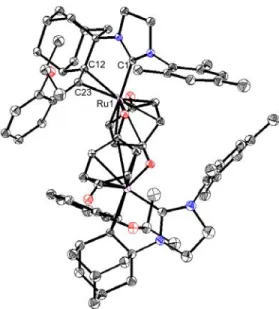
Further evidence for β-hydride elimination playing a role in the decomposition of C–H activated catalysts was uncovered by treating catalyst 5 with p-benzoquinone (Scheme 5).12 Addition of p-benzoquinone to 1.5 in C6D6 led to an immediate color change from purple to red/orange and decomposition of the original complex as evidenced by disappearance of the alkylidene resonance in the 1H NMR spectrum. Crystals of the decomposition structure (1.18) were obtained and analysis by X-ray diffraction revealed the structure to be a ruthenium(0) dimer with 2-bound olefins (Figure 8), a binding mode also observed for complex 1.17, bridged by two benzoquinone ligands.
Scheme 5: Decomposition product 1.18 derived from exposure of 1.5 to excess p-benzoquinone.
Figure 8: X-ray crystal structure of 1.18. Displacement ellipsoids are drawn at 50% probability.
For clarity, hydrogen atoms have been omitted. Selected bond lengths (Å) for 1.18: C1-Ru 2.061, C12-Ru 2.245, C23-Ru 2.168, C12-C23 1.418.
The olefins of the benzoquinone ligands in 1.18 appear to be coordinated primarily in an η4 fashion as demonstrated by the downfield 13C carbonyl resonance (CD2Cl2, δ = 211.5 ppm), the relatively long C-O bond length (1.27 Å), and the boat-like conformation of the benzoquinone ligands.13 Complexes similar to 1.18 have previously been observed for ruthenium and other metals,14 although they are typically formed by simple ligand displacement. This novel structure appears to be the result of alkylidene insertion (as observed for complex 1.15) and subsequent β- hydride elimination (as observed for 1.17), reduction, and dimerization.
We next turned our attention to the synthesis of analogs of catalyst 1.5 with stronger ruthenium-carbon bonds derived from C–H activation of an sp2-hybridized carbon-hydrogen bond,15 and observed a unique decomposition mode seemingly resulting from alkylidene insertion and α-hydride elimination (Scheme 6). Complex 1.19, a species containing hydrogen atoms at the ortho-position of its N-aryl substituents, immediately decomposed upon treatment with t- BuCOOAg, with appearance of pivalic acid and disappearance of the starting material’s
alkylidene proton resonance, as observed by 1H NMR spectroscopy. The resulting decomposition product (1.21) was crystallographically characterized and its structure revealed attachment of the benzylidene carbon to the ortho carbon of the N-aryl group, with retention of the alkylidene moiety (Figure 9).16 Although mass spectrometry data of the initial product mixture suggested formation of 1.20, upon prolonged treatment with a mixture of methylene chloride and pentane, the pivalate ligands were replaced by chlorides derived from the chlorinated solvent to yield 1.21.17 Observation of pivalic acid again suggested that a C–H activation event had occurred, but with subsequent decomposition. Attempted C ̶H activation of various other complexes containing N-aryl groups with unsubstituted ortho-positions resulted in this decomposition mode.
Scheme 6: Decomposition products 1.20 and 1.21 derived from exposure of 1.19 to t-BuCOOAg.
Figure 9: X-ray crystal structure of 1.21. Displacement ellipsoids are drawn at 50% probability.
For clarity, hydrogen atoms have been omitted. Selected bond lengths (Å) for 1.21: C1-Ru 1.913, C10-Ru 1.829, Cl1-Ru 2.340, Cl2-Ru 2.341.
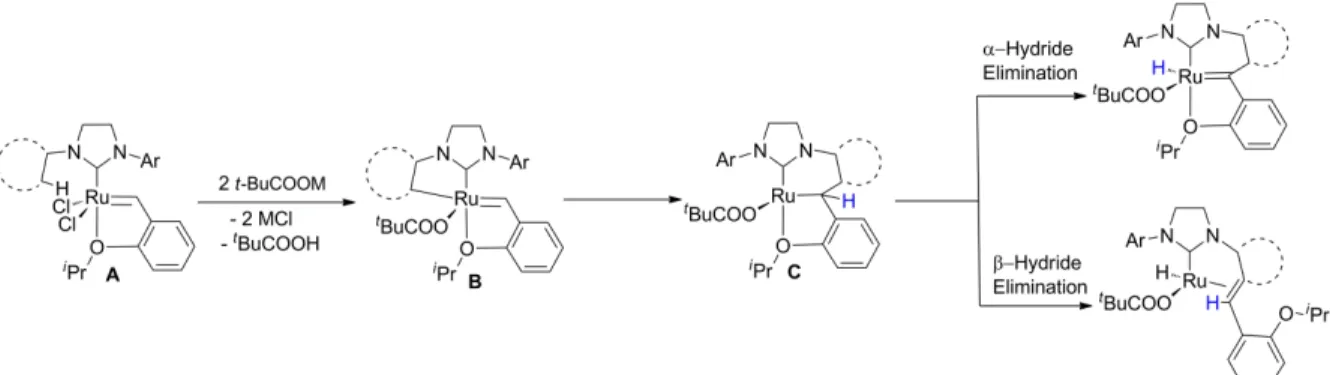
From the complexes presented above, we were able to elucidate a general decomposition mechanism for species related to complex 1.5 (Scheme 7). It is proposed that the unactivated catalysts 1.16 and 1.19, upon treatment with t-BuCOOAg, form chelated architectures with an intact ruthenium alkylidene (B), as observed for catalyst 1.5. However, these C–H activated species react further, as the alkylidene inserts into the newly formed ruthenium-carbon bond to yield alkyl ruthenium intermediate C. The isolated structure of complex 1.15 provides evidence for the in situ formation of this alkyl intermediate. Following insertion, the complex can undergo
– or –hydride elimination to regenerate an alkylidene (as in 1.20 and 1.21) or form an 2- bound olefin complex (as in 1.17 and 1.18), respectively.
Scheme 7: Proposed decomposition pathways for C–H activated ruthenium metathesis catalysts.
In these studies, the hydrides formed rapidly reacted with excess t-BuCOOAg to form the observed dipivalate adducts. The isolation and structural determination of ruthenium hydrides generated from chelated catalysts was highly desired. Accordingly, ruthenium-hydride 1.22 was formed by reaction of iodide-substituted catalyst 6 with silver (I) diethyldithiocarbamate, which
proceeded through alkylidene insertion and β-hydride elimination (Scheme 8). This species could be isolated and purified using column chromatography (SiO2). The solid state structure of hydride 1.22 was determined using X-ray crystallography (Figure 10); this structure is closely related to dipivalate complex 1.17 that resulted from reaction of the corresponding hydride with excess t- BuCOOAg. In the more electron deficient hydride complex 1.22, the isopropoxy group is bound to the Ru center, whereas in the dipivalate complex 1.17 the isopropoxy group is unbound.
Scheme 8: Proposed mechanism of formation of complex 1.22 from 1.6.
Figure 10: X-ray crystal structure of 1.22. Displacement ellipsoids are drawn at 50% probability.
For clarity, hydrogen atoms have been omitted. Selected bond lengths (Å) for 1.22: C1-Ru1:
1.925, C14-Ru1: 2.113, C23-Ru1: 2.092, C14-C23: 1.440.
Over the course of subsequent studies, the decomposition of dipivalate intermediates was investigated. It has been shown that dipivalates are the species that undergo C–H activation;
mono chloride, mono carboxylate adducts have been independently prepared and do not undergo C–H activation even upon heating. As a result, studying the stability of dipivalate intermediates will allow us to better understand the mechanism of C–H activation. When complex 1.23 bearing an N-2-adamantyl group was treated with t-BuCOOAg, ligand exchange to form the corresponding dipivalate complex occurred and was observed by 1H NMR spectroscopy (Scheme 9). A stable chelated complex was formed (vide infra) however another product (1.24) was concurrently formed and characterized by X-ray crystallography (Figure 11). In decomposition product 1.24, the N-mesityl group had lost aromaticity and was converted to a N-1,4- cyclohexadienyl cycle, and ipso-carbon of the former N-mesityl group was bound to an intact alkylidene carbon. Additionally, H2 gas was generated during the reaction. A proposed mechanism for this decomposition route is depicted in Scheme 10. Due to substitution with two bulky pivalate groups, the N-2-adamantyl group could be pushed farther away from the metal center, forcing the N-mesityl group close to the benzylidene. This proximity could enable attack of the electrophilic benzylidene carbon by the C=C bond of the N-mesityl group in a mechanism similar one seen in a Friedel-Crafts reaction. This would lead to a complex where the ipso-carbon of the former N-mesityl group is bound to the former benzylidene carbon. Additionally, the ruthenium center would be anionic and a tertiary carbocation would be formed on the N- substituent. The presence of this carbocation would increase the acidity of the para-methyl group due to resonance stabilization. Deprotonation using excess t-BuCOOAg would thus form a complex with the observed N-1,4-cyclohexadienyl group. A Subsequent α-hydride elimination and protonation of the Ru-H bond by t-BuCOOH would generate the observed product 1.24 and the byproduct H2.
Scheme 9: Formation of decomposition product 1.24 from complex 1.23.
Figure 11: X-ray crystal structure of complex 1.24. Displacement ellipsoids are drawn at 50%
probability. For clarity, hydrogen atoms have been omitted. Selected bond lengths (Å) for 1.24:
C1-Ru: 1.94, C10-Ru: 1.84.
Scheme 10: Proposed decomposition pathway for the formation of complex 1.24.
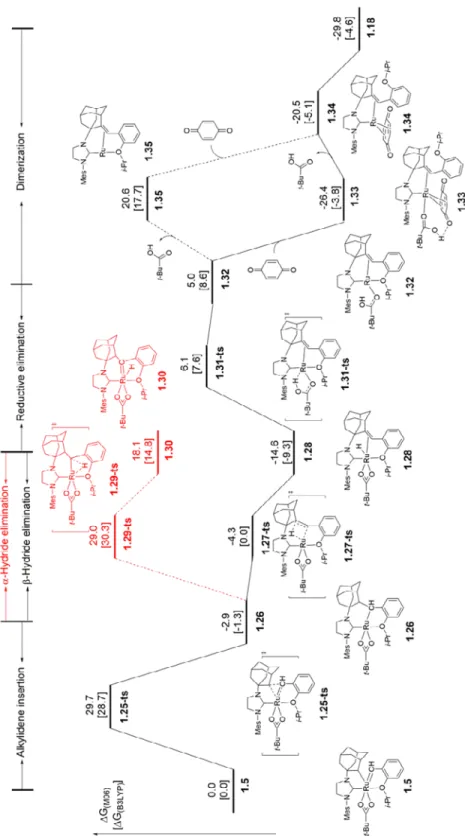
In an effort to probe the proposed decomposition mechanism for NHC-chelated complexes (Scheme 7), DFT calculation were performed on the decomposition modes of C–H activated catalyst 1.5. Both - and -hydride elimination pathways were investigated and the free energy profile is shown in Figure 12. Energies were calculated in the gas phase using M06 and with a mixed basis set of SDD for ruthenium and 6-311+G(d,p) for other atoms; B3LYP energies are also given in Figure 12. Geometries were optimized with B3LYP/LANL2DZ–6-31G(d), and all calculations were performed with Gaussian 09.18 Based on these computational results, the decomposition of NHC-chelated catalysts initiates by alkylidene insertion into the chelating ruthenium-carbon bond as proposed.
Figure 12: The free energy profile of the decomposition pathways for C–H activated ruthenium catalyst 1.5. The values are relative free energies calculated by M06 and B3LYP (in square
brackets) and given in kcal/mol. B3LYP was used in the geometry optimizations.
The decomposition of catalyst 1.5 initiates via insertion of the alkylidene into the ruthenium- carbon (adamantyl) bond (1.25-ts), for which both M06 and B3LYP predicted an activation barrier of ~29 kcal/mol. The alkylidene insertion leads to alkyl ruthenium complex 1.26, a structure similar to proposed intermediate C in Scheme 6. -Hydride elimination from 1.26 is facile (1.27-ts),19 while the activation barrier for -hydride elimination (1.29-ts) is calculated to be 33.3 kcal/mol higher. This β-hydride elimination reaction leads to ruthenium hydride intermediate 1.28 which is 14.6 kcal/mol more stable than catalyst 1.5. These energy differences agree well with previous experimental observations of ruthenium-hydride species by 1H NMR.
The overall exergonicity of the transformation from 1.5 to 1.28 suggests that the alkylidene insertion is irreversible.
The preference for -hydride elimination over -hydride elimination agrees with the observed decomposition product derived from complex 1.17 (Scheme 4). Previous experimental and theoretical studies performed on hydride elimination reactions of ruthenium pincer-type complexes analogous to intermediate C also suggest that when – and –hydrogens are both present, –hydride elimination is energetically favored, however when the molecule lacks –
hydrogens, -hydride elimination occurs.20 This is the case for the alkyl intermediate (C) of complex 6 resulting from C–H activation and alkylidene insertion, as its backbone does not contain β-hydrogens, and thus only –hydride elimination can occur and is therefore observed.
The ruthenium-hydride species (analogs of 1.28 and 1.30) generated from these hydride elimination reactions subsequently react with the excess t-BuCOOAg to generate 1.17 and 1.20, respectively.21
The transformation from 1.28 to the dimeric complex 1.18 was also investigated using DFT and the free energy profile is shown in Figure 12. Reductive elimination of pivalic acid from ruthenium hydride 1.28 forms a ruthenium (0) complex 1.32, which is 19.6 kcal/mol less stable
than complex 1.28.22 Subsequent ligand exchange replaces the pivalic acid with benzoquinone and forms the ruthenium(0) complex 1.34, in which the benzoquinone is
4-coordinated with ruthenium; the benzoquinone binds to the ruthenium much more strongly than pivalic acid. M06 predicted that the ruthenium(0)-benzoquinone complex 1.34 is 25.5 kcal/mol more stable than the ruthenium(0)-pivalic acid complex 1.14, while B3LYP predicted that 1.16 is only 15.7 kcal/mol more stable than 1.32. The energy differences between B3LYP and M06 here are not unexpected, since B3LYP is known to underestimate the binding energy of olefins to ruthenium centers.23 The ligand exchange from 1.32 to 1.34 occurs via an associative pathway involving complex 1.33, as the dissociative ligand exchange pathway would involve generating the unstable 14 electron complex 1.35 and thus is predicted to be less favorable. The electron-deficient C=C bonds in p- benzoquinone bind strongly with the -basic zero-valent ruthenium in complexes 1.33 and 1.34.24 Dimerization of complex 1.34 leads to the crystallographically characterized ruthenium dimer complex 1.18 and this dimerization is exergonic by 9.4 kcal/mol. Addition of benzoquinone facilitates the decomposition of ruthenium hydride 1.28 by stabilizing the ruthenium(0) species that leads to formation of the stable dimeric complex 1.18. The increased decomposition rate with addition of benzoquinone suggests that this additive may also accelerate alkylidene insertion (1.25-ts), however the mechanism of this process is not clear.In conclusion, we have investigated the decomposition of a new class of Z-selective metathesis catalysts with chelating NHC ligands resulting from an initial carboxylate-driven C–H bond insertion. Formation of a stable carbon-ruthenium bond in the presence of an alkylidene seems to be subtly dependent on a variety of steric and electronic factors. A number of decomposition products derived from side reactions of C–H inserted complexes were characterized by X-ray crystallography and from these, decomposition pathways were proposed.
The decomposition of C–H activated catalysts is thought to proceed via insertion of the chelating ruthenium-carbon bond into the alkylidene to yield an alkyl ruthenium intermediate. Due to the
presence of a vacant coordination site, subsequent hydride elimination can occur in these alkyl intermediates to generate a ruthenium hydride, which has been proposed to cause olefin migration of alkene substrates. Density functional theory calculations were performed and support the proposed decomposition pathway of 1.5, which proceeds via insertion of the alkylidene into the chelating ruthenium-carbon bond and subsequent β-hydride elimination, leading to a ruthenium hydride complex.
The decomposition modes presented above are markedly distinct from those observed for previous generations of ruthenium metathesis catalysts. Preventing alkylidene insertion and hydride elimination will be key criteria in future catalyst development. In spite of these decomposition modes, such chelated complexes have proven to be effective catalysts for Z- selective olefin metathesis. Since decomposition can reduce overall catalyst activity and enable undesired side reactions, designing more stable catalysts by understanding catalyst decomposition is essential for highly chemoselective metathesis reactions.
SODIUM PIVALATE METHOD:
Synthesizing new NHC-chelated architectures with differing NHC substituents has proven difficult and mostly results in decomposition after exposure to t-BuCOOAg. The N-1-adamantyl group of 1.5 is unique in that the bond that undergoes C–H activation on the preactivated species (1.4) is quite close to the ruthenium center (2.80 Å). This led to a complex that was seemingly less susceptible to insertion of the ruthenium-carbon bond into the alkylidene and subsequent decomposition. As previously mentioned, retaining this adamantyl group and exchanging the N- mesityl group for an N-2,6-diisopropylphenyl group (1.16) led to mostly decomposition after exposure to t-BuCOOAg (Scheme 4).
The use of t-BuCOOAg to cause the ligand exchange of chlorides for carboxylates was undesired because an excess amount of this reagent was shown to induce the decomposition of
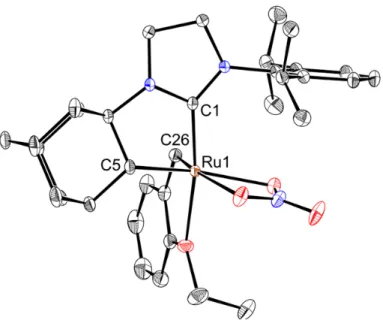
otherwise stable chelated complexes. If this salt metathesis step was slow for a particular catalyst, the C–H activated species would decompose before it could be isolated. We thus sought to find conditions that used a less reactive, cheap metal to cause the ligand exchange. After screening a number of alkali metal derivatives and reaction conditions, it was discovered that exposing the unactivated catalyst 1.4 to sodium pivalate (t-BuCOONa) in a 1:1 mixture of MeOH and THF led to clean formation of the desired chelated catalyst 1.5 after heating at 40 °C overnight.25 Using t- BuCOONa to effect the salt metathesis and C–H activation, complex 1.11 was synthesized in two steps with 60% overall yield; this is in contrast to the analogous route using t-BuCOOAg that proceeded in 48% overall yield. Additionally, sodium acetate could be employed to form acetate- substituted catalyst 1.8 directly from 1.4. In order to show the utility and mildness of this new approach, we sought to synthesis catalyst 1.35 which had decomposed in situ when prepared with t-BuCOOAg. Indeed we were able to cleanly form stable chelated catalyst 1.35 after heating for 6 days at 40 °C (Figures 13 and 14). Catalyst 1.35 has emerged as the most active and Z-selective metathesis catalyst to date, exhibiting up to 7400 turnovers in homodimerization reactions and near perfect Z-selectivity (>98%) in mostly all metathesis reaction attempted.
Figure 13: Highly active and Z-selective ruthenium catalyst 1.35 bearing an N-DIPP group.
Figure 14: X-ray crystal structure of 1.35. Displacement ellipsoids are drawn at 50% probability.
For clarity, hydrogen atoms have been omitted. Selected bond lengths (Å) for 1.35: C1-Ru1: 1.95, C5-Ru1: 2.06, C26-Ru1: 1.85.
DEVELOPMENT OF NEW CHELATES:
Discovery of a milder method for salt metathesis and C–H activation has allowed for the preparation of catalysts with chelating N-substituents different than N-1-adamantyl that were previously not possible. This has allowed insight into how other chelating substituents affect stability and activity of the resulting catalysts. Due to the unpredictable stability of C–H activated architectures, we first sought to screen a number of metathesis catalysts to determine if a stable ruthenium-carbon bond could be formed after a carboxylate-driven C–H bond insertion. A number of ruthenium catalysts were prepared with alternative N-carbocyclic chelating groups, and changes to the NHC ligand. The starting material dichloride catalysts were synthesized through straightforward ligand and catalyst synthesis, and were subsequently tested for their ability to form a stable chelating ruthenium-carbon bond in the presence of an alkylidene, by 1H NMR spectroscopy. Ten equivalents of sodium pivalate (t-BuCOONa) were added to a solution
of each catalyst in a 1:1 mixture of CD3OD and THF-d8. With species that were able to form a stable chelated complex, the starting material was readily converted to a NHC-chelated species with concurrent generation of pivalic acid. Alternatively, with some species, a dicarboxylate complex resulting from salt metathesis of the starting complex was distinctly observed before C–
H activation occurred. If pivalic acid was generated with disappearance of the starting material dichloride complex or the analogous dicarboxylate adduct, with formation of a ruthenium- hydride, the complex was deemed unstable and not relevant for further study. We scaled up the synthesis of complexes observed to form a stable chelated architecture using previously described methods.
Ruthenium dichloride complex 1.36, bearing an N-bornyl group,26 and complex 1.38, bearing an N-2-adamantyl group, were prepared and treated with t-BuCOONa. Formation of the desired five-membered chelates derived from a carboxylate-assisted C–H activation of the corresponding N-carbocycle group was monitored by 1H NMR spectroscopy. For both 1.36 and 1.38, the dipivalate intermediates were initially observed followed by clean formation of the desired chelated products 1.37 and 1.39, respectively (Schemes 11 and 12); the assumed connectivity is depicted below, but has yet to be confirmed by NMR spectroscopy and X-ray crystallography analysis. Complex 1.37 bears a chiral chelating N-bornyl group and thus could find utility in enantioselective metathesis reactions. Both 1.37 and 1.39, however, have yet to be evaluated in metathesis reactions.
Scheme 11: Synthesis of N-bornyl activated complex 1.37.
Scheme 12: Synthesis of N-2-adamantyl activated complex 1.39.
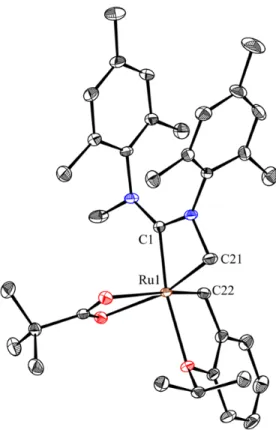
Previously reported complex 1.40, bearing an acyclic diamino carbene, was treated with t-BuCOONa with the expectation that the N-mesityl group would be activated to form a six- membered chelating architecture.27 However, the N-methyl group was alternatively activated and a four-membered chelate was formed (1.41) (Scheme 13); this marked the first time a four- membered chelate had been observed with these types of ruthenium alkylidene complexes and this unique structure was verified by X-ray crystallographic analysis (Figure 15). In the crystal structure of the unactivated complex 1.40, the distance between the methyl group that is activated and the Ru center is quite short (2.83 Å) which helps explain why a four-membered chelate would form as opposed to a six-membered chelate. The stability of this chelated complex is seemingly due to the flexibility of the acyclic diamino carbene. Complex 1.41 was evaluated in olefin homodimerization reactions, but was not active even upon heating. It was able to react with norbornene in a ring-opening metathesis polymerization (ROMP) reaction, however the yield was low.
Scheme 13: Synthesis of complex 1.41 bearing a four-membered chelate.
Figure 15: X-ray crystal structure of 1.41. Displacement ellipsoids are drawn at 50% probability.
For clarity, hydrogen atoms have been omitted. Selected bond lengths (Å) for 1.41: C1-Ru1: 1.96, C21-Ru1: 2.07, C22-Ru1: 1.85.
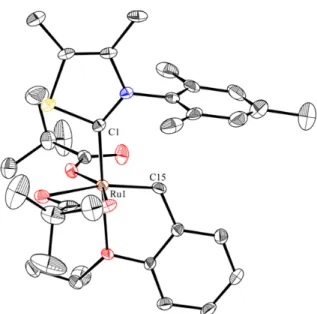
During our investigations into developing new chelating groups, we were able to isolate stable pivalate intermediates that unexpectedly did not undergo C–H activation. Studying these types of intermediates could provide important insight into the mechanism of carboxylate-assisted C–H activation and why certain groups cannot be activated. Previously reported complex 1.42 was treated with t-BuCOONa in hopes that a six-membered chelating architecture would be generated (Scheme 14).28 However, the corresponding dipivalate-substituted complex 1.43 was formed according to 1H NMR spectroscopy. A crystal structure of complex 1.43 was obtained and provided insight into why this complex did not undergo C–H activation (Figure 16). In the structure of the starting complex 1.42, the N-mesityl group resides over the chloride X-type
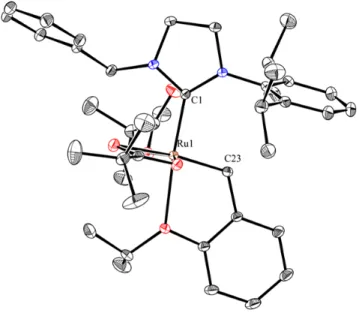
ligands. In the structure of 1.43, however, the NHC has rotated and the N-mesityl group resides over the ruthenium alkylidene, most likely due to the increased steric bulk of the pivalate X-type ligands. As a result, the ortho-methyl group of the N-mesityl group is too far from the pivalate ligands to undergo a carboxylate-assisted activation. Similarly, when activation was attempted on complex 1.44, bearing an N-benzyl group, a dipivalate-substituted complex was formed (Scheme 15). The product was crystallographically characterized and revealed that the N-benzyl group was located too far from the pivalate ligands to readily undergo C–H activation (Figure 17). It seems that adding a methylene linker to an N-substituent gives the group added flexibility, allowing it to rotate away from the bulky pivalates and avoid C–H activation. The information gained from isolation and characterization of dipivalate-substituted complexes 1.43 and 1.45 will be important for the future design of chelated alkylidene complexes for Z-selective olefin metathesis transformations.
Scheme 14: Formation of stable dipivalate-substituted complex 1.43.
Figure 16: X-ray crystal structure of 1.43. Displacement ellipsoids are drawn at 50% probability.
For clarity, hydrogen atoms have been omitted. Selected bond lengths (Å) for 1.43: C1-Ru1: 1.97, C15-Ru1: 1.84.
Scheme 15: Formation of stable dipivalate-substituted complex 1.45.
Figure 17: X-ray crystal structure of 1.45. Displacement ellipsoids are drawn at 50% probability.
For clarity, hydrogen atoms have been omitted. Selected bond lengths (Å) for 1.45: C1-Ru1: 1.97, C23-Ru1: 1.84.
CONCLUSIONS:
The serendipitous discovery that NHC chelated ruthenium alkylidene complexes could be stably formed and exhibited high Z-selectivity in olefin metathesis reactions has enabled the development of ever more active and selective catalysts. In order to design catalysts with more stable chelating architectures, the decomposition of chelated catalysts was investigated using experimental and theoretical techniques. It was found that decomposition proceeds via irreversible insertion of the alkylidene into the chelating ruthenium carbon bond to generate a ruthenium alkyl intermediate that contains an open coordination site. Depending on the presence or absence of a β-proton, either an α- or β-hydride elimination can occur to generate the corresponding hydrides; it was found that β-hydride elimination is energetically more favorable.
These decomposition modes were elucidated by the isolation and crystallographic characterization of a number of decomposition products, including a ruthenium hydride. Results
also suggested that the silver (I) reagents used to effect the salt metathesis and C-H activation were enabling the decomposition modes outlined above and thus a more mild method, using sodium carboxylates, was developed.
This method has allowed a large number of new and improved catalysts to be accessed for the first time. Notably, a catalyst (1.35) was discovered that exhibited near perfect Z- selectivity (>98%) in a variety of olefin metathesis reactions and with high activity (up to 7400 turnovers). More recently, the synthesis of catalysts with new chelating architectures has been achieved. For example, different carbocyclic groups, including N-bornyl (1.37) and N-2- adamantyl (1.39), have shown to undergo clean C-H activation to form new five-membered chelating catalysts. Additionally, the methyl group of an acyclic diamino carbene has been shown to undergo C-H activation to form a four-membered chelating architecture (1.41), which had previously not been observed. The studies into the stability and decomposition of NHC-chelated ruthenium alkylidene catalysts presented here have enabled the discovery of highly active catalysts that are now capable of producing Z-internal olefins with only trace amounts of the undesired E-isomer.
References and Notes:
1. Teo, P.; Grubbs, R. H. Organometallics 2010, 29, 6405.
2. Occhipinti, G.; Hansen, F. R.; Tornroos, K. W.; Jensen, V. R. J. Am. Chem. Soc. 2013, 135, 3331.
3. Endo, K.; Grubbs, R. H. J. Am. Chem. Soc. 2011, 133, 8525.
4. Endo, K.; Herbert, M. B.; Grubbs, R. H. Organometallics 2013, 32, 5128.
5. Keitz, B. K.; Endo, K.; Patel, P. R.; Herbert, M. B.; Grubbs, R. H. J. Am. Chem. Soc. 2012, 134, 693.
6. (a) Davies, D. L.; Donald, S. M. A.; Macgregor, S. A. J. Am. Chem. Soc. 2005, 127, 13754. (b) Davies, D. L.; Donald, S. M. A.; Al-Duaij, O.; Macgregor, S. A.; Pölleth, M. J. Am. Chem. Soc.
2006, 128, 4210. (c) Ess, D. H.; Bischof, S. M.; Oxgaard, J.; Periana, R. A.; Goddard, W. A.
Organometallics 2008, 27, 6440. (d) Boutadla, Y.; Davies, D. L. Macgregor, S. A.; Polador-
Bahamonde, A. I. Dalton Trans. 2009, 5820. (e) Tsurugi, H.; Fujita, S.; Choi, G.; Yamagata, T.;
Ito, S.; Miyasaka, H.; Mashima, K. Organometallics 2010, 29, 4120.
7. (a) Hong, S. H.; Chlenov, A.; Day, M. W.; Grubbs, R. H. Angew. Chem. Int. Ed. 2007, 46, 5148. (b) Hong, S. H.; Day, M. W.; Grubbs, R. H. J. Am. Chem. Soc. 2004, 126, 7414. (c) Hong, S. H.; Wenzel, A. G.; Salguero, T. T.; Day, M. W.; Grubbs, R. H. J. Am. Chem. Soc. 2007, 129, 7961. (d) Vehlow, K.; Gessler, S.; Blechert, S. Angew. Chem. Int. Ed. 2007, 46, 8082. (e) Leitao, E. M.; Dubberley, S. R.; Piers, W. E.; Wu, Q.; McDonald, R. Chem. Eur. J. 2008, 14, 11565. (f) Poater, A.; Cavallo, L.; J. Mol. Cata. A: Chem. 2010. 324, 75. (g) Poater, A.; Ragone, F.; Correa, A.; Cavallo, L. J. Am. Chem. Soc. 2009, 131, 9000. (h) Mathew, J.; Koga, N.; Suresh, C. H.
Organometallics 2008, 27, 4666. (i) Rensburg, W. J.; Steynberg, P. J.; Meyer, W. H.; Kirk, M.
M.; Forman, G. S. J. Am. Chem. Soc. 2004, 126, 14332.
8. (a) Chung, C. K.; Grubbs, R. H. Org. Lett. 2008, 10, 2693. (b) Kuhn, K. M.; Bourg, J.; Chung, C. K.; Virgil, S. C.; Grubbs, R. H. J. Am. Chem. Soc. 2009, 131, 5313. (c) Ragone, F.; Poater, A.;
Cavallo, L. J. Am. Chem. Soc. 2010, 132, 4249. (d) Poater, A.; Bahri-Laleh, N.; Cavallo, L.
Chem. Commun. 2011, 47. 6674.
9. (a) Courchay, F. C.; Sworen, J. C.; Ghiviriga, I.; Abboud, K. A.; Wagener, K. B.
Organometallics 2006, 25, 6074. (b) Schmidt, B. Eur. J. Org. Chem. 2004, 9, 1865. (c) Camm, K.
D.; Castro, N. M.; Liu, W.; Czechura, P.; Snelgrove, J. L.; Fogg, D. E. J. Am. Chem. Soc. 2007, 129, 4168.
10. For a discussion of CO induced insertion reactions of ruthenium alkylidenes see: Weng, W.;
Parkin, S.; Ozerov, O.V. Organometallics 2006, 25, 5345.
11. Research on previous generations of ruthenium metathesis catalysts has revealed that increasing the steric bulk of an N-aryl groups can lead to increased activity and stability: (a) Dinger, M. B.; Mol, J. C. Adv. Synth. Catal. 2002, 344, 671. (b) Ritter, T.; Hejl, A.; Wenzel, A.
G.; Funk, T. W.; Grubbs, R. H. Organometallics 2006, 25, 5740. (c) Fürstner, A.; Ackermann, L.;
Gabor, B.; Goddard, R.; Lehmann, C. W.; Mynott, R.; Stelzer, F.; Thiel, O. R. Chem. Eur. J.
2001, 7, 3236.
12. p-Benzoquinone is an additive shown to prevent olefin migration. For a reference, see Hong, S.
H.; Sanders, D. P.; Lee, C. W.; Grubbs, R. H. J. Am. Chem. Soc. 2005, 127, 17160.
13. (a) Takao, T.; Akiyoshi, K.; Suzuki, H. Organometallics 2008, 4199-4206. (b) Ura, Y.; Sato, Y.; Shiotsuki, M.; Suzuki, T.; Wada, K.; Kondo, T.; Mitsudo, T.-aki Organometallics 2003, 22, 77-82. (c) Barral, M. C.; González-Prieto, R.; Jiménez-Aparicio, R.; Priego, J. L.; Torres, M. R.;
Urbanos, F. a Inorganica Chimica Acta. 2005, 358, 217-221. (d) Kumbhakar, D.; Sarkar, B.;
Maji, S.; Mobin, S. M.; Fiedler, J.; Urbanos, F. a; Jiménez-Aparicio, R.; Kaim, W.; Lahiri, G. K.
J. Am. Chem. Soc. 2008, 130, 17575-83.
14. (a) Moussa, J.; Amouri, H. Angew. Chem. Int. Ed. 2008, 47, 1372-80. (b) Moussa, J.; Guyard- Duhayon, C.; Herson, P.; Amouri, H.; Rager, M. N.; Jutand, A. Organometallics 2004, 23, 6231- 6238.
15. Siegbahn, E. M. J. Phys. Chem. 1995, 99, 12723.
16. A structurally similar decomposition product has been reported for catalysts containing N- phenyl groups, wherein decomposition was thought to proceed through pericyclic cyclization and
oxidation by O2 (See reference 7d). This postulated mechanism of decomposition does not account for any carboxylate-driven C-H activation events and cannot proceed in an O2-free environment, thus we expected a different decomposition mechanism.
17. Reactions of methylene chloride with ruthenium complexes to produce metal chloride bonds has been reported: (a) Oliván, M.; Caulton. K. G. Inorg. Chem. 1999, 38, 566. (b) Prechtl, M. H.
G.; Ben-David, Y.; Giunta, D.; Busch, S.; Taniguchi, Y.; Wisniewski, W.; Görls, H.; Mynott, R.
J.; Theyssen, N.; Milstein, D.; Leitner, W. Chem. Eur. J. 2007, 13, 1539.
18. Gaussian 09, Revision B.01, Frisch, M. J.; Trucks, G. W.; Schlegel, H. B.; Scuseria, G. E.;
Robb, M. A.; Cheeseman, J. R.; Scalmani, G.; Barone, V.; Mennucci, B.; Petersson, G. A.;
Nakatsuji, H.; Caricato, M.; Li, X.; Hratchian, H. P.; Izmaylov, A. F.; Bloino, J.; Zheng, G.;
Sonnenberg, J. L.; Hada, M.; Ehara, M.; Toyota, K.; Fukuda, R.; Hasegawa, J.; Ishida, M.;
Nakajima, T.; Honda, Y.; Kitao, O.; Nakai, H.; Vreven, T.; Montgomery, Jr., J. A.; Peralta, J. E.;
Ogliaro, F.; Bearpark, M.; Heyd, J. J.; Brothers, E.; Kudin, K. N.; Staroverov, V. N.; Kobayashi, R.; Normand, J.; Raghavachari, K.; Rendell, A.; Burant, J. C.; Iyengar, S. S.; Tomasi, J.; Cossi, M.; Rega, N.; Millam, N. J.; Klene, M.; Knox, J. E.; Cross, J. B.; Bakken, V.; Adamo, C.;
Jaramillo, J.; Gomperts, R.; Stratmann, R. E.; Yazyev, O.; Austin, A. J.; Cammi, R.; Pomelli, C.;
Ochterski, J. W.; Martin, R. L.; Morokuma, K.; Zakrzewski, V. G.; Voth, G. A.; Salvador, P.;
Dannenberg, J. J.; Dapprich, S.; Daniels, A. D.; Farkas, Ö.; Foresman, J. B.; Ortiz, J. V.;
Cioslowski, J.; Fox, D. J. Gaussian, Inc., Wallingford CT, 2010.
19. Both B3LYP and M06 predicted very low barriers for -hydride elimination. B3LYP predicted the barrier from 1.26 to 1.27-ts to be 1.3 kcal/mol. M06 single point calculations with B3LYP geometries resulted in a small negative barrier, due to the different locations of saddle point on M06 and B3LYP surfaces (Figure 12).
20. (a) Kuznetsov, V. F.; Abdur-Rashid, K.; Lough, A. J.; Gusev, D. G. J. Am. Chem. Soc. 2006, 128, 14388. (b) Leis, W.; Mayer, H. A.; Kaska, W. C. Coordin. Chem. Rev. 2008, 252, 1787.
21. It is proposed that these ruthenium hydrides react with t-BuCOOAg to produce an ill-defined mixture of silver (I) hydrides. All attempts to observe such species by 1H NMR were unsuccessful due to insolubility of the resulting gray precipitate in deuterated solvents.
22. Pivalic acid generation is observed by 1H NMR spectroscopy after the addition of p- benzoquinone to complex 1.5.
23. (a) Kulkarni, A. D.; Truhlar, D. G. J. Chem. Theory Comput. 2011, 7, 2325. (b) Handzlik, J.;
Sliwa, P. Chem. Phys. Lett. 2010, 493, 273. (c) Torker, S.; Merki, D.; Chen, P. J. Am. Chem. Soc.
2008, 130, 4808. (d) Zhao, Y.; Truhlar, D. G. Org. Lett. 2007, 9, 1967.
24. Johnson, J. B.; Rovis, T. Angew. Chem., Int. Ed. 2008, 47, 840.
25. Rosebrugh, L. E.; Marx, V. M.; Keitz, B. K.; Grubbs, R. H. J. Am. Chem. Soc. 2013, 135, 10032.
26. Thomas, R. M.; Keitz, B. K.; Champagne, T. M.; Grubbs, R. H. J. Am. Chem. Soc. 2011, 133, 7490.
27. Rosen, E. L.; Sung, D. H.; Chen, Z.; Lynch, V. M.; Bielawski, C. W. Organometallics 2010, 29, 250.
28. Vougioukalakis, G. C.; Grubbs, R. H. J. Am. Chem. Soc. 2008, 130, 2234.
29. Paczal, A.; Bnyei, A. C.; Kotschy, A. J. Org. Chem. 2006, 71, 5969.
Experimental Section:
General Information
All reactions were carried out in dry glassware under an argon atmosphere using standard Schlenk techniques or in a Vacuum Atmospheres Glovebox under a nitrogen atmosphere unless otherwise specified. All solvents were purified by passage through solvent purification columns and further degassed by bubbling argon. Hexane was dried over CaH2 and distilled into a dry Schlenk flask and subsequently degassed with argon. NMR solvents were dried over CaH2 and vacuum transferred to a dry Schlenk flask and subsequently degassed with bubbling argon. C6D6 was purified by passage through a solvent purification column. CDCl3 was used as received.
Potassium t-amyloxide was purchased as a toluene solution and concentrated before use.
Dichloro(o-isopropoxyphenylmethylene) (tricyclohexylphosphine) ruthenium was obtained from Materia, Inc. 1.1,2-chloro-N-2,6-diisopropylphenylacetamide,29 1.36,26 1.40,27 and 1.4228 were synthesized according to previous reports. Other commercially available reagents and silica gel were used as received.
1H and 13C NMR spectra were recorded on a Varian 600 MHz spectrometer, Varian 500 MHz spectrometer, or a Varian 400 MHz spectrometer. High-resolution mass spectra were provided by the California Institute of Technology Mass Spectrometry Facility using a JEOL JMS-600H High Resolution Mass Spectrometer. X-ray crystallographic data was collected by the California Institute of Technology Beckman Institute X-ray Crystallographic Facility using Bruker KAPPA APEXII X-ray diffractometer.
Synthesis of 1.15: In a glovebox, a Schlenk flask was charged with 1.5 (26 mg, 0.039 mmol) and THF (1 mL). The reaction was removed from the glovebox, attached to a vacuum manifold, and cooled to –78 °C in a CO2/acetone bath. The flask was evacuated and ca. 1 atm of CO was added through the vacuum manifold and the reaction was allowed to stir for 15 min at ̶ 78 °C under a continuous stream of CO. During this time, the color of the solution changed from purple to light gray. After the elapsed time, the reaction was concentrated and placed back in the glovebox where it was dissolved in C6H6, transferred to a 20 mL vial, and concentrated a second time to give 1.15 as a yellow solid (28 mg, 93%). Crystals suitable for X-ray diffraction were grown from slow diffusion of pentane into a saturated toluene solution. 1H NMR (400 MHz, C6D6) δ 7.66 (d, J = 7.6 Hz, 1H), 6.99 (t, J = 7.5 Hz, 1H), 6.91 (dt, J = 7.2, 1.8 Hz, 1H), 6.72 (s, 1H), 6.70 – 6.60 (m, 2H), 4.41 (sept, J = 6.1 Hz, 1H), 4.15 (d, J = 11.8 Hz, 1H), 3.83 (d, J = 12.4 Hz, 1H), 3.18 – 3.04 (m, 1H), 3.03 – 2.86 (m, 2H), 2.83 – 2.71 (m, 1H), 2.69 – 2.59 (m, 1H), 2.32 – 2.23 (m, 1H), 2.12 (s, 2H), 2.05 (s, 6H), 1.99 (br s, 3H), 1.92 – 1.83 (m, 2H), 1.79 – 1.71 (m, 1H), 1.70 – 1.64 (m, 1H), 1.62 (s, 9H), 1.58 – 1.50 (m, 2H), 1.48 – 1.44 (m, 1H), 1.31 (d, J = 6.0 Hz, 3H), 1.29 (d, J = 6.0 Hz, 3H). 13C NMR (101 MHz, C6D6) δ 201.38, 199.70, 188.49, 184.68, 182.09, 150.91, 147.97, 139.48, 138.44, 138.38, 136.02, 123.27, 120.53, 111.37, 67.98, 67.84, 61.76, 49.42, 45.60, 44.92, 44.40, 38.36, 37.21, 36.32, 31.57, 30.40, 30.26, 30.08, 29.65, 25.84, 22.52, 21.97, 21.02, 18.34, 17.98, 17.67. HRMS (FAB+): M – (-O-(CH)(CH3)2) Calculated – 700.2451, Found – 700.2458.
Synthesis of 1.47: 1.46 (2.90 g, 11.43 mmol), 1-adamantylamine (3.46 g, 22.9 mmol), and anhydrous potassium carbonate (3.17 g, 22.9 mmol) were added to a 250 mL round bottom flask with MeCN (120 mL) and heated to reflux for 28 h. After cooling to room temperature, the solution was filtered and concentrated in vacuo. The crude mixture was chromatographed through silica gel with a mobile phase of CH2Cl2 and THF (4:1). The solvent was removed in vacuo and 1.47 was obtained as a white solid (7.02 g, 61%). 1H NMR (500 MHz, CDCl3) δ 9.07 (s, 1H), 7.19 - 7.29 (m, 1H), 7.19 (d, J = 7.7 Hz, 2H), 3.46 (s, 2H), 3.04 (sept, J = 6.9 Hz, 2H), 2.13 (s, 3H), 1.70 (dd, J = 15.3, 7.5 Hz, 9H), 1.63 (d, J = 11.7 Hz, 3H), 1.22 (d, J = 6.9 Hz, 12H). 13C NMR (126 MHz, CDCl3) δ 172.56, 145.92, 131.78, 128.14, 123.63, 51.33, 44.31, 43.14, 36.74, 29.71, 29.09, 23.84. HRMS (FAB+): Calculated – 369.2906 Found – 369.2893.
Synthesis of 1.48: 1.47 (2.47 g, 6.69 mmol) was added to a 100 mL three-necked round bottom flask containing THF (60 mL). Lithium aluminum hydride (2.10 g, 55.3 mmol) was added slowly and the mixture was refluxed for 16 h. The flask was cooled to 0 °C in an ice bath. Water (1.5 mL), a 2N NaOH solution (3 mL), and water (3 mL) were added sequentially. Et2O (30 mL) and water (30 mL) were added and the solution was allowed to stir for 1 h at room temperature. The mixture was poured into a separatory funnel, the organic phase was collected and the aqueous phase was extracted with Et2O (2 x 30 mL). The organic phases were combined and washed with
water (3 x 30 mL), a saturated sodium chloride solution (1 x 30 mL), and dried over anhydrous MgSO4. The solvent was removed in vacuo to yield 1.48 as a yellow solid (2.00 g, 84%). 1H NMR (500 MHz, CDCl3) δ 7.12 - 7.02 (m, 3H), 3.38 (sept, J = 6.8 Hz, 2H), 2.97 (dd, J = 6.6, 4.8 Hz, 2H), 2.88 (dd, J = 6.6, 4.7 Hz, 2H), 2.11 (s, 3H), 1.75-1.62 (m, 12H), 1.27 (d, J = 6.9 Hz, 12H). 13C NMR (126 MHz, CDCl3) δ 144.08, 142.27, 123.53, 123.38, 52.74, 50.35, 43.24, 40.78, 36.94, 29.76, 27.69, 24.36. HRMS (FAB+): Calculated – 355.3113 Found – 355.3104.
Synthesis of 1.49: 1.48 (1.47 g, 4.13 mmol) was added to a 25 mL three-necked flask with NH4BF4 (467 mg, 4.54 mmol) and trimethylorthoformate (15 mL). The suspension was refluxed for 2 h and the solvent was evaporated. The crude product was washed with a mixture of toluene and isobutanol (1:1), then hexane. After drying under high vacuum, 1.49 was obtained as a white solid (759 mg, 41%). 1H NMR (500 MHz, CDCl3) δ 7.86 (s, 1H), 7.40 (t, J = 7.8 Hz, 1H), 7.21 (d, J = 7.8 Hz, 2H), 4.34 (dd, J = 12.8, 9.4 Hz, 2H), 4.23-4.17 (m, 2H), 2.86 (sept, J = 6.8 Hz, 2H), 2.22 (s, 3H), 2.01 (d, J = 3.2 Hz, 6H), 1.71 (t, J = 3.1 Hz, 6H), 1.24 (dd, J = 25.4, 6.8 Hz, 12H). 13C NMR (126 MHz, CDCl3) δ 155.05, 146.82, 13